
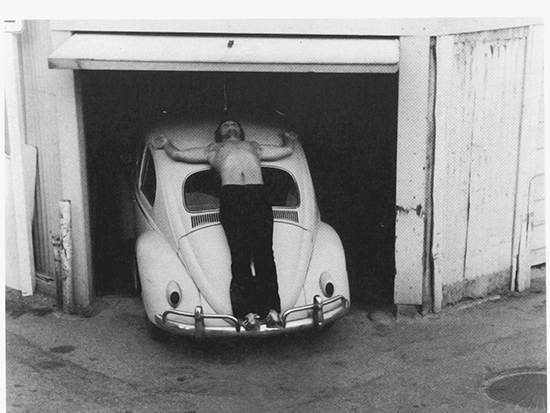
Chris Burden, Trans-fixed (1974) (© Chris Burden; courtesy Gagosian Gallery)
{ 23 }
The morning mist lingered around the seaside town of Venice, California, on April 28, 1974. On the quiet, sleepy street inaptly named Speedway Avenue, strange doings were afoot. Twenty-eight-year-old artist Chris Burden was already infamous for his piece Shoot. In it he had had himself shot in the arm—for art, for experience, for who knows what reason. Since then he had been buzzing with ideas and carrying them out in performances, ranging from nearly being electrocuted, to locking himself in a small locker for five days, to writhing across a floor strewn with broken glass, to name only a few. Today he had something else in mind.
Burden was joined by only a handful of others, including his lawyer, in the shabby, peeling-paint garage. At the appointed moment, Burden, clad in dark jeans, white T-shirt, and sneakers, backed up to a blue Volkswagen Beetle, brought himself up on the bumper, and leaned against the sloping backside of the car. He then lifted his hands up so that his attorney could drive two nails through the palms of his hands and into the car roof. The VW engine revved up—a sound that Burden later described as a loud whistle. His pals then rolled the car into the middle of the street. The engine had whirred loudly for two minutes, as if screaming in lieu of Burden’s silence. The performance piece ended when the car was pushed back into the garage and the nails removed, freeing him from the Volkswagen. The audience for the piece was confined to his co-conspirators and a handful of local residents gawking from their windows. Artifacts from the performance were a photograph of Burden stoically impaled upon the car and the two nails, which would later be exhibited with a plaque. “Physically, it was no big deal,” he later stated; all that remained was “a little scar, a little black thing” on each of his palms, the stigmata of Burden’s excess. The hardest part, he admitted, had been the anticipation.
The piece was laden with religious symbolism. Despite such heaviness, the performance managed to resist interpretive closure. Although Burden was not Catholic, he had lived in Italy and been surrounded by images of Jesus on the Cross. “I’ve thought,” Burden later revealed, “about being crucified lots of times.” Certainly the piece could be read as a mea culpa from Burden, ironically atoning for earlier outrages against his body and establishment art. Maybe it was a wry commentary, too, on postwar America’s willingness to forget the intimate connection between the “people’s car” (Volkswagen) and the atrocities of Nazi Germany (during the Second World War, the car was partly built by slave labor). Was it, art historians asked, a sort of shamanistic performance, or simply an act of male power and ego?1 Or perhaps it was just another opportunity for young Mr. Burden to offend the sensibilities of almost everyone by abusing his body and living up to his reputation as the bad boy of the art world.2 In an understatement, one art historian remarked, “Burden has made an entire career of defining the edge.” And, no doubt, of transgressing it. The pleasure, to his mind, came from “redefining art.”3
Whatever his motivations, Chris Burden’s performances in the early 1970s were exemplary of the New Sensibility. The distance from Cage’s 4’33” to Burden’s performance pieces is minimal, of degree more than kind. If Cage wanted to open the audience up to sounds heretofore unheard, Burden tried to open them up to the pain of everyday life. Cage and Sontag were fascinated with the power of boredom to create new possibilities. So, too, was Burden, as he slept in a bed for twenty-two days without rising, or as he hunched in a locker for five days. His projects, too, might be read as demolishing the lines—ethical and otherwise—between performer and audience, an enterprise that harkened back to the Living Theatre. He was, in effect, restructuring the public sphere for both artist and audience.4
Like Mailer, Burden’s outrageousness was played out in macho fashion on the public stage. Parts of Burden’s “body text” could have been borrowed verbatim from Sontag’s musings on performance and the potential payoff of boredom, while he shared Wolfe’s fascination with media and car culture. No less than Warhol, Burden was about the presentation of self, sometimes on a cross, sometimes masked, but always with an eye toward maximum shock. Indeed, Burden purchased time on television to run advertisements. One of them flashed his name and the title of the artwork, then showed a few seconds of him from the piece as he moved snail-like in agony across a glass-strewn gallery floor. In another, he pronounced the names of great artists, Leonardo Da Vinci, Michelangelo, and Vincent Van Gogh, among others. The piece concluded with the utterance of the name Chris Burden—and the information that the spot had been paid for by Chris Burden.
Burden was the New Sensibility in extremis. He was a harbinger of the orchestrated violence and outrageousness of the punk sensibility that was beginning to emerge during these years. On occasion, Burden referred to himself as the “Lou Reed of the art world.”5 But all of his shenanigans, even the most outrageous, were done for the oldest of reasons, a desire to respond to a set of artistic and personal imperatives. As he admitted, “I wanted to be taken seriously as an artist.”6 Shoot, he reiterated, was not designed to “get publicity” but to be a “real important” work of art.7
Born in Cambridge, Massachusetts, Burden led a peripatetic early existence, his family following his engineer father to live in France and Italy. Coming back to the United States, Burden attended Pomona College and later received an MFA from the University of California, Irvine. He shared his father’s scientific bent; in many ways he was a tinkerer in the Cage mode. He was also early on a fan of Duchamp’s ironic art. Drawn to art, architecture, and literature, Burden at one point wanted to be a sculptor: “I really liked making things.”8
He began his career in the minimalist mode, associated with Donald Judd, Robert Irwin, and Robert Morris. This movement was in part designed to challenge the angst surrounding abstract expressionist process, with its heroic gestures. Instead, minimalism dealt with bare essences, surface beauty in sculpture, with no importance attached to the process of production (often much of the work was farmed out to freelance fabricators). There would always be a minimalist aspect to Burden’s work, except in his case the object of the art was his own body: “I am the sculpture.”9 He always maintained that he followed the injunction of Judd to make his work “interesting.” He wanted to “pare it down to something essential,” to make his work about the purity—and limits—of experience.10
As with Cage, an element of chance, of the unexpected, was always present. “I do things to find out what’ll happen,” he announced.11 The element of risk, the potential of dying for one’s art, added a titillation of danger and an air of absurdity to Burden’s work. As one gallery director put it, “We hoped he would show up and do something dreadful to himself.”12
The advantages of working with the body were varied. In terms of the more recent history of body art in the 1960s, as historian Sally Banes and others have demonstrated, it defied the power of the art business and high-blown notions of the art object. After all, like a happening, what occurred to the body of the artist during the performance could not easily be assigned a cash value; it could not be owned and sold. It was also, generally, a one-time event, experienced directly (although it could be documented to varying degrees). And it was, in effect, a final blow against the reign of the traditional art object, the ideal of a permanent piece of work, forever fixed in reality. Body art or performance art gave truth to the concerns of many about “the anxiety of the object” or the dematerialization of the artwork. Performance art demanded a new language of analysis and a different sensibility on the part of both artist and audience. Burden was aware of this, hence his desire to push his work—and his body—to extremes.13
Performance art boomed in the 1970s. Most of the pieces offered strong political commentary. Feminists employed performance art to undermine the male gaze and objectification of women’s bodies and to support abortion rights. In one particularly controversial piece from 1974, Lynda Benglis paid three thousand dollars to have an ad placed in the avant-garde magazine Artforum. The image provoked outrage and delight, as it pictured a nude Benglis (although she did wear sunglasses) holding a massive dildo that reached out from her pubic region. It probably was about women’s subordinate position in the arts and the macho flavor of some artwork (Burden’s perhaps included).14
Burden was part of this flowering, but his work avoided direct political commentary. For his MFA project at UC Irvine, Burden devised a fascinating piece. A row of lockers, stacked three high, lined a hallway wall at the university. Locker number five was to be Burden’s home for five days. What he liked about the locker space was that it existed prior to the piece; there was nothing to be built. “I didn’t know what it was going to feel like,” Burden stated; “that’s why I did it.” The top locker—“home”—was fitted with “five gallons of bottled water” that Burden could access. The locker below had a five-gallon bottle for his urine; Burden had fasted for a number of days before beginning the piece. At the appointed hour, he scrunched himself into the tiny middle locker (two feet high, two feet wide, and three feet deep). Folks passed by the locker, sometimes talking with Burden (as if to a confessor figure, he imagined) through the air holes. The only “relic” from the performance (besides a picture of the locker) was the lock that had secured Burden in the space.15
Other pieces worked in a similar manner. His Bed Piece, from 1972, found him spending twenty-two days in bed. In contrast to John Lennon and Yoko Ono, who had stayed in bed comfortably while entertaining guests, making love, and sipping champagne, Burden did nothing other than exist. The bed was set up in a Venice Beach gallery. Burden disrobed and climbed into the Spartan bed, with white sheets and pillow case. He remained silent for the entirety of the performance. Visitors to the gallery approached the bed warily, rarely coming closer than fifteen feet. Burden felt their presence, claiming, “In their minds I had become an object … a repulsive magnet.”16 The challenge was that Burden was a live object. Gallery director Josh Young had been surprised when Burden’s wife told him that complete responsibility for Burden’s survival now rested with the director and gallery. Burden planned nothing more than to stay in bed.17
In his performance pieces Burden liked to make demands on himself and upon the audience. Shoot (1971) was less about endurance than about immediacy and presence of experience. But, as with almost all of his pieces, it was also about passivity—on the part of both the artist and the audience. He called the event an “action,” an homage of sorts to the work that Otto Mühl and others in the hard-core actionist movement of the early 1960s. They had created orgies of blood art. Nor was the notion of gunplay absent from performance art prior to Burden. In 1970, at the Museum of Conceptual Art in San Francisco, Mel Henderson had paced the floor with a .30-caliber rifle in hand, before finally firing one shot at an image of a tiger projected onto a wooden sawhorse covered in paper.18
“I will be shot with a rifle at 7:45 p.m.” read the announcement.19 The event was to take place in F-Space, a gallery founded by Burden and other art students in an industrial building in Santa Ana. Arts Magazine in 1978 would call it “the single most notorious piece.”20 Although estimates vary, there were probably between eight and twelve friends of Burden’s present for the event. Also included was a tall, thin, long-haired young man entrusted with the task of shooting Burden with a bullet from a .22-caliber rifle, at a range of about fifteen feet. The young man had practiced with the rifle and apparently shown himself to be both a good marksman and willing to take the risk. Burden later claimed, “I was trying to get him just to graze my arm, to actually nick it.”
At the appointed moment, Burden took his place in front of a white wall. He was wearing his signature white T-shirt, arms down, looking relatively relaxed. He later claimed to be thinking, “I hope this guy doesn’t miss.” He did not—but he did more than nick the flesh. The bullet hit Burden’s upper left arm and exited. Burden related that the impact of the bullet “felt like a truck hit my arm at 80 m.p.h.”21 Images of Burden after the impact show him bewildered and dreamy eyed, on the verge of shock. A medic friend put some dressing on the wound before hurrying Burden to the hospital. A police report kindly listed the shooting as an accident. No one was prosecuted. Burden later said that the performance was, like all art, “an inquiry,” the asking of questions. Stated Burden, “I don’t think I am trying to commit suicide.”22 He later referred to the piece as “instant sculpture.”23
Let’s look at a few additional pieces of orchestrated violence from this period to get the full flavor of Burden’s sensibility. In March 1972 Burden performed Match Piece at the Pomona College Museum. What made it singular in Burden’s corpus was that the violence in this case was directed not at himself but at someone else. Within the confines of an all-white gallery space, Burden sat on the floor, in an all-white outfit, feet bare. He had set up a television monitor in front of him, along with another by which the audience could view the performance. About twelve feet away from him, lying prone, was his wife, Barbara. She was totally nude. Every few minutes, while watching a television with the sound turned up high, Burden prepared a match missile, basically wrapping aluminum foil around a match and lighting it. The preparation of each match missile took about one minute. The matches were attached to paper clips, and with a flick of his fingers, Burden sent them darting in various directions. Match after match was set off in this manner, with about fifteen of them ending up upon the body of Barbara Burden. When they did, she flinched and flicked them away.24
Many in the audience were uncomfortable with both the sadism and sexism of the piece. Burden showed no awareness of the audience, as the piece continued for nearly three hours. Finally, with most of the audience having exited the gallery, Burden got up and went to fetch his wife’s clothes, and the piece concluded.25
In 1974 Burden continued visiting violence upon his body.26 Some acts were relatively benign. In one piece, an audience sat facing a freight elevator. Inside the elevator was Burden wearing only a pair of blue jeans. A volunteer was requested from the audience. He then was taken to the elevator, entered it, and then found himself traveling to the basement. The audience was told there was a sign in the elevator that read “Please push pins into my body.” Faced with this request, the volunteer obliged, thankfully meekly, by sticking four pins into Burden’s stomach and one into his foot. The elevator returned to the floor where the audience was, and the volunteer emerged from it. The piece concluded with Burden being transported back to the basement, one assumes to have the pins removed. The relic: the push pins and the stainless steel bowl in which they had been kept.27
In Velvet Water at the School of the Art Institute of Chicago in May, Burden essentially undertook to drown himself, with audience members watching it happen via television monitors. He addressed the audience through one camera, stating, “Today I am going to breathe water which is the opposite of drowning, because when you breathe water you believe water to be a richer, thicker oxygen capable of sustaining life.” He then put his face into the sink full of water, for about five minutes. He then “collapsed choking.” End of performance.28
A month later at the prestigious Art Basel fair in Switzerland, Burden opted again for the outrageous. The performance opened the art fair. Burden lay down at the top of a stairwell and had a friend, Charles Hill, kick him repeatedly. The force of the kicks drove Burden to tumble down the stairs, usually a few at a time. The kicking continued until he had descended the two flights of stairs. The ritual of violence, of falling in pain, was restaged in July in Graz, Austria, no doubt just after the bumps and bruises from the first performance had healed.29
What is one to make of this burst of orchestrated violence undertaken in the name of art? Esquire magazine, always seeking to take the pulse of American culture, reported that Burden’s willingness “to lay his life on the line” fit well with “the sensibility of the Seventies.” But that sensibility was hardly worth dying for: that “the artist [was] now ready to lay down his life over a silly pun” seemed absurd to the magazine writer.30 Burden came of age—intellectually and artistically—in the late 1960s and early 1970s. It was, as we have seen, an extremely violent, tumultuous period.31 How could art confront the momentous events of this period without simplistic didacticism or plaintive protest?
Burden felt that his works reflected back upon American society the violence that was its own beating heart. The dangerous line that he walked (or slithered) with each performance—not always successfully—was that his works had to critique the sensationalism of the era without exemplifying it.
Burden was deeply opposed to the war in Vietnam (in 1991 he designed a war memorial to acknowledge the millions of Asians killed in the conflict).32 The Shoot piece could be seen as rendering the distant violence palpably up-close and personal by having it occur within the confines of an art space and in front of an audience of friends. In a similar manner, the piece Trans-fixed (where he is nailed to a VW) could be viewed as a protest against war, with Burden symbolically assuming the role of Christ suffering for the sins of Americans. Perhaps, too, he was making a prescient comment about how over time enemies are transformed by circumstance and capitalism into allies. His general political stance was mainstream radical for the period: he believed that capitalism was voracious and that television polluted the minds of viewers and seduced them into the false world of consumption. Mechanization, at factories like the GM plant in Lordstown, Ohio, saw workers being reduced as much as possible to mere automatons on the assembly line—Burden’s work could be read as reanimating the body—in all of its contusions and constraints. At the moment when pornography was going mainstream, Burden’s performance art might be read as critiques of the reduction of the body (especially the female body) to the lowest levels of objectification (if one chooses to read Match Piece in such a manner). Almost all commentators agree on a connection between Burden’s personal politics and his performances in these years. But hyperbole sometimes clouds the issue. According to one analyst, Burden “questioned the American dream, the military industrial complex, and all forms of authority and power.”33
Burden invariably explained the drive behind his performances as a desire to test limits, of endurance, pain, and experience. There is almost a sense of “Oh, gosh, did I really do that?” associated with him in these years. Innocence, however, coexisted with a firm knowledge on Burden’s part of the history of performance art and the difficulties of establishing an artistic reputation by sticking to the mundane.
He repeated similar sentiments in interviews. “I mainly do these things,” he stated, “to see what will happen.”34 Why, he was asked, did he decide to have himself shot? “Well, it’s something to experience. How can you know what it feels like to be shot if you don’t get shot? It seems interesting enough to be worth doing it.”35 Rather than his pieces being simply sensationalist, “masochistic” and violent, they were about “vulnerability,” about the artist seeking and recording experiences. Burden maintained that he was a sort of Walter Mitty, thinking about situations and then throwing himself into them. Everything he did, he claimed, was well thought out, carefully planned: “I’m not a masochist at all. I mean I wear my seat belt, I don’t drive a motorcycle any more.”36
The “majority of the stuff I’ve done,” Burden claimed, “was not about violence.”37 Instead, he wanted to communicate a sense of isolation and passivity, a feeling that the artist was being effaced by the commercially oriented art establishment.
As with a prisoner up against a wall, facing a firing squad, the existential loneliness and dread—and the contingency of the shooter’s aim—figured as central elements in Shoot. Being shuttered for five days within the tiny space of a locker was also about being shut off from humanity; ditto spending twenty-two days in bed. In other pieces from the early 1970s, Burden disappeared for three days without informing anyone (he had checked into a hotel room and did not eat, read, or watch television), or took a small boat to a deserted island, essentially distancing himself from civilization. In You’ll Never See My Face in Kansas City (1971), Burden spent three days in the city; the entire time he wore a ski mask. The ski mask constituted the relic for that performance. Burden’s face remained unrevealed.38 In Jaizu (1972), dressed in white, Burden sat on a chair in a gallery; he wore sunglasses. In front of him were two cushions, beside them “a small box of marijuana cigarettes.” One at a time, viewers were allowed into the space—to light up, to talk with the artist. Burden, for his part, maintained absolute silence. Unbeknownst to his audience members, the interior of his sunglass lenses were painted black, so that he was “virtually blind.” The piece, performed over two days, five hours each day, included Burden being assaulted by one viewer; another person “left sobbing hysterically.”39
Burden also upended the notion of detachment between artist and artwork when it served performance purposes. The New Sensibility in part pivoted on the confessional mode. Burden caught this aspect in a rather remarkable art piece called The Confession (1974). Burden spent four days before the official performance in Cincinnati, Ohio, interacting with folks—at the hotel and restaurants, in the normal course of events connected with the show. He then contacted twenty-five of these individuals (none of whom knew him well) and asked them to come to the Contemporary Art Center on a Thursday evening at 8:30 p.m. Those who attended were seated around a television monitor. Burden appeared on screen and unburdened himself with intimate details about his love life and exposed every raw nerve, it seemed, in his life. “I felt,” he commented, “that I had lost control of my life.” The audience, who came to the event not knowing what to expect, sat uncomfortably as this veritable stranger on a screen babbled on intimately. Finally, exhausted from his self-revelation, Burden “was unable to continue.” Those present “left quickly without discussion among themselves.”40
Burden’s pieces were often as much about the audience as about himself. It was, as with the Living Theatre and all performance artists following in the footsteps of Antonin Artaud, trying to reduce the distance (literal and otherwise) between performer and audience. In Burden’s best pieces, the work was about audience passivity, to be sure, but also about the ethics of the audience in the midst of a performance. It was about audience responsibility—an issue long current, as in Yoko Ono’s Cut-Piece.41
Issues of responsibility, of passively avoiding ethical action, were central to this period. Hannah Arendt’s notion of the “banality of evil,” however wrongly applied to Adolf Eichmann’s Holocaust criminality, seemed a fitting concept for the willingness of many Americans to participate in the apparatus of the war in Vietnam, by manufacturing napalm, by working on bombs, and by simply accepting the status quo. In the early 1970s, Stanley Milgram’s famous experiment, highlighted in an article, “The Perils of Obedience,” in Harper’s Magazine, showed normal people being rigidly obedient to authority. When ordered to give potentially fatal shocks (or so they imagined) to subjects, over 60 percent carried out the task. The phrase “If you are not part of the solution, then you are part of the problem” echoed in the ears of many opposed to the war and racism.
Consider how in Shoot Burden had willingly put himself in danger, with the audience implicit in this act. None of them stood up to question the event, to worry about the marksmanship of the young man about to shoot Burden. They chose, in effect, to accept Burden’s premises and not to show overt concern for the dangers inherent in the action. Their passivity became part of the piece—a willingness on their part to allow something outrageous to happen. Burden saw the audience present as “witness” to his act, but in a passive manner.42
Two other pieces confronted the responsibility of the audience. Prelude to 220, or 110, which took place at the F-Space Gallery in Santa Ana in 1971, began with Burden anchored to the floor with copper bands. A pair of buckets filled with water flanked him. In the buckets were live electrical wires. Over the course of three nights, audiences entered the gallery, wandered around, and observed Burden. Had any of the audience stumbled and knocked over a bucket, Burden would have been electrocuted. He later remarked that he was not worried about that happening—“I had absolute faith that they wouldn’t… . After all,” Burden confided, “I’m not suicidal.”43
Burden challenged his audience anew in a 1975 piece called Doomed. It was similar to other pieces from that time: White Light/White Heat and Oracle. In all of them, Burden went for extended periods without eating or communicating. With Doomed, he gauged the audience’s willingness to allow him to suffer, perhaps to the point of death. The event attracted close to a thousand spectators.44
The setup for the piece was simple: a clock on the wall and the artist lying on the floor between a sheet of plate glass and the gallery wall. Burden planned to stay put, without moving, eating, drinking, or having access to a bathroom. Roger Ebert, then a reporter for the Chicago Sun-Times, covered the performance. It was a difficult assignment, since the piece was of indeterminate length. He reported that some in the audience came close to Burden, trying to get his attention and failing. One member of the audience said, “He can hear us, and he doesn’t answer, but he can’t help listening… . It’s like God.” Like God or not, most in the audience were as perplexed by the nonaction as Ebert. Many of them left after ten minutes of waiting for something to transpire. Every few hours, Ebert called in to find out what was happening and asked how many remained in the audience. What had started out with a “circus” atmosphere had become “like a shrine … very mysterious and beautiful.” Hour after hour passed, with the gallery staff unaware (like those in attendance) that “responsibility for ending the piece” rested with them. For forty-five hours and ten minutes, nothing happened. Finally, someone “placed a container of water inside the space between the wall and the glass.” Burden then arose, smashed the clock face with a hammer, and exited.45
Burden claimed that he had never felt close to death. Yes, thirst and hunger haunted him, and he did pee in his pants. He had not expected the piece to last so long. “I thought perhaps the piece would last several hours,” he told Ebert. Once he realized that the piece was going to continue despite shrinking audience and overtime pay for guards, “I was pleased and impressed that [the museum curators] had placed the integrity of the piece ahead of the institutional requirements of the museum.” But as the hours turned into a second day, Burden began to wonder, “My God, don’t they care anything at all about me? Are they going to leave me here to die?”46