
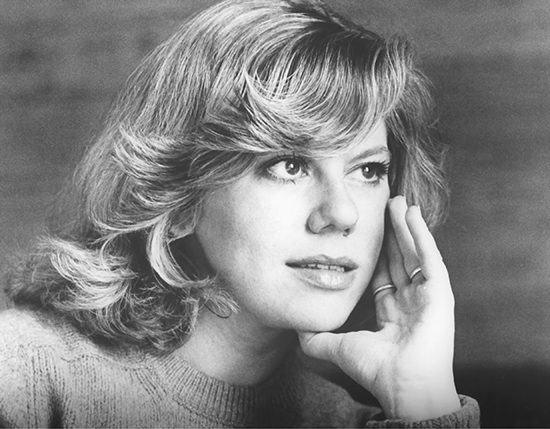
Erica Jong, around the time of the publication of Fear of Flying (© Photofest)
{ 22 }
Early in the novel Fear of Flying, the fantasy of the “zipless fuck” is unveiled. It is the ultimate fuck, “a platonic ideal,” or at least a prelude to masturbatory satisfaction. Yet, under certain circumstances, it’s a fantasy that can be realized. Consider this. You are riding on a train, and you and a certain fellow lock eyes with swelling desire. Names and nationalities are unspoken. All that transpires is pure sexual congress, without any filibustering about room temperature, long-term commitment, or implications for unmentioned spouses or lovers. Anonymity and brevity are the hallmarks of a good zipless fuck. How, then, is it platonic in nature? Because despite the potential exchange of bodily fluids, the humping of sweaty bodies, and the intermingling of salty tongues, “the zipless fuck is absolutely pure … free of ulterior motives” other than, well, sexual pleasure.
The “zipless fuck” episode, as recounted by a delightful and sometimes distraught narrator named Isadora Wing, is a fantasy—one that she has personally never experienced. But as the pages of the novel unfold, she will experience in vivid detail a good deal of fucking, a threesome, and even a “zipless fuck” scenario.
Jong regaled readers with Isadora’s anxieties and hopes, her wretchedness and allure, not to mention descriptions of her menstrual flow, forays in masturbation, expertise in the use of a diaphragm, and boredom with her marriage. Wing condemns her husband for, in her words, “never buying me flowers. And not talking to me. And never grabbing my ass anymore. And never going down on me, ever.”1
One reviewer considered the book “a diatribe against marriage, against the dread dullness of habitual, connubial sex, against the paucity of means of reconciling the desire for freedom and the need for closeness, against childbearing.” Writer William Brashler (who published a baseball novel this year), was so disgusted with this “thoroughly obnoxious book” that after reading about sixty pages he “threw it against the wall.”2
No wonder that Jong later remarked that some of her critics imagined that Fear of Flying “represented the decline of Western Civilization.”3
By the end of 1973, when first-time novelist Erica Jong published Fear of Flying, depictions of sex were startling but no longer readily considered by the public as pornographic. Ginsberg, Mailer, Bruce, and Sexton had pushed the envelope. Philip Roth’s bestselling novel Portnoy’s Complaint (1969) had thrilled, and disgusted, readers with its graphic sexual scenes, narcissistic, masturbating narrator, and obsessive confessional tone, and, let’s not forget, Mr. Portnoy’s rather imaginatively strained relationship with his ultra-Jewish mother. All the dirty linen of upwardly striving Jews had been displayed for the goyim to observe. In the section “Whacking Off” (which had appeared first within the highbrow pages of Partisan Review), Roth wrote, “Then came adolescence—half my waking life spent locked behind the bathroom door, firing my wad down the toilet bowl, or into the soiled clothes in the laundry hamper, or splat up against the medicine-chest mirror, before which I stood in my dropped drawers so I could see how it looked coming out.” Just wait until thirteen-year-old Alexander Portnoy has real sex as an adult!4 Not surprisingly, reviewers may have occasionally wondered if the book was thinly disguised memoir, but all recognized that its salacious content and ribald humor had made it a monumental success.5 Erica Jong stated, “I loved that book… . I reread Portnoy’s Complaint many times.”6
Pornography, or at least works dealing explicitly with sex, as seen in the previous chapter, had gone mainstream.7 The 1960s were, as noted, the time of the sexual revolution. Gone were the older taboos against sex before marriage, concerns about unwanted pregnancy (use of the birth control pill had become widespread in the early 1960s), and fear of being considered a slut for enjoying sex with more than one partner. While it is nice to indulge in nostalgia for the Elysium of the sexual revolution, for many women it was stillborn. Males, freed of concerns about getting their sexual partners pregnant (at least as part of their responsibility), reveled in the possibility of sex without commitment and continued to objectify women, now castigating them as prudes if they were closed to sex. Many politically committed, idealistic young women worked in the civil rights and antiwar movements. Sometimes they put their bodies on the line by going into Ku Klux Klan–infested regions of the South to register African Americans as voters and to support civil rights. Violet Liuzzo’s temerity in working on behalf of civil rights cost her her life. Yet women in radical organizations continued to be relegated to secretarial work, cranking the mimeograph machines or typing press releases. And they were expected to put their bodies on the ground for sex with alpha-male leaders, which they were told served both the movement and the sexual revolution. As the charismatic Black Power leader Stokely Carmichael was reported to have put it, “The only position for women in the movement is prone.”8
Such dissatisfaction with the missed potential of left-wing politics as a royal road to liberation for women fed into the second wave of feminism in the 1960s and 1970s. Using organizing and office skills learned in various movements, radical women began to agitate for social and legal equality, for reproductive freedom, and much more. The women’s movement was never really a single entity; some women found common ground with the National Organization for Women (founded in 1966), with its middle-class ideology; other women preferred consciousness-raising and direct-action approaches. Some women, including radical feminists Roxanne Dunbar and Ti-Grace Atkinson, floated the idea that celibacy might best allow women to break free from the yoke of males. Others increasingly argued that women loving women was the key to both personal and political liberation. This was the position of a group in the early 1970s called Radicalesbians in New York City. For feminist critic and activist Jill Johnston, writing in 1973, the split between straight and gay women was immense. To be a lesbian meant that one was not sleeping with the enemy but was also in the vanguard against patriarchy, combining the personal and political, as all revolutionaries must do. This sentiment, of course, was hardly restricted to feminists; it was a key point for followers of the New Sensibility.9
Despite schisms in feminism, victories were achieved in the early 1970s, most importantly on January 22, 1973, when the United States Supreme Court ruled in the case of Roe v. Wade. At issue was whether the Fourteenth Amendment, protecting privacy, applied to a woman’s right to have an abortion. The case had been brought before the court by Norma McCorvey, who was impoverished and pregnant with her third child. In the case, originally filed in 1970 when she was six months pregnant, she had been referred to as Jane Roe. Although legal rigmarole prevented her from having an abortion (she gave the child up for adoption), the decision was a tremendous victory for women’s liberation—enshrining their right to control their own bodies. As McCorvey put it in her memoir, “Prior to Roe v. Wade, approximately one million women had illegal abortions each year. Approximately 5,000 of these women were killed.”10 She was proud to have been the Joan of Arc of reproductive rights.
Everywhere one turned in 1973, the fight for women’s rights raged, often in unlikely places. “The Battle of the Sexes” was perhaps the most egregious and fascinating example. It was a much ballyhooed tennis match between Billie Jean King and Bobby Riggs. The match was televised nationally on September 21, watched by an audience of forty million; an additional 30,492 were present at the Houston Astrodome for the occasion. The winner-take-all purse was a sweet one hundred grand, but both winner and loser realized that ancillary earnings would top that figure. ABC planned to make a killing, too, with commercials for the two-hour special bringing in over $1.2 million.11
Some referred to it as a “circus”—with good reason. Riggs was wheeled to the tennis court on a rickshaw, led by Bobby’s bosomy beauties; King arrived on some sort of Egyptian-themed litter and carried by scantily clad young men. Once the athletes were free from their conveyances, the hoopla continued apace. Riggs presented King with a two-foot-long Sugar Daddy candy bar. Perhaps it was a joke about him being a monetary sugar daddy for King, or implied that he was a sucker for taking her on. Not to be outdone, King offered Riggs “a little male chauvinist piglet,” in recompense for the many sexist statements that Riggs had spewed during the buildup to the confrontation.12
Aside from the hustle and hype, something more was happening in this match. Four months earlier, Riggs had suckered Margaret Court, a leading woman’s tennis star, to play him for $10,000. With goofy shots, and sheer chutzpah, the fifty-five-year-old has-been had managed to defeat Court easily. Court’s humiliation struck King as a setback for women’s tennis. A strong feminist, King had organized the National Women’s Tennis Federation and fought for equity in purses for tennis championships for men and women. She had furthered the cause by hooking up with Virginia Slims, a cigarette brand marketed to women, to sponsor a tournament that paid women handsomely. Not only did she have to take up Riggs’s challenge, she had to beat him, or else her accomplishments for women’s tennis “might go right out the window.” One leading male tennis player, Gene Scott, stated: “You see, women are brought up from the time they’re six years old to read books, eat candy, and go to dancing class… . They can’t compete against men… . Maybe it’ll change some day. But not now.”13
King demolished Riggs in straight sets, 6–4, 6–3, 6–3. She was hailed as the “Joan of Arc of athletics.”14 King made no claim for her ability to beat a quality male player in his prime. She simply wanted to put to rest the view that women could not compete, that women’s tennis was less interesting than the men’s game and hence less deserving of recompense. In the process, she was happy to walk away with more money that anyone had ever won in a tennis match. And what was wrong, after all, with scoring a small victory in the proverbial battle of the sexes?
Into the ferment of this moment in sex and gender controversy came Erica Jong’s Fear of Flying. She was only thirty-two years of age at the time of publication, but she had already issued two books of poetry, Fruits and Vegetables (1971) and Half-Lives (1973). The latter volume, as Jong remarked, contained “poems about obsessive sexuality.” Her own reading of confessional poets Sylvia Plath and Anne Sexton (who became a friend) had broadened horizons for what poetry—and her novel—could accomplish. It contained thinly veiled allusions to the vicissitudes of her life, including sexual ones: of her husband: “Cooking or fucking, you live in your skin.” And one poem captured in a handful of words the imperative that defined Fear of Flying: “She stands on the edge / still hoping / she can fly.”15
Jong had been working on a novel for many years. But she later realized that she was writing against herself, against her inclinations. The novel, with the working title God on West End Avenue, was Nabokovian in style—“because I loved Nabokov and had read and reread everything of his.” The novel, written in a first-person male voice, was “about a young madman who thought he was God.” She abandoned the project, she later claimed, because it was “difficult to sustain the madman’s viewpoint and also show the things that were happening in the outside, ‘sane’ world.” Inhabiting the mind of a madman, she said, “finally overwhelmed me.” As well it should have, for the additional reason that her first husband had gone mad, experiencing delusions of divinity. Another abortive novel followed, until “with great trepidation” she turned her considerable enthusiasm and talent to Fear of Flying.16
Within a few years, the manuscript was ready. The book’s cover was as busy as the novel’s heated prose. It depicted a colorful Cupid, with a red sash hiding his private parts. The part of the sash in Cupid’s hands looks to be in the shape of a penis, but this could be an overinterpretation. Androgynous, this Cupid looks a bit like Jong, with curly blond hair. Adam and Eve frolic in Cupid’s wake, hardly ill at ease at being forced out of the Garden of Eden. The main locales for the novel, Austria and New York City, are also depicted, the former through architecture, the latter via a small map of Manhattan. A plane is aloft at the top of the cover, and at the bottom is a train—conveyances of escape and freedom. The plane, like freedom, as we learn early in the novel, also brings the potential for fear of crashing. A train, in contrast, is identified as a perfect place for a “zipless fuck,” in reality or as a place to dream about it.
On the inside back cover, readers encountered a picture of the author. Jong is striking, her blonde locks flowing and her smile glistening. Normally, an author’s photograph would not merit any attention. But it does on occasion, as it once had with Truman Capote’s rather louche portrait on the back cover of Other Voices, Other Rooms. There is really nothing inherently vixen-like in the photograph of Jong. But, thanks to the content of the novel and its erasure of lines between fiction and experience, the picture became an object of discussion—or, perhaps, more of desire.
Initial reviews of the book were mixed, until novelist John Updike weighed in with “Jong Love” in the New Yorker. Updike was the perfect reviewer—impeccable literary credentials and a long list of novels that explored with brashness the sexual mores of middle-class Americans, especially from a male point of view. His adoration was boundless. He called Fear of Flying “this lovable delicious novel.” And so, too, was its author. “On the back jacket flap,” Updike noted, “Mrs. Jong, with perfect teeth and cascading hair, is magnificently laughing.” Since the line between the author and the content of the book was blurred, Updike also noted that Jong/Isadora was “admiring … even of the impotence, madness, and defective hygiene of her many awful lovers.” What more could a sagging middle-aged reviewer want than a beautiful author, with sterling feminist credentials, who could not only endure such problems but admire them?
The novel, in Updike’s paean, was better than Catcher in the Rye (“a smart kid’s lament” and “innocence as an ideal”) and Portnoy’s Complaint (“the New York voice on the couch” and “cruel”). She shared those work’s humor and idealism, while staying in the real world. The novel was well-acquainted with the raging war between the sexes, but it managed not to dig a trench between them. It offered hope of reconciliation—and sexual release.17
Soon after, the aged king of sexual license, Henry Miller, compared Fear of Flying with his own, long-banned but now available, classic, Tropic of Cancer. He wrote a fan letter to Jong in April 1974; “I don’t know when I’ve read a book by a woman which has made such an impact on me.” Fear of Flying was “gay, witty, thoroughly uninhibited” in its writing and, he perceptively remarked, with a “serious side,” full of suffering. “It is a text book as well as a novel or autobiography.”18 Biographer Nancy Milford was impressed and insightful, writing to Jong: “For all its wit and sexual daring it is a sad book.”19
The same conflation between author and character was in evidence among reviewers less smitten with Jong and her book. A reviewer for The Nation consigned the novel to the unfulfilling, narcissistic, politically irrelevant genre of “dear diary” complaining.20 Critic Patricia Meyer Spacks agreed: the novel was burdened with “self-pity and self-display.” Its characters, most damningly, “directly articulate the author’s beliefs or sensibility.”21
If Updike was seduced by Jong’s attractiveness, literary critic Alfred Kazin was repelled by it. He titled his piece “The Writer as Sexual Show-Off.” “Erica’s sweet, confiding blond prettiness” was on display in “interview after interview,” where she admitted, no doubt with a certain coyness, that Fear of Flying was “autobiographical” and that Isadora’s “lovable weaknesses could be hers.” The book was not a novel but a confessional, coming from “a regular girl who confides to her reader that she is always looking for love but determined not to be dominated.” She is the face of feminism as a “nice, pretty Jewish girl.”22
Women reviewers also examined the confluence between author and character—and the author’s photograph. Film critic Molly Haskell reviewed the book favorably in New York’s Village Voice: “ ‘ Fear of Flying’ is definitely a vehicle for exceeding the limits on the open road.” As to the dust-jacket image of Jong, Haskell noted “her blond hair billowing across her sensually grinning face, ripe, juicy.”23
Jong was dismissed by some as a “sexual show-off.” It was a heady time for her—she was a bestselling novelist, interviewed everywhere, solicited for her opinion, especially on sexual matters, and often paid quite nicely. Thus, the May 1975 issue of Esquire featured a story by Jong titled “Notes on Five Men.” Therein she discussed the “woman’s sensibility” with respect to Paul Newman, Al Pacino, Robert Redford, Steve McQueen, and Charles Bronson.
There is truth, of course, to the charge leveled by academic Charlotte Templin that Jong’s reception focused on her more as “a woman rather than as a writer.” But in an emerging age of celebrity this was the fate of many serious writers. Some opted for it consciously—Sexton comes readily to mind. Others, such as Sontag, had a more ambivalent relationship to it. Jong, in addition to relating her views about male movie stars, readily dispensed sexual advice in Playboy magazine, appeared regularly on television and radio shows, and worked tirelessly to promote both herself and her novel.24 The Playboy interview was particularly gutsy, as Jong—often with tongue in cheek—talked about sexual preferences (intimacy above all, but in the act a large cock and sure stroke were best), pornographic movies (ten minutes watching one made her want to spring home for the real thing, but longer viewing was a turnoff) and openness to the varieties of the sexual experience (“I think it’s nice to do it in all different positions, different ways, including hanging from the chandelier”). Jong was in command of her performance for Playboy, a publication aimed at heterosexual males.25
Whatever her heady relationship to celebrity, Jong was keenly aware that her persona was embedded in the novel. She related a conversation that she had with her friend Anne Sexton. She asked Sexton, “What do I do when men come up to me … and start saying, ‘Hey, baby, I want a zipless fuck’? And Anne replied, ‘Thank them. Thank them and say, “Zip up your fuck until I ask for it.”26
Ah, there it is again, the equation of the novel with an autobiography. Two questions arise: Was it true, and, if so, was it a problem or just an indicator of how the New Sensibility was tied into the feminist ideal of the personal and the political being intertwined?
Jong was inconsistent about how much of her own life was reflected in the saga of Isadora Wing. One interviewer prefaced her first question to Jong as follows: “This is the question everybody’s asking, so let’s get it over with: How much of Fear of Flying’s Isadora Wing is really Erica Jong?” Jong’s reply: “Sure, there’s a lot of me in Isadora, but a lot of characters and events in the book are totally invented. I didn’t set out to write autobiography.” At best, the book could be called a “mock memoir” in the same manner as Portnoy’s Complaint or Tropic of Cancer. She admitted in the Playboy interview that while “Isadora is an alter ego,” she “is 100, 000 times more audacious, more outrageous.”27 “I hate the confusion between myself and the character,” she told a reporter, “because the book is hyperbole. I don’t think I’m as sexy as Isadora.” Nonetheless, the reporter emphasized, no doubt to Jong’s chagrin, “Everything that happens to Isadora happened first to her creator.”28 Novelist Cynthia Ozick wrote Jong that Fear of Flying was a memoir “fully fictionalized.” In reply, Jong admitted that her book “has the feel of a memoir—but there’s more fiction in it than I can remember.”29 Finally, in another interview, Jong lamented, “But as long as I’m young and pretty, things will not be easy. People confuse me with my writings.”30
With good reason, beyond both Isadora and Jong being “young and pretty.” For example, both characters had been married and divorced from a bearded young man who had gone insane; both were married to a Chinese American psychiatrist; both were from the Upper West Side, grew up wealthy, and were educated at Barnard and Columbia; both had been in psychoanalysis for years; both had lived in Germany; both had mothers with artistic leanings. But this does not mean that the novel was a simple transcription of life onto the page. No less than with Sexton, it was experience rendered into art, by dint of voice, narrative techniques, and vision.
But, then, what is the problem? Some critics refused to see the art in the telling. The criticism lodged by Kazin against Jong was similar to that thrown against confessional poets or Roth in Portnoy’s Complaint, that the self must be distanced from the words on the page, lest it be insufficient as art. But the presumption is mistaken. First, no writer can capture with absolute veracity him- or herself and translate it onto the page. The very act of writing is selective, and hence marked by the intercession of an editing, even censoring mind (even with Kerouac’s attempts at spontaneous prose). Nor is there anything inherently problematic about using one’s experiences and inserting them into the story. In biography or memoir the material must be reined in by a regime of truth, of fact-checking. In a novel, such constraints do not apply.
Another potential concern with too close an identification between author and character is lack of perspective, or a perspective that erases nuance, coming as it does presumably unfiltered from the writer. The same criticism, it would seem, applies to memoir or autobiography. The essential key, then, is whether the writer—in whatever mode of presentation—writes with self-examination, with openness to complexity, and without resorting to stereotyping. And it is also necessary for the fiction writer to prove, in confessional or “mock memoir” writing, that they are part of an historical moment, transforming themselves from a self-recording, narcissistic unit into something more.
Jong succeeded admirably on these fronts. She caught and rode the waves of the feminist and sexual revolutions to shore.
Fear of Flying is a spirited and lusty Bildungsroman. It traces Isadora Wing’s coming to terms with her own anxieties and limitations. At the outset of the novel she is afraid of flying, in a literal sense, but also in the sense of being afraid of experiencing life, undertaking a journey, committing to her artistry.31 Yes, many of her fantasies revolve around uninhibited sex, but it is more complicated than that. She takes pains to make clear that her husband is an accomplished, insatiable lover. But his silences and stony demeanor make her feel alienated from him. Yes, in the spiral of the novel, Isadora does attempt to break free sexually. But the results are mixed—and ironic—at best. And that is as it should be. Fantasy is a vehicle of both escape and avoidance; it is also a means to coming to terms with limits and to discovering new possibilities in art and life. As Jong later put it, “In Fear of Flying, I wanted to slice open my protagonist’s head and reveal the fantasies within… . Most of the sexual escapades were disappointing compared to the lavishness of Isadora’s fantasy life. Perhaps that’s the case with most people.”32
Early in the novel, while at a psychiatric conference, Isadora eyeballs the ultimate partner for a “zipless fuck”—a blond, handsome, hippyish Laingian psychiatrist with a perfect name Adrian Goodlove. He claims to live for the moment, open to all pleasures, most assuredly including sexual ones. Alas, the outwardly virile Adrian is, much of the time, impotent. Beyond the sexual element, Adrian represents—at least in Isadora’s still developing consciousness—an ideal of freedom. She opts to flee with Adrian on a road trip, but the journey is mostly frustrating and sometimes harrowing.
Finally, arriving in Paris, Isadora is determined that she will return to her husband, if he allows. Liberation certainly has its limits and betrayals, as Isadora learns the hard way. “I’d like to kill you,” she screams at Adrian, after finding out that his claims to be unencumbered in relationships is a sham. His mocking response: “ ‘I only wanted to give you something to write about,’ he laughed.”33
All of the male characters in the novel, no less than the female lead, are presented with warts intact, but also with their good sides gleaming. Isadora’s first husband may start out as an odd genius that develops into a raving paranoid, but he is exciting, and she recognizes how she benefits from her relationship with him, in both healthy and problematic ways. And such, too, is the case with herself.
The novel is about coming to self-consciousness and liberation. Isadora Wing succeeds in the former admirably, albeit with difficulty. The latter, she comes to recognize, is the result of a difficult process, a long journey. Isadora, alone in a Paris flea-bag hotel, awakens to find herself with “blood welling up between [her] legs.” She continues: “If I parted my thighs even a little, the blood would gush down and stain through to the mattress.” The bloodletting is, of course, symbolic—indicating that she is not pregnant and that her twenty-eight-day ordeal may be coming to a conclusion: “Menstruation was always a little sad—but it was also a new beginning.” She will not confuse liberation with license, or give in to absurd romantic longings. “I knew I wouldn’t screw up my life for the sake of a great self-destructive passion.”34
She leaves Paris by train. A “young train attendant in a blue uniform” helps her with her heavy luggage. He reappears later, asking if Isadora might prefer to have a compartment of her own—what a kind gesture, she thinks. He even begins “pushing the armrests up to make a bed for [her]. Then,” she goes on, “he ran his hand along the seats to indicate that it was a place to lie down.” In a few moments, “His hand was between my legs and he was trying to hold me down forcibly.” Isadora calls him a “pig” and escapes to another compartment, filled with people, finding comfort and protection in their midst. And then she comes to her realization:
It dawned on me how funny that episode had been. My zipless fuck! My stranger on a train! Here I’d been offered my very own fantasy. The fantasy that had riveted me to the vibrating seat of the train for three years in Heidelberg and instead of turning me on, it had revolted me!35
The novel ends with Isadora installed in husband Bennett’s London hotel room, waiting for his return. She is determined, it seems, to continue the relationship, but also to survive, aware at last that her fear of being herself, of flying into new realms of experience and art, has finally dissipated. She becomes the existentialist that Adrian claimed to be: “Surviving meant being born over and over. It wasn’t easy, and it was always painful. But there wasn’t any other choice except death.”36
Fear of Flying was an immense success. Within a few years, thanks to a paperbound edition in 1975 with a sexy cover of a partially naked woman, the book had sold six million copies. As Jong liked to relate, the book had clearly touched a nerve among readers. Certainly, many were attracted to the book for its sexual content. But, in fact, by the 1970s much steamier content was readily available, both on the screen and in romance literature and magazines. In 1973 Playgirl magazine debuted, with its centerfolds of male nudes. A year earlier, actor Burt Reynolds was shown bare-assed in a centerfold for Cosmopolitan magazine. Clearly, if women wanted to find lusty writing and sexual scenes, they could turn elsewhere. Certainly, despite Kazin’s criticisms, Jong was a serious writer, which did grant legitimacy to her work. She had, after all, previously published two collections of poetry, won writing awards, taught part-time at Columbia, and had her novel offered by a mainstream publishing house.
The book resonated because it was of its time and place—a salvo in the war of the sexes. Its appeal was in part that it was written by a woman, with ribald humor and matter-of-fact dealing with sex—often in minute detail. This was a time when second wave feminists were dissecting the canon of literature, finding sexism and patriarchy in its very sinews. This was a mission of the highest order. Feminist critic and activist Kate Millett, in her influential Sexual Politics (1970), opened her attack with a diatribe against Henry Miller, who would soon champion Jong. Miller’s protagonist “is always some version of the author himself, is sexually irresistible and potent to an almost mystical degree,” wrote Millett. But sex and literature serve the purposes of patriarchy, the “male assertion of dominance over a weak, compliant, and rather unintelligent female.”37
Jong maintained that one could be a strong feminist and a devotee of Miller. Her novel was a reversal of the Henry Miller ideal of the male as sexual predator. Isadora’s husband is potent but passive; Adrian is impotent but active. Isadora walks a tightrope between being a loony dame falling head-over-heels in love with an attractive idiot and being a strong female figure. After all, as one reviewer pointed out, one of the problems with Isadora Wing as narrator is that she is so smart, capable, and biting in her observations. Perhaps in this ambivalence, in presenting a character of some complexities as unresolved, Jong created in Isadora Wing some version of everywoman, or at least, a fantasy of everywoman.38
Many women readers found the novel spoke to their own frustrations—with marriage, career, sex, and the feeling that they were unable to liberate themselves. And they reveled in its self-revelation and honesty.39
One reader from England announced, “It’s my story. If you had lived next to me or even inside my skin all of my life, you could not have created a more vivid or real portrait of my doings, my feelings, my fantasies, my (mis)adventures, in short, my history.” In her first fan letter, Seena Lee Brooks, from West Palm Beach, wrote, “I just had to let you know ‘Fear of Flying’ hit the nail on the head. A ‘zipless fuck’—how many girls have just wanted that,” and then she proceeded, in great detail, to relate her own personal story. In the same vein, Gene Steinman, from Lula, Georgia, shared intimate aspects of her life in six single-spaced, typed pages. “To me, the novel is pure allegory. Allegory for the reason that I have traveled the same road.” Even some men wrote to Jong to celebrate her achievement: “I don’t think I’ve ever read a book so filled with love and humor and poetry,” one male reader wrote. And, like Updike, he was smitten. “I’ll just say that I’ve fallen in love with you from this great distance… . I hope that you will keep on writing forever.” And, by the by, he would be happy to buy her a beer anytime she happened to be in Greensboro.40
With her characteristic bravado (perhaps consciously mimicking Mailer’s ambition to “create a revolution in the consciousness of our time”), Jong stated that Fear of Flying “signaled a switch in the female consciousness and encouraged women to change their lives.” As the letters quoted above attest, she succeeded in that goal. Equally important, and connected with that desire, was how the novel captured sexual jouissance, the notion that women had roiling and unfulfilled (and valid) sexual wants and fantasies. As Jong put it, “You can have pleasure; sex is not so serious.” Hence, the “zipless fuck” became “a catch phrase that was needed at that moment in history.”41
But freedom is never absolute, never unanchored in social, class, gender, and economic webs of significance. The sexual revolution in the minds of some had confused license with liberation. For others, it had not gone far enough in challenging patriarchal and other presumptions. Jong was well aware of this, as she continued to chart Isadora’s life journey in other novels.42