
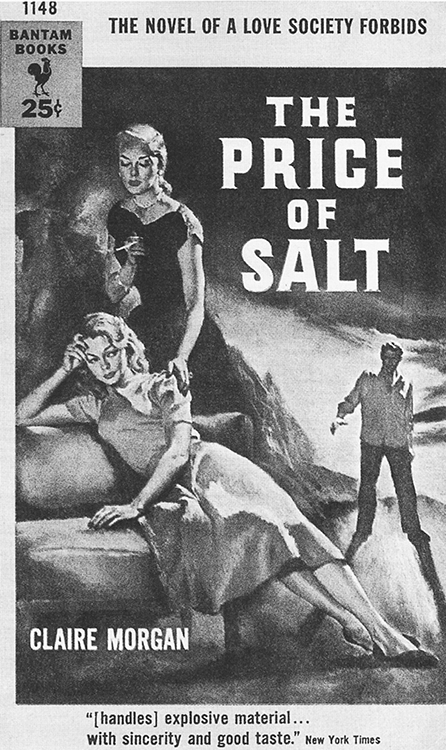
The Price of Salt, lesbian novel written by Patricia Highsmith (1955) (courtesy Bantam Books/Random House)
{ 4 }
In 1955 a rather unusual character arrived on the scene. Tom Ripley seemed to be a pleasant fellow, agreeable in looks, demeanor, and breeding. For some poor souls who came into contact with him, however, the encounter proved fatal. Mr. Ripley was a talented killer, rather blasé in his attitude about the act, charmed more by the results. Something of a chameleon, Ripley, when required, dispensed with the baggage of his previous life effortlessly. He might be viewed as exemplary of what the sociologist David Riesman had only recently designated as the “other-directed” character—someone wanting to conform to the system, to not make waves, and to bow down to the views of others.1 Of course, unlike the glad-handing, affable sorts that Riesman analyzed, Mr. Ripley was spooky, obsessive, and lethal.
The same might be said for his creator, Patricia Highsmith. In December 1948, Highsmith—then twenty-seven years old and fetching in an offbeat style, razor thin, tall, usually dressed in a white Oxford shirt from Brooks Brothers—was working as a temporary salesclerk in the toy department at Bloomingdale’s in Manhattan. It was a rather bleak day, with showers making the mild temperatures less pleasant. In any case, it was a day that she would never forget. A tall blonde woman in her late thirties, reeking of class, wearing a mink coat, approached the counter to inquire about a toy for her daughter. Dazzled by the woman’s cool beauty and presence, Highsmith struggled to focus on the simple request. A few words, no more, were exchanged. In a poof, it seemed, this vision of beauty exited the art deco store on Lexington Avenue. Only her perfume and presence lingered for Highsmith, made palpable by the fact that she had near to hand the woman’s name and home address on a slip of paper for shipping purposes.2
The day after this fevered encounter, Highsmith wrote a plot outline for a novel. “It flowed from my pen as from nowhere,” she recalled.3 In her journal she recorded the intensity of the experience: “I see her the same instant she sees me, and instantly, I love her, … Instantly, I am terrified, because I know she knows I am terrified and that I love her.”4 In a chilling observation, Highsmith admitted, “Murder is a kind of love, a kind of possessing.”5
Such was the stuff of Highsmith’s art and life, dedicated as it was to turning things on their heads, to dissolving lines between madness and sanity, and to an upswell of excess.
The name of the woman who skittered into Highsmith’s life that day in Bloomingdale’s was Kathleen Senn. Highsmith always appreciated quality and was attracted to trouble, so she had sized up Senn perfectly. Beyond her pristine beauty, Senn was an aviatrix and a keen golfer, married to a wealthy executive. Unfortunately, she was also a raging alcoholic suffering from psychiatric problems. In 1951, prior to publication of Highsmith’s novel that recounted their brief encounter, Mrs. Senn turned on the car engine in the enclosed garage attached to her home and asphyxiated herself.6
Highsmith spent hours huddled over her notebooks and typewriter until she had imaged Senn as the character Carol Aird in the novel The Price of Salt. Twice, however, Highsmith indulged her obsessive curiosity about the real Mrs. Senn. As she admitted about herself, “Obsessions are the only things that matter.”7
In fact, Highsmith stalked Senn. On June 30, 1950, one day after completing a first draft of Price of Salt, Highsmith took a train from Penn Station to Ridgewood, New Jersey. She recorded in her journal: “Today, feeling quite odd—like a murderer in a novel, I boarded the train.” Highsmith arrived at the Ridgewood train station, gulped down a couple of stiff drinks, then clambered aboard a bus to find the house—and perhaps steal a glimpse of the divine Mrs. Senn. Exiting the bus, she moved conspicuously along streets with tony homes. Solitary walkers along the tree-lined streets were unusual, and Highsmith feared she would be discovered and revealed as a voyeur. Highsmith failed to locate Senn’s upscale Normandy Tudor home, which bustled with turrets and stonework. She liked to think, however, that a passing automobile had been driven by the object of her attention. The experience, Highsmith wrote, “shook me physically and left me limp.”8
Patricia Highsmith’s life and work existed on the edge of a moral abyss. Severe alcoholism and frenzied promiscuity complicated her private life, but she managed somehow to drag herself daily to her desk to write about her favored subjects: murder, obsession, paranoia, and the permeable boundaries of identity. And she adored perversity: “Perversion interests me most and is my guiding darkness,” she recorded in her diary at age twenty-one.9
Everyone constructs their history by retrospectively mining it for tidbits that seem relevant. Many blame Highsmith’s perversities on her mother, who was reported to have tried to abort Pat by drinking turpentine. Her mother joked later about Pat’s unusual appreciation for “the smell of turpentine.”10 Highsmith survived birth, apparently none the worse. Her haughty, beautiful mother was a fashion illustrator, who often left Patricia in the care of her mother, Willie Mae Coates. Highsmith’s biological father, Jay Plangman, was out of the picture early on, except for a time when, in Pat’s account, as a teenager, she reunited with her father briefly enough to be shown pornographic pictures and share “some lingering kisses.”11 Highsmith’s mother remarried and took the child from Texas to live in New York City, although they rarely stayed put in any domicile for too long. Patricia managed to graduate from Barnard College and dreamed of becoming a great novelist. From 1942 until 1948, she supported herself by writing volcanic stories for comic books such as Jap Buster Johnson, The Human Torch, and Spy Smasher.12
Despite natural shyness and embarrassment about her work in comics, Highsmith was well connected. By 1950, her roster of influential friends was substantial and varied: photographers Ruth Bernhard and Karl Bissinger; writers Sybille Bedford, Dorothy Parker, Chester Himes, Truman Capote, James Merrill, and Carson McCullers; and many in the fashion world. She impressed everyone with her intellect and charmed them with her eccentricities; she would tap her cigarette (Camels up until 1949; only Gauloises after a trip to Europe) on her watch face prior to lighting up. Many remarked on her impeccable manners and thoughtfulness. But she tended to avoid physical contact, preferring not to shake hands with new acquaintances.13
Nonetheless, Highsmith was sexually voracious. What interested her most, however, as reflected in her fiction, was the excitement of the quest, the seduction rather than the result. This sexual allure was captured in a nude photograph by Rolf Tietgens, a bisexual lover who wanted to marry her (she did have a complex life). In the photograph she appeared at once androgynous, slim, and powerful. She enjoyed being viewed as attractive, and she pursued sex mainly with women. Arthur Koestler, a writer of great talent and connections, became her friend in 1950; he liked her work but, with his vaunted lecherousness, also wanted to bed her. Highsmith allowed this to happen, after fortifying herself with “seven martinis, a bottle of wine and three gins.” Suffice it to say, intercourse with Koestler was a “miserable, joyless episode.” After sex with men, Highsmith confided, she was riven with “hostility, masochism, self-hatred, self-abasement.”14
Perhaps it is best at this point to move away from the numerous potholes in Highsmith’s personal life to the delicious and daunting perversities on the pages of her first novel, Strangers on a Train (1950). As with most of her writing, according to novelist James Sallis, Highsmith “pushed things to the very border of expectation, civility, civilization and reason—even of humanity.”15 Such qualities of the New Sensibility, sugarcoated somewhat in her initial novel, would only become more overt in subsequent works.
Paranoia and guilt eat at the main character of this novel—sometimes with good reason; Highsmith would undoubtedly have nodded in agreement with the poet Delmore Schwartz’s remark that “even paranoids have real enemies.” Layered with troubling themes, Strangers leaves readers with a shaky feeling. Although the novel is marred by artificial plot twists and stagey moments, the atmosphere is relentlessly Highsmith.16 The novel was a perfect vehicle for her views about murder, as she confided to her journal the year it was published:
I am interested in the murderer’s psychology, and also in the opposing planes, drives of good and evil (construction and destruction). How by a slight defection one can be made the other, and all the power of a strong mind and body be deflected to murder or destruction! It is simply fascinating.17
The story spins around a chance meeting on a train heading west between Guy Haines, an appealing young architect, and a rather odd fellow, Charles Anthony Bruno. When Bruno learns that Guy’s wife is hindering his career and potential happiness with another woman, the conversation takes a startling and dastardly turn. Bruno asks Guy if he would like him “to dope out a perfect murder” of his wife.18
Amoral, drunk, and obsessive, Bruno is the character that sparkles with the daring of a new sensibility. Highsmith acknowledged as much: “I am so happy when Bruno reappears in the novel… . I love him!”19
Bruno is determined to kill for Guy. Drawing on a thimbleful of information about Guy’s wife, Miriam, Bruno tracks her down and stalks her. With each glance, Bruno’s repulsion for her grows. Finally, in a wooded area near a carnival, he finds her alone and attacks, choking her fiercely: “He sunk his fingers deeper, enduring the distasteful pressure of her body under his… . Her throat felt hotter and fatter.” In a few moments, the deed was done; the killer “felt great.”20
With more twists than a pretzel, Strangers on a Train piles on psychological nuances. Bruno’s adoration of Guy verges on the perverse. He stalks (a key theme in Highsmith’s work) Guy, slowly insinuating himself into Guy’s life, at the most unexpected and inopportune moments. Guy’s moral resources start to wear thin. He anxiously fulfills his half of the implicit bargain by killing Bruno’s father. Bruno and Guy are now brothers in sin.21
The guilty are punished, at least in this novel. A dumpy detective named Shannon is a loyal and smart bulldog; he tracks down the most hidden clues, all leading to Guy’s doorstep. But first comes Bruno’s accounting. While drunk on board a yacht with Guy and his new wife, Anne, and a few others, Bruno slips on the deck into the water and drowns, despite Guy’s brave attempt to save him.
The story concludes in even more absurd fashion. Guy has returned to Texas, to the town where Miriam was strangled. Racked with guilt, Guy feels encased in an “invisible glass cell.”22 He decides to locate Owen, his wife’s former lover, and confess to him his passive, accidental role in her death. To further unburden himself, Guy intends to admit to the murder of Bruno’s father. Owen could care less about any confessions or even Miriam; “Hell,” he says, “I didn’t love her.” Undeterred by his unfeeling auditor, Guy confesses: “I—I killed someone, too! I’m a murderer, too!” Owen’s response, offered with a smile, is “Live and let live.”23
Detective Shannon has secretly been eavesdropping on Guy’s confessional. Once confronted, Guy is relieved: “Take me.”24 Case closed.
Highsmith’s own bundle of obsessions and identity confusions remained in the late 1940s. She was involved in a relationship with a man (disdainful of the sex and horrified at the potential of getting pregnant), yet seeing women and enjoying them briefly, laboring unhappily in the comic book trade, and writing, writing, writing. And her fraught relationship with her mother continued.
Forty-seven times Highsmith dragged herself to the office of psychiatrist Eva Klein Lipshutz. A Rorschach test for Highsmith concluded that she suffered from “raging violence” and a “weak ego.” Lipshutz’s recommendations were both precise and absurd: Highsmith should work toward “a condition to be married,” since the therapist equated heterosexuality with normality. But until she got her bearings, Highsmith was warned to refrain from entering into any serious, obsessive relationship. Armed with this prescription, and ending therapy in May 1949, Highsmith booked passage aboard the Queen Mary for Europe. She would quickly violate all of Lipshutz’s imperatives.25
In England, Highsmith succumbed immediately to the intoxicating presence of Kathryn Hamill Cohen. She was a remarkable woman: American-born, once a Ziegfeld Follies dancer, a geneticist, and a psychiatrist. Moreover, as Highsmith’s biographer Joan Schenkar states, Cohen was also “beautiful, intelligent, melancholy, moneyed, and married: a combination Pat always found irresistible.”26 Kathryn and her husband, an editor for Harper & Brothers, were fabulously wealthy, no doubt thrilling the ever-materialistic Highsmith with their Rolls-Royce and magnificent house. Kathryn introduced Highsmith to London’s cultural elite. Yet Highsmith soon heeded the call of the Continent, heading first to Paris, then to Italy.
During this period, Highsmith obsessively and enthusiastically frequented lesbian bars in Paris, and she had managed during her short time in London to have sex with a few women. Lonely in a Roman hotel, Highsmith wired Cohen, inquiring if she might join her on a jaunt around Italy. The two of them met up in Naples, traveling to Positano (the city that would become the setting for The Talented Mr. Ripley), as well as to ever romantic Capri. Mutual attraction had blossomed into a passionate romance. It was no more than a fling for Cohen; she had no intention of abandoning her London life for the strangely alluring young writer. On September 23, “the horrible day,” Highsmith wrote, Kathryn returned to London. A month later, Highsmith was back in New York City, working arduously on the manuscript that would become The Price of Salt.27
Highsmith was finally accepting her lesbianism, although she would continue on occasion to sleep with men. Her infatuation with Senn in December had convinced her that lesbianism was natural and ripe with possibilities. This emerging sense of confidence about her sexuality would become apparent in the new novel. Strangers on a Train, which was published on 15 March 1950, was dedicated to “all the Virginias,” a reference to past female lovers.28
Confidence in the writing of the new novel, however, coexisted with shame. The book did bear, she remarked, a “close truthfulness” to aspects of her life, but it promised little for her reputation. As the novel hurried to publication, Highsmith drank so much that weeks in her life had dissolved into a “blank in memory.” Published under the pseudonym Claire Morgan, The Price of Salt was reissued a year later as a Bantam paperback edition; its lurid cover captured all the tropes then common for the lesbian novel genre. A beautiful young woman sits seductively on a couch. Looming over her is a beautiful older woman, one hand holding a cigarette, the other hand placed fondly on the younger girl’s shoulder. In the distance, rushing to put a stop to the seduction is a handsome young man. “Bad” girls were meant to get caught and punished, according to historian Jaye Zimet: “The lesbian gets her due … marriage, insanity or … suicide.”29
Being a lesbian in the United States in the late 1940s and 1950s was, as Zimet makes clear, difficult and dangerous. The pressure was great from family and friends to conform to the heterosexual norm. And the consequences of refusal could be immense. Gay men and women were considered not only perverts but security risks; thousands of government workers were dismissed from service during the “lavender scare” for being presumed to be gay. Women in the postwar years were expected to marry and raise a family, to anchor their existence within the happy confines of the home.30
In some ways, however, lesbianism in this period was emerging from the shadows. The Kinsey Report on women’s sexuality, published in 1952, found that 6 percent of women between the ages of twenty and thirty-five were lesbian in inclination. As more young women with such an orientation gravitated to urban centers in search of careers and liberation, they discovered lesbian bars, where a culture of freedom was tempered by fear of harassment.31 Highsmith gained entry into a world of wealthy lesbians who threw lavish parties in their homes. This rich environment teemed with talented and wealthy women. For those unwilling or unable to enter into either of these worlds, some titillation might be gained from pulp fiction depicting female relationships.
The Price of Salt centered on a lesbian relationship. But it went beyond expectations of pulp fiction. Lesbians invariably bowed to the heterosexual demands of society—or, if unrepentant, experienced its wrath. Highsmith’s novel was remarkable both for its tender depiction of lesbian love and for its sensitivity to shifting balances and power relations between lovers. Most of all, as Highsmith wrote later, “It had a happy ending for its two main characters, or at least they were going to try to have a future together.”32 This emphasis on pleasure, without guilt or punishment, was part of the New Sensibility that was central to writers such as Allen Ginsberg, Gore Vidal, and Samuel R. Delany.
After that magic moment with Kathleen Senn at Bloomingdale’s (Frankenberg’s in the novel), nineteen-year-old salesgirl Therese sends a thank-you Christmas card to Mrs. Carol Aird. She coyly signs it with her employee number, 645-A—secretly hoping that Carol will be tickled and respond positively.
She does, and they meet. Therese swoons in Carol’s perfume, admires her beauty, and marvels at her confidence. Therese is in the tight arms of an infatuation, a love that had never gushed so high with her boyfriend, Richard Semco. But Therese remains childlike, alienated from the larger world (experiencing life “secondhand”), and “anxious.” As Carol puts it at one point, Therese is “a strange girl … flung out of space.”33
Carol assumes the role of a mother to Therese—pampering her, trying to get her to be more realistic about the vicissitudes of life and love. But Therese craves more than mothering (although she does enjoy the “hot milk” that Carol provides her at night). She wants a passionate relationship; nothing less will suffice. For Therese is obsessed: “There was not a moment when she did not see Carol in her mind.”34
At Carol’s behest, they embark on a road trip west. They are in search of metaphorical freedom, but also, as it turns out, going “westward into the darkness.” Finally, in Waterloo, Iowa, sharing a single bed in a hotel room, their bodies touch and cling, their lips lock, and their desire for one another is satisfied. It is a victory on the one hand but also a harbinger of suffering.35
Highsmith stories always brim with problems (real and anticipated), scattered like litter along the highway. It develops that their first night of sexual bliss in Waterloo has been discovered. Therese had noticed earlier that they were being followed by a detective “with creases on either side of the mouth.” He has been hired by Carol’s estranged husband to gather evidence of promiscuous perversity, to use in court to gain full custody of their child, Rindy. And he has managed to wire the Waterloo hotel room to record the delighted moans of their first coupling.36 Will this Waterloo rendezvous be the scene of Napoleon’s defeat or Wellington’s victory?
The plot thickens. An armed Carol confronts the detective but is forced to return east to deal with divorce issues. Therese feels isolated. But abandonment has a hidden silver lining, since Therese, now living on her own in the west, achieves maturity and independence. In typical Highsmith fashion, Therese nurtures resentment for Carol, who has betrayed her by caring more for Rindy than for her.37
When they meet anew, Carol tells Therese: “I was hoping you might like to come and live with me, but I guess you won’t.” Upon hearing these words, Therese’s heart leaps, but it is quickly brought back to earth by her seething resentment at Carol’s presumed betrayal: “No, I don’t think so,” responds Therese.38
Yet the seed has been planted. Therese realizes in a flash that “it was Carol that she loved and would always love.” She flees a party and rushes along New York streets to the restaurant where she knows Carol is having dinner. Carol sees her coming and seems to acknowledge in a subtle glance their future together, as “Therese walked toward her.”39 So ends Highsmith’s novel, without a single murder or suicide taking place. And no punishment for the lesbians, only the prospect of a life together.
“My personal maladies and malaises,” Highsmith confided in her journal, “are only those of my own generation and of my time, heightened.”40 This was a surprising admission; the novels she published between 1950 and 1955 seem disconnected from the historical moment. There is nary a mention of the Cold War, Red Scare, Korean War, or civil rights movement. But, in a sense, like Ginsberg and other exemplars of the New Sensibility, such as Norman Mailer (chapter 9), Highsmith had placed her finger on one aspect of the historical pulse of the time: the existential challenge of living in an age of anxiety. What moral constraints existed to stop an individual from going too far—apart from empty traditions or prohibitive legalisms?
Highsmith was familiar with the giants of existentialism—Kierkegaard, Kafka, Nietzsche, Sartre, de Beauvoir, and Camus. She was writing in the heyday of the initial wave of American enthusiasm for existentialism. Translations of key existential texts cascaded from presses; books explaining existentialism were common, and even in popular culture existential motifs became de rigueur for almost anyone claiming to be aware of social and intellectual currents. W. H. Auden had captured the “groans of grief” well in his long poem The Age of Anxiety (1946), while psychologist Rollo May plumbed the depths of such grief—and its transcendence—in The Meaning of Anxiety (1950).41
Highsmith read such works selectively. She exulted in the existential emphasis on alienation, on contingency (think of how it plays in Strangers on a Train), and the problematic nature of identity. The (perhaps overly) famous line from one of Sartre’s plays about hell being other people became a sort of mantra for Highsmith. For Sartre, the problem of the age was bad faith, failing to accept responsibility for making the world a place devoid of exploitation, racism, and anti-Semitism. Alas, on the latter two issues, Highsmith’s prejudices could cut deeply. She had many Jewish friends and lovers, but when they crossed or disappointed her, they were immediately reduced to disgusting stereotypes. Highsmith was more of a curmudgeonly existentialist in the fashion of Nietzsche—freedom was about power and creativity, about being above morality. She ignored how Camus and Beauvoir grasped for a common humanity, realizing how since everyone is thrown into this world, each individual has the responsibility to develop an ethical stance which can accommodate competing visions.42
Without such an understanding, the world becomes a place of power struggles, deceit, and murder. A fine description, of course, for the universe that Highsmith created in her novels.
Cold War secrecy, confession, and paranoia were mirrored in Highsmith’s fiction. Secrecy, of course, became a paramount concern in the postwar years—especially with revelations of atomic spy rings and Communist agents infiltrating the government. In the name of national security, the United States government and its political representatives increasingly sought to penetrate the personal lives of Americans, looking for any hint of subversive activity. In fact, Highsmith had once been intrigued with the Communist Party, at least in the early 1940s. She was drawn more to its machinations than to its politics, however: “This business of dodging and bulldozing the authorities has limitless opportunities for clever remarks.”43
The postwar years also brought forth a new sort of literature—heralded most compellingly by Whittaker Chambers’s bestselling Witness (1952). Much of the book detailed Chambers’s secret life as a Communist spy; he revealed how Alger Hiss, a high-level government official, had worked closely with him in Communist espionage. The book, however, went beyond detailing spy networks and various modes of secrecy; it was a cri de cœur, a masterful work of confession. Having exchanged his Communism for a sort of existential Christianity, Chambers was pushed as strongly by his harrowing sense of guilt to confess as Guy had been in Strangers on a Train. Rejecting his earlier hints of sexual deviance, Chambers worked to find refuge in faith, marriage, fatherhood, and life on a farm.44 None of those options interested Highsmith.
As usual, high drama marked Highsmith’s personal life. In her journal entries she obsessively kept lists of the women she slept with (she rated them as lovers), her medical information, and much else. Her relationships with women were volcanic. Joan Schenkar nicely captured why this was so: Highsmith “could live for love, but she couldn’t live with love.”45 For four years—during composition of The Talented Mr. Ripley—Highsmith was in an open relationship with Ellen Hill (a woman who sought to dominate Highsmith—no easy task).46 One night Hill threatened to commit suicide if Highsmith went out on a scheduled date. Highsmith stormed out of the apartment—later to find Hill in a hospital, having almost made good on her threat. Hill and Highsmith returned to their fraught, constantly squabbling relationship. Depression, excessive drink, and fears of madness plagued Highsmith’s life in this period of the early 1950s—and yet she pecked away at the typewriter, managing to write her first Ripley novel, completing it in six months and publishing it in December 1955.47
Tom Ripley captured Highsmith’s devotion to a handful of themes and her penchant for taking things too far. His life revolves around contingent situations, chance encounters (as with the characters in Strangers on a Train). Ripley’s identity (like that of Therese in The Price of Salt) is malleable. He is a stalker. First he imagines being connected with the target; then he actually seeks to attach himself to those who have struck him as appealing. In turn, he will adopt their identities while retaining the option of shifting back to his own original presentation of self.
Lest we forget, Ripley is a murderer. Much like Charles Bruno, he kills without remorse. And he gets away with his murders—both of others and, in a sense, of himself. Ripley is, then, the exemplification of a dream that Highsmith had once experienced. She had dreamt of immolating a figure in a bathtub that was herself as well. Highsmith interpreted this dream thusly: “I had two identities: the victim and the murderer.”48 Further proof of the closeness between Ripley and Highsmith is found in how she sometimes signed copies of the Ripley books, “Pat H, alias Ripley.”49
The Talented Mr. Ripley opens on a typically Highsmithian furtive note. Tom Ripley believes he is being followed and about to be arrested. He has, after all, committed mail fraud—although for various reasons he has not cashed in on any of his ill-gotten gains. Ripley’s stalker, it turns out, is a Mr. Herbert Greenleaf, the father of Dickie, who is living a lush and listless life in Italy. Presuming Tom to be an old pal of Dickie’s, he tries to enlist him to bring his wayward son home. At this point, the novel promises to be an updated version of Henry James’s The Ambassadors. The prospect of going to Europe offers Ripley freedom—an opportunity to shift his identity and possibilities for seduction, of varied kinds.50
Tom Ripley is a bit of a scoundrel, unanchored in his plans, unmoored in his relationships. There is a blankness about him, although he is not totally bereft of emotions, but he does have a particular soft spot for material objects; he appreciates value—be it in a fine watch or a particularly impressive floral gift. He is convinced that by donning an outfit, speaking in a certain manner, effecting certain gestures, he becomes that role. Hardly surprising, then, that Tom had once imagined himself becoming an actor. But he lacks gumption: “He had never stuck to anything.”51
Tom finds Dickie in Mongibello, a town modeled on Positano, which Highsmith had visited during her tryst with Kathryn Cohen. She had at that time espied a young man who made an indelible impression upon her, and she based Dickie on his physical appearance and style. In some ways, Dickie is much like Tom, someone who skips from one thing to another without achieving much. At this moment he is serious about painting. Unlike Tom, however, Dickie is blessed with plenty of money and social savoir faire; he has a rather lovely existence in Mongibello.
Under false pretenses and with imaginative effort, Tom enters into Dickie’s lavish daily life. To make the alluring Dickie like him was what Tom “wanted … more than anything else in the world.”52 But in Highsmith’s world, to have someone like or love you is to court disaster, to depend on affection which comes from a well that will quickly run dry.
Tom clings to Dickie. He studies him closely, like a method actor, and begins to ape him. Gazing in the mirror one day, he realizes that their physical differences are minimal, distinctions of hair shade, slightly more pudginess on Tom’s part. One time Tom goes into Dickie’s bedroom, dons his clothing, mimics his gestures, and realizes “he could become Dickie Greenleaf.”53
Spurned by Dickie, who grows bored with him, and no longer of any use to Dickie’s parents, Tom realizes that his stay in Shangri-La will soon end. With equal parts jealousy and fear, he decides to kill Dickie and assume his identity. Traveling together through Italy, they rent a boat to go out on a placid lake. But Tom’s mind roils with murder. Highsmith’s passage at this key moment is notable for its phallic undertone: “He picked up the oar, as casually as if he were playing with it between his knees, and when Dickie was shoving his trousers down, Tom lifted the oar and came down with it on top of Dickie’s head.”54
With Dickie dead, Tom transforms himself into Dickie. Tom begins wearing his clothes, adopting his gestures, impersonating his speech. He writes long letters to the Greenleafs, scamming for additional funding. He enjoys the emoluments of wealth and confidence. When his ruse is discovered by Freddie, an old pal of Dickie’s, Tom is forced to kill him. Things get complicated, as the Italian police and an American private investigator enter the picture, trying to solve two murders which may be connected. A bank questions the signature that Tom has forged on a check made out to Dickie, which adds another piece to a muddled puzzle. With dizzying skill, Tom manages to elude his pursuers, but at a cost:
This was the end of Dickie Greenleaf, he knew. He hated becoming Thomas Ripley again, hated being nobody, hated putting on his old set of habits again, and feeling that people looked down on him and were bored with him unless he put on an act for them like a clown, feeling incompetent and incapable of doing anything himself except entertaining people for minutes at a time. He hated going back to himself as he would have hated putting on a shabby suit of clothes, a grease-spotted suit of clothes that had not been very good even when it was new.55
Tom has gotten away with murder but finds himself in need of money. In an audacious appendix to his crimes, Tom claims that he has found an envelope in his suitcase that Dickie had given him prior to his demise. It is a last will and testament—neatly forged—that grants Dickie’s trust funds to Tom Ripley. With surprisingly little fuss, the Greenleafs accept the veracity of the will.
“It was his! Dickie’s money and his freedom.” Mr. Ripley, talented and amoral, has emerged victorious. As Highsmith noted, “I find the public passion for justice quite boring and artificial, for neither life nor nature cares if justice is done or not.”56
And in a sense, so had Highsmith emerged victorious. She had created a killer with few redeeming features, a protean figure living without guilt, enamored of material objects and heaving with homosexual desire. Ripley was a man who played roles, an actor no less skilled than Brando, as much in rebellion against what the fates had decreed for him as the biker Johnny was against staid conventions. But Ripley takes it further; his sensibility refuses limits, resides in the territory of extremes. He is a monster of sorts, destroying the lives of those around him, his only concern his own pleasure.