
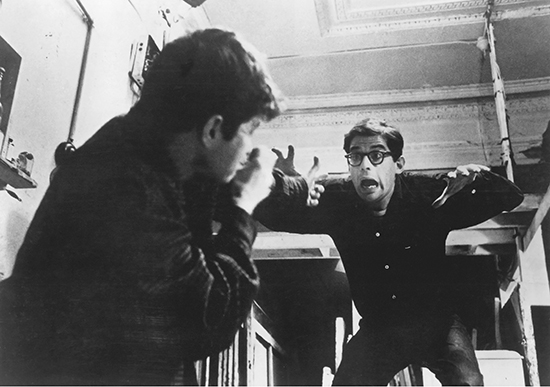
Allen Ginsberg and Gregory Corso in Robert Frank’s film Pull My Daisy (1959) (© Photofest)
{ 5 }
Allen Ginsberg was aboard a merchant marine ship during the summer of 1956 trying to earn money to travel to Morocco. The vessel sometimes anchored close to the Alaskan shoreline, offering Ginsberg views of Eskimos going about their daily chores. His duties were undemanding, and he was delighted watching the ice floes and thrilled to be within a thousand miles of the North Pole. But he encountered turbulence when contemplating his confused reality and Kafkaesque dreams. His beloved and mentally ill mother had died in June while she was confined to the Pilgrim State Hospital on Long Island. “I see a part of my childhood in the grave,” he wrote to a friend in San Francisco, “a piece of my own life gone and the rest surely to go.”1
Such churning of the soul had long been a staple for Ginsberg. It would reach artistic heights in his poem Howl. While Ginsberg was at sea physically and mentally, City Lights Press in San Francisco was readying publication of the slim volume, after many revisions and mishaps by the printer in England. Potential problems loomed in getting the book through customs. For a book born of such deep angst and joyful release, its debut in 1956 was certain to be both controversial and monumental.2
Part of the poem had its public debut on a Friday evening in early October 1955. That night, around 11:00 p.m., Ginsberg was sitting on a toilet when he was called to the Six Gallery stage. The gallery, once an auto parts store, was located in a seedy section of San Francisco. Pulling up his jeans, Ginsberg walked a bit unsteadily, thanks to large amounts of cheap wine—“I was very drunk.”3
Some of Ginsberg’s closest friends were crowded around the stage, ready to participate in what would prove to be a “mad,” historic night.4 Jack Kerouac was sprawled on the floor, drunk and excitable, his back to the stage. Beat muse Neal Cassady, in a brakeman’s uniform with vest and pocket watch, eagerly waited to hear Ginsberg read his new poem in progress.5 Also among the throng were poet Gregory Corso and dancer Yvonne Rainer, along with Ginsberg’s new boyfriend, Peter Orlovsky, and Ruth Witt-Diamant, the doyenne of the Bay Area poetry scene. Kenneth Rexroth, outfitted in what was described as formal pinstripe diplomat garb, bought in a thrift store, served as master of ceremonies. Reading that night as well were poets Michael McClure, Gary Snyder, Philip Lamantia, and Phil Whalen. The audience was studded, McClure recalled, with “anarchists and Stalinists and professors and painters and bohemians and visionaries and idealists and grinning cynics.” By the time Ginsberg stumbled to the stage, everyone present appeared well lubricated with wine, paid for with nickels and quarters that Kerouac had collected.6
Few knew what to expect from Ginsberg—least of all the poet himself. It was, after all, only his second public reading. Ginsberg was of average height, slim, with a thick crop of hair, complemented by his black-framed glasses. By all accounts, Ginsberg started reading slowly but in a clear voice. As the adrenaline kicked in and the booze haze receded, he became animated, “rather surprised by his own power,” waving his arms, reciting the long strophes in extended, breathless fashion.7
As Ginsberg wailed, Kerouac grew boisterous. With eyes closed and head nodding, Kerouac sang out words of approval, repeating phrases as if at a revival meeting. After taking a slug from a gallon bottle of Burgundy, Kerouac started “beating tunes on empty bottles” in time with the lines of the poem. He chanted “Go! Go! Go!” as Ginsberg’s recitation picked up speed and power.8
“I saw the best minds of my generation destroyed by madness, starving hysterical naked,” Ginsberg intoned. With building confidence, he moved into the early part of the poem, each line beginning with “who.” Gasps of shock and delight came from the audience when Ginsberg read: “Who let themselves be fucked in the ass by saintly motorcyclists, and screamed with joy.” More than forty-five times in a row, he chanted the roll call of the “who”—all those who had suffered and frolicked on the hot rim of experience. The images hit hard, striking in their originality, confounding in their meaning: “hydrogen jukebox,” “orange crates of theology,” and “harlequin speech of suicide.”9
The audience “gasped and laughed and swayed,” according to one observer, like participants in an “orgiastic occasion.”10 The crowd was “standing in wonder, or cheering and wondering but knowing at the deepest level that a barrier had been broken.”11
Never before, it seemed, had an audience heard a poem of such vigor, relentlessly detailing acts of sexual perversion, drug euphoria, divine and diseased madness, and sympathy for those forced to the periphery of society. Sweating and triumphant, Ginsberg concluded with a powerful nod toward fellow sufferers of American repression “with the absolute heart of the poem of life butchered out of their own bodies good to eat a thousand years.”12
Rexroth was in tears, emotionally wrung by this poetic bomb blast. Gary Snyder felt that “we had finally broken through to a new freedom of expression,” and come to the realization that “the imagination has a free and spontaneous life of its own, that it can be trusted that what flows from a spontaneous mind is poetry.”13 “The spiritual darkness” had lifted, at last.14
Later, in the indecent hours of the morning, Ginsberg and friends were eating dinner in Chinatown and then getting redrunk at a bar. Lawrence Ferlinghetti, the proprietor of City Lights Bookstore, reportedly sent a telegram that night to Ginsberg, echoing the words of Emerson to Whitman: “I greet you at the beginning of a great career—When do I get the manuscript of ‘Howl’?”15
Ginsberg had no intention in early August 1955 to write a great poem. But the time was right.
In June 1954, after traveling for six months, Ginsberg landed in San Jose, California. The situation was steamy and complex. He was staying with his old pal Cassady and his wife, Carolyn, along with the couple’s children. Things quickly became complicated—the same old “sexual drama” between Ginsberg and Cassady that dated back to 1947.16 After catching the pair in flagrante delicto, Carolyn exiled Ginsberg from San Jose. He relocated to San Francisco, cleaning up his act and working various jobs, even finding a position with a marketing firm.
For some time prior, however, he had been depressed. His twenty-ninth birthday in June 1955 had signaled the end of his youth. He was, as he wrote to Kerouac, dragged down by life, feeling “very unsure of myself.”17 But life soon took some positive turns: he quit his job working for the marketing company and was living off unemployment compensation; his psychiatrist had given him sage advice: that he was a good person, that his homosexual urges were valid, and that he should pursue his desire to be a poet. And he was now in a relationship with Orlovsky, a strange man, at turns childlike and wise.18
In his shabby apartment, situated on a slope at the corner of Montgomery and Broadway, not far from the bohemian North Beach area, Ginsberg began composing Howl. Perhaps he listened to his favorite record, Bach’s Mass in B Minor, or glanced at the Cezanne print on his wall; it had been a summer of delight in both Bach and Cezanne, one a master of form, the other a visionary of relations. In his journal he had announced a desire to emulate Cezanne: “To present to the mind’s eye two equally strong images without editorial or rhetorical connection.”19
“I sat down to blow” is how Ginsberg later described the initial moments of the poem to Kerouac. He planned to doodle around and see what emerged. He marveled at Kerouac, for whom such writing came with ease. A legend in beat circles, Kerouac had been trying unsuccessfully for years to get his novel On the Road into print. Other beats admired his improvisational and jaunty style, as well as his refusal to bow to tradition. Ginsberg had tacked to his wall Kerouac’s admonitions for writers: “Blow as deep as you want to blow”; “Something that you feel will find its own form”; “Remove literary, grammatical and syntactical inhibition.”20
Why not give it a try? Ginsberg thought. With the first sheet of “cheap scratch paper” in the typewriter, he began to type.21 Seven pages of single-spaced poetry were pounded out in a single sitting—the first section of Howl. Later that day, he returned to the typewriter and wrote some of what would become the third section of the poem. Over the next few months, at first in San Francisco and then in a cottage in Berkeley, Ginsberg completed the poem. Although it had begun in spontaneity, Ginsberg carefully revised it over months, giving the poem a more certain rhythm and continuity. Yet he wanted the poem to flash with “eyeball kicks” for the reader, in the manner of a Cezanne canvas.22
Looking back on that initial day of work, Ginsberg stated, “I thought I [would] … just write what I wanted to without fear, let my imagination go, open secrecy and scribble some magic lines from my real Mind—sum up my life—something I wouldn’t be able to show anybody, writ for my own soul’s ear and a few other golden ears.”23
Soon, however, Ginsberg knew that he was blowing something spectacular, with a “point of view,” a “physiological” sense, and confessional, with “a secret that needed to be revealed.24 It was a poem that captured varied aspects of a new sensibility. First, it was confessional; there was little doubt that Ginsberg had shared experiences detailed in the poem.25 Months earlier he had hinted at this possibility in his journal: “I’ll be my own subject matter, / all I know.”26 Second, it oozed excess, the words uncensored, the lines seemingly going on forever. And it dealt graphically with themes of madness, sex, and violence, both in the content and in its images. Much as the poem was about degradation and defeat, it was also about heroism and regeneration. Civil authorities, and some literary critics, would come to believe that Ginsberg had gone too far with this work.
Sometimes like a dark ghost, other times like a lofty angel, madness had long kept close company with Ginsberg. It threatened institutional confinement and shock therapy that would wipe clean his mental slate of creativity. Yet, as historian Jonah Raskin remarks, madness also “was the Beat badge of honor in a world gone insane with bombs and dictators, terror and tyranny.”27 Madness stalked nearly every line of Howl. “I’m with you in Rockland / where you scream in a straightjacket that you’re losing the game of the actual pingpong of the abyss.”28 This was as it should be: no firm line between life and poetry. “Writing must come from your life”; it is about “really looking in the heart and writing.”29
There was his mother, Naomi, once a girlish immigrant from Russia, astir with visions of Marxist revolution. Her first nervous breakdown occurred just before her wedding to Allen’s father, Louis. Over time, she became a bloated and frightened figure, a peekaboo presence in his life. Once she locked herself in the bathroom, flirting with the idea of iodine overdose or razor blade slashes. Confinement to asylums and exile from the family became Naomi’s normal routine. In 1947, Allen had signed the form authorizing Pilgrim State Hospital to have her electroshocked, injected with insulin, and lobotomized. As he phrased it later in his poem “Kaddish,” “I saw her led away—she waved, tears in her eyes.”30 She would function, in the formulation of critic James Breslin, as “the psychotic mother” who became Ginsberg’s “muse.”31
As a young man at Columbia University, Ginsberg had grappled with madness, at least in the view of his advisors and university officials. He considered his displays of oddity and danger as simply experiments in living, pushing the envelope of liberation. During his initial year at college, he had fingered on the dirty glass of his dorm room window the words “Fuck the Jews.” This earned him an official rebuke and expulsion. In 1948, he wrote to Kerouac, “I have decided that I am dead, given up, gone mad.”32
Later, he cavorted with junkies and thieves. His off-campus apartment became a haven for stolen goods and illicit activities. Realizing that, in his words, “My pad is hot,” Ginsberg decided to relocate his personal journals (full of incriminating information, both sexual and criminal) to his brother Eugene’s place in Queens.33 Driving him there in a stolen car were Little Jack Melody (he had done time for stealing a safe), junkie/writer Herbert Huncke, and Vicky Russell (“a naturally bitchy girl”). With Little Jack unsteady at the wheel, a turn was missed. The police were now in pursuit, and Little Jack headed the wrong way down a one-way street, pulling off to the side, careening and crashing. Chaos ensued. Ginsberg scrambled from the car, lost his glasses, and blindly scooped up scattered papers and journals. He escaped on the subway, trying to return home before the police arrived to arrest him. Thanks to a good lawyer, the intercession of bigwig Columbia professors, and his nervous, hangdog apologies Ginsberg avoided criminal charges.34
He was, however, sentenced to eight months at the New York State Psychiatric Hospital, starting late June 1949. His time was spent in intensive analysis and group meetings, playing ping-pong, writing, and becoming friends with another patient, Carl Solomon, to whom he would dedicate Howl. In the third section of the poem, Ginsberg recounted his experiences in the mental hospital with Solomon, who was presumably constrained in a straightjacket.35 Ginsberg learned much from Solomon, especially about French culture. Together they struggled with the burden of genius and the demands of sexual gratification and identity. To Solomon, and all other bearers of the diagnosis of madness, Ginsberg proclaimed his solidarity again and again: “I’m with you in Rockland.” To a degree, however, Ginsberg’s period of confinement in a mental hospital, served as a sort of sabbatical, a time for reflection, for figuring out paths to pursue, and for finding some surcease from the harrowing situations with his mother and friends.36
The results proved mixed. Convinced that he must abandon his homosexuality, Ginsberg entered into a relationship with Helen Parker after getting discharged, losing his heterosexual virginity to her in 1950. He promised himself as well to tone down his rebellious instincts. Both these resolutions would be temporary.
Death and violence loomed large, alongside madness, in Ginsberg’s life and in Howl—and in the lives and work of many creators of the New Sensibility. In the decade prior to Ginsberg’s composition of the poem, his life had felt as if it had been littered with the dead bodies of close friends and family, not to mention the mountain of corpses produced in the Holocaust, Second World War, and Korean conflict. And ever present, in Ginsberg’s mind, was the potential for atomic annihilation. All of this weighed on Ginsberg as he composed his poem and helped form the words “Who created great suicidal dramas on the apartment cliff-banks of the Hudson under the wartime blue floodlight of the moon & their heads shall be crowned with laurel in oblivion.”37
As an undergraduate at Columbia, Ginsberg was part of an edgy coterie: the strikingly beautiful and habitually bored Lucien Carr; the handsome, athletic, and artistically talented Kerouac; and the drug-addled and slyly sinister William Burroughs. David Kammerer, an older homosexual acquaintance of Carr’s from Saint Louis, arrived in the city one day in 1944 and became part of the group. Mainly, he was desperate to win Carr’s affection. Kammerer failed miserably, and, according to some accounts, he tried to impose his drunken desire on Carr during a hot August night in Riverside Park. Carr stabbed Kammerer to death and dumped his body into the Hudson River. Kerouac helped dispose of the bloody blade.38
Death struck again and again in Ginsberg’s circle. His friend Bill Cannastra perished on 12 October 1950. He was on a subway train with friends, apparently in good spirits. In one account, Cannastra suddenly decided to climb out the window of the train to get back to the station to go to some nearby bar. Carr offered a different view, stating that Cannastra had simply, and stupidly, stuck his head out the window in a daredevil manner and struck a pillar. An afternoon paper was headlined: “Loses Last Gamble for a Drink.” Ginsberg concluded later that day: “It was not apparently a fully conscious suicide.” The night before, at the San Remo bar in Greenwich Village, Cannastra had told Ginsberg that he was “coming to an end.” Cannastra had been dealing with his homosexual inclinations and his budding love for a woman, as well as with his depression and drinking. Perhaps Ginsberg saw in Cannastra—“head carnaged after sunset”—his own image and his own generation. He had certainly entertained his own thoughts of suicide, pushing them aside and curtly commenting: “Curiosity is the only thing that keeps me from suicide.” A few years later, he acknowledged more maturely that the time had come to jettison the “chaotic element which is ultimately death-dealing.”39
The “death-dealing” nature of “chaotic,” drunken, and drug-infested lives hit home again a year later. Joan Vollmer, a mother figure of sorts to Ginsberg, was killed in Mexico in September 1951 by her husband, William Burroughs. It was a most absurd death. Accounts of what happened vary, but the most common one is that they were both inebriated as Burroughs fired his. 38-caliber revolver to demonstrate his keen marksmanship by shooting a tumbler off Joan’s head. He missed, and she was killed in an instant. Although indicted, Burroughs was able to flee Mexico and, in the end, receive a wrist-slap two-year suspended sentence for involuntary manslaughter.40
The trail of blood and violence in young Ginsberg’s life was reflected in Howl, as was the violence of the society at large. John Clellon Holmes, a novelist, remarked that the beats were the first generation to come of age under the cloud of atomic annihilation—“the final answer to all questions” (see chapter 11).41 Ginsberg’s poetry prior to Howl was focused on images of apocalypse (influenced here by William Blake) but also composed after the Soviet Union had detonated its own atomic device in August 1949. Most notably, in the poem “Siesta in Xbalba” he combined imagery from the New Testament with more up-to-date political realities. Speaking of the United States, Ginsberg imagined “detonation of infernal bombs” which led to “the silent downtown … in watery dusk submersion.”42
Nuclear-weapon metaphors energized Howl, most famously in the description of “angel-headed hipsters” who were “listening to the crack of doom on the hydrogen jukebox.” This was one of many examples of Ginsberg’s use of the surrealist technique of abrupt juxtaposition. But the image is haunting because it connects the liveliness of music with the destruction of the world. Later in the poem, he returns to the term “hydrogen,” writing of the evil, “vast stone of war” that is Moloch, “whose fate is a cloud of sexless hydrogen.” Moloch destroys not only through war but also through the voraciousness of capitalism, the repression of freedom, and the creation of fear.43 Moloch, an evil God-king in the Old Testament, had reputedly demanded the sacrifice of children. In Milton’s poem, Paradise Lost, Moloch was a fallen angel, waging war against God. In either case, he was a grim figure. While Ginsberg associated Moloch with evil, he also, in a manner, identified with him (if not explicitly in the poem) as revolting against the Father of staid, traditional poetry.44
Ginsberg’s specific vision of Moloch was partly inspired by a nighttime view of the Sir Francis Drake Hotel in San Francisco, under the influence of peyote—“Moloch Moloch smoking in red glare downtown … with robust eyes and skullface, in smoke.”45 After this vision, Ginsberg “wandered down Powell Street muttering, ‘Moloch, Moloch’ all night,” before settling into an all-night cafeteria to write the Moloch section of the poem “nearly intact … deep in the hellish vale.”46
Moloch, embodied by the high tower with its pulsating lights, became a powerful, incantatory device in the poem, summoning forth all that Ginsberg disdained: materialism, conformity, numbing rationalism, love denied; it is the eruption of warfare, “whose fingers are ten armies!” It is cold death and living evil.47
Like Marlon Brando in the role of Johnny, Ginsberg in Howl was rebelling against much of what American culture and society “got” in the early 1950s, with bravado and excess. Ginsberg had seen The Wild Ones prior to composing his poem. Repression, in the service of conformity, had imprisoned him and his friends in jails and mental institutions and pushed them to suicide and depression. For Ginsberg Moloch was enforced conformity and death.
A year before Ginsberg composed Howl, the issue of conformity in America was being hotly debated among intellectuals, from both left and right-wing perspectives. Irving Howe wrote a piece, “This Age of Conformity,” for the highbrow publication Partisan Review. His subtitle was “Notes on an Endless Theme, or, A Catalogue of Complaints.”
Howe’s particular bugaboo was mass culture. He claimed it lowered standards and promoted conformity. He feared that intellectuals had succumbed to its siren song and thus lost their critical edge. The natural stance of the intellectual, he argued, was to be alienated from society rather than from one’s self. Too many of his fellow intellectuals, now that they had jettisoned the radical politics of the 1930s, had drifted into a lifeless conformity. The only hope, it seemed, was for a new, critical avant-garde to challenge the Moloch of conformity.48
From a more conservative perspective came a similar critique of conformity. Alan Valentine, who had once won Olympic gold as a rugby player and served as the youngest president of the University of Rochester in its history, weighed in with a book, The Age of Conformity (1954). Like Ginsberg, albeit without poetic vituperation, he condemned American conformity for its materialism, diminution of individualism, vulgarity, salaciousness, spiritual vacuity, fanatical tolerance, disdain for tradition, and the ignorance of the public.49
Ginsberg agreed with many of Howe’s and Valentine’s complaints about the numbing effects of materialism and conformity. To oppose conformity, to rail against the bourgeoisie, of course, had long been a staple, even a requirement for avant-garde, indeed for radical and conservative opponents of the status quo. For self-conscious avant-gardists like Ginsberg and his comrades, craving a new sensibility, they wanted to toss away bourgeois constraints and bring forth a “bop apocalypse.”
Ginsberg went well beyond Howe’s calm, traditionalist avant-garde stance through his allegiance to spontaneity in prose and embrace of excess. Against Valentine’s clear dismissal of the salacious, Ginsberg embraced eroticism and sexual liberation as holy. He wrote of those “who let themselves be fucked in the ass by saintly motorcyclists and screamed with joy,” and he announced further, “The bum’s as holy as the seraphim! the madman is holy as you my soul are holy!”50
Howl was also a Whitmanesque ode to the joys of sexual activity, in its wild variety and uninhibited freedom. In the years prior to composition of the poem, Ginsberg had been an explorer—engaging in masochistic, occasional sex with Cassady, shadowy sex in subway bathrooms with strangers, and intercourse with a few women. In a sense, Howl is a confession and cataloging of the varieties of the sexual experience that hit prudish America right in the gut, or maybe a bit lower anatomically.
The poem was a roadmap of the homosexual underworld. In contrast with Cage and Rauschenberg, who kept their homosexuality under wraps or practiced silence in their works of art, effacing the personality, Ginsberg went the opposite route, big time. Masturbation, homosexuality, anal sex, pederasty, blow jobs, and more are mentioned and celebrated. Ginsberg takes his reader on a tour of sexual delights (which are all too readily repressed by conformist authorities): to “a Turkish Bath when the blond & naked angel came to pierce them with a sword;” “who blew and were blown by those human seraphim, the sailors, caresses of Atlantic and Caribbean love;” of those “with dreams, with drugs, with waking nightmares, alcohol and cock and endless balls.”51
All of this, Ginsberg proclaimed in his “Footnote” to the poem, was “holy.”
Holy, Holy, Holy.
Howl was a revelation to those hankering to break from academic strictures about proper poetic form and content and for those yearning for a model of rebellion. Novelist and chronicler of the Greenwich Village scene Ronald Sukenick labeled Howl “a call to consciousness” against what he termed the “flat fifties.” Poet Diane di Prima believed that the poem signaled that “a new era had begun” by veering sharply away from the erudite and constrained toward “the language of the streets.” “My life changed overnight,” recalled Ed Sanders, later to be part of the rock/radical group the Fugs, when reading Howl soon after its publication.52
Not all readers were enamored. John Hollander, an undergraduate acquaintance of Ginsberg at Columbia, now beginning his climb up the ladder of academic poetry and criticism, savaged Howl. In Partisan Review Hollander castigated Ginsberg’s “utter lack of decorum of any kind in this dreadful little volume.” The poem’s confessional style—and its recounting of the horrible lives of his compatriots among the beats—dismayed Hollander. A “hopped up” and “improvised” method had led astray an otherwise talented young poet. Lionel Trilling, Ginsberg’s former professor at Columbia and perhaps the leading man of letters in the United States in the mid-1950s, dismissed the poem as “all rhetoric without any music.” Trilling indicted Ginsberg for striving self-consciously and dully “to be violent and shocking.” Trilling, who had thrived in academe despite anti-Semitism, lived in a shell of restraint and refinement, hiding in his personal journal a desire to escape, to feel more and analyze less. Perhaps his vituperation against Ginsberg masked some of his own inner tensions, but he unkindly closed his criticisms of Ginsberg with the absurd proclamation that “there is no real voice here.”53
Ginsberg responded to Hollander at great length, explaining patiently and pedantically about his methodology, long strophes, “surrealistic imagery,” and more. He maintained that the poem was “built like a brick shit house.” About their former professor, Ginsberg jibed that Trilling had a “tin ear” and was “absolutely lost in poetry.” Howl was a broadside against constipated tradition, resting comfortably and confidently in both its excess and subject matter.54
In a sagacious letter to his lawyer brother, Eugene, while the manuscript of Howl was being printed in Europe before shipment to America, Ginsberg wrote, “I use cunts, cocks, balls, assholes, snatches, fucks, and comes liberally scattered around in the prosody.” He asked, “Know a good lawyer?” He would soon need one.
On the evening of May 21, 1957, San Francisco undercover police inspectors Russell Woods and Thomas Pagee entered City Lights Bookstore. They purchased a copy of Howl and a copy of the avant-garde journal The Miscellaneous Man. The collector of customs for San Francisco had earlier that spring seized copies of Howl, explaining that it was a book “that you wouldn’t want your children to come across.” But when challenged by the American Civil Liberties Union and examined further by the United States attorney for San Francisco, the copies were released for distribution. A week later, however, after due consideration of the book by San Francisco’s Juvenile Division, two undercover police officers arrested bookstore clerk Shigeyoshi Murao for selling the book. A warrant was issued for the arrest of Lawrence Ferlinghetti, the owner of City Lights Bookstore and publisher of Howl. No charges were filed against Ginsberg, who was at the time aboard that merchant marine ship somewhere near the Arctic Circle.55
Prior to leaving the continental United States, Ginsberg, along with poet Gregory Corso, had been at a party in Los Angeles. About seventy-five people were present, including Anaïs Nin, the bewitching memoirist. Someone began heckling Corso during his reading. A drunken Ginsberg, for unknown reasons, challenged the heckler to disrobe. Then, to his own “great surprise,” Ginsberg opted to do so himself. He reveled in his liberating nakedness; the audience squirmed with embarrassment. He put his clothes back on and then read from Howl.
While this might appear as a silly, drunken eruption, it indicated the direction in which the emerging New Sensibility was headed. Part of what made Ginsberg central to the moment was his performative style. His content—confessional, confrontational, surging with eroticism—was controversial enough. But in his Six Gallery reading and subsequent ones, he delivered the poem with emotion, straining for effect and rhythm, transforming poetic diction and decorum. Certainly, his wanting to perform Howl naked was revolutionary, collapsing the presumed distance between poet and poem, performer and audience.56
Following service in the merchant marines and after trips to Mexico and then New York City, Ginsberg traveled to Tangier, where he was to reside while the obscenity trial played out. He tried to follow the proceedings closely and to serve as distant cheerleader: “I wish I were there; there could really, we could really have a ball and win out in the end inevitably.” Always savvy as a publicist and promoter, Ginsberg, no less than Ferlinghetti, understood that the legal case would generate publicity for Howl and pump up sales, which it did.57
It was an auspicious time for the legal proceedings. In a major Supreme Court case, Roth v. United States, Justice William Brennan’s majority opinion had laid out new rules for what might constitute obscenity. The “Brennan doctrine,” delivered in April 1957, was a landmark decision for freedom of expression. According to Brennan, material could not be considered obscene simply because it contained dirty and upsetting words. Rather, these words must be understood in the context of the entire work. Moreover, the ruling dealt with intent: Were the offending words and the work overall aimed to excite prurient interests? If not, then the work was legal. Finally, if the work possessed literary merit, it was not obscene.58
The ruling, at least in theory, changed the playing field. Many of the classics of literature, James Joyce’s Ulysses, D. H. Lawrence’s Lady Chatterley’s Lover, Edmund Wilson’s Memoirs of Hecate County, as well as works by Henry Miller, had all earlier been judged obscene in court cases. Despite the Supreme Court ruling, resistance continued against some expression. Local police officials would continue to prosecute novelists, comedians such as Lenny Bruce, films such as Jack Smith’s Flaming Creatures, and more. The New Sensibility, with its focus on erotic excess (at least in the view of moral custodians) remained well into the mid-1960s an affront to standards of decorum and moral values. But by then such works were being produced in seemingly unstoppable profusion.
The case against Howl was argued in the courtroom of Judge Clayton W. Horn. The defense waived the right to trial by jury, opting to let Horn decide the case. Horn was a conservative Republican who also taught Sunday school. But, as it turned out, he was fair and considerate.
With the help of a legal team gathered by the American Civil Liberties Union, led by criminal attorney Jake Ehrlich, the defense had a rather easy time of it. The argument was that while particular words might be obscene, their presence in the work was artistically necessary and valid. This was also the view of the United States Supreme Court, as Ehrlich lectured Horn: “Some people think that certain four-letter words in and of themselves destroy mankind from a moral standpoint. This, of course, is not the law.” And, he added, “The court must construe the book as a whole.”59
The defense trotted out some impressive witnesses. Each attested to the literary value of Howl. University of California literary critic Mark Schorer noted that some of the offensive words were common as “language of the street” and “absolutely essential to the esthetic purpose of the work.” He also found a stirring critique of materialism, conformity, and militarism at the heart of the book, rendered in surrealist fashion. Also testifying on behalf of Howl was Walter Van Tilburg Clark, the Pulitzer Prize–winning novelist who wrote The Ox-Bow Incident. Kenneth Rexroth, the poet who had emceed the Six Gallery reading, further hailed the poem.60
Prosecutor Ralph McIntosh was outgunned from the start. He admitted to lacking a poetic sensibility, but he maintained repeatedly that the book was obscene simply because it contained dirty words and “lewd passages.” He often asked witnesses for the defense to explain “obtuse” passages for him, content to rest his case on the poem having dirty words and being difficult for a layman to understand.61
McIntosh offered witnesses to condemn the work. The first admitted that the work had “literary value,” albeit “negligible” literary value. Gail Potter, who identified herself as a teacher, was more assured: the work had “no literary merit” since it lacked “form, diction, fluidity, [and] clarity” of style. She was offended and upset that it had words that belonged in the gutter.62
On October 3, 1957, Judge Horn issued his ruling clearing Ferlinghetti (charges against his assistant Murao had already been dropped). Relying on the Roth decision, Horn had no choice but to find the book not obscene. For a work to be censored, the Judge announced, it had to do a lot of bad things—intend to “deprave or corrupt readers by exciting lascivious thoughts or arousing lustful desires” that would actually lead to “anti-social or immoral action.” The offensive words in any book had to be considered in light of the work as a whole. And those words, “even if coarse and vulgar,” must be allowed when the work in question had literary merit. Before dismissing the case against Ferlinghetti, Judge Horn quoted the French motto “Honi soit qui mal y pense” (Evil to him who evil thinks).63
The evil Moloch of censorship, at least in this case, had been vanquished. But new challenges to the status quo, in this case in the frenzied form of rock and roll, soon erupted.