
[15] Chapter 1
Everything is what it is, and not another thing.
Bishop Butler, Fifteen Sermons Preached at Rolls Chapel
To say that a painter expresses the ethos of a religious body does not imply determinism or essentialism. Rather, it means that the structure of the order and its practices have the ability to produce certain persistent outcomes due to their commitments and aims. Examining the personalities of Filippo Neri and Federico Barocci and the characteristics of the Oratorians reveals a structure that can account for patronage decisions and artistic choices. Following a materialistic methodology allows a focus on material practices and relations. The more materialistic these are, and the more they are based in the actual historical record, the easier it will be to make meaningful statements about Neri, the Oratorians, or Barocci. In the end the contrast between Jesuits and Oratorians becomes clear.
Looking at the personalities and traits of Filippo Neri, the founder of the Congregation of the Oratory, and Ignatius of Loyola, founder of the Society of Jesus, leads to interesting conclusions about the emphasis and commitments of the two contrasting groups. When it comes to each group’s visual rhetoric, the Oratorians’ focus on direct, uncognized grace and the Jesuit focus on rhetorical description and adornment led the Oratorians to focus their artistic commissions on altarpieces, in contrast to the Jesuit focus on elaborated ensembles of decoration. These different foci explain the Oratorians’ fixation of interest upon the affective potentiality of the altarpiece form.
[16] The Late Sixteenth Century in Italy
The quarter century from 1582 (the year of the commission of the Visitation) to 1608 (the delivery of the Institution of the Eucharist) was indeed an active period in Roman church history. These are the years of the appearance of what is called the Church Triumphant, the post-Tridentine church full of confidence. There is good reason to regard the papacy of Sixtus V (1585–90) as a turning point of the Catholic Counter-Reformation and therefore of a new attitude to religious imagery—an attitude that was essentially carried on by his successor, Pope Clement VIII (1592–1605).1 The papacies of Paul IV (1555–59), Pius IV (1559–65), Pius V (1566–72), and Gregory XIII (1572–85) had been marked by indecision, dissent, and defensiveness. The severity of Paul IV officially supported the counter-maniera and saw the near destruction of Michelangelo’s Last Judgment. His successor, Pius IV, revived the Council of Trent and oversaw the moderate reform of the church. At the end of his papacy, however, the Netherlands saw its largest period of iconoclasm (1566). Under Gregory XIII, momentum was gaining for a confident offensive to Protestantism, despite setbacks like the Calvinist conquest of Antwerp (1581).
In the year Sixtus V assumed the papacy, 1585, Philip II regained the Spanish Netherlands and ejected the Calvinists. Religious images both there and in Rome survived and lived on, and Sixtus wanted to make that fact well known. He loudly proclaimed his position on images in several Vatican commissions (the Scala Santa, the Sistine Chapel of Santa Maria Maggiore, the Biblioteca Sistina).2 These commissions continued a trend, however, where the exigencies of content won out over manual coherence and refinement. They announced the message of the Church Triumphant, but did not necessarily clothe it in a complimentary form. This task would fall—at least until the pontificate of Clement VIII (1592–1605) and the decoration of Saint Peter’s and the Lateran—to the traditional altarpieces adorning individual chapels in the churches of the new religious orders of regular (Jesuits, Theatines, etc.) and secular (Oratorians) clerics that began to be founded in the sixteenth century.
Sixtus V Peretti was a Conventual Franciscan from the Marches. He adopted the name Sixtus in emulation of Sixtus IV della Rovere, the general of the Conventual Franciscans, defender of the Virgin, and founder of the Urbino dynasty of della Roveres.3 Sixtus provided the benevolent atmosphere in which these reform orders thrived. He had promoted the Franciscan reform movement of the Capuchins (so important for Barocci’s development in Urbino) and befriended their saintly leader Fra Felice da Cantalice (1515–87). Significantly, both Capuchins and Theatines were still in the grip of reformist asceticism (Santa Maria della Concezione would not be begun and decorated until 1626 and Sant’Andrea della Valle, [17] until 1608) so the churches of the Jesuits and Oratorians took the lead in pioneering Counter-Reformation decoration.4
Ignatius of Loyola founded the Society of Jesus in 1540 and its church, the Gesù, was already built by 1575 (it was begun by Vignola in 1568 and seen to completion by della Porta in 1575).5 Similarly, the Congregation of the Oratory led by San Filippo Neri had been given Santa Maria in Valicella in 1575, which was substantially rebuilt by Martino Longhi in 1582 and subsequently referred to as the Chiesa Nuova.6 Although the Jesuits had a head start in the construction of the church, the Oratorians did their best to quickly set up altars with altarpieces, in some cases preceding those set up at the Gesù.
In conformity with the Council of Trent, both Jesuits and Oratorians exerted a new control over interior church design, conceiving their decoration as a program.7 The altar dedications were fixed, and had to be accepted by the patron. Under Alessandro Farnese’s protection, the Gesù pioneered Counter-Reformation church design with its wide nave and large transept arms. Like the Gesù, the Chiesa Nuova also began under Farnese’s influence but perhaps due to the intervention of the new patron, Cardinal Pierdonato Cesi (1522–86), and his architect Giacomo della Porta, it came to look like the Congregation’s former home (and site of della Porta’s earlier work), San Giovanni dei Fiorentini.8 Unlike the Gesù, where Farnese’s princely tastes dictated much of the decoration, the Chiesa Nuova was ruled by corporate decision and therefore more contemplated choices. The result in the Gesù was a great stylistic plurality that the Chiesa Nuova seemed to avoid by the sheer quality of its altarpieces commissioned by the best artists in Rome and abroad.
The Gesù pioneered a cross-nave pairing of nave chapels, where the left-hand chapels saw their fulfillment on the right; thus the Chapel of the Apostles is paired with the Chapel of the Martyrs, the Chapel of the Infancy of Christ is paired with the Chapel of the Passion, the Chapel of the Trinity is paired with the Chapel of the Angels, and the Chapel of the Crucifixion is paired with the Chapel of the Resurrection. The Chiesa Nuova is slightly different, owing to its inspiration in the mysteries of the Virgin. It carries on a more traditional chronological program, but maintained the possibility of cross-nave pairing. It is a counterclockwise wraparound pattern beginning in the left transept, wrapping around the church, and ending at the right transept, evoking older monastic orders.9
The entire theme is Mariological but ingeniously typological and is further discussed in chapter 2. For example, on the left side of the nave going toward the high altar, the Annunciation succeeds the Presentation of the Virgin in the Temple. Nevertheless, like the Gesù, the same scenes have cross-nave pairs. The Annunciation foreshadows the Assumption of the [18] Virgin, and the Presentation of the Virgin in the Temple foreshadows the Coronation of the Virgin. Thus, just as in the Gesù, it is possible to conceive of chapel design in pairs, an idea that will play an important part in the following discussion.
The Oratorians in particular placed characteristic demands on the works that would adorn their chapels. For example, in 1583 they asked Scipione Pulzone to send a cartoon (cartone) of his work to see how it would look in situ in the Chapel of the Crucifixion (1R).10 They also had some control over which artist was picked; in an example discussed below, the patron was given a choice between two artists. Earlier scholarship regarded the artists of the Chiesa Nuova as so many famous men (Barocci, Caravaggio, Rubens) and we can add to this picture more recent views that see an underlying affectivity common to the various works, in spite of their differences.11 Of these artists, the most successful in obtaining Oratorian patronage would of course be Federico Barocci.
Federico Barocci of Urbino
Barocci was the artist who came to be central to the Oratorians’ aesthetic. But historiographally he is also often linked to another aesthetic: the Baroque. We have already discussed the theoretical status of style terms like “Mannerism” and the Baroque is no different. By way of discussing Barocci and his contribution to seventeenth-century Italian art it will be possible to clarify the freight we expect style terms and labels to carry.
Federico Barocci was born in Urbino to a prosperous family of craftsmen. Since the emigration of his great-grandfather Ambrogio from Milan to work as a sculptor and architect at the court of Federico da Montefeltro, the Barocci increasingly wove themselves into Urbino civic life. Like many former communes in northern Italy, Urbino had an extensive bureaucracy of offices. This was a time of social mobility, as wealthy merchants gained patents of nobility, and this allowed them to occupy these offices and serve on the town council. Some artists were even enfeuded with lands for their long service. The result is that, while Barocci’s ancestors were by no means peers of the ducal house and other lesser aristocrats within the duchy, they were entwined with it in a mutually beneficial way. Each generation found a way to serve their trade and the reigning duke, and anxious patronage seeking was absent.12
It would perhaps be too aggressive to state that Barocci’s exquisite style had a ring of the aristocratic to it. Perhaps more accurate is to say that he inherited the precision of his clock- and instrument-making father and cousins, and his personal talent and individual compulsion to search after perfection produced paintings that were both effortlessly beautiful [19] and of the finest craftsmanship. It is easy to say that they have an air of confidence with their aristocratic quality. Barocci’s famous portrait of Prince Francesco Maria II della Rovere (1571, Galleria degli Uffizi, Florence) victorious on his return from the Battle of Lepanto stylistically mirrors the easy authority of the prince himself.
Federico Barocci naturally found commissions around Urbino but he could not avoid the “state religion” of Franciscanism. Saint Francis, from not-too-far-away Assisi, had performed a major miracle in Gubbio—pacifying the wolf that was terrorizing the city—and generations of Franciscans dominated the city of Urbino. The reigning ducal family was extremely devoted to the Franciscans.13 Closer to Barocci’s time, the Capuchin movement was taking off and several of its leaders were from the Marche region. Coupled with the vicinity to the Holy House of the Virgin in the nearby city of Loreto, emphasis in Urbino was placed securely on Marian devotion.
There is an interesting coincidence of the announcement of the maturity of Barocci’s style with Capuchin patronage or, more accurately, gratitude. The Madonna of Saint John of ca. 1565 was occasioned by Barocci’s recovery from a poisoning that occurred in Rome, after he convalesced with the Capuchin friars outside Urbino. In gratitude, Bellori tells us, he presented this painting to them as an ex voto. In the painting, Saint John, holding a chalice with the poisonous snake, gives thanks to the Virgin, in the way that Barocci would.14 The painting shows remarkable artistic maturity gained from Barocci’s absorption of the Roman art scene in two prior trips and the digestion of various influences, new technical procedures, and even, perhaps, the reading of Leonardo da Vinci’s Trattato della pittura.
An old theory that Barocci was a Franciscan tertiary has been debunked. Barocci was no friar-artist, but his abandonment of the competitiveness of Rome in favor of his patria, his commitment to religious subjects (he only produced one prominent secular work in his career, The Flight of Aeneas from Troy for Emperor Rudolf II), and the fact that he remained a bachelor his entire life, nominate him for special status. In a society increasingly valuing the disposition toward piety of its artists, few could compete with the nonworldly (nevertheless highly sophisticated) Barocci.
Barocci’s subsequent career is dominated by works for mostly Conventual Franciscans and the allied Capuchins. Capuchins were the reforming bodies, nominally allied to the Conventuals, and were championed by Barocci’s patron Cardinal Giulio Feltrio della Rovere. Shortly after painting the Saint John, Barocci painted a Madonna and Child with Saints John the Baptist and Francis (ca. 1567, Pinacoteca di Brera, Milan) for the friars of Fossombrone.15 Around the same time, Barocci painted the Madonna of Saint Simon for the Conventual church of Urbino, San Francesco (1566, Galleria Nazionale, Urbino).16 Barocci [21] went on to paint two more paintings for this church, the Immaculate Conception (mid-1570s, Galleria Nazionale, Urbino)17 and the painting for the high altar, the Perdono di Assisi (1576, in situ).18
Numerous other commissions could be cited but suffice it to say that Franciscan and Capuchin belief provided the background to Barocci’s native Urbinate spirituality. The emphasis is squarely on Francis and the passion and the imitation of Christ through stigmatization, but there is also a strong Marian element that takes for granted Mary’s immaculacy and her status as co-redemptrix. There is also an emphasis on otherworldly vision, which became a hallmark of Barocci’s work, as he pioneered depicting saints—beginning with Francis in the Perdono—in a state of rapt communion with God.
It is useful to discuss visionary iconography, not only because of its importance for seventeenth-century art but for Filippo Neri’s own hagiographic self-fashioning. Following important prototypes well known to Barocci, the painter transformed them into a formula usefully summarized by David Ekserdjian: “what Barocci does is to combine both these elements [physical and spiritual isolation] in a new kind of altarpiece, in which a single saint below on earth is represented in a state of ecstasy as a result of some celestial inspiration…their importance for the art of the next century would be hard to over-estimate.”19
It is really two later works that established Barocci’s unique approach to visionary experience, the Madonna del Rosario and the Beata Michelina. The dual iconography of the Madonna del Rosario is partly explained by its patronage.20 Commissioned by the Senigallia Confraternity of the Rosary and the Assumption, it treats Dominic on a mountaintop receiving the rosary from a remarkably treated Madonna. Barocci’s challenge is to find a formal analog to Dominic’s spiritually privileged station and experience.21 It is in the Cristo vivo and especially the Beata Michelina that Barocci stretches the formal possibilities available to him to show a saint gazing heavenward with impossibly elevated pupils.22 These exemplars were directly known to Guido Reni, who definitively established Neri’s iconography in his 1609 portrait (fig. 1.1).23
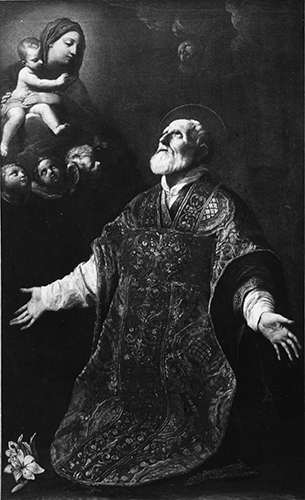
[20] Fig. 1.1: Guido Reni, Saint Filippo Neri in Ecstasy, 1615, oil on canvas (Biblioteca dell’Istituto centrale per il catalogo e la documentazione).
In this context of institutionalized Marianism, mutually reinforced by the local strength of the Franciscans and patronage of the ducal house of the della Rovere, it is interesting to note that the reigning duke, Francesco Maria II, indicates that he read the entire Bible for the second time in 1598, utilizing the commentary of Denys the Carthusian (1402–71).24 [22] Such an author was not so popular in Italy in that day. Instead, this author was more popular in German and Spanish-speaking lands with a strong mystical tradition. Anticipating our discussion of illuminism in Spain, it is suggestive that Ignatius of Loyola read Carthusian authors, including Denys, when convalescing.25 Coupled with the fact that the Duke of Urbino spent a couple of formative years at the royal court of Madrid, we begin to get a picture of pious and very personal devotion that took for granted an exalted status for Mary. Such ideas are quite close to the animating core beliefs of Filippo Neri.
Christian Optimism
The Oratorians intuited Barocci’s style and their delight would only be enhanced after the delivery of his first picture. There are many pitfalls to identifying an artist with an order (or group), but it is clear that the Oratorian sensibilities resonated with Barocci’s work. Of course, this must relate to the way in which Oratorians constituted their own “norm circle,” and from those shared values (which overlapped with others, with the same individuals) endorsed and enforced behavior. In the case of artistic patronage, these values provide the basis for the artistic brief to follow.
As a convenient umbrella concept that is the most comprehensive for Oratorian belief and thought, there is no better term than “Christian optimism.” This is one of the most fruitful and maddeningly vague terms for discussing the art produced for the Congregation of the Oratory in Rome—the Oratorians.26 Cardinal Agostino Valier coined the phrase “laetitia christiana” and during Neri’s lifetime applied it to Neri’s personality in his Philippus: Dialogus de laetitia christiana.27 Subsequently, this term became the leitmotif for describing Neri’s personality in his official biographies by Father Gallonio (1600) and Father Bacci (1622). The stories about Neri’s devotion to art, especially the famous account of his praying before Barocci’s Visitation of the Virgin and Saint Elizabeth (plate I) in the Chiesa Nuova, immediately suggest the application of the quality to the art itself. This concept then would encompass not only Barocci’s two paintings but other paintings, as well as the famous recitative dramas produced by the Oratorians.28
For decades the notion of Christian optimism has mixed with other notions about the aesthetic sensibility, aristocracy, and overall high quality of art patronized by the Oratorians, usually at the expense of the Jesuits, with whom they are habitually compared. Our [23] review of recent debates on Jesuit patronage and whether there ever existed a Jesuit style provide an ideal point of departure for what has been written on Christian optimism.29 There is an important difference between Oratorian and Jesuit ideas that emerges along several lines—touching theology, sacred rhetoric, and visual rhetoric—and principally along the lines of the content of Christian optimism.
Using an approach based on visual rhetoric makes it possible to underscore concepts that help organize elements about visual arts, namely fatica and quiete. San Filippo Neri had an intensely personal and ecstatic approach to prayer. This approach has been recognized as an inspiration of quietism, the passive approach to prayer and will that was condemned by Jesuits and finally by the Catholic Church in the seventeenth century. The notion of quiete, which underlies the movement, signifies both silence and stillness. The 1675 Guida Spirituale of Miguel de Molinos (1628–96) was the founding document of quietism and stressed a passive giving-over to God.30 Quiete was not only passive enlightenment but also, in placing one’s hands in God, a relinquishment of moral responsibility. The theory was developed further by a member of Neri’s Congregation of the Oratory, Pietro Matteo Petrucci, and then condemned by the Jesuit Paolo Segneri in a work that questioned the harmony between fatica, effort, action, and the word, and quiete, rest, inactivity, and silence.
This brief clash between Oratorians and Jesuits can serve as an enlightening axis of concepts, alternating between quiete and fatica, and can ultimately help illuminate Christian optimism. Although quietism did not emerge as a movement until the later seventeenth century, the Jesuits had already attacked the position of Michel de Baye (Baius) of Louvain that emphasized the sufficiency of divine grace, and the Spanish Jesuit Luis de Molina had already enunciated a strong voluntarist position in 1588 in Neri’s lifetime.31 Reflecting on the balance of divine grace and free will in determining human predestination, Molina strongly favored the latter. This aggressive stance, strongly contrary to Calvinist and reformist approaches, upset the long-standing consensus set down by Thomas Aquinas. Such ideas held by Jesuits emphasized the urgent need of free choice for human salvation and well served their idea that “God’s grace was efficacious only or especially through man’s collaboration on earth,” reflected both in their active proselytizing and in their religious iconography.32
Interestingly, one finds abundant evidence that the focus of the Oratorians was often of a private nature, emphasizing personal prayer and meditation. In general, saints express their moral authority through humility, ascetism, and fasting. They express their power [24] through their special access to miracles and visions.33 This might sound like any recipe for sainthood, and indeed Neri was canonized in 1622, but these traits were more than a human veneer over a saintly interior. Of most interest to understanding Oratorian spirituality are those elements of personal communion with God. Neri’s very trademark of religious enlightenment was not particularly dramatic; in the midst of his mental prayer he was often found in ecstasy. These altered states lasted for up to an hour and the proof of the saint’s holiness no longer lay in his imitable actions or sagacious words, but in a lack of action and rapt silence, quiete as opposed to fatica. In his famous painting, Guido Reni precisely depicts Neri (see fig. 1.1) in a state of ecstasy as the Virgin miraculously appears to him. (Indeed, we could imagine that he is sitting before Barocci’s Visitation.)
It is important to point out that Neri on a stool in the Chapel of the Visitation occurs outside the mass, outside of preaching. It is a part of Neri’s spirituality, not a part of any official function. In the same way that extreme (Dominican) predetermination might appear to verge on Calvinism in its annihilation of good works, ecstasies could also be suspect for, as in the case of the suppression of the alumbrados in Spain, they left the believer in isolation and make no reference to the activity-based sacraments.34 In this regard, it is interesting that Filippo Neri was a close friend of the charismatic Capuchin Fra Felice da Cantalice.35 Because of the spectacular apostasy of its leader, Bernardino Ochino, earlier in the sixteenth century, a shadow of heresy hung over the Capuchins, who would not be recognized officially until 1619. No wonder that the Oratory (not to mention the Society of Jesus and other groups) came under periodic suspicion in its early years.36
The lack of action and speech was conspicuous, and would later become an issue when the quietism propounded by an Oratorian was condemned in the seventeenth century. More importantly, the inactive Neri was also the silent Neri, and both word and act were halted in ineffable ecstasy. Scholars have shown how holy women, because they could not study theology, were more subject to suspicion by the church. Neri may have been subject to the same scrutiny because of his lay and indeed feminine religiosity. Oratorians never became great theologians, exploring instead, as did Baronio, the netherworld of church tradition, where practices and tradition could supplant dogma.
In fact, it was an Oratorian, Cesare Baronio, who, upon the invitation of Pope Clement VIII, stepped into the furor as part of what became known as the Congregatio de Auxiliis to offer a strictly orthodox viewpoint.37 Although the controversy could not be resolved for many years—successive popes forbade debating of the respective arguments—Baronio’s nondoctrinaire vision of relative passivity is interesting. Regarding the differences between [25] Dominicans and Jesuits as almost inevitable, he refers back to Saint Augustine’s authority to clarify the issue. Neri’s sympathy with Dominicans has often been pointed out and here his quietist leanings would probably have extended to a belief compatible with the Dominicans that fate is predetermined. It is not by accident that later debates surrounding the Oratorians in France and Jansenists in the Netherlands fed directly into the Jesuit-Oratorian controversy.
On Neri’s death, plans began immediately for his beatification and eventually his canonization. Stories of his life codified an iconography that importantly was set by Guido Reni and Luca Ciamberlano, working on the illustrations to adorn the life of Neri celebrating his canonization, just as Rubens’s had for Ignatius’s beatification some years earlier. Extremely telling are the respective death scenes. In both, we see a little soul of the departed being borne to heaven. In Ignatius’s death scene (which importantly preceded Neri’s), it is written that Ignatius’s soul passed with great, conspicuous effulgence (“ingenti splendore conspicua”) (fig. 1.2).38 On the other hand, Father Pietro Giacomo Bacci, the author of Neri’s biography, notes how the saint sat up and expired very calmly, “con molto quiete.” (With this in mind it is tempting to think into the seventeenth century and the fact that the Jesuits featured Ignatius’s apotheosis along their nave vault, while the Oratorians instead showed their founder beholding a miracle.)
The Jesuit tendency to aggressively promote its saints is well known. For example, around 1600 the fathers circulated broadside prints of Ignatius and his miracles in anticipation of his beatification and ultimate sanctification.39 Later, in the Jesuit church of Antwerp—San Carlo Borromeo—the local Jesuits placed on the high altar two altarpieces of Ignatius of Loyola and Francis Xavier, respectively, even before they were canonized.40 As Gauvin Bailey notes, “the Oratorians never dared to depict as many of their unbeatified members as the Jesuits did in their iconographic cycles, printed or painted.”41
A recent, thorough examination of the beatification procedures of both orders by Ruth Noyes shows not only cooperations between Oratorians and Jesuits, but some strident practices among Oratorians as well. For example, in 1602 the Oratorians translated the body of Neri to the left transept chapel, effectively giving the laypeople a locus of veneration for a holy man not yet canonized or even beatified.42 As a result, Pope Clement VIII formed the Congregazione dei beati, the Congregation on Beatification, to monitor the cults of beati moderni (“modern blesseds”). Both Oratorians (Gallonio, Baronio) and Jesuits (Bellarmino) were agreed that the new beati should be promoted and they clearly pushed the envelope in the support of their saints.
Nevertheless, Noyes’s research also demonstrates the Oratorians’ greater circumspection in other matters. For example, their broadsheet of 1600 engraved by Antonio Tempesta [26] shows Neri with a corona about his head; this was before he was beatified, but was nevertheless approved by Pope Clement VIII, while similar ones by the Jesuits were not. Indeed, Tempesta’s sheet shows the modest iconography of Neri that would become a trademark, Filippo kneeling. The Jesuit emphasis on apotheosis and the Oratorian aversion to it is shown further in Guido Reni’s altarpiece for Neri’s chapel (see fig. 1.1), which significantly was not put in place until Neri was beatified (1615) and repeats that iconography. Reni depicted Neri in one of his ecstatic states. Neri is emphatically kneeling, in utter humility, and Reni has taken pains to make the miraculous Madonna and Child slightly more monochrome than Neri’s brilliantly colored figure; furthermore his upward gaze does not directly catch the holy group, who hover nearby just outside of his gaze. His pose and emphatic separation from the heavenly realm stresses his worldliness and her otherworldliness. This iconography continues throughout the seventeenth century in the works of Guercino and Pietro da Cortona.
What is ironic is that the Jesuits, who questioned the presumption of communion of God in ecstasy and quiet, themselves betrayed the most forceful iconography of apotheosis in their art. That is, even at this early stage the Jesuits sought a much more aggressive rhetoric of apotheosis that the Oratorians avoided. It cannot be argued that distance from Ignatius’s death explains the advanced iconography, for the Oratorians never adopted such a stance relative to Neri. In a manner very similar to the Franciscans and Dominicans who gave each order its inspiration, this episode shows how Ignatius was likened in the manner of Saint Francis as an alter Christus.43 Neri’s passive death shows his submersion into the corporate identity of the Oratorians, latter-day Dominicans.44 This fortuitous historical example of theological opposition and its concrete display in the hagiographical texts surrounding Loyola and Neri point to pervasive complexes, which in the Oratorian case are passivity, withdrawal from the world, and rapt silence.
Filippo Neri and Ignatius of Loyola
This is a good general beginning, with large patterns of ideas that are a useful guide. But to give specificity to the argument we cannot remain solely at the level of theology, as important as it is. We must look at the institutions, practices, and individual actors that animate the scheme. Here it is useful to contrast Neri with Ignatius of Loyola because the latter was older, and recounting his life and the successes of his order allows one to appreciate the religious climate in which Neri came of age. There are no inexorable factors that account for Oratorian and Jesuit ideas, only plainly stated institutional goals and plans for achieving them.
[27] Born in 1491 in Spain, Ignatius of Loyola was an aristocratic soldier. After experiencing a conversion, he devoted himself to the church, but his military background never left him. His “company” was formulated on the model of a military unit of organization and he eventually swore direct allegiance to the pope, much as would a general. Loyola arrived in 1537, intent on offering himself and his companions to the service of the pope; within three years he had papal approval and within ten years the constitutions were completed and recognized. The military character of the Jesuits is often overblown; however, what is absolutely central to the success of the Jesuits was their ambition and organizational power to achieve their aims.
Raised in a native Spanish tradition ripe with mysticism and illuminism, Loyola’s approach to spiritual transformation was quite sensuous, which is reflected in his handbook for spiritual improvement, the Spiritual Exercises.45 It was precisely this that led to his arrests and accusations to be an illuminist (alumbrado). Ironically, the Jesuits’ later course would go some way toward disavowing the mystical elements of Loyola’s thought that were difficult to regulate. As the sixteenth century progressed, suspicion arose in relation to the use of sense in meditation and internal prayer, as the Jesuits adapted a curriculum to address theological debate and reinforce the twin missions of crusading around the globe and active proselytizing.46
In Rome, however, the organization of the order was efficient and expansive. As the order wished to serve the pope, priests needed to be trained. Their task was to convert souls lost to Protestantism or savagery. It is in this context that Neri, a layman, came to Rome to aid pilgrims with the Jubilee year of 1550. Neri seems to both have been attracted to the Jesuit order and recognized that his brand of spirituality was different. He became well known for sending young hopeful men into the service of the Jesuits and was therefore called the campana or bell of the Society of Jesus. This deference to Jesuits as a mere conduit for other orders is significant; he was content to serve those already in Rome.47
The two holy men—Ignatius of Loyola and Filippo Neri—famously met, a fact advertised by both Jesuits and Oratorians in the official biographies of Ignatius of 1609 (see fig. 1.3) and of Neri of 1622.48 Neri at one time considered leading his followers into missionary work. Significantly, however, he was advised that his “Indies” were to be found in Rome (“le tue Indie sono a Roma”).49 The background to the story, however, is significant because it shows the dialectical self-fashioning of each religious group in contrast to the other. [30] It was said by Jesuits that Neri was rejected from joining the order and by Oratorians that Neri declined to join.50 It might seem that Neri’s small order would not be proper competition for the dominating Jesuits; however, it was Neri’s ability to attract powerful acolytes and allies that ensured the persisting power of the Oratorians.
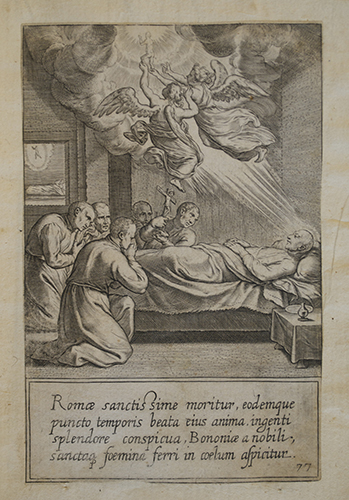
[28] Fig. 1.2: Copper engraving from Vita Beati P. Ignatii Loyolae Societatis Jesu fundatoris (Rome, 1609) (New York Public Library).
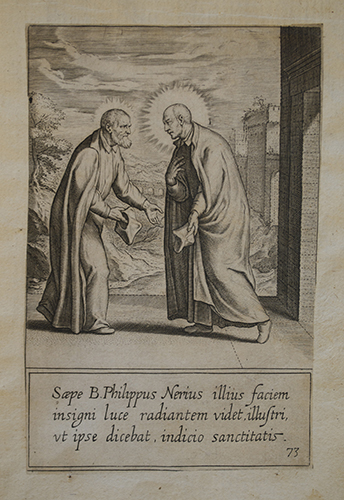
[29] Fig. 1.3: Copper engraving from Vita Beati P. Ignatii Loyolae Societatis Jesu fundatoris (Rome, 1609) (New York Public Library).
If Ignatius was a stern, practical ex-soldier, Filippo was an unassuming holy man who abhorred formality and pretension and was a famous joker. He had his congregation sing religious compositions to the tune of popular songs. His congregation remained informal and was located at the church of San Girolamo della Carità until the little dilapidated church of Santa Maria in Vallicella was given to them in 1575. The men surrounding Filippo did not seek final approval of the order for decades, until 1612 in fact. The fathers took no vows and could even maintain personal property. They always remained, unlike the Jesuits, secular priests.
Neri was not the general or even superior-general, as he might have been in other orders. In contrast to the necessary hierarchy of the Jesuits, he insisted that each father have an equal say in the running of the organization and Neri retired from active management of its affairs after several terms as preposito. In Joseph Connors’s words, the Oratory was “equipped to take up only one task, in one city.”51 Whereas the Jesuits had to attend to dogma, in deciding issues in far-flung locales, the Oratorians looked to the traditions of the church. No wonder that Neri’s quiet religiosity inspired the scholarly works of Cesare Baronio, Antonio Gallonio, and Antonio Bosio.52
Since the very structure of the Oratory was corporate, every artistic decision was made by consensus. Their artistic decisions were more inflexible and they resisted patrons with strong personalities. In some cases, they eschewed rich patrons altogether. For example, the Casa next door to the church, designed by Borromini, was largely self-funded. Although Borromini imposed his own sense of elevated models, expensive materials, and elaborate design, it was paid for with small donations managed by the fathers as they saw fit. In the 1630s the Oratorians were determining their religious imagery while the Jesuits awaited Gian Paolo Oliva (1600–1681).53
The Jesuits built colleges and churches and decorated them to inspire their missionaries to be sent around the world. Their dedication to the name of Christ coincided with his circumcision, and the shedding of blood remained forevermore symbolic in their mission. In contrast, the Oratorians rebuilt ancient Christian foundations in Rome in order to underscore continuity of faith and practice with the early church. This had consequences for their individual rhetoric of persuasion. The Oratorians looked backward to the apostles, while the Jesuits had to persuade their pupils and subjects that the contemporary Church Militant was in danger and needed their active intervention.54
[31] Oratorians and Jesuits
Clearly the Oratorians and Jesuits had different aims. The Oratorians, although influential, had a vastly reduced scope of mission in comparison to the Jesuits. Their main focus was the engagement with Rome’s populace and its spiritual shepherding. As such, the Oratorians and Jesuits were not competing for the same crowds. Indeed, the Oratorians read stories of the Jesuits’ brave exploits in the east, and even visited popular sermons, oftentimes by a Jesuit.
The Jesuits’ dedication to Christ and his blood contrasts with the Oratorians’ emphasis on Mary. Indeed, as will be seen in the discussion of Barocci’s Institution of the Eucharist, Neri was almost overwhelmed by the real flesh of Christ. Mary was the intercessor who could hear the prayers of Neri and others via indirection. Neri was, thus, an anticleric who was obsessed with the humble and downtrodden, the suffering and defeated.
The rhetorical strategy that might unify these various insights would be irony. The key to this irony lies in Neri’s Socrates-like manner and status indeed as a “Christian Socrates.”55 The humble yet wise Socrates had achieved his position through admission of his ignorance. Likewise, Neri was extremely sophisticated but dissembled his behavior in order to disguise it; by likening wisdom to ignorance he achieved paradox or, in short, irony. Indeed, the motto placed beneath Guido Reni’s portrait is “Exaltavit humiles” (“he has exalted the humble”), a line from the Magnificat that derives ultimately from the Gospel of Luke (1:46–55). The source of these lines is indeed striking for Oratorian iconography, because they legendarily came from the Visitation of Mary and Elizabeth, when Saint John in utero kicked in recognition of his Lord. The topicality of Mary’s and Christ’s humility in pregnancy and before birth and the subject of a work adored by Neri is not accidental.
In moving on to enlighten the rhetoric of Oratorians, it is first of all important to note that they always denied that they presented sermons at all ex pulpito. After all, the oratorio is the form of devotion that takes place outside a church. They did not discourse on topics but elaborated ragionamenti, and used concrete stories of the early saints for inspiration. These were followed by sung lauds, creating an institutionalized informality that the Oratorians believed followed early Christian practice. Significantly, although Neri and Baronio were aware of the features of early Christian churches and sought to include some in the Chiesa Nuova, there was never any plan to add a bench or synthronon to the apse. Discourse was intended for the oratory.56 Perhaps this reflects the flexibility that Carlo Borromeo also shared when affirming church decoration.
[32] Father Gallonio in his La Vita di San Filippo Neri writes how Neri’s sermons were “of useful matters, and necessary to the well-being of the listeners (leaving aside obscure and subtle problems), simply explained without the pomp of words or mixing rhetorical colors [colori rettorici].”57 Such an approach can be likened to the traditional sermo humilis, but in conformity with Neri’s ironic attitude, it is only apparently humble. It proceeds simply via dissimulation in order to reach deeper truths.
This attitude is captured in the rhetorical manual written by the same devotee of Neri who had coined the phrase “laetitia Christiana”—Agostino Valier in his De rhetorica ecclesiastica sive modo concionandi libri tres (1574).58 According to John O’Malley, in contrast to calls either to maintain ancient eloquence or priggishly deny it, Valier openly invoked Aristotle and stressed the need for classical elegance to impart emotion.
Just as classical as the preaching theory that Valerio adopts is the humanitas that seems to me to animate the treatise. Besides embodying the classical virtues of clarity, order, and simplicity, the treatise emphasizes the human or humane values in Christianity. Valerio, for instance, rejects Stoic apathy and urges the preacher to awaken or instill good affections in his listeners. The preacher should especially arouse the emotion of love—love for God, of course, but also love of parents for their children, of children for their parents, of citizens for their native land, of friends for their friends. He should even try to make the good among his audience love themselves.59
Valier’s references to love indicate that he is working more with the Platonic vocabulary of divine inspiration. The point of such a sermon is to deliver pleasure and delight, which is felt rather than cognized. Rather than arouse emotion through intellectual comprehension, it appeals directly to the heart. In this it attempts to address divine grace through the grace of the preacher. Similar ideas were later expressed by Federico Borromeo in his various tracts, including De nostrorum temporum sacris oratoribus.60
Valier’s approach, and Neri’s for that matter, was not for the purposes of the church writ large. More popular were guidebooks for mainstream preaching, like the Jesuit Cipriano Soares’s De arte rhetorica (1562) or Pedro Fonseca’s Institutionum dialecticarum (1564).61 Not surprisingly, as summarized by Thomas Conley, “Soares…seems to place an unusually high premium on emotion as a component of persuasion, for it is evidently emotion that mainly moves the souls of men—that is, persuades them, in addition to teaching them.62 Persuasion here is Ciceronian, not only in the sense of eloquence but also as an institutional and civic virtue. Jesuit rhetoric in general motivates practical concerns [33] to citizens, and personal emotion is in the service of action. The Oratorian instead moves to improve the person through love.
If Oratorian rhetoric is marked by irony, which in some senses can be seen as a development away from more standard strategies of resemblance (metaphor, metonymy, synecdoche), then the clearest opposition would be found in the straightforward, or even labored or intellectual, aims of the Society of Jesus. Jesuit rhetoric, as exemplified by Soares, or Pedro Fonseca, was based on definitio, that is, descriptive and logical definition in terms of rigorous use of figures and categories of cause and effect.63 This emphasis on elaborating likeness explains the strong attachment to the emblematic imagination and use of words and pictures as memory aids. To be clear, these are not incipient ideas in the heads of priests of each order. The purpose to which they are preaching is central. In general, because the Oratorian focus is so personal, they remain with stories of the lives of the saints or the history of the church, tangible things. No wonder then that each of the altars in the Chiesa Nuova, in distinction to those of the Jesuits, is an ordinary istoria, even if elevated to the dignity of a Misterio. Whereas in the Gesù we find the chapel of the Angels, or the Trinity, at the Chiesa Nuova the altarpieces depict simple stories that are immediately obvious to the average person.
This idea of opposition even leads us to see the two new orders as constituting their own opposition in Roman society of the time. That is, the Jesuits were the outward-directed missionaries with a clear message and steadfast purpose while the Oratorians cultivated love, inwardness, and reflexivity. Here we can return to the cooperation among Oratorians and Jesuits noted before. Strangely, it was the Oratorian Cesare Baronio who placed a portrait on Ignatius’s tomb in the Jesuit church of the Gesù. While it appears that the two orders share similar sentiments (and certainly the urge to promote their respective saints), perhaps Baronio is here promoting Ignatius in their manner, as appropriate to them. His actions become, then, a tacit and sometimes acknowledged “divison of labor” between the two orders.64 As suggested in the introduction, this sense of contrasting commitments is common, indeed necessary, for social differentiation.
Barocci and the Visual Rhetoric of the Oratory
Oratorian dissembled irony is the rhetorical consequence of “Christian optimism” and it is seen first in works by Neri’s favorite artist, Federico Barocci. As noted previously, while Neri was alive three paintings by Barocci for the Chiesa Nuova were discussed while two were actually painted, the Visitation of the Virgin and Saint Elizabeth of 1586 (plate I) and the Presentation of the Virgin in the Temple of 1603 (plate II), but delivered only after Neri’s death. Equally after Neri’s death, another commission, this time for the prized high altar, was seriously discussed but was frustrated by lack of funds before means were secured for [34] completion of Rubens’s altarpiece, which adorns the altar even today (plate III). These commissions form the subject of chapters 3 and 4. Barocci’s pictures, too, are misleadingly simple and dissemble their effect, at once intimate but artificial.
Barocci seems like such an eminent Oratorian artist because so many works were requested of him. But it was not uncommon to have multiple works by a single artist in churches like the Chiesa Nuova or the Jesuit church of Gesù. Scipione Pulzone, who contributed two works to the Gesù, comes to mind.65 Rather, Barocci is so remarkable for being in such demand and a foreigner, sending his works from far-off Urbino. Is there more to say about what Neri saw in these works? The whole Chiesa Nuova’s iconographical scheme was devoted to Mary and here we have two narratives devoted to her. Not only is the subject feminine, but the treatment is feminine, in the soft sfumato and airy figures. The act of recognition is concentrated on a single gesture outside of narrative unfolding and speech. The sweetness makes the treatments more iconic, outside of time, and hence appropriate to Neri’s own interests.
In this context, “feminine” means many things. First, it means the exclusive depiction of women, vulnerable women, a young or pregnant Virgin Mary. Next, it refers to a modest and passive approach to figuration via indirection. Barocci’s paintings are often noted for their gracious, alluring (vago) presentation of holy events, sustained through a realism of parts. Finally, it means colorito, the bearer of the artistic message being the stuff of matter, traditionally feminine, rather than intellective form.66 Delicate color, sfumato contours, and refined yet believable types communicate the direct state of grace of the figures.67
Sixteenth-century categories of thought recognized a faculty of direct apprehension, a non so che, of which grace was the conspicuous example.68 This neo-Platonic idea was well known in both Filippo Neri’s Florence and Barocci’s Urbino, where Castiglione discoursed on grace and Raphael was considered “divine.” Unlike beauty even, which was understood intellectually as a harmony of parts, grace was a sensuous form that affected the soul without introspection.69 Jesuit altarpieces were more traditional, and they follow the more traditional intellectual path. The artistic style of Jesuit altarpieces leads the viewer through an intellectual operation to a thought.
The Counter-Reformation treatise writers relied on this intellectual apparatus and added to it. Most importantly here is the Filippo Neri devotee Gabriele Paleotti, archbishop of Bologna, whose Discorso intorno alle imagini sacre e profane (1582) was specifically intended for artists. He distinguishes three kinds of knowledge that painting may impart: [35] the sensuous, the intellectual, and the spiritual. The sensuous is a kind of knowledge common to animals. The second kind of knowledge, the intellectual, was understood by the rational soul. The highest level of spiritual cognition was obtained only by opening oneself to the gift of grace. Further, Paleotti clarified, it “tends more to be awakened in noble souls by means of pious images.”70
Barocci’s strategy can be captured under the idea of his work as a vision, a vision “of divinity soliciting the worshipper to enter and participate in that vision.”71 We already noted his development of iconographies of visionary experiences, but his works as wholes are, in an important way, visions given to the viewer. The idea that Neri’s form of devotion relied on visions rather than recalled images (as in the case of Ignatius of Loyola’s Spiritual Exercises) has been expounded by Costanza Barbieri, on a suggestion of Alessandro Zuccari.72 To elaborate on this idea, this feature has important consequences for what is unique about Oratorian patronage, because of complex phenomenological and semiotic features relevant to the experience of a work like Barocci’s Visitation (plate I).
What exactly does it mean for an altarpiece to disclose a vision? On one hand, the definition is technical; the scene should be understood as appearing to the viewer, perhaps as a miracle. On the other hand, a vision must be believable as a vision. Phenomenologically, its figures must possess substantial presence while not appearing ordinary (and unrecognizable as visionary).73 What this means is that the vision has less status as a relational sign than as pure being. It is in some senses pre-pictorial. The corollary is that elements within the vision cannot upset the uninterrupted presence. Artifice as an index of relational sign activity is to be avoided. Reduced scale, conspicuous brushwork, unusual figural conventions, opaque iconographies—these can all destroy presence. Barocci’s famous sfumato fused his scene into a single vision and also guaranteed its verisimilitude.74
The vision with the viewer comprises a dyad. Its opposite is a third-person report, disclosing the relations between external objects. This is not identical but is related to the famous paragone between Guido Reni and Domenichino, about which artist could better create convincing narratives, or istoriare. In an anecdote apparently first reported by Giovanni Battista Agucchi, an elderly woman (vecchiarella) visits the Oratory of Saint Andrew at San Gregorio Magno, and while she has nothing to say about Reni’s Saint Andrew Led to Martyrdom (1608–9) she goes on at length to a young girl (fanciulla) about Domenichino’s Flagellation of Saint Andrew.75 Agucchi and his followers (including Bellori, Malvasia, and others) intended the story to denigrate Reni. However, Reni, who was [36] very popular with the Oratorians, represents the Oratorian aesthetic here with his simple devotional compositions (further explored in the final chapter).
This opposition is not about liturgy and personal devotion. As noted, Jesuit altarpieces could lead to personal devotion; for example, the chapel of the Madonna della Strada in the Gesù is in one sense a series of visions. But by and large the art treats of those things for which personal agency was a primary concern. The latent maniera or more positively the archaizing of many Jesuit works in Rome recalls the active intellect of the artist. Mannerist artificiality found in material traces in the picture has been transformed into an index of the piety of the artist. The question is an alteration of that which inspired polemics in the middle of the sixteenth century: Who is more important, Michelangelo or the represented subject? In a certain way, the Jesuits sided with the artist but only to the degree that the conspicuous style could stand as a surrogate for the reflective intellect.
In his book on Barocci, Lingo details the artist’s struggles with the Congregation of the Misericordia in Arezzo, leading to his Madonna del Popolo of 1579. The members desired the “mystery” of the misericordia, that is, the traditional iconography of Mary protecting a group under her mantle. Barocci felt this would be a poor subject and successfully reduced the literality of the iconography. The Jesuits were somewhat like the Aretines in promoting iconographies like the Seven Archangels or the Trinity. While the Oratorians use the term “mystery” in their discussions of their altarpiece cycle, they mean it in a reduced and literal sense as a narrative with a deeper significance. Indeed, in their practice they are remarkably like Barocci in remaining with a narrative. The consequences are enormous. Instead of baldly naming an allegorical relation, Barocci merely hints at it. The viewer can follow it through, but doesn’t have to.
In such a system, the goal is not to recreate the pathos of the event via its sensory recollection, an intellective operation. Rather, it is the overriding sense of humility, tenderness, or grief itself that becomes the analogical content. What is significant in this discussion is the unity between the movements, the moti, of the mind, the mouth, and the body. For the Oratorians, it is their absence, and this is why observers saw Neri transfixed before Barocci’s Visitation (plate I). The intensely meditative altarpiece concentrated his mental state, stilled and immobilized him in the chapel space, and closed his eyes to the world and communication with his fellow man. These arguments really underscore the way in which each religious body develops its identity in contrast to its peer group and competitor.
The quietist elements discussed above are less often found in a typical work commissioned by Jesuits, which is significant because the Jesuits were more established. What is perhaps controversially a typical Jesuit work is oriented precisely toward intellectual apprehension. Scipione Pulzone (already mentioned in connection with the Jesuits) and his work in the Chiesa Nuova is informative in comparison with Barocci’s. The slightly archaized outlines of Pulzone’s Crucifixion draw attention to themselves, as does the reduced scale of his Christ figure.76 The purposely awkward forms of the archaizing artist are signs that demand an intellectual act. The same is true of his Lamentation for the Gesù (now in the [37] Metropolitan Museum of Art). When one views it, one is to regard the pietistic signs like the tears. These mental acts of interpretation have a counterpart in physical action and its mental manifestation in speech.
The Jesuit visual rhetoric described above is very close to the “art without time” (“arte senza tempo”) that Federico Zeri proposed for the whole Counter-Reformation.77 His canon of artists, especially Pulzone, Fra Valeriano, and Federico Zuccaro, also has similarities to the “counter-maniera” style described by Marcia Hall, which was pioneered by Michelangelo and Sebastiano del Piombo and attempted to strip away mannerist artificiality in favor of simple medieval-inspired forms. She notes the lack of a Jesuit style at the Gesù due to the powerful personality of its patron, Cardinal Alessandro Farnese, and the dictation of patronage by private donors.78 Yet the degree to which some of these works share at least partly in this aesthetic she might be prepared to attribute to a Jesuit context.
Gauvin Bailey has made an eloquent and informed survey of prior interpretations of Jesuit art and rightly downplays attempts to polarize Jesuits and Oratorians.79 The two companies had more in common than they had differences. One strategy Bailey follows is to note the optical richness of various Jesuit works. Yet this is ultimately a losing strategy. The proper way to portray the situation is this: in the context of beautiful and charming forms, artists like Barocci invested subtle iconic elements to ensure their works’ devotional power. Contrariwise, artists like Zuccaro began with stronger archaizing outlines and poses and added to them beautiful color and brushwork.80 The two approaches of Barocci and Zuccaro are more or less inverted.
To illustrate this point, compare Barocci’s Visitation (plate I) with the Seven Archangels in Adoration of the Trinity of his countryman and friend Federico Zuccaro, painted about 1600 (fig. 1.4).81 Both have stark figures in profile, the Virgin Mary in Barocci’s and two archangels in Zuccaro’s. The profiles give a static air to the picture but in Barocci’s the profile is unobtrusive. Zuccaro’s usage draws more attention to itself, partly because the painting is symmetrical. When Barocci’s work is reproduced in black and white, the figural quality does not stand out, whereas it does in Zuccaro’s. Perhaps that evident figural quality found in photographs explains the low opinion of such works. In color, Zuccaro’s does have much coloristic interest, but it is secondary.

[38] Fig. 1.4: Federico Zuccaro, Seven Archangels in Adoration of the Trinity, 1600, oil on panel, Gesù, Rome (photo by Ron Reznick, digitalflashimages.net).
Thus, instead of portraying the Jesuits in terms of poverty and lack of aesthetic sensitivity, one should focus on aspects of their visual rhetoric that are not normally attended to, namely, the Jesuit predilection for a more intellectual visual rhetoric, as opposed to the Oratorians’ facile rhetoric. If this difference truly exists, how then are we to deal with the great sharing of artists at the Chiesa Nuova and Gesù: Pulzone, Cavaliere d’Arpino, Girolamo [39] Muziano, Andrea Lilio? Indeed, what of the fact that Jesuit Cardinal Farnese pursued Barocci for an altarpiece within his church or the fact that many of Barocci’s followers found work at the Gesù, including Francesco Vanni, Ventura Salimbeni, and Andrea Lilio, who worked at both churches?82
The importance of the artistic brief does not rule out historical contingency. Even if different bodies had different ideas of what they wanted, they would not always be able to get it. So it is ahistorical to presume some kind of determinism of taste, but determinism is never perfect. To repeat, any social event is caused by multiple factors and in social life it is impossible to see the pure working of any single tendency. Nevertheless, we can hope to inquire into the contribution these tendencies make in producing the unpredictable whole that is social life. While Fra Valeriano, Federico Zuccari, and Scipione Pulzone served remarkably well for the Jesuits, the isolated success of Barocci for the Oratorians represents a kind of historical experiment in taste.
Here we may even have to utter the phrase “proto-baroque,” but what do we mean by it? It is not meant, as explained in the introduction, as a term of periodization or of essential being. Rather, Barocci and his peers become the first in a causal series. The unique conditions at the Chiesa Nuova helped nurture this art and while it is retrospective to mention how developments in the seicento turned out, it is not ahistorical to note that in the late sixteenth century there were different styles available and it just so happens that the style of Filippo Neri’s Oratorians is closer to that of one prominent strain of seicento art connected to Guido Reni and Pietro da Cortona. This of course does not leave Ignatius of Loyola’s Jesuits out of the picture. In many respects, the studied rhetoric or a Domenichino or a Nicholas Poussin remained closer to their ideals.
Money and Fame
The preceding argument has highlighted the different aesthetic aims of Jesuit artists, and therefore has not needed to raise issues of aesthetic quality. Yet, it can still be demonstrated that the Oratorians made use of a higher quality of artist in general. That is, although Oratorian thought elevated the lowly and pauperistic, it was not impoverished; indeed, such a duality is in line with their dissemblance.83 This is admittedly a subjective judgment, but by examining payments in each church and the results of the payments, we can make some positive observations. While notions of the mediocrity of Jesuit art were indeed overstated by Sydney Freedberg, Howard Hibbard, and Francis Haskell, the argument for the quality of Oratorian artists has been defended by Alessandro Zuccari and others. Bailey challenged these notions, but this traditional reading of Jesuit patronage has some merit.84
[40] We may begin with some anecdotal evidence. The resident ambassador for Urbino in Rome, Baldo Falcucci, wrote to the Duke of Urbino in regard to Federico Barocci, noting that the church is “of much nobility and devotion, where they have many paintings by excellent hands in their new structure” (“luogo di molta nobilità et divotione hanno molti quadric et di bonissima mano nella lor fabrica nuova”).85 Similarly, when Peter Paul Rubens wrote to the Duke of Mantua in regard to his commission to paint the high altar, his wording seems to suggest that contemporaries regarded the Chiesa Nuova in a special light. Rubens noted that the church was “decorated by all the most talented painters in Italy, who rival each other.”86
These comments suggest that the Chiesa Nuova was in some senses a “sacred gallery,” combining the best of religious devotion with the new discrimination of the connoisseur. This is not a slight against the Jesuits. Instead, as has been pointed out, the Jesuits spent equally and consistently in an overall sense, completing the whole church’s decoration more or less at the same time. The Chiesa Nuova, on the other hand, placed its emphasis on the altars and in particular on the altarpieces. Indeed, we recall that the majority of altarpiece commissions were given out before those of the Jesuits (appendix 1).
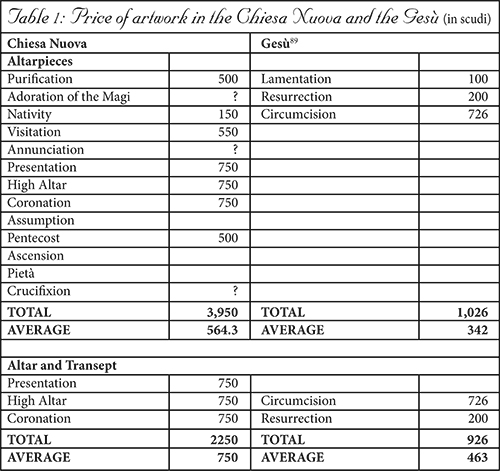
Consequently, it should not be surprising that the average price paid for an altarpiece in the Chiesa Nuova was much higher than at the Gesù. Barocci’s Visitation and Wenzel Coebergher’s Pentecost in the Chiesa Nuova cost 550 and 500 scudi, respectively.87 In fact, Gauvin Bailey has noted that 100 scudi was about the average price paid for an altarpiece in the Gesù, not an impressive sum.88 More analytically, there are two measures to look at. The first is taking all the payments for known altarpieces divided by the number of altarpieces, and doing the same solely for those for the choir (high altar and transepts). In the first case, the average altarpiece price at the Chiesa Nuova is 564 scudi and at the Gesù was only 342. Because the Jesuits genuinely put money into their high altar, the second measure is necessary but still telling. For only those altarpieces on the high altar or transepts, the average price is 750 for the Chiesa Nuova and 463 for the Gesù.
It might be objected that the Jesuits only figured 200 scudi for Baglione’s Lamentation, when 1,000 scudi were promised. This is an important part of the story for the Jesuits who, unlike the Oratorians, fell short in some of their payments. Gauvin Bailey has introduced the potential practice of cut rates given by the artists in order to show sympathy with the religious ends of the Society of Jesus. This is an important mitigating factor that indeed would skew prices. But it should already be clear that the Oratorians did not make such arrangements, least of all for their beloved Barocci, whose 550 scudi fee for the Visitation was extremely generous in spite of its small size.
This difference is at least partly due to the way in which the two orders managed their funds and artistic decisions. The difference between Oratorians and Jesuits in this regard [41] was not lost on Borromini himself, who noted that “their buildings were made by princes [da’ Principi], for whom it serves to build big things, but having themselves built their own building permitted them above all their things with modesty keeping their eye only on propriety.” Borromini might seem to be talking only about size and cost, but equally important is the self-management: they make their buildings (and decorate them) themselves.89 Although Borromini was writing much later, his comment about patronage “da’ Principi” was true in Neri and Barocci’s day. Ironically, the modesty Borromini spoke of translated into more expensive paintings in the sense that the parity of quality and lack of [42] any particular project or chapel project taking precedence over any other meant that an overall general level of quality could be assured.
After looking at the theology, sacred rhetoric, and visual rhetoric of the Oratorians and the Jesuits, it seems clear that the traditional affirmations about the Oratorians and the contrasts made between them and the Jesuits still have merit. There is clearly something distinctive about Oratorian patronage, and their attempt to pursue four altarpieces from Federico Barocci indicates that they recognized something compelling in his style, something that resonated with their ideas.
Notes
1. On the status of the concept of the “Counter-Reformation,” see O’Malley, “Was Ignatius Loyola a Church Reformer?” O’Malley prefers “Early Modern Catholicism.”
2. On Sixtus V’s public commissions, see Zuccari, I pittori di Sisto V; and Hall, After Raphael, 258–67.
3. During his papacy, Sixtus V promoted the Franciscan Saint Bonaventure (1217–74) to the position of doctor of the church, just as his namesake, Sixtus IV della Rovere, had elevated him to sainthood one hundred years earlier.
4. The Capuchins held San Bonaventura before Santa Maria della Concezione; de Alençon, Il terzo convento dei Cappuccini in Roma.
5. On the decoration of the Gesù, see Hibbard, “‘Ut picturae sermones’”; and Bailey, Between Renaissance and Baroque.
6. On the building and decoration of the Chiesa Nuova, see Strong, La Chiesa Nuova; Kummer, Anfänge und Ausbreitung der Stuckdekoration im römischen Kirchenraum; and Barbieri, Barchiesi, and Ferrara, Santa Maria in Vallicella.
7. This was pioneered in Florence by Cosimo and Vasari; see Hall, Renovation and Reformation.
8. Russo, “I Cesi e la Congregazione dell’Oratorio.”
9. Lavin, Place of Narrative.
10. ACO, C.I.2, fol. 30, quoted in Barbieri, Barchiesi, and Ferrara, Santa Maria in Vallicella, 178–79: “Che per deliberare sopra la pittura della Cappella della famiglia Caetano si metta per provare un cartone col Golgotha.”
11. Zuccari, “Cultura e predicazione nelle immagini dell’Oratorio.” Hall sees a commonality in “an understanding that the worshipper’s affective participation must be solicited” (After Raphael, 445).
12. I investigated this in regard to Francesco Paciotti, a contemporary of Barocci, in “Francesco Paciotti, Militare Architecture, and European Geopolitics.”
13. On this, see “Introduction,” in Verstegen, Patronage and Dynasty, xiii–xxviii
14. Bellori, “Vita di Federico Barocci,” ed. Borea, 185.
15. For the Madonna and Child with Saint John the Baptist and Saint Francis, see Olsen, Federico Barocci, 151; Emiliani, Federico Barocci, 1:58–59; Emiliani, Federico Barocci [2008], 1:150–54.
16. For the Madonna of Saint Simon, see Olsen, Federico Barocci, 149–50; Emiliani, Federico Barocci, 1:45–46; Emiliani, Federico Barocci [2008], 1:174–84.
17. For the Immaculate Conception, see Olsen, Federico Barocci, 161–62; Emiliani, Federico Barocci, 1:122–27; Emiliani, Federico Barocci [2008], 1:298–309; and Lingo, Federico Barocci, 39–48.
18. For the Perdono di Assisi, see Olsen, Federico Barocci, 159–60; Emiliani, Federico Barocci, 1:104–15; Emiliani, Federico Barocci [2008], 1:264–82; and Lingo, Federico Barocci, 63–84.
19. Ekserdjian, Correggio, 294. On the iconography of the Visionary Saint, see Male (L’Art religieux après le Concile de Trente, 151–201), for whom visionary iconography is not considered as a whole “nouvelle.”
20. For the Madonna del Rosario, see Olsen, Federico Barocci, 186–88; Emiliani, Federico Barocci, 2:265–71; Emiliani, Federico Barocci [2008], 2:107–17.
21. Lavin, Review of Federico Barocci, by Harald Olsen.
22. For the Beata Michelina, see Olsen, Federico Barocci, 207–8; Emiliani, Federico Barocci, 2:368–71; Emiliani, Federico Barocci [2008], 2:284–91.
23. For Reni, see the conclusion.
24. Francesco Maria II della Rovere, 15 December 1598, in della Rovere, Diario, ed. Sangiorgi, 101.
25. For Denys and Ignatius, see O’Malley, First Jesuits. On the Carthusians during the Catholic Reformation, see Martin, “Carthusians during the Reformation Era.”
26. On Neri’s Christian optimism, see Dupront, “Autour de Saint Filippo Neri”; Jones, Federico Borromeo and the Ambrosiana, 9–10, 87–89; and Armogathe, “Le facezie degli angeli.” The connection to Barocci was made in Emiliani, Federico Barocci, 1:xxxiv–xxxv; Verstegen, “Federico Barocci, the Art of Painting and the Rhetoric of Persuasion”; and Verstegen, “Federico Barocci, Federico Borromeo and the Oratorian Orbit.”
27. Valier, Philippus: Dialogus de laetitia christiana. For a useful discussion of “laetitia” in sixteenth-century thinking, see Periti, “From Allegri to Laetus-Lieto.”
28. On the “religious ethos” of Oratorian music, without, however, reference specifically to “Christian optimism,” see Morelli, “Chiesa Nuova in Rome around 1600.”
29. See, above all, Bailey, Between Renaissance and Baroque; and Levy, Propaganda and the Jesuit Baroque.
30. Molinos was arrested in 1685, recanted his views in 1687, and spent the rest of his life in prison. The main condemning document, which led to a papal processo, was by the Jesuit Paolo Segneri (1624–94): Concordia tra la fatica e la quiete nell’oratione. One of the most influential quietists, Pietro Matteo Petrucci (1636–1701), was an Oratorian who ultimately capitulated his views. Petrucci was born in Jesi, studied in Macerata, and frequented the Oratory of San Filippo Neri of Jesi. He became an Oratorian priest on 2 February 1661, on 20 April 1681 he was made bishop of Jesi in the Chiesa Nuova, and in 1686 was made cardinal by Innocent XI. He recanted his views and resigned his bishopric, but was retained as apostolic visitor. His main work was the Della contemplazione acquistata.
31. Molina, Concordia liberi arbitrii cum gratiæ donis. On Molina, see Doyle, Jansenism; and Leone, Saints and Signs, 124–25.
32. Hibbard, “‘Ut Picturae Sermones,’” 39.
33. Ahlgren, Teresa of Avila and the Politics of Sanctity.
34. On the politics of sanctity see ibid.; Ditchfield, Liturgy, Sanctity and History in Tridentine Italy; and Gotor, I beati del papa.
35. On the history of the Capuchins, see Cuthbert, Capuchins; and D’Alatri, I Cappuccini. On Neri and Fra Felice, see Ponnelle and Bordet, St. Philip Neri and the Roman Society of His Times, 363.
36. Ponnelle and Bordet, St. Philip Neri and the Roman Society of His Times, 267–71, 279–83.
37. Calenzio, La vita e gli scritti del cardinale Cesare Baronio, 592–97; Pullapilly, Caesar Baronius, 91–92; Broggio, “Baronio e la controversia de auxiliis”; Leone, Saints and Signs, 296.
38. A very similar treatment is found in the Life of Ignatius from the Loyola Chapel, now exhibited in the Cappella Farnesiana of the Casa Professa; see Bailey, Between Renaissance and Baroque, fig. 114. Cf. König-Nordhoff, “Ignatius von Loyola.”
39. Noyes, “On the Fringes of Center.” Cf. Levy, Propaganda and the Jesuit Baroque, 127–30.
40. Martin, Ceiling Paintings for the Jesuit Church of Antwerp, 30.
41. Bailey, Between Renaissance and Baroque, 19.
42. Noyes, “On the Fringes of Center.”
43. Significant of course is the chapel dedicated to Francis of Assisi in the Gesù, for which see Russo, Il ciclo francescano nella chiesa del Gesù in Roma. Perhaps not surprisingly, Capuchins—the newest and most zealous branch of the Franciscans—had the most conflicts with the Jesuits.
44. On the corporate identity of the Dominicans, see Hood, Fra Angelico at San Marco. Maginnis (World of the Early Sienese Artist, 168) finds Saint Thomas Aquinas’s miracle of the speaking crucifix that says, “You have written well of me” (“Bene scripsisti de me”), to be a perfect example of Dominican attitudes as opposed to the Franciscans’ bold promulgation of controversial theological topics and iconographies.
45. On Spanish mysticism, see Hamilton, Heresy and Mysticism in Sixteenth-Century Spain. On the way in which Loyola’s aims were retrospectively made more militant, see O’Malley, “Was Ignatius Loyola a Church Reformer?”
46. For critiques of sense application in the late sixteenth century, see de Boer, “Invisible Contemplation.” For the reinvigoration of the polemical intent of the Jesuits in the 1580s, see Casareo, “Jesuit Colleges in Rome under Everard Mercurian.”
47. Leone, Saints and Signs, 221.
48. Drawings by Rubens, engraved by Barbé, in Lancicius, Vita Beati P. Ignatii Loyolae Societatis Jesu Fondatoris; Drawings by Guido Reni, engraved by Luca Ciamberlano, in Held, “Rubens and the Vita Beati of Ignatius Loiolae of 1609”; Bacci, Vita di San Filippo Neri; Melasecchi and Pepper, “Guido Reni, Luca Ciamberlano and the Oratorians.”
49. This comes from the testimony of Agostino Ghettini, recalling the time in 1557 when Neri considered taking his companions on a mission; Incisa della Rochetta and Vian, Il Primo Processo per San Filippo Neri, 1:384–85. Cf. Ponnelle and Bordet, St. Philip Neri and the Roman Society of His Times, 211.
50. Levy, Propaganda and the Jesuit Baroque, 142.
51. Connors, Borromini and the Roman Oratory, 7. Indeed, there exists no general (as in the Jesuits) or superior-general (as in older monastic orders) of the entire Congregation of the Oratory.
52. Baronio, Annales ecclesiastici; Gallonio, Trattato de gli instrumenti di martirio; Bozio, Roma sotterranea.
53. But see Zuccari, “Aggiornamenti sulla decorazione cinquecentesca di alcune cappelle del Gesù.”
54. On the contrast between Jesuits and Oratorians, see Ponnelle and Bordet, St. Philip Neri and the Roman Society of His Times, 323–24; Rahner, “Ignatius of Loyola and Philip Neri”; the twin papers by Zuccari, “La politica culturale dell’Oratorio Romano della seconda metà del cinquecento” and “La politica culturale dell’Oratorio Romano nelle imprese artistiche promosse da Cesare Baronio”; and Leone, Saints and Signs.
55. These references by Agostino Valier and Federico Borromeo to Filippo Neri are conveniently collected by Lavin, “Divine Inspiration in Caravaggio’s Two St. Matthews,” 73n44.
56. Ponnelle and Bordet, St. Philip Neri and the Roman Society of His Times, 265; Herz, “Cardinal Cesare Baronio’s Restoration of SS. Nereo ed Achilleo and S. Cesareo de’Appia.” Cf. Ferrara, “Cesare Baronio e la fabbrica della Chiesa Nuova.”
57. Gallonio, La Vita di San Filippo Neri, 144: “I Sermoni erano di materie utili, e necessarie alla salute de gli Ascoltanti, (lasciate da parte le questioni oscure, e sottili) spiegati semplicemente senza pompa di parole, e senza mescolarvi colori rettorici.”
58. The work is most easily accessed as it is appended to De Granada, Ecclesiasticae rhetoricae. On Valier, see Conners, “Homiletic Theory in the Late Sixteenth Century,” esp. 317–23.
59. O’Malley, “Content and Rhetorical Forms in Sixteenth-Century Treatises on Preaching,” 251.
60. Borromeo, De nostrorum temporum sacris oratoribus. On Borromeo’s idea of sacred rhetoric, see Jones, Federico Borromeo; and Giombi, “L’oratoria sacra di Federico Borromeo.”
61. Soares, De Arte Rhetorica Libri tres; Fonseca, Institutionum dialecticarum Libri Octo.
62. Conley, Rhetoric in the European Tradition, 154.
63. Fumaroli, “Définition et description”; Melion, “Artifice, Memory, and Reformatio.”
64. Leone implies but does not formally state that the Oratorians and Jesuits form a semiotic binary in Counter-Reformation Rome; Saints and Signs.
65. Pulzone painted the Lamentation of Christ (1589/91; Metropolitan Museum of Art) and a Seven Angels (1594, lost), which was rejected, ostensibly due to the appearance of contemporary personages, and replaced by a painting of the same subject by Federico Zuccaro (1600, in situ), to be discussed shortly. For differing accounts of the affair, see Bailey, Between Renaissance and Baroque, 211; and Mansour, “Censure and Censorship in Rome.”
66. Sohm, “Gendered Style in Italian Art Criticism”; Jacobs, “Aretino and Michelangelo, Dolce and Titian.”
67. On Barocci’s grace and vaghezza, see Verstegen, “Federico Barocci, the Art of Painting and the Rhetoric of Persuasion”; and Lingo, Federico Barocci. For a similar discussion, see Spear, ‘Divine’ Guido.
68. On the non so che, see Summers, Judgment of Sense; and D’Angelo and Velotti, Il ‘non so che.’
69. On grace, see Cropper, “On Beautiful Women, Parmigianino, Petrarchismo”; Emison, “Grazia”; and Spear, ‘Divine’ Guido, 102–27.
70. Paleotti, Discourse on Sacred and Profane Images, 112; and the discussion in Hall, Sacred Image in the Age of Art.
71. Hall, Sacred Image in the Age of Art, 74; Lingo, Federico Barocci, esp. 39–48.
72. See above all Barbieri, “Invisibilia per visibilia”; and Barbieri, “To Be in Heaven,” departing from Zuccari, “La politica culturale dell’Oratorio Romano della seconda metà del cinquecento.”
73. For presence and the factors that mitigate it, see Puttfarken, Discovery of Pictorial Composition.
74. Hall, Sacred Image in the Age of Art. For color phenomenology and ideas of subjectivity, see Verstegen, “Padua Blue between Katz and Kristeva.”
75. On the vecchiarella anecdote, see Spear, ‘Divine’ Guido, 27–31; and Marciari, “Girolamo Muziano and Art in Rome,” 347–51.
76. For the painting, see Barbieri, Barchiesi, and Ferrara, Santa Maria in Vallicella, 56–58.
77. Zeri, Pittura e Controriforma.
78. Hall, After Raphael, 174–75, 269.
79. Bailey, Between Renaissance and Baroque, 17.
80. See the recent discussion of Stoenescu, “Ancient Prototypes Reinstantiated.”
81. For Zuccaro’s painting, see Bailey, Between Renaissance and Baroque, 212; and Balass, “Five Hierarchies of Intercessors for Salvation.”
82. Bailey, Between Renaissance and Baroque, 199–200, 220.
83. For Filippo Neri’s wealth, or collection of costly items, see Anonymous, “San Filippo Neri nella scienza e nell’arte sacra.”
84. Freedberg, Painting in Italy, 1500–1600; Hibbard, “‘Ut Picturae Sermones’”; Haskell, Patrons and Painters.
85. Gronau, Documenti artistici urbinati, 156–57.
86. Jaffé, “Peter Paul Rubens and the Oratorian Fathers.”
87. In the following, I am always using silver scudi, scudi di moneta, the standard coin for business transactions.
88. Bailey, Between Renaissance and Baroque.
89. Borromini, Opus architectonicum, 8.5, quoted in Connors, “Early Projects for the Casa dei Filippini in Rome,” 110: “tutte cose pratticate nel collegio romano, nella casa professa de’ Padri Giesuiti, nell’abitazione de’ Padri Teatini per non dire de I monaci di S. benedetto, ed altri, dicento, che le fabriche di questi sono state fatte da’ Principi, a’ quail conviene far cose grandi, ma facendo loro medemi la propria Fabrica premevano sopra tutte le cose nella modestia, bastandoli aver l’occhio alla proprieta.”