
[43] Chapter 2
“The paintings should be one of the mysteries of the Holiest Madonna [Misterij della Madonna Santis.ma]”1
“Conditioni cole quali si ha conceder le Cappelle,” ca. 1580
There are some very tangible reasons that Oratorian spirituality, institutional facts, and artistic patronage have a distinct physiognomy, with the Oratorian emphasis on personal devotion in a nonhierarchical context placing emphasis on the cultivation of the personal spirit of the believer. This leads to the question of how, specifically, the Oratorians laid out their church and with it Barocci’s altarpieces.
The Chiesa Nuova has a unified program of altarpieces in the manner of other Counter-Reformation churches in Italy and throughout Catholic Europe. Federico Barocci’s two completed works, the Visitation (plate I) and the Presentation of the Virgin (plate II), contributed indelibly to the realization of that unified arrangement. Obviously, having multiple works by the same artist contributes to the uniformity of the church. Yet the religious import of that same artist’s style can also contribute harmoniously to the overall message the church seeks to impart. By understanding the accumulating Marian message received by a believer as he or she moved around the church, one can better appreciate Barocci’s importance for the Oratorians.2
[44] During the sixteenth century, it became common for churches to create organized iconographic programs with particular emphasis on altarpieces. The Chiesa Nuova is a prime example of this due to the early emergence of its unified Marian scheme. Many historians point to the Dominican devotion to the rosary as the inspiration for the Chiesa Nuova’s Marian scheme, but the Oratorian church’s Marian focus is actually closer to Franciscan devotions. The Oratorians’ emphasis on the joy of the Virgin is consonant with Neri’s spirituality, and it is the Oratorian’s unique “internal typology” that unifies the altars. Although there is an altarpiece plan, its simplicity militates against heavy typological pairing and is consistent with the directness of the aesthetic experience the Oratorians were seeking to develop.
Unified Altarpiece Programs
The interior of the Chiesa Nuova is composed of the high altar—dedicated to the Birth of the Virgin—and ten lateral chapels, each assigned to an episode of “mystery” (Misterio) of the life of the Virgin (see appendix 1). Although such an arrangement seems relatively straightforward, no such cycles are known until the sixteenth century. Before then, patrons always exercised their rights to select artistic themes and it was not until new religious movements promoted the laicization of society that the balance of influence tipped in favor of the religious over the patron.
Already in the fourteenth century, Siena Cathedral had an iconographic program of altarpieces devoted to patron saints of the city.3 By including these saints within narratives of the life of the Virgin, a program seemingly devoted to the Virgin appeared. Yet this was not the case. Even in churches decorated in the earlier sixteenth century, we find some iconographic programs that appear to be unified, but on closer inspection, are not. One of the first was at Santa Maria Novella in Florence, for which Duke Cosimo I de’ Medici charged Giorgio Vasari with overseeing the project. That program was unified but incorporated older altarpieces, supplemented with newly painted altarpieces. A renovation from scratch began at Santa Croce in Florence with a series of new altarpieces based on the Passion.4
The efforts at the Chiesa Nuova can be classed with those of various bodies that tried to respond to the Council of Trent and provide new solutions to the appointment and arrangement of the church, all of which culminated in the grand projects for Saint Peter’s in Rome.5 [45] Trent and its interpreters sought to bring order to the church interior, and ensure that mass could be said at its altars without trouble. What is more, the new arrangements allowed for new meditative meanings to be developed.6
While these projects were absolutely essential for new church designs, they had to be translated to the purposes of new religious orders. The earliest experiments in a unified layout were undertaken precisely by the church of the Jesuits, the Gesù, under the patronage of Cardinal Alessandro Farnese, and the Chiesa Nuova, proceeding in competition with the Gesù, with Cardinal Pierdonato Cesi trying to outdo his rival. As we shall see, the Chiesa Nuova has precedence at least in the completion of its altarpieces.
An interesting thing about the Chiesa Nuova is the closeness of the primary author on church appointment, Carlo Borromeo, to the congregation. His Instructiones fabricae et supellectilis ecclesiasticae was being prepared just as the Chiesa Nuova received its first cornerstone in 1575.7 Marcia Hall has remarked that his book was less influential in publication because its principles were fairly obvious. This is especially true of the Chiesa Nuova, where the young Borromeo was a disciple of Neri and eventually gained an honorary chapel. This would make the Chiesa Nuova an extremely interesting example to study.
The most important thing to notice about this conversion is the similarity in focus. The Jesuits, like the Franciscans at Santa Croce, devoted their program to the Passion, culminating in an appreciation of Christ’s full sacrifice. In the same way that affective devotion by the Jesuits led to the emphasis on the memory of place, passage through the church was cumulative. As will be explained below, the attention by Oratorians to “mysteries” somewhat downplayed such anagogical engagement.
The iconographic program of the Chiesa Nuova is often attributed to Saint Filippo Neri himself. Indeed, we can expect that the Oratorians’ informality of devotion would be translated to the layout of their church. But it did so for one very important reason. The Chiesa Nuova, true to many other churches dedicated to the Virgin Mary, did not possess a mammoth sacramental tabernacle at its high altar, as could be found on the high altar of the Gesù.8 The Chiesa Nuova may have only had a small, inconspicuous tabernacle on the high altar before that (still small one) by Cirro Ferri was designed.9 (If it were true, as it seems [46] to be, that the Host could be reserved in the Vittrice Chapel of the Pietà, it would go some way toward explaining the appropriateness of Caravaggio’s literal style.) In a sense, the Marian icon was the focus of the altar but was also duplicated throughout the church. Consequently, the very goal-directed quality within the Gesù, focalized upon the body of Christ upon the high altar, was absent or at least downplayed at the Chiesa Nuova.
Much has been said about the Chiesa Nuova and at the same time, the number of studies of unified church interiors have increased. Therefore, it is time to reassess the iconographic design of the Chiesa Nuova, questioning the unity of the Chiesa Nuova’s program and its basis on the Rosary. This reassessment suggests that the Chiesa Nuova altars should be read typologically and affirms that the Gesù’s decorative program should not be given precedence over that of the Chiesa Nuova. While the Gesù’s architectural fabric was more advanced than that of the Chiesa Nuova’s, that fact says nothing about the relative maturity of their iconographic programs.
Misterii della Madonna: The Earliest Indications of a Unified Program
Altarpiece programs have been around since the fourteenth century. Moreover, the demands of Albertian and Brunelleschian architecture suggested the harmonization of the church interior with like altars and frames. It took only the combination of the two ideas of thematic and formal unity in the sixteenth century to bring to light the new idea of organized altarpiece programs. Once altars and their altarpieces had been standardized, clerics could spell out larger meanings beyond the individual chapel.
In Santa Croce in Florence, Orvieto Cathedral, and the Oratory of the Gonfalone in Rome, the Passion was the subject of the altarpieces.10 The Santa Croce series was able to communicate Eucharistic ideas dear to the Franciscans and was probably designed by Raffaele Borghini. At the Chiesa Nuova, the intent was to communicate Oratorian ideas about the Virgin Mary, so the fathers probably would have relied on the talents of a theologian, although we don’t know whom.
By the seventeenth century, the canonical biographies report that Neri intended the arrangement of the altars to center on the mysteries of the Virgin; however, this is a rather late date for this suggestion to appear. Marilyn Lavin has confidently written of the “unity planned from the beginning and carried out without change.”11 It is interesting to follow the actual history and see the desire of the Oratorian fathers for some meditative program within the context of problems of patronage and renovation, for the Chiesa Nuova had an early expansion (1594) immediately after it was built, which complicates any discussion of a unitary plan.
[47] The first mass was held in the Chiesa Nuova on 3 February 1577, even while it was still under construction.12 The first documented altarpiece for the Chiesa Nuova was Cesare Nebbia’s Adoration of the Kings, commissioned in 1578. John Marciari has hypothesized that Nebbia completed a Pentecost around 1579 that was probably also for the Chiesa Nuova, but is now located in the Duomo of Perugia.13 In addition, an anonymous Pietà adorned the Chiesa Nuova’s Chapel of the Pietà, carrying a portrait of Gregory XIII, who had donated the church.14 So even before the important altarpieces of Barocci, Muziano, and Pulzone of the 1580s, the Oratorians appear to have given priority to putting altarpieces quickly on the altars of the Chiesa Nuova.
The basis of the Oratorians’ altarpiece program was clearly stated by 1580, as seen in a contemporary document:
The Congregation of the Oratory gives authority to whoever would seek in their name to concede the chapels to particular individuals with the following conditions, reserving however, the desires of the Holy Seat or the Vicar. The first is that the deputy submit for consideration that it would be reasonable first of all for one first to pay for the vault and stucco. Nevertheless, the committee should have permission to arrange for this as seems expedient. The chapels should be adorned all in one manner, similar to that already begun. The paintings should be of one of the mysteries of the Holiest Madonna [Misterij della Madonna Santis.ma] according to the sequence already begun. The ornamentation of the painting should be of the same design as in the chapel of monsignor Ponzio, monsignor Silvio, and monsignor Lavaino, so that one is of gilt wood and the other of gold and the columns a mixture. The tabernacles should correspond with one another, that is, gold with gold, marble with marble, with the same kind of mixtures. That the chapels which aren’t stuccoed be stuccoed inside and out in the same way as the others; that the windows be done like those of Mssrs. Ponzio and Silvio. That the banisters be made like the others. That the candelabras [candelieri] be made of wood, like the others. That the chapels be endowed with goods at least as good as those given by Mr. Ponzio. That whoever is ceded a chapel may have burial privileges for himself and his heirs. That inside the chapel he may place a stone on the ground with his arms and an inscription like that of the Lavaiani. That the Congregation has the duty to celebrate mass the week and anniversary of one’s death in perpetuity in whichever chapel has been ceded. That this duty be recorded in the Sacristy.15
[48] By a geometrical fluke, the Oratorians had ordered an altarpiece for every alternating opposite chapel by 1583, proving that a program was intended. Beginning with Nebbia’s Adoration of the Kings of 1579 (2L), one can move across the nave to the Pentecost of 1579 (4R) and directly across to Barocci’s Visitation (1582, 4L), and then back across the nave to Pulzone’s Crucifixion (1583, 1R). Altarpieces are fixed, in other words, across the whole length of the church. The Madonna della Vallicella was simultaneously assigned to the first chapel on the left.
One phrase is particularly interesting: that the remaining dedications should be given out according to the “sequence already begun” (“second l’ordine incominciato”). The church was originally planned with only four chapels on each side, so the addition of the fifth chapel on each side, and indeed the transept altars, could be worked out flexibly. What is clear, however, is that a tight core of eight chapels was designed contemporaneously with the original four chapels, which also means that the possibility of typological pairing (with the exception of the Crucifixion opposite the Madonna della Vallicella) was intentional, as will be amplified later. Although there was no masterminded template for each chapel, the first completed altars became a model for all others to follow. Mention of the previously completed chapels helps date the document to about 1580. This accords with what has been hypothesized about the Gesù by Howard Hibbard, who suggested that “the iconographic scheme of the whole church was worked out in the early 1580s if not before.”16
There is no information on the church’s iconographic program in the first official biography of Neri, Antonio Gallonio’s Vita di San Filippo Neri (which was prepared in 1601 for Neri’s beatification), although Barocci is mentioned twice.17 In fact, the work focuses almost exclusively on the beatus’s life, with little information on the young congregation, including the decoration of their church. A contemporary letter from the beatification process itself refers merely to the “vita della Madonna.”18 By the seventeenth century, there was no ambiguity. A charge of 1609 states that the altarpieces “devono per ordine rappresentare qualche misterio della Madonna.”19 Six decades later, Father Pietro Giacomo Bacci published what came to be the authoritative biography of Neri. In a section titled “Philip’s Devotion to our Blessed Lady, and to Holy Relics,” Bacci notes that Neri “ordered that a mystery of our Saviour should be painted on each of them [the altars], [49] and that the Madonna should appear in the mystery.”20 Given these statements, it is curious that the program is habitually ascribed to a rosary pattern.
There is no indication these mysteries from the “life” of the Virgin would be chronological, but that seems implicit. But how strictly did the fathers hold to the pattern? Like any monumental building program, the Chiesa Nuova (fig. 2.1) went through a complicated history of construction, even in its early history. Cardinal Pierdonato Cesi paid for the church itself, but his untimely death caused disruption in the building, as his brother only reluctantly paid for the façade. This had an indirect effect on the interior program. The perennial struggle over the choice of architect—the congregation’s or the patron’s—provided the usual difficulty, but in the case of the Chiesa Nuova was massively disruptive. The chapels of the new church, built between 1575 and 1594, were made into aisles as the chapels proper were pushed back. Alessandro Nova has likened the first-stage design to nearby San Girolamo degli Schiavoni,21 and one must seriously consider that the church must have been something of a disaster area, with certain chapels pushed back while others remained temporarily in place.
This meant that altarpieces begun for the earlier church had to be accommodated to the new chapels. This expansion was under the command of a single architect, Giacomo della Porta, and executed by a single builder, the lay Giovan Battista Guerra (1547–1627), but in the interior of the building, the fortunes of the chapels rested with the various patrons. The highest priority was given to the two transepts, and afterward to the chapels themselves, which were executed more or less according to the chronology of commission (see appendix 2).
The Chapel of the Visitation presents an anomaly: while Barocci’s altarpiece was received in 1586, the chapel’s reconstruction was not begun until 1598, presumably because Neri was fond of it, leaving the chapel untouched until after Neri’s death in 1595. A similar case concerns the Chapel of the Pietà, because of its special papal indulgence. That chapel was apparently begun not too late, but it was not finished until 1611, along with the Visitation. A document states that in 1602 the chapel still looked old-fashioned.22
Obviously, the second decorating campaign gave the Oratorian fathers more control than the previous, and it was difficult to make older commissions conform to the new spirit of the system, which may explain the new commissions that emerge around 1600, like those for Coebergher’s and Caravaggio’s works. It appears that at this stage, after having received higher quality works by Barocci, Muziano, and Pulzone, the Oratorians—when they could not promote their preferred choices (like Barocci for the transept chapels or high altar)—allowed their patrons to nominate artists based on regional [51] affiliation but with the stipulation that they be of the highest excellence.23 This explains the selection of Caravaggio, Coebergher, and Rubens.

[50] Fig. 2.1: Chiesa Nuova (Santa Maria in Vallicella), Rome (photo by author).
Replacement of older altarpieces at this stage can be explained simply in terms of size. For we know that a lost Pentecost and Pietà were in the chapels before Coebergher’s and Caravaggio’s pictures for those chapels were done. The rebuilding took some time, but the primary motivation for the renovations—aesthetic unity—was obviously a priority. Documents relating to the Vittrici’s Chapel of the Pietà bear this out, when the fathers expressed their desire to make it the same as the others (“uguagliarla all’altre”).24
In light of this issue of aesthetic unity, it is interesting to see that in one case the altar dedication was outright ignored. This concerns the high altar, where the intended Nativity of the Virgin theme was substituted for Rubens’s sacra conversazione, Adoration of the Madonna della Vallicella (plate III).25 The change was made for complicated reasons. As late as 1604, Federico Barocci (already the author of two paintings in the church) was being considered to paint the Birth of the Virgin. We know this from a letter from the Oratorian Flaminio Ricci in Rome to Cardinal Federico Borromeo in Milan, who writes that Barocci’s “giovane”—almost certainly Antonio Viviani—brought with him the news that Barocci could paint a “Natività” (Birth) for the high altar of the church. Ricci related that “the aforesaid Barocci would gladly paint the Nativity for the high altar . . . he has a work that is half-done, having already for the Duke of Urbino made a drawing and sketch for the King of Spain, which he abandoned when the Duke changed his mind and having made a Saint Andrew in its place, and for this expressed the hope to have it finished in two years.”26
However, designs for the altar began to enclose a space for the Madonna della Vallicella, which was decisively moved to the high altar on 2 August 1606. Against the context of the martyr relics under the altar, the Madonna della Vallicella above it, and a shortage of money, a new patron emerged and suggested his protégé Peter Paul Rubens as the author of the painting. The discontinuity was enough to overturn completely the old idea that was substituted for Rubens’s new sacra conversazione. The Madonna della Vallicella, a medieval icon from the original church, was special because it had been responsible for a major miracle. In 1575 in the first construction of the church, a beam began to fall but was suspended in the air due to the intervention of the Virgin Mary, who interceded through the Madonna della Vallicella. This miracle would later be the subject of a fresco by Pietro da Cortona that was [53] placed above the nave in the middle seventeenth century, but for the time being this incident was enough to ensure the placement of the Madonna della Vallicella alongside the Rubens painting and the disruption of the original iconographical scheme.

[52] Fig. 2.2: Anonymous, Madonna della Vallicella, within Rubens’s altarpiece, date unknown, fresco, Chiesa Nuova, Rome (photo by author).
The Oratorian devotion for early Christian martyrs also contributed to their overturning the high altar’s iconography. In 1590 the relics of the martyr-saints Papia and Mauro were brought from San Adriano, and in 1597 (after Neri’s death, and directly under the supervision of Baronio) the relics of the martyrs Domitilla, Nereo, and Achilleo were brought from Baronio’s titular church of Santi Nereo e Achilleo. The idea of venerating saints as they multiplied must have made the idea of a sacra conversazione that much more appealing. Thus, even though the altar was dedicated on 23 March 1599 to the Nativity of the Virgin and Saint Gregory the Great, it was possible to introduce an altarpiece of a completely different subject. Evidence that some injury had been done to the iconographic program is suggested by the later decision to move the Madonna della Vallicella temporarily to the original chapel, where it remained from 1612 to 1616.27
It can be argued that the iconographic program was not disturbed so much after all by regarding the Madonna della Vallicella on the high altar as a type of the “seat of wisdom” (sedes sapientiae) and more specifically the variety well known in Italy of the Madonna of Loreto, which emphasized a continuity through associations with the birth of the Virgin at the Holy House of Loreto. Perhaps just as interesting are the strong connotations of the Virgin’s immaculacy that the image of the Madonna of Loreto had at this time, which infuse new meanings into the Marian focus of the church. It is of course true that the Office of the Nativity of the Virgin had been used for the Immaculate Conception in the late medieval period.28 And it is also true that the celebration of the nativity of the Virgin was considered proof of the Virgin’s exemption from sin, as stated for example by the French Oratorian Francis de Sales.29 But what is most striking is how the venerable image of the Madonna della Vallicella was reconceived as the Virgin with a crescent moon beneath her, a golden aureole above her head, and Christ blessing the viewer while he holds an orb (fig. 2.2).
It has been casually noted that at the time Rubens completed the high altar (1606–8), the Madonna della Vallicella had been slightly elongated and the crescent moon added to the original fresco, suggesting the Virgin Immaculate.30 While it is true that these attributes suggest the Immaculate Conception, what is more interesting is what happened before this with paintings like those of Durante Alberti (Madonna della Vallicella Adored by Seven Archangels, 1601, Santi Nereo e Achilleo, Rome) and Francesco Vanni (Madonna della Vallicella Adored by Saints Francis and Restituta, 1601, Santa Maria degli Angeli, Sora), and with Baronio’s own imprint for his Annales ecclesiastici (1588–1607).31 For it was these various works that interpreted the Christ child as Salvator Mundi and make the image a kind of Madonna of Loreto even before, and therefore also, making it an Immaculate Conception (figs. 2.3 and 2.4).

[54] Fig. 2.3: Copper engraving, after Nicolas Beatrizet, Madonna of Loreto (detail), published by Antoine Lafréry, Rome, 1540–66 (© Trustees of the British Museum).

[55] Fig. 2.4: Title page, detail of copper engraving frontispiece from Cesare Baronio, Annales ecclesiastici (Rome: Tipografica Vaticana, 1588), (Ryan Library Collection, Saint Charles Borromeo Seminary, Wynnewood, Pennsylvania).
Although a universal Christian shrine, the Holy House of Loreto had long been under Franciscan protection, which means that immaculist associations were allowed to proliferate. Thus, the Litany of Loreto sung on Saturday at the Holy House became the main source for the attributes of the Immaculate Virgin. Apart from the strong invocation of the Madonna of Loreto found in the imprint of the Madonna della Vallicella, these litanies were not unknown in the Oratorian church. They were reflected in the vault frescoes of the Chapel of the Annunciation in the Chiesa Nuova.32 This vault is interesting not only because it was painted by a Baroccista, Andrea Lilio, but also because Lilio uses one of Barocci’s images to render the Immaculate Conception (fig. 2.5).

[56] Fig. 2.5: Andrea Lilio, Assumption, 1610, fresco, Annunciation Chapel, Chiesa Nuova, Rome (photo by author).
Images of the Madonna of Loreto were either imitations of the cult statue in the shrine itself, an image of Mary and the Christ child atop a house as her house miraculously escapes the infidels and lands on the Adriatic coast of Italy, or a Virgin and Child under a baldachin. In many cases, whether it is the flying house or baldachin type, Christ holds the orb and blesses, while attending angels surround.33 As in the case with all images of the throne of wisdom, Mary is elevated as the Mother of God, founding Christ’s contribution from her encompassing lap.34 In this way, the Oratorians understood their image as a variant of the Madonna of Loreto, whose timeless immaculacy was hinted at just as with the Nativity of the Virgin.35
The high altar, one could argue, is the least disruptive to a narrative sequence, especially when an iconic image like Rubens’s sacra conversazione is substituted. Such a non-narrative [57] image stands outside of time and simply marks the beginning (or end) of the narrative. The high altar, however, points to another problem area of the church, because the Madonna della Vallicella icon had been adorning the fifth chapel on the left, the present Chapel of the Purification, from 1580 to 1608. This was a long time for the chapel to have no altarpiece to fit a sequence. But it was also a concession to the local siting of the church and the real veneration of the icon, which was believed to be ancient. This is the only case of an anomalous altar dedication, reminding us how difficult it was to overcome previous devotion, dedications, and patrons in the service of a new plan.
Evidence that once evacuated the new altarpiece would have to conform to the project came after 1605, after the Madonna della Vallicella was removed. The new patron of the chapel, Cardinal Agostino Cusani, requested a picture of his namesake, Saint Augustine, for the altarpiece.36 But in 1616 the Oratorian fathers insisted that the subject be a Purification of the Virgin and the commission was given to the Cavaliere d’Arpino. More evidence of a strict adherence to the decorative program lies in the fathers’ resistance to putting windows and a portrait in the Chapel of the Holy Spirit.37 This evidence goes to show that although certain idiosyncracies evolved, by and large the Oratorians maintained an overall layout from the 1580s.
Here it is worth reflecting on the Jesuits once again. They completed the façade of the Gesù the same year that the Oratorian church was begun, leading to the presumption that they led the way in decoration. For example, Hibbard says that the iconographic program in the Chiesa Nuova is “of somewhat later date.”38 Gauvin Bailey writes that the Jesuits may have dedicated their chapels as early as the 1560s and that “most of the contracts for the Gesù side chapels and altarpieces were drawn up in the 1580s and 1590s, when Rubens was still in Flanders and Pietro da Cortona had not yet been born.”39
It is true that the Gesù’s chapels were completed in 1604, when the high altar, nave, and dome were not yet painted. But there is actually something more significant in these dates. Both the Jesuits and Oratorians began worshipping in their churches as soon as they could; however, the Jesuits decorated their church all over, simultaneously. They seem to have given equal weight to altarpieces, chapel wall paintings, the high altar and dome, and pendentives, for all were decorated at the Gesù in the 1580s and 1590s. Comparing the Gesù to the Chiesa Nuova, the Oratorians’ more exclusive emphasis on altarpieces is striking. While it is true that two side chapels—those decorated by the Cavalier d’Arpino—lacked completed works, a core of altarpieces at the Chiesa Nuova was done before most of the altarpiece commissions went out at the Gesù. By 1586, the Chiesa Nuova had paintings on three altars (Nebbia in the Three Kings Chapel [1579], Alberti in the Nativity Chapel [probably 1582], Barocci in the Visitation Chapel [1586], and Pulzone in the Crucifixion Chapel [also 1586]). The majority of altarpieces in the Gesù arrived between 1589 and 1592.40 This timing [58] may reflect each order’s priorities. But in any case, the Oratorians wanted to get the altarpiece in place as soon as possible, even if the chapel lacked its peripheral decorations. This sense of urgency put them neck and neck (and sometimes ahead) of the Jesuits in the completion of their church.
The Altar Program as a Rosary Devotion
The historical evidence is clear: the Oratorians outlined their program by 1580, which also corresponds to their earlier commissions. What, however, was the series supposed to mean? The altarpieces are conceived in chronological order from the life of the Virgin. The Nativity of the Virgin was to be the original high altarpiece, and the program proceeded counter-clockwise down the left wall from transept to chapels and wrapped around onto the right wall toward the transept. This is similar to Santa Croce in Florence, except that the beginning is not in the right transept in emulation of early Christian churches, but rather in the left transept. This arrangement combines, according to the brilliant observation of Lavin, the new altar cycle “wraparound” pattern with the old counterclockwise pattern of monastic orders. Filippo Neri would have gained the wraparound idea from Vasari and the Florentine Franciscans at Santa Croce, but the counterclockwise design would have been inspired by monastic arrangements that would have been of interest to the new orders.
Different authors, among them Graeve, Lavin, Kummer, and to a degree Zuccari, say that this plan is ultimately derived more specifically from the devotions of the Rosary than simply from the mysteries of the Virgin.41 Rosary devotion was indeed important in late sixteenth-century Rome, and was solidified by Pius V’s fixing of the form of the fifteen-mystery Rosary and his proclamation that the Rosary was responsible for the victory at the 1571 Battle of Lepanto.42 In particular, Graeve and Zuccari cite the Rosary book of Alberto da Castello (or Castellano), Rosario della gloriosa Vergine Maria, which Neri is known to have owned; Graeve suggested that Caravaggio had followed that guide for the iconography of his Pietà and Zuccari goes so far as to suggest that the woodcut illustration was the rough model for Barocci’s Visitation.43 Lavin even goes so far as to relate the counterclockwise orientation of the altarpieces to the direction the rosary beads pass during prayer, and supposes that one could go around the church in the manner of a [59] Rosary devotion. The way in which the altarpieces might be matched to the Rosary devotion is represented in table 1 (page 66).
As can be seen from the table, the problem is, of course, that there are thirteen altarpieces and fifteen Rosary devotions. But it is a problem that most authors have not found damning to the theory, if they have even acknowledged it. Graeve believed that while there are inconsistencies, the fact that most of the mysteries of the Incarnation and Glory are represented and that Caravaggio’s altarpiece conflated aspects of the Entombment and Pietà suggests he was covering more of the Passion series. For the most part, only biographical facts sustain the identification of the iconographic program with the Rosary. The closeness of Neri to the Dominican friars of Santa Maria sopra Minerva would explain its genesis, as the Rosary was especially important for the Dominicans. Neri’s ownership of the influential Rosario della Gloriosa Vergine Maria by the Dominican Alberto da Castello would seem to seal the argument.
The fact that Neri was indeed devoted to the Rosary is not in question. This devotion is recorded in the biographies, some forty corone were listed in his death inventory, and early portraits show him holding a rosary.44 But this reduction is too simplicistic. Part of the confusion is probably due to Bacci’s early life, in which he discusses Neri’s devotion to the Rosary and then immediately discusses the altars of the Chiesa Nuova.45 It is not the case, first of all, that thirteen of the fifteen mysteries are represented. As a brief glance at table 1 again will show, there are thirteen mysteries in total but only seven of the actual mysteries are present.46 Secondly, it is against the spirit of the Rosary devotion as a vita Christi to eliminate almost all of the Passion mysteries. Graeve argued that Caravaggio’s altarpiece succeeded in melding several Passion themes and thereby addressed those missing. However, the Passion was even included in the abbreviated Rosary devotions of the fifteenth century and included two sets of five based on the Joy and the Passion (leaving out the Incarnation, which is well-represented in the Chiesa Nuova).47 Graeve’s useful interpretation of Mary’s compassion (and not Christ’s suffering) in this picture, then, becomes evidence militating against the Rosary interpretation of the series.
The Rosary interpretation is the most difficult to advance because the number of altarpieces and mysteries do not match, and the last mysteries of the Incarnation and almost all of the Passion are overwhelmingly Christological and find no place for Mary. Castello’s Rosary even culminates without the coronation of the Virgin, the use of which was in flux, but was about to be universally adopted at about the time the Chiesa Nuova’s program was devised.48 The program of the Chiesa Nuova is Mariological—still of the Ave Maria type [60] of devotion—and it focuses on Mary; and when it focuses on Christ, it is Christ through Mary’s eyes (as in the case of Muziano’s Ascension, where a deliberation resulted in a specific order for the artist to include the Virgin).49
The final piece of evidence about the motivations of the series lies in the first chapel on the left, the Chapel of the Purification. This chapel was only conceived in 1606, when the venerable Madonna della Vallicella was moved to the high altar to be enclosed by Rubens’s new altarpiece. Knowing that the Passion was not well addressed in the altarpiece cycle (and even the remaining two mysteries of the Incarnation), the fathers instead chose the unusual Candlemas (purification of the Virgin/presentation of Christ) for the chapel’s dedication. This theme includes Christ, but unlike Christ’s disputing in the temple, this is an emphatically narrative event in Mary’s life that betrays an interest in Mary rather than in Christ and, therefore, in the Dominican rosary.
What we arrive at instead is a set of narratives that have very little place for Christ at all. Mary is shown as young, vulnerable to an extent, when Christ did not display his divinity (as in the disputation in the temple), or else she is shown grieving, vulnerable again, but on her way to returning to God. The high altar and its theme of the birth of the Virgin can be read as a symbol of absence of sin, which suggested in contemporaries’ minds Mary’s eternal status in heaven. She is close to the divine in the early narratives and undertakes the traditional Jewish rites of presentation and purification. Later, Mary’s divine status reveals itself again and she ultimately assumes and is crowned in heaven.
The strict reading of the Dominican Rosary is not satisfactory. Although naturally devoted to Mary, the modern Rosary that Neri knew from Castello, which was codified in contemporary works like Andrea Gianetti da Salò’s Rosario della sacratissima Vergine Maria (1573), had incorporated large parts of Christ’s life. However, the original inspiration in the Song of Songs, culminating in Mary’s assumption and privileged place in heaven, as derived from the tradition of private devotion with a psalter, certainly does inspire the program. It is also worth recalling that at its introduction, the Rosary had immaculist overtones because Sixtus IV popularized it, along with indulgences, for his own pet cause of the Immaculate Conception.50 The Chiesa Nuova, with its immaculist inscription on the front reading, “Amica mea, No macula est in te,” would not be too chained to Dominican, maculist spirituality.
This is also the conclusion of Nathan Mitchell in his study of the Rosary, wherein he notes that the popularity of the Rosary was due to the immaculist claims made about Mary.51 Indeed, he argues that this exceptionalism was required for a really popular devotion to take off and capture as much interest as competing Protestant texts. Mainstream Rosary texts, while they included the standard fifteen devotions, could also have appended to them other devotions with strong immaculist connotations, like the Litany of Loreto. For example, Thomas Worthington’s Rosarium sive Psalterium Beatae Virginis Mariae published in [61] Antwerp in 1600 references the old psalter in its title (and also has a Virgin and Child remarkably like that used by the Oratorians), and includes the Birth of the Virgin just as was originally intended for the high altar of the Chiesa Nuova. Such books, called in English “Our Lady’s Psalter,” are expressly Marian.
Here we have to give credit to sixteenth-century believers for improvising numerous Rosary devotions, including Filippo Neri, who was known to compose novel devotions.52 As a corollary, we have to recognize a plurality of other Rosary devotions in circulation at the time. For example, the Franciscans had their own beadroll prayer based on seven and twelve mysteries of the Virgin, the former becoming eventually the Franciscan or Seraphic Rosary or Corona (crown) and the latter the Stellarium (crown of stars).53 Such a rosary is seen preeminently in Barocci’s Stigmatization of Saint Francis for the Capuchin church of Urbino, a work known for its scrupulous attention to detail.54 Therein, Fra Rufino sits at his Rosary devotions while Francis has the seraphic vision. The devotion to the Franciscan Rosary is evidenced in many places, as when it was recorded that Sixtus IV’s nephew, prefect of Rome Giovanni della Rovere (d. 1501), recited the Corona daily.55
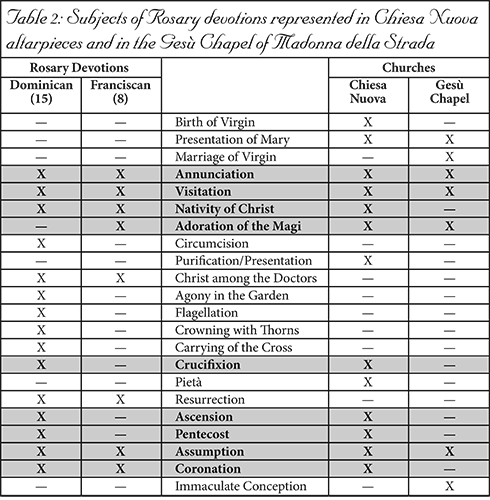
The seven-mystery devotion was related to the seven joys of the Virgin and went back at least as far as the fifteenth century; the twelve-mystery devotion related to the stars about the Virgin’s head (and thereby invoking the Woman of the Apocalypse) and was just as old and led to the devotion—especially popular later with the Jesuits—of the Stellarium. Table 2 shows the degree to which the twelve-mystery devotion approaches the Chiesa Nuova program. Listed are the Chiesa Nuova altar dedications, the standard fifteen Rosary devotions, the standard Franciscan Corona devotions, and lastly the altars of the Chapel of the Madonna della Strada in the Gesù. One can see that of those altar dedications that match, the Chiesa Nuova has most in common with the Franciscan Corona. Although these devotions do not match those of the altarpieces of the Chiesa Nuova perfectly, the emphasis on Mary is a much better fit. More importantly, the mysteries relate to Mary’s joys, which is consonant with Oratorian emphasis on elevated wonder.
One can note that Christ in the Temple is rarely shown in sixteenth- and seventeenth-century altarpieces. On the other hand, the “sorrowful” devotions of the Crucifixion and the Entombment in the Chiesa Nuova militate against a pure Franciscan reading of the cycle, since they clearly depart from the canonical joys of the Virgin. In addition, some versions of the seven joys include the metascriptural visit of Christ to the Virgin Mary on his resurrection, [62] a strongly Franciscan-marked devotion.56 With this said, it is left to explain the Franciscan-seeming slant of the program, as close as it is to Franciscan devotion. Apart from the strong immaculist message engraved on the façade that has just been mentioned, one could also point to immaculist imagery within the church. Alessandro Zuccari makes the convincing case that Barocci’s Immaculate Conception from the Franciscan church of San Francesco in Urbino (ca. 1577, now in Galleria Nazionale delle Marche, Urbino) would have been well known to the Oratorian fathers. In fact, when the Barocci imitator Andrea Lilio painted the vaults of the Annunciation chapel, he placed centrally a version of Barocci’s immaculate Madonna (see fig. 2.5).57 The pose has an encompassing gesture, appropriate to a Misericordia that may have functioned happily for the Oratorians as a version of the early Christian orant.
More could also be said about the unusual appearance of Mary in Muziano’s Ascension. Although including Mary in the ascension was popular in Byzantine and some earlier Italian examples, this was not the case in post-Tridentine Italy, where prominant examplars like the Cavalier d’Arpino’s fresco in the Lateran or Jerome Nadal’s version in the Imagines did not feature Mary. Interestingly, a work that does also include Mary is Stradano’s Ascension in Santa Croce, Florence, perhaps suggesting a Franciscan inspiration to this iconography.58
Was Neri, the quiet devotee of Florentine Dominican spirituality, actually more influenced by Franciscans? The façade of the Chiesa Nuova, finished just ten years after Neri’s death, suggests that he was. This is clearly the one sentiment Neri could not share with Dominicans, in spite of his strong identification with their corporate ethos. This discussion can help resolve a curious contradiction: why Barocci, who was so popular with Franciscan-related clients in Urbino (Conventuals and Capuchins), should instead resonate with the Dominican-inspired Neri in Rome. In fact, Neri is perhaps less Dominican than we have thought.
The general trend in the Catholic Church toward accepting Mary’s immaculacy might not have been acceptable to Dominican theology, but does not necessarily imply rejection of core Dominican themes. Nevertheless, the Dominican Rosary devotion was mostly a vita Christi and therefore automatically inappropriate for the kind of thing Neri wanted. What Neri actually implemented in decorating the altars in the Chiesa Nuova is closer to the joyful narrative of Mary’s life found in the Franciscan devotions.
Internal Typology
If anything, the rosary style of devotion was populist, and the fathers of the Oratory strove to make devotion accessible to the visitors of the church. Therefore, each altarpiece followed a chronological order and featured a distinctive episode of the Virgin’s life that was easy to [63] recognize. In light of this, it is interesting to think about the chapel decoration because it was previously noted that the Oratorians above all sought to place altarpieces on their altars whereas the Jesuits conceived of their chapels as ensembles for which fresco decoration was just as important.
In the Chiesa Nuova side chapels, there is additional decoration only in the vaults and underarches, as each chapel is pierced with a portal leading to the next chapel. Examining each of the chapels in the Chiesa Nuova, one notes that there is no rigid formula for the typological pairings, which are formalized but only broadly significative. The underarch’s painted and stucco decoration can contain Old Testament and New Testament subjects, and emblematic figures. Meanwhile, the vaults in their tripartite decoration (sometimes a rectangle, sometimes a foliated field) feature Old Testament prophets, martyred saints, and elaborations of the narrative below, as when in the Chapel of the Crucifixion a Flagellation fills the central vault field above Pulzone’s Crucifixion, or in the Chapel of the Pietà the Lamentation is found above Caravaggio’s Pietà. In the case of the Chapel of the Visitation, a figure of John the Baptist (whose mother, Elizabeth, is featured in Barocci’s painting) is shown, deepening the significance of the bridge from old to new dispensation.
The comparison with the Gesù is actually more striking than the foregoing discussion suggests, for the simple fact that in many cases the stucco and vault decoration was left for much later. For example, in the Chapel of the Visitation, which hosted Barocci’s Visitation, there was no additional decoration until 1618 (see appendix 1). This is true of many other chapels. For many years, the additional decoration simply did not exist to make any meaningful iconographic connections available to the viewer.59
In some cases, there is an explicit meaning developed across the aisle, that is, a typology. While the Florentine mendicant churches do not have a typology, the Gesù certainly does and it is important to investigate this issue for the Chiesa Nuova. Pairing occurred first of all because of architectural features. The Chapels of the Nativity and Ascension, directly across the nave from one another, have unique architectural features.60 This can be explained by the fact that in Giovan Battista Guerra’s (1547–1627) rebuilding of the church, the Chapel of the Nativity was finished first (1600) and therefore the Chapel of the Ascension (finished only in 1616) had to conform to it, even as the fathers of the Congregation of the Oratory evidently changed their mind about the overall decoration. There is furthermore planning of paired chapels, as in the offer to Barocci to paint both the Presentation of the Virgin and the Coronation of the Virgin. The very act of simultaneous commissions raises the issue of thematic relationship. As noted, the core of eight altars was also formed simultaneously, which in the same way required a consideration of thematic relationship.
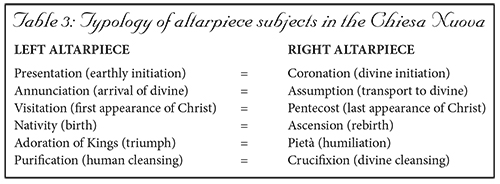
This would be an example of what Marilyn Lavin has called “internal typology,” that is, “scenes within the same cycle that refer to each other to intensify the reciprocity between [64] them.”61 Basically, the left side of the church represents the life of the Virgin before Christ’s death and the right side, after his death, since the first altarpiece on the right-hand side is the Crucifixion. This is already significant and allows for such ideas as—to begin with the visually prominent transept aisles of the Presentation and Coronation—an idea of an earthly initiation and a divine initiation. Similarly, the Annunciation, which is the appearance of divinity on earth, is traded in the Assumption for Mary’s transport to heaven, home of the divine.62 And so on. This collapses the narrative flow into an alternative cross-aisle reading.
Although we problematized the direct reading of the Rosary as the source of the iconographic program, it is nevertheless significant that there was a tradition of meditating alternately on the joys of the Virgin and the sufferings of Christ during his Passion, that is, alternating between the first five and second five devotions. Broadsides of rosaries, such as Hans Schaur’s in the Germanisches Nationalmuseum, Nuremberg (ca. 1481), match the Annunciation with Christ in the Garden of Gethsemane, the Visitation and the Flagellation, the Nativity and Crowning of Thorns, Christ Found Teaching in the Temple and Christ Carrying the Cross, and finally the Death or Assumption of the Virgin and the Crucifixion.63
As noted, the decoration of the two chapels can be quite similar, as with the Chapels of the Annunciation and Assumption. In that example, the vault of the Chapel of the Annunciation (above Passignano’s altarpiece) features the Coronation of the Virgin, which is precisely what Giuseppe Cesari painted across the aisle. The two events fold into one of cosmic significance. This observation confirms Hibbard’s largely forgotten point that in the Chiesa Nuova, there is “also the possibility of reading across [the nave] through an ingenious interlocking system.”64 Hibbard made this observation in explaining the typology formed within the Gesù, yet his observation has not been followed up. For example, Bailey contrasts the Chiesa Nuova to the Gesù, saying, “unlike the Oratorian Chiesa Nuova, which had a more traditional chronological program arranged in a counterclockwise circle, the Gesù had a cross-nave pairing of chapels.”65
Nevertheless, it is certainly true that the system connecting the altarpieces in the Chiesa Nuova, just like that connecting the altarpieces themselves to the chapel decoration, is not rigorously interlocking, but intuitive and broad in its symbolism. In other words, the typological pairing across the aisle was relatively simple and didn’t require too much theological clarification. In another sense, the clarification of this weak typology within the church fulfills the iconographic program upon mysteries of the Virgin. “Mystery” is a an old term that refers back to Paul’s original creation of an alternate sense to scripture, to set it apart from pagan writing. Because the sacramental and mystical sense [65] was more or less synonymous with the allegorical and spiritual, the nomination of such subjects had an inherent meditative purpose.66
Nevertheless, what is the real significance of these pairings? I believe they are simple truths available to the viewer but not really “cumulative” in a strict iconographic sense. They tend to reinforce a general appreciation of a single mystery without adding a substantial alternative reading. For example, after contemplating Barocci’s Visitation—as Neri did—and the way in which divinity visited the humble Mary, one could turn and look at the Pentecost, yet another case of the workings of the divine spirit. If anything, in line with the Oratorian emphasis on vulnerability of the young Virgin Mary or the grieving Virgin Mary, the mediation becomes one of Mary at two different difficult periods in her life when she, paradoxically, is closest to God, that is birth and assumption. The way in which this paired devotion relies on the early Marian devotion of the Rosary rather than the strict form of the popular Dominican version, means once again that Neri drew from its spirit rather than its codified form.
After seeing in the last chapter the basic features of Oratorian structure and commitments, and the aesthetic that they found in Barocci’s painting, this chapter has explored how those commitments play out in the way that Marian spirituality is engineered through the church’s decoration. Although decoration of the Chiesa Nuova is often connected to the Rosary, an attractive theory given Neri’s devotion to the Dominicans, a careful examination shows that Neri and the Oratorians instead improvised their altarpiece cycle based on simple principles of Marian devotion. With their emphasis on simple narratives of the life of the Virgin, the Oratorians focus on the experience brought by the altarpieces themselves, while they neglected the decoration of their chapels, sometimes letting them languish for years. In noting this, we have to revise our understanding of Oratorian chronology of decoration in comparison to the Jesuits, for the Oratorians quickly got altarpieces on their altars, whereas the Jesuits decorated the Gesù as a whole at the same time. The relationship of the Oratorians to the cross-aisle pairing, or typology, that connects subjects in the church is characteristic of their overall idea of devotion. Just as Barocci sought in his Visitation to suggest the cosmic significance of the mystery without losing sight of the immediacy of the scene depicted, the Chiesa Nuova’s altarpiece cycle itself hinted at larger themes but kept attention squarely on Mary.
Notes
1. “Conditioni cole quali si ha conceder le Cappelle,” ca. 1580, ACO, Rome, C.I.26, cited in Barbieri, Barchiesi, and Ferrara, Santa Maria in Vallicella, 160n35.
2. On Neri’s attachment to the Virgin Mary, see Venturoli, San Filippo Neri; and Barchiesi, “S. Filippo Neri e l’iconografia mariana della Chiesa Nuova.”
3. Frederick, “Program of Altarpieces for the Siena Cathedral.”
4. Santa Croce’s Passion cycle was undoubtedly influenced by Orvieto Cathedral’s, which was executed between 1556 and 1575, and includes The Betrayal, Christ before Pilate, The Flagellation, The Crowning with Thorns, Ecce Homo, The Way to Calvary, The Crucifixion, The Raising of Lazarus, and The Marriage at Cana. The cycle at Santa Croce (executed in the 1560s and 1570s) includes The Entry into Jerusalem, Ecce Homo, The Flagellation, The Way to Calvary, The Crucifixion, The Deposition, The Resurrection, Christ in Limbo, The Supper at Emmaus, Pentecost, The Doubting Thomas, and The Ascension; Hall, Renovation and Reformation; Swank, “Iconografia controriformistica negli altari delle chiese fiorentine.”
5. The pioneering work on this whole subject began with these two churches in the work of Hall, Renovation and Reformation. Peter Humfrey has dealt with the situation in Venice: “Co-ordinated Altarpieces in Renaissance Venice.” He says that in San Francesco della Vigna, the Observant Franciscan church of Venice, patrons chose the subjects for the altarpieces (p. 199) and that, contra Goffen, there was no program at the Frari, the Conventual Franciscan church (p. 201). Only in San Giorgio Maggiore (where frames match) can we definitively say that a program existed and it was decided by the presence of relics. Even at the Redentore, there were all lay patrons and no program (p. 211). For a northern Italian example, see Knox, “Unified Church Interior in Baroque Italy.” For the Jesuit (Saint Michael’s) church in Munich, see Smith, Sensuous Worship. For Saint Peter’s, see Rice, Altars and Altarpieces of New St. Peter’s.
6. For the meditative program underlying a fresco group, see Monssen, “Triumphus and Trophae Sacra.” For printed images, see Freedberg, Power of Images, 178–88. For virtual and physical ways of the Cross (via Crucis), see Kirkland-Ives, “Alternate Routes.” For altarpieces, see Smith, Sensuous Worship, chaps. 3–4.
7. Borromeo, Instructiones fabricae et supellectilis ecclesiasticae. See Sénécal, “Carlo Borromeo’s Instructiones.”
8. On Marian churches, see Knox, “Unified Church Interior in Baroque Italy,” 689. For the sacramental tabernacle in the Gesù, see Masheck, “Original High Altar Tabernacle of the Gesù Rediscovered.”
9. This can be seen in Andrea Sacchi’s record of the solemnities for the canonization of Filippo Neri (1622, Vatican Pinacoteca), reproduced in Museo di Palazzo Venezia, La Regola e la Fama, 322, where no tabernacle is visible. For Cirro Ferri’s tabernacle, see Barbieri, Barchiesi, and Ferrara, Santa Maria in Vallicella, 52; and Montagu, “Cirro Ferri’s Ciborium in Santa Maria in Vallicella.”
10. See note 4 for the altarpiece cycles.
11. Lavin, Place of Narrative, 256.
12. Cistellini, San Filippo Neri, 1:206.
13. Barbieri, Barchiesi, and Ferrara, Santa Maria in Vallicella, 71; Marciari, “Girolamo Muziano and the Dialogue of Drawings,” 127.
14. For this lost image, which was replaced by Caravaggio’s Entombment, see Zuccari, “Deposizione di Cristo nel Sepolcro.”
15. “Conditioni cole quali si ha conceder le Cappelle,” ca. 1580, ACO, Rome, C.I.26, quoted in Barbieri, Barchiesi, and Ferrara, Santa Maria in Vallicella, 160n35: “La Congreg.ne dell’Oratorio da facultà à chi sarà deputato à trattare in nome suo, di concedere le Cappelle à persone particolari con le infrascritte conditioni, riservato però, quanto sia di bisogno il consenso della Sede Apostolica ò vero del Vicario di N.S.r e non altrimenti. In prima che il detto Deputato metta in considerat.ne che sarebbe ragionevole che anteprima si pagasse il guscio e lo stucco. Non di meno egli in questo particolare habbi faculta di disporre secondo che gli parera spediente. Che le cappelle si ornino tutte ad un modo come è gia incominciato. Che la pittura sia uno de Misterij della Madonna Santis.ma secondo l’ordine incominciato. Che l’ornamento della pittura sia un Tabernacolo del medesimo disegno della Cappella di m. Pontio [Ceva], m. Silvio [Antoniano] e ms. Vincenzo Lavaiano, sia che uno sia di legno tutto dorato l’altro di marmo con colonne di mischio. E che I tabernacoli all’incontro corrispondino l’uno all’altro, cioè oro con oro, e marmo con marmo con la medesima sorte di mischi. Che le cappelle che non sono stuccate si stucchino dentro e fori nell’istesso modo che l’altre. Che si faccia la invetriata come quella di m. Pontio e di m. Silvio. Che si faccino I balaustri come gli altri. Che si faccino un par de candelieri di legno come gli altri. Che le cappelle si dotino tutte in beni stabili almeno con quella dote che ha dato m. Pontio. Che quello à chi si concederà una delle cappelle habbi la seppoltura per se e suoi heredi e che possa far la tomba dentro la cappella. Che possa mettere una lapide in terra dentro la cappella con l’arme et inscrittione come quella del Lavaiano. Che la Congregazione habbi obligo di far celebrare una messa la settimana et un anniversario de morti in perpetuo in ciascuna cappella si concederà. Che del detto obligo se ne tenghi memoria in sacrestia.” Note that as regards the banisters mentioned above, that of the Lavaiana chapel was of wood; cf., ibid., n329. In translating this passage, I was helped by consulting an unpublished manuscript by John Marciari.
16. Hibbard, “‘Ut Picturae Sermones,” 34; Bailey, Between Renaissance and Baroque, 195.
17. Gallonio, Vita di San Filippo Neri, 178, 201. There is no mention of artists in the 1600 Latin edition.
18. Incisa della Rochetta and Vian, Il Primo Processo per San Filippo Neri, 1:64.
19. Archivio dell’Oratorio Romano, Rome, AV 14, fol. 17r–v, cited in Zuccari, “Cultura e predicazione nelle immagini dell’Oratorio,” 34.
20. Bacci, Vita di San Filippo Neri: “quando si ebbero a fabbricare gli altari della chiesa, volle che in ciascheduno di essi si dipingesse un mistero del salvatore, in cui vi dovesse andar dipinta ancora la Madonna Santissima”; and Bacci, Life of St. Philip Neri, ed. Antrobus, 1:154. It is possible that in this official publication, Bacci conducted a bit of self-censorship in deflecting attention slightly away from the Virgin.
21. Nova, “Il ‘modello’ di Martino Longhi il Vecchio.”
22. Graeve, “Stone of Unction in Caravaggio’s Painting for the Chiesa Nuova,” 234.
23. Sickel, “Remarks on the Patronage of Caravaggio’s ‘Entombment of Christ.’”
24. Calvesi, Le realtà di Caravaggio, 314.
25. Baronio recounts his mother’s devotion to the Nativity of the Virgin in his native Sora; Calenzio, La vita e gli scritti del cardinale Cesare Baronio della Congregazione del Oratorio, 171. When Baronio filed in the Vatican Library, of which he was librarian, the processo documents related to Filippo Neri’s beatification, he made sure they were deposited on the day of the Nativity of the Virgin, 1605; ibid., 724.
26. Flaminio Ricci to Borromeo, 7 May 1603, ACO, B.IV.19, fol. 61v, quoted incompletely in Olsen, Federico Barocci, and Emiliani, Federico Barocci, but completely by von den Mühlen, “S. Maria in Vallicella,” 269–70: “il predetto Baroccio farebbe volontieri me.o il quadro della Natività per l’altar maggiore, sì per haver particolare genio a quella istoria, che non solamente a questo della Presentazione con tutto che sia riuscito maraviglioso, et di stupore a tutta Roma, come per trovarsi la fatiga mezza fatta, havendone di già per ordine del Duca d’Urbino fatta un disegno et sbozzo per il re di Spagna, che gli restò poi essendosi detto Duca mutato di pensiero, et havendole fatto fare un S. Andrea in luogo di quello et per questo ricordata speranza che si haverebbe finito in due anni.”
27. Barbieri, Barchiesi, and Ferrara, Santa Maria in Vallicella, 194: “Fu ballottato se si doveva revocar il decreto altra volta fatto di reportar la Madonna dove stava prima et fu concluso che si rinnovasse poiche per essere aperta la porticella vicino a detta cappella et per passo continuo staria con poca decentia, in somma fu concluso che non vi si riportasse altrimenti, nonostante il primo decreto.” Amazingly, it was due to the Oratorians’ wish to keep the door open and the throngs of people coming to visit the chapel that the Madonna was moved back to the high altar.
28. Levy d’Ancona, Iconography of the Immaculate Conception, 41.
29. Mann, “Annunciation Chapel in the Quirinal Palace,” 130.
30. Costamagna, “La più bella et superba occasione di tutta Roma . . . ,” in Museo di Palazzo Venezia, Regola e la fama, 156. These paintings are discussed in the last chapter.
31. For Alberti and Vanni, see Museo di Palazzo Venezia, Regola e la Fama, 502–4, no. 61, and 505–6, no. 65, respectively. Both are discussed in the conclusion.
32. de Santi, “Litany of Loreto,” in Catholic Encyclopedia, 9:289. For the Chapel of the Annunciation, see Barbieri, Barchiesi, and Ferrara, Santa Maria in Vallicella, 122–26.
33. For the iconography of the Madonna of Loreto, see Grimaldi and Sordi, L’iconografia della Vergine di Loreto.
34. The classic study of medieval representations of the throne of wisdom is Forsyth, Throne of Wisdom.
35. Several Oratorians made pilgrimages to the Holy House of Loreto. Cardinal Sfondrato had a particular devotion to the Virgin of Loreto, making several gifts to the shrine; Gallagher, “Expression of Piety.”
36. Barbieri, Barchiesi, and Ferrara, Santa Maria in Vallicella, 140.
37. Ibid., 72.
38. Hibbard, “‘Ut Picturae Sermones,’” 36.
39. Bailey, Between Renaissance and Baroque, 189.
40. In 1589, Muziano’s Crucifixion for the high altar was delivered. The side chapel altarpieces arrived in this order: probably 1590 for Ciampelli’s for the Martyr’s Chapel; 1591 for Pulzone’s for the Passion Chapel; probably 1591 for Bassano’s for the Trinity Chapel; and 1591 for Pulzone’s for the Angels’ Chapel.
41. Graeve, “Stone of Unction in Caravaggio’s Painting for the Chiesa Nuova”; Lavin, Place of Narrative, 256; Kummer, Angänge und Ausbreitung der Stuckdekoration, 147. Zuccari, “Cultura e predicazione nelle immagini dell’Oratorio,” is a special case because he never equates the program with the Rosary, only suggesting that Neri and others took “suggestioni tematiche e iconografiche” (344). Exceptions are the archivally minded authors who literally invoke the 1580 brief; Ponnelle and Bordet, St. Philip Neri and the Roman Society of His Times, 416: “mysteries of the Blessed Virgin”; Cistellini, San Filippo Neri, 1:286: “misteri mariani”; and von zur Mühlen, “S. Maria in Vallicella,” 253: “Marienmysterien.” Barbieri, Barchiesi, and Ferrara, Santa Maria in Vallicella, 27, 166, openly dismisses the Rosary theory.
42. On the iconography of the Rosary, and Rosary-based rituals that informed images, see Male, L’Art religieux après le Concile de Trente, 466; and Olson, “Rosary and Its Iconography, part I.”
43. Graeve, “Stone of Unction in Caravaggio’s Painting for the Chiesa Nuova,” 235; Zuccari, “Cultura e predicazione nelle immagini dell’Oratorio,” 344. Filippo Neri owned the 1567 edition, still in the collection of the Biblioteca Vallicelliana.
44. For the corone, see Anonymous, “San Filippo Neri nella scienza e nell’arte sacra,” 231. For the portrait with a rosary, see Piero Leone Ghezzi’s print after a Roncalli original in Museo di Palazzo Venezia, Regola e la Fama, 35. Cf. Francesco Villamena’s portrait from Gabriele Paleotti’s De bono senectutis (1595) in ibid., 466–67, no. 16.
45. Bacci, Vita di San Filippo Neri, 102; Bacci, Life of St. Philip Neri, ed. Antrobus, 1:153–54.
46. As emphasized already by Wright, “Caravaggio’s Entombment considered in situ”; and Barbieri, Barchiesi, and Ferrara, Santa Maria in Vallicella, 27, 166n87: “poiche solo alcuni di quegli episodi coincidono con I soggetti delle pale d’altare.”
47. Winston-Allen, Stories of the Rose, figs. 5 and 6.
48. Winston-Allen, Stories of the Rose, 60, with reference to Peter Canisius.
49. Barbieri, Barchiesi, and Ferrara, Santa Maria in Vallicella, 67.
50. Ringbom, “Maria in Sole and the Virgin of the Rosary.”
51. Mitchell, Mystery of the Rosary.
52. Francesco Zazzara, 22 November 1595, in Incisa della Rochetta and Vian, Primo Processo per San Filippo Neri, 1:378–79; and Ponnelle, Bordet, and Kerr, St. Philip Neri and the Roman Society of His Times, 596–97. For an allied point about improvised Passion devotions, see Kirkland-Ives, “Alternate Routes.”
53. For the Franciscan Rosary, see “Rosary,” in Catholic Encyclopedia; Bracaloni, “Origine, evoluzione ed affermazione della Corona Francescana Mariana,” 274; and van Wely, “Het Kransje der Twaalf Sterren,” well summarized by Stratton, Immaculate Conception in Spanish Art.
54. Lingo, “Capuchins and the Art of History,” 359–60. For the efforts by Franciscans to promote their own Rosary in the later sixteenth century, see McGrath, “Dominicans, Franciscans, and the Art of Political Rivalry.”
55. Frate Gratia, La vita et gesti della bona mem. Sig.re Johan Prefetto (Vatican Library, Cod. Urb. Lat. 1023, fol. 332r; cited in Lightbown, Carlo Crivelli, 261.
56. On this tradition, see Breckenridge, “‘Et Prima Vidit.’” In fact, the Capuchins and Jesuits both strongly defended the appearance of Christ to the Virgin; it appears for instance in Nadal’s aforementioned Imagines.
57. Zuccari, “Cultura e predicazione nelle immagini dell’Oratorio,” 347. Lilio follows a reversed print, most likely that of Philippe Thomassin printed in 1591.
58. Swank, “Iconografia controriformistica,” 114, notes the rarity of the iconography. The Virgin also appeared in Naldini’s Ascension in Santa Maria del Carmine, Florence, another church of an immaculist Marian Order (Carmelites).
59. For the chapel decorations, see Barbieri, Barchiesi, and Ferrara, Santa Maria in Vallicella; and Barchiesi, “S. Filippo Neri e l’iconografia mariana della Chiesa Nuova.”
60. Barbieri, Barchiesi, and Ferrara, Santa Maria in Vallicella, 167n93.
61. Lavin, Place of Narrative, 116. As an example, she cites the Oratorio della Croce in San Francesco, Volterra. Her discussion of the Chiesa Nuova is not classified in this way, because I am noting the effect of typology is relatively weak.
62. See Wimsatt, “Blessed Virgin.”
63. Winston-Allen, Stories of the Rose, 41–43.
64. Hibbard, “Ut picturae sermones,” 36.
65. Bailey, Between Renaissance and Baroque, 196.
66. de Lubac, Exégèse médiévale, 2:19–27. Cf. Eco, “Modern Concept of Symbol.”

[A] Plate I: Federico Barocci, Visitation of the Virgin and Saint Elizabeth, 1586, oil on canvas, Chiesa Nuova, Rome (photo by author).

[B] Plate II: Federico Barocci, Presentation of the Virgin in the Temple, 1603, oil on canvas, Chiesa Nuova, Rome (photo by Bradley Cavallo).

[C] Plate III: Peter Paul Rubens, Adoration of the Madonna della Vallicella, 1608, oil on slate, Chiesa Nuova, Rome (image from Wikimedia Commons).

[D] Plate IV: Federico Barocci, Head of an Old Man (Filippo Neri?), ca. 1583, charcoal pastel on paper (Galerie Hans, Hamburg).

[E] Plate V: Federico Barocci, Nativity of Christ, ca. 1597–99, oil on canvas, Biblioteca Ambrosiana, Milan (© DeA Picture Library/Art Resource, NY).

[F] Plate VI: Federico Barocci and Alessandro Vitali, Saint Ambrose’s Pardon of Theodosius, 1603, oil on canvas, Duomo, Milan (Fabbrica del Duomo di Milano).

[G] Plate VII: Federico Barocci and Alessandro Vitali, Nativity of the Virgin, ca. 1588–1603, oil on canvas, San Sempliciano, Milan (Soprintendenza per i beni storici artistici ed etnoantropologici per le province di Milano).

[H] Plate VIII: Federico Barocci, The Institution of the Eucharist, 1603–1608, oil on canvas, Santa Maria sopra Minerva, Rome (photo by Chris Paprocki).