
6
Franca Varallo
Margaret of Austria’s long journey as the betrothed of Philip III of Spain has been the subject matter of numerous studies aimed at reconstructing visits and ceremonies which took place in the different towns, especially those in Italy.1 Nonetheless, in this essay I return to Margaret of Austria’s Italian progress to examine in detail the celebrations in Spanish Lombardy. In fact, the condition of this territory, subject to a foreign state, created particular dynamics between the central power and local realities, both on a cultural and on economic and social levels, thus offering an interesting margin of analysis. In order to avoid pointless generalizations, I shall narrow the field to two moments in Margaret’s journey: the sovereign’s entrance to Milan, with some clarifications on the matter of apparati; and her passage into Pavia to which I shall devote a more detailed analysis, due to the specific conditions and the richness of documentary material.2
Maria Antonietta Visceglia, in a fine essay on female politics and royalty,3 demonstrates the importance of some rites of passage during festivals, among which she emphasizes the moment at which the queen consort entered the towns and more importantly the capital of the realm. Visceglia interprets this as the first symbolic ‘presentazione della nuova sovrana al suo popolo’ [‘introduction of the new sovereign to her people’], and a ceremony through which the sovereign was legitimized. In other words, this significant moment was a ‘ritual of inclusion’.4 These considerations can be extended in general to subject territories, to which such occasions meant an implicit confirmation of loyalty to the sovereign celebrated through his consort, with an ephemeral commemoration and the dramatization of allegorical themes and motifs.
Considering Visceglia’s point of view, Margaret of Austria’s progress thus becomes an exemplary model. Indeed, the numerous written and visual sources, preserved in the State of Milan and elsewhere, are a testimony of the rare completeness of the festivals staged in her honour. Before arriving in Milan the cortège stopped in Lodi where, according to the chronicle by Scipione Bendinelli and the surviving drawings of the seven triumphal arches,5 receptions took place without difficulty in the presence of the city’s authorities, as well as of gentlemen and ladies sumptuously dressed for the occasion (Figures 6.1 and 6.2).6
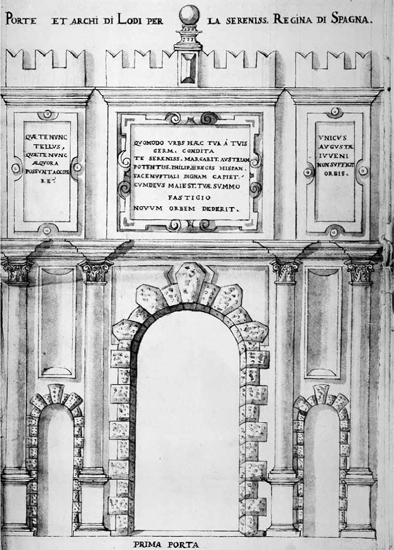
6.1 Scipione Bendinelli (?), Triumphal arch, Lodi Copyright © Archivio Comunale
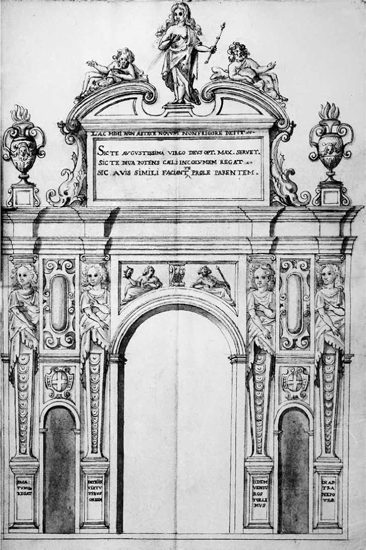
6.2 Scipione Bendinelli (?), Triumphal arch, Lodi Copyright ©Archivio Comunale
On leaving Lodi, Margaret and her retinue made for Milan where the entrance had been prepared with particular care. Of numerous reports, the official description was undoubtedly the one written by Guido Mazenta, which has come down to us in a printed edition and in a manuscript version dated 1597, held in the Biblioteca Nacional in Madrid.7 A comparison between the latter, studied by Fernando Checa and Rosario Díez Del Corral,8 and the former is interesting because it allows us to discern the differences in the ephemeral decorations before and after Philip II’s death. Indeed, these festivals are an unmistakable testimony of the ways in which the Spanish sovereign exerted systematic control over ephemeral inventions devoted to celebrating Spain. Checa and Díez del Corral have examined the allegorical figures in comparison to treatises on iconology, hieroglyphics and emblems (mainly Ripa, Bolzanus and Alciato) and consulted the sources used for defining the symbolical programme of the apparati. While their analysis of the sources is sound, they do not consider the impact that that the death of the King of Spain had on the symbolic ornamentation of the festival.
The manuscript in Madrid had been drawn up before the sovereign’s death and was sent to Philip II for approval by Mazenta, who was charged by the Court of Provision and by the lords elected by the General Council of Milan. Mazenta was an architect and a prominent figure in the political and cultural milieu, and we owe to him the suggestion of symbolic images, words and devices within the structures. This manuscript supposedly contained five arches, of which the first and the last ones were dedicated to Margaret, the second to Philip II and the third to the Crown Prince, whereas the fourth was named after the governor. The death of Philip II imposed some important changes on the festival for Margaret, not only because the princess-spouse had become queen, but also because the occasion turned into a solemnity to recognize and glorify the new sovereign, Philip III. The arches increased from five to seven: only the first one was dedicated to Margaret, the second and third maintained their dedication to Philip II and Philip III respectively; the (additional) fourth was named after Archduke Albert, the fifth (previously the fourth) was transformed in order to celebrate Philip II together with the Lord Constable of Castile, the governor’s father. A sixth arch was located on the cathedral façade and built by the Fabbrica del Duomo; the seventh, commissioned by the governor, was erected in front of the main gate of the Duke’s Palace. Therefore the eulogy shifts from Margaret, previously celebrated with two arches, to the deceased king and to the Spanish monarchy, and with the more explicit involvement of the governor, representing the power of the state. The symbolism had a double meaning: on the one hand a homage by the new sovereign to his deceased father; and on the other the general theme of the seventh arch, namely ‘l’arco celeste, detto Iride da gli antichi’ [‘the celestial arch, called Iris by the ancients’] that symbolized the serenity sealed by marriage.
The overall conception of the apparati must be assigned to Mazenta, as may be confirmed by the licensing of a printed version of his text. Certainly, the drawings in the Madrid manuscript are also his and their style clearly belongs to Milan’s figurative milieu, full of mannerist suggestions, notably in the terminations of the second arch, actual omenoni inserted in an ensemble following Serlian rules.9 The inventor might well have been a single person, however many artists were involved in the apparati construction, which was usually teamwork; among the latter can be counted the Chamber’s engineers Giovanni Battista Clarici and Gabrio Busca, who are documented in works assessments at the theatre, and Tolomeo Rinaldi, an architect from the Fabbrica del Duomo, to whom we may ascribe the arch leaning against the building façade. At the entrance of the city, instead of an ephemeral structure Aurelio Trezzi built a new masonry gate, Porta Romana, and a bridge; Francesco Brambilla made the numerous statues on the arches and elsewhere along the route.
The Archduke and the sovereign stayed in Milan until 3 February 1599, then continued south, heading to Pavia, which they entered, after a brief stop in Binasco, on 4 February. As noted previously, the documentation regarding Pavia is significant; in addition to archival sources there survives a report written by Giovanni Battista Olevano10 and a detailed account written by Antonio Maria Spelta.11
Like other cities, Pavia began preparations during the summer, having received the first official notice of the princess’ passage around 18 July. On 20 July the Council invited absent lords to return to town in order to collectively tackle the issue12 and from 21 July it started a dense exchange of letters with the orator resident in Milan to inform him about the apparati, the clothing, the accommodation, the donative, the canopy and the precedences. In the first letter, we find proof of how the festivals were defined and of how limited the autonomy of single communities was (they had to follow protocol and to assume procedures in compliance with other, similar circumstances, for example, according to the guest’s degree of importance and the governor’s wishes). Therefore, the Lords asked the orator:
Where she will have to dwell here in Pavia, said Serene Princess, Serene Mother and Serene Prince Archduke Albert, namely if as Sovereign she shall dwell in the Castle as [is the] custom of other Sovereign Princes of the State, or if the city is to provide for a home, as was done for Her Serene Empress. If the Court’s expenses will be carried out by the Chamber as for the passage of Her Serene Empress … If the Chamber will furnish the house for the Princes, as was done for the house of Her Serene Empress, or if also this will be on behalf of the city, knowing, that in Pavia suitable furnishings for so grand Princes are not to be found. If the Chamber shall provide as previously done for the canopy to greet said Empress at the city gate. If the Chamber shall provide sutlers who will carry out the expenses for the court without any trouble for the city, as when the Empress passed.13
Moreover, they asked him to find out information on the tour the princess would take in the state, which stopped before arriving in Pavia, details of the festival preparations in other cities, especially Milan, and how many pageants and knights must go to pay homage to her, but above all:
If in making triumphal arches one is to make few, or more sumptuous, or larger and at lesser expense. If the streets of Pavia are to be covered, and if unable to cover with wool drapes, since the wool manufacture has ceased in Pavia, it will suffice to cover them with cloth. If the pageboys are to be dressed on behalf of the city, or on behalf of the private citizens, and how many and in what kind of clothing, so in respect of colours as well as ornaments. If Her Serene Highness is to be presented and with what sort of things, namely silverware or travel victuals …. If Her Ladyship is to be attended up to Genoa by those who will meet her, or if it will suffice to escort her out of the city.14
Thus the city asked for details on every single issue and urged the orator to exercise the shrewdness demanded by the situation, to advise on each matter, each resolution and ‘avertendo a non trattar di questi affari se non con persone d’autorità et pratiche, et soprattutto, confidenti, acciò comunicandoli a qualche emulo, non ci tasseremo di puoco valore, et prudenza.’ [caring to deal with such business only with authoritarian and practical people, and most of all confident, so as to communicate them to some imitator, we shall not be taxed of little value, and caution.] The secrecy of his work was coupled with the necessity of knowing what other communities had organized in order not to be outshone. This entailed a diplomatic espionage operation which involved lords from Pavia resident in other cities, as attested by the letter the Council sent to Hortado Landolfi in Cremona, dated 27 July 1598:
We intend that in this city of Cremona many things shall be prepared to honour the visit of Her Serene Princess Our Lady of Spain, and, since we wish to secretly receive clear and distinct information about everything, we decided to receive it through Your Lordship, whom we are sure loves his country as any other good citizen. However, upon receiving this, we send by post, Your Lordship shall advise us on what he has ruled and decided to do in that city, so as for arches, triumphal gates and encounters, clothing and gifts, and other things, informing us minutely on every detail.15
The Council was preoccupied with the necessity of making as good an impression as the other municipalities, as well as trying to avoid immoderate or superfluous expenses.16 For that reason the decisions made during the Council’s sessions were passed on to the orator so that, in addition to his approval, he might obtain some economic allowance from the governor able to help with the expenses of the festival preparations. At the time the city was in such a difficult financial situation that it had even been forced to sell its rendita to cover its expenses.17 Control from Milan was tight and little was left to the initiative of the single municipality; the governor, in the sovereign’s name, held the right to decide on each matter, from the design of itineraries to the choice of structures and accommodation and down to the selection of materials. An eloquent demonstration of the situation is offered in the reasons given for the arrangements made for the entrance gate and the arches to be erected along the route, which the Council reported in a letter dated 29 July:
The city of Pavia eager to receive and honour the arrival of Her Lady the Princess, altogether pleasing HE so that that city shall be content with the orders, … [has] concluded that … it would have been appropriate to welcome Her Serene Highness through the Salla Gate near the Castle [now closed], and there start the arches, accordingly, having on the outside the straight and perpendicular road coming from Milan, and on the inside crowns the new road and the citadel gate where another arch shall be made by removing another house of little importance, since it would make a great view and a great magnificence, but unable to carry out such honourable and right designs without the authority of HE … the orator of that city has resolved, should Her Ladyship grant him the authority, to open such door and pull down said house for this purpose.18
Milan, either for the sake of clarity or, most likely, not trusting the Council of Pavia’s decisions and always suspicious of communities trying to economize on works, instructed Giovanni Battista Clarici, the Chamber’s engineer, to inspect the quality of the sites and the projects and to report to the governor. On the back of the same letter but written in a different hand, we read: ‘1598 a 29 di luglio L’ingegnere Gio. Battista Clarici vada subito a Pavia et visiti tutto quello ch’essa città espone in questo memoriale, e riferisca a S.E.’ [‘1598 on 29 July the Engineer Gio. Battista Clarici shall go at once to Pavia and visit everything that city displays in this memorial and report to HE.’]
It was presumably after the architect’s visit that the tour chosen by the City, which had initially included the entrance from Porta Sala near the castle, as it had when the empress had passed in 1581, was altered to start westward from Porta Nuova. Although we cannot establish to what extent Clarici’s presence affected the final choices, we may infer that the Chamber’s engineer was not welcomed in Pavia, where his presence was rightly considered a form of control from Milan. The documents are silent on the names of the apparati designer and makers, whereas they allude to many difficulties encountered in the arches’ execution, both financial and organizational. Economic problems were not only due to the construction of ephemeral structures: the organization of the festival was a considerable expense for the municipality, and cost far more than had been predicted.
On 30 July the Court of Provision elected those who were to take care of the negotii [‘business’] necessary for Margaret’s arrival, from gentlemen’s clothing19 (Figure 6.3), to the canopy and the arches with relevant inscriptions, for which Doctor Gringhelli was instructed to deal with Academicians.20 In the following session on 3 August the works for the bridge and Borgo Ratto gate (the pedestals of two colossi to be placed flanking the gate on each side) were commissioned. Moreover, it was decided to build the Ticino gate in masonry, upon authorization from Milan,21 and to invite all the painters in town ‘che avendo pensiero di pigliar l’impresa di dipingere gli archi’ [‘who bother to undertake the painting of the arches’] and to conclude other necessary works, to show before the said Court of Provision.22 Following the usual procedure, the construction of the ephemeral structures should have been assigned to those who had offered, according to the terms of contract, the most favourable estimate together with a declaration of risk underwriting all the works.23 Since nobody had ‘fatto partito accettabile’ [‘presented an acceptable solution’] the City was forced to assume all the expenses, assigning the works to ‘maestri intendenti [della] professione’ [‘master experts [of the] profession’] under Francesco Botta’s guidance.24 Very little is known of the paintings and stucco statues made, among which was a Victory praised by Spelta as a work by Marcello Sparti di Urbino;25 once the ceremonies were over, it was claimed that Sir Silvio Salvatico put this work in a niche in his garden. The latter information draws attention to the reuse of ephemeral structures, which were either auctioned for minor financial gain or reused in other apparati, as in the case of the 1598 arches which were partly adjusted for the subsequent entrance of Archduke Albert with the Infanta Isabella Clara Eugenia, who were heading to the Low Countries.
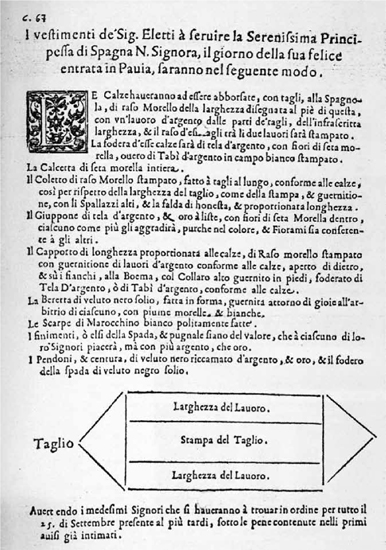
6.3 Instructions on gentlemen’s clothes Source: ASCPV, fold. 546, Feste per la venuta di principi (1418–1598), fol. 67. Copyright © ASCPV
The streets that were part of the triumphal entry, besides being ennobled by the presence of the arches, were cleaned, repaired and entirely covered by cloth. All the citizens living in or owning a shop there were invited, with several edicts from the Podestà and elected lords, to take care of their pertinent stretch of street, under the penalty of a fine of 100 gold scudi,26 whereas shopkeepers, innkeepers, poultry sellers, bakers, etc. had to provide the necessary victuals. Moreover, the nobles, as well as the bourgeoisie, the merchants and the craftsmen, had to take upon themselves the cost of accommodation, hosting the princess and her retinue in their houses, adequately adorned, following a specific structure based on the hosts’ degree of nobility. The most reluctant to obey were gentlemen spending the summer in the countryside, and the Podestà had to repeatedly order them to return to town and open their dwellings; but other citizens were not very zealous at the call of authority, in spite of the menace of pecuniary or physical penalties:
With the following we order as a first notice … all gentlemen and other citizens from:
Pavia, by birth and privilege, so as by any rank, condition, degree and pre-eminence, none excluded, that under the penalty of two hundred golden scudi each, and more or less to HE’s will according to the person’s rank, shall all meet in Pavia on the calends of next September, with all their families, and with their houses replete with victuals and properly adorned according to everyone’s degree, in order to meet Her Serene Highness the Princess, when they will be invited, and to lodge those Knights and people from the Court, whom will be entrusted to them by the Lords Deputies upon lodgings and on behalf of this City … Moreover, under this order from HE we command all the bakers, fowl and poultry sellers and other sutlers, innkeepers and hay sellers from this City to provide abundantly any sort of victuals, according to their business. So when … her Highness the Princess and her Court will stay in this city everyone will find food and drinks according to their need and money.27
At first Margaret of Austria was to have stayed at the Castle and the Archduke Albert and the governor were to have been hosted by the city. Since the gentlemen of the Council could not refuse to lodge His Excellency, they tried at least to avoid the expense for Prince Albert, claiming that they would not have been able to procure adequate tapestries and furnishings and suggesting the Castle would be a suitable dwelling for the Archduke as well.28 Furthermore, they remarked that it was not appropriate to remove decorations and hangings from houses which were supposed to host other dignitaries29 and on 4 September they wrote about this matter to the orator, begging him to intercede with the Great Chancellor and the President of the Senate. In the end, their efforts resulted in further expense as they had to accommodate them all:
Instead of being relieved from His Serene Highness the Archduke’s lodging, it seems that HE wants with this last letter to charge us with the provision of both, of all three, namely Her Serene Highness the Princess, His Serene Highness the Archduke and HE, which may seem too much and almost impossible to fulfil, because even if they were to empty [as in taking furniture out] in all gentlemen’s houses, there would have not been enough for the three lodgings only.30
In fact, the Lord of the Castle was not burdened with any hospitality duties since the expense would have struck the Chamber directly and the City had to provide for all the lodgings. The sovereign, the Archduke and the governor were hosted respectively in the residences of Marquis Giulio Cesare Malaspina, commissary Gio. Pietro Negri and Lord Carlo Mezabarba, Cardinal Aldobrandini. The remaining personalities in the entourage were accommodated in the houses of other noblemen from Pavia, which the city provided with appropriate furnishing, although not without difficulty.31 The cavalry lodging raised the same issue: once again the gentlemen of the Council tried to avoid the expense by begging the governor to use the hall in the citadel and not the houses ‘de’ particolari’ [‘of the private citizens’].32
This complex ceremonial entailed sending some city representatives first to Ferrara, then to other places where a stop was scheduled. The elected lords had to take care of all travel and clothing costs, which is one reason why there were many absentees.33 The motives given for declining the honour of election were various and most imaginative; health problems were the most frequent; in folder number 6 of the Potenze Sovrane found at the Archivio di Stato of Milan we find several letters of renunciation from noblemen in Pavia and other towns, such as that from Gaspare de Mayno, who explains to the governor that, although very honoured, he is forced to refuse such an ‘endeavour both for my age in need of rest rather than toil, and for my corpulence which prevents me from not only riding but also taking long journeys on coach, and finally for the foot and hand arthritis afflicting me greatly’.34 Therefore, age and corpulence, compounded by the foot and hand gout, impeded Mayno from honouring the princess. But other duties hung over the unwilling citizens: besides being elected ambassadors, the noblemen and the bourgeoisie might have their sons chosen as pages for the sovereign’s entrance ceremony in Pavia; in this case too there were many refusals for financial reasons, with some attempts to move the deputies to compassion, as in the letter from Gio. Domenico Visdomo Loi in August 1598:
Fellow citizen Gio. Dominico Visdomo Loi is as eager to serve HM the King Our Lord and Her Serene Highness the Princess of Our Lady Spain and his country as any other citizen … has seen the precept ordered by petition of the elected lords so that he may send a son of his to serve as pageboy to Her Ladyship upon entering our City for which he is most grateful … and he is immensely sorry for not being able to serve her on this occasion for several reasons, mainly for being burdened at present with seven children, thus being unable to bear such cost; moreover, the two sons are not fit to serve, since one is of 14 years of age and the other 12 only, and they attend grammar school and are unfit to carry a sword with many Lords and to serve accordingly … therefore he begs Your Lordships not to force him to such an expense not being compelled to especially since there are Gentlemen in town more honourable and rich.35
Those who could not avoid the burdensome engagement had to personally provide clothing, as well as other decorative garments, in compliance with what the Council had established regarding the fabric quality and quantity. These requirements often included detailed measurements and models.36 After Philip II’s death, the city called upon to welcome the new sovereign, unwilling to ‘restare troppo inferiori ad altri’ [‘remain too inferior to others’], thought it convenient to create, besides the gathering of noblemen to serve as pages in black clothes, ‘un’altra squadra di trenta o quaranta giovani mercanti vestiti uniformemente in altra guisa’ [‘another team of thirty or forty young merchants dressed alike in another guise’]. At once there were, as expected, absentees and sorrowful letters;37 not only the sons but also the fathers and the guild delegations had to promptly provide for clothing in compliance with what had been agreed upon, under penalty of their guild’s matricula loss:38 calza alla vallona [Walloon breeches], ‘over [ovvero] alla Sivigliana, d’ormesino avelutato, overo fondo di raso, o veluto a opera negro’ [‘or Seville style, of velvet ormesino, or satin bottom, or black damask velvet’], an open damask coat with a sleeve from the same, black and polished sword and dagger, black satin heavy coat, felt hat also black, with cord or band in the same colour as the morocco leather shoes.39 A similar notice was sent on 29 January 1599 to the Universita’ Dei Sarti (as the tailors’ guild in Pavia was called) so that they could in turn make a uniform suitable for the occasion, under penalty of paying 25 gold scudi or matricula loss.40
Besides the apparati and lodgings, the noblemen had to bear the costs for the canopy and donation,41 as well as for the new king’s year’s payment and for Philip II’s funeral.42 As for the canopy, the city had hoped the Chamber would intervene, as had been the case in Empress Mary’s progress,43 but after a negative response, they asked the orator for further information and commissioned the work from painter Giovanni Battista Tassinari, an artist active in Pavia between the sixteenth and seventeenth centuries.44 At the same time, the city took care over choosing the donation since in August the councillors had been torn between a ‘bacilla d’oro’ [‘golden bowl’] and crystal vases or similar gold and silver objects. At the beginning of October the issue was still unsolved.45
On 2 March 1599, once the celebrations were over, the City informed the orator: ‘The description of Her Serene Highness the Princess entering this city is well written, but not yet printed, but when it goes for printing in a few days, many copies will be sent to HE, as many as necessary to meet all the Lords’ requests.’46 After a few months, the situation presented itself once again with the same issues for the passage of Isabella Clara Eugenia and Archduke Albert who were travelling to the Low Countries.
Pavia, on account of its importance and geographical position, was an inevitable stop for those crossing the state to reach the capital. The city, already burdened by the expenses for previous lodgings, tried very hard to avoid further financial engagements, but unable to succeed it found itself in the uncomfortable position of being the first notable stop on Lombard territory before Milan. It therefore had to proceed without role models, aware that it served as a blueprint. The Infanta and the Archduke landed at Genoa on 18 June; on 1 July they passed Serravalle, then continued to Tortona and on 3 July arrived in Pavia. The itinerary was the same used for Margaret, but reversed: coming from South, the couple entered from Porta Ticinese and continued in a straight line along Strada Nuova, passing by the University, up to Porta di Santa Maria in Pertica; along the way six arches were built, including the one on the Cathedral façade, decorated with statues, paintings, words and inscriptions written by the Academy of the Affidati.
There was little time to conceive the apparati: in May the City started asking its orator to confirm the couple’s travel and itinerary, hoping not to be involved until the very last moment. Once it was clear it could not be exempted as in 1598, it had to sell its rendita to face up to expenses,47 including those for the canopy and the donation.48 Because of the inhabitants’ and shopkeepers’ lack of contribution to the expense, the streets were not covered but decorated with tapestries and carpets. The arches, in spite of the partial reuse of previous structures, demanded considerable expense and several artists were employed, among whom Gerardi paid for stucco statues, Gio. Guglielmo Riva, Francesco di Romani and Mostarda for two arches and for the Porta a Santa Maria in Pertica, and painter Gio. Antonio Zareciano for the Biosone decoration.
The Councillors expected that the citizens would oppose the request to pay for clothes and accommodation, so they [the Councillors] requested to use their authority to publish official news with which they [the Councillors] declared that the Major [Podestà] and the Deputies for provisions were in charge.
… under pecuniary and physical penalties order any person of any degree or rank, and prevail in their own houses, order the father for the son, and merchants or craftsmen.49
In spite of these efforts, the councillors had to release another edict (19 June) raising the pecuniary penalty to 25 gold scudi. Since this only resulted in the remaining gentlemen closing their houses and leaving town, in a subsequent edict on 23 June, besides raising the penalty further to 200 scudi, they proclaimed that all house doors found shut would be pulled down. Despite the citizens’ resistance and poor collaboration, the ceremonies took place with the required pomp, as reported by Antonio Maria Spelta. After the festival, the Court of Provision decided to sell the arches, together with their sculptures and paintings, to the highest bidder in the hope of obtaining some money. However, since nobody sent in an ‘oblatione di compra’ [‘purchase offering’] it had to issue a further notification to demolish the structures.
These short remarks on Pavia’s case suggest some considerations, both general and particular. The subject of festivals and ephemeral apparati boasts a considerable number of studies and is now an integral part of the bibliography on the ancien régime. The celebration of power through artful ceremonies and the combination of architecture, words and images is a well-established topic in historiography, though it risks an uncritical repetitiveness. The cross-examination of printed and archival sources suggests different perspectives on economic as well as political issues, such as the presence of opposing factions50 or outbursts of independence, often fuelled by the consciousness of a cultural identity. Historiography, long ago freed from the ‘pregiudizio antispagnolo’ [‘anti-Spanish prejudice’], has begun a careful reconstruction of the political and administrative system of the State of Milan and of the dynamics of that complex ‘arena of power’.51 De facto an extremely inhomogeneous territorial situation, in which the nine cities that the former duchy had been divided into had wide autonomy, resulted in an attempt – especially on a financial level – to achieve a direct and exclusive connection with the king, free from governors’ control.52
These tensions led to conflict, in which several political actors, not least the ecclesiastical hierarchies and the cultural milieu (especially the academies), put into effect different strategies to ensure their own sphere of power.53 The 1599 celebrations in Pavia fit into this picture, since their reconstruction based on archive documents brings to light not only tensions with Milan and the governor on an economic level and attempts by the elected Lords to avoid internal disagreements with citizens unwilling to bear considerable costs, but also the pride of a city trying to autonomously handle the situation. The festival’s programme, which had been commissioned by the Academy of the Affidati, clearly states, in its careful choice of apparati and ceremonial, the will to reinforce the city’s bond with the sovereign and its own historical and cultural autonomy in an anti-Milanese environment. Pissavino’s analysis of the political role played by the academies finds consistent development in Fabrizio Fiaschini’s essay in which the scholar, examining the programme of Margaret’s entrance, interprets the celebration of Lombard Pavia, royal capital, as the will to restore a civic identity.54 Looking back to its own illustrious past allowed the city to posit itself Sub Umbra Imperialis Aquilæ,55 a direct connection with the Spanish sovereign. On the other hand, this was achieved through the exaltation of Philip II’s good government expressed in inscriptions on the arches and in funeral eulogies written by the academicians. This had the clear agenda of showing Pavia and its aristocratic elite ‘as an academic cultural seat of excellence consisting of a theoretical speculation (and a rhetorical celebration) on the basis of good governance’.56
Therefore, the study of festivals demands an analysis of different registers to reconstruct the complexity of such phenomena. Thus I believe the diverse issues examined in this essay such as the conflicts and attempts to escape economic levy may contribute not only to our understanding of the reasons behind the academicians’ choices but also to general understanding of cultural and political dynamics in the State of Milan and its relationship with the Spanish Habsburgs.
Notes
1 For example, see a major congress held in Pisa in 2006: Il viaggio attraverso l’Italia di Margherita d’Austria regina di Spagna, 1598–1599, Pisa S. Giuliano Terme, Fondazione Cerratelli, 22–23 September 2006.
2 For a complete reconstruction of Margaret of Austria’s travel in the State of Milan I refer to my doctoral thesis, the second volume of which collects all archival and documentary sources: Franca Varallo, Ingressi trionfali e apparati funebri nello Stato di Milano dal 1558 al 1621, dottorato di ricerca III ciclo, Università degli Studi di Milano (1986–1989), 2 vols.
3 Maria Antonietta Visceglia, ‘Politica e regalità femminile nell’Europa della prima età moderna. Qualche riflessione comparativa sul ruolo delle regine consorti’, in A. Merola, G. Muto, E. Valeri, M. A. Visceglia (eds), Storia sociale e politica. Omaggio a Rosario Villari (Milan, 2007), pp. 425–58.
4 Visceglia, ‘Politica e regalità femminile’, p. 432: ‘di inclusione’.
5 Scipione Bendinelli, born in Lucca on 1 February 1549, was a teacher of Greek and Latin letters in Piacenza, where he succeeded his father, first in Lucca and after in Lodi and Pavia, as a professor of eloquence, until 1610; he died on 15 December 1611. This information is taken from a short article, followed by the transcription of the manuscript report held at the archive, written by the then director for the Archivio storico per la città e i comuni del circondario di Lodi, V (1886), pp. 40–41. One must use the conditional tense when describing the obvious occurrence of events because of the incompleteness of Provision books for the years 1598–1599.
6 The tensions between governor and lords of the city of Pavia would be determined by those very aspects.
7 Biblioteca Nacional Madrid, ms. 2908 (Guido Mazenta), Arcos triunfales con que fué recebida en Milan la Princesa Gregoria de Austria, ano 1597; Guido Mazenta, Apparato fatto dalla città di Milano per ricevere la Serenissima Regina D. Margherita d’Austria sposata al Potentissimo Re di Spagna D. Filippo III nostro signore, Milano, nella stampa del quon. Pacifico Pontio, Impressore Archiepiscopale, MDXCVIII.
8 F. Checa Cremades, R. Diez de Corral, ‘Arquitectura, iconologia y simbolismo politico: la entrada de Margarita de Austria, mujer de Felipe III de España, en Milan el año 1598’, in A. Schnapper (ed.), La scenografia barocca (Bologna, 1982), pp. 73–83.
9 The term omenoni refers to the famous Casa degli Omenoni in Milan, a palace built in 1565 taking its name from the telamones on its façade by Antonio Abondio.
10 The report, usually considered to be by Pietro Bartoli, ought to be ascribed (according to Fiaschini) to Giovanni Battista Olevano, ‘intellettuale di nobili origini, membro dell’accademia degli Intenti e degli Affidati’ [‘intellectual of noble descent, member of the Academy of the Intenti and Affidati’], cf. Fabrizio Fiaschini, ‘Il passaggio di Margherita d’Austria a Pavia’, paper presented at the congress Il viaggio attraverso l’Italia di Margherita d’Austria, cit., currently available only on the congress’ website; G. Battista Olevano, Entrata in Pavia della sereniss. reina Margherita d’Austria, moglie del potentissimo Re di Spagna nostro signore et l’Apparato fatto da essa città per ricevere una tanta maestà (Como, 1599).
11 A. Maria Spelta, La curiosa et dilettevole Aggionta del sig. Antonio Maria Spelta cittadino pavese all’Historia sua. Nella quale oltre la vaghezza di molte cose, che dall’anno 1596 fino al 1603 s’intendono, sono anco componimenti arguti da quali non poco gusto gli elevati spiriti potranno prendere (Pavia, 1602), pp. 35–87.
12 Archivio Storico Comunale di Pavia (henceforth abbreviated ASCPV), ancient part, fold. 546 Feste per la venuta di principi (1418–1598), fold. 546, year 1598, fol. 72.
13 ASCPV, Lettere dell’oratore, years 1598–1599, fols 218–19, see also fols 220–1. ‘dove haverà ad alloggiare qui in Pavia la detta Ser.ma Prencipessa, la Ser.ma Madre et il Ser.mo Principe Arciduca Alberto, cioè se come Padrona alloggiare nel Castello all’usanza d’altri Principi Padroni dello Stato, o pure, se la città haverà a provedergli di casa, come si fece alla Ser.ma Imperatrice’. Se le spese della corte si faranno della Camera come nel passaggio della Ser.ma Imperatrice … Se la Camera provederà di finimenti della casa per le persone de Prencipi, come fece per la casa dell’Imperatrice ser.ma, pure questo sarà a carico della città, avertendo che in Pavia non si troveranno adobamenti pari et convenienti a sì gran Prencipi. Se la Camera provederà come fece altre volte del baldacchino per ricevere alla porta della città la detta Prencipessa. Se la Camera provederà di vivandieri i quali facciano le spese alla corte senza disturbo della città, come quando passò l’Imperatrice.’
14 ASCPV, Lettere dell’oratore, years 1598–1599, fols 218–19, see also fols 220–1. ‘Se nel fare gli archi trionfali si devono fare o puochi, o più sontuosi, o pure più spessi et di minor spesa. Se si devono coprir le strade di Pavia, et se non potendosi coprire di drappi di lana, per esser cessato assai il lavorerio di essa lana in Pavia, basterà coprirle di tela. Se si devono vestir paggi a nome della città, o pure a spese de’ particolari, et in che numero et in che habito, così per rispetto de’ colori, come delli ornamenti. Se si deve presentare questa s.ra et di che sorte di robbe, cioè argenti, o pur vittovaglie di viaggio, et per galera. Se si debba mandar a servire essa s.ra sino a Genova per quelli che anderanno ad incontrarla, o pure basterà accompagnarla fuori della città unitamente.’
15 ASCPV, ancient part, fold. 546 Feste per la venuta di principi (1418–1598), fold. 546, year 1598, fol. 70. ‘Intendiamo noi che in cotesta città di Cremona si preparanno molte cose per honorare la venuta della Ser.ma Principessa di Spagna N.S.ra, et desiderando noi haver secretamente chiara et distinta informazione d’ogni cosa, habbiamo pensato di non poterla per miglior via, che per mezo di V.S. la quale siamo certi ama la patria nostra al pari d’ogn’altro buon cittadino. Però alla ricevuta di questa, qual mandiamo per mezzo posta, sarà V.S. contento avisarci di tutto quello che sin’hora ha ordinato, et deliberato di fare quella città, così per gli archi, et porte trionfali, come per li incontri, vestimenti et presenti, et altre cose, avisandoci più minutamente che potrà di ogni particolarità.’
16 ASCPV, fold. 387 Lettere dell’oratore, years 1598–1599, fol. 222.
17 Archivio di Stato di Pavia, Amministrazione Città e Principato, fold. 15701, fols 254 and 256, and fol. 271.
18 Archivio di Stato di Milano (ASMI), Potenze sovrane (ancient part), fold. 6 Filippo II, years 1598–1621, unnumbered folio, but dated 29 July 1598. City of Pavia memorial, drawn by its orator and addressed to the Governor of the State of Milan; ASCPV, fold. 387 Lettere dell’oratore, cit. fol. 222v. ‘La città di Pavia desiderosissima di ricevere et onorare la sig.ra Principessa nella venuta et insieme dar gusto a V.E. che da quella città resti nelli comandamenti satisfatta, … [ha] concluso che … saria stato molto a proposito accetar la Ser.ma per la porta della Salla vicina al Castello hor serrata, et ivi cominciar l’archi, come più commoda, avendo di fori la strada drita, et patente che viene da Milano, e di dentro mette capo per diritura alla strada nova e al portone della cittadella, ove si farà un altro archo con levarli una casuta di puocho momento, che faria bellissima vista e renderia magnificentia grande, ma non potendo questi onorati e giusti disegni effettuar senza l’autorità di V.E. … ha ricorso l’orator di quella città Supp.la voglia essere servita darli auttorità di far aprire per questo effetto il detto portone e gittar a terra detta casa.’
19 ASCPV, fold. 546, Feste per la venuta di principi, (years 1418–1598), fols 34 and 67.
20 ASCPV, fold. 547, Feste per la venuta di principi, year 1599, fol. 64 address and election of the Lords; indications on gentlemen’s clothing characteristics and quality, fol. 65; indications regarding arches and inscriptions, fol. 66. On the Academicians’ role in the definition of the iconographical and symbolical programme see quoted essay by Fabrizio Fiaschini.
21 ASPV, Amministrazione Città e Principato, fold. 15701 (1594–1603), fols 309–312; also ASCPV, fold. 546, Feste per la venuta di Principi (1418–1598), fols 25 and 112.
22 ASCPV, fold. 546 Feste per la venuta di principi (1418–1598), fol. 58.
23 ASCPV, fold. 546 Feste per la venuta di principi (1418–1598), a. 1598, fols 27, 29, 31, 37, 38, 39, 47 and 110.
24 ASCPV, fold. 546 Feste per la venuta di principi (1418–1598), a. 1598, fol. 27 edict for the arches dated 30 September 1598.
25 Marcello Sparti (Sparsi, Spassi, Sparzo), sculptor and plasterer from Urbino, worked not only in Pavia but also Genoa and Turin where, in 1608, he took part in the decoration of the Castle hall and made the coat of arms on Porta Nuova, A. Baudi Di Vesme, Schede Vesme. L’arte in Piemonte dal XVI al XVIII secolo (Torino, 1963–1968), vol. III, p. 1005.
26 ASCPV, fold. 546 Feste per la venuta di principi (1418–1598), a. 1598, fol. 21; fold. 547 Feste per la venuta di principi (anno 1599), fols 29, 31. The edicts were issued on 17 August and 8 October.
27 ASCPV, fold. 546 Feste per la venuta di principi (1418–1598), a. 1598, fol. 60, edicts dated 5 August and 15 November. ‘Con la presente si commanda per primo aviso … tutti i Gentiluomini et altri Cittadini Pavesi, così originarii, come per privileggio, che qualità, conditione, grado et preheminenza si voglia, niuno eccettuandone, che sotto la pena di scudi ducento d’oro per ciascuno, et maggiore o minore all’arbitrio di S.E. secondo la qualità delle persone, debbano ritrovarsi tutti in Pavia alle Kal. di settembre prossimo, con tutte le fameglie loro, et con le sue case fornite di vittovaglie, e ben adobate conforme al grado di ciascuno, per incontrare la detta Sereniss. Prencipessa, quando saranno invitati, et per alloggiare quei cavaglieri et altre persone della Corte, che gli saranno destinati dalli ss. Deputati sopra gli alloggiamenti, et forieri di questa Città … In oltre in virtù del medesimo ordine di S.E. si commanda a tutti i prestinari, beccari, pollaroli et altri vivandieri, hosti et venditori di fieno della presente Città, che debbano provedersi abondantemente d’ogni sorte di vittovaglie, secondo l’essercitio e professione di ciascuno, affine che quando sarà la detta Serenissima Prencipessa con la sua Corte in questa Città, possi ciascuno ritrovare per suoi denari vittovaglie, e robbe, conforme al bisogno.’
28 ASCPV, fold. 546 Feste per la venuta di principi (1418–1598), y. 1598, fol. 59.
29 ASCPV, fold. 387 Lettere dell’oratore aa. 1598–1599, fol. 224 letter dated 8 August.
30 ASCPV, fold. 387 Lettere dell’oratore aa. 1598–1599, fol. 229 letter dated 4 September, ‘invece di restar sollevati dall’alloggiamento del Ser.mo Arciduca, pare che S.E. per quest’ultima lettera ci voglia incaricare la provisione d’ambedue, anzi di tre, cioé della Ser.ma Prencipessa, del Ser.mo Arciduca et di S.E., il che sarebbe troppo, et quasi impossibile ad esseguire, perché quando anche si fossero sforniti tutte le prime case de gentilhuomini, non si saria anche provisto a bastanza per i detti tre alloggiamenti soli.
31 ASCPV, fold. 546 Feste per la venuta di principi (1418–1598), fols 42 and 36 letters dated 4 and 21 September; the issue was still unsolved on 2 February 1599, see fold. 547 Feste per la venuta di principi a. 1599, fol. 36.
32 ASCPV, fold. 387 Lettere dell’oratore anni. 1598–1599, fols 253 and 255.
33 ASCPV, fold. 546 Feste per la venuta di principi (1418–1598), fol. 23.
34 ASMI, Potenze Sovrane, fold. 6, letter dated 28 July 1598, ‘impresa si’ per la molta mia età più bisognosa del riposo che delle fatiche, si’ per la mia corpulenza che mi vieta non pure il cavalcare, ma il poter far’ancho longo viaggio in carrozza, si’ finalmente per la podagra et chiragra che molto mi affligge’.
35 ASCPV, fold. 546 Feste per la venuta di principi (1418–1598), fol. 69. ‘Gio. Dominico Visdomo Loi concittadino non meno desideroso di servire alla C.M. del Re Nostro Sig.re et alla Ser.ma Principessa di Spagna nostra S.ra et alla sua patria di qual si voglia altro cittadino … ha visto il precetto intimatogli ad instanza dell’ sig.ri eletti acciò mandi uno suo figliolo a servir a paggio a detta S.ra nell’entrar in questa nostra Città del che li rende quelle maggiore gratie … e gli rincresce assai non poter in questa occasione servirla conforme al suo desiderio per diverse cause, principalmente per essere di presente gravato di sette figliuoli né trovarsi il modo di far tal spesa, ma più li duoi figliuoli ha non sono in stato di poter servire, poiché uno è d’età d’anni 14 incirca, et l’altro 12 incirca solamente che attendono alla scolla di grammatica et non habili a poter in compagnia di tanti Sig.ri bringare spada et servire conforme al dovere, … perciò richiede dalle SS.VV. contentarsi non gravarlo di tal spesa non sendo in ciò obligato, massime sendo nella Città gentiluomini più habili et ricchi.’
36 ASCPV, fold. 546 Feste per la venuta di principi (1418–1598), fol. 34 edict dated 22 September 1598 and fol. 67; fold. 547 Feste per la venuta di principi, 1599, fol. 65.
37 ASCPV, fold. 384 Lettere dell’Oratore, 1598, fol. 256 letter from the City to the orator dated 4 December 1598, also see the letters dated 22 January and 24 January 1599, fols 268–9.
38 For those who were still not registered the penalty consisted in not being admitted to the guild and in being reported on the College books ‘acciò che in ogni tempo, si possa saper et veder la disobedientia delli ingrati cittadini’ [‘so that at all times one may know and see the ungrateful citizens’ disobedience’], ASCPV, fold. 547 Feste per la venuta di principi (year 1599), fol. 67, notice to merchants from the end of January 1599.
39 ASCPV, fold. 547 Feste per la venuta di principi (year 1599), fol. 67, notice to merchants from the end of January 1599. On the use of black in clothing see Amedeo Quondam, Tutti i colori del nero. Moda e cultura del gentiluomo nel Rinascimento (Vicenza: Angelo Colla, 2007).
40 ASCPV, fold. 547 Feste per la venuta di principi (year 1599), fol. 89: ‘Calza di rassa di meschia alla valona, guarnita di lavori con li bottoni, che sia d’un ‘istesso colore che tiri al tanello, colletto di marocchino negro intiero / …giuppone o manica di tela d’Olanda col filetto d’armisino…, banda di zendado cremesino, cappello negro con piume rosse et bianche, spada et pugnale con fornimenti bianchi, alabarda nova e bella’ [‘Walloon breeches of mixed satin, furnished with patterns with buttons, so that it may be the same colour turning to tan, morocco black whole collar / … doublet or cloth of netherlands sleeve with an ormesino thread …, crimson head-cloth banner, black hat with red and white feathers, sword and dagger with white hilt, new and fine halberd’].
41 ASCPV, fold. 546 Feste per la venuta di principi (anni 1418–1598), fol. 66.
42 ASCPV, fold. 387 Lettere dell’oratore (yy. 1598–1599), fol. 240 letter dated 29 October 1598.
43 ASCPV, fold. 387 Lettere dell’oratore (yy. 1598–1599), fol. 247 letter dated 13 November 1598.
44 ASCPV, fold. 387 Lettere dell’oratore (yy. 1598–1599), fol. 253 letter dated 30 November relative to lodgings, canopy, donation and precedences; ASCPV, fold. 547 Feste per la venuta di principi (year 1599), fol. 33 dated 8 February 1599 statement by Gio. Battista Re.
45 ASCPV, fold. 387 Lettere dell’oratore (yy. 1598–1599), fols 225 and 226 letters dated 11 and 17 August 1598; also see fold. 546 Feste per la venuta di principi (yy. 1418–1598), fol. 23 letter dated 3 October 1598.
46 ASCPV, fold. 387 Lettere dell’oratore, yy. 1598–1599, fol. 247 letter dated 2 March 1599. ‘La descritione dell’entrata della Ser.ma Regina N.s.ra in questa città è ben compilata, ma non ancora stampata, però quando sarà data alle stampe che sarà fra puochi giorni, se ne manderanno a V.S. tante copie, quanto saranno bisogno per soddisfare a quei ss.ri che gli ne fanno istanza.’
47 ASCPV, fold. 387 Lettere dell’oratore (yy. 1598–1599), f. 286 letter from the City to the orator dating 22 May 1599 and fols 287–8.
48 ASCPV, fold. 387 Lettere dell’oratore (yy. 1598–1599), f. 291 letter dated the last day of May; in this case likewise the Chamber did not provide any financial help.
49 ASCPV, fold. 547 Feste per la venuta di principi (year 1599), fol. 50, authority motion dated 9 June 1599; also see fold. 387: ‘I Consiglieri, prevedendo le resistenze dei concittadini nel farsi carico degli abiti e degli alloggiamenti, chiesero di poter intervenire d’autorità ottenendo la pubblicazione delle relative grida, con le quali si rendeva noto che il Podestà e i Deputati di provvisione avevano facoltà.’ ASCPV, fold. 547 Lettere dell’oratore (yy. 1598–1599), fol. 292 letter from June, unspecified date, ‘sotto pene pecuniarie e corporali commandar a qualunque persona di che grado o qualità si siano, e prevalersi delle case loro, comandar al padre per il figliuolo, et a mercanti o artigiani’.
50 On this matter see F. Varallo, ‘Le cerimonie per l’infanta Catalina’, in J. Martínez Millán, M.P. Marçal Lourenço Las Relaciones Discretas entre las Monarquía Hispana y Portuguesa: Las Casas de las Reinas (siglos XV–XIX), (Madrid, 2008), vol. 3, pp. 1711–32, where I examine the contrasts within pro-French communities during the passage of Catherine of Austria, who married Duke Charles Emmanuel I of Savoy in 1585.
51 I owe this expression to H. D. Lasswell, A. Kaplan, Power and Society. A Framework for Political Inquiry (London, 1952), p. 78. On Lombardy see L. Antonielli and G. Chittolini (eds) Storia della Lombardia: 1. Dalle origini al Seicento, (Bari, 2003); for a historiographical consideration see G. Signorotto, ‘Equilibri politici, istituzioni e rapporti di potere in età spagnola’, in Antonielli, Chittolini, Storia della Lombardia, pp. 225–51.
52 Paolo Costantino Pissavino, ‘Politica e accademie nella Lombardia spagnola tra Cinque e Seicento: il caso Pavia’, Archivio storico lombardo, CXIX/ X, (1993), pp. 71–105: 77.
53 Pissavino, ‘Politica e accademie nella Lombardia spagnola’, pp. 79–80.
54 Fiaschini, ‘Il passaggio di Margherita d’Austria a Pavia’, p. 26. ‘un prestigio rinnovato non solo agli occhi della casa d’Austria, ma anche di quella di Milan spagnola da cui l’elite aristocratica pavese, pur essendo pacificamente subordinata, si prendeva tuttavia licenza di segnare idealmente le distanze’.
55 This effective expression refers to the following important work: S. Leydi, Sub Umbra Imperialis Aquilæ. Immagini del potere e consenso politico nella Milano di Carlo V (Florence, 1999).
56 Leydi, Sub Umbra Imperialis Aquilæ, p. 33. ‘come centro accademico culturale di eccellenza in cui si articola la riflessione teorica (e la celebrazione retorica) sui fondamenti del buon governo’.