
7
Víctor Mínguez Cornelles
From its origins in classical Rome, the triumph ceremony has been defined as the ritual celebration of a military victory throughout the city. That is the reason why it is indissolubly associated with the very idea of empire, with the concept of an expanding power successively widening its borders by dominating other peoples and civilizations. In fact, it was the authorization of the triumph given by the Republican Senate that turned a general into an Imperator. His march through the decorated city beneath triumphal arches, amid the cheers of the crowd, granted him the tribute to the level of hero.
The humanist culture of the Renaissance recovers this classical ceremonial model at an appropriate time: Emperor Charles V is fighting on all fronts against his enemies in Europe – Protestants, Turks, Berbers and France – and one of the kingdoms making up his domains – Castile – is conquering and civilizing vast, recently explored lands on the other side of the great ocean. After his abdication, the imperial title would be inherited by his brother, but the de facto Atlantic empire would come to be the patrimony of his son and his heirs, the Spanish Habsburgs. They would never visit the New World, delegating their power to successive viceroys belonging to the highest nobility, who, from the metropolis, would make an interminable journey to one of the two capitals into which the American empire was divided – Mexico City or Lima (Figure 7.1) – to take possession of their new post. Commemorating the military conquest of these territories by Hernán Cortés and Francisco Pizarro in the first half of the sixteenth century, each viceroy, in his assigned city, would make a triumphal entrance beneath temporary arches whose iconographic programmes on mythological themes would transform the recent governors into new heroes capable of the greatest deeds, like the best-known classical references: Ulysses, Hercules, Achilles or Jason.
Although the viceroys never had to fight to exercise their dominion over the territory, the memory of the far-off, bloody victories over Aztecs and Incas and the invocation of the deeds of the ancestors of each viceroy in the European wars made it possible to make the new governor triumphant by empathy – a new Imperator who even met the three conditions required in Rome for granting a general a triumph: defeating a foreign enemy; inflicting considerable casualties on them; and belonging to the socio-political elite. To reinforce the parallel, not only was the classical triumph ceremony recovered, along with its visual elements – especially the erection of arches – but the geographical itinerary each viceroy followed over various months from Madrid to Mexico or Lima, over land and sea, was also provided with symbolic significance as he faithfully followed the steps of the heroic conquistadores of the first half of the sixteenth century. This commemoration of the route followed by the subsequent triumph in the capitals of New Spain and Peru, plus the visual and literary deployment of evocations of mythical heroes from the Greco-Roman pantheon, always involved a symbolic renewal of the power exercised by the Habsburgs, who sat on the throne of Spain, over their overseas dominions. Although, as I have already mentioned, no monarch of the House of Austria ever visited those lands, the arrival of the king on American soil took place virtually. For instance, Mexico City in 1676, represented the fictitious arrival of Charles II, the last prince of that dynasty, to take possession of the government of New Spain on the moment of his enthronement.1

7.1 Map of Lima from 1685, engraved by Pedro Nolasco Copyright © General Archive of the Indies, Seville
Sea and land routes converted into ceremonial itineraries, ritual entries into the American capitals beneath temporary triumphal arches, the invention of heroic and mythological iconography and the fictitious representation of royal entries constitute a permanent theatricalized and propaganda spectacle designed in the sixteenth century and kept alive for 300 years. They effectively contributed to consolidating Spanish and Habsburg dominion over the American territories until 1700, and then that of their Bourbon successors, until the independence processes at the beginning of the nineteenth century. Transformed and adapted to new circumstances and tastes, they continued to be valid for many decades for leaders, emperors and presidents of the new independent republics.2
An Empire Communicated by Oceans
The Spanish empire governed by the House of Austria was structured based on a union of kingdoms made up of diverse historic European and Peninsular territories: Castile, Aragon, Navarre, Flanders, Portugal (viceroyalties in the Old and the New Worlds); Naples, Mexico, Lima (European duchies and cities); and African and Asian possessions. The loyalty and permanence of some of them depended on the result in the diplomatic and military conflicts linked to the misnamed Thirty Years’ War, a conflict actually lasting eight decades. It is clear that such a politically dispersed entity governed by a monarchy with universal aspirations required strong control over sea routes. The Western Mediterranean, the North Sea, the Atlantic and Pacific Oceans and, for a time, the Indian Ocean were the routes travelled not only by armies and merchandise but also by the politicians and civil servants who administered the empire in the name of their kings.
The pre-eminence of Castile among all the kingdoms making up the empire was due not so much to it having borne the greatest share of the demographic and military effort making it possible to conquer dominions so diverse and so far afield, but to the fact that it housed the court and the royal residences. From the Emperor Charles V to King Charles II, the Spanish Habsburgs lived in the palaces of the city of Madrid and its surroundings and, except for the first two Austrias, their successors very rarely travelled out of this geographical environment. Certainly none of them ever crossed the Atlantic to visit their overseas possessions and the last Habsburg king never even saw the sea. Their lives were organized in a precise, repeated cycle of journeys: during the long summer they lived in the Alcázar in Madrid and the Buen Retiro Palace; in autumn they travelled to the El Escorial and Valsaín palaces; in winter they hunted at their residence in El Pardo and in spring they established themselves in the Palace of Aranjuez.3 This network of royal palaces, and not so much the Peninsula, the kingdom of Castile or the city of Madrid, constituted the true metropolis of monarchical and court power.
But while the Spanish kings during the seventeenth century hardly left the royal palaces of Madrid, the members of the nobility who agreed to represent the monarchs in the most distant territories of the empire – the viceroys of the American territories – had to do so. When they were appointed they had never before crossed the Atlantic: they had to undertake a long journey from the court to the distant territories they had to govern, and this was often a one-way trip. The long and arduous path to their new lands emulated, metaphorically, the journey of the Argonauts seeking the Golden Fleece. Each viceroy’s journey became an exhibition of Habsburg power, especially once they disembarked at the port of Veracruz and began their long journey through American lands to Mexico or Lima, in this latter case including a new ocean voyage via the Pacific. The stage sets – streets and squares – for the entries into the cities on the route, and especially in the capital of the viceroyalty they had been awarded, were decorated on each occasion, and the viceroy made a solemn triumphal entry into them beneath arches invariably decorated with mythological iconography. It was a ceremony that synthesized classical and medieval models reinterpreted based on the humanist culture of the Renaissance.
From Rome to the New World
In ancient Rome, the itinerary of the triumph began at the Field of Mars. The parade of the legions with their general riding a chariot crossed the Porta Triumphalis, which would only be opened in triumphal ceremonies. After travelling along the Via Lata and crossing the Circus Flaminius and the Circus Maximus, they skirted the Palatine Hill to reach the Forum and finally climb to the top of the Capitol Hill, where sacrifices were made on Jupiter’s altar. All the areas on the route and the neighbouring buildings were adorned with temporary decorations, with the outstanding features – the provisional arches – constructed for the occasion in wood and covered with sculptures and paintings. The flavour of flowers and incense, the sound of music and the light of the torches completed the spectacle, without forgetting the entertainments – food, circuses and theatre – paid for by the man enjoying the tribute.4 In total, and according to the classical sources – Pliny, Strabo, Dionysius of Halicarnassus and Plutarch – at least 320 triumphs were held over 1,000 years.5
During the early Middle Ages the triumph ceremony is adapted to the new socio-political scenario. In the later medieval period we find an alternative ritual: entries or reception of kings, emperors and popes in medieval towns and cities evoking the triumphal entry of Jesus Christ into Jerusalem. The civil and ecclesiastical authorities received the prince outside the town. After he swore to accept the municipal privileges and received the oath of loyalty from the inhabitants of the town and the keys, the ruler entered the gate in the wall and, beneath a canopy and amid the cheers of the multitude, the prince journeyed through the main streets until he reached the cathedral, where he swore the ecclesiastical privileges. Finally, the itinerary concluded at the palace where he was staying. Like the classical triumph, the medieval entry was also complemented with entertainment and spectacle: tournaments, games, dancing, music, etc. The temporary decorations consisted of floral decorations, noble pennants, platforms for the oaths and small theatres for the spectacles.6
The recovery of a classical language in the triumphus ceremony began in the Italian republics in the fifteenth century. Two precedents to be considered are Il Trionfi, by Petrarch, and the series of pictures painted at Mantua by Andrea Mantegna representing the triumphs of Caesar (now preserved at Hampton Court). Now imperial Roman iconography and the architectural vocabulary of Antiquity are superimposed on the medieval itinerary consisting of reception outside the walls, procession and entry into the cathedral, and the temporary arches beneath which the ruler parades are recovered. This formula is followed, for example, in Alfonso the Magnanimous’s entry into Naples (1443) and Louis XII’s entries into Cremona and Milan (1509).7
The American viceroyal entry has its remote origin in royal entries in medieval Europe, reinterpreted on classical models by the humanist culture of the Renaissance, especially during the sixteenth century. The journeys of Emperor Charles V in Flanders, Italy, Spain and Germany, and to a lesser degree to England or France, and the incessant military campaigns in which he was immersed, make him an itinerant prince. As such Charles was received ceremoniously in triumphal entries in a multitude of European cities. The definitive model would be established on two of his Italian journeys: in 1529–1530, when he went to Genoa, Mantua and Bologna for his imperial coronation, and in 1535–1536, with the triumphal journey he undertook to Messina, Naples, Rome, Siena and Florence to celebrate the victorious Tunis campaign.8 Like the classical triumph, the most significant artistic element of Charles’s triumphs was the temporary arch, allowing the deployment of iconographic programmes using images and inscriptions – predominantly mythological, historical and allegorical references. There is, however, an important difference: in Antiquity, once the ceremony was finished a stone arch was frequently built to commemorate it, while in Renaissance Europe the construction of definitive stone arches, like the one that Luciano Laurana constructed in Naples to commemorate the entry of Alfonso the Magnanimous, were exceptional.9
Philip II was also a travelling monarch, he was honoured with triumphal entries in Flanders, England, Portugal, Italy and Germany.10 During his reign, the classical language of the triumph ceremony was imported to the Peninsula, where it would develop over time and was regulated in the seventeenth century. The Etiqueta issued by the Spanish court in Madrid regulated precedence and decorum among other details for the triumphal entries that were designed to receive newly crowned Spanish monarchs. The document dated in 1651 is titled Etiqueta para la entrada con palio de los Señores Reyes después de su exaltación al trono.11 This political ritual has clear similarities to other Baroque protocols for entries celebrated at various European courts.12 Also important were the entries of new queens into the Spanish capital, such as those by Mariana of Austria in 1649, Marie Louise of Orleans in 1680 and Maria Anna of Neuburg in 1690, governed by a protocol fixed in the Etiquetas de Palacio compiled by Philip IV in 1647.13 However, the ceremonial entries for a viceroy in the two American viceregal courts preceded these courtly regulations, as since the mid-sixteenth century they were based on legislative texts. In its Third Book, the Recopilación de las leyes de los reinos de Indias (commonly known as ‘The Laws of the Indies’), published by Antonio León Pinelo and Juan de Solórzano Pereira in 1680 and approved by Charles II, they establish diverse rules relating to their triumphal entries, covering matters concerning the way the viceroy should be received, the organization of the ceremony, the preparation of the houses where they would stay, etc.
Taking these precedents and models into account, as well as the regulatory framework, the viceroy would set out, together with his family and his entourage, from Seville where he would have previously been staying in the Reales Alcázares. He would sail in a flagship from Cádiz or Sanlúcar de Barrameda at the head of a fleet on a long, hard, three-month voyage with a single stop in the Canary Islands, and sometimes another in Cuba. From this point, the itinerary was different depending on whether the new viceroy was taking up his post in Mexico or Peru. If it was in the viceroyalty of New Spain, a ship sent ahead warned Veracruz of his imminent arrival, so preparations to receive him could begin immediately and messages could be sent to the other cities. From Veracruz the journey continued by land, over the plateau, visiting the cities of Tlaxcala, Puebla and Cholula, ending in Mexico City. If on the other hand he was designated viceroy of Peru, the fleet moored in Cartagena de Indias, from whence all the other towns were warned. The route continued by sea from Cartagena to Portobelo, where the viceroy disembarked to cross the isthmus by land to Panama. On a ship once again, the route continued to the port of Paita, now in the southern hemisphere. The final stretch, to El Callao or Lima, could be covered by sea or land respectively.14
In Lima, the viceroy entered via Calle del Arco, so called because of the permanent triumphal arch which stood in it, known as the ‘arch of the oath’, at the beginning of the bridge over the River Rimac. From there he moved through the city to the cathedral, where he was received by the ecclesiastical chapter and a Te Deum was sung. Finally, he was accompanied to his palace. During the subsequent days, vigil fires, bullfights and jousting with canes completed the festive programme. As well as the permanent arch already mentioned, a variable number of arches were erected for each entry. They were initially structures of wood and canvas or plant-based compositions. From 1561 they were built of mud bricks and, from 1615, they became the temporary structures created by architects and sculptors following European models. On the map of Lima from 1685, engraved by Pedro Nolasco, two triumphal arches can be made out, constructed at both ends of the bridge over the Rimac. However, on the map made by the same engraver in 1687 only one can be seen. The iconographic programmes combine heraldic, allegorical and mythological elements.15
In Mexico the viceroy entered along Calle de Santo Domingo, and then travelled through the city until he reached the cathedral, where he was awaited by the clergy and the corresponding Te Deum was sung. Finally, he was taken to the palace where he would live. Arches were usually erected next to the monastery of Santo Domingo and the cathedral, the former paid by the city council and the later by the ecclesiastical chapter. The celebrations normally went on for several days, with masques, bullfighting, jousting with canes, fireworks, vigil fires and dancing.16
The Splendour of the Symbolic Culture of New Spain
The journeys and entries of the Spanish viceroys into American cities gave the opportunity, on each occasion, for the deployment of a spectacular propaganda machine. Following the models of the Renaissance and Baroque festivals held at the Madrid court and in European towns and cities, the imperial administrators took advantage of every solemn public occasion to project the image of Habsburg power in the streets and squares of American cities. The decorations and temporary architecture – basically triumphal arches – built for the purpose were decorated with texts and images providing them with ideology. Ceremonies, art and iconography were combined effectively, putting across political messages to Mexican and Peruvian subjects. The spectacular nature of the ceremonies and decorations and the repetition of the models over the time allowed the rhetoric of power to connect with all social strata, including the mixed-blood and indigenous population, who were initially a long way from the models of celebration and symbolism belonging to humanist-based European culture.
Emblems, hieroglyphics, enigmas, statues, reliefs, paintings, poems and inscriptions covered the façades of the triumphal arches. These images and words developed two principal types of symbolic language – emblematic and allegorical discourses, which became crucial to triumphal culture in the Spanish American viceroyalties. These discourses were two different manners of projecting the intended message through metaphors; two systems of communication in the service of Spanish political propaganda. Emblematic literature begins arguably in 1419 with the discovery of the Hieroglyphica by Horapollo, a Greek manuscript that awakened a passion for Egyptian hieroglyphics. At the time, these emblems were unintelligible and enigmatic and it was supposed that they contained wisdom revealed by the ancient gods to their priests. Renaissance intellectuals soon designed their own compositions that consisted of an enigmatic image, a slogan, motto or sentence, and a key for clarification. Thus, the emblem was born, coming to maturity with the work of Andrea Alciato, the Emblematum Libellus (Augsburg, 1531). From this date onwards, hundreds of books of emblems would be published in all European languages.17 While the emblem was initially conceived as an intellectual pastime, it was soon seen to be an ideal vehicle for putting across a moral, a political theory or religious mysticism, and the didactic, propagandistic function took precedence over the simple game. Renaissance hieroglyphics therefore gave way to Baroque emblems, which became extensively used in festivals in American viceroyalties under the Spanish Habsburgs (Figure 7.2).

7.2 Ideographic hieroglyphic for the entry of the Viceroy José Sarmiento de Valladares (Puebla, 1697) Copyright © General Archive of the Indies, Seville
The appearance of allegory is consecutive in time to emblematic literature. Its starting point comes with the publication of the iconographic treatise by the Perugian Cesare Ripa, Iconologia (Rome, 1593). Its principal sources are the Christian tradition, classical culture, medieval bestiaries and books of emblems. The allegories are human personifications generally of abstract concepts, such as vices and virtues, and we can identify them because they are accompanied by distinctive attributes codified in Ripa’s treatise. Emblems and allegories show motifs and elements taken from different cultural sources: classical natural histories and medieval bestiaries, the heraldry of knightly culture, coins and medals, history, religion, etc. An inexhaustible field of inspiration for creators of emblems and allegories and, more broadly, for those behind symbolic programmes, was the mythology of Antiquity. These classical myths were the principal artistic and literary material used by the creators of the viceregal triumphal arches in Mexico and Peru. Paradoxically, mythology had a low profile in Hispano-American painting, which was largely limited to religious themes. However, classical mythology, as Francisco de la Maza highlighted many years ago, became the favourite subject matter for Mexican ephemeral art in the service of Spanish royal power and, in this way, triumphal arches, catafalques, and other ephemera, as well as royal masques and spectacles, were flooded with pagan paintings, sculptures and hieroglyphics.18
Whether the symbolic programmes of the decorations displayed for the political festivals incorporated mythological, allegorical or emblematic elements or, most commonly, a combination of all of them, their design and arrangement required the intellectual participation of mentors versed in these symbolic sciences. Along these lines, the early American universities and religious schools provided festivals with scholars prepared to devote their time to invent these programmes. For these local scholars, a fundamental material in order to develop their work consisted of the humanist books that arrived on ships from Europe. Isabel Grañen has analysed the inventories of books arriving in Veracruz from Spain. The list of titles in these inventories did not only comprise theological books but also publications with intellectual and humanistic content comparable to contemporary European collections.19 Years ago, Santiago Sebastián – citing Otis Green and Irving Leonard – highlighted the considerable presence of books of emblems in the commercial records of books arriving in New Spain. Specifically, in the record for 1600, the emblematas of Alciato, Sambucus, Junius, Ruscelli, Camilli, Valeriano, Soto, Horapollo and El Sueño de Polifilo.20 In addition, there are other examples of the major impact of emblematic culture in New Spain, such as the early Mexican republication of the emblemata of Andrea Alciato at the College of San Pedro y San Pablo in 1577, with the title Omnia Domini Andreae Alciati Emblemata. The success of classical symbolic culture in New Spain is not only clear but also an unsurprising source for the festival culture under the Spanish Habsburgs.
Myths were reflected in emblems and allegories that decorated ephemeral structures, becoming an effective tool for propaganda and persuasion in festivals and ceremonies which for centuries ensured the loyalty of distant American lands to the Spanish monarchy.21 The majority of the leading elites, civil servants, administrators and soldiers, as well as people of all American races, participated in the festivals staged for the Spanish crown and their representatives (Figure 7.3). There are few painted or engraved images showing the viceregal arches and their decorations, and, although there are many illustrations of Spanish American Baroque festivals, these are fundamentally focused on funeral solemnities, representing catafalques and hieroglyphics designed for mourning.22 Some important canvases, like the anonymous painting Arco triunfal para la entrada del Marqués de las Amarillas [Triumphal arch for the entry of the Marquis of Las Amarillas], or the one painted by Melchor Pérez de Holguín, Entrada del virrey Morcillo a Potosí [Entry of Viceroy Morcillo into Potosí] are from the eighteenth century. Even the rich emblematic culture of New Spain, so widely represented in the illustrations printed in accounts of festivities, devoted only two engravings to triumphal hieroglyphics. These are two ideographic compositions painted for the entry of the Viceroy José Sarmiento de Valladares into the city of Puebla in 1697, which was designed by Juan de Bonilla, a member of the Order of the Blessed Virgin Mary of Mercy (Figure 7.2).23 However, many festival booklets were published to chronicle the entry of this viceroy, describing the arches, hieroglyphics, and providing extensive information for the appropiate interpretation of each iconographic programme.24

7.3 Anonymous, El obispo Mollinedo llevando la Custodia (about 1680) Copyright © Cuzco Museum of Religious Art
The Entry of the Heroes
In the absence of the Spanish kings, the leading figures of the American triumphs were the viceroys, who were alter egos of the monarch and principal political figures during Hispanic rule on that continent. Charles V established the viceroyalty of Mexico in 1535 and Peru in 1542. The first viceroy of Peru, Blasco Núñez Vela, arrived on 17 May 1544. The viceroy travelled from Trujillo, the city council at the entrance to Lima received him and, already on this occasion, at least one triumphal arch was erected. As in Imperial Rome and in Renaissance Europe, in America temporary arches were the symbolic landmarks on the ceremonial itinerary undertaken by the new heroes.
We have hardly any reports of the sixteenth-century entries of viceroys into Mexico.25 The first information refers to the arrival of Friar García Guerra who, in 1608, made his first entry into Mexico City as the new archbishop coming from the metropolis and who, in 1611, re-entered the city as viceroy. On both occasions, García Guerra entered the capital of the viceroyalty under temporary triumphal arches.26 As I have already mentioned, the solemn entry of the viceroyalty into the capital was only the last step in a much greater ritual, beginning with the arrival of the new viceroy at San Juan de Ulua and Veracruz and extending along his entire itinerary before he arrived in the capital. This journey had a clearly symbolic component because from Veracruz to Mexico City the route coincides with the one followed by Hernán Cortés when he conquered the Aztec kingdom. Thus each viceregal entry symbolically represented the renewal of Spanish rule over the territory where he would be triumphally received in every city on the way.
After García Guerra, subsequent viceroys made heroic, triumphal entries into the kingdom of Mexico throughout the seventeenth century. All of them followed the same route from Veracruz to Mexico City and the ceremonial culture was well established in the form of a solemn entry into the cities where the viceroy and his entourage would form part of a procession through streets with temporary triumphal arches. And there was still another common element: the arches were decorated with imagery of heroes and gods from Greco-Roman Antiquity. Normally the central theme of the decoration of each arch in every city was a character from the classical pantheon, establishing a parallel between the virtues and deeds of the recently appointed viceroy and his ancestors with certain episodes from the life of a Greek or Roman god or hero.
Between 1640 and 1696 there were numerous entries by viceroys. In them, the triumphal arches’ representations of Mercury, Prometheus, Hercules, Perseus, Mars, Ulysses, Apollo, Atlas, Jupiter, Aeneas, Pan, Neptune, Castor, Pollux, Proteus, Paris and Janus were associated with the viceroys. It was only at the end of the century that heroes belonging to other pantheons appeared: in 1688, for example, for the entry of the Count of Galve, Cadmus, the Egyptian founder of Thebes, appeared and, in 1691, at the entry of the Viceroy Ortega Montañés, the Israeli leader Aod was represented.27 From among the different heroic references associated with the viceroys and archbishops on the triumphal arches, the ones most often repeated throughout the seventeenth and eighteenth centuries were Hercules and Ulysses. Concerning Habsburg America, we find Hercules for the first time in 1650, on the occasion of the entry of Viceroy Luis Enrique de Guzmán, Count of Alva de Aliste. Ulysses would later appear again under the rule of Charles II in 1696, for the entry of Viceroy Sarmiento. Ulysses appeared in 1653 on the triumphal arch for the entry of Viceroy Francisco Fernández de la Cueva, Duke of Alburquerque. The presence of Ulysses is interesting to analyse because from it we can deduce that the preferred virtue or quality in a viceroy was shrewdness or cleverness, a surprisingly Machiavellian approach in a century that saw an intense debate on the thesis of the famous Florentine secretary which, in Spain, inclined clearly in favour of his detractors.28 This process of the deification and mythification of each viceroy remains paradoxical in any case, as it contradicts the essence of the triumph ceremony in classical Rome, when the victorious general was accompanied on his chariot by a slave who, as well as holding the laurel wreath, constantly whispered references to his mortal nature in his ear in order to compensate for his public exaltation.
It must be stressed that, in both the seventeenth and eighteenth centuries, the accounts of the viceregal entries served in colonial America almost as mirrors for princes, defining prototypes for rulers. Many of the booklets began with the name of the selected mythical character and a qualifying adjective: allegorical Atlas, face of Apollo, benevolent Jupiter, true Aeneas, original Perseus, allegorical Neptune, upright Olympus, sacred Proteus, Catholic Mars, new Ulysses, true Maximinus, famous Atlas, Spanish Aeneas, of the lineage of Vespasian, allegorical Gemini, altar of Apollo, holy Maccabeus, true Ulysses or Prince Bellerophon are some examples. However, others offer titles referring to the exemplary and pedagogical use that can be made of the relationship with the prince: Ivpiter benevolo, astro ethico politico, idea symbolica de principes (1660) [Benevolent Jupiter, ethical political star, symbolic ideal of princes], Theatro de virtudes politicas, qve constituyen á vn Principe (1680) [Theatre of political virtues constituting a Prince] and Zodiaco illvstre de blasones heroycos, gyrado del Sol politico, imagen de príncipes [Illustrious zodiac of heroic blazons revolving around the political Sun, image of princes] (1696).29 Ideal prince, virtues of princes or image of princes are expressions highlighting the link between the triumphal chronicles of New Spain and the prolific Spanish political literature of the seventeenth century, while they demonstrate the conception of the viceroy as the mirror of the monarch (Figure 7.4).
The most interesting viceregal entry of the seventeenth century for its singular nature from a symbolic point of view was that of the Count of Paredes. This is partly because it was written about by the poet Carlos de Sigüenza y Góngora, but, above all, because of its original approach: the triumphal arch was not decorated with the usual Greek heroes but with 12 Mexican kings of pre-Hispanic America, including Acamapichli, Quauhtemoc, Huitzilihuitl and Chimalpopocatzin. Sigüenza himself explains the choice:
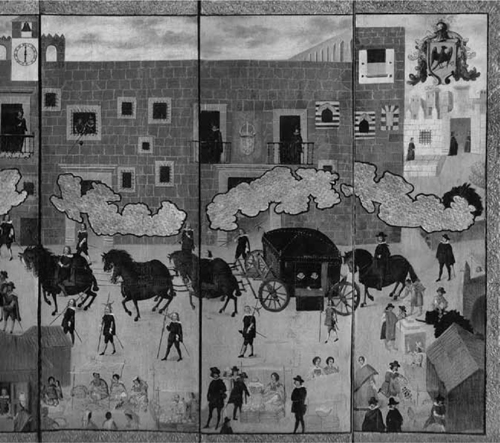
7.4 Anonymous, Biombo del Palacio de los Virreyes (about 1680). Detail Copyright © Museum of America
as Your Excellency is the high object at which the applause is directed, how could I choose a subject other than the Kings when the Royal blood of your most excellent house now enamels not only French lilies but beautiful Castilian lions, participating for the benefit of the Augustan eagles of the German empire? Nor could Mexico do less than boast of its Kings and Emperors …
… the love owed to the homeland is why, rejecting fables, a more realistic idea was sought to decorate this triumphal gate.30
These references to the kings of Mexico and the love owed to the homeland are a clear prelude to Creole feelings which would find the roots of the still far-off Mexican nation in the Pre-Columbian past. A closer examination can be made of the entry into New Spain made by Viceroy Antonio Sebastián de Toledo y Salazar, Marquis of Manzera, in 1664, first into the city of Puebla de los Ángeles and then into Mexico City. In Puebla, the chapter of the cathedral erected a triumphal arch offering as its iconographic theme the myth of Perseus, ‘whose noble birth; illustrious lineage, bizarre origin, legacies and glorious occupations are alluded to in the some of the decoration and stamps adorning the noble garments of the Most Excellent Lord Antonio Sebastián de Toledo’.31 Allegories of East and West were painted on the spandrels of the arch. Six pictures on the façade of the arch established the parallels between Perseus and the new viceroy, representing the deeds of the classical hero: he appeared accompanied by his mother Danae and various Olympian deities: Vulcan, Minerva and Pallas, releasing Andromeda and fighting Medusa. The arch was finished off with Perseus turning King Atlas into a mountain. This last image represented King Philip IV and, because of this, the new viceroy appeared helping him in the enterprise of sustaining the world. Many references to Puebla cathedral, portraits and allegorical statues and 26 hieroglyphics completed the decoration of the arch.32
The main figure on the arch built in Mexico City to receive the same viceroy was Aeneas and the booklet read ‘the heroic deeds of our Prince remain for posterity, even greater and more glorious than those of the Trojan’.33 Standing at the entrance to Plaza de Santo Domingo, it was structured in three bodies: Ionic, Corinthian and Composite. The inter-columns on each façade were decorated with ten emblematic paintings representing the deeds of the hero: saving his father Anchises, steering a boat, giving out prizes, hunting, etc. From each of these episodes, a political virtue of the new viceroy that the subjects of New Spain would discover can be deduced: strength, hard work, beneficence, diligence, prudence and other similar examples – all virtues appropriate for the office. In addition, on each façade, the column bases showed four hieroglyphs where common motifs of emblematic language appeared repeating the parallels between the new viceroy and Aeneas. The common experience that made it possible to establish this relationship was the successful journey of both men seeking a new homeland: the former to Mexico and the latter to Italy.34
As we have already mentioned, the entry of Viceroy José Sarmiento de Valladares into the city of Puebla dates from the end of the century – 1697. Its interest lies in the fact that its chronicle is the only seventeenth-century entry that appears illustrated with hieroglyphics. They are two curious compositions, far from the normal emblematic structure – motto, body and key – slightly recalling an ideographic hieroglyphic that Polifilo discovers on the pedestal of the black stone elephant in the well-known Renaissance novel by Francesco Colonna.35 The chronicler calls them ‘mute couplets’ and defines them as ‘in the style of the pegmas used by the Egyptians’.36 Each hieroglyphic is divided into several horizontal registers in which various motifs have been painted. Each of these registers transforms one of the verses of the couplets accompanying the hieroglyphic into images. These two hieroglyphics decorated the triumphal arch designed by the priest of the Order of the Blessed Virgin Mary of Mercy, who chose the god Janus as the central motif.
The Triumph of the Last Habsburg King in Mexico
In New Spain, the Spanish kings were also considered heroes and this is how they appear represented in some of the symbolic programmes established in royal festivals. I would mention just two examples: on Charles V’s ephemeral tomb in the chapel of San José de los Naturales in the monastery of San Francisco in Mexico City, the emperor appears identified with Ulysses, Theseus and Hercules, and, in the cathedral funeral honours for Philip IV in the same city, the Planet King was compared favourably with Jason, Theseus and Prometheus.37
Despite the fact that these kings of Spain never travelled to their overseas possessions, Charles II, who had recently ascended the throne, did make a virtual triumphal entrance into the capital of the viceroyalty of New Spain. To mark his enthronement, Mexico City organized celebrations between 6 November and 9 December 1676.38 As well as bullfights and theatrical plays, two masques were held: one organized by the nobility and one by the guilds. A group of 240 horsemen, luxuriously attired, took part in the first of these, parading through the illuminated streets to the decorated main square, where they were received by the Viceroy Friar Payo Enríquez de Ribera and a portrait of Charles II. The second masque paraded from Plazuela del Rastro to the Plazuela del Volador. The parade was formed of 200 guild officials, 300 footmen, 5 allegorical carriages and 1 carriage with fireworks. The symbolic discourse of the guilds’ masque had a deep dynastic and imperialist meaning, as Dalmacio Rodríguez has already highlighted.39 Let us look at the way it was arranged. After the tanners’, livestock dealers’ and bakers’ guilds, in Roman costume, came a carriage carrying Charles V, painted with his deeds, Faith and Fame; after the tailors, mounted and dressed like children of the Sun, came a carriage manned by the Sun, Time and the Hours; then came the painters and merchants in military attire accompanied by a carriage bearing the god Mars, and by an allegory of the Liberal Arts, trophies and shields; after the confectioners and fruit sellers, dressed as Aztecs and chiefs, joined by many natives from Tlatelolco and Xochimilco and all guided by Moctezuma, came allegories of America, Silver, Gold, Cochineal and Precious Stones. The final group was formed by the silversmiths’ guild representing the Spanish and German royal guard and, in the triumphal carriage, seated on the throne, travelled a boy characterized as the new, young king. When the masque of the guilds was repeated the following day, the boy representing Charles II entered the square mounted on a dark horse. In a carriage or on a horse, according to the chronicler of the festivities, Ramírez de Vargas, the victorious entry of the proclaimed Charles II into Mexico City represented his Majesty entering the government.
Ramírez also tells us how the throne on which the monarch sat in the carriage was like: ‘… carmine velvet embroidered with gold, with golden nails, and with two lions at the sides’.40 They evoked the big felines in the Solomonic iconography that characterized the throne of the King of Spain in his Madrid palaces El Buen Retiro and the Alcázar Real, and which had already been represented then many times in royal portraits painted and engraved throughout the sixteenth and seventeenth centuries, especially during the reign of Charles II.41 This iconography transformed the monarch into a new, wise and prudent Solomon.42 As on every occasion throughout almost two centuries when a viceroy arrived in Mexico or Peru to govern vast territories in the name of the Spanish Habsburgs, the symbolic entry of the young Charles II into the capital of New Spain announced a new Golden Age for the American dominions of the great-great-grandson of the Emperor under whose mandate the New World had been conquered.
Notes
1 I have previously concerned myself with the entries of viceroys into the American capitals in the following texts: V. Mínguez Cornelles, ‘Virreyes y arzobispos: la realeza próxima’; a chapter in my book V. Mínguez Cornelles, Los reyes distantes. Imágenes del poder en el México virreinal (Castellón, 1995), pp. 29–45; and V. Mínguez Cornelles, ‘La fiesta política virreinal: propaganda y aculturación en el México del siglo XVII’, in Karl Kohut and Sonia V. Rose (eds), La formación de la cultura virreinal. El siglo XVIII (Madrid, 2004): pp. 359–74. I have published many works on Spanish American symbolic culture. I would simply highlight V. Mínguez Cornelles, ‘Imágenes jeroglíficas para un imperio en fiesta’, Relaciones. Estudios de Historia y Sociedad, 119 (2009), pp. 81–112.
2 Concerning the survival of triumph ceremonies in independent Mexico, see Juan Chiva Beltrán, especially his two books, J. Chiva Beltrán, El triunfo del virrey. Glorias Novohispanas: origen, apogeo y ocaso de la entrada virreinal (Castellón, 2012), and J. Chiva Beltrán, El triunfo del águila. Arte, ceremonia y poder en el México decimonónico (in press). Concerning the political organization of the viceroyalties, see R. María Serrera, La América de los Habsburgo (Seville, 2011).
3 J. L. Sancho, G. Martínez Leiva, ‘¿Dónde está el rey? El ritmo estacional de la corte española y la decoración de los Sitios Reales (1650–1700)’, in Cortes del Barroco. De Bernini y Velázquez a Luca Giordano (Madrid, 2003), pp. 85–98.
4 H. S. Versnel, Triumphus. An Inquiry into the Origin, Development and Meaning of the Roman Triumph (Leiden, 1970). Mentioned by Juan Chiva in El triunfo del virrey…. See also M. Beard, El triunfo romano. Una historia de Roma a través de la celebración de sus victorias (Barcelona, 2009).
5 Juan Chiva, El triunfo del virrey.
6 Teo Ruiz has published widely on the medieval festival culture in Castile, in the Burgos area in particular. In this latest monograph Ruiz has examined ideas of continuity and change in the late medieval and early modern festival culture in Iberia, see T. F. Ruiz, A King Travels: Festive Traditions in Late Medieval and Early Modern Spain (Princeton, 2012).
7 For a discussion on the development of the triumphal culture in the Italian peninsula and elsewhere in Europe, see for instance, S. Bertelli, The King’s Body: Sacred Rituals of Power in Medieval and Early Modern Europe (University Park, 2001).
8 F. Checa Cremades, Carlos V y la imagen del héroe en el Renacimiento (Madrid, 1987), pp. 86–102 and 245–58.
9 Triumphal culture still had a major impact on the architecture and urban design of early modern cities. While examples can be found in major Italian cities such as Rome and Palermo, this impact can also be seen in other cities, as in Madrid for the entry of 1570 discussed in David Sánchez’s chapter for the present book. However, arches were not ‘systematically’ built, as was the case in Ancient Rome. For the case of the Naples festival see Bertelli, The King’s Body.
10 F. J. Pizarro Gómez, Arte y espectáculo en los viajes de Felipe II (Madrid, 1999).
11 The title’s literal translation would be: ‘Etiquette for the entry under canopy of the Lord Kings upon being raised to the throne’. This is to be found in Archivo General de Palacio (Madrid), Sección Histórica, caja 48, expediente 2. This has been studied by Juan Chiva in El triunfo del virrey….
12 See also the similar ceremonies at the different European courts in the collective book J. R. Mulryne, H. Watanabe-O’Kelly, M. Shewring, Europa Triumphans. Court and Civic Festivals in Early Modern Europe (Aldershot, 2004).
13 The literal translation of Etiquetas de Palacio would read ‘Palace’s Etiquettes’, although perhaps a closer translation to the original meaning of the expression would read ‘Court Etiquette’. This document is to be found in Archivo General de Palacio (Madrid), Sección Histórica, caja 51, expediente 9914. T. Zapata, La entrada en la Corte de María Luisa de Orleans. Arte y fiesta en el Madrid de Carlos II (Madrid, 2000), p. 22. See also a recently published book that focuses on the regulation of protocol and precedence at the Spanish Court in Madrid; some essays in the book explore the documents regarding royal ceremonias and festivities: J. Eloy Hortal Muñoz, F. Labrador Arroyo (eds), La Casa de Borgoña. La Casa del rey de España (Leuven, 2014).
14 A. J. Morales Martínez, ‘Antes de la fiesta. Notas sobre el viaje y recibimiento de los virreyes del Perú’, in F. Cantú (ed.), Las cortes virreinales de la Monarquía española: América e Italia (Rome, 2008), pp. 465–92.
15 R. Ramos Sosa, Arte festivo en Lima virreinal (siglos XVI–XVIII) (Seville, 1992), pp. 32–70. A. B. Osorio, Inventing Lima: Baroque Modernity in Peru’s South Sea Metropolis (Basingstoke, 2008).
16 J. M. Morales Folguera, Cultura simbólica y arte efímero en Nueva España (Seville, 1991), pp. 99–110.
17 This was until the Enlightenment called this symbolic language into question in the mid-eighteenth century.
18 F. de la Maza, La mitología clásica en el arte colonial de México (Mexico City, 1968).
19 M. I. Grañen Porrua, ‘Creaciones emblemáticas y alegóricas en el México del Quinientos’, in B. Skinfill Nogal and Eloy Gómez Bravo (eds), Las dimensiones del arte emblemático (Mexico City, 2002), p. 203. As Grañen skilfully argues: ‘Estos libros de literatura clásica, humanística y emblemática sirvieron como repertorios de consulta para establecer paradigmas locales, ya fueran de materia amorosa, moral, espiritual o lúdica. La creación de programas iconográficos del Nuevo Mundo se hizo en base a la tradición occidental.’ [These books of classical, humanistic and emblematic literature served as directories to be consulted for establishing local paradigms, whether this material concerned love, morals, spirituality or leisure. The creation of New World iconographic programmes was achieved based on the Western tradition.]
20 S. Sebastián, ‘Los libros de emblemas: uso y difusión en Iberoamérica’, in J. Cuadriello (ed.), Juegos de ingenio y agudeza. La pintura emblemática de la Nueva España (México, 1994), p. 59.
21 The significant role played by the festival culture in Spanish American viceroyalties during the Habsburg rule in the lasting loyalty of the subjects to the Spanish Monarchy has been explored in relatively recent scholarship. See, for instance, A. Cañeque, The King’s Living Image: The Culture and Politics of Viceregal Power in Colonial Mexico (Abingdon, 2004) and Osorio, Inventing Lima.
22 The second volume of the ‘Baroque Triumphs’ book series, authored by the faculty in the Iconography and History of Art (IHA) at the Universitat Jaume I, focuses on American festivities and examines many unpublished images and decorations displayed in festivals. See V. Mínguez, I. Rodríguez, P. González and J. Chiva, La fiesta barroca. Los virreinatos americanos (1560–1808) (Castellón, 2012).
23 See Arco triumphal, disceno politico, consagrado en poemas, y delineado en symbolos â la feliz entrada del Excmo. Señor D. Joseph Sarmiento de Valladares… (Herederos del capitán Juan de Villa-Real: Puebla, 1697).
24 These chronicles are examined in Mínguez, Rodríguez, González, Chiva, La fiesta barroca.
25 Only a few reports in the minutes of city councils give information about the costs of the ceremonies.
26 See Mínguez, Rodríguez, González, Chiva, La fiesta barroca.
27 In the eighteenth century, Greek heroes would decline in favour of biblical heroes and, above all, historical characters from Antiquity.
28 See I. Rodríguez Moya, ‘Odiseo en la Nueva España. Las virtudes políticas y heroicas del virrey en la decoración de tres arcos triunfales’, in J. Pasqual Buxó (ed.), Reflexión y espectáculo en la América virreinal (México, 2007), pp. 231–57.
29 P. Fernández Ossorio, Ivpiter benevolo astro ethico politico, ideas symbolica de principes Qve en la svmptvosa fabrica de vn arco trivmphal dedica obseqviosa, y consagra festiva la illvstrissima iglesiametropolitana de México Al Exmo señor D. Iuan de la Cerda, y Leyba, conde de Baños, marqves de Leyba (Mexico City, 1660). C. Sigüenza y Góngora, Teatro de virtudes políticas que constituyen a un príncipe : advertidas en los monarcas antiguos del Mexicano Imperio, con cuyas efigies se hermoseó el Arco triunfal que la … Ciudad de México erigió para … recibimiento del … Virrey Conde de Paredes, Marqués de La Laguna … (Mexico City, 1680) and A. Ramírez de Vargas, Zodiaco illvstre de blasones heroycos, gyrado del Sol politico, imagen de príncipes … (Mexico City, 1696). I have discussed these entries and its printed evidence at length in V. Mínguez Cornelles, Los reyes distantes: imágenes del poder en el México virreinal (Castellón, 1995).
30 C. de Sigüenza y Góngora, Theatro de virtudes políticas, qve constituyen á vn Principe: advertidas en los Monarchas antiguos del Mexicano Imperio, con cuyas efigies se hermoseó el Arco Trivmphal, que la muy Noble, muy Leal, Imperial Ciudad de Mexico erigiò para el digno recivimiento en ella del Excelentissimo Señor Virrey Conde de Paredes (Viuda de Bernardo Calderón: México, 1680): ‘siendo V. Exa. el alto objeto â que mirava el aplauso, como pude elegir otro asunto, sino el de Reyes, quando con la sangre Real de su excelentissima Casa, se hallan oy esmaltados no solo los Lilios Franceses; sino hermoseados los Castellanos Leones, participando de ella â beneficio de estos, las Aguilas augustas de el Aleman imperio? Ni pudo Mexico menos que valiendose de sus Reyes, y Emperadores’ and also ‘el amor, que se le deve a la Patria es causa de que despreciando las fabulas se aya buscado idea mas plausible conque hermosear esta triumphal portada.’
31 Disceño de la alegorica fabrica del arco Triumphal que la santa iglesia cathedral de la Puebla de los Angeles erigió en aplauso del Excellentissimo Señor Don Antonio Sebastián de Toledo, Marques de Mançera (Viuda de Juan de Borja y Gandía: Puebla, 1664), p. 1: ‘cuyo nacimiento noble; Prosapia illustre; proceder bizarro, legacias, y ocupaciones gloriosas: apuntaron algo de los lucimientos, y timbres que adornan las prendas loables de el Señor Excellentissimo Don Antonio Sebastián de Toledo’.
32 Perseus was also the main figure on the triumphal arch erected for the entry of Viceroy Pedro Colón de Portugal y Castro into Mexico City. See M. Perea Quintanilla and D. de Ribera, Historica imagen de proezas, emblematico exemplar de virtudes ilustres del original Perseo: Prevenido en Oraculos Mythologicos, y decifrado en colores Poeticos (Viuda de Bernardo Calderón: México, 1673).
33 A. Ramírez de Vargas, Elogio panegirico, festivo aplavso, iris politico, y diseño trivnfal de Eneas verdadero. Conqve la muy noble, y leal ciudad de Mexico, recibió al Exmo. Señor D. Antonio Sebastian de Toledo y Salazar: Marques de Manzera (Viuda de Bernardo Calderón: México, 1664), p. 1: ‘deviendo queda siempre de nuestro Principe à las proezas, quedando las del Troyano, aunque encarecidas gloriosamente aventajadas’.
34 J. M. Morales Folguera offers an iconographic diagram of the two façades of this arch, reconstructed based on the chronicler’s description see Morales Folguera, Cultura simbólica…, pp. 120 and 121.
35 Francesco Colonna, Hypnerotomachia Poliphili (Venice, 1499).
36 Arco triumphal…, p. 10: ‘al modo de los pegmas, que vsavan los Egypcios’.
37 See the chapter ‘La imagen mitológica: dioses y héroes versus gobernantes’, in my book, Mínguez, Los reyes distantes, pp. 47–58.
38 A. Ramírez de Vargas, Sencilla narración, alegórico fiel trasumpto, dibujo en sombras y diseño escaso de las fiestas grandes con que satisfizo en poca parte el deseo, en la celebrada nueva feliz de haber entrado el rey Nuestro Señor don Carlos Segundo (que Dios guarde), en el gobierno […]. (Viuda de Bernardo Calderón: México, 1677). Published as a final appendix to the book by D. Rodríguez Hernández, Teatro y fiesta en la literatura novohispana (Mexico City, 1998), pp. 193–267. By 1675 there had already been a masque to mark the young Charles coming of age, described by Ignacio de Santa Cruz Aldana in Relación de las Reales Fiestas, Cesáreos júbilos, y augustos regocijos. Con que solemnizó los felices años del Rey Nuestro Señor Carlos Segundo, la muy noble, y leal Ciudad de México […] (Herederos de Juan Ruiz: México, 1677). It has been studied by A. Herrera, ‘Los años felices de Carlos II’, in N. Campos Vera (ed.), La Fiesta. Memoria del IV Encuentro Internacional sobre Barroco (La Paz, 2007), pp. 273–78.
39 D. Rodríguez Hernández, ‘Imagen de Carlos II en la Nueva España’, in J. Pascual Buxó (ed.), La producción simbólica en la América colonial (Mexico City, 2001), pp. 173–91.
40 Rodríguez Hernández, Teatro y fiesta, pp. 193–267.
41 I examine the image-making of Charles II of Spain in V. Mínguez Cornelles, La invención de Carlos II: Apoteosis simbólica de la casa de Austria (Madrid, 2013).
42 V. Mínguez Cornelles, ‘El rey de España se sienta en el trono de Salomón. Parentescos simbólicos entre la Casa de David y la Casa de Austria’, in V. Mínguez Cornelles (ed.), Visiones de la monarquía hispánica (Castellón, 2007), pp. 19–55.