
Yet while worrying about losing desirable members of its population, the government in London remained convinced that colonial development enhanced the nation’s power and wealth. To bolster the Chesapeake labor force, nearly 50,000 convicts (a group not desired in Britain) were sent to work in the tobacco fields. Officials also actively encouraged Protestant immigration from the non-English (and less prosperous) parts of the British Isles and from the European continent, promising newcomers easy access to land and the right to worship freely. A law of 1740 even offered European immigrants British citizenship after seven years of residence, something that in the mother country could only be obtained by a special act of Parliament. The widely publicized image of America as an asylum for those “whom bigots chase from foreign lands,” in the words of a 1735 poem, was in many ways a byproduct of Britain’s efforts to attract settlers from non-English areas to its colonies.
Among eighteenth-century migrants from the British Isles, the 80,000 English newcomers (a majority of them convicted criminals) were considerably outnumbered by 145,000 from Scotland and Ulster, the northern part of Ireland, where many Scots had settled as part of England’s effort to subdue the island. Scottish and Scotch-Irish immigrants had a profound impact on colonial society. Mostly Presbyterians, they added significantly to religious diversity in North America. Their numbers included not only poor farmers seeking land but also numerous merchants, teachers, and professionals (indeed, a large majority of the physicians in eighteenth-century America were of Scottish origin).
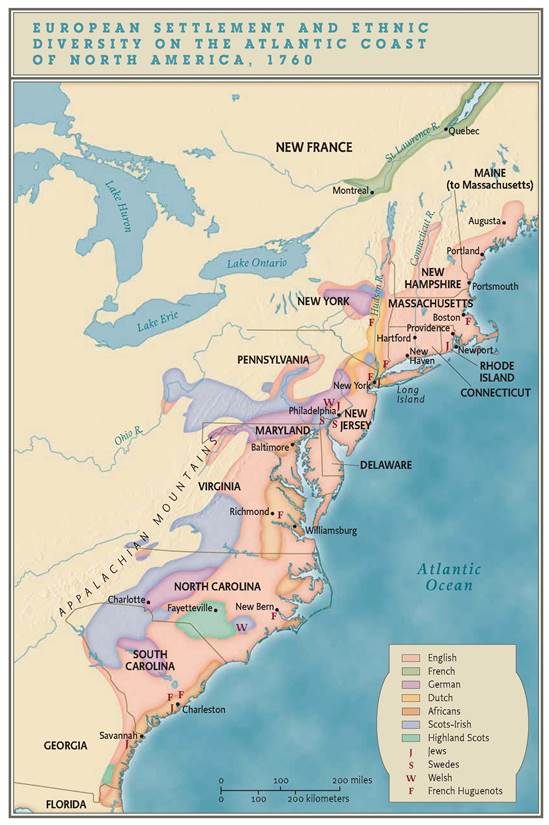
Among the most striking features of eighteenth-century colonial society was the racial and ethnic diversity of the population (except in New England). This resulted from increased immigration from the non-English parts of the British Isles and from mainland Europe, as well as the rapid expansion of the slave trade from Africa.