
By the mid-eighteenth century, three distinct slave systems were well entrenched in Britain’s mainland colonies: tobacco-based plantation slavery in the Chesapeake, rice-based plantation slavery in South Carolina and Georgia, and nonplantation slavery in New England and the Middle Colonies. The largest and oldest of these was the tobacco plantation system of the Chesapeake, where more than 270,000 slaves resided in 1770, nearly half of the region’s population. On the eve of the Revolution, Virginia and Maryland were as closely tied to Britain as any other colonies and their economies were models of mercantilist policy (described in Chapter 3). They supplied the mother country with a valuable agricultural product, imported large amounts of British goods, and were closely linked in culture and political values to London. As we have seen, the period after 1680 witnessed a rapid shift from indentured servitude to slavery on the region’s tobacco plantations. In the eighteenth century, the growing world demand for tobacco encouraged continued slave imports. When tobacco prices fell in the early part of the century, some planters shifted to grain production. But tobacco remained their primary source of wealth.
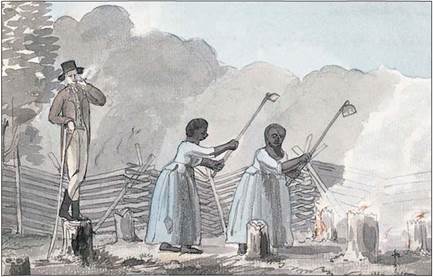
Benjamin Latrobe’s watercolor, An Overseer Doing His Duty, was sketched near Fredericksburg, Virginia, in 1798. The title is meant to be ironic: the well-dressed overseer relaxes while two female slaves work in the fields.
As Virginia expanded westward, so did slavery. By the eve of the American Revolution, the center of gravity of slavery in the colony had shifted from the Tidewater (the region along the coast) to the Piedmont farther inland. Most Chesapeake slaves, male and female, worked in the fields, but thousands labored as teamsters, as boatmen, and in skilled crafts. Numerous slave women became cooks, seamstresses, dairy maids, and personal servants. The son of George Mason, one of Virginia’s leading planters and statesmen, recorded that his father’s slaves included “coopers, sawyers, blacksmiths, tanners, shoemakers, spinners, weavers, knitters, and even a distiller.” Slavery was common on small farms as well as plantations; nearly half of Virginia’s white families owned at least one slave in 1770. Because there is little “economy of scale” in tobacco growing—that is, enlarging the size of the producing unit does not lower costs and maximize productivity—Chesapeake plantations tended to be smaller than in the Caribbean, and daily interactions between masters and slaves were more extensive.
Slavery laid the foundation for the consolidation of the Chesapeake elite, a landed gentry that, in conjunction with merchants who handled the tobacco trade and lawyers who defended the interests of slaveholders, dominated the region’s society and politics. Meanwhile, even as the consumer revolution improved the standard of living of lesser whites, their long-term economic prospects diminished. As slavery expanded, planters engrossed the best lands and wealth among the white population became more and more concentrated. Slavery transformed Chesapeake society into an elaborate hierarchy of degrees of freedom. At the top stood large planters, below them numerous lesser planters and landowning yeomen, and at the bottom a large population of convicts, indentured servants, tenant farmers (who made up half the white households in 1770), and, of course, the slaves.

A detail from a 1768 map of Virginia and Maryland illustrates a tobacco wharf. A planter negotiates with a merchant or sea captain, while slaves go about their work.

Henry Darnall III, painted around 1710 by Justus Engelhardt Kuhn, who produced numerous portraits of prominent Marylanders in the early eighteenth century. The boy, clearly the son of a member of the colony’s wealthy gentry, stands next to a young slave, a symbol of his family’s wealth. The background is an idealized European palace and formal garden.