
While Indians experienced American independence as a real threat to their own liberty, African-Americans saw in the ideals of the Revolution and the reality of war an opportunity to claim freedom. When the United States declared its independence in 1776, the slave population had grown to 500,000, about one-fifth of the new nation’s inhabitants. Slaveowning and slave trading were accepted routines of colonial life. Advertisements announcing the sale of slaves and seeking the return of runaways filled colonial newspapers. Sometimes, the same issues of patriotic newspapers that published accounts of the activities of the Sons of Liberty or arguments against the Stamp Act also contained slave sale notices.
Slavery played a central part in the language of revolution. Apart from “liberty,” it was the word most frequently invoked in the era’s legal and political literature. Eighteenth-century writers frequently juxtaposed freedom and slavery as “the two extremes of happiness and misery in society.” Yet in the era’s debates over British rule, slavery was primarily a political category, shorthand for the denial of one’s personal and political rights by arbitrary government. Those who lacked a voice in public affairs, declared a 1769 petition demanding an expansion of the right to vote in Britain, were “enslaved.” By the eve of independence, the contrast between Britain, “a kingdom of slaves,” and America, a “country of free men,” had become a standard part of the language of resistance. Such language was employed without irony even in areas where nearly half the population in fact consisted of slaves. South Carolina, one writer declared in 1774, was a “sacred land” of freedom, where it was impossible to believe that “slavery shall soon be permitted to erect her throne.”
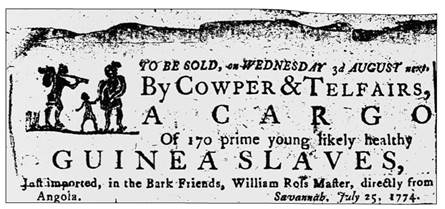
Advertisement for newly arrived slaves, in a Savannah newspaper, 1774. Even as colonists defended their own liberty against the British, the buying and selling of slaves continued.
Colonial writers of the 1760s occasionally made a direct connection between slavery as a reality and slavery as a metaphor. Few were as forthright as James Otis of Massachusetts, whose pamphlets did much to popularize the idea that Parliament lacked the authority to tax the colonies and regulate their commerce. Freedom, Otis insisted, must be universal: “What man is or ever was born free if every man is not?” Otis wrote of blacks not as examples of the loss of rights awaiting free Americans, but as flesh and blood British subjects “entitled to all the civil rights of such.”
Otis was hardly typical of patriot leaders. But the presence of hundreds of thousands of slaves powerfully affected the meaning of freedom for the leaders of the American Revolution. In a famous speech to Parliament warning against attempts to intimidate the colonies, the British statesman Edmund Burke suggested that familiarity with slavery made colonial leaders unusually sensitive to threats to their own liberties. Where freedom was a privilege, not a common right, he observed, “those who are free are by far the most proud and jealous of their freedom.” On the other hand, many British observers could not resist pointing out the colonists’ apparent hypocrisy. “How is it,” asked Dr. Samuel Johnson, “that we hear the loudest yelps for liberty from the drivers of negroes?”