
The Alien and Sedition Acts failed to silence the Republican press. Some newspapers ceased publication, but new ones, with names like Sun of Liberty and Tree of Liberty, entered the field. The Sedition Act thrust freedom of expression to the center of discussions of American liberty. Madison and Jefferson mobilized opposition, drafting resolutions adopted by the Virginia and Kentucky legislatures. Both resolutions attacked the Sedition Act as an unconstitutional violation of the First Amendment. Virginia’s, written by Madison, called on the federal courts to protect free speech. The original version of Jefferson’s Kentucky resolution went further, asserting that states could nullify laws of Congress that violated the Constitution— that is, states could unilaterally prevent the enforcement of such laws within their borders. The legislature prudently deleted this passage. The resolutions were directed against assaults on freedom of expression by the federal government, not the states. Jefferson took care to insist that the states “fully possessed” the authority to punish “seditious” speech, even if the national government did not. Indeed, state-level prosecutions of newspapers for seditious libel did not end when the Sedition Act expired in 1801.
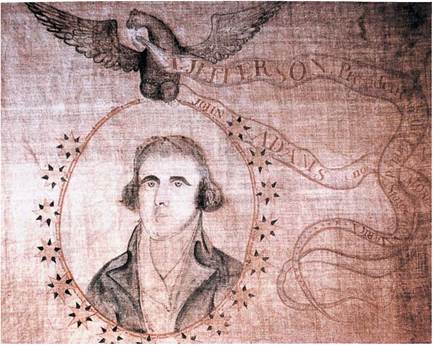
An 1800 campaign banner, with a portrait of Thomas Jefferson and the words, “John Adams is no more.”
No other state endorsed the Virginia and Kentucky resolutions. Many Americans, including many Republicans, were horrified by the idea of state action that might endanger the Union. But the “crisis of freedom” of the late 1790s strongly reinforced the idea that “freedom of discussion” was an indispensable attribute of American liberty and of democratic government. Free speech, as Massachusetts Federalist Harrison Gray Otis noted, had become the people’s “darling privilege.” The broad revulsion against the Alien and Sedition Acts contributed greatly to Jefferson’s election as president in 1800.