
In some industries, most notably textiles, the factory superceded traditional craft production altogether. Factories gathered large groups of workers under central supervision and replaced hand tools with power-driven machinery. Samuel Slater, an immigrant from England, established America’s first factory in 1790 at Pawtucket, Rhode Island. Since British law made it illegal to export the plans for industrial machinery, Slater, a skilled mechanic, built from memory a power-driven spinning jenny, one of the key inventions of the early industrial revolution.
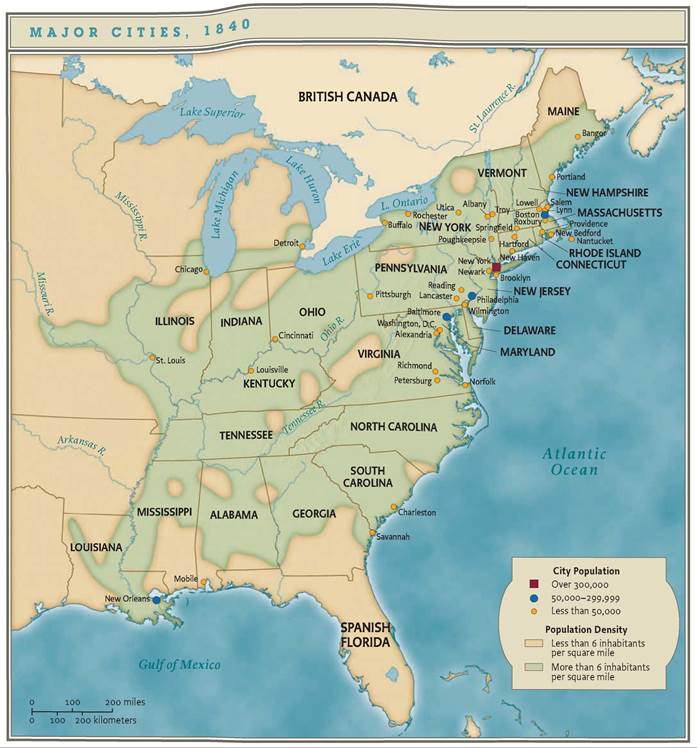
Although the United States was still predominantly agricultural, by 1840 major cities had arisen in the northern and northwestern states. The South lagged far behind in urban growth. Most cities were located on navigable waterways—either the Atlantic coast or inland rivers—or on rivers that provided water power for early factories.

A group of shoemakers with their tools, photographed in 1837. Artisan production survived in many crafts, hut shoemakers found themselves in dire straits as factories began industrializing shoe production.
Spinning factories such as Slater’s produced yarn, which was then sent to traditional hand-loom weavers and farm families to be woven into cloth. This “outwork” system, in which rural men and women earned money by taking in jobs from factories, typified early industrialization. Before shoe production was fully mechanized, for example, various parts of the shoe were produced in factories, then stitched together in nearby homes, and then returned to the factories for finishing. Eventually, however, the entire manufacturing process in textiles, shoes, and many other products was brought under a single factory roof.
The cutoff of British imports because of the Embargo of 1807 and the War of 1812 stimulated the establishment of the first large-scale American factory utilizing power looms for weaving cotton cloth. This was constructed in 1814 at Waltham, Massachusetts, by a group of merchants who came to be called the Boston Associates. In the 1820s, they expanded their enterprise by creating an entirely new factory town (incorporated as the city of Lowell in 1836) on the Merrimack River, twenty-seven miles from Boston. Here they built a group of modern textile factories that brought together all phases of production from the spinning of thread to the weaving and finishing of cloth. By 1850, Lowell’s fifty-two mills employed more than 10,000 workers. Across New England, small industrial cities sprang up patterned on Waltham and Lowell. Massachusetts soon became the second most industrialized region of the world, after Great Britain.

Mill on the Brandywine, an 1830 watercolor of a Pennsylvania paper mill Because it relied on waterpower, much early manufacturing took place in the countryside.

The early industrial revolution was concentrated in New England, where factories producing textiles from raw cotton sprang up along the region’s many rivers, taking advantage of water power to drive their machinery.
The earliest factories, including those at Pawtucket, Waltham, and Lowell, were located along the “fall line,” where waterfalls and river rapids could be harnessed to provide power for spinning and weaving machinery. By the 1840s, steam power made it possible for factory owners to locate in towns like New Bedford nearer to the coast, and in large cities like Philadelphia and Chicago with their immense local markets. In 1850, manufacturers produced in factories not only textiles but also a wide variety of other goods, including tools, firearms, shoes, clocks, ironware, and agricultural machinery. What came to be called the “American system of manufactures” relied on the mass production of interchangeable parts that could be rapidly assembled into standardized finished products. This technique was first perfected in the manufacture of clocks by Eli Terry, a Connecticut craftsman, and in small-arms production by Eli Whitney, who had previously invented the cotton gin. More impressive, in a way, than factory production was the wide dispersion of mechanical skills throughout northern society. Every town, it seemed, had its sawmill, paper mill, iron works, shoemaker, hatmaker, tailor, and a host of other such small enterprises.

A broadside from 1853, illustrating the long hours of work (twelve hours per day, with thirty minutes for lunch) in the Lowell mills and the way factory labor was strictly regulated by the clock.
The early industrial revolution was largely confined to New England and a few cities outside it. Lacking a strong internal market, and with its slaveholding class generally opposed to industrial development, the South lagged in factory production. And outside New England, most northern manufacturing was still done in small-scale establishments employing a handful of workers, not in factories. In Cincinnati, for example, most workers in 1850 still labored in small unmechanized workshops.