
If the Black Legend inspired a sense of superiority among Spain’s European rivals, the precious metals that poured from the New World into the Spanish treasury aroused the desire to try to match Spain’s success. The establishment of Spain’s American empire transformed the balance of power in the world economy. The Atlantic replaced the overland route to Asia as the major axis of global trade. During the seventeenth century, the French, Dutch, and English established colonies in North America. England’s mainland colonies, to be discussed in the next chapter, consisted of agricultural settlements with growing populations whose hunger for land produced incessant conflict with native peoples. New France and New Netherland were primarily commercial ventures that never attracted large numbers of colonists. More dependent on Indians as trading partners and military allies, these French and Dutch settlements allowed Native Americans greater freedom than the English.
The first of Spain’s major European rivals to embark on New World explorations was France. The French initially aimed to find gold and to locate a Northwest Passage—a sea route connecting the Atlantic to the Pacific. But the hopes of the early French explorers were soon disappointed, and North America came to seem little more than a barrier to be crossed, not a promising site for settlement or exploitation. For most of the sixteenth century, only explorers, fishermen, pirates preying on Spanish shipping farther south, and, as time went on, fur traders visited the eastern coast of North America. French efforts to establish settlements in Newfoundland and Nova Scotia failed, beset by native resistance and inadequate planning and financing. Not until the seventeenth century would France, as well as England and the Netherlands, establish permanent settlements in North America.
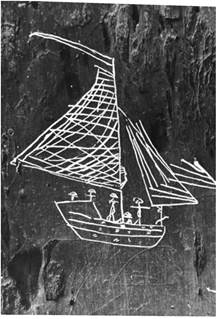
A Native American in present-day Nova Scotia carved this image of a European ship on a rock. Long before explorers and colonists descended on the area, its residents were familiar with Europeans. One chief, Membertou, acquired a French ship and traded with fishermen out at sea.
The explorer Samuel de Champlain, sponsored by a French fur-trading company, founded Quebec in 1608. In 1673, the Jesuit priest Jacques Marquette and the fur trader Louis Joliet located the Mississippi River, and by 1681 Rene-Robert Cavelier, Sieur de La Salle, had descended to the Gulf of Mexico, claiming the entire Mississippi River valley for France. New France eventually formed a giant arc along the St. Lawrence, Mississippi, and Ohio rivers.
Until 1663, when the population of European origin was fewer than 3,000, French Canada was ruled by the Company of New France through a governor-general appointed in Paris. There was no representative assembly. In that year, the French government established a new company. It granted land along the St. Lawrence River in seigneuries to well-connected nobles and army officers who would transport colonists to take their place in a feudal society. But most of the engages, or indentured servants, returned home after their contracts expired. More than 80 percent of the migrants were men. Apart from nuns, fewer than 1,800 women (compared with more than 12,000 men) emigrated to French Canada in the seventeenth century. And during the entire colonial period, only about 250 complete families did so.
By 1700, the number of white inhabitants of New France had risen to only 19,000. With a far larger population than England, France sent many fewer emigrants to the Western Hemisphere. The government at home feared that significant emigration would undermine France’s role as a European great power and might compromise its effort to establish trade and good relations with the Indians. Unfavorable reports about America circulated widely in France. Canada was widely depicted as an icebox, a land of savage Indians, a dumping ground for criminals. Most French who left their homes during these years preferred to settle in the Netherlands, Spain, or the West Indies. The revocation in 1685 of the Edict of Nantes, which had extended religious toleration to French Protestants, led well over 100,000 Huguenots to flee their country. But they were not welcome in New France, which the crown desired to remain an outpost of Catholicism.