
Some southerners worried about their standing in the eyes of the world, especially how others viewed the intellectual life of their region. “We of the South,” one wrote, “must, to Europe, continue to appear inferior to the North in intellectual cultivation.” The free states outstripped the slave states in public education, the number of colleges, and in newspapers, literary journals, and other publications. Nonetheless, the life of the mind flourished in the Old South, and the region did not lack for novelists, political philosophers, scientists, and the like.
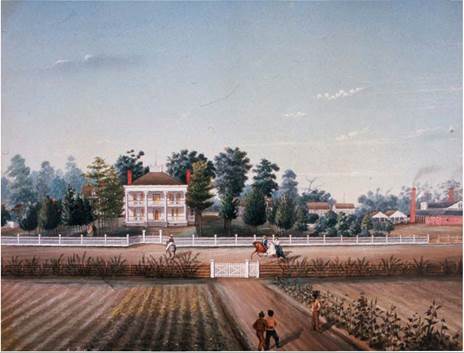
St. John Plantation, an 1861 painting by Marie Adrien Persac, a French-born artist who originally came to the United States to hunt buffalo. This was a Louisiana sugar plantation; the sugar mill can be seen on the extreme right. In Persac’s romanticized depiction, whites enjoy themselves on horseback while slaves appear to have little to do but watch.
In the thirty years before the outbreak of the Civil War, however, even as northern criticism of the “peculiar institution” began to deepen, proslavery thought came to dominate southern public life.
Fewer and fewer white southerners shared the view, common among the founding fathers, that slavery was, at best, a “necessary evil.”
“Many in the South,” John C. Calhoun proclaimed in 1837, “once believed that [slavery] was a moral and political evil.... That folly and delusion are gone; we see it now in its true light, and regard it as the most safe and stable basis for free institutions in the world.”
Even those who had no direct stake in slavery shared with planters a deep commitment to white supremacy. Indeed, racism— the belief that blacks were innately inferior to whites and unsuited for life in any condition other than slavery—formed one pillar of the proslavery ideology. Most slaveholders also found legitimation for slavery in biblical passages such as the injunction that servants should obey their masters. Others argued that slavery was essential to human progress. Had not the ancient republics of Greece and Rome and the great European empires of the seventeenth and eighteenth centuries rested on slave labor? Without slavery, planters would be unable to cultivate the arts, sciences, and other civilized pursuits.
Still other defenders of slavery insisted that the institution guaranteed equality for whites by preventing the growth of a class doomed to a life of unskilled labor. Like northerners, they claimed to be committed to the ideal of freedom. Slavery for blacks, they declared, was the surest guarantee of “perfect equality” among whites, liberating them from the “low, menial” jobs like factory labor and domestic service performed by wage laborers in the North. Slavery made possible the considerable degree of economic autonomy (the social condition of freedom) enjoyed not only by planters but by non-slaveholding whites. Because of slavery, claimed one congressman, white southerners were as “independent as the bird which cleaves the air.” And because independence was necessary for citizenship, slavery was the “cornerstone of our republican edifice.”