
The most important secular communitarian (meaning a person who plans or lives in a cooperative community) was Robert Owen, a British factory owner. Appalled by the degradation of workers in the early industrial revolution, Owen created a model factory village at New Lanark, Scotland, which combined strict rules of work discipline with comfortable housing and free public education. Around 1815, its 1,500 employees made New Lanark the largest center of cotton manufacturing in the world. Convinced that the “rich and the poor, the governors and the governed, have really but one interest,” Owen promoted communitarianism as a peaceful means of ensuring that workers received the full value of their labor. In 1824, he purchased the Harmony community in Indiana—originally founded by the German Protestant religious leader George Rapp, who had emigrated to America with his followers at the beginning of the nineteenth century. Here, Owen established New Harmony, where he hoped to create a “new moral world.”
“The character of man is, without a single exception, always formed for him,” Owen declared. Individuals could be transformed by changing the circumstances in which they lived. In Owen’s scheme, children would be removed at an early age from the care of their parents to be educated in schools where they would be trained to subordinate individual ambition to the common good. Owen also defended women’s rights, especially access to education and the right to divorce. At New Harmony, he promised, women would no longer be “enslaved” to their husbands, and “false notions” about innate differences between the sexes would be abandoned.

The Crisis, a publication by the communitarian Robert Owen and his son, Robert Dale Owen. The cover depicts Owen’s vision of a planned socialist community.
Harmony eluded the residents of New Harmony. They squabbled about everything from the community’s constitution to the distribution of property. Owen’s settlement survived for only a few years, but it strongly influenced the labor movement, educational reformers, and women’s rights advocates. Owen’s vision resonated with the widely held American belief that a community of equals could be created in the New World.
Quite different from Owen’s planned system were the short-lived secular communities founded by Josiah Warren, an early American anarchist (one who believes that all institutions that exercise power over individuals, including government, are illegitimate). At Utopia, Ohio, and Modern Times, New York, Warren established totally unregulated voluntary settlements. Like other communitarians, Warren tried to address the sources of labor unrest and women’s inequality. In an attempt to solve the labor problem, he created stores where goods were exchanged according to the amount of work that had gone into producing them, thus preventing middlemen like bankers and merchants from sharing in the hard-earned income of farmers, laborers, and manufacturers. Marriage in Warren’s communities was a purely voluntary arrangement, since no laws regulated personal behavior. In effect, Warren took American individualism to its logical extreme. Freedom, he declared, meant “allowing each individual to be absolute despot or sovereign” over himself.
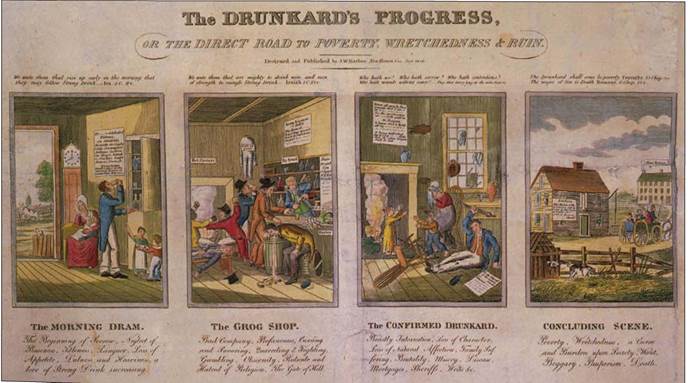
The Drunkard’s Progress, an 1826 anti-liquor broadside illustrating how drinking leads a respectable man and his family to ruin.
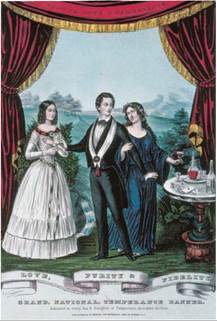
A temperance banner from around 1850 depicts a young man tom between a woman in white, who illustrates female purity, and a temptress, who offers him a drink of liquor.