
In world history, the year 1848 is remembered as the “springtime of nations,” a time of democratic uprisings against the monarchies of Europe and demands by ethnic minorities for national independence. American principles of liberty and self-government appeared to be triumphing in the Old World. The Chartist movement in Great Britain organized massive demonstrations in support of a proposed Charter that demanded democratic reforms. The French replaced their monarchy with a republic. Hungarians proclaimed their independence from Austrian rule. Patriots in Italy and Germany, both divided into numerous states, demanded national unification. But the revolutionary tide receded. Chartism faded away. In France, the Second Republic was soonsucceeded by the reign of Emperor Napoleon III. Revolts in Budapest, Rome, and other cities were crushed. Would their own experiment in self-government, some Americans wondered, suffer the same fate as the failed revolutions of Europe?
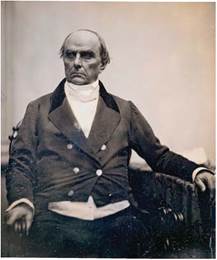
Senator Daniel Webster of Massachusetts in a daguerreotype from 1850, the year his speech in support of the Compromise of 1850 contributed to its passage.
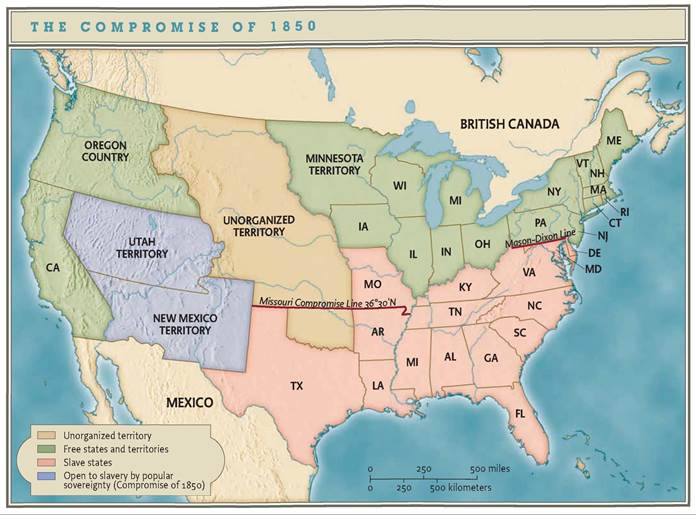
The Compromise of 1850 attempted to settle issues arising from the acquisition of territory from Mexico by admitting California as a free state and providing that the status of slavery in Utah and New Mexico would be determined by the settlers.
With the slavery issue appearing more and more ominous, established party leaders moved to resolve differences between the sections. Some disputes were of long standing, but the immediate source of controversy arose from the acquisition of new lands after the Mexican War. In 1850, California asked to be admitted to the Union as a free state. Many southerners opposed the measure, fearing that it would upset the sectional balance in Congress. Senator Henry Clay offered a plan with four main provisions that came to be known as the Compromise of 1850. California would enter the Union as a free state. The slave trade, but not slavery itself, would be abolished in the nation’s capital. A stringent new law would allow southerners to reclaim runaway slaves. And the status of slavery in the remaining territories acquired from Mexico would be left to the decision of the local white inhabitants. The United States would also agree to pay off the massive debt Texas had accumulated while independent.