
The outbreak of the war found both sides unprepared. In 1861, there was no national railroad gauge (the distance separating the two tracks), so trains built for one line could not run on another. There was no national banking system, no tax system capable of raising the enormous funds needed to finance the war, and not even accurate maps of the southern states. Soon after the firing on Fort Sumter, Lincoln proclaimed a naval blockade of the South, part of the so-called Anaconda Plan, which aimed to strangle the South economically. But the navy charged with patrolling the 3,500-mile coastline consisted of only ninety vessels, fewer than half of them steam-powered. Not until late in the war did the blockade become effective.
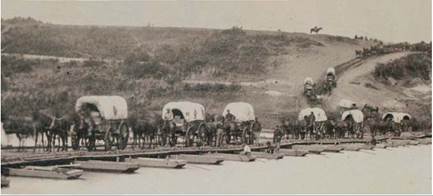
Union army wagons crossing the Rapidan River in Virginia in May 1864. Supplying Civil War armies required an immense mobilization of economic resources.
Then there was the problem of purchasing and distributing the food, weapons, and other supplies required by the soldiers. The Union army eventually became the best-fed and best-supplied military force in history. By the war’s third year, on the other hand, southern armies were suffering from acute shortages of food, uniforms, and shoes. Yet the chief of the Confederacy’s Ordnance Bureau, Josiah Gorgas (a transplanted northerner), proved brilliantly resourceful in arming southern troops. Under his direction, the Confederate government imported weapons from abroad and established arsenals of its own to turn out rifles, artillery, and ammunition.