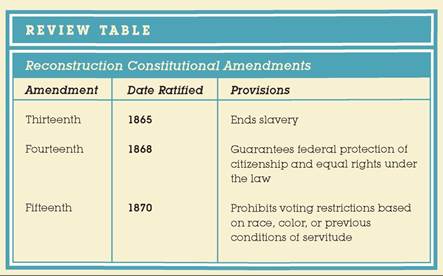
As a historical process—the nation’s adjustment to the destruction of slavery—Reconstruction continued well after 1877. Blacks continued to vote and, in some states, hold office into the 1890s. But as a distinct era of national history—when Republicans controlled much of the South, blacks exercised significant political power, and the federal government accepted the responsibility for protecting the fundamental rights of all American citizens—Reconstruction had come to an end. Despite its limitations, Reconstruction was a remarkable chapter in the story of American freedom. Nearly a century would pass before the nation again tried to bring equal rights to the descendants of slaves. The civil rights era of the 1950s and 1960s would sometimes be called the Second Reconstruction.
Even while it lasted, however, Reconstruction revealed some of the tensions inherent in nineteenth-century discussions of freedom. The policy of granting black men the vote while denying them the benefits of land ownership strengthened the idea that the free citizen could be a poor, dependent laborer. Reconstruction placed on the national agenda a problem that would dominate political discussion for the next half-century—how, in a modern society, to define the economic essence of freedom.
REVIEW QUESTIONS
1. In 1865, former Confederate general Robert Richardson remarked that “the emancipated slaves own nothing, because nothing but freedom has been given to them.” Explain whether this would be an accurate assessment of Reconstruction twelve years later.
2. The women’s movement split into two separate national organizations in part because the Fifteenth Amendment did not give women the vote. Explain why the two groups split.
3. Explain how important black families, churches, schools, and other institutions were to the development of African American culture and political activism in this period.
4. Why did ownership of land and control of labor become major points of contention between former slaves and whites in the South?
5. By what methods did southern whites seek to limit African-American civil rights and liberties?
6. How did the failure of land reform and continued poverty lead to new forms of servitude for both blacks and whites?
7. What caused the confrontation between President Johnson and Congress over Reconstruction policies?
8. What national issues and attitudes combined to bring an end to Reconstruction by 1877?
9. By 1877, how did the condition of former slaves in the United States compare with that of freedmen around the globe?

FREEDOM QUESTIONS
1. After the Civil War, how did the definitions of freedom change for the nation, for the freedmen, and for southern whites?
2. Identify and explain the key elements of freedom according to the former slaves.
3. In the text we see that “Reconstruction redrew the boundaries of American freedom.” How did these boundaries expand for some citizens but remain closed or restricted for others?