
The boundaries of nationhood, expanded so dramatically in the aftermath of the Civil War, slowly contracted. Leaders of both parties expressed vicious opinions regarding immigrants from China—they were “odious, abominable, dangerous, revolting,” declared Republican leader James G. Blaine. Between 1850 and 1870, nearly all Chinese immigrants had been unattached men, brought in by labor contractors to work in western gold fields, railroad construction, and factories. In the early 1870s, entire Chinese families began to immigrate, leading Congress in 1875 to exclude Chinese women from entering the country. California congressman Horace Page, the bill’s author, insisted that it was intended to preserve the health of white citizens by barring Chinese prostitutes. But immigration authorities enforced the Page law so as to keep out as well the wives and daughters of arriving men and of those already in the country.
Beginning in 1882, Congress temporarily excluded immigrants from China from entering the country altogether. Although non-whites had long been barred from becoming naturalized citizens, this was the first time that race had been used to exclude an entire group of people from entering the United States. Congress renewed the restriction ten years later and made it permanent in 1902.
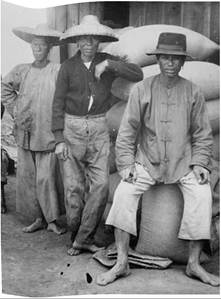
Chinese agricultural laborers in southern California around 1880.
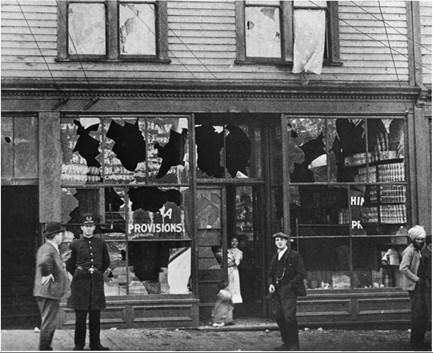
Result of an anti-Chinese riot in Seattle, Washington.
At the time of exclusion, 105,000 persons of Chinese descent lived in the United States. Nearly all of them resided on the West Coast, where they suffered intense discrimination and periodic mob violence. In the late-nineteenth-century West, thousands of Chinese immigrants were expelled from towns and mining camps, and mobs assaulted Chinese residences and businesses. Drawing on the legislation of the Reconstruction era, Chinese victims sued local governments for redress when their rights were violated and petitioned Congress for indemnity. Their demands for equal rights forced the state and federal courts to define the reach of the Fourteenth Amendment. For example, between 1871 and 1885, San Francisco provided no public education for Chinese children. In 1885, the California Supreme Court, in Tape v. Hurley, ordered the city to admit Chinese students to public schools. The state legislature responded by passing a law authorizing segregated education, and the city established a school for Chinese. But Joseph and Mary Tape, who had lived in the United States since the 1860s, insisted that their daughter be allowed to attend her neighborhood school like other children. “Is it a disgrace to be born a Chinese?” Mary Tape wrote. “Didn’t God make us all!” But her protest failed. Not until 1947 did California repeal the law authorizing separate schools for the Chinese.
The U.S. Supreme Court also considered the status of Chinese-Americans. In Yick Wo v. Hopkins (1886), the Court unanimously ordered San Francisco to grant licenses to Chinese-operated laundries, which the city government had refused to do. To deny a person the opportunity to earn a living, the Court declared, was “intolerable in any country where freedom prevails.” Twelve years later, in United States v. Wong Kim Ark, the Court ruled that the Fourteenth Amendment awarded citizenship to children of Chinese immigrants born on American soil.
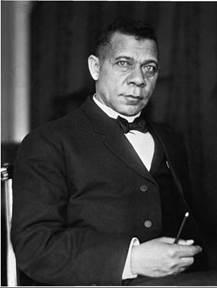
Booker T. Washington, advocate of industrial education and economic self-help.
Yet the Justices also affirmed the right of Congress to set racial restrictions on immigration. And in its decision in Fong Yue Ting (1893), the Court authorized the federal government to expel Chinese aliens without due process of law. In his dissent, Justice David J. Brewer acknowledged that the power was now directed against a people many Americans found “obnoxious.” But “who shall say,” he continued, “it will not be exercised tomorrow against other classes and other people?” Brewer proved to be an accurate prophet. In 1904, the Court cited Fong Yue Ting in upholding a law barring anarchists from entering the United States, demonstrating how restrictions on the rights of one group can become a precedent for infringing on the rights of others.
Exclusion profoundly shaped the experience of Chinese-Americans, long stigmatizing them as incapable of assimilation and justifying their isolation from mainstream society. Congress for the first time also barred groups of whites from entering the country, beginning in 1875 with prostitutes and convicted felons, and in 1882 adding “lunatics” and those likely to become a “public charge.” “Are we still a [place of refuge] for the oppressed of all nations?” wondered James B. Weaver, the Populist candidate for president in 1892.