
One group of Americans who spread the nation’s influence overseas were religious missionaries, thousands of whom ventured abroad in the late nineteenth century to spread Christianity, prepare the world for the second coming of Christ, and uplift the poor. Inspired by Dwight Moody, a Methodist evangelist, the Student Volunteer Movement for Foreign Missions sent more than 8,000 missionaries to “bring light to heathen worlds” across the globe. Missionary work offered employment to those with few opportunities at home, including blacks and women, who made up a majority of the total.
A small group of late-nineteenth-century thinkers actively promoted American expansionism, warning that the country must not allow itself to be shut out of the scramble for empire. In Our Country (1885), Josiah Strong, a prominent Congregationalist clergyman, sought to update the idea of manifest destiny. Having demonstrated their special aptitude for liberty and self-government on the North American continent, Strong announced, Anglo-Saxons should now spread their institutions and values to “inferior races” throughout the world. The economy would benefit, he insisted, since one means of civilizing “savages” was to turn them into consumers of American goods.
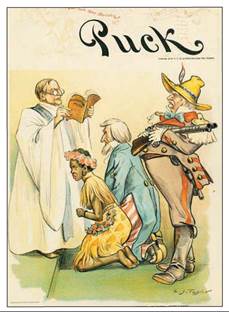
A cartoon in Puck, December 1, 1897, imagines the annexation of Hawaii by the United States as a shotgun wedding. The minister, President McKinley, reads from a book entitled Annexation Policy. The Hawaiian bride appears to be looking for a way to escape. Most Hawaiians did not support annexation.
Naval officer Alfred T. Mahan, in The Influence of Sea Power upon History (i 890), argued that no nation could prosper without a large fleet of ships engaged in international trade, protected by a powerful navy operating from overseas bases. Mahan published his book in the same year that the census bureau announced that there was no longer a clear line separating settled from unsettled land. Thus, the frontier no longer existed. “Americans,” wrote Mahan, “must now begin to look outward.” His arguments influenced the outlook of James G. Blaine, who served as secretary of state during Benjamin Harrison’s presidency (1889-1893). Blaine urged the president to try to acquire Hawaii, Puerto Rico, and Cuba as strategic naval bases.
Although independent, Hawaii was already closely tied to the United States through treaties that exempted imports of its sugar from tariff duties and provided for the establishment of an American naval base at Pearl Harbor. Hawaii’s economy was dominated by American-owned sugar plantations that employed a workforce of native islanders and Chinese, Japanese, and Filipino laborers under long-term contracts. Early in 1893, a group of American planters organized a rebellion that overthrew the Hawaii government of Queen Liliuokalani. On the eve of leaving office, Harrison submitted a treaty of annexation to the Senate. After determining that a majority of Hawaiians did not favor the treaty, Harrison’s successor, Grover Cleveland, withdrew it. In July 1898, in the midst of the Spanish-American War, the United States finally annexed the Hawaiian Islands. In 1993, the U.S. Congress passed, and President Bill Clinton signed, a resolution expressing regret to native Hawaiians for “the overthrow of the Kingdom of Hawaii... with the participation of agents and citizens of the United States.”
The depression that began in 1893 heightened the belief that a more aggressive foreign policy was necessary to stimulate American exports. Fears of economic and ethnic disunity fueled an assertive nationalism. In the face of social conflict and the new immigration, government and private organizations in the 1890s promoted a unifying patriotism. These were the years when rituals like the Pledge of Allegiance and the practice of standing for the playing of “The Star-Spangled Banner” came into existence. Americans had long honored the Stars and Stripes, but the “cult of the flag,” including an official Flag Day, dates to the 1890s. New, mass-circulation newspapers also promoted nationalistic sentiments. By the late 1890s, papers like William Randolph Hearst’s New York Journal and Joseph Pulitzer’s New York World—dubbed the “yellow press” by their critics after the color in which Hearst printed a popular comic strip—were selling a million copies each day by mixing sensational accounts of crime and political corruption with aggressive appeals to patriotic sentiments.