
Many Cubans, Filipinos, and Puerto Ricans had welcomed American intervention as a way of breaking Spain’s long hold on these colonies. Large planters looked forward to greater access to American markets, and local elites hoped that the American presence would fend off radical changes proposed by rebellious nationalist movements. Nationalists and labor leaders admired America’s democratic ideals and believed that American participation in the destruction of Spanish rule would lead to social reform and political self-government.
But the American determination to exercise continued control, direct or indirect, led to a rapid change in local opinion, nowhere more so than in the Philippines. Filipinos had been fighting a war against Spain since 1896. After Dewey’s victory at Manila Bay, their leader, Emilio Aguinaldo, established a provisional government with a constitution modeled on that of the United States. But once McKinley decided to retain possession of the islands, the Filipino movement turned against the United States. The result was a second war, far longer (it lasted from 1899 to 1903) and bloodier (it cost the lives of well more than 100.000 Filipinos and 4,200 Americans) than the Spanish-American conflict. Today, this is perhaps the least remembered of all American wars. At the time, however, it was closely followed and widely debated in the United States. Press reports of atrocities committed by American troops—the burning of villages, torture of prisoners of war, and rape and execution of civilians—tarnished the nation’s self-image as liberators. “We do not intend to free the people of the Philippines,” complained Mark Twain. “We have gone there to conquer.”

Emilio Aguinaldo, leader of the Philippine War against American occupation, in a more dignified portrayal than in the cartoon above.
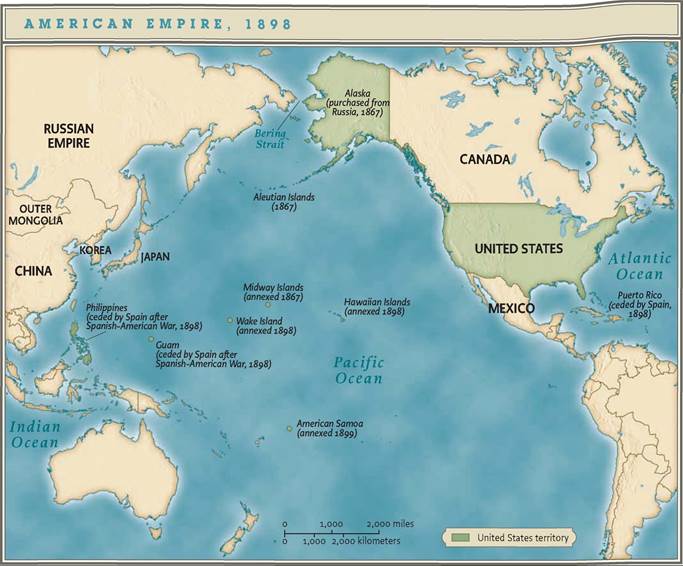
As a result of the Spanish-American War, the United States became the ruler of a far-flung overseas empire.
The McKinley administration justified its policies on the grounds that its aim was to “uplift and civilize and Christianize” the Filipinos (although most residents of the islands were already Roman Catholics). William Howard Taft, who became governor-general of the Philippines in 1901, believed it might take a century to raise Filipinos to the condition where they could appreciate “what Anglo-Saxon liberty is.”
Once in control of the Philippines, the colonial administration took seriously the idea of modernizing the islands. It expanded railroads and harbors, brought in American schoolteachers and public health officials, and sought to modernize agriculture (although efforts to persuade local farmers to substitute corn for rice ran afoul of Filipino climate and cultural traditions). The United States, said President McKinley, had an obligation to its “little brown brothers.” Yet in all the new possessions, American policies tended to serve the interests of land-based local elites—native-born landowners in the Philippines, American sugar planters in Hawaii and Puerto Rico—and such policies bequeathed enduring poverty to the majority of the rural population. Under American rule, Puerto Rico, previously an island of diversified small farmers, became a low-wage plantation economy controlled by absentee corporations. By the 1920s, its residents were among the poorest in the entire Caribbean.
From Interview with President McKinley (1899)
In 1899, soon after the end of the Spanish-American War, President William McKinley met with a group of Methodist Church leaders to discuss his decision to annex the Philippines. McKinley offered a defense of American empire as being in the best interests of Americans and Filipinos.
Before you go I would like to say just a word about the Philippine business. I have been criticized a good deal about the Philippines, but don’t deserve it. The truth is I didn’t want the Philippines, and when they came to us, as a gift from the gods, I did not know what to do with them. When the Spanish War broke out [Admiral] Dewey was at Hong Kong, and I ordered him to go to Manila and to capture or destroy the Spanish fleet, and he had to; because, if defeated, he had no place to refit on that side of the globe, and if the Dons [Spanish] were victorious they would likely cross the Pacific and ravage our Oregon and California coasts. And so he had to destroy the Spanish fleet, and did it! But that was as far as I thought then.
When I next realized that the Philippines had dropped into our laps I confess I did not know what to do with them. I sought counsel from all sides—Democrats as well as Republicans—but got little help. I thought first we would take only Manila; then Luzon; then other islands perhaps also. I walked the floor of the White House night after night until midnight; and I am not ashamed to tell you, gentlemen, that I went down on my knees and prayed [to] Almighty God for light and guidance more than one night. And one night late it came to me this way— I don’t know how it was, but it came: (1) That we could not give them back to Spain—that would be cowardly and dishonorable; (2) that we could not turn them over to France and Germany—our commercial rivals in the Orient—that would be bad business and discreditable; (3) that we could not leave them to themselves—they were unfit for self-government—and they would soon have anarchy and misrule over there worse than Spain’s was; and (4) that there was nothing left for us to do but to take them ah, and to educate the Filipinos, and uplift and civilize and Christianize them, and by God’s grace do the very best we could by them, as our fellow-men for whom Christ also died. And then I went to bed, and went to sleep, and slept soundly, and the next morning I sent for the chief engineer of the War Department (our map-maker), and I told him to put the Philippines on the map of the United States (pointing to a large map on the wall of his office), and there they are, and there they will stay while I am President!
From “Aguinaldo’s Case against the United States” (1899)
Emilio Aguinaldo, who led the Filipino armed struggle for independence against Spain and then another war against the United States when President McKinley decided to annex the Philippines, explained his reasons for opposing American imperialism in an article in the widely read magazine, the North American Review.
He contrasted American traditions of self-government with the refusal to grant this right to the Philippines.
We Filipinos have all along believed that if the American nation at large knew exactly, as we do, what is daily happening in the Philippine Islands, they would rise en masse, and demand that this barbaric war should stop [and]... she would cease to be the laughing stock of other civilized nations, as she became when she abandoned her traditions and set up a double standard of government— government by consent in America, government by force in the Philippine Islands....
You have been deceived all along the line. You have been greatly deceived in the personality of my countrymen. You went to the Philippines under the impression that their inhabitants were ignorant savages.... We have been represented by your popular press as if we were Africans or Mohawk Indians....
You repeat constantly the dictum that we cannot govern ourselves.... With equal reason, you might have said the same thing some fifty or sixty years ago of Japan; and, little over a hundred years ago, it was extremely questionable, when you, also, were rebels against the English Government, if you could govern yourselves.... Now, the moral of all this obviously is: Give us the chance; treat us exactly as you demanded to be treated at the hands of England when you rebelled against her autocratic methods.
Now, here is a unique spectacle—the Filipinos fighting for liberty, the American people fighting them to give them liberty.... You entered into an alliance with our chiefs at Hong Kong and at Singapore, and you promised us your aid and protection in our attempt to form a government on the principles and after the model of the government of the United States.... In combination with our forces, you compelled Spain to surrender.... Joy abounded in every heart, and all went well... until... the Government at Washington ... commenced] by ignoring all promises that had been made and end[ed] by ignoring the Philippine people, their personality and rights, and treating them as a common enemy.... In the face of the world you emblazon humanity and Liberty upon your standard, while you cast your political constitution to the winds and attempt to trample down and exterminate a brave people whose only crime is that they are fighting for their liberty.
QUESTIONS
1. How persuasive is McKinley’s account of how and why he decided to annex the Philippines?
2. Why does Aguinaldo think that the United States is betraying its own values?
3. How do these documents reflect different definitions of liberty in the wake of the Spanish-American War?