
Despite the ferment of Progressivism on the city and state levels, the most striking political development of the early twentieth century was the rise of the national state. The process of nationalization was occurring throughout American life. National corporations dominated the economy; national organizations like the American Medical Association came into being to raise the incomes and respect of professions. The process was even reflected in the consolidation of local baseball teams into the American and National Leagues and the advent in 1903 of the World Series. Only energetic national government, Progressives believed, could create the social conditions of freedom.
Despite creative experiments in social policy at the city and state levels, the tradition of localism seemed to most Progressives an impediment to a renewed sense of national purpose. Poverty, economic insecurity, and lack of industrial democracy were national problems that demanded national solutions. The democratic national state, wrote New Republic editor Herbert Croly, offered an alternative to control of Americans’ lives by narrow interests that manipulated politics or by the all-powerful corporations. Croly proposed a new synthesis of American political traditions. To achieve the “Jeffersonian ends” of democratic self-determination and individual freedom, he insisted, the country needed to employ the “Hamiltonian means” of government intervention in the economy. Each in his own way, the Progressive presidents—Theodore Roosevelt, William Howard Taft, and Woodrow Wilson—tried to address this challenge.
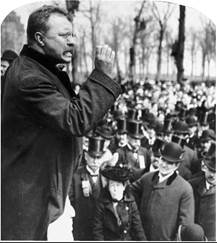
President Theodore Roosevelt addressing a crowd in Evanston, Illinois, in 1902.
In September 1901, the anarchist Leon Czolgosz assassinated William McKinley while the president visited the Pan-American Exposition in Buffalo, New York. At the age of forty-two, Vice President Theodore Roosevelt became the youngest man ever to hold the office of president. Roosevelt was an impetuous, energetic individual with a penchant for what he called the “strenuous life” of manly adventure. In many ways, he became the model for the twentieth-century president, an official actively and continuously engaged in domestic and foreign affairs. (The foreign policies of the Progressive presidents will be discussed in the next chapter.) Roosevelt regarded the president as “the steward of the public welfare.” He moved aggressively to set the political agenda.
When the British writer H. G. Wells visited the United States soon after the turn of the century, he found that “the steady trend towards concentration” had become “the cardinal topic of thought and discussion in the American mind.” Roosevelt’s program, which he called the Square Deal, attempted to confront the problems caused by economic consolidation by distinguishing between “good” and “bad” corporations. The former, among which he included U.S. Steel and Standard Oil, served the public interest. The latter were run by greedy financiers interested only in profit, and had no right to exist.
Soon after assuming office, Roosevelt shocked the corporate world by announcing his intention to prosecute under the Sherman Antitrust Act the Northern Securities Company. Created by financier J. P. Morgan, this “holding company” owned the stock and directed the affairs of three major western railroads. It monopolized transportation between the Great Lakes and the Pacific. Morgan was outraged. “Wall Street is paralyzed,” quipped one newspaper, “at the thought that a President of the United States should sink to enforce the law.” In 1904, the Supreme Court ordered Northern Securities dissolved, a major victory for the antitrust movement.