
Even more extreme repression took place at the hands of state governments and private groups. Americans had long displayed the flag (and used it in advertisements for everything from tobacco products to variety shows). But during World War I, attitudes toward the American flag became a test of patriotism. Persons suspected of disloyalty were forced to kiss the flag in public; those who made statements critical of the flag could be imprisoned. During the war, thirty-three states outlawed the possession or display of red or black flags (symbols, respectively, of communism and anarchism), and twenty-three outlawed a newly created offense, “criminal syndicalism,” the advocacy of unlawful acts to accomplish political change or “a change in industrial ownership.”
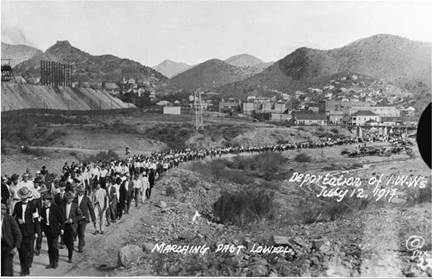
A long line of striking miners being led out of Bisbee, Arizona, in July 1917. Some 1,200 members of the Industrial Workers of the World were transported into the desert by armed vigilantes and abandoned there.
“Who is the real patriot?” Emma Goldman asked when the United States entered the war. She answered, those who “love America with open eyes,” who were not blind to “the wrongs committed in the name of patriotism.” But from the federal government to local authorities and private groups, patriotism came to be equated with support for the government, the war, and the American economic system, while antiwar sentiment, labor radicalism, and sympathy for the Russian Revolution became “un-American.” Minnesota established a Commission of Public Safety to root out disloyalty from the state. Local authorities formally investigated residents who failed to subscribe to Liberty Loans. Throughout the country, schools revised their course offerings to ensure their patriotism and required teachers to sign loyalty oaths.
The 250,000 members of the newly formed American Protective League (APL) helped the Justice Department identify radicals and critics of the war by spying on their neighbors and carrying out “slacker raids” in which thousands of men were stopped on the streets of major cities and required to produce draft registration cards. Many private groups seized upon the atmosphere of repression as a weapon against domestic opponents. Employers cooperated with the government in crushing the Industrial Workers of the World (IWW), a move long demanded by business interests. In July 1917, vigilantes in Bisbee, Arizona, rounded up some 1,200 striking copper miners and their sympathizers, herded them into railroad boxcars, and transported them into the desert, where they were abandoned. New Mexico’s governor ordered them housed in tents and provided with food and water. Few ever returned to Bisbee. In August, a crowd in Butte, Montana, lynched IWW leader Frank Little. The following month, operating under one of the broadest warrants in American history, federal agents swooped down on IWW offices throughout the country, arresting hundreds of leaders and seizing files and publications.
The war experience, commented Walter Lippmann, demonstrated “that the traditional liberties of speech and opinion rest on no solid foundation.” Yet while some Progressives protested individual excesses, most failed to speak out against the broad suppression of freedom of expression. Civil liberties, by and large, had never been a major concern of Progressives, who had always viewed the national state as the embodiment of democratic purpose and insisted that freedom flowed from participating in the life of society, not standing in opposition. Strong believers in the use of national power to improve social conditions, Progressives found themselves ill prepared to develop a defense of minority rights against majority or governmental tyranny. From the AFL to New Republic intellectuals, moreover, supporters of the war saw the elimination of socialists and alien radicals as a necessary prelude to the integration of labor and immigrants into an ordered society, an outcome they hoped would emerge from the war.
From Eugene V. Debs,
Speech to the Jury before Sentencing under the Espionage Act (1918)
The most prominent spokesman for American socialism and a fervent opponent of American participation in World War I, Eugene V. Debs was arrested for delivering an antiwar speech and convicted of violating the Espionage Act. In his speech to the jury, he defended the right of dissent in wartime.
I wish to admit the truth of all that has been testified to in this proceeding.... Gentlemen, you have heard the report of my speech at Canton on June 16, and I submit that there is not a word in that speech to warrant the charges set out in the indictment....
In what I had to say there my purpose was to have the people understand something about the social system in which we live and to prepare them to change this system by perfectly peaceable and orderly means into what I, as a Socialist, conceive to be a real democracy.... I have never advocated violence in any form. I have always believed in education, in intelligence, in enlightenment; and I have always made my appeal to the reason and to the conscience of the people.
In every age there have been a few heroic souls who have been in advance of their time, who have been misunderstood, maligned, persecuted, sometimes put to death.... Washington, Jefferson, Franklin, Paine, and their compeers were the rebels of their day.... But they had the moral courage to be true to their convictions....
William Lloyd Garrison, Wendell Phillips, Elizabeth Cady Stanton ... and other leaders of the abolition movement who were regarded as public enemies and treated accordingly, were true to their faith and stood their ground.... You are now teaching your children to revere their memories, while all of their detractors are in oblivion.
This country has been engaged in a number of wars and every one of them has been condemned by some of the people. The war of 1812 was opposed and condemned by some of the most influential citizens; the Mexican War was vehemently opposed and bitterly denounced, even after the war had been declared and was in progress, by Abraham Lincoln, Charles Sumner, Daniel Webster.... They were not indicted; they were not charged with treason....
I believe in the Constitution. Isn’t it strange that we Socialists stand almost alone today in upholding and defending the Constitution of the United States? The revolutionary fathers... understood that free speech, a free press and the right of free assemblage by the people were fundamental principles in democratic government.... I believe in the right of free speech, in war as well as in peace.
From W. E. B. Du Bois,
“Returning Soldiers,” The Crisis (1919)
Scholar, poet, activist, founder of the National Association for the Advancement of Colored People and editor of its magazine, The Crisis, W. E. B. Du Bois was the most prominent black leader of the first half of the twentieth century. He supported black participation in World War I, but he insisted that black soldiers must now join in the struggle for freedom at home.
We are returning from war! The Crisis and tens of thousands of black men were drafted into a great struggle. For bleeding France and what she means and has meant and will mean to us and humanity and against the threat of German race arrogance, we fought gladly and to the last drop of blood; for America and her highest ideals, we fought in far-off hope; for the dominant southern oligarchy entrenched in Washington, we fought in bitter resignation. For the America that represents and gloats in lynching, disfranchisement, caste, brutality and devilish insult—for this, in the hateful upturning and mixing of things, we were forced by vindictive fate to fight, also.
But today we return! ... We sing: This country of ours, despite all its better souls have done and dreamed, is yet a shameful land.
It lynches.
And lynching is barbarism of a degree of contemptible nastiness unparalleled in human history. Yet for fifty years we have lynched two Negroes a week, and we have kept this up right through the war.
It disfranchises its own citizens.
Disfranchisement is the deliberate theft and robbery of the only protection of poor against rich and black against white. The land that disfranchises its citizens and calls itself a democracy lies and knows it lies.
It encourages ignorance.
It has never really tried to educate the Negro. A dominate minority does not want Negroes educated. It wants servants....
It insults us.
It has organized a nationwide and latterly a worldwide propaganda of deliberate and continuous insult and defamation of black blood wherever found....
This is the country to which we Soldiers of Democracy return. This is the fatherland for which we fought! But it is our fatherland. It was right for us to fight....
We return fighting.
Make way for Democracy!
QUESTIONS
1. Why does Debs relate the history of wartime dissent in America?
2. What connections does Du Bois draw between blacks fighting abroad in the war and returning to fight at home?
3. In what ways does each author point up the contradiction between America’s professed values and its actual conduct?