
In 1925, a trial in Tennessee threw into sharp relief the division between traditional values and modem, secular culture. John Scopes, a teacher in a Tennessee public school, was arrested for violating a state law that prohibited the teaching of Charles Darwin’s theory of evolution His trial became a national sensation. The proceedings were even carried live on national radio.
The Scopes trial reflected the enduring tension between two American definitions of freedom. Fundamentalist Christians, strongest in rural areas of the South and West, clung to the traditional idea of “moral” liberty—voluntary adherence to time-honored religious beliefs. The theory that man had evolved over millions of years from ancestors like apes contradicted the biblical account of creation Those who upheld the Tennessee law identified evolutionists with feminists, socialists, and religious modernists, all of whom, they claimed, substituted human judgment for the word of God. To Scopes’s defenders, including the American Civil Liberties Union, which had persuaded him to violate the law in order to test its constitutionality, freedom meant above all the right to independent thought and individual self-expression To them, the Tennessee law offered a lesson in the dangers of religious intolerance and the merger of church and state.
The renowned labor lawyer Clarence Darrow defended Scopes. The trial’s highlight came when Darrow called William Jennings Bryan to the stand as an “expert witness” on the Bible. Viewing the trial as a “duel to the death” between science and Christianity, he accepted Darrow’s challenge. But Bryan revealed an almost complete ignorance of modern science and proved unable to respond effectively to Darrow’s sarcastic questioning. Does the serpent really crawl on its belly as punishment for having tempted Eve in the Garden of Evil?
When Bryan answered “yes,” Darrow inquired how it got around before being cursed—on its tail? Asked whether God had actually created the world in six days, Bryan replied that these should be understood as ages, “not six days of twenty-four hours”—thus opening the door to the very nonliteral interpretation of the Bible fundamentalists rejected.
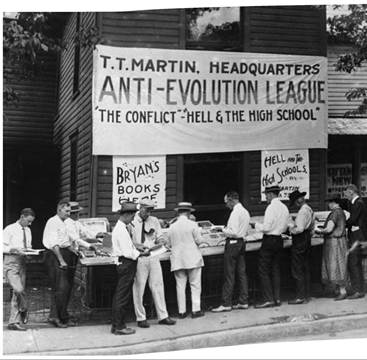
The Anti-Evolution League selling its publications outside the Tennessee courthouse where the Scopes trial was taking place.
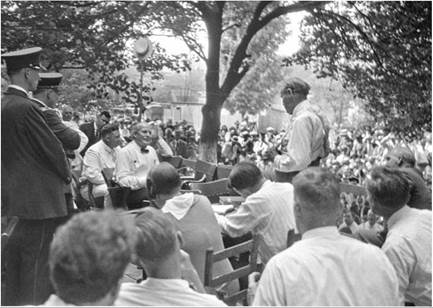
Because of extreme heat, some sessions of the Scopes trial were held outdoors, in front of the courthouse in Dayton, Tennessee. A photographer snapped this picture of the trial’s climactic moment, when Clarence Darrow (standing at the center) questioned William Jennings Bryan (seated) about interpretation of the Bible.
The jury found Scopes guilty, although the Tennessee supreme court later overturned the decision on a technicality. Shortly after the trial ended, Bryan died and the movement for anti-evolution laws disintegrated. Fundamentalists retreated for many years from battles over public education, preferring to build their own schools and colleges where teaching could be done as they saw fit and preachers were trained to spread their interpretation of Christianity. The battle would be rejoined, however, toward the end of the twentieth century, when fundamentalism reemerged as an important force in politics. To this day, the teaching of the theory of evolution in public schools arouses intense debate in parts of the United States.