
Other popular movements of the mid-1930s also placed the question of economic justice on the political agenda. In California, the novelist Upton Sinclair won the Democratic nomination for governor in 1934 as the head of the End Poverty in California movement. Sinclair called for the state to use idle factories and land in cooperative ventures that would provide jobs for the unemployed. He lost the election after being subjected to one of the first modern “negative” media campaigns. Sinclair’s opponents circulated false newsreels showing armies of unemployed men marching to California to support his candidacy and a fake endorsement from the Communist Party.
The rise to national prominence of Huey Long offered another sign of popular dissatisfaction with the slow pace of economic recovery. Long’s career embodied both Louisiana’s Populist and Socialist traditions (Winn Parish, his home, had voted for both of these third parties) and the state’s heritage of undemocratic politics. Driven by intense ambition and the desire to help uplift the state’s “common people,” Long won election as governor in 1928 and in 1930 took a seat in the U.S. Senate. From Washington, he dominated every branch of state government. He used his dictatorial power to build roads, schools, and hospitals and to increase the tax burden on Louisiana’s oil companies.
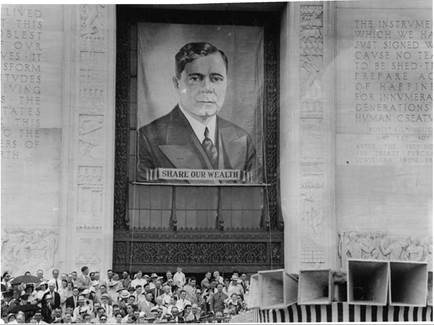
A portrait of Huey Long, the “Kingfish” of Louisiana politics, towers over the inauguration of his supporter, Richard Leche, as governor in 1936.
One of the most colorful characters in twentieth-century American politics, Long was referred to by both admirers and critics as the “Kingfish.” In 1934, he launched the Share Our Wealth movement, with the slogan “Every Man a King.” He called for the confiscation of most of the wealth of the richest Americans in order to finance an immediate grant of $5,000 and a guaranteed job and annual income for all citizens. In his inimitable style, Long explained his goal: “Let’s pull down these huge piles of gold until there shall be a real job, not a little old sow-belly, black-eyed pea job but a real spending money, beefsteak and gravy ... Ford in the garage ... red, white, and blue job for every man.” Long claimed a following of 5 million. He was on the verge of announcing a run for president when the son of a defeated political rival assassinated him in 1935.
Also in the mid-1930s, the “radio priest,” Father Charles E. Coughlin, attracted millions of listeners with weekly broadcasts attacking Wall Street bankers and greedy capitalists, and calling for government ownership of key industries as a way of combating the Depression. Initially a strong supporter of FDR, Coughlin became increasingly critical of the president for what he considered the failure of the New Deal to promote social justice. His crusade would later shift to anti-Semitism and support for European fascism. Dr. Francis Townsend, a California physician, meanwhile won wide support for a plan by which the government would make a monthly payment of $200 to older Americans, with the requirement that they spend it immediately. This, he argued, would boost the economy. By the end of 1934, Townsend Clubs claimed more than 2 million members. Along with the rise of the CIO, these signs of popular discontent helped to spark the Second New Deal.