
In 1942, a public opinion survey sponsored by the army’s Bureau of Intelligence found that the vast majority of white Americans were “unaware that there is any such thing as a ‘Negro problem’” and were convinced that blacks were satisfied with their social and economic conditions. They would soon discover their mistake.
The war years witnessed the birth of the modern civil rights movement. Angered by the almost complete exclusion of African-Americans from jobs in the rapidly expanding war industries (of 100,000 aircraft workers in 1940, fewer than 300 were blacks), the black labor leader A. Philip Randolph in July 1941 called for a March on Washington. His demands included access to defense employment, an end to segregation, and a national antilynching law. Randolph, who as founder of the Brotherhood of Sleeping Car Porters had long battled racism among both employers and unions, hurled Roosevelt’s rhetoric back at the president. He declared racial discrimination “undemocratic, un-American, and pro-Hitler.”
The prospect of thousands of angry blacks descending on Washington, remarked one official, “scared the government half to death.” To persuade Randolph to call off the march, Roosevelt issued Executive Order 8802, which banned discrimination in defense jobs and established a Fair Employment Practices Commission (FEPC) to monitor compliance. The black press hailed the order as a new Emancipation Proclamation.

From Henry R. Luce, The American Century (1941)
Even before the United States entered World War II, some Americans were thinking of a postwar world in which the United States would exert its influence throughout the globe. One influential call for Americans to accept the burden of world leadership was a short book by Henry R. Luce, the publisher of Life and Time magazines.
In the field of national policy, the fundamental trouble with America has been, and is, that whereas their nation became in the 20th Century the most powerful and the most vital nation in the world, nevertheless Americans were unable to accommodate themselves spiritually and practically to that fact. Hence they have failed to play their part as a world power—a failure which has had disastrous consequences for themselves and for all mankind. And the cure is this: to accept wholeheartedly our duty and our opportunity as the most powerful and vital nation in the world and in consequence to exert upon the world the full impact of our influence, for such purposes as we see fit and by such means as we see fit....
Our world of 2,000,000,000 human beings is for the first time in history one world, fundamentally indivisible.... Our world, again for the first time in human history, is capable of producing all the material needs of the entire human family.... The world of the 20th Century, if it is to come to life in any nobility of health and vigor, must be to a significant degree an American Century....
In postulating the indivisibility of the contemporary world, one does not necessarily imagine that anything like a world state—a parliament of men— must be brought about in this century. Nor need we assume that war can be abolished.... Large sections of the human family may be effectively organized into opposition to one another. Tyrannies may require a large amount of living space. But Freedom requires and will require far greater living space than Tyranny.... Justice will come near to losing all meaning in the minds of men unless Justice can have approximately the same fundamental meanings in many lands and among many peoples....
As to the ... promise of adequate production for all mankind, the “more abundant life,” be it noted that this is characteristically an American promise.... What we must insist on is that the abundant life is predicated on Freedom.... Without Freedom, there will be no abundant life. With Freedom, there can be.
And finally there is the belief—shared let us remember by most men living—that the 20th Century must be to a significant degree an American Century.... As America enters dynamically upon the world scene, we need most of all to seek and to bring forth a vision of America as a world power and to bring forth a vision ... which will guide us to the authentic creation of the 20th Century—our Century.
From Charles H. Wesley, “The Negro Has always Wanted the Four Freedoms,” in What the Negro Wants (1944)
In 1944, the University of North Carolina Press published What the Negro Wants, a book of essays by fourteen prominent black leaders. Virtually every contributor called for the right to vote in the South, the dismantling of segregation, and access to the “American standard of living.” Several essays also linked the black struggle for racial justice with movements against European imperialism in Africa and Asia. When he read the manuscript, W. T. Couch, the director of the press, was stunned. “If this is what the Negro wants,” he told the book’s editor, “nothing could be clearer than what he needs, and needs most urgently, is to revise his wants.” In this excerpt, the historian Charles H. Wesley explains that blacks are denied each of the Four Freedoms, and also illustrates how the war strengthened black internationalism.
[Negroes] have wanted what other citizens of the United States have wanted. They have wanted freedom and opportunity. They have wanted the pursuit of the life vouchsafed to all citizens of the United States by our own liberty documents. They have wanted freedom of speech, [but] they were supposed to be silently acquiescent in all aspects of their life.... They have wanted freedom of religion, for they had been compelled to “steal away to Jesus”... in order to worship God as they desired. ... They have wanted freedom from want.... However, the Negro has remained a marginal worker and the competition with white workers has left him in want in many localities of an economically sufficient nation. They have wanted freedom from fear. They have been cowed, browbeaten or beaten, as they have marched through the years of American life....
The Negro wants democracy to begin at home....
The future of our democratic life is insecure so long as the hatred, disdain and disparagement of Americans of African ancestry exist....
The Negro wants not only to win the war but also to win the peace.... He wants the peace to be free of race and color restrictions, of imperialism and exploitation, and inclusive of the participation of minorities all over the world in their own governments. When it is said that we are fighting for freedom, the Negro asks, “Whose freedom?” Is it the freedom of a peace to exploit, suppress, exclude, debase and restrict colored peoples in India, China, Africa, Malaya in the usual ways? ... Will Great Britain and the United States specifically omit from the Four Freedoms their minorities and subject peoples? The Negro does not want such a peace.
QUESTIONS
1. What values does Luce wish America to spread to the rest of the world?
2. Why does Wesley believe that black Americans are denied the Four Freedoms?
3. Do Luce and Wesley envision different roles for the United States in the postwar world?
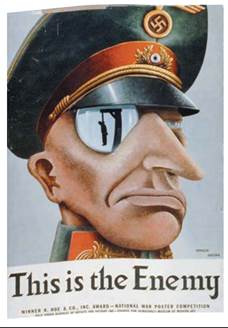
This Is the Enemy, a 1942 poster by Victor Ancona and Karl Koehler, suggests a connection between Nazism abroad and lynching at home.
Essentially an investigative agency, the FEPC lacked enforcement powers. But its very existence marked a significant shift in public policy. Its hearings exposed patterns of racial exclusion so ingrained that firms at first freely admitted that their want ads asked for “colored” applicants for positions as porters and janitors and “white” ones for skilled jobs, and that they allowed black women to work only as laundresses and cooks. The first federal agency since Reconstruction to campaign for equal opportunity for black Americans, the FEPC played an important role in obtaining jobs for black workers in industrial plants and shipyards. In southern California, the aircraft manufacturer Lockheed ran special buses into black neighborhoods to bring workers to its plants. By 1944, more than 1 million blacks, 300,000 of them women, held manufacturing jobs. (“My sister always said that Hitler was the one that got us out of the white folks’ kitchen,” recalled one black woman.)