
Almost as soon as he won the vice-presidential nomination, Nixon ran into trouble over press reports that wealthy Californians had created a private fund for his family. Eisenhower considered dropping him from the ticket. But in an emotional nationally televised thirty-minute address in which he drew attention to his ordinary upbringing, war service, and close-knit family, Nixon denied the accusations. The “Checkers speech,” named after the family dog—the one gift Nixon acknowledged receiving, but insisted he would not return—rescued his political career. It illustrated how television was begun ning to transform politics by allowing candidates to bring a carefully crafted image directly into Americans’ living rooms. The 1952 campaign became the first to make extensive use of TV ads. Parties, one observer complained, were “selling the president like toothpaste.”
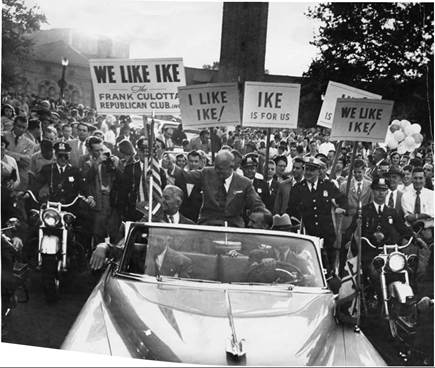
Dwight D. Eisenhower’s popularity was evident at this appearance in Baltimore during the 1952 presidential campaign.
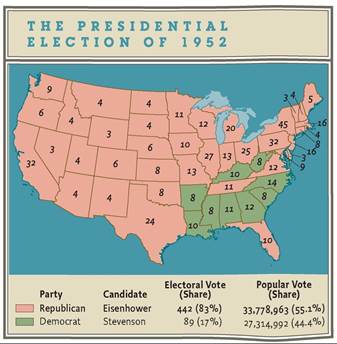
More important to the election’s outcome, however, was Eisenhower’s popularity (invoked in the Republican campaign slogan “I Like Ike”) and the public’s weariness with the Korean War. Ike’s pledge to “go to Korea” in search of peace signaled his intention to bring the conflict to an end. He won a resounding victory over the Democratic candidate, Adlai Stevenson. Four years later, Eisenhower again defeated Stevenson, by an even wider margin. His popularity, however, did not extend to his party. Republicans won a razor-thin majority in Congress in 1952, but Democrats regained control in 1954 and retained it for the rest of the decade. In 1956, Eisenhower became the first president to be elected without his party controlling either house of Congress.
During the 1950s, voters at home and abroad seemed to find reassurance in selecting familiar, elderly leaders to govern them. At age sixty-two, Eisenhower was one of the oldest men ever elected president. But he seemed positively youthful compared with Winston Churchill, who returned to office as prime minister of Great Britain at age seventy-seven, Charles DeGaulle, who assumed the presidency of France at sixty-eight, and Konrad Adenauer, who served as chancellor of West Germany from age seventy-three until well into his eighties. In retrospect, Eisenhower’s presidency seems almost uneventful, at least in domestic affairs—an interlude between the bitter party battles of the Truman administration and the social upheavals of the 1960s.