
Malcolm X was the intellectual father of “Black Power,” a slogan that came to national attention in 1966 when SNCC leader Stokely Carmichael used it during a civil rights march in Mississippi. Black Power immediately became a rallying cry for those bitter over the federal government’s failure to stop violence against civil rights workers, white attempts to determine movement strategy (as at the Democratic convention of 1964), and the civil rights movement’s failure to have any impact on the economic problems of black ghettos.
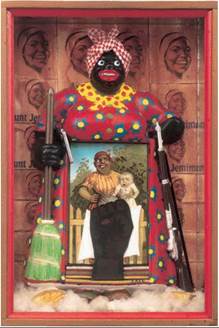
Betye Saar’s 1972 installation, The Liberation of Aunt Jemima, illustrates modes of thought associated with Black Power. Quaker Oats Company has long used an image of a black woman reminiscent of the stereotypical slave “mammy” as a symbol for its brand of pancake mix. Saar gives Aunt Jemima a rifle to go along with her broom. In front of her is another Aunt Jemima, holding a light-skinned baby, a symbol, according to the artist, of the sexual exploitation of black women by white men. Images in the background reveal how Quaker Oats had already modified its advertising image, giving her a smaller kerchief and an Afro hairdo. By the end of the twentieth century, the kerchief had disappeared entirely, and Aunt Jemima had become slimmer and younger and was not smiling quite so broadly.
One who embraced the idea proclaimed, “Black Power means Black Freedom”—freedom, especially, from whites who tried to dictate the movement’s goals. A highly imprecise idea, Black Power suggested everything from the election of more black officials (hardly a radical notion) to the belief that black Americans were a colonized people whose freedom could only be won through a revolutionary struggle for self-determination. But however employed, the idea reflected the radicalization of young civil rights activists and sparked an explosion of racial self-assertion, reflected in the slogan “black is beautiful.” The abandonment of the word “Negro” in favor of “Afro-American,” as well as the popularity of black beauty pageants, African styles of dress, and the “natural,” or “Afro,” hairdo among both men and women, signified much more than a change in language and fashion. They reflected a new sense of racial pride and a rejection of white norms.
Inspired by the idea of black self-determination, SNCC and CORE repudiated their previous interracialism, and new militant groups sprang into existence. Many of these groups proved short-lived. But both traditional civil rights organizations and black politicians adopted some of their ideas. Most prominent of the new groups, in terms of publicity, if not numbers, was the Black Panther Party. Founded in Oakland, California, in 1966, it became notorious for advocating armed self-defense in response to police brutality. It demanded the release of black prisoners because of racism in the criminal justice system. The party’s youthful members alarmed whites by wearing military garb, although they also ran health clinics, schools, and children’s breakfast programs. But internal disputes and a campaign against the Black Panthers by police and the FBI, which left several leaders dead in shootouts, destroyed the organization.
Black unemployment declined throughout the second half of the 1960s. But by 1967, with the escalation of U.S. military involvement in Vietnam, the War on Poverty had ground to a halt. By then, with ghetto uprisings punctuating the urban landscape, the antiwar movement assuming massive proportions, and millions of young people ostentatiously rejecting mainstream values, American society faced its greatest crisis since the Depression.