


• What were the major policy elements of the war on terror in the wake of September 11, 2001?
• How did the war in Iraq unfold in the wake of 9/11?
• How did the war on terror affect the economy and American liberties?
• What events eroded support lor President Bush's policies during his second term?
• What kinds of change did voters hope lor when they elected Barack Obama?
Nо member of the present generation will ever forget when he or she first learned of the events of September 11, 2001. That beautiful late-summer morning began with the sun rising over the East Coast of the United States in a crystal-clear sky. But September 11 soon became one of the most tragic dates in American history.
Around 8 A.M., hijackers seized control of four jet airliners filled with passengers. They crashed two into the World Trade Center in New York City, igniting infernos that soon caused these buildings, which dominated the lower Manhattan skyline, to collapse. A third plane hit a wing of the Pentagon, the country’s military headquarters, in Washington, D.C. On the fourth aircraft, passengers who had learned of these events via their cell phones overpowered the hijackers. The plane crashed in a field near Pittsburgh, killing all aboard. Counting the nineteen hijackers, the more than 200 passengers, pilots, and flight attendants, and the victims on the ground, around 3,000 people died on September 11. The victims included nearly 400 police and firefighters who had rushed to the World Trade Center in a rescue effort and perished when the “twin towers” collapsed. Most of the dead were Americans, but citizens of more than eighty other countries also lost their lives. Relatives and friends desperately seeking information about the fate of those lost in the attacks printed thousands of “missing” posters. These remained in public places in New York and Washington for weeks, grim reminders of the lives extinguished on September 11.
The attack dealt New York City and the country as a whole a severe blow. Immediate damage and recovery costs ran into the billions of dollars. An estimated 80,000 persons lost their jobs in the New York area. They included employees of financial firms housed in the World Trade Center, as well as waiters, retail sales clerks, and cleaning workers dismissed when business in lower Manhattan ground to a halt and tourism to the city plummeted. The loss of tax revenue plunged the city into a deep fiscal crisis. Major airlines also faced bankruptcy as Americans became afraid to fly.
The Bush administration quickly blamed Al Qaeda, a shadowy terrorist organization headed by Osama bin Laden, for the attacks. A wealthy Islamic fundamentalist from Saudi Arabia, bin Laden had joined the fight against the Soviet occupation of Afghanistan in the 1980s. He had developed a relationship with the Central Intelligence Agency and received American funds to help build his mountain bases. But after the Gulf War of 1991, his anger increasingly turned against the United States. Bin Laden was especially outraged by the presence of American military bases in Saudi Arabia and by American support for Israel in its ongoing conflict with the Palestinians. More generally, bin Laden and his followers saw the United States, with its religious pluralism, consumer culture, and open sexual mores, as the antithesis of the rigid values in which they believed. He feared that American influence was corrupting Saudi Arabia, Islam’s spiritual home, and helping to keep the Saudi royal family, which failed to oppose this development, in power. But if Al Qaeda believed in traditional Islamic values, it also acted much like a modern transnational organization, taking full advantage of globalization. The terrorists moved freely across national borders, financed themselves through international capital flows, and communicated via e-mail and the Internet.
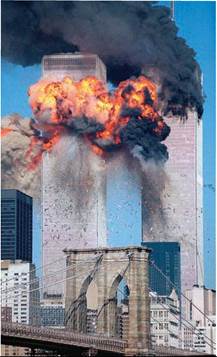
The twin towers of the World Trade Center after being struck by hijacked airplanes on September 11, 2001. Shortly after this photograph was taken, the towers collapsed.
Terrorism—the targeting of civilian populations by violent organizations who hope to spread fear for a political purpose—has a long history, including in the United States. During the Reconstruction era after the Civil War, the Ku Klux Klan and similar groups launched a reign of terror that led to the deaths of thousands of American citizens, most of them newly emancipated slaves. Between the assassination of President William McKinley in 1901 and the Wall Street bombing of 1920, anarchists committed numerous acts of violence. Antigovernment extremist Timothy McVeigh killed 168 persons when he exploded a bomb at a federal office building in Oklahoma City in 1995.
In the last three decades of the twentieth century, terrorist groups who held the United States and other Western countries responsible for the plight of the Palestinians had engaged in hijackings and murders. In October 1985, a group of Palestinians seized control of the Achille Lauro, an Italian cruise ship, and killed an American Jewish passenger. In 1988, a bomb planted by operatives based in Libya destroyed a Pan American flight over Scotland, killing all 259 persons on board. After the Gulf War, Osama bin Laden declared “war” on the United States. Terrorists associated with Al Qaeda exploded a truck-bomb at the World Trade Center in 1993, killing six persons, and set off blasts in 1998 at American embassies in Kenya and Tanzania, in which more than 200 persons, mostly African embassy workers, died. Thus, a rising terrorist threat was visible before September 11. Nonetheless, the attack came as a complete surprise. With the end of the Cold War in 1991, most Americans felt more secure, especially within their own borders, than they had for decades.

A bystander gazes at some of the missing posters with photographs of those who died on September 11.
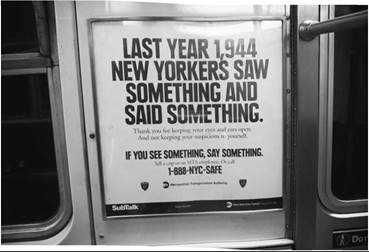
In the years following September 11, 2001, fear remained a prominent feature of American life. Authorities urged Americans to monitor each other’s activities. This sign, widely displayed on subway and railroad cars, advised New Yorkers, “If you see something, say something.” As the sign notes, 1,944 reports of suspicious behavior were made to the police in 2007. These reports included Muslims seen counting in the subway (they turned out to be men counting prayers with the equivalent of rosary beads) and individuals taking pictures of railroad tracks. The 1,944 reports resulted in eighteen arrests. None involved a terrorist plot, though they did include persons selling false driver’s licenses and dealing illegally in fireworks.
September 11 enveloped the country in a cloud of fear. The sense of being under assault was heightened in the following weeks, when unknown persons sent letters to prominent politicians and television journalists, containing spores that cause the deadly disease anthrax. Five individuals—postal workers and others who handled the letters—died. In the months that followed, as the government periodically issued “alerts” concerning possible new attacks, national security remained at the forefront of Americans’ consciousness, and fear of terrorism powerfully affected their daily lives.
In the immediate aftermath of September 11, the Bush administration announced a “war on terrorism.” Over the next two years, the United States embarked on wars in Afghanistan and Iraq, the second with very limited international support. It created a new Department of Homeland Security to coordinate efforts to improve security at home, and it imposed severe limits on the civil liberties of those suspected of a connection with terrorism and, more generally, on immigrants from the Middle East.
The attacks of September 11, 2001, gave new prominence to ideas deeply embedded in the American past—that freedom was the central quality of American life, and that the United States had a mission to spread freedom throughout the world and to fight those it saw as freedom’s enemies. The attacks and events that followed also lent new urgency to questions that had recurred many times in American history: Should the United States act in the world as a republic or an empire? What is the proper balance between liberty and security? Who deserves the full enjoyment of American freedom? None had an easy answer.
Before becoming president, George W. Bush had been an executive in the oil industry and had served as governor of Texas. He had worked to dissociate the Republican Party from the harsh anti-immigrant rhetoric of the mid-1990s and had proven himself an effective proponent of what he called “compassionate conservatism.” Because of his narrow margin of victory in the election of 2000, he came into office without a broad popular mandate. He had received fewer votes than his opponent, Al Gore, and his party commanded only tiny majorities in the House of Representatives and Senate. Nonetheless, from the outset Bush pursued a strongly conservative agenda. In 2001, he persuaded Congress to enact the largest tax cut in American history. With the economy slowing, he promoted the plan as a way of stimulating renewed growth. In keeping with the “supply-side” economic outlook embraced twenty years earlier by Ronald Reagan, most of the tax cuts were directed toward the wealthiest Americans, on the assumption that they would invest the money they saved in taxes in economically productive activities.
Bush also proposed changes in environmental policies, including opening Alaska’s Arctic National Wildlife Refuge to drilling for oil and allowing timber companies to operate in national forests, claiming that this would reduce forest fires. But soon after the passage of the tax bill, Senator Jim Jeffords of Vermont, a moderate Republican, abandoned the party and declared himself an independent. His action gave Democrats a one-vote margin in the Senate and made it difficult for Bush to achieve further legislative victories.