
CHAPTER ONE
Covid-19 is not just a temporary crisis. [It is] a permanent disruptor. Historic global crises like wars, revolutions, pandemics, etc. often feel like they put history on fast-forward. Processes that normally take decades or longer to play out unfold in a couple of weeks. Coronavirus is the political, economic, and psychological event of our lifetimes that will drive disruption and transformation for years to come. It will bring a radical transformation of the kind that occurs only once in a generation.
—Bank of America, internal report, May 20201
The Covid-19 virus that spread around the world in 2020 triggered an economic meltdown and social catastrophe unmatched since the Great Depression of the 1930s. Millions of people became unemployed overnight, went hungry, lost their homes, fell ill, and faced harsh state repression. The extent of the meltdown was simply staggering. More than 90 percent of the world’s countries fell into deep recession in 2020, compared to only 60 percent in the 2008 Great Recession, making it a truly global crisis.2 “Beyond the staggering economic impacts, the pandemic will also have severe and long-lasting socio-economic impacts that may well weaken long-term growth prospects” warned the World Bank several months into the pandemic. There would be no quick recovery, it cautioned, given “the plunge in investment because of elevated uncertainty, the erosion of human capital from the legions of unemployed, and the potential for ruptures of trade and supply linkages.”3 Economies did bounce back from the depths of the implosion, yet it was clear that economic turbulence and political conflict around the world would only escalate as the world emerged from the pandemic.
The contagion was but the spark that ignited the combustibles of a global economy that never fully recovered from the 2008 financial collapse and had been teetering on the brink of renewed crisis ever since. The political agents of global capitalism in states and the corporate media were quick to blame the meltdown on the virus, as stock markets and international commerce went into free fall. The pundits had deluded themselves into believing that all was well, but the underlying structural causes of the 2008 debacle, far from being resolved, had been steadily aggravated. On the eve of the pandemic, growth in the EU countries had already shrunk to zero, much of Latin America and sub-Saharan Africa was in recession, growth rates in Asia were steadily declining, and North America faced a slowdown. The writing was on the wall. With or without Covid-19, as we will see, the world economy has been mired in a structural crisis that is too entrenched to be considered a mere recession or even a depression.
The crisis of global capitalism, however, is more than just economic, or structural. It is also political, one of state legitimacy, even capitalist hegemony. Millions, perhaps billions, of people around the world are questioning a system they no longer see as legitimate. Some have taken a renewed interest in socialism, while others are being mobilized by far-right demagogues into neofascist projects. Capitalist states face spiraling crises of legitimacy after decades of hardship and social decay wrought by neoliberalism, aggravated by these states’ inability to manage the health emergency and the economic collapse. Crises, let us recall, are times of intense social and class conflict. There has been a rapid political polarization in global society since 2008 between an insurgent far right and an insurgent left. The ongoing crisis has animated far-right and neofascist forces that have surged in many countries around the world and that sought to capitalize politically on the health calamity, but it has also roused popular struggles from below, as workers and the poor engaged in a wave of strikes and protests on every continent that shows no signs of letting up. Political systems are cracking, social orders crumbling. We have entered into a period of mounting chaos in the world capitalist system.
The global revolt has been underway for some years now and is escalating as we move into the brave new world of post-pandemic capitalism. Prior to the health emergency, the system was already headed toward what we call an organic crisis: a general crisis of capitalist rule. The Bolshevik leader Vladimir Lenin described the symptoms of such a situation: 1) when there is a crisis in the prevailing system, and it is impossible for the ruling classes to rule in the old way; 2) when the want and suffering of the oppressed classes have grown more acute than usual; 3) when as a consequence the masses increase their historical action. Whether or not we are headed for a revolutionary rupture with capitalism, a worldwide fascist dictatorship, or a collapse of global civilization is a matter I will discuss in chapter three. Here we can note that the health emergency, above all, served to bring into stark relief the profundity of this crisis and the extent of malaise in the global social order. The worst of the contagion eventually passed, but not before taking a heavy toll. But the crisis of global capitalism is here to stay and has become considerably more acute in the wake of the pandemic. Before I launch into a discussion of the pandemic itself we must make a brief analytical and theoretical incursion into the nature of capitalist crises. Let us start with the economic dimension.
OVERACCUMULATION AND CHRONIC STAGNATION
Despite claims to the contrary by neoclassical economists, crisis is endemic to capitalism, and instability rather than equilibrium is the natural state of the system. The history of capitalism is one of periodic crises of two types. One is cyclical, sometimes called the business cycle, and shows up as recessions. They typically occur about every ten years. There were recessions in the early 1980s, the early 1990s, and the early 2000s. The other is more serious, a structural crisis, or what I call a restructuring crisis, because its resolution requires a major restructuring of the system. Cyclical crises may affect only certain countries or regions, whereas structural crises generally affect the entire world economy. In the course of the twentieth century the system experienced two restructuring crises, the Great Depression of the 1930s and the crisis of stagnation and inflation (known as “stagflation”) of the 1970s. Both these crises had their origin in what political economists call overaccumulation. This refers to a situation in which enormous amounts of capital (profits) are built up, but this capital cannot find productive outlets for reinvestment. This capital then becomes stagnant, as capitalists hold on to their accumulated profits rather than reinvesting them, throwing the system into crisis.
Overaccumulation originates in the circuit of capitalist production. In simplified terms, capitalists seek to maximize profit by constantly lowering the overall cost of labor, that is, the wage portion of the costs of production. One way to lower these costs is to lower the absolute amount paid to workers. In recent years, for instance, capitalist globalization has involved the relocation of factories and services to low-wage zones, epitomized by the spread around the world of sweatshops employing super-exploited young women. Another way is to raise productivity, that is, to raise output per worker per unit of time worked, so that fewer workers are needed for the same output. Typically, this has involved the introduction of new technologies that either replace workers entirely or that increase the productivity of each worker. Yet labor is the source of all surplus value, that is, of profits. Internal to the dynamic of capital accumulation is a tendency for the rate of profit to fall, even as the overall volume of profits may increase, because as capitalists compete with one another and strive to control labor and to reduce labor costs, they raise productivity through the ongoing introduction of new labor-saving and productivity-enhancing technologies and organizational forms. Ever less labor is required to produce ever more wealth as output per unit of labor increases. Anticipating what we will explore in the next chapter, new digital technologies that are now at the very core of the global economy have greatly increased productivity and corporate profits, even as the worldwide economic restructuring made possible by these technologies has resulted in an expanding army of the unemployed and the marginalized, or surplus humanity.
Analyzing these tendencies in the nineteenth century, Karl Marx noted that “a fall in the profit rate, and accelerated accumulation, are simply different expressions of the same process, in so far as both express the development of productivity.” He continued: “In view of the fact that the rate at which the total capital is valorized, i.e. the rate of profit, is the spur to capitalist production, a fall in this rate … appears as a threat to the development of the capitalist process; it promotes overproduction, speculation and crises.”4 To reiterate, overaccumulation thus refers to how enormous amounts of capital are accumulated, yet this capital cannot be reinvested profitably and becomes stagnant, or, in Marx’s words, “the capitalist would have won nothing by his own exertions but the obligation to supply more in the same labor time, in a word, more difficult conditions for the augmentation of the value of his capital.”5 In fact, while the absolute volume of transnational corporate profits has snowballed in recent years, the rate of profit has steadily declined. The average rate stood in the brief post–World War II “golden age” of world capitalism at about 15 percent. By the end of the 1980s it had dropped to 10 percent and continued to decline, to 6 percent in 2017.6
Although overaccumulation originates in the sphere of production, it becomes manifest in the sphere of circulation, that is, it shows up in the market as a crisis of overproduction or underconsumption. This refers to a situation in which the economy has produced—or has the capacity to produce—great quantities of wealth (defined as things that people need and want), but the market cannot absorb this wealth, because more and more people have been made surplus as technology advances and productivity increases, and/or because the wages of those that are employed are not sufficient for them to consume all that their labor produces. In other words, capitalism by its very nature will produce abundant wealth yet polarize that wealth and generate ever greater levels of social inequality. Overaccumulation appears first as a glut in the market, and then as stagnation. In fact, in the years leading up to the pandemic there was a steady rise in underutilized capacity and a slowdown in industrial production around the world.7 The surplus of accumulated capital with nowhere to go expanded rapidly. Transnational corporations recorded record profits during the 2010s at the same time that corporate investment declined.8 The total cash held in reserves of the world’s two thousand biggest nonfinancial corporations increased from $6.6 trillion in 2010 to $14.2 trillion in 2020—considerably more than the foreign exchange reserves of the world’s central governments—as the global economy stagnated.9
Well before the pandemic hit in 2020, all the telltale signs of an overaccumulation crisis were present. Before further analysis of this new crisis, let us return to the two early restructuring crises of the twentieth century. In the actual course of capitalist history, ongoing class and social struggles shape and constantly reshape how capitalism develops and how crises play themselves out. Mass popular and working-class struggles spread early in the twentieth century and reached a peak in the 1930s. These struggles forced capitalists into what became known as a “class compromise.” Capitalists and states were forced to back down from the unrestrained free market capitalism of the nineteenth and early twentieth centuries, with its stark inequalities and deprivation of the masses. What some called the “gilded age” and the “age of the robber barons” gave way through the pressure of these mass struggles to a new form of capitalism. This new form involved state intervention in the economy to regulate the market and redistribute wealth downward through social welfare and other state policies.
The new form has been referred to variously as New Deal capitalism, welfare capitalism, social democracy, or, in more technical terms, Fordism-Keynesianism. Regardless of what we name it, this state regulation of the market, redistributive policies, and working-class power acted as what we call “countervailing tendencies” to the tendency toward overaccumulation, that is, they helped offset overaccumulation. State intervention in the capitalist market and a component of redistribution came to define economic policy in the mid–twentieth century in the then First World, as well as in the then Third World in the wake of decolonization. This redistributive nation-state capitalism evolved, therefore, from capital’s accommodation to mass upheavals from below in the wake of the crisis of the two world wars and the Great Depression. Capitalist classes had little choice but to accept these arrangements in the face of mass struggles, including socialist and communist movements, militant trade unionism, and anti-colonial and Third World liberation movements. In any event, capital was able to sustain a high rate of profit for several decades as the world economy experienced an unprecedented boom in the aftermath of World War II and the devastation that it left in its wake.
As world capitalism entered its next structural crisis in the 1970s, capitalists and bureaucratic elites from around the world strove to beat back the power of organized labor, radical social movements, and Third World liberation struggles. These emerging transnationally oriented elites sought to win government during the 1980s and 1990s, typically through elections that took place on the heels of financial turmoil,10 and to utilize state power to open up the world in new ways to transnational capital. In this way, reorganizing the system on a global scale became a strategy to reconstitute the power of capital over the working and popular classes, whose struggles remained at the level of the nation-state. As they went global, these capitalist groups integrated with one another across borders in pursuit of their collective class interests in a process of transnational class formation. A transnational capitalist class (TCC) emerged in this way as the manifest agent of global capitalism, about which much has been written by myself and others in recent years.11 While there is intense competition within its own ranks, the members of this TCC share an interest in promoting global rather than national markets and circuits of accumulation, in competition with local and national capitalist groups and elites whose fate is more closely bound up with their particular nation-states and regions. By the end of the twentieth century, this TCC became the hegemonic fraction of capital on a world scale. It is made up of the owners and managers of the giant transnational corporations (TNCs) and financial institutions that drive the global economy. As the hegemonic fraction of capital, transnational capital increasingly integrates local circuits into its own; it imposes the general direction and character on production worldwide and conditions the social, political, and cultural character of capitalist society worldwide.
The unprecedented concentration of capital at the global level allowed the emerging transnational corporate elite to accumulate an enormous amount of power and control. The TCC and the states whose policies they were able to shape used this power to bring about a vast restructuring of the global economy and society, putting in place a new globally integrated production and financial system, as I will return to in the next chapter.12 In this way, globalization made it possible for this TCC to increasingly break free of nation-state constraints to accumulation, such as the need to assure the reproduction of their own national proletariats, to do away with the model of redistributive nation-state capitalism and to beat back the tide of revolution in the Third World. This should have come as no surprise, as capitalist crises generally provide capitalists and the state with opportunities to restore profitability and push forward accumulation—although we must stress that these crises also open up new opportunities for counterhegemonic projects from below, as I shall discuss in chapter three.
Structural crises like those of the 1930s and the 1970s typically involve the transformation of patterns of capital accumulation and new rounds of expansion, often incorporating new cutting-edge technologies, such as the synthetic materials, consumer durables, automotive and petrochemicals, and military-industrial technologies that drove the post–World War II boom. Early in the twentieth century, the Soviet economist Nikolai Kondratieff noted how the world economy, driven by new cutting-edge technologies, experiences cycles of some forty to fifty years (called Kondratieff waves). In these cycles, rounds of expansion eventually become exhausted and are followed by downturns and crises, resulting in a reorganization of the system and new technologies that help launch a new cycle. However, the underlying causal dynamic that drives these cycles forward is the struggle among contending social and class forces. New Deal and social democratic arrangements, together with world war and the postwar expansion, “resolved” the structural crisis of the 1930s. But the contradictions internal to the model of redistributive nation-state capitalism led to a new structural crisis in the 1970s, as I mentioned above. The emerging TCC “resolved” this next structural crisis through sweeping worldwide economic restructuring made possible above all by new computer and information technologies.
In my view, the Great Recession of 2008 marked a new structural crisis that was not caused but became greatly aggravated by the pandemic. This crisis takes place under circumstances distinct from earlier ones. The economic and social disaster unleashed by the pandemic rivals that of the 1930s Great Depression, but the world capitalist system of today looks different than that of the early twentieth century. People and nations around the world have been linked into a single and constantly expanding world market since capitalism’s inception in that symbolic year of 1492. In the five centuries that it has conquered the world, capitalism has gone through successive phases or epochs in its ongoing and open-ended evolution. Globalization ushered in a new epoch in world capitalism, characterized above all by the rise of a globally integrated production, financial, and service system under the control of the leading capitalist groups from around the world and their political agents in states. Indeed, the meltdown triggered by the pandemic highlighted just how dependent all countries have become on this globally integrated system. The nexus that links together all peoples and nations has dramatically tightened; in fact, it appears inextricable. It is the global networks of trade and travel that account for the rapidity with which the coronavirus spread around the world, as well as why it was so difficult to control through the action of individual states in a piecemeal fashion.13 Now, the structural crises that started in 2008 and has become greatly aggravated by the pandemic is resulting, once again, in a sweeping restructuring and transformation of global capitalism, as we will explore in the next chapter.
Capitalist globalization and neoliberal austerity since the late 1970s pushed the global working and popular classes onto the defensive and shifted the global balance of class forces in favor of transnational capital following the period of mass struggles in the 1960s and 1970s. By liberating emergent transnational capital from national constraints, globalization undermined the redistributive programs that had attenuated capitalism’s inherent tendency toward social polarization and had helped ensure the system’s survival, at least for a while. The result has been an unprecedented sharpening of inequality that has fueled overaccumulation. Social polarization, to reiterate, is not an aberration under capitalism; it is its sine qua non. Marx showed in Capital how social polarization and inequality are inherent to the capitalist system, since capitalists own the means of producing wealth and, therefore, appropriate as profits as much of the wealth that society collectively produces as possible. In fact, the terms pauper (a Latin word meaning in the character of a poor person) and pauperization became popularized in our contemporary vocabulary as eighteenth-century industrial capitalism generated a new type of poverty that involved large groups of people uprooted from their traditional livelihoods and thrown into chronic impoverishment.
The level of global social polarization and inequality now experienced is without precedent. In 2018, the richest 1 percent of humanity controlled more than half of the world’s wealth, while the bottom 80 percent had to make do with just 5 percent.14 Such inequality ends up undermining the stability of the system as the gap grows between what is (or could be) produced and what the market can absorb. The extreme concentration of the planet’s wealth in the hands of the few and the accelerated impoverishment and dispossession of the majority meant that transnational capital had increasing difficulty in finding productive outlets to unload the enormous amounts of surplus it had accumulated. The more global inequalities expand, the more constricted the world market becomes and the more the system faces a structural crisis of overaccumulation. If left unchecked, expanding social polarization results in crisis—in stagnation, recessions, depressions, social upheavals, and war—just what we are experiencing at this time.
As I noted above, the tendency for the rate of profit to fall and for capital to overaccumulate is just that—a tendency that can be offset, temporarily at least, by what are called countervailing tendencies and by mechanisms that may counteract the tendency. Frenzied financial speculation, unsustainable debt, the plunder of public finance, and state-organized militarized accumulation are just some of the mechanisms that the TCC and capitalist states turned to in the years leading up to the pandemic to keep the global economy sputtering along in the face of chronic stagnation. As the productive economy has stagnated, capitalists have turned above all to financial speculation.15 The global economy has become a giant casino for transnational investors. In the wake of the Great Recession of 2008 the US Federal Reserve undertook a whopping $16 trillion in secret bailouts to banks and corporations around the world.16 Then the banks and institutional investors simply recycled the trillions of dollars they received into new speculative activities in global commodities markets, in cryptocurrencies, and in land around the world, fueling a new global “land grab.” As opportunity dried up for speculative investment in one sector, the TCC simply turned to another sector to unload its surplus. As a result, the gap between the productive economy and fictitious capital has grown into an enormous chasm.
Fictitious capital refers to money thrown into circulation without any base in commodities or production.17 A major portion of the income generated by financial speculation is fictitious, meaning (here in simplified form) that it exists on paper but does not correspond to real wealth in the world, that is, goods and services that people need and want, such as food, clothing, houses, and so on. A company may for instance issue shares on the stock market that may be bought and sold by traders, but these shares do not correspond to the actual production of new wealth and typically become one of innumerable sources of financial speculation. Mortgages represent a claim on future rent, government bonds represent a claim on future tax revenue, derivative trading in futures markets represents claims on future values of commodities, and so on. The trade in this fictitious capital represents less the creation of new value or expanded production than the mirage of a bustling economy, as stock markets surge, assets values inflate, and credit expands. The accumulation of fictitious capital through speculation may offset the crisis temporally into the future or spatially to new digital geographies and new population groups but, in the long run, only exacerbates the underlying problem of overaccumulation. In 2018, for example, the gross world product, or the total value of goods and services, stood at some $75 trillion, whereas the global derivatives market—a marker of speculative activity—was estimated at a mind-boggling $1.2 quadrillion.18 This accumulation of fictitious capital gave the appearance of recovery in the years following Great Recession of 2008, but it only offset the crisis temporally into the future, while in the long run exacerbating the underlying problem.
In addition to speculation, mounting government, corporate, and consumer debt drove growth in the first two decades of the twenty-first century. Consumer credit has served the dual purpose of class pacification, as workers and the poor are able to cover essential necessities for the moment, even as they become ever more indebted, and of generating demand, even as real incomes have dropped for the immiserated majority subject to austerity and ever more precarious forms of employment. In countries around the world, consumer debt was higher on the eve of the pandemic than it has been for all of postwar history. State and corporate debt also reached breaking points. The global bond market—an indicator of total government debt worldwide—more than doubled between 2003 and 2019, when it surpassed $105 trillion, while total global debt reached a staggering $258 trillion in 2020.19 Particularly troubling is the growth of debt in the former Third World. The total debt for the thirty largest countries in the former Third World surpassed $72 trillion in 2019, a 168 percent rise over the previous decade. Worldwide corporate debt has soared to $75 trillion, up from $32 trillion in 2005, while, by 2018, corporations had issued $13 trillion in bonds, more than twice the bond debt on the eve of the 2008 collapse.20
Debt levels have soared through policies known as “quantitative easing,” which essentially means that government treasuries print money and inject it into the banking system as cheap credit—even involving negative interest rates—in what some have referred to as “crack cocaine for financial markets.” Quantitative easing ends up creating mountains of debt that sooner or later must collapse. A major default on consumer, state, or corporate debt—or waves of defaults—would set off a further chain reaction in the downward plunge of the global economy. The following table on the steep rise of fiat money—which refers to government-issued currency that is not backed by a commodity—shows the explosive growth of the money supply through quantitative easing that has aggravated the gap between fictitious capital and the real economy since 2008. Apart from the prospect of collapse itself, the out-of-control printing of money may in the long run trigger uncontrolled inflation that would further destabilize the global economy.
The TCC has also set out to raid and sack public finance, which has been reconfigured through austerity programs, bailouts, corporate subsidies, government debt, and the global bond market, as governments transfer wealth directly and indirectly from working people to the TCC. The global bond market itself serves as a vehicle to transfer wealth from the working classes to capital. Governments issue bonds to investors to close government budget deficits and also to subsidize private accumulation, so as to keep the economy going. They then have to pay back these bonds (with interest) by extracting taxes from current and future wages of the working classes. Already by the late twentieth century state income brought in by bonds often went right back to creditors. Thus, the reconfiguration of state finances amounts over time to a transfer of wealth from global labor to transnational capital: a claim by transnational capital on future wages, and a shift in the burden of the crisis to the working and popular classes. Yet financial pillage cannot resolve the crisis of overaccumulation and ends up aggravating it in the long run, as the transfer of wealth from workers to the TCC further constricts the market.
Fiat Money Quantity (FMQ) $bn
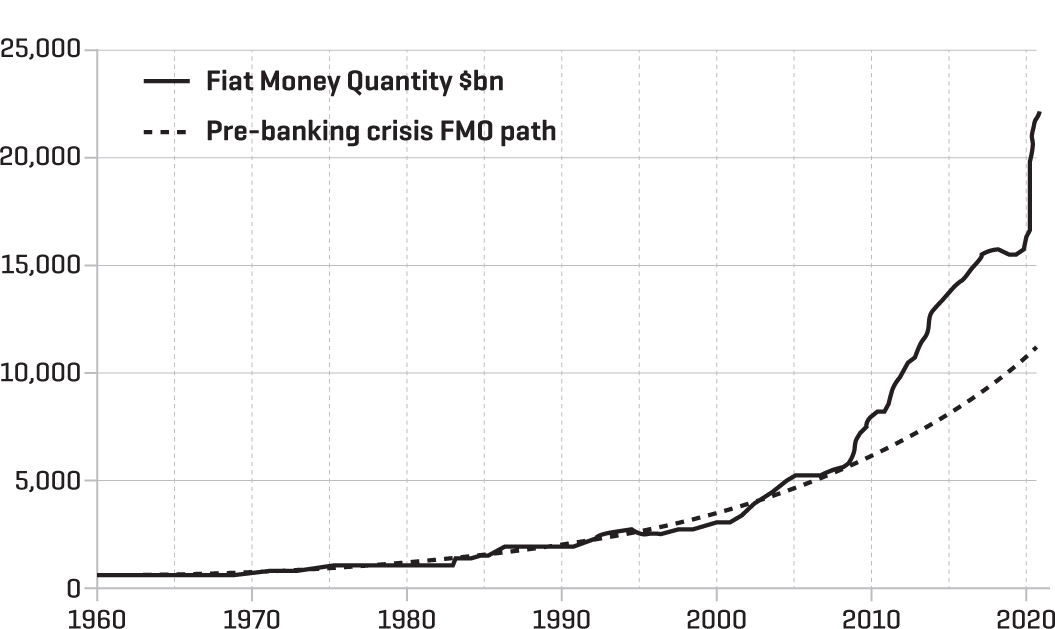
Source: St Louis Fed database (Fred), Goldmoney
The ruling groups must not only figure out how to keep accumulating capital in the face of stagnation. They must also maintain control by keeping a lid on rebellion. As protest spreads around the world, they have turned to expanding the global police state, particularly in the aftermath of the pandemic, as the structural crisis becomes aggravated and as there is a further breakdown of capitalist hegemony. Global police state refers in the first instance to systems of transnational social control and repression to contain the oppressed. Savage global inequalities are politically explosive, and to the extent that the system is simply unable to reverse them or to incorporate surplus humanity it turns to ever more violent forms of containment to manage immiserated populations. As popular discontent has spread in recent years, the dominant groups have expanded transnational systems of social control, repression, and warfare—from mass incarceration to deadly new modalities of policing and omnipresent systems of state and private surveillance—to contain the actual and the potential rebellion of the global working class and surplus humanity.
Apart from political considerations, as I showed in my 2020 study The Global Police State, the global economy is becoming ever more dependent on the development and deployment of these systems of warfare, social control, and repression simply as a means of making profit and continuing to accumulate capital in the face of stagnation. This is what I refer to as militarized accumulation or accumulation by repression. The so-called wars on drugs and terrorism, the undeclared wars on immigrants, refugees, and gangs (and poor, dark-skinned, and working-class youth more generally), the construction of border walls, immigrant detention centers, prison-industrial complexes, systems of mass surveillance, and the spread of private security guard and mercenary companies have all become major sources of profit-making, and they will become more important to the system as stagnation becomes the new normal.
The events of September 11, 2001, marked the start of an era of a permanent global war in which logistics, warfare, intelligence, repression, surveillance, and even military personnel are more and more the privatized domain of transnational capital. The Pentagon budget increased 91 percent in real terms between 1998 and 2011, while, worldwide, total defense outlays grew by 50 percent from 2006 to 2015, from $1.4 trillion to $2.03 trillion, although this figure does not take into account hundreds of billions of dollars in “homeland security” spending. In the decade from 2001 to 2011, military industry profits nearly quadrupled.21 Led by the United States as the predominant world power, military expansion in different countries has taken place through parallel, and often conflictive, processes, yet all show the same relationship between state militarization and global capital accumulation. Worldwide, official state military outlays in 2015 represented about 3 percent of the gross world product of $75 trillion.
Militarized accumulation involves vastly more than activities generated by state military budgets. There are immense sums involved in state spending and private corporate accumulation through militarization and other forms of generating profit through repressive social control that do not involve militarization per se. The various wars, conflicts, and campaigns of social control and repression around the world involve the fusion of private accumulation with state militarization. In this relationship, the state facilitates the expansion of opportunities for private capital to accumulate through militarization, such as by facilitating global weapons sales by military-industrial-security firms, the amounts of which have reached unprecedented levels. Global weapons sales by the top one hundred weapons manufacturers and military service companies increased by 38 percent between 2002 and 2016.22
By 2018, private military companies employed some fifteen million people around the world, deploying forces to guard corporate property, providing personal security for TCC executives and their families, collecting data, conducting police, paramilitary, counterinsurgency, and surveillance operations, carrying out mass crowd control and repression of protesters, managing prisons, running private detention and interrogation facilities, and participating in outright warfare.23 The private security (policing) business is one of the fastest growing economic sectors in many countries and has come to dwarf public security around the world. The amount spent on private security in 2003, the year of the invasion of Iraq, was 73 percent higher than that spent in the public sphere, and three times as many persons were employed in private forces as in official law enforcement agencies. There were an outstanding twenty million private security workers worldwide in 2017, and the industry was expected to be worth over $220 billion by 2020. In half of the world’s countries, private security agents outnumber police officers.24
In the end, financial speculation, pillaging the state, and debt-driven growth are all temporary “fixes” that cannot address the underlying structural conditions that have thrown the world economy into crisis. The massive concentrations of transnational finance capital destabilized the system as global capitalism ran up against the limits of these fixes. The expansion of a global war economy may pick up some of the slack, but it has its limits and is not in the long run a viable solution. Moreover, such an economy generates and is generated by acute political and military conflict that destabilizes the system. The global economy was a ticking time bomb. All that was needed was something to light the fuse. That came in the form of the Covid-19 pandemic.
…AND THEN THE PANDEMIC
The origins of Covid-19 remain in dispute. The evidence that the virus displays “gain of function” (GOF) properties is considerable. It is feasible that it was developed in a biolab and accidentally leaked out. (For that matter, the development of the virus as an agent of biological warfare cannot be ruled out. The United States, Israel, China, and Russia are some of the countries known to have bioweapon research programs, and the Pentagon alone operates biowarfare laboratories in twenty-five countries around the world).25 Given the contemporary proliferation of unfounded conspiracy theories, we must stress that the possibility the virus was developed in a laboratory in no way implies that it would have been intentionally leaked or that there was a larger plot to cause a pandemic. Rather, the forensics of the virus, as well as the social and political response to the outbreak, must be subject to critical analysis given the likelihood of new and deadlier pandemics in the future.
Among those who identified the virus’s GOF properties and argued that it was created in a laboratory was the 2008 Nobel laureate for Medicine Luc Montagnier, a French virologist who first discovered the HIV virus.26 GOF research attempts to combat potentially deadly microbes proactively by first creating them artificially in a laboratory in order to develop a vaccine against them, in a process known as “biosynthesis” (see next chapter). In 2011, the Erasmus Medical Center in Rotterdam announced at a European scientific conference that it had found a way to turn H5N1, a coronavirus that almost exclusively infected birds, into a possible human-to-human flu. Researcher Ron Fouchier told the gathered scientists that the Dutch research team, with funding from the US National Institute of Health, had “mutated the hell out of H5N1,” turning the bird flu into a variant that could infect ferrets, a laboratory stand-in for human beings.27
The claims that Covid-19 originated in a biolab, possibly even at the US Army’s Medical Research Institute of Infectious Diseases at Fort Detrick in Maryland,28 cannot be dismissed as “conspiracy theory,” because there is enough credible evidence to make that plausible. A conspiracy is a plot by two or more actors to undertake some action toward an intended outcome. Conspiracies, therefore, take place routinely as part of the natural course of human affairs. Theories about conspiracies should be dismissed when they are not backed by verifiable evidence; well-documented conspiracies cease to be theories. “Regimes of truth,” as French philosopher Michel Foucault put it, distinguish between acceptable and unacceptable ideas. They set the boundaries of acceptable discourse as established by power dynamics.29
There are plenty of wild and baseless conspiracy theories circulating among the public, often associated with the far right, such as the claim that Jews or the Illuminati are plotting to take over the world.30 Notwithstanding, the pejorative charge of “conspiracy theory” is all too readily evoked by those in position of power to dismiss arguments that may be threatening to their interests or contrary to acceptable narratives. It is remarkable given the widely available evidence that should lead journalists and researchers to at the very least retain skepticism regarding the official narrative on the origin of the novel Covid-19 coronavirus that the New York Times, among others, simply dismissed any but this official narrative as “unfounded conspiracy theory.”31 As part of our training, scientists—social as much as natural—learn that we cannot ignore empirical evidence simply because by not ignoring it we are subject to reprobation by the powers that be, or because our funders cut off support if that evidence contravenes official accounts.
Here is what we do know. Biosafety Level 3 and 4 laboratories have proliferated around the world in recent years, and their research includes developing new strains of microbes, including viruses, along with vaccines to immunize people from them. Prior to the Covid-19 outbreak, the global vaccine market was valued at over $40 billion and projected to increase to nearly $60 billion by 2024.32 The US government’s Defense Advanced Research Projects Agency (DARPA) had been researching coronaviruses and bats prior to the Covid-19 outbreak. Once the pandemic hit, it set out to develop a vaccine for the virus in collaboration with leading pharmaceutical companies, and with the participation of the World Health Organization, the Bill and Melinda Gates Foundation (one of the largest benefactors of the WHO), the World Economic Forum, and several other governments.33 As with other United Nations agencies, the WHO used to be funded principally by states, but as rich states have cut funding to the WHO and other agencies, transnational corporations and the philanthropies (“philanthro-capitalists”) they endow have become major funders (in 2020, about 70 percent of the WHO’s budget came from private donations). Thus, the TCC can bypass the mediation of states and directly shape the WHO’s policies.
In shaping global health policies through the WHO and private channels, the TCC has sought to privatize public health systems and to open up new opportunities for accumulation by the medical and pharmaceutical industry. This effort includes the creation of global markets for vaccines and other drugs developed by pharmaceutical corporations. As has been well documented, the Bill and Melinda Gates Foundation has been at the forefront of these efforts. Dutch international relations scholar Kees van der Pijl noted in a 2020 paper that “health has been a key concern of the $52 billion Gates Foundation (and of the Rockefeller Foundation for that matter) and Bill Gates has pursued his private views on a grand scale as a result.” As part of its campaign to privatize and commodify health and educational systems around the world, in the years prior to the pandemic the Gates Foundation funded a series of vaccine programs, some of them highly controversial, in collaboration with leading global pharmaceutical corporations, and has pushed for mandatory vaccination laws, with the goal of expanding global markets for the industry.34 “[If] we could stimulate the pharmaceutical companies through public private partnerships to create vaccines,” explained Melinda Gates in 2012, “if we could guarantee them a market of millions of children getting this vaccine and then being paid for it in the developing world. If we could commit to a market and we knew that the demand would be there, we could incent them with the right research dollars to actually create those vaccines.”35 Once the coronavirus pandemic hit, the foundation enlisted these corporations, rather than public laboratories and health systems, to develop a vaccine, assuring that the response to the pandemic would be driven by the pursuit of private profit.36 Among the beneficiaries of the foundation’s multibillion-dollar tax-deductible donations to private companies were leading pharmaceutical corporations and the private hospital industry that stood to cash in on the sale of billions of test kits, therapeutic treatments, and vaccines, with the foundation owning stocks and bonds in these corporations.37
As we shall explore in the next chapter, the pharmaceutical industry has not been the only one to benefit from the pandemic. Governments around the world reached out to tech platforms for help with enforcing quarantines and public gathering restrictions. In the United States, Facebook and Google met with Trump administration officials to discuss drafting the phone data of US residents into a system of heightened surveillance in the name of fighting the virus, while Amazon unveiled a program to deliver test kits and test Seattle area residents in partnership with the Bill and Melinda Gates Foundation.38 Shortly after the pandemic hit, Gates suggested issuing universal “digital certificates” for each member of the public attesting to the bearer’s coronavirus and vaccine status.39 Mass vaccination against coronavirus may well have been necessary from a public health perspective, although the matter was not without controversy. The point here is that the pandemic presented the global pharmaceutical industry with a potential windfall. Once the virus spread, developing a vaccine became an imperative from the viewpoint of public health. A global race to develop a vaccine pit open sourcing against corporate control through patent monopoly. With the stakes so high, Amnesty International warned against global vaccine apartheid, urging that “Big Pharma profits must not be prioritized over the health of billions”40
Hence, to reiterate, the way that the pandemic was exploited for other purposes became far more important than the forensics of the event itself.41 Rather than a plan hatched beforehand to achieve the desired outcome, powerful political and corporate actors seized upon the pandemic to advance an agenda, elements of which had been gestating and others improvised later. “Once the health emergency opportunity presented itself, the pharmaceutical industry was obviously first in line to defend, not just a capitalist response, but also a specific medication-oriented approach to health,” observed van der Pijl. He noted that Bill Gates and the World Health Organization that he finances had long called for pandemic preparedness. “The dress rehearsals more than the actual Covid-19 crisis determined the response, to which the other IT giants, high finance, and the intelligence/surveillance world added their weight.” He further observed, “A paralyzed society will not resist the shock-like acceleration of the concentration of capital in fewer hands either.”42
It is well-documented that at least a decade ahead of the outbreak, scenarios for such a pandemic were rehearsed. A 2010 report by the Rockefeller Foundation described a “Lockstep Scenario” that would start with a coronavirus pandemic. In this scenario, the pandemic would result in “a world of tighter top-down government control and more authoritarian leadership, with limited innovation and growing citizen pushback.” The conclusion reached by some that the report proves the pandemic was planned is entirely unsubstantiated and unwarranted—claims to that extent end up undermining legitimate critique of how capitalist states launched particular strategies for dealing with the pandemic compatible with the interests of the TCC. Of concern to us here, the uncanny report envisioned that the scenario would drive a dramatic expansion of state control and digitally driven technologies:
China’s government was not the only one that took extreme measures to protect its citizens from risk and exposure. During the pandemic, national leaders around the world flexed their authority and imposed airtight rules and restrictions, from the mandatory wearing of face masks to body-temperature checks at the entries to communal spaces like train stations and supermarkets. Even after the pandemic faded, this more authoritarian control and oversight of citizens and their activities stuck and even intensified. In order to protect themselves from the spread of increasingly global problems—from pandemics and transnational terrorism to environmental crises and rising poverty— leaders around the world took a firmer grip on power.43
Then on the eve of the pandemic, the World Economic Forum, the Johns Hopkins University Center for Health Security, and Gates Foundation held a symposium in New York, “Event-201—A Global Pandemic Exercise,” as a large-scale simulation. Dubbed a “germ-game,” based on a fictional scenario in which a coronavirus that jumped from pigs to humans spread around the world, the exercise laid out a plan for corporate domination of any response to a potential pandemic, including the suppression of any narratives that might contradict official ones. Presaging what would actually take place during the pandemic, the exercise recommended that “governments, international organizations, and businesses” should plan for “how essential corporate capabilities will be utilized during a large-scale pandemic.” It recommended that governments partner with private media corporations to develop “the ability to flood media with fast, accurate, and consistent information … trusted, influential private-sector employers should create the capacity to readily and reliably augment public messaging, manage rumors and misinformation, and amplify credible information to support emergency public communications … media companies should commit to ensuring that authoritative messages are prioritized and that false messages are suppressed including through the use of technology.”44
As I stated above, I am not in a position to review and evaluate the mass of contending accounts and their merits with regard to verifiable evidence. What concerns us here is that whether an accidental release from a biolab or simply a transmission from bats to humans in a Chinese wet market the effects are the same: a global health emergency that facilitated a massive transfer of wealth to the rich and allowed the ruling classes to impose a state of exception, enhance surveillance and control through the global police state, and accelerate the restructuring of global capitalism through a new wave of digital technologies. As we shall see in the next chapter, the pandemic was a boon to the leading sectors of capital worldwide, led by the tech sector, interwoven as it is with finance, pharmaceuticals, and the military-industrial complex. Powerful political actors seized on the health emergency to manipulate fear of contagion, in the words of researcher Piers Robinson, “fully aware that these conditions of fear and panic provide a critical opportunity that can be exploited in order to pursue political, economic, and societal objectives.”45 Robinson, van der Pijl, and others were quick to note parallels between the aftermath of the September 11, 2001, attacks on the World Trade Center and the Pentagon and the state of exception imposed around the world as the coronavirus spread. As with September 2001, the emergency mobilization, perhaps necessary from a public health point of view, provided the conditions for a new wave of control by the corporate and political agents of global capitalism.
THE VIRAL PANDEMIC AND THE PANDEMIC OF CAPITALISM
The coronavirus may not have been caused—directly—by global capitalism, but it did pull back the veil of a global capitalist system that had been wreaking calamity on the poor majority of humanity long before the outbreak began. The pandemic left in its wake more inequality, more political tension, more militarism, and more authoritarianism—or, rather, there were more of these things through the pandemic. Capitalist states around the world, unable to cope with the pandemic and the fallout from the socioeconomic implosion it triggered, were exposed as callous instruments of wealth and corruption, aggravating many times over the political dimension of global capitalist crisis, that of state legitimacy and capitalist hegemony. Just as with everything else that occurs in society, the pandemic did not unfold on its own terms but in the context of capitalist society, driven above all by the implacable logic of accumulation and on the terrain of all the existing relations of power, inequality, and oppression. The pandemic, therefore, was not solely a biomedical phenomenon. It was as much social as economic, political, and environmental. Its impacts were integral to ongoing processes of domination and resistance, and, as we shall see in the next chapter, these impacts also accelerated a new wave of restructuring and transformation of global capitalism.
The class character of the health emergency could not have been clearer. The virus did not care about the class, ethnicity, or nationality of the human hosts it sought to infect, but it was the poor and working classes who were unable to protect themselves from contagion, and whose conditions put them at much greater risk. As is known, those with poor health to begin with or with preexisting medical conditions were most susceptible to falling ill, and, if ill, to dying from the virus. Those with poor health and preexisting risk factors were the most likely to have inadequate access to health care, to live in congested circumstances and in substandard housing, to have inadequate access to nutritious food, and to work in jobs that are hazardous and in areas with elevated exposure to environmental toxins. In the teeming slums of the world’s megacities, social distancing was a privilege that was out of reach. Millions became ill, and many died, not so much from the viral infection as from the lack of access to life-sustaining services and resources.46
International agencies warned early in the pandemic of the devastating impact it would have on the world’s poor majority. Even before the pandemic hit, the number of those experiencing hunger and food insecurity was rising. In 2019, some 1.5 billion people suffered from hunger and severe levels of food insecurity, another 500 million did not have access to nutritious and sufficient food.47 An April 2020 report by the international development agency Oxfam warned that the pandemic would push an additional half a billion people into poverty and threatened to set poor regions such as sub-Saharan Africa and the Middle East back thirty years in terms of their development. “Existing inequalities dictate the economic impact of this crisis,” said the report. “The poorest workers in rich and poor nations are less likely to be in formal employment, enjoy labor protections such as sick pay, or be able to work from home.” It went on to note that women, who make up 70 percent of health workers globally and provide 75 percent of unpaid care of children, the sick, and the elderly, were at the front line of the coronavirus response and were the hardest hit financially.48
The momentary lull in the global economy in the opening months of the pandemic brought respite to heavily polluted cities and waterways. In the canals of Venice, water became crystal clear, and fish could be seen for the first time in memory. Almost surreal scenes spread around the world of deer and other wildlife roaming deserted city streets during lockdowns. Air pollution that normally chokes millions seemed to magically disappear for a few fleeting months. These changes gave us a glimpse of what a radical transformation of the global political economy could achieve for the environment. Yet the respite in pollution was short-lived. Within months, it became clear that the climate emergency was on track to intensify even in the midst of the pandemic. The fall 2020 hurricane season in the Caribbean and the Pacific, the most severe on record, wreaked devastation on Central America. Months earlier, California was wracked by unprecedented wildfires that raged uncontrolled. A record heat wave in Siberia marked a dramatic acceleration of permafrost loss and left millions of people on unstable ground. The European Environmental Agency warned that the increased use of single-use plastics and the sharp rise in the generation of household waste brought about by the pandemic posed a significant environmental risk that would continue into the future as the spread of viral and bacterial infections increased and as new pandemics loomed.49
In the larger picture, the pandemic itself was an outcome of the environmental crisis, which in turn is driven by global capitalism, with its implacable logic of accumulation. Scientists and epidemiologists had been warning of a pandemic for at least a decade before the Covid19 outbreak.50 Human and livestock encroachment on animal habitats, deforestation, the extension of farming driven by the expansion of transnational agribusiness, logging, mining, and factory farms, and the resulting urbanization, climate change, and pollution, bring society into increasing proximity with formerly isolated ecosystems and create multiple bridges for microbes to leap from wild animals to humans, either directly or through animals confined to factory farms.51 Sixty percent of human infectious diseases are of animal origin and three-fourths of new diseases are transmitted from animals, including viruses responsible for significant global mortality, such as the HIV-1 and HIV-2 viruses, the Rift Valley fever virus, and influenza viruses, such as bird flus and swine flus.52 In fact, over the past fifty years zoonotic diseases—that is, those that spread from animals to humans—have quadrupled.53 Rising global temperatures favor the development and spread of infectious diseases. They also extend the scope of transmission of diseases to new zones. As regions previously too cold for malaria heat up, for instance, they will become susceptible to the mosquito-borne disease. As permafrost in arctic and subarctic regions melts, there is concern over the release of bacteria and viruses that have so far remained frozen, and for which humans would have little immune resistance.
Capital wasted no time in endeavoring to shift the burden of the crisis and the sacrifice that the pandemic imposed onto the working and popular classes. The ruling classes set out to push policies to exploit every aspect of the pandemic for private profit. “Never let a crisis go to waste” was how US president Barack Obama’s chief of staff Rahm Emanuel famously put it during the 2008 financial collapse. For this purpose, it could count on capitalist state power. Many governments turned to massive new bailouts of capital with only very modest relief, if any at all, for the working classes. The US government injected an initial $1.5 trillion into Wall Street banks, with the White House promising that its response to the pandemic is “centered fully on unleashing the power of the private sector,”54 meaning that capitalist profit would come first and would shape the response to the emergency. It then passed several other multitrillion-dollar stimulus packages, the single biggest component of which was a giveaway to corporations along with smaller amounts for relief to the unemployed and poor families (early on in the pandemic, the US Federal Reserve was buying $1 million in financial assets every second).55
In Europe, the EU and member governments approved similar stimulus packages,56 as did the Chinese government.57 The US and EU governments provided an astonishing eight-trillion-dollar handout to private corporations in the first two months of the pandemic alone, an amount roughly equivalent to their profits over the preceding two years.58 Most governments around the world approved packages that involved the same combination of fiscal stimulus, corporate bailout, and modest public relief, if any.59 One report showed that 2.7 billion people around the world received no government support whatsoever to cope with the pandemic.60 Even if deficit spending and Keynesian stimulus were to remain in place for the duration of a depression, the experience of 2008 showed that governments recovered the costs of bailouts by deepening social austerity, even as banks and corporations used bailout money to buy back stock and engage in new rounds of predatory activities.
As savage as global inequalities already were, the wealth gap widened rapidly around the world during the pandemic. Assisted by corporate bailouts, in the United States, the ultra-wealthy increased their wealth by $931 billion from March to October 2020, even as sixty million workers lost their jobs, and as poverty, hunger, and homelessness spread.61 Worldwide, billionaires’ wealth jumped by 27 percent, to $10.2 trillion in just four months of the pandemic, from April to June 2020, according to a report by the Swiss bank UBS, which also warned against the threat of a global uprising by the poor against the superrich.62 The pockets of the rich were also lined through pandemic price gouging, reflecting a gangster capitalism based ever more on fraud, racketeering, and crime in high places.63 In the midst of the pandemic, the US-based news service BuzzFeed published an exposé on widespread criminal operations at the highest level at Deutsche Bank, one of the largest banks in the world.64 In the United States, private hospitals, owned for the most part by corporate hospital systems, jacked up charges to patients by as much as eighteen times above costs. These corporate hospitals, according to one study, charged from $1,129 to $1,808 for every $100 of their costs, as the industry’s profits approached an annual rate of $100 billion.65
As the rich got richer, there were no mass bailouts for the billions of poor precarious and informal sector workers, whose daily struggles for survival suddenly became a near unsurmountable challenge. The International Labour Organization (ILO) predicted in mid-March 2020 that 25 million people worldwide would lose their jobs as a result of the virus.66 One month later, the ILO warned that nearly half the global workforce was at risk, including 305 million workers with full-time jobs, and 1.6 billion workers in the informal sector. The agency estimated that as a result of economic closures and lockdowns informal sector workers globally faced a drop of 60 percent of income; 81 percent in Africa and the Americas, 21.6 percent in Asia and the Pacific, and 70 percent in Europe and Central Asia.67 In Latin America, 34 million people lost their jobs due to the pandemic, according to the ILO, or some 20 percent of the region’s workforce—a rate nearly double the 12 percent job loss worldwide.68 But as the pandemic stretched into 2021, the ILO had to continuously up its estimates of the number of people thrown into unemployment. In January of that year, it reported that 255 million workers worldwide had lost their jobs.69 As I will discuss in the next chapter, some of those made unemployed may be absorbed back into the workforce, but under new post-pandemic work conditions involving much greater discipline, alienation, and exploitation.
As elsewhere around the world, however, official job loss tells only a small portion of the story, given that some two billion people labor in the informal sector, meaning that they are not among those formally employed (this held true also for those tens, or perhaps hundreds, of millions in the rich countries who are considered “self-employed” and outsourced contract workers, even though they work for transnational corporate employers, such as Uber drivers and grocery deliverers). Some one billion children worldwide were affected by school closures. Hundreds of millions of transnational migrants and refugees faced the virus with no access to any health infrastructure. Prisoners in overcrowded jails the world over, the homeless, and those in war zones were sitting ducks for the virus. The story of the contagion was a story of the shocking disparities in the degree of risk to which different social classes and groups were exposed—risk that became overlaid onto already unprecedented levels of global inequality going into the pandemic. As the worst of the pandemic passed and economic malaise set in, the TCC strived to take advantage of long-term mass unemployment and job insecurity to attempt to enhance its class power over labor through further discipline and austerity.
The global working class experienced the pandemic through four structural locations. First were hundreds of millions who shifted to telework, involving a very significant change in the nature of the labor process, as I will discuss in the next chapter. Second were “essential workers,” frontline workers who were forced to continue working or felt the need to do so out of economic desperation—health care, warehouse and delivery, agriculture, meatpacking, food processing, and so on. The pandemic had a particularly devastating impact on these informal-sector and low-wage workers in essential industries and services. (In the United States, for instance, residents earning less than $20,000 annually were twice as likely to have lost their job as someone earning over $80,000 a year).70 Workers deemed essential were often forced into dangerous work arrangements, such as health care workers, who had to labor with insufficient personal protective equipment. Third were those workers who lost their jobs (or were unemployed to begin with) and faced uncertain prospects of recovering employment post-pandemic. And forth were the mass of informal sector workers—two billion worldwide.
The crisis provided agents of the TCC in capitalist states and supranational organizations—what I have referred to as transnational state (TNS) apparatuses71—with a lever to force indebted countries in the former Third World into a new round of neoliberal reform. “Countries will need to implement structural reforms to help shorten the time to recovery,” declared World Bank president David Malpass at a virtual meeting of the G20 finance ministers held in the midst of the pandemic. “For those countries that have excessive regulations, subsidies, licensing regimes, trade protection, or litigiousness as obstacles, we will work with them to foster markets, choice, and faster growth prospects during recovery,” that is, to push to further liberate transnational capital from any state or popular class constraint.72 The International Monetary Fund (IMF) launched a Covid-19 Financial Assistance and Debt Relief initiative, making available $1 trillion in new loans and temporarily suspending servicing of the debt owed to multilateral agencies.73 The initiative, however, did not involve any debt forgiveness or suspend the accrual of interest, so that countries emerged from the pandemic more heavily indebted than going into it—this at a time when many countries experienced a sharp drop in foreign exchange receipts as commodity prices sunk, remittances from workers abroad sent home declined, and the world tourist industry nearly collapsed.
THE PANDEMIC AND THE GLOBAL POLICE STATE
Governments around the world centralized the response to the pandemic and many declared states of emergencies: in effect, imposing what some called “medical martial law.” Such centralized coordination may have been justified as necessary to confront the health crisis, but centralization of emergency powers in authoritarian capitalist states was used to deploy police and military forces to contain discontent, heighten surveillance, and impose repressive social control—that is, to push forward the global police state. By May 2020, at least four billion people were under government lockdowns, more than the number of people in the world who have access to internet broadband, social media, or indoor safe toilet sanitation.74
As the world emerged from the contagion, states used what van der Pijl referred to as a “bio-political emergency” to further normalize and institutionalize state surveillance and repressive control in a way reminiscent of the aftermath of the 2001 attacks. In the wake of those attacks, 140 countries passed draconian “anti-terrorist” security legislation that often made legal the repression of social movements and political dissent. The laws remained in place long after the 2001 events. “The counterterror laws enacted around the globe represent a dangerous expansion of powers to detain and prosecute people, including peaceful political opponents,” warned a 2012 report by Human Rights Watch. “The elements that raise grave human rights concerns include overly broad and vague definitions of terrorism—such as ‘disrupting the public order’—as well as sweeping powers for warrantless search and arrest, the use of secret evidence, and immunity for police who abuse the laws.”75 As countries around the world raced to contain the pandemic, “many are deploying digital surveillance tools as a means to exert social control, even turning security agency technologies on their own civilians,” noted one New York Times article, recalling the experience of 2001. Ratcheting up surveillance during an emergency “could permanently open the doors to more invasive forms of snooping later,” the newspaper warned. “Law enforcement agencies have access to higher-powered surveillance systems, like fine-grained location tracking and facial recognition—technologies that may be repurposed to further political agendas like anti-immigration policies.”76
In country after country, emergency powers were used to selectively ban protests on the grounds that they spread the virus, harass dissidents, censor journalists, and scapegoat minority groups. At least 158 governments imposed restrictions on demonstrations. At the very start of the pandemic in Wuhan, Chinese officials silenced doctors who first raised the alarm. In Egypt, at least twelve doctors were thrown in jail for criticizing the government response to the contagion. Many governments criminalized “fake news,” which often meant reports that criticized the ruling groups. The Nicaraguan government criminalized any news reporting, pandemic or otherwise, that it deemed to “cause alarm, fear, or anxiety.” In Zimbabwe, anyone who published or disseminated “false information” about an official or that the government deemed to impede its response to the pandemic was threatened with jail terms of up to twenty years. Bulgarian authorities imposed a harsher lockdown on Romany neighborhoods than on others. The Malaysian government blamed migrant workers for the virus, while a UN rapporteur charged the Myanmar/Burmese government with stepping up its repression of the Rohingyas and other ethnic minorities.77 The Russian government demanded that the media stop publishing information on the virus that it declared to be false. The governments of Turkey, Montenegro, and Serbia carried out arrests and fined people who published information on social media that “provokes panic and jeopardizes public security.”78
Throughout Europe, thousands of soldiers were deployed to quarantined cities to patrol streets and enforce lockdowns. Even the conservative weekly the Economist felt obliged to warn that “armed forces are designed first and foremost for killing people, rather than issuing fines on street corners or delivering food to supermarkets.”79 In Hungary, the far-right authoritarian prime minister Viktor Orban sought an open-ended state of emergency that would give him powers to bypass parliament and rule by decree.80 One early April 2020 headline banner by the influential publication Foreign Policy declared, “Coronavirus and the Dawn of Post-Democratic Europe.”81 In Great Britain, a coronavirus bill was rushed through parliament that authorized the government to detain and isolate people indefinitely, to ban public gatherings, including protests, and to shut down ports and airports with little oversight.82
In the United States the national guard was activated in all fifty states (this happened before the anti-racist uprising in the wake of the May 2020 police murder of George Floyd), and the US Department of Justice secretly asked Congress to suspend constitutional rights during the health crisis, including the suspension of habeas corpus.83 A law passed in New York State gave Governor Mario Cuomo unlimited authority to rule by executive order and overrule existing regulations during state crises like pandemics and hurricanes.84 Several states enacted laws to criminalize protest against fossil fuels by designating them as “critical infrastructure.”85 The State of Oregon, among others, imposed a penalty of jail or a $1,200 fine or both for those who broke quarantine. President Donald Trump did not invoke the Defense Production Act, which authorizes the president to expedite and expand the supply of materials and services from the US industrial base in response to national defense and other emergencies, to manufacture personal protective equipment (PPE), which remained in critically short supply throughout most of 2020. Instead, he invoked the act to declare that meatpacking workers, many of whom were particularly vulnerable immigrants, were “essential,” and to order them back to work under hazardous conditions. After workers were forced back to work at a Tyson Foods meat processing plant in April in the US state of Iowa, company supervisors and managers placed bets among themselves on how many employees would catch the virus. Within a month, one thousand workers had contracted the virus, and at least six of them died from complications.86
From Russia to Singapore to South Korea governments around the world stepped up surveillance of their populations as the virus became a testbed for surveillance capitalism. The Italian, German, Chinese, and Austrian governments, among others, put systems in place in coordination with the giant tech corporations as the disease spread to analyze smartphone data so as to determine to what extent populations were complying with the lockdown.87 The Tunisian government deployed robocops—tank-like surveillance robots with facial recognition abilities—to patrol streets. One video posted to social media appeared to show one of the robots scanning a woman’s papers. On the video, the woman is seen rummaging around her purse to produce papers.88 Drones were deployed by authorities in some parts of the United States, Europe, Australia, China, and elsewhere to patrol lockdowns from the skies. The New York City police department deployed a fleet of drones to patrol Central Park in search of social-distance violators, while in Australia a mechanical voice emitted by drones that flashed the red and blue lights of police vehicles broadcast commands from the sky for locals to maintain social distancing at all times. The University of Southern Australia debuted drones manufactured by the Canadian-based Draganfly, a leading drone company, that had the ability to detect fever, cough, respiratory and heart rates, and blood pressure from a distance.89
Some countries required citizens to carry documents verifying their “right” to be out of their homes, even if, as in France, they could handwrite these documents themselves. The idea seems to have been merely to get populations accustomed to producing papers on demand, to ask permission to exist in public space. Even in those countries whose lockdowns did not require residents to carry paperwork to show permission to be out of home, one observer cautioned, “the conditioning still pointed toward a submissive permission-oriented model of domestic movement.”90 Australians had to choose between sixteen authorized “excuses” to be outdoors, while the UK government warned that being caught out of home “without a reasonable excuse” would trigger a fine that would double with every offense. In Italy, local governments captured location data transmitted by residents’ mobile phones to determine who was obeying the lockdown order and the typical distances they moved each day.91 In South Korea, government agencies harnessed surveillance camera footage, smartphone location data, and credit card purchases to trace the movements of those infected by the virus.
The dictatorial Kenyan government went much further, with police unleashing a wave of repression against citizens struggling their best to obey the lockdown. In downtown Nairobi, police whipped and kicked people on the street. In Embakasi, they forced people walking home from work to kneel before them, and in the port city of Mombasa, security forces teargassed crowds trying to board a ferry home, beating them with batons and gun butts, and then forced them to huddle together and lie on top of one another. At least thirty people were confirmed to have been killed in the state violence in the first six months of the pandemic.92 In the Philippines, strongman president Rodrigo Duterte issued shoot to kill orders for anyone defying the stay-at-home lockdown, while his government stepped up its campaign of extrajudicial killing of thousands of supposed criminals.93 In Israel, the government’s Shin Bet intelligence agency announced it would monitor cell phones for citizens’ location data to surveil the movement of potentially infected individuals and contact trace them. Prime Minister Benjamin Netanyahu stated that the method of contact tracing would be the same that the government routinely used against “terrorists [read: Palestinians].”94 In hundreds of cities in China, the government required citizens to use software on their phones that automatically classified each person with a color code—red, yellow, or green—indicating contagion risk and determining which people should be quarantined or permitted to enter public places like subways. At least thirty other countries issued such citizen tracking orders.95
In a least a dozen countries in Latin America, the armed forces were called out to enforce lockdowns against a labor force that in its majority works in the informal sector and could not survive staying at home. In Lima, Guatemala City, and elsewhere starving households had to wave white flags as if they were surrendering as they broke mandatory lockdowns in search of food and supplies. The Peruvian armed forces arrested more than eighteen thousand residents for violating the lockdown. The Salvadoran government similarly arrested thousands of people for violating home quarantine and locked them up in “containment centers” that lacked proper hygiene and safety requirements. In Bolivia, the government of Jeanine Añez, which came to power in an illegal coup d’état in October 2019, used the contagion as a pretext for mass repression of political opponents (Añez was forced to leave office after losing elections held in October 2020).96 All over the region, charged Amnesty International, governments turned to “arbitrary, punitive and repressive tactics” to enforce compliance with quarantine measures and clamp down on popular protest. “Added to the structural challenges and massive social and economic divides present prior to the pandemic, these measures only combine to perpetuate inequality and discrimination across the continent.”97
Honduras provided a case study in how the ruling groups used the health emergency to legitimate an escalation of state repression. The dictatorial regime, put into power by a US-backed coup d’état in 2009, ordered a nationwide lockdown enforced by the Honduran military and police. The lockdown included the suspension of numerous constitutional guarantees, including freedom of expression, freedom of movement, and freedom from arbitrary detention. Hundreds of arrests, some of them of known political dissidents, were carried out in the first few days of the order. A life and death situation spread across Honduras with the closure of street markets and roadside vendors. Some 60 percent of all Hondurans live in poverty, and a full 70 percent are employed in the informal sector. As in other countries around the world, confinement at home was simply not possible for this impoverished majority. The repressive lockdown meant that millions faced starvation, unable to go out in search of food, assistance, or other necessities for survival without risking military and police repression. The government used emergency funds to politicize food packages doled out to supporters of the ruling National Party. In several municipalities, residents who took to the streets to demand relief were met by bullets, tear gas, and arrests.98
The Indian government was particularly vicious in its declaration of a state of emergency and mandatory confinement at home. In what was arguably the world’s strictest lockdown, hundreds of millions of precarious and informal workers who had no choice but to starve or leave home to scrape by were met with brutal and humiliating police violence, scenes of which were caught on televisions cameras and social media recordings and aired around the world. Tens of millions more migrant workers were caught by the lockdown far away from their villages. With public transportation shut down, they were forced to endure pitiless state repression as they marched hundreds of kilometers to get home. Media reports were full of stories of extreme dehumanization of these migrant workers, deaths in custody, mass arrests, and spraying people with bleach as a disinfectant. The state of Karnataka, in but one example, required all individuals during the lockdown to send in selfies of themselves at home every hour. Those who failed to do so, warned the government, would be sent to mass quarantine centers.99 As the Indian government escalated its repression it targeted human rights organizations, forcing Amnesty International to close its offices in the country in September 2020.
There was little doubt that the pandemic allowed the ruling groups to further tighten the global police state. But it also allowed the TCC to consolidate its grip over the global economy, especially leading sectors of global capital that flourished during the pandemic, as we shall discuss in the next chapter. India provides a case study in how repression and TCC control came together around the health emergency. In the same month that the Indian government forced Amnesty International to close its Indian offices, the government drafted an agricultural bill that would open the floodgates to transnational agribusiness and devastate millions of farming families. Among those pushing the bill was Mukesh Ambani, CEO of the transnational conglomerate Reliance Industries, which, in 2017, turned to expanding its empire through agricultural investments. Ambani himself, the richest man in India, increased his wealth by a staggering $12 million per hour during the pandemic. He was not alone. The number of Indian billionaires jumped by a quarter in the first six months of the pandemic, and the combined wealth of India’s richest surpassed $800 billion, a full one-third of the country’s GDP and more than the combined GDP of neighboring Pakistan, Bangladesh, Sri Lanka, Afghanistan, and Bhutan.100 Not surprisingly, Ambani increased his wealth by strategic investments that Facebook, Google, and other tech giants made into his conglomerate (see next chapter).
The coronavirus was in many respects a blessing in disguise for the TCC and its political agents in capitalist states. It came on the heels of mass popular protests that swept six continents in fall 2019, as I will discuss in chapter three. The contagion forced protesters off the streets momentarily and gave states a respite with which to gather their repressive forces and deploy them against restive populations. The wave of repression and brutality unleashed by these states against their own citizens simply cannot be explained by the need for these states to keep them safe. To the contrary, the pandemic provided an expedient smokescreen with which to push back against the global revolt. India is again revealing. Up to 150 million workers went on strike in January 2019, the largest single labor mobilization in world history. This was followed later that year by months of protest against proposed changes to a citizenship law that would discriminate against Muslims. The curfew imposed as the pandemic hit conveniently undercut the ongoing civic uprising. When the government began to impose strict local lockdowns as the virus spread, it singled out neighborhoods identified with the protests. In these areas, heavy police barricades locked in residents for weeks.
Well before the contagion, the agents of the emerging global police state had been developing new modalities of policing and repression made possible by application of digitalization and fourth industrial revolution technologies.101 The global police state was on full display around the world during the pandemic. Now, the post-pandemic world will see more inequality, conflict, militarism, and authoritarianism than previously, and the ruling groups will come to depend more and more on their repressive apparatuses to maintain control. In the aftermath of the pandemic there will be new waves of mass migration to richer regions of those who lost their livelihoods and, along with it, an escalation of state repression against migrants and refugees, of racial and ethnic tensions, and of right-wing nationalism. The gravest danger is that in the face of mass struggle unleashed by the crisis the ruling classes will use the pandemic even after it has passed as a smokescreen to consolidate a global police state.102 As I will discuss in the next chapter, the expanding global police state is fused into a new round of worldwide capitalist restructuring based on a digitalization. Early on in the pandemic former army general Stanley McChrystal recalled how “digital leadership” became crucial for the military high command of which he formed a part at the height of the US intervention in Iraq in the early 2000s. “Though units and leaders moved constantly across the battlefield, a vast majority of our interactions were by videoconference,” he noted. “We became the military’s ultimate remote-work force.” Those “lessons of 9/11,” he advised, should be applied in the post-pandemic world to the massive shift to remote work and should be embraced as permanent.103
GLOBAL CAPITALISM’S LEGITIMACY CRISIS
The pandemic heightened international geopolitical tensions, most spectacularly between China and the United States, as the Trump administration blamed Beijing for spreading the contagion in what was a clumsy attempt to deflect attention from its own negligence in managing the health crisis. International tensions derive from the very dynamics of global capitalism, and they will escalate dangerously in the post-pandemic world. However, an outdated nation-state/ interstate mode of analysis that attributes such tensions to national rivalry and competition among national capitalist classes for international economic control is of limited utility, as I have analyzed at length elsewhere.104 US policy toward China in recent years, including during the Trump years, sought to open China up to transnational capital—to break with continued state control over the financial system, to allow foreign investors more than a 49 percent share in corporate ownership, to remove trade restrictions, and so on. “The Chinese state has long been an important player in mediating the political and economic conditions necessary to help transform and expand global capitalism into a vast global value chain network,” notes political scientist Ronald Cox with regard to US-China tensions. The battle over the extraction of surplus value from the China market, in Cox’s view, is “at the center of the latest crisis of neoliberal capitalism.” Competition among transnational interest blocs within the China market “has intensified under the current dynamics of global capitalist accumulation.”l05 Far from a decoupling, US-China financial integration actually accelerated during the Trump years, even in 2020 in the midst of the pandemic. In that year, US-based investors held $1.1 trillion in equity issued by Chinese-based companies.l06
Geopolitical frictions, including those surrounding US-China and US-Russia relations, are used to justify rising military budgets and stoke conflicts that open up opportunities for militarized accumulation. However, there is another fundamental dynamic at work. International tensions derive from an acute political contradiction in global capitalism: economic globalization takes place within a nation-state-based system of political authority. To put this in technical terms, there is a contradiction between the accumulation function and the legitimacy function of national states. That is, the national state faces a contradiction between the need to promote transnational capital accumulation in its territory and the need to achieve political legitimacy and stabilize the domestic social order. Attracting transnational corporate and financial investment to the national territory requires providing capital with all the incentives associated with neoliberalism, such as downward pressure on wages, deregulation, low or no taxes, privatization, investment subsidies, fiscal austerity, and on so. The result is rising inequality, impoverishment, and insecurity for working and popular classes, precisely the conditions that throw states into crises of legitimacy, destabilize national political systems, and jeopardize elite control. International frictions escalate as states, in their efforts to retain legitimacy, seek to sublimate social and political tensions and to keep the social order from fracturing. This sublimation may involve channeling social unrest toward scapegoated communities, such as immigrants in the United States (this is one key function of racism), or an external enemy, such as China or Russia, to again take the case of the United States.
The larger theoretical backdrop to this discussion is how politics, including geopolitics, may overdetermine economics. The state’s efforts to resolve the crisis of legitimacy and stabilize the social order runs up against the accumulation strategies pursued by the TCC and capitalists’ efforts in each country of the world to shift the burden of the crisis onto working and popular classes. In its attempt to secure legitimacy and assure the reproduction of the social order as a whole, the capitalist state can and often does impose restraint on capital or push the process of capital accumulation in certain directions. Yet such imposition runs up against the selfsame capitalist state’s drive to promote (transnational) capital accumulation. As discussed by the French philosopher Louis Althusser, over-determination refers to how multiple forces within a larger unity that are often contradictory or opposed to one another are active in any given political situation.107 Most observers, fixed as they are in a state-centrism and a nation-state/ interstate framework of analysis that attributes global political dynamics to capitalist competition among nation-states, fail to see how the political contradictions generated by the legitimacy crisis—in this case, the political dynamics of the pandemic—feed back into economics. For instance, in the face of the Trump administration’s anti-China stance, US-based transnational corporations were hesitant to swap board seats with Chinese-based firms with which they were cross-invested. Their hesitancy was not due to intercorporate competition but because they feared that Trump’s political rhetoric over China would bring them political difficulties. In this way, politics became overdetermined.108
On the other hand, global capitalism pits nationally constrained workers against one another and sets up the conditions for the TCC to manipulate the crises of state legitimacy and the international tensions generated by this contradiction. The problem of the relationship between capital and the state in the capitalist system is rooted in a more expansive theoretical matter, that of the relationship of the political to the economic, which I cannot take up here. Suffice it to observe that the relationship between economics and politics, between capital and political operatives and elites, is mediated in complex ways and is often tension-ridden. The capitalist state is not a mere instrument of capital, and its policies may contradict those of specific capitalist groups or of capital as a whole. The capitalist state does form a unity with capital, but we cannot collapse the two into one, just as the political and the economic are a unity that cannot be collapsed into one. Capital has the sole objective of maximizing accumulation, but capitalist states have the contradictory mandate I mentioned above.
The point is that we can expect the contradictions I am discussing here to intensify in the post-pandemic world. Splits and infighting will escalate within and among ruling groups everywhere, as they search for ways to retain legitimacy and maintain order. The drive by the capitalist state to externalize the political fallout of the crisis increases the danger that international tensions will lead to war. Historically, wars have pulled the capitalist system out of crisis, while serving to deflect attention from political tensions and problems of legitimacy. At first glance, policies and politics under crisis-ridden conditions are bewildering, unstable, and seemingly contradictory. The astute political sociologist must know how to make sense out of what may appear bewildering, to think dialectically, to see how contradictions play themselves out in unpredictable ways, to distinguish between surface appearance and underlying essence in the social phenomena we are studying. All this is important not just as an intellectual exercise, but because the more we understand our reality the better positioned we are to intervene in it.
Depending on how social and political struggles play out, structural crises like the one that began in 2008 may expand into the third type of crisis, a systemic crisis, meaning that the crisis must be resolved by moving beyond the existing socioeconomic system, in this case capitalism. Whether a structural crisis becomes a systemic crisis depends on a host of political and subjective factors that cannot be predicted beforehand. What is clear is that mass popular struggles against the depredations of global capitalism are now conjoined with those around the aftermath of the health emergency. While the ruling groups deploy the new technologies to enhance their control and profit-making, this same technical infrastructure of the fourth industrial revolution is producing the resources in which a political and economic system very different from the global capitalism in which we live could be achieved. If we are to free ourselves through these new technologies, however, we would first need to overthrow the oppressive and retrograde social relations of global capitalism. Let us turn to the restructuring of global capitalism now underway through a more advanced digitalization, a process that has been accelerated by the pandemic.