
CHAPTER TWO
In The Communist Manifesto, Karl Marx and Frederick Engels famously declared that “all that is solid melts into air” under the dizzying pace of change wrought by capitalism. Not since the Industrial Revolution of the eighteenth century has the world experienced such rapid and profound change as that ushered in by globalization. But now it appears that the system is at the brink of another round of restructuring and transformation based on a much more advanced digitalization of the entire global economy and society. This restructuring had already become evident in the wake of the 2008 Great Recession. But the changing social and economic conditions brought about by the coronavirus pandemic have catalyzed an acceleration of the process. These conditions have helped a new bloc of transnational capital led by the giant tech companies and financial conglomerates to amass ever greater power during the pandemic and to consolidate its control over the commanding heights of the global economy. As restructuring proceeds, it will heighten the concentration of capital worldwide, worsen social inequality, and aggravate international tensions. Enabled by digital applications, the ruling groups, unless they are pushed to change course by mass pressure from below, will turn to ratcheting up the global police state to contain social upheavals.
The emerging post-pandemic capitalist paradigm is based on a digitalization and application of so-called fourth industrial revolution technologies. The new wave of technological development is made possible by a more advanced information technology. There is a growing body of literature that examines the new technologies and their varied impacts, too vast to reference here. In this chapter, I set out to build on and branch off from those works that focus on capitalist restructuring, most notably, that of Nick Srnicek, who, in 2016, published Platform Capitalism, an analysis of the rise to prominence of a small number of monopolistic “platform” companies such Facebook, Google, Apple, Siemens, and Uber, among others, and how they interact with the rest of the economy.1 Led by artificial intelligence (AI) and the collection, processing, and analysis of immense amount of data (“big data”), the emerging technologies include machine learning, automation and robotics, nano- and biotechnology, the Internet of Things (IoT), quantum and cloud computing, 3D printing, virtual reality, new forms of energy storage, and autonomous vehicles, among others. Computer and information technology (CIT), first introduced in the 1980s, provided the original basis for globalization. It allowed the transnational capitalist class (TCC) to coordinate and synchronize global production sequences and, therefore, to put into place a globally integrated production and financial system into which every country has become incorporated. Just as the original introduction of CIT and the internet in the late twentieth century profoundly transformed world capitalism, this second generation of digital-based technologies is leading to a new round of worldwide restructuring that promises to have another transformative impact of the structures of the global economy, society, and polity.
THE SECOND DIGITAL AGE
Technological change is generally associated with cycles of capitalist crisis and social and political turmoil; indeed, digitalization has been spurred on by capitalist crisis. As I discussed in the previous chapter, the restructuring crisis of the 1970s led to globalization and the rise of a TCC from the 1980s onward. If “the handmill gives you a society with the feudal lord and the steam-mill gives you society with the industrial capitalist,” A Sivanandan famously noted in the late twentieth century, “the microchip gives you society with the global capitalist.”2 The first generation of capitalist globalization from the 1980s onward was based on simple digitalization—the so-called third industrial revolution that was proceeded by the first such revolution, based on steam power to mechanize production, and the second, based on electrical power that led to mass production. What distinguishes the fourth from the third revolution is a fusion of the new technologies and the blurring of lines between physical, digital, and biological worlds.3 There has been astounding progress in recent years in these new digital technologies, which are evolving at an exponential rather than linear rate. These technologies vastly enhance our physical and mental powers as a species. Their deployment in the midst of the pandemic signals an inflection point. Digitalization since its inception exhibits a network effect in so far as the gamut of human activities and social relations become plugged into the same ultimate language of streams of bits—that is, into ones and zeros. We are approaching a situation, or may well have arrived at it, in which every person on the planet is connected—for the most part directly, although everyone indirectly—through a single common digital network. Already by 2015 more than 30 percent of the global population was using social media platforms. By 2019, there were 5.2 billion smartphones in operation worldwide and more than half the planet was online.4
It is hard to underestimate just how rapid and extensive is the current digital restructuring of the global economy and society. According to United Nations data,5 the “sharing economy” will surge from $14 billion in 2014 to $335 billion by 2025. Worldwide shipments of 3D printers more than doubled in 2016, to over 450,000, and were expected to reach 6.7 million by the end of 2020. The global value of e-commerce is estimated to have reached $29 trillion in 2017, which is equivalent to 36 percent of global GDP. In that year, 277 million people made cross-border purchases through e-commerce. In 2019, digitally deliverable service exports amounted to $2.9 trillion, or 50 percent of global services exports. By 2019, global internet traffic was sixty-six times the volume of the entire global internet traffic in 2005, whereas global internet protocol (IP) traffic, a proxy for data flows, grew from about 100 gigabytes (GB) per day in 1992 to more than 45,000 GB per second in 2017. Yet the world is only in the early days of the data-driven economy; by 2022, global IP traffic is projected to reach 150,700 GB per second, fueled by more and more people coming online for the first time and by the expansion of the IoT.
If the first generation of capitalist globalization from the 1980s on involved the creation of a globally integrated production and financial system, since 2008, the new wave of digitalization and the rise of platforms have facilitated a very rapid transnationalization of digital-based services. By 2017, services accounted for some 70 percent of the total gross world product and included communications, informatics, digital and platform technology, e-commerce, financial services, professional and technical work, and a host of other nontangible products, such as film and music.6 This shift worldwide to a service-based economy based on the widespread introduction of fourth industrial technologies brings about a sea change in the structure of capitalist production toward the centrality of knowledge to the production of goods and services. This has involved the increasing dominance of intangible capital (literally, capital that is not physical in nature), what has alternatively been called “intellectual capital,” “intellectual property,” and “immaterial production,” along with the associated concept of immaterial labor, cognitive labor, and knowledge workers, in reference to workers involved in immaterial production.
The shift has involved an ongoing reversal in the relationship of tangible to intangible capital since the late twentieth century—a reversal that accelerated in the aftermath of the 2008 Great Recession, and now in the wake of the pandemic has sped up seemingly exponentially. From an historic pattern in which tangible capital accounted for 80 percent of corporate value, by the mid-2010s intangible capital accounted for over 80 percent of value for the average corporation (we should note that financial assets, such as stocks and bonds, which derive their value from contractual claims, are considered tangible assets).7 Graph one illustrates this reversal for the S&P 500 companies. To state this another way, intangible capital now drives material production. As the core of the global economy comes to be based on intangible capital and trade in services, the TCC—led by tech capital—has lobbied capitalist states to negotiate a new legal order and global trade regime that commodifies knowledge through copyrights, trademarks, and patents under the rubric of “intellectual property rights” and new digital trade rules. International trade negotiations began in 2013 for a Trade in Services Agreement and continued into the pandemic.8 If earlier free trade agreements sought to bring down all barriers to the free movement of capital within and across borders, more recent negotiations have sought to remove remaining national regulations and public control of services, including finance, utilities, infrastructure, transportation, data, health, and education, in the drive to lift any barriers to trade in services (including e-commerce) and to protect intangible capital and its “intellectual property.”
The coronavirus pandemic has spotlighted how essential digital services have become to the global economy. But more than shine this spotlight, the pandemic and its aftermath, to the extent that it accelerates digital restructuring, can be expected to result in a vast expansion of reduced-labor or laborless digital services, including all sorts of new telework arrangements, drone delivery, cash-free commerce, fintech (digitalized finance), tracking and other forms of surveillance, automated medical and legal services, and remote teaching involving prerecorded instruction. The pandemic has boosted the efforts of the giant tech companies and their political agents to convert more and more areas of the economy into these new digital realms. The tech giants flourished during the contagion, as their digital services became essential to the pandemic economy, as hundreds of millions of workers worldwide moved to remote work at home or through enhanced platforms or engaged in digitally driven service work, and as in person services were replaced by remote digital services. The post-pandemic global economy now involves a more rapid and expansive application of digitalization to every aspect of global society, including war and repression.
Percentage of S&P Tangible and Intangible Assets, 1975–2018

Source: BofA Research Committee, Aon
The breakdown at the height of the pandemic of globally dispersed supply chains, so emblematic of globalization, led many to predict a wave of diversification in these supply chains, “de-globalization,” and the reshoring of production and supply chains that had previously been offshored. Globalization scholars Manfred Steger and Paul James show how the levelling off of cross-border trade in goods and a dip in cross-border financial flows after the 2008 crisis was more than compensated for by a massive increase in global digital connection, so that instead of deglobalization there is a shift from “embodied globalization,” by which they mean the physical mobility of human beings, and “object-related globalization,” which refers to the mobility of physical objects, to what they term “disembodied globalization,” which pertains to intangible global transactions, such as those I am here documenting.9
In any event, it is highly doubtful that reshoring will somehow bring back to rich countries stable, high-skilled, and high-paying industrial and postindustrial jobs, given that the relocation back to the core centers of the global economy will involve high levels of automation, as I discuss below. (As a side note, reshoring, or “de-globalization,” does not mean that capital ceases to be transnational.10 It is transnational capital that relocates from one place to another as the geography of global capitalism is continuously reconfigured). The flip side of reshoring to rich counties is the automation of plants that were offshored. Sweatshops that largely employ young women in cheap labor zones around the world, perhaps the archetypical image of the global economy, may become rarer, as the low-skilled and repetitive labor that these sweatshops employ are exactly the type of tasks that are easily automated. As early as 2012, following a wave of strikes that year by its workers in China, Foxcomm, the Taiwanese-based conglomerate that assembles iPads and other electronic devices, announced that it would replace one million workers with robots. In fact, official Chinese statistics report a decline of thirty million manufacturing jobs from 1996 to 2014, 25 percent of the total, even as manufacturing output increased by over 70 percent.11
On the other hand, digitalization drives the expansion of cross-border services, as electronic offshoring, unlike the overseas relocation of production facilities, is virtually frictionless and does not add transportation and other ancillary costs, such as customs charges. By 2016, the production of CIT goods and services represented 6.5 percent of global GDP and one hundred million people were employed in the CIT service sector.12 When work is carried out remotely, it does not matter where it is performed. The surge in investment in remote working during the pandemic opens the door to increased trade in digital services. Yet even for services, new digital technologies, such as interactive voice response systems, are reducing the requirement for direct person-to-person communication and may lead to the automation of call centers around the world. In the coming years, we may see a mix of reshoring to rich countries and increased automation in areas that became labor-intensive industrial processing zones and service centers, such as China’s Guangdong Province. In the long run, it may be that offshoring is a historical way station on the road to automation.
Anecdotes from around the world on new waves of digitalization and automation are as fascinating as they are frightening. In Japan, seven-foot robots that stack convenience store shelves have been introduced in the midst of the pandemic to two popular store franchises, FamilyMart and Lawson. Unlike earlier retail robots introduced in the United States by Walmart to scan shelf inventory or by warehouses in which the robots pick up and deposit the same things from the same place in repetitive operations, the Japanese robots can grasp different shapes and sizes and place them into different locations as they move about the store. The robots are controlled by a “human pilot” operating in virtual reality, who is not present in the store, can operate multiple robots, and may, in fact, physically be anywhere on the planet. According to one spokesperson for Telexistence, the Japanese startup that developed the robot, workers who control the robots can be hired from overseas in places that offer lower labor costs.13
Evolution of Global Market of Internet of Things (in $ billions)
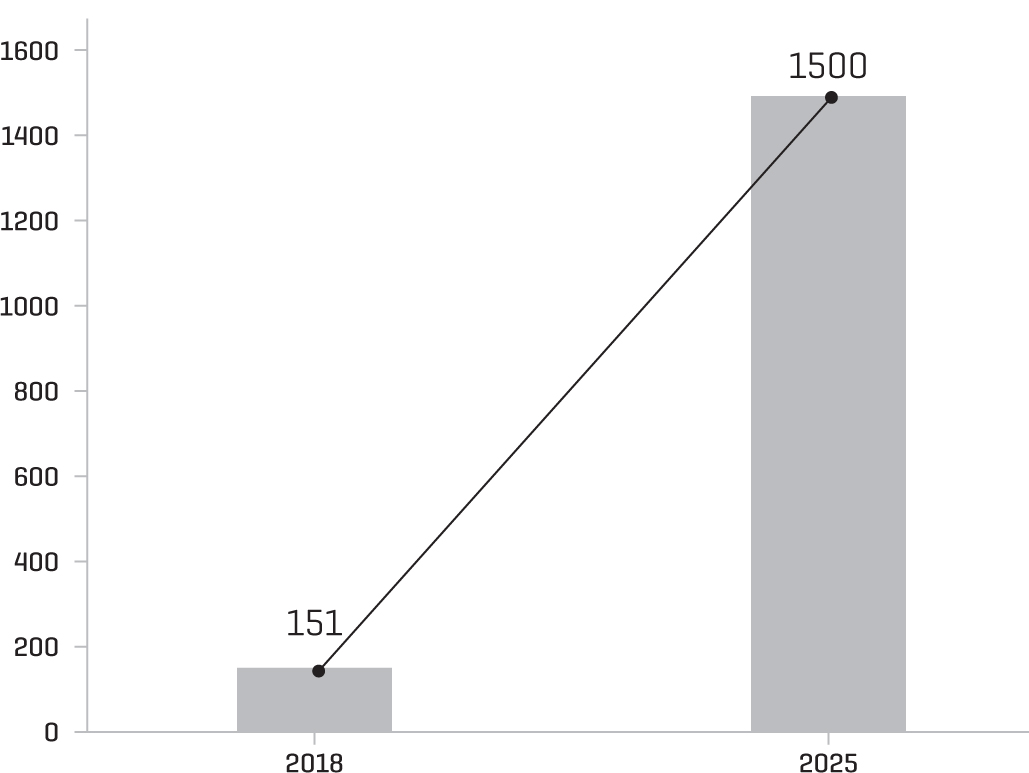
Source: United Nations Conference on Trade and Development (UNCTAD), Digital economy report 2019: value creation and capture, implications for developing countries, 2019, p.9
As impressive as the take-off of the new round of digitalization appears, this second digital age, to reiterate, is still in its infancy. For instance, blockchain technologies, or “distributed ledger technologies,” that allow multiple parties to engage in secure transactions without any intermediaries, including financial transactions, had barely gotten off the ground by 2020. Blockchain first became known in the 2010s as the technology that made cryptocurrencies, such as Bitcoin, possible and will constitute the technological infrastructure for a more general shift to digital money in the future (as the use of digital currency spreads, it will bring us closer to dethroning the domination of the dollar, but that is a story for elsewhere). In fact, blockchain business value is expected to explode toward the end of the 2020s, reaching an estimated $3 trillion by the end of the decade.14 The truly momentous effects of big data are yet to be felt. Big data exploded onto the scene in the early twenty-first century. In 2000, only one-quarter of the world’s stored information was digitalized, but by 2013 only 2 percent of all stored information was nondigital. One 2017 IBM report noted that 2.5 quadrillion bytes of data were created every day in that year, and that “90 percent of the data in the world today has been created in the last two years alone.”15
Global Internet Protocol Traffic (in Gb per second)

Source: United Nations Conference on Trade and Development (UNCTAD), Digital economy report 2019: value creation and capture, implications for developing countries, 2019, p.9
Much of fourth industrial revolution technology central to the digital restructuring of global capitalism is dependent for its widespread introduction on 5G (fifth generation broadband technology), which first began rolling out in 2019 and can be considered the essential underlying infrastructure (along with cloud computing) for the second digital age. Rolled out in the 1980s, the first commercial automated cellular network, 1G, enabled voice calls between mobile technologies. This analog technology was replaced by the digitalized 2G network in the 1990s, which made text messaging possible. In the 2000s, 3G opened up the transmission of data and made smartphones possible. In the following decade, 4G further optimized data transmission and enabled streaming video. Now, the greater bandwidth of 5G makes possible higher download speeds (up to 10 gigabits per second) that are required for the emerging digital technologies, in particular, the IoT (machine to machine connections), blockchain, and the much more rapid and extensive collection and processing of data. Closely correlated with 5G technology is cloud computing necessary to store and process the vast new quantities of data, including for a wide range of e-commerce and applications that allow for remote work. Cloud computing experienced a rapid expansion during the pandemic, accounting for 10 percent of all technology spending and attracted tens of billions of dollars in corporate investment.16
THE NEW CAPITAL BLOC
The era of globalization has involved an ongoing radical transformation in the modalities of producing and appropriating surplus value, a transformation hastened first by the 2008 crisis and now again by the pandemic. At the center of global restructuring are the giant tech companies, among them Microsoft, Apple, Amazon, Tencent, Alibaba, and Facebook. These companies experienced astonishing growth in the 2010s. Added now to the earlier tech behemoths are Zoom, Netflix, and other companies boosted by the pandemic, as well as tech firms like Taiwan Semiconductor Manufacturing (TSM), whose expansion and market capitalization was ballooning even before the contagion. Zoom daily users jumped by 3000 percent in the first four months of the pandemic.17 In 2020, Apple and Microsoft registered an astounding market capitalization of $1.4 trillion each in early 2020, on the eve of the pandemic. By the end of that year, this figure had jumped to $2.08 trillion and $1.63 trillion, respectively. Amazon’s capitalization stood at $1.04 trillion going into the pandemic and had climbed to $1.58 trillion by the end of 2020. Alphabet (Google’s parent company) registered a $1.2 trillion capitalization, Samsung $983 billion, Facebook $779 billion, and Alibaba and Tencent some $700 billion each.18 To give an idea of just how rapidly these tech behemoths have grown, Google’s market capitalization went from under $200 billion in 2008 to over one $1 trillion in 2020, or a 500 percent increase over the decade.19 Meanwhile, in just two years, from 2015 to 2017, the combined value of the platform companies with a market capitalization of more than $100 million jumped by 67 percent, to more than $7 trillion.20 It must be stressed that both the pace of change and the magnitude of global capital is simply without precedent, so that these figures and others identified in this book are bound to be outdated even before this study reaches my readers.
The cluster of giant tech firms that generate, extract, and process data have absorbed enormous amounts of cash from transnational investors from around the world who, desperate for new investment opportunities, have poured billions of dollars into the tech and platform companies as an outlet for their surplus accumulated capital. Annual investment in CIT jumped from $17 billion in 1970 to $65 billion in 1980, then to $175 billion in 1990, $496 billion in 2000, and $654 billion in 2016, topped $800 billion in 2019, and then predictably spiked again during the pandemic, approaching $1 trillion by the end of 2020.21 As capitalists invest these billions, the global banking and investment houses become interwoven with tech capital, as do businesses across the globe that are moving to cloud computing and artificial intelligence. Moreover, the tech giants are purchasing bonds floated by transnational corporations in other sectors of the global economy as a way to hedge their enormous financial assets across a range of investments.22 By the second decade of the century, the global economy came to be characterized above all by the twin processes of digitalization and financialization.
Data shows that from the 1980s onward, those corporations that transitioned to CIT were dramatically more productive than their competitors, managing to resolve the so-called “productivity paradox,” whereby the growth in productivity notably slowed starting in 1973, the date of the onset of a structural crisis and subsequent globalization.23 As a result the center of gravity in the circuits of accumulation began to shift toward those corporations developing and producing CIT. Digitalization is a “general purpose technology,” meaning that, like electricity, it spreads throughout all branches of the economy and society and becomes built into everything. Those who control the development and application of digital technologies acquire newfound social power and political influence. As this process deepens, those TCC groups that control general digitalization develop new modalities for organizing the extraction of relative surplus value and increasing productivity at an exponential rate. Hence, the new technologies disrupt existing value chains and generate a reorganization among sectors of capital and fractions of the capitalist class. They allow the tech giants and digitalized finance capital to appropriate ever-greater shares of the value generated by global circuits of accumulation.
In this process there emerge new configurations and blocs of capital. The rise of the digital economy involves a fusion of Silicon Valley with transnational finance capital—US bank investment in tech, for instance, increased by 180 percent from 2017 to 201924—and the military-industrial-security complex, giving rise to a new bloc of capital that appears to be at the very core of the emerging post-pandemic paradigm. This new bloc is emerging even more powerful than it was going into the health emergency, spurring a vast new centralization and concentration of capital on a global scale. At the head of this bloc, the tech behemoths are larger financial entities than most countries in the world and are able to wield enormous influence over capitalist states. New York state governor Mario Cuomo showcased this emerging capital-state relation in early May 2020, when he appointed three tech billionaires, Eric Schmidt of Google, Apple, and Facebook, former Microsoft CEO Bill Gates, and Michael Bloomberg, to head up a Blue Ribbon Commission to come up with plans to outsource public schools, hospitals, policing, and other public services to private tech companies.25 Such “public-private partnerships” privatize to capital traditional state functions, while converting public funds into corporate subsidies.
While it is true that US- and Chinese-based corporations dominate the global tech sector, I have shown in my earlier research, and more recently sociologist Peter Phillips has documented in his study Giants: The Global Power Elite,26 how transnational capital has become so interpenetrated that there are no major concentrations of capital outside of the interconnected mass. Moreover, there are now hundreds of up-and-coming tech firms from around the world that have prospered during the pandemic and can be expected to expand rapidly as restructuring proceeds. Rather than referring to nations, by the new bloc I am alluding to the cutting edge of accumulation that is what is most at the inner core of global circuits of accumulation central to the very generation of value. As digitalization disrupts previously established value chains, these new clusters and branches of capital become amalgamated, and as these new clusters and branches of capital become amalgamated, this shift toward the new bloc is captured by the notion of center of gravity. While the contours of this new bloc were already in focus before the pandemic, the contagion accelerated the shift in the leading edge of accumulation. Entire industries, from airlines, leisure and hotel, mall-based retail establishments, and entertainment companies, such as movie theaters, were forced to downsize and even suspend operations during the pandemic, while simultaneously the opportunities for the emerging bloc of capital expanded dramatically.
Emblematic of the sudden windfall to tech capital afforded by the pandemic and of how the new bloc is becoming the center of gravity of global accumulation is the case of Draganfly corporation, a Canadian-based manufacturer of military and civilian drones. According to one 2020 report:
Like the rest of the world, Canadian drone maker Draganfly has been anxiously watching the spread of the novel coronavirus. And when COVID-19 cases started springing up across Washington nursing homes in mid-February, the team began brainstorming. By March, Draganfly had licensed the machine vision and AI tech needed to offer social distancing and health monitoring services from the air. Demand to test the technology was ‘insatiable,’ not just from government and law enforcement, but also from health care, airline, cruise, hospitality, theme park, and other commercial industries. By mid-April, the police department in Westport, Connecticut had a pilot underway, the first of its kind in the U.S. [Company spokesperson] Chell says Draganfly has been ‘inundated’ with requests from other jurisdictions, while the numbers on the private side ‘are even more prolific. As federal and local governments wrestle with the coronavirus pandemic—from tracking the spread of COVID-19 to gauging when to lift restrictions—everyone is taking a closer look at autonomous technologies like drones and robots.27
Similarly, in conjunction with the tech sector, the pandemic presented the global medical and pharmaceutical industry with numerous potential windfalls. It is predicted that global digital health revenue from various forms of telemedicine and related services will rise from $350 billion in 2019 to over $600 billion in 2024, as the global multitrillion-dollar health care market becomes restructured through digitalization. Billions in equity funding flowed into private digital health corporations as equity investment doubled during 2020 alone.28 Propelled forward by digitalization, biotechnology stands at the cutting edge of the fourth industrial revolution. Developments in biotechnology and bioengineering came together “with a host of complex sensory mechanisms to bring about a significant shift in the life sciences,” notes Timothy Erik Strom. He continues: “Building on the constitutive forces that enabled the origin of cybernetic capitalism in the military-industrial complex of the Second World War, the rise of biotech brought a tighter weave to the alliance between state-induced research, corporate power over technology, and finance capital, with the combination radically altering humanity’s relationship with the natural world.”29
In 2010, Craig Venter, the CEO of the biotech company Celera Genomics announced that he had created “the first self-replicating species on the planet whose parent is a computer.” For first time ever, he explained, a private biotech company assembled out of computer information real DNA that was then used to create a new virus—that is, to create a new life form out of inorganic material. Venter defined the technology as “synthetic genomics.” It would “start in the computer in the digital world from digitized biology and make new DNA constructs for very specific purposes,” that is, for commercial purposes.30 Synthetic genomics, in turn, has been combined with another area of biotechnology, “gain of function” research, which as I discussed in the previous chapter, starts with an already existing life form and modifies its structure. The pharmaceutical industry stands to cash in massively on diseases and new therapies made possible through such biotechnology breakthroughs. Early in the pandemic, Gilead Sciences, a biotech/pharmaceutical company, developed a prototype drug, Remdesivir, as a therapeutic aid (not a vaccine) for treating Covid-19 patients. The drug gained notoriety after it was used to treat US president Donald Trump when he caught the virus in October 2020. The company’s stock price surged after the WHO commended the experimental drug early on in the pandemic.31
In the absurdly perverse world of capitalism, everything that occurs in society, including vaccines against Covid-19 and other biotechnology breakthroughs, must be subjected to the logic of capital accumulation. So long as this is the case, humanity will be simply unable to benefit from the enormous opportunities opened up by new biotechnologies. Cancer, hepatitis C, heart disease, and a host of other deadly ailments are banes for hundreds of millions of people. Yet the treatment of these diseases constitutes a multitrillion-dollar industry, immensely profitable for pharmaceutical companies, private hospitals, and manufacturers of medical equipment, among others. Preventative medicine is simply not profitable. The treasure chest to capital lies in treatments that simply slow the decline in the health of patients or ameliorate symptoms without eliminating the underlying causes of pathologies or in creating additional patients so as to convert them into lifetime customers. There are now antiretroviral drugs that treat people for the symptoms of HIV, yet the virus continues to spread throughout the world, as do such diseases as malaria and tuberculosis, even as the global cosmetic surgery market is expected to surpass $40 billion by 2025,32 and each year US citizens spend tens of millions of dollars on plastic surgery for their pets.33 Revolutionary breakthroughs in health care are only available to the rich through the prism of medicine for profit. New medical technologies are now capable of restoring hearing to the deaf, sight to the blind, and providing robotic limbs to quadriplegics, but the majority are locked out of these medical miracles.
Goldman Sachs, one of the biggest investment houses in the world, displayed this impeccable logic of capital, warning in 2018 report that gene therapies that cure diseases were bad for business. The report referenced Gilead Sciences, the biotech/pharmaceutical company that developed a treatment for hepatitis C, which achieved cure rates of more than 90 percent. The company’s US sales for the treatment, observed the report, peaked at $12.5 billion in 2015, but then steadily fell:
Is curing patients a sustainable business model? The potential to deliver ‘one shot cures’ is one of the most attractive aspects of gene therapy, genetically-engineered cell therapy and gene editing. However, such treatments offer a very different outlook with regard to recurring revenue versus chronic therapies. While the proposition offers tremendous value for patients and society, it could represent a challenge for genome medicine developers looking for sustained cash flows. … [Gilead Sciences] is a case in point, where the success of its hepatitis C franchise has gradually exhausted the available pool of treatable patients. In the case of infectious diseases such as hepatitis C, curing existing patients also decreases the number of carriers able to transmit the virus to new patients, thus the incident pool also declines. … Where an incident pool remains stable (e.g., in cancer) the potential for a cure poses less risk to the sustainability of a franchise.34
The digital restructuring of global capitalism is driven by big data, which exploded onto the scene in the early twenty-first century. As mentioned above, in 2000, only one-quarter of the world’s stored information was digitalized, but, by 2013, only 2 percent of all stored information was nondigital. One 2017 IBM report noted that 2.5 quadrillion bytes of data were created every day in that year, and that “90 percent of the data in the world today has been created in the last two years alone.”35 This “datafication” was not merely in terms of size but also in the ability to quantify aspects of the world not previously quantified, such as location information captured, amassed, and processed through GPS satellite systems. Previously, information was chiefly captured through sampling as a statistical method first introduced in the late nineteenth century that involved a random sample followed by inference to the population universe. But, now, as Cukier and Mayer-Schoenberger observe, big data involves collecting all the data of the entire population in concern, that is, we are shifting from sampling data to “data-n,” to use the terminology of statistics.36 Data is becoming an immensely valuable asset and the lifeblood of the digital economy. The firms that control big data are able to exercise decisive influence over the economy as a whole, including feeding into machines (artificial intelligence) the data necessary for the algorithms that drive production and commerce. As this process deepens, algorithms increasingly organize the circuits of capital accumulation.
In her study The Age of Surveillance Capitalism, Shoshona Zuboff of the Harvard Business School shows how data extraction and analysis has reached a height of ubiquity unimaginable only a few years ago. But her liberal analysis is concerned with how “raw surveillance capitalism” supposedly distorts the competitive market—that surveillance through data is a rogue form that has undermined a happier era of “democratic capitalism” and “market democracy.” Unregulated data, in her view, is “a threat to capitalism itself” that can be addressed by regulation. But advanced digitalization and surveillance through big data is not some rupture with an earlier capitalism. As we have seen, far from an aberration, it springs from the “normal” dynamics of capital accumulation and contradictions internal to capitalist development.37 Moreover, along with new opportunities for corporate profit-making, big data immensely enhances the social control powers of both states and capital beyond surveillance alone. French philosopher Michel Foucault had pointed out in many of his works that preceded the digital age how states and “disciplinary regimes” create and use data to exercise control over populations. Political scientist James Scott, in his study Seeing Like a State, identified how states’ drive to collect data and quantify everything leads to heightened state control over communities.38 Both Foucault and Scott were writing before the age of big data, which now makes possible a more all-pervasive Big Brother—an expanding global police state—epitomized in so-called “predictive policing,” in which populations are criminalized in the absence of the actual commission of a crime.39
Cukier and Mayer-Schoenberger observe (not unapprovingly, I should note) how big data allowed for a dramatic increase in the vacate orders issued to poor people by the New York City government during the mayoralty of Michael Bloomberg, whose multibillion-dollar fortune was made in the data business. This was done through the creation of a database of every one of the 900,000 buildings in the city, involving the amalgamation of data from nineteen city agencies on tax liens, anomalies in utility usage, service cuts, missed payments, local crime rates, rodent complaints, and more. The amassing, merging, and processing of all this data allowed building inspectors to increase the number of vacate orders they issued following an inspection from 13 percent of building visits to 70 percent.40 This in the midst of an acute housing crisis in New York and other big US cities that has led many poor families to share apartments lest they live in the streets. In my own city, Los Angeles, in 2020, there were at least 134,000 people living in the streets on any given day, and in the first ten months of that year nearly 1,000 homeless people died, even as 93,000 housing units sat vacant because would-be tenants could not afford the rent.41 The larger story here is how big data and digitalization is transforming welfare systems worldwide, in what one report termed “automating poverty,” including the fact that millions of citizens who lack digital skills or access are being barred from accessing their welfare and social service rights.42
The second leg in the new triangulated bloc is transnational finance capital. Money capital is the universal and most mobile form of capital and also the most globalized. Money (value) moves seamlessly and instantaneously across the globe through the digitalized global financial system that predated by several decades the current restructuring. But finance is also undergoing a revolution driven by digital restructuring, as competition heats up for shares of the $1.5 trillion global pool of financial industry profits. Digital payment platforms are rapidly replacing earlier forms of payment. In the United States, payments through the US network Venmo increased by 52 percent during the pandemic, while in Latin America payments through the Mercado Pago network rose by 14.12 percent. In 2020, conventional banks accounted for only 72 percent of the stock market value of the global banking and payments industry, down from 81 percent at the start of the pandemic, and 96 percent in 2010. As financialization deepens, transnational capital, octopus-like, has extended its tentacles into every branch and sector of the global economy. BlackRock is emblematic of how it has become interwoven in particular with tech and the military-industrial complex. With some $8 trillion in assets under its management in 2020, BlackRock was already, pre-pandemic, one of the largest shareholders in the leading transnational corporations, owning multibillion-dollar stakes in the tech and military-industrial giants, as well as in energy, pharmaceutical, retail, media, and entertainment complexes. On the eve of the pandemic, BlackRock CEO Larry Fink predicted, “In the near future, and sooner than most expect, there will be a significant reallocation of capital.”43
Bank of America, one of the largest global banking conglomerates, conducted a survey of three thousand of the largest companies in twenty-five economic sectors. Among these sectors, the report identified “enablers for the world—post-Covid,” including health care, technology, digital, consumer staples, industrial real estate, and ESG. This latter is an acronym for Environmental, Social, and Governance, which includes the development of the IoT, telecom infrastructure, and security. The report predicted a rise in IT spending and an escalation of corporate tech wars, some of it expressed in geopolitics, led by a wave of investment in infrastructure, AI technologies, and moonshot future tech. The phrase “moonshot future tech” was coined by Google in reference to venture investments in new “groundbreaking” technologies that do not necessarily register immediate profitability, such as autonomous vehicles, quantum computing, and vertical farming. Half of the corporations surveyed said they expected to increase technology investments in the wake of the pandemic, and 44 percent specified that the increase would be in robots and automation. The report further broke down winners and losers. Leading the winners, unsurprisingly, were tech service providers, new media and entertainment, big tech platforms, tech hardware, e-commerce, payments and “other diversified financial wealth,” data centers, biopharma and biotech, food and household staples, life sciences and “tools-diagnostics,” med-tech and health tech, capital goods and industrial automation, defense, software, semiconductors, cloud and software services, integrated utilities, and renewable utility grids. Some of the losers were, predictably, “old” media and entertainment, autos, general and apparel retail, travel and leisure, oil and gas, banks (this distinct from new forms of finance capital such as investment houses, fund management, and so on), offices, commercial shopping, malls, and lodging.44
Throughout the world, we are seeing a novel fusion of tech and finance capital around nontraditional forms of digital finance. In Latin America, digital bank and e-commerce pioneers such as Nubank and MercadoLibre (owner of Mercado Pago) are capturing major shares of industry. In Southeast Asia, the ride-hailing service companies Asia Grab and Gojek introduced apps that also turned them into financial firms. In 2020, such fintech firms provided the majority of consumer loans in Sweden. In the United States, credit card firms, such as Visa, digital finance giants, such as PayPal, and conventional banks compete for financial market shares. Tech giants, such as Alibaba, Apple, and Alphabet, are establishing fintech branches.45 Alibaba manages the most integrated fintech platform in the world—ANT—which, in 2019, handled a whopping $16 trillion in payments and operations, ranging from loans to digital credit card services, investment, and insurance brokerage—in the words of the Economist, “the world’s purest example of the tremendous potential of digital finance.”46
The new bloc of capital is able to appropriate through digitalization and the circuits of distribution greater portions of surplus value generated elsewhere in the global economy, especially as value flows through a porous financial system. “In the new business models of the digital economy, two emerging and related forces are increasingly driving value creation: platformization and the monetization of the rapidly expanding volume of digital data,” noted the United Nations Conference on Trade and Development (UNCTAD) in a report issued in the midst of the pandemic. “Digital platforms are central actors in this economy, and digital data have become a key resource in economic processes, which can lead to value creation.”47 The critical point, however, is not so much that tech capital, in its fusion with the financial industry, necessarily creates this value; rather, its inordinate control over the digitalization process means that it can appropriate value created throughout the global economy. Data in and of itself cannot create value; only labor can. Data may work to enhance the production of surplus value (and then appropriate it from other capitals that directly extract that surplus value) or it may appropriate that value through such channels as advertising revenue. In this way, big data is turned into big profit for capitals that control such data. The UNCTAD noted:
In the traditional economy, property rights in well-established markets comprising producers and consumers strongly determine who is the beneficiary of the value of the corresponding goods and services. With regard to data, the situation is less clear, as it is difficult to establish “ownership” of the data. Indeed, given the specific characteristics of data, ownership may not even be the appropriate term. The value of personal data is tied to the data subject or producer, and this cannot be sold. What matters more are the control, access and rights over the data. Under the current system (or non-system), digital platforms are often the main collectors or extractors of data and can therefore appropriate the value. The data sources (i.e. the data producers or data subjects) are not able to capture any part of the economic value created with their data.48
The third leg in this triangulated bloc of capital is the military-industrial-security complex. As the tech industry emerged in the 1990s, it was conjoined at birth to the military-industrial-security complex and the global police state.49 Over the years, for instance, Google has supplied mapping technology used by the US Army in Iraq, hosted data for the Central Intelligence Agency, indexed the National Security Agency’s vast intelligence databases, built military robots, co-launched a spy satellite with the Pentagon, and leased its cloud computing platform to help police departments predict crime. The other tech giants are similarly intertwined with the military-industrial-security complex.50 The marriage between the tech industry and the US intelligence and covert operations complex became further cemented in the midst of the pandemic, when the Central Intelligence Agency announced that it had awarded its Commercial Cloud Enterprise (known as C2E), potentially worth “tens of billions” of dollars (the exact amounts remains undisclosed), on behalf of seventeen intelligence agencies to five companies—Amazon, Microsoft, Google, Oracle, and IBM.51
The rise of the digital economy blurs the boundaries between military and civilian sectors of the economy and between the state and corporations, as it brings together finance, the military-industrial complex, and tech companies around a combined process of financial speculation and militarized accumulation. The concepts of militarized accumulation and, relatedly, accumulation by repression, as I have developed them in my 2020 study The Global Police State help us identify how transnational capital has become more and more dependent on a global war economy that in turn relies on perpetual state organized war-making, social control, and repression and is driven by the new digital technologies. Worldwide, total defense outlays grew by 50 percent from 2006 to 2015, from $1.4 trillion to $2.03 trillion, although this figure does not take into account secret budgets, contingency operations, and “homeland security” spending. During this time, military-industrial complex profits quadrupled. By 2018, private military companies employed some fifteen million people around the world, while another twenty million people worked in private security.
The new systems of warfare, social control, and repression are driven by digital technology. The market for new social control systems made possible by digital technology runs into the hundreds of billions of dollars. The global biometrics market, for instance, was expected to jump from its $15 billion value in 2015 to $35 billion by 2020.52 The new technologies of social control span artificial intelligence–powered autonomous weaponry, such as unmanned attack and transportation vehicles, robot soldiers, a new generation of superdrones and flybots, hypersonic weapons, microwave guns that immobilize, cyberattack and info-warfare, biometric identification, state data mining, and global electronic surveillance that allows for the tracking and controlling of every movement. State and corporate surveillance are melding into a single omnipresent system. The surveillance powers applied for the pandemic became normalized and repurposed for heightened political control and corporate dominance through the emerging state-corporate surveillance complex. The pandemic, as we saw in the previous chapter, aggravated all of the social and political contradictions of a global capitalism in deep crisis. It became even more politically necessary than prior to the outbreak for the ruling groups to wield the global police state to contain discontent from below at the same time as the pandemic itself presented the TCC with new opportunities for militarized accumulation and accumulation by repression.
LABOR AND CAPITAL IN THE SECOND DIGITAL AGE
“The role of humans as the most important factor of production is bound to diminish in the same way that the role of horses in agricultural production was first diminished and then eliminated by the introduction of the tractor.”
—Wassily Leontief, Nobel laureate in economics, 198353
The capitalist system is by its nature expansionary. Just as riding a bicycle, in which the bike collapses if one stops pedaling, capitalism collapses if it stops expanding. World capitalism has gone through ongoing cycles of crisis followed by waves of expansion. In each earlier structural crisis, the system went through a new round of extensive expansion, that is, incorporation of new territories and populations—from waves of colonial conquest in earlier centuries to the integration in the late twentieth and early twenty-first centuries of the former socialist bloc countries, China, India, and other areas that had been marginally outside the system. There are very few pockets of territories and peoples, if any, around the world that have yet to be incorporated through this process of extensive (outward) expansion. What is left for global capital, increasingly, is intensive expansion, involving the commodification of what were noncommodified resources and activities. Commodification refers to the process of turning people, the things that people produce, and nature into things that are privately owned, have a monetary value, and can be bought and sold. The juggernaut of commodification now targets the accelerated privatization of health and educational systems, infrastructure, and other public services, public lands, and nature reserves, and even military and police forces.
But this commodification involves a double movement. First, transnational capital seeks to open up new opportunities for accumulation by seizing what remains outside its domain and turning it into assets, in particular, an ever more violent appropriation of nature and the public domain. Second and closely related, transnational capital seeks to sustain the rate of profit by replacing workers with technology and by pushing down wages and other labor costs through deskilling and fragmentation of the labor process. It seeks in this effort to transfer the cost of reproducing labor from the wage—what capitalists have to pay to workers for them to reproduce their existence—to states precisely at a time when state services are themselves being gutted and privatized. Marx theorized that the cost of labor power (the wage) is the cost for the reproduction of labor power, that is, the cost of the workers’ social reproduction. If the price of labor power dipped below this minimum, workers could not survive long enough to return to work to produce more surplus value (profit). He wrote:
Wages will rise and fall according to the relation of supply and demand, according to the turn taken by the competition between the buyers of labor power, the capitalists, and the sellers of labor power, the workers. The fluctuations in wages correspond in general to the fluctuations in prices of commodities. Within these fluctuations, however, the price of labor power will be determined by the cost of production, by the labor time necessary to produce this commodity—labor power. What, then, is the cost of production of labor power? It is the cost required for maintaining the worker as a worker and of developing him into a worker.
To the extent that capital is more and more transnational (outside of home territory), combined with the expansion of the ranks of surplus labor worldwide, global capital as a totality can more and more dispense with the social wage. To put this in simplified terms, the more capital can freely move around the globe and the more there is a mass of humanity that is unemployed and marginalized, the less the capitalist class needs to worry about paying wages with which those they employ can survive. This survival is what we may call social reproduction. Social reproduction becomes ever more externalized, forced onto households and communities. In other words, the price of labor can dip below the cost of the reproduction of labor so long as this externalization of social reproduction holds. David Harvey has long observed that capitalists in the geographic centers of the world capitalist system have been able to overcome waves of crises by displacing these crises in time and space as temporary “fixes”—shifting these crises onto more vulnerable regions or postponing them further into the future without having to reckon with them.54 But at a certain point the system may no longer have anywhere to spatially displace crises or the ability to displace them temporally, which heightens the pressures for a reduction of the total global wage bill—that is, pressures build up for capitalists to unload the crisis on the backs of workers or to quicken the process of replacing workers with technology. Marx continues:
The price of the cost of existence and reproduction constitutes wages. Wages so determined are called the wage minimum. This wage minimum, like the determination of the price of commodities by the cost of production in general, does not hold good for the single individual but for the species. Individual workers, millions of workers, do not get enough to be able to exist and reproduce themselves; but the wages of the whole working class level down, within their fluctuations, to this minimum.55
This process described by the ever-prescient Marx is driven forward by the new wave of digitalization, accelerated now in hothouse fashion by the economic and social conditions thrown up by the pandemic. Crises, let us recall, provide transnational capital with the opportunity to restore profit levels by forcing greater productivity out of fewer workers. Since the 1980s, almost all employment lost in the United States in routine occupations due to automation, for instance, occurred during recessions.56 The first wave of CIT in the latter decades of the twentieth century triggered explosive growth in productivity and productive capacities, while the new digital technologies promise to multiply such capacities many times over. Specifically, digitalization vastly increases what radical political economists, following Marx, refer to as the organic composition of capital, meaning that the portion of fixed capital in the form of machinery and technology tends to increase relative to variable capital in the form of labor. In laymen’s terms, digitalization greatly accelerates the process whereby machinery and technology replace human labor, thus expanding the ranks of those who are made surplus and marginalized.
This process described by Marx is evident today. One US National Bureau of Economic Research report found that each new robot introduced in a locale results in a loss of 3 to 5.6 jobs.57 In 1990, the top three carmakers in Detroit had a market capitalization of $36 billion and 1.2 million employees. In 2014, the top three firms in Silicon Valley, with a market capitalization of over $1 trillion had only 137,000 employees.58 As Brynjolfsson and McAfee recount, a team of just fifteen people created a single app, Instagram, that, shortly after it was launched, had over 130 million customers who shared billions of photos. Within fifteen months of its founding in 2010, the company was sold to Facebook, which in turn reached one billion users in 2012, although it employed only 4,600 people. In contrast, they note, Kodak, a giant in photographic technology prior to the digital age, also helped customers share billions of photos over the decades, yet it directly employed 145,300 people and indirectly employed thousands more through the vast supply chain of retail redistribution that is now made redundant by digital distribution.59 In a fatal twist of irony, Instagram was sold just months after Kodak declared bankruptcy.
The increase in the organic composition of capital may bring profit windfalls to certain sectors of capital, yet it also aggravates overaccumulation and social polarization. Expanded inequalities, as we saw in the previous chapter, have reached unprecedented levels worldwide. They end up undermining the stability of the system as the gap grows between what is (or could be) produced and what the market can absorb. The extreme concentration of the planet’s wealth in the hands of the few and the accelerated impoverishment and dispossession of the majority means that transnational capital had increasing difficulty in finding productive outlets to unload enormous amounts of surplus it accumulated. As I noted earlier, the total cash held in reserves of the world’s two thousand biggest nonfinancial corporations increased from $6.6 trillion in 2010 to $14.2 trillion in 2020, even as the global economy stagnated.60 But capital cannot remain idle indefinitely without ceasing to be capital. Beyond financial speculation, printing more money, debt-driven growth, and investment in the global police state, the TCC—or at least its organic intellectuals—is hedging its bets on the current wave of restructuring opening up enough new opportunities for investing overaccumulated capital in the new technologies and circuits of accumulation.
It is certainly possible that restructuring will unleash a new wave of expansion, but any such expansion will run up against the problems discussed previously that an increase in the organic composition of capital presents for the system, namely, the tendency for the rate of profit to fall and the amassing of profits that cannot be profitably reinvested. With heightened digitalization brought about by the pandemic there will be tens, even hundreds, of millions who lost their jobs and will not be reabsorbed into the labor force as technology takes over their former tasks. One University of Chicago study estimated that 42 percent of pandemic layoffs in the United States would result in permanent job loss.61 As well, large corporations will snatch up millions of small businesses forced into bankruptcy—the ILO estimates that some 436 million such businesses are at risk worldwide and may be snatched up by the giant combines and investment houses, thus heightening the concentration of capital worldwide.62 Several US government research reports found that the pandemic accelerated the pace of automation and exacerbated automation’s impact on job loss.63 “Even after the pandemic, the threat of future pandemics and the massive technological transition into the virtual world induced by the pandemic could induce significant shifts in the labor market and provide a catalyst for more automation in the long run,” observed a Federal Reserve Bank study. “Recent technological developments have made more previously safe jobs automatable … forc[ing] an experiment of various technologies and innovations that was unprecedented in its scale and scope.”64
Many mainstream accounts put forward a fairy-tale version of the fourth industrial revolution as ushering in a new age of democracy, prosperity, and abundance for all. This potential is subverted by capitalism, in so far as the technologies are applied by capital and its political agents to enhance social control and intensify the extraction of surplus value (profits), and amass private wealth, as brought home by the pandemic.65 With regard to the world of work, for many years, the apologists of global capitalism have claimed that the digital economy will bring high-skilled, high-paid jobs and resolve problems of social polarization and stagnation. It is true that the first wave of digitalization in the late twentieth century resulted in a bifurcation of work, generating high-paid, high-skilled jobs on one side of the pole, giving rise to new armies of tech and finance workers, engineers, software programmers, and so on. On the other side of the pole, digitalization produced a much more numerous mass of deskilled, low-wage workers and an expansion of the ranks of surplus labor. But the new wave of digitalization now threatens to make redundant much so-called “knowledge work” and to deskill and downgrade a significant portion of those knowledge-based jobs that remain. Increasingly, cognitive labor and gig workers face low wages, dull repetitive tasks, and precariousness. As “big data” captures data on knowledge-based occupations at the workplace and in the market, and then converts it into algorithms, this labor itself is threatened with replacement by artificial intelligence, autonomous vehicles, and the other fourth industrial revolution technologies. Algorithms are built into all aspects of the labor process and come to underpin the organization of capitalist exploitation. Digitally driven production ultimately seeks to achieve what the Nike Corporation refers to as “engineering the labor out of the product.”66
The transformations that CIT promises to bring are distinct from previous waves of technological change, in which labor shed from sectors replaced by automation was absorbed into new economic activities. For instance, the rise of the automobile industry destroyed industries dedicated to horse-based transportation but created vast new industrial and managerial employment in the auto industry, and earlier computerization created an abundance of high-skilled knowledge jobs, but, now, as human knowledge is transferred to machines through machine learning, machines become valuable substitutes for humans at multiple levels.67 The “big data revolution” means that the data captured on knowledge-based occupations at the workplace and in the market may lead to direct automation of specific tasks and jobs. As algorithms generated by big data become predictable enough to make cognitive labor more and more redundant to a whole host of activities, from medical diagnosis to legal advice, it is clear that acquiring education and skills will no longer assure protection against job automation. Over time, we can expect a greater supply of knowledge workers simultaneous to a deskilling of their labor.
The end game in this process, although still far away, is laborless production. Writing in 1858 in the Grundrisse, the rough notes that he drafted for his magnus opus Capital, Marx anticipated this process. He speculated how machines and fixed capital would ultimately evolve into an automated system. “The means of labor passes through different metamorphoses, whose culmination is the machine, or rather, an automatic system of machinery … set in motion by an automaton, a moving power that moves itself. This automaton consists of numerous mechanical and intellectual organs, so that the workers themselves are cast merely as its conscious linkages.” Automated machinery represents social knowledge transformed into assets controlled by capital. “The accumulation of knowledge and of skill, of the general productive forces of the social brain, is thus absorbed into capital, as opposed to labor. … In so far as machinery develops with the accumulation of society’s capital, of productive forces generally, general social labor presents itself not in labor but in capital.”68
The processes that push capitalism toward laborless production also push marginal cost toward zero, that is, zero cost for each incremental unit of output. As costs move toward zero, we step into the unknown. It is most unlikely that we will ever reach laborless production or zero marginal cost, much less in the near future (in any event, either situation would present capital with new contradictions, although here is not the place to elaborate). Nonetheless, these tendencies are underway, driven forward now by advanced digitalization, and are at least theoretically in the realm of the possible. Even if marginal cost never actually reaches nil, it is inexorably pushed down toward zero by the processes now underway. Digital capital in particular can become extremely cheap, e.g., software can be duplicated and distributed at almost zero incremental cost—and let us recall that practically anything can be digitalized, that is, codified, and once codified, then digitalized. Short of full automation, the ever-rising organic composition of capital (that is, the increase in fixed capital as machinery and technology relative to living labor) leads to more and more being produced with fewer and fewer precarious workers.
A 2017 United Nations report estimated that tens, if not hundreds, of millions of jobs would disappear in the coming years as a result of digitalization. The report also said that the spread of online labor platforms would accelerate a “race to the bottom of working conditions with an increasing precarity.”69 A 1998 study found that already in the late twentieth century some one-third of the global labor forces was under- or unemployed. Then in 2011, the ILO reported that 1.53 billion workers around the world, representing more than 50 percent of the global workforce, were in “vulnerable” employment arrangements. Eight years later, in 2019, it concluded that a majority of the 3.5 billion workers in the world either eked out a living (or attempted to) in the informal economy or worked in precarious arrangements, experiencing “a lack of material well-being, economic security, equality opportunities or scope for human development.”70
Even before the pandemic hit, automation was spreading from industry and finance to all branches of services. Global sales of industrial robots were forecast to increase from 381,000 units in 2017 to 630,000 by the end of 2021.71 We typically associate automation with factory work, but the latest wave has involved branches of the economy that were previously believed to be insulated from automation, such as fast food, agriculture, mining, and warehousing. One 2016 report from researchers at Oxford University concluded that up to 86 percent of jobs in restaurants, 75 percent of jobs in retail, and 59 percent of jobs in entertainment could be automated by 2035.72 Artificial intelligence, robotics, and big data now underpin processes of mineral extraction, allowing for “digital mining” in which completely robotized trucks, shovels, and drills work around the clock. The fast-food industry is following the same path of automation. One startup, Miso Robotics, has been introducing “flippy,” a robot cook that prepares and packages hamburgers, into quick-service restaurants in California, such as White Castle. Agriculture was already becoming automated before the pandemic, alongside a rapid concentration of corporate power in global agribusiness.73 The agricultural robotics market expected to grow from $4.6 billion in 2020 to over $20 billion by 2025. “Overall, agricultural employment in California fell by about 11 percent in the first decade of the twenty-first century, even as the total production of crops like almonds, which are compatible with automated farming techniques, has exploded.”74 Driscoll’s now employs Agrobot, a robotic strawberry picker in its California fields, and the California wine industry has reengineered the bulk of its vineyards to allow machines to span vines like a monorail and strip them of grape clusters or leaves. The pandemic hastened the turn toward agricultural automation and “digital farming” as the recruitment of seasonal agricultural workers became more difficult due to restricted movement.75
Beyond manual and low-skills service labor, automation and algorithms are expected to eventually replace much professional work, such as lawyers, financial analysts, doctors, journalists, accountants, insurance underwriters, and librarians. One robotics company, iRobot, has been working on creating robots that won’t need to be programmed by high-skilled and high-paid engineers. The robots are to be taught and retaught to perform a task by shop floor workers who would need barely an hour of training to learn how to instruct the robots.76 It may be that high-skilled professional jobs will be digitalized, while low-skilled and low-paid jobs requiring a low level of sensory motor skills, along with basic literacy and numeracy, will not be. Specifically, digital technologies are acquiring abilities previously exclusive to humans, such as pattern recognition and complex communication.
As mass industrial production took off in the late nineteenth century, capitalists introduced new forms of harsh discipline on shop floors, routinizing and deskilling work, as Harry Braverman, following Marx, discussed in his modern classic Labor and Monopoly Capital.77 Bosses set out to separate thinking and conception from execution in the labor process. Workers were to provide their raw, degraded labor power, while conception would be concentrated in management, which would exercise total control over how tasks were carried out. “If the workers’ exertion is guided by their own conception it is not possible,” noted Frederick Taylor, the architect of “scientific management,” “to enforce upon them the methodological efficiency of the working pace desired by capital.”78 However, management and supervisory work is not immune from digitally driven restructuring and is likely to be hit as hard as manual and professional occupations. Now in the wake of the pandemic accelerated digitalization may involve a gradual shift—or perhaps not so gradual—from management to computer algorithms.
As we have seen, technologies driven by artificial intelligence are becoming more widely adopted worldwide as a result of the conditions brought about by the contagion. The pandemic allowed the TCC to massively push forward capitalist restructuring that it could not previously accomplish because of resistance to the digital takeover. Those economic sectors bolstered by accelerated restructuring during the pandemic are where precarious forms of employment prevail, that is, the self-employed, contract, temporary, platform, and other such workers.79 A growing portion of this proletariat labors by supplying “on-demand” digital services online, what is sometimes dubbed the “human cloud.” The ranks of this digital proletariat will swell rapidly given the accelerated shift to online and home work. There appears to be a new bifurcation of work spurred on by the pandemic. There are, on the one hand, those who will shift to remote work. More than half of all employees in the United States were working at home in May 2020, whereas worldwide, according to the ILO, some 20 percent of employment may become permanently remote.80 From their homes, these workers face new forms of control and surveillance. On the other hand, there are those locked into high-risk “essential” in-person work, such as health care providers, agricultural and industrial day laborers, cleaners, transport and delivery workers.
Capitalists will use mass unemployment along with more widespread remote and precarious work arrangements as a lever to intensify exploitation of those with a job, to heighten discipline over the global working class, and to push surplus labor into greater marginality. Tech work in China provides a glimpse into the Taylorist discipline and exploitation to which knowledge workers in the post-pandemic global economy will be increasingly subjected as they become precarious digital proletarians. Tech giants such as Huawei, Tencent, Alibaba, Baidu, and Xiaomi, among others, employ millions of college-educated workers, who are thrown into intense competition for a shrinking number of positions. Known simply as the “996 work regime,” workers in China’s expanding high-tech sector are forced to work from 9:00 a.m. to 9:00 p.m., six days a week. The strategy of Chinese and foreign-based transnational capital here seems to be one of combining an increase in absolute surplus value with that of relative surplus value. “The stereotypical image of privileged white-collar workers persists despite the changing employment reality and the decline and stagnation of white collar salaries,” notes one labor activist in China.81 As the number of skilled tech jobs contracts and unemployment expands around the world, the Chinese model is likely to be adopted elsewhere.
As the pandemic and its aftermath accelerates the process whereby labor is replaced by technology and algorithms, it is also bringing about significant change in the nature of the labor process itself. Lockdowns around the world forced nearly every industry and service at least partially online, giving the emerging tech-led bloc of capital newfound powers to mediate the gamut of human interaction in the economy and society. The pandemic lockdowns served as dry runs for how digitalization may allow the dominant groups to restructure space and exercise greater control over the movement of labor. Governments around the world, from India through South Africa to El Salvador, decreed states of emergency and violently repressed those who violated stay-at-home orders.82 The lockdowns may have been necessary from the perspective of the health emergency, yet they showcased how the TCC and capitalist states may more tightly control the distribution of labor power, especially surplus labor, by controlling movement and by locking labor into cyberspace and, therefore, making it disaggregated and isolated. As new digital technologies expand the cognitive proletariat and the ranks of workers in the gig economy, they also allow for a stringent surveillance and control of this proletariat through cyberspace. This enhanced surveillance is, of course, matched by the heightened direct control over labor made possible by digital technologies. In 2018, for instance, Amazon secured patents for wristbands for use on warehouse workers to track their every move. The wristbands include tracking devices that monitor exactly where one’s hands are in relation to inventory bins. They can track everything from how long a worker takes for a bathroom break to how much work is lost when one scratches her nose and can emit vibrations for infractions such as nose scratching and misplacing items.83
Well before the pandemic, digital restructuring had been making work more “modular.” This refers to breaking work into smaller packets that are farmed out to workers by companies through platforms and online work. Such modulation takes to a new level industrial outsourcing associated with globalization in recent decades. “Work will increasingly get disconnected from companies, and jobs and work will increasingly get disconnected from each other,” explained Ravi Kumar, the president of the India-based tech services conglomerate Infosys, which got its start in outsourced digital services. Some work will be done by machines, some will require physical proximity in an office or a factory, some will be done remotely, and some will be just a piece of a task that can be farmed out to anyone anywhere, he said. As more work becomes modular, digitized, and disconnected from an office or factory, noted Thomas Friedman, who interviewed Kumar on the future of modulation, “many more diverse groups of people—those living in rural areas, minorities, stay-at-home moms and dads and those with disabilities—will be able to compete for it from their homes.” In Friedman’s view, traditional education, such as universities, will disappear as workers acquire just enough skill to perform modulated tasks and no more. More than just privatized, education will more fully become the domain of the corporation itself, which will provide “in-house” and “just-in-time” learning suitable for modular tasks and nothing beyond that.84
Let us analyze what such digitally driven modulation means. The fragmentation of the labor process reaches new heights in post-pandemic global capitalism, insofar as the separation of conception from execution that Taylor called for deepens through digital restructuring and modulation. At this same time, the fragmentation of the work itself combines with the actual physical fragmentation of the members of the working class, that is, their physical isolation from one another. Workers experience further alienation from their own labor and its products, but also their alienation from one another is intensified as never before, both in the abstract and literally, in daily life. Collective labor is our very species being and the basis of our sociability. The switch to remote and online work breaks up awareness of our collective labor, as it becomes mediated through cyberspace and is spatially dispersed into individual isolated cubbyholes. The social, cultural, and psychological implications of this qualitatively new fragmentation of collective labor are vast.85 Previously, work tasks may have been fragmented and deskilled, as physical and mental labor became separated, but workers still gathered together. Marx referred to cooperation in industrial capitalism as “the collective labor of many workers.” He specifically described this collective labor as “agglomeration, heaping up of many workers in the same area” (in one place).86 Such proximity allowed for awareness of common experience and, therefore, for the possibility of class consciousness, solidarity, and collective labor struggles. The physical isolation of more and more workers made possible by digitalization and brought on more extensively by the pandemic throws up great challenges for the struggle against capitalist exploitation and for class-based protagonism of the working class.
There is a generational dimension to these new conditions. Young workers born into the new capital-labor relations of fragmentation and precarity may have no consciousness of—or at least no direct experience of—earlier moments in these relations as a reference point. In the new capital-labor relation, gig workers are outsourced “independent contractors” deprived of labor rights and benefits embedded in the capital-labor relation forged in the earlier moments of redistributive capitalism and the “class compromise” of social democracy. Many gig workers have never even spoken to a person associated with the corporations for whom they work, as their labor is organized through automated platforms. Millions of such “freelancers” and “independent contractors” around the world found themselves suddenly without work as economies collapsed in 2020 and were not eligible for unemployment and other benefits accorded to workers internal to the corporate employment structure. Well before the pandemic, the leading corporations that exploit the labor of this outsourced precariat—especially the leading tech and platform firms, such Amazon, Uber, and Instacart—had little incentive to respond to the labor demands of their precarious workforce. This model is becoming more and more entrenched in the capitalist economy in the wake of the pandemic, with millions of newly unemployed people thrust into competition with one another and with those who managed to retain employment. This competition will increasingly play out remotely. Such isolation is not normal to our species. The danger is that it will become internalized as normal—that is, normalized. It is no wonder that the viral pandemic was associated with a worldwide spike in mental health problems and suicidal thoughts.87
The twentieth-century social contract that regulated work is a thing of the past for many, perhaps most of the millennial generation born between 1980 and the turn of century, and even more so the next generation that some have referred to as Generation Z. “Gen Z is uniquely prepared for the new era of social distancing, the online world, and sustainability,” claimed the Bank of America report on the post-Covid economy cited in the previous chapter. “Other generations will be slow to adapt. Millennials, the ‘double downgrade’ generation, is most exposed to earning cuts as more US jobs have been wiped out this past month [April 2020] than have been created since the great financial crisis” of 2008.88 New waves of labor are either forced into under- and unemployment or pushed into gig work in ever greater numbers. Online labor, especially its extreme expression in remote work, results in the further isolation and atomization of individuals who objectively remain involved in a collective labor process yet do not subjectively experience that process. The anti-collective and individualist tendencies inherent in social relations mediated by cyberspace are aggravated through such isolation.89
In conclusion, the new wave of worldwide digital restructuring that began in the aftermath of the 2008 financial collapse and is now turbocharged by the pandemic is resulting in a further fragmentation of the global working class. Fragmentation and isolation work against the development of class consciousness and collective political action as processes that require intersubjective formation. These processes force more and more proletarians to compete with one another. They expand the ranks of surplus labor and the downward pressure on wages and working conditions exerted by this reserve army of the un- and underemployed, but, more than that, they open up to exploitation by the TCC vast new reserves of labor that can be tapped into, tightly controlled, and disciplined in new ways. This is, of course, an entirely incomplete picture, one side only in a dialectical relationship. The other is the resistance of workers and the oppressed.
The global police state was on full display throughout the pandemic against restive populations thrown into chaotic situations as a result of the contagion and also against those who, notwithstanding the virus, took to the streets in countries around the world, from India to Chile, Thailand, and France, to protest the ongoing deprivations of global capitalism. The sustained uprising in the United States (and worldwide) sparked by the May 25, 2020, police murder in the US state of Minnesota of an unarmed black man, George Floyd, shined a spotlight on police state technologies deployed against millions of anti-racist protesters. In the repression unleashed against protests across the continents, the boundaries became blurred between active war zones and militarized cities experiencing civic strife. Digitally driven modalities of social control and repression have combined with a restructuring of space, allowing for new forms of spatial containment and control of the marginalized and the rebellious. Now, the boundaries that distinguish the domains of work and those of global police state are also becoming ever more blurred, as the pandemic and its aftermath expands the ranks of surplus labor, propels a general shift to home and remote work, and brings about the new digitally driven mechanisms of control over labor discussed above. In the next chapter I will explore how the global working and popular classes have attempted to revitalize their political action capacity under these new conditions and the challenges that they face in forging an emancipatory project.