
9
Debunking ‘Technicolor Reconstructions’
The 1970s and 1980s was another golden age for Palaeolithic research in East Africa, with generously funded interdisciplinary teams from numerous institutions and countries amassing and analysing a wealth of new data. It was a period of fevered interpretation, hostile debate and widespread media interest. Much of the action dealt with the earliest Oldowan industries, but the ripples of consequence flowed through time and would soon have a major and largely detrimental impact on the Acheulean, as we shall see in this chapter.
The Leakeys’ close relationship with the National Geographical Society and their frequent appearances in its popular magazine, when mixed with imaginative reconstructions of early humans in popular books (e.g. Augusta and Burian 1960; Howell 1965; Leakey 1981), film (2001, 1 Million Years BC) and television (The Flintstones) and the general media sensation that surrounded major new hominin finds, had helped to engrain the cosy yet bloody Leakey-Isaac vision of Early Palaeolithic life into the public imagination. Papers in popular science magazines also worked to spread these narratives among the non-specialist scientific community (Lumley 1969; Isaac 1978); by the close of the 1970s Isaac’s ‘working hypotheses’ had become the de facto mainstream scenario (Binford 1985). Thus, having effectively relegated culture history to an anachronistic if sometimes necessary process, Binford now turned his attention to what he saw as the new orthodoxy.
In Lewis Binford’s (1981) opinion, Isaac’s evolutionary tableau was a conjectural history that had never been properly tested. It was constructed on three interlocking behavioural inferences: 1) meat eating and hunting, 2) the use of home bases and 3) food transport and sharing, yet at no point had a causal relationship been demonstrated between the bones and the artefacts, and nor had any attempt been made to establish the temporal depth of the living floor occupations. The dominant model was a ‘just-so’ story that presented Early Palaeolithic humans as people not unlike ourselves in their social and economic structures. Armed with a new frame of reference–the results of his ethnoarchaeological middle range research into how humans and other carnivores accumulated and modified bones–Binford constructed a series of predictions explicitly stating what he would expect to see if the faunal assemblage had been hunted rather than scavenged, and if it had been transported to home base for shared consumption (Table 9.1).
|
Table 9.1 Ethnoarchaeologically informed predictions of the type of bone-assemblages produced by a range of Oldowan behavioural scenarios (after Binford 1981). |
|
|
Scenario |
Archaeological Implications |
|
Oldowan hominins lived in home bases and hunted animals. |
Bone assemblages would be dominated by the selective transport of high utility (high meat yielding) body parts (femur, humerus, ribs) analogous to the parts that other predators consumed at kill sites and modern human hunters. Would show evidence of disarticulation, filleting and marrow extraction. |
|
Oldowan hominins lived in home bases and scavenged animal foodstuffs from the kills of non-human predators. |
Bone assemblages would be dominated by low utility body parts with low meat yield (tibia, radius, metapodials, skull, vertebra), analogous to the accumulations of other competitive predator-scavengers, but with evidence of tool use such as cut marks and distinctive breakage patterns. |
|
Oldowan hominins were hunting animals but not transporting food to home bases. |
Human kills would look like other carnivore kills, apart from possible traces of tool use such as cut-marks and distinctive breakage patterns. |
|
Oldowan hominins were scavenging animal parts from predator kills but were not transporting them to home bases. |
Bone assemblages would be dominated by low utility body parts with low meat yield (tibia, radius, skull, vertebra), analogous to the accumulations of other scavengers, but with evidence of smashing (rather than biting) to extract marrow. |
Binford obtained his data from the third Olduvai Gorge monograph (Leakey 1971), which provided species lists, body-part frequencies and basic breakage patterns (for all larger mammals combined and for the Bovidae alone), plus some almost anecdotal information concerning carnivore gnawing. Leakey had stressed that these data were preliminary and provisional, a fact that was not lost on Binford’s opponents and which he openly acknowledged had presented “truly impressive problems” (Binford 1981, 263). Employing his favoured factor analysis, Binford argued that the pattern of gnawing and body-parts was exactly what one would expect if hominins had scavenged from abandoned carnivore kills, being dominated by heads and non-meaty bones smashed to extract marrow. These lean pickings suggested to Binford that Oldowan hominins had been the most marginal of scavengers, relying on vegetable resources for most of their calories. The dense concentrations had been formed close to places where carnivores frequently hunted (around the lake margins) and represented temporary safe spots away from the madding crowds of carrion feeders to which hominins had repeatedly transported ravaged carcass parts for quick consumption. They provided evidence for limited meat eating but were no basis on which to erect the edifice of hunting, home bases and food sharing; the possibility that humans slept at these places or shared food could not be inferred from the evidence at all.
The Olduvai living floors could not in any meaningful sense even be considered living floors at all. They might have been stabilised land surfaces to varying degrees, but it had to be acknowledged that the more stable a land surface the greater the likelihood that the integrity and resolution of the materials occurring on it would be very low (Binford 1981, 282). Humans had certainly been present and contributed to the archaeological record, the stone tools were testament to that, but they were just one agent in a complicated palimpsest of activity. It was a “far cry from the technicolor reconstructions” found in textbooks (Bin-ford 1984a, 165).
Debating the Oldowan
While Binford was busy building his new frame of reference and firing off warning shots (e.g. Binford 1977b), the research teams at Olduvai and Koobi Fora had not been idle, and neither had they become complacent in their behavioural models. Rather, they had been actively testing and revising them.
At the ~1.5 million-year-old FxJJ50 site at Koobi Fora, Isaac’s team discovered several intersecting clusters of Oldowan artefacts and animal bones from ~20 taxa (Bunn et al. 1980). The fine-grained sediments (redeposited volcanic tuff), refitting sets of lithic and faunal material, and general lack of weathering on the bones (cf. Behrensmeyer 1978), suggested the site had been quickly buried under low energy conditions. It was most certainly not a fluvial jumble (Binford 1977b), but rather an intact concentration, preserved on the floodplain of a wide stream that once ran through fairly open savannah-type landscapes. Carnivore dung and gnawed bones clearly signalled that predators had also been active (Bunn et al. 1980).
As Binford’s new book Bones (1981) went to press, both the Olduvai and Koobi Fora teams reported evidence of humanly inflicted damage on animal bones from Oldowan contexts (n=18 and >300 respectively), a ‘smoking gun’ that conclusively proved hominins had created at least parts of the East African living floors (Bunn et al. 1980; Bunn 1981; Potts and Shipman 1981). This took the form of diagnostic straight-sided V-shaped incisions (cut-marks) made by stone tools (the precise shape varied according to sharpness of the edge), plus bones broken in a manner consistent with being smashed open with a percussor. Such human-modification occurred on a range of animal taxa, from small gazelles to hippos, giraffes and elephants, and on a variety of meaty and non-meaty body parts.
Experimental butchery (Jones 1980; Bunn 1981; Potts and Shipman 1981; Toth 1985) further suggested that the principal locations of the marks–on articular ends, long bones shafts, rib shafts–were indicative of a range of activities including skinning, disarticulation, slicing or scraping, marrow extraction and the removal of tendons. Evidence of human interaction with animal bones was also found at FLKNN2 at Olduvai and Gaji5 at Koobi Fora, sites which lacked associated lithic artefacts, suggesting that stone tools had been transported to site, used and then removed again.
Further proof that the bones and lithic artefacts were causally related came from microwear on stone tools from Koobi Fora (Keeley and Toth 1981), although the results were disappointing as polishes developed only poorly on most African rock types (Isaac 1984). When applied to 53 non-basalt flakes and one pebble-core, only nine flakes produced evidence of use, bearing traces similar to those produced experimentally by cutting soft materials (meat, plants) and scraping/sawing wood. Still, one thing was now clear, Oldowan humans had eaten meat and had used stone tools to process it.
Equally clear though, was the fact that hominins had not been the sole agents of accumulation. Many bones showed incontrovertible evidence of predator gnawing in the form of U-shaped grooves and vice-like crunching patterns, as well as paired tooth-marks made by rodent incisors. Hominins and other carnivores had been in competition for the same carcasses, but the timing of events was unclear, with cutmarks found both underlying and overlying gnaw marks. Isaac (1981a) also realised that there was no conclusive way to determine whether the animal body parts had simply been found by humans at a site or had been transported from another place, but felt the diversity of species and observation that carnivores tended to disperse bones at kill sites favoured the latter explanation. On balance,
the concentrations of artefacts and bones, the cut marks and the conjoining sets [were] consistent with (but not final proof of) interpretations that attribute meat-eating and food transport activities to the early tool makers [with] scavenging rather than hunting as the prominent mode of meat acquisition.
(Bunn et al. 1980, 133)
These new results and conclusions were not entirely at odds with Binford’s own, yet in a post-script to Bones added at the proof stage, he described them as a “feeble attempt” to salvage the preferred model (1981, 286). He agreed that the placement of some cutmarks suggested dismemberment but noted that these were in a minority. Most cut and scrape marks, he claimed, were on the shafts of lower limbs bones, where they were more likely to be associated with cleaning and skinning before marrow extraction. They certainly provided no reason to infer that Oldowan humans routinely ate meat. Nor could the few dismemberment marks be accepted as evidence for food sharing, any more than a diverse range of species must indicate transport (Binford 1985).
His stated concern, though, lay not in creating a “new theory of early man” but in critically examining how archaeologists used their evidence and how they constructed their inferences about the past (Binford 1983b, 291; 1984a, 164). It was thus on methodological and theoretical grounds that he and Isaac parted ways: “being a nice guy (which Glynn is), being dedicated (which he also is), and conducting germane research (which Glynn also does) does not solve the problem of inference (which I don’t think Glynn even recognises as a problem)” (Binford 1983b, 292). “Observing the past, like the present, is at least a partial function of what the observer brings to the experience” (paraphrasing Binford 1984a, 167).
This statement is clearly reflected in the subsequent ‘never the twain shall meet’ debate between Binford and the Koobi Fora/Olduvai research teams (a staple of archaeology undergraduate essays worldwide), which saw heated, ad hominem and ultimately inconclusive arguments about how to differentiate between scavenged and hunted carcasses, how to distinguish different types of scavenging (early vs late access, confrontational vs passive), the behavioural meaning of the cutmarks, the role of trampling and part/species representations (Bunn 1982, 1983; Bunn and Ezzo 1993; Bunn and Kroll 1986, 1988; Binford 1983a, 1983b, 1984b, 1988; Binford et al. 1988; Shipman 1983, 1986; Shipman and Rose 1983). At the end of it all, perhaps the only thing they agreed upon was that the excavated materials could not be “viewed as simple complete records of human activities” (Bunn 1981, 6).
Although rattled by Binford’s attack, Isaac (1983a, 1983b) acknowledged that it had provided a salutary lesson, which drew attention to unwarranted assumptions and gave a name to the middle range style of research in which his team were already actively engaged. Still, he thought that Binford’s conclusions, based on limited published evidence and ethnoarchaeological generalisations based entirely on Alaska and a single hyaena site, were probably wrong1 (Isaac 1983b). What seems to have irked Isaac most was Binford’s constant tilting at retired windmills–the Koobi Fora team had already stepped back from hunting as a main mode of meat acquisition, and had started to rethink the home base interpretation.
Isaac accepted the criticism that past interpretations had taken the integrity of the archaeo-logical record for granted and subconsciously imposed a watered-down version of modern people onto the past, roving bands of hominins, the members of which may have dispersed for hours at a time during the day to hunt and forage, but who came back together at night to share the spoils and sleep in safety. He abandoned the use of loaded terms like living floor, kill site, butchery site, home base, and advocated a more neutral descriptive classification (Table 9.2). Isaac (1984) was no longer even certain whether those sites where a single carcass and stone tools occurred together could provide evidence of hunting. Further research at the Hippo and Artefact (HAS) site at Koobi Fora, originally believed to represent a single kill event (Isaac 1976a), showed a background of other animals, found no cut-marks, and discovered that the bones and stones were not even from the same stratigraphic unit (Isaac 1984; citing Bunn 1982). The concentration and arrangement of tortoise remains at FLKNN 3 was also unrelated to any stone tools (if taking tortoises should even be considered hunting rather than carnivorous foraging), suggesting that they were natural deaths that had been left to rot, before being rearranged by lake edge fluctuations (Binford 1981). In his 1982 doctoral thesis, Richard Potts (cited in Isaac 1984) had reported cutmarks from the Deinotherium kill site at Olduvai FLKN 6, but also noted that the site contained more than a single elephant carcass. There was no way of knowing the mode of acquisition, but it seemed extremely unlikely that the small-bodied and small-brained Oldowan humans could have hunted these elephants. Stone tools may have given them an advantage in gaining early access to fresh carcasses–according to Isaac (1984) it was difficult for hyaenas and other carnivores to penetrate the skin of an elephant until decay had set in–but it was debatable how important this was in the everyday lives of Oldowan hominins. Was it part of their regular mealtime routine, or a once in a lifetime extravagance? There was no way of knowing.
|
Table 9.2 The Oldowan unloaded: site classifications suggested by Isaac. |
|
|
Site Type |
Characteristics |
|
|
|
|
A |
A concentration of artefacts without bones |
|
B |
Stone artefacts in association with the bones of a single large animal |
|
C |
Stone artefacts in association with the bones of numerous animals |
|
D |
Vertically dispersed artefacts, with or without bones |
|
G |
Containing materials transported and redeposited in a geological context |
|
O |
Faunal sites, lacking artefacts or evidence of human presence |
|
M |
Concentrations of bone with cutmarks, but without associated stone tools |
The interpretation of other types of archaeological site needed further enquiry and was clear to Isaac (1981b, 1984) that archaeologists needed to take a landscape approach. Isaac conceived modern human land use as web of pathways over a piece of terrain, a network of conduits linking nodes, places to which people returned frequently, where they sometimes lingered for hours and often spent the night. As one went back in time, he argued, the patterns changed: nodes were less well developed, places seemed to be used only temporarily, and probably did not involve overnight social gatherings (Isaac 1981b). By mapping the different types of patches and scatters, the mini-site and the mega-sites, Isaac (1981b, 1984; Isaac et al. 1981) thought it would be possible to build up an idea of hominin mobility and land use. It required a careful scalar approach–not all sites recorded the same amount of time, some were single events capturing minutes and hours, others palimpsests capturing years or decades of activity by numerous agents. Sites needed to be examined as part of a system, individually, in relation to each other, and to factors such as habitat zones and proximity to key resources such as animals, water and stone. Artefact biographies would need to be explored as part of the same system. Hay’s work at Olduvai (in Leakey 1971) had shown that most raw materials were available within 4km of each site, but pieces had occasionally moved 10km or more. This required some degree of foresight, planning and transport, even if the carcasses themselves were opportunistically scavenged nearby.
Experimental work by Jones (1980) and Toth (1985) reiterated the point that most of the objects African archaeologists classified as Oldowan tools (generally core forms) were in fact waste, while most of the material treated as waste or debitage (flakes) were in fact tools. In use, flakes were versatile and efficient at cutting, slicing or whittling, while the core-tools were practically useful for more heavy-duty or blunt-force tasks but most were probably just sources of flakes. Knapping experiments had also provided a basis for estimating where each flake belonged in the sequence (Bunn et al. 1980; Toth 1985, 1987) and what types and size of flake would be expected from complete reduction episodes (e.g. Newcomer 1970 for handaxes; Toth 1987; Schick 1986, 1987 for Oldowan and Acheulean forms, cf. Tixier et al. 1980 and Chaîne Opératoire later in the chapter). These showed that sites were not static repositories but a dynamic system of imports, exports and transformations. At FxJJ50, for example, it was possible to demonstrate that partly worked cores had been introduced from elsewhere, and that some of the flakes produced on-site had been carried away. There was nothing in the toolkit that could be considered to be a weapon: if Oldowan humans had used weapons then they were probably made of wood (Isaac 1984). These new data had major implications for the interpretation of Oldowan sites.
If they were not home bases, what were these dense concentrations of Oldowan materials? There were any number of ways for bones to become dispersed, but they only tended to accumulate in a few select locations, common death sites, regurgitation sites and the dens of hyaena and leopard, but none of these accounted for the presence of worked stones, which could only have been introduced by water, erosion or humans. Did they represent carnivore kills usurped by hominins, scavenging at locations where animals died or were killed, were they common amenities independently used by carnivores and hominins (large shady trees for example), or were they central places of relative safety in which hominins congregated to socialise and share meals, but not to sleep? There was a frustrating degree of equifinality (more than one way to explain the data), but Isaac felt that central place foraging was the best explanation of the available data subject, of course, to later revision in the light of new research, not only at Olduvai and Koobi Fora but at exciting new localities such as Melka Kunturé, Ethiopia (Chavaillon et al. 1978; Chavaillon 1979), Chesowanja, Kenya (Gowlett et al. 1981) and Hadar in the Afar (Harris 1983), the last of which, initially dated to about three million years old, instantly added another 500,000 years to the duration of the Oldowan.
Rick Potts (1984, 1988) added another equifinite explanation to the mix. Based on his analysis of six sites from Olduvai Bed I, Potts found no evidence that whole or partly whole carcasses had been transported to sites and no evidence of prey size-selection, as would be expected from a hunted faunal assemblage. The processing of most bones seemed to be incomplete, quick and dirty, work done by people in competition with other carnivores and without the luxury of time, an inference supported by the presence of both gnaw marks and cutmarks on the same bone. Conversely, the differential weathering patterns suggested that some sites were used for prolonged periods, longer than a single hunter-gatherer camp, which tended to be abandoned once they became infested with insects and parasites. It was thus not possible to assume that “food sharing, avoidance of carnivore competition, or other behaviours associated with hunter-gatherer home bases occurred at the early sites at Olduvai” (Potts 1984, 344).
Instead, Potts proposed that the Oldowan sites were ‘stone caches’, places to which scavenged animal parts could be taken and eaten in relative safety, and where hominins cached stone and stone tools for quick use whenever they were required. Computer simulations suggested that this strategy was cost-efficient, in terms of time and energy, and reduced the risk of competition (or death) by removing carcass-parts far from the crowded and dangerous death/kill sites. By caching stones collected several kilometres away at various points, time in accessing tools and processing food was also minimised, further reducing the risk of competition. They were a staging-post on the route to home bases.
Binford (1985) applauded Potts’s attempted move away from home bases but observed that such tactical use of stone resources and site furniture–the provisioning of places–was unknown outside of modern humans. The model sounded plausible, and had a fashionable appeal to optimality, but for Binford it was really another post-hoc (accommodative) argument tailored to match the data (in other words, it explained the things it was designed to explain). He was also not fooled by Isaac’s rebranding: the new central place model still involved too much logistical transport and meat eating. Oldowan hominins were still too human.
Every which way Binford looked at it, the central place hypothesis was a mass of theoretical and logical contradictions (Binford 1985; Binford et al. 1988). For example, where cut-marks overprinted gnaw marks, the obvious conclusion was that hominins had scavenged scraps from carnivore kill sites which they had removed to a safe distance to eat individually. Humans were the most significant agent of accumulation, but the sites were not home bases and food sharing could not be inferred. By the same logic, one would have to conclude that where gnaw marks overprinted cutmarks, humans had earlier access to carcasses, probably gained through hunting or confrontational scavenging, which provided significant quantities of meat that could feed a whole group. Yet this also meant that carnivores and not hominins had been the most significant agent of accumulation. In Binford’s experience, though, hyaenas tended to disperse and destroy rather than accumulate (except in dens2). It just made no logical sense. If humans had secondary access, then they must have been marginal scavengers, if they had primary access, then hunting and meat may have been important, but sites could not be home bases, nor could they provide evidence for food sharing or other human behaviours. Binford (1985) concluded that there must have been multiple agents at work and that the potential for extracting information about human behaviour was limited. He openly acknowledged that few people seemed to agree with him, but that was frankly their problem.
Glynn Isaac’s untimely death in 1985 brought his own dispute with Binford to a sudden end, and by the end of the decade the editors of several major journals had decided to call time on the increasingly personalised rehearsals of the same arguments between Binford and Isaac’s former students (Meltzer 2011). Later research into the timing and pattern of hominin and carnivore activity at Olduvai would help identify a list of multiple actors and present a more complex but ecologically more realistic sequence of events for a dynamic, living savannah ecosystem (Blumenschine et al. 1994; Blumenschine 1995; Capaldo and Blumenschine 1994; Selvaggio 1998). These essentially saw hominins as scavengers at the kills of carnivores, gaining access after the predators had sated their initial appetites and retired, when the carcasses were still fairly meaty and marrow rich. After processing, bone crunchers had found the bones and finished them off, but the recognition that hyaenas tended to ignore humanly smashed fragments (Selvaggio 1998) meant that some of the signals left on site were anthropogenic, formed between two bouts of carnivore feeding. They were not home bases any longer, not even necessarily central places, but occasional hangouts, areas of temporary safety not far from a waterhole where non-human predators were highly active by day and by night: these opportunities depended on the predator, prey, time of day, habitat and season.
Ancient Hunters Put Down Their Weapons
The idea that early prehistoric humans had been hunters who lived by the chase was as old as the idea that early prehistoric humans had existed at all and was a given in the minds of most nineteenth- and early twentieth-century archaeological practitioners. Binford (1983a) traced the more recent roots of this ‘hunting myth’ to Raymond Dart, who, he suggested, had attempted to compensate for the ape-like appearance of the australopiths by arguing that evidence for hunting, meat eating, fire-use and culture (the osteo-donto-keratic industry and stone tools) showed they were behaviourally much more human-like. Robert Ardrey (1961), who had championed the importance of hunting in human evolution in his book AfricanGenesis, Washburn and Lancaster (1968), and the entire Man the Hunter Conference (Lee and Devore 1968), also shouldered a share of the blame in Binford’s eyes (Binford 1987a). Although few agreed with his ultimate conclusions, or what they saw as misuse and misreading of data, by the end of the 1980s Binford had successfully exposed what he saw as the folly of hunting, and all its ramifications, in the Oldowan. Certainly, nobody at the Institute of Archaeology at UCL was teaching the old consensus view when my student career began in 1990. Instead, the debate was used as a seminar topic in archaeological theory, and the idea that hominins had used a variety of scavenging tactics, combined with minimal hunting of small prey that could be easily torn apart with the bare hands, was the new norm.
Attention soon turned to Isaac’s (1975b) ‘muddle in the middle’, particularly Homo erectus (sensu lato) and the Acheulean. In a earlier discussion document, Krantz (1968) had put forward the hypothesis that the doubling of brain size between the australopiths/early Homo and Homo erectus from ~500cc to 1,000cc, had been driven by the development of hunting. Small-brained hominins had occupied a niche similar to modern baboons, who subsisted predominantly on a vegetarian diet. Homo erectus, on the other hand, had been a persistence hunter who probably tracked prey for hours and days, practices which required better planning, better co-ordination and better memories and which were linked to the development of obligate bipedalism and hairlessness. Hunting was a new ecological niche, one that had fuelled brain growth, restructured the anatomy and affected the overall behavioural repertoire of Homo erectus. It was a plausible hypothesis (Kochetkova and Krantz 1970; Ceci and Krantz 1971; Brown and Lahren 1973), but not everyone agreed.
In his “more than the usual” book review of Isaac’s 1977 Olorgesailie monograph, Bin-ford (1977b) cast doubts over the interpretation of the concentration of giant gelada (Theropithecus oswaldi) fossils at Olorgesailie DE/98b, which Isaac had vividly imagined as a night-time raid involving the mass slaughter of a nesting baboon troop by a band of well-organised Acheulean hunters.3 For Binford, simply the presence of more than 4,400 lithic artefacts, including 581 tools, demonstrated that it was unlikely to represent a single event, and made him question whether the tools and the bones were associated at all. Shipman et al.’s (1981) independent analysis of the remains of 90 baboons from DE/98b showed that some of these reservations were not without cause. The age profile of the gelada assemblage showed a dominance of juveniles (n=76), indicative of attritional mortality over time rather than a catastrophic event, with immature and less dangerous animals (an adult male Theropithecus weighed about 65kg, as much as a female modern gorilla) being selectively picked off by predators. There were no cutmarks on any of the baboon remains, but the skeletal-part profile and consistent pattern of breakage (particularly to proximal femur, calcanea and ulna) differed from natural accumulations from non-archaeological sites at East Turkana, Olduvai and Kanjara. They seemed to be aimed at smashing through bone or knocking off attachments to dismember whole carcasses, rather than for marrow extraction. On this evidence and taking the associated stone tools and rarity of large primates in the fossil record into account, Shipman and colleagues concluded that while there had been no mass slaughter, hominins had created the accumulations through multiple smaller hunting episodes, most likely stray individuals who were opportunistically killed at irregular intervals and taken back to a campsite for butchering. From the frequent damage to the baboon skulls, they suggested that hominins had probably brained the baboons senseless with a suitable rock. For Shipman et al. (1981, 264), the key question now became why hominins had hunted the potentially dangerous geladas in the first place. Were the techniques for hunting baboons an isolated phenomenon, was there a local taste for gelada meat, or was it part of a ceremonial rite of passage for juvenile hominins?
These were probably not the first questions to spring into the mind of Lewis Binford, who found in the new data no cause to alter his opinion of the DE/98b faunal assemblage (Binford and Todd 1982). Far from accepting Shipman’s interpretation of the breakage patterns at Olorgesailie, Binford pointed out that it had been inferred from comparisons with other fossil baboon assemblages for which the main agents of accumulation were equally unknown. These had no value as a control sample. You simply could not use one uncontrolled assemblage as a control for another uncontrolled assemblage. Nothing was controlled. Conversely, Binford argued, fluvial accumulations provided a good analogy for the body-part frequency, while the pattern of breakage and element loss was more suggestive of small carnivore predation followed by a period of trampling of dry bones (ibid.). Nothing spoke of hominin involvement: it was just another ‘just-so’ story.
The evidence for elephant hunting at Torralba and Ambrona came under similar scrutiny. The excavators (e.g. Freeman and Howell 1981, 1982) had quickly responded to Binford’s preliminary analysis, which pointed to the low number of elephants per occupation level (mean = 15) and small number of stone tools (n=611) to argue against hunting (Binford 1981, 16–17). For a sequence that accumulated over a period of perhaps 10,000 years, this represented only one kill per 87 years, and one tool every 16 years, hardly evidence of regular large-game hunting by co-operative groups. In response, Howell’s team had noted new evidence from the 1980–1981 season at Ambrona and new analysis of the old collections that supported their original interpretation. The elephants showed a catastrophic rather than attritional mortality pattern, the skeletal representation showed the removal of meaty bones for later sharing, and microscopic analysis had revealed evidence of cutting, hacking and scraping on a ‘significant’ proportion of the bone, including worked elephant tusks. The number of artefacts was also now much larger.
This reading of the data still depended on one key assumption, that Acheulean humans were hunters and that all body parts had originally been present. According to Binford, this was still not supported by the data (Binford 1987b), and if this foundation stone were not secure then the whole interpretative structure collapsed. At the most basic level, the evidence for abrasion and erosion did not support the interpretation that either site was in a pristine intact state. A linear feature described by Freeman (1975), which had small artefacts and bones at one end and heavier objects at the other, was probably a result of natural erosion and size sorting rather than different parts of an elephant processing system. That the same pattern was seen in another level was further evidence that this phenomenon was part of a repetitive natural cycle. Shipman and Rose (1983) had also failed to verify claims for significant numbers of butchery marks, finding only 16 unequivocal examples on 14 bones, 0.5% of the total number of bones examined. That their analysis had been hindered by surface abrasion to the bones was yet another reason to doubt the hunting interpretation and cast further suspicion over the presence of worked bone (Binford 1987b). Binford’s (1987b) factor analysis of the bone and stone accumulations also found no evidence that stone tools co-varied with elephant bones, but showed instead a correlation between lithics and bovid, equid and cervid bones, generally heads and marginal parts. Binford concluded that Torralba and Ambrona had been disturbed by fluvial and slope action, and by animal trampling. They were not well-preserved floors and contained limited evidence of human involvement with the fauna. At best they indicated marginal scavenging with occasional access to more complete carcasses, but this was largely opportunistic.
The use of local limestones to make handaxes at Torralba and Ambrona, combined with a few small tools on exotic quartz and quartzites, also failed to support interpretations of a well-planned co-operative enterprise, but instead suggested poorly equipped hominins taking advantage of unanticipated opportunities. The presence of multiple edged tools further indicated to Binford that humans had recycled artefacts abandoned during earlier episodes, perhaps tools originally unrelated to carcass butchery. Binford also noted a correlation between denticulates/notches and marginal carcass parts (heads, lower limbs), and between scrapers and more complete carcasses. That denticulates were the dominant tool form at Torralba provided Binford with further proof that marginal scavenging had been the most frequent activity.
Klein’s (1987) more thorough and first-hand re-analysis of the Torralba and Ambrona faunal material reached similarly negative conclusions. Klein noted that an abundance of herbivore carcasses was only to be expected in riverine/lacustrine settings, many of which must have died without humans even noticing. The range and abundance of species matched the environmental evidence for open woodland or parkland from the pollen, the fluctuations over time perhaps reflecting the change from warm and moist to cold and semi-arid conditions. As both carnivores and humans had been present (unequivocally evidenced by coprolites and artefacts), it was difficult to know which was responsible for the bone accumulations, if that is, one could assume it was exclusively one or the other. The general condition of the fauna was poor, much had been abraded, leached and corroded, and major fragmentation had taken place during or after burial. The sites had also not been sieved to recover smaller lithic and faunal elements, introducing a size bias and making it difficult to believe that the observed patterns reflected what was originally present. Skeletal-part representation was thus likely a function of differential destruction and recovery, and fluvial sorting, with the gnaw marks and cut marks showing only that both humans and carnivores interacted with carcass parts, not how they obtained them. Establishing age-sex profiles suffered from similar problems of selective preservation of adult bones, and while Klein did detect an attritional rather than catastrophic mortality profile this did not necessarily indicate selective predation. Klein (1987, 32) imagined that the ancient setting “probably resembled the margins of a historic African stream or waterhole, where the events that produce and dis-articulate carcasses can be complex and need not involve people”. There was simply insufficient evidence to support either the hunting or scavenging argument: various processes ancient and modern had rendered the record silent on the matter.
Villa (1990) shared this opinion of the Spanish evidence, and failed to understand why Binford, having reached the same conclusion, still thought it appropriate to apply factor analysis to the tool/fauna associations and offer behavioural interpretations. Even then the data did not support Binford’s arguments. The bifaces may have been made of local limestone, but there was an inverse relationship between tools and waste flakes. The bifaces had not been made on the spot, they had been made somewhere else and transported. So had the quartzite and quartz artefacts. Surely this was evidence for some degree of planning? The point was largely academic, given Villa’s conclusion that the site was too problematic to build any alternative scenarios.
Superior evidence came from the lesser known but better-preserved sites at Aridos 1 and Aridos 2, near Madrid, Spain (Santonja et al. 1980; Santonja and Villa 1990). Both were discrete, individual death sites, each containing the remains of a single elephant, refitting stones tools, and no other significant faunal remains. Some of the bones showed rodent gnawing, but none had carnivore gnaw marks. While there was no direct evidence of hunting (weapons, traps) and the presence of cutmarks had not been investigated, both sites showed “pattern of meat acquisition through early access to a carcass in a noncompetitive situation” associated with a small toolkit produced on the spot (18% could be refitted) but using material obtained at least 3km away (Villa 1990, 301). At Aridos 1, 16 flint cores and three quartzite choppers had been partly or completely worked, whereas at Aridos 2 at least seven flint nodules had been partly flaked. Handaxes and other tools were rare, as they were on most Early Palaeolithic butchery sites, but this did not indicate they had not been important butchery tools. Rather, at both sites, raw materials had been introduced as nodules or preforms, shaped into handaxes and then transported again, leaving a residue consisting of waste flakes (including handaxe thinning flakes) and ad hoc small tools. The evidence from Aridos did not support Binford’s view that Acheulean humans had been marginal scavengers of depleted carcasses who reacted to rather than planned for such situations. Some degree of anticipatory behaviour in connection with carcass acquisition was clearly signalled.
Homo erectus may have enjoyed early access to large carcasses, but did this mean they had been the mighty hunters of the textbooks? Had the development of large game hunting really been the great leap forwards that had allowed brain development, the successful expansion to the rest of the world or the development of human social organisation? To examine this question, Binford (1985) turned his attention to the temperate zone. In the summer of 1984 Binford analysed the fauna from Waechter’s 1968–1971 excavations at Swanscombe (Conway et al. 1996) and from Wymer’s 1968–1974 excavations at Hoxne (Singer et al. 1993). Using an unspecified number of samples he found little evidence of human involvement with the bones at either site. At Swanscombe, he identified only six cutmarks, three related to disarticulation and three to meat removal. There was similarly little evidence of carnivore involvement, suggesting that the fauna was of paleontological value only. The evidence from Hoxne was little better. Only nine bones showed cutmarks from disarticulation and filleting, one fallow deer bone and eight horse bones. The dominance of heads and lower limbs, and systematic marrow extraction, suggested that most had been scavenged, although fallow deer, being only small, may have been hunted. It was, in Binford’s opinion, no different from Olduvai Gorge. There had been no major changes in human subsistence in over a million years. Meat may have been more important in more northerly latitudes, as ample hunter-gatherer data had shown, but it was likely made possible by a reduction in competition (as evinced by the lack of gnaw marks), rather than developments in hunting (Binford 1985, 325–326). Binford now concluded that clear evidence of hunting did not emerge until much later, with the Neanderthals in Europe at Combe Grenal, and in the Late Stone Age of South Africa at Klasies River Mouth (Binford 1984b, 1985, 1987a).
Binford’s next target was the cosy image of Homo erectus home life at Zhoukoudian (aka Choukoutien: Binford and Ho 1985; Binford and Stone 1987).4 According to popular accounts, the makers of the pebble-tools and bone-tools had been successful deer hunters with a taste for hackberries,5 and had brought the spoils of this hunting and gathering back to their well-appointed cave to share with friends and family around the fireside. There had even been suggestions that the broken human bones indicated interpersonal violence, ritual cannibalism, or a skull cult (e.g. Weidenreich 1939; Breuil and Lantier 1965). Working ‘at a distance’ of 6,600 miles and entirely from photographs, Binford (1981; Binford and Ho 1985) began to suspect that Zhoukoudian was not at all like the stories. The skeletal-part profile was exactly what he expected from a carnivore den, the breakage also looked typical of carnivore gnawing. Most of the supposed burning seemed to be nothing but post-depositional mineral staining. Another difficulty for Binford was the fact that the stone tools were not usually associated with the ash horizons, which had mostly formed during a time when wolves and hyaenas had been the tenants of the cave. He suspected that the 6m depth of ashy deposits was a smouldering guano pile, rather than one almost continuously burning hearth, which might explain why some bones were calcined and therefore definitely burnt. Taking ‘a closer look’, Binford and Stone (1987) spent several months on a study-tour of China, where they were horrified to find the Zhoukoudian faunal collection was in a heavily depleted state, highly dispersed and quite different to their expectations based on published lists (e.g. Aigner 1978). The lack of the original excavation records or other contextual information also prevented them from reconstructing what might have originally been present. In just four working days, Binford and Stone examined 1,523 of the surviving bones, a remarkable rate (Olsen in Binford and Stone 1987). Acknowledging that the extant collections provided a poor basis for interpretation, they noted that gnaw marks outnumbered cut-marks, with the latter most frequently found on small deer bones and horse mandibles. They provided no positive evidence for hunting, cannibalism, or the use of home bases, but were typical of what Binford would expect from a carnivore den accumulation and a small amount of human scavenging.
What Binford should have concluded, as pointed out to him by Beyrensmeyer, Haynes and Olsen in their comments to the published paper, was that the surviving collections provided no basis for any new interpretation whatsoever. Any signals they once contained had been muted and distorted in the time since their excavation, and one had really to accept the original fuller accounts as a working hypothesis that could only be tested by new data. Still, if Binford had failed to strengthen the cogency of his interpretation, he had successfully cast doubt on what constituted archaeological fact as opposed to archaeological fancy at Zhoukoudian, and effectively removed it from serious consideration as a home base for the next two decades, in the West at least.
All in the Planning: An Organisational Approach to the Acheulean
Binford might not have set out to provide a new model of Lower Palaeolithic human behaviour, but that is precisely what he ultimately achieved. From its origins in evolutionary theory and culture-history, the Palaeolithic had become a science “dedicated to understanding the past and its dynamics through fine-grained study of the processes that brought [the] record into being” (Binford 1987a, 1). It provided a new perspective, and a new type of early human, one not very much like us at all (Binford 1987c). It also came with its own language that a new generation of students would be quick to learn.
Modern humans operated in the world “in such a way that their behaviour was the interface between a technologically aided ‘cultural geography’ and the properties of the natural environment” (Binford 1987c, 18). They modified the natural environment to suit their needs and constructed their own environments (huts, settlements) in which to live. Many animals, however, did not have a cultural geography. They just moved within their natural environment among places where they could obtain the resources vital to survival, not in a random fashion but according to natural structure of the landscape and the distribution of water, vegetation, prey and so on. This could be described as ‘niche geography’.
Narratives involving home bases and food sharing had assumed that early hominins operated within a cultural geography and that their behaviour was culturally organised, a comfortable human origin story for the comfortable middle class archaeologist (Binford 1987c). If the unpleasant debates concerning the Oldowan had shown anything, it was that these assumptions were unfounded (Binford 1989a, 1990). They were no more valid when applied to the Acheulean, which was in organisational terms essentially the same as the Oldowan (Binford 1987c). Both reflected a tool-assisted direct adaptation to the environment (a niche geography), not a culturally constructed environment (a cultural geography).
Several things struck Binford (1983a, 74) as odd about many Acheulean sites: the sheer quantity of stone tools, the fact that most were relatively unmodified through use, the rarity of occupation in caves and rockshelters, and the close association with sources of water. They were clearly palimpsests of many visits to the same place but then why had the occupants continued to bring new raw materials and make new tools, when the floor must have been strewn with old ones that had been minimally used? This did not sound like the behaviour one would expect at a modern hunter-gatherer camp, which were places where tools were maintained and curated and thus tended to accumulate. Modern hunters also tended to leave little evidence of their presence at places where tools were used. The Acheulean showed the total opposite pattern (Binford 1990). Tools were left in greatest abundance at places where they had been used in direct engagement with the environment, the end point of a very short episode of planning. As a thought experiment that was plausible but not necessarily true, Binford (1983a, 75) imagined a dreary Palaeolithic ground hog day, an interminable daily routine that began with hominins leaving their overnight sleeping spot and setting out foraging and scavenging for food, targeting familiar waterholes and streams because they were places where carcasses were likely to be most densely concentrated. Somewhere along the way they made tools suitable for their scavenging tactics and carried them until food was found. Once used to remove the available edible parts, many stone tools were discarded. Consumption probably took place on the spot, at the nearest waterhole or at a sleeping site, where stone tools that had not previously been abandoned would accumulate. That said, Binford did not expect that this behaviour–taking food back to a living-sleeping site (home base) to share–was part of human behaviour until the Upper Acheulean or into the Middle Palaeolithic.
Most of the Acheulean record showed no planned use of places. Tools were a technological aid to the scavenging-foraging mode of adaptation, not a mode of adaptation that was achieved through technological means. Acheulean behaviour appeared episodic, individual in focus and conditioned by local resources. In this hominins might have shown a degree of ‘flexibility’ (the ability to adapt to a situation: Binford 1983b) and ‘tactical depth’ (the ability to find more than one way to skin a cat: Binford 1990) but there was no evidence of long-term planning or tool curation, as might be evidenced through the recycling of implements to exhaustion, the absence of debitage or differential raw material use correlated with distance from source (Binford 1990; cf. Binford 1989a). Rather, Acheulean tools were quickly made and just as quickly discarded, with no apparent regard for, or stored knowledge of, the fact that many favoured places in the landscape were already littered with stone tools from earlier visits. Each episode of activity was independent and not integrated into a cultural geography wherein people operated out of camps and at least partly constructed their own environments.
Within this ‘tool-assisted and episodic’ Acheulean, Binford (1985, 1987c, 1990; cf. 1977a) detected two main types of behaviour: on the spot manufacture of expedient flake tools, and the manufacture and import of handaxes and core tools made elsewhere. This could be seen at Kalambo Falls, at Olduvai, at Isimila, at Olorgesailie, and at a different scale in the Acheu-lean and Clactonian of Europe. They were not different cultures, but different behaviours patterned by direct engagement with the environment and the subsistence strategy being employed. A third type of behaviour was seen at places where handaxes and large tools were manufactured, of which there were many Acheulean examples (such as Olorgesailie MFS), most associated with an immediate source of raw materials.
Handaxes and other large cutting tools were thus part of a mobile toolkit. They had been made with some expectation of later use in another part of the landscape, but the planning depth was short (Binford 1987c). Most were hardly worn and there was minimal evidence of retouch or recycling. The distribution of handaxes was also strongly tethered to sources of raw materials, and they seemed to be active in the hands of mobile humans (the technological system) for a series of brief and directly linked episodes. Binford (1987c) thought that transport was often to more out of the way places. Handaxes were thus rarely found at butchery sites because they were taken away for the next round of processing, not because they had not been an important butchery tool. Experiments by Jones (1980) and Toth (1985) reached the concordant conclusion that that small tools were quick, easy to make and replaceable, and excellent for piecing, cutting skin and scraping, but handaxes were better for longer bouts of meat cutting and jointing, being weightier, easier to grip and causing fewer cuts to the users’ hand. The flakes found on butchery sites (which frequently included handaxe trimming flakes, see Aridos example earlier in the chapter) were feasibly produced by maintenance, resharpening or repurposing of core tools, enough to finish the job at hand before moving out again.
The people making and using the concentrations of small tools, on the other hand, did not seem to have had access to the transported handaxes and core-tools. Binford (1987a, 8–9) wondered whether these transported and expedient elements might reflect the different feeding strategies of different segments of society (males vs females) or of different species. The latter seemed unlikely, given that the same pattern was found from the Oldowan to the terminal Acheulean, and while Binford was unusually taciturn in drawing out the social implications of different sex-related strategies, one can reasonably guess that it did not involve nuclear families, food sharing and home bases, but a more primitive anthropoid social structure.
The monotonous, identical character of the Acheulean record across the Old World and in myriad environments, suggested to Binford (1990) that early technology was simply a generic organisational basis to behaviour. This behaviour was not part of “a rudimentary or nascent cultural system… with the possibility of varying niches occupied by different sub-populations… [but] a technologically aided, biologically based panspecific form of adaptation” (Binford 1990, 26). “Early humans were probably not very much like us” (Bin-ford 1987c, 31).
Clive Gamble’s (1986) processual magnum opus provided a fully developed model of human adaptations during the Palaeolithic Settlement of Europe. Compared to Africa’s new-found stardom, Europe had become the unfashionable preserve of older, more traditional ideas, which Gamble deliberately set out to challenge. Gamble shared the opinion of Isaac that the Palaeolithic record was the worst data set from which to attempt the reconstruction of culture history and agreed with Binford that common-sense interpretations had “trivialised our understanding of the complexities and potential of Palaeolithic data to inform us about past lifestyles for which there are no contemporary or historical analogues” (ibid., xvii). Instead, Gamble took an ecologically informed regional approach, dividing Europe into three latitudinal zones and nine regions that reflected environmental differences in temperature, continentality, relief, drainage, precipitation, vegetation and fauna (Figure 9.1). These formed the framework from which to explore the structural and organisational properties of the Palaeolithic record, which, on a continental scale and using the re-invigorated marine oxygen-isotope stages as a chronological key, gave Gamble new insights into general patterns of human adaptation and behaviour. Presented as ethnoarchaeological theory-building, followed by data summary and finally interpretation, it defined the methods, the models and the agenda for the next generation of European archaeologists, especially in Britain and the Netherlands (e.g. Roebroeks et al. 1992a), and while sometimes challenging, had the distinct advantage of being, for the average student and researcher, eminently more readable and more understandable than its source of inspiration.

Figure 9.1 A regional framework for the Palaeolithic settlement of Europe (after Gamble 1986).
In Gamble’s model, Lower Palaeolithic humans, which to avoid the taxonomic minefield he assigned to a grade of Homo sapiens (cf. Stringer et al. 1979), had come late to Europe, no earlier than 730,000 years ago (Table 9.3). The earliest convincing evidence was found at Isernia la Pineta in Italy, which has been dated by both K-Ar and palaeomagnetism (Coltorti et al. 1982; Delitala et al. 1983) and formed the gold-standard for comparison, although ironically this would later be revised down to 600 ka (Coltorti et al. 2005).6 Each region had its own settlement history, but by 350 ka BP, at the latest, humans were everywhere except the Alpine and NE regions. Gamble felt it likely that these regions would eventually be filled, and that the apparent absence of occupation in Russia was based on the expectation of finding handaxes, of which there were very few convincing examples (see Chapter 8). The arrival of humans in Europe did not mark the onset of the first favourable set of conditions, but the point at which humans had developed the necessary strategies to allow colonisation of new habitats. Europe had always been capable of supporting humans, but before they could leave Africa they needed long-term survival solutions capable of coping with significant changes in environments and resources, in both time and space. Regional hominin populations were keyed into dense, abundant and predictable local resources, and were isolated from other populations by areas where insufficient resources prevented long-term survival or movement. To disperse, humans needed to deal with this variation. Taking the last interglacial-glacial cycle as a template, Gamble noted that for some 60% of Pleistocene time Europe was neither fully glacial nor densely wooded, but saw intermediate conditions marked by a temperate climate and open mosaic woodland. It was to the structure and temporal wavelength of these conditions that the reproductive and social strategies of the initial colonisers were matched, allowing isolated groups to come together, split apart and traverse the mosaic European landscape. It was a meat management strategy, increasingly so in more northerly latitudes, that took advantage of the continent’s dense, abundant and predictable ungulate herd resources. Plant and marine resources were a more costly and unreliable alternative, and it was unlikely that they formed the basis of a wide-spectrum Acheulean subsistence strategy in Europe.
|
Table 9.3 Gamble’s interpretative models, and their implications (after Gamble 1986). |
|||
|
Model 1 |
Model 2 |
Model 3 |
|
|
|
|||
|
Settlement System |
Continous in small geographical areas |
Less continuous across landscapes and a greater degree of residue aggregation, but in larger geographical areas |
Pinpointed, dense clustes of material, very large geographical areas |
|
Food Management Strategy |
Foraging for meat, marrow and fat from frozen carcasses; some summer hunting and scavenging |
Intercept hunting of large herd animals scavenging, tactical use of storage; variable strategies between regions |
Planning ahead and a considerable use of storage after successful intercept hunting |
|
Organisation of Technology |
Tools to make tools, especially wooden implements; time stress results in a greater investment in some flake production |
Some degree of investment in hunting equipment but still many expedient and ad hoc tools, very little use of caches |
Curated, with high investment in raw material selection, multi-component implements, caches |
|
Lifespace Layouts |
Accumulative, rarely based around a repeatedly used facility such as a hearth |
Use of fixed facilities such as rock shelters and river bluffs by fords; some formal layout |
Regulation in organisation and repeated use of fixed facilities, such as hearths, leads to very formal patterning and are part of the planning ahead |
|
Raw Material Transfers |
Local only |
Predominantly local |
High grade transfers over considerable distances, use of quarries |
|
Stylistic Messaging |
No use outside local group requirements |
Very limited use, if any, outside local group requirements |
Use in range of contexts and mediums in both open and closed systems at local and regional scales |
|
Interaction |
Closed system irrespective of the ecological conditions |
Closed system irrespective of the ecological conditions |
Open/closed depending on ecological constraints |
|
Alliance Networks |
Does not extend outside local group |
Strangers rarely encountered, insurance against failure not needed |
Basis for complex differentiation of individuals and groups |
|
Settlement Histories |
Periodic: occupation of area shifts with ecological balance of biomass and animal community organisation |
Longer in duration at sub-region and keyed to climatic stage 2 open conditions with large biomass |
Intensification of exploitation, tactical use of poor resource areas within and between regions; strategic use of expensive r selected resources leads to greater settlement duration |
Meat, on the other hand, could have been acquired in several ways (foraging, scavenging or hunting), thereby exploiting a variety of economic niches depending on season and opportunity. One major limiting factor for all human groups was winter dearth, when large herds migrated and dispersed at speeds that far outpaced their hominin predators. To solve this problem, Gamble suggested that hominins exploited another niche, searching among the predictable and substantial winter mortalities for frozen carcasses that could be defrosted and shared among large groups. Such large groups would in their turn make this food management strategy more secure, with more individuals on the look-out and with none of the dangers and risk of failure associated with hunting megafaunal resources. Fire was a prerequisite for such a strategy, and the tools to systematically search and probe into deep snow and fissures in frozen lakes and rivers had already been found at Lehringen and Clacton but had been mistakenly interpreted as hunting spears (Gamble 1986, 388, 1987; cf. Oakley et al. 1977).
Gamble argued that the stone tools produced during this winter strategy would have been simple, required only to cut defrosted meat or to make other tools such as wooden shovels, snow probes and digging sticks. Lithic assemblages were therefore unstandardised and most would have been discarded at the site of use, rather than well designed and curated like the wooden tools. In the spring and summer months, the winter toolkits would have been set aside and replaced with another set of stone tools geared towards the speedy dismemberment and filleting of fresh carcasses and the extraction of metabolically vital fat and marrow resources (cf. Speth 1987). Variation in the lithic record could thus be broken down into two elements, assemblages with simple reduction strategies and assemblages with more complex reduction strategies (or core-flake-chopper industries vs handaxe industries), which reflected different environmental settings and selective pressures rather than separate cultures. Gamble saw no value in the numerous traditional names for these groupings, there was not even a “sensible distinction” between the Lower and Middle Palaeolithic, and as more absolute dates became available this Earlier Palaeolithic record resembled “nothing so much as a well stirred minestrone soup of types and techniques that coagulate into industries at the end of the taxonomist’s spoon” (1986, 178). It was only those expecting to find predictable order who found the record a “bewildering variety” (e.g. Roe 1981, 270).
Gamble’s model did not expect to find home bases but predicted a direct relationship between the density of food resources and the density of findspots. Human mobility was essential to the model, as the means to gather information and find resources, and it was no surprise to Gamble that most sites were in fluvial or lacustrine settings, places where living and dead animals tended to cluster, where sources of stone could be found and where wood could be gathered from adjacent gallery forests (for probes and fuel for defrosting). On the other hand, Gamble did not expect long-distance seasonal movements, arguing that humans were tied to their winter ranges for much of the year, the places where most of life’s limiting factors had been successfully overcome.
This skill set was transferable to many European environments and provided a buffer against climatic change. It was a pan-generic mode of adaptation, but this did not mean that every region was densely or continuously populated. It was highly likely that regional or sub-regional populations had undergone frequent extinction events, after which their place and space would be quickly filled by adjacent groups, smoothing the record across space and time. Otherwise, hominin social systems were insular and closed, and it was unlikely that stylistic differences in lithic artefacts, if such existed, were used to signal personal and social identity outside the group. It was more likely, as Villa (1983) had suggested, that regional variations in handaxe form, such as Bordes’s (1968, 1972) Northern Acheulean and Meridional Acheulean, resulted from the use of different types and different forms of raw material, flint nodules versus quartzite cobbles in this instance.
Gamble was also at the vanguard of those archaeologists who recognised that the most recent developments in the marine isotope chronology (e.g. Kukla 1977; Bowen 1978, 1979) spelled the end for traditional regional frameworks. The MIS curve now provided a continuous, globally applicable scheme stretching over the past one million years. It was increasingly well time-constrained through various scientific means and offered an easy-to-follow numbering system which obviated the need for the multifarious, confusing and often poorly defined local names. It was perfect for examining the human occupation of Europe.
The last interglacial was now incontestably correlated with MIS 5e (128–118 ka BP). It marked the warmest episodes of the last half a million years, with beetle faunas from southern England indicating mean July temperatures some 4°C above present values (Coope 2001). Pollen spectra indicate that in the north-west region dense deciduous forest comprised largely of oak, maple, ash and hazel dominated the landscape, accompanied by some dry grassland and areas of disturbed ground (Gibbard 1985). Frost-sensitive species such as holly, ivy and mistletoe showed that winters were mild, mean January temperatures perhaps only dropping to 1–2°C. The MIS 5e mammalian fauna was also dominated by thermophiles, including straight-tusked elephant, fallow deer, giant deer, narrow-nosed rhinoceros, wild boar, red deer, aurochs and, famously, hippopotamus. It seemed to be a veritable Garden of Eden, ideal conditions, one would think, for Palaeolithic big-game hunter-gatherers. Indeed, during the Mesolithic, when humans were faced with similar but less optimum conditions (cooler and with no megafauna) humans were everywhere. Why then, was there no firm evidence that humans had been present in the north-west and south-west regions, and little to suggest dense populations in the north-central and north-east regions during the last interglacial?
The crux of the issue for Gamble (1986, 1987) was that temperate forested environments were not ideal for human hunters. He argued that in the north-west and south-west regions the deciduous forests characteristic of interglacial maxima were not well-stocked larders affording easy pickings, but stubbornly difficult places to make a living. Plant resources tended to be unevenly spaced and highly seasonal, with most of the forest biomass being inedible wood. Forest faunas lived in small, scattered and flighty herds. Success in such environments depended upon complex solutions, involving technical and planning skills, advanced hunting techniques and extended alliance networks that used sophisticated channels of information exchange to communicate the availability and location of resources. Earlier Palaeolithic societies were ill-equipped to deal with such conditions, and much better suited to life on the open wooded parkland of the Mammoth Steppe (Guthrie 1990), which were ecologically more varied, provided localised access to a range of resources and were home to much larger herds (Gamble 1986, 1987). The spatial structure of these open mosaics also rendered them more resilient and quicker to recover from disruption through fire or overgrazing, as any local perturbations would be rapidly repaired filled by resources in adjacent areas (Gamble 1995a). Modern humans had obviously crossed this social and organisational threshold sometime between 110,000 and 10,000 years ago, but the key point was that early humans, the users of handaxes and makers of Levallois, were very different. “Man the shoveler” (Gamble 1987) was tuned to a different wavelength.
Hominins Without Homes
In the Pyrrhonian spirit of the age, claims for Lower Palaeolithic campsites were dismantled as quickly as they had been constructed. Potts’s (1984) re-interpreted the stone (hut) circle at Olduvai DK 1 as a natural phenomenon, perhaps the footprint of a tree, a bare area where the trunk would have been surrounded by lava blocks formed by roots pushing through the basalt. The Acheulean camp on the beaches of Terra Amata near Nice also failed to survive closer scrutiny. Here, within a section of Middle Pleistocene (Mindel-Riss) beaches and sand dunes, Henry de Lumley (1969) had identified 21 intact living floors, from which he recovered a total of >35,000 objects including some refitting lithic groups. He also found several oval arrangements of large rocks (7.5–15m in length, 4–6m wide) each flanked by an oval pattern of stake-holes (~9cm diameter) and with sets of post-holes aligned to the long axis, which were interpreted as substantial if draughty hut structures. At the centre of each hut was a hearth, either on a bed of stones or in a small pit; small walls of stones sat to the north-west of each hearth, probably a windbreak to shield against prevailing north-westerly winds.
Lumley concluded that the huts had been briefly occupied by a group of Acheulean hunters who arrived in late spring/early summer (judging by the pollen evidence from a supposed fossilised human coprolite). They had quickly set up camp, hunted for a few days, collected some shellfish to eat, made a few tools to supplement those they had brought with them, rested by the fire and then departed. The lack of ground compaction and sun-bleached artefacts were testament to the brevity of the occupation and the fact that the structures had quickly collapsed. When the same group of humans returned the following year, evidence of their previous activities would already have been buried by the drifting sands. It suggested to Lumley a stable and complex society. Huts and hearths were places where people clustered together for light and comfort, where they sat, ate, relaxed and planned. From such interactions the family and tribe were formed.
In a re-analysis of Terra Amata for her PhD thesis, Paola Villa (1982, 1983) found many of these inferences hard to support. The vertical distribution of the artefacts, where still known, did not reveal several discrete horizons, but thicker bands of material which could not represent short, individual occupation episodes. Conjoining lithic artefacts were sometimes separated by vertical distances of 20–30cm or more, with some 40% (n=232) coming from different levels. Horizontal disturbance was more limited, but there was very little concrete evidence for numerous individual occupations on a series of intact living floors. The whole site seemed to have suffered from bioturbation (burrowing, trampling) and geological disturbance, leaving the cultural subdivisions pretty much an arbitrary construct. There was no evidence for single occupations, for the duration of occupation, for season of use or the consumption of shellfish. The evidence for huts required similar caution as the nature and distribution of the post-holes, stake-holes and hearths was ambiguous. Villa (1982, 285) concluded that Lumley’s “reconstructions should be considered as largely speculative because they are based on ambiguous or inadequate data”.
Doubts soon spread over other the published arrangements or concentrations of stones (stone structures) at Melka Kunturé, Ethiopia (Chavaillon 1967); DE/89 B at Olorgesailie, Kenya (Isaac 1977a); Kalambo Falls, Zambia (Clark 1970); Latamne, Syria (Clark 1966); Orangia I on the Orange River in South Africa (Sampson 1974); and the Hungsi Valley in India (Paddayya 1977). In an atmosphere of assuming a non-human origin unless proven otherwise, new claims failed to have much effect, beyond a somewhat bored disbelief. Thus, when Ohel (1982, 1986) published nine stone arrangements at Y25 at Mitzpah Yiron near Galilee as evidence of “some kind of construction efforts” (1986, 247), he was quietly ignored. Given the levels of rigour workers now demanded of their data, it is not hard to understand why.
The site was situated on a raised plateau overlooking a wide valley, ideally located near to water, raw materials and on the flightpath of migrating storks. The lithic assemblage was Acheulean, but contained an anomalously large number of points, drills, notches and exhausted, irregular cores. Ohel suggested it was a seasonal aggregation site, where small groups assembled to exploit a temporarily abundant avian resource. Other lithic assemblages at Y18 and Y27 were also found to show the range of tasks expected of a home base, while Y13 was seen as a transitory winter camp. That the same Acheulean techno-complex was found at other sites across the Yiron and Avivim area, each exploiting several micro-environments, prompted Ohel to treat them as a coherent group that represented different points on an annual round. Ohel imagined that during the pleasant spring and summer months, hominins would have used various camps on the Plateau (Y18, Y25, Y27) but as winter set in, they would move to lower ground seeking the shelter of woodland (Y13).
This was without doubt a classic and familiar forager pattern of annual mobility, with implications of co-operative hunting, sociocultural relationships between different local groups and kinship ties. Sadly, the supporting evidence was simple not there, by any standards. There was no reason beyond typology to argue that the sites were even remotely contemporary. Most were undated surface finds and all had been over interpreted.
Dietrich Mania’s (1986, 1991) proposed hut structures with central hearths at Bilzingsleben II, Germany (Figure 9.2) also came at the wrong moment and were not assisted by associated claims for ritual and symbolic artefacts (Mania and Mania 1988, see more on this later in the chapter). It was not that researchers doubted Palaeolithic humans had the ability to pile a few rocks together as a wind break or to stack branches as a basic shelter, but that many had grown suspicious of the social and economic implications now carried by such structures. There was a burgeoning sense that home bases were simply not there to be found and that symbolic resources had just not been used (Binford 1985; Gamble 1986).

Figure 9.2 A Lower Palaeolithic camp at Bilzingsleben. Key to Plan: 1) Limit of the excavation. 2) Faults, tectonic structures. 3) Border line. 4) Brook channel. 5) Deluvial fan with waste of the settlement. 6) Activity zone near border line. 7) Dwelling structures. 8) Activity zone, workshop zone. 9) Special workshop zone. 10) Paved area. 11) Fire places. 12) Workshop with anvil. 13) Heated block. 14) Engraved bone artefacts. 15) Rows of pebbles. 16) Tusk. 17) Human skull. 18) Human tooth. South of the living floor is a reed bank (after Mania and Mania 2005).
Handaxes, Language and Human Cognition
Over the course of human evolution, acted out in our Palaeolithic théâtre de l’absurde, the chasm between the intellectual faculties of modern humans and apes had slowly opened. It was not, however, a subject upon which traditional archaeology had dwelt at any length, possibly because there was insufficient knowledge of how the modern brain worked, or more precisely how the modern human mind worked, to provide a basis for interpreting past intelligences (Gowlett 1984). Early studies of endocasts of fossil hominin skulls showed an essentially human structure over two million years ago, but the neurological details were unclear and often controversial (Holloway 1972, 1976, 1981a, 1981b; Falk 1980, 1983). There had been plenty of speculation concerning the primary drivers of brain development (bipedalism, culture, hunting, food sharing and combinations thereof, see Isaac 1983b), but little examination of what the human mind was like at each stage of evolution (Gowlett 1984). Still, as a record of behaviour, archaeology potentially offered the most profitable line of enquiry into hominin mental capacities (Holloway 1969, 1976).
Holloway (1969) had argued that the key factor separating humans from all the ‘clever’ tool using chimps, baboons, vultures and ants was arbitrary form and its imposition. Chimps could not conceive of a conceptual form and then realise it. Their toolmaking was based on direct perception followed by action; the relationship between a termite-dipping tool and the stick made to use it, for example, demanded no imposition of form, just stripping of leaves. The shape of handaxes, however, often bore no relationship to the form of the original nodule. The handaxe was an arbitrary choice (other forms would have done the same job) that was mentally conceived at the outset and deliberately imposed. Imitation and observational learning could explain some of the assemblage-level standardisation, but seemed insufficient to account for the presence of the same types over a million years and much of the Old World. It seemed more likely to Holloway that the transmission of handaxes involved explicit and socially mediated rules, not entirely dissimilar to those involved in language and syntax. Making a handaxe did not just require removing a “flint wrapper from tool-candy” and nor was it simply the result of learned motor responses (Holloway 1969, 404). They were “acts producing structure where there was none before… through social rules, shared frames of references, socially transmitted… arbitrary form… imposed on the environment , and rules imposed upon the society’s members ” (ibid., 404, emphasis in original).
Similar points had been made by anthropologist and archaeologist André Leroi-Gourhan (1911–1986), although his ideas remained little known outside France until translated and summarised in English in the 1990s.7 Leroi-Gourhan suggested that the linguistic abilities of early humans could be gauged by the complexity of their tools, a ‘palaeontology of language’ (Leroi-Gourhan 1964, 1965, 1993). Throughout his long career, Leroi-Gourhan had sought to understand the evolution of material culture and techniques, the latter the only human enterprise that could be traced back to the earliest hominins (Audouze 2002, 282). The quest for concepts with which to compare and understand all technologies past and present eventually led him to develop the idea of the chaîne opératoire, involving interconnected sequences of operations and actions drawn from memory (ibid., 286–288).
As conceived by Leroi-Gourhan, memory was a set of programs containing information for enacting operational sequences. Memory was acquired in three principal ways. Specific (or genetic) memory was present in all living creatures. They were programs “shaped by experience, but through narrow pre-specified species-specific channels” that were “activated by the central nervous system under physiological impulses and external stimuli” (Audouze 2002, 293). Individual memory was memory gained through experience and education. It was present in all higher mammals, but in humans it was uniquely transmitted and preserved by language. Individual memory gave access to the third type of memory–virtual memory–the social or ethnic memory shared by the whole group.
Memory facilitated behaviour; the type of memory activated being dependant on the operational behaviour involved. Automatic behaviours such as alimentary or reproductive instincts required only specific or genetic memory. Semiautomatic behaviour involved sequences that had been acquired by education and experience, but which were enacted without really thinking about it (driving to work, putting on one’s shoes, for instance). When semiautomatic routines were disrupted, however (a traffic jam, breaking a lace), lucid behaviour was activated, which introduced a “confrontation between the present situation and experience through language symbols” (Audouze 2002, 294). Much of human life was made up of semiautomatic behaviour, stereotyped routines transmitted by kin or peer groups. They were the basis for individual behaviour within a group, but at the same time made the ‘strongest ethnic imprint’ on the individual.
These concepts provided Leroi-Gourhan (1993, 25–26) a means of investigating the complexity of hominin mental processes and representations through lithic artefacts. He suggested that the chopper tools of the australopiths and Homo habilis as well as the handaxes of Homo erectus were true stereotypes, corresponding to mental pictures in the minds of the makers that had not changed over thousands of years.8 They were programmed by specific memories and used in much the same way as an animal used its claws; they bore more relationship to zoology than any other science (Leroi-Gourhan 1993, 97–98). The diversification and specialisation of the Neanderthal toolkit, however, showed greater technical intelligence and foresight. Symbolic intelligence in Neanderthals could also be inferred from burials and emergent aesthetic concerns such as jewellery. The technology of Homo sapiens saw a constant increase in efficiency, diversification and specialisation, and the ‘exteriorisation’ of memory, in writing and perhaps art. As Audouze (2002, 291), points out, it is somewhat difficult to reconcile Leroi-Gourhan’s association of handaxe manufacture (or any toolmaking behaviour) with genetic memory, when in all other respects it resembled the stereotypes of semi-automatic behaviour.
Pursuing the connection with language, Leroi-Gourhan (1993, page) argued that from
what we know of techniques from pebble culture to Acheulean industry, we could adopt the hypothesis of a language whose complexity and wealth of concepts corresponded approximately to the level of those techniques. The language of Zinjanthropus with his single series of technical actions and small number of operating sequences, would then have had a complexity and wealth of symbols scarcely greater than that of the gorilla’s vocal signals, but, unlike the latter, it would have been composed of already available and not totally determined symbols. The operating sequences of [ Homo erectus ] with their doubled series of actions and their five or six different tool forms were already much more complex, and the language we may credit them with was considerably richer, though probably still limited to expressing concrete situations.
Isaac (1976b, 1986) and Gowlett (1984) also used the concept of operational sequences to explore hominin mental abilities, focussing on objects not as types but as parts of ancient behavioural systems, stretching from initial raw material acquisition and transport, through manufacture, use and curation, to final discard and burial. Isaac (1986, 377) accepted the criticisms of his earlier interpretations of the Oldowan, which he agreed had used archaeology as “a mirror to find a more or less familiar reflection of ourselves”. Early hominins had clearly not been like modern humans, but equally they had not been like modern apes. They were on their way to becoming human.
In the Oldowan, raw materials were never transported more than 8–12km, most much less, but this still required several hours of planning, an order of magnitude greater than anything seen in modern apes. In recorded observations of chimpanzee termite dipping or nut cracking behaviour, the time between idea and execution never exceeded 17 minutes, and distances rarely extended beyond 100m (Toth 1985). Compared to the apes, humans have a remarkable level of ability to navigate in time and space; time and space were formalised, they could be imagined over vast distances, were connected in different ways, and were exploited using a number of alternative strategies (Gowlett 1984).
On the other hand, and despite the increasingly elaborate typologies that had been proposed since the 1930s, there was very little evidence of imposed design in Oldowan artefacts. Toth’s (1985) experimental study of Oldowan artefacts from Koobi Fora found a strong relationship between the initial form of the stone block and the end-product. Toth concluded that the various core forms were not deliberately imposed types reflecting internalised mental templates, but the natural outcome of a knapping process that just followed the path of least resistance. The final shape depended on the degree to which the block was worked. Industry size and shape variation in the landscape was directly related to the available raw materials, which showed a gradient from large material in the highlands to smaller material near the lake related to outcrop locations and stream transport. Larger raw materials gave hominins more options and led to greater variation. Isaac (1984, 1986) now suggested that the Karari scraper-core variant was another type of flaking adjustment to deal with a specific type of raw material, while the character of the Shungura F assemblage from Omo was entirely due to the use of pigeon-egg sized pebbles that were smashed to attain sharp edges of any form. In other words, the Oldowan typology just described different knapping strategies used on different raw material packages. Furthermore, most of the cores were waste, not tools, although some might have been used for breaking bones after the fact.
While there might have been no obvious design target, flaking had not been carried out at random, but rather in an orderly and purposive fashion (Toth 1985; Isaac 1986). It was also likely that while local idiosyncratic techniques may have developed to deal with local raw materials, over time these would have become fixed patterns over the life of an individual and passed through generations by imitation and instruction (Isaac 1986). They were still, in that sense, part of a tradition, just not a consciously initiated and maintained one. Bower (1977) reached similar conclusions in South Africa, proposing that tradition in the Lower Palaeolithic was best conceptualised as emerging from a common social matrix, with no necessary connotations for sustained social interaction or signalling. Artefacts were certainly not categorical indices from which one might infer language or other symbolic behaviour (Isaac 1986). As it was thus both pointless and misleading to use formal names for different parts of the Oldowan complex, Isaac (1984, 1986) and Toth (1985) proposed the wider adoption of Grahame Clark’s (1969) system of technological modes (Table 9.4), in which all the early East African lithic assemblages belonged to Mode I type industries.
|
Table 9.4 Clark’s technological modes for the Old Stone Age in Europe. These were globally applicable and described the dominant form of lithic technology. It allowed Clark to rewrite his world prehistory without the mire of locally derived industry names, but it came at the cost of masking internal variation (see Chapter 10). |
||
|
Mode |
Dominant Lithic Technology |
Temporal Division |
|
|
||
|
Mode 5 |
Microlithic components of composite artefacts |
Mesolithic |
|
Mode 4 |
Punch-stuck blades |
Upper Palaeolithic |
|
Mode 3 |
Flakes tools from prepared cores |
Middle Palaeolithic |
|
Mode 2 |
Bifacially flaked handaxes |
Lower Palaeolithic |
|
Mode 1 |
Chopper-tools and flakes |
Lower Palaeolithic |
The advent of handaxes and the Acheulean, made by hominins with brains only 10–20% smaller by volume than our own, marked a major junction in human cognition. At Olorgesailie and Kilombe obsidian had been transported 26–60km from its source, indicating that the temporal and spatial dimensions of behaviour had increased, with outcrops of this fine quality material being points on the hominin landscape that were well-known and deliberately targeted (Gowlett 1984). Acheulean tools also showed longer operational chains, with several stages of manufacture from roughing out, shaping and trimming, each subordinate to a final goal (Gowlett 1984; Newcomer 1970). The African Acheulean frequently included an additional step–the initial production of a large flake blank from a boulder or outcrop (Isaac 1977a, 1986).
At the University of Arizona, Arthur Jelinek (1977, 28) had a somewhat different impression of the Acheulean, which he famously described as a period of “almost unimaginable monotony”, a million years during which no discernible innovation or anything else of particular interest occurred. Where limited directional change could be detected, as in some of the classic regions of western Europe, it took place over tens of thousands of years, hundreds of generations. In Africa there no longer seemed to be any directional trends at all, just random fluctuations in the percentages of repetitive forms. When compared to the rapid succession of typologically and technologically discrete industries seen in the Upper Palaeolithic and later periods, it suggested to Jelinek that Lower Palaeolithic humans had possessed “a more limited capacity for the control of variables upon which synthesis and innovation are based”, perhaps related to the lack of sophisticated language skills with which to communicate such conceptual abilities. The repetitive and conservative nature of the Acheulean suggested a complex form of non-linguistic ‘imitative behaviour’, part of a system that was “no longer found among the hominidae and which was qualitatively different from the cultural behaviour of modern humans” (Jelinek 1977, 28).
Jelinek saw the multitude of regional and personal typologies in contemporary use as a barrier to effective comparison, which also raised serious questions about the validity of the different categories. Did they have any significance to prehistoric hominins, or were they the products of our own experiences? Ethnographical work showed that modern hunters often had very different ways of classifying their tools, and nobody had satisfactorily demonstrated that the variation in handaxe morphology was either stylistically or functionally meaningful. Jelinek (1977, 18) suggested that the shape of any given stone tool was best viewed not as its final form but as a temporary stage of reduction in a continuous process of modification (i.e. resharpening and re-purposing) dictated by convenience or a change in task.9 The possibility that handaxes had, at some point in their lives, also served as cores to produce flakes had been given insufficient attention. So, the form of a handaxe, or any other ‘tool’, as experienced by the archaeologist, might not have been the final intended form, culturally or functionally, but simply the last stage of modification before the artefact was lost or abandoned. The best one could expect was that “similar traditions of manufacture of tools for similar purposes would result in similar lithic refuse”, but even then it would represent “only a very incomplete picture of the employment of this one substance (stone)” (Jelinek 1977, 18), in which variation might be most heavily conditioned by the local raw materials and duration of occupation.
Jelinek did not totally reject cultural or functional interpretations. His point was, like Binford’s, that variation in the archaeological record was more complex than archaeologists had previously imagined, and that the interpretations and assumptions of the past needed revisiting. Middle Pleistocene hominins had “in every likelihood been the most intelligent and effective predators on Earth”, he opined (ibid.), and even without language they were “surely more aware of the potentials of their environments and their fellows than any previous animal population”. Their adaptions over tens of thousands of years laid the foundation for modern behavioural and cultural systems, but it would be a mistake to assume that earlier systems had operated in an identical fashion. Jelinek’s students would later pursue these ideas to their ultimate conclusions.
Similar ideas had been published by Krantz (1961). Weidenriech’s neurological ‘doorstep of humanity’ had identified a brain size of 750cc as the point at which increases in volume no longer produced a proportional increase in intelligence. This had kept the Asian Homo erectus comfortably on the human side of the line, but for Krantz the vast periods of technological stasis were difficult to reconcile with a fully modern intelligence or with a modern, symbolic, cumulative culture. By plotting modern human brain size against age and using the curve to project developmental brain growth in Homo erectus, Krantz suggested that while modern babies passed the 750cc cognitive rubicon by the end of the first year of life, Homo erectus children would not have crossed the threshold until the sixth year. These five years would have been a significant proportion of their short lives, a critical period of learning in which they would not have been able to fully participate in the culture or fully grasp its meaning, meaning that the quantity and quality of cultural information passed between generations was limited. Homo erectus was a late developer who never reached their full potential.
In contrast, Gowlett and Isaac agreed with Holloway, that handaxes marked the earliest evidence for the imposition of arbitrary form onto the natural world. There was a high degree of free-play between stone tools and environments (Isaac 1975a), and the final shape of a handaxe often varied according to raw materials–brittle materials such as phonolite were often more intensively retouched to stabilise the edge than basalt, giving the false impression that they were more expertly made (Jones 1979, 1980, 1981)–but they nonetheless all shared the same basic design rules (Gowlett 1982, 1984). Morphometric analyses of five handaxe assemblages from Kilombe showed a remarkable degree of consistency in their form, with particularly high correlations between length and breadth (r = 0.8 to 0.93) and between breath and thickness (r = 0.46 to 0.58). The mean for the ratio of breadth/length (Roe’s elongation index) was 0.612, which Gowlett noted was an almost perfect match for the aesthetic Golden Triangle ratio (0.618) (Gowlett 1982). From at least one million years ago, humans were making handaxes to a standard shape with regular proportions in three dimensions. It appeared to Gowlett that the functionalist agenda had underestimated the cognitive and cultural abilities of Acheulean humans, the regularity of the handaxe alone was evidence for the existence of arbitrary forms, a geometrically accurate sense of proportion (and mathematical transformations to maintain this) as well as a developed system of cultural transmission (Gowlett 1984, Figure 9.3). To achieve this, hominins must have had recourse to both a mental template (an image of the desired outcome, held in the mind’s eye, see Deetz 1967 and Styles of style below) and a procedural template (a set of routines that allowed the outcome to be achieved). Opportunistically removing flakes along a bifacial edge (cf. Jelinek 1977) simply would not produce such regularity–there must have been a target design, even if it were not always realised.

Figure 9.3 Mental and procedural template. Top: diagram showing the series of planned steps in the manufacture of a Kilombe Handaxe; bottom: diagram showing the various procedural routines involved in making an East African Acheulean assemblage (after Gowlett 1984).
The functional significance of handaxes was also unknown, whether they were a new tool for an old task or a new tool for a new behavioural adaptation (Isaac 1986). The same was true of Levallois technology. It was often assumed that the shape pre-determination evident in Levallois technology represented a great leap forward in intelligence, but this had probably been over-stated (Isaac 1986). Isaac wondered whether the development of Levallois did not reflect changes in the “mechanics and engineering” of technology, but the increased “strength and pervasiveness of cultural rules”. In the MSA and Middle Palaeolithic, Levallois technology was part of an adaptation that showed burials, inferred hafting and greater regional contrasts; it seemed to Isaac that during the Late Acheulean hominin life became more fully governed by increasingly socially prescribed customs and precepts, rules of what was appropriate and acceptable. It was a basically human grade of adaptation, and one could reasonably infer that some form of language would have been required.
Thomas Wynn, Jean Piaget and Operational Intelligence
As ingenious as these pioneering cognitive studies were, they were largely based on circumstantial evidence (raw material transfers, individual perceptions of design) deployed in an almost anecdotal fashion. The data allowed archaeologists to place particular traits of tool-making hominins somewhere on a sliding scale from chimps to protohumans to humans, but they did not provide a general theory of cognitive evolution and nor were they particularly useful outside the discipline of archaeology. The increasing use of statistics did little to alter this picture.
To overcome these limitations, Thomas Wynn (1977, 1979, 1981, 1985) turned to the science of psychology, specifically the influential genetic epistemology of Swiss psychologist Jean Piaget (1896–1980). In his theory of cognitive development, Piaget argued that humans passed through four progressive stages of mental development, based on biological maturation and experience. Human children were not, though, simply ‘little adults’ who differed only in the amount of knowledge they possessed, but beings who thought differently at each stage of development. Piaget recognised four key stages, which Wynn condensed into three:
1. The Sensorimotor Stage. This stage extends from birth to the acquisition of language, and sees human children pass from basic organisations regulated by reflex and instinct to goal orientated behaviour and an understanding of the difference between self, others and environment.
2. The Pre-operational Stage. This stage lasts from two to seven years of age. The action schemes of the previous stage are now internalised in thought, there is an increased emphasis on pretend play and an understanding of concepts of past and future, all of which require the same symbolising abilities that allow the development of language. However, children at this stage do not understand concrete logic and cannot solve problems mentally because pre-operational structures are internalised imitations of action sequences and are restricted to operations that can be performed by action (Wynn 1981). Pre-operational intelligence employs organisational features such as trial and error learning but lacks features such as logical classification and prediction (pre-correction) of mistakes.
3. and 4) The Operational Stage. This stage is characterised by the development of logic and was divided by Piaget into the concrete operational stage (7–11 years of age) and the formal operational stage (11+), the boundary marking the point at which operations become abstracted and based on hypothetico-deductive reasoning and meta-cognition (thoughts about thoughts). It marked the adult stage of modern human cognitive development.
As the archaeological record was the product of human behaviour organised by an intelligence, Wynn argued these principles could be applied to human cognitive evolution, if one assumed that ontogeny (the developmental history of an individual) recapitulated phylogeny (the developmental history of a species). This did not mean that different hominin populations should be seen as groups of children at different ages, casting the Palaeolithic as a million-year long chapter of Lord of the Flies. Rather the stone tool record could provide evidence of hominin spatial intelligence, how humans had mentally organised different operations, lending a minimum guide of the stage of cognitive development reached at different points in human evolution.
The spatial concepts necessary to make Oldowan tools were primitive, requiring the type of pre-operational intelligence typical of the modern chimpanzee (Wynn 1981, 1985; Wynn and McGrew 1989). They did not require a Euclidian understanding of space, only topological geometry, involving simple spatial relationships such as proximity, boundary and order. An Oldowan chopper-core, for example, resulted from striking a flake from the platform created by a previous flake removal. In spatial terms this required only the concept of the pair. The organisation of only one preceding element needed to be considered, even if many flakes were removed. It was easily achieved by trial and error, but nonetheless Oldowan tools were still the result of deliberate intention and implied the internalised projection of action into the future (i.e. planning). Nothing in the Oldowan adaptation, including the hotly disputed ideas of home bases, food sharing and transport, was beyond the competence of modern apes, whether they were routinely expressed or not (Wynn 1981). Although modern apes were not known to carry food or tools for hundreds of metres, or compete with large carnivores for animal protein, Oldowan tools showed a basic ape-grade of adaptation (Wynn and McGrew 1989).
|
Table 9.5 A chimp’s-eye view of the Oldowan. The cognitive organisation of Oldowan and chimpanzee material culture (after Wynn and McGrew 1989). |
||
|
Chimpanzee |
Oldowan |
|
|
|
||
|
Known Tools |
Termite probes |
Flaked cores |
|
Ant probes |
Unmodified flakes |
|
|
Leaf sponges |
Modified flakes |
|
|
Stone hammers |
Stone hammers |
|
|
Stone anvils |
Stone anvils |
|
|
Tree-root anvils |
Manuports |
|
|
Spatial Concepts |
Primitive spatial concepts of proximity, boundary and order in production of organic tools |
Primitive spatial concepts of proximity, boundary and order in production of stone tools |
|
Natural Groupings of Tools |
Some standardisation results from selection of raw material of appropriate size and strength for the task. Bitten to size |
Some standardisation results from selection of lava for large tools and quartz/ite for small tools |
|
An ad hoc technology |
An ‘ad hoc’ technology |
|
|
Manufacturing Procedures |
Selection of raw material |
Selection of raw material |
|
Modification by stripping, biting and chewing. |
Modification by flaking |
|
|
Trial and error sufficient |
Trial and error sufficient |
|
Conversely, the Acheulean handaxe demonstrated concrete operational intelligence from about 1.6 ma BP (Wynn 1979). The form of handaxes showed that hominins were capable of mentally manipulating typological geometry, projective geometry (the ability to project an imagined line between points) and Euclidian geometry. Four key operational principles were involved.
1. Whole–Part relations: the ability to conceive of an object as a whole, one made up of parts that are organised in a particular order.
2. Qualitative displacement: the ordering of elements in a specific but reversible relationship to neighbouring elements. The object is conceived as interrelated parts, not a whole. Flakes are removed to make a shape using projective geometry.
3. Spatio-temporal substitution: the mental interchangeability of relations, such as the ability to recognise familiar landscapes from different directions and viewpoints. In handaxes, it is demonstrated through the conservation of regular cross sections, which required removals from one side (which the knapper cannot see) without ruining the other side (which the knapper can see). The results of flaking must therefore be mentally projected onto viewpoints that are not visible.
4. Symmetry: the ability to reverse an equivalent relationship (if A=B, then B=A). It shows an understanding of Euclidian geometry.
Together these demonstrated the presence of two key markers of operational intelligence–reversibility and conservation.10 Reversibility is concerned with understanding the relationship between actions. Reversibility by inversion described the ability to invert a transformation and return to an earlier point, while reversibility by reciprocity was the ability to perform actions in the opposite order. Conservation was the ability to correct errors, using reversibility, or even pre-correct them by anticipation. Handaxes represented a pattern of flake removals that Wynn concluded could only have been organised by means of reversibility and conservation, and therefore required modern human operational intelligence. Fundamentally, they showed an ability to understand and manipulate cause and effect.
Evidence for fire-use would likewise have shown an understanding of cause and effect, of which materials burned and which did not, even if humans had only conserved natural wild-fires rather than kindled fire from sparks or friction. Fire use in Europe, Africa and Asia was evident from ~500,000 years (at Verteszöllös, Arago, Terra Amata, Zhoukoudian, Kalambo Falls), but these, as well as the evidence from Chesowanja, where burnt clay was dated to 1.42±0.07 ma BP, were now open to doubt (Isaac 1984; Toth and Schick 1986; James 1989; Bellomo 1993).
That Acheulean hominins demonstrably possessed concrete operational intelligence offered few insights into language, numeracy, or annual planning, but did show that they were capable of geometrical manipulations and concrete operations that would have been useful in other aspects of their daily lives: conceptualising space in terms of landmarks and features, making mental maps of their surroundings and measuring their location in relation to other places (Wynn 1979, 1981). The management of kinship systems also depended on reversibility and conservation of relationships, as did the ability to serialise action. These skills would thus have underpinned several other developments associated with the Acheulean–range expansion and greater mobility (including into temperate latitudes), specialised activity sites and the emergence of hunting (but see preceding). It was for Wynn a period during which humans developed a heavier reliance on culture, the concomitant for which was the selection for greater intelligence.
Acheulean Symbols and Modern Human Origins
If Acheulean humans recognised the causality in artefact manufacture, then perhaps they also sought cause and effect relationships elsewhere in the world or engaged in some degree of mythologising and symbolic behaviour (Wynn 1979). The problem here was that the Lower Palaeolithic record was notoriously quiet on these matters. Among the hundreds of thousands of handaxes, cleavers, flakes, cores and others stone tools, among the animal bones that humans may or may not have accumulated, there sat a vanishingly small number of potentially symbolic artefacts, objects that in some way referred to something beyond themselves, whether directly (iconic, e.g. figurative representations of animals and people), indirectly (indexical, e.g. smoke = fire) or in an abstract/arbitrary way (language, colour, red = danger) (see Mellars 1996). Of the precious few claimants, furthermore, none was entirely above doubt and all were unique specimens, leading some to doubt their wider significance (e.g. Chase and Dibble 1987).
This paucity of evidence stood in stark contrast to the modern human record of the Upper Palaeolithic, which contained portable and parietal art, burials with grave goods, personal ornaments, pigmentation-use (signalling body adornment and colour symbolism), abstract notation and material transfers (indicative of social networks) that extended over hundreds of kilometres. Together these differences formed an Upper Palaeolithic Package, one arm of a rapidly developing multidisciplinary theory that posited the existence of a vast evolutionary chasm between earlier and Upper Palaeolithic hominins, which was expressed culturally, biologically, genetically and cognitively (e.g. White 1982; Mellars 1989; Chase and Dibble 1987; Stringer et al. 1984; Stringer and Andrews 1988; Stringer 1989a, 1989b, 1990; Cann et al. 1987; contra Clark and Lindly 1988, 1989; Wolpoff 1984, 1988, 1989a, 1989b, see Box 9.1).
Millions of words, popular and academic, have been written in the past 30 years on the origins of modern humans, and it is not possible or desirable to repeat them in detail here. Briefly, during the 1980s and 1990s two main hypotheses plus intermediate variations, dominated discussion on human origins: the ‘single geographical origin’ Out of Africa model, most closely associated with Chris Stringer (Natural History Museum, London) and colleagues, and the Old World-wide Multi-Regional model, championed by Milford Wolpoff (University of Michigan) and his colleagues. Critical to my objectives is the fact that while the multi-regional model would have expected genetic and material exchanges between regional populations and the gradual development of modern human behaviour across the entire Old World, the Out of Africa model saw a Human Revolution, in which modern human behaviour, cognition and anatomy appeared once, in Africa, and spread to the rest of the world, leaving a trail of ancient human extinctions in their wake. The fact that early anatomically modern humans were also associated with the behaviourally primitive MSA in Africa (Lindly and Clark 1990) simply underlined the fact that modern human cognition must have been turned on ‘like a light-switch’ sometime around 50 ka BP, perhaps as a result of a unique genetic mutation (Klein 1989, 1995; Stringer and Gamble 1993). Only African
9.1 No Archaics Allowed: Key Archaeological Signals of Modern Human Behaviour and Cognition (after Mellars 1989, 1996).
1. A shift in stone tool technology from predominantly flake technologies to more regular and standardised blade manufacture. Usually involves novel and more economical means of core preparation.
2. An increase in variety and complexity of stone tools, involving more obvious standardisation and a high degree of imposed form.
3. The appearance of relatively complex and extensively shaped organic (bone, antler and ivory) artefacts.
4. A generally increased tempo of technological change, accompanied by more obvious chronological and geographical patterning in stone tool types.
5. Appearance of a wide range of personal ornamentation, such as bead, pendants and so on made of perforated animal teeth, marine shells, bone and ivory.
6. The appearance of highly complex forms of representational and naturalistic art
7. Accompanying changes in human social and economic organisation:
· More specialised pattern of animal exploitation based on systematic hunting, rather than scavenging
· An increase in the density of human populations
· An apparent increase in the maximum size of local residential groups
· The appearance of highly ‘structured’ forms of human settlements, including regular and well-defined huts, tents or other living structures.
Homo sapiens sapiens of the LSA, and their Eurasian Upper Palaeolithic descendants, had ascended to higher realms of thinking, only modern humans were fully self-aware–all other hominins had been cognitively deficient.
The implications of the Out of Africa model bedded perfectly with the conclusions of the processualist and evolutionary archaeologists, sprouting tendrils that reached backwards in time. Seeking evidence for symbolic behaviour among Earlier Palaeolithic populations anywhere outside of Africa was a forlorn hope, even a fool’s errand. Culture before the Upper Palaeolithic had been a ‘palaeoculture’ (Jelinek 1977), not a fully symbolic modern human culture. Reviews of putative Neanderthal symbolic artefacts (Chase and Dibble 1987) deliberately set out to find equifinite utilitarian/natural explanations and almost inevitably reached negative conclusions, while the few Lower Palaeolithic examples simply left too much to the imagination, however positively they were presented (e.g. Bednarik 1992,1995, 2001).
Bednarik’s exhaustive surveys of pre-Upper Palaeolithic symbolic artefacts found 81 possible examples, 17 of them Lower Palaeolithic (Table 9.6). Among the most significant were two proto-figurines. The Berekhat Ram figurine (Figure 9.4) was made from a 35mm long scoria pebble which naturally resembled the head, torso and arms of a human female (Goren-Inbar 1985, 1986), and was found in a Late Acheulean context >230 ka BP. Although several authors immediately rejected the find without first examining it (Chase and Dibble 1987; Davidson 1988, 1990, Nowell, in Bednarik 1995), subsequent microscopic analysis concluded that the grooves and abrasions had been at least enhanced by stone tools (Marshack 1996, 1997; d’Errico and Nowell 2000). The proto-figurine from Tan-Tan, Morocco (Bednarik 2001, 2003), was also made on a naturally anthropomorphic quartzite pebble, which had been enhanced by a series of five grooves and had possibly once been covered in a red pigment. In both cases humans had brought out the iconic properties of the object (Bednarik 2007), evidence for pareidolia at the least.

Figure 9.4 ‘Proto-figurine’ from Berekhat Ram, Israel. Scale = 2cm (after d’Errico and Nowell 2000).
|
Table 9.6 Lower and Middle Palaeolithic symbolic behaviour (compiled from data in Bednarik 1992, 1995,2001,2003,2005,2007). |
||
|
Evidence of Symbolic Behaviour |
Number of Lower and Middle Palaeolithic Cases |
Lower Palaeolithic Examples |
|
|
||
|
Use of Natural Pigments |
21 |
Acheulean: |
|
1) Striated haematite from Beçov, Czech Republic. |
||
|
2) Striated haematite pebble from Hungsi Valley, India |
||
|
3) Facetted fragments of heated limonite from Terra Amata |
||
|
4) Slab of ochre from Ambrona, Spain |
||
|
Oldowan: |
||
|
5) Two lumps of ochre from Olduvai BKII |
||
|
Crystals and Fossils |
7 |
1) 20 quartz crystals at Choukoutien |
|
2) Large clear quartz crystal from Acheulean layer at Gudenushöhle, Austria |
||
|
3) Handaxes from Swanscombe and West Tofts |
||
|
Perforated Objects |
10 |
None (although see discussion of beads in text) |
|
Non-Utilitarian Circular and Discoid Objects |
8 |
1) Soft sandstone disc with centripetal flaking from Acheulean context at Maihar, India |
|
2) Grooved and pecked pebble from Oldowan levels at Olduvai FLK |
||
|
Engraved and Notched Bone |
18 |
1) 4 engraved bones from the non-Acheulean Lower Palaeolithic site at Bilzingsleben |
|
2) Engraved elephant vertebra from non-Acheulean Lower Palaeolithic site at Stránská skála, Czech Republic |
||
|
3) Engraved fragment of ox rib from Acheulean levels at Pech de l’Azé, France |
||
|
Other Engraved Objects |
11 |
1) Scoria pebble from Acheulean contexts at Berakhat Ram, Israel, with deep anthropogenic grooves emphasising the natural resemblance to a human female figure |
|
2) Quartzite pebble from Acheulean layers at Tan Tan, Morocco, with 8 anthropogenic grooves emphasising the natural resemblance to a human figure. Showed microscopic traces of ochre pigment. |
||
|
Non-Utilitarian Wooden Objects |
3 |
1) Willow plank from Acheulean context at Gesher Benet Ya’aqov, Israel. |
|
Rock Art |
3 |
1) Cupules and grooves covered by Palaeolithic deposits at Bhimbetka, India. |
There was otherwise little evidence that Lower Palaeolithic humans exploited the plastic properties of bone or soft stone. They might have recognised human and other forms in natural shapes (cf. Boucher’s figure stones), but they did not impose them on blank canvases. When bone was used as a crafting material, it was knapped just like (animal-)stone, as shown by the bone handaxes from central western Italy (e.g. Fontana Ranuccio, Segre and Ascenzi 1984; Anzidei 2001; Biddittu and Celletti 2001; Castel del Guido, Michel et al. 2001, see Figure 9.5). This was easily interpreted as a cognitive failing, hominins not understanding that organic materials other than wood could be carved, but equally the use of bone as a knapping material in regions where local stone resources were small or poor quality (cf. Kuhn 1995), showed that humans had a very clear idea of the tools they wanted to make and did not let the lack of suitable stone stop them. Whether this was obsessive stereotypical behaviour or evidence of behavioural flexibility depended on the individual researcher’s theoretical leanings.
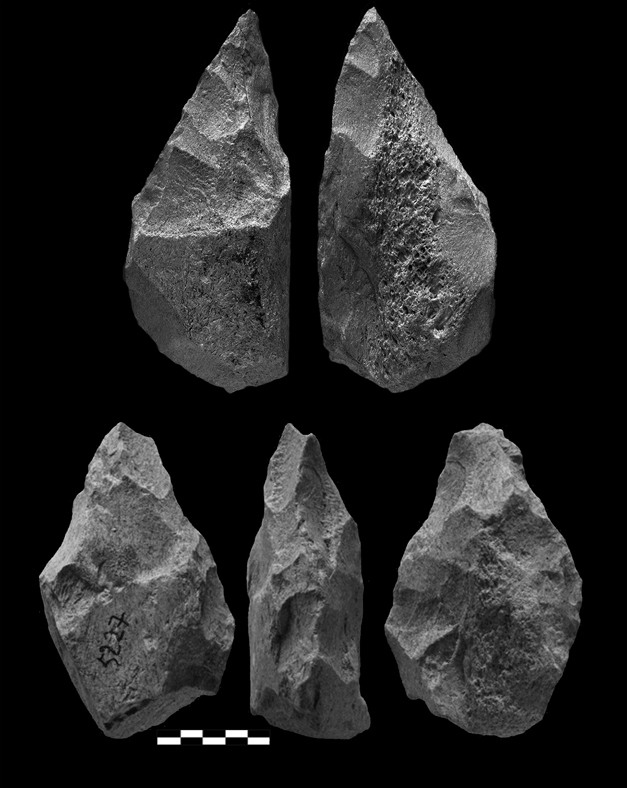
Figure 9.5 Two bone handaxes from Castel di Guido, Italy. Scale = 5cm (courtesy Giovanni Boschian).
Unequivocal ‘concept-mediated markings’ (Bednarik 1995) were equally scarce. The most discussed and disputed examples were the four engraved bones from Bilzingsleben (Mania and Mania 1988). Of these, the largest was a fragment of elephant tibia with 21 separately engraved lines arranged in two sets, one parallel and the other slightly splayed and offset, together forming a radial sunburst pattern (Figure 9.6). It was generally accepted that the marks were not from animal gnawing and were not natural, but the question of whether humans had deliberately engraved them, or whether they were the accidental by-product of using the bone as a chopping board, was a matter of opinion, although if the latter, why had hominins used the narrow side of the object and not the wider, flatter one (Bednarik 1995)? Similar uncertainties surrounded the set of fanned incisions on an elephant vertebra from Stránská skála, Czech Republic (Valoch 1987).

Figure 9.6 Concept mediated markings. Drawing of the incised elephant rib bone from Bilzinsleben, showing the radial pattern of repetitive human-made markings. The object is ~30cm in length.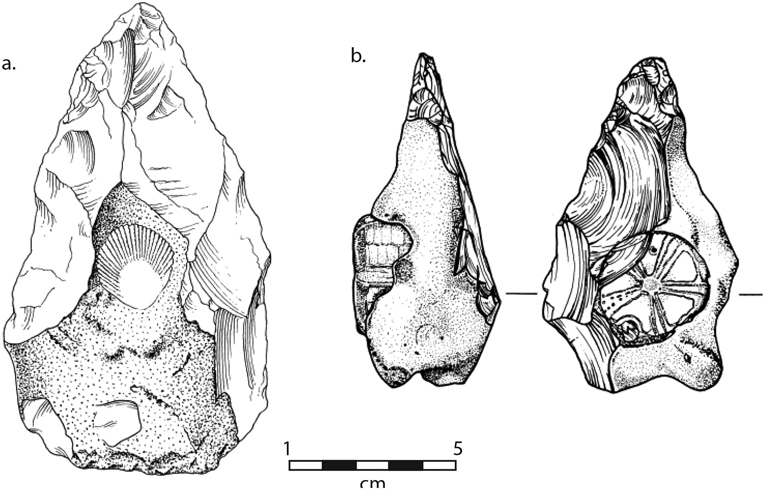
Figure 9.7 An aesthetic sense. a) handaxe with bivalve fossil preserved in the centre, from West Tofts, Cambridgeshire; b) another from Swanscombe with a fossil echinoid (after Oakley 1981 and © The Royal Society).
Claims for the use of bodily adornment in the Earlier Palaeolithic likewise depended on whether one accepted that the fragments of red and black pigments were introduced and used by humans, rather than being naturally occurring lumps. The same judgement call was required of the naturally perforated Porosphaera globularis fossils found at St Acheul and Bedfordshire in the nineteenth century and interpreted by Boucher, Lyell and Smith as beads from a necklace. Microscopic analysis by Keeley (1980, 164) and Bednarik (2005) concluded that the holes had been modified using stone tools and bore wear-patterns consistent with being worn on a string. Rigaud et al. (2009) also found the case suggestive but not conclusive. The Acheulean samples were larger than a natural control sample and showed a distinct pattern of localised abrasions along and chipping around the hole, but this could have resulted from natural or collector behaviour, rather than Acheulean humans engaged in decorating their bodies. Rigaud et al. (2009) suggested that only a new excavated sample would resolve it, but in truth even this would probably not have satisfied the deep-seated disciplinary biases that only solidified further during the 1990s.
Other than some truly outstanding and beautiful handaxes, some far too large and heavy to have been of much practical use (see Mortillet in d’Acy 1887), and the rare fossil or crystal inclusion (Oakley 1981) there was also little that could be considered to have aesthetic or artistic value in the lithic record.
The Châine Opératoire: Technology in the Humanities
French prehistorians had little time for New Archaeology. They watched from the sidelines, somewhat bemused by the processual juggernaut rampaging through Anglo-American archaeology, slowly and quietly effecting their own Palaeolithic revolution, a technological approach to artefacts known as the chaîne opératoire. As generally understood, the chaîne opératoire sought to
describe and understand all cultural transformations that a specific raw material had to go through. It is a chronological segmentation of the actions and mental processes required in the manufacture of an artefact and its maintenance in the technical system of a prehistoric group. The initial stage of the chain is raw material procurement, and the final stage is the discard of the artefact.
(Sellet 1993, 106, italics mine)
In practice, it is not dissimilar to the American concept of an operational sequence (Schiffer 1976; Toth 1985; Sellet 1993; Audouze 1999), although in aims, development and philosophy, they could not be more different.
The inspiration behind the chaîne opératoire is often traced to the theories of André Leroi-Gourhan (1964, 1965, 1993), where it sits as one of many new ideas and insights that were ‘thrown into the mix’ but never fully explored (Karlin 1992; Delages 2017, see preceding). Leroi-Gourhan (1964, 1965) certainly introduced the term, which he used on several occasions (interestingly using enchaînement and chaîne interchangeably) but as an autodidact who rarely cited his sources or inspirations, Leroi-Gourhan was tuning in to the general intellectual frequency of France in the post-war years, when similar concepts on the theme of technique were discussed by sociologist Marcel Mauss (1872–1950), botonist/anthropologist Andre-Georges Haudricourt (1911–1996), ethnographer Marcel Maget (1909–1994) and philosopher Gilbert Simondon (1924–1989), among others (Schlanger 1996; Audouze 2002; Delages 2017).
Leroi-Gourhan’s sole attempt at explaining the concept is ‘typically fuzzy’ (Audouze 1999): the chaîne opératoire forms
the link between techniques and language. Techniques are at the same time gestures and tools, organized in sequences by a true syntax which gives the operational series both their stability and their flexibility. The operational syntax is generated by memory and is born from the dialogue between the brain and the material realm.
(Leroi-Gourhan 1993, 114)
At its core lay the idea that gestures (actions or technical acts) were social products, dance being just as much a technical act as making a handaxe. Sequences of technical acts (chaînes opératoires) were embedded in memory and formed the building blocks of technology and culture. Chaînes opératoires were highly structured and socially conditioned, imprinted through immersion and repetition from a young age, until they become semi-automatic routines (White 1993). Leroi-Gourhan thus posited that it was possible to “untangle the series of actions that led to such and such form of tool… to follow the gestures, flake by flake, is to reconstruct with certainty an important part of the mental structure of the maker” (Leroi-Gourhan 1952, 82). Equally characteristically, however, Leroi-Gourhan never developed the analytical procedures necessary to realise the full potential of his ideas (Audouze 1999), even though his celebrated excavations at the Upper Palaeolithic site at Pincevent provided the ideal conditions. In the opinion of Randolph White (1993) had such ideas been more widely known to American archaeologists, who mostly knew Leroi-Gourhan from his structuralist interpretation of western European cave art (1967), the intellectual dead-end that was the culture-function debate might well have been avoided.
Origins aside, the realisation of the chaîne opératoire in the field of prehistory owed much to the work of Jacques Tixier (1925–2018) and his technological research school in Paris. Tixier began his working life in 1948 as a schoolteacher in the town of El-Hamel, Algeria, where his boyhood interest in archaeology compelled him to explore the local area (Inizan and Roche 2018). His many discoveries included a multilevel Epipalaeolithic-Neolithic site near his workplace, from which he collected, excavated, sieved, recorded and studied abundant lithic materials (Inizan and Roches 2018). Lacking access to formal sources of information that might help him understand his findings, Tixier taught himself to knap, recreating the forms of lithic objects and, in doing so, reconstructing the technological actions that produced those forms. To break his isolation Tixier joined the Bardo Museum of Ethnography and Prehistory in Algiers, where he met museum curator and Professor at the local university, Lionel Balout (1907–1992). Balout was impressed with Tixier’s detailed observational skills, so involved him in the organisation of the second Pan-African Congress on Prehistory and by 1953 had arranged for him to transfer to Algiers, where Tixier helped to re-organise the museum’s collections and install its new laboratory, the Centre de Recherches Anthropologiques, Préhistoriques et Ethnologiques (CRAPE). Tixier soon began his PhD under Balout’s supervision and by 1955 had left school teaching for a role at the CNRS (LA 150). He returned to France for the summers, where he worked with François Bordes, chatting, knapping and learning the niceties of the système.
Balout’s (1953) discussion of the intelligence of prehistoric humans, using the archaeo-logical record as a gauge of how and when our cognition evolved beyond instinct to understanding and reason, shows the technological direction the two men were taking. For Balout, the importance of the knapping experiments of Bordes, Coutier, Leakey, Tixier and others was not the replica artefact, but the way it was made, glimpsing, through the gestures of the hand, “the reasoning, the association of ideas, the abstract notions they revealed; in short, the creative spirit at work, the mind in action” (Balout 1953, 243). Techniques were basic experiences that we shared with our Palaeolithic ancestors and the regular ‘harmonious’ shapes of Acheulean handaxes, the indisputable quest for symmetry, the lightness of touch and knowledge they demonstrated aroused admiration and cast a ‘surprising light’ on the intelligence of humans before Neanderthals.
Tixier’s (1956) technological classification of cleavers, a form he deemed to be almost exclusively confined to the Acheulean, was another early sign of the shape of things to come (Figure 9.8). The manufacture of the cleaver was
governed by a leading principle of obtaining a terminal cutting edge…. This cutting edge is… devoid of any intentional retouch [and] is the result of the intersection of two planes: that of the fracture face and one of the planes of the upper face, which is the very definition of a flake tool…. The removal of the flake whereby the cutting edge of the future tool is prepared is, from a cognitive viewpoint, a fundamental operation in the manufacture of a cleaver.
(Tixier 1956, 914–923)
The cleaver blank was thus strongly predetermined, often produced using Levallois, Victoria West, Tabelbala-Tachengit or Kombewa methods. The sides and butt were sometimes made more regular through retouch, but the tip was rarely if ever modified. What made a cleaver was not the shaping but the predetermination; the function of shaping was entirely related to enhance balance and appearance, and was inversely proportionate to the degree of predetermination. Cleavers looked deceptively simple but were made through an elaborate and efficient conceptual scheme (Inizan et al. 1999). Bifacial tools with a broad terminal edge created by shaping, retouch or by terminal tranchet removals were not cleavers at all, just handaxes with transverse cutting edges (cf. Roe 1968b; White 2006, which simply reinforced Inizan et al.’s (1999) point that despite having been clearly defined in the 1950s, cleavers are still heavily misinterpreted).
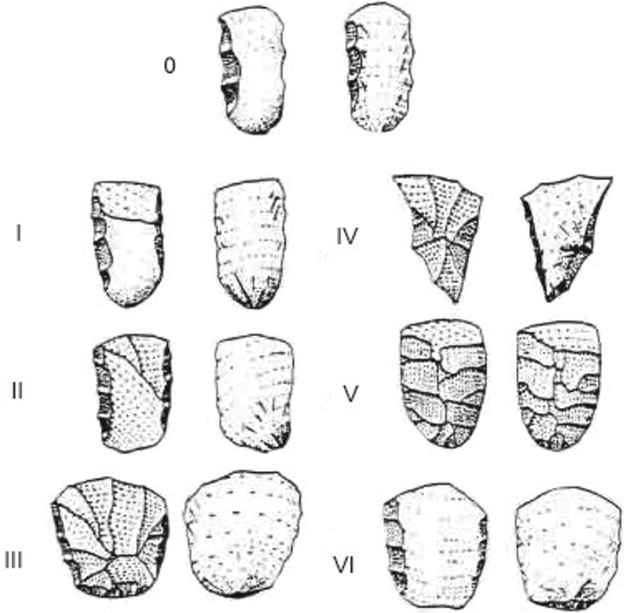
Figure 9.8 Technological variations on the cleaver. 0) on a cortical flake with cleaver edge produced by intersection of the cortical dorsal and ventral faces; I) on a cortical flake, but with the cleaver edge created by the intersection of a prior removal from the dorsal and the ventral face; II) on an ordinary flake; III) on a Levallois flake; IV) on a Tabelbala-Tachengit type flake with both sides configured prior to the removal of the cleaver blank, without retouch; V) with invasive retouch; VI) on a Kombewa flake (after Tixier 1956).
In 1962, Tixier followed Balout to Paris, where the former continued his work for the CNRS while the latter took up a specially created Chair of Prehistory at the Muséum national d’Histoire naturelle. Both were located in the IPH in Paris, since Boule’s death in 1946 under the directorship of Henri Vallois (1889–1981: Balout would succeed him in 1973). Between 1964 and 1978, Tixier conducted fieldwork in the Dordogne, at Jebel Irhoud in Morocco and at Ksar Akil in Lebanon, expanding his chronological and geographical range, while a meeting with American knapper Donald Crabtree at an experimental technology conference in Les Eyzies in 1964, introduced him to a new technique, pressure flaking (Inizan and Roche 2018). Papers for the Wenner-Gren conference at Burg-Wartenstein, Austria (July–August 1965), called to discuss issues of conception, definition and terminology,11 further showcased their developing thinking on lithics. In his discussion of the Lower Palaeolithic of North Africa, Balout (1967, 704) called for a dynamic morphology, “the gestures accomplished by the prehistoric artisan, from the raw material to the finished product”, and distinguished between technique, the means used to knap stone (hard hammer, soft hammer, punch), and methods, the “reasoned succession of technical gestures” behind the making of an artefact. Tixier’s (1967) examination of the Middle to Epipalaeolithic of North Africa drew the same distinctions, noting that Levallois should not be called a technique because technique does not translate to a chain of concepts; the reasoned chain of processes involved in Levallois was a method. Formal typologies were retained, and Bordes systems applied, but Tixier’s focus was on technologies and he insisted that typologies should not be functional but should be founded on the sequence of actions performed by the prehistoric craftsman, who gave different intentional form to the tools.
By the end of the 1970s, Tixier and the young team of researchers at the CNRS laboratory (by then known as LA 184) had become disillusioned by the dehumanising (that word again) effects of French typological methods, which seldom went beyond percentages and graphs. In his state thesis, an award that finally allowed him to supervise his own students, Tixier (1978) moved further away from Bordes (whose death in 1981 broke his 30-years’ hold over French prehistory) and presented a more fully realised technological approach. Tixier’s approach explicitly sought to understand how tools were made, rather than the more vexing question of why they were made. When a dispute with Balout saw him driven out of LA 184 in 1979, a new CNRS laboratory was created for him (URA 28 Prehistory and Technology, then ERA 28). It was here that Tixier and his team, which included Hélène Roche, Marie-Louise Inizan, Michèle Reudron and Eric Boëda, founded the French technological school of prehistory, and developed an operational approach to the chaîne opératoire (Inizan and Roche 2018).
In May 1979 Tixier organised a round-table at his new research centre to bring together select and mostly like-minded researchers to discuss lithic technology; it was attended by Catherine Perlès, Lillian Meignen and Belgian prehistorians Marcel Otte and Daniel Cohen, among others (Tixier 1980). The following year saw the publication of the first volume (of five) of Préhistoire de la Pierre taillée, dealing with technology and terminology (Tixier et al. 1980). A second meeting to discuss advances in microwear studies was hosted by Daniel Cahen at Teuveren, Belgium in 1981 (Cahen 1982) followed by a third meeting on blades and pressure flaking at URA 28 in 1982 (published as the second volume of Préhistoire de la Pierre taillée, Tixier 1984). At the same time, archaeologists were beginning to assimilate complementary ideas emerging from the fields of ethnography and anthropology (Delages 2017), which enriched the theoretical basis even further (e.g. Lemonnier 1983; Pelegrin et al. 1988: for further reading on the various intellectual roots of the chaîne opératoire, see Delages 2017).
For Tixier and his ‘disciples’ (Brun-Richalens and Potin 2018) the essential fact about an artefact was that it was made and used by a human being and preserved a concrete record of the manual and cognitive steps used to transform a block of stone into a stone tool (Brun-Richalens and Potin 2018, 224). Each lithic object constituted a project, involving a conceptual scheme implemented through an operational scheme, from initial procurement of raw material, through all stages of manufacture and use, to final discard (Figure 9.9, Table 9.7). Chaînes opératoires thus captured well-rehearsed series of operations that “transformed a raw material from its natural state to a manufactured state… made with actions on matter, preparatory phases and phases of rest” (Lemonnier 1980, 8). Chaînes opératoires were built upon both connaissances (knowledge) and savoir-faires (know-how, skill) drawn from declarative and procedural memory respectively. Knowledge involved the mental representations of forms and materials, and a “register of action modalities”, mental links between sequences of action and their results. Know-how was concerned with practical operations (skills): ideational know-how dealing with spatial and sequential transformations, mental assessments of the current situation and of the outcome of any intended action; and motor know-how corresponding to the execution of an action based on muscular control and dexterity (Lemonnier 1980; Pelegrin 1990, 1993). The transmission of knowledge and know-how involved learning, not individual learning but learning that could only have taken place in the context of the social group, by interactions between individuals (Inizan et al. 1999). All technical acts were social and cultural acts.

Figure 9.9 The mind and body in action: the organisation of a single chaîne opératoire, showing the relationship between conceptual and operative schemes, knowledge and know-how (skills), and techniques and methods (based on information in Inizan et al. 1999, 15).
|
Table 9.7 Means of achieving a chaîne opératoire (after Pelegrin 1990). |
|||
|
Knowledge (Cognaissance), Composed of |
Know-How (Savoire Faire), Existing as |
||
|
|
|||
|
Mental representations |
Of ideal forms |
A conceptual know-how |
Which organises actions |
|
Of raw materials |
Which evaluates actions and results at every step |
||
|
Concepts |
Of ideal forms |
A psycho-motor know-how |
For programming gestures and actions |
|
Of raw materials |
|||
|
A catalogue of actions and gestures |
With their practical consequences |
||
At the heart of the technological approach was the notion that the biography of an arte-fact could be ‘read’ from the scars of creation preserved on its surface in historical order. The skilled lithic analyst could thus not only recreate the series of actions used to produce a lithic object, blow by blow, but could also infer the decisions and thoughts (psychomotor processes) behind them, the obstacles encountered, the choices made and the reasons for success or failure. This required strong experimental foundations but refitting groups of artefacts also took on a new significance, offering fine-grained reconstructions of real prehistoric sequences that showed the Palaeolithic mind and body in action (cf. Schlanger 1996; Bergman and Roberts 1988; Bergman et al. 1990; Cziesla et al. 1990). They were certainly more than a cheap ‘gee-whiz’ thrill for the lithic fetishist (cf. Mithen 1998). Indeed, early studies by Daniel Cahen (Cahen et al. 1979) showed that refitting offered many opportunities for studying chronological, technological and typological issues, but that its greatest interest lay in following the movement of artefacts through their lives, determining where the material was obtained, where they were made, used and finally lost or rejected. This was a route into understanding how humans and objects moved in social contexts through space and time, although most of the early studies were focussed on the generally better-preserved records provided by the Middle and Upper Palaeolithic (Cahen et al. 1979; papers in Cziesla et al. 1990; Pigeot 1990; Bergman and Roberts 1988; Bergman et al. 1990; Roebroeks and Hennekens 1990; Schlanger 1996).
It was apparent, however, that further experiments, refitting analyses and technological readings of lithic artefacts would only end in “an almost infinite number of solutions”, which did not help in understanding the rationale behind Earlier Palaeolithic artefacts (Audouze 1999, 172). This prompted researchers such as Jean-Michel Geneste and Eric Boëda to pursue generalisations, built around the technological logic and geometric principles that governed lithic production sequences (Boëda 1986; Geneste 1991). When applied to handaxes and Levallois, these studies provided an entirely new conceptualisation of these artefacts, and another new lexicon (Boëda 1982, 1986, 1994, 1995, 1997; Boëda et al. 1990).
In Boëda’s view, Lower and Middle Palaeolithic technology was structured around two overarching systems of lithic production: débitage (knapping to produce flakes) and façonnage (knapping to produce shapes), each of which subsumed different methods and techniques (as defined earlier). Such divisions had obviously long been in use, but in an “abusively exclusive” way (Boëda et al. 1990, 45). Böeda et al. (1990) identified several different operational chains, the most significant of which were:
1. Systems of Façonnage
o 1.1) Pebble-tool chaînes opératoires
o 1.2) Bifacial chaînes opératoires
2. Systems of Débitage
o 2.1) Levallois chaînes opératoires
o 2.2) Discoidal chaînes opératoires
o 2.3) Quina chaînes opératoires
o 2.4) Mixed production chaînes opératoires: flakes, blades, points
3. Trifacial chaînes opératoires
In bifacial chaînes opératoires, the handaxe and the cleaver were the two main objects sought. They were produced by two operating schemes, which differed in their volumetric approach. In the first the handaxe was a tool shaped from a pebble or nodule though successive phases of reduction, each of which shared the same volumetric conception: two non-hierarchical surfaces (i.e. both may act interchangeably as a flaking surface or a striking surface) that were convex and symmetrical with respect to their secant and sagittal planes of intersection (see Figure 9.10). In the second conception the handaxe was produced on a flake or flat tablet, which formed a ‘support for a bifacial tool’. Instead of continuous, if staged, reduction to a volume of flint, this scheme involved a mixture of initial debitage and later shaping, the volumetric conception in the later phase consisting of two hierarchical surfaces which were not symmetrical in their secant place, rather one was convex and the other flat (i.e. the classic plano-convex handaxes from Wolvercote and La Micoque). The secant plane merged with the flat surface. A flat surface was difficult to produce, certainly harder than a convex one, and this was the reason many began as a flat piece of flint or a large flake. Tixier’s techno-morphological classification of cleavers was a perfect example of a bifacial support for tools, in this case produced by mixed series of flaking methods followed by limited shaping (débitage followed by façonnage). When analysing bifacial sequences, it was vital to understand the characteristics of the raw materials, its flaking properties, accessibility, transportability (and in what forms) and morphology. In some cases, humans carefully selected natural forms to facilitate the desired form, in others they were simply indifferent. Whatever methods were used, both bifacial chaînes opératoires might involve hard hammer or soft hammer techniques, exclusively or in combination.
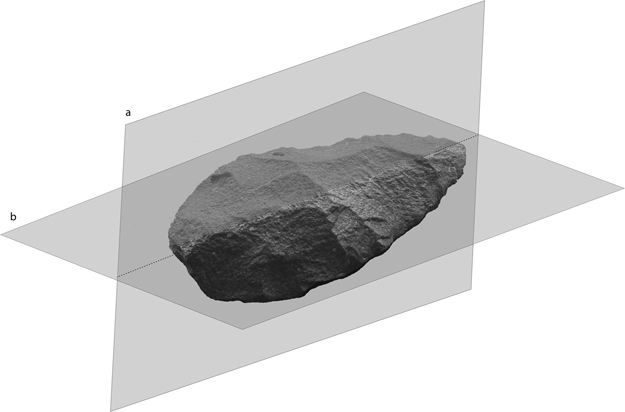
Figure 9.10 The bifacial volumetric concept showing bifacial (a) and bilateral (b) planes of intersection on a handaxe (based on Boëda et al. 1990).
As we have seen throughout this book, the definition of Levallois had always been somewhat sketchy, with Bordes’s famous (1950a) formulation, that Levallois flakes were predetermined by special preparation, often serving as a vague standard. Here the shaping of the core was simply a necessary preliminary stage in manufacturing a flake of predetermined shape and size, which might be a point, a blade or flake depending on the precise method of preparation. Levallois products were both standardised and variable, and open to significant misunderstanding and misidentification. Levallois-like flakes could be produced by different unrelated means–through handaxe manufacture for example (Callow 1986b)–and any two analysts rarely agreed on which objects were Levallois products and which were not, even in the same assemblages (Perpére 1986). Boëda’s technological analysis of Levallois, taking a volumetric and geometric perspective, was in all respects truly transformational. Boëda conceived of Levallois as a way of managing the volume of the core in order to exploit one of its surfaces. He identified six technical and geometrical principles that absolutely underwrite Levallois production (Figure 9.11).
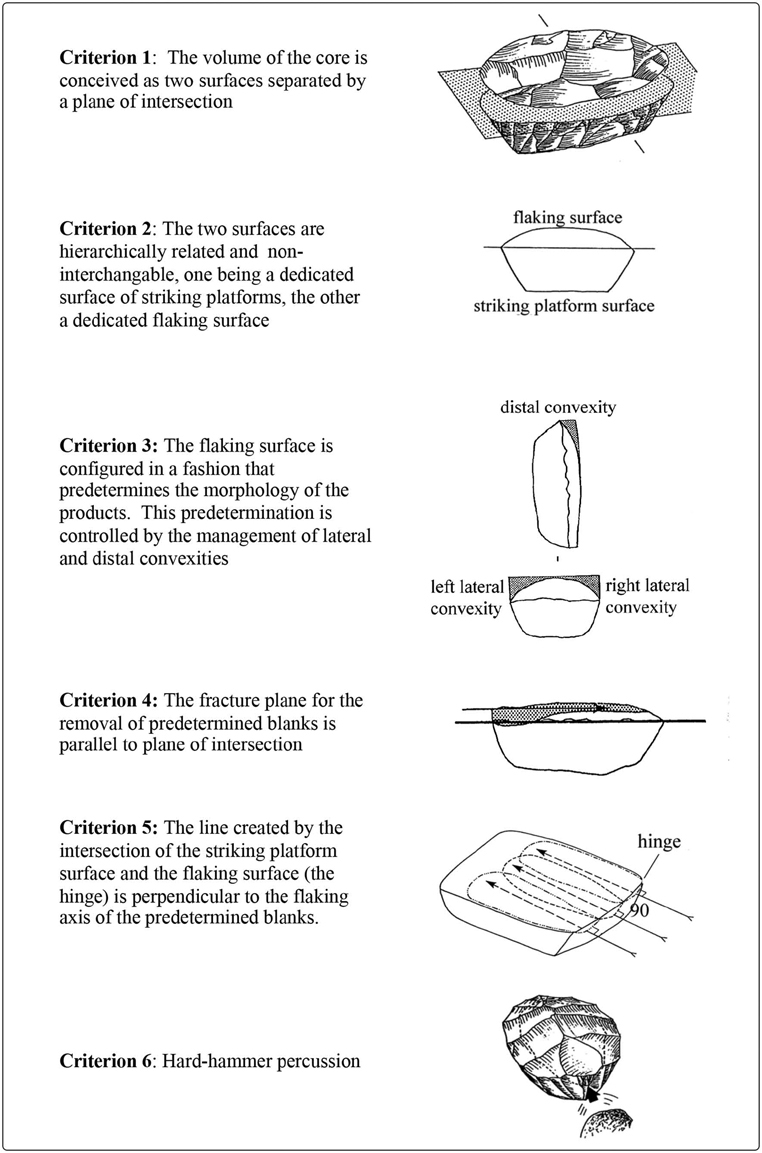
Figure 9.11 The Levallois volumetric concept (after Boëda 1986).
This scheme emphasised technology above typology and refined the range of methods subsumed within Levallois. It recognised two principal modes of execution: recurrent, in which there is more than one ‘privileged’ removal per prepared flaking surface; and lineal, in which each prepared flaking surface produces only one preferential removal, which could be achieved using a variety of preparatory methods (centripetal, convergent, unipolar or bipolar) depending on the intended mode of exploitation (see Figure 9.12). This approach also showed that Levallois was not a wasteful technology that required a huge nodule to produce a single flake, but allowed for flaking surfaces to be re-prepared and re-exploited over several cycles. Tixier et al.’s (1980) demonstration that handaxes did not take several hours to make burst a similar myth (Coutier’s demonstrations having fallen from memory). A good knapper could make a very respectable example, using a soft hammer, in about 15 minutes, a scraper was the work of seconds. Boëda was less concerned with the notion of predetermination, because within the technological framework all knapping products were to some extent predetermined by human action and choices, and it was implicit in the technological definition that Levallois flakes were more predetermined than most. Boëda and colleagues were not interested in fossiles directeurs, but chaînes directeurs, culturally diagnostic reduction sequences (Shott 2003). By unravelling these sequences, they argued, it was possible to understand the maker’s intentions and decisions.

Figure 9.12 Different methods of exploitation within the Levallois concept. Two early Middle Palaeolithic cores from Britain, both conforming to the Levallois concept but showing different modes of exploitation of the flaking surface. In Boëda’s terms these are lineal preferential (left) and recurrent Levallois cores (right).
Unleashing the Chaîne Opératoire
By the early 1990s the chaîne opératoire approach was becoming de rigueur among French researchers, regardless of whether they came from the Bordes, Tixier or Leroi-Gourhan schools (Audouze 1999). It was, as Schlanger (1994) observed, a distinctly French approach that emerged from two separate yet cognate intellectual traditions–the technological experiments of French archaeologists and the technological theories of French anthropologists. Yet very similar ‘sequence models’ were being used elsewhere and had been for decades (Bleed 2001; Shott 2003), Bradley’s analysis of the nineteenth-century collections from Caddington (Sampson 1978), Toth’s (1985) work on the Oldowan at Koobi Fora, and Chris Bergman and Mark Roberts’s preliminary analysis of the newly excavated material from Boxgrove, England (Roberts 1986; Bergman and Roberts 1988; Bergman et al. 1990), being prime examples, but there was one key difference. In the processual world outside of the French technological school, neither artefacts or technical acts were automatically assumed to have social or cultural significance. Such an assumption might be acceptable for the Upper Palaeolithic, on which the majority of refitting studies were based (e.g. Cahen et al. 1979; papers in Cziesla et al. 1990; Pigeot 1990) and which had been made by modern humans who could be assumed to have been physically and cognitively identical to us, but it could not be extended into the Lower and Middle Palaeolithic. The cultural and social significance of an object had to be demonstrated (tested) by eliminating all other factors that could have produced the same result, such as raw materials, function and re-sharpening. Removing this assumption, however, turned the sequence models into little more than an analytical grid (cf. Audouze 2002), reductive operational sequences to be read in a step-wise fashion, rather than an elegant and nuanced tool for reading the deep past in more human terms.
A few notable exceptions will show what could be achieved if these biases were set aside. Under the supervision of Paul Mellars at the University of Cambridge, French archaeolo-gist Nathan Schlanger (1996) took an explicitly technological and cognitive approach to a 250,000-year-old refitting Levallois sequence from Site C at Maastrict-Belvedére, Netherlands (known as ‘Marjorie’s Core’). Of 145 flakes belonging to the same raw material unit, 41 could be refitted, nine of which were Levallois and 32 non-Levallois. None belonged to the initial decortication phase of working, suggesting that the core had been introduced to the knapping area in a partly dressed state (Roebroeks 1989), where it was further worked by six separate Levallois reduction episodes. The Levallois flakes were less variable than the non-Levallois flakes, and their size did not decrease markedly, even as the core itself got smaller. The knapper had worked in a fashion that had allowed relatively consistent products, in terms of shape and size, and had used both recurrent and preferential methods, each of which was available to them as different options. Schlanger (1996, 248) concluded that the Leval-lois chaîne opératoire formed an overarching principle, providing an “enabling image in the course of situated action that set the knapper’s” objectives and incorporated the visual and tactile cues for progression. But it was not a static representation, with any errors faithfully corrected to return to the original plan, but a fluid one that could react and adjust to events as they unfolded. It was neither fully responsive or adventitious nor fully controlled by an inviolable series and pattern of removals. Rather, Levallois cores were worked out in the hand, at the interface between the material and mental activities of the Levallois flintknapper (Schlanger 1996, 248). There was little to justify the opinion that pre-modern humans were limited in their capacity to plan, that they were not rational, conscious beings, or to argue that raw materials or other technological constraints controlled human action.
At the Hebrew University in Jerusalem, Naama Goren-Inbar (1988) applied a chaîne opératoire approach inspired by Boëda, Pelegrin and Geneste to study planning and decision-making processes in the Lower and Middle Palaeolithic of Israel. She concluded that both were recognisable as early as ‘Ubeidiya (now dated to 1.4 ma BP; Tchernov 1987), as demonstrated in the use of three different types of raw material to produce different tools, in a manner that was neither random nor the result of trial and error. The methods of manufacture were consistent through time, the only ‘random’ element being size, probably a reflection of the range of locally available materials. That certain rock types were used for specific things showed a deliberate choice; that this practice persisted through time showed it was informed by tradition. This was also true at the Middle Pleistocene site at Gesher Benet Ya’aqov, where in Layer V a single socially preferred material–basalt–was used for all tool types.
Despite early optimism, a strong PR campaign and a generally positive reception in many places, including Britain, the chaîne opératoire is yet to be globally ‘unleashed’ (Schlanger 1994; Pettitt 2003). Language barriers aside, and regardless of the fact that the empirical application of the chaîne opératoire followed methods almost identical to the reduction sequence models commonplace in North American (Shott 2003) and Japanese archaeology (Bleed 2001), there were underlying and fundamental epistemological differences.
American technologist Michael Shott (2003, 100) was entirely unconvinced by the chaîne opératoire, which he grumpily observed had really only replaced ‘essential tools’ with ‘essential ways to make tools’, both invoking “the concept of essences bounded in time and space that mark traditions, whether they be phylogenies or cultures”. It was unrealistic to presume that all members of a culture would have reduced lithic objects using an invariant pattern of working, regardless of material quality and abundance and other circumstantial factors. Bar-Yosef (1991) thought the chaîne opératore basically had the same aims as traditional culture history.
Even the question of whether lithic reduction was ‘staged’ (i.e. conceived by the makers as a series of discrete stages) was in question, an assumption common to both the French and American concepts, was moot. Refitting handaxe reduction sequences at Boxgrove showed no clear distinction between thinning and finishing, which were part of a seamless continuum of production (Austin 1994). Experiments also suggested that the Boxgrove knappers had used soft (bone or antler) hammers throughout reduction (Wenban-Smith 1989), although American knappers were less confident that it was possible to distinguish between flakes produced with soft-hammer and those produced with a cortical hard-hammer or any marginal blow (Mewhinney 1964; Bradley and Sampson 1986).
Shott pointed out that the idea that only one method would be represented in an assemblage (Boëda 1994), unless different methods were adopted for different purposes or the knapper was diverted by a flaw or error, was also not what was seen in the archaeological record, where a single core might show different methods of manufacture as knapping progressed. Stages of reduction were another analytical convenience, not a statement of prehistoric fact (Shott 2003). The practice of dividing non-refitting flakes according to their position in the reduction sequence was equally fraught with difficulties and again assumed only one mode of reduction at any given site. The evidence from cores and core tools, if not part of a refitting group, preserved evidence only of the last phases of an implement’s manufacture, far too abstracted to draw concrete conclusions about reduction sequences or the knappers’ intentions (Van Peer 1992). Indeed as Sellet (1993) noted in an otherwise unequivocal endorsement of the chaîne opératoire approach, it was these ideational issues, particularly the question of intent, that formed the greatest obstacle to wider adoption. All reduction sequence approaches required the lithic specialist to make some assumptions about the intentions and decisions of the maker (Shott 2003), but the default assumption of the French models, that everything was ultimately cultural, ignored all other possibilities and assumed a modern human level of cognition. In treating a knapping sequence as a set of internally generated, goal-orientated actions leading to a predetermined result, the chaîne opératoire could legitimately be labelled ‘teleological’ (Bleed 2001). This stood in contrast to sequence models elsewhere, which emphasised the situational context and the diversity that resulted from external factors. In the US, UK and other processually inclined countries, it was important to eliminate all other possibilities before making any cultural or cognitive assumptions.
Tostevin (2011) argued that the contrasts between sequence models reflected the different high-level theoretical frameworks behind them, which affected how low-level theory (basic observations and measurements, data) and middle-level theory (connecting observations to behavioural processes, bridging arguments) were used. Chaîne opératoire approaches focussed on high-level ‘emic’ processes (from within the social group, techno-psychological) that could be read using inductive and inferential reasoning using ideas drawn from different French intellectual traditions, while processual approaches were more concerned with ‘etic’ factors (external to the social group) and deductive reasoning, with high-level theory drawn from evolutionary ecology. I think he is largely right in this contention. It is not just that people are not listening to each other, speaking in different languages or using different nouveau jargon for the same processes (Sackett 1991; Shott 2003), but that they are not thinking about the past in the same ways or interested in the same questions. The past is many different foreign countries, depending on where you started, though some destinations are still more popular than others.
Styles of Style
While culture sat at the very core of French technology, the Anglophone world of processual archaeology was having a hard time finding it at all. Here, most approaches to Palaeolithic stone tools were not holistic but atomistic, quantitively breaking assemblages into types and types into attributes then statistically ‘measuring the truth out of them’, in sharp contrast to the wilfully qualitative analyses of French technologists, a small but significant rebellion against Bordes’s statistical approach. In Britain and America many Palaeolithic archaeologists, explicitly or otherwise, frequently adopted a rather literal form of Glynn Isaac’s stepwise approach12 (e.g. Isaac 1984), which in itself was a specific reformulation of Christopher Hawkes’s famous ladder of inference (Hawkes 1954; Evans 1998). The basic steps are worth repeating verbatim (Isaac 1984, 40):
1. Ascertain which characteristics of an assemblage are accounted for simply by the application of least-effort flaking procedures, given the particular forms of the raw material used. Differences attributable directly to the simplest ways of flaking different raw materials do not enter into higher-order interpretation.
2. Residual differences not accountable for in Step 1 can then be checked for being attributable to economy of effort in fetching replacement raw materials from a source that is not immediately to hand (e.g. intensive working-down of cores, repeated resharpening retouch, etc.).
3. Remaining variance, if any, can now be checked for interpretable connection to specific activities. That is, one would look for reduction in variance among members of sets that are grouped according to context variables such as palaeogeographic location, and amount and characteristics of associated bones. Such an apparent association becomes an activity facies [i.e. functional] hypothesis to be tested in other ways.
4. If there is any significant residual variance unaccounted for after step 3, the possibility can be entertained that it is due to arbitrary cultural differences of a stylistic nature.
One immediate problem, other than the fact that unaccounted variance was almost never deemed significant enough to warrant much attention, was how to define style. Sackett (1977, 1982, 1985, 1986, 1990) noted that archaeologists tended to use style as an “omnibus word… to carry several different meanings to several different destinations over the landscape of their research” (1977, 369). For Sackett himself, style was generally identified as formal patterning in the archaeological record–specific artefact forms or technological practices–that was delimited to a particular place and time, and which was not dictated by more mundane concerns. Sackett argued that such style could be active, reflecting the consciously expressed identity of the makers, arbitrary ‘indexical’ traits that groups employed to distinguish themselves from others. Or it could be passive, unintentional style that was not a deliberate sign of social identity, but which emerged as the outcome of the craft traditions within which individuals were enculturated, simply by virtue of being part of a social group. Sackett also distinguished between adjunct style, attributes that had no direct functional purpose (such as decoration) and isochrestic style, which referred to differences in the form of functionally equivalent artefacts (different ways to skin a cat) and which reflected choices made by individuals and groups that were just as socially bounded as styles of decoration. None of these were easy to differentiate archaeologically (Chase 1991), but that was immaterial: style of all kinds was an almost inevitable consequence of living in groups. There was no need for a dichotomy between style and function, a position that put Sackett closer to the French technologists and culture historians than the processual approach. In another important essay based on her work with the Kalahari San, Wiessner (1983, 256) defined style as the “formal variation in material culture that transmitted information about personal and social identity”. This could be assertive (sending messages about personal identity) or emblemic (sending messages about group identity).
Style also had a mental dimension and was central to many archaeological discussions of symbolism, based on the notion that as both were essentially arbitrary, they should reveal similar cognitive structures. Chase (1991) largely agreed with Sackett, arguing that style could provide an index of a particular group of people in the past, identified on the basis of manufacturing choices that transcended functional, technological or material constraints. But it need not indicate indexical or any other type of symbolism. Style would indicate symbolism only if it could be shown to have been active in Sackett’s sense, that humans had intended to send a message. This was practically impossible to identify using lithic artefacts, where the idea of style was largely for the archaeologist’s own convenience. Binford (1986, 1989b) rejected Sackett’s definitions of style, resenting the perceived slight that his processual agenda recognised (or was interested in) only active style.
Intrinsically linked to these discussions was the idea that artefact style represented the physical manifestations of thought, a form held in the mind of the maker. In other words, artefacts style derived from a mental template, an idea/l in the maker’s mind’s-eye about the proper form of an artefact and how to make it, an idea/l informed by function, technology, raw materials and culture, as famously formulated by Deetz (1967). The execution of the mental template obviously depended on several other factors, the nature of the available materials and the skill of the maker for instance, but behind this variation lay the same culturally shared idea of what an artefact should look like. Deetz probably hoped that caveat was self-evident and the definition uncontroversial, and it may well have been for archaeologists working on modern humans of the Holocene period, but when applied to the Lower and Middle Palaeolithic, cultural tradition was not an element of past social systems that could be so easily assumed. It had to be demonstrated, by eliminating all other explanations.
For many workers of the 1990s onwards the mental template thus became a synonym for normative variation based on social tradition. There were differing expectations for what the presence/absence of a mental template might indicate in terms of cognition (Wynn 2002), symbolism (Mellars 1996; Monnier 2006), language (Dibble 1989; Davidson and Noble 1993), or socially imposed norms (Dibble 1989; McNabb et al. 2004), but in most cases its recognition depended on demonstrating high levels of standardisation in selected aspects of artefact shape and size (Dibble 1989; Chase 2008). This conflated two separate issues, stan-dardisation of process and standardisation of product, as Marks et al. (2001) pointed out, and turned the mental template into an entirely cognitive issue, making the simple equation that more highly standardised artefacts = clearer mental templates = more cognitively advanced makers = a greater chance that artefacts were symbolically active (cf. Chase 2008). Lower Palaeolithic hominins didn’t stand a chance.
Just-So Stories in Stone
As a PhD student under Arthur Jelinek at Arizona, Harold Dibble (1951–2018) had focussed his research on the ‘Frison Effect’, the impact of continuous modification and resharpening on the form of stone tools. This had led him to propose a radical new interpretation of the classic problem of Mousterian variability, a debate that had stalled at the crossroads of culture (Bordes), function (Binford) and time (Mellars).
Dibble (1987) argued that the morphology of a tool changed throughout its use-life, as it was repeatedly resharpened and maintained. So, while Bordes’s scraper types might appear to be discrete categories, they were in fact just different points in the life of the same tool, comparable to the differences between a new pencil as opposed to a resharpened stub. Dibble argued that depending on the character of the initial flake blank, a number of predictable reduction patterns could be identified. Single scrapers then worked on the other edge would become double scrapers, and if further worked until the retouch joined at the proximal end, would become convergent forms. If resharpening focussed solely on one margin and the proximal end, intensive resharpening would produce transverse and offset scraper types. Thus, rather than representing desired target forms that remained static from manufacture to discard, artefact form was dynamic. The character of each assemblage depended on the intensity of reduction that had been deemed possible or required, given the circumstances. Consequently, Bordes’s Mousterian variants, largely constructed on the percentage frequency of different tool types, were not functional and certainly not cultural but resulted from differential reduction intensity in different places and at different times, a very basic technological consideration. This was, in turn, related to a nexus of other mundane non-cultural factors such as duration of occupation, climate and raw material availability (Dibble 1987, 1991; Rolland and Dibble 1990; Dibble and Rolland 1992; Dibble 1995).
At the agenda-setting Human Revolution Conference, held in Cambridge (England) in March 1987 (Mellars and Stringer 1989), Dibble extended this line of reasoning to handaxes and Levallois. Dibble argued that the existence of natural categories of handaxe shape had been near impossible to demonstrate, and that typologies such as Bordes’s partitioned a continuum of variation (cf. Alimen and Vignal 1952; Isaac 1977a). The strong relationship between handaxe width and length (where regression analysis showed a 90% correlation), as identified by Gowlett (1984; Crompton and Gowlett 1993; Gowlett and Crompton 1994) showed that handaxe form was not random, but this did not necessarily demand forethought or an arbitrary conscious standard. If handaxes were truly arbitrary, one would expect differences between regions and continents, not monotonous sameness. They were probably related to basic technological constraints for length/width or even methods of classification: 100 random, computer-generated measurements, with the solitary stipulation that one dimension could not exceed three times that of the other, produced a non-random correlation of 0.609 (i.e. 60%). By adding a second stipulation–that the longest measurement always had to be length–this figure rose to 0.866. The apparent standardisation in handaxes was not therefore a sure-fire indicator of mental templates.
Dibble (1989, 424ff) also questioned the notion that Levallois flakes were predetermined target forms. If Levallois flakes were predetermined, Dibble argued, then we should expect them to be more standardised in shape and size than flakes produced by non-Levallois core working or handaxe manufacture. In an analysis of four attributes (length, width, thickness and surface area) from 8,700 Levallois, handaxe thinning and ‘normal’ flakes from Combe Grenal, Orgnac II and Pech de L’Aze, Dibble argued this was simply not the case. Levallois was not a method designed to allow a mental template to be realised, but one that allowed many flakes to be produced. The size factor varied according to site, and presumably the size of the raw material, rather than time or assemblage type. “Standardization, or reduction of variability can be explained on the basis of raw material or technology, without having to suppose the presence” of rules (1989, 425).
The influence of raw materials on handaxe size and shape was not a new idea, but whereas earlier workers either took the view that actual shape was a compromise between what was desirable and what was possible (see Pelegrin 1990) or that traditions developed around local raw materials (e.g. Clark 1975 or any French technologist), it was now perceived as a more deterministic constraint. In an analysis of DOB and Early Acheulean assemblages from Bed II at Olduvai, plus handaxes from Sterkfontein that had at times been classed as both (Leakey 1971; Mason 1962), Stiles (1979, 1981) concluded that different raw materials, not different cultures, were responsible for the observed differences. The dominant material used in the DOB was quartz, whereas the Acheulean was predominantly made on lava. This would also explain why large-flake bifaces were restricted to the Acheulean: it was not that the makers of the DOB were a different species or a backwards group who were incapable of making large flakes, but that quartz did not come in packages large enough to produce them. This probably related to site location, and conformed to Hay’s observation that in Olduvai Bed II Oldowan sites were found at the lake margin, whereas Acheulean sites were found ‘inland’ (Leakey 1975; Hay 1976). Likewise, the Karari industry (Isaac and Harris) was a regional variant of the DOA (Stiles 1981). Jones (1979, 1994) made a similar point about variation within the Acheulean at Olduvai, noting that the brittleness, durability and friability of different materials required different levels of working, which produced a false impression of crudeness or sophistication of manufacture.
At the >700,000 year-old Acheulean site at Kilombe, where artefacts were spread horizontally over 14,000m2, Gowlett (1988) noted the presence of a distinct group of small, irregular handaxes among otherwise Acheulean industries dominated by well-made, flake-based handaxes and cleavers. This could not be attributed to different raw materials–trachite and phonolyte lavas had been used for both groups–and nor was it likely that they represented different cultures. Gowlett (1988) wondered whether they might have been needed for different functions or actions, or whether the Acheulean and DOB showed different degrees of planning: bifaces in the former made on flakes specially struck for the purpose, the DOB-type handaxes from immediately available lumps in a more ad hoc fashion. Their co-occurrence in the same assemblages at Kilombe but separation at Olduvai was probably related to the duration of occupation, both accumulating at more intensively used sites but perhaps only DOB at expediently used locations. There was no evidence that two different traditions coexisted in Africa about one and a half million years ago, just a heterogenous landscape.
Paola Villa (1983) reached similar conclusions in Europe. There was a geological case for an Older Acheulean (e.g. Terra Amata, Ambrona, Arago, Pech de l’Aze II), characterised by hard-hammer technique, chunky flake tools with steep retouch and both coarse and well-made handaxes, and a case for a Late Acheulean (Lazeret, Combe Grenal, Bouheben), with frequent use of soft-hammer, fine regular flake tools and a wide range of handaxe forms. Shorter trends were difficult to determine, however, and regional variation was not as diagnostic as Bordes or others had implied (see Chapter 7). Variability in the Northern Acheulean had been underestimated, the popular impression based on old and biased collections with irregular forms apparently absent only because they had not been kept, studied or displayed. More recent excavations at Cagny la Garenne and Cagny l’Epinette (Tuffreau 1980a, 1980b) had produced numerous irregular forms. Much regional variation could be accounted for by the technological requirements of different raw materials–quartzite in the Tarn basin, limestone in Provence, flint in the Dordogne and quartz in the Languedoc (Villa 1983, 268).
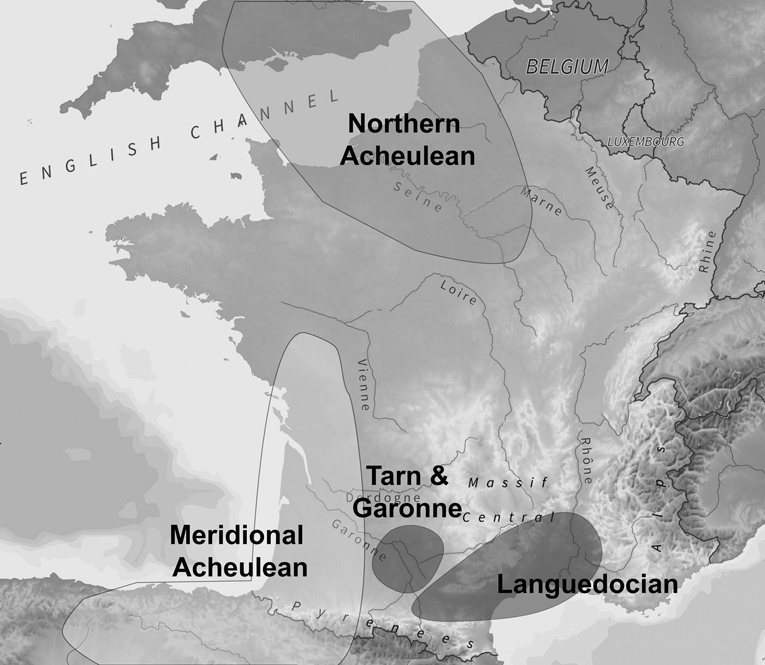
Figure 9.13 Cultural geography or cultural petrology? Map of western Europe showing some of the regional variants of the Lower Palaeolithic. These were argued by Bordes (e.g. 1968) to represent regional traditions, and by Villa (1983) to reflect local raw materials (after Villa 1983).
The presence of flake cleavers in the Meridional Acheulean and their absence from the Northern Acheulean (Bordes 1971) was equally dependant on raw materials according to Villa’s new analysis. Cleavers were mostly made on quartzite, basalt, limestone or silicified sandstone, rocks that occurred as outcrops or large boulders that supported the production of large flakes. Flint nodules required greater preparation to remove the soft crumbly cortex, and many were too small to produce large flakes without Levallois preparation, which only appeared in significant frequency in the Late Acheulean.
A slightly different story emerged from Villa’s surveys of the Lower Palaeolithic of the Iberian Peninsula, once again largely unfamiliar to non-Spanish or Portuguese archaeologists (Santonja and Villa 1990). The sites were too poorly dated and sparsely distributed for Santonja and Villa to detect chronologically distinctive industries or artefacts, leaving only broad chronological trends. The evidence for a non-handaxe Lower Pleistocene occupation was weak. Humans with handaxes had first appeared during the Middle Pleistocene, the earliest industries (Pinedo, La Maya III) from the upper terraces of the principal river basins containing irregular hard-hammer bifaces, pebble tools, simple flake tools and no use of the Levallois technique. A later phase, as found in the middle terraces of these rivers, showed more regular handaxes and cleavers, elegant flake tools and the frequent use of soft-hammer and Levallois technology. A final phase was marked by well-made classical handaxe types, cleavers made on Kombewa or Levallois and the use of trihedral picks. It was unclear if these patterns were strictly linear because there were too many uncertainties, but in general the typological and technological character of Iberian Lower Palaeolithic record was ‘profoundly influenced’ by two factors–the location of sites on the banks of rivers and the use of quartz and quartzite as raw materials. The end of the Lower Palaeolithic was marked not by the emergence of Levallois but the disappearance of handaxes, which occurred just before the end of the Middle Pleistocene.
Jelinek (1977) had reached the same conclusions regarding Levantine and African handaxes: those made on rock types common to both regions were largely indistinguishable, whereas those on flint, found only in the Levant, were different. Irregular flint handaxes were also very common in southern Britain (Wymer 1968, 1985), the northern limit of the Northern Acheulean. Moving further north and west again, beyond the flint rich Chalklands, artefacts became sparse and were made on a range of non-flint materials, which had a marked effect on artefact morphology and the ease with which collectors would recognise them, as John Evans (1897) had observed 100 years earlier. Newcomer (1984), Aldhouse-Green (1995; Green 1988) and Moloney (1988) all noted how the use of hard-to-flake coarse-grained rocks in Wales, the Midlands and the Southwest had led to less refined implements that closely followed the shape of the original blank. The site of Wolvercote, in the flint-poor landscapes of Oxfordshire, had been assigned on the basis of its plano-convex flint handaxes to its own unique group (Roe’s Group III, cf. Micoquian), but it also contained a lesser-known series of quartzite handaxes that took an entirely different form (Roe 1968a; Tyldesley 1986). As the same group of hominins had presumably produced both series, the effects of raw materials on handaxe form were incontestable.
In experiments using raw materials from Caddington, Bedfordshire, Bradley and Sampson (1986) noted that when using a single material–flint–the shape and internal quality of the nodule imposed constraints on the knapper’s technological choices, which influenced the final shape of the artefact. Three clusters of refitting flakes and handaxes from Worthington Smith’s (1894) Palaeolithic Floor at Pit C, Caddington (Bedfordshire) showed that prehistoric knappers had faced and sometimes solved the same problems. From their reading of the technology, Bradley and Sampson (Sampson 1978) argued that the clusters were the work of three different knappers whose visits, if not actually at the same time, were separated by no more than weeks: they were likely contemporaries in life (Sampson 1978, 146). Knapper C was described as an experienced craftsman who made good flint choices (largely selecting easy to work tabular pieces) and made few mistakes, but they were not a ‘master craftsman’. Of six attempts, one failed due to end-shock at a late stage,13 and another showed lack of judgement in raw material selection and was abandoned. Knapper A1 was also experienced. They successfully fashioned a ‘closely matched set’ of fine, small, pointed handaxes on tabular flint, two of which end-shocked at a late stage. Knapper Ab was still a beginner. Poor nodule choice and lack of technique led to frequent failures, many of which were followed by ‘stubborn’ attempts to continue. Only one half-finished handaxe was taken from the knapping area. Knappers C and A1 dropped their failures where they happened, showing emotional restraint commensurate perhaps with age and experience, while Ab hurled their broken halves downslope in what would seem to be frustration. In terms of style, Knapper A1 made signature small ovates with a pointed tip, decently made but not outstanding, while Knapper C preferred round-ended ovate forms and used tranchet removals to prepare a transverse cleaver edge on some. Knapper A1 failed to finish a single handaxe, making their products difficult to classify, and it is probable that they would in any case be excluded from any study of handaxe shape because they are incomplete.
The sad truth, then, is that most of our individual moments were moments of failure. Absolute beginners may thus be under-represented in archaeological analyses either because they are broken or would not be classed as finished. Even among these three knappers there was a lot more to handaxe variation than a rigid mental template.
Bordes would not have been dismayed by these conclusions. Modern eyes were used to seeing absolute uniformity in manufactured goods and were so dazzled by variation that they failed to appreciate the truly remarkable degree of similarity (Bordes 1969). As an experienced knapper, Bordes understood how hard it was to achieve a high degree of standardisation. It would have required a long apprenticeship to master, and the record would naturally be full of failures and partial successes created by the young and hapless. The ‘masterpieces of prehistory’ were the marque of a master craftsman (Bordes 1969, 5). Bordes drew a distinction between intelligence and creative intelligence, the latter depending on the number of people in a population. If change was slow in prehistory it was not necessarily because hominins had been slow-minded, he argued, but because the restricted social scale of human interaction meant that novel traits emerged only rarely and were unlikely to spread widely.
Modelling the Mundane
The wider application of new dating frameworks, increasingly based on biostratigraphical and lithostratigraphical correlations with the marine isotope curve (see Chapter 8) initially failed to produce the long-awaited “orderly and predictable pattern of variation” (Roe 1981, 270) in the British Lower and Middle Palaeolithic record. The finely made ovate handaxes from Boxgrove and High Lodge were shown not to be late expressions of the Acheulean, but among the oldest in Europe, belonging to the MIS 13, the Cromerian Interglacial (Roberts 1990; Ashton et al. 1992a). The sediments at High Lodge and other East Anglian localities (e.g. Warren Hill) had been laid down by the extinct Bytham River, which had once flowed from Wales through the Midlands and East Anglia to the North Sea, and which had been destroyed by the MIS 12 (Anglian) Ice sheet, the same ice sheet which had diverted the river Thames into its current course (Bridgland 1994). Ovates were also found at the much later sites of Hoxne (at this point tentatively dated by AAR to MIS 9, Bowen et al. 1989) and Baker’s Hole, while assemblages belonging to Roe’s Pointed Handaxe Tradition spanned a similarly vast time period. These new dates led Wymer (1988) to emphatically conclude that Acheulean handaxe typology was not an indicator of age, an opinion he held until the end of his life. They also rendered the famous scraper assemblage from High Lodge, which some still regarded as a Middle Palaeolithic expression of the Clactonian (Roe 1981), even more anomalous, and meant that the Clactonian could no longer be considered the earliest occupation of Britain (Wymer 1988).
A new generation of British Palaeolithic archaeologists, led by Nick Ashton at the British Museum and John McNabb and Mark Roberts at UCL, took a technological approach to the problem. This led them, for a while, to abandon the historically loaded term ‘handaxe’ and adopt the neutral technological descriptor of ‘biface’ common in America and France, although this carried its own problems; not all handaxes were bifacial, and not all bifaces were handaxes, as John Wymer neatly summarised it (MJW pers comm, 1996). Nevertheless, in an analysis of nine assemblages, representing five of Roe’s handaxe groups,14 Ashton and McNabb (1994) suggested that a key cause of variation in the British Acheulean related to the degree to which different flint packages had affected the actions of the knapper. Using the position of residual cortex and natural surfaces on bifaces to reconstruct the dimensions and shape of the original nodule, they found that many pointed bifaces were made on thick and elongated blanks that guided the hand of the knapper along a path of least resistance (i.e. Isaac’s least effort flaking), whereas many ovates and cordiforms were produced on large nodules or flakes, onto which the knapper was free to impose whatever shape they desired. Ashton and McNabb concluded that humans were guided not by a socially defined mental template for a specific shape, but by a generalised mental construct of a functional tool that was bifacially worked, had sharp durable edges and a basic level of symmetry (1994, 187). Morphological variation existed because different blank types either facilitated or demanded different technological approaches to the realisation of this construct.
Building on this work for my own PhD, I noted a correlation between the dominant handaxe form–and the sources of raw material at 23 sites (White 1995, 1996, 1998a). Roe’s pointed tradition assemblages were almost always manufactured on smaller nodules and cobbles from derived raw material sources, such as fluvial and glacio-fluvial gravels. The ovate tradition assemblages, by contrast, were made on large nodules of fresh flint from primary Chalk out-crops and clay-with-flints. Where no immediate source of raw materials existed, such as Wansunt Pit and the Foxhall Road Grey Clay assemblage, ovates tended to dominate, suggesting that when faced with decisions about curation and transport, hominins preferentially carried well-made, highly functional tools, or the blanks to make them. Where exceptions to this pattern existed, such as the use of fresh chalk flint in the point dominated assemblage from Cuxton in Kent (Shaw and White 2003) and Red Barns in Hampshire (Wenban-Smith et al. 2000), the character of the particular resource used–burrow flint at Cuxton (Figure 9.14) and frost-riddled nodules from Red Barns (Gamble and Apsimon 1986; contra Wenban-Smith et al. 2000)–provided adequate explanations for the departure from the expected pattern.
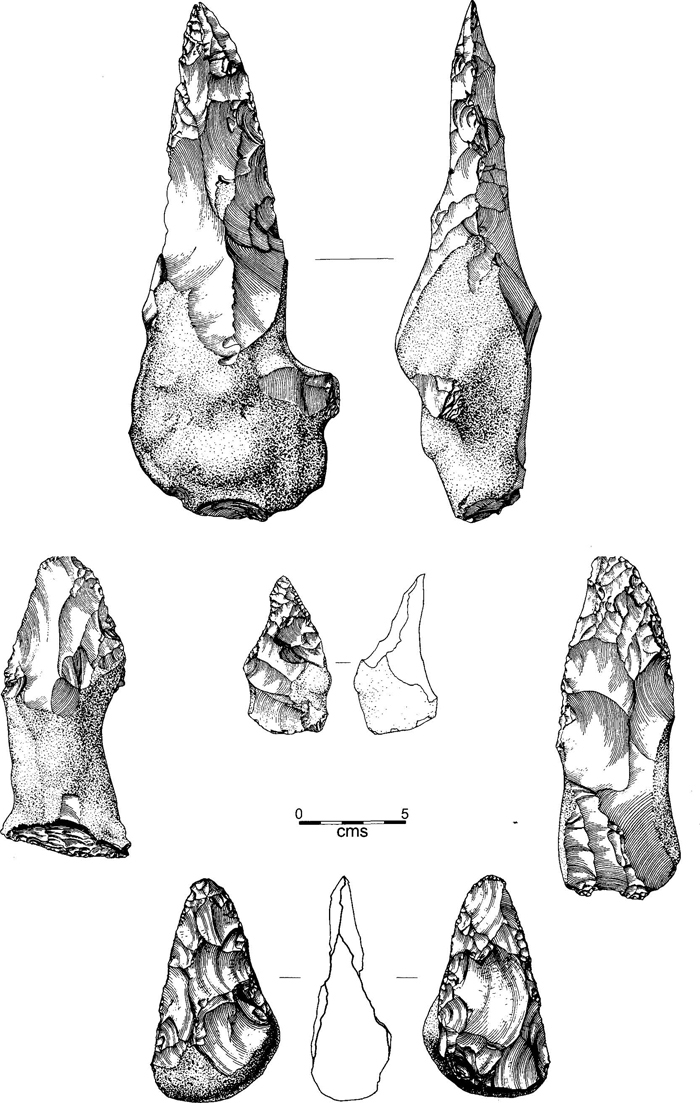
Figure 9.14 Form follows form. A series of handaxes from Cuxton, Kent (after Tester 1965), showing the influence of blank choice on bifacial technology and handmade form. Ashton and McNabb (1994) and White (1998a) considered these to be ‘constrained’; French technologists just saw careful selection with a shape in mind.
Changing raw materials through time also had a structuring effect on the types of handaxes produced (White 1998a). At Swanscombe, the makers of the point dominated Middle Gravel industries had access to raw material directly from the river beach (Wymer 1964), the diminutive size of many of the handaxes reflecting the size of the clasts within the gravels. However, the ovate industry in the Upper Loams, as well as at the nearby sites of Bowman’s Lodge and Wansunt Pit, were produced after these gravels had been concealed by metres of fine-grained deposits, cutting off the previous source of raw material. Hominins therefore came to the locales equipped with finished ovates or suitable blanks. The reverse is seen at Foxhall Road, Ipswich, where an imported ovate industry on top of the Grey Clay was replaced by a locally made point dominated industry following the emplacement of the Red Gravel (White and Plunkett 2004).
So, when unrestrained by the shape and size of raw materials, hominins produced ovate handaxes. White (1996, 1998a) offered two possible reasons why this might have been the case. The first viewed handaxes through the lens of optimal foraging theory (Torrence 1989). As a class of objects, handaxes had long been thought of as multipurpose tools that prepared hominins for many eventualities (Keeley 1980) or simply as effective butchery knives (Mitchell 1996), which paid dividends on the time and energy spent in locating, transporting and working suitable raw materials into a handaxe15 by speeding up food processing and reducing the risk of loss (Mitchell 1996; White 1998a, cf. Potts 1984). Emphasis was also placed on their ergonomic shape, robustness, transportability and ease of resharpening, making them comfortable to hold, versatile, reliable and maintainable (Bleed 1986; Ohel 1987; McPherron 1994; Mitchell 1996). As ovate handaxes usually possessed an all-round cutting edge and a centre of gravity that allowed the tool to be rotated during use, to access new edges and in a sweeping motion whilst cutting (cf. Mitchell 1996), they might be considered the more optimal form, offering functional and operational advantages. Pointed handaxes on the other hand had sharp edges to the lateral margins and tip, with the butt acting mostly to maintain good balance in the hand. Rotation and a gentle sweeping motion were barely possible, with pointed forms more suited instead to the sawing motion used in modern steel knives (Mitchell 1996). Variation was therefore directly linked to economy of effort and efficiency of use, by making the best of what was closest at hand, rather than taking the time, energy and bother to transport materials that might have supported a more optimal form.
The second possibility was that ovate handaxes naturally emerged from the mental concept, the inevitable result of complete circumferential knapping aimed at maximising edge and resharpening potential, socially learnt ‘rhythms of making’ uncompromised by raw material considerations. In both, the rule systems that created the strong allometric relationship between length and width and between size and thickness (Crompton and Gowlett 1993; Gowlett and Crompton 1994) were explained by simple mechanical requirements. Assuming that handaxes had been tools and had been used in the hand, then they clearly had to be of a shape and weight suitable for the user. Longer handaxes were relatively narrower than shorter ones because larger egg or disc-shaped handaxes would be unwieldy and poorly balanced. Similarly, large bifaces tended to be relatively thinner in order to minimise weight. They might show evidence for mathematical manipulations, but they were probably worked out in the hand, not in the head.
A model very similar in spirit if not in mechanisms was developed by Shannon McPherron, a research student working under the supervision of Harold Dibble at the University of Pennsylvania, who extended the reduction models to handaxe form (1994, 1999, 2006). McPherron argued that when the bifacial edge of a handaxe dulled it was resharpened, and this produced predictable effects on several key aspects of handaxe morphology.
McPherron proposed that since functional edges must be assumed to be more important than shape, resharpening would have focussed on the longest arc of usable edge–the tip. This created differential reduction to the tip length (and therefore total length) and had major effects on the typologically key variables of elongation (i.e. length/width), refinement (thickness/width) and shape. The butt was expected to see minimal reworking. Further, by assuming that raw materials at a site were of a constant size and shape, McPherron argued that the sequence of resharpening would follow a regular pattern with predictable changes to the highlighted aspects of shape:
1. All handaxes began their use-life as elongated pointed forms with long tips and poor levels of metrical refinement.
2. Through resharpening, these were gradually transformed into smaller and less elongated cordiforms and ovates, with shorter tips and higher refinement.
3. The ultimate stages of resharpening saw the handaxe become a discoid, at which time refinement may decrease, although the piece should display equal butt-tip length and very low elongation.
This process is summarised in Figure 9.15.
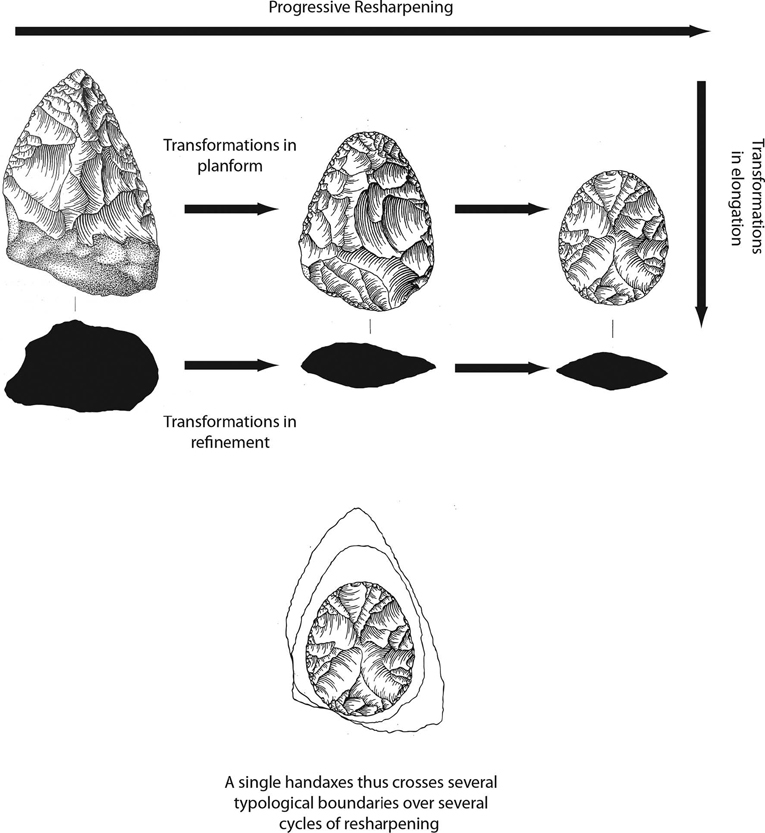
Figure 9.15 McPherron’s resharpening model for Acheulean bifaces (after Pettitt and White 2012, modified after McPherron 1994).
Tested against handaxes from 22 British sites,16 White (1996; Ashton and White 2003) found that the predicted pattern of change in elongation, refinement and shape predicted by McPherron’s model was barely evident. This was not to say that resharpening was not occurring. Evidence from Boxgrove (Austin 1994) showed that handaxes were sometimes resharpened on the move, and several British sites contain recycled patinated or stained handaxes, showing that on occasion old handaxes were picked up, resharpened and reused (White 1996). It means that the regular and routine sequence of resharpening cannot be found, probably because the assumption that raw materials were of a constant shape and size is unfounded and that handaxes started life in different sizes and forms. Resharpening was almost certainly happening and probably had some effect on handaxe shape and size, it was just not predictable and consequently very hard to measure.
Resharpening might, however, provide an explanation for the rare bifacial cleaver (White 2006), which metrically and technologically appeared to represent other forms of handaxes which had been reworked with a transverse tranchet removal. This technical act had two effects: in some cases it created a genuine cleaver bit; and in all cases it preferentially removed material from the tip, producing an unavoidable increase in relative butt size and decrease in relative tip length, thus producing a cleaver type in Roe’s terms (cf. McPherron 1994). They were not cleavers at all, according to Tixier’s definition; although there were a few classic cleavers in north-west Europe, produced serendipitously on large flakes.
Lamotte’s (2001) study of handaxes from the MIS 9 site at Cagny L’Epinnette (Somme, France), also found a strong link between raw material and handaxe morphology. The quality of material had strongly influenced the intensity to which a nodule was reduced (if it was chosen at all), while nodule shape and size had affected the geometry of the final biface. Functional requirements had also been an important consideration, but there was no evidence of a progressive change in shape as a result of resharpening. However, Lamotte diverged from White, Ashton and McNabb in regarding careful nodule selection as an important part of the manufacturing process, blanks chosen because they could fulfil the desired goal, rather than being picked up at random and worked in whatever fashion was easiest.
At the very extreme end of these positivist models sat the ‘Finished Artefact Fallacy’ championed by Iain Davidson (Davidson 1991; Davidson and Noble 1993; Davidson 2002). Most of the archaeologists discussed previously would probably agree that the precise form of a handaxe might vary according to many circumstantial factors, without the need to invoke ethnic identity or cultural lineages, but the basic idea of the handaxe, as a distinct class of implement, must have been understood and transmitted between individuals. They were just too consistent across time and space for it to have been otherwise, although of course, they could have been repeatedly reinvented, as suggested by the fact that the earliest occupants of Europe and the Levant seemed to have temporarily abandoned handaxes on their way out of Africa (Toth and Schick 1993). Davidson, on the other hand, thought that this showed only the ingenuity of archaeologists to find patterns.
Davidson argued that handaxes were simply cores, used to detach flakes in a bifacial manner from two intersecting margins. The handaxe form was not an imposed design, but the natural outcome of basic techniques learnt by observation and imitation, a “by-product of stereotyped motor patterns” (Davidson 1991, 42) that required and demonstrated no greater planning or forethought than the next flake, rather like a chimpanzee cracking nuts. Davidson noted that at Olorgesailie new work led by Rick Potts (1989) had shown that handaxe manufacturing flakes had been used in butchery activities, and some bifaces were just so large that they could not easily be picked up. They were nothing more than cores dumped in large numbers close to sources of material. Similarly, the elegant tranchet removals on the handaxes at Boxgrove did not signify, for Davidson, that these were well-designed specialist tools, but that bifacial cores had been repurposed to produce tranchet flakes (Davidson 1991). Strong support for this contention apparently came from a non-flint handaxe from Slindon (a site located in lateral continuation of the deposits at Boxgrove), held in the Archaeology and Anthropology Museum at Cambridge, which Davidson (1997) saw as proof that handaxes were transported as sources of flakes.
While the models of Stiles, Villa, McPherron, Ashton, McNabb, White and others largely rejected the idea that handaxes assemblages contained active cultural patterning–and one might even be justified in suggesting that by adopting concepts such as the mental construct or continuous resharpening, they had removed the step where residua were even sought–they did at least try to present Lower Palaeolithic humans in an positive light (or at least that is what we told ourselves). Instead of being slaves to tradition, hominins were cast as knowledgeable actors engaging intelligently and flexibly with the vagaries of a heterogeneous environment. They were equipped with a set of socially acquired practical skills that could be transferred to a range of different situations; a hominin who at one site made a pointed form because of raw material considerations, would at another have been equipped with the knowledge and skill to make an ovate. To varying degrees they were flexible, adaptive and intelligent. White (1996, 1998a, 1998b) even considered the possibility that particular characteristics, such as tranchet removals, the burin-like removals on pointed handaxes at Whitlingham, Norfolk, and twisted ovate handaxes might be local stylistic markers, in the passive sense.
The finished artefact fallacy, on the other hand, marked a something of a new nadir in interpretations of the handaxe makers, making their behaviour not that much more remarkable than that of the honeybee. Despite name-checking anthropological notions of techniques, it abandoned one essential point: that techniques are social facts. It also displayed a rather cavalier disregard for the Lower Palaeolithic record, ignoring the microwear evidence and the dozens of examples of semi-complete knapping sequences, including ones where the handaxes had been broken during manufacture and been left at the site, and those where nests of unused flakes sat untouched while the handaxes had been taken away, as at Boxgrove. The logic behind the argument that an igneous-rock handaxe from Slinden conclusively supported the notion that handaxes were cores has always escaped me–it would show only that handaxes were mobile, not what they were used for–but regardless, the object in Cambridge is not made of an igneous rock but is a green-coloured plaster cast of a flint handaxe held in the British Museum.
To misappropriate a quote from American essayist John Burroughs (1837–1921), for many Anglo-American workers of the 1980s and 1990s “there were no sermons in stones, it was easier to get a spark out of a stone than a moral” (Burroughs 1912). Sadly, Acheulean hominins seemed not even able to do that–in a well-received, forensic review of human fire-use in the Lower and Middle Pleistocene, James (1989) argued that at the most well-known examples across Asia, Africa, Europe and the Levant, the evidence for fire was tenuous at best. Palaeolithic humans lived in a cold, cybernetic wasteland devoid of social meaning (cf. Mithen 1991).
Still, very few people were convinced when the idea that handaxes were projectiles was resurrected (again without reference to the nineteenth-century French drubbings), even if it was this time backed up by experimental and psychological data (O’Brien 1981; Calvin 1993). There were far simpler solutions for braining a baboon.
Enigma Variations
The fashion for extremely negative, almost robotic interpretations of Acheulean behaviour failed to convince the more seasoned scholar, particularly European archaeologists who had spent a large part of their careers excavating, handling and studying Acheulean assemblages (Gowlett 1996). For Wynn (1995), “the handaxe enigma” could be reduced to several key issues, the matter of intention, form versus function and whether handaxes carried symbolic information that required the use of rules or verbal communication.
Wynn argued that there were several reasons for believing handaxe shape was intentional–the extensive modification, the precisely imposed bilateral symmetry that even mirrored natural edges, the complete reduction sequences and so on. He accepted that raw material size and shape would make a difference to what a knapper could produce, but the knapper still imposed shape on that material. They had options, including the option not to use it. The form of a handaxe was similarly not determined by its function (general light and heavy-duty cutting purposes)–like most functional devices, there was a range of forms that would do the same job, even in complex machines like an aeroplane (Pye 1968, 1978). There was nothing inevitable about the handaxes in technological or functional terms.
On the other hand, there were very limited reasons to suppose that handaxes carried symbolic meaning. They were not obviously icons, a direct referent to some something else, as they bore no resemblance to any object in nature, or at least one common to all the continents on which handaxes were found, nor to anything on the human body. An arbitrary or indexical meaning would now be almost impossible to reconstruct, and it was important, as Chase (1991) had done, to distinguish between two types of arbitrariness: arbitrary in the sense that humans had a choice of what shapes to impose (and chose the handaxe), and arbitrary in the sense that the handaxe shape contained an active symbolic meaning understood by both the maker and others, perhaps the identity of an individual or a community. They might have done, depending on one’s theoretical stance, but there was no conclusive proof (there never is).
Wynn further argued that the structural links between language and toolmaking were superficial, particularly in how they were learnt. Language was acquired ‘effortlessly’, whereas tools use required a long period of observation and practise to master. Tool use required the novice to learn motor-memory sequences, and have both the enabling image and the action sequences to produce it, a mental and a procedural template (Gowlett 1984, 1996). There may well have been rules but they were not syntactical or grammatical like language and they could provide no evidence either way for the existence of language. It was equally unlikely that there was a handaxe gene (Wynn 1995, 22).
Since Binford’s (1983b) observation that although much archaeological interpretation depended on social learning as an inheritance mechanism nobody had ever conducted a proper study of learning, a growing literature had developed in the fields of cognitive ethology and psychology (see also Kleindienst and Keller 1976, who examined handaxes in terms of learning of motor habits, specifically language, posture, locomotion and gestures). Theories of social learning recognised several modes of transmission, from direct imitation to goal emulation where the novice does not just copy observed motor patterns but constructs their own understanding of the goal to be achieved (Whiten and Byrne 1991; Whiten and Ham 1992). Language and verbal instruction obviously made it easier for the novice to develop this ‘inter-subjective’ understanding (Tomasello et al. 19 87), but neither was essential. It was possible to learn to make a stone tool just by watching another person, but to do this the novice had to be capable of ‘meta-representation’, the ability to see things from the model’s point of view, “to put themselves in the perspective of another” (Wynn 1995, 20), a process more commonly referred to today as a Theory of Mind. This required the novice to understand a visual perspective that was not available to them, a relatively complex cognitive task, but within the capacity of modern apes such as Kanzi, the bonobo chimpanzee that Nick Toth had taught to flake stone (Toth et al. 1993).
Handaxes required another level of complexity. The novice had to understand both the model’s perspective and conceive of what the model thought to be an acceptable end result (in terms of shape). Just copying actions would not result in the same shape–the novice had to understand what the model was trying to achieve. Whether or not this could have been achieved without language was moot, but it did demonstrate high levels of cognitive processing (Wynn 1995, 20). Drawing on the work of Canadian neuroscientist Merlin Donald, Wynn (1995) suggested that Homo erectus would have required, at the very least, a ‘mimetic’ culture based not on language or grammatical rules but on performance, ritual and prosody (patterns and rhythms). This required meta-representation, inter-subjectivity and observational learning.
If shape carried no obvious symbolic meaning, the fact that most sites showed a model form still supported the notion that shape carried passive cultural information: local ways of doing things among local groups or ‘social distance factors’ (Mellars 1996). Wynn and Tierson (1990) also found unexpected regional differences in the shapes of later Acheulean handaxes. They measured ~1,200 handaxes from 17 sites in Europe, East Africa, India and the Near East using a polar coordinate technique and compared the results using discriminant analysis and analysis of variance. African and Levantine handaxes were the most distinctive (58% and 68% being correctly attributed using discriminant analysis), but India and British examples were more heterogeneous (only 19% and 12% were correctly attributed). Analysis of handaxe shape and raw materials showed a strong correspondence, but this did not explain all the variance: nodules of two different shapes were used at three different Israeli sites to make the same forms. Rather the different shapes represented geographically distinct styles, passed on among regional groups over many generations, however subtle those differences might seem (White 1996 and McPherron 2000 predictably had different interpretations of these data, which we need not rehearse here).
Wynn’s (1995, 21) closing remarks are important enough to cite verbatim:
The handaxe makers lived in a cultural and cognitive milieu that was very different from that of the modern world. Handaxes tell us this, if nothing else. However, although they reveal little about the origin of language or other symbolic behavior, they are not entirely mute concerning the nature of this milieu. The artifacts themselves provide evidence of information processing abilities and spatial cognition, and how these evolved. The distribution and variability of handaxes provide evidence for social learning and possible cultural differences and how these evolved. When combined with evidence from neuroscience, handaxes have helped draw a very rough outline sketch of the mind and culture of Homo erectus. Nevertheless, it would be difficult to over-emphasize just how strange the handaxe is when compared to the products of modern culture. It does not fit easily into our understanding of what tools are, and its makers do not fit easily into our understanding of what humans are.
The implications of these sharply contrasting views of handaxes for our understanding of Lower Palaeolithic social structures were profound (Villa 1983). If one took the approach of Wynn, Gowlett or many Francophone archaeologists, then the Acheulean was a complex and variable group of industries (a techno-complex, after Clarke 1968) that potentially showed culturally significant chronological and geographical patterning. This would imply a closed social structure, with conservative cultural practices, and widely spaced populations separated by geographical and social barriers. Groups would have moved throughout well-established and defended territories that were stable over long time periods and in which they maintained distinct traditions of manufacture. Groups projected an active identity and saw themselves as different from the others across the river (Bordes 1968). They were cognitively highly advanced.
The alternative view denied that temporal trends or regional patterns existed, beyond those created by raw materials or context. There was nothing specialised about the Acheu-lean, which was found in cold and warm environments, in forests and on the plains, on river banks and lakesides, in swampy lowlands and hilly uplands, on the sea-shore and on the desert margins and sometimes in caves: at some point during its more than one million years of existence, the handaxe, and by extension the Acheulean, had turned up in all possible environments (Villa 1983). In this view, there were no styles or expressions of identity, social boundaries would not have been maintained and groups formed open networks. Population density was low, cognitive skills were poor and the store of cultural knowledge was largely empty.
The Clactonian Gets an ASBO 17
It took little imagination to transfer countercultural interpretations to the extended18 Clac tonian or chopper-core family of industries, terms still in use in the 1980s and 1990s in a technologically descriptive sense, but which were increasingly being replaced with Clark’s (1969) more neutral Mode I, the simplest stage in his modal classification (Isaac 1984; Toth 1985; Rolland 1992; Wymer 1999). Whatever individual authors called them, such industries still conjured up images of crude and primitive technology, which, when given the step-wise treatment, were found to be devoid of any residual social information. The classic British occurrences were a strategically decisive battleground.
As discussed in earlier chapters, there had been numerous attempts to define the Clactonian, as a cultural entity rather than a technique. These had variously invoked the use of anvils as hammers, a particular chopper/core morphology, simple scrapers and flake-tools, as well as exaggerated flaking characteristics (thick flakes, wide flaking-angles, large bulbs, etc.: Breuil 1932a; Paterson 1945; Wymer 1974), and while it was acknowledged that these were not uniquely Clactonian traits, they were thought to be more prevalent in non-handaxe assemblages (Kelley 1937; Warren 1951; Wymer 1968). Statistical and technological analyses soon brought this into doubt.
In a comparative analysis of 41 Acheulean and Clactonian assemblages from southern Britain and northern France, Ohel (1979) found no statistically significant differences in the size, technology or morphology of flakes, cores or flake tools, or even in the presence of ‘trimmers’ (thin flakes produced when shaping a core or handaxe). There were some interesting contrasts in the frequency of different tools or traits (end-scrapers, choppers and, by definition, handaxes), but these could easily have been a function of biased collection practices. As the makers of both industries had occupied similar environments, exploited similar habitats and targeted similar raw materials, there was little to suggest that they were the product of different cultural groups. Ohel concluded that the two industries were part of the same ‘parent population’ and each represented different parts of a continuous sequence of reduction occurring at separate places in the landscape, Clactonian occurrences representing preparatory workshops where handaxes were roughed-out, Acheulean sites places where handaxes were finished and used. In a separate case study, Ohel and Lechevalier (1979) used this as a model to explain the difference between two sites on the Le Havre littoral: Station sous Marine, where handaxes were supposedly absent, and Station Romain, which occurred in the same gravel deposit, yet contained abundant handaxes. They argued that blanks were prepared at the cliff collapse adjacent to Station sous Marine and then transported to Station Romain for finishing. It was a convincing explanation; for these two sites. They were part of a contiguous palaeolandscape and contained artefacts occurring in the same context, the same condition and made on flint from the same cliff collapse; further confirmation came from the small number of handaxes subsequently found at Station sous Marine (Callow, in Ohel 1979). It was, however, an idea that Hazzledene Warren had rejected in 1922, and which contemporary authorities could still not accept as an adequate explanation for the British phenomenon, which contained no evidence of handaxe manufacture (there were no thinning flakes and what Ohel interpreted as roughouts were cores), no bias towards the early stages of reduction, were not associated with high-quality sources of raw material, and did not overlap chronologically with the Acheulean (Bordes, Newcomer, Wymer, Roe and other discussants in Ohel 1979; McNabb 1992).
By the early 1990s, the chronology of the British Clactonian was looking far less secure. It could no longer be considered the earliest occupation but was temporally sandwiched between older and younger Acheulean occurrences. Furthermore, while land-sea correlations of Clactonian sites with the MIS framework had assigned the industries from Clactonon-Sea, Swanscombe and Barnham to MIS 11, those from Little Thurrock and Purfleet were younger, belonging to late MIS10 or MIS9 (Wymer 1985, 1988; Bridgland and Harding 1993; Bridgland 1994; Ashton et al. 1994a, 1994b).
John McNabb’s PhD thesis, started in the early 1980s under Mark Newcomer, focussed on a technological analysis of British Clactonian and Acheulean assemblages (McNabb 1992). Like Ohel, McNabb could find no distinctive technological differences between core and flake working in the two industries, both of which had employed a set of universal working methods, consisting of single, parallel and alternate flaking (Figure 9.16), executed on nodules of various shapes and sizes on a flake-by-flake basis. These practically exhausted the number of limited possibilities inherent in basic stone working (Rolland 1981) without recombination into specialised methods such as Levallois, and formed a technological lowest common denominator from the Oldowan to the Bronze Age. Like Breuil, McNabb saw the Clactonian as a flake industry, regarding the so-called chopper tools as cores (Ashton et al. 1992b) but found no evidence to support the use of anvil technique in the Clactonian: experimental work repeatedly showed that manual hard-hammer percussion produced Clactonian flakes more reliably and safely, whereas an anvil tended to produce wholly un-Clactonian flakes with small bulbs and flat ventral surfaces (see also Baden-Powell 1949; Warren 1951; Newcomer 1970).
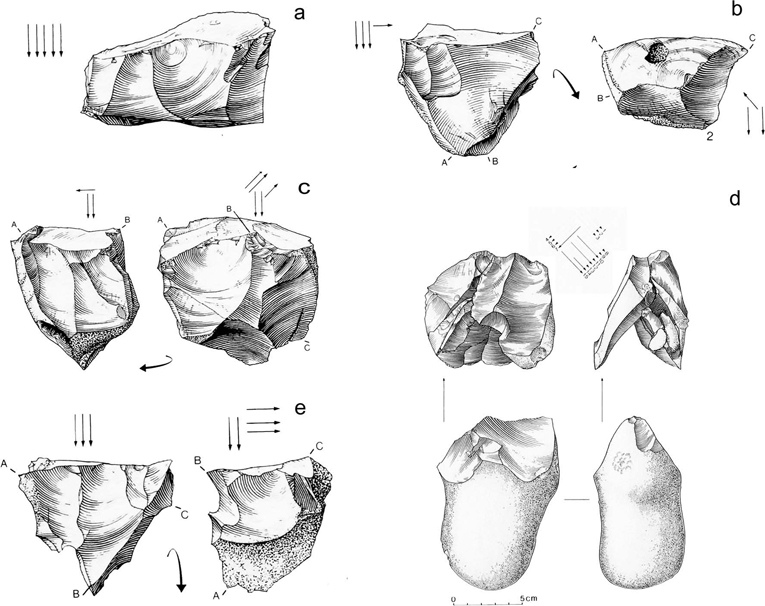
Figure 9.16 Core working techniques common to both the Clactonian and Acheulean. Arrows indicate direction and sequence of removals: a) parallel flaking; b) alternate flaking; c) alternating flaking resulting in irregular core; d) alternating flaking resulting in chopper-core; e) mixture of parallel and alternate sequences on the same core (after Ashton et al. 1992a).
McNabb therefore saw no technological or metrical basis on which to construct two cultural groups. The only difference that could be supported was typological, viz, the highly variable presence of handaxes in the Acheulean, accompanied on some sites by soft-hammer thinning flakes from handaxe manufacture; the latter furthermore were produced by a different hammer and a different technique and were not in any way comparable to hard-hammer flakes. McNabb concluded that Clactonian did not exist as a separate industrial group; it was just one end of a continuum of variation in the frequency of handaxes, which ranged from 0% to almost 100% (it is important to note here that the criterion that Acheulean assemblages must contain >40% handaxes (Leakey 1971) was never really adopted outside Africa, where a single thinning flake is still taken as evidence of an Acheulean presence).
To explain this large range, McNabb (1992; Ashton and McNabb 1994) argued that handaxes were ‘problem-solving devices’ the frequency of which reflected the frequency with which hominins encountered that problem, whatever it may have been. In some cases, the decision not to make handaxes may have been driven by local raw materials–the flint resources at the Golf Course and Jaywick Sands at Clacton, for example, were generally small and rounded, totally inadequate for handaxe manufacture. Just how locally restricted and poorly planned these technical decisions might have been was also demonstrated by new excavations at the in situ Clactonian knapping floor site at Barnham (Ashton et al. 1994a, 1994b; Ashton et al. 1998), where a small discoid biface was found in Area VI (4), located just 75m east and on the same cobble surface as Wymer’s (1985) refitting Clactonian core (Figures 9.17 and 9.18).
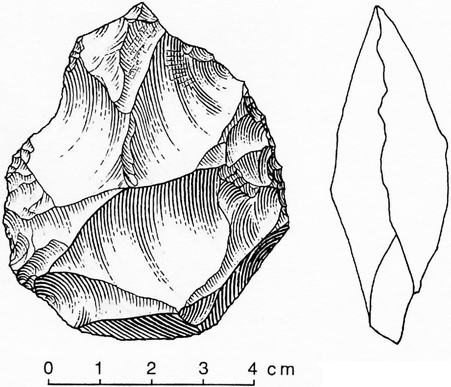
Figure 9.17 Small handaxe found by Nick Ashton’s team in Area VI(4) at Barnham, 1994.
Figure 9.18 Refitting ‘Clactonian’ core found during a small excavation by John Wymer’s team at Area 1, Barnham St Gregory, Suffolk, 1979 (after Ashton and Dean 1998).
McNabb and Ashton (1992; McNabb 1996a, 1996b; Ashton and McNabb 1994) further questioned whether the absence of handaxes in the Clactonian was real, drawing attention to several examples that had been conveniently ignored, dismissed, or classed as other tools (Warren’s crude pointed implements, for example, see Figure 9.19). They viewed handaxes as occurring within a wide continuum of variation, with classic handaxes at one end and non-classic bifaces at the other. The latter, which showed some bifacial working and shaping, might not have shown the clear imposition of form, but they were produced using the same basic principles as all other handaxes (the mental construct) and probably served the same function. They were a regular part of almost all Acheulean assemblages (in Britain being subsumed by Wymer’s Type E: small, crude bifaces), where they were usually outnumbered by classic forms, but occurred alone and usually in single figures on Clactonian ones. The activities undertaken at a location and the character of the local flint probably explained much of the variation.
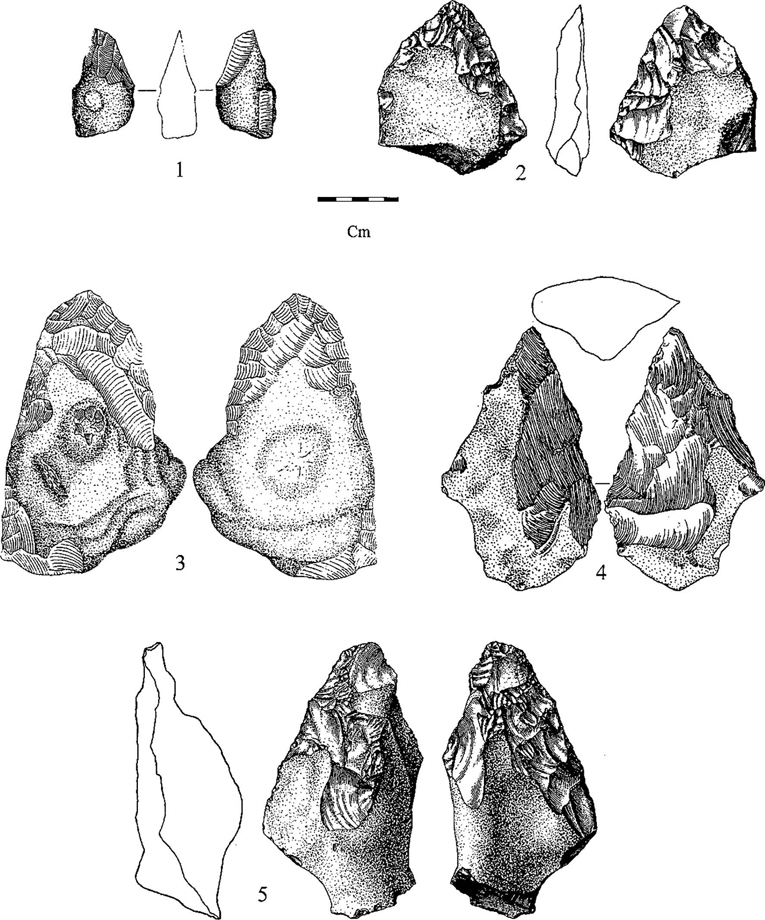
Figure 9.19 Non-classic bifaces or classic legerdemain? Non-classic bifaces from Clactonian contexts at Little Thurrock (1 and 3), Rickson’s Pit, Swanscombe (2) and the Lower Gravel at Barnfield Pit, Swanscombe (1, 3 after Conway et al. 1996, with permission LSS; 2, 5 after
Ashton and McNabb 1994, © Trustees of the British Museum; 4, after Chandler 1930).
Inspired by the work of Isaac’s team in East Africa, Ashton (1998) later developed these ideas by integrating assemblage variation into a landscape and behavioural context. Ashton’s static resource model proceeded from the assumption that Middle Pleistocene hominin behaviour was largely organised around the structure of the natural environment. Locations where valuable static resources existed would have encouraged repeated visits, resulting in palimpsest accumulations reflecting the range of activities carried out and the options presented by the materials available (in Kuhn’s 1995 terms, the means, motive and opportunity). If raw material were the prime resource being targeted, then one might expect to see high levels of waste, few formal tools and minimal imports/exports, but if another resource provided the reason for humans to gather at a location (vegetation, water, shelter, a high chance of obtaining meat by whatever means, etc.), then imported stone would have accumulated there by design or accident.
The exploitation of more unpredictable mobile resources would have required greater planning, with handaxes and other tools being introduced as single discards or in discrete activity areas that would generally escape archaeological notice. Barnham was an attractive river-side location with an abundant source of immediate raw material from a cobble beach at the water’s edge. The flint was convenient but not often suitable for handaxe manufacture, which encouraged hominins to take a less formal approach to their tools and only occasionally opt to make a handaxe, which often turned out rather small. At Elveden, another attractive location a few kilometres downstream from Barnham, humans had access to both cobble flint from the river margins and fresh Chalk flint from the river-bank, which they used to produce flakes from cores and a large number of handaxes (~100 handaxes are known). The difference then, was not cultural but captured two expressions of the same behavioural repertoire tailored to local circumstances. The presence of handaxes in the brickearth above the Clactonian floor at Barnham was just the same groups adapting to new circumstances: as the cobble band was now concealed, later humans had brought handaxes and other tools from other places. It captured the spirit of the times and I, for one, was (temporarily) convinced.
At a regional level, different raw materials could also explain the technology and absence of handaxes in the Lower Palaeolithic of Central and Eastern Europe (McBurney 1950; White 2000). Non-handaxe assemblages in this region fell into two categories: 1) Lower Palaeolithic ‘micro-lithic’ industries characterised by the use of small flint pebbles that had been ‘smashed’ to make informal miniaturised tools (Svoboda 1987, 1989), sometimes accompanied by large quartzite choppers, as seen at Bilzingsleben (Mania and Weber 1986; Mania 1995), Schöningen (Thieme and Reinhard 1990; Mania 1995) and Vértesszöllös (Vértes 1965); and 2) heavy-duty tool kits with larger flakes, Toepfer’s central European Clactonian, as found at Wallendorf and Wangen (Toepfer 1961, 1968). Where handaxes did occur, they tended to be accompanied by a Mode 3 or Levallois type technology, and were younger in age (e.g. Markkleeberg, Grahmann 1955; Mania and Baumann 1980).
Rolland (1998) argued that these industries had developed in response to local circumstances, and one could either regard them as culturally distinct ‘non-Acheulean Mode II’ or an atypical variant of an elastic Acheulean. As the prevalent view held that only one morphologically variable type of hominin was present in Europe during this period–Homo heidelbergensis (Roberts et al. 1994; Roebroeks and Kolfschoten 1994, 1995)–Rolland argued that the second option was the more plausible. This implied that a common knapping repertoire had been shared by all Middle Pleistocene Europeans, an Acheulean stock, which had been variously expressed according to context and situation: they were local responses rather than local traditions. These responses might have subsequently been transmitted from individual to individual, as part of local practice, or re-invented by different populations faced with the same problems, but they were ultimately part of a single European repertoire shared by open but geographically isolated networks. There were no cultural traditions, but sporadically occurring geographical variants. McNabb (2007) seems to have shared this opinion when he emphasised the bifacial retouch and supposed bone handaxes at Bilzingsleben. For McNabb these small bifacial pieces (usually less than 3cm: Figure 9.20) resembled the small symmetrical bifaces associated with the central European Micoquian (an MIS 3 phenomenon not to be confused with the classic Micoquian) and reinforced the opinion that a single cultural repertoire was shared by all Middle Pleistocene hominins.
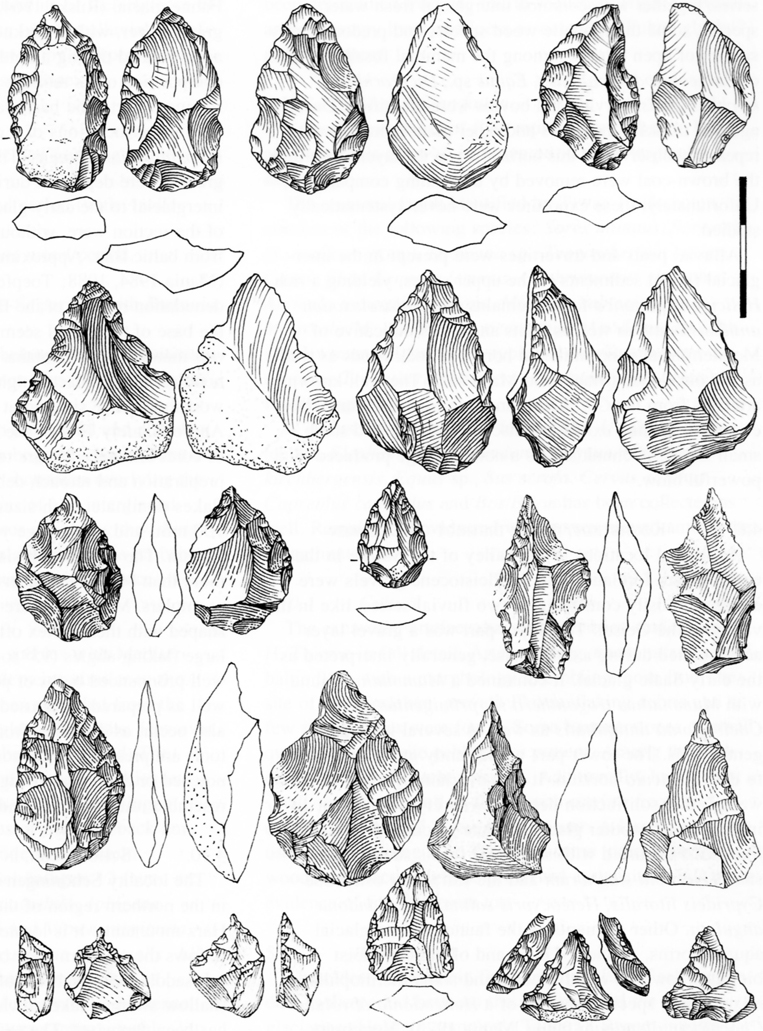
Figure 9.20 Can we please at least agree that these are not handaxes? A series of bifacially worked implements from Bilzingsleben, the largest of which is just over 3cm long (after Mania 1995).
Svoboda (1987, 1989) agreed that the central European Lower Palaeolithic represented adaptations built on local conditions, with local populations isolated from global trends. They had initially developed in open landscapes, but during interglacials when wood was widely available, these had been further developed into microlithic forms suitable for hafting in composite tools and weapons. They were different traditions stemming from the same ancestral technology, but they were sufficiently distinct to warrant separate classification, at some level.
The problem with Rolland’s and all other suggestions that we abandon the classical definition of the Acheulean (e.g. Davis and Ashton 2019) and include all Middle Pleistocene industries, whether they contain handaxes or not, is that they simply move the problem to a higher and more abstract level in the hierarchy of classification. It homogenises the heterogenous and requires regional subdivision to organise it or to allow the most basic levels of communication. It is the EU compared to the 27 member states, each of which, despite the many threads of commonality, has its own unique history that demands its own identity. The problem is not what names we give to archaeological entities, it is what we understand those names to mean.
Bietti and Castorina (1992) were equally skeptical about the supposed Clactonian sites in Italy, a country where late twentieth-century prehistorians sometimes seemed to be labouring under nineteenth-century notions that cores, flakes and flake tools were not a constituent part of Acheulean assemblages. First identified by Demangeot and Radmilli (1953, 1966; Radmilli 1965) the most famous Italian Clactonian locality was found at the Riss (~300 ka BP, MIS 10–8) site at Valle Giumentina, in the Abruzzo region. This supposedly showed the inter-stratification of Clactonian (Layers 33 and 40–42) and Acheulean (Layer 37), all made on the same locally available flint, but other than five handaxes from the latter horizon, Bietti and Castorini could identify no differences in the technology or typology. It was likely that the absence of handaxes was an artefact of sampling, especially if poor raw materials meant they were made less frequently than at other sites. Another example was found at Notarchirico in the Venosa Basin (Mussi 1995; Piperno et al. 1998), where 12 archaeological horizons, each separated by 10–100cm of sterile sediment, were excavated from an area in excess of 500m2. The assemblages in Layers A, B, C, D, F, G and H contained pebble tools, rabots (push-planes) and end-scrapers of limestone and silicious limestone, with rare flake tools and thick irregular handaxes made on flint and quartzite. Inter-stratified among these Acheulean horizons were three levels (Alfa, E and E1) containing limestone pebble tools, numerous flint flakes and flake tools, but no handaxes. Acknowledging the probability of sampling error, Piperno et al. (1998) warned against making simple cultural interpretations. The period of human occupation had witnessed several volcanic eruptions in the Venosa basin, causing short-term disruptions to habitats and micro-climates. It was highly likely that the changes in the lithic record represented not changing cultural groups, but rapid adaptive responses to sudden changes in local environments and resources. The intedigitation of industries both with and without handaxes may also be little more than sampling, although new dating of the Italian site at Valle Giumentina (Villa et al. 2016; Limondin-Lozouet et al. 2017) has shown a persistent absence of handaxes throughout 11 archaeological layers spanning some 30m of sediment covering the period 620–450 ka (MIS 15–12). Nicoud et al. (2016) have recently rejected the Clactonian attribution status of this site, although the lack of handaxes in some sites and layers still requires explanation.
The Italian record further demonstrated that where stone raw materials were irredeem-ably poor, humans had instead used large bones (usually elephant) as animal stone to make handaxes, as seen at Fontana Ranuccio and Castel di Guido (Milliken 1999; see preceding). McNabb (2007) took this as the proof that raw material limitations had affected hominin behaviour, particularly their ability to make handaxes, but they equally show that if hominins wanted to make handaxes, the absence of suitable stone did not prevent them from doing so. The similarities of form on different media can hardly be a coincidence of technology.
Non-handaxe assemblages from Middle Pleistocene contexts are also common along the coast of northern France, particularly in the igneous and metamorphic landscapes of Normandy and Brittany, where they had been given the name Colombanien (Monnier and Molines 1993). The localities included the type-site at Saint Colomban (Monnier 1983) and the collapsed coastal cave of Menez-Dregan (Molines 1992, 1999; Ravon 2019). These industries were largely composed of unifacially and bifacially worked choppers, denticulates and notches. Handaxes were absent or occurred as single finds. The character of the industry was clearly influenced by the use of beach pebbles, but as McNabb (2007) pointed out this could equally have been what Acheulean people made at the Armorican sea-side, rather than a long-term local tradition. In the south of France, the status of the Tayacian was similarly in the balance (Rolland 1986; Falguères et al. 1997; McNabb 2007).
The Caune de l’Arago, Tautavel, contained another celebrated succession of Acheulean and non-Achulelean assemblages, with at least 11 separate industries spanning MIS14 to MIS12. Despite the wide range of climates and environments humans had encountered, lithic technology and typology of Arago remained remarkably stable, as had the main activities undertaken (tool manufacture and meat processing according to Lumley (Lumley et al. 2004; Lumley and Barsky 2004). Handaxes were found in relatively small numbers in Units E, F, G and Q, but otherwise they were absent. Wilson’s (1988) study of the raw materials at Arago identified some 100 types of rock, some obtained from sources 35km away, suggesting minimum territorial range of 65km. The most common raw material was local quartz and quartzite, and there was a clear selective use of raw materials for different tools: pebble tools were on limestone, scrapers were on flint and quartzite, notches and end-scrapers on poorer crystalline rocks type. Exotic rock types were more common among small tools. This suggested to Wilson that humans at Arago had organised their technology in two main ways: the expedient use of local rocks to produce large tools and flakes, and the curation and transport of small tool forms on high-quality exotic rocks. Under these circumstances, the absence of handaxes might just reflect periods in which no handaxes were dropped at Arago, rather than the presence of distinct human groups who did not have the know-how or desire to make them. Intractable round quartzite cobbles also explained paucity of handaxes and the character of the unifacial and bifacial choppers from the Lower Tagus and Portuguese littoral, variously assigned by Breuil and Zbyszewski (1942) to an early pebble tool industry, the Clactonian or the Languedocian (Raposo and Santonja 1995 and personal observation).
In Boëda’s (1997) scheme the Clactonian was one of seven structures of debitage (the others being, Levallois, Discoid, Quina, Trifacial, Hummal and Rocourt) based on the exploitation of an abstract volume. Forestier’s (1993) technological reading saw it as an elementary operating scheme, a system of recurrent operations based around alternate flaking, the precise sequence of which was strongly influenced by the original shape of the nodule, and which adapted to the organically evolving form as flaking progressed. The variability in final core shape thus reflected little more than the natural nodule shapes available and how the basic knapping algorithm had been applied. Clactonian debitage was produced wherever this basic algorithm was used. It required little cognitive acumen and was no basis on which to identify a Clactonian culture, in Britain or elsewhere. Even from a French technological perspective, the Clactonian was a social outcast. There was no effective treatment for the late twentieth-century ‘allergy’ to cultural explanations (Otte 1992): one had to hope that individuals would eventually grow out of it.19
Another Short Chronology for Europe
At the start of the 1990s, many workers were ready to accept an age of ~1 ma BP for hominin dispersals into Europe (e.g. Rolland 1992), with some accepting dates up to two million years old (Bonifay and Vandermeersch 1991). Almost all these early assemblages were primitive flake and pebble industries, suggesting that the earliest occupants of Europe had used a Mode I technology. Mode II handaxe assemblages had appeared much later (Rolland 1992).
In a reversal of the normal trend in origins research, where things tend to get increasingly older, the European Science Foundation workshop on the Earliest Occupation of Europe, held at Tautavel, France in 1993 (Roebroeks and Kolfschoten 1994, 1995), promoted a much shorter chronology for Europe. Participants at this workshop agreed that there was no convincing evidence of hominin presence prior to ~0.5 ma BP. In a critical review of claimed Lower Pleistocene sites, Roebroeks and van Kolfschoten (1994, 1995) concluded that most contained only pseudo-artefacts, were poorly dated and/or contained fossils thought to be hominin that on critical inspection belonged to other species. Qualitative and quantitative differences between sites before and after 0.5 ma BP, provided a number of falsifiable propositions (Table 9.8). Among the fallen were the famous sites at Beroun, Prezletice and Stránská skála, Czech Republic (Valoch 1987; Fridrich 1989, 1991); Kärlich A, Germany (Lower Pleistocene, Würges 1986, 1991); and Vallonet and Soleilhac in the Central Massif of France (Lower Pleistocene: Bonifay 1987, 1991).
|
Table 9.8 The main tenets of Roebroeks’s and van Kolfschoten’s (1994, 1995) short chronology. |
|
|
Before 0.5 ma BP |
After 0.5 ma BP |
|
Small series of isolated pieces selected from a natural pebble background |
Large collections of obvious artefacts from excavated knapping floors with conjoinable material |
|
Secondary disturbed contexts (coarse matrix) |
Primary context sites (fine-grained matrix) |
|
Contested primitive assemblages |
Uncontested Acheulean and non-Acheulean industries |
|
No hominin remains |
Hominin remains ‘common’ |
This begged the question of why humans had stalled at the Gates of Europe, to which temperature and environmental tolerances were the most obvious factors in the North but probably not in the South. Gamble (1986, 1987) had suggested that humans were absent from parts of Europe during certain periods because of a mismatch between the structure of the environment and the structure of human societies. Some environments gave up their resources more easily than others, and the ability to survive in the higher risk environments depended not on technology but on social alliance networks capable of allowing the free movement of information and people. This would have made the dense forests and the glacial steppes very difficult places for Lower Palaeolithic humans to exist at archaeologically visible levels. Whallon (1989) similarly saw the ability to store and transmit information as the major difference between Upper Palaeolithic and earlier societies, one predicated on more complex language systems that facilitated the storage, retrieval and use of group memory: history, in other words. This allowed modern humans to colonise environments such as the Australian desert and the Siberian tundra, where low resource density, poor biodiversity and high unpredictability demanded the ability to plan beyond the immediate present, to project different possibilities and devise a course of action based on past experiences and which could be shared and discussed.
The problem was, as Roebroeks et al. (1992a) pointed out, that both Gamble and Whallon were making generalisations that were contradicted by the archaeological record. Across Europe, from the Early Middle Pleistocene to the Late Pleistocene Middle Palaeolithic, humans had exploited both cold steppes and fully interglacial forested environments, even the empty garden of the Eemian (MIS 5e) (Table 9.9). There were considerably more similarities between archaic humans and modern humans, in terms of the habitats they exploited, than was usually acknowledged.
|
Table 9.9 Dense forests, cold steppes: the environmental context of Lower and Middle Palaeolithic sites in Europe (after Roebroeks et al. 1992b). |
|||
|
Period |
Interglacial Environments |
Intermediate Environments |
ColdSteppic Environments |
|
|
|||
|
Late Pleistocene Upper Palaeolithic |
Gönnersdorf |
||
|
Andernach |
|||
|
Mainz-Linsenberg |
|||
|
Sprendlingen |
|||
|
Lommersum |
|||
|
Late Pleistocene Middle Palaeolithic |
Neumark-Nord |
Seclin |
Bocksteinschmeide |
|
Grabschutz |
Wallertheim |
Balve |
|
|
Rabutz |
Tönchesberg 2 |
Kartstein |
|
|
Gröbern |
Königsaue |
Salzgitter-Lebenstedt |
|
|
Lerhringen |
Ariendorf 3 |
||
|
Veltheim |
|||
|
Taubach, Weimar, Burgtonna |
|||
|
Late Middle Pleistocene Early Middle Palaeolithic |
Stuttgart-Bad Cannstatt |
Biache-Saint-Vaast |
Achenheim Sol 74 |
|
Ehringsdorf |
LA Cotte de St. Brelade |
||
|
Maastrict Belvédère |
Schweinskopf |
||
|
Wannen |
|||
|
Tönchesberg I |
|||
|
Ariendorf 2 |
|||
|
Early Middle Pleistocene Lower Palaeolithic |
Bilzingsleben |
Cagny L’Epinette |
Ariendorf I |
|
Clacton-on-Sea |
Mesvin 4 |
||
|
Kärlich |
|||
|
Miesenheim I |
|||
|
Boxgrove |
|||
As Gamble (in Roebroeks et al. 1992a, 1995a) observed, there were scalar problems in making such statements. Pollen often provided only crude indications of regional environments. The landscape might have been dominated by trees, but this did not mean humans lived in forests. Conversely, mammals, beetles and molluscs provided very fine-grained evidence of rich mosaic environments composed by many irregularly spaced micro-habitats (muddy pools, grassy meadows, particular plant communities) but again these were not necessarily shared by humans. The general impression was that Middle Pleistocene humans had very wide tolerances in both temperature and ecology, which was not telling us much at all (Gamble 1995a).
In terms of the earliest human occupation of Europe, the 500 ka BP rubicon also marked several environmental tipping points. The Early Pleistocene was a period of muted climatic cycles of low amplitude and high frequency, operating on an average duration of ~41 ka BP (controlled by orbital precession). The Middle Pleistocene, by contrast, saw low frequency but high amplitude climatic cycles of ~100 ka BP average duration (controlled by orbital eccentricity), triggering the familiar pattern of prolonged glacials and interglacials, with net decreases in moisture and temperature, and longer lasting episodes of steppic and forested conditions. Optimum forested conditions made up only a very small percentage of Middle Pleistocene time (~8%: Gamble in Roebroeks et al. 1992a), most of the period hosted a rich mosaic of grassland and open woodland, presaging the final expansion of the ‘Mammoth Steppe’ (Guthrie 1990) across Northern Europe during the Upper Pleistocene.
These mosaic environments were a good match for Lower Palaeolithic social organisation. They were ecologically varied, carried a more biodiverse fauna and provided localised access to a wider range of resources (Gamble 1986, 1987). The closely spaced structure of these mosaics also rendered them more resilient and quicker to recover from disruption through fire or overgrazing, as any local perturbations would be rapidly repaired and alternative resources could be found in closely adjacent areas (Gamble 1995a). If not totally predictable, they were at least reliable. The structural characteristics of the more continental parts of Eurasia, where more exaggerated seasonal changes would act to make the tesserae of the mosaic larger and more widely spaced, might further explain why north-east Europe and the Russian Plain had not provided any convincing evidence of human presence before ~300 ka BP (Gamble 1995a). Successful occupation during the Lower Palaeolithic depended on an environment in which resources were rich, diverse, densely packed and stable, allowing quick and easy access to a wide range of opportunities. These conditions were most commonly found in oceanic Europe and persisted longest in more southerly (and cryptic) refugia, where humans saw out the hostile glacial periods.
Major changes to the carnivore guild just before 500 ka BP also made the European landscapes more attractive for carnivorous hominin (Turner 1992). Between 600–500 ka BP several species of sabre-toothed flesh-eating cats (Homotherium and Megantereon) and carcass ravaging hyaenids (Pacycrocuta) became extinct, leaving only familiar African species such as lion, leopard, spotted hyaena and wolf. This would have reduced completion for scavenged carcasses and possibly improved hunting success. Prior to 500 ka BP humans would have faced stiff competition for access to meat, meaning any population incursions into the continent would probably have been unsuccessful and short lived.
These were persuasive hypotheses, but the ‘Short Chronology’ proved to be rather short-lived. Re-evaluation of the age of the Mode I assemblage at TD6, Atapuerca (Spain), originally dated on the basis of palaeomagnetism and biostratigraphy to ~500 ka BP, now placed it beneath the Brunhes-Matuyama palaeomagnetic boundary, that is, older than 780 ka BP (Carbonell and Rodríguez 1994; Carbonell et al. 1995). The flakes and cores were certainly anthropogenic, and the subsequent announcement of the discovery of a new species of hominin in the same levels (Homo antecessor, Bermúdez de Castro et al. 1997) put human presence beyond reasonable doubt. In Italy, ESR and palaeomagnetic dating provided age estimates of 800–900 ka BP for the Mode I assemblage from Monte Poggiolo (Peretto 1992; Mussi 1995; Peretto et al. 1998), which contained small cores, flakes and retouched tools (including proto-handaxes according to Mussi 1995), but no handaxes. The human origin of the huge lithic assemblage from Isernia la Pineta (>10,000 pieces, mostly cores, flakes, denticulates and scrapers) was equally beyond dispute, although the dating was less clear. Potassium-argon dating had provided an age estimate of ~730 ka BP, although this was at variance with amino-acid racemisation estimates of ~545 ka BP. A later consensus would converge on an age of ~600 ka BP (Roebroeks 2001).
Dennell and Roebroeks (1996) quickly announced a ‘modified Short Chronology’, which accepted that hominins had occasionally and temporarily dispersed into southern Europe prior to 500 ka BP, as and when conditions allowed, but were still confined by winter foraging requirements, minimum daylight tolerance and winter temperature to areas south of 35 degrees north of the equator. Thus, while southern Europe occasionally threw up surprises (due to a closer environmental match and its much shorter and less intensive research history) Dennell and Roebroeks maintained that a ‘quantum leap’ in adaptive abilities was required to take humans into northern and central Europe, where their absence prior to 500 ka BP was still valid (Dennell and Roebroeks 1996, 535). Dispersals into the north, and more permanent occupation of southern latitudes, still occurred only after 500 ka BP. When humans moved, they tended to move through corridors of familiar grassland settings–a habitat Dennell has dubbed Savannahstan (Dennell 2011).
Even once dubious sites were removed, the Mode I character of the earliest lithic industries in Europe remained true (Carbonell et al. 1999), and this pattern could be extended to include the material from the base of the 1.4 to 1.2 ma BP ‘Ubeidiya sequence and the industry from the >1.7 ma BP site at Dmanisi, Georgia. Rolland’s (1992) pre-Tautavel observations on global patterns of colonisation, rapidly becoming archaeology’s fifth big question (Gamble 1998b), thus retained much relevance, despite his own fear that all such endeavours were immediately obsolete. Rolland argued that the initial Mode I industries in Europe could represent the persistence of an ‘epi-Oldowan’ culture, atypical Acheulean facies, or modifications to the Acheulean by local or regional populations that coalesced into autonomous traditions, or an adaptation to forested environments. He concluded, following a review of the chronology, taphonomy, statistical sampling issues, activity facies and raw material properties of early European sites, that weight of evidence supported the existence of a distinct Mode I technocomplex made by humans that had already abandoned or never possessed handaxe technology. None of the names currently in use–pre-Acheulean, Archaic Palaeolithic, Clactonian–adequately described the phenomenon, for which Rolland suggested the neutral term European Early Palaeolithic Horizon.
Carbonell et al. (1999) similarly saw the Mode I: Mode II dichotomy as showing the arrival of different human groups at different times who practiced different technological and subsistence strategies. Mode I industries arrived between 1 ma and 0.5 ma BP. These were organised around ad hoc or expedient strategies, with artefacts made for immediate use and discard. They involved little planning or mobility. Mode II industries arrived in Europe between 600 and 500 ka BP, the earliest known being those at Notarchirico, Italy (Piperno et al. 1998) and Carpentier’s Quarry, Abbeville (Antoine et al. 2016). These assemblages were technologically more complex and showed greater levels of planning and mobility, greater maintenance of territories and better control of resources. Carbonell et al. (1999) suggested that the Mode I hominins that arrived in Europe after 1 ma BP had been displaced from the African Rift Valley by the more organised Mode II groups, a diaspora that coincided with a wider faunal dispersal during an interglacial period. Half a million years after the first dispersal event, Mode II hominins turned up again, their delayed arrival probably a result of very slow demographic growth and resistance by the existing Mode I inhabitants. Replacement was slow, leading to both groups occupying the same or overlapping territories during the Middle Pleistocene.
These hypotheses were “neat, plausible, and almost certainly wrong” (Villa 2001, 119). Villa argued that adaptive flexibility and limited range of technological choices had caused the patterns seen in Europe, which could explain the disappearance and reappearance of handaxes without the need to imagine the long-term transmission of very specific tool types. She remained highly skeptical about the very early ages proposed for Isernia and Monte Poggiolo, where the small (<10cm) and poor materials provided an adequate explanation for the use of Mode I technology. The Lower Pleistocene age of Gran Dolina at Atapuerca and Mode I industry from Fuente Nueva 3 in south-east Spain (Agustí et al. 1999) were more secure, but the assemblages from these sites were too small and the excavated areas too limited to rule out sampling error. A single handaxe could change everything. There was, for Villa, no European Early Palaeolithic Horizon. It was a mirage.
Summing up at the end of the 1973 Conference on East and Southeast Asian Archaeology (held in Montreal, Canada: Ikawa-Smith 1978), Hallam Movius (1978) had been pessimistic that an integrated regional scheme was possible given the very patchy state of knowledge. His own model, published with limited data in 1944, had proved remarkably popular and had been applied far outside the geographical areas it was devised to describe and explain. It had also proven to be remarkably resilient. Even though the number of known Palaeolithic sites had grown enormously in the intervening decades–between 1945 and 1962 the number of known sites in China rose from 10 to over 200, while Korea, which had no Palaeolithic sites in 1945, had by the 1980s reported 28 (Yi and Clark 1983)–language and political barriers still meant that these discoveries percolated only slowly into the western literature and consciousness (Brumm 2010).
The main reason for the continued popularity of his Line, Movius thought, was that it was basic and simple, but these were precisely the same reasons he also deemed it woefully inadequate (Movius 1978, 351). The chronology of the region was far from clear, and the extremely variable nature of Asian Lower Palaeolithic industries, often strongly influenced by the nature of the local raw materials, defied formal typological methods and attribute analysis; what was needed was a new way of examining the data, one that reflected the choices made by the knappers as they worked (Movius 1978). This was one of the reasons why the conference delegates had agreed that any subdivision of the Palaeolithic in the region beyond Early and Late was artificial (Ikawa-Smith 1978).
Yi and Clark’s (1983) widely cited 1983 review and dismissal of Movius’s work as theoretically and empirically outmoded was thus something of an attack ad hominem paleas. They argued that the defining characteristic of the Movius Line, the absence of classic handaxes in Asia, was not only based on a small sample but was illusory. Classic handaxes were now known from Chon-Gok-Ni, South Korea and from Lantian and Dingcun in China (Figure 9.21), forms that could not be ignored or hidden behind pseudonymous terms like handadze or proto-handaxe. Furthermore, there was little that clearly united the Asian Chopper-Tool Complex at all: the famous Zhoukoudian Locality 1 was a flake tool industry, not a chopper-tool one. Japan, Mongolia and Siberia were still largely terra incognita, although the discovery in 1982 of a pebble tool industry at Diring Yuriakh, Central Siberia, which was later dated to ~260 ka BP, conformed to the general picture (Mochanov 1993; Waters et al. 1999), if, that is, one accepted that they were artefacts and not geofacts.

Figure 9.21 Like tigers in Africa. Bifacial/Mode 2 technologies from beyond the Movius Line from the Bose (Baise) Basin, China (after Li et al. 2014).
Others sought new and largely non-cultural explanations for the differences observed either side of the Line, rather than their homogenisation or erasure. Hutterer (1977) drew a link between simple lithic inventories and tropical rainforests. These were undoubtedly rich ecosystems in terms of species diversity, but resources were widely scattered, requiring hominins to adopt a constantly mobile existence. Under such circumstances, plant resources such as wood and bamboo would have been a more reliable and economical resource compared to large workable stone (cf. Pope 1989; Bar-Yosef et al. 2012). Lithics might have only been used as basic cutting tools or to make wooden/bamboo implements, which would not have required elaborate retouch or shaping, just a keen edge.
Watanabe (1985) linked the absence of handaxes to the different subsistence strategies practiced in tropical forests. He suggested that the diet of SE Asian Homo erectus was largely vegetarian, like modern tropical hunter-gatherers. Protein was obtained from small animals such as rats, squirrels, frogs and snakes, which would have only required very simple cutting tools, not handaxes designed to dismember medium-large game. A similar adaptive pattern was seen in Africa, where sites in equatorial Congo had yielded far fewer handaxes than the savannah sites in East Africa. Zhoukoudian, where medium-large game had been exploited (contra Binford), was more northerly and so still conformed to the same ethnographically derived principle that meat eating increased with latitude. There might still have been greater reliance on small mammals than most zooarchaeologists would acknowledge, particularly lagomorphs and squirrels. These occurred in abundance at Zhoukoudian but not as natural deaths or carnivore excreta; some were possibly burnt. Watanabe suggested that the AC-TC was not functionally or technologically inferior to the Acheulean, but represented a typologically degenerate form of it, an adaption to new conditions in which elaborately engineered stone ‘axes’ were found to be surplus to requirements and so were abandoned. These same rainforests and the Himalayas subsequently formed barriers between these populations.
In another English-language review of the East Asian evidence, Schick and Zhuan (1993) advocated the adoption of Clark’s modes, which solved the problem of implicit meanings of Acheulean and AC-TC, and the point that most AC-TC industries seemed to have been flake-based not chopping-tool based. There was a strong Middle Pleistocene presence, although it was difficult to define any chronological sequence. The earliest occupation of China could be traced to at least one million years ago, as represented by the Mode I assemblages from the Nihewan Basin (by the end of the decade this age had increased to 1.67 ma BP (Huang and Yamei 1997), while the Homo erectus skulls from Sangiran and Mojokerto, Java were now known to be as old as 1.8 my BP (Swisher et al. 1994), making the proposed 2 my BP age for Mode I artefacts from Riwat in Pakistan (Dennell et al. 1988) far less of an incredible outlier.
A number of sites in China had produced Mode 2 bifacial technologies, including a possible 800–970,000-year-old biface from Lantian (Schick and Zhuan 1993). Large bifacial and unifacial Mode 2 tools had also been found at Sanmenxia, Liangshian, Dongxing, Ding-cun, but many were surface finds that could be of much later date; as was the case with the South Korean site at Chon Gok Ni, which was very imprecisely dated to between 100 and 500 ka BP. Furthermore, while they may have had a planform similar to a handaxe, technically they were thick picks similar to those seen in the African Sangoan and quite dissimilar to classic African and European handaxes. The occasional Chinese and Korean handaxe sites were technological variations of significant interest but they did not alter the fact that a basic Mode 1 small tool industry formed the vast majority of the evidence; nor did they show that human populations across Africa and Eurasia had shared a single heterogeneously expressed cultural repertoire. For Schick and Zhuan, handaxes in Asia were a late phenomenon that did not signal cultural links with the west and did not demand the complete dismantling of the Movius Line.
Archaeologists were soon disabused of the first of these conclusions, when dates of ~803 ka BP ± 3,000 were obtained on tektites associated with handaxes in Terrace 4 of the Bose Basin, Guangxi Zhuang region of southern China, although the Line itself was still not quite crossed (Yamei et al. 2000; Keates 2002). Some 58% of the Bose artefacts were classed as large cutting tools (LCT) compatible with Mode 2 technologies in Africa in terms of targeted manufacture (i.e. shape), biased spatial distributions, large-scale flaking and high scar counts (Yamei et al. 2000). Most had been made on asymmetrical pebbles that had been shaped directly or split and then shaped, which had exercised a strong influence on the form of many LCTs and had dictated the size distribution. To the west of the basin where clasts were largest, LCTs were also larger. They differed from African, European and Western Asia examples in several respects, most notably the lack of soft hammer flaking and the absence of large flakes as blanks, but they were undoubtedly target forms, not a reduction stage in the manufacture of other objects, nor a chance technological convergence (ibid.).
The Bose handaxes demonstrated with no room for doubt that Asian Homo erectus had possessed the same levels of cognition, technological skill and cultural abilities as their western counterparts. The flow of people and information across the line may have been limited, however. The appearance of bifacial technology in the Bose Basin corresponded with a period of burning and widespread deforestation. This exposed the cobbles used to make handaxes, which might have been developed internally or introduced from outside to cope with the drastically (albeit temporarily) changed ecology. Handaxes were not entirely absent from east of the Movius Line, but this did not justify the conclusion that the Acheulean had a major or persistent presence in the region. The implications drawn by Movius were inadequate, but there was still something to explain.
The Movius Line was even more permeable on the leg through the northern Indian subcontinent, where it was supposed to divide the Acheulean of peninsula India from the Soanian of the sub-Himalayan region. Since the rise of New Archaeology, method and theory in India had developed along lines similar to East African archaeology, with an emphasis on multidisciplinary Quaternary fieldwork, intensive surveys and more behavioural questions (e.g. Hungsi Valley, Paddayya 1978, 1982a, 1982b; Chirki, Corvinus 1983; Bhimbetka, Misra 1978, 1989; see Mishra 1994). Explaining assemblage variation was also high on the agenda and was an important objective for a number of international collaborative projects of the 1970s and 1980s (e.g. the Oxford-Baroda Thar Desert Project, Allchin et al. 1978; the Berkeley-Allahabad Middle Son Valley project, Sharma and Clark 1983; the Deccan-Jodhpur-CNRS-ANU collaborations on the Didwana Project, Gaillard et al. 1986, and the British Archaeological Mission to Pakistan, Dennell et al. 1988; Rendell et al. 1989).
Supekar’s (1985) excavations at Mahadeo Piparia in the central Narmada basin found both choppers and handaxes among Khatri’s (1962b) apparently Oldowan-like Mahadevian industry, bringing the integrity and age of that industry into doubt. The geographical separation of the Soanian and Acheulean also broke down. Several Mode 1 chopper assemblages were now known from peninsula India (e.g. at Lahchura, Pant 1982; and Durkhadi, Armand 1983), while handaxes had been reported from the Soanian heartlands in the sub-Himalayas (Mohapatra 1975; Jayaswal 1978, 1982; Corvinus 1990; Dennell and Rendell 1991). Dennell (1989; Dennell and Rendell 1991) therefore questioned whether the Acheulean and Soanian were separate entities, although work by Mohapatra (1990) in the western part of the sub-Himalayan region could find no trace of Acheulean presence until the end of the Last Interglacial. Middle Pleistocene sediments contained only a developing Soanian tradition.
Claire Gaillard’s (1995, 1996) technological study of the Soanian and Acheulean also identified similarities in their chaînes opératoires, showing that the makers of the Soanian had the technical know-how to make handaxes, but concluded that for cultural or environmental reasons they did not. Chauhan (2003) disputed this, noting that the criteria used in reaching these conclusions (trimming techniques, large cortical flakes, retouch on semi or non-cortical flakes) were universal technological features found in most industries, that the sites represented a wide range of ecological and geographical situations, and were not proven to have been co-eval.
Indeed, a proper understating of the Indian Acheulean-Soanian was and still is hampered by a lack of chronological control. Radiometric dating estimates using Thorium-Uranium techniques had given remarkably young ages, ranging from 69 ka BP to >350 ka BP (Szabo et al. 1990; Mishra 1992) while Argon-Argon dating of volcanic ash from the site of Bori produced a remarkably old age of 1.4 my BP (Korisettar et al. 1989), later revised down to 670 ka BP ± 30 ka BP (Mishra 1995). They could hardly be relied upon to give an accurate chronological picture or allow the validity of the Early and Late Acheulean to be tested (Table 9.10). Without chronological confirmation these prefixes remained of techno-typological relevance only and could potentially relate to one of several mundane explanations.
|
Table 9.10 Proposed chronological divisions in the Indian Acheulean. |
||
|
Division |
Characteristics |
Sites |
|
|
||
|
Indian Late Acheulean |
Absence of choppers, low percentage of handaxes |
Bhimbetka |
|
High percentage of diverse flake tools |
Hungsi-Baichbal Valleys |
|
|
Low ratio of handaxes: cleavers high incidence of Levallois and blade technology |
||
|
The predominance of soft-hammer technique |
||
|
Indian Early Acheulean |
High frequency of choppers and handaxes |
Chirki |
|
Low percentage of simple flake tools; high ratio of handaxes: cleavers |
Bori |
|
|
Singi Talev |
||
|
Low incidence of Levallois and blade technology |
Hungsi-Baichbal |
|
|
The predominance of hard-hammer |
Valleys |
|
Projecting its course northwestwards, the Movius Line also dissected Central Asia, where important discoveries were being made in stratified loëssic sequences that could be dated on their contained series of palaeosols (ancient soils generally indicating past interglacial cycles; Ranov 1995). The sample of Lower Palaeolithic sites and number of excavations was relatively small, and most handaxes were surface finds dated only by their typology, but an east-west opposition was nonetheless apparent (Vishnyatsky 1999). Most handaxe sites were located in the west of the region at Yangadja (western Turkmenia) and Shakbagata (western Kazakhstan), or in the north at Jaman-Aibat 4 and Semizbugu (Kazakhstan) (Vishnyatsky 1989, 1999). In the south and south-east of the region only non-handaxe Mode 1 assemblages had been found, including from excavated Lower and Middle Pleistocene contexts at Kuldara (~800 ka BP) and Karatau (~500–600 ka BP). Vishnyatsky (ibid.) noted that the core and flake industries were associated almost exclusively within mountainous areas, whereas handaxes were found on the plains, implying that they represented cultural adaptations to different environments. Ranov (1993) suggested that the pebble tool industries of the Tadjik Depression, which he named the Karatau Culture, had persisted for hundreds of thousands of years with no outside influences, while typology led Davis and Ranov (1999) to suggest that handaxes might have been a late introduction, possibly Middle rather than Lower Palaeolithic, although they noted that following the break-up of the Soviet Union archaeological research in the region had itself fallen into a sullen depression.
Lying firmly within the Acheulean world, the Yabrudian Tradition of Western Asia (or Mugharan Complex, as it was renamed by Jelinek 1982a, 1982b, see Table 9.11) was also geographically restricted, being found only from the Taurus foothills to the Central Levant at El-Kowm, Yabrud, Adlun, Zuttiyeh and Tabun (Bar-Yosef 1999). Improved chronological control had further indicated it to be a relatively late phenomenon, always occurring beneath the Mousterian and with TL and ESR dates indicating a calendar age of ~220–350 ka BP (Bar-Yosef 1994, 1999). Raw materials could not provide an adequate explanation. At Tabun the Upper Acheulean, Acheulo-Yabrudian and three facies of the Mousterian were all made on the same flint, available a short distance from the cave in the Wadi el-Mughara, but equally the new dates cast doubts on Jelinek’s (1982a, 1982b) correlation between stone tool assemblage type and climate. Bar-Yosef (1994, 254) opined that there had never been a satisfactory demonstration that changes in climate and environment had ever resulted in a change in stone tool industries. As Isaac (1984) had observed, there was a high degree of ‘free play’ between lithics and ecology. It seemed more likely to Near Eastern archaeologists that hominins either side of the artificial Lower-Middle Palaeolithic boundary had very rigid patterns of learned behaviour concerning the manufacture of stone tools (Belfer-Cohen and Goren-Inbar 1994; Bar-Yosef 1999). Scientific approaches did not automatically entail the rejection of cultural explanations.
|
Table 9.11 Yabrudian/Mugharan facies (after Jelinek 1982a, 1982b; Copeland and Hours 1983). |
|
|
Yabrudian/Mugharan Complex Facies |
Characteristics |
|
|
|
|
Yabrudian |
Numerous side-scrapers, often on thick flakes with steep Quina type retouch. No handaxes, but some Levallois products. |
|
Acheulean or Acheulo-Yabrudian |
As above but with up to 15% bifaces. |
|
Amudian |
End scrapers, burins, backed knives and rare bifaces. Originally called pre-Aurignacian due to high frequency of blades. |
Notes
· 1 Binford (1984b, 299) had little time for criticisms of his use of published data or his manipulations of it to suit his methods. He perceived this as an empiricist view, based on the notion that there is some absolute truth waiting to be discovered, and one true set of facts.
· 2 Potts (1984) suggested that the bone accumulation at Olduvai FLKNN 2, which had no associated artefacts, was characteristic of the hyaena den assemblages he had observed at Amboseli Park.
· 3 Isaac (1977a) dismissed the possibility that the site was a fluvial accumulation. He also doubted whether humans could have easily cornered a troop of baboons during the day, and rejected the idea that hominins might have poisoned a waterhole, because this would kill indiscriminately and other species would be proportionately represented.
· 4 At this point, one might be forgiven for thinking that Binford’s key source for choosing sites to investigate really was Clark Howell’s popular Time-Life book, Early Man.
· 5These berries, of which a single casing was found at Zhoukoudian, are from trees of the genus Celtis. They ripen in September-October, and are unusually high in fat, carbohydrate and protein (Thayer, S. 2010. Nature’s Garden. Birchwood, WI: Forager’s Harvest. p. 130).
· 6 Please beware using any dates cited in this book for anything other than historical purposes.
· 7 I am indebted to Françoise Audouze’s (2002) superb summary of Leroi-Gourhan’s substantial body of work and intellectual influences in writing this section. It made much more sense than his original texts.
· 8 I have taken the liberty of replacing Leroi-Gourhan’s idiosyncratic classification of the hominins with more familiar taxa used in this book. In the original Australopiths and Homo habilis = Australanthropians; Homo erectus = Archanthropians; Neanderthals = Palaeoanthropians; Homo sapiens sapiens = Neanthropians.
· 9 Jelinek named this phenomenon the “Frison Effect”, after George Frison (1968) who demonstrated the effect of resharpening on the shape of North American projectile points.
· 10 Wynn (1979, 372) explained these concepts in the following passage:
The lighting of the bulb could cause the object to stop (I will call this relation A). This would be disproved if the bulb ever lights without the object stopping (relation B). Alternatively, the stopping of the object could cause the bulb to light up (relation C). This in turn would be disproved if the object stopped without the bulb lighting (relation D). What is significant here is that, if the individual does approach the problem in this manner, he is coordinating two kinds of reversibility-inversion and reciprocity. The hypothesis that the light caused the object to stop (A) is disproved by inversion (B), i.e., the light came on but the object did not stop. The individual then hypothesises the reciprocal situation (C), i.e., the stopping of the object lights the bulb. This can in turn be negated (D). Interestingly, this inversion, the object stopping without the bulb lighting, would not disprove the original hypothesis (A) because if the object stops without the bulb lighting it does not mean that lighting the bulb would not stop the object. The negation of the reciprocal is, therefore, a corollary of the original hypothesis.
· 11 The Burg-Wartenstein conference sought to resolve the long running issue of imprecise definition and usage of terminology (Mason 1962). The standing committee in African Terminology established at the third Pan African Congress (held in London and Lisbon) passed a resolution to regulate terms, but this was still under discussion at the fifth congress held in Tenerife in 1955. The terms were eventually agreed at Burg-Wartenstein and ratified at the sixth Pan-African Congress in Dakar, 1967, for all the good it did. See Underhill 2011 for a longer discussion of these meetings.
· 12 Far more so than Isaac ever did, to judge from his writings. Again, it was a framework for understanding, not a device for producing truths.
· 13 End-shock describes a common knapping accident, whereby the tool is inadequately supported during the delivery of a heavy blow, causing it to snap laterally, producing a butt fragment or tip fragment.
· 14 The assemblages examined were: Group I (ficrons and cleavers): Cuxton and Furze Platt; Group II (with ovates): Swanscombe Upper Middle Gravels; Group V (crude): Fordwich; Group VI (more pointed): Bowmans Lodge, Round Green; Ovate Tradition Group VII (less pointed): High Lodge, Gaddesden Row, Caddington.
· 15 A well-made handaxe will usually show about 50–120 removals (a minimum measure as earlier removals will be obliterated by later ones), but in proficient hands this usually takes no more than 15–30 minutes (Newcomer 1970; Mateos et al. 2018). Many show far less of an investment in either measure. Knapping is also a relatively light-intensity activity. Seated knappers using only stereotyped upper-body movements show an average metabolic equivalent task of activity (MET) of 1.86 (measured by deducting resting basal metabolic rate from the net energy cost during an activity: Mateos et al. 2018).
· 16 I used Roe’s indices for elongation and refinement, and both Roe and Bordes’s calculations for shape (White 1996; White unpublished data). In the two systems elongation (B/L vs L/B) and refinement (Th/B vs B/Th) are calculated using exactly the same measurements. Bordes’ shape calculation is based on L/L1–4.574 x (midwidth/maxwidth) whereas Roe used the simpler L1/L, although when all handaxes used in this study were combined, the correlation between the two methods was r=–0.975. This suggests that by including the midwidth/maxwidth ratio to the calculation, Bordes actually added little to the overall picture of biface shape and the key to understanding shape lies in the relative position of the maximum width.
· 17ASBO = Antisocial Behaviour Order. This was an order given out by UK courts (but now only in Scotland) that hoped to stop a person from continuing to behave in a manner deemed antisocial.
· 18 Clactonian, Tayacian, Evanosian (Lumley 1975), The Buda Industry, Hope Fountain, Soanian and so on.
· 19 I am fairly certain that this is what Derek Roe thought about me and my ilk (see for example, Roe 2000). He wasn’t wrong.