10
As the twentieth century went to sleep, the culmination of two long-term projects, one empirical, the other theoretical, called time on processual approaches to the past.
Going Sub-Milankovitch
Over the last 20 years absolute dating techniques have been enhanced, improved and developed, and we now have a range of methods for dating organic matter such as bone, teeth and shell and inorganic materials including soil, sediments, pebbles, speleothem and igneous rocks, all of which provide calendrical age estimates with increasing accuracy and precision. These have been accompanied by equally significant improvements in more traditional relative dating techniques, which now aim to correlate terrestrial sediments and their contents with the marine isotope sequence, often using absolute dates as anchor points and as independent tests of the method. Particular advances have been seen in the lithostratigraphy, where David Bridgland’s (1994) model for terrace formation has provided the baseline for global correlation, with local geomorphological adjustments (Bridgland 1994; Bridgland et al. 2006; Schreve and Bridgland 2002; Antoine et al. 2003a, 2003b, 2007, 2010, 2011, 2019; Antoine and Limondin-Lozouet 2004; Westaway et al. 2006, 2009; Mishra et al. 2007; Bridgland and Westaway 2008). The key to Bridgland’s model was the realisation that terrace formation was a regular process controlled by climate change and tectonic uplift (Bridgland 1994, 2006, 2010; Bridgland et al. 2004; Bridgland and Allen 1996; Maddy et al. 2000; Bridgland and Westaway 2008: see Figure 10.1) that was coupled with Milankovitch cycles and so could be directly correlated with the marine isotope framework. For many rivers, it is possible to use the model to count terrace ages, which increase up the staircase, although this is not inviolable (Figure 10.2). Flights of separate terraces tend to form only in areas where uplift has occurred (Bridgland and Westaway 2008), and major river valleys that have experienced net subsidence are underlain by stacked sequences of fluvial deposits, with all but the most recent sediments only accessible by boreholes. The Solent River appears to have sometimes formed two terraces per climatic cycle as a result of differential uplift and rejuvenation (Westaway et al. 2006), but rivers do not behave in the erratic way demanded by the earlier models for the Thames, Somme and adjacent systems discussed in earlier chapters. If one ignored the archaeology, which apart from the appearance of Levallois in MIS 8 (Bridgland 1994) was largely a chronological red herring, rivers made perfect sense.

Figure 10.1 The Bridgland model for fluvial terrace formation (courtesy David Bridgland).
Figure 10.2 River terrace staircases for the Thames east of London (A) and River Wipper, Thuringia, Germany (B) (after Bridgland and Allen 2014, courtesy David Bridgland).
As a framework for understanding landscape evolution in relation to Quaternary climatic change, these lithostratigraphical models have been successfully applied to rivers all over Europe, including the Thames, Somme, Seine, Tagus, Wipper and many others. They have facilitated the development of more refined biostratigraphical schemes, which link suites of mammals, reptiles and invertebrates and the first/last appearances of key species to the MIS curve (Keen 1990, 2001; Parfitt 1998; Schreve 2001a, 2001b; Limondin-Lozouet and Antoine 2006; Preece et al. 2009; Van Asperen 2013; Agustí et al. 2015a; Maul et al. 2016). As a result, the Pleistocene terrestrial record has been stretched to include more interglacial and glacial periods, more sites can be confidently attributed to MIS stage, with some capable of further refinement to the Milankovitch sub-stage level (Ashton et al. 2008; White et al. 2013, 2019). Pollen zones and other proxies, which might not be able to distinguish between separate interglacials, can nevertheless be used to fine-tune a correlation still further.
The full adoption of the MIS stages as a global framework has largely negated the need for traditional period names such as Holsteinian, Hoxnian and Mindel-Riss, although these are often retained to provide clarity and historical linkages. Not all interglacials have a name, moreover. In Britain MIS 9 and MIS 7 are often referred to as the Purfleet and Aveley interglacials, but this is not a formally recognised nomenclature. There is also, predictably, still disagreement within countries and across continents about which period correlates with which MIS stage, and to which MIS stage key sites belong. MIS stages also seem to have more significance to European archaeologists than to those working in south-east Asia, India or Africa, where the effects of climatic fluctuations were less marked and where absolute dating methods providing actual age determinations in Pleistocene time are more important. MIS stages are also rarely used beyond MIS 23–25, ~1–1.2 ma BP (or even MIS 16–18, 600–700ka), probably because this is near the current limit for human (or Acheulean) occupation of Europe, and because age estimates here do not allow precise correlation.
It must be admitted that few nations seem quite so keen on MIS correlations as the British, many of whom (in my acquaintance) harbour a mistrust of absolute dating methods and will only accept the results if they agree with all other lines of evidence; then only reluctantly. That the error ranges of absolute techniques sometimes straddle several climatic cycles (e.g. the OSL dates for Broom; Green and Hosfield 2013), or that dates are constantly revised as techniques develop or problems with assumptions about water content, background radiation or uptake rates are discovered (for example, the sites of Ceprano, Isernia, Koobi Fora, Olduvai, etc.), does not help matters. Other countries place much more emphasis on absolute dating methods, sometimes because they are all that is available (Cuhna et al. 2017) but often because, I feel, being scientific estimates of probability, they are afforded greater confidence than relative schemes, almost all previous examples of which have broken down eventually. In Britain, when calendrical dates are needed to aid comparison with other countries, they are most often inferred from an independent MIS correlation or the absolute ages of non-British localities are assigned an appropriate cold or warm stage number, depending on the presence of other proxies. In many respects, it is a more traditional way of doing things, but it has uncovered some very interesting patterns in the British Palaeolithic record that do not rely on circular artefact-based reasoning or require fluvial gymnastics.
It is thus at the regional level that MIS corrections have had the biggest impact, particularly in Britain, where the new framework has allowed the recognition of distinctive time-space patterns outlined at the end of this chapter.
Personality Most Ancient
The original aim of the New Archaeology had been to develop theoretical models and analytical techniques that would provide a better understanding of human behaviour (defined as the dynamics of adaptation) in the deep past, and eventually get us closer to hominin societies. In this final endeavour it is fair to say that it singularly failed. As the millennium approached, archaeologists were further away from early hominin societies than ever. The processual agenda had warped into a positivist reductionist framework that appealed to parsimony in virtually all Early Palaeolithic matters–when it came to the australopiths, Homo erectus/ergaster/heidelbergensis or the Neanderthals, the simpler the explanation, the better. The basic unit of analysis was the group, representing the collective intentions, decisions and motivations of its members, situated in the organisational system of adaptation (Gamble and Porr 2005). It was to some extent an agenda driven more by a tacit need to make modern humans the vastly superior outcome of evolutionary processes than a balanced reading of the data (cf. Roberts 1995), and its models of adaptation were not evolutionary in a Darwinian sense because they only dealt with the consequences of adaptation not its causes (Gamble and Porr 2005, 3).
In its quest to find basic pan-generic patterns and explanations, processual archaeology was little different from Isaac Asimov’s fictional theory of psychohistory, the driving force behind his Foundation Saga. As developed by mathematician Hari Seldon, psychohistory was a statistical law based on mass action, which predicted that people across the galaxy would behave in the same way in similar situations, without any co-ordinated effort or planning. The problem was, in both fiction and the real world, that people very rarely behaved predictably or parsimoniously–indeed psychohistory argued that if people became aware of their predicted behaviour, then they would become unpredictable. If people were socially aware, then their behaviour would vary according to their social situation.
The failure of ‘interpretative’ or ‘post-processual’ archaeological theory to make earlier inroads into the Palaeolithic period can also be explained, in part at least, by this Homo sapiens superiority complex, the x-gene that made us self-aware sapient humans. There were, of course, fundamental epistemological differences between the dominant processual approaches and post-processualism, a movement that had emerged in Britain during the late 1970s and 1980s and which enjoyed wide and diverse application to later periods of prehistoric and historic archaeology (e.g. Hodder 1982; Hodder 1986; Binford 1982a, 1982b, 1989c). Proponents rejected the idea that archaeologists could ever reach objective conclusions, because even when using scientific methods there were always several different ways in which one could explain the data. Interpretation was subjective and depended on the viewpoint of the person making the interpretation. Instead, post-processual archaeologists emphasised the social and ideational aspects of human existence, drawing on a wide range of structuralist, marxist, feminist and agency-based theory that put the individual at centre stage and granted them free-will enough not to have been ‘passive dupes’ to the environment or cultural rules (Johnson 1999) but to have actively manipulated both. There was no single correct way to read the past. This is, I acknowledge, a thin description, but my purpose here is not to summarise the outputs of one of the major theoretical paradigms of the past 40 years, one which Binford (1989c) famously satirised as taking archaeology from “science to séance”. Rather it is to stress that for the period I was there, Palaeolithic archaeologists in Ian Hodder’s own department in Cambridge harboured a genuine and firmly held belief that because we were not dealing with modern humans, post-processual approaches were irrelevant. How, the question went, could we subjectively reconstruct the social and ideational aspects of Palaeolithic life when we were not even dealing with the same species or even a particularly close relative? Would we look to Martin Heidegger to understand baboons? No. Processualism was right for the Palaeolithic and was the only route to having your ideas taken seriously by your peers; later prehistoric and historical archaeologists of a post-processual persuasion probably thought we deserved each other.
Ironically, it was one of Clive Gamble’s early attempts to change the direction of Palaeolithic research, to move beyond statements about technology, land use and feeding patterns, and make more socially orientated inferences (Gamble 1995b, see also 1995c, 1996), that led Mark Roberts (1995), director of the excavations at Boxgrove, to liken the result to a “Pleistocene Alf Garnett”.1 It was an amusing if somewhat cheap shot, but one that didn’t travel well and has not stood the test of time.2 In the years since publishing Settlement, Gamble had become disappointed with the “stomach-led and brain-dead” models that dominated Palaeolithic interpretation, each looking for the elusive prime mover that could explain the patterns in the past, such as the appearance of hunting, co-operative behaviour, new technologies or language (Gamble 1999, xx). He was equally unconvinced that ever more detailed technological reconstructions of refitting knapping episodes or spatially precise plotting to trace movements that were, quite literally, a stone’s throw away, were providing adequate returns on the investment. All Early Palaeolithic archaeologists had succeeded in creating was an ecologically determined half-human creature that had spent millennia after millennia dancing to the rhythms of the Pleistocene, banging out sharp edges in a variety of meaningless forms, and fatalistically waiting for the arrival of far more intelligent humans who outwitted them at every turn. They had drawn an interpretative curtain between modern humans and all other species of Homo, one that divided social interpretations from natural history interpretations, producing an ethology of archaic humans that didn’t even have the benefit of David Attenborough narrating the story. It was equally futile to look for formal social entities, whether these were labelled tribes, bands, groups, cultures or traditions.
Most of the behaviour we see in the archaeological record, Gamble argued, was the result of routinised patterns of behaviour (‘practices’) based on habits and expressing the repetitive, recursive nature of social life. This called for an outlook that went beyond ecological and functional forcing and required “a thinking, social actor that was capable of constructing the social fields in which he/she lived as well as being capable of transforming them” (Gamble 1996, 66). It was not a plea to make early hominins more like us, but more like themselves. In the completely revised and renamed Palaeolithic Societies of Europe, Gamble (1999, 1996, 1998a, 1998b) therefore called for a new focus, a new vocabulary and a new social framework that unified rather than divided the past. He advocated a different perspective of Society based on the individual, rather than the group; one focussed on the emotional, material and symbolic resources used by individuals in their interactions with others, rather than cultures and other formal structures; one in which individuals were active participants in the creation and performance of social life, not passive drones “trapped in a World they never made”.3
This view of society was partly built around the structuration theory of sociologist Anthony Giddens (1981, 1984), central to which was the concept that society was a twoway process: “all human action is carried on by knowledgeable agents who both construct the social world through their action, but yet whose action is also conditioned or constrained by the very world of their creation” (Giddens 1981, 54). So, action proceeded from a set of structuring principles inherited from a social domain that transcended and preceded the individual, and disposed them to act in particular ways, while at the same time, were enacted by individuals who pursued their own agendas, saw the world from different positions, and did not act in an invariant or rational manner (Hopkinson and White 2005). Individuals were active participants in the creation and performance of social life, and while much of life might be built around routine and habit, group behaviour was an emergent property of its members’ individual behaviour and therefore in a constant state of flux (Gamble 1998a). It was a concept of society that could be, and indeed had been, successfully applied to baboons (e.g. the work of Bruno Latour and colleagues).
To situate individuals in Pleistocene time and space, Gamble developed a network approach based on interactions and negotiations performed at different scales, at different levels of connectivity and utilising different social resources (emotional, material and symbolic). He settled on a hierarchical egocentric model (Gamble 1998a, 434, 1999, 51) involving different types of relationship:
Intimate Networks: Involving people with whom the individual had a close genetic and emotional relationship, family and significant others who provide the individual with a sense of security, that the world was as it should be: they were affective relationships. A high level of face-to-face interaction is involved, and the network is usually limited to about five people.
Effective Networks: “These are people who provide the individual with material and emotional assistance during the routines of daily life” (1998a, 434), friends and work-mates who are instrumental in the individual’s pursuit of reproductive, economic, political and social goals. They normally include ~20 people, and material resources are important in creating and maintaining bonds.
Extended Networks: These were friends of friends who were known to an individual and who could be brought into an effective network if required. Symbolic resources (organised through style and material cultures) are important in negotiating and maintaining this network. Its scale was extremely variable, but often included 100–400 people and extended the spatio-temporal scale to beyond constant co-presence, beyond the here and now. (The scale was topped by global networks, but these are irrelevant to current purposes.)
|
Table 10.1 Table summarising Gamble’s network model for human relationships. The number of asterisks indicates the relative use of each resource (modified after Gamble 1999). |
||||
|
Resources |
||||
|
Networks |
Emotional |
Material/Exchange |
Symbolic/Stylistic |
|
|
|
||||
|
Intimate (5) |
Significant others**** |
Generalised household*** |
Immediate household* |
Personal Network |
|
Effective (20) |
Colleagues, friends*** |
Generalised ♀♀♀ lineage/Village sector |
Friends/Relatives** |
|
|
Extended (100-400) |
Friends of friends ** |
Balanced ♀Tribal sector* |
Target groupSocial distant*** |
|
|
Global (2,500) |
Neutral or antagonistic* |
NegativeInter-Tribal sector* |
Non-target groupSocial very distant* |
|
In Gamble’s (1998a, 1998b, 1999) new vocabulary the negotiation of these relationships took place at locales in the context of encounters, gatherings and social occasions (or places). Social life was performed as a series of routines and interactions using portable resources such as food, stone and the body. These formed, in the same sense of Leroi-Gourhan and advocates of the chaîne opératoire approach, the rhythms of life, the gestures, movements and habits by which individuals were known and through which relationships were forged. Artefacts were thus embodied gestures and while being made, handled and transported they took on the properties of the person holding them, although not necessarily in an overtly symbolic sense. Freed from this personal association, an artefact would quickly lose its significance. The real existence of an object was while it was in action.
At the regional level, locales were linked by tracks and paths and formed parts of a landscape of habit (aka a local hominin network: Gamble 1996), a spatio-temporal construct formed of familiar and often frequented places around which humans carried on the ‘unthoughtful flow of action’, the repeated, recursive routines that provide the basic shape of social life (cf. Gosden 1994) and where affective relationships were negotiated. It was applicable to all hunters and gatherers, past and present, but at some point humans had broken free of the requirement for proximity to maintain social relationships, transcending and subsuming landscapes of habit and developing fully social landscapes. Here relationships were maintained by symbolic resources without the need for face-to-face communication.
Adopting a nautical metaphor, Gamble (1996, 1999) saw archaeological data as emerging from two main sources: flagships, well-preserved sites containing high-resolution signals encompassing 15 minutes to a few months within peri-personal and interpersonal space; and dredgers, the mass of secondary context materials from fluvial contexts that contained palimpsests of centuries or millennia of occupation captured from potentially anywhere upstream. There was a scalar gulf between these records, and even the more human scales of the flagships presented challenges; as no single site represented anything more than a partial glimpse, they had to be ‘cabled’ together to form longer narratives. But, as Stern (1993, 1994) had pointed out, this proceeded as though individual sites were parts of continuous and contemporaneous human action across the landscape, capturing a snapshot of space-time for us to study, whereas in fact even those from a single geological unit could potentially be separated by 70,000 years. Interpretations were thus heavily time-averaged. To overcome the difficulties of such a record, Gamble suggested that archaeologists needed to adopt different approaches at different levels of abstraction, with questions posed at appropriate temporal and geographical scales. They had to mentally navigate between ecological time and geological time, between individuals and species, between the litter of a seated knapper and the sweepings of a valley floor. Continuing the nautical metaphor Gamble likened this process to tacking, which allowed archaeologists to sail into the headwinds of space-time (see Figure 10.3).

Figure 10.3 Tacking (after Gamble 1996, courtesy Clive Gamble).
While this summary does little justice to the richness of Gamble’s model, it does I hope serve to provide the context for his reconstruction of ancient personalities at Boxgrove described in the next section, which provoked Mark Roberts’s response. At least in this debate nobody had used the word dehumanised… not yet anyway.
The Hominin Individual in Context
Having set out his stall, Gamble then offered archaeologists a socialised Lower Palaeolithic hominin (1996, 1998a, 1998b, 1999, Figure 10.4). Lower Palaeolithic sites were cast as locales where frequent gatherings took place and were preserved. It was here that individuals engaged in the routines of life and performed the day-to-day interactions essential for the creation and maintenance of social cohesion. These routines were most often preserved in their various chaînes opératoires and were expressed, for example, in the diversity of handaxe shapes. Following the French school, Gamble argued that material culture was an extension of the social actor, that all technical acts were social acts. Acheulean individuals had been known by the embodied rhythms and gestures involved in the performance of handaxe manufacture, handling and use. In the context of action handaxes communicated social identity (cf. Schlanger 1996), but when released from human proximity they ceased to have any meaning and became another pebble on the beach. Focussing on the typology of handaxes, debating whether it was the result of culture, function, raw materials or reduction, entirely missed the phenomenological point of their production and use, and the fact that shape didn’t really matter that much. Routines and their results no doubt varied in ecological time according to context, such factors as raw material, the resources being targeted, the level of risk and who was present, but they still depended on a set of generic social skills variably applied in different situations. These same generic skills were evident over longer timescales and across the entire Lower Palaeolithic world.

Figure 10.4 Routinised behaviours among Middle Pleistocene hominins (after Gamble 1996, courtesy Clive Gamble).
The absence of constructed hearths or rings of debris (Binford’s drop and toss zones) typical of modern hunter-gatherers, the size of which reflected the spatial scale of a ‘conversation ring’ (Dunbar 1996 suggested a radius of 1.7m), suggested that Lower Palaeolithic humans had relied more on bodily gestures than linguistic communication. Using Stapert’s (1992) ring and sector method for analysing supposed huts, Gamble (1999) reinterpreted the circular features from Bilzingsleben as burnt out trees. This did not make the MIS 11 humans there any less social, it made them differently social. Their social occasions were not based around cosy chats around the fireside while gazing at symbolic runes, but around the meanings and associations of places and the people who had placed anvils, knapped stone, filleted meat, shared food, rhythmically smashed bones and occasionally produced a repeating pattern of cut-marks. In this way, gatherings became social occasions and the spaces where they took place became places imbued with those meanings and associations. We might, I suppose, profitably refer to major sites as regular ‘hang-outs’ rather than central places, but the presence or absence of huts made little difference to the argument. There was, moreover, plenty of other evidence for co-presence and co-operation among individuals, especially in the examples of large-animal butchery, whether obtained by hunting or scavenging.
The local pattern of resource exploitation and artefact discard in the Lower Palaeolithic had of course been known for decades, but quantification of raw material transfers was now giving a more nuanced picture (e.g. Wilson 1988; Féblot-Augustins 1990, 1997, 1999), while rare instances of organic technologies, such as the wooden spears from Schöeningen (Thieme 1997, see more on this later in the chapter), suggested that these were treated in the same fashion. Large scale syntheses (e.g. Féblot-Augustins 1990) established that the modal distance for raw material movement in the Lower Palaeolithic of western Europe was between 0–5km, but transfers between 5–40km and rarely up to 80km had occurred. Gamble (1995c, 1995d; Gamble and Steele 1999) used these figures to model the geographical scale of Lower Palaeolithic life, attempting to quantify the landscape of habit, the locales, tracks and paths that marked the social and economic space occupied by individuals on a daily basis. The size of the Lower Palaeolithic landscape of habit was commonly ~40km radius, a distance that individuals might travel in a day. In this sense all materials found at a site were local in terms of their social and organisational implications: further travelled materials, which tended to be more heavily reduced and often introduced as worn out tools, reinforced the purposeful but continuous nature of social action across this ‘taskscape’ (Gamble 1999).
In terms of Gamble’s personal network model, Lower Palaeolithic humans maintained only intimate and effective networks (Figure 10.4). Life was local and in the present, continually reaffirmed by co-presence, and strangers would have been treated with suspicion and excluded from the social networks. Objects were personified while in use, but they did not retain any meaning at a distance, so were not symbolically encoded. Thus, the record was almost void of overt symbolic artefacts and artefact assemblages did not express ethnic identity. Local populations would have become extinct, with most areas marked by the ebb and flow into and out of settled regions. There were no obvious long-term trends because there had been no elaboration of social life beyond the intimate, the same reason there had been no long-distance information or trade networks.
At the 1999 European Association of Archaeologists conference held that year at Bournemouth University, Clive Gamble, his PhD student Martin Porr and I brought together international researchers who might have something to contribute to the new endeavour. The papers that arose from that session were eventually published as an edited volume (Gamble and Porr 2005),4 focussed on the Lower and Middle Palaeolithic where preconceptions of evolutionary differences ran deep. Gamble and Porr’s introduction led from the front, summarising the rationale and reasoning behind the approach, accepting that not even all the contributors entirely bought into it, and provocatively contrasting collective-led frameworks with George Orwell’s dystopian vision of Oceania in 1984. Individuals made decisions and had to deal with their choices, they were the agents behind historical process, it was asserted. It was easy to invoke environmental forces as drivers of culture change and variation in the past, but these took place over timescales well beyond the lifetime of any individual, who probably saw little environmental change at all, other than seasonally. Stability and change need to be examined as long-term consequences of short-term actions.
Like most contributors, Hopkinson and White (2005) welcomed the new social focus but were not ready to fully jettison the group. Giddens’s structuration theory, they noted, was not designed to deal with the timescales of the Palaeolithic and had nothing direct to say about the influence of the natural environment, but nevertheless the individual and the group should not be divided. They re-interpreted the correlation between dominant form and raw material in the British Palaeolithic as the result of knowledgeable knappers applying their full repertoire of stored knowledge to a range of real-world situations, an interaction between the structuring principle and the actions of individuals. Yet they noted that the persistence of this general repertoire over enormous lengths of time indicated that the power of the individual to make substantial changes to their social and technological milieu were muted.
Gowlett’s (2005) statistical quest for the individual in East African handaxes found a number of suggestive clusters, but noted that ethnographic studies had shown that modern stone workers rarely stuck to a rigid form, and individuals could not often identify their own work. Individuals making tools and working within group norms operated within a ‘substantial but limited’ part of the whole range. The Acheulean likewise had limited elasticity, but whether this was for cultural or functional reasons remained debatable. This did not prevent us from seeing the individual, who was only anonymous because we lacked a name. “By their works you shall know them” (Matthew 7:16). Gowlett wondered whether idiosyncratic practices, rather than standards might provide a clearer picture of individual knappers.
One example where this might be the case was provided by Hopkinson and White (2005). Archival research on the site of Foxhall Road, excavated between 1902–1904 by Nina Layard (see Chapter 4), found that around the feature she had identified as a hearth had lain in a tight semi-circular (~1.5m in diameter) cluster of 11 handaxes, with three sets of closely matched pairs and a trio of well-made twisted ovates that in style and technique appeared to belong to different individuals (White and Plunkett 2004). Within this small social gathering, everyone had a signature handaxe that likely expressed their skill, age and social position. There are similar examples at Boxgrove. Assemblage level variation might thus be most closely related to the frequency with which these individuals produced handaxes, or the frequency with which others in the group adopted these forms, both of which were ultimately related to the social identity of individual knappers. As French (2015, 97) later noted, these approaches thus turn “large-scale population trends into the result of multiple individual decisions triggered by personal experience and short-term self-interest, not goals of biological self-regulation designed to maintain long-term equilibrium with the environment”.
Pope and Roberts (2005) combed the Pleistocene beaches at Boxgrove in front of the Chalk Cliffs of the South Downs, where a record spanning no more than 100 years showed numerous individual and collective knapping events, a high-resolution narrative of logistical handaxe modification and movement around the landscape in a variety of social settings. Individuals had roamed the base of the cliffs looking for flint, leaving tested flint nodules, flakes and partially roughed out bifaces among the Chalk scree. Selected blocks and roughed out tools were then taken to other parts of the shoreline, where they were finished, used and, frequently, taken away again. At GTP 17 six individual blocks were introduced and made into handaxes, all of which were removed for future use (see more on this later in the chapter). The handaxe thinning and finishing scatter from Q1/A at Boxgrove, located some 100m south of the contemporary Chalk cliff, was found lying where it had fallen between a seated knapper’s legs 500,000 years ago (Austin et al. 1999). The handaxe itself is missing, removed from the area along with some of the larger flakes, but refitting revealed that this episode was aimed at thinning a specific section of a salvaged piece that had end-shocked earlier in its manufacture (ibid., 335), not necessarily in the hands of the same knapper. Highly developed technique and dexterity are demonstrated by the thinning of the broken roughout, while the end-shock can be considered carelessness. The handaxe was missing, taken to another location in the landscape. Handaxes were also rejuvenated on the go, the Boxgrove knappers taking additional tranchet removals from the tip to resharpen them (Austin 1994).
Spatial analysis of the distribution of artefacts across the Boxgrove landscape suggested that handaxes were not discarded randomly, but were more likely to accumulate in well-used locations with predictable resources rather than places where individual or isolated events took place (Pope and Roberts 2005). This was also true of the African Lower Palaeolithic, where the inverse relationship between individual butchery events and handaxes was well known, and where handaxes seemed to be less frequent or well made in some landscape settings than others. One could argue that this pattern was a function of the frequency and duration of site use, but to Pope (2002; Pope and Roberts 2005), the deposition of handaxes was more structured. He suggested that hominins deliberately discarded handaxes at certain socially important places, which served as social cues for later visitors, telling them that there were rich pickings to be had and evoking memories of events and people associated with those places.
The evidence from the Hungsi and Baichbal valleys of India told a similar tale. Petraglia et al. (2005) argued that the use of lithic resources showed complex spatial memory and planned movements in the landscape. Lower Palaeolithic humans had routinely visited spatially confined rock outcrops and transported selected blanks to sites 1–2km away, where they were worked into tools. Once they were finished, these tools were taken to other locales, where they were used and discarded, typically no more than 3.5km from the original rock source. Life was repetitive, local and group orientated. Artefact distribution suggested that knappers had not sat alone, while at Isampur the manipulation of massive blocks in order to strike large flakes for LCT manufacture would certainly have required co-operation, showing that knapping was rarely an individual pastime. For Petraglia et al. handaxe manufacture was a learned process that depended on high levels of imitation to produce such a homogenous set of industries, while social rules might also lie behind the partitioning of activities into heavy duty primary working and handaxe finishing. Females were just as likely to have made handaxes as males, they argued, noting that one of the implications of the Grandmothering hypothesis (O’Connell et al. 1999) was that post-menopausal females were vital to foraging success and persistence of technological traditions, the latter particularly relevant in their capacity of infant caregivers and potential role models. Some processes might have been fully male preserves, however, such as the lifting of blocks and striking of massive flakes, which required great strength. Given their relatively short lifespans and rapid social turnovers there was little room for invention, but the record showed greater cognitive prowess and more complex social behaviours than previously recognised. There was strong conformity to social rules, and humans rarely manipulated their world in novel ways.
Elaborating on Gamble’s main themes, Porr (2005) emphasised that learning to make a handaxe was a social activity that required co-presence and interaction with others and which would have involved long periods of apprenticeship, practise and correction. It demanded face-to-face contact and demonstration, requiring the learner to understand what the other person was trying to achieve, and to copy the gestures involved. Modal similarities within the Acheulean record were just passively acquired styles, which reflected the small pool of competent individuals from whom learners could learn and become socialised and were not active expressions of ethnic identity. Porr further argued that technology should not be studied in isolation from its wider social context; handaxes were integral to the acquisition and availability of animal carcasses and formed part of a suite of technical skills that included how to locate and hunt prey, and how to process the carcass. They were a material reaction to the new social tensions deriving from the integration of these large meaty carcasses into society and their production, and use by an individual was a sign of social and economic authority: “the mastery of a particular set of social relationships” (ibid., 80) and of key dietary resources. Being seen in action was more important than the actual objects, which would predominantly have been made by males and ceased to be important (have agency) once discarded, according to Porr.
Sinclair and McNabb (2005) opined that it should be obvious just from our primate heritage that hominins were not slaves to the environment constantly worried about the whereabouts of their next meal. As advances in primatology and evolutionary psychology had shown, their brains and bodies had been designed for mobility and gossip, for tactical deception and the complex relationships that make up a full and demanding social life (Humphrey 1976; Whiten and Byrne 1988; Byrne and Whiten 1988; Dunbar 1993; Aiello and Dunbar 1993). The Acheulean assemblage from the 400–500 ka BP Cave of Hearths showed little evidence that these relationships involved any shared sense of cultural identity. There were no standardised practices and no preferred forms; handaxe manufacture had involved low imposition of symmetry, and minimal shaping usually confined to selected portions. They suggested that handaxe technology would have been acquired passively by observations and trial and error. Each one was completely individual but they did not express individuality. There was no culturally constructed personhood, no individuals who consciously recognised themselves as individuals and who might have sought to subvert the social order
Hosfield (1999, 2005) tackled the dredgers, accepting Gamble’s (1996) challenge that if the data were not telling us what we wanted to know, then perhaps we were asking the wrong questions. The problem with the dredgers was that specific examples of individual action could seldom be isolated, beyond the high probability that individual handaxes were the product of a single individual. One was left with the concept or idea of an individual, a generic individual (Mithen 1993) of a particular age and sex who would be expected to behave in certain ways in different social, economic and historic settings. Adler and Conard (2005) agreed that studying the Palaeolithic individual was a valid goal but doubted that even the short periods of activity at well preserved locales such as the last interglacial site at Wallertheim in the Rhineland, were suitable for constructing individual hominin biographies.
The Individual Hominin in Context indisputably contained a disparate constellation of ideas with very little method. It could be dismissed as well-trodden data dressed-up in post-processual jargon, sophistry designed to make the Palaeolithic more attractive to other investors, but the loose agenda it followed was for many a welcome release from the austerity of processualism. This was not a Stone Age Alf Garnett, it was a Palaeolithic Jay Gatsby: “If personality is an unbroken series of successful gestures, then there was something gorgeous about him, some heightened sensitivity of the promises of life” (Fitzgerald 1925, 7). It was not an endeavour that appealed to everybody, largely because, like the Great Gatsby himself, the Palaeolithic individual was more of a conceptualised personality than a tangible being with truly knowable characteristics (cf. Hosfield 2005; Mithen 1993). It was a speculative approach that required us to fill the spaces between the stones with our archaeological imaginations, a leap of logic but not of faith. Unlike the just-so stories deplored by Binford, these approaches were not simply a backwards projection of ourselves (or a forward projection of chimpanzees) but were founded on a wealth of primatological, anthropological and sociological research, were steeped in data and had strong theoretical foundations. It probably did involve some degree of grandstanding (Straus 2006) but it was certainly not unique in this and could never hope to satisfy archaeologists of a strictly scientific mind-set who still want to see some hypothetico-deductivist reasoning (Gamble 1996; Straus 2006). In his review, Pettitt (2007) commented, along with several contributors, that the individual had been over-privileged, going on to describe the volume as
15 attempts to tease out individual agency in the Lower and Middle Palaeolithic periods. One or two are little more than verbose collections of terminology and concepts; a few arguably say more about bifaces than humans; and a few do not really grapple with the agenda.
If though, that agenda was to reposition Palaeolithic discourse so that hominin societies and social hominins could be thought and spoken of without embarrassment or instant rejection, rather than to prescribe a new method for spotting real Palaeolithic individuals in an Acheu-lean game of Where’s Wally, then it did, I think, fulfil its agenda. The Palaeolithic is today a very different and more relevant place than the cybernetic wastelands of the 1990s, although like culture history before it, processual archaeology is still very much a living part of the interpretative landscape in many countries.
The Return of the Hunter
Based on the evidence from Boxgrove, Mark Roberts’ image of Acheulean social behaviour was altogether less heavily theorised and more modern in form. Excavations from 1982–1996 had revealed an extensive and incredibly well-preserved Palaeolithic landscape, part of an ancient coastal embayment flanked by 60m high Chalk cliffs (Roberts 1986, 1990; Roberts et al. 1997; Roberts and Parfitt 1999). The main period of human occupation had occurred towards the close of the MIS 13 (Cromerian) interglacial, after the sea had receded and the coastal plain had become a lagoonal intertidal grassland with freshwater pools fed by springs from the Chalk downland. This land surface, representing as little as 20–100 years, was littered with a diffuse spread of handaxes, handaxe manufacturing debris and the bones of butchered animals, among which were denser clusters representing numerous visits to a waterhole and individual butchery and knapping events across the landscape (Austin et al. 1999).
Much of the lithic material from Boxgrove was excavated in situ and extensive refitting groups could be reconstructed (Bergman and Roberts 1988; Bergman et al. 1990; Austin et al. 1999). In many cases there was a spatial and temporal separation between two or three separate phases of production, in others almost whole sequences occurred together (Austin et al. 1999; Langbroek 2012). At Q1/A, handaxes were made elsewhere and imported to the locale, whereas at GTP 17 handaxes were made on the spot from nodules imported in different states and then removed. Flake tools and cores were rare, the latter often being re-used end-shocked handaxes (Roberts 1990). The archaeology in the contemporary cliff collapse was mostly large cortical flakes and biface rough-outs (Roberts 1986), demonstrating that material was tested and roughed out at the cliff, before selected flints and rough-outs were transported up to 400m away for finishing. Tranchet removals were frequent, with some examples being resharpened while on the move (Austin 1994). The artefact inventory also included several stone- and bone-hammers, with the 1995 excavations yielding a well-used antler soft-hammer, showing that humans were equipped with well-maintained tools to make tools, even if they treated stone in a more disposable fashion. Use-wear analysis on Box-grove handaxes by John Mitchell (1996) at Oxford showed that where traces were preserved (57%), the handaxes had all been involved in meat processing activities. Boxgrove is also celebrated as one of only three British sites to produce hominin fossils, the tibia and lower front incisors found in the 1990s being assigned to Homo cf. heidelbergensis.
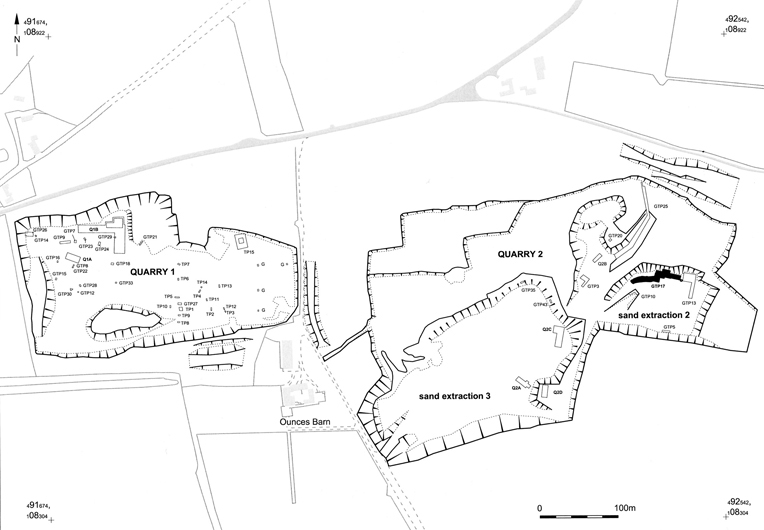
Figure 10.5 Uncovering a kilometre of the Palaeolithic landscape at Boxgrove (after Roberts and Parfitt 1999, courtesy Mark Roberts).
Among these riches, the most important finding from Boxgrove was the horse butchery episode from GTP17. Located about 40m south of the Chalk Cliff in Quarry 2, this excavation preserved the partial skeleton of a mare, the surviving elements suggesting that the whole animal had once been present. Cut-marks and scrape-marks showed that the entire animal had been skinned, disarticulated and filleted, with some bones broken for marrow, all demonstrating early access and not marginal scavenging, but most critical of all, one scapula exhibited a semi-circular puncture interpreted as a spear wound. If so (and doubts remain) this was clear evidence of hunting. The refitting stone tools associated with the horse butchery showed that six or seven blocks of flint in different states had been brought from the cliffs, made into handaxes. The handaxes had subsequently been removed, presumably to further process joints and fillets of horse flesh, providing a very compelling reason for the apparent inverse relationship between butchery and handaxes previously noted (Chapter 8). The whole event appears to have been a well-planned and leisurely affair, the killing and butchery taking place over several hours in an unhurried and non-harassed fashion.
Around the waterhole at Q1/A at Boxgrove, Roberts found evidence for the exhaustive butchery of three near-complete rhinoceros carcasses, large but short-sighted animals which he suggested had been hunted by ambushing them on their upwind side (Pitts and Roberts 1997). The hominins at Boxgrove were hunters at the top of the carnivore guild, not passive scroungers. There was no reason to suppose that humans had not also been responsible for killing the other animals bearing traces of human butchery, which included red deer, fallow deer, roe deer, bear, bison and badger.
Roberts (1996a, 1996b; Pitts and Roberts 1997) interpreted the landscape at Boxgrove as a hunting ground, a well-stocked larder on a grassy plain to which hunting parties came to kill animals and use the abundant facilitating resources. Hunting animals with the speed of a horse or the strength of a rhinoceros would have taken more than a lucky individual, but would have relied on group co-ordination and co-operation, perhaps even requiring some form of language (Roberts 1996b). The ring of knappers who obviously sat around the carcass at GTP 17 was certainly similar in size and shape to a conversation ring (Roberts 1995). But whether these animals had been hunted or not was not really the question. The amount of edible material on a horse or a rhino, in excess of half a ton in the latter case, was far too much for a small band of hominins to eat. Assuming hominins were not as wasteful with food as they appeared to be with flint, this possibly implied larger social gatherings or transport to a camp site for sharing. These would not have been situated on coastal hunting grounds stalked by wolves and hyaenas, but in the forested safety of the downland block, which would also have provided an excellent vantage point for scanning the plain below. Sadly these had been destroyed at Boxgrove by the distal effects of the Anglian Glaciation, but Roberts suggested that a camp might be in evidence at High Lodge, where the ice-shunted scraper assemblage might show different types of processing, maybe of hides from skinned animals for clothing. In this case, one wonders whether children would have been present on the Boxgrove hunting ground, or whether only skilled hunters and stone workers would have been allowed.
While Boxgrove failed to provide the murder weapon, the announcement in November 1995 of wooden spears in association with horse remains and hearths at Schöningen 13 II-4, Germany, in lacustrine deposits overlying a lignite formation, put a sudden and rather definitive end to the question of hunting versus scavenging in the Lower Palaeolithic (Figure 10.6 and 10.7). Helmut Thieme initially recovered eight spears (there are now over a dozen), seven made of dense slow-growing spruce, and one of pine. The spears were up to 2.5m long and between 29 and 50mm in diameter. They were constructed like a modern javelin, tapered, pointed at both ends and with the weight distributed towards the front third, and experiments showed that although heavy they flew with considerable power (Thieme 1997, 2000, 2005). Other wooden objects were also recovered, including a 78cm wooden stick pointed at both ends, interpreted as a throwing stick, digging stick or child’s spear; an 88cm stick, stripped of all bark and branches, with one end showing polish from prolonged handling, the other charred from use as a firehook or roasting spit. Recent experiments using professional javelin athletes and replica wooden spears (Milks et al. 2019) have shown that they can be thrown up to 30m, travel at a constant velocity and land with an impact sufficient to penetrate the hide of large animals, although the target was missed 75–100% of the time at distances beyond 10m. This was almost certainly due to lack of practise, because athletes train for distance not accuracy: using a flat (rather than parabolic) throwing trajectory over distances <15m was found to be most accurate. Regardless of whether the spears were used as long-distance projectiles or close-quarter thrusting spears, they were designed to injure or kill animals. Microwear analysis of a second pointed stick (64.5cm long) found in new excavations (2011-date) showed no evidence of abrasion or hammering but random impact damage consistent with use as a throwing stick (Conard et al. 2020). Ethnographically, similar weapons are used to hunt large birds or small game, from rabbits to small deer, and are effective at distances over 30m. They were unlikely to have been used directly to kill horses but could also have been used to steer horses towards other individuals armed with spears (ibid.).
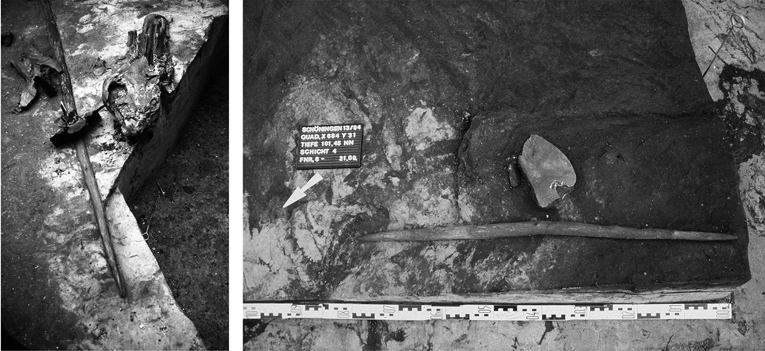
Figure 10.6 Advanced Lower Palaeolithic weaponry: left: spear II, 2m long, lying next to a horse skull at Schöningen 13 II-4; right: a ~80cm long throwing stick (courtesy Nick Conard).
Figure 10.7 Schöningen 13 II-4. Central distribution of finds, with location of throwing stick and spears I–VII and X shown (after Conard et al. 2015).
The spears were found in lacustrine marls, silts and peats, representing an interglacial lake some 2.5km long, 400m wide and 6–7m deep, that had formed in the depression left by a partially filled glacial tunnel valley (Lang et al. 2015; Conard et al. 2015). The faunal and lithic materials show no evidence of having been rearranged whatsoever but represent in situ activity areas concentrated along the lake edge. Thieme originally suggested that the site belonged to the Holsteinian interglacial, around 400,000 years ago (MIS 11), yet the most recent uranium series and luminescence age estimates have converged on the opinion that the deposits are ~300 ka BP, belonging to the MIS9 or Reinsdorf Interglacial (Sierralta et al. 2012; Richter and Krbetschek 2015), in line with some interpretations of the lithostratigraphy and biostratigraphy (Urban and Sierralta 2012; Urban and Bigga 2015; Kolfschoten 2012, 2014), but not all (Schreve and Bridgland 2002).
Mortality data on the horses showed a catastrophic age profile (Voormolen 2008), with large numbers of prime-aged adults and young animals, rather than attritional or natural deaths dominated by young or old animals. Voormolen (2008, 128) suggested that humans had disadvantaged groups of horses at the lakeside as they came to drink:
if surprised and rapidly closed in by a group of hominids equipped with spears, it should be possible to drive the animals into the wet soft lakeshore zone to minimize their mobility. This would have enabled the killing of the horses with the use of multiple spears by throwing and stabbing at close distance, minimizing the risk for the hominid hunters of horse defence attacks.
Thieme (1997, 2000, 2005) argued that humans had slaughtered a whole family group in one mass killing, but for Voormolen the minimum number of 16 butchered individuals and mortality profile did not conform to the normal equid harem structure of a stallion plus two to six mares and their foals, nor was it a large bachelor herd. It was more likely to represent multiple killing events of one or more individuals, a suggestion supported by isotopic and micro-wear analysis of horse teeth, which showed that the horses had similar but not identical life histories and had died at different times of the year (Julien et al. 2015; Rivals et al. 2015). Based on the low degree of weathering, burial was probably rapid, with the site preserving a record of decades rather than millennia (Voormolen 2008; Kolfschoten 2014; Kolfschoten et al. 2015a; Starkovich and Conard 2015). More recent excavations to the south of the original horse butchery site demonstrated that human hunters were equally active along other stretches of the ancient shoreline (Serangeli et al. 2015a, 2015b; Starkovich and Conard 2015).
Among the other species found at Schöningen, deer and large bovids also bore traces of human exploitation, but other than a Homotherium latidens humerus remarkably used as a percussion tool, none of the carnivores or mega-herbivores (elephant and rhinoceros) bore traces of human interference (Kolfschoten et al. 2015a). The dominance of horse was probably a result of human hunting preferences, a taste for horse flesh perhaps, or some aspect of horse behaviour that attracted them to the lakeside more often or made them more susceptible to human predation (Starkovich and Conard 2015). Even if only one or two animals were taken at a time, the hunt would have produced an enormous amount of meat (~550kg per adult animal), far more than could be eaten by a small group of hunters (ibid.). This indicated to the excavators that food must have been shared with members of society who were not actively involved in the hunt, the old, the young and pregnant woman for example (cf. O’Connell et al. 1999; Hawkes 2003), indicating a basic division of labour based on age, ability and risk. Similar divisions might therefore be expected in other labour tasks, such as flint knapping, hide processing or spear manufacture (see Pope et al. 2020 for a similar new interpretation of Boxgrove).
In this regard the butchery marks provided intriguing clues. While the hunters at Schöningen were competent butchers with intimate knowledge of the anatomy of their quarry, Star-kovich and Conard (2015) observed that the distribution and orientation of cut marks was somewhat disorderly or haphazard, different to what was seen among Neanderthal and modern human hunters. This, they suggested, demonstrated that the horses had been butchered by multiple people, possibly indicating a less organised system of provisioning in which individuals had access according to the role in the social group, or possibly an indication that the horse carcasses were butchered in several episodes taking hours or days, with humans taking breaks from eating and later returning to the kill. Another important feature of the Schöningen horse assemblage was that almost complete carcasses were present (Voormolen 2008; Starkovich and Conard 2015), with no evidence that meaty or fat-rich elements had been extensively removed by hominins or other agents.
Fillets of meat and internal organs may have been top of the menu, but the original claims that hearths were used to smoke and preserve meat for future use (Thieme 2000, 2005; Roebroeks and Villa 2011) did not survive the scientific scrutiny to which the Schöningen data has been subsequently subjected. Analyses of soil micro-morphology, thermoluminescence and mineral magnetism found no anthropogenic ash, charcoal or evidence of other indications of burning, with the reddened patches identified as the result of dewatering and weathering during mining activities and the supposed burnt artefacts recognised as just being stained (Stahlschmidt et al. 2015). As Conard et al. (2015) noted, a swampy lakeside was never the most obvious place to light a campfire. If humans had lit fires, then they would have been located further away on dry land and in more upland settings; the distance involved might be one factor in the decision not to transport meaty but heavy limb bones.
The spears were almost certainly curated gear (Conard et al. 2015) that would have taken several hours to prepare from selected trunks of slow growing spruce, a commodity that was not immediately available on the lake shore. Technological analysis showed they had been carefully cut, scraped and smoothed with stone tools, and in one case the tip of the weapon had been resharpened, showing more than one episode of use (Schoch et al. 2015). They must have been prepared in advance of need and carried with the plan of future use; overall the manufacturing sequences, transport, use, repair and final loss of organic weaponry demonstrate a high degree of technological and subsistence planning. Like Roberts, Conard et al. (2015) argued that these repeated visits to the same hunting ground where humans had killed dozens of horses over a short space of time could not reasonably be seen as a series of opportunistic events. They would have required social co-ordination and co-operation beyond that seen in modern primates, and probably demanded the ability to communicate ideas about contexts that extended beyond the here and now, requiring the capacity of linguistic displacement (ibid.).
More than 1,500 flint objects and 100 bone tools (mostly retouchers) were associated with the horse butchery events. The tools were made on good quality flint that was locally available in the glacial gravels, but they were not manufactured on the spot. The lithic assemblage was dominated by isolated flakes, retouched flakes or scrapers, and small and micro-debitage, with no handaxes, no Levallois and no long reduction sequences. They represented the distal end of the reduction sequence, where blanks were taken, retouched, used, resharpened and discarded (Serangeli et al. 2015b), a conclusion that is not necessarily at odds with the large number of bone retouchers (Kolfschoten et al. 2015a, 2015b). The lithic chaîne opératoire had started somewhere else, possibly by a different social sub-set, and selected pieces were brought to the lake shore with the understanding that they would be needed to butcher carcasses. Microwear analysis demonstrated that the lithics had been used for cutting meat, hides and wood (Rots et al. 2015). It was a different picture to that seen at Boxgrove, arguably showing greater levels of planning and social division of labour.
Broadly similar assemblages occurred in over 20 other sites in the Schöningen locality, showing the Schöningen industry was not an accumulation of ad hoc tools, a chance activity variant of something else, but a stable technological adaptation (Conard et al. 2015). The lack of handaxes and abundance of carefully made scrapers led Jöris and Baales (2013) to suggest that Schöningen should be placed in the Early Middle Palaeolithic, a rather semantic proposition rejected by Conard et al. (2015) as missing the key point: that is, the Schöningen hominins appear to have been ‘well on their way’ towards a modern hunter-gather lifestyle and social organisation. A small number of gnaw marks show that wolves and sabre-toothed cats sometimes took advantage of the carcasses after humans had finished with them, but hyaenas, the primary bone destroyer, were absent.
It is now beyond dispute that humans 300,000 years ago were accomplished hunters with specialised weaponry. Similar weapons were in use 400,000 years ago at Clacton, and, if the puncture wound is genuine, by 500,000 years ago at Boxgrove. The unique information provided by these finds has made modern archaeologists more confident in identifying the presence of complete carcasses with hunting in the archaeological record, even if these are not at a demonstrable kill site. Significant and well cited examples include the 300 ka BP (MIS9) site at the TD10.1 Bone Bed at Gran Dolina, Atapuerca, Spain (Rodríguez-Hidalgo et al. 2015), where evidence for the transportation and butchery of prime-aged red deer in the cave, has been accompanied by claims that the site served as a long-term residential focus. In the much older (>800 ka BP) bed TD6, Homo antecessor not only brought back whole carcasses of young red deer and horses, but occasionally dined on their own species, which they butchered using a Mode I technology (Falguères et al. 1997; Bermúdez de Castro et al. 1997, 2004; Fernández-Jalvo et al. 1999; Villa and Lenoir 2009; Carbonell et al. 2010). Gesher Benet Ya’aqov, Israel provides another example. Analysis of fallow deer bones excavated from Acheulean layers ~750 ka BP (MIS 18), provided evidence of regular and systematic exploitation of complete carcasses, which were expertly butchered in a manner identical to that seen in Upper Palaeolithic contexts at Hayonim. Rabinovich et al. (2008) did not hesitate to interpret it as the result of hunting by proficient communicators who possessed good anatomical knowledge, impressive technical skill, the ability to control fire (Goren-Inbar et al. 2004; Alperson-Afil et al. 2007; Alperson-Afil 2008; Alperson-Afil and Goren-Inbar 2010) and considerable foresight.
Elephant exploitation of any kind probably required group cooperation. In Layer II-6 Level 1 at Gesher Benot Ya’aqov, nine handaxes were found around the carcass of an elephant, the skull of which had been turned upside down using a branch as a lever (Goren-Inbar et al. 1994). Given the weight and shape of an elephant’s head, it probably required several hominins working together to detach and invert it. In other parts of the site discrete nut-cracking, stone knapping and shellfish exploitation were situated around hearths, their spatial patterning suggesting that they were carried out by a group of contemporaries who pooled resources into a shared pot (Alperson-Afil et al. 2009).
The question is not whether these were hunted or scavenged, which was probably not a matter of either/or. What matters is that these events provide another glimpse into the complicated social world of the Palaeolithic, one arrived at by different empirical and theoretical means, but socially orientated nonetheless. A strict and positivist focus on the minimal cognitive and behavioural requirements required to produce archaeological patterning, and suspicion or rejection of anything that does not conform to these expectations, is presently not particularly useful to debate or the wider relevance of archaeology.
At the same time, Whittaker and McCall (2001; McCall and Whittaker 2007) were forced to remind an increasingly diverse audience that, despite new experimental tests (Samson 2006), and modelling of the positive neurological implications and selective reinforcements (Calvin 1993, 2002), the 150-year-old notion that handaxes were used as lethal projectiles still didn’t fly. Nor does it seem particularly likely that they were laid edge up in the ground, in order to injure unsuspecting ungulates (Wayman 2010): old reports of handaxes in this position have been long recognised as post-depositional alignments (Isaac 1967), while the presence of pointed sticks would seem to negate the need for animal traps made of elaborately shaped stones.
Hearth and Home: Central Places for the Twenty-First Century
If it was only the perfect preservation at Boxgrove and Schöningen that allowed their positive identification as hunting grounds, then it must surely be to similarly unique situations that we should turn to find the elusive camp sites, those communal/central places (the differences are largely semantic) to which Palaeolithic hunters must have returned to share their spoils with those who were not present for the kill.
The rich, organic site at Beeches Pit, Suffolk, excavated by John Gowlett and a team from the University of Liverpool, has provided a genuine contender for an open-air camp site (Gowlett et al. 1998, 2005; Preece et al. 2006). Hominins here gathered around the northwestern margins of a spring-fed marshy pool, situated within a fully interglacial (MIS 11) deciduous forest. Human activity was focussed around hearths, sharply defined features 1m in diameter with reddened edges and ~20cm blackened fills containing fire-crazed burnt flint and charred and calcined bones (Gowlett 2006b; Gowlett et al. 2005; Preece et al. 2006). They had clearly been kept burning for significant periods of time, as single events or over repeated occupations, with fuel collected from the surrounding forest and brought to this communal locale. Several thousand lithic artefacts were recovered from the main archaeological horizons at Beeches Pit (Beds 3–7), including a small number of handaxes (n=7), flake tools, cores and flakes (both soft and hard hammer) made on locally accessible Chalk and till flint (Gowlett et al. 2005). Over 100 refits suggest that the archaeology is partly in situ, with some possible downslope movement. Knapping sequences were incomplete, showing spatial and temporal separation of different phases of the chaîne opératoire. In particular, the absence of conjoinable thinning flakes belonging to the handaxes in Area AH suggested that they were introduced from a manufacturing site elsewhere; similarly, the flake tools were not found in association with their parent cores (Gowlett et al. 2005; Hallos 2005). A refitting roughout, abandoned due to a flaw in the flint, shows that handaxe manufacture did take place at Beeches Pit. The hard hammer flake population is also consistent with full reduction sequences on site, although many of the cores used to produce them seem to have been exported. John Gowlett (e.g. 2006b; Gowlett et al. 2005) interpreted Beeches Pit as a home base, to which hominins repeatedly returned. This would have functioned as a social hub, where they gathered, built fires, ate and made tools, and where objects were transported in and out as they carried out their day-to-day activities in the surrounding environs. As Roberts (1996a) suggested, perhaps High Lodge was similar.
The cave system at Atapuerca, Spain, provides another example of a domestic and residential focus, repeatedly used over hundreds of thousands of years by different species with different technologies, as does Arago in France, although neither has convincing evidence of habitual use and control of fire (Roebroeks and Villa 2011). New excavations at Zhoukoudian Locality 1 have demonstrated that while burning had taken place in the cave, it could not be linked to human maintenance of fire (Gao et al. 2017).
Qesem Cave near Tel Aviv, however, has revealed a wide range of social behaviours among humans in Israel, dated by U-Series and TL methods to between 200 and 400 ka BP (Barkai et al. 2003; Gopher et al. 2010; Mercier et al. 2013). Excavations here since 2000 have produced a rich sequence of Acheulo-Yabrudian industries, specifically a non-handaxe Yabrudian facies with Quina and demi-Quina scrapers and Amudian facies with systematic blade production, both of which are regarded as precocious regional developments not seen in contemporaneous industries elsewhere (Gopher et al. 2005, 2010; Barkai and Gopher 2011; Shimelmitz et al. 2011, 2016). Evidence of fire use was spread throughout the sequence, but it intensified ~300,000 years ago, when a central stone-lined hearth covering 4m2 was established and repeatedly used over two prolonged periods of time (Shahack-Gross et al. 2014; Barkai et al. 2017). As a cave site, Qesem can provide only distal evidence for hunting, but Stiner et al. (2009, 2011) presented a convincing case, based on the dominance of prime-aged individuals, body-part selection and transportation, that Lower Palaeolithic humans in the cave practiced selective hunting of medium-large game, including aurochs, red deer, horse, wild ass and rhinoceros with a 70% dominance of fallow deer, including seasonally-taken infants and juveniles (Blasco et al. 2013a, 2014, 2016). Cut-marked tortoise shells and bones show that these reptiles may have been harvested to supplement the mammalian diet, and bones were extensively processed for marrow, but carnivores were almost absent and contributed little to the faunal assemblages. Analysis of weathering and processing patterns on marrow rich bones suggests they might have been stored for several weeks before consumption (Blasco et al. 2019), evidence that the Qesem humans did not live by immediate hand-to-mouth subsistence but practiced storage and delayed returns. Intriguingly, elephants, an important part of the hominin diet during the Acheulean, disappear from the Levant at the beginning of the Acheulo-Yabrudian, and while this may only signal their local extinction, it may have been one of the stimuli for wider developments in communal hunting techniques aimed at smaller species.
Like the horses at Schöningen, the processing marks on ungulate bones from Qesem showed a limited range of activities compared to those seen in Middle and Upper Palaeolithic assemblages, being generally concentrated on meat removal and marrow extraction. The orientation of some of the butchery marks also appeared to be ‘chaotic’ and interrupted, lacking the ‘surgical’ precision of later Palaeolithic butchers (Stiner et al. 2011). This suggested that butchery was not undertaken by one or a few competent individuals, but was done by many hands, including inexperienced ones. Stiner et al. (ibid.) concluded that while food was definitely shared, it may not have been portioned and distributed in an orderly fashion: individuals might have competed to cut their own slice from the same joint, or a carcass might have been placed so that individuals could help themselves at their leisure. Whatever the case, it was a less formal and more individual pattern of feeding (ibid.).
Evidence of burning was found on >30% of the total bone assemblage, but 63% of those found around the central hearth were affected, suggesting that humans had habitually roasted their share around a communal fire. Micro-charcoal particles found in the dental calculus of the Qesem hominin teeth showed that humans in the cave had inhaled smoke (Hardy et al. 2016), indicating that the occupants had not entirely solved the problem of ventilation and that their environment was often unpleasantly and dangerously smoky (Barkai et al. 2017; Kedar and Barkai 2019).
Over 80 types of lithic raw material had been brought to the cave, some grubbed up from underground sources and some brought from surface sources 15km away from the cave (Verri et al. 2004; Wilson et al. 2016). Different materials were often selected for specific tools or techniques. Amudian industries dominate the sequence, with full chaînes opératoires from selection of flat flint nodules to final discard being present. Use-wear analysis showed that blades were mostly used for cutting activities involving soft tissue (meat) for short periods of time (Lemorini et al. 2006). Tool recycling was common (~10 of the debitage) and followed well established routines designed to produce flakes and blades for specific functions (Parush et al. 2015), their diminutive size leading to their being compared to personal cutlery (Barkai et al. 2010). Bone retouchers and percussors were frequently employed. Twelve handaxes, three rough outs and a trihedral pick were also recovered from the Amudian layers at Qesem, but these were not made in the cave and petrological analysis suggested that they were made on a different flint source to the rest of the assemblage; they were interpreted as old tools collected from Acheulean sites near the cave (Agam et al. 2019), perhaps as curiosities, rather than an intrinsic part of the lithic repertoire. Concentrations of shiny coloured pebbles might also have been introduced for their aesthetic interest, perhaps as playthings by children attracted to their shiny smooth surfaces (Assaf 2018, Figure 10.8).

Figure 10.8 Light-coloured, well-rounded pebbles from Qesem (courtesy Ran Barkai).
The character of the assemblage in the southern part of the cave differed from the main industry, having a higher proportion of cores, lower numbers of blades, fewer shaped tools and poorer quality flint (Assaf et al. 2016). This was suggested to be an area where novice knappers were taught to knap, providing insights into learning and the transmission of knowledge which must have extended beyond gestures to raw material procurement, hunting practices, fire control, the etiquette of food sharing–all the skills and knowledge needed to live a full hominin life 300,000 years ago, in fact.
The Qesem team have argued that the suite of innovative behaviours seen in the cave heralds the arrival of a new hominin lineage in the Levant (Ben-Dor et al. 2011) the first to fully master fire and to regularly cook their food, perhaps related to the early modern humans from the Mt Carmel caves of Qafzeh and Skuhl (Barkai et al. 2017). The degree to which these patterns are evident in earlier periods is still to be determined, but by at least 400,000 hominins are recognisably humans. Layer II-6/L2 at GBY has similarly been interpreted as a home base, where humans maintained continuous fires around which they carried out a range of social functions while processing edible and non-edible resources (Alperson-Afil 2008; Alperson-Afil et al. 2009).
Given such a major sea-change in archaeological theory and the acceptance that unique sites provide unique insights, it is worth putting aside taphonomic skepticism and revisiting Mania and Mania’s oft-maligned interpretation of Bilzingsleben (Mania 1991; Mania and Mania 1988, 2003 ). In their joint contribution to the Individual Hominid in Context volume, Mania and Mania (2005) reiterated their belief that that spatial patterning at this site showed that humans were constructing wooden shelters, very simple structures involving a few branches stacked around a central support (perhaps even a tree) but which nevertheless provided artificial environments that could be warmed by hearths. In an environment where winter temperatures regularly dipped below zero, Mania and Mania thought this a simple necessity, not a social decision. Each structure had an activity zone in front of it, where hominins had sat, socialised and conducted domestic activities. Each structure had enough room for some six individuals, suggesting that they may have been used by small, nucleated families who practiced a social division of labour. On the eastern part of the site, the Manias excavated a peculiar stone platform 9m in diameter, ‘paved’ with non-local rocks, fragments of bone and teeth and the outlines of numerous wooden objects that had been pressed down into the soft layer beneath. In the centre of the platform was a deliberately placed anvil and hearth that had burnt to a fierce temperature. Macerated human bones suggested that this was not a place of domestic activity, but had ‘special cultural purposes’, ritualised or even ritual behaviour. Dietrich and Ursula Mania certainly used their archaeological imagination to interpret Bilzingsleben, but which of their claims today stretches our own imaginations too far? None can ever be tested or ‘proven’, but then little in the archaeological record ever will be, certainly not beyond reasonable doubt.
The past 20 years has also seen some sort of resolution to the debates about the Oldowan living floors. Re-analyses of the Olduvai FLK Zinj by Domínguez-Rodrigo and colleagues yielded lower estimates of carnivore involvement, with hyaenas active only after humans had abandoned a carcass. They concluded that hominins had early access to meaty carcasses, which they transported to well-known gathering places to process. Tool marks on fauna from the BK site at Olduvai, the ST complex at Peninj (Tanzania), FxJj50 at Koobi Fora (Kenya) and Member 3 from Swartkrans (RSA) suggested that humans had been significant agents in the formation of these bone assemblages too. They rejected Binford’s model, as well as the three-stage model of Blumenschine’s team, all of which overstated the role of passive scavenging by humans (e.g. Domínguez-Rodrigo 2001, 2002; Domínguez-Rodrigo and Pickering 2003, 2010; Domínguez-Rodrigo and Barba 2006; Pickering and Domínguez-Rodrigo 2006; Dominguez-Rodrigo et al. 2007, 2014). The significance of fluvial disturbance at Olduvai Gorge has also been downgraded (Domínguez-Rodrigo et al. 2019). The famous FLK N site at Olduvai, however, was found to contain very limited evidence for human involvement (Bunn et al. 2010), only four butchered bovid bones among an assemblage predominantly accumulated by felids and destroyed by hyaenas with no hominin involvement. Hominins appear to have used this place only occasionally, and for short-term stops, perhaps before moving on to a safer location. Use-wear analysis has also demonstrated that hominins were processing plants and underground storage organs at Oldowan sites (Domíngeuz-Rodrigo et al. 2001; Lemorini et al. 2014). Despite a growing dependence on meat and habitual bipedalism, Oldowan hominins were not cognitively, behaviourally or socially vastly different from modern apes and there was no evidence for basic human traits such as linguistic communication, extensive sharing, division of labour, or pair-bonded families (Wynn et al. 2011). Indeed, in a study of chimpanzee nesting and feeding sites in the Congo, Sept (1992) argued that although they were almost exclusively composed of organic materials that would never be preserved in the archaeological record, the spatial patterning was analogous to that seen on the Oldowan floor. She wondered whether similar social behaviour had produced both.
Toth and Schick (2018), however, still regard the total suite of behaviours to be at a more human-like threshold. They emphasised the difference in brain size between early Homo (650cm3) and the early australopithecines and chimpanzees (~400cm3), which shows an increase of ~60% within one million years. There must have been strong selective forces at work, which almost certainly involved higher cognitive abilities in foraging, social interaction and communication. By the time the Acheulean and hominins of the Homo erectus grade (1,000cm3) appeared, that human social threshold seems to have been successfully crossed.
Learning to Be an Acheulean
The 1990s also saw growing interest in the processes of social learning that underpin cultural transmission, drawing on significant advances in cognate disciplines including primatology, evolutionary behavioural psychology, anthropology and biology (e.g. Galef 1976; Cavalli-Sforza and Feldman 1981; Boyd and Richerson 1985; Tomasello et al. 1987; Tomasello 1990; Whiten 1989; Shennan 1991, 2011). Cultural Transmission Theory (CTT) recognised material culture as part of an inheritance system passed down from source to recipient, like genes or language (Eerkens et al. 2014), and like genes or language it was most effectively studied within a Darwinian evolutionary framework (Shennan 1991, 2011; Mithen 1995). Unlike genetic inheritance, which always flows vertically from two sources, is encoded in the individual’s chromosomes and subject to variation only by mutation, cultural inheritance systems can operate in multiple directions (vertically from parents, horizontally from age-mates and obliquely from older unrelated individuals), can come in different forms of different complexity (actions, words, things), can involve multiple sources, can be modified by error or design and can vary according to context (Eerkens et al. 2014).
Several ways in which humans acquire cultural skills have been defined:
· Individual or trial and error learning–when an individual reaches a solution by drawing on innate abilities rather than through observation.
· Social facilitation–increased or improved performance of a behaviour already in the individual’s repertoire due to the presence of other people. In the case of stone tools, this might suggest accumulations were most likely to accumulate in large numbers where other humans were engaged in knapping, even if for no immediate purpose.
· Stimulus enhancement–when an individual’s attention is drawn to a behaviour, object or resources by observing another’s interactions with it.
· Emulation–when an individual tries to attain the same results as the model, but not necessarily using the same methods. In stone tools for example, this might involve attempting to reproduce the finished form without copying the exact actions (or vice versa).
· Imitation–when an individual observes a behaviour and attempts to reproduce that behaviour exactly. In stone tools, the learner would thus attempt to faithfully reproduce both the object and the actions used to produce it.
Cultural learning mechanisms are subject to biases (Shennan 2011). Results biases refer to examples where an individual compares their results with another and changes their behaviour to the more effective methods. Content biases (or direct biases) prompt humans to acquire certain beliefs or behaviours because some property of the thing being learned makes it attractive. Examples include food biases for sweet or fatty foods that may be innate but also form part of cultural dietary habits. Context biases are derived from the social structure of the population in which an individual is immersed. They may be frequency-dependant (conformity biases, non-conformity biases) or model-based (in which a learner chooses different models based on an understanding of that person’s skill, success, or prestige within the community). There is also the cultural equivalent of genetic drift, as identified by Isaac, where traits will change for essentially random reasons not involving any particular selective process; who or what one copies might depend on nothing more than who you happen to meet and how often (Shennan 2011).
In modern studies with non-human primates and other animals it has often proved difficult to fully distinguish between different types of learning, particularly outside of artificial laboratory conditions. In modern humans it has proved equally difficult to partition what is genetic and what is cultural, the two systems are so mutually intertwined and co-dependant that while human behaviour may reflect innate tendencies its expression is most often culturally shaped (language is an innate human ability but a lexicon is not generated spontaneously, it is learnt). It is therefore now commonplace to situate CTT into a broader theory of co-evolution or dual inheritance (DIT: Henrich and McElreath 2007). This further recognises that modern human culture is characterised by being high-fidelity, high-frequency and cumulative, each new state adding to or modifying pre-existing structures, in recent centuries at a truly amazing pace (and largely driven by capitalist not natural forces). Another important feature of DIT is that, although the individual is the unit of selection, the nature of cultural transmission and the likelihood of conformist biases means group selection is also important, maintaining differences between populations and making it difficult for novel cultural variants to spread. Such biases are almost inevitable (Boyd and Richerson 1985) and help to explain long-term structures but not more ephemeral ‘fashions’. Cultural transmission will thus work to maintain inter-group variation, making artefacts suitable for the study of cultural phylogenetics (see stone tools as phenotypes).
One of the key factors affecting cultural transmission is group size. As group size increases, so does the rate and strength of cultural innovation and transmission (Shennan 2011). This is because individuals are exposed to many other individuals and because factors such as predation, resources distribution/access and interpersonal conflicts will foster strong kin-bonds and coalitions; the young will therefore tend to remain close to familiar adults from whom they learn (Mithen 1994a). In relatively large populations there is greater potential for different cultural practices to be compared, and adaptive traits are more likely to be maintained within the population rather than lost through stochastic processes or drift (Shennan 2000, 815). There are strong channels of social transmission, especially imitation, which in terms of lithic technology will produce high levels of knapping skill and regular patterns in artefacts form. Innovation tends to be low, however, as the constant proximity of learning young to knowledgeable adults discourages experimentation; conversely any innovation that did emerge would quickly spread through social channels. In smaller groups, many of these relationships are reversed or do not operate. When populations are small, chance plays a greater role in determining which cultural elements will be transmitted and cultural drift will tend to have greater effect.
How far an innovation spreads beyond its point of origin also depends on the regional meta-population, not only in terms of gross numbers but the extent to which different groups are connected (Hopkinson et al. 2013). Small and relatively closed groups could be expected to have limited lifespans compared to large and socially open groups, with innovations spreading only as far and lasting only as long as the group that made them. This helps to explain the long-recognised but poorly acknowledged diversity in the Lower Palaeolithic as well as its very ‘unmodern’ duration (papers in Petraglia and Korisettar 1998; Nowell and White 2010): there was no lack of local inventiveness, of novel lithic solutions, but innovations were unable to persist or disseminate beyond the short-lived local band, and culture was therefore not cumulative in the long term.
In a highly important paper, Steve Mithen (1994a) introduced mainstream Palaeolithic archaeology to the literature on cultural transmission theory and provided a new socially driven theory to explain the classic dichotomy between the Clactonian and Acheulean industries in Britain (and by implication Mode 1 vs Mode 2 assemblages elsewhere). Mithen’s model operated on the joint premises that the dynamics of social learning within human groups varied as a function of group size and that group size was correlated with the character of the environment within which they lived. Mithen argued that the Clactonian, with its lack of complex formal tools, short knapping procedures and relative low skill requirements, reflected the impaired social transmission of smaller groups in temperate closed environments. Groups living in closed wooded environments formed smaller social units because of low predation risk and small patchy food resources, and as a result are less cohesive, experience fewer interpersonal conflicts and have more independent young. Channels of social learning were thus weaker with high levels of trial-and-error learning, resulting in an absence of clear social traditions and non-standardised techniques and forms. Individual knapping skills would be low, and culture would not have been cumulative. Innovation may be higher due to more experimentation, but new developments would often fail to be transmitted. The Acheulean by contrast signalled larger groups in open environments, with much stronger channels of social learning based primarily on imitation.
Mithen’s model was an innovative and exciting solution to an old problem, but suffered, like Collins’s (1969) and similar ecological explanations, from a lack of palaeoenvironmental support at the pertinent scales of analysis. There was no evidence that the Acheulean was exclusively or mostly associated with non-temperate open environments or the Clactonian with closed temperate woodlands. Both Clactonian and Acheulean assemblages were produced in similar habitats; both were associated with temperate environments; both were found adjacent to water sources; and all sites showed a mosaic of open and wooded environments. In a complete reversal of the expected pattern the Acheulean at Beeches Pit was produced during the height of the MIS11 interglacial during a period of dense forestation (Preece et al. 2006). McNabb and Ashton (1995) also pointed out that the basic technology and cognitive requirements were the same in both industries. During MIS 11 the appearance of the Acheulean in Britain did roughly correspond with an episode of open conditions (Hoxnian Pollen Zone IIc), probably the result of a massive wild-fire event, but forest regeneration took place within 400 years (Turner 1970).
It is worth noting that Mithen’s model was situated within an even more ambitious project that explored the cognitive differences between modern and archaic humans (Mithen 1994a, 1994b, 1995, 1996a, 1996b). This was based on the principle that modern humans possessed a generalised intelligence, whereby the domains of technological intelligence, social intelligence and natural history intelligence were fully interconnected. This was most clearly shown by Upper Palaeolithic cave art and other modes of visual symbolism (Mithen 1995, 1996a), the anthropomorphic mammoth-ivory ‘lion-man’ from Höhlenstein-Stadel, Germany providing a fine example of an integrated social, technological and natural intelligence as well as the ability to attribute mental states to non-human animals, a ubiquitous feature of modern hunter-gatherers (Mithen 1990). By contrast, the cognitive architecture of Neanderthals and earlier humans was domain-specific (Mithen 1996a, 1996b). The Lower and Middle Palaeolithic record showed that by 40 ka BP essentially modern forms of intelligence had developed in each domain. Handaxes and Levallois required complex technological intelligence that involved the maintenance of target forms, planned sequences of action and a good understanding of raw material properties. Studies of the chopping tool industry from Zhoukoudian had also detected several complex cognitive routines (mental rotation, visual attention and element recognition) that showed Asian Homo erectus had also possessed a high level of spatial/technological intelligence (Robson-Brown 1993). The ability to survive in northern latitudes (in Europe and Asia) likewise showed an advanced natural history intelligence, the ability to read the environment for signs of prey and understand the rhythms of annual change (Mithen 1994b, 1995). Developed social intelligence was common to all higher primates. Yet before the Upper Palaeolithic these domains were separate and not mutually accessible. The implication was that handaxes and Levallois were a product of technological intelligence alone, with little social content and no referent in nature.
Nowell and White (2010) took a life-history approach to the question of hominin learning and handaxes. Human life-history differs from that of the great apes in several ways. Human life-history is divided into five stages–infancy (birth to weaning), childhood (weaning to eruption of M1), juvenile, adolescence and adulthood–with the childhood and adolescence stages being unique to humans (Kennedy 2003; Bogin 2003). Childhood conveys two specific advantages. First, the development of a childhood stage coincides with a shortening of the infancy period in humans when mothers are lactating, meaning that although humans mature later than apes they more quickly become fertile again and have shorter birth intervals (Aiello and Key 2002; Bogin 2003). Second, the childhood stage adds four years of “relatively slow growth and allows for behavioral experience that further enhances developmental plasticity” (Bogin 2003, 32). Nielsen (2012) similarly emphasised how important playing was to the cognitive and social development of children, as it provided the sandpit in which children can try out their socially acquired skills and test rules.
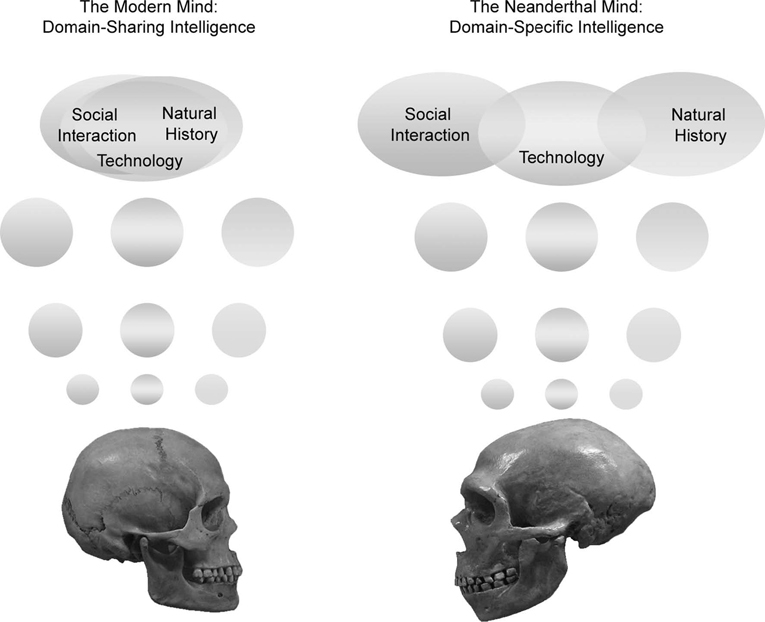
Figure 10.9 Steve Mithen’s modular intelligence model for Neanderthals and modern humans (based on drawing in Mithen 1995).
Adolescence provides further developmental space that allows humans to practice and refine their social skills, technological prowess, language and other aspects of life (Bogin 2003). In mammals that have juvenile periods, a greater percentage of offspring reach adulthood than in species without this stage. Accordingly, it is believed that the childhood and adolescence stages dramatically enhance offspring survival. There is consensus that the life-histories of Middle Pleistocene Homo included a childhood stage for the first time (Bogin 2003; Krovitz et al. 2003). The skeletal evidence also points to an adolescence stage for archaic sapiens, although this is less clear for Homo erectus (Antón and Leigh 2003; Bogin 2003). The development of an adolescent phase marks an extremely important point in human evolution because for the first time in hominin history there was additional time to perfect social, ecological, technical and economic skills (hunting, Gurven et al. 2006, knapping, Geribàs et al. 2010) before reaching full reproductive maturation.
Humans also enjoy greater overall longevity, with an extended post-reproductive life in women (Hawkes et al. 1997, 2003; Kaplan et al. 2000; Zimmermann and Radespiel 2007). Modern studies into the life histories of Middle Pleistocene hominins have suggested that the development of the Neanderthals and erectines was much closer to modern humans than to the pongids (Krovitz et al. 2003). In adaptive terms Homo erectus was an obligate biped with similar body proportions to modern humans. They exploited a significantly larger range than earlier hominins (Antón et al. 2002) and had a greater reliance on meat in their diet (Aiello and Wells 2002). This change was accompanied by increased hunting proficiency and an increased use of fire, possibly for cooking (Wrangham 2017). Leslie Aiello suggested that this shift to a more high-quality diet resulted in a reduction in gut size and a 20–60% increase in brain size relative to early Homo (Aiello and Wells 2002; Aiello and Wheeler 1995).
Brain size and body size, furthermore, have significant correlations with a variety of maturational processes such as age at sexual maturity, maternal age at first birth and gestation length. Kennedy (2003) argued that Middle Pleistocene species reached sexual maturity around age 13 with a female’s first birth occurring somewhere between 15 and 16.5 years of age, within the range of modern humans. It was also likely that Homo erectus was the first hominin species in which females enjoyed a life expectancy well beyond menopause (Aiello and Key 2002; Bogin and Smith 1996). Christina Hawkes and colleagues’ ‘Grandmothering Hypothesis’ (Hawkes et al. 1997, 2003; Hawkes 2003; O’Connell et al. 1999) suggested that this new social strata of grandmothers and great aunts would have provided supportive care for the infants of their own kin, meaning that children could be weaned earlier and the mother’s inter-birth spacing reduced. These social caregivers might then have formed the primary models for the acquisition of cultural behaviour for both male and female children: if both sexes made handaxes, they might have done so to Granny’s recipe.
There were, however, significant differences that would impact upon the individual’s cultural abilities. Studies of dental development suggested tha t Homo erectus development was more rapid than modern humans, with a shorter period of childhood (Dean et al. 2001). On this basis, Nowell and White (2010, 76) asked whether the lack of innovation in Middle Pleistocene technologies, which while locally and regionally variable were all basically variations on a theme, reflected short childhoods in which individuals had less time to play, learn and experiment, and whether this meant that technology was more safely imitated with errors. Sterelny (2020) further argued that if Middle Pleistocene hominins had closed social networks, a “standoffish” relationship with their neighbours and subadult single-sex dispersal (like pongids and not dissimilar to Gamble’s intimate and effective networks, or Alf Garnett) then the chances that any innovation that did occur would spread or be archaeo-logically visible was very low. If different sexes made different tools, then anything made by the non-dispersing sex would always remain within their closed social system and never spread beyond the point of origin.
Imitation, Over-Imitation and Normativity
As a body of cultural practice that lasted 1.25 million years and which transcended several species of Homo (presently Homo ergaster, Homo erectus, Homo heidelbergensis, Archaic homo sapiens and the Neanderthals) the Acheulean must have had a robust means of reproduction (Shipton et al. 2009; Shipton and Nielsen 2015). In a series of recent papers, Ceri Shipton and Mark Nielsen (Shipton 2010; Nielsen 2012; Shipton and Nielsen 2015; Shipton 2019a, 2019b) have emphasised that the key feature of human cultural transmission is not imitation but over-imitation, the tendency to copy the behaviours of others exactly, even if part of the action is redundant. Over-imitation is absent in apes, but emerges in human babies in the second year of life and is inextricably linked with shared intentionality (Shipton and Nielsen 2015). Over-imitation does carry the risk of an individual learning time-wasting or deviant traits, but in the context of the need for children to acquire vast quantities of different and contrasting information it makes adaptive sense (Shipton and Nielsen 2015). In terms of stone tool manufacture, over-imitation means that the inexperienced individual avoids having to make uninformed decisions about which actions are required and which are not. By copying completely the behaviour of others, children rapidly acquire the ‘array of essential skills’ necessary for survival accumulated by previous generations, without having to continuously ‘reinvent the wheel’. Social learning in adult humans is also characterised by over-imitation, but only when the demonstrator is regarded as an expert.
The capacity for imitation and over-imitation is linked to the mirror neuron system (MNS) in the brain, a relatively recent discovery by Rizzolatti and colleagues (1996) who noticed that a group of neurons in the premotor cortex that were triggered when a monkey performed an action were also fired when the monkey observed that action being performed by another animal. Brain imaging studies in humans have revealed that action observation triggers several regions of the brain and, unlike monkeys, the MNS fires even when observing meaningless actions. But children do not just copy anything. Actions must be perceived as having been performed intentionally, and the imitator must share those intentions. In modern humans the ability to read the intentions of others is first expressed at about six months of age, and by 18 months infants can interpret another’s actions in terms of what they are trying to achieve (Shipton and Nielsen 2015). Further sets of mirroring neurons are associated with social cognition, empathy and the Theory of Mind (Rajmohan and Mohandas 2007). So, internal simulation via mirror neurons enables an individual to attain “motor, emotional, and intentional attunement with another and thus understand others as being goal-directed agents with emotional motivations” (Shipton and Nielsen 2015, 340).
Shipton and Nielsen argued that even though the Oldowan was a least effort strategy, it probably involved some degree of imitation. Oldowan knapping methods were more stan-dardised than those used by Kanzi and Panbanisha, the two bonobo chimpanzees taught to knap by Nick Toth (Toth et al. 1993; Davidson and McGrew 2005). Both individuals could eventually make the simplest stone tools using free-hand percussion and Panbanisha was observed to calculate angles, but the acquisition of these skills was slow and seemed to rely on emulation and limited imitation (Shipton 2010). For Shipton and colleagues however, Acheulean handaxes and cleavers were undoubtedly products of over-imitation and shared intentionality (Shipton et al. 2009; Shipton 2010; Shipton 2013; Shipton 2019a, 2019b, see also Rossano 2017). Handaxe size and symmetry were more homogeneous than would be expected under conditions of random variation (Lycett 2008; Kempe et al. 2012; White and Foulds 2018; Shipton 2018; Shipton et al. 2019), while cleavers, with their specially designed and pre-planned bit, were unique to the Acheulean. Use-wear and residue analysis has identified that the bit was the functioning part of the tool, but it was never retouched (de la Torre et al. 2014; Shipton 2018; Shipton et al. 2019). Retouch is only found on the nonfunctional margins and butt, where it mostly modified the shape and symmetry of the tool (Shipton et al. 2019). It was yet another example of over-imitation (Shipton et al. 2019). The specific methods used to arrive at handaxes and cleavers further suggested that hominins made a distinction between the two, evidence perhaps of a lexicon (Shipton et al. 2009).
The flake blanks for handaxes and cleavers were frequently struck from different types of Mode 3 technology–Victoria West, Kombewa, Tachengit, ‘giant’ cores and Levallois (Sharon 2007; Sharon and Beaumont 2006)–which must have involved shared intentionality in order for the relationship between nodule selection, method and tool form to be transmitted and understood (Shipton 2010). Excellent evidence that these were also the product of over-imitation was the fact that the flakes from Victoria West cores were predominantly struck from the right, while those struck from Tachengit cores were struck from the left, an arbitrary pattern for which there is no technological explanation (Shipton 2019a). Over-imitation and shared intentionality fostered long-lived traditions. Technology at Gesher Benot Ya’aqov showed remarkable consistency over 16 layers spanning 50,000 years, with persistence in the selection of raw material selection, flake production, retouch strategies and the size of the finished piece despite considerable environmental variation (Sharon et al. 2011). Innovations were at best sporadic (Goren-Inbar 2011), perhaps indicating that cumulative culture had not developed. In north-west Europe and other places where nodules were used instead of flakes, the handaxe itself became the prepared core.
Shipton (2019a, 2019b) has cogently re-introduced the importance of normativity in shaping the Palaeolithic record. While once the derided target of processual archaeology, normativity is increasingly recognised in anthropology and psychology as a key human trait across a wide range of behaviours (Sripada and Stich 2005; Roughley and Bayertz 2019). It describes the unique human tendency to conform to normal social conventions and institutions that exist independently of dyadic relationships (Shipton 2019b), and while these might be completely arbitrary they represent the collective agreement about the way people ought to behave and provide a standard against which to judge behavioural variation (Shipton 2019b, 253). It is vital for language because it is how collective agreements are reached on the meaning of arbitrary vocalisations and it is key for socialisation as it creates a sense of affiliation between individuals and enables children to understand roles and relationships (Shipton 2019b). Normativity fosters the expectation of similar (and appropriate) behaviour, and is essential to delayed reciprocal relationships, morality and empathy; normativity creates expectations of loyalty, and shifts the burden of dealing with transgressors from the victim to the group (Boyd et al. 2003; Lakin et al. 2003; Henrich et al. 2006; Tomasello and Vaish 2013). In modern humans, normativity emerges in an apparently innate way during development. By the age of three children begin to speak in terms of norms, quickly infer a norm from only the briefest exposure and are disturbed when norms are broken (Shipton 2019a, 2019b, citing Chartrand and Bargh 1999; Kenward 2012; Schmidt et al. 2016). Adult humans will persist with norms even when they are costly.
As with over-imitation, Shipton (2019a, 2019b) suggested that normative behaviour was first seen during the Acheulean (see also Finkel and Barkai 2018), in which handaxes varied from assemblage to assemblage, with each location showing its own modal type. During the late Middle Pleistocene of Britain, which was repeatedly colonised and abandoned during warm and cold climatic cycles, each interglacial has now been shown to have been associated with different and often highly specialised handaxe types and manufacturing techniques (White 2015; Bridgland and White 2014, 2015; Shipton and White 2020). Increased region-alisation in technology after 500 ka BP was also evident in the Acheulo-Yabrudian of the Levant and the Fauresmith of Southern Africa (Porat et al. 2010).
Psychologist Matt Rossano (2017) has attempted to explore precisely how this over-imitation operated, going further than most archaeologists, who are still pondering the general principle, would care to tread. Rossano argued that the selective pulse of over-imitation altered through time, from an early concern with causal relationships (learning by ‘automatic causal encoding’ which only imitates intentional or uncertain acts and discards obvious redundancies or ‘copy-everything-and-correct-later imitation’) to a later emphasis on social relationships (via normative behaviour or social affiliation which served to help the learner identify with or share social experiences). According to the archaeological record, the switch between causal and social relationships seems to take place about 500,000 years ago (ibid.).
As an adjunct to these more socially orientated approaches, several recent workers have used diverse experimental approaches and a range of unexpected resources to re-examine the reductionist models of the 1990s. One key conclusion is that typological differences cannot be accounted for by functional factors (Key and Lycett 2017a, 2017b). Neither final shape nor symmetry has much effect on handaxe cutting efficiency (Machin et al. 2007; Key and Lycett 2017a, 2017b). As one of several large cutting tools5 handaxes performed no better than flakes of equivalent size, although their findings did suggest that small flakes were more effective at intricate jobs, handaxes for longer, bigger tasks involving more resistant materials (Key and Lycett 2017a, 2017b). In fact, individual biometric and biomechanical attributes had a far greater impact on handaxe use than shape, by a factor of ten. Eren et al. (2014) have further shown that, while there can be no doubting that the archaeological record demonstrates some relationship between raw material type and handaxe type, this was not determined by any intrinsic property of the stone. Starting with a set of fairly homogenous large nodules and cobbles of flint, basalt and obsidian, Eren (an expert knapper) replicated a target handaxe with truly remarkable skill and precision 105 times (35 of each material). There was however clear variation in size, reflecting original blank size and the fact that in order to keep to a strict target, any mistakes that arose could not be easily accommodated but had to be remedied by removing additional volume (cf. Schillinger et al. 2014a). In terms of frontal and cross-sectional shape, however, the three replica sets could not be statistically separated using principal components analysis or multivariate analysis of variance. A very skilled knapper could impose the exact same form on any rock type if they so wished,6 suggesting that raw materials influenced stone tool form only “because hominins did not possess the knowledge, manual dexterity, skills, or incentive to tackle challenging raw materials” (Eren et al. 2014, 474). In a 20-month long experiment designed to measure the impact of improving skill-level in preferential Levallois production, Eren et al. (2011) found that knapping skill rather than raw materials was the key determinant of success or failure: once the technique had been mastered, switching from a high to a lower quality material had minimal effect on whether the knapping goals were achieved. In sum, there was no automatic correlation between raw material type and artefact form, suggesting that human decisions involving a variety of social, technological and material considerations had created the observed archaeological variations (Eren et al. 2014).
In another series of experiments, Shipton and Clarkson (2015a, 2015b) have shown that different levels of resharpening cannot adequately explain variation in handaxe shape. They calculated reduction intensity using a scar density index (SDI), which divided 3D measurements of surface area by the number of flake scars to determine the proportion of the original mass removed during manufacture. Experiments using different blank types and different raw materials, and following several possible resharpening paths (Figure 10.10), found that SDI was able to account for 80% of the mass lost during handaxe manufacture. When applied to five British assemblages, Shipton and Clarkson (2015b) found that differential reduction intensity was certainly a key feature, but at Boxgrove, Swanscombe and Broom shape was conserved independently of SDI. At Hitchin and High Lodge, handaxe shape did correlate with SDI in a manner that was consistent with the predictions of resharpening models, but it was impossible to rule out the possibility that ovate handaxes just required more working than points (see White 1998a). Compared to the experimental sample, the archaeological handaxes were far from exhausted. Biface life-histories were short and made to order. African and Indian handaxe assemblages from Kariandusi, Isenya, Patpara and Bhimbetka also provided only indifferent evidence for resharpening on non-flint raw materials (Shipton and Clarkson 2015b).

Figure 10.10 The possible changes to handaxe shape using different resharpening strategies (after Shipton and Clarkson 2015a, courtesy Ceri Shipton).
Re-analysis of the evidence for on-site manufacture and resharpening of handaxes from Late Acheulean contexts at Tabun (Shimelmitz et al. 2017) has also failed to support inferences made on the basis of size and shape attributes that handaxes at this site were routinely and repetitively resharpened (McPherron 2003; Iovita and McPherron 2011). Furthermore, the high frequency of tranchet flakes at Boxgrove, which perhaps provides some of the most convincing signs that hominins did possess a set of resharpening options, presents little reason to suppose that tip resharpening radically altered the final form, or that it was not an original part of the design (García-Medrano et al. 2019), although it did negatively affect symmetry (White and Foulds 2018). The hunters at Boxgrove made handaxes according to the same mental template, whatever they did next. Comparisons of handaxes made on elephant bone with those made on stone from Castel di Guido, Italy, have further shown that humans transferred their lithic skills and designs across media, using the same knapping techniques to produce the same shapes in bone despite differences in form and structure (Costa 2010).
Another implication of these studies, given the documented consistency with which an expert modern knapper can reproduce a target form, is that in those rare instances where we see clusters of identical handaxes, such as at Foxhall Road, Boxgrove or Isimila, we must be dealing with similarly expert knappers with an equally well-defined target form, presumably one originally learnt from someone else. That sites never show the exclusive use of a single type, even among the very well-made subsets, further suggests that there was more than just one model form in a group and that more complex social relationships must underlie variation (cf. Shipton 2019a, 2019b). The remarkable consistency of handaxes at Boxgrove, in terms of both shape and expert technique (García-Medrano et al. 2019; McNabb 2017), might thus be more a reflection of the sub-set of hominins present on the palaeoshore and what they were doing, than a full cross-section of the population. Hunting grounds were probably not the best places to have children getting in the way. If only adults and adolescents were present on the beach, we might expect to see high skill levels in handaxe manufacture (see Pope et al. 2020 for a more communal view of Boxgrove). At home bases such as Beeches Pit, High Lodge and maybe Foxhall Road (Suffolk, England) we would therefore expect to see a wider cross section of skill levels, reflecting the very different social gatherings that took place there, but equally we might expect these sites to contain different tools made for purposes not required during the hunt (such as flake tools and scrapers, cf. Roberts 1996b). So, as well as potentially showing activity differences, assemblage variability has the potential to unravel the different skill levels, and by inference different subsets of the hominin band present. The re-examination of handaxe assemblages in terms of the range of technical skills present rather than just shape and size, backed up by a suitably robust set of experimental observations, might then be the route to a more detailed mapping of the dayto-day fission-fusion that took place across the hominin landscape of habit.
In stark contrast, Tennie et al. (2016, 2017) argued that Lower Palaeolithic technology might not have been the product of robust mechanisms for high-fidelity cultural transmission but could have been the result of repeated and independent reinvention. Although Whiten et al. (1999) had provided a compelling case that chimpanzees in East and West Africa had regional cultures, with a strong correlation between the number of shared traits between groups and proximity, Tennie and colleagues argued that these might not be cultural at all, but could have been reinvented spontaneously by different individuals, with only minor low-fidelity social stimuli. The same was true of the Oldowan and Early Acheulean. These too were not cultural in the sense of being high-fidelity, socially learnt skills acquired by imitation and teaching, as seen among modern humans. Instead, the variable and simple nature of the Lower Palaeolithic record suggested low-fidelity learning driven by stimulus enhancement and emulation and which largely involved trial and error learning until the goal was achieved. Simple stone tool manufacture thus lay within a ‘zone of latent solutions’, behaviour that lies dormant in an individual until it is triggered by a set of social, environmental or other motivational cues. In other words, there was nothing in the Oldowan or Early Acheulean tool kit that an individual hominin could not have worked out for themselves. As such, there was no transmitted store of knowledge to give each generation a head-start; culture was not cumulative but endlessly repetitive. This was especially true of the 3.3 ma BP pre-Oldowan Mode 1 assemblage from Lomekwi 3 (West Turkana, Kenya), assigned to the new Lomekwian industry and currently the oldest known stone tools, nearly one million years older than the earliest known fossil Homo (Harmand et al. 2015). The techniques used at the site–‘passive hammer’, whereby a stone was simply struck against another hard object, and bipolar knapping, whereby a stone was held on an anvil and struck with a hand-held hammer (similar to nut cracking)–were both techniques transmitted by emulation and low-fidelity learning in chimpanzees (Shipton 2019a)
As Sterelny (2020) has noted, the zone of latent solutions hypothesis presents an implausibly extreme version of nativism, one that is impossible to demonstrate because human behaviour can never be divorced from its social context. Only if an individual’s repertoire were totally independent of their developmental environment would the ZLS even be possible, but this can hardly have been the case for young hominins growing up surrounded by other toolmakers and their dynamic and static outputs. Like lithic reduction models, which still reject the idea that artefact form emerged from an internal mental template (Dibble et al. 2017), this model questions the universality of social learning in humans and hominins. By appealing to latent innate behaviour, plus, at most, some form of social facilitation, it ostensibly provides a scientific and parsimonious explanation, one that requires just two low-level universal principles to operate. But for the Acheulean it requires us to assume that every new generation of hominins re-invented the handaxe, innumerable millions of individuals, which I would venture is far less parsimonious than believing handaxes were invented only a handful of times and transmitted by imitation. Hominins used handaxes to prepare meat (or anything else) because they learned to do so from other hominins. If they had been raised by wolves they would probably have just used their teeth. The ZLS model also fails to satisfactorily explain why the earliest handaxes are all found in East Africa, or why populations of Homo erectus that left Africa prior to their invention failed to independently invent them (Shipton 2019b; Beyene et al. 2013; Diez-Martín et al. 2015; Lepre et al. 2011; Baena et al. 2010; Mgeladze et al. 2011).
In this vein, Shea (2017) has asked whether humans were obligate or simply habitual or occasional tool users prior to 300 ka BP, suggesting that, despite their abundance in the archaeological record, stone tools might not have been as central to Middle Pleistocene hominin adaptation and society as many archaeologists assumed. The less regularly stone tools were used, the less innovation one might expect. Nevertheless, where Homo of all types is concerned, the most logical null-hypothesis is that Palaeolithic technology was a social technology transmitted in social groups.
Handaxes as Phenotypes and Genotypes
After moving from Durham to Cambridge in the late 1980s, archaeologist turned paleoanthropologist, Rob Foley (1987b) pointed to the ‘curious anomaly’ that separated his two main areas of expertise. Despite dealing with essentially the same subject matter–the evolution of the hominins, one through material culture, the other by anatomy–there had been little attempt to integrate the two disciplines theoretically or methodologically, Glynn Isaac being a notable exception. Foley suggested several historical reasons for this chasm, but noted that the central problem for a unified approach was the way in which biology and culture had been dichotomised in terms of the processes that drive them, the former seen as the product of natural selection, the latter of various non-biological cultural mechanisms. This dichotomy was for Foley (1987b, 380) ‘increasingly untenable’.
Behaviour was an integral part of biology, which evolved under mechanisms for selection similar to those that applied to anatomical features, and which could be explored using principles derived from evolutionary theory. Culture was part of the biological phenotype. Foley suggested that a useful way of looking at hominin behaviour, as fossilised in material culture, was through cladistic analysis. Cladistics is a system of analysis for constructing evolutionary relationships (phylogenies) that recognises that not all similarities and differences have the same interpretative value (Foley 1987b, 381). Features that derive from a common ancestor (primitive characteristics or plesiomorphs) are not useful for determining the degree of relatedness between species. Only features that are unique to a specific lineage–derived characteristics (apomorphies) and shared derived characteristics (synapomorphies)–can be used to determine an evolutionary relationship. The earliest stone tools of the Oldowan were associated with Homo habilis and other small-brained hominins, while the Acheulean evolved in tandem with the more advanced Homo erectus lineage and its descendants. As these humans diverged across the Old World, so did their technology. Those that moved west preserved biface technology, but those that went east reverted to the primitive state. Acheulean populations in Africa, India and Europe then become isolated from each other and diverged, with a number of local developments appearing in different epicentres throughout the Lower Palaeolithic/Early Stone Age. Foley concluded that stone tool assemblages behaved in the same way as morphological traits, being relatively conservative and diversified only in instances of large-scale geographical distance. “Stone-tool variability in the Pleistocene, prior to the appearance of anatomically modern humans”, as seen by Foley (1987b, 388) was a “marker for the biological populations that produce them”, relatively fixed phylogenetic traits that changed only slowly and within limits in response to isolation, local ecology and raw materials. By the late Middle Pleistocene, Asian Homo erectus, African Homo ergaster/erectus/archaic Homo sapiens and the European Neanderthal lineage had all developed in different directions, with a range of both unique and shared cultural characteristics on top of a basic primitive technology. The cultural regression in Asia probably reflected advances in organic technologies rather than evolutionary regression.
Foley and Lahr’s (1997, 2003) ‘Mode 3’ hypothesis pushed the phylogenetic links between species and technology further. The departure points for this model was the fact that ~100,000 years ago in the Levant both early modern humans at Skuhl and Qafzeh and Neanderthals at Tabun were using Levallois technology, which had rapidly become the dominant mode across Africa, India and Europe ~250 ka BP, when Mode 2 handaxes diminished and disappeared. There were significant regional differences. In Africa, Mode 3 (Victoria West, proto-Levallois) was frequently associated with handaxes and cleavers, from at least 400–350 ka BP, and they rarely occurred as distinct industries, as Riet Lowe had emphasised in the 1950s. Mode 3 technology (particularly Levallois) became more dominant as a source of flakes for flake tools at the beginning of the MSA, ~250 ka BP, except in western Africa where the Sangoan persisted. After 250 ka BP Africa experienced increased regional divergence. In Europe and the Levant, handaxes quickly disappear after 250 ka BP and, once established, Mode 3 industries dominate until the emergence of modern humans ~50 ka BP. We will fully examine the most current issues surrounding the Lower-Middle Palaeolithic or ESA-MSA transition in the last chapter, but for present purposes, the key point is that for Foley and Lahr, Mode 3 technology was an African invention that spread into Europe during a late dispersal involving the last common ancestor of Neanderthals and Modern Humans, for which they proposed using the ‘available’ name Homo helmei, based on fossils from the South African cave site of Florisbad. Mode 3 technology apparently held many advantages over Mode 2 technology, meaning that this new hominin was able to replace existing groups, although the persistence of Mode 2 suggested that some relict populations may have survived into MIS 7. So, by the time the ancestors of this elusive species meet again in the Levant, Levallois was a plesiomorphic technology, reflecting their distant relationship.
Rolland (1995), Otte (1995), Tuffreau (1995) and White and Ashton (2003) on the other hand, thought that Levallois was a technology of convergence (a homoplasy in biological terms) and detected an earlier in situ emergence of Levallois in western Europe from existing biface technologies. Rolland (1995) proposed an asynchronous and independent emergence of Levallois technology, first in Africa, where it developed from existing Mode 3 technologies (VW, Tachengit, Kombewa, giant cores, etc.), and then in Europe, where the manufacture of finely made handaxes on nodules and cobbles would have led, almost inevitably, to the accidental discovery of prepared core technology in the form of large axial thinning flakes. Such removals–termed pseudo-Levallois by Callow (1976) and ‘ biface acheuléen ayant servi de nucléus Levallois’ by Bordes (1961a)–are widespread, with examples coming from High Lodge, England (Callow 1976), Tabun and Ma’ayan Barukh, Israel (Debono and Goren-Inbar 2001), and Cagny-la-Garenne, France, where on occasion what appear to be lineal Levallois cores have been formed from handaxes broken during manufacture, as well as from very thick handaxes (Tuffreau 1995). White and Ashton (2003) suggested Levallois emerged from existing core technologies through the transfer of concepts borrowed from handaxes (hierarchical surfaces, a plane of intersection), a fusion of façonnage and débitage, labelling the products of this experimental phase ‘simple prepared cores’. These showed five of the six criteria Boëda (1986; see Chapter 8) prescribed for the Levallois Concept, but lacked management of convexities on the flaking surface, using the natural convexities of the raw materials instead. They seem to be geared towards maximising flake production rather than controlling for size and shape. Flaking is controlled but not predetermined.
The biological analogy has been taken further by several of Foley’s former students and colleagues, who have focussed on using micro-cultural processes to understand macroscopic archaeological entities. Stephen Lycett and Noreen von Cramon-Taubadel (2008, 2013; Lycett 2008, 2009, 2013, 2015) used cultural transmission theory and dispersal models developed in population genetics to test the assumption that the Acheulean arose in Africa and spread with migrating hominin populations into Europe and India. Their ‘iterative founder effect model’ predicted that as humans moved along their migration routes, reductions in the effective population size and repeated instances of bottlenecking would act to reduce within group variation in material culture, just as it did in genes. So, as hominins moved out of Africa effective population sizes became progressively smaller with distance and this stretched networks of social transmission involved in the learning of effective handaxe manufacturing skills. One would therefore expect an inverse relationship between the variation in handaxe shape and geographical distance from East Africa: like genes Africa would show the greatest variation. When they applied this hypothesis to ten handaxe assemblages from Europe, the Levant, India and Africa (n=255 handaxes), they found that distance from Africa accounted for as much as 45%–50% of within group variation. The remainder of the variance could potentially be accounted for by raw materials, selection for functional or social reasons, horizontal transmission between groups, incorrect assumptions regarding dispersal routes, biased samples, different longevity of regional populations, or backward movements into Africa–it was still too early to decide–but it seemed highly likely that a large part of the residuum could be accounted for by random drift and demographic factors. This did not preclude the possibility of multiple dispersals, since the same basic relationship would be expected for each event. Variation in handaxe symmetry, on the other hand, did not conform to these expectations (Lycett 2008), suggesting that symmetry was under selection for functional, adaptive or aesthetic reasons.
Using the same population principles, Lycett and Cramon-Taubadel (2008) suggested that the contemporaneous occurrence of Mode 1 technologies in the form of the Clactonian and industries east of the Movius line could represent instances where effective population size in colonising or peripheral groups dropped below levels where handaxe technology could be socially maintained (cf. White and Schreve 2001). Even stasis required certain social thresholds to be maintained in terms of population size, density, clustering and interconnectedness (Lycett and Cramon-Taubadel 2008).
To further refine these models, this team has examined the effect of raw materials (Eren et al. 2014, see preceding), function (Key and Lycett 2017a, 2017b, 2017c, 2018, 2019; Key et al. 2016, 2020), different learning processes (Schillinger et al. 2015) and the rate of expected copy-errors (Kempe et al. 2012; Schillinger et al. 2014b, 2015; see also Lehmann and Wakano 2013.). Experiments using iPad images of handaxes, in which 200 participants were split into 20 transmission chains and asked to copy the image of the previous participant in their chain, showed an average error in perceptions of size of 3.43%, the images tending to get larger the further down the chain (Kempe et al. 2012). When compared to a set of 2601 Acheulean handaxes, Kempe found less variation than predicted by the experimental mutation rates, suggesting that some other process counteracted copy-error variation in handaxe size. Using florists’ oasis foam to sculpt handaxes (to overcome safety and knap-ping ability issues), Schillinger et al. (2014b, 2015) noted that cumulative mutation rates in reductive processes such as flint knapping were greater than in additive technologies such as pottery. Together these results suggest that in reductive traditions shape was inherently unstable, making the temporal and spatial coherence of the Acheulean even more remarkable (Lycett et al. 2016). To test the possible learning mechanisms involved in handaxe cultural transmission, emulation versus imitation, Schillinger et al. (2015) ran another set of experiments using foam replicas. The emulation group of participants was shown only the target object and had to work out how to make it themselves using the tools provided, whereas the imitation group were shown the target object and a video demonstrating the manufacturing techniques and stages. Their results showed that imitative learning significantly reduces copy error compared to emulation learning, the performance of those in the imitation group significantly improved by observing the required gestures and techniques. Lycett et al. (2015) have further stressed the significance of imitative learning in reducing accident and injury.
Lycett and von Cramon-Taubadel (2015) concluded that principles drawn from quantitative genetics provide very appropriate models for lithic variation, as they are predicated on the principle that variation in the phenotype (individual/handaxe) stems from both heritable (genetic/learnt) and non-heritable (environment, diet, activity patterns). The question that arises in all these models is the extent to which micro-scale agent-centred processes, acting on timescales that range from hours to across generations, can be documented in the coarse-grained archaeological record and, moreover, whether random drift should be taken as the null hypothesis when attempting such analyses. As Boyd and Richerson have emphasised (2008; Richerson and Boyd 2008a; cf. Shennan 2011) parsimony elides the effects of more complex processes that could produce the same results. These same authors have been highly critical of the ‘mimeticists’, those philosophers of science who treat artefacts as memes, physical manifestations of transmitted mental representations (i.e. mental templates), without fully examining the psychological and social processes involved (Henrich et al. 2008), very similar in fact to traditional culture history approaches, which sometimes strayed very close to imagining artefacts as self-reproducing entities. Lycett and colleagues do not fall into this category, although I once nursed doubts about the use of genetic inheritance models, not doubting that people learnt in particular ways, but having concerns about the directness of the analogy and whether the results from mean shape values were a valid representation of the complicated patterns of variation seen in the archaeological record. Many of these doubts have been assuaged.
As a synthetic body of work by a cohesive and dynamic team of researchers these approaches:
provide a new perspective on the role of issues such as raw material, copying errors, and social learning mechanisms and how these will have interacted to constitute the long-term, short-term, geographically widespread, and localized patterns that are conflated under the term Acheulean… [giving] insights into the precise factors that both generate and constrain variation at a multiplicity of scales.
(Lycett et al. 2016, 399)
It is an essentially processual, scientific approach, within which the legacy of David Clarke’s (1968) analytical archaeology has been openly acknowledged (Lycett and Shennan 2018), but as a rapidly maturing subdiscipline cultural-evolutionary archaeology offers a series of valuable generalisations and expectations about variation with which we can interrogate the patterns only now emerging from the record; even those proceeding from a more relational or empirical perspective.
The same will probably not prove the case for theories that suggest the longevity and monotony of the Acheulean was because handaxe manufacture was under ‘soft genetic control’, in that the basic designs and sequences of manufacture were genetically inherited, but role models and social learning added contextual detail and so produced variations (Corbey et al. 2016). This idea has already been refuted by a number of archaeologists: some emphasising that the record was not as homogenous or unpatterned as Corbey et al. imagine (Hosfield et al. 2018; Shipton 2019a), some that handaxes show arbitrary design elements as well as an aesthetic sense (Wynn and Gowlett 2018), and others asking why, if under genetic control, did hominins who left Africa both before and after the emergence of the handaxe not invent them or not maintain them (Shipton 2019a). Several authors have emphasised that it is simply unrealistic to remove handaxes from their social context (McNabb 2019; Sterelny 2020). Novices had multiple opportunities to learn, and not just through a single mechanism. Acquiring competence in handaxe manufacture might have involved imitation but emulation and individual practice potentially also had a role (Sterelny 2020): young hominins would have had access to many individual models and would have had ample opportunities to see and handle complete, partial and failed handaxes throughout their learning experience. Practise and observation would have provided feedback that helped prevent future error, allowing each individual to keep the handaxes they made within the ‘space of functionality’ (Sterelny 2020). That Lycett and Cramon-Taubadel’s (2008) conclusions suggested handaxe transmission behaved in a manner analogous to biological inheritance was never intended to imply that handaxes were under soft genetic control, but that that they were part of a cultural inheritance system, if my reading of that work is correct. Furthermore, as McNabb (2019) noted, such interpretations ignore the fact that handaxe shapes were never irrevocably lost like genetic sequences, but vanished and reappeared time and again.
As McNabb (2019, 15) puts it: “Which is more parsimonious: unidentified and hypothetical genetic routines, or the reality of stone tools made by individuals in social groups who grew up watching them [being] made?”
Handaxe Temptations and the Acheulean Gaze
Handaxes, and LCTs in general, have formed a particular focus for social approaches to the Earlier Palaeolithic. This is not because social approaches are uninterested in entire toolkits, knapping waste, or the range of techniques and methods on display, but because handaxes are considered to contain more information relevant to their shared emphasis on social cognition. From a purely functional or technological perspective handaxes remain an enigma (Wynn 1995) in terms of the time and energy spent in making them, when a simple flake would suffice (Key and Lycett 2017b), the imposition of symmetry well beyond any use-related requirements of the tool, and the presence of extravagant and giant tools that could not have functioned in any utilitarian sense (Kohn and Mithen 1999). They were simply too over-engineered for the simple purpose of cutting (ibid.).
In Gamble’s (1998a, 1999) network approach handaxe production was part of the social glue. Individuals made handaxes in social settings (gatherings), and the gestures and rhythms of manufacture, the symmetry and form of the object, were all part of the performance by which individual identity was forged. The resulting handaxes had agency only so long as they were physically linked to their makers, in the context of social actions: once discarded they had no more personality than any other cobble on the beach. Gamble’s model therefore emphasised the role of handaxes as part of a social technology but side-stepped the usual fixation on final form and its meaning. It did not matter whether form was affected by raw materials, whether it had subsequently been altered through resharpening, or reflected an arbitrary individual or collective preference: these were contextual details that seemed to be mostly under the control of drift. Handaxe shape did not capture an individual’s stamp but their hand-written signature, each slightly different depending on factors such as time, materials and social context. The point was to be seen.
Kohn and Mithen (1999) argued that handaxes were used by male hominins to express their reproductive fitness, operating under the principles of Darwin’s ‘other’ major evolutionary driver, sexual selection. The time and effort invested in handaxes would have provided signs of the knapper’s intelligence and health, they argued, and displayed to potential mates their knowledge of resources, an ability to plan, technical skills and social ability, all important considerations for hominin females living in complex and competitive groups. Kohn and Mithen further suggested that handaxe symmetry reflected the evolutionary cognitive biases for visual symmetry found in humans and other animals; females were attracted to males who made the most symmetrical handaxes because they subconsciously triggered associations with sexual fitness. The ever-enigmatic giant handaxes might in this model have served as more elaborate and ostentatious displays of fitness.
Just as a peacock’s tail may reliably indicate its success to peahens, so might the manufacture of a fine symmetrical handaxe have been a reliable indicator of a male hominin’s ability to secure food, find shelter, escape from predation and compete successfully within the social group. Such individuals would have been attractive mates, their technical prowess indicating ‘good genes’.
(Kohn and Mithen 1999, 521)
The obvious corollary is that elaborate handaxes were usually made by males, females presumably making other tools or more workaday handaxes. The emphasis was not entirely on the final form of the artefact, which again lost its significance once removed from its maker’s grasp, but on social performance. To prevent deception by passing another individual’s work off as their own (lithic plagiarism?), males would have to regularly be seen to make handaxes even if there was no immediate physical purpose to which to put them. This functional redundancy helped Kohn and Mithen explain the sheer number of handaxes sometimes recovered in seemingly pristine condition.
The archaeological community’s response to this model was somewhat predictable. Shennan (2002) commented that the ‘sexy handaxe theory’ was untestable, while others have rejected it on the basis that it lacked archaeological support, greatly simplified the technological ‘realities’ of flint knapping, and had little theoretical merit (Nowell and Chang 2009; Machin 2008; Hayden and Villeneuve 2009). Several workers understood the sexy handaxe hypothesis as meaning that handaxes were ‘lekking devices’, objects used in courtship displays to make an individual more attractive to the opposite sex (Nowell and Chang 2009; Burriss 2009), although Mithen has insisted that this was not implied or intended in the original model. It is certainly true that the behaviours which the sexy handaxe hypothesis seeks to understand are no longer directly observable, but it suffers in this no more than any other archaeological interpretation. It is furthermore capable of being evaluated against how much of the archaeological evidence it weaves together (Mithen 2008). Handaxes cannot have had a single purpose and meaning over the 1.5 million years of their cultural existence, and it would be astonishing if during this time no male hominin ever had the idea to impress a female by producing a particularly large or extravagant handaxe.
Spikins (2012) has taken a very similar approach, but instead of focussing on the role of handaxes in attracting mates, has asserted their significance in managing the wider emotional landscape of hominin social relations. Spikins suggested that by going beyond basic functional requirements and crafting a fine handaxe, the Acheulean knapper was showing that they cared about their work, that they had the patience and emotional constraint, that they were reliable and trustworthy. They helped to build and project a sense of social self, demonstrating altruism and an empathetic concern for the emotions of others. In this way handaxes could be regarded as ‘goodwill gestures’, and if used in the context of communal butchery was an investment that directly gave to others.
In McNabb’s (2012b) visual display hypothesis (VDH) handaxes were used for altogether more Machiavellian purposes. In the presumed absence of language and abstract thought, handaxes were used to exchange important information about identity, self and other and to enhance their social capital. Displays were deliberate and purposeful, and selection would favour the biggest ‘show offs’ (McNabb 2012b, 2): sexual attractiveness was just one of many potential boasts being made. The physical context and precise location of displays would also affect their efficacy (Porr 2005). Places associated with particular people or events might evoke a more powerful emotional response than others, which might lead to the emergence of enculturated landscapes. Like other agent-based models, the focus was not on the traditional concern with artefact variation, which could be assumed to reflect a combination of local resources, social tradition and individual variation around acceptable limits although, like Shipton, McNabb considered the mirror neuron system to be a significant plank in the maintenance of the handaxe through such vast stretches of space and time.
Despite forming one of the defining characteristics of handaxes and cleavers since the 1800s, symmetry has only recently become central to discussions. In cognitive terms, symmetry recognition is a fundamental element of human and animal visual perception, hardwired and controlled by an automatically functioning brain network residing in the medial occipital gyrus (Hodgson 2009). In humans, it forms part of a package of core geometrical concepts that emerge in babies at the age of about four months (Hodgson 2009). From an evolutionary perspective, this probably relates to the fact that biologically important objects (such as mothers, predators and prey) are symmetrical, making symmetry perception a key discriminatory tool for processing visual information and, thus, vital for survival (Hodgson 2009; Wynn 2002; Kohn and Mithen 1999). Symmetry perception was therefore a very ancient trait, but the advent of the handaxe ~1.7 ma BP marked the first time in human history that hominins artificially imposed symmetry onto the world, rather than just perceiving it in the world like other animals. This constituted for Wynn (1995, 2002) a cognitive leap in the realms of spatial recognition and spatial thinking. A second milestone was reached ~500,000 years ago, when, Wynn suggests, hominins began to pay much greater attention to three-dimensional symmetry, carefully balancing the side- and end-views as well as the frontal plan, and sometimes deliberately violating symmetry by creating a twisted edge. This was evidence for a modern Euclidian understanding and manipulation of space (Wynn 2002, 402).
The main problem in assessing symmetry was that it remained difficult to measure and was highly subjective. Discussions of symmetry often drew from a selective and anecdotal pool (see comments by Schoenemann and by Nowell in Wynn 2002), and several workers expressed the opinion that symmetry might be a by-product of the reduction process: by working opposed edges in a repetitive, rule-based fashion, a certain level of symmetry is, arguably, unavoidable (cf. Nowell in Wynn 2002; McNabb et al. 2004; McPherron 2013). Equally, the act of resharpening might accidentally enhance rather than destroy symmetry, as the need to maintain a good balance would require flakes to be removed from both faces and both edges (McPherron 2013).
Early quantitive analyses using the ‘continuous symmetry measure’ approach (Saragusti et al. 1998, 2005) showed excellent potential but the methods were time consuming, mathematically complex and the results ultimately ambiguous. From a sample of 44 handaxes from ‘Ubeidiya, Gesher-Benot Ya’aqov and Ma’ayan Barukh (spanning 1.4 to ~0.3 ma BP) Sara-gusti and colleagues (1998) initially concluded that levels of symmetry did increase through time, although the later addition of 124 younger handaxes from Tabun showed the picture to be more complicated (Saragusti et al. 2005). As a quick and easy method for recording symmetry, McNabb and colleagues (McNabb et al. 2004; McNabb and Cole 2015; Cole 2015) developed the eye-ball test (Figure 10.11). This divided the two-dimensional plan-form of each handaxe into three equal segments down the median line (tip, mesial and base) and scored each segment for symmetry on a yes–no scale. There are eight potential combinations, ranging from yes-yes-yes to no-no-no, with State 1 being fully symmetrical, States 2, 4 and 8 being two-thirds symmetrical, States 3, 5 and 7 being one-third symmetrical and State 6 being totally asymmetrical. Subsequent work (McNabb et al. 2019; Hoggard et al. 2019) has digitised the images and quantified the results, thus eliminating subjectivity bias and under-estimation of overall symmetry (see Underhill 2007; Hodgson 2015), although this has greatly increased the time and effort involved. Nonetheless, results from the 400,000–600,000 year-old ESA assemblage from the Cave of Hearths (McNabb et al. 2004; Sinclair and McNabb 2005) have shown that handaxes there were rarely symmetrical and only minimally shaped to bring out core functional properties and regularise the midline. The ESA showed only “an incipient awareness of symmetry” (McNabb et al. 2004, 662). A larger study using handaxes from 25 sites across Europe, the Levant, and North, East and South Africa, spanning the period 1.75 ma to 250 ka BP, found no temporal development in symmetry, no gradual slope of advancement nor any step-change from sporadic to prolific occurrences (McNabb and Cole 2015; Cole 2015). Nor was symmetry as strongly developed as generally believed. Individual axes were no doubt symmetrical, but these were not particularly prevalent in any given assemblage (McNabb and Cole 2015; Cole 2015; McNabb et al. 2019). In the relatively well-dated British Acheulean, the oldest (Boxgrove, MIS 13) was the most symmetrical, with levels of symmetry actually decreasing in younger interglacials (Hoggard et al. 2019).
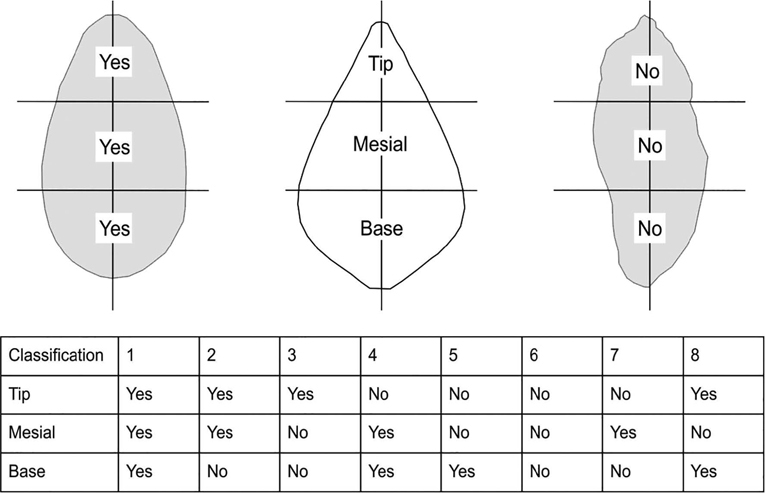
Figure 10.11 The eye-ball test for handaxe symmetry. Its eight attribute states can be subsumed into fully symmetrical, partly symmetrical and asymmetrical (courtesy John McNabb).
Studies that have employed the flip-test (Hardaker and Dunn 2005) have produced somewhat different results (Table 10.2, Figures 10.12 and 10.13).7 In an analysis of 1,405 handaxes from 22 sites ranging in age from ~MIS 15 to MIS 8 (~525–300 ka BP), White and Foulds (2018) found that 52% of handaxes had symmetry values within Classes 1, 2 and 3, described qualitatively as virtually perfect, very high and high levels of symmetry respectively. The number of handaxes in symmetry class 1 was low, only 1.4% but nevertheless within a British context the majority of handaxes were highly symmetrical or better. There was an apparent trend for decreasing levels of symmetry from MIS 13 to MIS 8, but this was strongly linked to the dominance of intensively worked ovates in the earlier period, later giving way to a dominance of pointed forms in which shape was achieved with a more economical number of removals from the original block. Even then, hominins had taken every opportunity to mirror natural margins and still imposed very high levels of symmetry on even the most unpromising piece.

Figure 10.12 Examples of handaxes in each symmetry class using real examples from Swanscombe (top), Boxgrove (middle) and Wansunt (bottom) (after White and Foulds 2018).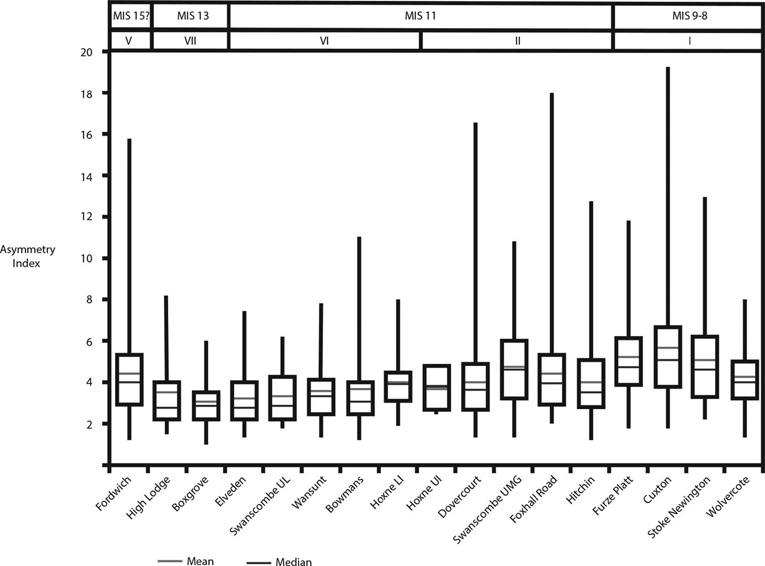
Figure 10.13 Boxplots showing mean asymmetry and range of variation in British handaxes. The sites are organised by age, with the oldest sites on the left. There is no correlation between age and symmetry in the Middle Pleistocene, but many sites contain a very high proportion of handaxes that are highly symmetrical or better (White and Foulds 2018).
|
Table 10.2 The flip test: asymmetry index, symmetry classes and descriptors (after Hardaker and Dunn 2005). |
||
|
Symmetry Class |
Asymmetry Index |
Description |
|
1 |
1.00–1.49 |
virtually perfect symmetry |
|
2 |
1.50–2.99 |
very high symmetry |
|
3 |
3.00–3.99 |
high symmetry |
|
4 |
4.00–4.99 |
moderate symmetry |
|
5 |
5.00–5.99 |
low symmetry |
|
6 |
6.00 |
very low symmetry |
Shipton et al. (2019) used the flip test on nine handaxe assemblages from Britain, India and Africa, plus a selection of Middle Palaeolithic Mode 3 core forms. They found no evidence that symmetry was dictated by reduction, by blank type, by raw material, or that it was an unintended consequence of the reduction process. Levallois and discoidal cores were not particularly symmetrical despite centripetal working, while cleavers were only ever retouched to modify shape, never function (see preceding). High levels of symmetry had been deliberately imposed.
White and Foulds (2018) argued that whatever utilitarian or social function handaxes might have served, they had also operated as part of a pleasure-reward system, linked to dopamine-releasing neurons in the brain. These rewards systems play a vital evolutionary role, providing animals with the basic motivations to survive and reproduce, and having the potential to foster learning, promote decision-making and give pleasure. Rewards combine sensory components (which can be sensed), salient components (which get attention) and value components (which reflect internalised, individual and subjective preferences that set the conditions for what different people find rewarding; Schultz 2015, 856). So, while all rewards affect the body through sensory systems, there is no single value or property that defines a reward. Rather, rewards are defined by subjective preferences (individual/cultural, private/shared) and the behavioural responses that they invoke. Critically, rewards are self-reinforcing–humans and animals crave rewards and seek them out because they give pleasure–and they in turn have the potential to promote learning, decision-making and positive emotions. For hominins, the rewards associated with handaxes came in different forms, including alimentary rewards for foods processed using tools and the social-sexual rewards possibly involved in tool-display behaviour, but White and Foulds suggested that hominins would have also derived intrinsic pleasure just from creating a handaxe, like any artisan who takes pride and pleasure in their work. Taking the finest expressions of craftsmanship it was clear to anyone prepared to see that individuals deliberately strove to achieve a visually attractive result: a handaxe that was nicely symmetrical, of a certain shape and size, elegantly tapered or lenticular, perhaps with a signature twist or a prominent fossil. Very elaborate examples, such as the ‘flamboyant’ giants found on every continent, showed evidence that these reward-systems were subject to ‘peak shifts’, in which exaggerated expressions of already rewarding behaviours were used to gain an even greater hit. That this did not lead to runaway developments to feed new highs was probably because life-history, longevity and demography placed a ceiling on innovation and spread. Culture would only have been cumulative over an individual’s short lifetime, a process of life-long learning: playing with technology as infants and learning to make handaxes as children; later experimenting with social norms and perfecting motor skills; ultimately mastering shape and heterogeneous materials to produce signature handaxes consistently; each stage of development had its own goals and rewards. This differs from other agent-based interpretations in placing greater emphasis on the final form of the handaxe, which is viewed not as the fleet-ingly significant outcome of social gestures, but as having emotional and personal significance to the individual and their social self.
Hodgson (2009, 2011, 2015) and Mithen (2008) have both suggested that handaxes were visual cues that held aesthetic appeal for the makers and their observers, the latter declaring our modern appreciation of beautiful handaxes to be the neurological echo of our Palaeolithic ancestors’ emotions. Others have gone further still, detecting in handaxe symmetry the beginnings of an artistic or symbolic sense, perhaps emerging over time from functional concerns (Tensorer 2006; Hodgson 2011). One interpretation of ‘Excalibur’ (Figure 10.14), the quaztite handaxe from the ~525 ka BP cave site at Sima de Los Huesos, Spain, which is visually radiant, large, symmetrical and was found alone amongst the bones of at least 28 hominin individuals, is that it was thrown into the pit of bones as a votive offering or sign of group identity (Carbonell et al. 2003; Carbonell and Mosquera 2006). The Sima was never a place of human occupation, but appears to have been a sepulchre, part of a nascent symbolically charged mortuary practice.
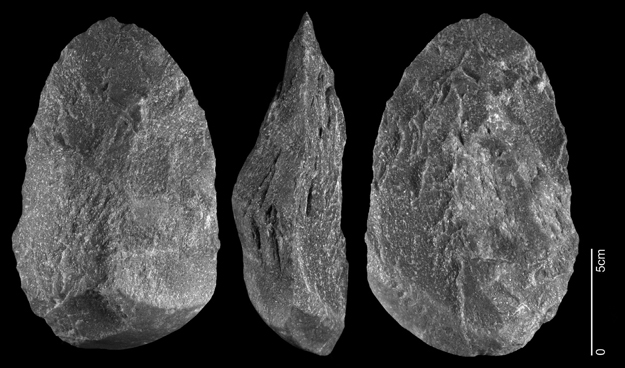
Figure 10.14 Excalibur: the impressive quartzite handaxe from Sima de los Huesos, Spain (© Andreu Ollé IPHES-CERCA).
The frequent association of hominins and elephant remains, has led Zutovski and Barkai (2016) to propose a long-lasting relationship between these species in Africa, Europe and the Levant, which went beyond a taste for elephant meat and fat and into the cosmological realm. Handaxes manufactured from elephant bone, they suggest, were not functional objects, but symbolised this special relationship.
In an attempt to move beyond single drivers, social or otherwise, Machin (2009) examined the multitude of decisions and influences potentially involved when an Acheulean hominin set themselves the task of making a handaxe (Figure 10.15). Using agency theory, Machin argued that the material outcome of handaxe manufacture would be influenced by immediate circumstances, the character of the individual agent and the nature of the social arena in which the individual existed, from which she isolated ten primary factors, 36 sub-factors, ecological environment and life history as possible influences on handaxe shape. It is, there can be little doubt, a somewhat bewildering cloud of possibilities, with little hope that it could ever be quantitively captured and packaged, but it is possible to distil an overarching agent-based motif: handaxes varied according to who, where, when, why and with whom.
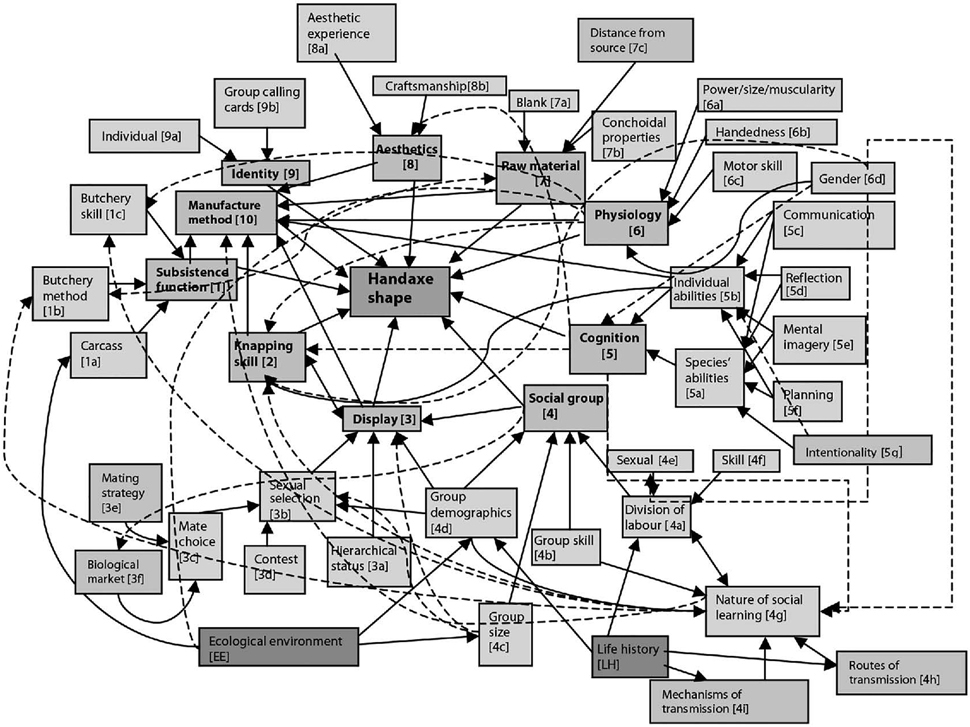
Figure 10.15 Flowchart showing the enormous range of factors that potentially contributed to handaxe form (after Machin 2009).
An Old Song Sung to a Different Tune
It was easy, and for some perhaps even desirable, to lose sight of the group while focussing on individuals, particularly when the record showed little more than a bewildering array of variation that clustered only at the broadest of scales (Roe 1981). Yet, as Roe suspected, a large part of the problem was not that there was no patterning in the archaeological record, just that our dating frameworks were insufficiently developed to allow us to spot them. In Britain, we believe we have finally overcome this obstacle, thanks to millennial scale correlations with the marine isotope curve.
Humans were present in Britain during MIS 13, 11, 9 and 7, and within different sub-stages within each cycle. Occupation was not continuous but punctuated, with distinct periods of abandonment, colonisation, settlement and isolation synchronised with Pleistocene climatic fluctuations (White and Schreve 2001; Ashton et al. 2011). Each interglacial shows its own unique sequence, but in general humans appear in the warming limb of the glacial-interglacial cycle, are found locally and regionally up to and beyond the climatic optimum, before disappearing with the renewed onset of glacial conditions. Humans are absent from Britain for most of the major glacial periods, although brief incursions might be in evidence within MIS 12 and MIS 8. Occupation is clearly biased towards warm, or at worst cool, conditions, but not extreme cold: how far cold sub-stages pushed local or regional extinction is presently unclear. Nevertheless, in each warm cycle, Britain formed a ‘sink’ area that required populating by people originating from elsewhere; even during periods of occupation, populations may have been reproducing below replacement levels and periodically ‘topped-up’ from the outside, should sea levels allow. Prior to MIS 12, Britain was permanently connected to mainland Europe via a vast ‘landbridge’ that occupied what is now the Strait of Dover. After this was breached in MIS 12, Britain remained connected to Europe as long as sea levels did not reach a critical threshold that flooded the basins of the Channel and North Sea. During post-MIS 12 interglacials, these basins were flooded several times, cutting Britain and any resident hominins off from the rest of the continent, and forming a barrier to movement (White and Schreve 2001; Ashton et al. 2011).
Using the presence/absence of handaxes and the characteristics of handaxe assemblages from the different interglacials, it is today clear that each phase of colonisation, settlement and isolation had its own distinctive archaeological signature (Table 10.3). The temporal patterns observed in the British Palaeolithic reveal a historically contingent Acheulean. It is a predictable pattern of colonisation, settlement and abandonment, connectedness and isolation, all tied to global climatic change and major geographical transformations in the British landscape. But it is also a deep history that charts different ways of making handaxes at different times that is neither progressive nor continuous, and which cannot easily be explained in purely ecological or economic terms. Human population movements might have been synchronised to Pleistocene climate change but the shape variation is largely arbitrary, ultimately based on human choices and actions not external forcing. There were no doubt many individual motives behind each handaxe, but they are also evidence of long-term traditions of manufacture, signalling an individual’s membership of a particular group, actively or passively.
|
Table 10.3 Temporal patterning in British Lower Palaeolithic handaxe groups. |
|||
|
MIS |
15 |
13 |
11c + a |
|
|
|||
|
Age in years |
500,000+5 |
500,000 |
400,000 |
|
Key types |
|
|
|
|
Roe’s group |
V (crude, narrow) |
VII(less pointed, limande) |
II (with ovates) |
|
Sites |
Fordwich |
Boxgrove |
Swanscombe UMG |
|
Farnham A |
High Lodge |
Swanscombe LMG |
|
|
Warren Hill worn |
Highland’s Farm |
Chadwell St Mary |
|
|
Kent’s Cavern breccia |
Corfe Mullen |
Hoxne |
|
|
Warren Hill fresh |
Dovercourt |
||
|
Highland’s Farm |
Hitchin |
||
|
Foxhall Road red gravel |
|||
|
|
|||
|
MIS |
11c + a |
9 |
9 |
|
|
|||
|
Age in years |
400,000 |
300,000 |
300,000 |
|
Key types |
|
|
|
|
Roe’s group |
VI (more pointed, twisted) |
I (with ficrons and cleavers) |
III (plano-convex) |
|
Sites |
Elveden |
Furze Platt |
Wolvercote |
|
Bowman’s Lodge |
Baker’s Farm |
||
|
Swanscombe Phase 3 |
Cuxton |
||
|
Wansunt |
Stoke Newington |
||
|
Foxhall Rd grey clay |
Whitlingham |
||
|
Hoxne Lower Industry |
Keswick |
||
Notes
· 1 Alf Garnett was a fictional character in the British television sitcoms Till Death Us Do Part (1965–1975) and In Sickness and in Health (1985–1992). He was a conservative and small-minded bigot who seemed to dislike everybody. He formed the inspiration for the US sitcom character Archie Bunker, and Eric Cartman from South Park.
· 2 The response from my 19- and 22-year-old daughters to this bon mot: “I don’t get it, who’s Alf Garnett?”
· 3 The tagline to Marvel Comics’ original run of Howard the Duck (1976–1979).
· 4 Although Gamble’s Palaeolithic Societies of Europe won the Society for American Archaeology 2000 award for best book, not everybody was ready to make the jump. The edited EAA conference volume was Plan B, after each and every one of the papers had been rejected by a theoretically orientated international journal that had actually solicited their submission for a special themed issue!
· 5 Since the Millennium more workers have adopted Isaac’s (1977a) term Large Cutting Tool (LCT) (e.g. McNabb et al. 2004, papers in Goren-Inbar and Sharon 2006) to subsume all those objects both bifacially worked and unifacially worked that fall into the many classes of handaxe, cleaver, trihedral, pick and so on. This is very useful shorthand if one simply wishes to avoid the bother of listing all the variations, but it is not so useful in communicating the precise nature of the objects contained in such a high-level classification. The term implement would have done and had the benefit of historical precedence. It’s not a term with which I am particularly enamoured, but it will occur from here on in.
· 6 John Lord and Francis Wenban-Smith, both highly skilled knappers, have been telling me this for years.
· 7 The Flip Test is a freeware programme developed by Hardaker and Dunn (2005) that literally flips a two-dimensional image of an handaxes about its long axis and measures the difference (in pixels) between the two sides. It provides repeatable, quantitative and easily understandable results, that are expressed in graphical form, showing where an object deviates from perfect symmetry, and as an index of asymmetry (AI), expressed as a number. The lower the latter value, the more symmetrical the handaxe. In practice, most handaxes show an AI between 1 and 7. Hardaker and Dunn (2005) divided handaxes into six handaxe symmetry classes (HSC) and provided a description for each class.