
4
The third distinctive phase of capitalist modernization in Greece corresponds to the post-war economic boom of the 1950s and 1960s, a period marked by significant US direct investment not just in Greece but also in Western Europe and Japan/South-east Asia. Other forms of economic support and aid in the framework of US international policy of Open Door also took place throughout the 1940s (‘Lend-Lease’, the Marshall Plan, loans, etc.). However, and despite the country’s rapid economic development during this period, Greece relinquished none of its ‘birthmarks’: its new developmental cycle in the 1950s and 1960s failed to bridge the qualitative gap with the advanced core of Western Europe, Japan and the USA, whereas its geo-politics, because of the Cold War, appeared to be quite upgraded relative to the past. Greece and Turkey were perceived by the USA as a united geo-strategic bloc able to deter, if appropriately supported, Soviet penetration/aggression through the Balkans and/or the Dardanelles or the Caucasus. But from the perspective of political economy, the most interesting feature of the period is the non-adherence of Greece to Keynesian policy-making, high (Fordist) wages and the creation of a welfare state. Especially for the Bank of Greece operating under the immense influence of pro-monetarist Xenophon Zolotas, pro-aggregate demand management policies were out of the question. The reasons for that are primarily related to the domestic security regime imposed after the defeat of the left-wing forces in the Civil War, and to Cyprus geo-politics. All in all, Greece’s ‘golden age of capitalism’ differed in two crucial respects in relation to its Northern European counterparts: first, it took place under an enormous expansion of the state’s security apparatus and, second, the state’s management of aggregate demand was minimal. Time and again, however, none of those had been sovereign decisions of the Greek state. Quite the opposite: they had been imposed, if not directly dictated, by the ‘American factor’, Greece’s new patron, the USA. Moreover, precisely because of the dependence of Greece’s right-wing establishment upon the USA, a wide range of opportunities had been missed, especially on Cyprus, in capitalising on the country’s Cold War geo-political importance.
Another concern of this chapter is to show that the new type of US hub-and-spoke hegemony established in the Euro-Atlantic heartland and Japan by the USA in the 1940s rests on a qualitatively different type of power arrangement between the lord and the vassal when applied to the periphery (Latin America, Greece, etc.). The form of new dependency relations between the new global master, the USA and Greece was such that the Greek state and its ruling classes had much less freedom of action in organising their hegemony within their social/national formation proper.1 This form of dependency and subordination led to a quasi authoritarian polity, whose culmination was the seven-year long dictatorship of the Colonels (1967–74), most of whom were on the payroll of Central Intelligence Agency (CIA).2 Thus, the ‘economic miracle’ of the 1950s and 1960s – in fact, during the years of the dictatorship, Greece experienced very high rates of growth – occurred under authoritarian and deeply regressive forms of governance, hence the title of our chapter here as ‘passive revolution’.
Interestingly, and this is our third preoccupation here, the bi-polar matrix of the Greek post-war political regime – the kampfplatz of the third period of capitalist modernization featured the Centre Union party of George Papandreou versus the right-wing bloc of Constantine Karamanlis and the King – persists in assuming qualitatively different features. It had to respond to a genuinely democratic political movement demanding the opening up of the political system and social reforms. At the same time, it condensed the dynamics of a new geo-politics in the Eastern Mediterranean epitomized, first, in the ‘East-West’ battles over Greece, Turkey and the Balkans (1940s) and, second, in the Cyprus issue (1950s–70s). By shedding light on these themes, we shall become aware of Greece’s inferior position within NATO relative to Turkey – about which, apparently, leaders such as Andreas G. Papandreou and Archbishop Makarios were fully aware – and the connection between Greece’s quest for democracy in the 1960s and the conflict over Cyprus. More to the point, we shall see that the real cleavage in Greek politics was that between Communism/the radical left, on the one hand, and anti-Communist forces, on the other, a cleavage that was to be suppressed by the political phenomenology of the kampfplatz. We believe that one of the most under-examined fields in the study of post-Civil War Greece is precisely the connection between domestic Greek politics, Greece’s positioning in NATO, and the Cyprus issue. In our view, this is the key to understanding why the democratic and reformist movement of the 1960s in Greece led by George and Andreas Papandreou did not manage to unblock the political system, leading instead to the imposed dictatorship of 21 April 1967.
4.1 The geo-political foundations of post-war growth
Greece participated in World War II on the side of the West, repelled an Italian attack through Albania but eventually succumbed to Germany’s invasion in 1941 and was then occupied by three armies, the German, Italian and Bulgarian. During the occupation, the fiscal and monetary system of the Greek state broke down completely. Some 250,000 died of hunger and more than 60,000 were executed by occupation forces, whereas some 60,000 Greek Jews were killed or deported to concentration camps.3 As if this was not enough, a bloody Civil War followed that lasted till the late 1940s. Middle classes almost ceased to exist. Hunger and pauperization became common among the population. All in all, between 1940 and 1950 more than 600,000 people out of a pre-war population of 7,345,000 perished. But Greece was a class and geo-political zone of conflict par excellence and before its elites could even think seriously of political economies of growth these conflicts should have been settled beforehand.
As we saw earlier, US primacy becomes completely embedded in the global capitalist system during and after World War II. Without ever abandoning Open Door, the USA qualifies its supremacy via economic (Marshall Plan, IMF, World Bank and dollar hegemony), security (NATO, bi-lateral treaties giving the USA base rights) and ideational (‘the war on evil Communism’) instruments, setting in motion new types of power arrangements within the core. The paramount goal was the shaping of the domestic environments of the states across the world after its own model of liberal democracy. Importantly, the Cold War ideational scheme of the ‘war on Communism’ had to be embraced by all the ruling elites of the spokes, becoming official state policy. Controlling each end of Eurasia – Western Europe and Japan – the USA could substantially assist the reconstruction of those crucial states creating large consumer markets and outlets for its produce. Thus, the chief aim of its policy in Europe and Japan was not primarily the containment of the Soviet threat – a notion put forth by George Kennan – but the establishment and ramification of US power within the core. The foremost drivers behind this policy were Dean Acheson and Paul Nitze – not George Kennan. Only the USA could initiate and do all this in the 1940s because, in the main, it was the sole creditor and nuclear power, in possession of 75 per cent of the world’s gold reserves while registering 60 per cent of the world’s total manufacturing output. But the same policy-makers who took care to fathom and design the new policy of imperial primacy for the USA in a ‘West-West’ context, at the same time took care to fathom and design a new geo-strategy for the periphery. From this perspective, Greece, Turkey, Iran and even Afghanistan loomed large.4
As early as 1945, US strategists began developing the notion of ‘Northern Tier’. This term ‘describes the northernmost Near and Middle Eastern countries on the border of or Near the Soviet Union’.5 Countries such as Greece, Turkey, Iran and, at times, even Afghanistan were deemed indispensable for the success of the US policy of primacy in Europe. The end of the war found Iran under the triple occupation of the USA, Britain and the USSR. Stalin’s post-war determination to hold onto Iran, as well as his subsequent challenge to provoke Turkey, prompted the USA to consider both Near Eastern countries as having invaluable strategic importance. Stalin wanted to control Iran’s oil and gas production, gain access to the Gulf region and also use the Kurdish issue ‘as a means of making inroads to Turkey’.6 At the same time, he sent diplomatic notes to Ankara requesting a base in the Dardanelles and the return to the USSR of the former Russian provinces of Kars and Ardahan. Turkey had borders with Communist Russia and oil and gas producing regions; it was situated on a large territory giving it strategic depth and its standing army numbered some 460,000 men in 1946. In addition, Turkey had the potential to become a large Black Sea and Eastern Mediterranean sea power and could offer significant listening posts to the USA reaching out not only to the Balkans and the Soviet orbits, but also the entire Middle East. Iran dominated the Eastern shoreline of the Persian Gulf and Afghanistan provided a crucial, buffer type of land-mass. The crises over Iran and Turkey, although they had been brewing since the war years, manifested themselves almost simultaneously (Iran: March 1946; Turkey: August 1946). It appears, however, that the most pressing contingency was that of Greece.
Greece, apart from its symbolic geo-cultural value as the ‘cradle of Western civilisation’, was experiencing an authentic type of ‘dual power’ situation. The democratic-radical bloc, a large section of which was controlled by the pro-Soviet Greek Communist Party (KKE), which had led the resistance against the German occupation, could overwhelm minor nationalist and right-wing forces and assume power, especially after Britain declared it had to cease underwriting financial assistance to Greece. If Communist guerrillas had been successful in defeating the nationalists in the second guerrilla warfare (1946–49), then Greece could have easily become both the USSR’s and Bulgaria’s Trojan Horses for gaining access to the Eastern Mediterranean. Such was the subservience and dependence of KKE on the Soviet Union and Tito’s Yugoslavia that its leader, Nicos Zachariades, re-opened the question of ‘minorities’ in (Greek) Macedonia, arguing that the party should ‘protect the interests of Macedonian people, who so bravely fought together with the Communists against the Greek chauvinists’.7 Effectively, Zachariades was advocating an independent Macedonia and Thrace, which was Stalin’s and Dimitrov’s policy to access the Aegean/Mediterranean via controlling the new communist statelet of Macedonia. This absurd policy of KKE alienated large sections of the Greek Macedonian peasantry, who were mostly resettled refugees from Asia Minor, withdrawing their support for the KKE and other radical guerrilla forces.8 But what was it exactly that prompted the USA to step into Britain’s shoes in the Eastern Mediterranean?
Greece’s land border with Turkey across the Evros/Maritsa River had to be maintained at all costs. As this border was adjacent to the bottleneck of the Bosporus and the Dardanelles, defence of Aegean Greece and Black Sea Turkey assumed particular importance. US strategists saw Greece and Turkey as forming a united geo-strategic bloc able, if properly backed, to deter Soviet incursion into the Eastern Mediterranean and the Suez via the Turkish Straits and/or the Aegean. It should be noted, in this respect, that the Aegean is the key to the Black Sea, rather than the other way around. It is no accident that Germany never bothered to make inroads to Turkey during World War II in order to outflank Stalin and reach the oil resources of Baku, so important for Germany’s war machine. For Germany, it was enough to hold onto the Aegean controlling the mouth of the Black Sea, thus its inward and outward navigation and trade routes, a position that assisted Hitler substantially in his East European and North African theatres. This view was highlighted perceptively by a contemporary Turkish scholar in 1944:
If aid to Russia is not being sent by way of the Straits, this is due to the facts that the Aegean islands are occupied by the Germans and that ships destined for Russia are prevented from reaching the Straits, all of which goes to show that the question of the Straits is linked to the Aegean, the Mediterranean, and the entrance to them.9
But Greece could not be lost also for an additional reason. In meetings with Stalin at Yalta and Potsdam, the Soviets made clear that the most important countries for their security were Romania and Bulgaria, not Greece, although they wanted a strong Communist force in Greece as a kind of ‘soft’ Soviet power there. Thus, the Greek crisis of the second guerrilla warfare provided Acheson with a perfect opportunity to launch his ideational scheme of ‘war against evil Communism’, exaggerating Soviet power projection capability in the region as much as the vulnerability of the USA itself. In February 1947, and in front of a group of prominent senators and General George Marshall, Undersecretary of State Dean Acheson gave a passionate speech explaining why the USA must intervene in Greece. Acheson himself recalls in his memoirs:
[if Greece fell] like apples in a barrel infected by one rotten one, the corruption of Greece would infect Iran and all to the East. It would also carry infection to Africa through Asia Minor and Egypt, and to Europe through Italy and France, already threatened by the strongest domestic Communist parties’.10
Acheson countered arguments that the ‘USA is simply pulling British chestnuts out of the fire’, or that an intervention can be justified on an ad hoc basis on humanitarian grounds. For him, ‘it was not a matter of bailing out Britain and responding to Greece and Turkey on humanitarian grounds, but rather a strengthening of free peoples against Communist aggression’. Thus, the USA had no other choice but to ‘protect its own security’ and in order to do that ‘it had to protect freedom itself’. In describing this scene, James Chase, Acheson’s biographer, says that ‘a deep silence followed Acheson’s call to arms’.11
It was no accident. Acheson’s call was unusual. It was not the containment of the Soviet threat in Europe via off-shore balancing and the use of proxies, which was Kennan’s approach and an approach that mainstream US policy-makers were accustomed to; but the actual involvement of US agencies and the army inside the very governing political and economic structures of the capitalist states by way of exaggerating both the Soviet threat and the vulnerability of the USA and the free world, i.e., the issue of primacy. But the way in which the Achesonian policy of primacy came to be implemented in the periphery differed substantially from the way in which it was to find expression within the polities and economies of the core. In the periphery, puppet regimes had been installed conducting ‘democratic’ elections, sustaining authoritarian states of emergency often via intelligence operations and cracking down on Communism, all the while keeping the domestic economies of the periphery open to world markets and US companies. With the partial exception of Italy in the 1940s and 1970s, when the Italian Communist Party was on the threshold of government, none of the above took place in Western Europe during the Cold War. The methods of US control there had been far more refined, sophisticated and complicated. But in Greece, in Chile and other Latin American and Third World countries, these methods of control had been the rule, not the exception. This, as we shall see, had as a result the aggravation of political relations of representation and legitimacy within the polities of the periphery, creating severe problems for the consolidation of the bi-polar phenomenology the USA itself wanted to create there. We shall become aware of all this by looking at concrete economic and political developments in Europe, Greece and Cyprus during the 1950s and 1960s.
Both Greece and Turkey received $400 million ($250 million to Greece and $150 million to Turkey), coming within the USA’s security orbit.12 Bulgaria and Romania moved into the Soviet bloc, whereas Yugoslavia came finally to employ a ‘non-aligned’ foreign policy in accordance with the famous Stalin-Churchill ‘percentages agreement’.13 For all intents and purposes, however, the defeat of the guerrilla movement in Greece by nationalist forces in summer 1949 paved the ground for the stabilization of the Greek polity along authoritarian practices and extreme disciplinarian forms of the political game. The terms and conditions of Greece’s own agreements under the Truman Doctrine and the Marshall Plan ‘ensured that no economic or military decision of any consequence could be taken by the Greek government without the prior approval or consent of the US Administration or its representatives in Athens’.14 The political, economic and geo-political premises of dependency and subordination for the country’s reconstruction and economic development had been laid. At this point, and before we move on to examine the political economy cycle of the 1950s and 1960s, an important point needs to be reiterated.
Despite the fact that the ‘Northern Tier’ was bound to become irrelevant if the Greek link was missing, the actual geo-strategic ordering put together by US policy-makers conceived of Turkey as more important than Greece. One of the best researchers on the issue, Bruce Kuniholm, put it as follows:
The security of Greece and Turkey were of critical importance to the United States. While both countries offered bases for operations in the Eastern Mediterranean, Turkey was strategically more important because it dominated the major air, land and sea routes from the Soviet Union to the Eastern Mediterranean and Persian Gulf. While Greece could probably never resist an attack in force, Turkey could impose an appreciable delay on attacking forces and, supported by the United States, could offer strong resistance. Based on these considerations, the JCS (Joints Chiefs of Staff) defined the following long-range US strategic interests: (a) A Greek military establishment capable of maintaining internal security in order to avoid Communist domination; (b) a Turkish military establishment sufficient to secure continued resistance to Soviet pressure, and able to delay Soviet aggression long enough to permit US and allied forces to deny certain portions of Turkey to Soviet Union.15
4.2 Miracles and mirages: the ‘golden age’ of the drachma
To be precise, Greece’s ‘passive revolution’ did not begin in the 1950s but during Venizelos’s cabinets in 1928–32, as indeed was the case in a number of other countries in Europe and Latin America, and even before. Venizelos’s rule initiated both the authoritarian physiognomy the Greek state began to assume in the 1930s – see, for example, the idionymon Law mentioned earlier – and the take off of the Greek economy based on a policy of exchange controls, multiple exchange rates and import-substitution industrialization accompanied by clearing agreements and quotas. A key aim of these economic policy measures was the protection of foreign exchange in the Bank of Greece; another was the creation of budget surpluses. These political and economic processes, it should be noted, found their culmination in Metaxas’s quasi-Nazi cabinet from August 1936 until the entry of Greece in the war in the autumn of 1940. For, as the collapse of the world trade and laissez-faire redirected production towards the home market, it was in his cabinet that political dictatorship and coercion found its sister tendencies and match in the political economy of autarky.
Default and exchange controls did indeed balance the budget, which was in surplus for nearly four years (1933–36). The budget turned into deficit again only after the heavy rearmament policy of Metaxas towards the end of the decade. More than 2 per cent of gross domestic product (GDP) represented savings from defaulting on external debt obligations, as external debt requirements dropped ‘from 44 per cent of export earnings in 1931 to just over 9 per cent in 1935 and 16 per cent the following year’.16 Also, to a certain degree, import-substitution benefitted the productive structure of the country (primary and secondary sectors) and undermined comprador activities and capital. As Mazower notes, ‘comparing 1928–32 with 1933–37, we find that the import share of domestic consumption fell from 38 per cent to 25 per cent for manufactured goods, 67 per cent to 32 per cent for foodstuffs, and 64 per cent to 27 per cent for wheat alone’.17 Between 1932 and 1938 growth was between 8 per cent and 9 per cent annually, the only countries surpassing Greece at the time were Japan and the Soviet Union (textiles/weaves18 and chemicals were the two leading manufacturing sectors). In fact, as we can see from Table 4.1, the only period in which Greece seems to have enjoyed a surplus in its overall trade structure indicating high levels of international competitiveness is the period that followed the default of 1932 and corresponded to the years of import-substitution industrialization, exchange controls, quotas and clearing agreements. All other periods, especially after its entry into the Eurozone in 2001 (see next chapters), Greece has had persistent trade deficits.
But the contradictions of autarky and the defects in the country’s weak infrastructure did not take long to resurface. Import restrictions imposed by the state obstructed the replacement of antiquated machinery, plant and equipment. It was difficult for Greece to import technological innovation and know-how, remaining a labour-intensive economy with severe problems in the reproduction of its industrial base and planning, all of which leads us to conclude that the passage to the capitalism of relative surplus-value between the wars had been extremely painful. To give only one example, in 1916, Greece’s main exports were vegetables and currants (60.1 per cent), wine, meat and milk, whereas in 1936 the main exports were again vegetables and currants (69.4 per cent), minerals and skins (tobacco becomes important only between 1925 and 1933). This perpetuated the historically uncompetitive position of Greek industry and agriculture in international markets, typically rendering the high rates of growth with characteristics of a peripheral type of dependent/subaltern growth with no elements of sustainability. The compartmentalization of land by Venizelos and the Greek ruling classes sapped Communist influence in the countryside, but at the same time it sapped the country’s position in European agricultural markets. Thus, the Greek state, once again, could not attain an independent economic and foreign policy during and after the war.
Table 4.1 Evolution of the balance between exports and imports of Greece, 1930–2008

Source: Our compilation of data from ELSTAT, Concise Statistical Yearbooks from 1930 to 2008, Athens.
Soon after the approval of the Marshall Aid to Greece, an American commission was formed (ECA – Economic Cooperation Administration) not only to advise but also to lead and direct the Greek government about how to use US aid in combination with the country’s domestic resources and needs.19 The government’s budget had to be approved beforehand by the US mission – as is the case in today’s Greece with the ‘troika’. Special provisions were made with regard to security and military matters, whereas a separate agreement was signed which imposed on Greek governments to work towards balanced budgets, price stabilization and enforcing law and order. These agreements ensured that no security/military ‘decision of any consequence could be taken by the Greek government’20 without prior approval by the USA, or indeed – as it became common sense in the years that followed the end of Civil War – without approval by ‘the Embassy’ – meaning the US Embassy in Athens. Law 509 of 1947 was a direct consequence of these agreements. It remained in force throughout Greece’s economic ‘miracle’ providing severe penalties for those advocating the overthrow of the existing order (the KKE was outlawed until 1974). It is on the basis of this Law that thousands of KKE members, including Nikos Beloyiannis, had been arrested, tried, imprisoned and killed or exiled. Nothing similar happened in France or in Italy. Hub-and-spoke arrangements there took on completely different forms. In Italy, for example, and despite the fact that the allied troops remained in the country until January 1947, the independence of the political classes to shape developments was paramount. Not only the Italian Communist party participated in the drafting of the Constitution of 1947, but also participated in national coalition governments and its leader, Palmiro Togliatti, was Minister of Justice (June 1945–October 1946).21 Moreover, Marshall Aid in Europe was not just a matter of Open Door. The European aid was to be administered in a coordinated way by West European governments in view of boosting European cooperation and economic growth, making Europe as a whole capable of purchasing US products without the need of US aid.22 Marshall Aid pushed the Europeans towards closer economic cooperation, especially in the fields of coal and steel industry. Hub-and-spoke arrangements in Western Europe were refined and sophisticated; in Greece, they were direct impositions indicating outright subordination of the country upon the USA. Even the country’s electricity grid, DEI (Public Electricity Corporation), from its foundation in 1948 until 1955, was financed by the Manufacturers Hanover Trust, a New York/Brooklyn company, and managed directly by the USA’s Ebasco Services, a major construction and engineering firm.
4.2.1 ‘Taking off’: the devaluation of the drachma
Although US aid to Greece was reduced with the passage of time, it continued well till the late 1950s. Gradually it came to be offset in the national accounts by other sources of income, such as remittances from sailors and emigrants. Tourism also began assuming particular significance as a source of national income.23 But the key policy development that occurred in Greece after the end of the Civil War was the abandonment of import-substitution industrialization. Xenophon Zolotas, who was to play a major role as Governor of the Bank of Greece, had already become the most influential critic of import-substitution industrialization between the wars, arguing that ‘the rapid expansion of industry was built on sand and was totally dependent on protectionism and the devaluation of the drachma which diminished the pressures of international competition’.24 Zolotas, who was influenced by liberal economists, stood for balanced budgets and detested high wages, credit expansion, full employment and inflation. For Zolotas, monetary stability was the key to success. He pursued consistently his ideas after the war, which finally came to fruition in 1952–53, when the drachma was devalued by 50 per cent against the US dollar, and Greece joined the Bretton Woods system of fixed exchange rates (April 1953). But even this was not a sovereign decision. As George Stathakis shows in his wide ranging studies of Greece’s post-war economy, the drachma’s devaluation and the pursuit of monetarist policies were, in the main, an American decision in which Dean Acheson was very much involved through the ‘Welldon Group’ and the MSA (Mutual Security Agency).25
The new rate was set at $1 = 30,000 drachmas, but the three zeros were excised from all prices and banknotes, and the real exchange rate became $1 = 30 drachmas. The internationalization of the Greek economy under Bretton Woods was a matter of time. Export subsidies had been dismantled and import restrictions eliminated. Two decades of economic development and low inflation ushered in, facilitating foreign direct investment accompanied by tax privileges for foreign and shipping capital.26 Law 2687 of 1953 offered massive tax privileges and ‘guarantees to the owners of capital imported into Greece for investment to re-export the capital, interests and profits abroad’.27 The same Law prohibited confiscation of foreign assets and investments. By the mid-1960s, Greece was operating almost as an offshore paradise, something which can be inferred by such policy acts as Law 4171 of 1961 or the promulgation by the dictatorship of Laws 89 and 378 of 1967 and 1968 respectively. Conglomerates such as the Esso-Pappas refinery in Salonica, or companies such as Dow Chemicals, Pirelli, Goodyear, Pechiney Aluminium and Republican Steel flooded into Greece throughout the 1950s and 1960s.28 Greek shipping capital began investing in banking, shipyards, tourism, chemicals, fertilizers and insurance. The best example here was the well-known Andreades Company – ‘Omilos Andreadi’, after the name of shipowner and tycoon, Stratis Andreadis – which controlled Greece’s Commercial Bank with capital that exceeded 35 per cent of the total liquid capital in Greece’s economy. Through his Company, Andreades’s private group was in control of Eleusina Shipyards, phosphor fertilizers, insurance and other businesses. His empire received a severe blow when the governments of Constantine Karamanlis in the post-1974 period embarked on a programme of extensive nationalizations and state expansion.29 All in all, and under such favourable business conditions, profitability increased across most sectors of economic activity, especially in manufacturing, banking and commercial activities. Yet robust and sustainable economic development associated with a virtuous cycle of high wages, welfare projects and solid public investments in infrastructure was anything but forthcoming. Let us explain why.
By 1952 most of Greece’s economic activities reached pre-war levels. Inflation fell from 15 per cent in 1954 to just over 2 per cent in 1959 and then remained stable for a number of years. The balance of payments exhibited a deficit, but it was largely offset by invisible earnings, tourism, US aid and war reparations. Investments were facilitated by the Bank of Greece, which provided liquidity to commercial banks in the 1950s. But until 1957, ‘US aid contributed more than 75 per cent to the overall budget deficit requirements, including investment expenditures’.30 In fact, as we can see from Tables 4.2 and 4.3 the real ‘take off’ occurred in the 1960s (the dictatorship lasted from 21 April 1967 until the Turkish invasion of Cyprus in July 1974), during which time Greece presented rapid rates of growth that could match those of all other countries, including Japan and Germany. The stability of the drachma, nevertheless, became a key propaganda tool for the right-wing ERE party of Constantine Karamanlis. In the crucial election of 1963 (see below), ERE ran on the following ticket: ‘This drachma is yours. Do not let Papandreou take it away from you’.
As with the inter-war period, no signs of Keynesian policy-making could be observed (deficit spending, welfare projects financed via taxation, high (Fordist) wages policy and intervention in aggregate demand management, etc.). Productive investment was left mostly in the hands of private capital. In Italy, for example, from 1949 to 1950 the rapid economic development that began taking shape was mainly instigated by domestic structures and the state via Keynesian instruments of demand management. The Italian miracle, although incapable of solving the problem of the Mezzogiorno, was driven by export-led, highly competitive industries.31 Thus, contrary to the rest of Europe and the capitalist world, neither the welfare state in Greece nor serious intervention in the aggregate demand happened during the ‘golden age of the drachma’. With an average unemployment of about 5–6 per cent, the period stretching from 1950 down to 1970 saw an apotheosis of a rather disorganized private capitalism, development and investment, especially in construction and the way in which private and political interests were being intermingled. Between 1960 and 1970 fixed capital investment absorbed 25 per cent of GDP, but the defence budget was equally high, at times as high as 9 per cent of GDP. This was partly due to Greece’s NATO commitments and partly due to financing a domestic regime of oppression and compulsion. In this milieu, attempts had been made to maintain working-class discipline via an authoritarian, anti-Communist state, which had essentially excluded more than half of the population from political and institutional participation, especially state employment.32 But we need to look at two important variables: the structure and contribution of manufacturing to the GDP; and the issue of internal and external migration, a phenomenon that marked Greek society and politics after World War II.
Table 4.2 Sectoral composition of GDP and rate of growth of GDP at 1958 constant prices up to 1960, and from 1960 to 1974 at 1970 constant prices (million drachmas)
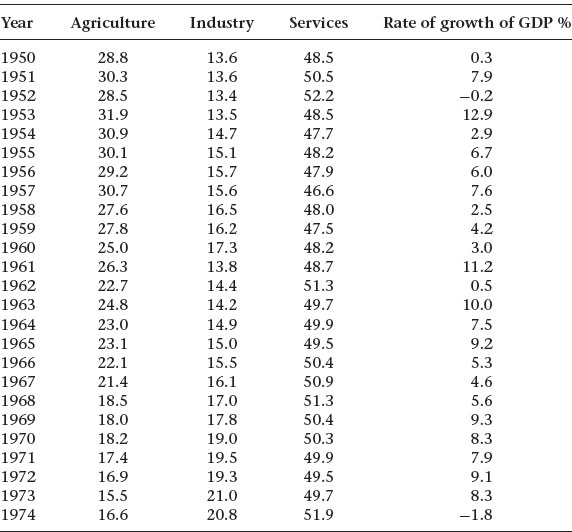
Note: Industry refers only to manufacturing and agriculture and includes fishing and forestry. Other sectors adding up to 100 per cent include construction, mining and electricity. Throughout the period, dwellings accounted for about 45–55 per cent of total construction, and public sector investment was chiefly in construction absorbing, at times, up to 70 per cent of it.
Source: Our elaboration of data based on Freris (1986) pp. 145 and 156; Constantine Tsoukalas (1986) pp. 236 ff.; George Karabelias (1989) State and Society in Post-1974 Greece (Athens: Exantas), pp. 66 ff, passim.
Table 4.3 Percentage increase, GDP and manufacturing in selected European countries (1950–70) and Japan (1960–70)
|
GDP |
Manufacturing |
|
|
France |
5.0 |
5.8 |
|
Germany |
6.2 |
8.0 |
|
Greece |
6.0 |
8.1 |
|
Ireland |
2.5 |
4.7 |
|
Italy |
5.4 |
7.9 |
|
The Netherlands |
5.0 |
6.3 |
|
Portugal |
5.1 |
8.6 |
|
Spain |
6.1 |
8.4 |
|
UK |
2.7 |
3.3 |
|
Japan |
10.0 |
16.7 |
Source: Our calculations using data from Robert Brenner (2006) The Economics of Global Turbulence (London: Verso), p. 82, passim and Angus Maddison (1973) Economic Policy and Performance in Europe, 1913–1970 (London: Collins/Fontana), p. 51.
As we can see from Table 4.2, the share of industry to GDP increased from 14 per cent to 19 per cent. The relative decline in agriculture we observe should not be confused with an increase in the overall output by nearly 5 per cent, whereas the growth of services remained almost stable at around 50 per cent. What we have also come to conclude by studying the statistical data provided by Hellenic Statistical Services (ELSTAT) and the Bank of Greece during this period is that the structure of industrial production remained qualitatively unaltered. For example, chemicals prevailed over food, tobacco, drink and clothing, but capital goods industry (metallurgical, mechanical, production of means of production, transport equipment and technological innovation) changed only marginally. In 1966, the main imports were transport equipment (19 per cent), machinery and electrical equipment (17 per cent), metals and metallic products (9.4 per cent), minerals (8.7 per cent) and chemicals(8.2 per cent). The same year, the main exports were food and beverages (32.5 per cent), agricultural products (28.2 per cent), weaves and clothes (11.4 per cent) and minerals (8.2 per cent). These data allow us to infer that Greece, during its ‘golden age of capitalism’, continued to import technologically advanced products from the capitalist core, and export labour-intensive products using previous generation technology. Thus, the comprador bourgeoisie of the Venizelist era regenerated itself by trading imports for final consumption purchased from the core, while sharing power with private capital that was mainly of foreign origin or interests. This reproduced the structure of deficit in the balance of payments, undermined the country’s positioning in the global economy and perpetuated its dependency also by way of decision-making powers foreign capitals/interests enjoyed in the Greek political system. Thus, to paraphrase Giuseppe Tomasi di Lampedusa in his il Gattopardo, everything seemed to have changed in Greece during the 1950s and 1960s, yet everything remained the same.33 Everything, but one variable: the regime of post-war ‘passive revolution’ came to be challenged head-on by social forces generated by the very truncated economic miracle itself.
Rapid economic development went hand in glove with internal and external migration. During the peak period of economic development (1960–70) some 800,000 people emigrated mainly to Australia, the USA and Germany, a fact that eased unemployment and under-employment. Emigration covered up the inability of the private sector to provide employment, whereas the public sector was constantly replenishing itself with civil servants loyal to the parties of the Right. Domestic migration reduced the numbers of economically active population engaged in agriculture – although, as we saw earlier, overall productivity in agriculture increased – and revolutionized construction levels and urbanization in the most anarchic and unplanned manner possible. Athens became Greece’s major urban centre with some 3.5 million people in 1975, growing from only 1.3 million in 1951. By 1975 more than 37 per cent of the country’s population lived in Athens and 18.4 per cent in Salonica. This type of population movement, coupled with the exclusion of large popular strata from political and institutional participation and the lack of welfare provision, created an explosive, radical socio-political mix. Because of the absence of mass parties of the Left, what was needed was the interpellation of this social radicalism by a charismatic political leadership that also knew how to foment nationalism among the people so that the monopoly of nationalist discourses could be snatched away from the Right and the Crown.34
4.3 Kampfplatz-3: lines of stress and fault-lines
The ideal-typical terrain of bi-polarism shaping Greek political developments during the ‘golden age’ is the juxtaposition between the Centre Union party led by old Venizelist politician, George Papandreou, on the one hand, and the right-wing forces of Constantine Karamanlis and the Crown, on the other. Matters, of course, were far more complicated and serious tensions and lines of stress existed within those two governing blocs. All cabinets had been unstable and backstage plots and counter-plots involving the army officers and security personnel were very common. It is important to note that Greece’s kampfplatz during this period is over-determined and controlled by the so-called ‘American factor’. The dependent/subaltern position of the Greek social formation does not concern only the field of political economy but, and perhaps even more importantly, the political and security/military fields of the formation as a whole. Even discourses and political movements such as those developed by Andreas G. Papandreou in the 1960s within the Centre Union party of his father had initially been supported by US agencies aiming at containing the rise of the United Democratic Left (EDA).
EDA, founded in 1951, received over 24 per cent of the vote in the May 1958 election, becoming the main opposition party to Karamanlis’s National Radical Union (ERE). EDA was perceived as an umbrella organization for the outlawed KKE since the end of the Civil War. The election of May 1958 was a landmark and alarmed Washington, because it became clear that nationalist and right-wing forces cannot contain the electoral rise of a genuine Left especially when the liberal centre is fragmented – as indeed was the case in 1958. Since then, US policy-makers had been in search of a pro-capitalist and pro-Western alternative to the rise of EDA. In other words, they wanted to frame kampfplatz in order to control it. The vehicle to achieve this was the Centre Union party founded in 1961 and led by George Papandreou (in fact, Papandreou, in the national election held that same year, cut EDA down to size pushing it into third place).35 US policy-makers wanted a liberal-democratic party in Greece after the image of the Democratic Party of John F. Kennedy and loyal to the USA and NATO. This would define the contours of the political phenomenology of Centre-Left versus Centre-Right, steadily anchoring Greek politics within NATO while sidelining EDA and Communism. It became obvious, therefore, that the Greek kampfplatz had been imposed and, under constant US superintendence and vigilance, simply because the real field of division was between the forces of Communism and the democratic Left, on the one hand, and the forces of anti-Communism, on the other. The US plan of injecting a second anti-Communist force within the Greek polity made a lot of sense, but it eventually failed to work inasmuch as lines of stress, especially within the Centre Union party and over Cyprus’s geo-politics, evolved into fault-lines. In addition, the nationalist Right also appeared to be disorganized and fractious, especially in its quarrels with the Crown and its lack of dynamic leadership (Constantine Karamanlis left Greece in 1963 after being defeated by George Papandreou’s Centre Union in the 1963 election). The advent of the Greek dictatorship, therefore, appears to fit in a conventional explanatory mould: apparent social disorder and political anarchy jeopardizing the pillars of the system, in this case, Greece’s ‘Hellenic-Christian’ civilization and its system of private property. But this is not really true. We cannot understand the reasons why a dictatorship was effectively imposed upon Greece, if we fail to appreciate the role of young Papandreou in the politics of Centre Union, the significance of the Cyprus issue and the cohesion of NATO’s Southern flank for the USA.
George Papandreou (and EDA) denounced the results of the 1961 election as rigged by the National Radical Union (ERE) of Karamanlis, refusing to recognize his government. Without procrastination, Papandreou immediately and single-handedly declared his unyielding democratic struggle against the Right. Possessing no instruments that are offered by a mass party (coherent and disciplined organization, national system of party branches, links with organized labour and trade unions), this political strategy helped Papandreou in harnessing support among the disparate forces of the Centre-Right, EDA and, broadly speaking, the new migrants in Athens and Salonica, all of whom could embrace his perspective of institutional renewal, democratization and pro-welfare reforms. ERE could only capitalize on the achievements of economic development and monetary stability, hence its main pre-election slogan: ‘This drachma is yours. Do not let Papandreou take it away from you’.36
Papandreou’s Centre Union won the November 1963 election, but the votes were not enough to achieve the parliamentary majority required to form a government. And as the parliamentary balance of power was held by EDA – whose social influence was still important especially after the murder of its MP, Gregory Lambrakis, by obscure underworld elements in Salonica – he forced a new election in February 1964 in which he achieved an unprecedented victory with nearly 53 per cent of the vote. Papandreou’s cabinet, which lasted less than two years, had no substantial time to deliver on reforms, yet signs of Keynesian policy-making appeared, especially under the influence of his son, Andreas. Characteristically, Papandreou tried to re-negotiate the multi-million investment license of Esso-Pappas in order to deprive the company, which was run by the Greek-American millionaire, Tom Pappas, from having the monopoly of oil supply for Greece’s domestic market. The licence was offered to Pappas by the Karamanlis government without parliamentary scrutiny. True, Papandreou did not have much success in renegotiating the agreement, but the credit should go to his cabinet, which tried to regulate monopoly capital. The overall philosophy drew from Keynesian economics. On the occasion of Greece’s agreement with the EEC in 1960, a policy pioneered by Karamanlis, the young Papandreou wrote:
Economic development is not to be measured in terms of the country’s per capita income, but in the distribution of income [ ... ] Economic development means an increase in the opportunities for productive occupation and a continual widening of the participation of the popular classes in a growing national income. That is the meaning of social democracy.37
(Emphasis by A.G. Papandreou)
To a great degree, however, the problem was the blocked character of the Greek political system, which suffocated the needs of a highly mobilized society for democratic reform. During George Papandreou’s battle to control the Ministry of Defence, allegations that Andreas Papandreou was the leader of a left-wing conspiratorial group within the army, known as Aspida (Shield), became widespread and a court case began. This organization, apparently, was the leftist counterpart of the ultra-nationalist IDEA (Sacred Bond of Greek Officers), which was founded by Greek officers in the Middle East during World War II.38 The crisis reached a climax in July 1965, when George Papandreou came to confront the King in a battle that he apparently lost, as a crucial number of his MPs, gathered around Constantine Mitsotakis, withdrew parliamentary support to his Centre Union government. A long period of instability followed leading to the dictatorship of 21 April 1967. However, neither the dispute over the control of the Ministry of Defence, nor the problems of governance Greece faced since July 1965 were the main causes of the April coup. We argue that the dictatorship was the result of two issues that are strictly interlinked: the first is the political mistrust shown by the US Embassy towards Andreas G. Papandreou, who served as Minister to his father’s cabinets, and was the natural candidate to lead the Centre Union party after the death of his elderly and ailing father. The USA did not want Andreas to become Prime Minister. The second reason is related to Cyprus’s and Greece’s Cold War security and the public support Andreas rendered to Makarios. Simply put, the USA wanted a solution to the Cyprus issue based on a form of partition of the island between Greece and Turkey, a policy that both Andreas and Makarios opposed with a rationale that undermined the pillars of NATO’s Cold War policy. Young Papandreou’s public policy seemed to be going beyond the constraints laid out by the neo-imperial power. As a consequence, the process of democratization in Greece had to be halted.
4.3.1 Acheson’s Cyprus scar, or how the USA impeded democracy in Greece
Discreetly assisted by both his father and Constantine Karamanlis himself, Andreas arrived in Greece in 1959 to become head of a new Economic Centre, which was supported with funds by the Ford and Rockefeller foundations. This very event shows exactly the bi-partisan support the USA rendered to the mainstream Greek political class in order to establish a functional political phenomenology sidelining EDA and squashing Communist influence. By that time, however, the ERE party of Karamanlis and Evangelos Averoff – Karamanlis’s Foreign Minister – had laid the policy determinants of the Cyprus issue in close cooperation with the British.
Britain had relinquished responsibility over Greece in the mid-1940s, but it did continue to be the master of Cyprus. The island was perceived to be the key – especially after the loss of Palestine – to Britain’s Middle Eastern approaches and the Suez Canal. Cyprus was Britain’s formal colony and had an ethnically mixed population (about 80 per cent ethnic Greeks and 18 per cent Turkish/Muslim Cypriots, the rest were Maronites, Armenians and other minorities). By and large, although the issue is far more complicated, neither Greece nor Turkey had formally raised any Cyprus question until after summer 1955. Aimed at containing the Greek Cypriot anti-colonial and pro-enosis (union with Greece) struggle on the island, Britain convened in London the so-called ‘Tri-partite Conference’ (Britain, Turkey and Greece). In a way, this undermined the success of US policy in the Balkans and the Near East, the ‘Northern Tier’ programme, as well as the 1953 Balkan Treaty of Friendship and Cooperation between Turkey, Greece and Yugoslavia. Archbishop Makarios, the foremost Greek Cypriot leader of the political branch of National Organisation of Cypriot Fighters (EOKA), opposed Greece’s participation in the Conference, but to no avail.39 With the inclusion of Turkey as an interested party in the Cyprus issue, it became clear which type of solution the British desired for Cyprus: a solution based on a form of political division of the island between Greece and Turkey, and with Britain having a superintendent and semi-formal role in view of maintaining at least its military bases there. Britain, in fact, had adopted almost openly a policy of ‘divide and rule’ over Cyprus, which, at a social level, included the recruitment of Turkish Cypriots as auxiliary police force aimed at suppressing the Greek Cypriot uprising.40 For these reasons, at least from 1957 onwards, Makarios began discreetly opposing Colonel Grivas’s armed struggle on Cyprus as he rightly saw that any continuation of violence played into the hands of the British policy of ‘divide and rule’. To the Greek Cypriot aim of enosis the Turkish Cypriots, encouraged by the British and actively supported by Turkey, counter-posed taksim (partition). Especially after the foundation of the Cypriot state in 1960, Makarios had essentially dropped any reference to enosis inasmuch as it would have meant further involvement of Turkey and other NATO powers in Cyprus, leading to its permanent vivisection. This turned the entire nationalist establishment in Cyprus and Greece – whether official or underground – against him.41 These two processes, one at the elite level the other at societal level, fomented Greek and Turkish nationalism inside and outside the island and laid the ground for the Constitutional arrangements of London-Zurich in 1959–60, which were basically negotiated by Karamanlis and Averoff, on the Greek side, and Adnan Menderes (Prime Minister) and Fatin Zorlu (Foreign Minister), on the Turkish side. Britain had, therefore, laid out the constraints within which the minor players, Greece and Turkey, could operate. If the Greeks wanted enosis and if the Turks wanted taksim, then the best way is the middle way, that is, a painful compromise by both sides concerned. Nonetheless, it should be said that enosis was never mainland Greek policy in the 1950s or before, despite the fact that taksim was Turkish policy instigated by Britain. Enosis was the policy of the Greek Cypriots in the 1950s alone (and also before that), not the policy of the Greek state. Taksim became Turkish policy in the 1950s, because Turkish policy-makers wanted to avoid encirclement of Turkey’s vital air-lanes and water passages, from the Northern Aegean down to Rhodes and the Cyprus/Syria zone, something which would have been the case if enosis was effected. Turkey has always connected the Cyprus issue with the strategic position of the Aegean, and if taksim is successful in the former, then it should also be tried in the latter.
But it is a myth that compromises do not have winners and losers. The essence of the London-Zurich agreements – with which Makarios disagreed signing up after enormous pressure exerted upon him by Karamanlis and Averoff – was basically twofold: first, that executive power had essentially to be shared between a Greek Cypriot President and a Turkish Cypriot Vice President, and despite the fact that the Greek side was the majority ethnic population on the island; second that three NATO powers, Britain, Turkey and Greece, maintained the right to intervene in the internal affairs of the Republic as ‘guarantor powers’, a right stipulated with a Treaty provision, the so-called Treaty of Guarantee (here, the Greek Cypriot side surrendered any meaningful form of sovereignty not just to NATO but to Turkey’s superior geo-strategic posture within NATO).
Predictably, the Cypriot Constitution collapsed because it could not provide for a functional polity. President Makarios, impossible to govern by enlisting the support of his Vice President who enjoyed the right to veto all significant decisions in matters of foreign, economic and administrative policy, put forth his ‘Thirteen Constitutional Amendments’ (1963). Inter-communal fighting ensued, with the Turkish Cypriots leaving their positions in the government and withdrawing into militarily protected enclaves. Greek Cypriot forces overwhelmed inferior Turkish Cypriot militia and the Turkish government threatened to invade the island invoking the Treaty of Guarantee (in fact, Turkish warplanes did bomb Greek Cypriot positions). However, Turkey’s operations were stopped at the 11th hour by US President, Lyndon Johnson, with an unusually harsh diplomatic letter to the Turkish PM, Ýsmet Ýnönü. Makarios won the battle at the UN, as resolution 186 of the SC recognized his Greek Cypriot government as the sole legitimate government on the island to impose law and order.42 At the same time, however, Turkey’s foreign policy changed tack and began fostering ties with the USSR.43 At this very juncture, the US assumed the political initiative sidelining Britain.
The mediating task fell on the shoulders of the architect of the USA’s international policy, Dean Acheson. In secret talks in Geneva with Turkish and Greek officials behind the back of Makarios, Acheson proposed a number of compromise plans, maintaining NATO’s cohesion by avoiding a war between Greece and Turkey over Cyprus. To this end, Turkey would receive a military base on Cyprus and some Turkish Cypriot villages would be administered by Turkish Cypriots, whereas the rest of the island would unite with Greece. The logistics for achieving this were equally important. The scheme assumed that Makarios, who opposed any NATO solution to Cyprus, as it would automatically have meant vivisection of his land between three NATO powers (Greece, Britain and Turkey), would have either to conform to this settlement or otherwise be eliminated. Greece, could either convince Makarios diplomatically, or enforce a military solution upon him, deposing him from power and proclaiming enosis. Once enosis was achieved, then Greece would have invited fellow NATO member, Turkey, to establish its military bases on Cypriot soil. For all intents and purposes, this was a proposal put forth by the American state to a subaltern ally. Thus, when Zolotas, at the time Governor of the Bank of Greece, asked the USA for economic assistance, the official reply he received was that ‘the USA could not see their way to any special assistance until there had been a solution in Cyprus’.44 This is how subaltern and hegemonic elites, behind the back of their people, trade national security and geo-politics for money and the other way around. US President Johnson officially suspended the Acheson mission on 9 September 1964.
Constantine Mitsotakis was in total agreement with Acheson’s partition scheme, arguing that, if necessary, it should be imposed on Makarios with a coup.45 George Papandreou was lukewarm and rather favourable and had already sent secretly a full Greek division to the island (circa 6000 soldiers) in April 1964, which could now be used to depose Makarios and effect the terms of the plan. The Greek Prime Minister’s line in his discussions with the US Embassy and President Johnson himself was that the best solution to the problem of Cyprus was enosis. This would bring Cyprus into Greece’s and NATO’s defence and security orbits, eliminate the large Communist party on the island that supported Makarios, and even eliminate President Makarios himself. But his son Andreas had a different opinion. In an interview he gave to Eric Rouleau in Le Monde, young Papandreou argued:
Certain Western powers have attempted to create a rift between President Makarios and our government by asking us to condemn his policies. In this fashion, they have shown that they do not understand anything about the Cyprus situation. Makarios is not an isolated leader. He is the genuine spokesman for his people, and his policy expresses the will of the overwhelming majority of the Cypriots. It is therefore both useless and dangerous to turn against Makarios.46
Makarios and Andreas stood indeed firmly against the Acheson plan. It is important, however, to understand young Papandreou’s rationale and political manoeuvring in full.
For Andreas, Greece’s coercive domestic regime was the result of the passive subordination of the Greek elites to the USA since the Civil War and the economic dependence of the country upon foreign capital and aid. Appointed as Minister to the PM in the government of his father, he had been assigned with overseeing the Greek intelligence service, State Information Service (KYP), which had literally been created by the CIA in the aftermath of the Civil War. His ministerial experience was very telling and instructive: he found out that the CIA was secretly financing KYP ‘to the tune of $300,000 annually without supervision of the elected Greek government’.47 His economic and theoretical analyses that Greece was effectively a dependent protectorate of the USA – what he later called ‘paternalistic capitalism’48 – found a revealing, first-hand empirical foundation. But young Papandreou had a refined and highly sophisticated approach to the operations of the ‘American factor’ in Greece. To him, US policy in Greece was not ‘monolithic’. In the main, three US services and agencies in Greece were competing over who was going to have the upper hand in determining the country’s policy. The first was the State Department; the second was the Military Mission and the Pentagon via NATO; and the third was CIA. Of these three agencies, Andreas argued, the CIA had the upper hand, closely followed by the Pentagon. He was also aware of the fact that Turkey enjoyed a superior geo-strategic position than that of Greece within NATO, so any Cyprus solution within NATO would tend to favour Turkey. In various public speeches, interviews, articles and interventions, Andreas argued that Greece must cease to be a dependent, comprador state serving US interests, developing instead a robust industrial policy which was the precondition for its national independence and dignity. To Karamanlis’s strategic notion that ‘Greece belongs to the West’, Andreas juxtaposed the slogan that ‘Greece belongs to the Greeks’. Exogenous structures and agencies would cease determining Greece’s foreign and economic policy only if a new, socialist political class assumed power on the basis of a Keynesian developmental agenda. For Andreas, Cyprus was a case in point. It showed that Greece’s national interest was subsumed not only by the USA and NATO, but also by Turkey, precisely because Turkey was assessed as having superior geo-strategic value than Greece in Cold War conditions. In an interview in the newspaper Eleutheria (Freedom) on 6 February 1967, Andreas, for the first time, accused openly the USA of the policies it imposed on Greece as inimical to the country’s national interest. The USA, Andreas’s argument went, wanted to lock Greece up to Turkey’s security system within NATO, especially over Cyprus, effectively making Greece operate as Turkey’s satellite within the overall framework of US Cold War international policy. But then, ‘if détente made NATO recede even in Europe, what is the purpose for having a NATO solution in Cyprus?’49 In this masterful way, Andreas divested the right-wing from its monopolistic appropriation of nationalism, transplanting it into a progressive socialist programme favouring democratic reform and endogenous industrial development.
As a result of these public positions, the CIA, in its reports, used to characterize Andreas ‘as the most dangerous, opportunistic, ruthless and unscrupulous politician in Greece, a politician whose views were to be regarded with the deepest suspicion’.50 The CIA and the Pentagon feared that with Makarios and Andreas in charge in Cyprus and Greece respectively – Makarios was also one of the founding leaders of the non-aligned movement – the entire programme of NATO’s deterrence in Europe, the Mediterranean and the Middle East would fall apart. Andreas, however, was giving private assurances to the US Embassy in Athens that the USA should not be afraid of him because he had to do what he was doing in order to win popular support and that, once he was in power, the radicalism of the people would be defused following implementation of institutional reforms. But the US Embassy in Athens never believed Andreas’s private assurances and inferred that, at best, ‘Andreas is a demagogue’.51 Lines of stress between the core faction of the Centre Union led by Andreas, on the one hand, and the American state, on the other, evolved into fault-lines. Significantly, these fault-lines were not primarily premised on economic issues, but on a security and geo-political Cold War issue: the fate of Cyprus.
Whether Andreas meant what he was saying privately to the US Embassy in Athens is irrelevant, because the election scheduled to take place in May 1967 would have given an overwhelming majority for the Centre Union to carry out its democratic and reformist programme that the country badly needed. But democracy, same as the quarrels about who would be in control of the Defence Ministry, was not the USA’s preoccupation and the election never happened. Most of the leading group of the Colonels that engineered the coup of 21 April 1967 were on the payroll of CIA. Their justification was that the country had entered a phase of political anarchy and chaos, ready to slide to Communism, and anarchy undermined Greece’s ‘Hellenic-Christian civilization’ and the values of ‘fatherland, religion, family’.52 The ‘American factor’ impeded not just democracy in Greece in the 1960s, but also contributed to the vivisection of Cyprus by projecting Acheson’s plans forward to execution in summer 1974.53 Turkey was also quick to open the issue of the Aegean Sea as early as 1973, asking that a median line be drawn in the water and air lanes of the Sea.54 Both issues, it should be said, linger to the present day despite Greece’s and Cyprus’s entry to the EEC/EU in 1981 and 2004 respectively.
4.4 Summing up
Greece’s social, economic and political destruction caused by the war and German occupation and, later, by a bloody Civil War, was addressed by first defining the contours of its geo-politics and security within Cold War conditions. The economic reconstruction of Greece would not have happened the way it did, if the country’s Cold War security positioning had not previously been determined and agreed upon by the USA and the USSR. Thus, geo-political and security arrangements preceded, at least in the case of Greece, other vital matters, such as economic and social development and welfare.
But the most interesting, and rather under-examined, aspect of this period is the way in which the USA, the country’s new patron, blocked the democratic process in Greece. In fact, the USA impeded the transformation of socio-economic dynamics into a political and institutional reform programme via the pro-Keynesian programme of George and Andreas Papandreou. The solution the American state had opted for was dictatorship for Greece arresting the process of democratization generated by rapid economic development, accompanied by the partition of Cyprus in order to satisfy Turkey. Time and again, it seems that Greece’s economic, social and political processes have been over-determined by geo-political and security contingencies that connected NATO’s global concerns in Cold War conditions with regional conflicts and parameters. However, the actor the superpower pleases more is not just the actor that counts more geo-strategically. This is just a fundamental pre-condition affecting decision-making processes, especially when the hegemon sets out its regional and global priorities. But agential strategies and responses by regional actors count too. When Turkey was stopped from intervening in Cyprus in 1964 by the USA, it approached immediately the USSR starting a number of important cooperative undertakings. Greece, due to the dependency and subservience of its Centre and Right-wing elites to the master, was never in a position to pursue similar policies. The Greek kampfplatz was fractious, fragmented and easy to be manipulated, whereas the involvement of the Crown offered nothing but confusion and irritability. Thus, when Andreas Papandreou in the 1960s dared to challenge these cornerstones of Greece’s modern politics, he and his policies went down the drain. The dictatorship of the Colonels took place for two main reasons: first, in order to stop Andreas from coming to power; second, to ‘solve’ the Cyprus issue on the basis of Acheson’s partition plan.55
Despite Greece’s rapid economic growth in the 1950s and 1960s, the country, once again, failed to catch up with the advanced core: it could not develop economies of scale remaining largely dependent on foreign direct investment and US aid and loans; its produce was labour intensive and internationally uncompetitive, thus the balance of payments problem persisted; and, very importantly, as opposed to what happened in the core, Greek governments stayed aloof from any type of Keynesian policy-making (deficit spending, high wages and social welfare). However, the penetration of private foreign capital in Greece in the 1950s and 1960s is such that it makes possible for one to argue that the power and influence of a comprador bourgeoisie is on a par with the power and influence of foreign capital (mainly of US origin). This combination of developments made the situation in the 1960s explosive, a situation that the Centre Union party wanted to address. Having said this, Greece’s position as a dependent/subaltern state in the neo-imperial chain of Cold War politics remained structurally unaltered, both politically and economically. The predominant socio-economic and political element is not just the comprador bourgeois (the key importer of technological, transport and other advanced equipment and know-how with broader financial and banking operations) but also the operations of private foreign capital, whose investments had been greatly facilitated by Greece’s conservative political elites in the 1950s and 1960s. However, due to vast portions of foreign capital operating in the country, we would argue that comprador capital was forced in the conjuncture of the 1960s to share power with foreign private interests. In this context, we argue that the comprador element, in its contradictory power-sharing with private foreign capital and the political system, created the most outrageous conditions of dependency and subordination, rather than inter-dependency and sustainable growth. The dictatorship imposed on Greece was a sign of weakness of the Greek polity, not a sign of strength.
Last but not least, we have tried to show that hub-and-spoke neo-imperial arrangements in Greece – and elsewhere in the periphery – had been of a qualitatively different political and economic order than those undertaken between the USA and other countries of the advanced core. This can be seen from the ways in which foreign capital penetrated Greece; the type of arrangements that were being engineered by the political/economic/security nexus inside the country; and the way in which this particular type of penetration disorganized production and national planning, leading to an uncontrollable construction boom whose negative consequences reverberate to present-day Athens, Salonica and other major provincial cities. Apparently, Andreas Papandreou was fully aware of these differences in the USA’s post-World War II international policy. In formulating a question to Stanley Hoffman – one of the gurus of post-war American academia in the field of IR – at a Princeton University conference in December 1968, Andreas said: ‘The Atlantic alliance includes powerful advanced nations which are not dominated by the US in the same sense as the Latin American republics. The pattern here is one of rapidly growing economic domination hand in hand with political infiltration and control’.56
The theoretical discussion that preceded in Part I, and the historical underpinnings of the Greek social formation we have presented in the last two chapters, inform our study of post-1974 Greece. We can therefore now turn our attention to the fourth period of the Greek kampfplatz, which corresponds to the political phenomenology of PASOK versus New Democracy. The sources of the Greek debt crisis today are consubstantial with the external and domestic articulations of the post-1974 kampfplatz. It is no accident, therefore, that the current crisis has not just turned out to be a simple, albeit acute, debt crisis but a severe crisis of the political phenomenology that has ruled the country since 1974.