
5
The stagflation that hit the Euro-Atlantic core in the 1970s can surely be seen as a peculiar crisis of over-accumulation, what Robert Brenner calls ‘overcapacity/overproduction’ caused, among others, by ‘uneven development’. Laggards, such as West Germany and Japan whose economies had been destroyed by World War II, managed not only to catch-up with the USA but also to out-compete it, the result being a fall in profitability from which the heartland has never managed to recover to date. But ‘uneven development’ alone cannot explain everything. The concept suffers from a certain reductionism – as it reduces everything to the economic sphere – and Euro-centrism, marginalizing developments and contradictions stemming from other parts of the world. For instance, the 1970s stagflation is linked to a number of structural and agential factors, including the power of Arab nationalism and anti-colonial movements that reverberated across the Euro-Atlantic centres of capital accumulation; the failure of the USA in Vietnam and the class struggles that occurred in the 1960s (May 1968 in France, the ‘Hot Autumn’ in Italy in 1969, etc.); and the policy of deténte, which was sourced not just from the first signs of economic decline of the US empire, but also from geo-political and security concerns. Thus, to the concept of ‘uneven development’ we proposed as supplementary the notion of ‘global fault-lines’, a hermeneutic, all-encompassing term setting out a new research agenda in IR and IPE.1
The responses of the Anglo-American world to its crisis can also be understood from the point of view of ‘global fault-lines’. First, it was dollar devaluation all the while getting rid of its gold fetter ($35 = 1 ounce of gold), thus ending the Bretton Wood system. Second, petro-dollar recycling and replenishing of the US Treasury with values and paper produced by petro-states, especially Saudi Arabia has to be factored in (momentarily, the mantra that was going around was that the dollar was now pegged to petrol – the ‘black gold’). The events are truly complex and causes mix with effects and vice versa. The end of the fixed exchange rates system signalled the beginnings of financialization/globalization, as speculators and investment banks proliferated moving the global political economy from a M-C-M’ relation into a M-M’ one, what Marx used to call ‘money begetting money’. The Anglo-Saxon polities also got on the move, fixing their domestic agendas on anti-Keynesian/anti-welfare grounds. Financialization went hand in glove with supply-side economics and the transition from deténte to Reagan’s new aggressive security policy in the 1980s. Meanwhile, the USA had previously negotiated with Mao’s China its exit from Vietnam’s quagmire, a highly costly affair from every point of view (economic, political and moral).2
If the empirical categories of financialization/globalization apply primarily, but not exclusively, to the external environment of the state, then neo-liberalism/neo-conservatism applies primarily, but not exclusively, to the internal (policy) domain of the state. The ‘freedom agendas’ of Friedrich Hayek and Milton Friedman became incarnated in the neo-liberal political programmes of Thatcher and Reagan in Britain and the USA respectively, whereas Paul Volcker, Chairman of the American Fed from 1979 to 1987, raised interest rates to a peak of 20 per cent in June 1981 with the ostensible aim of fighting inflation, although his real objective was to ‘smash’, as Leo Panitch put it, ‘working class power’.3 At the very same time, in the 1980s Reagan launched the ‘star wars’ project bringing the USSR down to its knees. Effectively, it was a security confrontation that ended the global bi-polar phenomenology of ‘evil Communism versus democracy and freedom’, and not just the antagonism of two opposing social and economic systems as such. Broadly speaking, the era of globalization cum neo-liberalism, the era of the New Right, began in the 1970s only to find its triumphant apogee in the Clinton era in the 1990s, when Communism had collapsed and most people thought that the ‘end of history’ is really at hand, because free market capitalism and history are identical and with no other alternative social system in sight. However, in the following decade this type of capitalism also collapsed and people again began to realise that – to paraphrase Louis Althusser – the future lasts a long time and surprises are always possible, although some might say that alternatives are still possible but within capitalism.4
The European project for a common market was in limbo during most of the 1960s. But by the late 1970s West European leaders began to realize that they needed to get on the move to overcome the over-accumulation crisis of their economies. The end of deténte by the USA was not good news for Germany, because it disallowed German capitalism to penetrate the Eastern markets with a certain ease, while simultaneously pursuing the re-unification of Germany via its Ostpolitik of Willy Brandt. But the Cold War was revived by the USA itself when it placed Cruise and Pershing missiles on West German soil, something which destroyed Germany’s ‘little deténte’.5 The Anglo-American aggression in economics was accompanied by an aggressive global security drive aiming not just at the defeat of Communism, but also at keeping Europe and Germany under the grip of NATO and the USA. Thus, and given the collapse of the dictatorships in Southern Europe in the mid-1970s, the obvious candidates for expansion were Spain, Portugal and Greece. But the fact that Greece entered the EEC five years ahead of Spain and Portugal cannot be explained by reference to the theory of over-accumulation alone. As we shall see below, security mattered more than some people might have thought.
5.1 The peculiarity of Greece: a bird’s-eye glimpse
The fourth phase of Greece’s modernization corresponds to the kampfplatz of PASOK versus the ND. This phase was marked by low rates of growth, high inflation and the opening up to Europe’s capital and various forms of aid and loans. It is through those exchanges and policy undertakings that the country became exposed to neo-liberalism and financialization, the new set of constraints placed upon the policy-making structures of nation-states. One interesting feature of this period is the revival of comprador capital, which, with or without state support, is now becoming a great force importing finished and capital goods from the European common market. During the period in question, the dependency of the Greek economy moves away from US capital to come under the supremacy of European capital and aid, although the superintended role of the USA, whether via NATO or not, remains unaltered. It is very interesting to note that Greek statistical agencies recorded US aid in the form of ‘investment loans’ until 1980, whereas from 1981 onwards this entry was replaced by ‘Transfers from the EEC and EEC Members and Receipts Collected in Favour of the Latter’. US aid as investment loans amounted to 14,572 million drachmas in 1978 and 28,104 million drachmas in 1980, but transfers from the EEC increased from 9420 million drachmas in 1981 to 22,124 million drachmas in 1985 and 113,068 million drachmas in 1991.6 However, this is a very peculiar dependency, and this is another interesting feature of the period.
Whereas during its ‘golden age’ Greece skipped any welfare policy and state expansion while following, like a poodle, the USA on security matters – the sole exception, as we saw, was the George Papadreou period –, the ruling political classes of the country exert now an idiosyncratic autonomy in the field of economic policy-making resisting for at least 15 years a fully fledged implementation of neo-liberal packages. This has also led us to propose the periodization (1974–89), which coincides with the end of both the Cold War and PASOK’s second term in office. This resistance took the form of an unprecedented expansion of the state into the aggregate demand management at a time when this role of the state was in retreat everywhere. How do we account for this ‘idiosyncratic autonomy’ of the Greek state and resistance to supply-side economics? We contend that there are three inter-related reasons for these developments.
The first, and perhaps most important, is the social/class struggle within the country proper (the same applies to Spain and Portugal). While the entry of the masses into democratic politics was blocked for nearly 30 years (1944–74), the New Democracy (ND) of Karamanlis was forced to open up the political system and implement a number of institutional reforms to ease public discontent. The second reason relates to the problematic structure of Greek capitalism in conjunction with the stagflation of the 1970s. The two main parties defining the political phenomenology formed a new bipartisan consensus at the heart of the state apparatus, which merged with a local, state-fed bourgeoisie in order to counter-balance the falling tendency in the rate of profit by means of extensive nationalizations.7 This, in a way, happened all over the Western world in the 1970s but in Greece, as we shall see, it assumed extraordinary proportions and lasted well beyond that decade. The type of political clientelism exercised by both main parties should be seen as forms of recruitment for the reproduction of consensus in the service of this state-led power arrangement. The third, and equally important, reason regards security. State expansion had also been necessitated by the Cyprus emergency of 1974 and Turkey’s perceived provocations in the Aegean in the 1970s (also Turkey, in 1983, recognized the ‘Turkish Republic of Northern Cyprus’, whereas in 1987 Greece and Turkey were on the brink of war when Turkey sent a ‘Sismik’ ship for oil exploration in the Aegean). For the ruling elites this meant that national security should, especially in the 1970s, take priority over economic adjustments (read: neo-liberal policy-making and exposure to financialization) required by the global policy shift of Anglo-American and, later, European capitalism. It could also be argued that both ND and PASOK capitalized on national security and geo-political issues to tighten their grip on the state and economy in conditions of excessive international competition resulting from the country’s gradual abolition of protective tariffs since 1961 in order to enter the EEC in 1981.8 From this perspective, the sources of the Greek debt crisis today are indeed to be found in the 1970s and 1980s and can be grasped by resorting to the fault-lines developed between security, economic and technological sluggishness, social struggle and the new international constraints of neo-liberalism and financialization the country had to conform or adjust to.
But did the process of the so-called ‘European integration’ bring about any change to this ‘idiosyncratic’ power arrangement in Greece? Yes it did. But the change was slow and painful and one can only pinpoint the full insertion of Greece into the orbit of neo-liberal capitalism and financialization only after the mid-1990s, that is after the Maastricht Treaty and the strict monetarist criteria imposed on member states wishing to partake in the currency union to be launched in 1999. In fact, as we shall see in detail in the following chapter, it is only after the mid-1990s that the structure of Greek capitalism began to change, altering at the same time the profile of the indigenous bourgeoisie and shooting up the fetter of debt, both internal and external. But there are also two other themes we wish to emphasize here.
There had been an observable economic affluence and prosperity all around Greece, especially in the 1980s, despite the fact that productivity output and growth were low. A new and large middle class had taken root in Greek society, a class that had direct or indirect links with the state providing political support to the two big parties, but mostly to PASOK – Marx used to say: the middle classes are the class-pillars of the regime. But what financed the prosperity, consumerism and micro-rentier activities of this class? We shall see that the source of funding for the unproductive activities of this class was debt cum inflation, which sustains our theoretical proposition put forth in Chapter 2, namely that if the amount of money circulating in the country does not correspond to the real values produced within the country then the end result is debt. But if this is correct, then the question arises: are the historical sources of the Greek debt crisis today to be found in the failure of the Greek state to adopt outright neo-liberalism and financialization during this period? The monetarist assessors in the central Banks, as well as their followers, whether in Greece, in Europe or the USA, then and now, answer this question in the affirmative. We beg to differ. We argue here that although the historical sources of the current debt crisis are indeed to be found in the 1970s and 1980s, the problem was not what had not been pursued, i.e., neo-liberal globalization, but the mode of governance of what had been pursued.
Last but not least, the most conventional accounts of the period 1974–89 examine Greece, whether in a comparative context or not, as a two-step case whereby the first was marked by a ‘transition to democracy’ phase (1974–81) and the second by a ‘consolidation of democracy’ (1981–89). According to this line of argument, both periods, it should be said, were marked by a flurry of ‘political clientelism’ and ‘populism’.9 Typically, most of those accounts, view ‘democracy’ and ‘democratic consolidation’ as linear and successive processes hemmed in by the metaphysics of progress, which is emptied of any class context, the only problems being clientelism and populism misguiding the masses and creating holes in public finances as they do not conform with the prudent policy of neo-liberal globalization. Although we have benefitted enormously by studying these accounts – in fact we have learnt a lot from them – in the end we find them to be deeply misleading. Liberal democracy in Greece and indeed everywhere, especially institutional democracy, has always been at stake and never a given, vested right. Moreover, as we have shown elsewhere, both populism and clientelism are forms of social and political struggle that cut across the state machine reverberating within the state executives and contributing to their reshuffling and reorganization.10 Lenin used to say that the bourgeoisie is ready to recognize (political) class struggle within the state apparatuses, but never in the dense executive core of the bourgeois state. This is true but not exactly accurate. The fact is that closed subsystems and administrative micro-cores of power centres exist in every state organization – and indeed business and business executives – and are impenetrable to liberal democratic practices and norms, never mind what is enshrined in liberal laws and protocols.11 One of the reasons why corruption and embezzlements of all sorts occur under capitalism, whether in the core or in the periphery, is because there is no real democratic control of those micro-cores of power, that know how to manipulate the system and present as legal and legitimate those transactions that are illegal and illegitimate. Whether in the periphery or in the core, whether under populism/clientelism or ‘advanced liberal democratic regimes’, rules and norms of liberal democracy are there to be manipulated by the executives of those democracies and not vice versa. It is the executive that makes the law, not the other way around. Thus, the way we have chosen to put forth our arguments here support and facilitate an understanding of Greek politics and political economy from the point of view of class analysis, a rather forgotten qualitative method in social sciences that builds upon quantitative and comparative data.
5.2 The Right against the Right
As the USA and Britain began drifting away from Keynesian policy-making in the 1970s and 1980s in order to arrest outsourcing and the fall of profitability in manufacturing, other states in the core had to adjust their policies to this twin programme. Greece, which formally qualified as a member of the core in 1981, also had to start adopting a neo-liberal agenda, i.e., liberalization of the banking and financial system, welfare state retrenchment, wage cuts, deregulation of labour market and wide ranging privatizations of public utilities and business. None of this happened – in fact, quite the opposite – and Greece, after all, never really had a welfare state.12
Karamanlis, amid the Cyprus crisis, regrouped the right-wing elements of the regime forming a new party, the New Democracy (ND), and later won the election held in mid-November 1974 with a spectacular 54 per cent of the vote (see Table 6.2 in the next chapter for a comprehensive breakdown of all electoral results from 1974 to 2012). On 4 September 1974 Andreas Papandreou founded PASOK. In December Karamanlis called a referendum on the future of the monarchy, which saw only a mere 30 per cent of the Greeks being loyal to the Crown (most votes in favour came from traditional conservative areas in Peloponnese). Karamanlis solved once and for all the old dilemma dominant in Greek politics since the Venizelos era, namely the dilemma ‘Monarchy or Democracy’ – hence the name rendered to the period stretching from 1974 onwards as ‘Third Hellenic Republic’.13 A new republican Constitution was formed and the two Communist parties, the result of a split in 1968 over the Soviet invasion of Czechoslovakia, KKE and KKEes, were legitimized.14 Karamanlis withdrew Greece from the military structure of NATO, a tactical move to appease popular discontent over the Cyprus issue and the wide-spread popular belief that the junta was engineered by the Americans and Henry Kissinger, at the time both National Security Adviser and Secretary of State. One of Karamanlis’s greatest successes in foreign policy was the gradual abandonment of the doctrine that ‘the war danger comes from the North’, imposed by the USA’s global ideational policy of the ‘war on Communism’. Instead, Karamanlis, after the Turkish invasion of Cyprus, considered Turkey to be the principal rival of Greece in the Eastern Mediterranean, thus changing the country’s security priorities and responding by re-militarizing all East Aegean islands in defiance of the Treaty of Lausanne (1923). Defence spending increased massively under Karamanlis, a fact that contributed to the country’s deficit (by the late 1970s Greece was spending as much as 5.75 per cent of its GDP on defence).15 It seems that the Right understood the simulacrum of the ‘war on Communism’, thus adopting post-Cold War security policies before the end of the Cold War itself. At the same time, Karamanlis began negotiating Greece’s entry into the EEC. Skilfully separating Greece from the increasingly complex Iberian negotiations, Karamanlis successfully reached an accession agreement with the Community in April 1979. The Treaty of Accession came into effect on 1 January 1981, ten months before Andreas Papandreou’s PASOK came to power, whose rhetoric was both anti-EEC and anti-NATO.
Greece’s entry into the EEC was seen as a serious blow for Turkey. As a Turkish economist put it: ‘The extension of EEC membership to Greece [ ... ] put Turkey at a disadvantage and required readjustments on the part of both sides’.16 But it is already perfectly clear that Greece did not enter the European Communities because of its industrial robustness or economic assets. Greece entered the EEC five years ahead of Portugal and Spain primarily for security and geo-political reasons. At the same time, the entry of Greece and, later, of Spain and Portugal, was obviously serving the needs of the European core to overcome its over-accumulation crisis of the 1970s via trade liberalization and other advantages.
The opening-up of the post-1974 political system to the parties of the Communist and socialist Left invited political participation and redistribution of value and wealth produced during Greece’s ‘Golden Age’. But it is wrong to assume that this participation was somehow ‘donated’ to the popular masses. Quite the opposite: it was the result of their continuous struggle since the years of the Civil War, and then through the years of the ‘passive revolution’. The real GDP growth in 1975 market prices was 9.9 per cent in 1969, 8.9 per cent in 1972, 7.3 per cent in 1973, 6 per cent in 1975, 3.4 per cent in 1977 and 1.6 per cent in 1980, just the year before PASOK assumed governmental power. This had been taking place in an economic environment in which the extended reproduction of the public sector pertained to minimal progress in real economy growth, especially in manufacturing, something that can be seen from the structure of GDP by economic sector (Table 5.1). At the same time, the labour movement began to show its strength. In 1978 more than 7400 hours were spent on general strikes and abstention from work, a number that soared to 20,933 hours in 1980 (Table 5.2). The number of general strikes alone rose from 43 in 1976 to 4450 in 1980.
Table 5.1 Sectoral structure of GDP at factor costs as percentage of total

Source: As per Table 4.2 in the previous chapter.
Table 5.2 Hours lost in strikes (in thousands) for 1976, 1978 and 1980

Source: Our compilation of data based on Karabelias (1989) p. 140.
Since 1961, when the association agreement with the EEC came into effect, Greece began abolishing gradually all tariffs on imports from the EEC, a fact which decimated any Greek competitive advantage within the common market leading to sharp falls in profitability. After all,
The majority of plants were of a handicraft nature. Out of roughly 129 thousand plants in 1978, 125 thousand had an average employment of 2.2 persons, while plants employing over 100 persons did not exceed 750. This element played a decisive role in the competitive position of Greek industry in its ability to expand internationally or to improve its technological potential.17
The worst was yet to come. The 1970s recession and two oil shocks (1973, 1979) had slowed down global trade, blocked Greek exports and deteriorated further the country’s balance of payments problem. Elsewhere in Europe and the Balkans in the 1970s and 1980s, such as in Yugoslavia, the stagflation created a vicious cycle of debt and inflation leading to IMF intervention and, eventually, to the break-up of the country.18 For Greece, despite the relatively high export growth rates in the 1970s (see also Table 4.2 in the previous chapter), ‘the deficit in the balance of payments in relation to the gross national income increased from 1,4 per cent in 1960 to 4,7 per cent in 1970 and to 11,3 per cent in 1985’.19 This resulted chiefly from the weak technological base of Greek industry, which could not sustain competitive pressure from an increasingly open European environment. In 1976, the main imports were transport equipment (27.9 per cent), minerals(21.4 per cent) and machinery and electrical equipment (13.04 per cent), whereas the main exports were, similarly as in the past, concentrated in traditional sectors, such as weaves and clothes (18.5 per cent), food and beverages (17.1 per cent), minerals (15.0 per cent) and agricultural products (11.4 per cent). This is the context in which the revival of the Greek comprador bourgeoisie took place after the dictatorship, assimilating now to European rather than American big capital. Eventually, the main beneficiary of Greece’s entry into the EEC was the EEC and the dominant economic powers within the EEC, that is primarily (West) Germany:
EEC’s share in non-oil imports of Greece increased from an average of 54.5 per cent in the years before accession (1978–80) to 64.3 per cent after accession (1981–85). A similar trend can be observed in industrial goods, where the EEC’s share increased from an average 67.9 per cent (1978–80) to 70.3 per cent after accession (1981–85).20
In 1973–74, Nicos Poulantzas was already noticing Germany’s economic domination within the EEC:
It is in West Germany, however, that American investment is growing more rapidly and massively, and it seems that Germany will replace Great Britain in the lead [ ... ] It is even more important to note it at a time when German economic domination within the EEC is being ever more strongly asserted, and when Germany is setting itself up as the champion of ‘European integration’.21
Thus, the small percentage increase in manufacturing (Table 5.1) did not reflect a qualitative increase in output or, even less so, in profitability heralding investment projects and economies of scale. Rather, it represented the absorption by the state of a large number of private business in order to offset their falling rate of profit caused by class struggle, uneven development, the global recession and the lack of investment in the few Greek industries that could compete internationally (the Greek state preferred to finance the traditional sectors of food, textiles and beverages, rather than technological innovation and research and development). Against the background of Cyprus and the Aegean crises, the post-1974 Greek state began extensive nationalizations especially in the Greek manufacturing sector (since 1981 the EEC has offset some of the costs of uneven development in the primary sector by subsidizing Greek agriculture). Undeniably, this fact contributed to the deterioration of public finances and an increase in the state’s borrowing requirements, further accentuated by a poor tax receipt collection. Just a year before the ‘Volcker shock’ in the USA and the advent of Thatcher to office in Britain, the Governor of the National Bank of Greece in 1978, Angelos Angelopoulos, argued:
There are some private enterprises that are very important for the overall performance of the national economy. Nevertheless, due to internal and external factors, they encounter financial difficulties, which are bound to increase as Greece approaches the European Common Market. It would be wise, therefore, to increase the spending to them [ ... ]. In essence, a new state organisation, helped by commercial banks, should be set up in order to subsidise or take over the management of those enterprises facing economic problems.22
The Greek Right was somewhat set against the new international Right and its twin programme of neo-liberalism and globalization/financialization. Contrary to conventional wisdom coming mainly from right-wing circles and pro-monetarist economic analyses,23 the debt and inflationary spirals of the Greek economy began in the 1970s under Karamanlis, not in the 1980s under Andreas Papandreou. The average rate of inflation between 1974 and 1981 was 16.8 per cent and the current account deficit in relation to GDP increased from 1.3 per cent in 1960 to 4.0 per cent in 1970 and to 5.3 per cent in 1980. Then, under PASOK, it skyrocketed to 10.0 per cent in 1985, mostly because of the entry of the country into the EEC in 1981, after which time Greece had to abolish the extensive protectionist barriers of its industrial sector (quantitative restrictions, financial and tax discrimination of imports, etc.),24 but also because of an increased public sector borrowing requirement to finance public deficits, lack of tax receipts and electoral cycles. True, part of the inflation was imported due to the global recession, which made all imported commodities very expensive, but state policy also mattered. From 1974 to 1981 a number of nationalizations took place in the banking sector, transport – including air transport – and shipyards. Some 80 per cent of the commercial banking system came to be controlled by the state through majority shareholding and at some point in the early 1980s, the Greek state controlled almost 50 per cent of the total fixed capital, participating, in one way or another, in almost every economic activity.25 Thus, the wealth produced during Greece’s ‘golden age’ began somewhat to be ‘redistributed’ via a set of state-managerial policies, such as nationalizations and an extension of the public sector via clientelistic recruitment, what the Greeks call rousfeti. But the internal debt accumulated in this way could not be offset by other sources of income due to the global recession and the structural incapacity of the Greek industry and agriculture to compete internationally. In other words, the response of the Greek state to the international recession of the 1970s was not a set of selective nationalizations accompanied by financialization and a gradual adoption of supply-side economics, but the unfolding of a peculiar type of massive state expansion, against the background of a ballooning trade and budget deficit, the former being only partially offset by invisible receipts (mainly migrants’ and sailors’ remittances), and tourism (Table 5.3).
To sum up: Greek policy after the fall of the Colonels was undoubtedly motivated by geo-political and security concerns, as the Cyprus crisis led the ruling elites to massively increase defence spending, a factor that has since been contributing to the state’s budget deficit. At the same time, neither the degree of social struggles nor the effects of stagflation upon the Greek economy gave Karamanlis’s cabinets the comfort to entertain a different set of policies following developments in Europe and the USA. However, despite the fact that the Greek state appeared to have had a large degree of autonomy compared to policy developments taking place in the core, at the same time, owing to its uncompetitive industry, it continued to be a dependent/subaltern state in every respect. But this period is also important for an additional reason: it registers a transition from the dominance of US capital in Greece to that of European capital. It is in this context in which comprador capital, the agent of foreign capital in the country, ‘resumed’ its operations.
Table 5.3 Balance of payments deficit and invisible receipts (1960–80) in millions USD; current prices

Source: Compilation of data from Freris (1986) p. 188.
Andreas Papandreou was even more ‘radical’. When in opposition, his tactic was to argue against Greece’s entry into the EEC and membership in NATO. Karamanlis, as we saw earlier, following the Cyprus debacle, withdrew Greece from the military structure of NATO, and reversed Greece’s military doctrine, now considering Turkey as the main enemy. But Papandreou, catapulting even KKE’s anti-EEC and anti-NATO positions, argued for a complete withdrawal from NATO and the sinking of various Turkish exploration ships that were periodically appearing in the Aegean Sea in search of oil. Before it assumed office, PASOK was proclaiming ‘import-substitution’ policies in order to strengthen Greece’s industry and export capacity, yet none of this was really delivered after 1981. Was it the case that Andreas gave to the US Embassy in the 1970s the same assurances he gave to the US Embassy in the mid-1960s, namely that, once in power, he will respect capitalism and NATO? We do not know. What we certainly know is that he and his party did not deliver from positions of power what they promised to deliver while in opposition.
5.3 Crisis of crisis management in the 1980s
Throughout the 1980s, the state, under PASOK’s populist management, continued to expand forms of corporatist intervention, despite a worsening of public finance, accelerating inflation and a ballooning debt, both external and internal. Faithful to ND’s economic programme rather than to its own,26 PASOK expanded the role of the state in the economy by nationalizing and even increasing employment in many firms that were facing economic/profitability problems: in the tourist sector (e.g., Xenia-Hotels), in energy (e.g., Petrola Oil S.A.), in transportation (e.g., OASA), in construction (e.g., Hercules General Cement Company S.A., the largest cement company in Europe), and in textiles (e.g., Peiraiki Patraiki, the largest textile manufacturer in Greece). PASOK’s rescue operations employed a very specific method: it involved the conversion of at least 50 per cent of each company’s outstanding debt into equity shares owned by the government via state-owned commercial banks that had initially issued the loans to those lame-ducks. By 1985, some 40 companies with nearly 28,000 employees and with a total debt of 170 billion drachmas ($6.9 billion) had been partially or entirely nationalized. This amalgamated business and banking capital under the aegis of PASOK’s populist wing headed by Papandreou himself. As a consequence, with gross capital formation and low labour productivity and capital output, the inflationary trend in the economy continued upwards. Worse, these policies failed to arrest unemployment, despite a flurry of clientelistic and nepotistic appointments in the public sector, including generous pension and holiday schemes and so on (Table 5.4).27
Table 5.4 Some key economic indicators, 1974–89

Sources: Compiled from the European Commission, European Economy: Annual Economic Report 1990–91, Brussels, November 1990, p. 281.
Table 5.5 Defence spending in selected countries in 1988 as percentage of GDP
|
USA |
5.7 |
|
Greece |
4.2 |
|
Turkey |
2.9 |
|
Spain |
2.0 |
|
Portugal |
2.7 |
|
France |
3.6 |
|
Italy |
2.3 |
|
The Netherlands |
2.8 |
|
UK |
4.1 |
Source: Data compiled from www.milexdata.sipri.org (Stockholm International Peace Research Institute, accessed on 3 December 2012).
This same populist wing expanded the public sector, increased defence spending (Table 5.5) and created a universal health system (NHS), while maintaining wage rises in industry around 30 per cent, a real increase close to 6 per cent yearly. PASOK did very little to reform public administration, while the setting up of an efficient tax-collecting machine was delayed, thus encouraging an underground economy and various illegal economic activities. Despite the 26 per cent growth in real personal incomes during the 1980s, personal income tax receipts were still at the low level of 4.5 per cent of GDP, which was less than half the OECD and EC averages.28 But the impressive phenomenon of the 1980s is state expansion, as if Greece wanted to do in less than a decade what other European states did in 30 years and under completely different international circumstances.
From the late 1970s and throughout the 1980s, state expenditure became possible due to internal and external borrowing, which resulted in the massive contribution of the state’s economic activity to the GDP. But contrary to West European practices in the 1950s and 1960s in which high wages, the welfare state and state expansion were the result of progressive taxation and high productivity outputs, PASOK cabinets attempted to build all the above on borrowing. State expenditure became larger and larger as a percentage of GDP, not because of the high collection of tax receipts as argued by neo-liberals, but because the government of PASOK threw most of its borrowed money in supporting state expansion for political and electoral purposes. This practice bears very little resemblance to Keynesian policy-making. However, in this way, PASOK created a new, state-fed, middle class – what the Greeks call nea tzakia, which literally means ‘new fireplaces’, as every middle-to-upper middle-class house in Greece ought to have a fireplace – which formed the power-base for many years to come. As we can see from Table 5.6, state expenditure for welfare provision and social insurance presented a very marginal increase if compared to the total state expenditure. The increase in social expenditure was higher after 1986, but this did not lead to a consistent pattern of income redistribution. In the main, this was the result of a massive increase in the numbers of pensioners due to the increase of the average life-span and the problems registered in the various pension funds, which had been established in the 1950s. This is also the context in which massive tax privileges for the nea tzakia and wider petite bourgeois social strata triumphed over the social reorganization of production and distribution in view of increasing output and productivity. These PASOK policies, Constantine Tsoukalas argued, created the new social archetype of ‘gatecrasher’ or ‘free-rider’.29
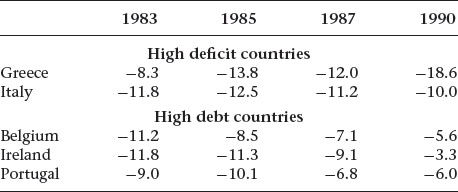
In order to cope with increased competitive pressures within the European common market, as well as the acceleration of inflation and public borrowing requirement (Table 5.10), PASOK announced a 15 per cent devaluation of the drachma in 1985 followed by a two-year ‘austerity program’.30 Skillfully negotiating with the Council of Economic and Finance Ministers of the EC (ECOFIN), and in return for absorbing the shock in Greek agriculture caused by the entry of Portugal and Spain in 1986, PASOK secured a loan of 1750 million ECUs in support of austerity. What did the two-year ‘austerity program’ achieve? It achieved almost nothing of any substance.31 Inflation decelerated marginally and any additional income or productive output was diverted towards the repayment of stabilization loans. Although injected in reduced portions, state aid to manufacturing continued in substantial quantities especially if compared to the rest of the EEC at the time (Table 5.7). Thus, the government’s borrowing requirement ‘jumped from 280 billion drachmas (15.8 per cent of total budget expenditure) in 1985 to 650 billion drachmas (24.3 per cent) in 1987’, while industry and agricultural output became even more uncompetitive relying increasingly on subsidies and loans.32
Table 5.6 Evolution of GDP, expenditures of the ordinary budget, expenditures for health, welfare and social insurance and public debt in million drachmas in current prices, 1977–91

Source: Calculations based on data from ELSTAT (1977–91) Greece: Statistical Yearbooks (Athens: ELSTAT).
Neither had the internal imbalances been reduced by implementing supply-side policies and austerity (fiscal restraint, wage and benefit cuts, etc.), nor the external imbalances been improved by boosting competitiveness and export-led growth, the latter being an almost impossible undertaking due to the structural-historical problems of the Greek productive sector (small-scale industry, small farm production, low technological output and innovation). The fault-lines between the monetary base of the social system and its financial undertakings represented in the vast quantities of uncommitted money-capital in circulation found its most clear expression in the monetary policy of the programme. In order to attract money to service its debt, the PASOK government increased interest rates across its commercial banking system. This, automatically, increased the servicing of debt. To solve this problem, the government increased the supply of money, thus bringing in inflation from the back door. A vicious cycle of debt creation, both domestic and external, was being created because the policies of the PASOK government failed to address the structural problems of Greek capitalism, now accentuated due to the country’s entry into the EECEC. The only real ‘achievement’ of the ‘stabilization’ programme was the decrease in average earnings (wages and salaries): for 1986 and 1987 they fell in real terms by 10 per cent and 4.7 per cent, respectively.33 However, the decade of PASOK needs to be brought into perspective in order to reach a better understanding of the complex inter-relationship between state/economy/society, on the one hand, and state/European economy, on the other.
Table 5.7 State aid to manufacturing (selected countries)

Source: Data compiled from OECD Economic Surveys (1993) Greece (Paris: OECD) p. 16.
Similar austerity programmes had been applied across Europe at the time, beginning with Mitterrand’s famous U-turn in 1983. Mitterrand abandoned his Socialist/Keynesian programme for reasons we cannot examine here – some say he abandoned it because he did not really want Socialism in France, whereas some others blame the global supply-side conditions depriving the French socialists of Keynesian instruments needed for the implementation of Socialist policies.34 From our perspective, what matters is that France, under Mitterrand, embraced neo-liberal globalization from 1983 onwards and yet its public debt condition did not improve. In Thatcher’s Britain, the average inflation throughout the 1980s was above 6 per cent, whereas no dramatic drop in the country’s debt situation took place despite harsh austerity and privatizations. Other countries in the periphery such as Spain, Italy and Portugal implemented similar anti-inflationary programmes in the 1980s, yet none of them managed to seriously tame either debt or inflation (Tables 5.8 and 5.10). Moreover, Italy, Belgium and Ireland also suffered from serious debt problems throughout the 1980s, with the ratio of their public debt to GDP exceeding over 100 per cent at the end of the decade (Table 5.8).35 Elsewhere, matters were critical: in August 1982, Mexico defaulted on loan repayments and several other countries in Latin America were on the verge of abandoning their foreign debt obligations (Tables 5.9 and 5.10).
Table 5.8 Inflation and money supply in Europe in the 1980s

Notes: MS = Money Supply.
Source: Data compiled from Donald Sassoon (1996) One Hundred Years of Socialism (London: Fontana), p. 450 and Robert Holland (1993) The European Imperative. Economic and Social Cohesion in the 1990s (Nottingham: Spokesman), p. 29.
Table 5.9 Gross public debt in EEC countries (in % GDP)

Source: Data compiled from the Official Journal of the European Communities (28 February 1991), No C53/25 available at www.eur-lex.europa.eu (accessed on 11 December 2012).
Table 5.10 General government net lending (+) or borrowing (–) (in % GDP)
Source: Data compiled from the Official Journal of the European Communities (28 February 1991), No C53/25 available at www.eur-lex.europa.eu (accessed on 12 December 2012).
Under PASOK, the public sector became the dominant labour market in the Greek economy. The more PASOK members poured into the public sector, making an already disorderly state machine even more dysfunctional, the more affluent and larger were the middle classes becoming. Whereas before 1974 the right-wing concentrated predominately on recruiting personnel from conservative-nationalist families to police Communism, the new political landscape after 1974 shifted the nature of the recruitment, adapting it to electoral cycles and the catch-all character of PASOK as a political party. According to the census for public employees by the Greek census agency conducted in 1956, civil servants, including army officers, accounted for 64,956 or0.85 per cent of the total population (7,632,801 at the time according to 1951 census). In 1961, the population was 8,388,553, the civil servants numbering 104,840 or 1.2 per cent. Although there are no available data concerning public employment in the 1970s and 1980s, according to the 1991 census the total population was 10,259,900 but the number of civil servants in 1988 had moved up to 589,386 or5.7 per cent of the total population.36 We have a useful yardstick by moving forward some 20 years: in 2011 the total population of Greece was 10,787,690, yet the number of civil servants had soared to 768,009 (2010 census conducted by the Ministry of the Interior) or 7.1 per cent of the total population. This represents an increase of 15.4 per cent at a time when the official unemployment rate was 16.3 per cent in the second quarter of 2011 (see relevant data in the next chapter). This, given that from the mid-1990s onwards Greece entered completely the cycle of neo-liberalism cum financialization (see Chapter 6), shows that clientelism and Greek-style corporatism survived under whatever regime of accumulation, be it under Andreas Papandreou’s populism or the ‘modernizing’ and supply-side cabinets of Costas Simitis’s PASOK (1996–2004) or Karamanlis’s Jr. ND (2004–09). Moreover, strong family ties, widespread petty-bourgeois ownership that created strong inheritance structures, as well as a widespread sense of community, all of which was the result of past and present policies aiming at undercutting Communist influence, backed the creation of a relatively prosperous yet highly unproductive societal structure.37 Thus, despite the stagnation in private capital performance and growth ratio, as well as the reduction in salaries/wages due to the ‘stabilization program’, people’s income potential and purchasing power increased drastically. Funding coming from European programmes in the 1980s further buttressed the new managerial structures of income distribution (Table 5.11) under PASOK. This funding, it should be said, anything but offset the country’s loss of international competitiveness, chiefly caused by the entry into the EEC. In the event, agriculture and industry had all but disappeared by the mid-1990s, making way for a recomposed, but always large, middle class and new, small-size, private service sectors dominated by private banking capital, financial operators and a finance-oriented comprador bourgeoisie, all phenomena we will explore in Chapter 6.
Table 5.11 EEC/EC transfers during PASOK’s second term, 1987–89 (% change from previous year)

Source: Data compiled from Dimitrios Chalikias (1990) Annual Report of the Governor of the Bank of Greece for the Year 1989 (Athens: Bank of Greece), p. 141.
Having said this, and compared to its northern European partners or the USA, one could argue that Greece in the 1980s and early 1990s was a poor state with rich people. This happens when subaltern ruling elites in the periphery, with the tacit approval of their foreign masters, create hallucinations of affluence by allowing societies to live on borrowed money for purposes other than those serving the stability and economic sustainability of those societies – never mind that almost all policies proclaimed were named as ‘stabilization policies’. Arguably, therefore, PASOK’s pro-welfare policies of the 1980s and its peculiar Keynesianism boosting aggregate demand management – a trend that continued, although in diminishing forms, half-way through the 1990s – was not the result of a ‘rational choice’ on the part of an independent entrepreneurial bourgeoisie in order to maintain and reproduce an extended subsumption of labour to capital with the state as the key class arbiter in disputes. It was something else.
The Greek ‘welfare’ state was the product of a peculiar ‘Keynesian’ political strategy that drew mainly on borrowing and the wealth generated in the 1950s and 1960s and justified on (external) security grounds. We insist that this was primarily a bipartisan (ND + PASOK) strategic intent, rather than a lack of an alternative due to the structural deficiencies of the Greek economy. PASOK’s case is very interesting. With a tradition of civic culture lacking in Greece, PASOK’s charismatic leader knew that all forms of clientelistic practices and political participation are in effect mechanisms for the acquisition of consensus, all the while undermining the electoral and political strength of the Communist Left. At the same time, Papandreou knew very well that intervention in the aggregate demand management by way of bailing out lame-ducks is economically problematic. Instead of advancing investment in the productive sector, especially in the production of capital goods, technology and innovation, PASOK cabinets used vast amounts of inflationary (debt) money to finance a large middle class while nationalizing a number of lame-ducks and encouraging the agricultural sector to become dependent on EEC subsidies. This enervated workers and peasants alike, making them, directly or indirectly, dependent upon a dilapidating state machine, hence our argument at the time that the ‘Third Hellenic Republic has exhausted itself’.38 Thus, contrary to neo-liberal – and at times even social democratic – orthodoxy, the fundamental problem that the ruling party elites of both ND and PASOK had to face and solve was not so much how to rule in absence of a modern industrial sector, but how to modernize against the labour movement.39 It is also this bipartisan approach by both PASOK and ND that brought about the type of extended political clientelism and public sector expansion Greece came to experience from the late 1970s onwards.
It is then clear that the post-1974 ruling classes of PASOK and ND decided to frame kampfplatz within a redefined imperial chain in which European capital began playing a predominant role, determining the contours of Greece’s economic policy. The adaptation was slow but even when they did so by the mid-1990s onwards, the prevailing norm of the political game – clientelistic and nepotistic recruitment of state personnel – remained untouched. It is in this sense that we argue that liberal and even social democratic arguments about ‘clientelism’, ‘populism’ and ‘corruption’, as phenomena hindering capitalist development and modernization, do not make sense. But more to the point, if this liberal argument held water, then Japan and the USA, two of the most clientelistic regimes in the world where also corruption is rife, would have never experienced modernity and other economic and technological advances over the last century. Corruption is embedded in the political culture of Hokkaido in Japan, not to mention the financial scandals in the USA, such as Enron, the more recent Madoff financial scandal, etc. Both countries, as well as Italy and France, are listed by Transparency International’s corruption index as highly receptive to bureaucratic corrupt practices in both private and public sectors. But even a pre-university educated pupil knows that these countries are some of the most advanced and powerful states in the world. In the same vein, one could refer to the large public sectors and welfare states of Scandinavia, which enjoy nevertheless a very low GDP/debt ratio. There is no correlation, therefore, between clientelism/nepotism/corruption, on the one hand, and debt creation/high growth, on the other. As we have seen, the debt is the historical and structural result generated by the fault-lines between the monetary and the financial bases of the system, that is the severe disequilibrium between the real commodity value produced in the country, on the one hand, and the large amount of money in circulation thrown into the market for consumerist and political purposes.
In the post-1974 period, Greece seems to have received the ‘dividend’ of its (formal) inclusion in the European core in return for suffering defeat in Cyprus (the USA supported wholeheartedly Greece’s entry into the EEC). The Greeks perceived it primarily as an economic and secondarily as a security reward compensating them for the Turkish security advantage on Cyprus. Within the transatlantic bloc, things were more complicated. For the USA and NATO, Greece and Cyprus were perceived as key security pillars within the Western alliance and entry of Greece within the EEC would diminish possibilities of war between two NATO allies. For the EU, and especially for (Western) Germany and other countries of the core, the entry of Greece into the EEC meant primarily, but not exclusively, a market of another 10 million consumers whose purchasing power could buy their technologically advanced products. And if the Greeks did not have the money to buy those products, then that is too bad for them: they would have to borrow money from the core in order to afford buying those commodities, which is exactly what happened.
PASOK did fail to lead modernization in Greece in the 1980s taking the country into a sustainable path of growth, because it did not advance an economic policy of industrial growth drawing from the vast popular movement that brought it to power. If anything, it offered a replenishment of the state machine with loyal PASOK members, while being faithful to the economic and security programme of ND, which was a NATO programme. The case of Greece in the 1980s, a decade which ended with PASOK sinking in a series of financial scandals, could fit the perceptive term ‘crisis of crisis management’ coined by Claus Offe in his analysis on the crisis of the Keynesian state.40
5.4 Concluding remarks
Greek state elites did not follow neo-liberal globalization in the 1970s and 1980s, either because they did not want to, or because they could not, or both. Pressure on those elites, especially in the 1974–81 period, was coming from three different quarters. The first type of pressure was exercised by the popular movement demanding the long overdue democratic reforms and political participation. The second stems directly from the country’s security and geo-political issues in Cyprus and the Aegean and the perceived threat from Turkey (in 1988 Greece was second only to the USA in defence spending as percentage of GDP); and the third is related to the weakness of the Greek industrial base, which immediately sought state protection from increasing international competition and risk exposure due to the country’s agreements with the EEC-EC since 1961 and the stagflation that prevailed in the 1970s; its entry into the EEC in 1981; and the Delors package of 1986 vis-à-vis the Maastricht deadline of 1991–92.
This picture is extraordinary. ND and PASOK began building a post-authoritarian state by way of pioneering inflationary, pro-Keynesian cum corporatist measures, at a time when similar policy undertakings were in retreat everywhere, except in Scandinavia. There was no major drift towards neo-liberalism and financialization in the 1970s and 1980s, and indeed halfway through the 1990s, as was the case, for example, in François Mitterrand’s France (the famous U-turn, 1982–83) or in Felipe González’s Spain (especially from the second half of the 1980s onwards). Both the ND and PASOK, once in office, had to manage the disintegrative tendencies in the productive sector (falling rate of profit, blockage of exports, shrinkage of agriculture), while dealing with societal demands for political participation and securing employment. But the Greek economy, due to its structural deficiencies and severe weaknesses, including the weakness of the crisis management of PASOK in power which failed to lead modernization, could not sustain these undertakings and, by the late 1980s, sank into the debt/inflationary spiral. Greek political elites found themselves borrowing externally and domestically in order to sustain shrinking primary and secondary sectors and a rudimentary welfare state without even contemplating reduction of defence spending. Thus, the Greek state could not overcome its historic fault-lines, that is its dependent/subaltern position in the imperial chain and the negative or positive security dividends it receives – or can capitalize on – from its geo-political position. All in all, this is the substratum of the fourth Greek kampfplatz as defined by the political phenomenology of PASOK versus ND, and that is why we insist that approaching the issue from the point of view of ‘transition to, and consolidation of, democracy in Greece’ leads to a rather misleading research agenda. However, it took another 20 years for this kampfplatz to completely exhaust itself and sink altogether in an unprecedented sovereign debt crisis triggered by the global financial crisis of 2007–08.
Pro-inflationary and Keynesian policies à la Grecque, coupled with the country’s extensive dependency on European capital inflows, provided the socio-economic environment in which the Greek comprador bourgeoisie rediscovered itself as a dominant social and political class in Greece. This class shared power with a new state-industrial class that received state protection via a wave of nationalizations that started under Karamanlis in the 1970s, a process that became exhausted by the late 1980s, when neither invisible earnings nor EU subsidies were enough to offset the debt caused by such undertakings. If the comprador bourgeoisie is the main referent for the external debt, then this state-aided class with the two main parties managing public sector recruitment and lame-ducks via internal and external borrowing, i.e., via management of the government’s borrowing requirement, is the main referent for the budget deficit. Both processes, however, took shape at the heart of an institutionally dilapidated state machine. If PASOK’s welfare state in the 1980s was primarily financed through borrowing, then taxation was eventually what was buttressing the nationalized lame-ducks. Gerassimos Arsenis, Economy Minister during PASOK’s first term in office, is very frank when he says that his government had either to liquidate a large number of lame-ducks, or to nationalize and finance them through taxation. Interestingly, New Democracy had made the same decision in 1979–80.41 This also proves our point that there had been a bipartisan consensus between ND and PASOK in the management of the Greek economy during this period, a management that resulted in a severe crisis towards the late 1980s jeopardizing the very survival of the bi-polar regime.
It is true that PASOK and ND in the 1970s and 1980s outflanked social struggle via corporatist methods and political clientelism creating a new bipartisan middle class, directly or indirectly dependent on the state. They tried to achieve modernization and qualify Greece as member of the core by undercutting the power potential of an independent labour movement. Bourgeois politics can outflank social struggle from the bottom up via whatever method (corporatism, high wages, political clientelism, etc.), but it cannot outflank competition among its factions, whether these factions operate nationally or internationally or both. It is, therefore, important to consider the transformation of the dominant classes in Greece in the 1990s and 2000s alongside the international trends of financialization and European integration processes, which pushed Greece and the European periphery to bankruptcy in 2010–11 and, together, at least as far as Greece is concerned, to the collapse of its fourth kampfplatz.