
AGRICULTURE WAS the first human enterprise we might call biotechnology—the deliberate adoption of the biological or biochemical talents of other living things for our own benefit.1 Like most great ideas, it was reinvented repeatedly, perhaps ten times by different human tribes around the globe. Before agriculture, there were fewer than fifteen million humans; now we are more than seven billion. We may be nostalgic about our hunter-gatherer origins, or long for a nomadic for-aging lifestyle and Paleo diet, but those idyllic days are gone.2
Today’s grain farms are a completely different world from a natural meadow or prairie, though above the surface they seem similar. They are artificial ecologies created over cen-turies, as farmers tilled their soil, planted seeds, prayed for sun and rain, and agonized over failed crops long before the causes were understood. They tinkered with their domesticated crops, breeding plants with desirable characteristics without realizing that symbionts were involved. In recent times, in the rush to produce ever more food, high-volume, high-throughput agro-industrial factory-like farms have been assembled without a full understanding of all the moving parts. Domesticated seeds and livestock, fertilizers and pesticides, threshers and combines, and irrigation systems are all hallmarks of modern farming. But the symbioses between crop plants, fungi, and other essential microbes that occur in wild plants and uncultivated soil were not considered important until recently.
Most contemporary farmers have a strong understanding of biology, and they continue a long tradition of planting enough to compensate for an expected 10 to 20 percent loss. Striving to provide missing nutrients and drive off diseases and pests, generations of farmers have relied on synthetic chemicals to tweak their crops, and many growers still use them. Plants often have trouble absorbing phosphorus and potassium from the soil. And although nitrogen gas makes up 78 percent of the atmosphere, plants, animals, and fungi cannot absorb this essential element from the air by themselves, even though they need ammonium, nitrate, or nitrite ions to assemble into amino acids and then proteins. Only nitrogen-fixing bacteria can make use of the gas for themselves.3 Luckily, many of them are mutualistic symbionts that form swollen nodules on legume roots, live free in soil or water, or partner with other organisms to pass their nitrogen on. In the early part of the twentieth century, German chemists invented a process to scrub nitrogen from the air so that it could be combined into fertilizers designed for crops that suffer nitrogen deficiencies. The resulting increase in food yields, without a need for more acres of farmland, was a main factor in the huge population growth of the past century.
It’s easy to understand why microscopic partners are so often overlooked in farming, which focuses on the big scale. But phytobiomes of crop plants are as important as the phytobiomes of trees. Many moulds affect plant health, and we need to understand them if we want to maximize the efficiency of our agricultural factories. Restoring the function of these natural biological modules of agricultural plants may be the key to increasing productivity while minimizing the environmental damage attributed to modern agriculture.
Fungal Crop Symbionts: Mycorrhizae, Rhizosphere Fungi, and Endophytes
There are pictures of me as a four-year-old on my uncle’s farm, posing with a bundle of freshly threshed wheat clutched to my chest. Holidays for our family meant driving the 1,300 miles across Ontario and Manitoba in our i960 green Oldsmobile until we pulled in at the family farmstead north of Regina, Saskatchewan. I always loved the prairies. My uncle Hugo was an old-fashioned man with pomade in his center-parted hair, pince-nez glasses, and a Bakelite cigarette holder. Lush fields of wheat drove his imagination. Each evening before sunset, we’d saunter out to inspect a different quarter section of the farm. The wheat was about the same height as me and I could almost disappear into it. To my eyes it seemed like a healthy crop, but if I’d known to look, I would have realized that something was amiss. The grasses and weeds growing on the margins of the field were filled with symbiotic fungi, but there were far fewer of them in the crop plants themselves.
Compared with trees, where the vibrant symbiotic relationships involving fungi drive the forest, the symbiotic relationships on farms seem feeble. It’s difficult to compare a farm ecosystem with a balanced community in nature because, in the process of domestication, we’ve unwittingly disrupted many of the original biological connections. The fungi that are symbiotic with crop plants are found mostly around their roots. If you sieve the dirt from beneath the plants in almost any field, you’ll find hundreds of shiny brown balls, each smaller than the tip of a pin. Your first guess might be that they are tiny insect eggs, but they are giant single-celled asexual spores. When these spores are stained and viewed through a microscope that casts ultraviolet light, you can see hundreds or thousands of glowing nuclei.4 We aren’t quite sure why they have so many, but we know individual spores are connected by a thin weft of hyphae (which also have lots of nuclei in their cells) to specialized structures inside the roots. Hence they are often called endomycorrhizae, which means “inside the roots.”
Endomycorrhizal fungi evolved a couple of times, once in the phylum Glomeromycota and once as part of a group of zygos known as the Endogonomycetes (now included in the phylum Mucoromycota). When you look at thinly sliced root tissues under a microscope, fungi of both groups make one or two distinctive structures inside individual cells: round, swollen cells called vesicles and elaborately branched tree-like structures called arbuscules. The latter give these symbioses the name arbuscular mycorrhizae (AM). Vesicles of AM fungi were probably illustrated by the Swiss botanist Carl Nägeli (1817-1891) forty years before the Hartig nets of ectomycorrhizae were discovered, but nobody understood what they were. They look like structures made by common plant pathogens called Pythium (fungus-like relatives of the potato blight), and for more than a hundred years they were thought to belong to a rare kind of parasite. The debate about whether they might be beneficial started in the 1950s. Then in the 1970s new microscopic techniques for examining roots were introduced, and we realized that about 70 percent of wild plants have AM roots, including tropical and grassland plants, as well as some tree groups that don’t have ectomycorrhizae.5 Arbuscules and vesicles are both well enough protected inside roots to be preserved in root fossils, but it took a while for paleontologists to realize that they were part of a fungus. This fossil record, combined with evolutionary dating using molecular clocks, suggests that AM symbioses already existed when plants migrated from oceans onto land. Without this support, it seems unlikely that land plants would be the dominant life-forms they are today, AM researchers are fond of claiming that “plants don’t have roots, they have mycorrhizae,” suggesting that the plants’ own roots are a plan B in case AM fungi aren’t around.
Unlike most ectomycorrhizal fungi, AM fungi have a promiscuous, open-arms policy towards their plant partners and form symbioses with many different plants. Thousands of plant species rely on only two or three hundred species of AM fungi. As with ectomycorrhizae, hyphae of AM fungi meander through the soil searching out deposits rich in phosphorus and other minerals. The nutrients stream back through the hyphal plumbing system and are dispersed through the finest branches of the arbuscules directly into the root cells. The repeated branching of the arbuscules, which look something like the alveoli in our lungs, maximizes the surface area to exchange minerals and liquids for photosynthetic carbon from the host plant. Some but not all AM fungi make vesicles to store a backup supply of nutrients for hard times, like a pantry for the symbiosis.
Plant breeders historically did not pay attention to AM fungi, and the ability of new cultivars to form endomycorrhizae was not considered. Despite this oversight, now that we are aware of them, we see that AM fungi persist in farm soils from one year to the next and that mycorrhizae still form in many crop plants. But the diversity of fungi involved is lower and the increase in root mass is less pronounced than in nearby uncultivated soils. Nevertheless, even plants casually colonized by AM fungi absorb more minerals and generate more photosynthetic carbon and hormones than those without. The fungi can also bind excess heavy metals into the chitin in their cell walls and to structures inside their cells, reducing the toxic effect of these ions on the plant. The result is greener, denser foliage and more seeds. Probably because of their more extensive root systems, mycorrhizal plants are better at tolerating drought, AM fungi seem to prime plant defense systems and reduce infections by root pathogens, but we do not know much about how this process works. Since about 2000, evidence has been growing that mycelia of AM fungi can form common mycorrhizal networks among plants of the same or different species, analogous to the Wood Wide Web in forests. The connections seem to provide dawdling seedlings with a boost of nutrients, share the priming signals alerting them to the presence of plant pathogens, and move signaling hormones from one plant to another. But seasonal plowing of fields disrupts these networks.6
With so many benefits from AM, you might expect that adding the fungi to fields would be a no-brainer. Unfortunately, it is not so simple. Positive effects in greenhouse experiments, where we can compare plants grown in sterilized soil with and without mycorrhizae, often aren’t matched in field experiments where there are always AM fungi waiting to colonize plants. The relationships between endomycorrhizae and plowing, fertilizer and pesticide use, plant diseases and crop yields are not straightforward. The nutrient-scavenging functions that the fungi provide for the plants are made redundant by the abundant nutrients provided by synthetic fertilizers. Most cultivars grown today were bred to expect high amounts of nutrients from fertilizers and are not attuned to working with the lower levels provided by mycorrhizae. Fungicides intended to kill plant pathogens may also kill symbionts. Further, although reduced plowing usually increases AM diversity, some species have difficulty colonizing plants in untilled fields, perhaps because of increased competition from saprobic fungi growing in the surface layers of crop debris. As a result, adding AM fungi often shows little benefit in crops.
The majority of AM species don’t grow at all in the usual agar systems used to culture most other fungi. Their hyphae need to be near living roots before they will grow and make more spores. To culture these species, plant biologists either grow root cells in agar culture and then colonize them with spores picked out of soil, or they inoculate spores of promiscuous AM strains into pots with fast-growing mother plants. After a few months, the cyst-like spores can be sifted out of the medium and mixed with powders and granules that keep them alive long enough for you to buy them at your local garden shop. Agricultural companies have developed industrial-scale methods to grow AM inoculum for fields that cover hundreds of acres. Usually, the fungi Rhizophagus intraradices, R. irregularis, and Funneliformis mosseae are used either alone or more often in mixtures. Such microbial inoculants, sometimes called biofertilizers, may be the way of the future, but we have a lot to learn about how AM fungi work. It will be some time until we can maximize their effects, and there are probably a few decades of plant breeding ahead to develop cultivars that will give reliable high yields when grown with blends of high-performing (or elite) AM fungi.
Other fungi also live near the roots of crop plants but do not form mycorrhizae. DNA surveys detect thousands of these non-mycorrhizal rhizosphere fungi and bacteria mooching around in grasslands, but only a subset lives in agricultural fields. Soil fertility improves as fungal diversity increases. The saprobic rhizosphere fungi that do live in fields appreciate the mixing of soil and roots during plowing, and their hyphae swarm the straw and dead bits of leaves and roots. There they continue the endless job of breaking down carbon and releasing other minerals, loosening soil particles to allow water and air flow, assaulting pest insects or nematodes, and attacking or outcompeting plant pathogens. Some of the rhizosphere moulds, like Penicillium bilaiae and Trichoderma virens, grow easily in culture and are being developed as commercial products to boost plant growth. Their spores are mixed into powders that are sprinkled into garden or farm soils during seeding or transplanting. When their hyphae start to grow, they exude organic acids that convert minerals into ions easily absorbed by plants. They don’t seem to interfere with AM fungi and can be helpful biofertilizers in low-phosphorus soils.7
In addition to the mutualistic fungi around their roots, most wild grasses have endophytes in their leaves. Because most grass plants live less than a year, these symbionts have little time to set up house. So, unlike their counterparts in the forest, grass endophytes spend their whole lives inside plants and then are prepackaged in the seeds. When the grass plant withers away and releases its seeds on their journey, the endophytes ride along, already installed when the next generation of seedlings starts growing. Epichloë species are mutualistic endophytes in many species of wild grass. Their growth outside the plant is so sparse you can hardly find them with a microscope, but inside stems they form a meshy network that produces complex toxins called alkaloids. These compounds protect the tissues from insects but not always from other animals. The well-known hallucinogenic properties of morning glory seeds result from ergot alkaloids produced by endophytic symbionts (more on ergot to come).
In crop plants, some endophytes have a kind of Jekyll and Hyde personality. As we’ve seen in forests, they’re useful to plants because they ward off harmful insects. However, if sheep or ponies consume too many endophyte-laden leaves, in particular the forage grass fescue, they lurch around and fall over like drunken college students, a malady known as ryegrass staggers. If they eat a particularly heavy dose, they develop a condition called fescue foot and their hooves can fall off. The toxins don’t affect birds or rodents that snack on colonized seeds, but wise rabbits turn their noses up when offered pellets made from endophyte-colonized grass.
The same symbiosis is beneficial in some situations and detrimental in others, depending on whether pest insects or livestock are consuming the plant. Proactive farmers grow endophyte-free forage for their livestock to prevent illness and keep the endophyte-plus seeds for their lawns.8 Some endophytes also turn against the same plants they at first seem to help. If you wander through a meadow in the last half of summer, you often find grasses with stems sheathed by the telltale speckled ascospore-producing tissue of Epichloë. The coating looks a bit like egg yolk and is the first symptom of a disease commonly known as “choke.” At this stage, near the end of the grass plant’s life, the fungus switches from mutualist to parasite and squeezes off the nutrients flowing from the roots into the upper part of the plant.
Endophytes are actually rare in the cultivated grains we grow for food. The grains sown on modern farms were domesticated from wild grass plants thousands of years ago, starting when Neolithic farmers saved their favorite seeds. The ancestral plants probably had endophytes, but they disappeared during the breeding process. Some botanists have tried to adapt Epichloe species from wild plants to grow in grain plants, in the hope that the endophyte will protect against insect pests. It works to some extent with wheat in greenhouses, but unlike the biocontrol system developed for conifer needles, so far no stable long-term symbioses have been established. For the time being most of our grain crops will continue to grow as endophyte-free plantations, but eventually this may change.
We may have domesticated many grains and grasses by selective breeding for our own purposes, but many of them have also done very well through their association with us. Wheat was just a minor wild grass from the Middle East before it got involved with humans ten thousand years ago.9 Now it occupies about 1.5 million square miles of farmland around the globe, including hundreds of varieties bred to improve yields. However, cosmopolitan crops tend to have cosmopolitan diseases, following along as acreages expand, seeds are distributed from one country to another, and food is imported and exported.
Rust Never Sleeps
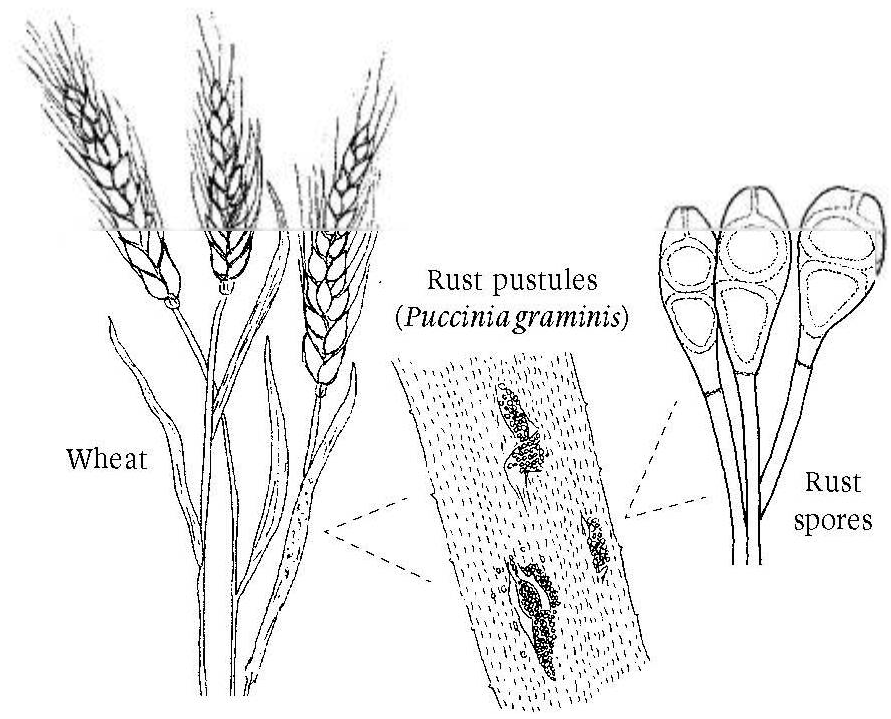
My grandfather grew Marquis (prairie farmers always called it “Mark-wiss”), a high-yielding wheat variety that matured quickly in the short prairie summers but was susceptible to black stem rust. The farmhands often emerged from their fields with their shoes and pants puffing orange clouds of spores. The combines that separated the wheat from the chaff caked up with the same powder. Stripes of tangerine-colored pustules on wheat stems were caused by the rust fungus Puccinia graminis. There are thousands of rust species, most pathogens of specific plants, including most grains and many trees. Each blister fills with microscopic spores. A moderately infected wheat field might have 50 trillion stem rust spores per acre.
Known since biblical times (Genesis 41:25-30), black stem rust was first noticed in the grain belts of Canada and the United States in the 1870s, then gradually spread as it increased in virulence. Wheat rust epidemics became increasingly severe on the North American prairies after the turn of the twentieth century. Before the United States entered World War I in 1917, a rust epidemic wiped out a third of the harvest and bread prices skyrocketed. To cripple the fungus, the first step was to stop it from having sex, which meant searching out and destroying its alternate host: barberry. European immigrants had brought ornamental barberry shrubs to the Americas, a source of berries for making preserves. Boy Scouts and “Rustbuster” clubs were soon mobilized with instructions from the Rust Prevention Association and the U.S. Department of Agriculture to “execute this criminal bush wherever it is,” because it was pro-German.10 The obliteration of the alternate host slowed the evolution of new pathogenic strains, and for a while, rust outbreaks were less severe. The 1930s, however, was a decade of drought and economic and political turmoil in Canada and the United States. Any crop that did grow was felled by rust. As the Great Depression took hold, a generation learned the hard way that ’hoppers or a fungus could kill a farm.
When rust spores land on wheat, they germinate and specialized hyphae punch their way through the hard cell walls of the stem into the softer living tissues. The mycelium then meanders through the plant, out of view, reminiscent of an endophyte, but there is no beneficial symbiosis here. The disease either kills the plant or siphons off so many nutrients that the seeds can’t mature. The complexity of the life cycle of wheat rust was discovered by 1660 and rivals some insect metamorphoses. Five different spore types—four asexual and one sexual—form on two different, often distantly related, host plants (known as alternate hosts) in different seasons. Some of these spores spread the contagion for a short distance in one field. One type develops thick walls and stays where it is, hunkering down for survival. Others float upwards for long-term dispersal on the wind. To this day, students shudder when asked to recite the details, but this complexity also confounds attempts by farmers to control the disease.11
Pustules of Puccinia’s sexual spores form on the underside of leaves, but any spores shed by infections in Canada and the northern United States are killed each winter by the cold. In 1935, when the National Geographic Society released the Explorer 11 high-altitude weather balloon, it found the distinctively spiny, golden spores of rusts in the stratosphere, 13.7 miles overhead.12 Wheat rust uses wild barberry bushes in the tropical and subtropical Americas as a winter resort. Thermal air currents lift the spores from these plants into the northbound jet stream. Weeks later they land on tender emerging stems and leaves of North American prairie wheat. Stem rust is an invasive disease that just keeps on invading.
Epidemics of wheat rust brought a new urgency to plant breeding. Even before scientists knew how genes operated, it seemed clear that wheat and rust were coevolving. Pathogenic strains of rust are called races, and each race has a unique collection of pathogenicity genes. Farmers therefore planted seeds bred with resistance genes designed to protect them from the races occurring in their regions. Of course, the rust is constantly evolving new variants, trying to find new ways in. But until it does, the crops might have ten or twenty years free from the disease. Eventually the fungus stumbles across new pathogenicity genes that let it attack wheat cultivars that were previously immune. Plant breeders seek out new resistance genes from related wild plants and cross them into new wheat lines so that another cultivar is ready when the old one crashes.13 When a planted crop is resistant to the local rust races, few fungicides are needed. But once a new pathogenic race finds a susceptible plant, the various asexual parts of the life cycle amplify it exponentially. A new epidemic spreads, and the genetic arms race continues.
Norman Borlaug (1914-2009) was an American plant breeder who developed wheat cultivars for the developing world. In 1944, the Rockefeller Foundation assigned him to solve the problem of wheat rust epidemics in Mexico, which were leading to serious food shortages. After World War 11, India and the newly separated Pakistan suffered devastating epidemics of wheat rust that led to terrible food shortages there as well. Borlaug’s colleague, M. S. Swaminathan, convinced the reluctant Indian government to plant the varieties developed for Mexico. The Indian authorities placed a massive order for an immediate supply. Borlaug shepherded truckloads of seeds from Mexican nurseries over the border into the United States. They were loaded onto barges in Los Angeles during the Watts race riots and docked in India just in time to be planted. Between 1965 and 1970, wheat yields doubled on the subcontinent. Borlaug and Swaminathan’s efforts saved as many as a billion lives. Borlaug was awarded the Nobel Peace Prize in 1970. Although his efforts prevented famine, his award was controversial and remains so today. The breeding of crops for physical traits and high yield, together with the use of extensive irrigation, fertilizers, and pesticides, was branded the Green Revolution. Critics questioned the long-term sustainability of such a high-tech approach to solving problems of the developing world. Advocates of population control in the developing world were also uncomfortable. Pacifists noted that much of the fertilizer was produced by chemical companies also heavily invested in explosives.14
In 1998, a virulent new race of wheat rust called Ug99 was found in Uganda. No resistance genes were known that would stop it. It survives at higher altitudes than other races, which put critical agricultural regions at risk if it were to spread. After its discovery, it flew from East Africa to Yemen and Iran on the trans-Asian jet stream. Wheat breeders in Canada and the United States began searching for new resistance genes.15 They sowed spores of Ug99 onto experimental varieties in high-security greenhouses, and in Canada, as an extra precaution, the experiments were done only in winter. It is working; new resistance genes are ready to be deployed, though new variants of Ug99 are still being discovered. So far, this rust has not touched India and remains far from the bread-basket of the North American prairies.
Poison by Degrees: Ergotism and Mycotoxins
Ergot was more of a curiosity in Saskatchewan in my uncle’s time, but everyone knew the lurid backstory. During the Dark Ages, ergotism caused violent convulsions in European peasants, who also hallucinated that their limbs were aflame. In severe cases, their circulation was badly impaired and they lost limbs to gangrene. This illness came to be known as St. Anthony’s Fire, named for the patron saint of the order of monks who cared for the afflicted. By 1670 the symptoms were linked to rye, a staple food of the poor, but the connection to the ergot fungus was not made until the 1880s. Two Frenchmen, the physician Charles Tulasne (1814-1884) and his lawyer brother Louis-René (1815-1885), connected several different spore forms to the ergot disease, which they called Claviceps purpurea.16
Rye crops suffer the worst ergot infections, but most wild grasses and agricultural grain plants get the disease. The fungus shoots ascospores into the spring winds just when grasses and grains are in flower—this is a common trick with plant pathogens, making sexual spores when the host plant is most vulnerable. The ergot spores germinate and send hyphae down the central channel of the young floret, taking advantage of a pathway intended by the plant to guide pollen. Each ovary is replaced by a black claw (a hard mass of mycelium called a sclerotium), and then no seed can form. The sclerotium gives the fungus its common name: in French, ergot is the hooked, backward-facing talon of a chicken, which is just what these spikes look like protruding from the grain. A sticky yellowish liquid called honeydew drips out of the florets and flows down the stalk, filled with millions of tiny asexual spores that stick to the legs of curious insects. The bugs fly from plant to plant, casually dropping off spores that start new infections. After the infected crop matures, the sclerotia fall to the ground or are harvested along with the grain, where most are sifted out in the elevators. In the spring, having survived the winter, tiny sexual structures that look like orange light bulbs balanced on curved stalks sprout from the buried sclerotia, releasing spores and starting the cycle again.17
Ergot is more or less a nuisance to the plant, but serious consequences await mammals who eat the sclerotia. Spontaneous abortions often occur in pregnant livestock who eat leftover grain contaminated with ergot, especially pigs. Alkaloid toxins are found in the sclerotia, especially high amounts of ergotamine, which the fungus makes to discourage insects from devouring them. In humans, ergotamine causes blood vessels to constrict. Doctors use small amounts to treat migraines, but larger doses lead to the painful burning sensations and hallucinations that are the hallmarks of St. Anthony’s Fire.18 Meanwhile, ergot can still be a significant problem in some grain belts. The sclerotia can be sieved out but are so potent they have to be handled as toxic waste.
In the 1940s, the Swiss chemist Albert Hofmann (19062008) was studying ergotamine as a possible drug to ease difficult human pregnancies. To improve its medical properties, he was experimenting with chemical alterations and synthesized a molecule that he called lysergic acid diethylamide (LSD). On April 16, 1943, some concentrated LSD splashed onto his skin just as he set off for home on his bicycle. He became disoriented and the sky spun like a kaleidoscope as he weaved all over the roadway trying to avoid other vehicles. Alarmed by the molecule’s potency, Hofmann next deliberately swallowed a quarter gram, which would today be considered a massive dose. It was the first Electric Kool-Aid Acid Test. Despite histories of illicit recreational experimentation, LSD and psychoactive metabolites like psilocybin from “magic mushrooms” (Psilocybe species) are in experimental use to treat alcoholism and depression, study chemical signals in our brains, and stimulate creativity, but at about one-tenth of the hallucinogenic dose. Psychedelia aside, the powerful effects of ergotamine and related compounds show that fungal metabolites, or chemical alterations of them, can have astonishing physiological and psychological effects.19
Ergot alkaloids, which include the very similar compounds produced by grass endophytes like Epichloë, are examples of fungal metabolites called mycotoxins. These are natural compounds that have negative effects on animals or people who consume contaminated food. In nature, mycotoxins are released by moulds when they grow in seeds or leaves and are probably intended to deter insects. Several are produced on living crops in the field and remain in the crop after harvest. We’ve known about them for less than a hundred years, and most people are unaware of them. But they are among the most serious dietary problems facing us today. According to the Food and Agriculture Organization of the United Nations (FAO), a quarter of our crops are contaminated with unacceptable levels of mycotoxins. Overexposure is hugely detrimental to public health, and one of the main factors separating rich and impoverished nations. Reduced pesticide use, open-air crop storage, homegrown seeds, and lax government regulation of food safety all correlate with higher mycotoxin intake.20
Aflatoxin, Vomitoxin, and Modern Agriculture
After World War n, high-quality protein was in short supply in the United Kingdom and food rationing continued for years. In the 1960s, about 100,000 young turkeys were fed peanut meal made from nuts imported from Brazil that were too scuzzy to be used as food for humans. The birds convulsed—their necks spasmed and jerked and left them staring straight up—until they fell into a coma and died. The newspapers called it Turkey X disease. Unraveling the cause led to the discovery of one of the most toxic natural compounds known, a mycotoxin called aflatoxin that was rife in peanut butter but also traced a messy line back to maize.
The name “aflatoxin” comes from the first syllables of the two parts of the scientific name of the mould that produces it, Aspergillus flavus. This beautiful fungus—which produces a long, slender stalk with a dusty head of yellowish-green spores—overgrows nuts, legumes, cereal grains, and soil almost everywhere, but especially in warm climates. In Africa and poorer parts of Asia, the chartreuse powder of A. flavus is pervasive. In nature, the toxin deters insects, and perhaps birds, interested in those same seeds. When aflatoxin was discovered in the aftermath of Turkey X disease, awareness slowly grew that it was a significant contributor to human illness too. Where peanuts were a staple protein source, as in much of Africa, aflatoxin was an ancient, but overlooked, problem. An already dire situation worsened with the introduction of maize during the Green Revolution, because it provided the local A. flavus with a rich new food source.
Widespread, chronic aflatoxin poisoning was then found in humans. A lifetime of consuming low levels of aflatoxin in maize and peanuts, or foods including them as ingredients, catches up to us as it accumulates in the liver. If it reaches a critical level, the toxin causes hemorrhaging and cirrhosis, and it is one of the leading causes of liver cancer. Developed countries strictly regulate it in imported food, but it is hardly monitored in countries with the highest levels. Tropical countries send their cleanest crops for export because they need foreign cash. The remainder, too toxic to be exported, is fed to animals. And in countries facing malnutrition or famine, contaminated food is used, mostly unwittingly, for people. In parts of Africa, you can buy dog food that is labeled aflatoxin-free, but there are no guarantees for the food you give to your children. Daily allotments of peanut butter, which some governments provide to disadvantaged schoolchildren, are often prepared from cheap peanuts laden with aflatoxin. According to some estimates, aflatoxin kills more people than malaria.21
Aflatoxin is not just an African problem. Losses to the United States maize crop each year vary from $52 million to $1.7 billion. And if corn products are contaminated-like cornstarch, a nearly ubiquitous ingredient in processed foods—the toxin remains even after cooking. In Canada the climate is presently too cool to support much growth of A. flavus, and aflatoxin is mostly a concern in imported peanut butter or corn products.
The curse of much agriculture in temperate countries is another ascomycete mould, Fusarium graminearum, known as red ear rot on maize and scab or head blight on wheat. Although it was rare on my uncle’s farm in the 1960s, this fungus is now the main concern in wheat- and maize-growing regions around the globe.
Like ergot and rust, Fusarium shoots off its sexual spores onto young plants in the spring, then amplifies in the crop by splashing asexual spores about. On maize, the orange and pink colonies sometimes blanket the whole cob, visible even through the husk, but on wheat its appearance is more discreet. Experienced eyes can pick out the shrunken, tan-colored seeds, which were called tombstone kernels before sensitive public relations specialists renamed them Fusarium-damaged kernels (FDK). The slimy orange smears are canoe-shaped spores of the asexual stage. This fungus makes several dangerous mycotoxins, the main one being vomitoxin, or deoxynivalenol (DON). The retching mostly affects pigs, who barf with little provocation, presumably as a defense mechanism. Vomitoxin is now the most carefully controlled mycotoxin in wheat and corn, and a main focus of crop breeders in many countries. Effective regulations mean that DON toxicity rarely affects humans.22
A handful of other mycotoxins are monitored carefully at mills, factories, and border crossings. Fumonisins, a family of metabolites produced by Fusarium verticillioides and related species, often occur in maize products from warm countries. These compounds were discovered only in 1988. They were overlooked for decades because a peculiarity in the chemical structure let them slip by the methods usually used to detect mycotoxins. Fumonisin molecules look a lot like fatty acids and ingratiate themselves into cell membranes, including those of brain cells. A medley of mysterious human liver and kidney cancers and birth defects are correlated with fumonisin exposure, especially in Africa. A disorder called leukoencephalomalacia, or “mouldy corn disease,” causes horses to race frantically around their paddocks, become dopey and torpid, stagger in circles, or lose their ability to walk backwards. Two or three days after symptoms start, they suffer seizures and die. Brain autopsies led vets to diagnose what they called “hole in the head syndrome.” After fumonisins were identified as the cause, the disease was prevented by making sure horses weren’t offered mouldy food.23
Ergot, A. flavus, rusts, smuts, and some Fusarium species are pathogens that grow inside leaves, stems, or seeds at first, and the plant seems to be healthy for a while. Plant pathologists call this systemic growth, just as doctors use the word “systemic” for hidden diseases in our bodies. The systemic phase is not usually considered symbiosis, but some mycotoxin producers blur the definition. Fusarium verticillioides, for example, is sometimes an infective pathogen of maize called ear rot. But it also grows between the cells of stems and leaves without causing symptoms and can then be considered an endophyte. When the affected plant parts are what we want to eat, we consider the result a disease. The plants have a different perspective; the anti-insect metabolites made by an endophyte protect them, at least for a while.
Insects are serious pests on farms. Fungi are often on the plants’ side of the dispute, contributing their mycotoxins to the battle. Insects also suffer diseases caused by fungal parasitic symbionts or pathogens. Some of the most curious—and gruesome—fungal relationships with insects involve species of Cordyceps and Ophiocordyceps called zombie fungi (close relatives of ergot and Epichloe). Like a fungal version of the horror film Alien, the bodies of infected carpenter ants fill up with hyphae of Ophiocordyceps unilateralis that consume them from the inside and then send biochemical signals commanding the insect to climb towards the sun. At the top of a stalk of grass, the fungus punctures the ant’s skull, sends up a spectacular colorful stalk, and shoots ascospores into the air in search of the next victim.24 Could effective biocontrols be developed from such pathogens that would benefit agriculture?
Agricultural Biological Control: Beauveria and Nosema
The first infective animal disease with a proven microbial cause was a fungal epidemic in silkworm farms in France and Italy. The mummified pupae resembled a popular chewy chocolate candy rolled in sugar, and the name of the candy was adopted as the name for the disease: muscardine. For thirty years in the early nineteenth century, the Italian civil servant Agostino Bassi (1773-1856) moonlighted on failing silkworm farms, hoping to strike it rich by discovering the cause.25 Through his odd brass microscope, he saw hyphae plugging the lymph ducts of shrunken pupae and realized the white powders on the corpses were masses of spores. His advice to farmers to reduce infections seems strangely familiar to us today. To limit spread, farmers widened the gap between the racks of cocoons and increased the physical distancing between rows of feeding caterpillars. They were told to wash their hands, boil their clothing, and quarantine diseased worms. These recommendations saved the Italian silk industry. The white muscardine fungus was eventually named Beauveria bassiana in Bassi’s honor. It is the asexual state of one of the zombie fungi.
Most fungal biocontrol products used on a commercial scale are based on moulds that attack pest insects. Originally considered a nasty pathogen, Beauveria bassiana emerged as a biocontrol hero in the mid-1930s. It was first considered to be a single species that was pathogenic to a broad range of insects. Now, after taxonomic studies of its DNA, we recognize about thirty species that look very similar but don’t interbreed. Some strains are quite specific about what insects they will attack. Beauveria’s spores germinate and its hyphae penetrate the insect’s exoskeleton, releasing a deadly mycotoxin called beauvericin. Then the mould sops up all of the valuable organic nitrogen bound in the dead host’s innards to boost its own growth. Beauveria is now used as a biocontrol for many plant pests, like weevils, whiteflies, fruit flies, aphids, and mites. There are hopes that some strains will be useful to control bedbugs.26
Swarms of grasshoppers thick enough to block out the sun wreaked havoc in Canada and the United States during the Great Depression, and ravenous plagues of locusts have troubled tropical farmers since biblical times. The billions of locusts in these swarms can cover an area a hundred miles across so densely that they interfere with aircraft navigation. They strip the leaves off crops. Sometimes they leapfrog across oceans, resting on transcontinental barges because they prefer not to fly at night. If there are no boats, they land on the water, drown, and float—gradually creating rafts of corpses on which laggard locusts can land. The green muscardine mould, Metarhizium acridum, is now one of the main biocontrols of these pests. Marketed as Green Muscle, the spores are suspended and stabilized in oil, then sprayed from low-flying crop dusters onto the meadows where the larvae live before they molt into the destructive flying form. Both the white and green muscardine moulds grow as saprobes in soil and infect the subterranean locust larvae.27 And both are also root endophytes of crops like chocolate and coffee, and may share some of the nitrogen they harvest from the insect corpses with their plant hosts. Several species of the microsporidian genus Nosema, related to the pébrine disease of silkworms studied by Pasteur, supplement Green Muscle in the biocontrol regimen for locusts. Microsporidia do not grow in agar culture, so spores are grown and harvested from captive colonies of grasshoppers.
Using host-specific plant pathogens as biocontrol agents of weeds is receiving serious attention. Weeds compete with crop plants for nutrients and moisture, but the herbicides used to combat them have similar negative effects as pesticides do. Pathogen species that include strains with narrow host ranges, like Colletotrichum acutatum, C. gloeosporioides, or Fusarium oxysporum, produce spores easily in culture but require special care to formulate into powders or sprays that remain alive long enough to be delivered to a farm for spraying. Some of these products are coming to market.28
From Farms to Food
With concerns about factory farming, environmental impacts, and effects on population growth, attitudes towards modern agriculture are polarized. Sustainable (or regenerative) agriculture is the successor to the Green Revolution, with goals of a reduced carbon footprint and less dependence on fertilizers and pesticides. Healthier agriculture is our goal—better for our health, better for environmental health, and less damaging to biodiversity. To feed our growing population healthier food from a smaller land base, we need to apply all we know about fungi, good and bad, that is integral to food production. We all face the same numbers, ten to twelve billion people by the turn of the next century. As advances in medicine allow more people to lead longer lives, these same people also must eat. Agriculture needs to keep pace. And we need to keep looking over our shoulders to see what new threats are emerging. According to the American nonprofit organization known as the Genetic Literacy Project, which has as its motto “Science Not Ideology,” nine major plant diseases threaten our food supply today.29 Of these, seven are fungi or fungus-like organisms, including wheat rust and potato blight.
Although the fungal contribution to agriculture has mostly been harmful, we can adjust farming to reflect the more complete and balanced ecosystem of plants, endophytes, mycorrhizae, and rhizosphere microbes that we see in forests. The simplistic, factory-like systems, with their reliance on heavy applications of synthetic chemicals and extensive irrigation, can shift towards managed ecologies based on locally adapted crop plants and phytobiomes, improved water management, reduced tillage, and strategies to reduce diseases and mycotoxins. Many of the current trends towards a return to family farms, organic farming, diversification of crops, locally grown foods, community-supported agriculture (CSA), and homegrown versions of once exotic products are moving us in a more sustainable direction. Each step along the path will be smoother if the roles of fungi are considered.
Despite their regrettable talents for interfering with food production, fungi themselves are sometimes our food. There are many more fungal products on our increasingly multicultural grocery store shelves than you might realize.