
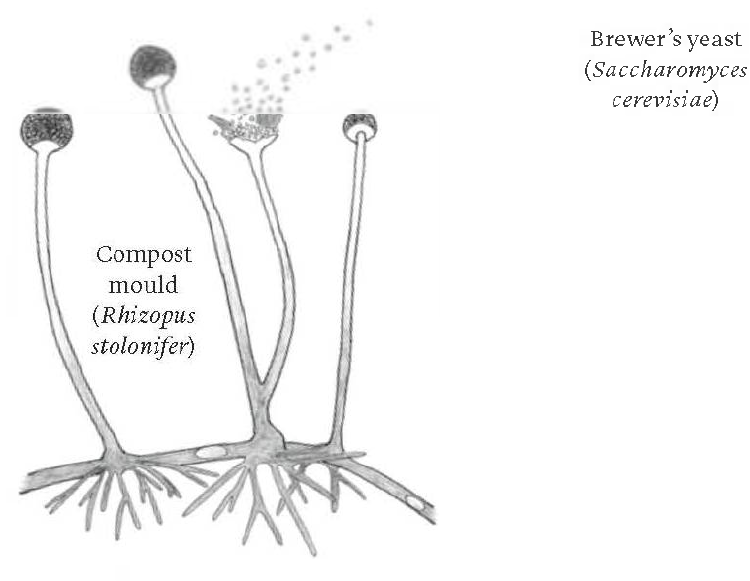
MOST HISTORIANS suggest that human towns and cities originated along with agriculture, which ensured a reliable source of food. However, counterculture philosophers offer an alternative: that civilization arose to guarantee a reliable supply of alcohol. According to this reasoning, our nomadic ancestors began staying put to grow crops to produce food for yeasts, including grains such as barley, rice, rye, and wheat, and fruit such as grapes. Even today, grape cultivation is far more about wine than it is about food. We are lucky to find four or five types of edible grapes in our grocery stores, but every wine shop stocks the fermented juice of hundreds of varietals on its shelves. By some estimates, the business around alcohol—wine, beer, sake, distilled spirits—accounts for 10 percent of the global economy. That’s a lot of booze—and a lot of yeasts. Whether it was beer or bread that led humans to settle, yeasts really have trained us rather well. You have to question who domesticated whom.
Microbes are expert at transforming unpalatable or indigestible substances into more usable forms. For example, we’ve seen how various saprobic moulds break down plant matter into humus and soil. In human terms, we think about this kind of process, called fermentation, as fungi or other microbes changing raw ingredients into something we like to eat or drink. Fermentation often involves the breakdown of complex proteins or polysaccharides into smaller molecules that are more digestible and offer enticing sensory pleasures. If the microbes alter flavors, textures, or chemistry in ways that we enjoy, compost becomes food. Or drink. Most human societies embrace fermentation in a big way, but the enjoyment of the result is often a matter of taste. One person’s delicacy is another person’s rot.
In Latin the word for yeast is fermentam. “Ferment” also suggests creativity, and it marks a major intersection where humans and fungi collaborate.
From the Beetle to the Bottle: Fermentation by Yeasts
A few thousand species of yeasts occur in nature, but for now we will focus on the famous one. Saccharomyces cerevisiae is known as the brewer’s yeast or, if you prefer bread to beer, baker’s yeast. Both common names refer to the same exuberant species, but the archaeological consensus is that beer came before bread.1
In nature, colonies of S. cerevisiae live in inconspicuous films on fruit, on bark, and in flower nectar, or they flow in tree sap. Like many other yeasts, this species also streams through the stomach and intestines of insects. Yeasts are well adapted for living, working, and drifting in a liquid world. Although some make hyphae, most remain as pale, single round or oval cells and grow in liquid by budding. This means that the “mother” blebs off a part of herself and gives birth to a clone “child.” Both cells rejuvenate and swell up a bit, then might divide again and again every twenty minutes or half an hour. Soon the mother cell is surrounded by offshoots of her former self—grandchildren and great-grandchildren and great-great-grandchildren and so on sharing a cozy, slimy family colony. After three or four days, most yeast cells will die when they run out of food or their swimming pool dries up. The buds that are slurped up by an insect get to carry on. This plant-to-plant, gut-to-gut resort lifestyle was the best of all possible worlds for a yeast of modest ambitions. Then, a new wispy-haired ape showed up, who jumped in grander leaps than any beetle or wasp. From a yeast standpoint, humans were a spectacular vector. So the yeasts climbed aboard and traveled faster and farther with dreams of ever larger vats of sugar water.
Archaeologists detect the chemical fingerprints of sugars characteristic of yeast-fermented beverages on the pottery of many ancient societies. The initial fermentations were probably accidental, but the pleasant tickle on the tongue and yeasty aromas may have inspired our inquisitive nomadic ancestors to settle down to ensure a dependable supply. In medieval Europe, beer was often a part of a worker’s wages. It was important to their health. Before the microbial aspects of hygiene were understood, beer was safer to drink than water drawn from streams contaminated with human waste. It was also a dependable source of B vitamins. Brewers cooked grains, especially barley, into a mash, turning the starches into sugars, and then waited. Grapes contain less starch and enough natural sugar that winemakers could simply press the fruit. Both hoped that an infusion of naturally occurring yeasts would settle in and perform their magic.
Today most winemakers and brewers hedge their bets by adding a starter culture of their favorite yeast. Starter cultures are often used in biotechnology—they are kind of like a controlled biological invasion. The starting material is saturated with the desired microbe (or a mixture of several). This saturation overwhelms the resident microbes and blocks weedy moulds from getting a hyphal hold.
Nowadays, commercial breweries are big business. Facilities filling city blocks are optimized to grow as much yeast and make as much alcohol as possible, as quickly as possible. The factories are a cacophony of grinding gears, bubbly golden liquids, and hisses of escaping gas. Copper tanks called fermenters are filled with hundreds of gallons of broth, wort, or mash and connected by a chaotic maze of pipes, switches, gauges, valves, and probes that control temperature, oxygen, acidity, and nutrients for the growing yeasts. Heady aromas saturate the air: the toasted odor of malted barley, the bitter bouquet of hops, the pungency of yeast. In sorting rooms the size of sports arenas, thousands of glass bottles jostle along conveyor belts and are filled, labeled, capped, and then stuffed into plastic crates by robotic hands. Foam gushes out of the bottle necks and bubbles down through grates in the floor.
All this budding and beer making by yeasts makes our own reproductive efforts seem quite modest. I don’t like to toss numbers around—biologists are terrible at mathematics—but we should get our heads in sync with the magnitude of the yeast population that shares our civilization. When you put a yeast cell in a new home, it starts to double: 2,4,8,16... over and over, and the wonders of exponential growth unfold. It takes about 5 billion yeast cells to make a bottle of beer, and humans make more than 50 billion gallons of it every year. Do the math and that’s about 3,000 quintillion (a billion billion, or 1018) yeast cells annually just to make beer—never mind whatever else they might be getting up to. If each yeast cell lives for four days, roughly 33 quintillion yeast cells are in circulation at any one time. That’s 80 million times more yeast cells in our beer fermenters than stars in the Milky Way galaxy, or more than four billion times more yeast cells than people on Earth.2 If you follow the growth of microbes like yeasts in a test tube, you can watch the sharp rise of the exponential growth, a leveling off, and then when the available sugar is exhausted, a crash. A brown residue of dead cells sinks to the bottom. Yeasts need to find a new home almost every day. They constantly push the limits of growth in a closed environment. This breakdown of glucose to ethanol and carbon dioxide by yeasts is the classic example of fermentation in the absence of oxygen, a condition we call anaerobic.
The involvement of yeasts in starter cultures used for beverages and breads was a major step in a domestication process that’s been going on for millennia. Most Saccharomyces species, including S. cerevisiae, live in nature in China and have the high genetic diversity there that we expect at the geographic origin of a species. Modern genomic analyses confirm that unique yeast starters were domesticated to make sake in Japan, wine in Europe, and a handful of distinct beverages in other countries. Most yeasts used for modern brewing are hybrids arising from sexual crosses between S. cerevisiae and other species of Saccharomyces, many but not all also native to Asia.3 The most widely used beer starter is a hybrid between the Japanese sake and the European wine yeasts.
Although many plants (like maize), animals (like mules), and microbes (like yeasts) readily form hybrids, their offspring are usually sexually sterile. In domesticated microbes, the guarantee of prolific asexual budding and clonal growth makes hybridization less limiting than it might be in nature. The cells of hybrid yeasts used for beverages often have two or sometimes up to six complete genomes, a condition known as polyploidy.4 This confuses the cellular machinery needed for sexual reproduction—there are too many chromosomes to sort out. The longer they are domesticated, the more yeasts adapt to the fermentation environment and lose touch with their natural origins. Domesticated brewer’s yeast strains are unable to mate or mix further with their wild relatives and seem locked into their genetic tunnels. The artificial selection imposed by their human accomplices ensures that the domesticated clone survives and stays more or less the same. With the offer of alcohol in return, this starts to resemble an arm’s-length symbiosis.
Most of us have a hard time distinguishing the components of tastes and smells. If two compounds with unique odors are blended, our noses can be fooled into interpreting it as a third aroma. In fermented beverages, variations in the biochemical fermentation process and secondary metabolism result in the wide range of volatile and soluble compounds that give each product its characteristic odor and flavor. Do you smell green apples? That’s probably acetaldehyde, one of the intermediates in the breakdown of glucose to alcohol (be careful, it’s one of the main causes of hangovers). Does your drink smell fruity? That could be an ester, formed by the reaction of alcohol with acids. Medicinal or smoky? Likely a phenolic, either from the wooden cask used to age the liquor or else breakdown products of pigments and other compounds in the original plant. How about rotten eggs? Hydrogen sulfide—proteins contain a certain amount of sulfur that is released when they break down. Sounds delicious, right? Finding the right balance is the art behind the science of fermentation. In nature, the alcohols and volatiles were probably originally an invitation to potential vectors to share sugar. Many creatures attracted to alcohol-infused fruit have the necessary enzymes, called alcohol dehydrogenases, to emerge with their sobriety intact. Animals who don’t partake in fermented foods in their day-to-day diet lack such enzymes and react with what we would consider inebriation.
Off-flavors are unfortunately also part of the game. Our noses and tongues are surprisingly sensitive at detecting what we don't like. Too much of a good thing, like a metabolite that might be seductive at a low concentration, or the addition of unexpected compounds from a renegade microbe, distorts the end product. Not surprisingly, some people like the result. Particularly in Belgian ales, other yeasts like Brettanomyces, as well as lactic acid-producing bacteria (Lactobacillus species), are deliberately included in starter cultures to broaden the flavors. But wine lovers are familiar with the cork taint caused by moulds growing in the natural corks used to seal bottles. The guilty metabolite is a chlorine-containing compound called trichloroanisole (TCA), which spoils up to 10 percent of bottled wine, TCA doesn’t smell much, but it makes our noses oversensitive to earthy or musty odors.5 The effect lasts for hours, and sending the bottle back is the only option. Reducing cork taint is the main reason screw caps are now commonly used on wine bottles.
Beer is the primary product of any brewery, but sediments from the fermentation tanks have a second use. Dead yeast cells, rich in B vitamins and glutamates, are filtered out and compressed into cakes for feeding livestock or transformed into food for humans. The love-it-or-hate-it sandwich spread Marmite (called “Vegemite” Down Under, and “Cenovis” in the Alps) is made from spent yeast that is heated, cooled, salted, and concentrated into a thick paste. To make single-cell protein (SCP), a fermentation with brewer’s yeast is altered to favor protein production and cell mass instead of ethanol. “Torula” or “nutritional yeast” is a similar product based on a different fungus, Cyberlindnera jadinii (often called Candida utilis). The cells are harvested at peak health and dried into a powder used as a nutritional supplement for humans and animals. Although some people sprinkle these powders onto cereals or into yogurt, not everyone enjoys the bitter, yeasty taste.
Fermented beverages can themselves get contaminated and undergo a second fermentation. For example, ten to twenty species of yeasts and bacteria turn the alcohol in wine or cider into acetic acid. If the wine is contaminated accidentally, the result is often sour or musty. Starter cultures for vinegar assure a happier outcome. The resulting wine vinegars are used as preservatives and valued flavor enhancers. Similarly, kombucha is brewed tea that is fermented by a starter culture of yeasts (often brewer’s yeast) and lactic acid bacteria called a “mushroom” or SCOBY (symbiotic culture of bacteria and yeast). The result is a fruity drink that is low in alcohol (0.5 percent or less). Having watched tiny protists zip around in homemade kombucha starters through a microscope, I’m usually not eager to drink the result. But quality control of commercial kombucha should allay such concerns.
A Slice of Life: Yeast-Leavened Bread
Although brewer’s yeast is lauded for its talent with liquids, it is equally celebrated for its abilities with dough. The first known loaf of yeast-leavened bread came out of the oven only about four thousand years ago, long after flagons of beer were commonplace. Unleavened bread, made without yeast, is flatter and less spongy, and dates back an additional millennium. Perhaps foam overflowed from a beer vat into a batch of bread dough left lying around by a distracted baker, who was pleasantly surprised by the light airiness and homey aromas when the loaf was baked.6
Bread is sort of beer turned inside out. The fermenters used for beer and wine are closed systems with inlets and outlets that in some ways mimic human stomachs. Bread dough is a more open system. Instead of precooking ingredients and confining them to a tank, bakers spread raw ingredients on the counter or dump them into a bowl, add a yeast starter dissolved in liquid with a little sugar, and then mix it all up on the counter. The excited yeast, unaware that it is on a suicide mission, foams the batter up with carbon dioxide and buds madly until the mixture is ready to be kneaded into loaves. Gluten—the stretchy, sticky proteins in milled grain—captures gas bubbles in pockets of the rising dough. During baking, they expand and give bread its spongy texture.
Commercial bakeries everywhere use only a few yeast starters. They are the same species as brewer’s yeast but different strains, and sometimes hybrids. This explains why most industrial or commercially baked breads taste so similar. You can buy the same clone in your grocery store, compressed into a dense paste or dried into shiny granules. Most kneading in bakeries is done with dough hooks inside sterile mixing bowls. Unless other ingredients are added, the main microbial activity is only the original Saccharomyces. The fermentation lasts just a few hours, so microbes in the air or on the counter have little time to fall into the dough and alter its properties.7
Hand-kneaded breads are more diverse, and artisanal breads really do taste different. The community of microbes in a sourdough starter is much more complex than the monoculture used for ordinary bread. Sourdough starters might begin as a clean blob of batter, but wild and domesticated yeasts and bacteria from bakers’ hands and the surrounding air are kneaded into the mix. Lactic acid-producing bacteria give the “sour” to the dough. Over time, the starter culture settles into a stable ecosystem, and the hands of the baker and the cracks and corners of work surfaces tend to host the same happy blend of microbes. Personal starters are precious and often have pet names, like Jane Dough or Rye Breadbury. Bakers keep their starters in the fridge or on the windowsill, and transfer a bit into a new batch of flour and water every few days to keep it invigorated. Sometimes a cranky yeast or bacterium invades the starter and reduces it to a weary, stinky paste. Then, a contingency plan, like sharing the starter with a trusted family member, allows the valued culture to be rescued. One enthusiastic Belgian baker curates a starter dough library, preserving the diversity of sourdough communities for research and posterity.8
Say Cheese: Mould Fermentations of Dairy Products
Bread and alcohol fermentations are variations on the Saccharomyces yeast theme, but many fermented foods involve moulds. With cheese, the moulds either grow inside the curds or form the rind on the outside. The flavor, taste, and texture depend on what kind of milk you start with (cow, sheep, goat, or something more exotic), how you mix and pack the curds, what fungi or bacteria you add or let settle, and how long you are prepared to wait. Even the breed of the cows and location of the farms supplying their food affect the result.
Rock paintings suggest our ancestors stumbled across cheese making about six thousand years ago. Caves still feature in cheese folklore—the French and Italian versions of mould-enhanced blue cheese, for example, share similar origin stories. A naive young shepherd or apprentice is distracted by an attractive individual of a compatible mating type. During their dalliance, their lunches languish in a cave. Eventually they return to find their sandwiches gone mouldy. Having gone without food and who knows what else for several days, the pair eat the fuzzy cheese and declare it delicious (the French Roquefort) or blithely use it as a starter for a new cheese in the hope that no one will notice the funny color and flavor (the Italian Gorgonzola). The modern warehouses of high-volume producers duplicate the cool, humid conditions of caves, with floor-to-ceiling shelves holding aging wheels of cheese. But artisanal makers often still mature their wares in natural caves or abandoned wine cellars.
Modern industrial cheese facilities are similar to large breweries. Plump tanks of coagulating curds sit among assembly lines for compressing, shaping, and packaging the product. Curds comprise cloudy wisps of protein and lipid that appear after an enzyme called rennet is stirred into milk or cream. Most rennet comes from the stomach lining of slaughtered cattle. Vegetarians, therefore, prefer cheeses initiated with plant enzymes or fungal rennet extracted from cultures of the zygomycete Rhizomucor miehei. After curds are squeezed into balls or sliced into slabs, the fermentation and succession proceed. The interiors of most cheeses are fermented by lactic acid bacteria, which occur naturally in unpasteurized milk. In some countries, the risk that the potentially deadly bacterium Listeria might appear during aging requires that the milk used for cheese be pasteurized, which means the liquid is heated to between 130 and 145 degrees Fahrenheit. This process wipes out the original microbial population in the milk, and the cheeses must be sown with a starter culture.
Hard cheeses slathered with a layer of molten wax or wrapped in plastic tend to remain mostly bacterial, and any mould growth is considered contamination. But cheeses with natural rinds are covered with a thin, tangled skin of the interwoven mycelium of several moulds. These are still often aged in caves, and spores of naturally occurring moulds are stirred up from dusty floors or flutter down from spiderwebs to settle on the slabs, DNA barcoding surveys reveal hundreds of fungal and bacterial species in the curds and on the rinds of these styles of cheese. Each has a role in creating the individual flavor, smell, and texture of the product—sometimes working in tandem, sometimes in succession—and the exact mixtures are specific to individual caves or farms. It was only recently discovered that the mould Geotrichum candidum provides most of the white mycelium in these rinds. Its hyphae meander over the outside and it has a yeast-like form that sometimes penetrates towards the middle, breaking down some of the lipids and proteins into tasty or pleasant-smelling smaller molecules. For traditionally aged cheeses, individual caves often have resident Geotrichum strains that contribute a unique flavor. If a different strain invades, the expected flavor might be spoiled.9
A less welcome fungal visitor on some rinds is Mucor mucedo. It makes a gray to green fuzz known as “hair of thecat” (poil de chat). Its funky flavors are acceptable on some kinds of cheese, but for varieties with more nuanced aromas the entire brick must be tossed out. And if this contamination occurs too frequently, the cave is abandoned. The “flower of the moulds,” Trichothecium roseum, turns some cheeses pink, but otherwise its role (and whether it might make mycotoxins in cheese, as it does in agar culture) is poorly understood.
More than 1,800 cheese varieties grace the world’s kitchens. The mould-based types in most Western refrigerators are blue (or bleu) cheese and white Camembert or Brie. The star fungi in both are species of Penicillium, which make high levels of enzymes that break down fats and proteins. Of these two types, blue cheese is much older. Its varieties all involve Penicillium roqueforti. Cheese makers aerate the aging cheese by stabbing it with pins or spikes, and P. roqueforti fills those holes with millions of spores that form dramatic dark blue or green veins. Gorgonzola is the oldest kind, made for more than a thousand years in towns around Milan, Italy. The English made a similar cheese in the town of Stilton starting in the 1820s.
Blue cheese is not to everyone’s taste. The flavor is salty and sharp, and the smell comes from organic acids. Perhaps these volatile compounds repel mites, which are seldom seen on the product although they often occur on other mould cheeses. The smell certainly repels some humans. If you have never tried blue cheese, just consider rancid butter (butyric acid) stirred up with old bananas (ketones) and spread onto a goat (hexanoic acid), and you can imagine the odor. I love blue cheese, especially with walnuts and pears and accompanied by port. Lots of people agree: world exports exceed half a billion dollars per year.10
Brie and Camembert are named for the cave-riddled regions of France where they are produced. During the French Revolution, according to legend, Marie Harel (1761-1844) sheltered a renegade priest from irate mobs. During the cleric’s exile, the pair passed their happy hours with clandestine cheese making. Their major innovation was to omit cream from the traditional recipe for Brie, and they adopted the name “Camembert” for the result. As a marketing ploy, they crafted those little wood-wafer boxes to transport their mini-rounds for sale. The fermenting agent responsible for the white rind and smooth white interior of both was always assumed to be a relatively pure culture of the white-spored Penicillium camemberti. Now it is clear that the white-spored Penicillium caseifulvum and Geotrichum candidum are also often involved. The combined fermentation talents of the mixture of moulds and lactic acid bacteria result in a subtle, slightly nutty odor—but not everyone enjoys the accompanying ammonia note.
These two white Penicillium species seem to be domesticated and are rarely, if ever, found outside of cheeseproducing areas. The green Penicillium commune, which spoils cheese and yogurt, is probably their wild ancestor. However, the blue cheese species, P. roqueforti, maintains a diverse population in the wild, although specific strains were domesticated as starter cultures. In the wild, this species is quite rambunctious, and colonies (which can be the size of soccer balls) sometimes swell up in grain silos and poison any cattle that accidentally eat them. Ominously, two of the main cheese species sometimes produce mycotoxins. When it grows in silage, P. roqueforti produces PR toxin as well as mycophenolic acid and a few other questionable compounds. Under some conditions P. camemberti makes cyclopiazonic acid. All can poison any cattle that accidentally consume them. Why do they poison cattle and not humans? When the moulds grow on dairy products, either the toxins are not produced or the ammonia emanating from the cheese breaks them down.11
My mother felt that these fancy French cheeses were unnecessary; there was only ever cheddar in her refrigerator. She maintained a strictly meat-and-potatoes kitchen, typically augmented by frozen or tinned vegetables. The only foreign food we ever ate was the occasional takeout from one of the Americanized Cantonese restaurants in town. The little plastic packets of soy sauce that came with the steamed rice were usually just stuffed into the corners of the fridge or wedged in beside the dusty bottle of the same at the back of the spice cupboard. It wasn’t until I went to university that I discovered soy sauce is a fungal fermentation product and a gateway into the world of delicious Asian fungal foods.
The Feast in the East: Soy Sauce and Other Adventures of the Kōji Mould
Soy sauce was invented in China about two thousand years ago as a cheap substitute for expensive rock salt. Buddhist monks traversing the Silk Road carried their recipe across the continent, and chefs modified the original to suit their own tastes, resulting in local variants like tamari, ketjap manis, and light and dark soy sauces. Although artisanal soy sauce is still produced as a disciplined, monkish activity, industrial factories make most of the 2.5 billion gallons sold every year.
Unlike most liquors, breads, and cheeses, soy sauce is made using a two-stage fermentation process.12 For the first step of many fermented Asian foods, various grains undergo an aerobic fermentation by the mould Aspergillus oryzae to produce an intermediate called kōji. The mycelium over-grows and penetrates a mixture of cooked soybeans or grains for a few days at 85 to 100 degrees Fahrenheit. The mould’s enzymes break the starches into simple sugars and the proteins into amino acids, especially glutamic acid. Natural glutamic acid contributes rich flavors to most fungal foods, from soy sauce to Marmite and mushrooms. It is also the chemical backbone of monosodium glutamate (MSG), the unfairly maligned umami-enhancing condiment that sits beside salt and pepper in many Asian restaurants.
It is hard to find a more remarkable example of domestication than the kōji mould. The aflatoxin-producing fungus, A. flavus, is considered the wild ancestor of the domesticated kōji mould, and research shows that their genomes are 99.5 percent identical. They can hardly be distinguished from each other, even with the best microscopes, yet one is useful to humans and the other can be toxic.13 Domestication happened many times, over and over again in different regions. The domestication of microbes seems haphazard, though, when compared with the more familiar examples of animal domestication. Originally no one realized that living things were involved in processes like cheese making or kōji, nor did they understand that their selections altered or removed specific genes. But koji domestications stabilized a set of about 150 genes involved in breaking down starch—a genetic modification that correlates with what the innovators were trying to encourage. The most surprising genetic change is that in many kōji strains, the aflatoxin genes have disappeared completely. They do remain in some strains but are silent and the toxin is never made.14 Most kōji strains make far fewer spores than wild forms of A. flavus. Perhaps such strains were selected because the result appeared less mouldy. Or perhaps the fungi don’t need as many spores to disperse themselves because humans do that for them.
Each geographical region has a characteristic kōji, based on indigenous strains of Aspergillus and other benign moulds and bacteria, which provide nuance to the eventual products. Traditional Japanese-style soy sauce, for example, starts with a blend of steamed soybeans and baked wheat naturally inoculated with kōji spores from the air or added as a starter. Tamari is a variant that traditionally omits wheat.15
In the second stage of fermentation, the kōji-fermented slurry from the primary fermentation is mixed into water containing up to 20 percent salt. This goop undergoes a second, mostly anaerobic fermentation. Factories have massive stainless-steel tanks and age the liquid for four months. Monasteries use wooden tanks and leave them for two to four years. The high salt concentration kills most microbes by drawing much of the water out of their cells. Only microorganisms that thrive in low-moisture environments-xerophiles—will grow. Among these is a bacterium with the memorable name Tetragenococcus halophila, which transforms some of the sugars into lactic acid and lowers the pH to about 5, roughly the same acidity as coffee. Then Zygosaccharomyces rouxii—let’s call it the salty yeast—starts to grow. It makes low levels of alcohol, less than 2 percent, and a blend of metabolites—mostly glutamates and breakdown products from other amino acids—that contribute malty, maple syrup, caramel, cooked potato, curry, and various fruity notes to the bouquet. When the fermentation and aging ends, the sauce is decanted and pressed out of the sludge. Then it is pasteurized and bottled. The felt-like cake of microbial cells and plant fibers left behind is dried and fed to cattle.
The kōji mould is used as a starter for various primary fermentations that break down starches in rice, wheat, soybeans, and even sweet potatoes. Then they are further fermented to make mirin, miso, pickles, sake and other liquors, and many other traditional Asian foods. Kōji has spilled over into the Western world in surprising ways. New York chefs now use koji mould to artificially dry-age expensive beef steaks. After only two to three days, they achieve aging effects that would normally take forty-five days of hanging. You can find instructions on the Web to try this at home, but it is not for the faint of heart.
Dessert With a Beverage: Chocolate, Tea, and Coffee
Because I want to leave you with good vibrations about fermented fungal foods, let’s complete what until this moment you may not have realized is a sacred fungal trilogy: wine, cheese, and chocolate. Chocolate making is an old biotechnology that dates back to about 450 BCE. The Aztecs considered cocoa a gift from the god of wisdom, Quetzalcoatl, who was expelled from paradise for sharing such a heavenly delight with lowly mortals. At that time, most chocolate was mixed with spicy or bitter ingredients and used in drinks. Not until 1847 did the confectioner Joseph Storrs Fry 11 (1826-1913) invent the chocolate bar in Bristol, England. Chocolate truffles have blessed us for less than one hundred years... and were named for their resemblance to fungal truffles.
Chocolate starts off as orange or brown pods that dangle off the branches of cacao trees like deflating balloons. A slice with a machete and the “beans” and white glutinous slime inside the pods can be scooped into large bins, where they are covered with banana leaves and left to ferment naturally. Brewer’s yeast is one of the first fungi to colonize the mess. It produces a bit of ethanol in the mildly anaerobic pulp, and then releases enzymes that break down the pectin that glues plant cells together. As the fermentation proceeds, the temperature rises above 100 degrees Fahrenheit. Then a succession of other yeasts (varying from country to country, but usually species of Candida, Kloeckera, and Kluyveromyces), lactic acid bacteria, and acetic acid-degrading bacteria blossom in the pulp. This succession of yeasts and bacteria stimulates chemical reactions that transform the bitter raw cocoa beans and release up to four hundred flavor compounds. These volatile fruity and floral esters and alcohol metabolites give chocolate its distinctive flavor and aroma. Over the past decade, starter cultures were developed to offer more control over the fermentation and are used by some small producers to ensure a more consistent product.
After about a week, the fermented beans are washed, dried, and roasted at 250 degrees Fahrenheit to kill off the remaining microbes, caramelize the residual sugars, and concentrate the flavors. The outer shell of the bean is removed and the soft tissue inside is ground into paste, pressed, and mixed with other ingredients. Then the texture and flavor are tweaked before the mixture is molded into shape. Eventually, what you think of as chocolate finds its way to you, to melt on your fingers and slide down your throat with a cup of tea or coffee.16
Although regular black or green tea does not involve microbial fermentation, traditional Chinese Pu-erh tea, naturally fermented in an aerobic process by Aspergillus niger and a yeast-like fungus called Blastobotrys adeninivorans, will satisfy your fungal muse—assuming you can afford the luxury price.17 You can try to pair its floral, smoky, sweet, or sour notes with your favorite chocolate. Or you can indulge in another beloved fungus-modified beverage, coffee, instead.
Coffee fermentation has a lot in common with chocolate. Coffee “beans” are twinned inside the red “cherries” that cluster along branches of coffee trees. Before roasting, farmers rub the skins off the beans, wash them, and let them sit for several days. The anaerobic fermentation is dominated by a yeast called Pichia nakasei and some lactic acid bacteria, with Candida parapsilosis sometimes showing up later. Lactic acid and acetaldehyde are the main yeast metabolites that build up, but volatile organic acids, alcohols, and esters also concentrate in the dried beans. When they are roasted, these metabolites join the caramelizing sugars and blossom into the seductive flavor and aroma of the brew. They also make the product acidic and less likely to spoil.18
You should enjoy your coffee while you can. Coffee crops are under serious threat—from climate change, low genetic diversity, and the invasive coffee rust Hemileia vastatrix. This rust followed coffee trees around the globe as imperial powers fell in love with the brew and planted it in far-flung countries. The disease was first seen in Sri Lanka in the mid-nineteenth century, where it destroyed the coffee crop. It was then that the English lost their coffee supply and adopted tea as their afternoon drink. Now it has finally caught up with the prized crops in South and Central America, with yield losses of 90 to 100 percent. Coffee breeders hope to save us by generating resistant cultivars.19
To Eat or Not to Eat: Rotting Food or Edible Compost?
From a fungal point of view, there’s no difference between human food and human garbage. Fungi don’t discriminate between what you store in your refrigerator or pantry and the scraps you denounce as compost; they just help themselves to nutrients from whatever organic matter they find.20 The green mould colonies powdering drying slabs of hard cheese or old bread are warning signals. You can’t just cut the visible mould off and carry on with your snack. The haze of spores doesn’t tell you how far the hyphae have penetrated into parts that look clean—there could be mycotoxins in the soft, faded zone where exuded fungal enzymes are breaking down fats and proteins. So the rule of thumb is “Don’t eat mouldy food.” And don’t feed it to the dog—and if you are a farmer, don’t feed it to your cattle either. Every year, animals die from eating food contaminated with mycotoxins made by some of the same Penicillium species that spoil human foods.
According to the Food and Agriculture Organization of the United Nations, one-third of food spoils before it is eaten, an amount large enough to feed 600 million people.21 Most of this loss is caused by fungal biodegradation or contamination with mycotoxins. Some of this loss occurs while crops and livestock are being processed or stored on farms, but most of it happens at home. The percentage has been constant for all our lives.
To prevent moulds from spoiling food before we eat it, we use the same physical and chemical logic as we use to protect harvested grains on a farm, or trees in a forest. To grow, living things need tolerable temperatures and acidity, and sufficient oxygen, nutrients, and water. Refrigerating food below 50 degrees Fahrenheit slows spoilage, but some moulds still grow at low temperatures. Fresh food in your refrigerator is an invitation for hungry moulds that tolerate cold temperatures. Every time you open and shut the door, their spores are pulled inside by air currents. They eventually sprout and grow onto crumbs hiding between the cracks or spread onto other unwrapped food. A pinhole in the lid is enough to let one spore of the fat- and protein-loving Penicillium commune squeeze into your yogurt container. Then you find a powdery green colony floating inside when you peel the foil back. Oranges covered by sneeze-inducing green rot (Penicillium digitatum) and bruised apples with mycotoxin-producing blue mould (P. expansum) often fall to the bottom of the fruit drawer. This spoilage is predictable and explains why most foods have a “best by” date.
Freezing food stops all mould growth, though it’s not always the best choice for some foods. Canning and vacuum packing eliminate oxygen, as does backfilling plastic packages of salads, potato chips, and fresh pasta with nitrogen gas. Still, some fungi get by with just a bit of oxygen. Drying foods removes the water that fungi need to grow. Cells immersed in salty or sugary liquids expel water, trying to balance inner and outer concentrations. But because they can make glycerol in their cells and tighten pores in their cell membrane to reduce water leakage, moulds known as xerophiles can often cope with the “virtual dryness” of salted or sweetened foods. Xerophiles are among the most common contaminants of preserved food and stored grains. In almost any pantry, xero-philic Aspergillus glaucus and related species run rampant in jams, sweet pastries, or fruit juices (even sometimes in sealed containers, because of pinpricks in the packaging or inadequate cleaning or pasteurization of the fruit). Through the microscope they look like yellow, egg-shaped geodesic domes filled with spores shaped like flying saucers.22
If we want food to be toxic to fungi but not to us, we use food preservatives. Traditional methods like salting and pickling food in acids like vinegar are not always effective, however. Salting makes foods attractive to xerophiles, and most fungi like acidic conditions too. In fact, they routinely release organic acids themselves as a way to slow down competing bacteria. Hundreds of preservatives are in use, some natural and some artificial, and they are usually much safer for consumption than the chemically complex synthetic molecules used on farms as pesticides. Preservatives like benzoic acid and sorbic acid interfere with the fungal metabolism of glucose. Even if spores land and germinate, the new hyphae can’t use the sugar and they starve. Both are flavorless “natural” metabolites discovered in the 1500s after the alchemist Nostradamus noticed (in his pre-prophecy days) that cloud-berries and mountain ash fruit last a long time before they start to rot.23 And you hardly see Neurospora crassa anymore because of the calcium propionate used in commercial baked products—the species is now so rare in bakeries that its former common name “red bread mould” is hardly ever used. But it is still comfortably at home in nature, forming powdery orange blooms on charred tree trunks after forest fires.
Using several strategies at once to preserve food works best. Each approach slows a fraction of the fungi knocking on the door. Putting two or more together cuts down the list of potential contaminants still further at each step. But a few moulds always find their way through. The cold-tolerant, acid-loving, sorbic acid-eating, moderately xerophilic, and oxygen-indifferent blue cheese mould Penicillium roqueforti is one of these multitalented moulds that is quite difficult to discourage. It’s a good idea to keep that blue cheese well wrapped up in the fridge.
Oddly, another solution to preserving food is just to let nature take its course and evaluate the consequences. It may not be comforting to think of the world as one big compost heap, but as we discovered over the centuries, some end products of biodegradation processes like fermentation are quite tasty. And others are not, and can be hazardous. In any compost, a succession of moulds take their turn as organic matter transforms and breaks down.24 When food is moved out of the refrigerator and left at room temperature, spores that carry over from their time on the farm, or settle from disturbed house dust, germinate and start to grow. After a day or two, the fruits and tomatoes collapse from hyperactive digestion by Rhizopus stolonifer. It likes anything with easy sugars and abundant water. Rhizopus grows so rapidly that it often spills over the edge of the compost bucket like a mist of wet cotton sprinkled with pepper. When you watch it with a microscope, the hyphae jump around like the runners that stretch out across the soil from one strawberry plant to another. Jutting out from the hyphae are clusters of what look like oversized pushpins. Black specks that flake off their helmet-like headgear resemble charred skin, freeing clouds of wrinkled gray spores to waft into the air. When the compost starts to dry out, colonies of Penicillium and Aspergillus cover everything with green, yellow, and black powder. Banana peels and chunks of cauliflower and potato are full of cellulose, starches, sugars, and oils that fungi love. Which moulds appear on your compost will vary according to what foods you started with, where you live, and the time of year.
Dangerous pathogens are unlikely in household compost, but people with allergies or asthma will suffer as the millions of spores float into the air. In some composts, surface microbes respire aerobically, but those buried in the center may be somewhat anaerobic. Mixing up the compost favors the aerobic microbes and reduces odors. In large-scale composting facilities, wood chips piled outside pulp and paper mills, or manure and straw heaps on farms, the energy released by microbial metabolism heats the inside of the pile to human body temperature or beyond. Then heat-loving moulds called thermophiles appear in the succession. If you inhale their spores, there is a risk they may grow inside your lungs. So especially in the summer, get the compost out of the house at the end of each day.
If you plan to use your compost to produce more food, you want it to be crumbly and fiber- and nutrient-rich, very similar to the humus produced on a forest floor. Leaving the results to the randomness of the natural succession is one option. Another is to add a starter culture that will help break down undigested plant matter. Mature compost still often contains a lot of cellulose, but we can use it to grow edible fungi that degrade cellulose and further reduce waste.
Compost is used to farm the familiar edible mushroom Agaricus bisporus—known variously as button, cremini, coffee, or portobello, though it is all one species. In commercial operations, instead of the traditional composted horse manure, a blend of straw (mostly cellulose), gypsum, and nitrogen-rich farm waste (like chicken droppings) is left to ferment outside in long steaming berms for one or two weeks. Then massive backhoes shovel it onto the shelves inside Quonset huts. When the compost has cooled, a starter culture, spawn of pure Agaricus mycelium growing on cooked grain, is stirred in.
The most common cultivated oyster mushroom, Pleurotus ostreatus, is also propagated using waste. Plastic bags are filled with sawdust, straw or other agricultural waste, or even newspapers or coffee grounds, then inoculated with a starter and stacked on shelves in temperature-controlled barns. After the white mycelium binds the substrate into a nougat-like mass, holes are poked in the bags and the mushrooms burst forth in clusters after a few days. Kits to grow them at home are quite popular.25
As unappealing as it might sound, compost itself some-times becomes food. In tropical Asia, soybeans thrown away after being boiled to make tofu are often quickly overrun with Rhizopus oligosporus, a thermophilic relative of the black compost mould. The result is tempeh, a protein-rich cake of fermented soybeans, originally sold in Indonesian farmers markets and until recent decades hardly known in the West.26 It was probably a chance discovery of a peckish Indonesian farmer nibbling on the fuzzy edges of discarded mash woven together by mycelium. In the natural succession, the spores of Rhizopus settle from the air onto cooked bean patties, which are then wrapped in hibiscus leaves. Hyphae race through the packed soy, altering the proteins to make them more digestible. Nowadays, commercial tempeh producers in North America and Europe compress boiled beans into plastic moulds and add Rhizopus spores directly. This addition short-circuits the somewhat random natural colonization and succession and improves the chances that an edible product will result after a few days.
As part of my introductory mycology course at university, we made tempeh from scratch. Our efforts were directed by a grad student with a roguish twinkle in his eye and a carefully groomed mustache that gave him a certain chef-like panache. Each of us in the lab group was assigned to monitor the boiling of a beaker full of soybeans that was held on a retort ring above the blue flame of a Bunsen burner. When we were sure the beans were soft enough, we pressed them into half-inch-thick cakes in Petri dishes and waited for them to cool. Then we sprinkled them with a homemade starter of rice flour mixed with spores of the tempeh mould, stacked them in a growth chamber set to tropical temperatures, and left them to ferment. Several days later, the grad student invited us back to the lab. He slit the mouldy soybean cakes with a scalpel freshly removed from a sterile foil packet, then sauteed the tempeh slices in a frying pan on a hot plate that was usually used to melt agar media. We all gathered around to sample the result. Using that standard lab accessory, a toothpick, I speared a little piece. The tempeh was dense and crumbly, with an earthy, almost meaty basal note. It was inoffensive, but I wondered why anyone would eat it. Still, at a time when cooking and eating in a science lab were forbidden—and the whole notion of consuming the results of research experiments was frowned upon—I was charmed by this illicit feast. It was a far cry from the stodgy menus of my childhood.
The lesson that waste becomes food and composting becomes fermentation took root. I began to understand that whether something is compost or food is a matter of perspective. What is food for a fungus can also be food for us. What is food for one creature might be garbage to another. But the carbon keeps cycling along, which is essential for the sustainability of our planet. Compost is a thriving microbial ecosystem, and we should keep our eyes open for more happy accidents that might transform waste into new tasty foods or rich, productive soil.
Whether you are reading this book with a selection of fungal delicacies in hand or not, chances are you are seated in a comfy chair in your home or office. These indoor spaces protect us and provide secure caches for our food. Fungi like these warm and sheltered environments too. Every time we leave our windows open, let our pets in or out, take off our muddy boots after a nature walk, or haul produce in from our gardens or farmers markets, moulds, yeasts, and soil fungi follow us inside. Our buildings are fungal fermenters of a different kind.