
WHEN I STEP into a house for the first time, I scan the surroundings for interesting fungi the way someone else might search out an interesting conversationalist.1 This quirk is more socially acceptable outdoors. People get uneasy when I try it in their homes because they’d rather not know there are moulds in plain sight. The particles bobbing in sunbeams. The haze of dust on countertops and the floor—probably spores. The faint water stains on the ceiling tiles. The pink smudges in the grout around the sink in the bathroom. The dark splotches on the door gasket of the fridge. The wilted houseplants covered with brown specks. These all signal growing moulds. And the musty odor seeping up from the basement? Microbial volatile organic compounds (MVOCS). These are mixtures of aromatic mould metabolites like 2-octen-1-ol (said to have a green, fatty smell), and geosmin (earthy or musty), which is mostly produced by fungus-like bacteria called actinomycetes but also by a few common moulds.2
Building artificial shelters separated humans from their surroundings and provided security against extreme temperatures, strong winds, and storms. A modern building is kind of an inflated version of a body. Its wooden skeleton and the air, heating, and water circulating systems are hidden away, while the walls are the skin protecting our bodies and possessions. During the energy crisis of the 1970 s, when the price of oil skyrocketed, the way we made buildings for temperate climates changed. To reduce heating costs, we increased insulation and reduced ventilation. The result was buildings with increased humidity and warmer air, both developments that made fungi feel more welcome.
Like farms, modern buildings are artificial ecosystems, but they are even more divorced from the usual patterns of nature. We didn’t plan for all of the creatures and microbes to move in with us, mostly without us noticing. Often the moulds, insects, and rodents that thrive in our warm and dry bedchambers, living rooms, and offices are native to deserts. More tropical or humidity-loving life-forms congregate in our bathrooms, kitchens, and laundry rooms, where dripping taps and billowing steam create a rainforest-like environment. Some of the fungi in our buildings blow through the windows or are carried in on food. We don’t need to worry much about most of them: small colonies that grow indoors are normal and play a part in training our immune systems to tolerate the impurities of our chosen habitat. It’s profuse growth that sets off the alarm bells. Indoor mould growth that increases the number of spores in the air is known as amplification. Modest amplification is tolerable, but we don’t want concentrations of airborne spores or M VOCS to get too high.
The meaningful biological divisions among fungi in the built environment are between moulds causing decay; moulds that amplify in wet places; moulds that amplify in dry places; and moulds causing allergies. Each zone of a house has its own guild of fungi that affect us in various ways.
Under the Floor and Between the Walls: Wood Decay and Sap Stain
In most homes, you don’t see the wooden frames that support the roof and floor and separate the rooms. But if you walk into a basement or garage, often you will see the vertical wall studs and horizontal floor joists. The first house I bought had an unfinished basement, and I was worried about the condition of the beams. No suspicious polypores or mushrooms were evident, but on some of the joists near the rock foundation, I could scrape away a quarter inch of softened fiber with my fingernail. That gentle corrosion is soft rot, a superficial decay often associated with the asco Chaetomium globosum. Its dark, burr-like sexual structures are covered with hooked hairs designed to catch on insect legs or rodent fur. Severely rotted wood is soft or crumbly, but sometimes lumber is badly weakened before it is noticeably rotten. When I stabbed a pocket knife into the solid wood, a long sliver lifted away from the surface. That was good news; the cellulose below the soft rot was still intact. If the cellulose fibers had been snipped by a fungal cellulase, the fibers would have cracked in the middle, indicating that the wood was already weakened. The building inspector confirmed that the strength remaining in the logs was sufficient to support a house of twice the size.
The wall studs in the garage were exposed and had patches that looked as if they were shaded with a pencil or dabbed with india ink. The smudges are a consequence of grayish or pale brown hyphae of saprobic Ophiostoma species or other dark moulds penetrating the wood fiber. The hyphae tunnel through pores and spread along the water-transporting vessel cells of incompletely dried sapwood, sometimes softening the cellulose. On dry lumber, this sap stain (or blue stain) is superficial and easily planed off; it has little effect on wood strength, but many people consider it unsightly. The common sap-stain species on lumber are not pathogens.3 However, some serious tree diseases also produce a deeper, darker version of blue stain. The destruction of conifer forests in the Pacific Northwest of North America by the mountain pine beetle left lumber companies searching for a use for millions of pine boards with deep blue stain. This richly patterned wood was rebranded as “blue denim pine.” It is now used as a decorative accent on exposed beams and panels in many public buildings in British Columbia and the rest of Canada.
Most structural wood is kiln-dried to reduce water content below 20 percent, and if it is intended for furniture, well below 10 percent. By the time lumber is assembled into houses, the wild wood-rotting fungi should be dead. In soft rot and blue stain, the core of the wood remains sound. Both defects are often a sign that the lumber was once wet, or may still be wet and then vulnerable to ongoing decay. Decay is a real enemy in buildings, and it usually happens when wood is rewetted. If plumbing leaks or condensation drips from cold water pipes, gallons of water can drip onto floor joists. Vapor barriers trap internal moisture and stop the lumber from drying out. The wood fibers swell up and spores that land on the wood during construction germinate, or mycelium edges through cracks in the foundation from the soil outside. The invisible hyphae of wood-rotting polypores and mushrooms get to work, and decay starts. Most leaks are small and difficult to locate. Building inspectors use moisture meters to track down leaks behind wallboard.
Serpula lacrymans is a common wood-decay basidio that causes dry rot. In nature, this fungus is only found high in the mountains of Asia, but it hitchhiked to the New World hundreds of years ago on the same wooden ships that ferried humans. It needs just enough water for its spores to germinate, and it harvests this water by breaking down cellulose and transferring it back through the mycelial cords to the dry parts of its colonies. The expanding brown fans of droplet-oozing mycelium and winding rhizomorph-like mycelial cords give Serpula lacrymans its name, which loosely translates as “the serpent with tears.” The rippled rusty-brown crusts spread along basement floors and ceiling joists at about 3 inches per day, often hidden from view, and start throwing out clouds of spores. These blow through heating ducts and settle in a rusty powder on the floor—the only clue homeowners may get before their floor, or sometimes the whole building, collapses.4
Finding environmentally friendly and human-healthy ways to preserve wood is challenging. Nowadays, the wood used in most kinds of construction is either kept dry or protected using chemical preservatives. Heavy-duty toxins based on arsenic and mercury are banned, but their historical use is worth remembering when you refinish older wood. Most lumber used inside the structure of a building is not treated with chemicals, unless termites live nearby. Less toxic copper or zinc naphthenates are painted on or infused into window frames or other wood that might get damp. Wood touching the ground or used in decks is impregnated with solutions of alkaline copper quaternary (ACQ).5 The priority otherwise is to keep lumber dry.
Wood is not the only material in a home that fungi like to eat, of course. For moulds, the built environment is a smor-gasbord. In addition to wood fibers from lumber, there’s human food, compost, cotton and linen from carpets and furniture, cellulose in wallpaper or drywall, skin cells and hairs that drop off human bodies, and droppings left behind by bugs and mice.
Damp Corners: Kitchens, Washrooms, and Leaky Pipes
The moist corners in a building are homes for moulds that grow on paint, silicone caulking, rubber gaskets, and just about anything with paper or cardboard in it. Water vapor billowing from sinks, kettles, and dishwashers condenses and drips from the coils of fridges and freezers. The warm water from dishwashers and washing machines soaks into the seals between the doors and cabinets. Those dark stains on rubber gaskets? They are often colonies of Exophiala species, one of the better-known examples of an informal group known as “black yeasts.” Under a microscope their budding forms look like typical yeasts, but instead of making creamy colonies, they look more like dark tar or oil. They are not considered “true” yeasts because of this dark pigmentation and the fact that most of them also make hyphae. In nature, some cause sap stain in living trees, or diseases of fish. In houses, they form a grungy gray film in detergent dispensers. They tolerate the alkali ingredients in soaps that kill off most other moulds—they even eat some of the hydrocarbon additives that give detergents their oomph. Their ability to switch between hyphal and yeast-like growth allows them to adapt to the hot or cold, wet or dry environments of these appliances. A few Exophiala species grow at human body temperature, but the ones in dishwashers don’t seem to cause disease. Even so, it’s a good idea to wipe the gaskets of your appliances with soapy water or rubbing alcohol now and then, and clean food crumbs out of the filters.6
The caulking around the edges of sinks, toilets, bathtubs, and windows often turns pink or black from growth of another black yeast, Aureobasidium pullulans. Slimy fungi like Aureobasidium tend to stick to surfaces, and their spores don’t find their way into the air easily. This species protects itself from drying by exuding the water-absorbing poly-saccharide pullulan. The fungus makes a lot of this gelatinous slime when grown in a fermenter. Pullulan is used in hairsprays and skin creams, or polymerized into translucent films used to make dissolving breath-freshening strips. The wild communities of this fungus, which grow on stone, wood, and leaves, have distinctive DNA fingerprints in each geographical region, just like human populations do. But in the built environment, its genetic markers are all scrambled together, and the same clones seem to live in bathrooms just about everywhere. The theory is that the semidomesticated strains spread internationally, from home to hotel room to home, when tourists inadvertently carried its spores around on toothbrushes and hand soaps. Aureobasidium, like dry rot, seems to be urbanized.7
The efficient ventilation systems of most modern buildings prevent humidity from getting too high. Older buildings often have old humidifiers, dehumidifiers, or air conditioners—or all three—that use cooling coils to remove humidity, then drip the condensation into reservoirs. Moulds grow on the organic matter that accumulates in these pools, and fans circulate the spores throughout the ventilation system to join the hundreds of other kinds of spores floating around in the rest of the house.
The Desert Air: Xerophiles, Mites, and Mould Spores
The most conspicuous domestic reservoir of moulds is house dust. Most of the inside cavities of buildings are as warm and dry as a desert, and it’s not always clear where the moulds are growing. The bits of dirt, sand, and fluff on floors and furniture and under our beds might seem mundane to most people, but they’re surprisingly full of microbes. A sample from a vacuum cleaner is easy to collect and study. Although house dust is a vibrant ecosystem for dust mites and some fungi, a mixture of spores released in other parts of the building also ends up in the canister.
Scientists used to think that Western homes harbored about a hundred fungal species, with maybe forty or fifty in any one building, because that was how many grew when we sprinkled house dust on agar media in the laboratory. Now we know it is many more. In 2008, when new next-gen DNA bar-coding methods became available, I decided to try DNA barcoding to look at the fungi in our house’s central vac system. Most of the canister was filled by a cushion of dog fur. But at the bottom was 2 inches of dark gray powder so fine that the gentlest puff of air caused a mini tornado. I scooped a few tablespoons into sealed plastic bags and brought them into the lab. When the next-gen sequencing data came back, I was modestly surprised to learn that we share our house with something like six hundred fungal species. Among them are plant pathogens blown in from the yard, yeasts and moulds actively spoiling food, soil fungi tracked in on our shoes, and the expected “typical” house dust fungi. The clear signals of conifer endophytes were a puzzle until a picture of our Christmas tree slid across my computer’s screen saver and reminded me of all the needles vacuumed off the floor. There was also the faint signal, just three sequences, of a poisonous Amanita species only ever seen in Japan. How did that get there? Despite all the fur, we didn’t detect canine pathogens. Later studies of many other homes in several countries, using more refined survey methods, suggested that the mould concentration in our house was relatively normal.8
Next-gen techniques are so sensitive that it is often hard to be sure what the results mean. Do the rarest microbes, barely rising above the baseline, matter at all? Or do they have significant effects despite their low abundance, like a single pheromone molecule that can excite insects for miles around? Because DNA stays intact for a long time, it doesn’t tell us whether the microbes that contained it were living, dead, or passing through on their way to somewhere else. It’s like being in a cathedral and unable to distinguish the active worshippers from the tourists or dearly departed. The important fungi in buildings are the ones who live there, not the transients. Trying to figure this out from a dust sample is like trying to determine the ingredients of a recipe after it has been turned to compost. Filtering out the background noise of vagrant bacteria and fungi in microbiome analyses, and identifying microbes that are really living inside, takes some ingenuity.
If we want to remove fungal contamination from a house, we need to find out where the moulds actually hide. One amplifier is houseplants, which bring their own assortments of saprobic moulds, epiphytes, and rhizosphere fungi into our homes. Potting soil is often pasteurized to kill off fungal spores. Of course, there is a mould for that. Commonly known as the peat mould, Chromelosporium fulvum often survives the heat treatment. Because its usual competitors are killed off and no longer keep it in check, it lays a cinnamon-colored carpet of powdery spores across the whole soil surface. This can be a serious problem in greenhouses, which may find tons of soil suddenly overgrown. Through the microscope, the peat mould looks like a long slender hand with hundreds of tiny round spores popping out all over the fingers. If it gets too enthusiastic, it hoovers up so many of the loose soil nutrients that delicate plants like African violets start to suffer. When weakened, these juicy-leaved plants with their profuse flowers are treats for several moulds, including the noble rot mould Botrytis cinerea. Botrytis often blows over from the compost bucket and colonizes the soft wet leaves with its gray fuzz, mopping up any sugars lying around and leaving behind dry brown patches. It sends up branched sporulating structures that look like microscopic bunches of grapes. The same fungus causes a serious disease in vineyards, but rather than producing musty odors, some strains concentrate the sugars in the grapes used to make expensive Sauternes and Tokaji dessert wines.
Dead leaves on plants, indoors or out, are an open invitation for black moulds. They sporulate happily on dead herbs and grass outside, but also inside on the dead brown stem and leaf tissues of plants that are watered too much or not enough. Under a microscope, you often see the club-shaped spores of Alternaria alternata and branching bead-like chains of Cladosporium cladosporioides. Although they are often blamed for allergies, these two moulds are so ubiquitous that their significance in indoor or outdoor air is difficult to evaluate. Outside, the abundance of their spores rises and falls in synchrony with the amount of decaying herbage in the spring and autumn. But inside, they grow year-round. All they really need is moisture from a little leak or condensation to get going. In one place I lived, there was always condensation on the ceramic floor of the poorly ventilated basement bathroom. Cladosporium grew in a faint haze across the tiles. Further, the upstairs shower drain leaked through to the dry wall basement ceiling, enough to support expanding rings of Alternaria colonies. I wiped them up every now and then, but they always came back.
Among the most common fungi in homes is a distinct group of xerophilic moulds that spend their lives in dust and preserved food. Whether their spores blow in from outside or drift over from the compost bucket, they germinate in the arid dust. Their hyphae snake out through the detritus searching for digestible nuggets and a few molecules of water. In nearly every home of mine, the tiny yellow sexual structures and greenish asexual spores of Aspergillus species hid behind wall hangings, on clothing in closets, and on leather baseball gloves stored in humid basements. They don’t produce much in the way of mycotoxins, but in warm, humid buildings (or leather-rich car interiors) they often flare up and can be quite allergenic.
Another house dust xerophile, Wallemia sebi, is one of the few basidios that grow like a mould. It’s kind of the domestic dog of the fungal world—brown, fuzzy, and seems to like living with people. It apparently took up residence with humans quite recently, perhaps brought inside hidden in table salt harvested from tidal flats, or in ultra-sweet liquids like honey or maple syrup. Wallemia often makes a dramatic peak in next-gen sequence analyses of house dust, but we were hardly aware of it previously because it grows so slowly on normal agar media. We need to add five times as much sugar and replace a fifth of the water with glycerol to make the medium xerophilic enough for it to grow. But when we do that, we find it in almost every house. One of its sneaky habits is nibbling on chocolate, which is a good hiding place for a mould with dark brown spores. Otherwise it is just a nuisance, although its tiny spores can provoke allergies.9
Several xerophilic moulds interact with tiny relatives of spiders called dust mites. In nature, dust mites hide in bird and rodent nests. They may have entered human dwellings riding on the backs of mice and discovered the pleasant desert environment awaiting them. Two species now scramble around in the sediments of most human dwellings, the “European” (Dermatophagoides pteronyssinus) and the “American” dust mite (D. farinae); despite their geographical names, both are widespread. They are almost invisible to the naked eye, but under a scanning electron microscope they look like mechanical monsters from science fiction films: squat and tank-like with protracted, bent legs and carapaces covered with long, spiky hairs. They live as long as three months and drop a few eggs every day.
Dust mites are also xerophiles. The wall-to-wall carpets of Western homes trap spore-laden dirt deep within their piles, and it finds its way into cushions and other textiles too. The moisture from our breath and sweat is enough to get dust mites eating, mating, and defecating. Awake or asleep, humans constantly shed a blizzard of dead skin flakes that mites like to chew on, so our bedding is a hot spot. After two years, 10 percent of a pillow might be the droppings and shed exoskeletons of millions of mites. Not only do mites eat our dead skin, they also snack on fungal hyphae and spores, and on textile fibers softened by mould growth. Some of these spores pass through the mites’ guts and tumble out at the far end; then they germinate and the moulds grow on the mite droppings. Some scientists consider this relationship a casual symbiosis. Although mites and moulds seem to enjoy each other’s company, they often live apart.
The Air We Breathe (Part 1): Mould Particles, Mycotoxins, Allergies, and Asthma
Since the early 1980s, we have become more concerned about the potential health consequences of airborne moulds in buildings. Parents of students sitting in “portable” classrooms built in the parking lots of overcrowded schools began to report that their children came home smelling of mould. Drawing a line between mould growth in a building and medical effects on an occupant can be a delicate process.
We automatically associate environmental allergies and asthma with reactions to pollen from outside, but mould spores, mites, and dried pet saliva or dandruff can all trigger symptoms. Humans evolved in a world covered with moulds, and most of us cope well with normal levels. Because more fungal spores float around outdoors in the spring and autumn, some mould allergies are seasonal. But if moulds amplify in a house, allergies can persist all year and may get worse. We each react to different moulds in our own way. Although individual mould species or metabolites sometimes cause specific concerns, the overall concentrations of fungal spores and M VOCS correlate with the health of any built environment. With so many species present in any building, pinning down the culprits that irritate a specific person is difficult. Standard skin-prick tests for mould allergies tend to focus on species that are more common outdoors, rather than evaluating antigens from Wallemia or Aspergillus, which are more likely to amplify inside.
Particles of frayed dead hyphae and spores chewed up by mites are potent components of airborne dust. Whether the mycelium in these fungi is alive or dead, as much as 60 percent of its cell walls consist of a polysaccharide called glucan.10 When glucan is inhaled, it causes inflammation and elevated body temperature. This leads to the intense fever known as a cytokine storm, which is typical of many respiratory infections. Glucan is a major trigger of asthma symptoms for the 20 percent of patients hypersensitive to moulds. Despite its importance in asthma, glucan sensitivities are not yet part of routine testing. Some people are quite allergic to mite feces, and 30 to 40 percent of asthma cases in North America are related to dust mites. Buying hypoallergenic bedding and replacing your pillows every year or two can help lessen exposure in that most intimate corner of your home.11
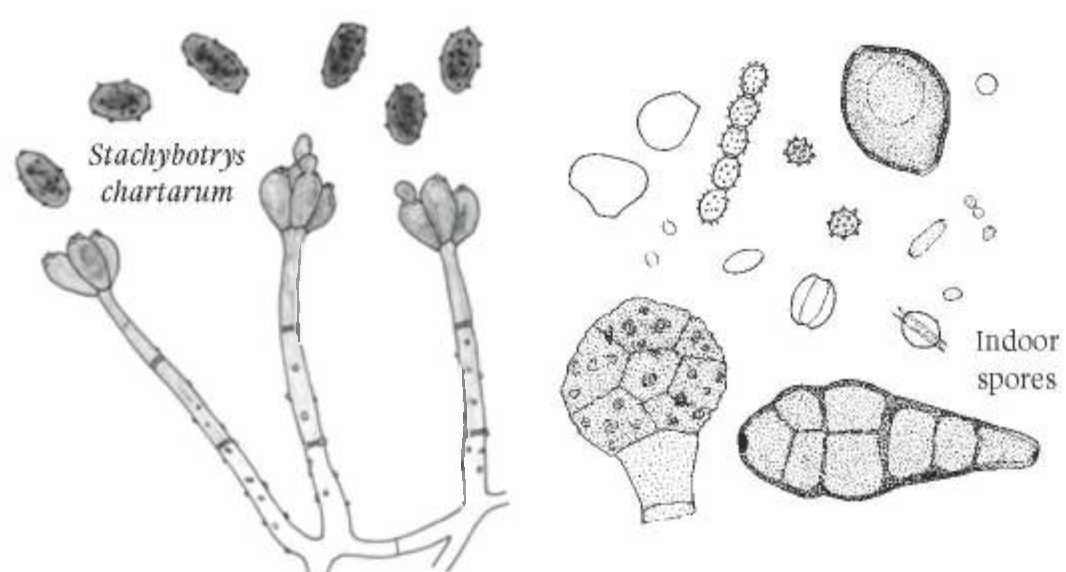
The most notorious of the dark moulds, Stachybotrys chartarum, is often called stachy or the toxic black mould. In the mid-1990s, S. chartarum was implicated as a cause of fatal lung hemorrhages in about a dozen babies living in poorly maintained older wooden homes in Cleveland, Ohio.12 In nature, stachy grows on dead plant material that has a lot of cellulose, like straw. In homes, it forms black splotches on wallpaper, ceiling tiles, insulation, or drywall (also known as wallboard or Gyproc), which absorbs water and swells when it gets wet, leaving the outer layer of paper to go mouldy. When stachy is alive, its spores are sticky and don’t easily get into the air. So they rarely appear in air samples, although dried fragments of dead spores and mycelium do get airborne. In a wall cavity or under the floor, stachy can spread over several square yards without anyone noticing. Its spores have high concentrations of a potent mycotoxin called satratoxin. Ifinhaled, satratoxin and glucan from the cell walls inhibit the amoeba-like white blood cells (macrophages) in our immune systems, leading to serious inflammation and bleeding. Black mould colonies don’t always mean stachy, though. Usually they are colonies of the comparatively benign Alternaria or Cladosporium, which should be cleaned up but are unlikely to cause more than a few sneezes.
I’m often asked what people can do in their own homes to reduce risks from mould growth. For most people and for most buildings, simply opening the windows, changing the bedding, and moving the compost along will stop resident fungi from amplifying and resident humans from wheezing and sneezing too much. If you do have sensitivities to dust, replace the carpets with tile or wood flooring. Vacuuming regularly and installing a furnace fan with an effective high-efficiency particulate air (HEPA) filter will help remove aller-gens from the air rather than recirculating them throughout the house.13 You can treat mild mould allergies with over-the-counter antihistamines. But if you have asthma, sensitivities to environmental allergens, or a compromised immune system, consult your doctor to see if more intensive hygiene methods or medications are needed. And if your home is flooded as the result of a natural disaster, the mould growth is unlikely to be subtle, and informed help to deal with it should be readily available.
If in the course of daily life you do find small mould colonies on walls or ceiling tiles, clean them with solutions intended specifically for this purpose and approved by bodies like the American Industrial Hygiene Association. Don’t use bleach: it dries into crystals that irritate the lungs and could be more troublesome than the fungus you are trying to get rid of. If you have visible colonies of stachy or other species, or ongoing problems, hire a qualified remediation expert. Make sure your contractor has experience with moulds—many focus on other indoor problems like asbestos. Qualified workers will wear appropriate personal protective equipment and follow local building codes when cutting out and replacing the contaminated material. And be sure they find and repair water leaks or sites of condensation, or you will end up in the same situation again.14 Sometimes the source of moisture isn’t obvious. A colleague of mine tracked a minor mould problem in a school to a specific section of the music room where trumpeters and trombonists from the school orchestra were emptying their spit valves onto the carpet.
As long as we live in homes and spend time indoors, we will interact daily with the microbial world. We can now detect with more and more accuracy which fungi live with us, and we can try to manage our interactions with them. Some of these species are indicators of problems and others cohabit with us peacefully. What’s less clear is whether any of them may actually be helpful in buildings. In the early part of my career, my research focused on finding biological controls for sap stain and decay. We didn’t get very far, in part because the lumber industry was then busy fighting to keep chemical fungicides registered, and in part because we just didn’t understand enough about the ecology of fungi in wood to make biocontrol work. Some building engineers wonder whether it might be possible to add harmless or beneficial “probiotic” fungi to buildings during construction or to design structures that encourage such fungi, in order to inhibit harmful moulds or decay fungi. These musings are usually met with skepticism, as unconventional ideas usually are.
The reality is that our buildings—like trees, crops, and humans—are mortal. Over time, saprobic fungi will turn all of our built environments into compost. And there’s one kind of building where none of us want to end up—the hospital. Our efforts to conceal ourselves from symbionts and pathogens eventually catch up with us. Like all the other environments we’ve considered for their fungal dimensions, our bodies are ecosystems too. We are all tied into nature, from beginning to end.