
THREE
On December 23, 1913, Congress approved the Federal Reserve Act. Final passage came after several lengthy disputes and many pages of testimony favoring and opposing a central bank. More than thirty volumes of research reported on the findings of the National Monetary Commission.1 Despite the intense discussions, detailed investigation of financial systems that preceded the act, and the number of alternative bills drafted, considered, and dismissed, the act says very little about the broader purposes of the legislation. The title talks of furnishing an elastic currency, affording means of rediscounting commercial paper, and improving the supervision of banking; the act speaks of setting discount rates “with a view of accommodating commerce and business” but mentions no other objectives.
Omission of a broad statement of purpose or policy objective was not an oversight. The act represented a compromise between many different groups that had very different purposes in mind. At one extreme were the proponents of a single central bank, owned by the commercial banks and run by bankers. The group favoring this alternative looked to the European central banks as a model, particularly the Bank of England. Many of the group’s members were bankers or “practical” men, which often meant in the context of the time that they had some idea of the services that central banks rendered to banks but less understanding of the longer-run consequences of central bank operations. They wanted the central bank to damp fluctuations in market interest rates, particularly those caused by the seasonal demand for currency and the financing of crop harvests, and to encourage the development of a broad national market in commercial paper and bills of exchange patterned on the London market. One of their principal aims was to increase the seasonal response, or elasticity, of the note issue by eliminating the provisions of the National Banking Act that tied the amount of currency to the stock of government bonds.2 They believed firmly that a central bank could reduce panics by serving as lender of last resort in periods of distress. The record of the Bank of England in the previous fifty years reassured them that their beliefs were well founded.
At the opposite extreme were those who opposed a central bank of any kind. The main economic content of their argument was that a central bank is a monopoly, but they did not oppose monopoly as such. They feared or claimed that the monopoly would be run for the benefit of the bankers, particularly J. P. Morgan and other New York bankers. Instead of proposals to avoid a “bankers’ monopoly” they produced evidence of concentration, interlocking directorates, and control of financial institutions, railroads, and other enterprises in hearings before the Pujo Committee and in that committee’s final report.3 However, the Pujo report made few recommendations, was silent on the main issues involved in the discussions of banking reform, and had greater influence on the designers of the Federal Trade Commission than on the designers of the Federal Reserve System.
Proponents and opponents of a central bank clashed over the recommendations of the National Monetary Commission. Legislation drafted at the end of the Taft administration in 1912 embodied many of the principles proposed by the commission. The chairman of the commission, Senator Nelson Aldrich, was a New York Republican. His plan, the Aldrich plan, was unacceptable to the Democrats and opposed in their platform for the 1912 election. They objected much more to the organization of the system and the centralization of power in the hands of the larger banks than to the chartering of a bank to discount commercial paper and issue currency not tied to government securities.
The 1912 election shifted control of Congress to the Democrats. Many Democrats were willing to accept a central bank only if it was under political control. Some members wanted semi-independent regional banks. A month after his election, President-Elect Wilson met with Carter Glass, the new chairman of the House Committee on Banking and Currency. Wilson proposed a mixture of private and public control (Glass 1927, 81–82).4 His legislative proposal to Congress, on June 23, 1913, included that recommendation and urged that control “be vested in the Government itself, so that the banks may be the instruments not the masters of business and of individual enterprise and initiative.” The final structure included Wilson’s compromise—a politically appointed Federal Reserve Board in Washington and regional banks in principal centers, run by bankers, with no clear division of authority between the two. As part of the compromise, Wilson proposed a Federal Advisory Council consisting of bankers, appointed by the reserve banks, to serve as advisers to the Board. As with the First Bank and Second Bank of the United States, Congress did not want to grant a permanent charter, so the initial charter was for twenty years. Permanence was not granted until the McFadden Act of 1927.
In its early years the Federal Reserve faced three major challenges. First, an unanticipated war brought a large increase in gold and removed the gold standard as the monetary system of the developed world. The Federal Reserve had a small portfolio, so it had no means of controlling the resulting inflation, even if it wished to sterilize the inflow. Second, the compromises that enabled a majority to support passage of the act shifted the argument over government or private control without resolving it. In the System’s early years, frequent conflicts broke out between the reserve banks and the Board as both sides struggled to gain control. Third, the intent of the principal proponents was not realized. They expected to create an institution capable of preventing inflation, responding to banking crises, and financing exports of grain, cotton, and other primary products. Instead they created a largely passive bank, dependent on revenues from member bank discounts but with limited influence over the volume of discounts. The real bills doctrine left the initiative to commercial banks. The Federal Reserve’s main channel of influence—the discount rate—was a penalty rate. But raising interest rates was unpopular and provoked concerns about bankers’ domination of the economy.
The early experience of the Federal Reserve induced it to abandon, or modify, the principles underlying the act. As noted, the international gold standard ended when the war started. War finance conflicted with the penalty rate, so the Federal Reserve abandoned it. Political concerns and mistaken policies prevented return to a penalty rate. And the more thoughtful among the early leaders began to question the central tenets of the real bills doctrine.
Wartime experience and the postwar boom, recession, inflation, and deflation convinced many that a passive strategy was inappropriate. Less than a decade after it was established, the Federal Reserve began to search for a more active approach.
THE FOUNDERS’ RATIONALE
The House report on the Glass bill accepted that centralization of banking resources is the “root of the central banking argument” but concluded that in a country as large as the United States “equally good results can be obtained” by several federations.5 The report makes it clear that the House Banking Committee expected the regional reserve banks to function cooperatively but independently and to achieve the advantages of central banking without acquiring the monopoly powers of a single central bank. The striking feature of the report, however, is the extent to which the congressmen who approved it viewed the proposed system as a large association of banks able by pooling gold reserves to take better advantage than the individual national banks of the note issuing and discounting privileges that the national banks possessed. In addition to providing a new bank of issue, Congress made sure that the act improved the procedures for issuing notes by both broadening the definition of acceptable collateral and removing government bonds from the list of acceptable collateral.
Virtually every discussion of banking reform commented on the frequency and severity of United States banking crises. The desire to reduce the frequency and severity of crises—five in the previous thirty years—is a main point of agreement in all the reform plans. All proposals recognized that a central bank could serve as lender of last resort in a banking crisis.
Since there was no established lender of last resort under the National Banking Act, banks attempted to protect themselves against runs or currency demands by holding gold or currency reserves.6 If all banks sought to increase their gold holdings simultaneously, short-term interest rose as high as 100 percent annually. To reduce the demand for gold, clearinghouse associations or groups of bankers pooled resources to provide payment facilities during periods of stress. Such private facilities had to assume the risk of defaults. A central bank that pooled reserves and lent during a panic would provide “elasticity” at lower cost. Hence bankers were eager to shift responsibility for maintaining the payments and clearing mechanism to a central bank, and there was wide support for this reform.
A second meaning of elasticity referred to seasonal fluctuations. Proponents expected a central bank to reduce seasonal fluctuations in interest rates, principally during the autumn marketing of the harvest. Under the prevailing system, interest rates rose and the dollar appreciated within the gold points when foreigners borrowed and purchased dollars to buy grain. New York banks sold holdings of British bills to smooth the seasonal fluctuation in exchange rates, but large seasonal swings remained until after the Federal Reserve was established (Warburg 1930; Myers 1931; Miron 1986).
The two types of inelasticity had a common source. The National Banking Act tied note issues to government bonds. Hence if banks expanded up to the limit set by the note issue, note issues could not expand further in response to seasonal or cyclical demands. A central bank empowered to discount real bills would remove this inelasticity and finance the crop movement. Currency would be more elastic.7 John U. Calkins, later governor of the Federal Reserve Bank of San Francisco, subsequently stated the contemporary view of the relation between elasticity and real bills: “Probably the most important effect of the Federal Reserve Act was to set up the machinery necessary to provide elastic currency; elastic in that it would be based on self-liquidating credit instruments arising out of the production and distribution of commodities. An obligation of the United States does not represent a transaction of this character …to the extent such obligations back the currency such currency is fiat currency” (Federal Reserve Governors Conference, May 1922, 143–44 [hereafter cited as Governors Conference]).
Authority to discount real bills was seen by many at the time as the main improvement of the new legislation.8 Many bankers shared Paul M. Warburg’s view that the Federal Reserve could prevent wide swings in interest rates without risking inflation if it purchased real bills.9 Reliance on real bills also freed the credit system from dependence on the call money market and thus on credit to stock exchange brokers and dealers who financed their positions in that market. Leading economists such as A. Piatt Andrew, H. Parker Willis, J. Laurence Laughlin, and Horace White also advocated the real bills doctrine.10 These economists believed that credit would be adjusted to the needs of trade if banks invested in commercial and agricultural loans and avoided bonds, real estate, call money, and other speculative assets (Mints 1945, 206–7).
Mints (1945, 251–53) adds three additional benefits the founders expected the Federal Reserve to bring. First, bank reserves, mainly gold reserves, would be pooled and therefore available for lending when needed. Second, a bill market would replace the call money market, as in London. The call money market provided credit based on stock exchange collateral and hence depended on a speculative asset. The bill market depended on real bills, particularly bills arising from the financing of foreign trade. Third, improvement in the check clearing system would reduce the number of banks charging fees for clearing checks. The Federal Reserve instituted collection at par at the reserve banks but did not, initially, make par collection a condition of membership.
Section 15 of the Glass bill (section 14 of the act), titled “Open Market Operations,” authorized the Federal Reserve banks to engage in such operations in any of the assets acceptable as collateral for rediscounts and to purchase and sell gold and government bonds. The House report on the Glass bill noted that the purpose of open market operations was to enable the “Federal Reserve banks to make their rate of discount effective in the general market at those times and under those conditions when rediscounts were slack and when therefore there might have been accumulation of funds in the Reserve banks without any motive on the part of member banks to apply for rediscounts or perhaps with a strong motive on their part not to do so” (Krooss 1969, 3:2317–18). The Senate report saw open market operations as a means of developing a market for bills, thereby reducing the variability of rates, the risk premium, and the average level of market rates.11
None of the reports discusses the effect of changes in money on prices or pays much attention to problems of inflation or deflation. The effects of money on prices were not unknown to Congress. Silver agitators had pressed the point during the deflation of the seventies and eighties. The lengthy report of the Jones Commission (1877) had discussed the issue and concluded that an inconvertible paper money was subject to government control and should be allowed to expand with population so as to keep the price level constant.12 The quantity of gold or convertible currency, on the other hand, could not “be greater than such an amount as may be requisite to maintain the prices …at a substantial parity with the prices of all other countries using the same kind of money” (Krooss 1969, 3:1866).13 Yet none of this found its way into the act or influenced the reports of the House or Senate committee on the amended Glass bill.14
A principal reason for the omission is the Gold Standard Act of 1900 that legally established the gold standard as the United States monetary standard. The United States was thought to be part of the international gold standard that determined the stocks of money and the price levels in all member countries. However, after the start of the European war but before the effective beginning of the Federal Reserve System, all the principal gold standard countries suspended the gold standard. It was never reestablished in its prewar form.
The intent of the legislation was very different from the way the System evolved. The original conception was of a relatively passive system. The price level would be controlled mainly by gold movements and changes in foreign exchange. Seasonal and cyclical movements in demand for credit would increase or reduce demand for rediscounts at Federal Reserve banks. Much of this activity, it was believed, would take the form of changes in the volume of rediscounts of bills of exchange or acceptances initiated by banks. The Federal Reserve would not be entirely passive, however. Its active role, like that of the Bank of England, would consist mainly of raising or lowering the discount rate in ordinary times and providing emergency credit to prevent or respond to a financial panic. The discount rate would be a penalty rate, so in ordinary times bankers would keep discounts to a minimum.
FIRST STEPS AND CONFLICTS
The new system took nearly eight months to get organized. A main reason for the delay was that members of the Board and governors of the reserve banks could not be appointed until the size and number of Federal Reserve districts had been set. The act specified that no two members should come from the same district and required that there be at least eight and not more than twelve districts, each with a Federal Reserve bank in a principal city. Decisions about size, location, number, and boundaries were left to an organizing committee consisting of the secretaries of the treasury and agriculture and the comptroller of the currency.15
These decisions were contentious, political, and time consuming.16 By April 2, 1914, the locations were decided, although appeals continued for more than a year.17 By mid-May the twelve reserve banks began to organize. Almost ninety days passed, however, before Charles S. Hamlin, Paul M. Warburg, Frederic A. Delano, W. P. G. Harding, and Adolph C. Miller took their oaths of office on August 10 as the first appointed members of the Federal Reserve Board.18 The president designated one of the members as governor and one as vice governor for renewable one-year terms. The secretary of the treasury was ex officio chairman of the Board, but the governor was the chief operating official of the Board. Hamlin served as governor until 1916, when Harding replaced him. The two remaining members of the seven-person board, Secretary of the Treasury William G. McAdoo and Comptroller of the Currency John Skelton Williams, were ex officio members who had taken office earlier.19
The twelve reserve banks opened on November 16, 1914, eleven months after passage of the act.20 Secretary McAdoo’s announcement of the opening said in part: “They will put an end to the annual anxiety from which the country has suffered and would give such stability to the banking business that the extreme fluctuations in interest rates and available credits which have characterized banking in the past will be destroyed permanently” (Board of Governors File, box 659, November 15, 1914).
Tension between the Board and the reserve banks began before the System opened for business. Two factions formed within the Board. Delano, Miller, and Warburg worried about Treasury control and loss of independence. They distrusted the Treasury group—Hamlin, McAdoo, and Williams. Harding was in the middle. Typical of the reserve banks’ concerns is a letter from a Chicago director H. B. Joy (president of Packard Motor Company), to Frederic Delano: “I have a little feeling—in fact it is growing on me—that the Federal Reserve Board in Washington is inclined toward dominating the District Banks” (Board of Governors File, box 659 October 10, 1914). Warburg described the problem. Dominance by the Board would allow political considerations to dominate decisions about interest rates. Dominance by the reserve banks “would render a concerted discount policy …an impossibility and reduce the Board to a position of impotence” (Warburg 1930, 1:473–74). To resolve some of the issues and coordinate the reserve banks’ activities, the organizing committee recommended appointment of an executive council of the banks’ governors. This is the origin of the Conference of Governors, later the Presidents Conference, that still continues (Board of Governors File, box 659, October 13, 1914).
The dominant personality in the early days of the System was Benjamin Strong, first governor of the Federal Reserve Bank of New York. Strong’s early views were the views of a sophisticated banker, with little formal training, who had gained enough understanding of the functioning of the domestic and international payments mechanisms to be ahead of most of his contemporaries. He saw the Federal Reserve Act as an opportunity to expand the international operations of United States banks, particularly New York banks, and like Warburg, he believed that the development of the market for bills of exchange and acceptances was the means to accomplish this end in a manner consistent with the act. Throughout his life he remained a proponent of fixed exchange rates and the gold standard and an opponent of devaluation or revaluation of currencies and of inflation. In practice, this meant that he accepted deflation when required and came to regard it as the price of international stability.21
Strong’s mature views on the gold standard and on monetary policy reflected his experience in the twenties. His prewar policies can be described succinctly as an attempt to recreate Lombard Street on Wall Street, with the Federal Reserve System, particularly the New York bank, playing the role of the Bank of England.22 He regarded the twelve reserve banks as eleven too many. The appropriate number was one, he wrote. And he believed it was a major defect to issue Federal Reserve notes as obligations of the government. Government note issues were too reminiscent of greenbacks and other fiat money (Chandler 1958, 34–35, 37).23 Like Warburg, he accepted that real bills should be the base for expansion. To that end he worked to develop and strengthen the money market. One of his first appointees to the New York bank was an American expert on the operation of the London bill market. This effort to develop a market for banker’s acceptances and bills of exchange as the principal means of affecting money market interest rates and to replace the call money market was renewed in the 1920s but did not succeed (Warburg 1930, vol. 2, chap. 12; Burgess 1964, 219). Early in his career as governor, he favored compulsory membership of state banks as a means of centralizing reserves. His views on discount policy read very much like pages from Bagehot and are not noticeably different from British views at the time.24
The first task was to organize and begin operations. For Strong this meant not only staffing the New York bank but organizing the System. Since he regarded the Board as a political agency and saw the banks as the business end of the System, 25 Strong moved to enlist the support and cooperation of the other reserve bank governors so as to make the banks the dominant partner. His opportunity came very quickly. The Board called a meeting of the governors for December 10–12 to discuss common problems. The governors used the meeting to organize a permanent Governors Conference, with Strong as chairman.
From the start, the Governors Conference tried to control operations. At its first meeting, the governors discussed how the reserve banks would conduct open market operations.26 One of the main issues was whether each bank would operate independently, as prescribed in the law, or whether they would operate collectively, as required for centralized control. Early in 1915, at Strong’s suggestion, the banks agreed to combine operations in both the open market and acceptance accounts to avoid any effect of competitive purchases on market rates. Although effects on the market were recognized, purchases were made principally to increase the earnings of the reserve banks and were allocated to the individual banks in part based on their need for earnings. Reserve banks retained the right to purchase independently (Anderson 1965, 8; D’Arista 1994, 22). Not all the governors were satisfied. Some claimed that New York did not buy enough, so their earnings were held down.
The reserve banks also purchased the 2 percent bonds that continued to serve as collateral for national banknotes. The aim was to replace national banknotes with Federal Reserve notes. At first purchases were made by the individual reserve banks for their own accounts. By 1917 wartime expansion of the reserve banks reduced pressures to increase earnings, so the banks centralized open market purchases of the 2 percent bonds in New York. Concern for earnings returned, however, in the early 1920s and in the mid-1930s. The reserve banks again acted independently in the early 1920s until a new agreement was reached. Centralization of open market operations and the decision about participation remained as problems until the Banking Act of 1933 amended section 14.
The Board also sought control. One of its earliest acts was to rule that the reserve banks could not announce or change discount rates until they had been approved by the Board (letter of Parker Willis to all reserve banks, Board of Governors File, box 1239, November 18, 1914). The Board based its order on the provision of section 13 that gave the reserve banks power to establish rates “subject to review and determination of the Reserve Board.” The governors chose to interpret “review and determination” as pro forma but the Board insisted that discount rates were subject to the Board’s “determination.”27 Early in 1915 the Governors Conference approved a resolution giving the reserve banks sole power to initiate discount rate changes “without pressure from the Federal Reserve Board” (Chandler 1958, 71).
Initially, discount rates were set above prevailing market rates; they were penalty rates to provide discount facilities in periods of market malfunction, as proposed by Bagehot.28 This principle was in conflict both with the political desire for lower interest rates during the 1914–15 recession and with the desire of the reserve banks to increase earnings.29
Earnings depended on membership. The act required approximately 7,500 national banks to be members, but state-chartered banks had a choice. Among the obstacles to membership were requirements for par collection of checks cleared at Federal Reserve banks and for holding reserves at Federal Reserve banks without earning interest. As of June 30, 1915, only seventeen of nearly twenty thousand state banks had elected to join. A year later state bank membership had increased only to thirty-four.
Partially offsetting these increased costs of membership, the act broadened the powers and reduced the reserve requirement ratio for national banks.30 Cagan (1965, 140) estimates the reduction as 13 percent in November 1914, when the System started operations. This reduction was partially offset in subsequent years by the requirement that member banks deposit more of their required reserves at Federal Reserve banks. In June 1917, by law all required reserves were held at Federal Reserve banks; vault cash was excluded from reserve computation.31 The legislation increased gold held by the Federal Reserve in excess of requirements by $300 million.32
Strong, and also Warburg (1930, 2:150–52), regarded the centralization of reserves as critical to the success of the System. Failure to deposit reserves at the reserve banks meant that gold holdings were dispersed, as they had been before the act. Without centralization, the System would be in a weak position to respond if the gold inflow from Europe reversed at the end of the war. Even if the gold remained, Warburg believed, the System required a larger gold reserve so that it would not be forced to contract the note issue in recessions as eligible paper declined. A larger stock of gold could be used to maintain the note issue.33 After June 1917, vault cash no longer counted as part of reserves, so banks deposited more of their gold at the reserve banks.
Gold flows in 1915 reversed the direction of change in interest rates. Early in January, discount rates followed market rates down. Interest rates continued to fall slowly through the first year of operations. The Board was quick to claim credit. Governor Hamlin wrote that by merely opening the doors, the steadying effect of the act became apparent in the market (Board of Governors File, box 1239, December 17, 1915). The reserve bank governors were more skeptical. When the Board asked all reserve banks to describe the effect of the new system, most attributed the decline in interest rates to gold inflows and the increase in gold reserves. Chairman John Perrin (San Francisco) wrote that there was “very little tangible evidence that the establishment and operation of the Federal Reserve bank has influenced rates in any important way.” Pierre Jay, chairman at New York, wrote that the new system had “no effect whatever” (letters, Board of Governors File, box 1239, December 11 and 13, 1915).
Although the governors invited the Board to send representatives to their meetings, and they sent summaries to the Board, the Board regarded the Governors Conference as a rival organization that weakened its authority by operating independently. It resented decisions by the governors to meet at reserve banks instead of in Washington. It was determined to prevent the governors from meeting too frequently or acting independently.
The Board decided to take control after the Governors Conference criticized the Board for “an exercise of pressure” on the reserve banks. It sent a letter to each of the governors suggesting that the governors hold no more than three or four meetings that year. Although the Board approved $12,900 in expenses for the most recent meeting, it told the governors that their expenditures were too large. The Board did not object to informal discussions among the governors, but “a permanent organization, the appointment of an executive committee, and the election of a paid secretary, are matters …of doubtful propriety and beyond the scope and powers of the Federal Reserve banks as defined in the Federal Reserve Act” (Board Minutes, January 20, 1916, 79). The creation of a standing executive committee “might create the impression that certain banks …had delegated certain powers to a definite committee” (80). Responding to the governors’ criticism, the Board replied that the governors had “assumed powers which they do not possess …when they undertook collectively to direct or to suggest to the Federal Reserve Board the manner of its exercise of the powers conferred upon it by the Act” (81).34
The Board won the first contest, but the issues of control and power were put aside, not resolved. Late in July the secretary of the Governors Conference notified the Board that the governors planned to meet on August 15. By this time Harding had replaced the conciliatory Hamlin as governor (Katz 1992, 119). Harding responded that the Board did not want a conference held and that in the future conferences could be held only if called by the Board. The Treasury opposed a conference, Harding wrote, and, he added, “plans for the proposed meeting should be abandoned…. [I]n matters which concern interbank relations and operation of the Federal Reserve banks as a system, authority is vested by law solely in the Federal Reserve Board” (Board Minutes, July 25, 1917, 99–101). McAdoo attended the meeting and concurred in the decision. He urged the Board to keep the Federal Reserve banks in hand. To rein in the banks, he had considered appointing five additional government directors to the banks’ boards, but he postponed the decision pending a favorable resolution of the dispute.
The following week the Board formally adopted the resolution discussed in the letter to the reserve banks. There was to be no permanent organization and no Governors Conferences unless called by the Board. No further conferences were held until November 1917.35
The Board and the reserve banks also clashed over the obligation of one reserve bank to discount for another and the rate to be charged for interdistrict borrowing. The intent of the act was to pool gold reserves by permitting interdistrict borrowing, thereby smoothing regional demands for reserves and borrowing associated with crop movements. The Board had authority under the act to set the rates for interdistrict loans. Strong disliked the provision and sought to limit its scope by permitting the lending bank to set the rate on borrowings (D’Arista 1994, 19). The Board members insisted that this was their responsibility, and they prevailed.
In March 1915 the Board established interdistrict rates. No transactions were made until 1916, when rates were set by the Board on each transaction. In the fall of 1920 the Board reestablished a common rate for interbank rediscounts related to the discount rate on member bank borrowing.
POLICY PROBLEMS
Almost from its founding, the System faced a series of major policy problems. First there was an outflow of gold before the reserve banks opened, as foreigners sold dollar securities at the start of the war in August 1914. Exports declined for lack of shipping because German and British ships that had carried much of the freight withdrew. Commodity prices, particularly for exportables, fell sharply. The initial wartime problems were severe enough to send the dollar above five dollars per pound sterling, well above its intervention point. The New York Stock Exchange and most foreign stock markets closed to hinder sales of securities and demands for gold.
Soon after the reserve banks began operations in November, a gold inflow replaced the outflow and produced monetary expansion and inflation. Wartime inflation, resulting from the financing of Treasury bond sales, soon followed. After the war there was the difficult task of establishing independence from the Treasury and developing an anti-inflation policy. By 1920 the System had to deal with its first recession. The System’s response to this series of events—the discussions, the proposals for action, and the actions themselves—reveals the policy approaches and understanding of the Board members and governors at the time and the flaws in the act.
The Federal Reserve System was not fully organized when war started in Europe, so it had a minor role in responding to the gold outflow. In September the Treasury issued emergency currency, authorized under the Aldrich-Vreeland Act of 1908.36 One of the Federal Reserve’s first actions was to oppose issuance of additional Aldrich-Vreeland currency. It worked with the Treasury to organize a group of bankers that subscribed $108 million to redeem United States loans abroad. The organization of the fund may have helped to restore calm; only $10 million was drawn.
Gold Flows
Within a few months of the start of the European war, exports increased and gold flowed to the United States in payment. In 1914 the United States held 19 percent of the world’s monetary gold stock. By 1918 its monetary gold stock had increased by 65 million ounces, more than $1.3 billion at the official gold price, $20.67 per fine ounce. The increase was 88 percent of the United States monetary gold stock in 1914 and more than 16 percent of the world’s prewar monetary gold (Schwartz 1982, tables SC7 and SC10).37
The Federal Reserve followed gold standard and penalty rate rules by reducing discount rates as market rates fell. By mid-December 1914 it had lowered discount rates at all reserve banks. By February 1915, rates at most reserve banks were two percentage points lower than on opening day.38 Market rates rose briefly in the spring, perhaps in anticipation of the expiration of Aldrich-Vreeland currency issues on June 30. The Board issued a press release urging the reserve banks to “discount as liberally as prudent” (Board of Governors File, box 1239, January 21, 1915). No problems occurred, and interest rates resumed their decline.
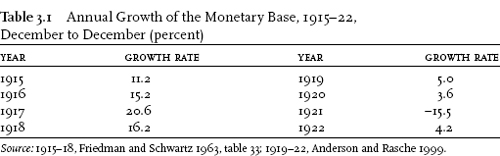
The gold inflows substantially increased the monetary base. Table 3.1 shows annual rates of increase in the base from 1915 to 1922. The Federal Reserve was at first powerless to stop or offset the increases even if it had chosen to abrogate gold standard rules by selling securities. The open market portfolio of government securities at the end of 1916 was only $55 million.39 In fact, the System made small net purchases of government securities in 1915 and 1916 and larger net purchases after the United States entered the war in April 1917.40 Many of these purchases were made to increase the reserve banks earnings.41
Alarmed at the increase in bank reserves and unable to get Congress to permit changes in reserve requirement ratios, the Board began 1917 by urging all reserve banks to let their aggregate acceptances decline by $40 million to $50 million, 20 to 25 percent of their holdings (Board of Governors File, box 1239, January 19, 1917). Several of the reserve banks ignored the request to maintain earnings.
Discount rates remained mostly unchanged until late in the year. The Board confined its activity to simplifying the rate structure. Reserve banks were requested to post no more than seven discount rates by type and maturity and to unify the rate structure across districts. The reserve banks’ responses to the request show the diversity that prevailed at the time in the United States.42
Wartime Finance
Once the United States entered the war, government spending increased. The nation advanced $7.3 billion to its allies during the war and an additional $2.2 billion after the war (Friedman and Schwartz 1963, 216). Effective income tax rates increased sixfold from 1916 to 1918, but the increased revenue was much less than the increased spending, so the Treasury had to finance relatively large deficits (Bureau of the Census 1960, 716).43 Military spending increased from less than $1 billion in fiscal 1916 to an average of $15 billion a year for the fiscal years ending June 1918 and 1919.
The war reshaped the Federal Reserve System in many ways. Most foreign governments suspended the gold standard, so it no longer served as a guide to policy. The System abandoned the penalty discount rate in the interest of war finance. The number of state member banks rose to more than a thousand by 1919, and they included the largest state-chartered banks, with 40 percent of the assets of all state-chartered banks (Bureau of the Census 1960, 633). Wartime (and prewar) changes made the System more like a central bank, as in World War II. Independence was sacrificed to maintain interest rates that lowered the Treasury’s cost of debt finance. The System became subservient to the Treasury’s perceived needs.
The Federal Reserve’s main wartime activity was selling Treasury bonds. The New York bank wanted to replace the existing Independent Treasury System, carried over from the nineteenth century, by serving as fiscal agent for the government. Its wartime activities, and those of the other reserve banks, included selling almost half of the debt issues. It succeeded in convincing the Treasury that the Independent Treasury System was redundant. In 1920 the New York bank was designated fiscal agent, and the Independent Treasury System ended.
Wartime finance consisted principally of a series of Treasury bond drives or Liberty Loans. The governors of the reserve banks served as chairmen of the committees organized in each district to sell Treasury bonds to the nonbank public. Since the amount borrowed was large relative to the size of the country or previous credit demands, the System ensured the success of the four wartime Liberty Loans by making two types of loans. Short-term loans at preferential discount rates encouraged banks to buy short-term Treasury certificates during the interval between bond drives. Initially the discount rate on these loans in New York was 3 percent for fifteen days and 3.5 percent for sixteen to ninety days. Rates rose to 3.5 and 4 percent in December 1917 and to 4 and 4.5 percent in April 1918, where they remained until November 1919.44 Loans were also made to encourage banks to stretch out the public’s payments for purchases of Liberty Loan bonds over $1,000. The latter was known as the “borrow and buy” policy. Its original intent was to avoid a short-term contractive effect on the money stock and interest rates as buyers drew down their balances to make payments to the Treasury (Governors Conference 1917, 233). Later it became a marketing device for the bonds, since buyers could defer payments for as much as a year from time of purchase.
The Treasury’s borrowing tested the System’s ability to pool reserves. By far the largest part of the Treasury’s short-term borrowing was in New York, so the New York bank was under pressure to finance the purchases. The Board urged other reserve banks to buy acceptances from New York to relieve the strain on its reserve position, and New York renewed the request at the November Governors Conference. All banks except Kansas City, Chicago, and Atlanta agreed to buy acceptances to earn interest for their banks and thereby supply additional gold reserves to New York.
The intent of the Treasury’s policy was that sales of certificates would be retired out of the proceeds of the Liberty Loans. From April 1917 to October 1919, the Treasury sold $6 billion of tax anticipation certificates and $19 billion in anticipation of bond and note sales. The intent was not realized. A large volume of certificates remained outstanding at the end of the war. The Treasury opposed raising short-term rates to refund the certificates as they came due. It expressed concern not only that higher shortterm rates on certificates would carry over to long rates, lowering bond prices, but also that an increase in rates would abrogate commitments made to purchasers of Treasury bonds under the borrow and buy policy.
By offering discounts at a preferential rate on Treasury certificates, the Federal Reserve abandoned the penalty rate, one of the main principles on which it was founded. Member banks could borrow at a preferential rate below the rate paid on the Treasury certificates or Liberty bonds, so borrowing became profitable.45 Penalty rates for other types of borrowing remained, but most borrowing was at the preferential rate, so higher rates had no effect. One consequence was that state banks membership increased, as noted earlier. Another consequence was that much of the collateral for borrowing was Treasury debt, contrary to the spirit of the Federal Reserve Act.
Table 3.2 compares the interest rates at which the Treasury sold Liberty bonds to the preferential discount rates at New York. Congress set the rate on the First Liberty Loan below the market rate on savings deposits. The intention was to avoid a drain of existing savings into war bonds (Warburg 1930, 2:12). On May 22, 1917, a week after the borrowing campaign began, New York introduced the preferential discount rate. The other banks followed within a few weeks. The decision reflected concern about the ability to sell the issue at the low interest rate Congress set (Wicker 1966, 14).46

The preferential rate enabled the Treasury to borrow on favorable terms between bond drives. The Treasury sold short-term certificates to the banks. The member banks paid by crediting the Treasury’s account at their banks and retained the deposits until the Treasury drew on its balances. Treasury balances were not subject to reserve requirements, but after they were spent, the money returned as private deposits subject to reserve requirements.47 The preferential discount rate allowed the banks to meet this obligation at low cost. The preferential rate soon became the modal borrowing rate. The Federal Reserve continued the practice until December 1919, after the war ended and the fifth and final war loan, the so-called Victory Loan, had been sold.48
The System considered direct purchases to be “inflationary.” To avoid making open market purchases, it encouraged banks to offer installment loans to nonbank purchasers on favorable terms. Most commentators point out (correctly) that it is no more inflationary for the Federal Reserve to buy the bonds directly (or in the open market) than to lend money to the banks at below market rates so that banks can either purchase the bonds or finance the public’s purchases. The increase in the monetary base is the same in both cases. However, the distinction was important to the Federal Reserve and many others who shared the real bills framework. Central bank purchases of government securities expand money (or credit) based on speculative paper. This paper would have to be eliminated after the war to restore the central bank’s reputation. Although the members recognized that it would be difficult to reduce member bank indebtedness by restoring a penalty rate in the face of almost certain Treasury opposition, far more difficult would be postwar direct sales of Treasury obligations by the reserve banks with the secretary and the comptroller on the Board. Further, currency issues had to be backed by gold and real bills. Treasury securities and commercial paper were not close substitutes for this reason.
By 1918 most of the Liberty Loans sold in the secondary market at a small discount. To raise their prices, Congress, in approving the Third Liberty Loan, permitted the Treasury to purchase not more than 5 percent of each outstanding issue in the market. Purchases were made at the market price and financed by short-term certificates subject to preferential rates for borrowing from the reserve banks. The effect was to lower the average maturity of the debt and to increase the incentive for the Treasury to maintain low interest rates on Treasury certificates and the preferential discount rate after the war. The purchase operations ended on June 30, 1920, when a sinking fund replaced the purchase program. In all, the Treasury purchased $1.7 billion under the program, with most of the purchases made after the war. The program did not succeed in bringing taxable bonds to par value.
Since the commercial banks could use the certificates at their option to borrow at preferential rates, the reserve banks were the source of the financing no more and no less than if they undertook the same volume of purchases directly. Despite a rising rate of inflation, Liberty bonds remained only slightly below par throughout the war. For example, at the time of the Third Liberty Loan, in spring 1918, the GNP deflator rose at an annual rate of about 7.5 percent. For the year 1918 as a whole, the deflator rose by 10 percent (Balke and Gordon 1986) and the consumer price index by 18 percent. Yet the Treasury was able to sell bonds at par with a 4.5 percent coupon and to keep its outstanding debt close to par by making occasional purchases. One partial explanation is that the market did not anticipate continued inflation over the life of the bonds. Although there was an embargo on sales of gold abroad, the United States remained legally on the gold standard, and the bonds contained a gold clause, permitting the holder to demand gold at redemption. Further, the common anticipation, based on experience in previous wars, was that budget deficits would end and the gold standard would be restored at the end of the war. Evidence of this disinflationary anticipation is given by the inverted yield curve: commercial paper with a maximum of 180 days maturity yielded 6 percent.49
Unlike its World War II policy, the Federal Reserve did not agree to purchase all government securities at fixed rates. In keeping with its mostly passive policy orientation, it achieved the same end by setting the discount rate on Treasury securities below the market rate on the securities. Bank reserves and the monetary base were thus set by the banks’ demand to borrow. Any bank with Treasury certificates could borrow profitably. The price of Treasury securities was kept relatively stable by this arrangement at the cost of supplying reserves and money at the market’s demand. As in World War II, the Federal Reserve became the “engine of inflation.”
The wartime policy achieved the Treasury’s objective of marketing an extraordinary increase in debt at relatively low direct cost to the Treasury.50 The public bought most of the debt, but between 1916 and 1919 commercial banks bought almost $5 billion, approximately 20 percent of the total issued. The banks financed their purchases in part by borrowing $2 billion from the Federal Reserve.
In June 1917 Congress amended section 13 of the Federal Reserve Act by reducing collateral behind the note issue. Initially, a reserve bank had to deposit with the Federal Reserve agent (at the reserve bank) 40 percent of the issue in gold and 100 percent in commercial paper and bills of exchange with less than ninety days to maturity. The new requirement reduced the total of real bills and gold to 100 percent of the note issue, 40 percent in gold. A year earlier, banker’s acceptances became eligible as collateral and, slightly altering a premise of the act, reserve banks could also use as collateral promissory notes of member banks secured by government bonds or notes.
Gold inflows slowed after 1917 (Schwartz 1982, table SC14). For the next three years Federal Reserve credit—mainly discounts—became the driving force in the expansion of the monetary base and inflation. The Federal Reserve Board’s annual report for 1918 looked forward to the time when “the invested assets of the Federal Reserve Banks have been restored to a commercial basis” (Board of Governors of the Federal Reserve System, Annual Report, 1918, 87). This appeal to the real bills standard gives a misleading impression of what had happened. From December 1916 to December 1918, Federal Reserve notes outstanding increased by $1.7 billion and bank reserves increased by $400 million. On the asset aside, discounts for member banks rose by $1.5 billion, gold by $200 million, and government securities by $180 million. Nearly all of the discounts, however, were secured by government obligations (Board of Governors of the Federal Reserve System 1943, 340).
THE POSTWAR STRUGGLE FOR INDEPENDENCE
The history of the early postwar years is principally the story of the Federal Reserve’s struggle for independence from the Treasury and the deflationary consequences of its policies after it obtained independence. This was the System’s first opportunity to take independent policy action. It made several mistakes, some avoidable, some unavoidable in the circumstances. By promising not to raise interest rates during the last wartime bond drive, the System relinquished a chance to moderate the postwar inflation. By raising discount rates from 4 percent to 6 percent and then to 7 percent in the space of a few months, it contributed to the postwar contraction.51 By failing to lower discount rates for more than a year after the cyclic peak, the System prolonged the recession and contributed to its severity.
In the first four years of Federal Reserve operations, the compound average rate of inflation was 12 to 13 percent, using consumer prices and the GNP deflator. Table 3.3 shows the annual data. The peak in the quarterly rate of inflation is in third quarter 1918, at the end of the war, but the price level did not reach a peak until second quarter 1920. For the first two quarters of the latter year, the deflator rose at a 20 percent annual rate. For the last two quarters, it fell at a 15 percent annual rate. The price level continued to fall throughout 1921, although the rate of decline slowed after midyear.
The inflation period has two phases. At first the Treasury dominated the Federal Reserve, aided by the System’s commitment to assist in war finance and, after the war, commitments under the borrow and buy policy. In the second phase, the commitments had expired. The System was free to act but uncertain about what to do.

The Inflation Phase, Part 1
The Board’s annual report for 1920 blamed the inflation on “an unprecedented orgy of extravagance, a mania for speculation, overextended business in nearly all lines and in every section of the country” (Board of Governors of the Federal Reserve System, Annual Report, 1920, 1). At best this was disingenuous, as the Board had recognized in its annual report for 1919. The Board wrote there that the absence of a penalty rate “is enough to prevent a normal functioning of a Federal Reserve Bank, whose rates should be so fixed that resort thereto is unprofitable …and thus has a tendency to check expansion” (Board of Governors of the Federal Reserve System, Annual Report, 1919, 2).
In fact, the Federal Reserve lacked any consensus on a policy regarding rates. A return to penalty rates might be sufficient to stop the inflation but was likely to conflict with accommodating the needs of trade and commerce. This was a principal concern for several governors. Others viewed the wartime policy as a violation of the real bills basis for credit expansion, hence inflationary. Insisting on a return to a real bills policy meant that the preferential discount rate on Treasury securities had to be raised. As long as the preferential rate remained in effect, the discount rate would be controlled by the Treasury when it set the rate on Treasury issues.52 Thus there was an issue of control or independence as well as a policy issue about rates. Members were aware, however, that the president could invoke the Overman Act and assign their responsibilities to another agency. This act did not expire until six months after the end of the war, in April 1919.
The division of opinion remained throughout the war and beyond. In February 1918 Governor Harding suggested an increase to 4 percent on commercial discounts with less than fifteen days to maturity. Opinion was mixed, and the rate remained unchanged. In June Adolph Miller wrote a long memo pointing out that the government had spent less than planned in fiscal 1918 but would increase spending to $24 billion in fiscal 1919. He estimated that this would be half of current GNP, and he urged an immediate increase in rates to curtail commercial lending. He included an increase in rates on loans secured by Treasury certificates. Hamlin replied in a letter to Harding, opposing Miller’s proposal and recommending “rationing credit as we now ration food.” Raising rates would be “bad faith” with the banks that bought certificates (Board of Governors File, box 1239, February 21 and 25, June 27 and 28, 1918).53 The only action was a decision by the Cleveland and Richmond banks to raise the discount rate from 4 to 4.25 percent in April. Kansas City followed in May, raising its rate to 4.5 percent. The others remained at 4 percent.
Government spending continued to exceed revenues at the end of the war, so the Treasury’s problem of financing the deficit continued through the winter and spring of 1919. This was one source, but not the only source, of contention between the Treasury and the Federal Reserve and within the Federal Reserve. Carter Glass, who replaced McAdoo as treasury secretary in January 1919, preferred qualitative controls and moral suasion to rate increases as a means of controlling credit. In the first of many differences about qualitative controls, governors of many of the Federal Reserve banks argued that exhortation or moral suasion would work, if at all, only if rates increased.54 Missing from the discussion of qualitative controls, as from Hamlin’s proposal to ration credit, was the role of interest rates in resource allocation. Wartime expenditures required a shift of real resources equal to almost 20 percent of GNP. Several Board members and Treasury officials seem unaware that their proposals raised the cost of the transfer and added to the burden of financing the war.
In addition to deficit finance, the Treasury faced the problem of rolling over the outstanding stock of short-term certificates. Before leaving office, McAdoo had sent a letter to all banks urging them to purchase short-term Treasury certificates. Glass continued this policy of moral suasion. Moreover, to sell the Fourth Liberty Loan (in September and October 1918), national banks had promised as part of the borrow and buy program to lend at 4.25 percent for ninety days with renewal guaranteed for a year at the 4.25 percent rate. These commitments did not expire until the end of October 1919. And to sell the Victory Loan, in April–May 1919, banks had offered customers installment loans at a 4.25 percent rate for six months.
The shorter period for financing the Victory Loan reflected a telegram from the Board to the reserve banks on April 16 suggesting that member banks be discouraged from “leaving the situation with respect to loans secured by Government bonds entirely clear after November” (Board Minutes, April 16, 1919, 297).
The Board and the reserve banks were parties to the borrow and buy policy. As heads of the Liberty and Victory Loan committees, the governors had wanted this commitment to make the bond drives successful and to avoid large changes in money and interest rates following Treasury bond drives. Treasury took the position that honoring the commitments took precedence over credit and monetary control (Board Minutes, April 16, 1919). With this stance, the Treasury also hoped to fund its outstanding short-term debt at the prevailing interest rate.
Behind the subsequent struggle lay the governors’ concern about independence. Wartime policy had prevented Strong and other governors from establishing an independent institution that was free of political control. A strong Board subject to political pressures, or dominated by the Treasury, was a long-standing concern.
In January Strong took another leave to rest and recuperate from tuberculosis. The Board approved a three-month leave with full pay. Strong was away from the bank during January and February and in Europe from mid-July to late September. He participated in the discussion only by letter. Early in February he wrote to Adolph Miller and to Russell Leffingwell, the undersecretary of the treasury, about the need to liquidate the banks’ borrowings secured by Treasury certificates. In his letter to Miller he is undecided about the speed with which the Federal Reserve should act and the consequences of a rapid liquidation. The letter to Leffingwell is more decisive about the need to deflate, although he recognized that “the process of deflation is a painful one, involving loss, unemployment, bankruptcy, and social and political disorders” (Chandler 1958, 138–39).
When the Governors Conference met with the Federal Reserve Board on March 20–22, three main considerations were the forthcoming sale of the Victory Loan, the French and British decisions to allow their currencies to depreciate against gold and the dollar, and the end of the gold embargo with the expiration of the Trading with the Enemy Act in June.55 Discussion of the size and pricing of the Victory Loan presumed that discount rates would remain unchanged. Large foreign balances had built up during the war, currency exports had increased, and there was concern that a higher discount rate would be needed to slow the gold export.
Leffingwell argued that Europe lacked effective demand. Although the gold reserve ratio had fallen from 61 percent to 49 percent in the year to March and seven reserve banks including New York and Philadelphia had recourse to interbank loans to supplement their reserves, he did not “see anything in the international situation to justify an apprehension about the protection of our gold reserves” (Governors Conference, March 20, 1919, 156). He would soon reverse that forecast. Strong responded that British and French devaluations effectively raised prices in the United States, so it was equivalent in its effect on spending to an increase in the discount rate. He feared that raising the discount rate would cause too rapid liquidation of inventories (162).
The next day the Conference voted to maintain the discount rate until after the Victory Loan was placed and “for such reasonable period thereafter as will permit a considerable liquidation of such borrowing [to buy the bonds] without imposing undue penalties upon the banks” (Governors Conference, March 21, 1919, 354–55). It would soon regret this decision. The Conference also voted to recommend a 5 percent interest rate on the Victory Loan.56 The Treasury set the rate at 4.75 percent.
The inflation rate increased sharply during the summer and fall of 1919. Part of the increase is mainly measurement, the release of prices that had been controlled in wartime, but this explains only a small part of the surge in the inflation rate. Balke and Gordon’s (1986) estimate of the deflator rose from 4.3 percent annual rate in first quarter 1919 to 15.8 percent for the last two quarters. The consumer price index shows an even larger increase.
Interest rates on government bonds and commercial paper remained steady through the spring and summer. The Treasury continued to support the bond price by purchasing in the open market. From June to year end, the Treasury purchased $500 million, with more than half the purchases in late November and early December (Wicker 1966, 35).
By June, an outflow of gold and rising inflation revived interest in eliminating the preferential rate for Treasury securities and raising the discount rate. On June 9 the Treasury removed the embargo on gold exports. Despite the subsequent gold outflow, bank reserves and currency continued to rise in response to member bank borrowing. Rising monetary liabilities and falling gold stock reduced the ratio of gold to monetary liabilities from 50.6 percent in June to 47.3 percent in September. The fall in the gold reserve ratio was the traditional signal to raise interest rates. The Federal Reserve had urged an end to the wartime embargo so that the United States would lose gold. Adolph Miller describes the decision as helping “to bring nearer the day when the Federal Reserve must be permitted to resume their normal relations to the money market and to exercise control through discount rates” (1921, 182).
The Treasury was in charge, and it continued to oppose a rate increase. In July, Boston requested a general increase in its discount rates. The Board rejected the request as “inadvisable from the point of view of Treasury plans.” Government debt outstanding reached a peak in August, but the Treasury was not yet ready to raise rates. At a September 4 meeting with the Board, Leffingwell explained that he shared the view that rates must rise. He was not primarily interested in borrowing money cheaply for the government. His purpose, he said, was to refund the debt and eliminate the Treasury certificates that were subject to the preferential discount rate. He thought that higher rates would make that task more difficult in two ways. First, Liberty and Victory bonds would fall below 90, and if this occurred, Congress might require the Treasury to refund the entire debt and absorb the loss. Second, banks were obligated to renew loans to carry securities at unchanged rates. A rise in rates would put more of the debt into the banking system, so speculative credit expansion would increase at the expense of commercial and agricultural credit. This he viewed as contrary to real bills principles, hence inflationary.
In response to a question from Governor Harding, Leffingwell indicated that the Treasury did not oppose an increase in rates on commercial loans: “I ask that you do not increase your rates on paper secured by Government obligations” (Board Minutes, September 4, 1919).
Despite Leffingwell’s comment, some of the differences at the meeting reflected the commitment to keep rates unchanged at least until November. A second issue concerned debt management. Strong wanted the Treasury to borrow at market rates, in smaller amounts, more frequently. His reasoning was that Treasury borrowing created a large volume of Treasury deposits not subject to reserve requirements. When the Treasury spent the proceeds, private deposits increased. Banks borrowed at the prevailing preferential discount rate to meet the reserve requirement. The Treasury’s view was that the reserve banks should discourage borrowing by the banks without raising rates. Strong, supported by several of the reserve banks, argued that inflation could not be controlled as long as borrowing at the preferential discount rate remained profitable.57
At an October 28 meeting, Strong urged the Board to approve an increase in the minimum discount rate to 4.5 percent. Leffingwell objected that such a move would hurt the Treasury’s planned refunding. He again favored higher rates for commercial and agricultural borrowers and greater use of moral suasion to prevent “speculation.” Secretary Glass strongly favored moral suasion and opposed rate increases.58
Glass, and others, argued as if demand were completely inelastic. By raising rates, the reserve banks would encourage commercial banks to raise their rates with no effect on the amount borrowed. He agreed, however, to increase the rate for borrowing against Treasury certificates to 4.25 percent and voted for the increase at the November 1 Board meeting.
Table 3.4 shows the interest rates prevailing during the years 1919 and 1920. In October 1919, just before the first increase in discount rates, short-term rates were above long-term rates. Both had changed little during the year; bond prices, on average, had remained in a narrow range below par, 91.3 to 92.9, sustained in part by Treasury purchases.
At the end of October 1919 the outstanding debt was $26 billion, with $3.7 billion in certificates of indebtedness subject to a preferential rate. At the nearest call date, November 17, member banks held $3.5 billion in United States government obligations, mainly Treasury certificates, and had borrowed $2.2 billion from Federal Reserve banks, mainly at preferential rates (Board of Governors of the Federal Reserve System 1943).59 An important change had occurred, however. Commercial bank commitments to lend at a fixed rate on the Fourth Liberty Loan and the Victory Loan issues had expired.

On November 3 the directors of the New York bank voted to increase the discount rate by 0.25 percent, putting the discount rate for borrowing on certificates (4.25 percent) equal to the rate on the certificates. The discount rate on commercial paper increased by 0.75 percent to 4.75 percent and to 4.5 percent on paper secured by Liberty Loans. However, the Bank retained the preferential rate for borrowing collateralized by Treasury certificates, so the new minimum effective rate was 4.25 percent for up to fifteen days maturity.60 This was the first increase in the discount rate for more than a year. The Board immediately approved increases at New York, Boston, and Chicago and, on the next day, at Kansas City. Other banks followed later.
Member bank borrowing continued to increase, but government bond yields rose and stock prices fell. The monthly index of common stock prices, at 80.5, was close to a peak in October. It did not pass the monthly October level in the next five years. Loans to brokers and dealers on the New York Stock Exchange declined, suggesting reduced demand for “speculative” credit. The rate of inflation increased, however.
Although Glass voted for the increase in rates, he was far from enthusiastic about the decision. He had always favored the real bills doctrine, and he now forcefully urged the reserve banks to rely on qualitative control. On November 5 he wrote a five-page letter to Governor Harding arguing that the Federal Reserve could not rely on interest rates alone. In principle he accepted that discount rates should be above commercial rates, but these were difficult times. A rise in Federal Reserve rates would only raise other rates. Wartime embargoes remained, so gold would not be imported. Higher rates would curtail domestic production, raise prices, and stimulate speculation. Then he added:
We cannot trust to copybook texts. Making credit more expensive will not suffice…. The Reserve Bank Governor must raise his mind above the language of the textbooks and face the situation which exists….
Speculation in stocks on the New York Stock Exchange is no more vicious in its effect upon the welfare of the people and upon our credit structure than speculation in cotton or in land or in commodities generally. But the New York Stock Exchange is the greatest single organized user of credit for speculative purposes.” (Board of Governors File, box 1239, November 5, 1919)
Glass praised the Federal Reserve for accepting Treasury leadership during the war. Now the Board must provide the leadership. Governor Harding replied that he was “in hearty agreement” with the letter. The Board sent a copy to each of the reserve banks “with the injunction that the policy outlined be carried into effect” with reliance on direct action to prevent excessive borrowing and improper use of “bank credit.”61 The emphasis on direct action continued. As late as April 1920, the Board commented on the use of credit for speculation.62
A new element now entered. Inflation reduced the real value of cash balances, inducing conversion of dollars to gold. The continuing fall in the gold reserve threatened to force suspension. The problem was most acute in New York, where most foreign balances were held. New York’s reserve ratio fell to 40.2 percent.
On November 7 the Board voted to suspend for ten days, if necessary, the reserve requirement against deposits at the New York bank.63 Adolph Miller opposed the action, arguing that New York had available $150 million in gold from the other reserve banks. Further, Miller noted, New York had allowed its credit facilities to be used for speculative borrowing. The Board was reluctant to let New York borrow gold by rediscounting in other districts. It had to be punished for permitting the increase in speculative credit.
The Federal Advisory Council met on November 19. A majority favored a rate increase, but Leffingwell convinced the members that a rate increase would be harmful. Their report to the Governors Conference the following day recommended no change. Many of the governors disagreed. They wanted a prompt increase in rates. Governor Charles A. Morss (Boston) expressed concern about speculative activity. The gold reserve ratio was approaching 40 percent. He “strongly advocated higher rates, even for commercial paper.” Governor Maximillian B. Wellborn (Atlanta) saw the credit situation in the country as more important than Treasury borrowing rates. But others were hesitant and preferred to hear the Treasury’s arguments before deciding (Governors Conference, November 19, 1919, 59–71).
When the governors meeting resumed after hearing Glass and Leffingwell, Strong asked each of the governors whether control could be achieved by moral suasion and admonition and what would happen to market rates if moral suasion succeeded in controlling credit. Although Strong was a proponent of the real bills view at the time, he did not believe that qualitative controls and moral suasion could replace quantitative controls. He believed that direct action to control the quality of credit would not work without an increase in rates. Even if the New York bank succeeded in getting its members to withdraw loans for stock exchange credit, loans would be available from banks in other districts. Many of the lending banks did not borrow from their reserve banks, so they were not subject to direct pressure. Several governors accepted that direct pressure could have an effect but doubted that it would work without an increase in rates. Governor Roy Young (Minneapolis), in particular, recognized that money and credit are fungible; the lender does not truly know what is financed at the margin. Governors who took this position argued that substituting one type of credit for another undermined the effects of direct action. These governors concluded that, if effective, moral suasion would raise interest rates.64
The conclusion was not unanimous, however. Governor George Seay (Richmond) claimed that moral suasion had a “very widespread effect.” A concerted effort would, he claimed, reduce credit demand and interest rates. Some shared this view, at least in part, qualifying their answers in various ways (Federal Reserve Governors Conference, November 19, 1919, 74–88).
The Board wanted to avoid harming the Treasury’s January refunding of $1.5 billion in certificates. Leffingwell agreed that rates should rise, but not until after the refunding. Miller expressed a common concern about the effects on the prices of government bonds. He favored an increase in rates only after the Treasury refunding.65 Strong argued that it was wrong to follow certificate sales with an increase in rates and compared this proposal to a “sharp” commercial practice. Strong’s position was weakened, however, by his own and the New York directors’ concern, earlier in the month, about the effect of a discount rate increase on bond prices and by his apparent ambivalence on the issue of a preferential rate.66
Strong recognized, correctly, that banks would borrow at the lowest rate available. He weakened his argument for higher rates, however, by buying banker’s acceptances at a 4 percent rate even after the discount rate on Treasury certificates was raised to 4.25 percent. Strong considered this preferential rate necessary to encourage the market for banker’s acceptances, one of his main aims. He wrote to Governor Harding that it was
essential to the Federal Reserve System and, particularly, to the financing of the foreign commerce of the United States by American banks instead of, as heretofore, by foreign banks. But this preferential rate was also established in recognition of the fact that a bill drawn against an actual shipment of commodities and accepted by the largest and richest bankers of the country was a credit instrument of greater value commanding a lower rate than the average of the commercial paper which would reach us. (Chandler 1958, 160)
This argument for a preferential rate has some similarities to the Treasury’s argument. The principal difference is that Strong wanted a preferential rate for a particular type of real bill. The Treasury wanted the preferential rate for itself, based on its claim that its debt had lower risk because the government would not default. A central issue was whether the rate structure should give preference to real (commercial) or speculative (government) borrowers. Beneath the surface was the continuing struggle over the control of policy and the requirements of Treasury finance.
The November Governors Conference made no decision.67 On November 24 New York and Boston voted to increase their discount rates. When the Board met two days later to consider the request, Leffingwell attacked Strong both personally and for several of his actions and policies.68 He accused Strong of making “a direct attempt to punish the Treasury of the United States for not submitting to dictation on the part of the Governor of the Federal Reserve Bank of New York even though it be at the cost of a shortage of funds of the Treasury to meet its outstanding obligations.” Treasury had consented to a rate increase early in November because Governor Strong had agreed to do three things: insist that stock exchange accounts be adequately covered; prevent a scramble for deposits (higher rates on deposits) by New York banks; and raise the buying rate on acceptances. Strong had done none of the three. Further, he said, Strong had made an agreement with the governor of the Bank of England to increase rates for Treasury borrowing. The Bank of England had forced the British Treasury to raise rates, thus encouraging a gold outflow and the fall in the gold reserve. The United States Treasury had to borrow $500 million every two weeks until January 15. Leffingwell urged the Board to wait until January 15, when Treasury borrowing would be completed.
The Board disapproved the increases by New York and Boston. Miller said that he believed rates should rise, but he would not vote against the Treasury. Albert Strauss, a New York investment banker who had replaced Warburg, saw “no occasion for an increase in rates” that would only add to the cost of credit with no effect on the credit situation. Williams opposed a rate increase because of heavy borrowing by banks that lent to Wall Street. The Board rejected the increase in discount rates and voted to advise Boston and New York that acceptance rates were too low (Board Minutes, November 26, 1919).69
The criticism found its mark. Strong at last fulfilled his commitment by raising buying rates on acceptances to 4.375 percent on November 26 and to 4.5 percent on December 4.70 Within a month, the rate was 4.75 percent. At a meeting in Secretary Glass’s office, Strong threatened to increase the discount rate without Board approval, claiming that section 14 of the Federal Reserve Act gave power over discount rates to the reserve banks. This was too much for Glass. He threatened to have the president remove Strong, and in a lengthy letter to the attorney general that left no doubt about his view, he requested an interpretation of section 14.71
On December 9, the Justice Department responded: “I am of the opinion that the Federal Reserve Board has the right, under the powers conferred by the Federal Reserve Act, to determine what rates of discount should be charged from time to time by a Federal Reserve bank, and under their powers of review and supervision, to require such rates to be put into effect by such bank” (quoted in Warburg 1930, 2:822).
The Treasury won the point, and the Board won another round in the continuing dispute about the locus of power in the System.72 The Federal Reserve System had shown itself divided, hesitant, and unable to move promptly against inflation in the face of Treasury opposition, a situation that was repeated in different circumstances after World War II.
The Inflation Phase, Part 2
The attorney general’s opinion came just as the Treasury’s cash position improved. On December 9 Leffingwell wrote to Glass: “I do not think that a moderate further increase in rates at the present time would have a disastrous effect upon the Treasury’s position” (quoted in Wicker 1966, 42). On the following day he gave a similar message to the Board, offering several reasons for the change in position. Recent Treasury issues had been successful; the chance of a coal strike had diminished; and he was concerned about renewed speculation. He no longer objected to an increase in rates or the elimination of the preferential rate for debt secured by Liberty and Victory bonds. The preference for certificates should remain (Board of Governors File, box 1239, December 10, 1919).
The Board immediately sent a telegram to the reserve banks informing them that they could now propose a rate increase. New York and Richmond responded at once, raising rates on paper collateralized by Treasury certificates and Liberty bonds by 0.25 percent to 4.5 percent and 4.75 percent, respectively. The minimum discount rate, 4.5 percent, was now above the rate on the Treasury’s latest certificates. Most other banks followed within the week. On December 30 New York voted to increase the rate on certificates to 4.75 percent. Despite the Treasury’s sale of certificates on the same day, Leffingwell permitted the increase, although he described the change as unwise.73 Other banks followed.
By mid-January the Treasury had completed its current financing operations. Leffingwell now became a proponent of higher rates on commercial loans but continued to demand a preferential rate for borrowing on Treasury certificates.74 He proposed a 6 percent rate on commercial paper and a 5.5 percent rate on Liberty bonds but wanted to retain the 4.75 percent rate on certificates. Comptroller Williams offered a substitute motion with a lower rate schedule. Williams’s proposal was approved by a vote of four to three. After further discussion, the Board voted to reconsider; Adolph Miller changed sides, and the Board approved Leffingwell’s proposal for Boston, New York, and Philadelphia (Board Minutes, January 21, 1920, 79–81). The new schedule put rates on commercial paper above the rates proposed by the New York directors. Relying on the earlier letter from the acting attorney general, the Board interpreted section 14 of the Federal Reserve Act as giving the Board authority to initiate increases in the discount rate and require reserve banks to adopt them.75
Why did the Board change its views about rates at this time? Years later, Adolph Miller answered: “It is a terrible thing to admit that the only thing that really awakened us was the fact that we were in sight of the 40 percent [gold reserve] ratio” (Governors Conference, March 1923, 766). In 1924 the Board’s staff gave several reasons. The gold reserve ratio is mentioned first, but the staff also cites data on gold exports following the end of the embargo, borrowing from the Federal Reserve banks, the increase in note circulation, and the rise in the wholesale price index (Board of Governors File, box 1240, July 28, 1924). The staff did not mention the change in the Treasury’s view.
The Treasury’s change of view was not adventitious. It had completed its borrowing, and inflation had increased with no sign of credit liquidation yet visible. Treasury debt outstanding was past its peak and continued to fall. The monthly average gold reserve ratio was probably most important. The ratio had continued to fall after the wartime gold export embargo ended the previous June. By January the monthly average reserve ratio for the System was 42.7 percent, down five percentage points in a year. Gold reserves in excess of statutory requirements had fallen to $233 million, a 50 percent decline in twelve months. Several reserve banks had less than a 40 percent reserve. They had to either suspend gold reserve requirements or rediscount acceptances with other reserve banks.
The Federal Reserve overcame the problem by using interbank loans to pool System reserves.76 The risk of suspension was greater than at any time in the next fifty years. Even in the fall and winter of 1931–32, after the British devaluation, the gold reserve ratio never fell below 60 percent, and excess reserves remained above $1.2 billion.77 The System’s later claim that the gold reserve prevented them from acting in 1931–32 is belied by the actions taken in 1920.78 Although the problem was inflation in 1920 and deflation in 1931–32, the remedy of pooling reserves to meet a deficiency at one or more banks applied in both periods.
The January rise in the discount rate did not change the minimum borrowing rate. Bank lending and reserve bank discounts continued to increase, and the gold reserve ratio continued to fall. At the end of February the minimum discount rate increased to 5 percent. In March, Boston, New York, and Cleveland asked to raise the minimum rate (collateralized by Treasury certificates) to 5.5 percent. The motion was tabled by the Board, with Harding and Miller opposed (Board Minutes, March 9, 1920, 250–51). The reserve banks continued to lose gold, so the Federal Reserve Board approved an increase in the discount rate at New York, Chicago, and Minneapolis to 7 percent on commercial credit and from 4.75 to 5.5 percent on Treasury certificates at seven banks effective June 1. Boston soon followed. This increase in interest rates, and the start of deflation in July, reversed the gold flow.
To supplement the increase in rates, Congress passed the Phelan Act in April 1920. The act authorized progressive discount rates on a member bank that borrowed relatively large amounts from its reserve bank. In districts that adopted progressive rates, each bank was given a line of credit, or normal rediscount. The governors agreed in principle that a member bank’s contribution to the lending power of the System increased with its reserve deposits and paid-in capital. They could not agree on a formula to apply the principle, so the choice of formula was left to the reserve banks (Governors Conference, April 1920, 388). Borrowing in excess of the normal line was subject to progressively higher discount rates.
There was considerable difference of opinion about how and when to use the new powers. Governor Wellborn (Atlanta) wanted progressive rates to be applied in all districts. Others wanted these rates used only as a last resort, mainly to reinforce efforts to discourage banks that borrowed heavily. A resolution to that effect was defeated at the April Governors Conference, in part because several governors opposed any effort to bind their directors or limit local authority over discount rates (Governors Conference, April 1920, 269, 279).
Rates were considerably higher in agricultural districts. The reserve banks in these districts saw that their members could lend at rates of 10 or 12 percent or more, so they would not be deterred by discount rates of 5 to 6 percent.79 Unable to get an agreement to use a progressive rate, the four agricultural districts in the South and West—Atlanta, St. Louis, Dallas, and Kansas City—acted on their own. The details of the formulas for computing borrowing lines differed, but in each of the districts the progressive rate was tied to the member’s reserve position, stock in the reserve bank, and the amount borrowed. Loans on government securities were excluded.80 Each 25 percent above the borrowing line was subject to a progressive or marginal rate of 0.5 percent a month. A bank with a borrowing line of $150,000 and excess borrowing of $150,000 subject to progressive rates would pay 2 percent above the standard discount rate for agricultural paper on borrowing above $112,500 and up to $150,000.
The aim of the program was to make the discount rate “effective” and penalize banks that borrowed heavily.81 Although Congress had authorized the program, it did not like its application. Since only banks in agricultural regions used progressive rates, the program seemed to confirm populist claims that a central bank would be run for the benefit of eastern bankers, especially Wall Street. Congress and the press pointed to marginal rates as high as 81.5 percent charged by the Atlanta Federal Reserve Bank on agricultural paper (Board of Governors File, box 1240, 1920).82 The System was also criticized for not applying the progressive rate at all reserve banks.
Political issues aside, progressive rates applied selectively shifted borrowing from reserve banks with high rates to those with lower rates. Member banks in an agricultural district could borrow from correspondent banks in other districts to repay their borrowing at the district reserve bank. Often the correspondent bank then borrowed from its reserve bank. The Board was aware that this kind of substitution took place, and the Joint Commission of Agricultural Inquiry gave examples, but the Board made no systematic effort to estimate the extent of the problem.83
Progressive rates remained in effect from six to fifteen months depending on the district. The main lessons the System learned were to be wary of political criticism of high marginal rates and to avoid the appearance of favoring financial over agricultural interests. Progressive rates were never used again. In March 1923 Congress repealed the provisions of the Phelan Act authorizing progressive rates.84
Glass left the Treasury early in 1920 and was elected to the Senate. His successor for the remaining months of the Wilson administration was David Houston and, after the presidential election, Andrew Mellon.85 Houston adopted Strong’s earlier plan of selling and refunding certificates more frequently, so in smaller volume. The Treasury intervened in the Board’s policy much less. For the first time in its brief history, the System had control of its policy and sufficient resources to carry it out. But it lacked enough determination and coherence of views to act. Although several governors complained about the preferential rate for Treasury securities, the April 1920 Conference voted nine to three to retain the preferential rate.
For nearly a year after the June 1920 increase in rates, the Federal Reserve did very little. Minimum borrowing rates on Treasury certificates remained at 5.5 percent in New York, Boston, and most other banks. Several reserve banks, however, kept the minimum, preferential rate on Treasury certificates at 5 percent until January or February 1921, when it was raised at all banks to 5.5 or 6 percent. Large-scale borrowing by member banks continued in 1920. Not surprisingly, much of the borrowing was at the minimum rate. Continuing the preferential rate severely reduced the effect of discount rate increases for commercial borrowers.

Table 3.5 shows the amount borrowed by type of collateral in the first two postwar years. The table makes clear that it was profitable for banks to borrow even at the higher rate on commercial paper.86
The gold reserve percentage continued to increase throughout the summer and fall, but it did not reach 50 percent until March 1921. Rates on commercial paper reached a peak early in January 1921 and remained above the 7 percent discount rate until late April. The Federal Reserve watched and waited but did not begin to reduce rates until open market rates began to fall.87 It made no effort to restore a penalty rate but followed the market, reducing the discount rate on commercial paper to 6.5 percent in May and 6 percent in June. Rates in New York were now uniform for all collateral.
The National Bureau of Economic Research (NBER) chose January 1920 as the peak of the postwar expansion. Industrial production reached a peak in that month, but consumer prices continued to increase until July. Using this measure of the start of recession, the recession was a year old before the Federal Reserve acted to stem the decline.
POLICY IN RECESSION AND RECOVERY
Virtually every statistical indicator shows the 1920–21 recession as a sharp decline. The measured unemployment rate rose from a 4 percent average for 1920 to 12 percent in 1921. The Federal Reserve Board’s index of industrial production (base 100 in 1947–1949) fell 23 percent, from 39 in 1920 to 30 in 1921 before returning to 39 in 1922. Agricultural production fell from 83 to 71 between 1920 and 1921, a much more severe decline than in the early years of the 1929–33 depression.88 The Bureau of Labor Statistics wholesale price index (base 100 in 1947–1949) fell 37 percent, a much sharper percentage decline than in any single year of the 1929–33 depression and a total percentage decline of comparable magnitude. Yet throughout the period the Federal Reserve maintained and even raised its discount rates.89
In its annual report for 1920, the Board defended the sharp rise in discount rates as necessary to “maintain the strength of the Federal Reserve Banks, which are the custodians of the lawful reserves of the member banks,” a reference to the gold reserve ratio. It denied that Federal Reserve policy had been the cause of the contraction (Board of Governors of the Federal Reserve System, Annual Report, 1920, 12–14). The dominant view, which reappears again in 1929–33, was that the deflation was an inevitable consequence of the previous inflation. Federal Reserve officials defended the deflationary policy as a means of reversing the effects of the previous inflation and restoring the gold standard at the prewar gold price.
Since prices had risen in virtually every country, a less costly means of restoring the standard would have been to adjust exchange rates to reflect differences in recorded rates of inflation. The United States, as the principal gold standard country, was in a position to negotiate buying and selling prices that would have avoided much of the adjustment of domestic and foreign prices. Although several European countries devalued against gold, there is no evidence that the Federal Reserve discussed devaluation or any other alternative to domestic deflation. To the governors and board members, gold standard rules called for a fixed gold price.
Both Strong and the governor of the Bank of England, Montagu Norman, regarded the restoration of the prewar gold standard as a necessary condition for reestablishing international stability. To restore “stability,” they were willing to deflate, just as the governors of the Bank of England had been willing to deflate to achieve resumption a century earlier and the United States had accepted deflation as necessary for resumption after the Civil War. However, there are few clues to why Strong, Norman, and others believed that both countries should deflate to restore prewar exchange rates.
Strong knew there were real costs of deflation. He predicted that the deflation would be “accompanied by a considerable degree of unemployment, but not for very long, and that after a year or two of discomfort, embarrassment, some losses, some disorders caused by unemployment, we will emerge with an almost invincible banking position, prices more nearly at competitive levels with other nations, and be able to exercise a wide and important influence in restoring the world to a normal and livable condition” (letter to Professor Kemmerer, February 1919, quoted in Chandler 1958, 122–24).90 There is no suggestion in his writings or speeches that the goals Strong sought to achieve required adjustment of the relative rates of inflation and not a reduction of the absolute price levels to their prewar values.
The size of the deflation during 1920–22 shows the extent to which the Federal Reserve saw the problem of restoring the gold standard as a problem of reducing the absolute price index to its prewar level. There had been two periods of rising prices in the United States between 1914 and 1920. The first, mainly due to gold movements, ended early in 1917; the second, mainly due to the Federal Reserve policy of assisting Treasury debt operations, continued until 1920. The prevailing view of the gold standard and the real bills doctrine treated these price increases very differently. Only the increases in price level resulting from the wartime and postwar policies had to be rolled back by eliminating the effects of speculative credit based on government securities or stock exchange loans.

Table 3.6 shows the values of the wholesale price index during the period. By 1921–22, the wholesale price level was approximately the same as the average for the years 1916–17.91 The United States gold stock was slightly higher than it had been at the start of the war, and at 70 percent the gold reserve ratio was within a few percentage points of its April 1917 value. If the Federal Reserve intended to eliminate the effects of wartime inflation, these indicators suggest that the policy was successful. The effect of the policy, however, was to reduce the United States price level relative to the price levels in other trading countries, so the commitment to fixed exchange rates became a commitment to deflation abroad as well as at home.92
The 1920–21 recession is one of the few recessions in which published market interest rates were higher at the NBER trough (by three-eighths to three-quarters of a percentage point) than at the previous peak. As long as market rates remained above the discount rates, many Federal Reserve officials opposed reductions in discount rates. Their arguments are very similar to the arguments put forward in England a half century earlier. Any attempt to encourage expansion by reducing discount rates or allowing discount rates to remain below market rates was an encouragement to borrowing for profit, speculation, and therefore was inflationary.93 They believed the discount rate should be a penalty rate.
At the start of 1921, rates for borrowing collateralized by Treasury certificates and Liberty bonds were generally 5.5 percent to 6 percent, and for agricultural and commercial paper 6 to 7 percent. On January 12 the Board sent a telegram to each of the reserve banks suggesting a uniform rate of 6 percent on all types of borrowing. The responses were mixed. The southern and western banks mainly favored the proposal; the larger eastern reserve banks opposed it. New York and Cleveland cited as reasons for their opposition that market rates were about to stabilize or fall below prevailing discount rates. Governor Richard L. Van Zandt of Dallas reported on the unsatisfactory and illiquid position of the Dallas bank. He suggested that discount rates be raised to correspond to market rates. The Board replied that the bank’s “condition …constitutes a serious reflection upon the management” and ordered the bank to set discount rates at 6 percent for government securities used as collateral and 7 percent for commercial paper (Board Minutes, January 24, 1921, 72).94
The outgoing Wilson Treasury at last agreed to end preferential rates on certificates of indebtedness. In late January, Undersecretary Parker Gilbert wrote to Governor Harding urging the reserve banks to raise their minimum rates to 6 percent. Between January 19 and February 9 several banks, including New York, adopted the 6 percent minimum rate on Treasury obligations.
President Harding’s administration had a different attitude than its predecessor. Pressure for lower discount rates came from farmers, Congress, the Treasury, and particularly Andrew Mellon, who had become secretary of the treasury in the new administration and was therefore ex officio chairman of the Federal Reserve Board. Mellon favored a reduction in the discount rate from the time he took office, March 1921.95
Mellon took office with the volume of discounts below its peak but above $2.3 billion and with prices falling at a 25 percent annual rate.96 Banks still held $2.5 billion of government securities, and their outstanding loans had declined very little from the peak. To the Federal Reserve, at the time, the banking data indicated inflationary pressure, both because the banks were borrowing heavily and because they continued to hold government securities. Hence banks could be regarded as financing speculative holdings by borrowing at the reserve banks. Moreover, the gold reserve ratio had increased only to 50 percent, and three of the reserve banks— Dallas, Richmond, and Minneapolis—continued to rediscount with other banks to maintain the legal reserve ratio behind their note issue.97
At his first meeting with the Board, in April, Secretary Mellon urged reducing rates at all reserve banks to a 6 percent maximum. Miller was opposed, arguing that wages had not been reduced enough. Other Board members did not want to dictate rate changes to the reserve banks again. Boston then proposed a reduction from 7 to 6 percent, but the request was denied pending a meeting of the Governors Conference the following week.
At the Conference, April 12–15, only Boston and Atlanta favored lower rates. Strong was opposed on grounds that a penalty rate had not yet been established. He claimed that a reduction in rates would encourage speculation on the stock exchange that “might very well extend to commodities…. I think the sound policy is to leave the rate unchanged” (Governors Conference, April 1921, 28–29).
Strong’s reasons for opposing rate reduction are set out more clearly in a March letter to Montagu Norman: “What I have written to you …is absolutely the fundamental and controlling factor, that is, the debt of member banks to the Reserve Bank” (quoted in Chandler 1958, 172). Bank loans had fallen only 4 percent, not the 20 percent reduction Strong believed necessary to reestablish sound conditions. During a period of liquidation, rate reduction would not encourage business. Businesses were liquidating inventories. Banks would not increase their borrowing at the reserve banks unless the Federal Reserve encouraged “a period of inflation with all the accompanying evils of speculation and extravagance.” The proper policy, he believed, was to follow “Bagehot’s golden rule” (Chandler 1958, 173–74).
On one of the four meeting days, the Board and the governors met with representatives of the American Farm Bureau Federation. This group told them that “the farmers feel that they have no financial system designed to meet their needs” (Governors Conference, April 13, 1921, 468). “Money is borrowed from Federal Reserve banks to be reloaned on Wall Street” (477). The farm representatives asked, “Who decided that deflation was necessary?” (472).
Strong replied that the deflation was an inevitable consequence of the previous inflation: “No one could have stopped it, and no one could have started it. In our opinion, it was bound to come” (ibid., 496). Governor George W. Norris (Philadelphia) supported him. Ignoring the effect of the gold standard, he said deflation was not confined to the United States. All countries had inflated during the war, and all must deflate.
Pressure for rate reduction was rising, however. Unlike some banks, the Board no longer argued for penalty rates or elimination of Treasury certificates from the banks’ portfolios. The 1920 annual report comments that “the Board’s purpose [in raising rates in 1920] was to maintain the strength of the Federal Reserve banks,” a reference to the gold reserve (Board of Governors of the Federal Reserve System, Annual Report, 1920, 12). Harding expanded the argument in a May letter to the Atlanta reserve bank. The 7 percent rates were emergency rates. He denied that the Federal Reserve responded to political pressure. Rates had been reduced because the emergency was over (Board of Governors File, box 1240, 1921).
At the end of the meeting, on April 15, Boston lowered its rate by one percentage point to 6 percent. The reduction and political pressure from Congress led New York to lower rates by 0.5 percent in early May. The following day, Strong wrote to Norman:
So far as I can discover, the demand [for lower rates] comes from no other class than those engaged in agriculture. They made an impressive showing, and their complaints reached all classes of Congressmen and executive officers of the government right up to the President.
…The general feeling prevailed that the New York Bank was causing the deadlock. My own belief is that the principle followed so long by your institution, and …first enunciated by Bagehot, that in such times as these, money should be loaned freely, but at high rates, is the principle which should now govern our operation. (Ibid., 175)
This was not the unanimous view of System officials. The Board was more responsive to political pressure. On June 10 the Board sent a telegram to all reserve banks recommending that “rates on paper secured by new Treasury notes should be 6 percent flat at all banks” (Board of Governors File, box 1240, 1921). Within a week, several banks (including New York) lowered rates to 6 percent. By June all the major banks had reduced their rates, and in July New York, Boston, Philadelphia, and San Francisco again lowered rates to 5.5 percent. Criticism of the Federal Reserve did not stop. On July 25 Harding wrote John Perrin (Federal Reserve agent in San Francisco): “I do not know whether you appreciate how violent the attacks are which are now being made upon the Board and the system” (Board of Governors File, box 1240, 1921).
Complaints were not limited to speeches and editorials.98 State legislatures, and Congress, considered legal limits on interest rates. In August 1922 the Senate approved a resolution criticizing the use of progressive rates only in agricultural districts and asking the Federal Reserve to refund any excess over the amounts that would have been paid at a 10 percent annual interest rate. It authorized Federal Land Bank to lend to farmers in distress but restricted loans to farmers who owned their land.
Those who had opposed a central bank on grounds that it would penalize agriculture by keeping rates high to benefit bankers and lenders believed that the Federal Reserve System had acted like the central bank they thought they had prevented. Typical of the criticism was a letter from the governor of Nebraska: “The War Finance Corporation promised relief to the …corn belt, but this relief should have come from the Federal Reserve…. [T]he tremendous reserves of the Federal Reserve Banks at a time when there was much need for credit in essentials [remained unused]” (Governors Conference, October 27, 1920, 580).
The Federal Reserve was torn between concern for the political power of the farmers and belief that the farmers’ problems were not of their making. They pointed to the worldwide decline in agricultural prices but made no mention of the deflationary effect of renewed United States accumulation of gold on other countries attempting to return to the gold standard. Their defense was that credit to agriculture had fallen very little. The much greater reduction was in nonfarm regions. Reserve banks had not called agricultural loans. Farmers had borrowed to buy land and increase output during the war and postwar inflation. Worldwide deflation had now reduced the value of farm assets while leaving loan liabilities unchanged. This forced liquidation, low prices, and bankruptcy. The governors were relieved when this interpretation was accepted by Congress’s Joint Commission of Agricultural Inquiry (Governors Conference, October 27, 1921, 567).
Livestock farmers faced particularly severe distress as prices fell and loans came due. Congress responded by extending the life of the War Loan Corporation to help livestock producers. In October the governors and Board members met with a group of senators who described at length the problems faced by farmers and ranchers. The governors responded that the Federal Reserve could not make long-term loans and was not authorized to direct credit to particular uses. Part of Strong’s response is a firm denial of the efficacy of direct pressure, or qualitative credit control, that played such a large role in the Board’s approach and was to return at the end of the decade. The Federal Reserve, Strong said, “has no power to tell any of its members what kind of loan it shall make, nor to restrain it from making any loan it wants to make” (Governors Conference, October 27, 1921, 390–91). He was concerned, however, that state member banks would withdraw from the system if Congress permitted the Federal Land Bank to make long-term loans. He urged the senators to confine such loans to member banks (392–93).
Deflation brought a large gold inflow. Strong’s first reaction was to favor keeping the gold abroad, earmarked at the Bank of England and thus not counted as part of the gold reserve (Governors Conference, April 15, 1921, 1083). This would avoid the need for monetary expansion. Others pointed out that this was politically risky. The system would be criticized for refusing to expand.99
By late October New York’s gold reserve ratio reached 82 percent. Strong told the October Governors Conference that if the gold reserve was the only factor, as at the prewar Bank of England, the discount rate would be 2 percent (Governors Conference, October 28, 1921, 622–24). He favored lower rates, and he urged the other governors to keep downward pressure on rates. Although a penalty rate had not been restored, he favored faster reductions in discount rates “as long as speculative fever is not on.” The New York bank intended to keep downward pressure on rates by remaining in the acceptance market and by making small purchases of new issues of Treasury certificates to keep them at a premium price (Governors Conference, October 28, 1921, 634–36).
Shortly after the meeting, most reserve banks reduced discount rates by 0.5 percent. The more important change was in the open market portfolio. That portfolio had remained in a narrow range since the summer of 1919. In November it began to increase. In the next seven months the portfolio increased threefold, an addition of more than $400 million.
During the winter and spring of 1922, open market rates continued to fall. As the discount portfolio fell, the reserve banks bought acceptances and Treasury certificates principally to improve their earnings. But Strong’s revised view had gained acceptance. At the Governors Conference in May, Morss (Boston) noted that a reserve bank could increase “momentum” by purchasing in the open market and then reducing the discount rate. And Strong pointed out that buying in the open market is equivalent to member bank borrowing (Governors Conference, May 2, 1922, 155–56). Some at the Federal Reserve had found virtue in activist policy, but the view was far from unanimous.
END OF THE RECESSION
The NBER dates the trough of the business cycle at July 1921, four months before the activist policy began. Industrial production turned in August and rose strongly. By March 1922 production was more than 20 percent above the previous year. Perhaps influenced by continuing agricultural problems, Balke and Gordon’s (1986) real GNP series shows a mixed pattern. A strong recovery in fourth quarter 1921 is followed by renewed contraction after the start of 1922. Averaging the two quarters suggests continued contraction. On this basis, real GNP does not return to expansion until second quarter 1922. Stock prices, however, reached a bottom in August 1922, and by December they were 13 percent above their trough.
The monetary base was subject to two principal countervailing forces. Federal Reserve discounts and advances continued to decline until September 1922, at times offsetting the continued strong inflows of gold. Quarterly average growth of the base did not become positive until second quarter 1922, nine months after the NBER trough. Quarterly average growth of M1 was weakly positive after fourth quarter 1921 but did not increase strongly until two quarters later. The New York discount rate remained at 4.50 percent until late in June 1922. This is the only business cycle in Federal Reserve history where market interest rates on many instruments—including commercial paper, long-term Treasury and corporate bonds—were higher at the NBER trough than at the preceding peak. Since prices fell throughout 1921, ex post real interest rates were far above nominal rates. Using Balke and Gordon’s (1986) deflator, real rates on commercial paper were between 13 percent and 26 percent around the recession trough.100

The economy recovered despite these high rates and the restrictive Federal Reserve policy. Two forces were at work. The monetary gold stock rose 28 percent in 1921 and 18 percent in 1922, moderating and finally reversing the effects of falling discounts on the monetary base and the money stock. Falling prices raised the value of the public’s real balances as well as real interest rates. Of the two, the rise in real money balances was the more potent.
Chart 3.1 compares the growth of the real value of the monetary base with the real long-term interest rate.101 The two series reach a peak just before the NBER trough in the economy. The recovery occurs despite an (ex post) real interest rate of more than 20 percent. Although the real interest rate fell after June 1921, the decline was gradual.
Real money balances show a very different pattern, surging during the early months of 1921 and, after a brief decline, rising in 1922. Chart 3.2 shows that this pattern is similar to the growth of real GNP two quarters later.
Growth of real money balances predicts the start and end of the recession; the growth rate declines precipitately before the recession, remains negative during 1920, and starts to rise five months before the trough (chart 3.2). Real interest rates show almost the opposite pattern, falling before the recession and rising during the recession. The reason is that both series have a common element—the annual rate of price change.

Falling prices raised real balances and attracted gold from abroad. The public used its increase in money balances to purchase goods and assets. Judging from stock market prices, after July 1921 asset prices rose absolutely and relative to prices of new production, stimulating the demand for new production. The change in relative prices and real wealth more than offset the negative effect of high real interest rates on spending.
The recovery from the 1920–21 recession provides some evidence on the way money and monetary policy influence the economy.102 Relative price changes are not limited to market interest rates. Prices of housing, autos, buildings, and many other assets change relative to the price of new production of substitutes. The relative price change stimulates or retards production (Brunner and Meltzer 1976).
POLICY FRAMEWORK
The 1920–21 recession was the first test of the policy conception implicit in the Federal Reserve Act. The act provided three principal means of regulating money—gold flows, discounting, and the discount rate.103 The Federal Reserve was expected to follow gold standard rules, allowing money and interest rates to rise and fall with gold movements. Discounts were at the discretion of the banks; they presented or paid off real bills at the given discount rate. The Federal Reserve responded by issuing or withdrawing base money. The discount rate was intended to be a penalty rate that changed in response to market rates.
Whether judged by money, interest rates, or economic activity, policy failed in 1920–22. The recession was long and deep; two years after the NBER peak, real GDP was 8.4 percent below its peak value. Principal monetary aggregates fell throughout the recession, and as noted, nominal interest rates were higher at the trough than at the previous peak. Table 3.7 shows the peaks and troughs in several of these series and the changes from the NBER peak to trough.
The monetary base and the money stock declined from peak to trough despite the heavy gold inflow in 1921. Measured by either the deflator or the consumer price index, prices fell after midyear 1920; the rate of deflation remained between 20 and 30 percent from fourth quarter 1920 through second quarter 1921. Thereafter, prices declined more slowly until mid-1922.
The movements of gold, discounts, and money were a response to a common cause. Federal Reserve policy held nominal interest rates high. With prices falling, real interest rose, reducing discounts and attracting a gold inflow that continued after nominal interest rates declined from their peaks. The relatively high real interest rates and declining activity also reduced the supply of acceptances offered to the Federal Reserve. The net flow of discounts, gold, and acceptances accounts for the peak to trough decline in the monetary base. Federal Reserve open market sales and redemptions of government securities made a further small negative contribution to the base.
Charts 3.3 and 3.4 show the relation of monthly values of the gold stock and the monetary base during the recession and recovery. Despite the gold inflow from October 1920 to January 1922, the Federal Reserve kept interest rates unchanged until September, contrary to gold standard rules, and allowed the monetary base to decline. After January 1921, the relation of gold to the monetary base reversed. Gold inflows supplemented by Federal Reserve open market purchases more than offset the continued decline in discounts, producing a rise in the monetary base.

At the time, the Federal Reserve did not use the gold reserve ratio as a guide to discount policy. To reduce pressure for reductions in discount rates, it excluded gold held abroad from the gold reserve in February, as Strong had proposed (Board Minutes, January 28, 1921, 94). By May 1921, the gold reserve ratio was above 55 percent. A classical response required reductions in discount rates despite member bank borrowing in excess of $2 billion. Although a reduction in discount rates would have helped Britain and others to accumulate gold for a return to the gold standard, as noted earlier, the Federal Reserve required prodding from the new administration and Congress to reduce its rates in May and June.104
Failure to respond to the reserve ratio was not the only departure from the classical gold standard. At the May meeting, Strong reported on a recent conversation with Montagu Norman in New York. Their concern was exchange rate instability. They had considered a plan to stabilize exchange rates among eight countries—the United States, Britain, Switzerland, Holland, Denmark, Norway, Sweden, and Japan. The participating countries would establish a trading account of about $300 million to buy and sell foreign exchange. Risks would be limited by an agreement to ship gold to pay for losses. To overcome legal obstacles, Strong proposed to implement the policy by buying foreign bills instead of currencies. Strong believed the operations would be highly profitable. The proposal was never adopted (Governors Conference, May 28, 1921, 721–41).105

By October 1921, the gold reserve ratio was above 69 percent and still rising. At the Governors Conference, the Treasury proposed putting gold into circulation. The governors objected on two grounds. The proposal was contrary to the System’s policies of centralizing gold reserves at reserve banks and encouraging the use of Federal Reserve notes. And the policy would be viewed as a subterfuge to avoid reducing discount rates. The action would raise new concerns about the System’s responsibility for deflation and high interest rates (Governors Conference, October 25, 1921, 9091, 374–77). In March 1922 the Treasury, on its own, announced a policy of unrestricted gold circulation. New York followed later.

The Treasury’s action put more gold into circulation but did not keep the reserve ratio from rising. The ratio reached a peak of almost 80 percent in August 1922 and did not fall below 75 percent until late in 1924.
The governors were not alone in rejecting the gold reserve ratio as a guide to policy. Many academic economists also held that view. For example, Oliver M. W. Sprague (1921) argued that the Federal Reserve could not adopt traditional Bank of England practices. Most countries had left the gold standard and would not soon return. Hence moderate credit expansion would not automatically induce an outflow of gold to limit credit expansion. Sprague urged the Federal Reserve to adopt a domestic standard, based on discretionary judgment. He favored a modestly countercyclical policy of “lessening price fluctuations within particular business cycles, checking somewhat the upward movement, and thereby lessening the subsequent decline” (ibid., 26). A policy of this kind could work, provided there was support from public opinion and “general confidence in the wisdom of the policies” (29).
Sprague wanted to substitute price stability for the reserve ratio as a guide to action. The price level should change “with permanent changes in prices associated with variations in the world’s supply of gold” (ibid., 28), but fluctuations around this level should be damped by the Federal Reserve acting on its best judgment.
This view was strongly criticized externally in papers or comments by Russell Leffingwell (1921) and Adolph Miller (1921). Leffingwell agreed that the reserve ratio was not an adequate guide when most countries had left the gold standard. He favored a penalty discount rate, to get the banks out of debt to the Federal Reserve, and circulation of gold to reduce the gold reserve ratio at the reserve banks. Miller recognized that, in principle, price stability could be a guide to policy. He found no practical merit in the proposal, however. Nothing in the Federal Reserve Act authorized such a policy, while both the act and tradition favored continued reliance on the reserve ratio. The problem was not one of finding a substitute for the reserve ratio, it was finding ways to make the “reserve ratio a more sensitive and immediate indicator” (Miller 1921, 195). Like Leffingwell, Miller blamed the 1917 amendments that centralized gold holdings at Federal Reserve banks for the reserve banks’ slow response to gold.106
Price stability as the goal of policy is a recurrent issue for the rest of the decade and again in later years. The internal discussion of price stability as a goal contains much that is repeated in these later episodes. Frederic H. Curtiss, chairman of the Boston reserve bank, accepted price stability as an important aim of policy. He argued that an explicit price level objective would have several defects. First, it would open the System to irresistible political pressure to create prosperity. Second, the public would not distinguish relative and absolute price changes. The farm bloc in particular would want the index to reflect its concerns. Third, changes in the price level are not entirely the result of monetary changes: the relation between money and the price index was looser, he thought, than quantity theorists like Irving Fisher and Knut Wicksell believed.
As usual, Strong was more forceful. He opposed price stability as a guide to policy: “It is not the business, the duty, or the function of the Federal Reserve System, or of central banks generally, to deal with prices” (Governors Conference, May 28, 1921, 629). For Strong, price stability was a desirable outcome of a proper monetary policy, not a policy objective. He continued to hold this position throughout the 1920s. Although his opposition lessened in 1928, he preferred to reconstruct the international gold standard, in the belief that the standard would maintain price stability, and he worked to that end.
If the reserve ratio was no longer useful, what principles should govern policy? At the October Governors Conference, the Board asked the governors to state how interest rates should be set.
Governor Norris expressed the confused state: “No two of us would write exactly the same essay…. The only thing we could agree on would be absolutely nothing” (Governors Conference, October 27, 1921, 591). The Federal Advisory Council had been asked to discuss the issue. It provided a list of factors affecting decisions, such as gold reserves, conditions of banks, or national, district, and world business conditions. The governors recognized that these were guides, not principles.
Roy Young (Minneapolis) proposed that discount rates should be penalty rates, “equal or slightly in excess of what the customer pays the member bank” (ibid., 599). Several governors agreed with this principle, none more than James McDougal (Chicago): “If the reserves of the Federal Reserve System were to be safeguarded against misuse and to be held available for legitimate seasonal requirements, as the law contemplated they should be held, the discount rate policy should be one which should hold those rates as high or slightly higher than the prevailing rates in the commercial centers” (619–20). George W. Norris (Philadelphia) and George Seay (Richmond) strongly agreed.
Strong’s reply is a sharp break from his earlier views favoring a penalty rate. In a March 1921 letter to Norman, he called the indebtedness of the member banks “absolutely the fundamental and controlling factor” (Chandler 1958, 172). He estimated that there would have to be a $6 billion to $7 billion reduction in lending, a decline equal to 20 percent of the outstanding stock, a contraction of lending five times greater than the contraction that he estimated had occurred to that time. A different signal had to be found, at least for the present.
The following month he told the Governors Conference that he opposed putting undue pressure on banks to liquidate debt. The effect would be to force inventory liquidation and additional deflation. He believed the correct policy was to lend freely at a penalty rate, and he again cited Bagehot’s rule.107 In July he continued to favor a penalty rate in principle, but he recognized that the principle had to give way. He told Norman that money market conditions “hardly justified …making a further reduction.” There were other considerations, however, that made classical methods “not always the wisest,” and he added, there were “political considerations brought about by the change of administration” (Chandler 1956, 176).108
At the October Governors Conference, Strong noted that the reserve ratio at the New York bank was 82 percent. If he followed Bagehot’s formula, the discount rate would be 2 percent. Further, he now saw that United States markets differed from Britain’s. Only one type of paper, acceptances, mattered for the Bank of England. The Federal Reserve bought many types of paper, each with its own rate, so the same procedures could not be applied. The problem was to keep the banks from borrowing for profit. This problem, he now believed, was more acute when the outlook for business was good and the community was more inclined to speculate (Governors Conference, October 27, 1921, 624–29).
Strong offered an observation that was to have an important role in shaping future policy operations and the policy framework. When banks were in debt, they used surplus reserves to reduce borrowing. Once some were out of debt, they reduced rates to put surplus funds to work: “The reduction in our rate had no influence in the market. It was the competition to lend money that did it” (ibid., 634).
Weekly data for 1921 and 1922 show that reductions in the discount rate at New York preceded declines in interest rates on four- to six-month commercial paper. All the reductions occurred with market rates on commercial paper above the discount rate. The timing was contrary to the penalty rate conception and suggests that the Federal Reserve had abandoned the idea of a penalty rate as a rule for setting the discount rate without making an explicit decision to do so.109
Perhaps the main force producing a major policy change was the political response to the 1920–21 experience. Congress began to discuss legislation limiting the Federal Reserve’s power to raise discount rates beyond a ceiling rate without congressional approval. In January 1921 Congress revived the War Finance Corporation to finance agricultural and other exports. Eugene Meyer, later governor of the Federal Reserve Board, returned as head of the corporation. In August 1921 Congress appointed the congressional Joint Commission of Agricultural Inquiry to investigate the reasons for agricultural distress, the protracted economic decline, and the level of interest rates.
The commission was organized in response to a request by the Board to consider charges against the Board and Strong by John Skelton Williams, the comptroller of the currency in the Wilson administration and an ex officio member of the Board until March 1921. Williams claimed that the Federal Reserve had deliberately created a deflation to the detriment of farmers and small banks.
In December 1920, with the election over and his term about to end, Williams wrote a letter to the Board advocating lower rates. After an exchange of letters with Governor Harding, he brought his proposals before the Board on January 25 (Board Minutes, January 3, 13, 17, and 25, 1921). His principal motion, at the time, called on the Board to prepare a press release showing the unused lending power resulting from gold inflows and stating the Board’s intention to reduce interest rates. The motion was defeated five to one, with Secretary Houston absent. A second motion, to suspend progressive rates, was tabled at Williams’s request when the Board produced a letter from the Dallas bank suspending its progressive rate.
On February 26 the Board considered some additional motions and charges.110 This time Williams demanded discount rate reductions to 6 percent at all reserve banks effective March 1 and the elimination of the remaining progressive rates. (Six banks were at 7 percent, the others at 6 percent.) Ignoring its own precedent, the Board objected that discount rate policy actions should be taken by reserve bank directors. Williams also moved that 4.5 percent Liberty bonds be purchased at par if the money was used for “essential purposes.” None of the proposals was approved.
Williams charged that the New York bank had lent to the Chase National Bank and that Chase had made “unsafe and improper advances to the officers of the member bank and to companies and corporations in which such officers were interested” (Board Minutes, January 25, 1921, 173). New York had continued the policy after the comptroller’s examinations in October 1919 and August 1920.
Strong was present for this part of the meeting and replied that there was nothing in the comptroller’s 1919 report to warn the Federal Reserve bank. A report of the August 1920 examination had not been received until January 1921. Moreover, the comptroller was required by law to make two examinations a year but had made only one.111
Williams’s charges and the complaints of farmers and small businessmen were aired by the Joint Commission at the first congressional hearing on Federal Reserve policy. Strong acted as the System’s principal witness. In three days of testimony, he defended the deflationary policies and urged the commission to accept that deflation was an inevitable response to the previous excessive expansion. The System had been unable to control the expansion because of wartime exigencies and subservience to the Treasury. “Nature” had brought on the deflation, and there was little the Federal Reserve could have done to prevent it.112 The reserve banks had been willing to lend on real bills. Without the reserve banks, there would have been liquidation and financial panic, as experience before 1914 showed. In the same hearings, Harding denied that the Federal Reserve had anything to do with the deflation and could not have prevented it (Joint Commission of Agricultural Inquiry 1921, 363).
The commission accepted most of Strong’s argument and concluded that the Federal Reserve was most at fault when it yielded to Treasury pressure during the summer and fall of 1919. The commission argued, correctly, that the System should have been more concerned about inflation and less concerned about Treasury refunding operations. To a considerable extent the final report reflects Strong’s ability to shift responsibility from the Federal Reserve to the Treasury, as well as the absence of any witness for the Treasury and perhaps the commission’s desire to dispose of the issues by blaming the previous Democratic administration. The System’s case was strengthened because the Treasury could have invoked the Overman Act and had threatened to do so. Moreover, the hearings came at the end of the deflation and the beginning of recovery. On the indexes used at the time, industrial production rose from 75 (1919 = 100) in the summer of 1921 to 87 by January 1922 and 100 by September 1922 (Reed 1930, 16).113
The commission led to only one important change in the Federal Reserve’s structure—the addition of one member to the Board to represent agricultural interests. Beginning in 1923, the Board had six appointed members plus two ex officio members. The first appointee to the new position died after eight days. He was replaced by Edward H. Cunningham, a farmer, leader of the Iowa Farm Bureau, and a Republican legislator. Cunningham served until his death in November 1930.
The problem of when to change the discount rate and the more basic problem of how to conduct monetary policy had not been resolved. Studies by Federal Reserve staff concluded that member banks borrowed for profit or at least profited while borrowing. The 1921 annual report compared the average rates charged on rediscounts at each Federal Reserve bank with the average rates charged by member banks on the paper used as collateral during December 1921. At a time when discount rates at the reserve banks ranged from 4.5 percent in the large eastern centers to 5.5 percent at Dallas and Minneapolis and rates on open market paper at New York were between 4 and 4.5 percent, the rates on the rediscounted paper ranged from 4 percent to 12 percent. Instead of a net cost, or penalty, the data show an average net return to the borrowing banks ranging from 1.27 percent (Cleveland) to 2.87 percent (Kansas City). Almost one-third of the items rediscounted had rates of 8 percent or above, and on 20 percent of the items the reported rates were at least 10 percent, almost twice as high as the highest rate of discount at any of the reserve banks. The study made no allowance for differences in risk on the different rediscounts. Further, the highest rates of recorded profit appear to have been on relatively small items, so the data overstate the marginal net return from borrowing by neglecting the cost of arranging and collecting loans and depositing collateral at the reserve banks.114
A second type of evidence on the effect of rediscount rates on member bank borrowing came from a study of progressive discount rates. Although only four of the reserve banks used progressive discount rates, all of them accumulated information on the number of banks borrowing in excess of their basic line and the average amounts borrowed.115 These data showed that during the contraction of 1920–21 the volume of borrowing in excess of basic discount lines rose at first, then declined as the larger banks reduced their borrowing. But the number of banks borrowing in excess of their lines continued to increase—from 1,800 in May 1920 to 3,000 in December 1921—and the increase was particularly great in the agricultural sections (Board of Governors of the Federal Reserve System, Annual Report, 1921, 67). These data furnished the main empirical basis for the conclusion that the use of a penalty discount rate did not reduce borrowing in the agricultural and rural sections of the country. Yet the report offered no analysis of the effect on borrowing of removing the progressive rates and made no effort to separate the volume of borrowing secured by Treasury securities that, during most of the period, could be used by banks subject to progressive rates to obtain discounts at a preferential rate. Perhaps most important of all, the Board’s report made no attempt to compare the marginal rates on loans at banks subject to progressive rates with marginal rates at other banks. Data collected in December 1921, long after the peaks in borrowing and interest rates, showed that lending rates on eligible paper rose to 12 percent or more, suggesting that marginal loan rates at the peak were well over 12 percent. The borrowing data, on the other hand, showed that fewer than 250 banks paid progressive rates of 10 percent or more (Wallace 1956, 61). Nevertheless, the Board concluded that progressive rates were not effective, and this conclusion has been repeated in subsequent System studies (see Anderson 1966, passim).
A third source of evidence came from examining the effect of removing the preferential discount rate for borrowing secured by government obligations. The elimination of the preferential rate at various times during 1921 was reflected in a rapid decline in the volume of borrowing secured by such obligations, but total borrowing continued to rise, and as late as May 1921, borrowing was above the level at the start of the recession. The Board’s 1921 annual report clearly conveys its inability to find a satisfactory explanation for the movements in member bank earning assets and member bank borrowing during the recession. After noting that the principle of maintaining central bank discount rates above market rates was well established, the report compared the Bank of England and the Federal Reserve System. The Bank of England accepted only one class of paper for rediscount—bills of exchange. Federal Reserve banks accepted a wide variety of paper, so that it is “exceedingly difficult to determine just what current market rates are” (Board of Governors of the Federal Reserve System, Annual Report,1921, 30). Neither the studies nor the discussion suggested setting the penalty rate in relation to the rate changed for the loan.
To many in the System, the 1920–21 experience showed the need to replace or supplement the discount rate as a main instrument of Federal Reserve policy and to speed the process by which policy changes reduced market interest rates. Using the discount rate as a penalty rate, applying the Bank of England’s system under American conditions, did not seem to work in the way they had expected. The System had tried progressive rates, nonuniform rates, uniform rates, preferential rates, and moral suasion. None of these methods seemed to them to be an effective means of controlling member bank borrowing. Years later Ralph Young, a director of research at the Board, summarized the experience: “The broad conclusions of System experience in the ’20’s, the record shows, was that in this country it was not feasible to attempt to make the discount rate function as a penalty rate. Our banking conditions were too unique. It was more practical to rely on the bankers’ tradition against borrowing and reluctance to remain continuously in debt” (Minutes, Federal Open Market Committee, August 23, 1955).116
The political attacks on the Board and the System for the high rates charged at a few banks during the period of progressive discount rates, and also the criticisms of the Board and the System for having caused a decline in agricultural prices and incomes, must be viewed against the background of hostility to high interest rates in the South and West, where the highest rates were charged, and the long debate before Congress agreed to establish the Federal Reserve System. Fears of political reprisal, combined with doubts about the effectiveness of the penalty rate policy, stimulated the search for a new approach to policy.117
CONCLUSION
The first annual report of the Federal Reserve Board, published within six months of its founding, saw the role of the Federal Reserve as preemptive. Its duty was “not to await emergencies but, by anticipation, to do what it can to prevent them” (Board of Governors of the Federal Reserve System, Annual Report, 1915, 17). Practice was far from that intent. In its early years the Federal Reserve financed the war by indirectly monetizing the Treasury’s debt. It was too weak politically to slow or stop the postwar inflation and too uncertain about the political consequences of its actions to act decisively when the Treasury allowed it to act. Thereafter the Federal Reserve pursued a deflationary policy throughout the deep postwar recession.
Wartime political weakness is certainly part of the explanation for the inauspicious beginning. Beliefs, or theories, also had a large role. Notwithstanding the intention to be preemptive, expressed in the first annual report, the policy conception embedded in the Federal Reserve Act and in the minds of the principals was passive. The gold standard was expected to maintain long-term price stability. The discount rate was a penalty rate that followed the market and the gold reserve. The principal asset, other than gold, was the discount portfolio. The real bills doctrine gave the borrowers responsibility for deciding on the volume of discounts.
This conception proved inadequate in the early years, particularly in the 1920–21 recession. Freed of Treasury controls in 1920, the Federal Reserve soon found its policy guides giving directions it did not wish to follow. The gold reserve rose, signaling a reduction in the discount rate at a time when member banks remained heavily in debt to the Federal Reserve, when member banks held large portfolios of Treasury securities, and when the penalty discount rate had not been restored. The real bills doctrine required higher interest rates and a reduction in borrowing. The gold reserve ratio sent the opposite signal.
In the event, political considerations tipped the balance in favor of lower discount rates. Secretary Mellon and the new Republican Congress were eager to show improved economic conditions, particularly before the 1922 congressional elections. Congressmen from agricultural areas, particularly in the South and West, were highly critical of the higher discount rates in those regions. Bills were introduced limiting the System’s ability to increase rates. The Federal Reserve yielded to this political pressure by lowering discount rates. More important for the recovery, however, was the gold inflow and the rise in real money balances resulting from almost two years of severe deflation.
The experience convinced the Federal Reserve that the original policy conception was flawed: the Bank of England’s use of the discount rate as a penalty rate and its limitation on discounts to one type of eligible paper were not the model for the United States. This conclusion appears to have been based more on conjecture than on careful analysis, the conclusion itself being as much political as economic. The discount rate worked “too slowly,” hampered by the diversity of the economy, by the alleged profitability of borrowing, and by the many types of paper eligible for discount. The evidence, such as it was, came from comparing average gross returns to banks on a wide variety of risky loans with the risk-free rate and from the fact that discounts had continued to rise long after the recession began. This suggested to the governors that much larger increases in discount rates would be needed during recessions. The political response to such rates was not something they wanted to experience.
Bank portfolio choices appeared to support the conclusion. There was no sign of a return to real bills. In both January 1920, when the discount rates were raised, and June 1922, when the rates were reduced, the 101 weekly reporting banks held $2 billion in government securities and $4 billion or more in total investments. Loans on securities had fallen by less than $1 billion. In fact, the low point for bank investment in “speculative” instruments and loans on securities had come in summer 1921, at the trough of the recession. The prospect of shifting portfolios of borrowing banks mainly to real bills by discount rate policy appeared unattainable.
By the end of 1922, in a speech at Harvard, Strong recognized that the real bills doctrine provided no effective limitation. He had seen early on that a bank may use its borrowings for many purposes. Now he saw clearly that the doctrine was flawed. Although he did not fully recognize the distinction between an individual bank and the banking or financial system, he was far ahead of his contemporaries on the Board and at the other banks.
Now as to the limitations which the Federal Reserve Act seeks to impose as to the character of the paper which a Reserve bank may discount. When a member bank’s reserve balance is impaired, it borrows to make it good, and it is quite impossible to determine to what particular purpose the money so borrowed may have been applied. It is simply the net reserve deficiency caused by a great mass of transactions. The borrowing member selects the paper which it brings to the Reserve bank for discount not with regard to the rate which it bears, but with regard to various elements of convenience…. [S]uppose a member bank’s reserve became impaired solely because on a given day it had made a number of loans on the stock exchange; it might then come to us with commercial paper which it had discounted two months before…. If it were the design of the authors of the Federal Reserve Act to prevent these funds …from being loaned on the Stock Exchange or to nonmember state banks or in any other type of ineligible loan, there would be only one way to prevent the funds from being so used, and that is by preventing member banks from making any ineligible loans whatsoever, or deny it loans if it had.
The eligible paper we discount is simply the vehicle through which the credit of the Reserve System is conveyed to the members. But the definition of eligibility does not effect the slightest control over the use to which the proceeds are put. (Chandler 1958, 197–98)
Important as the policy issues were, they were not the only problems. The Federal Reserve Act left the lines of authority unclear. Political trading had not resolved the dispute between those who wanted a central bank modeled as closely as possible on the Bank of England and those who wanted the political authorities to protect the public against bankers. Lines of authority were unclear not only between the Board and the reserve banks, but between Washington, New York, and the other banks. Early conflicts did not resolve the issue. Throughout the early 1920s letters and memorandums from the reserve banks complained that the impression in the districts was that discount rates were set in Washington and that the Board controlled discount policy. The Board, in turn, complained that the reserve banks leaked information about rate changes before they had been approved by the Board. In addition, personal antipathies between Strong and Miller, or between Strong and Glass, sometimes affected judgments and decisions.
The long delay in reducing interest rates provided a test of two longstanding conceptions about monetary policy. Nominal interest rates were higher at the trough of the recession than at the preceding peak, the only time this has occurred in Federal Reserve history to date. With prices falling at the trough, real interest rates rose more than nominal rates during the contraction. The economy recovered in large part because falling prices combined with an inflow of gold to increase real money balances. The rise in real money balances overcame the effect of high real interest rates, increasing spending and output. This experience contrasts with experience in the early 1930s when real balances fell as real interest rates rose.
Although there were many mistakes, the first eight years produced some successes as well. The System was able to pool the gold reserve and to make interdistrict loans when the gold reserve ratio fell. Although more banks failed in 1921 than in the recessions of 1893 or 1907 and 1908, there was no banking panic. Also, the Federal Reserve pressed the banks, particularly rural banks, to establish par collection. It improved the system for issuing currency, eliminated the effects of seasonal swings in currency demand, and nurtured a market in banker’s acceptances with the aim of reducing the influence of the stock exchange and the call money market on the banking system.
The System had survived its first mistakes. The central task of developing a policy framework and useful operating guides remained.
1. The commission was created by act of Congress following the 1907–8 recession that produced more than 240 bank suspensions (Board of Governors of the Federal Reserve System 1943, table 66, 283).
2. Government bonds were used as collateral or security for national banknotes, the principal currency or note issue under the 1863 National Bank Act. As the government debt declined, pressure to reduce the note issue rose. The Federal Reserve Act initially removed this tie by eliminating government securities as collateral for Federal Reserve notes.
3. Arsene P. Pujo was chairman of the House Committee on Banking and Currency. See 62d Cong., 3d sess., February 28, 1913, H. Rept. 1593, in Krooss 1969, 3:2143–95.
4. Carter Glass was a Virginia country newspaper publisher. He was elected to the House from Virginia in 1902 and served as chairman of the Banking Committee from 1914 to 1918. In 1918 he replaced William G. McAdoo as secretary of the treasury. In 1920 he was appointed, then elected, to the Senate, where he served until 1946.
5. See 63d Cong., 1st sess., September 9, 1913, H. Rept. 69,in Krooss 1969, 3:2275–2342. The quotations are from Krooss 1969, 3:2284. Some of the passion aroused by the different views can be judged from the reference to the work of the National Monetary Commission. The commission’s work is described as costly, lacking in originality, of historical interest only, and with no value for or direct bearing on legislative issues (Krooss 1969, 3:2280–81). Although Glass claimed credit for the final bill, much of the substance had been worked out earlier by Nelson Aldrich based on proposals made by Paul Warburg, a partner in Kuhn, Loeb and Company. Also, Glass gave no credit to Senator Robert Owen (Oklahoma), chairman of the Senate Banking Committee (Friedman and Schwartz 1963; Chernow 1993). Warburg (1930, 2:238) found five main differences between the Aldrich bill and the Owen-Glass bill. The most important of these concerned the greater role of the federal government in the Owen-Glass bill and the provision allowing each reserve bank to set its own discount rate. Owen-Glass also prescribed the size of reserve requirement ratios, a matter left to the central bankers in the Aldrich plan. The act specified that two members of the board were to come from banking and finance. The principal difference between the Glass-Owen and Aldrich proposals is the size and power of the Federal Reserve Board. The Aldrich plan called for a single central bank with fifteen branches and a board with forty-five members.
6. In the panic of 1907, call money rates in New York reached a 100 percent annual rate on October 24. There were no offers earlier in the day at 60 percent (Tallman and Moen 1990, 8). J. P. Morgan and others organized loans to the stock exchange, and on October 26 the Clearinghouse Association began to issue certificates. The certificates served principally as a means of settlement between banks, releasing gold and currency for use by the public. Other currency substitutes were also introduced (9–10). Tallman and Moen (1995) point to an important difference between New York and Chicago during the panic of 1907. The Chicago clearinghouse treated trusts similar to banks and permitted them to be members of the clearinghouse. New York did not. When concerns arose about the safety of depositors at Knickerbocker Trust, the New York clearinghouse did not have much information about, or responsibility for, payments drawn on Knickerbocker. Chicago did not experience failures, but New York did. Although there was no lender of last resort, this experience suggests how anticipations or uncertainty about the payments function can induce bank runs and failures. The experience also points up the importance of defining financial institutions broadly at a time of panic.
7. The outright prohibition against government securities as backing or collateral for note issue was written into the Federal Reserve Act. Paradoxically, the Glass-Steagall Act of February 1932 temporarily removed the restriction as a means of encouraging expansion of the note issue and preventing bank runs during the Great Depression. It was never restored. In June 1945 the use of government securities as collateral became permanent. See chapter 5.
8. Attempts to include deposit insurance in the Senate bill failed in the House. Glass opposed these efforts, and they were removed in conference (Glass 1927, 208–9). United States economic history would have been very different had the provision been in place after 1930.
9. Warburg was a New York banker who had taken a strong interest in central banking. He was born in Germany into a family of German-Jewish bankers, so he was familiar with practices abroad. After the 1907–8 crisis, he discussed his views with Senator Nelson Aldrich and subsequently took a leading role in drafting the Aldrich plan. One of his major contributions was to convince Aldrich that the problem of elasticity was not primarily a problem of providing currency. He saw the need for a discount bank to provide reserves seasonally and cyclically. He repeated this point many times. See Warburg 1930, vol. 2. He also worked with the House and Senate committees that drafted the Federal Reserve Act and served a four-year term from 1914 to 1918 (vice chairman in 1916–18) as a member of the first Federal Reserve Board. He was not reappointed during World War I, allegedly because of his German origin and his close ties to German bankers (Chernow 1993, 44). In the 1920s he served as an influential member of the Federal Advisory Council.
10. Of these, the most important in practice was Willis. Willis collaborated with Glass, served on his staff at the House Banking Committee, and drafted much of the act. Later he served as secretary of the organizing committee and as secretary of the Federal Reserve Board. In later years he was highly critical of the way the System developed and made his views known as editor of a leading business paper, the Commercial and Financial Chronicle.
11. Glass (1927, 90) records that H. Parker Willis, his chief adviser, proposed open market operations. Willis was later highly critical of the use of open market operations as the principal policy tool. The perceived tie between open market operations and discount rates was so close that authority for setting discount rates is in (the same) section 14 of the act. The Senate committee could not agree and issued two separate reports. One report refers to open market operations as one of the main benefits of the bill. The source of the gain is the development of a market for bills and not the power to affect market rates of interest and expand or contract the monetary base. See 63d Cong., 1st sess., November 22, 1913, S. Rept. 133, in Krooss 1969, 3:2377–2416. The discussion of open market operations is on 2398–2400. On 2395 the report discusses the stability of interest rates and notes that in 1907 interest rates had been highly variable using the following figures for money rates in selected months of 1907:
Month: Range of Rates
January: 2%–45%
March: 3%–25%
October: 5%–125%
The extreme variability of rates may explain the great concern in the Senate report with reducing the variability of market rates. However, the report anticipates that there will be “a comparatively stable rate of interest upon a lower basis than heretofore, because the element of hazard of panic and of financial stringency will be removed by the proposed system” (2395).
12. The proposal is, of course, similar to Henry Thornton’s. Krooss (1969, 3:1798–1911) reprints the report of the chairman of the Senate Monetary Commission (45th Cong., 1st sess., March 1877, S. Doc. 703). The report offers, as a sideline, a monetary explanation of history and points out that from the end of the Roman Empire to the fifteenth century, the stock of money in the (former) empire shrank from $1.8 billion to $200 million. It asserts a large effect of the decline in money and prices: “The crumbling of institutions kept even step and pace with the shrinkage in the stock of money and the falling of prices. All other attendant circumstances than these last have occurred in other historical periods unaccompanied and unfollowed by any such mighty disasters. It is a suggestive coincidence that the first glimmer of light only came with the invention of bills of exchange and paper substitutes, through which the scanty stock of the precious metals was increased in efficiency” (3:1863). Other periods are interpreted in a similar way. However, the report does not argue for inflation but generally favors stable prices.
13. The following was written before Irving Fisher’s analysis of interest rates: “Equally fanciful and erroneous is the proposition that the rates of interest for money can be lowered by increasing its quantity…. [T]he rates for the use of loanable capital depend upon …the current rates of business profits …and the fiscal policies [sic] of governments…. In truth, increasing the amount of money tends indirectly to raise the rate of interest by stimulating business activity, while decreasing the amount of money reduces the rate of interest by checking enterprises and thereby curtailing the demand for loans” (3:1866–67; italics added). The report did not, however, distinguish anticipated from actual price changes, as Thornton had done.
14. There was a general belief, however, that centralization of reserves and development of a money market would reduce interest rates and make rates more uniform within the country. This was expected to contribute to economic development (U.S. Treasury Department 1915, 12; Warburg 1930).
15. The committee used data on trading areas and size and growth of banking facilities. It also took a poll of national banks and usually chose the most popular city. Cleveland was the exception; it came third in the voting after Pittsburgh and Cincinnati. The committee also held hearings in eighteen cities (Reserve Bank Organizing Committee 1914).
16. Warburg’s account of the choice of number of districts and their boundaries shows the importance attached to these issues at the time. Those, like Warburg, who wanted a European-type central bank appear to have resented greatly the decision to create twelve instead of eight districts. See Warburg 1930, vol. 1, chap. 11. Earlier, Warburg had wanted only four districts with multiple branches (Warburg 1930, 2:275).
17. In 1916 the attorney general ruled that the Board could not reduce the number of reserve banks or change the location of reserve bank cities.
18. Charles S. Hamlin, the first governor, was a Boston lawyer who was serving as assistant secretary of the treasury. He was a last-minute substitute for Richard Olney, a former secretary of state, who declined because of age (Warburg 1930, 2:143). He is described as organized and conciliatory but a weak leader who was too responsive to the requests of Secretary McAdoo (Katz 1992). Delano, a railroad executive from Chicago, was designated vice governor. Harding was a banker from Birmingham who served as governor from 1916 to 1922. Miller, an economics professor who had taught at Chicago and Berkeley, served as assistant secretary of interior in the early Wilson administration. Miller was also the brother-in-law of Wesley C. Mitchell, a leading economist and founder of the National Bureau of Economic Research (NBER) (Katz 1992). Hamlin and Miller were reappointed twice. Both served until February 3, 1936. By law two of the members were to represent banking and finance. In 1922 this requirement was removed and an eighth member, representing agriculture, was added. Members had ten-year terms with two-year staggered appointments. Other requirements for membership were geographical diversity to satisfy sectional interests and prevent eastern control. The initial salary was $12,000, at the time equal to the salary of a cabinet member. In 1995 prices, the salary before taxes would be approximately $175,000, 40 percent more than the salary in 1995.
19. Charles J. Rhoads, first governor of the Philadelphia reserve bank, described Williams as “the only man I ever knew who could strut sitting down” (Rhoads, CHFRS, June 29, 1955, 4). Rhoads was a Quaker, opposed war, and left the system rather than sell war bonds.
20. Secretary McAdoo was authorized to choose the date on which the reserve banks opened. Under pressure from agricultural groups, he chose November 2 against the advice of Strong and Warburg. The opening was delayed because Federal Reserve notes were not ready for distribution. Also, not much capital had been paid in, so the System had very little gold (Harding and Warburg to McAdoo, Board of Governors File, box 659, October 13, 1914). I will use this reference with box number, date, and page where applicable to identify unpublished records in the “Central Subject File, 1913–54,” stored at National Archives II in College Park, Maryland.
Many in the South and West criticized the delay in opening. The Texas legislature passed a resolution urging prompt opening. The System was expected to release gold by lowering reserve requirement ratios and thus lower interest rates. Rates had increased after August, when war started in Europe. (Prime commercial paper increased from 4.5 percent in May to 7.6 percent in September, and other rates rose commensurately.) Large banks were less eager to rush the opening because the gold outflow at the start of the war made it more costly to deposit reserves and subscribe.
21. Strong’s views and actions are described in a favorable biography (see Chandler 1958). His starting salary as governor was $30,000, equal to more than $400,000 in 1995. The governors of Boston and San Francisco banks received $15,000 as initial salary.
22. See his letters to Adolph Miller and to Paul Warburg, both of the Board, quoted in Chandler 1958, 90–91. Warburg’s views on real bills, discussed earlier, were similar to Strong’s. The two had worked together on the Aldrich bill. One of the first statements issued by the Federal Reserve appears in the Commercial and Financial Chronicle for November 14, 1914. The statement declares that discount policy is for the purpose of financing self-liquidating loans, or real bills (Mints 1945, 266).
23. In a letter to Warburg, Strong explained that he would decline the offer to serve as governor of the New York bank because of his disagreement over two features of the act—failure to create a central bank and vesting the note issue in a government institution. He accepted the appointment only after a weekend of persuasion by banking friends including Warburg (Chandler 1958, 39).
24. There are many references to Bagehot and Bagehotian principles in speeches at the time of passage. One proposal that did not become law would have made discounting up to twice the amount of the banks capital and surplus a right and not a privilege of membership. This proposal was defeated in the Senate by a vote of thirty-seven to thirty-one (Timberlake 1978, 202). Had it been approved, Federal Reserve history, particularly during the Great Depression, might have been very different.
25. Strong, like Warburg, had favored the Aldrich plan based on foreign central banks. The political role of the Board referred to the presence of the secretary and the comptroller on the Board, its presence in Washington, and the legal requirement that the Board’s accounts were subject to audit (until 1933) by the General Accounting Office. On the other hand, the attorney general ruled in December 1914 that the Board was independent of the Treasury (Beckhart 1972, 31). The Federal Reserve Act was unclear about the specific function and responsibilities of the treasury secretary. He was chairman of the Board by law, but the duties of the chairman and his relation to the governor of the Board were not spelled out (Dykes and Whitehouse 1989).
26. The first open market purchase of $5 million of New York City tax anticipation notes was made by the New York bank on December 31, 1914.
27. This clause continued as a source of friction. In 1919 and again in 1927, the Board considered or ordered a change in a discount rate without prior action by one of the reserve banks.
28. Until the early 1920s penalty rates were considered the normal arrangement. Warburg wrote to John Perrin, Federal Reserve chairman and agent at San Francisco: “Whenever the market rate approaches the bank rate, the bank rate will be increased” (Board of Governors File, box 1239, December 13, 1914).
29. The latter was a legitimate concern. The reserve banks were required to cover expenses, including salaries for the Board and its staff and a cumulative dividend for the member banks. Section 10 of the act authorized the Board to assess the reserve banks in proportion to their capital and surplus. The reserve banks as a group had negative earnings (– $141,000 before dividends) for the period from their organization in November 1914 to December 1915. The reserve banks were authorized to assess member banks if necessary to meet expenses. In 1915 the Board discussed an assessment to cover losses and voted in favor, but the reserve banks recognized the effect on membership and were reluctant to choose this option (Board of Governors of the Federal Reserve System, Board Minutes, September 21, 1915, 1154 [hereafter cited as Board Minutes]). Moreover, with the gold inflow providing reserves, banks had little reason to discount. Further, the reserve banks were obligated to pay a 6 percent cumulative dividend on capital stock owned by member banks. Any net earnings in excess of dividend were divided between payments to the Treasury and the surplus account of the reserve banks. (When the surplus account reached 40 percent of paid-in capital, the entire net earnings were to be paid to the Treasury as a franchise tax on the note issue.) The law changed in March 1919 to permit the reserve banks to keep all net earnings after dividends until the surplus reached 100 percent of subscribed capital, after which 90 percent of earnings was paid as a franchise tax and the remaining 10 percent was added to surplus. The franchise tax was repealed in 1933 and restored after World War II (Board of Governors of the Federal Reserve System 1943, 329 n. 7).
30. Under the National Bank Act, there were three classes of banks. Central reserve city banks in New York, Chicago, and St. Louis were required to hold 25 percent of deposits as reserves in gold, government currency issues, or gold certificates issued by a clearinghouse. National banknotes could not be used as reserves. Reserve city banks also had a 25 percent reserve requirement, but half could be held at central reserve city banks at prevailing interest rates. Country banks had a 15 percent reserve requirement ratio, of which 60 percent could be deposits at reserve city or central reserve city banks. These requirements applied to all deposits, demand and time. Treasury deposits were exempted in 1908. The Federal Reserve Act set different reserve requirement ratios for time and demand deposits. For demand deposits, the initial reserve requirement ratios were 18 percent for central reserve city banks, 15 percent for reserve city banks, and 12 percent for country banks. For time deposits, the ratio was a uniform 5 percent. Initially, vault cash and correspondent balances counted as reserves, up to 6, 5, and 4 percent at the three groups of banks respectively.
31. At the same time, requirement ratios were reduced to 13 percent, 10 percent, and 7 percent for central reserve city, reserve city, and country banks and to 3 percent for time deposits, greatly expanding the money multiplier. Cagan (1965, 190) estimates that the 1917 amendment was a 21 percent increase in the monetary base. The increase was partly offset by reductions in the amounts discounted. These 1917 ratios remained unchanged until August 1936. In 1922 St. Louis changed from central reserve to reserve city classification, releasing a modest amount of required reserves. Vault cash did not again count as part of reserves until 1959. Miller (1921, 180) explains the 1917 legislation as a wartime measure to centralize gold reserves and provide for expansion of money and credit to finance the war. Sprague (1921, 19) estimates that the Federal Reserve increased the base money multiplier by 50 to 100 percent compared with the pre–Federal Reserve period.
32. The legislation also made membership more attractive for state banks by permitting them to withdraw on six months’ notice. Warburg also wanted the Board to have authority to raise reserve requirements in case of a large gold inflow. This authority was not granted until the 1930s. Reserve requirement ratios could be reduced for central reserve and reserve city banks if five of the seven members of the Board approved. State banks also disliked having the comptroller of the currency as a member (ex officio) of the Board. They feared he would favor national banks. In 1915 the Federal Advisory Council urged an amendment removing the comptroller, but no action was taken (Board Minutes, 1915, 1158). The Federal Advisory Council consisted of bankers from each of the districts. It was authorized by the Federal Reserve Act and continues to the present as an advisory group to the Board.
33. Under Warburg’s proposal, the Federal Reserve would not follow gold standard rules.
34. On March 9 the Board voted to publish expenses of the Governors Conference in the Federal Reserve Bulletin, but they reconsidered on April 21 and voted to include these expenditures in the accounts of the reserve banks (Board Minutes, 1916).
35. In March 1918, Strong proposed a Governors Conference to act on interest rates. The Board responded that if a meeting was held, it would be confined to Treasury security sales and a few technical matters. Strong held an informal meeting in New York with about six governors (Board Minutes, March 8 and June 22, 1918). As late as May 1921, Governor Harding appointed a committee of governors to consider whether the Governors Conferences should be continued. The governors responded that they wanted more frequent conferences, with some held at reserve banks. Harding remained opposed to meetings outside Washington, and none were held (Federal Reserve Governors Conference, May 28, 1921 [hereafter cited as Governors Conference]).
36. The act expired in June 1915 and was not renewed. The emergency currency issue helped to prevent a panic (Friedman and Schwartz 1963, 196; Dykes and Whitehouse 1989, 237). At its peak in October, $308 million of emergency currency was outstanding, approximately 15 percent of total currency. In addition, banks issued clearinghouse certificates to pay their adverse balances (Chandler 1958, 56). There were no bank runs and the crisis was overcome, a marked contrast to experiences in 1929 to 1933.
37. In addition, foreigners sold $2 billion of American securities and borrowed $2.4 billion. The United States became a net creditor.
38. In the early years, discount rates differed by maturity and by district. I have used the rates on thirty-one- to sixty-day commercial and agricultural paper.
39. The Federal Reserve requested authority to increase reserve requirements of member banks, but Congress did not approve. Increases in reserve requirement ratios were often politically unpalatable. Congress resisted or ignored proposals to increase statutory authority both at this time and after World War II.
40. Net earnings before payments to the Treasury rose from $2.7 million in 1916 to a peak of $149 million in 1920. The 1920 earnings were not surpassed in nominal value until 1948. Most of the increase at the end of World War I came from the increased volume of discounts.
41. One achievement of the early years was a reduction of the seasonal swing in interest rates. Warburg (1930, 2:357–58) emphasizes this result. For a modern analysis supporting his view, see Mankiw, Miron, and Weil 1987.
42. For example, the New Orleans branch of the Atlanta reserve bank had a different structure of rates than Atlanta. Many banks had more than seven rates. Schedules differed by number of rates, type of discount, and maturity.
43. Gross public debt rose from $1.2 billion on June 30, 1916, to $25.5 billion on June 30, 1919 (Bureau of the Census 1960, 720). Deficits for the two fiscal years 1918 and 1919 were $22.3 billion, a large fraction of GNP but not as large as the 50 percent share estimated at the time. Average nominal GNP for the two years is $73.5 billion (Balke and Gordon 1986, 793). Friedman and Schwartz (1963, 221) put the total cost of wartime outlays at $32 billion, with 70 percent financed by borrowing, 25 percent by explicit taxation, and 5 percent by money creation. Their estimate implies a $22.4 billion increase in debt for war finance.
44. Discount rates were discussed at a meeting of the Board and the governors on November 9, 1917. New York saw no need for a change in rates, but Boston wanted higher rates to prevent borrowing for profit. Chicago wanted uniform rates at all reserve banks. On November 21, Harding telegraphed the reserve banks that the Board had concluded that rates should be raised by 0.5 percent. Rate increases were approved in late November for all banks except Boston and New York. New York did not increase its rate to 3.5 percent until December 21. At the time all other banks were at 4 percent (Board Minutes, November 9, 21, 26 and December 21, 1917).
45. The Board objected to the low rate paid by the Treasury on the initial certificates, $50 billion at 2 percent interest. Secretary McAdoo responded by threatening to invoke the Overman Act, under which the president could give the secretary (or other official) authority to carry out any of the functions of the reserve banks. The Board withdrew its objections. McAdoo was President Wilson’s son-in-law. This was the first clash with the Treasury over wartime finance. It was a preview of experience during and after the two world wars.
46. The governors’ recommendation was that the first Liberty Loan should be for $1 billion, a sum they considered very large (Governors Conference 1917, 317–20). The Treasury ignored this advice also. See table 3.2.
47. This change was made in April 1917 as part of Federal Reserve support of war finance.
48. During and after World War II, Secretary Henry Morgenthau pointed out frequently that Liberty Loans had been sold at rising interest rates, whereas he financed World War II at constant rates. Another major difference is that in World War II the Treasury offered the public nonmarketable bonds, with fixed nominal redemption value. These were used to attract small savers and avoid the losses of nominal value that followed World War I.
49. This does not explain why short-term rates rose so little, hence it can only be a partial explanation of interest rate changes.
50. Congress approved the Third Liberty Loan with a 4.25 percent maximum interest rate. This restriction on the interest rate remained for all government bonds issued until the 1960s. The restriction did not apply to notes.
51. The 7 percent discount rate was posted (as the lowest available rate for commercial and agricultural discounts) at only six of the twelve reserve banks. Philadelphia, Cleveland, Richmond, St. Louis, Kansas City, and San Francisco held the minimum discount rate at 6 percent, but some of these banks adopted progressive rates to penalize heavy borrowers. Dallas did not adopt the 7 percent rate until February 1921, more than a year after the NBER date for the cyclic peak, January 1920. Less than two months later, Boston lowered the discount rate to 6 percent on April 15, followed by New York on May 5. The 7 percent rate applied to commercial paper. A 5.5 percent rate for borrowing on Treasury certificates remained in effect throughout the period. The latter was the applicable rate for most borrowing.
52. The first restive sign came early. Chairman Perrin (San Francisco) wrote on October 3, 1917, to ask whether the discount rate should be raised to 4 percent for loans on 4 percent certificates and 4 percent Liberty bonds. Miller replied for the Board, saying that an increase in rates would hurt the Second Liberty Loan. Two weeks later, in a lengthy memo, Miller argued that rates should have been raised after the First Liberty Loan so they could be reduced to support the Second Liberty Loan. Miller defended the policy as part of the Federal Reserve’s responsibility to help the government finance the war “with a minimum of injury to the health and strength of the banking situation” (Board of Governors File, box 1239, October 3 and 17, 1917). Miller also stressed the need to modify the System’s real bills orientation by reducing commercial loans to nonessential industries. On December 12 Warburg responded, noting the Board had no power to discriminate against particular borrowers. Rates were raised by 0.5 percent after first payments were made on the Second Liberty Loan. This established a precedent that the Treasury was not willing to follow in 1919.
53. A few months later, Governor Joseph A. McCord (Atlanta) wrote to Harding warning that banks were recycling fifteen-day paper to avoid the 0.5 percent difference between fifteen- and ninety-day paper. The Federal Reserve ignored evidence of this kind when it decided that there was a tradition against borrowing for profit.
54. No one pointed out that urging a bank to repay borrowing could shift the borrowing to another bank.
55. Some of the meetings in this period included outsiders. Present on the first day of the meeting were members of the executive committee of the Federal Advisory Council and two senior members of Congress, Senator Robert Owen, chairman of the Senate Banking Committee, and Congressman Edmund Platt, the ranking minority member of the House Banking Committee. Platt subsequently became a member of the Board.
56. The conference agreed also to hold the buying rate on acceptances below the discount rate to encourage the market for dollar acceptances. This policy, favored by Strong, later infuriated Glass.
57. For example, Governor Perrin (San Francisco) wrote to the Board on September 16 to report that his directors favored a gradual increase in discount rates, first eliminating the preferential rate for Treasury certificates, then “fixing higher rates for loans based on government securities than for those growing out of commerce.”Harding replied that “it was not advisable to make any change in rates until after Christmas” (Board of Governors File, box 1239, September 16 and 24, 1919).
58. The chairmen of the reserve banks, who also served as Federal Reserve agents, met in conference periodically. The views expressed at their October 1919 meeting suggest the ambivalence that prevailed at the time. The chairmen concluded: “The normal check [against inflation] …is a higher discount rate. But in the opinion of your Committee the conditions prevailing at home and abroad are so abnormal as to render this method not wholly effective of itself…. Some increase in bank rate, however, seems the necessary first step in any program for the restraint of undesirable credit expansion” (Federal Reserve Agents Conference, October 1919, 6). The agents favored a small increase in rates accompanied by a campaign to moderate speculative uses of borrowing (7). Talk of “special conditions” and the problems of refinancing debt produced a very similar lack of response after World War II.
59. Reserve bank holdings are available for June 30 and December 31, 1919. On these dates, 86 percent and 68 percent of borrowings were secured by Treasury obligations. The December data came after the increase in discount rates, so they probably understate the importance of Treasury debt at the October meeting.
60. The preferential rate remained until June 1921.
61. Leffingwell stated the Treasury’s case for moral suasion as a solution to the wartime and postwar problem at a symposium held at the American Economic Association meeting in December 1920 (Leffingwell 1921). Wartime inflation reflected excess demand and the waste of those goods in a wartime “debauch.” “To control credit through rates would have been futile” (31). The Treasury would have had to pay higher rates. Since gold movements were controlled by all governments, this would have had no effect unless rates were so high that “we would have lost the war and would have to inflate afterwards to pay the indemnity which Germany would have imposed” (31). The same conditions continued after the war. Invoking an argument reinvented after World War II, he argued: “You cannot have credit control with an unmanageable floating government debt” (32). “An increase in rates would operate solely on the domestic situation, and with painful results” (34). Leffingwell concluded that the Federal Reserve was “bound to make the effort to deal with the problem by direct action” (34). In fact, the failure of higher rates to attract a gold inflow because foreign governments were off the gold standard, if true, would have helped, not hindered, Federal Reserve control of inflation. In fact, deflation soon attracted a gold inflow despite restrictions abroad.
62. Later Strong amplified his view about the difficulty of implementing control in testimony before the Joint Congressional Commission on Agricultural Inquiry (1921, pt. 13, 693–98). He argued that qualitative control would require examining each loan by each member bank, so it was not feasible in practice. Governor Harding recognized that the policy had not worked (Harris 1933, 1:224). Nevertheless, the Board returned to the policy at the end of the decade. With hindsight, several Board members concluded that September 1919 had been the time to increase rates (Miller 1921, 188). Recognition came after the Federal Reserve was blamed for the subsequent deflation.
63. This action contrasts with the inaction in 1931–32 when faced with the alleged free gold problem. The law required a 35 percent reserve against deposits and 40 percent against notes. The note issue was about three times the amount of reserves, so the 40 percent reserve was considered a minimum for the sum.
64. Young’s position is of interest because he was governor of the Board during the 1928–29 period of qualitative controls. Many have noted that the dispute over policy in 1919–20 was a prelude to the policy dispute in 1928–29 when the Board again favored moral suasion and direct pressure to control speculative credit without raising interest rates and most of the reserve banks wanted to raise rates as a supplement to direct pressure. In both periods the Board was able to delay an increase in rates. An important difference between the two episodes is often overlooked. In 1919–20, monetary growth was fueling inflation, and ex post real interest rates were negative. Balke and Gordon’s (1986) data show the price deflator rising at a 16 percent annual rate at the end of 1919 and nearly 25 percent in the first quarter of 1920. In 1928 the deflator rose only 4 percent, and the consumer price index fell. In the first half of 1929, the price level appears to have been stable or falling.
65. Miller (1921, 188) later admitted that it was wrong not to raise rates in September 1919.
66. Wicker (1966, 39) quotes Hamlin’s diary: “I cannot help feeling some lack of confidence in Strong—his health is bad and he is inclined to be panicky.” In October, Strong had insisted on a minimum rate of 4.75 percent. Two days later, he phoned saying that any increase would hurt Liberty bonds and finally accepted Leffingwell’s proposal to increase the rate to 4.25 percent. See also Friedman and Schwartz 1963, 226.
67. The governors also noted but took no action against the effects of inflation on the melting of silver coinage and the reduction in silver certificates outstanding.
68. Glass told Hamlin that he had almost made up his mind that Strong should be removed. The section of Hamlin’s diary is in Board of Governors File, box 1240, November 26, 1919.
69. The criticism of acceptance policy had merit. Acceptance rates in October and November were almost a full percentage point below rates on prime commercial paper. Banks therefore sold acceptances to the reserve banks at the preferential rate and bought commercial paper. Acceptances held by the reserve banks increased from a low of $187 million in May 1919 to $570 million in January 1920. During the same period discounts, although a much larger stock, increased only $160 million.
70. Hamlin wrote in his diary for November 29 that Strong was “in a panic.” He “feared an industrial panic.” Raising rates might bring on a crisis. Rates should have been raised “long ago” (Board of Governors File, box 1240, November 29, 1919).
71. A month earlier the Board’s legal staff had concluded that the act gave the Board wide authority, so the Board could require a reserve bank to change discount rates. Glass sent the staff opinion to the attorney general and added his recollection that it was the “intent of Congress to give the Federal Reserve Board complete power in the matter of fixing the rate of discount.” Attorney General King’s opinion repeated many of the arguments in Glass’s letter to him (Board of Governors File, box 1239, October 29, November 14, and December 9, 1919).
72. Less than eight years later, the Board used the ruling to lower the discount rate at Chicago without a vote by the Chicago directors. Glass, then a senator, opposed the move as an unwarranted centralization of authority, “a long stride in the direction of making the Federal Reserve Board a central bank, with the Reserve banks as mere branches” (quoted in Warburg 1930, 2:493). Hamlin wrote to Glass reminding him of his position in 1919. Glass responded that his request for a ruling by the attorney general in 1919 was opportunistic, done “more in anger than in reason” (Chandler 1958, 104).
73. Strong went on a year’s leave soon after. On December 31 the Board met to decide whether Strong could have a year’s leave of absence (for health reasons) at half salary as recommended by the New York directors. The Board’s discussion shows the divisions and controversy within the System. Glass favored an indefinite leave, saying that if Strong were well he would favor calling for his resignation. Harding, Strauss, and Hamlin voted for the resolution; Miller and Comptroller Williams voted no. Miller urged the Board to demand Strong’s resignation, “in view of the conditions existing in the Second Federal Reserve District.” This motion was tabled. The reference was to the use of speculative credit, the need to borrow from other reserve banks, and continuous heavy borrowing by some member banks.
74. Leffingwell wrote to Strong: “I became an earnest and, in some respects, successful advocate of dear money” (quoted in Chandler 1958, 167).
75. The New York directors hired a law firm to give an opinion on section 14. The opinion said that the initiation of a rate change was the responsibility of the reserve banks, but the Board had authority to change the recommendation.
76. On October 12, 1920, four of the reserve banks had $231.8 million in loans outstanding to the other reserve banks. Banks in the South and West did most of the borrowing; Cleveland, Boston, and Philadelphia were the principal lenders. Other unusual arrangements included counting deposits abroad as part of reserves and including deposits of silver from the Treasury’s holdings. The Federal Reserve Act authorized interdistrict lending at rates set by the Federal Reserve Board.
77. The monthly average reserve ratio fell to 56.3 percent in July 1932 and 51.3 percent in March 1933 (Board of Governors of the Federal Reserve System 1943, 348–49). New York had a reserve deficiency in early March 1933.
78. Several of the governors and Board members served in both periods.
79. “The margin of profit to a member bank in the western regions of this district …is so great as to tempt even the most conservative bankers to make loans which they know their bank is not able to carry” (R. L. Van Zandt [Dallas] to Governor Harding, Board of Governors File, box 1470, December 8, 1920). Richard L. Van Zandt was governor at Dallas. The letter goes on to recognize that a penalty rate should be based “on the rate actually received by the member bank from its customers on the identical item.” This was a rare recognition of differences in risk.
80. If a bank with a borrowing line of $100,000 borrowed $400,000 with $150,000 secured by government securities, the amount subject to a progressive rate was $400,000 – $100,000 – $150,000 = $150,000.
81. The annual report (Board of Governors of the Federal Reserve System, Annual Report, 1921, 3) reports that 906 member banks had borrowed 494 percent of their basic lines, while all member banks borrowed 40 percent of their basic lines.
82. The borrowing bank had a small reserve position, hence a small borrowing line. The 81.5 percent rate applied to a loan of $112,000 for two weeks. Maximum rates at St. Louis, Dallas and Kansas City were 16 percent, 7 percent, and 22.5 percent, respectively, all on relatively small amounts for short periods (Board of Governors File, box 1240, December 1, 1920).
83. To mute criticism of the effect on agricultural districts, the Board did a study of borrowing rates at the twelve reserve banks. The study compared average rates charged in New York with the average rates charged in the four districts with penalty rates. The study ignored differences in marginal rates and found similar average rates.
84. Progressive rates were not the only problem. Congressional criticism of the System’s policy was followed by bills in December 1920 and April 1921 to impose ceiling rates of 5 percent. Senator Robert Owen (Oklahoma), an author of the Federal Reserve Act, took a leading role in criticizing policy and urging lower rates (Board of Governors File, box 1246, November 1919, October 1920).
85. Houston was the secretary of agriculture in 1914, so he had served on the organizing committee for the System.
86. Banks in the largest cities did most of the borrowing, so the discount rates at New York are a useful benchmark. For example, at December 30, 1920, all member banks had borrowed $3.04 billion, of which $2.1 billion was for banks in 101 leading cities. New York banks owed more than one-quarter of the total outstanding (Board of Governors of the Federal Reserve System 1943, table 48). Friedman and Schwartz (1963, 233) neglect the 5.5 percent borrowing rate on Treasury certificates and conclude that banks continued to borrow at a loss. This leads them to overstate the role of the 7 percent discount rate and the lag in response to discount rate increases during this period.
87. The October 1920 Governors Conference voted to eliminate the preferential rate on Treasury certificates, but the Board did not act. In place of policy discussion, the governors considered, at length, the development of an acceptance market in each district. The discussion brings out the rivalry between reserve banks. With Strong on leave, Acting Governor J. Herbert Case argued that New York’s purchases should “unreservedly” bind other banks to participate in the purchase. Chicago and Boston were unwilling, and Boston argued that if New York wanted to limit purchases, it could raise it rate and let acceptances go to other markets. Charles A. Morss (Boston) accused New York of being too protective of the buyers and too hesitant to change buying rates: “We think you protect them too much; that they do not take any chances at all” (Governors Conference, October 14, 1920, 65). The Conference voted, however, to establish a centralized committee on acceptances, with a secretary in New York. The committee was to develop uniform policies, suggest buying rates, and receive weekly reports on activity from each reserve bank. Much of the discussion foreshadows issues that arose about the management of the open market account.
88. Comparable figures for 1929–33 show agricultural production relatively flat from 1929 through 1932, then falling from 80 to 58 between 1932 and 1934.
89. Balke and Gordon 1986 shows a 27.5 percent peak to trough decline in the GNP deflator. The wholesale price index available at the time, base 100 in 1913, declined 44 percent from May 1920 to January 1922.
90. This was very much the conventional view. At the time, Keynes was a strong proponent of rapid deflation in the United Kingdom. He favored a 10 percent bank rate for up to three years to eliminate inflation (Meltzer 1988, 45–46). At the time, Keynes also favored a return to the prewar gold parity for Britain on grounds of national prestige and confidence (49).
91. Balke and Gordon’s deflator returns to the level of mid-1918, the consumer price index to the level of early 1919. These data were not available, of course.
92. Friedman and Schwartz (1963, 770) suggest how much the size of the disequilibrium increased from 1920 to 1921. The ratios of United States prices to British, Swedish, and Swiss prices (each base 100 in 1929 and each adjusted for exchange rate changes) are:

The deflationary policy turned the terms of trade in favor of the United States and required revaluation or deflation in the rest of the world.
93. Chandler (1958, 174) quotes Strong’s letter to Parker Gilbert of July 1920 to this effect. Strong wrote in a very similar vein to Montagu Norman almost nine months later—April 1921—after he had been pressured to reduce the New York bank’s discount rate by Secretary Mellon and the Federal Reserve Board.
94. Within a year the Dallas bank replaced Governor Van Zandt. The problems at the Dallas bank arose from the agricultural depression. Later recollections by officers of the Dallas bank describe their memories of the period. They recall that cotton prices fell from 60 cents to 5 cents a bale. All eleven banks in El Paso, Texas, failed in 1920; eight hundred banks failed in Texas the same year (CHFRS, interviews with William D. Gentry and Joseph Dreibilbis, March 4 and 31, 1955).
95. In 1921 Secretary Mellon also proposed, and Congress agreed to, a reduction of $835 billion in tax revenues out of a budget of approximately $5 billion (17 percent).
96. The March 1920 volume of discounts was not reached again until 1980, when the price level, the economy, and the size of the banking system had increased manyfold.
97. The system hailed the interdistrict lending as evidence of the importance of the new system. After 1921, however, the system relied much more on open market operations and could use the allocation of the open market portfolio among banks to smooth earnings and gold reserves.
98. The Board’s records for the period contain many editorials, especially from agricultural areas, denouncing and criticizing the Federal Reserve. To meet the criticisms, the Board requested the reserve banks’ opinions on a proposal to establish a preferential rate for commodity paper. The banks opposed it, and the proposal died (Board of Governors File, box 1240, August, 1922).
99. Miller asked Strong whether he could maintain a 7 percent interest rate if the gold reserve reached 60 or 65 percent. Strong replied, “Yes, I think we ought to fight that out right now” (Board of Governors File, box 1102, April 15, 1921).
100. Consumer prices show a similar pattern. They fell until March 1922. Their annual growth rate did not turn positive until early 1923, in part as the result of a large negative value in August 1922.
101. Real base growth is the annual rate of change of the monetary base deflated by Balke and Gordon’s (1986) GNP deflator. Real long-term interest rates are rates on Treasury debt minus the annual rate of change of the deflator.
102. Real money balances are M1 balances deflated by Balke and Gordon’s (1986) deflator.
103. Acceptances and open market security purchases or sales had a smaller policy role at the time. Acceptances, like discounts, were at the discretion of holders, given the rate posted by the reserve banks. The Federal Reserve wanted to expand the role of acceptance markets but did not succeed. Warburg (1930, 1:457) regarded the failure to develop markets for discounts outside New York as the System’s biggest failure. In his view, this failure left the banks dependent on the call money market and thus on the daily movements of the New York Stock Exchange. After he left the Board, Warburg returned to Wall Street. He became the representative of the New York Federal Reserve bank to the American Acceptance Council. In 1922 he proposed a preferential discount rate for trade acceptances. The Federal Reserve disliked preferential discount rates and voted to treat acceptances as open market paper, where they would have a lower rate only if endorsed by a bank.
104. In a speech delivered late in 1922, Strong recognized that the gold reserve ratio was not likely to be useful as a policy indicator or guide: “The present banking system has created a situation where there is a surplus of banking reserves (gold and foreign exchange) in the country, and where there is not likely to be a deficiency. The real reserve barometer is the reserve percentage of reserve banks. The impulse, which led the Reserve System to change rates, must for the present largely arise from general conditions, and it cannot be expected that the impulse to advance rates will be given by gold exports for a long time to come. Therefore, the regulation of the volume of credit which is the chief function of the Reserve System must be effected by a combination of rate changes and due caution as to members’ borrowings” (Strong 1930, 197).
105. The plan is a forerunner of the swap arrangements developed after 1960.
106. Miller favored a system more like the Bank of England’s, in which gold reserves were held separately against notes and bank reserves with a higher percentage against currency than under the Federal Reserve Act. The aim was to absorb some of the excess gold and restore the gold reserve ratio as a policy indicator. At about the time this public statement was published, Miller argued internally that the reserve ratio was a faulty indicator that was inconsistent with the prevailing discount rate. His proposal was intended to remove the problem (Governors Conference, April 1921,1098–99). The Governors Conference did not accept his proposal. A principal counterargument was the uncertainty about whether or when the gold reserve would fall. The members were unwilling to make a permanent policy change based on a gold stock that might prove to be temporarily high.
107. He seemed unaware that Bagehot’s argument for maintaining a high discount rate was offered as a means of reversing a temporary gold drain and was inappropriate in 1921 with the gold reserve rising and the price level falling.
108. Classical conditions meant maintaining a penalty rate and following market rates down. Strong mentions five factors that guided his policy. Four were short-term interest rates—the rates on banker’s bills, short-term Treasury certificates, commercial paper, and stock exchange call loans. The fifth factor was the Treasury’s success in selling three-year notes and the rate at which they sold. He does not mention that these are nominal rates and that real rates were much higher.
109. In contrast, rates on short-term Treasury certificates led market rates down. At each of the reductions in the New York discount rate during 1921 and 1922, open market rates on certificates were from 0.5 percent to 0.75 percent below the discount rate in the month before the discount rate reduction. For these securities, the penalty rate was in effect. However, the Federal Reserve had no intention of allowing these securities to be used as collateral. That was contrary to their real bills view and the principles of the act. Long-term governments with a minimum of eight years to maturity or first call were also below the discount rate in July 1921 but 0.25 percent above at the other reductions.
110. This meeting was considered so confidential that the Board’s copy of the minutes is written in longhand. The minutes for the meeting were stored in Governor Harding’s office and never transcribed. These are the only handwritten minutes I have found.
111. Williams sent copies of his charges to some members of Congress but refused to give the Board their names (Board Minutes, March 2, 1921, 184). The Board and the reserve banks retaliated by asking the Treasury to transfer the comptroller’s functions to the Board (Board Minutes, March 11, 1921, 205).
112. Strong’s testimony is reprinted in Strong 1930; see esp. 135–38. The claim about inevitability was widely held at the time. See, e.g., Sprague 1921, 20–22, or Miller 1921. The same claim returns at the end of the decade. “Nature” in this case is the combination of the real bills doctrine, the gold standard, and agricultural production. The Federal Reserve and the Bank of England wanted to restore the prewar gold standard at unchanged gold parities. The Federal Reserve also wanted to eliminate speculative credit as collateral for discounts to banks and to eliminate most Treasury securities from the portfolios of borrowing member banks. They did not achieve the last objective.
113. The recent Federal Reserve index shows a more rapid initial recovery from 6.03 in July 1921 to 6.53 in January 1922 followed by a 26 percent increase to 8.22 in September 1922. Miron and Romer (1989) have a very different pattern, based on a smaller sample.
114. More than 80 percent of the total volume of rediscounts carried rates of 6.5 percent or less, but this volume was accounted for by only 25 percent of the number of items rediscounted. The average value of the notes rediscounted during the month was about $14,000; the average value of the notes bearing 6 percent interest was about $40,000; the average size of notes bearing 10 percent interest was about $1,000.
115. Most of the reserve banks computed the borrowing lines by taking 65 percent of the balances maintained with the reserve bank, adding the amount paid in subscription to the reserve bank’s capital stock, and multiplying the total by 2.5.
116. The Board’s tenth annual report comments that the outlook for credit regulation would be “unpromising …if the Reserve banks had no other means than discount rates to regulate the volume of their credit” and had to rely on penalty rates (Board of Governors of the Federal Reserve System, Annual Report, 1923, 9).
117. The 1920–21 experience and its political repercussion helps to explain why the Board was reluctant to raise interest rates above 6 percent during the stock market boom at the end of the decade.