
FOUR
The years 1923 to 1929 are often described as one of the best periods in Federal Reserve history. Inflation, though highly variable from quarter to quarter, averaged close to zero for the period as a whole. Economic growth was variable but robust. The economy grew at a 3.3 percent average rate, despite two recessions in six years.1 Labor productivity in manufacturing rose 4 percent a year, and the index of stock prices rose 20 percent a year.
Whether judged by money growth or by interest rates, Federal Reserve policy avoided the sharply inflationary and deflationary actions of earlier and later years. Interest rates on both long-term Treasury bonds and commercial paper averaged about 4.5 percent. The monetary base rose about 1.5 percent a year. Although the United States was on the gold standard for the period as a whole, variations in money growth were not much affected by gold movements.
Membership in the Federal Reserve System was far from complete. Fewer than 10 percent of state banks were members. The number of state member banks declined, but deposits of member banks increased both absolutely and relative to deposits of nonmember banks.
The Federal Reserve developed much more activist procedures than envisaged by the authors of the Federal Reserve Act or practiced in earlier years, and policy actions became more centralized. The reserve banks, particularly New York, gained more control over decisions, but disputes about the locus of power continued and at times became intense.
The problem was partly personal, partly substantive. Adolph Miller, the dominant personality at the Board, was indecisive, inclined to shift his position in debate, and unwilling to take responsibility. Miller envied the power and influence of Benjamin Strong and the New York reserve bank that Strong headed. As the only economist in a decision-making position, he expected Strong and others to defer to him on economic issues. Strong was decisive, commanding, and eager to exercise leadership. Intended ambiguity in the Federal Reserve Act, a result of the compromise President Wilson crafted, heightened the personal controversy. To Strong and other bank governors, the System was an association of reserve banks supervised by the Board. To Miller and others in Washington, the Board was responsible for directing the System to a common policy goal and steering away from bankers’ interests. As open market operations increased in importance and discount policy declined, Miller tried repeatedly to shift control of open market policy from Strong and his colleagues to the Board. He was unsuccessful while Strong was alive.
Substantive differences also reflected problems in the Federal Reserve Act. Miller and the Board emphasized control of the quality of credit by discounting real bills. The act supported their position; this was the intent of Carter Glass and others who drafted the act. Strong held this view before the 1920–21 recession, but the policy failures of that period and the political response to interest rate increases changed his mind. Further, unlike Miller and the Board, he recognized that the type of credit instrument discounted by the borrowing bank did not restrict the volume of borrowing or give information about the use of new loans. He saw that under the real bills doctrine, money and credit would expand as long as banks had eligible paper and could discount profitably. To be effective, the System had to control the quantity of credit.
Initially, policy action responded to the gold reserve ratio. A decline in the ratio signaled that interest rates should rise, a rise that rates should decline. With few countries on the gold standard during and after the war, the signal was less reliable.
What should replace it? The Board’s annual report for 1923 set out the new operating framework. By carefully sifting through the responses to open market purchases and sales, economists at the New York bank and the Board developed a new set of signals to guide operations. I call this analysis the Riefler-Burgess doctrine. The doctrine played a major role in the 1920s and beyond.
Governor Strong’s efforts to support the British by easing policy in the summer and fall of 1927 brought differences between New York and the Board into sharp focus. Under Strong’s leadership, the open market committee lowered United States interest rates by buying government securities after member bank borrowing declined. Advocates of real bills, such as Miller, criticized the action as inflationary, by which they meant that the increased credit was not backed by productive assets. They, and most others, believed that inflationary credit expansion, like wartime expansion, must inevitably be followed by contraction and deflation. For the real bills advocates, the deflation and depression that started in 1929 were the inevitable consequence of Strong’s policies in 1927.
Conflict between New York and the Board reached new heights in 1928 and 1929. New York, operating on Riefler-Burgess rules, favored a higher discount rate to reduce member bank borrowing and the quantity of credit. On their interpretation, reduced borrowing would indicate greater ease. The Board, fearful of a return to the high discount rates at the start of the decade and wanting to limit credit to stock market speculators, favored controlling the quality of credit by moral suasion, direct pressure, and exhortation against speculation. It opposed increases in discount rates. The result was delay and inaction; the more serious problem on both sides was failure to recognize that monetary policy was deflationary.
The Federal Reserve had three principal aims during the 1920s: to reestablish the gold standard as an international exchange system; to maintain price stability at least as well as if the country remained on the prewar gold standard; and to prevent or slow the growth of speculative credit, particularly credit used to carry securities traded on the New York Stock Exchange. A fourth aim, though rarely stated, was present also: the Federal Reserve wanted to avoid a return to the level of interest rates and deflationary policies of 1920–21 that had damaged agriculture and commerce and heightened criticism of the System.
The different aims often gave conflicting signals. Higher interest rates to prevent growth of stock exchange lending exposed the System to renewed criticism and attracted gold. Mindful of those criticisms, some officials preferred to rely on exhortation or qualitative control instead of quantitative control. This produced conflict within the System.
At a more basic level was the conflict between price stability and restoration of the world gold standard. In part to maintain price stability, the Federal Reserve System sterilized gold inflows and, reversing its earlier policy, put gold and gold certificates into circulation. This policy reduced the monetary expansion resulting from gold inflows, thereby shifting more of the burden of adjustment to Britain and other countries seeking to reestablish and sustain a type of gold standard. Once Britain returned to the gold standard, it had to raise interest rates and deflate to defend its exchange rate. A more classical gold standard policy of lowering United States interest rates and allowing the country’s prices to rise in response to gold inflows would have reversed some of the gold flows and reduced the need for deflationary policies abroad, at the cost of higher inflation in the United States.2
French policy added to the problems faced by Britain and others. France returned to the gold standard in 1927 at a rate that undervalued the franc; Britain returned in 1925 at an exchange rate that overvalued the pound. Under the rules of a full gold standard, gold would have flowed from Britain to France, the United States, and perhaps elsewhere. The countries receiving gold would have allowed prices to rise, and British prices would have fallen. But France and the United States were as reluctant to permit prices to rise as Britain was to let them fall. Without this mechanism, or a substitute, the gold standard could not work to adjust gold stocks and prices.
In practice, after 1927 the United States and France pursued mildly deflationary policies that drained gold from Britain, Latin America, and elsewhere. The collapse of the gold standard came in the 1930s, foreshadowed by the policies of the 1920s.
The result was failure to achieve three of the four aims. Qualitative controls failed to prevent a rise in stock prices and brokers’ loans. The international gold (or gold exchange) standard collapsed, never to be restored. And the relative stability of the 1920s was followed by severe deflation and economic depression throughout the world.
NEW PROCEDURES
A more activist policy required more and better information, new procedures, and a new framework for deciding on policy actions. The procedures began to take shape after 1921, and though they evolved through the first half of the decade, the System had the main outlines in place by the end of 1923.
The prewar gold reserve had served as a signal for timing changes in the thrust of policy. That signal was now muted. During the first part of the decade, the United States was the only major country on the gold standard. The governors agreed that they could not rely on the gold standard mechanism to maintain price stability until currencies became convertible and countries restored the international standard. They favored restoration and worked toward that end, but until countries readopted the gold standard, they needed a new guide for policy. Hence they developed the research function, first in New York and later at the Board, to provide indexes of industrial production, prices, interest rates, credit, and other measures of current and prospective economic activity.3 These measures, and the volume of discounts, replaced the gold reserve ratio as guides to policy action.
Development of Open Market Policy
Section 14 of the Federal Reserve Act authorized open market operations to make discount rates effective. The section reflected the belief that if banks were out of debt to the reserve banks, changes in discount rates would be ineffective.4 By selling in the open market, the reserve banks could reduce bank reserves and force banks to borrow, thereby restoring the effectiveness of discount policy.
Open market operations were not new. They had been known for at least one hundred years in England. As early as 1822, the Bank of England purchased and sold government securities to assist the Treasury in refunding the public debt by maintaining a particular market rate (Wood 1939, 5).5 After 1830, the bank bought and sold Exchequer bills at its own initiative on a limited scale.6
Open market purchases and sales were also well known in the United States before 1920. A few weeks after the reserve banks began operations, the Board authorized them to purchase government securities “within the limits of prudence as they might see fit” (Board of Governors of the Federal Reserve System, Annual Report, 1914, 16). The first Governors Conference in 1915 discussed whether each reserve bank should purchase and sell independently or as part of a coordinated effort.7 The reserve banks retained the right to purchase independently but agreed to combine operations in government securities and acceptances under New York’s supervision.
The Board’s hostility to the Governors Conference and the demands of wartime finance ended the first coordination effort. Although San Francisco, Chicago, and Cleveland continued to coordinate actions with New York in the acceptance market, the System did not have a common policy (D’Arista 1994, 82). After the war, the reserve banks renewed efforts to coordinate operations at the March 1919 Governors Conference. New York proposed centralization of acceptance purchases in New York and rules for reserve bank operations. New York wanted a no resale rule for acceptances, to avoid competition with member banks, and common rules for purchases made outside a reserve bank’s home market to restrict competition. Nothing happened. A year later New York tried again, this time urging a common program in which everyone would share and all would be obligated “unreservedly.” Boston argued for developing local markets, and Chicago argued that New York held acceptance rates too low, reducing reserve bank earnings.
The governors could not agree at the time on rules for allocating acceptances purchased commonly. The main decision in 1920 was to appoint a committee to develop a basis for dividing costs and income from joint operations in the acceptance market. A year later the committee recommended a uniform purchase rate and urged that purchases be made only from dealers and only after bills had been endorsed.8
Coordinated operations in acceptances laid the groundwork for coordinated government securities purchases. Three factors worked to force the next step. First, the New York bank, as the main fiscal agent, was responsible for distributing and refunding government debt. The Treasury complained that uncoordinated market activity by the reserve banks interfered with debt management operations, and some commercial banks complained about competition from the reserve banks in the debt market. Second, the reserve banks purchased heavily in 1921–22 to replace income from discounts during the recession and recovery. The Treasury objected both to the timing of purchases and to the magnitude of the reserve banks’ holdings. Third, the New York bank observed that when the regional reserve banks purchased, New York member banks repaid some of their borrowings. The result was a transfer of earnings to the regional reserve banks at New York’s expense.
The main impetus for coordination came from the Treasury following the large-scale purchases by the reserve banks. Between October 1921 and May 1922, the reserve banks added almost $400 million to their holdings of government securities as partial replacement for the $900 million reduction in discounts during the same period. Purchases were particularly heavy in February and March, when the reserve banks purchased $200 million, doubling their holdings.9
The desire to avoid losses overcame scruples about real bills (Parthemos 1990, 12). In 1920, with high discount rates and heavy discounting, the reserve banks added $83 million to surplus after paying a franchise tax of $60.7 million and dividends of $5.6 million. In 1921 the addition to surplus fell to $16 million after similar franchise tax and dividend payments. By early 1922 all the reserve banks recognized that income would not be enough to cover their banks’ expenses, franchise tax, and dividends. The volume of acceptances had declined along with discounts and discount rates, reducing earnings. Even with the large increase in their government portfolios early in the year, some of the reserve banks had to pay dividends in 1922 from their accumulated surplus.10
Secretary Andrew Mellon asked the Federal Advisory Council in November 1921 to recommend a policy for the reserve banks. On April 29, 1922, he sent Governor Harding the council’s recommendations, opposing any use of the Federal Reserve System “for the purpose of carrying the Government’s obligations” and recommending that the reserve banks confine their purchases to bills of exchange and acceptances (Governors Conference, May 1922, 13–14). Undersecretary Parker Gilbert pursued the issue with great force in 1922 by writing and speaking to the governors, rejecting their argument about covering expenses, and repeatedly urging them to sell their holdings (Board of Governors File, box 1441, January, March, and April 1922).
Strong undertook three main tasks at the May 1922 governors’ meeting. He wanted to coordinate purchases and sales and centralize responsibility in his hands and away from the Board. He had to satisfy the Treasury that the reserve banks would not interfere with fiscal operations and would reduce their holdings. And he had to satisfy the other governors that their autonomy and earnings would be maintained. The governors regarded government securities as a substitute for discounts and acceptances, hence subject to decisions by their directors.
At the May 1922 Conference, Strong read a letter from Secretary Mellon to Governor Harding, dated April 25, objecting to reserve bank purchases. The Treasury’s policy was to not ask Federal Reserve banks for assistance. Mellon’s letter recognized the desire for earnings, but policy was more important: “I should regard it as particularly unfortunate if incidental questions of expenses and dividends were to be permitted to control on questions of major policy” (Governors Conference, May 1922, 519). He reminded the governors that the reserve banks were not created to make a profit.
Treasury Undersecretary Gilbert wanted the reserve banks to liquidate all their current holdings of governments. To partially compensate for the reduced income, he offered to pay the reserve banks for their fiscal services. And he reminded them that the attorney general had ruled that they could pay dividends out of accumulated earnings when they had insufficient current income.
Most of the governors admitted they were investing for earnings. George W. Norris (Philadelphia) favored buying longer-term bonds to increase yield. Others argued, incorrectly, that since they bought mainly from district banks, they had no effect on the national market. David C. Biggs (St. Louis) reported that one of the reasons his directors agreed to purchase Treasuries was to keep the gold reserve ratio from rising.
Although New York was by far the largest investor in Treasury debt issues, Strong used the Treasury’s complaints to advance his program. The reserve banks were fiscal agents of the Treasury. And, he insisted, the Treasury’s complaints were correct. The reserve banks had a legal right to purchase securities, but the Treasury wanted a policy of noninterference.11 Not only was it their duty to meet these demands, Strong said, but the Federal Reserve Board could require them to do so.
James McDougal (Chicago) resisted centralization as an attack on the regional character of the System. Open market purchases were local decisions to be decided locally. If the Treasury was in the market, the reserve banks would stay out if notified. He offered a resolution expressing willingness to work with the Treasury but retaining local decision making (Governors Conference, May 1922, 113, 129).
Strong had no interest in solving the problem so simply. He saw the opportunity for a coordinated policy under his guidance. He wanted to build a portfolio that they could use later to prevent a repeat of the 1919–20 (or 1915) experience: “The first thing we know we will suddenly break into a run-away market such as occurred in 1919, with no means of checking it. It is not the intention of this bank to let go its hold upon the situation at the present time, and we would regard ourselves as derelict in our duty were we to do so” (quoted in Chandler 1958, 211).12
The main concern of most governors was their banks’ earnings, not System policy. McDougal moved, and the Conference agreed, that “each governor recommend to his directors that it be the policy of the bank to invest in Government securities only to the extent it may be necessary from time to time to maintain earnings in amounts sufficient to meet expenses including dividends and necessary reserves” (Board of Governors File, box 1434, May 2–4, 1922). The governors also agreed to allow their investment accounts to decline at maturity until they had eliminated earnings in excess of expenses and dividends.
Strong was able to gain approval for creation of a committee that would execute centrally all orders to buy or sell for the account of any of the Federal Reserve Banks. He saw this as a way of laying “a foundation for an investment policy” (ibid., 497). The banks were to draw up statements of projected earnings and expenses including dividends. All agreed to stay out of the market when the Treasury issued or redeemed securities. This was the beginning of what was later called an “even keel” policy—keeping interest rates unchanged during Treasury operations.
The agreement did not satisfy McDougal, Norris, and Charles A. Morss (Boston). Chicago had nurtured a local market for government securities. A central committee in New York would favor the New York market. Strong offered to buy and sell in all active markets and suggested that decisions to purchase and sell be controlled by a committee consisting of himself, Mc-Dougal, Norris, and Morss. The governors voted to establish the Committee of Governors on the Centralized Execution of Purchases and Sales of Government Securities with the four members Strong had proposed. In October the committee added Governor Elvadore R. Fancher (Cleveland). Governors of these banks continued to serve as the executive committee during the 1920s.
As the committee’s name suggests, its role was limited to recommendations and to execution of orders sent by the reserve banks. Responsibility for decisions remained with the individual banks and their directors, who retained the right to purchase and sell at their discretion and to buy directly from member banks in their districts.
At the first meeting, the committee elected Strong chairman, with Deputy Governor J. Herbert Case of New York as his alternate. The committee began coordinated sales of securities in response to the Treasury’s request to reduce holdings and the reserve banks’ agreement to limit holdings to cover expenses. The sales occurred at a time of recovery and expansion. The Board’s index of industrial production rose 35 percent in 1922, and GNP increased at a 13 percent average annual rate for the four quarters of 1922, despite a decline at the start of the year. In June Boston, New York, and San Francisco responded to the continuing decline in open market rates by reducing their discount rates by 0.5 percent to 4 percent despite the expansion.
Undersecretary Gilbert wrote to Strong in mid-September, again urging that the reserve banks liquidate all their government securities. Sales would permit increased member bank borrowing, he said, expressing what was soon to be the System’s policy view. The reserve banks should reduce discount rates to encourage the additional borrowing. Further, he complained that even with the Committee on Centralized Purchases and Sales, reserve banks were purchasing independently to increase earnings. Strong replied that since May the reserve banks had sold $150 million, one-third of the account. The committee had no power to do more than act as agents for the individual reserve banks. And, Strong added, he opposed a reduction in the discount rate, since additional borrowing might prove to be inflationary (Board of Governors File, box 1434, September 13 and 15, 1922).
When the governors met in October, Gilbert continued to press for reductions in reserve bank holdings to be carried out without disturbing Treasury operations (Governors Conference, October 10–12, 1922, 425). The governors recommended no further purchases and modified their objectives.13 Henceforth they would conduct open market operations with less attention to earnings and dividends and more to the effects on the money market. Governor McDougal, though a member of the Committee on Centralized Purchases and Sales, spoke against the recommendation as a radical departure from practice and from the principle that made directors responsible for portfolio decisions. George J. Seay (Richmond) also objected. He was hesitant to give any committee the power to override the judgment of the individual reserve banks. Strong replied, perhaps disingenuously, that nothing of that kind was intended. The committee would make recommendations to the individual banks. The reserve banks’ directors would make portfolio decisions. The committee had a “purely ministerial function”; it would not decide policy.14
The governors also took a major step away from the original plan for semiautonomous banks and toward a unified System. The Committee on Centralized Purchases and Sales now had responsibility for recommending to the reserve banks the advisability of purchases and sales.15 Decisions remained with the individual banks; they could refuse to participate, so centralization had not yet been realized. This is clear from the responses to a letter sent by Vice Governor Edmund Platt of the Federal Reserve Board early in February 1923.16 The letter asked each governor to explain his bank’s policy with respect to purchases of acceptances and governments.17
The question is surprising. The reserve banks, by unanimous vote, had adopted a common policy statement at the October 1922 Governors Conference. The statement said that discount policy and “open market operations should be administered in each district in such manner as to assist the system in discharging, as far as it may be able, its national responsibility to prevent credit expansion from developing into credit inflation.” The statement was included again in the minutes of the Committee on Centralized Purchases and Sales on February 5, 1923, when it decided not to make further purchases (Board of Governors File, box 1434, February 5, 1923). Except for New York, none of the responses to Platt’s letter referred to the policy statement. The eleven banks gave no recognition to systemic or market effects. There were three types of responses.
Several banks reported that they executed all their purchases through the centralized committee. There were not many discounts, so purchases were made to increase earnings. Chicago acknowledged that the System’s policy was to assist the Treasury by buying acceptances instead of governments. However, “the volume of bills …is at times inadequate to supply the Federal Reserve Banks with sufficient investments” (Board of Governors File, box 1434, February 7, 1923). Relying only on acceptances would depress rates and drive the commercial banks out of the market. A few banks wrote that they did not participate in the governors’ centralized purchases. They bought governments from district member banks, at prices quoted in New York, as an accommodation because there was no market in their district. Only New York wrote that purchases were made as part of a policy of keeping the volume of credit as stable as possible after allowing for seasonal demands.18
The Board’s Response
From the very beginning of centralized purchases, the Board tried to find ways to control operations. Soon after the Treasury began to express concern about purchases, the Board asked its general counsel for an opinion about its powers. The counsel’s report concluded that the “Board has legal right to impose any restrictions and limitations it may deem proper” (Board of Governors File, box 1434, April 14, 1922, 190). The memo left decisions to purchase and sell up to the reserve banks; the Board had general supervisory powers.
During the winter of 1923, the Board was pressed to adopt a policy from one side by Secretaries Mellon and Gilbert and from the other by Adolph Miller. The Treasury wanted the Board to stop the reserve banks’ open market purchases and get the banks to liquidate their holdings (letter Mellon to the Federal Reserve Board, Board of Governors File, box 1434, March 10, 1923). Vice Governor Platt’s response expressed general agreement with Mellon’s concerns, but he noted that the Board could coordinate actions by the reserve banks but did not have authority to stop all purchases. Mellon’s reply did not accept the Board’s argument. Under its power of general supervision (section 11[j]), he wrote, the Board had ample authority to prohibit the reserve banks from investing in government securities. Mellon sharply distinguished investments from credit market transactions. Only the former should be prohibited. Credit market transactions “should not be hampered by regulations any more than is absolutely necessary” (Mellon to Platt, Board of Governors File, box 1434, March 15, 1923).
Miller wanted open market policy to be made with regard to the general credit situation. On March 8 the Board voted to ask Miller to draft a policy statement, and meanwhile it wrote to all the reserve banks urging them to allow their certificate holdings to run off without replacement. Two weeks later the Board considered Miller’s proposed resolution. Citing its powers of general supervision of investments under sections 13 and 14 “to limit and otherwise determine the securities and investments purchased,” the need to maintain a proper relation between discount and open market operations, and the embarrassment that past operations had caused the Treasury, the Board ruled that the reserve banks should conduct open market operations “with primary regard to the accommodation of commerce and business, and to the effect of such purchases or sales on the general credit situation” (Board Minutes, March 22, 1923, 177–78). The resolution abolished the Committee on Centralized Purchases and Sales and appointed the five members of that committee as the Open Market Investment Committee (OMIC). Miller’s resolution placed the committee under the Board’s control.19
To placate the Treasury, the Board’s resolution required the committee to conduct most of its operations in the acceptance market. Reflecting the real bills view incorporated in the act, the resolution instructed the committee to take account of the effect of purchases of government securities, “especially short-dated issues, upon the market for such securities, and to restrict open market purchases to primarily commercial investments, except that Treasury certificates be dealt in, as at present, under so-called repurchase agreement” (Board Minutes, March 22, 1923, 177–78; emphasis added).
The governors were meeting down the hall. A joint meeting with the Board, which Burgess (1964, 221) describes as “stormy,” discussed the Board’s resolution and its claim to general powers over portfolio decisions. W. P. G. Harding had replaced Morss as governor at Boston. Perhaps because he was the former governor of the Board and Strong was on leave, Harding led the governors’ criticism of the proposed resolution. He was not opposed to selling government securities, but he opposed doing so on the Treasury’s orders. This gave the Treasury a voice in open market policy and set a bad precedent. Further, he objected to the part of the resolution that severely restricted the banks’ right to buy government securities. The Board did not have power to prevent the reserve banks from buying securities. Its power was supervisory only, and the Treasury had no power at all (Joint Meeting of Governors and Board, Governors Conference, vol. 2, March 22, 1923, 669–70).
Miller responded that the banks’ purchases in 1922 had not been coordinated by the Committee on Centralized Purchases and Sales. The banks had purchased $400 million more than needed to meet expenses and dividends. This criticism angered McDougal, who argued that the additional purchases were made because discounts had increased more than expected as the economy recovered.20
The Federal Reserve Act gave the Board general powers of supervision. None of the governors questioned the extension of these powers to open market operations. Harding, joined by Case and Norris, objected to the Board’s claim that it would “limit and otherwise determine” the amount and type of open market purchases and sales. Norris said the Board lacked general authority over a reserve bank’s portfolio decision. General authority would mean that the law created a central bank, in Washington, with the reserve banks as operating branches.
Miller’s response recognized the importance of open market operations: “The open market operations of the system are going to be the most important part of the system, largely because it is through the open market clause of the Act that the reserve banks are in a position to take the initiative” (ibid., 700).
The Board was the proper authority, Miller argued, because it had a national, not a regional, perspective. Harding replied that there was no general power in the Federal Reserve Act. The Board’s counsel could not point to any place where the Board was empowered to limit the amount of government securities that the reserve banks could purchase.
Miller’s response recognized the law’s limitations but chose to ignore them. Without intending to prophesy, he foresaw what would happen: “The powers of the Board have been challenged in this matter. I regret to say that there has even been some question in the Board itself as to whether it had the power. A Board that doubts its power doubts its responsibility, and a Board that doubts its responsibility is very apt to be charged with responsibility later…. I think we have got the power; to me it is almost as clear as though it were there” (ibid., 694).
Miller found no support for his interpretation among either the governors or his Board colleagues. The governors, on their side, did not question the Board’s supervisory role or its power to replace the Committee on Centralized Purchases and Sales with the OMIC. Hamlin proposed that the offending paragraphs claiming general authority be stricken. With that change, the Board and the banks reached agreement. On April 7 the Board approved an amended version of Miller’s resolution that omitted the offending language. The Board also issued a statement of objectives for open market policy. Open market investments were to be “governed with primary regard to the accommodation of commerce and business, and to the effect of such purchases or sales on the general credit situation.” Thus the new procedure was blended with the old and brought under the congressional mandate. The banks had thwarted the Board’s attempt to control policy operations, but the issue would return.
The compromise did not satisfy either side. Before the first meeting of the OMIC on April 13 at Philadelphia, Miller proposed that Vice Governor Platt tell the governors they must sell all their government securities before the Board would approve an increase in discount rates. Strong was annoyed repeatedly by the Board’s failure to endorse OMIC decisions and by the frequent delays and changes in the decisions reached by the committee. Miller continued to press for more control. As chairman of the Board’s Committee on Discounts and Open Market Operations, Miller was well placed to interpose his views of proper actions. Further, he tried unsuccessfully to reduce the committee’s power. Early in 1925 he proposed that the Board outlaw repurchase agreements. In 1928 he again asked the Board’s counsel to review the Board’s authority over open market operations. The resulting memo left no doubt that the Board lacked the power Miller sought. The memo also made it clear that the open market agreement was voluntary—that any bank could withdraw if it chose to do so:
The Board, under this Section [14(b)], is given the power to regulate, and probably it could prescribe, maximum and minimum amounts which could be sold during any one period, but it could not forbid sales or purchases absolutely, for the power to regulate is not the power to destroy….
The formation of the Open Market Investment Committee grew out of a voluntary agreement entered into between the Federal Reserve Board and the Federal Reserve banks. Under this agreement, the individual authority and discretion of each Federal Reserve bank to buy and sell Government securities is taken away, and the power is given to the Open Market Investment Committee and the Federal Reserve Board. I believe a Federal Reserve bank could withdraw from this agreement at any time….
In my opinion, the Federal Reserve Board has no legal right under the Federal Reserve Act to create such a Committee, or to take over to itself such functions, except by voluntary agreement. (Board of Governors File, box 1435, April 25, 1928)
What Changed?
The decision to create an open market committee did not introduce a new policy instrument. Open market operations had been used for more than a century, and it was widely believed that purchases and sales could be used to change interest rates and expand credit and money.21
The principal changes were in interpretation or beliefs about the effect of open market purchases and sales, the role of the reserve banks, and their influence on national, as opposed to regional, financial conditions. Strong’s view that the principal effect of open market operations fell on member bank borrowing, not interest rates or credit, became the foundation of a revised view of how monetary operations worked. The new view changed the role of the reserve banks in two ways. Burgess (1964, 220) reports the two conclusions drawn at the time:
First, as fast as the Reserve banks bought government securities in the market, member banks paid off more of their borrowings; and, as a result, earning assets and earnings of the Reserve bank remained unchanged. Second, they [the reserve banks] discovered that the country’s pool of credit is all one pool and money flows like water throughout the country…. These funds coming into the hands of banks enabled them to pay off their borrowings and feel able to lend more freely.
Burgess (1964) recognized that the new policy view depended on the large gold reserve. This allowed policymakers to ignore any gold movements induced by purchases or sales. Reserve banks did not have to wait for gold movements or for member banks to borrow or repay; they could take an active role, forcing borrowing or encouraging repayment by reducing or increasing bank reserves. Further, discount rates now had at best a secondary role of supporting open market policy. The System could curtail borrowing without raising rates to levels that brought political and public criticism.
The new view, developed in New York, was based partly on observation of the effects of open market purchases in 1921–22 and partly on empirical studies. At the time, Burgess summarized the empirical findings about interest rates from 1831 to 1922 as showing that the System’s main effect on rates would be less seasonal variation. He reported that
(1) there is no long-term effect of Federal Reserve operations on interest rates; in the long-run rates depend on the productivity of capital;
(2) changes in the demand for and supply of money cause fluctuations around the long-term rate;
(3) the Federal Reserve is one factor reducing interest rate variability; other factors include reduced speculation on natural resources, other improvements in money market organization, and increased wealth and saving;
(4) a main effect of the Federal Reserve was a change in the seasonal; rates were lower in October to December, and higher in April to July, after 1914. (Board of Governors File, box 1240, December 1923)
As was customary at the time, and long after, Burgess did not distinguish between real and nominal interest rates.
The Board’s Tenth Annual Report
Studies of policy actions and development of statistical series by the Board’s staff, led by Walter Stewart, complemented the findings at New York. Stewart’s work formed the basis for the most important policy statement of the period—the Board’s tenth annual report—offering substitutes for the gold reserve ratio as a guide to Federal Reserve policy (Board of Governors of the Federal Reserve System, Annual Report, 1923, 29–39).
The report, written mainly by Stewart with Miller’s support, blends the old and the new policy views by joining the real bills doctrine underlying the Federal Reserve Act with the more activist policy of responding to current and anticipated changes in the credit market.22 Instead of waiting for member banks to borrow or repay, the reserve banks could influence the supply of real bills. Instead of a portfolio consisting of real bills and gold, the reserve banks would now choose to hold government securities as part of their portfolios.23
The report offered two “tests” of policy, qualitative and quantitative. The qualitative test, as before, was whether credit was used for productive purposes. The new quantitative test replaced the gold reserve ratio with measures showing how credit changed relative to production. The report argued that the qualitative test alone could not be sufficient. Credit is fungible. A bank could offer real bills while financing speculative activities. Or a bank could borrow on government securities to finance production.
Both tests required judgment. The assets used to support bank borrowing need have no relation to the marginal extension of credit. Judgments about quantity could be made only by looking at many indications of business conditions, including indexes of production and employment.
The report rejected both the gold reserve ratio and the price level as the principal quantitative guides. The gold reserve ratio had the benefit of tradition and wide acceptance, but its usefulness depended on the reestablishment of the international gold standard. In response to critics who urged the Federal Reserve to adopt price level stability as its main objective, the report argued that there are many causes of price level changes. Several of the causes are independent of “the credit system,” so a central bank that tried to control the price level would fail. The quantity theory of money was brushed aside: “The interrelationship of prices and credit is too complex to admit of any simple statement.” The discussion of the price level ended with the following: “Credit is an intensely human institution and as such reflects the moods and impulses of the community—its hopes, it fears, its expectations” (Board of Governors of the Federal Reserve System, Annual Report, 1923, 32). Credit administration cannot be done by “mechanical rules.” It must be done by judgment guided by the principles of the Federal Reserve Act.24
Some members of the Board, particularly Miller and Hamlin, did not accept the activist view of policy and the quantitative guides. They could accept the new policy as a means of getting banks to discount or repay, since that was consistent with the Federal Reserve Act and the real bills doctrine. Further, to satisfy proponents of real bills the report advocated a policy of qualitative control by “direct supervision” of the use of credit by member banks, contradicting the clear statement about the fungibility of credit.
These different statements became the basis later in the decade for disputes between the Board and the reserve banks. In 1924 and 1927, Miller objected to open market purchases made not to reduce discounts but to expand money and credit. In 1929, the Board and the reserve banks quarreled over reliance on direct supervision (qualitative control) to prevent increases in stock exchange credit.25
Differences of Opinion
Burgess later claimed that most of the reserve banks regarded direct supervision of the use of credit as “theoretical and impractical” (1964, 222 n. 2). Clearly there was little enthusiasm for direct controls at some of the larger reserve banks, and New York was opposed. Governors of several reserve banks held to the real bills view, however, and accepted qualitative controls. They disliked Board interference in lending as a violation of their autonomy, but their views were closer to Miller’s than to Strong’s.
Case praised the discussion in the tenth annual report, calling it “a most excellent report and a good set of principles to follow” (Governors Conference, May 6, 1924, 240).26 New York had applied the quantitative principles on April 30, lowering its discount rate in recognition of what appeared to be the start of a recession. At a joint conference of the Board and the Governors on May 7, Governor Daniel R. Crissinger27 of the Board asked New York “on what theory they acted” (Joint Conference, Governors Conference, May 7, 1924, 1).28 This question started a lengthy discussion of discount rate policy that gives insight into prevalent views. Some of the differences reflected in the discussion became central issues later in the decade and help to explain the failure to act during the depression.29
The governors had agreed at an earlier meeting that in place of a penalty discount rate, the discount rate should be held at the average of commercial paper rates and the lending rates at banks in the principal cities of the district (Governors Conference, May 6, 1924, 240). This set the level of the discount rate relative to a market rate, but it left the decision to the market, in contrast to the part of the tenth annual report that proposed activist Federal Reserve policy.
Case used this agreement to justify the New York decision. The decision was taken to align the discount rate with market rates and with the principles of the tenth annual report. Several governors, who disliked the lower discount rate, challenged the decision as an unduly activist policy out of keeping with the Federal Reserve Act. One reason for the criticism is that the lower discount rate in New York drew borrowing to New York, reducing the earnings of other reserve banks and encouraging Boston, Philadelphia, and others to lower their rates, further reducing their earnings. Governor Harding of Boston described business conditions in New England as showing “a very distinct recession,” but he did not want to lower the discount rate. A reduction would not stimulate business but would probably encourage speculation. Further, the member banks did not want a reduction because they did not want to reduce their lending rates (Joint Conference, Governors Conference, May 7, 1924, 9–11). Governor Norris supported Harding’s statement. Banks in the Philadelphia district also opposed a reduction in discount rates. Norris believed that any recession “should be allowed to run its course, provided it does not become too violent” (ibid., 19 and 20).
Neither Norris nor Harding gave either recognition or support to the new policy principles. McDougal also opposed activist policy. In an exchange with Miller, he argued that lowering the discount rate was “squarely against the policy that Federal Reserve banks should pursue.” It would lead to an “abuse of credit [and] …encourage inflation.” The discount rate reduction was wrong because “it is not reflected in the demands upon the Reserve banks.” “I think we should not lead the rates down, and that is what has been done recently by one bank” (ibid., 38–40). Although they were members of the OMIC, McDougal and Norris threatened to purchase securities for their banks to increase earnings.
John U. Calkins (San Francisco) and Fancher (Cleveland) criticized New York’s action also. Calkins took a standard real bills approach. The open market committee “has put money into the market when it is unduly easy and it will …be taking money out of the market when the market is beginning to tighten” (ibid., 19). He did not oppose Strong’s purchases in principle, but the purchases had not lowered market rates. The failure was evident in New York’s decision to lower rates by reducing its discount rate. The only reason for reducing the discount rate that he had heard from Case was that it could be raised later.
Stewart then reported on business conditions. Wholesale prices had fallen by 6 percent in three months, and employment by 2 percent, since the start of 1924. Other indicators also showed the beginning of a moderate to steep decline.30 The report had no perceptible effect on the discussion. The Board and the New York bank continued to argue for lower interest rates; the other reserve bank governors continued to oppose them. Seay (Richmond) thought 4.5 percent was attractive, since banks in his district paid 5 percent for time deposits. He challenged Miller to explain why a reserve bank should try to lead rates down (ibid., 57). Roy A. Young (Minneapolis) and David C. Biggs (St. Louis) saw no reason for lower rates. Willis J. Bailey (Kansas City) put forward an argument that some of the others may have been hesitant to make—the effect on reserve bank income: “How are we going to pay dividends and salaries?” (80).
Miller and Crissinger said that rates should have been reduced in January or February. Miller made the argument for the Board, but all the Board members concurred (ibid., 80, 83–84). Leading the market to rate reduction was the right policy unless the increase in credit was for speculation. Policy actions must be symmetrical. When the Federal Reserve “undertakes to use its rates for the purpose of restricting credit, it has got to show that it is also willing to do what it can to give the public and the borrowing community the benefit of lower rates when conditions warrant it” (59). If the recession continued or deepened, Miller said, New York should reduce its rate to 3.5 percent: “It will be very much easier for the directors of the New York reserve bank and its officers to bring the rate up if they move from 3.5 percent than if they had stuck at 4.5 and desired to raise it from 4.5 to 5” (60–61). Miller concluded: “The Federal Reserve is on trial, and I do not want to acutely attract destructive attention to us through niggardly, parsimonious or hesitant action with respect to the discount policy” (75).
Much of this argument was political, so it was unlikely to persuade the governors who thought the Board was overly responsive to political pressures. The argument hardly spoke to the main concerns felt by most of the governors—concerns about earnings and dividends and what later became known as “elasticity pessimism,” the belief that demand did not respond much to changes in interest rates. Although Miller claimed that rate reductions could have sizable effects on the amount of borrowing, many of the governors contended the opposite. This was particularly true of the governors from the agricultural regions, but the point was voiced by others, including Norris, McDougal, and Harding.31 None of the principals except Case (New York) made any reference to, or expressed support for, the principles in the tenth annual report.
Meeting in conference without the Board, the governors discussed whether to continue centralized purchases through the OMIC and, if so, the principles that should guide the OMIC. Calkins argued that reserve bank earnings were an inappropriate guide. Earnings would be low when borrowing and interest rates had fallen. If earnings were the guide, the reserve banks would purchase and ease the money market when the market was “easy” and conversely. Policy would be countercyclical. This, he said, is “exactly the reverse of what is desired” (Governors Conference, May 1924, 17). The reserve banks were supposed to take money out of the market in recession when the market was “unduly easy” because the supply of real bills had declined (19). This policy was procyclical.
McDougal, Fancher, and others criticized earlier decisions, taken in response to Treasury pressure, requiring reserve banks to sell all government securities. McDougal wanted to purchase long-term bonds to increase earnings (ibid., 20). Case acknowledged that selling off most of the portfolio in 1923 was a mistake, but recently the Open Market Investment Committee had bought back $235 million. The purchases had not increased reserve bank credit as Calkins implied. Reserve bank credit declined as purchases were made in recession. The effect of purchases, he said, was much more on the volume of discounts than on the aggregate portfolio.
The discussion turned again to earnings. The governors discussed three options: If earnings fell below expenses plus dividends, the reserve banks could curtail check processing, currency deliveries, and other services, purchase securities, or pay dividends from their accumulated surpluses. Three governors favored curtailing services. Nine favored paying dividends from surplus. The consensus was that open market operations should be conducted independently of earnings and dividend requirements and that the OMIC should continue. The governors retained the right to purchase or sell independently of the OMIC if their directors decided to do so.
Economists’ Views
The tenth annual report marks a turning point in Federal Reserve policy and, later, in the policies of other monetary authorities. Leading economists commented on the development of more activist policy and the use of open market operations to adjust bank borrowing.
The British economist Ralph Hawtrey found the new view of open market operations “highly encouraging to those who hope for enlightened management of credit with a view to the stabilization of prices” (1924, 284). He praised the report for its contribution to solving some of the practical problems of monetary control. He found the analysis flawed in two respects, however. First was the continued reliance on real bills and the qualitative test. These are “time-honored fallacies from which practical bankers seem to be quite incapable of emancipating themselves.” (285) Second was the “delusion” that the United States received gold because of its balance of payments: “Apparently they have not yet learnt that they receive all this gold simply because they offer a higher price for it” (286). However, Hawtrey did not go on to say that, at the current gold price, the Federal Reserve’s aims of achieving price stability and restoring the international gold standard required continued deflation abroad or changes in exchange rates.
John Maynard Keynes (1930, 2:225–21) accepted the new role for open market operations but thought that Federal Reserve officials underestimated their effectiveness (2:231). He praised the Federal Reserve for its policy from 1923 to 1928. It had shown “that currency management is feasible in conditions which are virtually independent of the movement of gold” (2:231). Although he recognized that the policy failed after 1929, he did not relate the failure to the previous policy.32
Charles O. Hardy (1932, 27, 273) was more representative of contemporary views. He argued that the new approach missed an important difference between discounts and open market operations. Control of discounts provided quantitative and qualitative control, whereas open market operations controlled only the quantity of credit. Like many of his contemporaries, he accepted the central idea of the real bills doctrine.
THE RIEFLER-BURGESS DOCTRINE
The tenth annual report does little more than sketch a new framework for monetary policy.33 During the 1920s, many people contributed to filling in the details. The best of this work was contained in two remarkable books by Winfield Riefler, an economist at the Board, and W. Randolph Burgess at the New York bank (Riefler 1930; Burgess 1936). I refer to the framework they developed as the Riefler-Burgess doctrine.34
The central relation was the member bank borrowing function. Although the reserve banks had tried in the early years to operate an English system with a penalty rate, Riefler and Burgess discarded that approach; they explained that banks were reluctant to borrow, borrowed only if reserves were deficient, and repaid promptly.35 To repay borrowing, banks called loans, raised lending rates, and sold government securities.36 Discount rate policy reinforced open market policy. A rise in the discount rate lowered the level of member bank borrowing, reduced credit and money, and raised market interest rates; a reduction in discount rates lowered market rates. Thus policy actions influenced market rates by changing the level of member bank borrowing and the discount rate.
Riefler presented the reluctance view as a central element of his theory. The importance of bank indebtedness in the transmission of policy reflected the banks’ inability to control borrowing and their unwillingness to remain in debt.
The most obvious theory is that member banks, on the whole, borrow at the reserve banks when it is profitable to do so and repay their indebtedness as soon as the operation proves costly. The cost of borrowing at the reserve banks, accordingly, is held to be the determining factor in the relation between the reserve bank operations to money rates, and the discount policy adopted by the reserve banks to be the most important factor in making reserve bank policy effective in the money markets. At the other extreme, there is the theory that member banks borrow at reserve banks only in case of necessity and endeavor to repay their borrowing as soon as possible. According to this theory the fact of borrowing in and of itself—the necessity imposed by circumstances on member banks for resorting to the resources of the reserve banks—is a more important factor in the money market than the discount rate …open market operations …contribute more directly to the effectiveness of the reserve bank credit policy than changes in discount rate. (Riefler 1930, 19–20)37
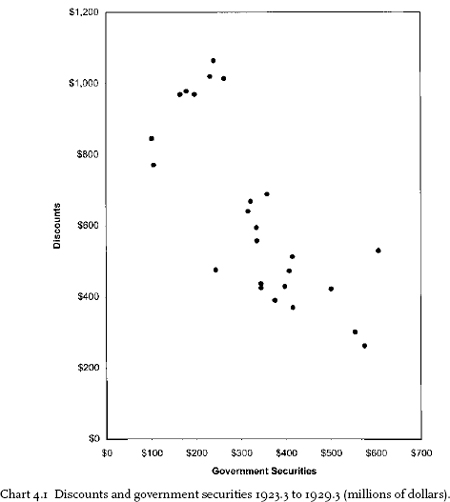
Chart 4.1 shows that the relation between discounts and government securities is negative in the 1920s. The bivariate relation is much less than one-to-one, however. On average, open market purchases reduce discounts by less than the amount of the purchase. A more complete analysis in appendix A allows for other relevant factors and casts doubt on the posited relationship.38
The discount rate has an ambiguous role in Riefler-Burgess. At times its role is modest; open market operations drive banks to borrow and repay at the prevailing rate. More often, open market operations prepare the way for discount rate changes. Strong testified in 1926 that the Federal Reserve continued to study and learn but had reached some preliminary conclusions:
If speculation arises, prices are rising, and possibly other considerations move the Reserve banks to tighten up a bit on the use of their credit, and we own a large amount of Government securities, it is a more effective program, we find by actual experience, to begin to sell our Government securities. It lays a foundation for an advance in our discount rate.
If the reverse condition appears, …then the purchase of securities eases the money market and permits the reduction of our discount rate. (House Committee on Banking and Currency 1926, 332–33)
The Riefler-Burgess doctrine was compatible with the real bills doctrine and the Federal Reserve Act, but it permitted activist policymaking. Open market operations could be conducted so as to accommodate agriculture and commerce, as the act prescribed, but they could also be used for other purposes. However, nothing in either the Riefler-Burgess or real bills doctrine distinguished between real and nominal interest rates, a major reason for later misinterpretation of policy.
The “reluctance” view of borrowing is the weak link in the Riefler-Burgess doctrine. Banks borrowed heavily in 1920–21, when it was profitable. The Board’s annual reports and statements of members during the next few years seem intended to inform banks of the “tradition” against borrowing or to impose it on them through the administration of the discount window.39
Being able to control borrowing without large changes in discount rates had strong appeal. If interest rates could be held in a narrow range without jeopardizing control of inflation, System policy would be effective and criticism would be muted. Until the end of the decade, discount rates stayed within a narrow range, 3.5 percent to 4.5 percent at New York.
Neither Riefler nor Burgess completed the framework to link money, credit, interest rates, and borrowing to income and the price level. Instead, they relied on the real bills notion that if productive lending expanded at about the same rate as production, prices would be stable. It was an easy, but invalid, inference to rely on member banks’ borrowing or a market interest rate as the proper measure of the thrust of monetary policy. If borrowing and interest rates were low, policy was easy; if the two were high, policy was tight. By the mid-1920s, high and low borrowing were defined as member banks’ borrowing above and below $500 million.
The System had adopted measures of tightness and ease that misled them at critical times. A principal problem was the failure to distinguish between an individual bank and the banking system. An open market sale removed reserves, but if banks were induced to borrow, reserve bank credit and the monetary base remained unchanged. The increase in borrowing may have induced some banks to repay, as Riefler-Burgess claimed. But unless all banks behaved that way, others borrowed at the unchanged discount rate.
During many of the cycles in Federal Reserve history, both member bank borrowing and the monetary base moved procyclically, rising relative to trend in expansions and falling relative to trend in contractions. The Federal Reserve interpreted increased (reduced) aggregate borrowing as evidence of restrictive (expansive) policy even if the monetary base and the money stock accelerated (decelerated).
Differences in regional discount rates and in the reserve position of member banks produced a market innovation. In 1921 banks with surplus reserves—reserves above current and near-term requirements—began to sell reserves to banks with deficient reserves. These sales (or loans) and purchases made better use of existing reserve balances and supplemented the correspondent banking system as a means of putting idle balances to work. The market also supplemented the discount facilities.
The new market was known as the federal funds market (Board of Governors of the Federal Reserve System 1959). Banks with surplus reserves exchanged checks drawn on their accounts at a reserve bank for checks drawn on the purchasing bank payable through the clearinghouse the following day (or later). The difference between the two checks included interest for the term of the sale. Most transactions were made in New York, and transfers occurred on the books of the New York Federal Reserve bank.
Once the banks established the market, its convenience attracted other users. Acceptance dealers, commercial paper dealers, and others settled transactions in federal funds—reserve balances at Federal Reserve banks. Brokers began to canvass regularly.
The market languished in the 1930s. Early in the decade, risk increased as bank failures rose, so far fewer banks were willing to accept the default risk. Later, gold flowed in and excess reserves accumulated. The market disappeared until after World War II (ibid., 29–30).
GOLD POLICY
Although the United States remained on the gold standard, Riefler and Burgess did not dwell on the role of gold and did not state a policy with respect to gold. The explanation may be that both authors sought to develop policy guidelines in place of the gold reserve ratio. Nevertheless, gold policy played a secondary, but important, role in the 1920s.
A contemporary reader has difficulty comprehending the strength of commitment to the gold standard by bankers, officials, and many economists. Federal Reserve officials were unanimous in their commitment to restore some form of gold standard. Strong and others took many trips abroad, motivated in part by efforts to restore fixed parities tied to gold.
Montagu Norman, governor of the Bank of England, expressed an opinion representative of the ideas of informed central bankers. Failure to restore the gold standard would mean “violent fluctuations in the exchanges, with probably progressive deterioration of the values of foreign currencies vis-avis the dollar; it would prove an incentive to all of those who were advancing novel ideas for nostrums and expedients other than the gold standard to sell their wares; and incentives to governments at times to undertake various types of paper money expedients and inflation” (Chandler 1958, 311).
The ruling orthodoxy of the period sharply separated governments and central banks. The decision to fix the exchange rate was typically taken by the government. Central bankers negotiated support operations among themselves, usually keeping their governments informed about their progress. Continuing prewar practice, Strong was the principal negotiator of these agreements for the United States.
It is convenient to treat gold policy in the 1920 as three separate topics: the monetary response to changes in gold; circulation of gold and gold certificates; and actions to foster or sustain the gold standard. The last of these raises the issue of international cooperation, about which much has been written (Nurkse 1944; Clarke 1967; Eichengreen 1992).
Gold and Money
The Federal Reserve has been both criticized and praised for not following gold standard rules during the 1920s (Brown 1940; Keynes 1930). To contemporary observers at the Federal Reserve, the rules did not apply in the circumstances of the period. These officials believed that the gold reserve ratio was not an adequate policy indicator as long as no international gold standard existed. New procedures had to be found while they waited for, and worked toward, convertibility of the principal European currencies into gold and elimination of embargoes and other impediments to gold flows.
The problem, as seen in the early 1920s, was that the United States gold stock had increased much more than expected. By the end of 1921, the System’s gold reserve ratio reached 72 percent; it continued to rise in 1922, and by midyear it had nearly doubled from its low point in 1920. The Federal Reserve did not want to monetize the entire increase, as required under gold standard rules, both from fear of a new inflation and from concern about subsequent deflation if gold should leave when foreign governments restored an international gold standard. The Federal Reserve had used the fall in the gold reserve ratio as a main reason for raising interest rates in 1920. Many in Congress and the public interpreted the rising gold ratio as a signal that the Federal Reserve banks should lower interest rates in 1922.
At the beginning of 1923, discount rates at New York, Boston, and San Francisco were 4 percent, 0.5 percent below the rates at other banks. Concerns about inflation prompted these banks to consider raising the discount rate, as they subsequently did, despite their gold reserves. Concerns about public interpretations of the gold reserve ratio prompted the Governors Conference to approve a resolution urging the Board to issue a statement about the diminished importance of the gold reserve ratio (Governors Conference, March 28, 1923, 379). Case (New York) expressed the dominant view: “The average person cannot understand why we should be thinking of high rates with that reserve ratio” (ibid., 768).40
Contemporary observers report a difference in the Federal Reserve’s response to gold movements before and after 1925 (Hardy 1932, 148). Table 4.1 divides the period 1923–29 at the second quarter of 1925, the date at which Britain returned to the gold standard. These data support Hardy; the monetary base more fully reflected the gold flow in the earlier period, before the Europeans returned to the standard. Chart 4.2 gives more detail, using quarterly data for the period.41

If the Federal Reserve had followed strict gold standard rules, gold movements would be fully reflected as changes in the base, and changes in the base would reflect only changes in gold. All points in chart 4.2 would lie on a straight line through the origin with a unit slope. We know that the Federal Reserve allowed discounts and open market operations to change the base. The points in the upper left quadrant suggest that large gold inflows were more than offset at times; the lower right quadrant shows that the base could rise while gold flowed out, contrary to gold standard rules. Nevertheless, there is a weak but clear positive relation between current quarterly gold movements and current quarterly changes in the base for the period as a whole. The Federal Reserve did not follow gold standard rules, but it did not ignore them entirely in the short run.
Together the data in chart 4.2 and table 4.1 suggest that gold flows often affected the base on arrival. In this sense the Federal Reserve “followed the rules” to a degree, most likely as a result of fixing the interest rate on discounts and acceptances and allowing reserves to respond to unanticipated gold flows. After Britain returned to the gold standard, the long-term change in the base was independent of gold flows.42

Gold as Currency
One aim of the Federal Reserve Act was to pool reserves by centralizing gold holdings in the reserve banks. In its first decade, the System worked to achieve this objective by replacing gold certificates with Federal Reserve notes.
Policy changed in the 1920s. Unwilling to allow prices to rise and concerned about the political pressures to expand as a consequence of a high reserve ratio, the governors looked for ways to reduce the reserve ratio without inflating. Early in 1922 Secretary Mellon proposed to substitute gold certificates for Federal Reserve notes. Gold certificates had 100 percent gold backing instead of the 40 percent behind Federal Reserve notes, so they reduced the gold reserve but had no effect on money or inflation.
The Federal Reserve was at first reluctant to change its policy of centralizing the gold reserve. Miller proposed instead raising the 40 percent gold reserve behind currency issues. This proposal, like Mellon’s, seemed too transparent to defuse political pressure. A second alternative kept the gold in Europe on “earmark” and, by ruling of the Board, excluded from reported gold reserves. At first the amount earmarked was relatively small, $20 million or less. Earmarked gold rose to $50 million in 1924–25 and again in the first half of 1926. The maximum during the decade was $200 million, about 5 percent of the monetary gold stock.
Despite Mellon’s request, in May 1922 the Governors Conference approved a proposal that made issuing gold certificates to the public a last resort. Gold inflows continued. In August, New York began issuing gold certificates and sent a letter to the Board asking all reserve banks to do the same. The other large bank, Chicago, did not accept the policy until February 1924, after repeated requests from Undersecretary Gilbert at the 1923 Governors Conference and by letters. The two banks had issued over $700 million in certificates by the end of 1924. The gold flow then reversed, so after discussion with the Treasury, Strong changed policy. The new policy kept total gold certificates equal to $1 billion, the amount outstanding in 1925. This policy remained in effect until mid-1928 (Governors Conference, March 1926, 126–29).43
In testimony before the Royal Commission on Indian Currency and Finance in 1926, Strong gave four reasons for changing gold certificate policy in 1922. First, the amount of gold certificates in circulation had fallen to $170 million; continued reduction might give gold certificates a scarcity value relative to Federal Reserve notes. Second, although the economy was recovering from the 1920–21 recession, “there was prevalent, especially in the agricultural sections, a feeling that possibly it would be a good thing for the country to have some expansion of credit” (Strong 1930, 301). Third, to restore the working of the gold standard, a country like the United States could fix the amount of gold in domestic circulation and permit inflows and outflows to be reflected in the monetary base. Fourth, he feared that the high reserve ratio would become the norm, so that a reduction from 85 percent to 65 percent would be considered serious (301–2).
Strong gave greatest weight to his third reason, letting the monetary base respond to gold movements, although the Federal Reserve did not follow this policy subsequently. His reasoning probably reflects the period in which he spoke, after Britain had returned to gold. Initially, the principal concern was the pressure from agricultural representatives to expand credit.44
The net new issues of gold certificates, about $800 million from 1922 to 1926, equaled about 20 percent of the gold reserve. Together, the policies of earmarking gold and issuing certificates reduced the gold reserve by about 25 percent at peak issuance.
Restoring the Gold Standard
The Federal Reserve consistently favored restoration of the gold standard in the principal countries, and it worked toward that end as long as it was consistent with domestic policy.45 At the end of the war, this meant that foreign governments had to either deflate or devalue prewar parities. Britain chose deflation; France, Germany (and others) chose devaluation.
Wholesale prices in Britain had increased 115 percent from the beginning of the war (August 1914) to March 1919, when the pound was allowed to float. In the following year, the pound declined 30 percent against the dollar. Devaluation and the effect of removing wartime price controls contributed an additional 40 percent price increase. From this inauspicious starting point, the Bank of England began to reestablish the prewar parity at $4.86 per pound by deflating rapidly. By the end of 1922 the Sauerbeck index (1867–77 = 100) had fallen almost 50 percent, from 251 to 131. At the 1922 level, the index was lower than in 1925, when Britain restored convertibility. The dollar exchange rate reached $4.61 per pound.
Achieving the remaining 5 percent appreciation took more than two additional years. Political and economic tension over reparations, including occupation of the Ruhr by French and Belgian troops, contributed to the fluctuation in the European exchange rates against the dollar during this period. The Dawes Plan of 1924 rescheduled reparations payments and provided loans to Germany that removed a major source of instability, at least for a time, by ensuring prompt payment of reparations and wartime debts.46
Germany’s return to the gold standard, or more accurately, the gold exchange standard, put pressure on Britain.47 Further, the British embargo on gold exports expired at the end of 1925. Aided by lower rates in the United States and speculation that the embargo would not be renewed, the pound rose toward its prewar parity (Howson 1975). On April 28 Winston Churchill, chancellor of the Exchequer, announced that Britain would not extend the embargo. This decision made the pound convertible de facto. Two weeks later Parliament passed the Gold Standard Act of 1925, restoring the prewar parity de jure.48
To achieve and maintain the $4.86 parity, the Federal Reserve offered the Bank of England a two-year standby loan of $200 million. On two occasions, 1924 and 1927, to help Britain it encouraged gold exports from the United States by lowering interest rates.49
The financial press and Congress criticized the loan as beyond the authority of the New York Federal Reserve bank.50 Strong responded at length in congressional hearings (House Committee on Banking and Currency 1926). The loan was secured by British Treasury obligations, payable in dollars. Governor Crissinger of the Federal Reserve Board had been present when it was discussed, and he had asked for and received approval from all members of the Board. The Open Market Investment Committee approved the loan unanimously, with Secretary Mellon present: “Mr. Mellon asked specifically if there were any objections to the arrangement …and the making of the commitment, and no objection being made, he stated it was understood that I was to go ahead” (Chandler 1958, 315).51
International Cooperation
As part of its policy to help countries return to the gold standard, the Federal Reserve lowered discount rates in August 1924. The United States was in recession, so the System had a domestic as well as an international reason for acting. Wicker (1966, 77) claimed that “the desire of the Federal Reserve Bank of New York to establish a rate spread between New York and London to encourage capital outflows and reduce gold imports was indeed the chief determinant of policy. It was not, however, the only one.”52 Chandler (1958, 241) was at the opposite pole, claiming that the policy was mainly an anticyclical policy that also was expected to encourage a capital outflow. This was also the view of Hardy (1932, 108), who found “a great deal of exaggeration” about the attention given to international considerations in setting Federal Reserve policy. Hardy recognized that Strong held such views, and stated them often, but he noted correctly that there was little evidence that other members of the OMIC shared them. They agreed on the desirability of reestablishing the gold standard but were more skeptical about using policy actions to help the British. Friedman and Schwartz (1963, 269) agreed with Hardy.

Chart 4.3 leaves no doubt that the spread between short-term rates in London and New York turned sharply in favor of capital flows to London during the summer and fall of 1924. The spread again moved in favor of Britain in the summer of 1927, the second occasion that some observers cite as evidence that international considerations had an important influence on United States policy. The covered interest parity shows the same general pattern, though the changes are smaller (Clarke 1967, 129). The difficult problem for an international explanation of policy action is that the spread reversed early in 1925, just as Britain was about to restore the gold standard. The reason for the reversal was a rise in the discount rate in New York on February 27, two months before the British decision. The reversal came for domestic reasons. The trough of the recession had occurred the previous July. By early 1925, recovery and expansion were well under way and the price level was rising. Despite the emphasis Strong gave to capital movements and restoration of the gold standard, he did not hesitate to raise the New York discount rate. This action required Norman to raise rates in London by 1 percent in early March to keep the spread in favor of London. Strong was fully aware that the British decision on gold was imminent; he was negotiating the standby credit at the time.
With hindsight, Strong told Congress in 1926 that policy in the summer of 1924 might have been too expansive for too long: “I think myself, if it were to be done over again, we might have stopped a month earlier or even sixty days earlier. We might have bought $50 million or even $100 million less, but there is no mathematical formula that will tell you where to stop or to begin” (House Committee on Banking and Currency 1926, 336). In a memo to his files written in December 1924, he defended the policy as a response to the recession in business starting in the fall of 1923 and problems in the farming and cattle industries. These “became perilously near a national disaster, and feeling became so strong throughout the West that all sorts of radical proposals for legislation and other government relief were being urged” (quoted in Chandler 1958, 242). The memo mentioned international considerations as a third reason for open market purchases “when [domestic] prices were falling generally and when the danger of a disorganizing price advance in commodities was at a minimum and remote” (243).
What remains of the role of international cooperation as a reason for easing policy in 1924? In his testimony to Congress, and in his conversations with Norman about the stabilization credit, Strong always insisted that international cooperation could not run counter to domestic policy considerations.53 Control of domestic inflation had priority for both political and economic reasons. Strong and others understood that a 10 percent United States price increase would make restoring the international gold standard easier, particularly for Britain. The Federal Reserve might have defended such action by appeal to gold standard rules or to the gold reserve ratio. Instead, Strong made price stability a more important goal and sought to avoid a repetition of the damaging 1920–21 inflation cycle.
Again in the summer of 1927, international cooperation played a role during a recession and at a time of falling prices. The Federal Reserve made larger than seasonal open market purchases during the fall, and all reserve banks reduced discount rates by 0.5 percent, to 3.5 percent, in August and September.54 Once again, the gold inflow reversed after the policy change.
The 1927 reduction in discount rates was part of an agreement between Strong, Norman, Governor Hjalmar Schacht of the Reichsbank, and Deputy Governor Charles Rist, acting for Governor Émile Moreau of the Bank of France, made at a secret meeting in New York held in July.55 Capital flows to Germany, fiscal reform and stabilization in France in the summer of 1926, the aftermath of the 1926 British general strike (implying that further deflation was unlikely), and continued gold flows to the United States weakened the British position. French interest rates were considerably above rates in Germany, Britain, or the United States, adding to the British problem of attracting short-term balances from abroad. Between January 1926 and February 1927, the Reichsbank reduced its discount rate in steps from 9 percent to 5 percent to slow its capital inflow (Board of Governors of the Federal Reserve System 1943, 656). The reductions soon produced a short-term capital outflow and a fall in the Reichsbank’s gold reserve that threatened its gold parity. Higher German rates, widely expected, implied increased short-term capital flows from Britain to Germany (Clarke 1967, 114). By the end of 1927, the German discount rate was back to 7 percent.
In May the Bank of France began to sell pounds against gold, withdrawing gold from the Bank of England and weakening the British position. Both central banks wanted the capital flow to slow or stop, Moreau because he resisted both appreciation of the franc and inflation, Norman because a large loss of reserves would force Britain to raise interest rates or suspend gold convertibility. At a meeting in late May at the Bank of France, Moreau told Norman that France would stop exchanging pounds for gold if Britain increased its discount rate. Norman responded that an increase was difficult given the weak state of the British economy. He told Moreau that the French capital inflow would not be solved by higher rates abroad. Moreau’s notes of the meeting record Norman’s comments:
Is it surprising that …you have an influx of capital! …Never before have such favorable conditions existed. 6½% for life with, in addition, the hope of a premium on the revalorization of the currency which may be considerable! In these circumstances, it is a hopeless task to check the influx of foreign exchange whatever you do….
If you buy gold in order to cut short credits for speculation, people will say: “The franc has more gold behind it, it is therefore worth more.” If you abolish the law on the export of capital, many Frenchmen will conclude that there is no longer any risk in repatriating and they will bring their money back….
At all costs reduce the price of money. (Moreau 1954, as quoted in Clay 1957, 231)56
Norman hoped to end speculation that the franc would appreciate by having Moreau announce that France would maintain its exchange rate. Instead, the Bank of France lowered its official discount rate to 5 percent. By late summer, open market rates had fallen to 2 percent (Board of Governors of the Federal Reserve System 1943, 656). Norman argued that any British rate increase must come later, after the British economy improved. He feared riots if he raised interest rates at once, but he promised to raise the discount rate a full 1 percent if conditions in industry improved (Clay 1957, 231).
The central bankers’ meeting in New York began on July 2 and continued through the week. To maintain secrecy about decisions, the group met at the summer home of Ogden Mills, undersecretary of the treasury.57 It did not keep minutes, and members of the Board were not informed about the agreements.58 After the meeting, on July 9, the central bankers met with the Board and Treasury officials in Washington but did not discuss details of the agreement.
Strong did not make notes of the New York meeting. Our information comes from Moreau (1954, 367–72) and Clay (1957, 237). The conference considered four problems: discount rates, gold movements, the poundfranc relation, and the worldwide decline in commodity prices. Strong offered to lower the discount rate to 3.5 percent, citing domestic reasons for the action. This pleased the British and Germans but not the French, who favored higher rates in Britain and Germany as a classical response to a weakening currency.59 Strong offered to sell gold to France and Germany at a price equal to the London price and absorb the extra transport cost; Germany and France agreed to buy gold in New York under these conditions.60
After the meeting, the Federal Reserve banks reduced discount rates and began large-scale purchases of acceptances and government securities, and the Bank of France began forward sales of French francs and purchases of pounds in the Paris market.61 The capital flow reversed. The pound rose to the highest value reached since the war, and gold flowed to London. By year end, cooperation—both Federal Reserve and French action—appeared to have improved the foreign exchange position of the Europeans and encouraged domestic expansion in the United States. Despite Norman’s statements to Moreau in May, Britain maintained the 4.5 percent discount rate unchanged until February 1929. France lowered its discount rate to 4.5 percent in December.
Eichengreen (1992, 213) regards this episode as “an admirable instance of international cooperation.” There is ample evidence in the minutes that international considerations influenced the decisions as to timing and magnitude of the actions and the uniform reduction in discount rates at reserve banks. Although some officials justified their votes by appeals to the beneficial effects on the sale of United States crops abroad and others were influenced by falling commodity prices, the minutes report that
the most important consideration at the meeting was undoubtedly the fact that the differential between the rates in New York and the rates in London was not today sufficient to enable London, and therefore the rest of Europe, to avoid general advances in rates this autumn unless rates here were lowered, and the consequence of such high rates as would result in Europe would be unfavorable to the marketing of our export produce abroad and would have an adverse effect generally on world trade. (OMIC Minutes, Board of Governors File, July 27, 1927)62
Federal Reserve action improved the short-term problem but did nothing about the long-term problem.63 French and British exchange rates were misaligned relative to gold, the dollar, and each other. The franc had depreciated officially by 80 percent, the pound not at all. After adjusting for price level changes, the franc was undervalued, the pound overvalued. Sooner or later, capital was bound to flow from Britain to France, the United States, and elsewhere.
Cooperation had not resolved the basic problem. Although the governors discussed falling commodity prices at the July meeting, they did not discuss a policy to stabilize price levels and exchange rates. Short-term concerns dominated a long-term solution. A choice had to be made between parity changes and price level changes. Both were ruled out politically. Neither France nor Britain was willing to adjust its exchange rate. Britain was unwilling to deflate further; France and the United States were unwilling to inflate. Temporary United States interest rate reductions, United States loans to Europe, or French decisions to buy gold in New York rather than London, as in 1927, could postpone but not prevent a long-term solution. If governments maintained the misalignment, the only issue was when financial markets would begin to force price level or parity changes.64 The answer, we know, was September 1931, when Britain left the gold standard.
Breakdown
The Board’s annual report for 1928 defended the 1924 and 1927 actions as factors “favoring the redistribution of gold [that] …contributed to the maintenance of the gold standard [and] …reduced the fluctuations of the exchanges to a range within the gold points” (Board of Governors of the Federal Reserve System, Annual Report, 1928, 16).65 By emphasizing the distribution of gold instead of the exchange rate misalignment, the Board’s statement overemphasized the benefits of short-term activist policies while neglecting the long-term problem. The same mistake was repeated in the 1960s in the efforts to “save” the Bretton Woods system of fixed exchange rates without correcting the misalignment of exchange rates.
The Board was not alone. Many observers at the time saw the maldistribution of gold as the core problem, just as they were to regard the “shortage” of gold as the core problem of Bretton Woods (League of Nations 1932).66
The distribution of monetary gold stocks had changed from prewar values. Table 4.2 shows the principal changes for the United States, Britain, and France. Estimates for the world are imprecise, but greater precision is unlikely to change main conclusions: Britain had a larger relative share in the 1920s than in 1913; France had restored its 1913 share by 1928; the combined United States and French shares rose from 50 to 55 percent in 1929, draining gold from the rest of the world; and the most significant change during the years 1926 to 1931 was the relative and absolute increase in French gold holdings.
The French view of the period 1927 to 1929 claimed that purchases by the Bank of France “tended to establish a better balance in the world’s distribution of gold” (Aftalion 1931, 8). After the de jure stabilization of the franc in June 1928, the Bank of France was no longer permitted to purchase foreign exchange. Foreigners had to pay in gold: “It was hoped, however, that foreign banks of issue, by raising their discount rates, would prevent the flight of their gold to France.” Writing soon after these events, Aftalion recognized the overvaluation of the franc, but he saw the solution as coming principally from an end to British investment abroad, not a change in French policy (8–10).
Despite the gold inflow, French wholesale prices, after declining rapidly in 1926, remained unchanged between the de facto stabilization in December 1926 and March 1929. In the next eighteen months, wholesale prices fell 16 percent, a compound annual rate of 11 percent a year, somewhat faster than the decline in the United States during the same period (League of Nations 1932, 46; Aftalion 1931, 10). Stable or falling prices refleeted the combined effect of increased demand for francs by domestic and foreign holders after stabilization and the policy of the Bank of France.67
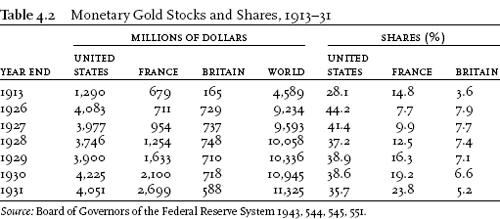
The law required the Bank of France to stop purchases of foreign exchange after June 1928. It did not require sales. Between 1928 and 1932, France reduced the share of foreign exchange in central bank reserves from 51 percent to 5 percent, an aggregate sale of more than $1 billion, 9 to 10 percent of the world gold stock. Many other countries reduced foreign exchange reserves in 1931, anticipating or following the British devaluation. France began large-scale sales of foreign exchange for gold in 1929 and continued to sell throughout the period (Nurkse 1944, app. 2, 234–35).68
French policy and French growth redistributed gold from the United States to France in 1928. In the next three years, France and the United States absorbed gold from the rest of the world. The redistribution toward France made the gold standard more deflationary after the French stabilization than before.
The French response to criticism denied the relevance of the quantity theory of money, linking prices to past or current changes in money and gold, and cast doubt on any effect of higher discount rates on price levels. The Bank of France kept its discount rate below the levels in other countries, and the government reduced taxes on sales of foreign securities in the French market to stimulate capital exports (Aftalion (1931, 11–13). But the bank’s sales of foreign exchange dwarfed any effect of these efforts.69
The particular crises that ended the interwar gold standard, in the summer and fall of 1931, have been analyzed many times, for example in Eichengreen (1992). The timing of these crises depended on the patterns of lending and borrowing that helped to sustain the system in the late 1920s and the subsequent reduction in lending. In this sense, international cooperation to “rescue” currencies by larger loans from surplus countries could have kept the system viable for a longer time. Without a willingness to permit price levels and exchange rates to adjust, crises seem to be the inevitable, but costly, means of adjusting exchange rates.
Federal Reserve policy of restoring the gold standard and maintaining stable prices failed. The principal fault was not insufficient cooperation but failure to follow the rules.70 The United States and France shared responsibility, but Britain’s (and other countries’) unwillingness to deflate also contributed. When Britain abandoned the gold standard on September 21, 1931, the London Times wrote:
The international economic crisis has played a large part in the temporary abandonment of the gold standard. The responsibility for this belongs to those countries that have hoarded gold on an unprecedented scale…. Prohibitive tariffs keep out goods, and unless the creditor nations relend the credits due to them, the debtor nations must pay in gold to the extent of their resources and then default. The gold standard game can only be played according to its well-proven rules. It cannot be played on the new rules practiced since the War by France and the United States. (Quoted in Crabbe 1989, 434)
PRICE STABILITY AND POLICY RULES
Inflation and deflation in 1920–21 heightened interest in the Federal Reserve’s choice of policy objectives. Some economists, influenced by Irving Fisher’s work on the purchasing power of money, favored price level stability as the main goal of Federal Reserve policy. Others supported price stability as an interim solution, pending the return to an international gold standard.
The severity of the inflation-deflation cycle, particularly in the heavily agricultural regions, gave popular support and created political pressure for stable prices. Stable money societies, influenced and encouraged by Fisher, campaigned actively for price stability. With the return of price stability during the 1920s, the Federal Reserve received credit for the more stable conditions; this encouraged advocates of a congressional mandate to believe that a stable price level rule was feasible.71
Congress held hearings on legislation setting price stability as the policy goal in 1922–23, 1926–27, and 1928. With the important exception of Benjamin Strong in 1928, all Federal Reserve officials and staff opposed the legislation, and it never became law.72 The extensive hearings go much beyond the reasons for the Federal Reserve’s opposition; Strong, Miller, and others from the Board and the reserve banks explained how monetary policy worked and the reasons for specific policy actions. The testimony showed the deep divisions and confusion within the system about how to conduct monetary policy.
In 1922–23, the Banking Committee considered House Resolution 11788, Irving Fisher’s proposal for a compensated gold dollar. The resolution, offered by Congressman T. Alan Goldsborough of Maryland, would have replaced the fixed price of gold, $20.67 per fine ounce, with a fixed number of grains of gold, the number of grains to be adjusted every two months based on changes in a basket of one hundred wholesale prices. The proposal restricted the maximum adjustment at each two-month period to 1 percent. If the wholesale price index rose, the relative value of gold declined, so the number of grains of gold had to increase to keep the real purchasing power of money constant. Conversely, a decline in the price index required a reduction in the number of grains of gold in a dollar.
Fisher testified at length, explaining the proposal, the benefits of the standard, and the advantages of price stability. He lectured on the differences between nominal and real interest rates and the effect of inflation on nominal rates, a topic that does not appear in Federal Reserve discussions for the next forty or fifty years (House Committee on Banking and Currency 1922–23, 13–14).73
The witnesses who criticized the proposal emphasized the uncertainty and unreliability of price index numbers. Federal Reserve officials did not testify at these hearings. At the time they had not formulated either the Riefler-Burgess doctrine or the policy statement in the tenth annual report. The hearings forced them to recognize the need for publicly stated guides or policy indicators to replace the gold reserve ratio.
Soon after the congressional hearings ended, the governors discussed a proposal by Professor Charles Bullock of Harvard that they announce the factors affecting discount rate changes. Anticipating later arguments about the importance of credibility, Bullock argued that the announcement would benefit businesses by letting them know how the discount rate would change in the near term. The statement would not be a precise rule, but it would require the System to name the factors that replaced the gold reserve ratio as an indicator of policy action.
Case, who substituted for Strong at the meeting, favored the proposal. He listed the main factors: the volume of credit relative to production, interest rates on various classes of paper, and gold movements. Most others opposed. Governor Seay (Richmond) expressed the dominant (and classic) view: “It is never the custom …for central banks to give out to the public their reasons for raising rates” (Governors Conference, March 1923, 46).
Nothing more was done until Congress called for hearings on stabilization policy in 1926–27 and 1928 to discuss an amendment to the Federal Reserve Act making price stability an explicit policy goal. The proposed legislation in 1926 added the words “promoting a stable price level for commodities in general” to section 14 of the act. The resolution also amended the purposes of the act by adding: “All the powers of the Federal Reserve System shall be used for promoting stability in the price level” (House Committee on Banking and Currency 1926).
The legislation was the work of Congressman James Strong, a Kansas Republican, who was influenced both by the events of 1920–21 and by Fisher’s work.74 In addition to Congressman Strong, members of the House Banking Committee included eight Democrats, five from cottongrowing states, and thirteen Republicans, about half from other heavily agricultural states. Their presence on the committee contributed to the wariness with which Federal Reserve officials considered the legislation.75
The bill generated unanimity within the Federal Reserve on the need to avoid any “mechanical formula” for setting policy and on the inapplicability of the quantity equation as a guide to price stability. Beyond that, there was not much agreement about how policy should be conducted. Although the spokesmen for the Board and the reserve banks opposed the bill, their reasons differed in several ways.
Strong’s Testimony
Governor Strong gave three main reasons for opposing the Strong bill. First, the mandate was difficult to carry out precisely because monetary velocity was unstable. The price level depended on velocity, and velocity depended on confidence or, in modern terms, anticipations (House Committee on Banking and Currency 1926, 482).76 Second, changes in money, or credit, were one of many factors affecting the price level.77 Third, as noted, he feared that price stability would be interpreted as the stability of individual prices, particularly agricultural prices: “Much of the discussion of prices recently has arisen from the great misfortune which the farmers of the country have suffered, which we all recognize and deplore. If the Federal Reserve Act is amended in these words, is it possible that the farmers of the country will be advised, or will be led to believe upon reading it, that a mandate has been handed to the Federal Reserve System to fix up the matter of farm prices?” (House Committee on Banking and Currency 1926, 293).
A member of the committee reminded Strong that the bill referred to the price level, not prices in general. Strong was not persuaded. He doubted that noneconomists would recognize the distinction (ibid., 293).
Strong used the opportunity to cite the accomplishments of the Federal Reserve System and to criticize the real bills doctrine as a guide to policy. Using charts to drive home his points, Strong pointed out that the System had eliminated seasonal swings in interest rates, reduced the spread in rates between New York and Chicago (and by inference the spread with other regions) and between different maturities of commercial paper, and lowered the amplitude of interest rate fluctuations (ibid., 426).
The real bills doctrine offered no guidance. He insisted, repeatedly, that the Federal Reserve could control the quantity of credit, not the type of credit outstanding. Asked by a congressman whether the Federal Reserve could direct the way credit was used, Strong replied: “We have no power to do that” (ibid., 260).78
Although Strong opposed the bill, he favored the principle that the bill represented. His testimony included several offers to help the committee redraft the bill and remove his objections, despite his conviction that the legislation was unnecessary (see, inter alia, House Committee on Banking and Currency 1926, 517–18). He told the committee that restoring the international gold standard was a better solution to the problem that concerned them: “I earnestly believe that the greatest service that the Federal Reserve System is capable of performing today in this matter, is to hasten …monetary reform in the countries that have suffered from the war. We can not do it until the time is ripe, and the conditions are favorable in each country” (518).79
Miller’s Testimony
Miller’s testimony differed markedly from Strong’s. He emphasized accommodating the needs of commerce and preventing speculative uses of credit. He rejected the price level as a policy objective, and he used the opportunity to urge Congress to increase the authority of the Federal Reserve Board over credit decisions. Where Strong, the practical banker, looked for principles to guide policy, Miller, the trained economist, came close to denying that such principles existed.
Miller’s response to the central issue before the committee used a quotation from the Board’s tenth annual report: “No credit system could undertake to perform the function of regulating credit by reference to prices without failing in the endeavor” (House Committee on Banking and Currency 1926, 634). The reason he gave was that the price index records an “accomplished fact.” Credit administration could be based only on judgment. He quoted from the tenth annual report on the role of judgment and the importance of judging each set of circumstances separately:
The Chairman: You [the Federal Reserve] have not, I understand from what you have just said, a definite plan on which you work in dealing with the question of stabilization?
Doctor Miller: We have nothing with reference to stabilization of prices as such.
The Chairman: You deal with the situation as the conditions are presented to you?
Doctor Miller: We deal with the credit situation.
The Chairman: And there is a good bit of human equation there in dealing with the subject, is there not?
Doctor Miller: Yes…. I think it is important to realize that no two situations are identical. They do not repeat themselves with such accuracy that the method by which you successfully deal with one situation will insure an equally satisfactory result in another situation. (Ibid., 636)
Asked for what end the System regulated credit, Miller replied: “To the end of ‘accommodating commerce and business’ as the act instructs” (ibid., 637). How did it decide when to act? “I should say, gentlemen, that action by the Federal Reserve Board usually lies midway between a deliberate or calculated action, such as is taken with full appreciation of the consequences, and what you may call unconscious action. I could not undertake to give any clear definition of just what considerations move my colleagues from time to time” ( 647).
Miller, like Strong, argued that restoring the international gold standard would restore price stability.80 But he saw risks in restoring the gold standard that Strong neglected. The principal risk he cited was that the demand for gold by countries restoring gold convertibility could cause a worldwide tightening of credit. Miller compared the current period to the years 1870 to 1880, when many governments restored or joined the gold standard. He concluded: “While the gold standard had very much of the quality of an automatic regulator before the war, it would never do to trust purely and in all situations to devices automatic or quasi automatic in their qualities” (ibid., 695). Miller thought that the price index was the wrong target. Price increases came late.
To the extent that the Federal Reserve System can do something useful and constructive …, it has got to have a far more competent guide than the price index offers….
Assuming that we want price stability—I prefer to put it as I have already put it, economic stability with price stability as a concomitant or resultant of that—in order to obtain it we have to look at things closer to the source or beginning of troubles than the price index….
If you are to have competent control of credit, you cannot wait until inflationary developments register themselves in the price index. By that time the thing will have already gotten considerable momentum. (Ibid., 837–38)
Controlling inflation did not depend on the quantity of money or credit. Miller’s remarks on expectations and speculation paralleled many statements by Latin American officials and economists in the inflating economies of the 1970s and 1980s. Inflation was a “vague term” without “precise or generally accepted meaning.” He discussed one type of inflation, inflation due to rising expectations. Businessmen observed “a disturbance in the market for a commodity or group of commodities…. You have an inflated state of commercial expectation that leads men to make plans and conceive projects and then make commitments and then, only after a lapse of considerable interval, does [the] thing [inflation] show itself in the form of a demand for increased credit…. By that time the thing will have already gotten considerable momentum” (ibid., 838).
Miller had rejected the quantity theory in the tenth annual report. In the 1928 hearings on a revised version of the Strong (Kansas) bill, Miller rejected the theory because it had two incorrect assumptions: “Changes in the level of prices are caused by changes in the volume of credit and currency; …[And] changes in the volume of credit and currency are caused by Federal Reserve policy. Neither one of those assumptions is true of the facts or the realities” (House Committee on Banking and Currency 1928, 109).
Later, returning to the role of money, Miller explained the irrelevance of the money stock in words that Federal Reserve officials repeated many times in the next fifty years: “The total volume of money in circulation is determined by the community. The Federal Reserve System has no appreciable control over that and no disposition to interfere with it” (ibid., 180).
For Miller, the way to provide economic and price stability was to prevent speculation based on credit. The Federal Reserve must “stop and absolutely foreclose the diversion of any Federal Reserve credit to speculative purposes” (ibid., 671).
Miller used the two hearings to comment on his colleagues, the role of the Board, policy in 1927, and the role of open market operations. Unlike Strong and the reserve bank governors, he claimed not to fear political influence on the Federal Reserve Board. Washington was the right place for the Board. The threat to good Federal Reserve policy came from bankers, not politicians: “The atmosphere of Washington keeps an administrative body on its feet, keeps them alert …I am not at all afraid of politics getting into the Federal Reserve Board because the Federal Reserve Board has its headquarters in Washington. I would be afraid of banking and financial interests getting undue preponderance in the deliberations of the board if the board were located in one of our great financial cities” (House Committee on Banking and Currency 1926, 727).81
Miller urged the committee to strengthen the Board’s role in policymaking, especially over open market operations (ibid., 678–79, 865–66). To strengthen his case, he criticized Strong’s 1927 open market purchases and blamed the policy for stock exchange speculation, neglecting to note that he had voted for the policy: “The money that was released by the Federal Reserve banks to the market through its policy of open market purchases had to go somewhere….[T]he low money rates that resulted from Federal Reserve policy, in the light of subsequent developments, appear to have been particularly effective in stimulating the absorption of credit in stock speculation” (House Committee on Banking and Currency 1928, 172).
Earlier in the hearings he had urged a return to reliance on the discount rate as the principal policy instrument: “I am of the opinion that openmarket operations have been the cause of almost as much mischief in credit and economic situations as of good” (ibid., 125).
This was not a new view. Miller had written much the same in an article explaining Federal Reserve operations (Miller 1928). There he restated the “needs and reluctance” view of borrowing. The economy required “a credit control device less leisurely in character and less openly deliberate than that of the discount rate” (75). This was an “expedient solution” to a temporary problem. With the restoration of the international gold standard and recovery of the world economy, “primary reliance in the future will be [on] the discount rate rather than the open market operation” (75).
Other Testimony
The committee heard from many other witnesses, including other Federal Reserve officers and officials, economists, and bankers. Irving Fisher supported the bill but urged the committee to attach the Goldsborough bill for a compensated dollar.82 Price stability could not be achieved without a rule of that kind. Fisher argued that the Federal Reserve had worked to stabilize the price level but refused to admit it. Oliver M. W. Sprague opposed the bill but favored “avoidance of considerable advance in the general level of prices” (House Committee on Banking and Currency 1926, 415). He opposed Fisher’s rule, or any other, on the usual ground that good policy required judgments not formulas.83
Governor Norris (Philadelphia) and Emanuel A. Goldenweiser were two of the more interesting witnesses. Their testimony suggests the level of understanding reached by officials and advisers outside New York. Norris testified against the bill. He regarded the bill as a doubtful and dangerous experiment (ibid., 395) The Federal Reserve dealt with currency and credit. Why was it asked to stabilize the price level? (384). Price stabilization, if it were to be done, should be left to the Commerce Department or the Bureau of Labor Statistics (395). Though a permanent member of the OMIC, he thought open market operations were too small to have an effect on credit supply. A committee member questioned his judgment:
Mr. Beedy: You would not deny that the purchase of Government securities, or the refraining from purchase …would either accelerate or retard the tendency [of prices and interest rates to change]?
Mr. Norris: It has an immediate effect on the volume and, therefore, to a certain extent on the price.
Mr. Beedy: It has a consequent proportional effect on the price.
Mr. Norris: I think before you translate those operations into an effect on credit and further dilute it by considering the effect of the cost of credit upon the cost of goods, it is very much like the homeopathic prescription of putting a drop of medicine in the Mediterranean and then a drop of that mixture in the Atlantic Ocean.” (Ibid., 391)
Other members of the committee joined the discussion, reminding Norris that changes in reserves increased credit by a multiple of the change in reserves. At last Norris admitted that open market operations could have an effect on credit supply, but he said they had been used “to take care of more or less temporary or local conditions” (ibid.).
Goldenweiser was the longtime director of the Board’s research division and one of its leading economists. Like Norris, he doubted there was any relation between open market operations and the price level. Asked by a committee member if supplying more credit would have “no appreciable effect on the price level,” Goldenweiser replied: “In general, I should say that is correct” (House Committee on Banking and Currency 1928, 46).
The 1928 Act
Irving Fisher wrote that Governor Strong favored the principle of the 1926 Strong (Kansas) bill but feared that legislation would be harmful. Fisher reported on a private conversation with Strong in which Strong threatened to resign if the bill became law: “If you will let me alone, I will try to do the best I can, but if you make me do by law what I am trying to do without legislative control, I will be so afraid that I cannot fill the bill that I will not accept the responsibility” (Fisher 1946, 3).84
Strong changed his mind in 1928, according to Fisher.85 He worked with Congressman Strong to redraft the 1926 bill and remove his three principal objections. As a result, the preamble to the revised bill included “to further promote the maintenance of a stable gold standard” and “to assist in realizing a more stable purchasing power of the dollar.” The bill itself directed the Federal Reserve to use its powers “to maintain a stable gold standard …[a]nd a more stable purchasing power of the dollar, so far as such purposes may be accomplished by monetary and credit policy” (House Committee on Banking and Currency 1928, 1, 5, 6). Congressman Strong met with the Reserve Board accompanied by Professor John R. Commons and, after discussion, made other changes to meet their objections.
Congressman Strong concluded his opening remarks at the hearings with a warning that was prophetic: “There is but one principal objection …that I would not meet in this bill …that the American people will not understand what is meant by the powers that they have given to the Federal Reserve System…. To my mind …that is not to be compared with the danger that may result from the failure to use these powers for the stabilization of the purchasing power” (ibid., 8).
The Board resolutely opposed the bill. Governor Strong began his testimony by noting that he spoke only for himself, not the System. He recognized that the new bill removed many of his earlier objections. Nevertheless, he did not endorse it. He preferred “a scientific application of the well-known principles of the gold standard” (ibid., 13). This would achieve “everything in the act” (17). He favored the gold standard because it was a rule that did not depend on human judgment: “When you are speaking of efforts to stabilize commerce, industry, agriculture, employment, and so on, without regard to the penalties of violation of the gold standard, you are talking about human judgment and the management of prices which I do not believe in at all” (21).
Governor Young of the Board testified for the Board, opposing the bill as requiring a central bank instead of an association of regional banks; reversal of the increases in agricultural prices that had recently occurred; and price fixing by the Federal Reserve. His arguments were superficial and showed little understanding. The first two arguments, however, appealed to widely held political views about a central bank and to the representatives of agricultural districts. Congressman Strong answered at length, denying Young’s claims by reading from the bill (ibid., 413–22). Young also defended the 1927 policy as “purely an American policy” to assist exports (415).
Miller’s testimony repeated many of the ideas he advanced at great length in the 1926–27 hearings. He continued to oppose the Strong (Kansas) bill. At one point he accused Governor Strong of not understanding the relation of Federal Reserve policy to price stability:
Mr. Strong: [T]he language you refer to has been dictated and suggested by members of the Federal Reserve System.
Doctor Miller: …The Federal Reserve System is a pretty big organization. There are many persons in it. We have a considerable number of amateur economists, and from my point of view they constitute one of its dangerous elements…. I venture to say that some of the men you have consulted do not know what this is all about. These are high sounding and captivating words you are using in your proposed statement.
Mr. Strong: Of course, one of them has been Governor Strong.
Doctor Miller: Of course, he is a very able man. But when it comes to economic insight and understanding …that is very unusual in any group of men anywhere. (Ibid., 212–13)
Miller’s views prevailed. The committee did not report the bill to the House. It is an understatement to say this was a missed opportunity. If the mandate for price stability had been passed and followed, the Federal Reserve could not have permitted deflation during the Great Depression of 1929–33 or inflation during the Great Inflation of 1965–80. Possibly a recession would have occurred in 1929, but the United States and the world would have avoided the deflationary policy and its consequences. The Federal Reserve would have had to choose price stability over the real bills doctrine and to lose gold, thereby reducing or preventing deflation elsewhere.
PERSONALITIES AND CONFLICTS
Miller’s testimony about Governor Strong suggests some of the rivalry and animosity between the two. As is often the case, the causes of the dispute were both substantive and personal, but it is not clear from the record which came first. Some of the differences had roots in the Federal Reserve Act itself. Miller resented Strong’s leadership in domestic and international policy, but he also believed that the Board, not the reserve banks, should lead the System. Only the Board considered the whole system.
Some of the substantive issues were the type that arise in many organizations. Particularly when discount rates were reduced, reserve bank governors often announced the changes, or leaked them to the press, before the Board acted. The Board believed that it was its prerogative to make these announcements. The governors complained that the Board acted as if it controlled rate changes, while the Board complained that the governors blamed the Board for discount rate increases when talking to member banks. The Board often irritated Strong and some of the other governors by delaying or modifying decisions about open market purchases.
The governors complained that the Board was not well organized, delayed decisions, failed to answer questions, and lost communications. Governor Crissinger, appointed by President Harding to head the Board, had no knowledge of central banking. William McChesney Martin Sr., who served at first as chairman and then as governor of the St. Louis bank from 1914 to 1941, described Crissinger as a “good natured man” but added that that was the only good thing that could be said of him (CHFRS, Martin, August 4, 1954, 2). Strong complained to Mellon about the Board’s functioning, but nothing was done until Crissinger resigned in September 1927 (Chandler 1958, 257).
Three more substantive issues underlay the antagonism between Strong and Miller. First, Miller was a firm believer in the power of the real bills doctrine and the importance of the quality of credit for controlling the quantity of credit and inflation. Strong recognized early in the decade that the marginal use of credit was unrelated to the type of paper a bank discounted. Second, Miller opposed reliance on open market operations to control the amount of credit and money. He favored reliance on discount policy and classical (British) central banking. Strong regarded the discount rate as a secondary instrument. He preferred to force bank borrowing and repayment by using open market operations. The Riefler-Burgess doctrine, with its emphasis on open market operations and quantitative control, could be called the Strong-Riefler-Burgess doctrine, to recognize Strong’s role in developing a policy framework based on observation and experience. Third, both Strong and Miller favored the restoration of the international gold standard, but Miller was skeptical about the relationship between Strong and Governor Norman of the Bank of England. He believed that Strong at times altered United States policy to benefit Britain, allowing the quantity and quality of credit to change unfavorably and inappropriately.86 This probably meant that Strong did not wait for banks to borrow or repay.
Oral transcripts of the recollections of Federal Reserve officers show Miller and Strong with powerful personalities. It is not hard to see why they would clash even if there had been no substantive issues. Both wanted to dominate decisions, but Strong was a decisive leader and Miller was not.
Charles J. Rhoads, the first governor at Philadelphia, who admired Miller, described him as “didactic,” “quite sure he knew the answer to every question” (CHFRS, Rhoads, June 29, 1955, 3). George L. Harrison, who worked at the Board as an attorney from 1914 to the mid-1920s before moving to New York, described Miller as unwilling “to admit that he was ever wrong” and difficult to persuade about the worth of an idea that was not his own (CHFRS, Harrison, April 19, 1955, 2).87
Unlike Miller, Strong had not gone to college and had not formally studied economics, but he had learned a great deal from his experience as a banker and central banker and from discussion with leading economists. Miller distrusted and possibly disdained this type of learning, and he envied the respect and acclaim that Strong received from economists such as Fisher, Sprague, and Bullock.
William McChesney Martin Sr. described Strong as ambitious personally and determined to make the New York bank the dominant force in the system. According to Martin, if the Aldrich bill had passed, Strong would have been the head of the central bank. The Glass bill created a regional system instead of a central bank, but Strong succeeded for a time in getting control (CHFRS, Martin, August 5, 1954, 2). Jay Crane, who worked in the New York bank from 1913 to 1935 and later became its chairman, described Strong as a powerful leader. He talked frequently about central banking with the junior staff who “sat at his feet and worshipped him” (CHFRS, Crane, March 5, 1954, 1). He was the only governor who tried to learn about central banking from European experience. Another officer of the New York bank, Leslie Rounds, referred to Strong’s great influence over policy and his clashes with Adolph Miller. But he also described Strong as certain that “he knew what was right” (CHFRS, Rounds, January 29, 1954, 3).88
George Harrison, who replaced Strong as governor, had a very different personality. Rounds described Harrison as diplomatic and thoughtful. Strong, he said, “moved directly from thought to speech,” whereas Harrison “thought first and talked afterward” (CHFRS, Rounds, January 29, 1954, 4).
On the critical question of whether Strong would have forced a change in policy in 1929 or after if he had lived, his contemporaries have mixed opinions. Rounds (CHFRS, May 2, 1955, 3) was uncertain whether Strong could have changed policy in 1928–29, but he believed that Strong would have insisted on an increase in the discount rate in 1929 (13).89 Roy Young was doubtful. Strong “thought he had more power in the System than he really had” (CHFRS, Young, March 1, 1954, 3). J. Herbert Case, one of Strong’s deputies, asserted the opposite (CHFRS, Case, February 24, 1954, 7). Several governors, led by Miller, blamed Strong’s policies, particularly the 1927 open market purchases, for the increase in speculative activity and the growth of stock exchange credit.90 He would have had difficulty persuading them to follow his (nonreal bills) policies again.91
Other active members of the Board and the banks at the time included Charles S. Hamlin, the first governor, who served on the Board from 1914 to 1936; Roy A. Young, governor of the Board from 1927 to 1930 and governor at Boston from 1930 to 1942; James B. McDougal, governor at Chicago from 1914 to 1934; and George R. James, a member of the Board from 1923 to 1936. Contemporary descriptions of these men give no evidence of leadership, understanding, or an ability to resolve the conflict between Miller and Strong.
Paul Warburg described Hamlin as a “second class Governor” (quoted in Yohe 1990, 479). Young reported that Hamlin seldom spoke at Board meetings: “He sat with his diary at hand and made notes” (CHFRS, Young, March 1, 1954, 1). Chester Morrill, in the Board’s Secretariat (secretary after 1930), claimed that Hamlin’s diary is “far from accurate as he grew older” (CHFRS, Morrill, May 20, 1954, 9). Others described him as “a man of no particular force who usually went with the majority” (CHFRS, Morgan, April 23, 1954, 5).
Harrison described Young as extremely stubborn and very vocal, and Young described James as “a diamond in the rough.” Meyer thought James lacked financial ability but was otherwise all right. Morrill held a very different view. He thought James had great respect for authority. Since Meyer was governor, James took Meyer’s word and spent no time studying issues. In return, Meyer sponsored his reappointment (CHFRS, Harrison, April 19, 1955, 2; Young, March 1, 1954, 1; Meyer, February 16, 1954, 6; Morrill, May 20, 1954, 6).92
James McDougal, the governor at Chicago, was a man of few words. Bentley McCloud, who served as McDougal’s assistant governor, said that if he was asked the time of day, he would not answer but would show you his watch. McDougal came to the Federal Reserve from the Chicago clearinghouse, where he had worked as an examiner. Meyer described him as “a mere bookkeeper” (CHFRS, McCloud, July 27, 1954, 5; Meyer, February 16, 1954, 5).
The other Board members during most of the 1920s were Edward H. Cunningham and Edmund Platt, the vice governor. Cunningham was a farmer who went into Iowa politics and was active in the American Farm Bureau. He filled the agricultural seat created after the 1920–21 deflation. He often opposed rate increases because he believed they hurt farmers and small businesses (Katz 1992, 67). He served from 1923 to his death in 1930. Platt’s biography appears above (see note 16). He was usually in favor of raising interest rates during 1927–29.
The general picture that emerges has two features. Many of the principals responsible for policy in the 1920s, and during 1929 to 1933, were weak men with little knowledge of central banking and not much interest in developing their knowledge. There were a few strong-minded individuals, but they were often at loggerheads. Policy decisions became a contest of wills between Strong and Miller and later between Miller, Meyer, and Harrison or Burgess.
Edward Smead, who served throughout the period as head of the Division of Reports and Statistics, described the scene. At first “Benjamin Strong was more powerful than anybody on the stage.” Later “Eugene Meyer was in constant opposition to Harrison in the New York bank” (CHFRS, Smead, June 14, 1954, 2).93 Meyer confirmed and strengthened Smead’s comments. During his period of service at the Board, he claimed, there was constant strife at the Board and ill feeling between the Board, New York, and Chicago. The “New York bank had built up its power entirely out of proportion with the intent of the Act” (CHFRS, Meyer, February 16, 1954, 4).
The struggle for power and control that was inherent in Wilson’s compromise had gathered momentum by the late 1920s. The Federal Reserve entered a critical period for policy decisions with a conflict that made decisions easy to postpone and left basic policy issues unresolved.
POLICY ACTIONS
New York and some of the Board’s staff followed the Riefler-Burgess doctrine as a general guide to policy actions. Miller relied mainly on the qualitative test, based on the real bills doctrine, underlying one part of the tenth annual report. Regional reserve bank governors were often more interested in their bank’s earnings than in issues of money or credit management. They were more willing to follow Strong’s leadership and participate in System policy when policy increased earnings. Those who voiced opinions about System policy usually held orthodox gold standard and real bills views.
The deflation of the early 1920s ended by 1922, but it continued to shape interpretations and actions. Many of the banks in the South and Middle West held distressed agricultural and livestock loans. The problem was particularly acute in the upper Middle West and in the northern plains states. Bank suspensions continued to rise, particularly in these states, during the middle twenties. As late as 1926, the peak year for suspensions in that decade, 976 banks with deposits of $260 million closed. More than one-third of the number of suspensions occurred in three states: Minnesota, Iowa, and South Dakota.
The potential political impact of agricultural interests heightened the effect of the regional economic problem. Since deflation was widely regarded as the inevitable consequence of prior inflation, avoiding inflation became a paramount interest. Strong had been impressed, however, by the reports of distress in agricultural regions during his appearance before the Joint Commission on Agricultural Inquiry and, despite concerns about inflation, he believed it was prudent to lean to the side of ease in 1922 (Burgess 1964, 223).
The 1923–24 Recession
The wholesale price index rose during most of 1922, sharply in the early part of the year, more slowly later. In the fifteen months ending in March–April 1923, the index (base 100 in 1913) increased from 140 to 160. Concern spread that inflation had returned.94
Although it was eager to take credit later, the Federal Reserve’s response was largely fortuitous. Under pressure from the Treasury, the reserve banks began to sell securities after May 1922. By the end of the year they had sold more than one-third of their holdings, $220 million. Sales continued in the first half of 1923. By June, System holdings were $150 million, one-fourth of their peak in May 1922. The System relied on discounts to satisfy seasonal credit demand in the fall. To the surprise of many in the System, after a small seasonal decline in January, member bank discounts continued to rise throughout the spring and summer.
The Federal Reserve increased discount rates at Boston, New York, and San Francisco by 0.5 percent in late February and early March. Rates were now uniform for all classes of paper, at 4.5 percent, at all reserve banks. Open market rates rose following the rise in discount rates.95
With market rates above the discount rate, prices and production rising, and speculation developing in stocks and commodities, Platt, the acting governor, wrote to Treasury Undersecretary Gilbert on March 24, 1923, reflecting the general uncertainty about how to conduct policy: “The old Bank of England guides appear to be inapplicable…. It may not always be necessary to have reserve bank rates above or exactly even with open market rates, but an increasing spread between them is certainly an invitation to inflation” (Board of Governors File, box 1240, March 24, 1923).
The March Governors Conference discussed additional discount rate increases. McDougal thought that economic conditions were similar to 1919–20. He favored an advance of 1 percent, to 5.5 percent, at all reserve banks. Calkins (San Francisco) and Norris (Philadelphia) were less aggressive, but both favored rate increases. Case thought another increase would be appropriate by mid-April. All other governors saw no reason for change. Chicago voted on April 6 to raise the discount rate to 5 percent, but the Board refused to approve the increase. The next day the Board sent a letter, proposed by Miller, to all reserve banks saying that discount rates should not be increased until the reserve banks had substantially liquidated their portfolios of governments. This was a reversal of traditional policy; open market sales were supposed to make discount rates effective. The new policy, under pressure from the Treasury, had the sales precede any increase in discount rates.
The Board’s correspondence leaves no doubt about the reason for the policy change. The Treasury continued to press the reserve banks to eliminate all government securities. On April 20 Platt wrote to Secretary Mellon, calling attention to the large open market sales in the previous year and pointing out that the System holdings of governments were about equal to the capital and surplus of the reserve banks. The reserve banks were eager to hold governments at this level to ensure sufficient earnings to pay dividends on their capital stock. They wanted the Treasury to agree that additions to surplus could be matched by increases in government securities. Mellon opposed, and Undersecretary Gilbert continued to press for additional sales (Board of Governors File, box 1434, April 20 and 27, 1923, and box 1433, May 3, 1923). Platt replied that additional sales would force higher discount rates and, by eliminating the portfolio, reduce the reserve banks’ ability to influence the market and prevent inflation should it occur.
The Board had abolished the governors’ Committee on Centralized Purchases and Sales and established the Open Market Investment Committee (OMIC), with the same membership but operating under regulations and subject to supervision by the Board. The Board’s resolution gave two guidelines to the OMIC. First was the effect on commerce, business, and credit markets. Second was the effect on the market for Treasury securities. At its first meeting, April 13, the OMIC adopted a statement, similar to the Board’s, directing open market operations to “the accommodation of commerce and business.” The statement added that a penalty rate of discount “is not always suited to the American bill market” and expressed concern that attempts to maintain a penalty rate “would quickly drive the dollar credit from those [bill] markets” and benefit London. The statement indicated that, although government securities would be bought and sold in the market, acceptances, once bought, would be sold only to another reserve bank. The latter policy represented New York’s view that sales should be avoided to prevent competition with member banks and encourage a domestic bill market (Policy Governing Open Market Purchases by Federal Reserve Banks, Exhibit A, Board of Governors File, box 1436, April 13, 1923).
Strong was on leave for health reasons from March to November 1923, so he missed the first OMIC meeting, in April. The meeting elected him chairman and selected Case, his deputy, to act in his place. Acceding to the Treasury, the OMIC allowed $36 million of maturing securities to run off and proposed raising the buying rate on acceptances by 0.125 percent. Four days later, New York raised the buying rate.96
The following month the OMIC recommended open market sales of $50 million, about one-quarter of remaining holdings, with sales distributed among the reserve banks in inverse relation to a bank’s earnings. Crissinger had become governor of the Board at the beginning of May. On May 31 he wrote to Case reversing Platt’s position and expressing concern at the restriction to $50 million: “The Board sees no reason why there should be any limitation…. [G]overnment securities should be disposed of as rapidly as possible until they are out of the banks” (Crissinger to Case, Board of Governors File, box 1434, May 31, 1923).
Case’s reply expressed surprise that the Board had not objected to the limitation at the time of the meeting, but his tone was conciliatory. His only criticism of the Board’s action was its timing, coming so soon after the Board had not objected to the decision. But he appended to his letter a letter from Philadelphia denying the Board’s authority to specify the volume of sales (Case to Crissinger, Board of Governors File, box 1434, June 11, 1923).97 Strong was more forceful. From Colorado, he wrote to Miller using the economic arguments of the Riefler-Burgess doctrine. Additional sales of $130 million would force the banks to borrow $130 million, reducing bank profits and increasing pressure to liquidate loans. There were signs of “hesitation in business” and rising bank failures: “Had I been home recently when these failures were popping, I would have bought $25 to $50 million” (Chandler 1958, 232).
The Treasury continued to urge the OMIC to get rid of all government securities. Despite the OMIC’s decision to support the acceptance market, the Treasury urged that the acceptance market be allowed to develop on its own “without artificial support from the Federal Reserve Banks.” The Treasury wanted the OMIC to limit its actions to the acceptance market, arguing that this could be done if the acceptance rate was a market rate and the reserve banks sold as well as bought (Letter Gilbert to Case, Board of Governors File, box 1434, May 25, 1923). Strong did not share this view, and the Treasury did not press it further.98
By fall the country was in a deep recession. The National Bureau of Economic Research ranks the recession as one of the most severe in the years 1920 to 1982, surpassed by only three others. The Board’s index of industrial production (1919 = 100) reached a peak of 127 in May 1923. The NBER trough is in July 1924, with the index at 94, a 23 percent decline (Reed 1930, 45).99 Balke and Gordon’s (1986) real GNP declined 4.1 percent. The decline was irregular, with some recovery in the fall.
At its November 1923 meeting, the OMIC mentioned “the possibility of harm to business when business is hesitating” but took no action to expand. Most of its attention was on the continued imports of gold and the seasonal increase in borrowing. A principal policy concern at the time was the small size of the open market portfolio available for sale if gold imports continued.
Strong had returned. His report to the committee, as chairman, noted that purchases would not be inflationary if total earning assets did not increase. He did not urge purchases at that time, however, because he did “not think the Federal Reserve Board would consider that” (Report of OMIC, Board of Governors File, box 1436, November 10, 1923, 29–35).100
A few weeks later, the OMIC voted to make its first purchases but, mindful of Treasury concerns, added that purchases should not disturb the money market. The Board approved purchases of no more than $100 million on December 3, but it reserved the right to discontinue purchases and resume sales if market conditions changed (Board Minutes, December 3, 1923).101
Although New York favored the decision to purchase, Strong and his directors feared that purchases of governments would be regarded as inflationary. They wanted the Board to issue a statement endorsing the view that open market operations changed the composition, but not the size, of the Federal Reserve’s earning assets. The Board adopted a statement prepared by Strong, Walter Stewart, and Pierre Jay (chairman at New York) that reviewed evidence of the close negative relation between open market operations and member bank borrowing in 1922 and 1923 and emphasized the relation between discount policy and open market policy as a means of accommodating commerce and business (Board Minutes, December 19, 1923). Although the act authorized open market purchases, the emphasis on commerce and business appealed to beliefs about real bills. The Board published the statement in the Federal Reserve Bulletin.
Strong was cautious. The System bought only $30 million in December. At its January 1924 meeting, the OMIC adopted a “waiting policy” at a time of “extreme caution” (Board of Governors File, box 1436, January 14, 1924). The committee purchased only $15 million. The reason for caution was the fear of inflation caused by adding securities purchases to a continued gold inflow.102 The background memo prepared for the meeting mentioned stock market speculation as a possible sign of inflation but noted that commodity prices showed no sign of inflation. In February, with a renewed decline in industrial production, the OMIC resumed purchases. On February 25 the Board approved purchases of an additional $100 million. By November 1924, the OMIC had bought more than $500 million in twelve months, with the bulk of the purchases between February and August, nine to fifteen months after the recession started.103
The reserve banks easily reached agreement on purchases. Nine of them, including New York, had negative earnings. In May, the OMIC revised the allocation formula to reflect the projected earnings positions. New York took 51 percent of purchases in June (instead of its previous 29 percent), and Chicago took 10 percent. Thereafter, allocations changed monthly.
Treasury officials did not oppose purchases by the reserve banks, but they asked for a limit on the size of the System account (OMIC Minutes, Board of Governors File, box 1436, April 22, 1924). The Board and the Treasury continued to resist purchases of long-term securities. The Federal Advisory Council supported the Board’s position, and the Board used the council’s opinion to reject Chicago’s request to purchase long-term securities for income (Letter Board to McDougal, Board of Governors File, box 1434, May 23, 1924).104 The issue did not die. In November 1924, with most of the reserve banks in deficit, the governors voted on a proposal to defy the Board by purchasing long-term governments to increase earnings. The motion was defeated on a tie vote.
Early in May 1924, New York reduced its discount rate to 3.5 percent in two steps.105 By July only Minneapolis remained at 4.5 percent. Open market rates for commercial paper fell to 2 percent. For the first time, some member banks began to report rising excess reserves. The difference in discount rates suggests, correctly, that there were sizable regional differences. Excess reserves at banks in large cities accompanied heavy borrowing in agricultural districts, particularly in June and July. A large United States crop and small crops abroad raised farm prices and improved the farmers’ position, so discounts declined in the fall, counter to the usual seasonal pattern. Strong later described the effect on the United States market:106 “The outcome of the crops made it necessary for Europe to make unprecedented purchases of our small grains at very high prices compared to recent years. But the coincidence of low rates for money in this market and higher rates in London enabled foreign …borrowers to place a billion and a quarter of loans in this market” (House Committee on Banking and Currency 1926, 337).107
The recession ended in July, but open market purchases continued. As noted earlier, gold outflow from Britain threatened Britain’s return to the gold standard. With United States interest rates below British rates, the United States gold stock reached a peak in June 1924 and declined slowly through the fall. Following a recommendation of the Federal Advisory Council, the OMIC discussed purchases of future sterling bills at its October meeting but decided that the futures market was too small. The committee was uncertain about its next move. It voted to give the chairman authority to buy or sell up to $100 million, but the Board would not consider giving the decision to Strong. By November, market rates were rising. The reserve banks’ acceptance rates were below market rates, so they supplied the usual seasonal demand for reserves and currency through the acceptance market.
Strong prepared a lengthy congratulatory report for the November meeting on the first full year of the OMIC’s operations. Purchases had added $500 million to the System account without adding directly to the volume of credit. Credit had shifted from discounts to government securities with little change in the total. As a result, gold imports and currency had their full effect on the credit markets and contributed to ease markets during the recession, and later a gold outflow contributed to the “readjustment of world finance” (Riefler 1956, 26).108
Further, Strong said, the System had built its portfolio so that it was now in a position to offset gold inflation. All of this had been achieved “without business disturbance or price inflation but rather with considerable benefit to business” (ibid., 26). The report argued that by changing the amount of credit available the Federal Reserve could smooth the business cycle, and that by reducing interest rates in recession it could help foreigners to finance recovery abroad. The report cited the financing of the Dawes loan to Germany that year as an example.109
Within a few weeks, the atmosphere at the meetings changed. The early months of recovery were very strong. Consumer prices rose at a 4.5 percent annual rate in October and November, and stock prices were 25 percent above 1923. At the December 2, 1924, Board meeting, Adolph Miller introduced a resolution calling on the reserve banks to raise discount rates by 0.25 percent above open market rates, restoring a penalty rate. The motion failed four to two. Reserve bank credit and the monetary base continued to increase despite the redemption of $65 million from the open market account. The M1 money stock rose at an annual rate of 10 percent for the quarter and 12 percent for the second half of the year. When the OMIC met with the Board on December 19, Miller favored an increase in the acceptance rate to 3 percent to slow the rise in stock prices and brokers’ loans. He feared that businesses would start to borrow, requiring a rapid increase in interest rates: “We have an enormous volume of credit poured into the market, and member banks are going to be put to it to meet demands. They will go to the reserve banks to get it” (OMIC Minutes, Board of Governors File, box 1436, December 19, 1924, 11).
Strong urged caution. December was not the time for a shift in policy. He wanted the Board and the OMIC to wait for the January meeting, when the market situation would be clearer, but he did not oppose an increase in the acceptance rate to 3 percent on ninety-day paper. Within a few days, New York increased the rate. During the rest of December discounts rose, and the System allowed government securities to mature without replacement. At year end the System account stood at $540 million—about $50 million below its peak but $40 million above the amount set as a maximum in November.
The minutes have no evidence that Strong wanted to delay sales in December to assist Britain’s return to the gold standard. Foreign borrowing and low rates in the United States helped the pound to appreciate nearly 9 percent against the dollar from the summer low, with no further increase in the Bank of England’s discount rate. In January the pound appreciated further, driven by rumors of a return to gold. On the record, Strong’s position at the December meeting is not very different from Miller’s and others’. All shared some uncertainty about the strength of the recovery and the size of the seasonal movement at the end of the year. The committee voted not to increase the OMIC account and to respond to demand for reserves by discounting.110
Recovery and Expansion
Despite a mild recession beginning in October 1926, real GNP grew at an average rate of 6 percent a year in 1925 and 1926. Prices remained within a band from –2 percent to +4 percent monthly, at annual rates. Common stock prices rose 24 percent in 1925, and total return to equities reached nearly 12 percent in 1926.111 These figures suggest a strong and steady expansion. Closer examination shows a much more variable pattern in 1925. Industrial production rose rapidly in January, then declined unevenly until late summer, so much of the rise for the year was completed in the first month. Balke and Gordon’s (1986) data on real GNP shows strong positive growth in the first and fourth quarters of 1925, declines during the second and third quarters, and renewed growth in 1926. Prices rose in 1925 and fell in 1926 following a decline in money (M1).
The OMIC met in Philadelphia on January 9, 1925, with Crissinger and Platt present. The secretary’s report showed that since the December meeting the open market committee had sold $57 million of governments and bought $125 million of acceptances, mainly in December. In the first week of January, as market rates fell, acceptances ran off. The committee anticipated that the market would firm in February and March. It voted to continue sales to prevent undue ease (OMIC Minutes, Board of Governors File, box 1436, January 9 and 10, 1925).
The February meeting renewed the decision to sell. Between November and March, the System sold $210 million. In the same period, member bank discounts rose $170 million and acceptances rose $30 million, offsetting the sale, as Riefler-Burgess implied. The gold stock fell almost $200 million, and open market rates rose. New York responded in late February by raising the discount rate from 3 to 3.5 percent, where it remained for the rest of the year. Strong coordinated the increase with Norman both during his visit in January and by cable (Governors Conference, April 6–7, 1925, 21).112
Strong credited the open market sales and the rise in the discount rate with reducing speculative activity on the stock exchange and lowering stock prices. He made no mention of the decline in business that occurred about the same time (Riefler 1956, 44).113
At the April 1925 meeting of the Governors Conference the governors considered a problem that continued for the rest of the decade—the use of credit by securities brokers and dealers. Strong explained how New York analyzed the problem. A tightening of the money market reduced loans by brokers to their customers if the New York banks were in debt to the reserve bank. Higher money market rates in New York also brought loans from banks in the interior. Governor Willis J. Bailey (Kansas City) asked how the interior banks could be prevented from sending money to the call money market. Strong replied: “I do not know that it can be done” (Governors Conference, April 6–7, 1925, 16).
Adolph Miller pressed Strong on the role of the discount rate as a factor affecting member bank borrowing and the volume of stock exchange lending. Strong, as usual, said he was uncertain about the effect of the discount rate. Gold flows and open market operations were the factors he cited as driving banks to borrow or repay discounts. Strong’s reasoning later made it difficult to persuade the Board to increase the discount rate in 1929, when New York wanted a 6 percent rate (Joint Meeting, Governors Conference and Board, Governors Conference April 8, 1925, 27–29).114
The April 1925 meeting reversed direction by purchasing up to $50 million to offset continuing gold outflows. This decision brought the power struggle into the open. The Board did not consider the action for two weeks and neither approved nor rejected it.115 No purchases were made. On May 21, 1925, the Board revoked the authority to purchase without its approval.
The OMIC met again on April 30 but devoted most of its attention to the reserve banks’ earnings. Strong defused pressure for purchases of longterm securities by agreeing to reapportion $83 million of the existing portfolio to increase the earnings at reserve banks with losses. Payments were made through the gold settlement fund.116
In late June 1925, the OMIC described the economy as in recession but above the level reached a year earlier. In the same month, the stock market reached a new high. The committee ignored the possible recession; it discussed sales to tighten the money market seasonally, if needed during the summer.
Stock prices continued to increase. When the OMIC met on September 21, the Standard and Poor’s index had risen 24 percent in twelve months, and volume was at a record level. Brokers’ loans to September 30 had increased more than $1 billion in a year, a 50 percent increase, and so-called street loans to finance stock purchases were $700 million above the previous year. Much of the increased lending to brokers and dealers came from outside New York.
Miller proposed open market sales, to be followed by an increase in the New York discount rate if discounts increased seasonally, as they were likely to do. The motion was defeated. The OMIC suggested that purchases might be needed in December, followed by sales in January, for seasonal reasons. The only action at the meeting was to suggest that reserve banks carefully consider whether discount rates should be raised (OMIC Minutes, Board of Governors File, box 1436, September 22, 1925; Board memo, box 1434, July 1, 1927). The following day, Boston voted to increase its discount rate to 4 percent. Miller was strongly in favor, but the Board was not, so it tabled the increase and did not approve it until November 10, 1925, six weeks later.
The semiannual Governors Conference met from November 2 to 4. The agenda included McDougal’s (Chicago) proposal to discuss discount rates, normally reserved for the individual banks. He believed New York’s rate was too low. Other governors shared his view, possibly to increase earnings. Norris (Philadelphia) argued that if the 3.5 percent rate in New York had been appropriate in midsummer, it was now too low because business conditions had improved and open market rates had increased. Others supported the increase, using as a main reason the increase in stock exchange credit.
Strong defended New York’s policy. He saw no sign of speculative borrowing for inventory accumulation.117 The main problems were local— real estate speculation in Florida and stock exchange speculation in New York. He then made the argument that he had made earlier and that New York would repeat many times in the next four years: loans to finance stock market accounts came from all over the country. A rise in the New York discount rate would reduce discounting in New York but increase discounting in the rest of the country without any effect on the call money market. Strong argued that at $210 million, the open market account was too small for additional sales to be useful. Member banks were already in debt to the reserve banks; increased indebtedness would not matter much. Higher rates would bring more gold to the United States, and that “would make the situation worse” (Governors Conference, November 2–4, 1925, 353).
Harding (Boston) urged a general increase in rates, to 4 percent at Boston, New York, Philadelphia, Cleveland, and San Francisco, but Calkins and Norris argued that the effect on speculative credit would be small. Fancher (Cleveland) and Norris agreed, however, that their rates should go to 4 percent. In the next two or three weeks the Board approved increases in discount rates to 4 percent at Boston, Philadelphia, Cleveland, and San Francisco. New York remained at 3.5 percent until early January 1926.
Underlying the discussion was the widely held belief that Strong was holding New York’s rate at 3.5 percent to help the Bank of England. Under pressure from British industry, the bank had lowered its rate from 5 percent to 4 percent in September and October. Gold flows to the United States stabilized during the summer and began to reverse. With United States commodity prices falling, Strong could help Norman without sacrificing price stability at home. This was always his policy, as he told Norman many times. Norman agreed and accepted it.118
In November 1925, after Britain removed restrictions on foreign lending, the gold flow reversed again. Norman was not disturbed. The size of Britain’s gold stock was now large enough to absorb the loss. In correspondence with Strong, he expressed concern about the effects of gold inflows on future inflation, either directly or through public pressure to reduce interest rates. The loss of gold gave him the opportunity to raise interest rates back to 5 percent in early December 1925.
Strong was in Europe during the summer of 1925. His correspondence with Norman and with the New York bank showed him shifting between two positions. Growing stock exchange speculation and concern about possible commodity price speculation and future inflation suggested the time had come for an increase in the New York discount rate, but higher rates would reverse the gold outflow and force higher rates in countries that had restored gold payments—Britain, Germany, Switzerland, and Holland. From Europe he explained the dilemma as seen by the four European banks. They were concerned about having gold forced on them and the inflation that would follow. They believed “that their own future depends upon establishing lower prices for what they produce and consume, especially what they produce for export” (Chandler 1958, 325).
The United States faced a classical central banking problem under a fixed exchange rate system. The gold outflow was deflationary but not large enough to offset increased borrowing. Higher rates seemed called for, but they would attract more gold, with longer-term inflationary consequences. Further, stock market speculation had increased. From New York, Strong wrote to Norman in November 1925: “Now all of this reads very much like an attempt to manipulate the stock market. I confess I hate it. It is repugnant to me in every possible aspect. It is the sort of thing that would not be necessary at all if general resumption of gold payment had been effected throughout the world and we had been able to effect some distribution of our excess vault reserve…. It is merely another chapter in the argument against a managed currency” (ibid., 329).
I believe this statement is as close as Strong ever came to recognition that he, Norman, and others had to choose between short- and long-term objectives. To get the gold standard operating as automatically as before World War I, either Britain had to deflate or the United States had to inflate. Reaching this long-term solution involved short-term changes that neither country would accept.
The problem was not, as is often suggested, lack of cooperation or unwillingness to cooperate. The failure was a failure of a managed system operating under inconsistent objectives on both sides. Forecast errors about short-term responses added to the problem, but these errors were minor compared with the inconsistent objectives: restoring the prewar gold standard at prevailing exchange rates without additional adjustment of the relative prices of traded goods on both sides of the Atlantic. European countries wanted to lower the real cost of exports, and the United States wanted to avoid inflation. All of them wanted the gold standard, but none wanted more gold. Coordination could not solve this problem; the countries’ objectives were incompatible with the international monetary system they had adopted.
Strong was more than a little misleading when he complained to the November 1925 Governors Conference about the “unjustified assumption that there was some arrangement with the British which made it impossible for us to increase our rates.” The key word is impossible. He had not pledged to keep rates unchanged. His correspondence with Norman during this period shows, however, that foreign considerations were important. His report on open market policy at the November meeting stated that “this country has a definite responsibility to determine its monetary policy with some regard to the effects of such policy outside of our own borders.”
Some of the governors were openly skeptical about Strong’s commitment. To Strong’s statement denying an arrangement with the British, Governor Calkins replied: “It is an assumption that still prevails, I believe” (Governors Conference, November 2–4, 1925, 351–52). Soon after, Calkins added: “I believe there is a widespread belief throughout the country that the Federal Reserve banks will not raise their rates because of some understanding with England.” Strong did not reply on the record. Discussion went off the record at this point.119
With the recovery and increased borrowing, all reserve banks could cover expenses and pay dividends. The November 1925 meeting, however, reconsidered the apportionment of the portfolio. The OMIC approved a resolution apportioning acceptances among the banks, based, first, on estimated expenses and dividends and, second, after these expenditures were covered, to take account of charge-offs for loan losses. By accommodating some of the regional reserve banks, Strong was able to maintain support for his policy actions. The November meeting suggests, however, that this support could not be taken for granted. The real bills view was firmly held, and several of the governors were openly critical of a policy they regarded as inflationary.120
The November conference also discussed an issue that continued to irritate some of the governors. Differences in reserve requirement ratios, combined with nonpayment of interest on required reserve balances, gave banks an incentive to minimize required reserves by encouraging customers to shift deposits from demand to time account. The customer received higher interest payments on the deposit, and the bank reduced its required reserves. The reserve banks’ desire to increase membership worked in the opposite direction. Oliver M. W. Sprague, as part of his work with the legislative committee, proposed a reduction to 2 percent in reserve requirements on savings deposits, with time deposits remaining at the 3 percent rate. The objective was to strengthen the System’s political base by increasing membership by savings banks. The reserve banks overwhelmingly rejected the proposal. Although the issue did not die, they took no action in the 1920s.121 Partly as a result of inaction, the ratio of time to demand deposits increased by 10.8 percentage points from 1920 to 1929. Inaction permitted bank credit to grow relative to money by about $1.5 billion.
The OMIC held meetings in January, March, June, August, September, and November 1926, but it made few decisions to purchase or sell government securities other than temporary changes to smooth the money market or replace maturing issues. Concern about renewed recession prompted purchases of $65 million in May and a reduction in New York’s discount rate to 3.5 percent. These decisions were soon reversed: in August New York restored the 4 percent rate, and the OMIC voted to sell $80 million.
Inactivity reflected an atypical year of general consensus on appropriate actions.122 Total return on common stocks was less than 12 percent, so total brokers’ loans and the stock exchange rose modestly, satisfying the real bills faction. Reserve bank earnings not only covered expenses and dividends but increased earned surplus by $8.5 million, satisfying those for whom earnings were the primary concern. The gold stock increased modestly, and member bank discounts remained between $500 million and $650 million throughout the year. This range reflected moderate pressure. Strong reminded the governors of the Riefler-Burgess principle:
Experience in the past has indicated that member banks when in debt to the Federal Reserve Bank of New York, and in less[er] degree at other money centers, constantly endeavor to free themselves from that indebtedness, and as a consequence such pressure as arises is in the direction of curtailing loans….
The total volume of borrowing undoubtedly exerts some pressure upon the business community. Should we go into a business recession while the member banks were continuing to borrow directly 500 or 600 million dollars, (if bills [acceptances] are included nearly 800 million dollars,) we should continue taking steps to relieve some of the pressure which this borrowing induces by purchasing government securities and thus enabling member banks to reduce their indebtedness. (OMIC Minutes, Board of Governors File, box 1436, March 20, 1926, 3–4)123
Notwithstanding general agreement on actions, conflict between the Board and the OMIC continued. The Board was often reluctant to give the OMIC standby discretion to purchase or sell without prior approval by the Board. For example, in November 1925 the OMIC voted no change in open market policy but asked for authority to purchase up to $100 million, if necessary, to offset near-term seasonal movements. Purchases would reverse in January if business conditions warranted. The Board rejected the request.
The Board continued to press the governors about continuous borrowing and stock exchange lending by member banks, particularly banks that discounted at the reserve banks.124 Despite his frequent claim that banks were reluctant to borrow, Strong agreed that governors should stop “continuous borrowing.” He reported that nine hundred banks had borrowed continuously for at least one year. The reasons differed. Some were problem banks, others were heavy seasonal borrowers or large borrowers that repaid.
Strong recognized that pressure on small banks to repay borrowing would shift the borrowing without affecting the total. Small banks would borrow from their correspondents. Given the stock of reserves, the correspondents would borrow from the Federal Reserve or, if the Federal Reserve would not lend, credit would contract. The question, he said, is, “Who is going to borrow this money from us to make good the reserves of the banking system as a whole? Somebody has got to do it” (Governors Conference, March 1926, 53).
Strong’s answers did not satisfy the Board. In April it asked the governors to supply the names of banks that borrowed continuously in 1925 and to identify those that could liquidate loans by selling government securities or other securities—nonreal bills. The Board justified this intervention in the management of the reserve banks as a means of helping individual member banks “to conserve their capacity to borrow at the Reserve banks” (Board of Governors of the Federal Reserve System, Annual Report, 1926). The reserve banks did not welcome the interference. The policy difference that paralyzed decision making in 1929 had begun.
Member bank borrowing rose to $650 million in the fourth quarter, about 30 percent of total reserves. The Board continued to press the reserve banks. In November some governors proposed that members be required to repay all borrowing at least once a year, but the only decision was to review the issue at the next meeting in spring 1927. By that time, borrowing had declined.
The Board took an additional step; it urged New York to collect data on loans to New York Stock Exchange members. Strong was reluctant, but he discussed the issue with the governors of the stock exchange. They agreed to collect and publish the data, but the published data included only borrowings in New York. A stock exchange firm that borrowed at a branch outside New York did not include those borrowings in its report (Governors Conference, March 1926, 83–85).125 The report also excluded nonmember firms (124).
Differences between New York and Washington on this issue continued for the rest of the decade. The Board wanted the governors to reduce loans for speculative, stock exchange credit. New York replied that the uses of Federal Reserve credit could not be controlled “once it leaves our doors” (ibid., 122).
In addition to these substantive issues, there were minor irritants. In March, just before the Governors Conference, the Board tried to return to the policy it had enforced before 1920. It voted to require that all meetings be held in Washington. The governors responded by voting that the action was an “inadvisable restriction upon the freedom of the Committee” (OMIC Final Minutes, Board of Governors File, box 1436, May 20, 1926).
Banks could choose to participate in open market purchases. Even if a governor voted to approve purchases at the Governors Conference, the directors of the bank did not always agree to share in the purchases. Several banks did not participate unless they were operating at a loss. Other banks—Dallas, Kansas City, and Minneapolis—were usually short of earnings, so they participated more than proportionally in the System portfolio. Table 4.3 compares the relative size of the open market portfolio at each bank in December 1926 and 1928 with the bank’s relative size.
The table suggests that Strong used New York’s portfolio to increase earnings at the regional banks. In December 1926 and 1928, New York’s holdings were ten to twelve percentage points below its proportional share.126 Together, St. Louis, Kansas City, and Dallas held ten to thirteen percentage points more than their proportional share. These banks were not members of the OMIC, but they had an incentive to support Strong’s policies at the Governors Conferences, particularly when he wanted to purchase. On the other hand, Richmond and Atlanta typically participated much less than proportionally, often not at all.

Rising Conflict
A turbulent 1927 followed the relative calm of 1926. Weaknesses of the Federal Reserve Act and the inconsistent objectives and divergent beliefs of officials hindered the System in choosing and maintaining policies. The recession that started in October 1926 called for open market purchases and lower discount rates to expand money and credit. Bond yields declined and stock prices rose throughout the year. Credit to carry securities rose, renewing and strengthening concerns about speculative credit expansion. The pound depreciated against the dollar, particularly in the winter and spring. Renewed gold flows to the United States increased the gold reserve ratio. Beginning in April, the Federal Reserve tried to hide the gold inflow by keeping the gold on deposit under earmark abroad.127
The Board, the New York bank, and the open market committee could not agree on which of these changes was most important. Strong’s views finally dominated; the System reduced interest rates during the summer and early fall, long after the recession had started, in part to support the pound. Miller blamed Strong for making a serious error, and he later told Herbert Hoover that Strong bore “a large measure of responsibility” for the 1927 increase in reserves (quoted in Kettl 1986, 34). Many contemporary observers shared this view. Reed (1930) called the credit expansion in 1927 excessive and argued that it contributed to a sustained rise in share prices.
In fact, growth of the monetary base was only slightly above 1 percent for the year; modest positive base growth in the first half turned negative in the second half. Growth of the money stock, currency, and demand deposits was slightly faster, about 1.5 percent for the year. More rapid growth of bank lending was achieved by growth of time deposits, in part encouraged by bankers’ efforts to reduce required reserves while increasing deposits.
The 1926–27 recession did not reach its trough until November 1927, thirteen months after it began. The National Bureau of Economic Research ranks the recession as one of the mildest in the years since 1920. Industrial production fell only 7 percent from peak to trough, one of the smallest reductions on record.
The Federal Reserve began open market purchases in May 1927, about halfway through the recession. Purchases added a total of $240 million to reserves, but much of the increase was offset by a decline in borrowing and in the reported gold stock.
On February 25, Congress passed the McFadden Act.128 Section 18 renewed the Federal Reserve’s charter and extended its term “until dissolved by Act of Congress” (Krooss 1969, 4:2656). The act also expanded the powers of national banks by permitting them to make loans on real estate for more than one year.129 And it permitted national banks to establish branches under the rules that applied to state-chartered banks in the state of domicile. This effectively prevented the spread of interstate and, in many states, intrastate banking for more than fifty years.
Despite the recession, the February meeting of the Federal Advisory Council found no reason to reduce discount rates or change open market policy. The OMIC did not meet until March 1927. With Strong once again on leave for health reasons, 130 the committee voted to replace $25 million of expiring securities and to purchase an additional $50 million if the situation required. The preliminary memo prepared for the meeting offered three reasons for not selling securities or permitting them to expire without replacement: to hold the portfolio to protect against future inflation; to avoid attracting more foreign balances and gold “from countries who need them, to us who do not want them”; and to prevent higher interest rates worldwide in a period of falling commodity prices (OMIC Final Minutes, Board of Governors File, box 1436, March 21, 1927).131
Hamlin moved that the Board accept the OMIC’s recommendations. Miller offered a substitute motion permitting replacement of the $25 million but rejecting standby authority to purchase up to $50 million. The Board approved the substitute, keeping decision power at the Board; only Hamlin voted no (Board Minutes, March 21, 1927, 235–37).
Strong returned at the end of April. Early in May, he informed the Board that the Bank of France was in the process of shipping $90 million in gold to a New York bank: $30 million had already been shipped. The gold had served as collateral for a loan from the Bank of England. The Bank of France prepaid the loan, releasing the gold for sale. After discussion with the other members of the OMIC, Strong bought the remaining $60 million from France and held it on earmark at the Bank of England. New York offset the effect of the purchase on the New York market by selling the Bank of France securities from the open market account.132
The preliminary memo, prepared for the May 9 OMIC meeting, mentioned a number of special factors—floods, problems in the oil industry, collapse of some real estate speculation—but made no reference to the general recession, then six months old. The report noted that a considerable fall in commodity prices had affected agricultural and nonagricultural prices and expressed concern about the growth of total credit (estimated to have increased $1.5 billion in the past twelve months), renewed gold flows to the United States, and the reduced size of the open market account after sales to France. The Federal Reserve had the same problem as in 1916; the remaining balance in the OMIC account, about $100 million, was too small to prevent future inflation or sterilize additional gold inflows.
Chart 4.3 (p. 173) shows a main source of the problem. The difference between New York and London rates had decreased, along with the covered spread, so New York was a relatively more attractive market for foreign and domestic accounts. Moreover, the Treasury paid up to 98 percent of the value of imported gold when it acquired the gold. This gave sellers a few additional days to earn interest, raising the effective price above prices abroad.133
Strong presented twelve ways of responding to the problem but did not recommend any action pending a meeting with the Board (OMIC Minutes, Board of Governors File, box 1434, May 11, 1927). The following day the OMIC voted unanimously to stop selling securities to offset gold inflows and to begin seasonal purchases no later than August 1 to bring the account up to $250 million, if it could be done “without undue effect on the money market” (OMIC Final Minutes, Board of Governors File, box 1436, May 11, 1927). The committee defined “undue effect” to mean that interest rates and borrowing would remain approximately unchanged during the summer. The decision permitted purchases of $150 million.
Once again, Hamlin moved for approval by the Board and Miller offered a substitute that delayed the decision. Miller’s substitute passed on a close vote. The next day, with Mellon present, the Board reconsidered. Hamlin again moved for approval; Miller again proposed delay, and Vice Governor Platt proposed to permit purchases up to $250 million but at a slower rate. Platt’s motion passed seven to one.134
The Board staff’s presentation to the May Governors Conference noted that the Bureau of Labor Statistics price index had fallen 10 percent in two years and was approaching its postwar low. The staff report mentioned the return of many countries to the gold standard, but it rejected this reason for the price decline. Although the staff produced no evidence to support its argument, it concluded that the price decline resulted from increased productivity (Governors Conference, May 9–12, 1927, 506). The Board made no mention of falling prices as a reason for open market purchases. Miller was generally opposed to using open market operations for such purposes. He preferred to let prices result from the ebb and flow of real bills relative to output.
Surprisingly, none of the governors disagreed with the staff argument that a return to gold convertibility by many countries had not lowered prices by increasing the world demand for gold. The price declines of the 1880s, when several countries adopted the gold standard, were well known. Even Miller, who had made this point in the 1926 hearings, did not insist on the deflationary effect of restoration.
Between May 16 and June 8, the System’s portfolio increased $180 million to $316 million, well above the limit established by the Board. On June 9, Strong wrote to Crissinger explaining that only $16 million of the $180 million was for the System account.135 The rest had been purchased to offset gold movements, changes in earmarked gold, and Treasury overdrafts. Later in the week, New York sold the Bank of France the $60 million in gold that it had acquired from the Bank of England. Britain’s gold sales renewed pressure on the pound.
Strong had considerable difficulty explaining the purchases to the Board. In letters written in mid-June, he described the technical changes in the money market resulting from Treasury operations, seasonal factors, gold flows, and actions of the Bank of France. France had withdrawn $100 million of deposits, converted them to gold, and shipped the gold. This alone would have reduced reserves and base money by $100 million if Strong had not purchased securities. Strong did not want to count the purchases made to offset these disturbances against the purchases authorized in May. His aim was to lower, not raise, market rates in New York (Strong to Crissinger, Board of Governors File, box 1434, June 9, 16, 20, 1927).
Strong argued that if open market rates increased, acceptances would come to the bank. To avoid the increase, the bank’s discount on acceptances would have to increase, followed by an increase in the discount rate to restore the rate spread. He gave three reasons for opposing higher rates. Higher rates would hurt business, reduce the sterling exchange rate and other foreign rates, thereby renewing the gold inflow, and interfere with a large Treasury refunding operation then in process (ibid., June 20, 1927).
Miller prepared the Board’s response. He acknowledged Strong’s argument about Treasury operations, made no mention of the other reasons Strong gave, and insisted on holding the System account within the limits agreed on in May. Additional purchases would have to be approved by the Board (Crissinger to Strong, Board of Governors File, box 1434, June 22, 1927).
By going to Washington to discuss the issue, Strong was able to get a majority of the Board to exclude the $100 million of purchases made to offset the gold outflow. Miller, joined by Edward Cunningham, did not agree; both voted against the resolution. Miller explained that he believed all authorizations to purchase and sell should be approved explicitly by the Board. He was not in favor of higher rates; his concern was the Board’s control of open market policy.
Shortly after the New York meeting between Norman, Schacht, Rist, and Strong, the OMIC met with the Board in Washington. Miller was on vacation. The meeting was free of conflict. The Board unanimously approved an additional $50 million of purchases. The members also discussed discount rate reductions:
There was no exception to the view that the time had arrived, or was approaching, when the discount rate in New York should be reduced, and with one or two exceptions, there was no dissent from the view that a System policy of lower discount rates should in general prevail. It was pointed out, however, that local conditions in some of the interior reserve districts did not indicate any demand for rate reductions in those districts... .
The most important consideration at the meeting was undoubtedly the fact that the differential between the rates in New York and the rates in London was not today sufficient to enable London, and therefore the rest of Europe, to avoid general advances in rates this autumn unless rates here were lowered, and that the consequences of such high rates as would result in Europe would be unfavorable to the marketing of our export produce abroad and would have an adverse effect generally on world trade. (OMIC Final Minutes, Board of Governors File, box 1436, July 27, 1927, 2)
The reasoning taken from the minutes shows that, at the time, the Board accepted Strong’s policy of helping Britain. Although the statement mentions domestic factors, they are not the main reason for acting. Later, many of those who voted for the rate reduction disavowed the decision and blamed Strong for the stock market boom that followed.
The background memo showed that the spread between market rates and the (penalty) discount rate had narrowed in London and Berlin and that the discount rate had increased in Berlin, drawing gold from London. At home, commodity prices continued to fall and, the committee noted, “there was some slackening in business” (ibid, 2).136 The System had continued to purchase in July; the System account increased to $265 million, but gold and foreign exchange changes, and reduced borrowing, canceled much of the effect on bank reserves and the monetary base.137
Discount rate reductions (to 3.5 percent) began in Kansas City, acting on Strong’s request. Four other banks followed within the next two weeks. By mid-August only four banks—Philadelphia, Chicago, Minneapolis, and San Francisco—kept their rates at 4 percent.
THE CHICAGO RATE CONTROVERSY The Wall Street Journal reported on August 4 that the Federal Reserve Board had asked Chicago to reduce its discount rate, following reductions by Boston and Cleveland. Chicago replied that “there was no basis or necessity.” Governor Crissinger and two other Board members responded by notifying Chicago that the Board, acting under the authority of the attorney general’s opinion in 1919, would lower the rate without waiting for the Chicago directors to act (Letter Platt to Hamlin, Board of Governors File, box 1434, August 4, 1927).138
With New York’s rate below the rates in other financial centers, regional banks borrowed in New York and lent at home. These actions, and the normal seasonal pattern, drained New York’s gold reserve by $120 million through mid-August. On August 19, Strong wrote to Crissinger about the higher discount rates in Philadelphia and Chicago but added “that is a matter for them to decide” (Strong to Crissinger, Open Market Policy, Board of Governors File, box 1434, August 19, 1927, 24).
The August 19 letter is the only mention of Chicago’s rate in Strong’s many letters to the Board during August. He wrote directly to Norris and McDougal, making the case for rate reductions in terms of the benefits achieved abroad by lower rates in New York.139 If the gold drain from New York to the districts with higher rates continued, New York would have to raise rates to stop it. Strong concluded with an argument that appealed to Norris’s and McDougal’s views about commerce and industry: “That orgy [stock market speculation] will always be with us and if the Federal Reserve System is to be run solely with a view to regulating stock speculation instead of being devoted to the interests of the industry and commerce of the country, then its policy will degenerate simply to regulating the affairs of gamblers. I have no hesitation in expressing my impatience with such a view of our role” (quoted in Chandler 1958, 444).
McDougal replied on August 24, saying that Chicago would decide by itself when it was appropriate to change rates. Strong responded, now citing issues that were important to the Chicago district—the benefits to crop movements and the need for System policy—but McDougal and the Chicago directors were not persuaded. On August 29, for the third time in a month, they voted to retain the 4 percent rate (ibid., 445–46).
Chicago’s inaction angered Crissinger. He demanded that Chicago reduce its rate by September 2 or the Board would act without a recommendation. Chicago’s chairman, William A. Heath, asked for a delay until September 9, when the Chicago directors would meet again. Heath explained that only the directors could act, not the executive committee, and they would not meet until September 9.
Although Crissinger waited for Philadelphia and San Francisco, he would not wait any longer for Chicago. At a September 6 Board meeting, Vice Governor Platt argued that the Board could not disapprove an existing rate. Crissinger overruled him. A motion was made to reduce Chicago’s rate to 3.5 percent effective the following day, September 7. Hamlin moved to substitute continuation of the 4 percent rate until September 9 to give Chicago time to reconsider. The substitute failed on a three to three vote with Miller abstaining and Mellon absent. The Board voted four to three to reduce the rate, with Platt, Hamlin, and Miller voting no and Cunningham, James, and Mclntosh supporting Crissinger.140 By the same one-vote margin, the Board then voted to notify San Francisco to reduce its rate. By the middle of September, all rates were 3.5 percent.
The Board had seized power from a reserve bank despite the bank directors’ opposition. Strong wrote to Senator Carter Glass expressing concern about the strengthening of a central bank in Washington, subject to political control (Chandler 1958, 449). Glass disliked the Board’s action. He dismissed its argument that it acted on the principle he had established in 1919, claiming that his earlier decision, and the supporting opinion of the acting attorney general, was not the correct interpretation of the Federal Reserve Act.141 But Glass was more concerned about New York’s role than about the board’s action. In a letter to Hamlin, he expressed most concern about “the New York Bank being regarded [as] the Central bank of the Reserve System, with the other eleven banks merely branches” (Glass to Hamlin, Board of Governors File, box 1434, September 29, 1927).142 Congress took no action.
The gold flows reversed after the rate reduction. In the next year, the gold stock declined more then $460 million to the lowest level in five years. By October, Strong suggested to the Board that an increase in the discount rate might soon be advisable. He also asked for the views of foreign central bankers. Governor Gerard Vissering of the Netherlands Bank urged caution (Board of Governors File, box 1434, October 20, 1927). The Board took no action; the 3.5 percent rate remained for the rest of the year. In November, New York proposed to set interest rates in relation to Europe that would allow newly mined gold to flow abroad “where the reserves are most in need of reinforcement” (OMIC Minutes, Board of Governors File, box 1436, preliminary memo for November 2, 1927, 11).
CONFLICT ABOUT STOCK PRICES Crissinger resigned as governor on September 15, 1927, to accept private employment. Roy A. Young succeeded him as governor. Young had been governor of the Minneapolis bank for eight years.143 Strong quickly wrote to foreign central bankers to assure them that Crissinger’s resignation was unrelated to the Chicago controversy (Chandler 1958, 450).
Chandler reports that Strong was enthusiastic about the appointment (ibid., 450). If so, it was a mistake. Young shared Strong’s enthusiasm for the gold standard but little else. He had sided with McDougal in the rate controversy, and he would later side with Miller in relying on direct action. Nothing in his record as governor of the Board suggests that he shared Strong’s enthusiasm for a systematic policy to moderate deflation. He was, first and last, a real bills advocate with a good understanding of banking and little appreciation of the role that the Federal Reserve could have taken to alleviate the depression by preventing deflation.
By mid-1927, stock exchange speculation began to take a more prominent place in policy discussions. Common stocks returned 37.5 percent in 1927, one of the largest returns on record. Returns in 1928 were larger still, 43.6 percent, so the compound total return for these two years was 98 percent. Between July and November 1927, loans to brokers and dealers in New York increased more than $300 million. The Board and the reserve banks faced a question that has often plagued central bankers: Should they respond to large increases in asset prices or confine their attention to prices, output, money, or foreign exchange rates?
At Strong’s request, Burgess prepared a background memo on the stock market for a meeting of the Governors Conference and the OMIC early in November.144 The memo showed that security loans had increased modestly as a percentage of total loans, rising from 25 percent in 1922 to 1924 to 28 or 29 percent in 1926–27. The stock market increase occurred worldwide, but United States stock prices rose somewhat more than prices abroad (OMIC Minutes, Board of Governors File, box 1436, November 2, 1927).
Earlier, Strong had written to Governor Young sending a draft of Burgess’s memo and commenting on the longer-term growth of bank credit. In the past three years, Strong wrote, bank credit had increased by about $5 billion, with about $3 billion at member banks, while the gold stock had increased only $18 million. The System had supplied about $200 million of additional reserves, a credit multiplier of fifteen. The large multiplier had been achieved by a reduction in the average reserve requirement ratio resulting from more rapid growth of time and savings deposits relative to demand deposits.
Some favored security sales and higher interest rates to reduce stock exchange lending. Strong opposed using an argument that the Board used later against New York: “I have not felt that such a policy was justified by the facts, that any effort through higher rates directed especially at stock speculation would have an unfavorable effect upon business generally, and that this would be particularly unfortunate at a time when we are producing a surplus of exportable farm products which cannot be marketed abroad unless the country remains a free loaning market for the rest of the world” (Strong to Young, Board of Governors File, box 1436, October 19, 1927).
The Governors Conference coincided with the end of the mild recession. Newspapers at the time commented on the “low rate policy” and urged the Federal Reserve to tighten. Others expressed concern about the loss of gold to Argentina, Brazil, and Canada (Reed 1930, 124–26).
Although all banks had reduced their rates to 3.5 percent and the Board had urged or forced some of the reductions, the governors grumbled but agreed to keep open market rates unchanged until March and to offset gold movements by open market purchases and sales. George Seay (Richmond) said: “I think it is too low a rate, and I thought so from the beginning.” Maximillian B. Wellborn (Atlanta) said he was compelled to lower rates because Kansas City, St. Louis, and Dallas had lowered theirs. Even Willis J. Bailey (Kansas City), who had been the first to reduce the rate (at Strong’s urging), wanted to return to the 4 percent rate. McDougal, of course, favored an increase (Governors Conference, November 2–3, 1927, 31–46).
The committee endorsed three policy guidelines: member bank borrowing, the general level of interest rates, and the movement of foreign exchange rates, the last as a guide to future gold movements. Adolph Miller proposed making all purchases or sales of foreign exchange subject to prior approval by the Board. The Board rejected his motion and accepted the OMIC proposal. Strong now had authorization to offset gold flows without limit, and he moved quickly. In the following two weeks, the System partially sterilized large gold movements to France and Argentina and from Brazil and Poland. The net effect was an increase in the System account but little change in the money market. When New York stopped sterilizing gold losses, discounts rose to more than $600 million for the month. Despite the increased discounting, the monetary base continued to fall. By year end, call money rates began to increase.
The November meeting shows both Strong’s ability to get approval for his policies and the growing restlessness of several governors and Board members. Miller was, as usual, opposed to giving Strong discretionary authority. McDougal and Norris wanted higher rates and a tighter policy. They were now joined openly by governors of smaller banks, who wanted to increase their earnings. Strong had answered, but not satisfied, the critics of his policy, who blamed him for the increase in loans to the stock market and in speculative credit.
Thus the discount rate and open market decisions of 1927 further divided the System’s policymakers. Those, like Strong, who favored a System policy that took account of domestic and international objectives were generally pleased by the outcome.145 International cooperation, though restricted by domestic considerations, had prevented a threat to the gold exchange standard. Strong now recognized more clearly the weaknesses in that system: any central bank holding a large stock of dollars or pounds instead of gold could precipitate a crisis or a serious problem by calling for gold.
Miller later blamed Strong for the easy policy. In congressional testimony and elsewhere, he described the 1927 actions as the beginning of an inflationary policy that produced an “inevitable” reaction culminating in the “breakdown of the autumn of 1929” (Miller 1931, 124; 1935). He described the policy in harsh words as based on an illusion that the Federal Reserve could correct “the maldistribution of gold in the world.... It is one of the most misleading illusions that any body of men charged with the responsibility of administering the fundamental credit mechanism of the country could allow to enter its mind” (Miller 1931, 134): “In my judgment [the policy] resulted in one of the most costly errors committed by it or any other banking system in the last 75 years” (134).
The mistake, according to Miller, was to expand reserves when there was no demand for additional reserves. Banks don’t hold idle reserves. The money flows into the stock market and brokers’ loans in the call money market.146
Miller’s statement reflected the theory he and others relied on. His statement is correct when it claims that the additional reserves would not remain idle, but the implication he drew was incorrect. Monetary expansion encourages stock purchases and raises stock prices by changing expected (nominal) earnings and lowering interest rates. This was part of the transmission process, as Miller recognized. He was wrong to oppose monetary expansion for this reason and to assert the real bills position that the Federal Reserve should respond only to banks’ increased demand to borrow on real bills.
Miller’s statement conflicted also with Strong’s Riefler-Burgess views. That analysis was flawed also, as events at the time, fall 1927, suggest. Discounts rose in December despite increased open market purchases of acceptances and securities. Contrary to Riefler-Burgess, banks did not show the reluctance to borrow that Strong’s interpretation relied on. Borrowing to buy shares had become unusually profitable. By holding rates down seasonally and to help Britain, the System permitted market rates to rise above the discount rate. The central problem of the next two years had begun.
Thus the System entered 1928–29 with divided views about its responsibilities and mistaken ideas about the appropriate course of action. Strong was now terminally ill. The Board had new, but weak, leadership in Young. Miller was an active critic, eager to take control but without much ability to persuade. Most of the others lacked an understanding of central banking and financial markets. They agreed on the desirability of an international gold standard, but they were unwilling to permit domestic prices to rise when gold flowed in, and they all seemed unaware, or at least never mentioned, that falling United States prices from 1926 to 1929 signaled that the gold exchange standard had a serious inconsistency.147
Hesitant and Uncertain Direction
Net gold exports continued in early 1928. The Federal Reserve sterilized part of the net outflow and allowed part to balance the seasonal reduction in bank reserves. Deputy Governors Case and Harrison kept the Board informed about the ebb and flow and the size of open market purchases and sales.
The OMIC met in mid-January. The preliminary memo described the 8 percent growth of bank credit in 1927 as the largest in three years and, despite the recession, 2 percent above “normal” growth. Loans on stocks and bonds showed the most rapid increase.148
The recession appeared to have ended. Also, system policy was now “much more independent of the European situation.” The current problem was to control credit expansion without harming business. The OMIC proposed, and the Board approved, authorization to sell securities to offset gold movements (OMIC Minutes, Board of Governors File, box 1436, January 12, 1928). In the three weeks ending January 25, the System sold $80 million and reduced advances to dealers by $76 million. Those actions offset the seasonal decline in currency. Market rates declined, so the OMIC voted to tighten by selling an additional $50 million.149
Chicago led the increase in discount rates back to 4 percent. Between January 25 and March 1, the other banks followed. The reason for the higher rates puzzled some officials. R. L. Austin, chairman at Philadelphia, requested an explanation of Chicago’s action and the Board’s approval. Young replied that the Board’s action was almost unanimous. The members had acted because open market sales in January had not raised rates very much. Young later repeated that credit extension had increased more than normal (Letters Young to Austin, Board of Governors File, box 1240, January 28 and 31, 1928). At this point, both the Board and the reserve banks agreed that the Federal Reserve could control credit expansion by open market operations and discount rate changes.
Agreement did not last. Early in February, Harrison told Young that discounts by New York banks had reached $156 million, indicating a modest increase in market tightness. New York wanted to suspend sales for a few days. The Board accepted the proposal with some members urging an indefinite suspension (Riefler 1956, 182).150
The OMIC met again in late March and noted that recovery was under way. Net sales of $150 million since January had reduced the System account to $273 million, but the New York money market did not show evidence that the discount rate was effective. The Board accepted a proposal for additional sales but exacted a promise that sales would be used to make discount rates effective without raising rates (Open Market, Board of Governors File, box 1436, March 26, 1928). Miller voted against the resolution, citing no evidence of increased borrowing for commercial purposes and uncertainty about business conditions (ibid.).
In April, credit expansion continued to exceed growth of output. The recovery from recession was complete, and there was no sign of price inflation.151 The main concern was that after a lull during the winter, security loans had increased. The OMIC continued to sell securities. Late in the month, Boston and Chicago raised their discount rates to 4.5 percent. Richmond, St. Louis, and Minneapolis promptly followed. New York waited a month.
Case was optimistic when the Governors Conference met at the end of April (1928). With call money rates at 5 percent and discount rates at 4.5 percent at several banks, the credit situation seemed well in hand. The French elections had been won by Raymond Poincaré, so French stabilization and continued United States gold outflow seemed likely. The governors discussed the possibility that some countries (France) would want to return to selling foreign exchange holdings to restore a full gold standard. Harrison dismissed this possibility as unlikely. He was soon proved wrong.
The committee once again discussed the continuing shift from demand to time deposits that lowered the average reserve requirement ratio and expanded bank credit. Bank credit was 9 percent above the previous year, production 2.5 percent. This was far from the norm proposed in the tenth annual report, but the governors could not agree on what should be done about time deposits (Governors Conference, April 30–May 2, 1928).
Between the April Governors Conference and the May 25 OMIC meeting, France withdrew $97 million in gold. Bank borrowing in New York increased to between $200 million and $300 million. New York now raised its discount rate with the intention of reducing borrowing. By May 25 the System account had fallen to $100 million, so it was no longer of much use (Riefler 1956, 202).152 System sales and gold outflows continued to reduce the monetary base, and member bank borrowing continued to rise; New York banks had borrowed $272 million, the System $880 million, far above the $100 million and $500 million that Strong regarded as “tight.” Market interest rates reached the highest level since 1923, with call money at 6 percent.
The preliminary memo recognized that discount rate changes in New York relative to the rest of the country changed the place where banks borrowed without much effect on the total amount borrowed. With call money 1.5 percent to 2 percent above discount rates, banks found borrowing profitable. The committee voted to continue open market sales.
June brought renewed, large gold outflows, almost $150 million to France alone, that reduced the reported gold stock to the lowest level since 1923. Chicago voted to increase its discount rate to 5 percent in early July. The Board was divided and delayed action. New York opposed an increase. With the call money rate at 10 percent, Case wrote to Young that the rise in call money rates was a more effective response than a new round of discount rate increases (Case to Young, Board of Governors File, box 1240 July 3, 1928). The following week the Board approved the Chicago increase, with James and McIntosh opposed. Despite the presidential election, Mellon favored the increase: “The sooner the rate increases come, the better” (Letter Platt to Young [on vacation], Board of Governors File, Box 1240, July 10, 1928). New York followed. By the end of July seven banks were at 5 percent, but the rate did not become uniform until the following May.
By the time the Board approved the higher rates, stock exchange trading had slowed to the level of previous years. Call money rates fell from 10 percent to 5 percent, and the Standard and Poor’s index was below the May level. These changes were seen as hopeful signs that the speculative boom was over. The OMIC met on July 18 but took no further action. Table 4.4 shows, however, that stock exchange volume soon increased.153
The mood was not entirely cheerful. The memo prepared for the July 18 OMIC meeting compared business activity with interest rates since 1900 and concluded with a prophetic warning: “High [interest] rates have almost invariably been followed by business declines after a lag of six months to a year” (Memo to OMIC, Board of Governors File, box 1436, July 17, 1928). The memo suggested that the restriction worked by slowing construction and new financing. It noted, however, that there was no current evidence of slower domestic activity or of adverse effects abroad. These circumstances did not last.

By mid-August, some exchange rates abroad had moved toward the gold export point. The OMIC did not want to absorb more gold but also did not want foreign banks to sell their short-term bill or security holdings at a time when the Federal Reserve provided additional credit to assist the seasonal crop movement. The reserve banks bought bills from foreign central banks to prevent a rise in market interest rates.
Miller proposed that the Board send a letter to all the reserve banks setting a preferential rate for seasonal crop marketing paper at 0.5 percent to 1 percent below market rates. James suggested, instead, a preferential rate on all acceptances to help move the crops (OMIC Minutes, Board of Governors File, box 1436, August 13, 1928). Only Governor Harding (Boston) favored the proposals, and they were not adopted.154 The principal objections were that without a general reduction in rates, member banks would not reduce their lending rates to farmers. The governors did not believe that preferential rates would affect the distribution of credit (ibid.).
The OMIC voted to ease money and credit through open market purchases, if necessary, to prevent “an emergency situation.” Young proposed that the Board purchase only to relieve a strain “which may react unfavorably upon commerce and industry,” but he also proposed allowing the OMIC to buy securities from foreign governments to prevent higher rates. He again suggested a preferential rate on crop-moving paper (draft letter, Young to Harrison, Board of Governors File, box 1436, August 15, 1928). The Board considered but rejected Miller’s proposal for a preferential rate for agriculture and also rejected a grant of discretionary authority to New York.
Typical seasonal credit expansion added $100 million to $200 million during the fall. With prices falling, Young thought many producers would hold inventories, so credit demand could be as much as “$300 million or more” (Letter Young to Cunningham, Board of Governors File, Box 1436, August 17, 1928). Member banks were heavily in debt; the concern was that they would not borrow enough to prevent a sharp increase in interest rates. Recalling the 1920–21 experience and the political influence of agriculture, some Board and OMIC members agreed to open market purchases as a last resort to prevent a substantial increase in market rates.155 By a three to two vote, the Board approved a limit of $100 million in purchases, only as a last resort. It urged the reserve banks to ease through purchases of acceptances only if ease was “unavoidable” (Open Market, Board of Governors File, box 1436, August 16, 1928).156
Although the August decision was cautious about purchases, it was not cautious enough to satisfy some of the reserve banks. C. R. McKay, deputy governor at Chicago, reported that the Chicago directors opposed any open market purchases and expressed “very little concern” about moving the harvest to market. The banks could rediscount if a problem arose. Governor Seay (Richmond) opposed open market purchases also: “Our directors are on record that this bank should not only not purchase government securities but that it should sell those which it has. ... [T]his bank will not participate in any purchase of government securities.” Seay recommended a reallocation of credit from “those who have absorbed credit for other than business purposes.” His letter explicitly reflects a recurring issue—loans by large corporations to the securities market. R. L. Austin, chairman at Philadelphia, approved of the decision to supply seasonal credit but urged the Board to state its policy publicly (McKay to Young, Seay to Harrison, Austin to Young, Board of Governors File, box 1436, August 17, 20, 23, 1928).157
The Board was in no position to issue a policy statement, since it had no policy and focused only on the short term. One financial journalist described the problem as a choice between three risky options. First, the System could ease to finance seasonal agricultural inventories. The risk was that the additional credit would lead to “another boiling stock market with ultimate danger to business.” Second, the System could tighten enough to reduce stock prices. This path led to deflation, recession, and accusations that policy was influenced by “the money power.” Third, the System could continue the status quo (Temple 1928).158
The presidential election made an additional complication. Early in January, the Treasury announced its intention to refund the Second Liberty Loan in September at 3.5 percent interest (Reed 1930, 136). This put the Federal Reserve on notice nine months in advance. No less important was the expected effect of higher interest rates in the midst of congressional and presidential campaigns. Temple (1928) quotes as the opinions of “Chicago bankers” that “the fall will see the greatest political market in history” and of an eastern investment banker that “there will be the greatest bull market in history from the middle of September until November.”
In the event, when commercial paper rates rose to 5.625 percent in September, the System bought acceptances to lower rates. In effect, it pegged the acceptance rate at 4.5 percent by buying $300 million of acceptances between August and November.159 The increase in acceptances and a small renewed inflow of gold offset a decline in discounts. The monetary base fell at an 8 to 10 percent rate in July and August, then increased in the fall. Nevertheless, the annual rate of change remained between o and -2 percent from March 1928 to August 1929. Long-term rates remained unchanged in the fall of 1928, but rates for new stock exchange loans increased almost three percentage points (to 8.9 percent) between August and December, the highest rate since 1920. The preliminary report for the November 13–16 OMIC meeting referred to “the presence of few other buyers of bills [acceptances]” and the reduction in discounts as banks borrowed at the lower acceptance rate to repay discounts.
The memo mentioned three guides to current policy: ending expansion of credit for speculation; limiting effects of interest rates on the volume of business; and limiting effects on world rates and world trade. The report noted that new stock and bond offerings through October were about the same in 1928 as in 1927. An increase in new stock issues almost offset an $800 million decline in bond issues. On September 28, the Federal Advisory Council agreed that the 5 percent discount rates had delayed some permanent financing but had not harmed business. All in all, the current situation seemed favorable for continued expansion and credit availability. The Board staff’s memo on the business situation is about expansion in production and sales without inflation (Board of Governors File, box 2461, November 8, 1928).
The situation abroad was more disturbing. The Bank of England began to lose gold in September 1928. Losses continued, with only brief interruption, throughout the fall and in 1929. The report for the OMIC meeting noted that earlier gold outflows from the United States improved countries’ ability to defend exchange rates, but continued high rates at home would force higher rates abroad. They soon did.
The OMIC congratulated itself for providing seasonal credit expansion at relatively low interest rates. The committee proposed that New York consider a 0.125 percent increase in the buying rate for acceptances. The Board accepted the recommendation, but the New York directors rejected the proposal. The acceptance rate remained at 4.5 percent until January. Adolph Miller later criticized New York for failing to tighten in the fall of 1928.
Balke and Gordon’s (1986) quarterly data show a small decline in the GNP deflator in third quarter 1928, the first such decline after three quarters in which the price level rose at an annual rate of 3.8 percent. It was not the last decline; the deflator fell persistently for the next eighteen quarters with only one exception.160 Thus ex post real interest rates remained above market rates during the 1929 expansion. And despite a sharp reversal of the gold outflow, beginning in fourth quarter 1928 (and continuing for the next three years) the monetary base declined at an average annual rate of 1.3 percent in the year ending June 1929.
These indicators suggest that monetary policy was deflationary. The Federal Reserve considered policy expansive, based on the 43 percent increase in stock prices in 1928, the use of credit to support leveraged positions, faster growth of credit than of output, and the large volume of member bank borrowing. Misled by its indicators, it believed the challenge as 1929 started was to restrain “speculation.” Disagreement, though sharp, was limited to how this could be best accomplished—how monetary policy should be tightened. All parties ignored the deflation.
Discount Rates and Direct Action
The new year’s first conflict between the Board and the New York bank came on January 3. With seasonal credit demands completed, New York raised its acceptance buying rate to 4.75 percent, effective at 10:00 A.M. the next day. This was the first change since July.
Following the procedure used since 1918, Harrison publicly announced the change and notified the Board. Young responded that the Board was not a “rubber stamp.” Early on January 4, Young reminded Harrison that the Board had changed procedural rules in 1926 to require Board approval of all acceptance rate changes. He allowed the higher rate to remain, since it had been announced, but he told Harrison that new regulations would be drafted (Conversations 1926–31, Harrison Papers, January 3 and 4, 1929).161
Three days later, the OMIC met in Washington. The preliminary memo commented on the growth of credit relative to output and the rise in open market rates. Harrison reported on the international effect of United States interest rates. Foreign central banks had reduced dollar balances to support exchange rates, and some—notably England—had sold gold heavily (Board of Governors File, box 1436, January 12, 1929).
With Young present, the committee discussed the Board’s responsibilities. The Board had not approved the November decision to purchase up to $25 million in an emergency because in its view the request was open ended and gave the OMIC too much discretion. Henceforth the Board would approve specific decisions to purchase or sell a specified amount. It would no longer approve requests to be executed when, or if, the chairman or the committee chose.
This exchange, coming shortly after Strong’s death the previous October, showed that the Board had renewed its effort to increase control over open market operations. The committee resisted. Harrison defended the procedures that had been in effect since 1923 and argued that the Board’s proposal would eliminate the usefulness of the OMIC. The Board’s reply is not reported in the minutes, but it is likely to have followed the lines of a letter that Young drafted after the meeting but did not send. The letter said that the Board would approve definite decisions. However, the future is indefinite, so the Board would henceforth make its decision whenever the OMIC proposed to purchase or sell (Young to Harrison, Board of Governors File, box 1436, January 12, 1929).162 The OMIC also considered selling up to $50 million in January or February if discounts and market rates declined. Since there was no definite recommendation, the OMIC did not test the Board’s new procedures.
By the end of January, System holdings of governments were down to $200 million, including both the open market account and approximately $150 million held by individual reserve banks for revenue.163 Discounts were nearly $900 million, below their peak but almost twice the level of the previous year. There was little prospect that open market sales could reduce borrowing substantially. For the first time in many years, the discount rate became the principal policy instrument available.
The Board was reluctant to use a general instrument to deal with what it regarded as special circumstances. Credit had increased 8 percent in 1928, and output only 3 percent.164 The Board believed much of the credit had financed stock purchases on margin. It aimed to reduce this use of credit without raising interest rates to the level reached in 1920–21 and to shift credit from financing speculative ventures to financing productive assets.165
Pressed by Adolph Miller to stop the speculative use of credit, on December 31, 1928, the Board adopted a resolution that blamed the spread between discount rates and rates for stock exchange loans for the temptation to borrow from the Federal Reserve and lend to help buy or carry securities. The Board decided to learn what the reserve banks were doing to prevent “improper use of Federal Reserve credit facilities by their member banks” (Riefler 1956, 263).
On February 2 the Board revised and approved a letter originally drafted by Miller. The letter noted that interest rates had increased, counter to the typical seasonal pattern. Since the available data underestimated the strength of the expansion, the Board blamed the rise in market rates on the absorption of funds in speculative loans. Continued growth of these loans would further increase interest rates, “to the prejudice of the country’s commercial interests.” The aim of the Board’s policy was to prevent credit expansion for uses not contemplated by the Federal Reserve Act. “The Board has no disposition to assume authority to interfere with the loan practices of member banks so long as they do not involve the Federal Reserve banks. It has, however, a grave responsibility whenever there is evidence that member banks are maintaining speculative security loans with the aid of Federal Reserve credit” (Board Minutes, February 2, 1929). On February 7 the Board issued a press release to the general public, quoting its letter.
The policy conflict between the Board and the banks intensified. After abandoning the penalty discount rate early in the decade, the System had kept the discount rate above the acceptance rate. The two were now equal, so banks and market participants believed an increase in the discount rate was imminent.166 Responding to the Board’s action, Boston notified the Board on February 4 that it voted to increase its discount rate. The Board asked that the Board’s program be implemented instead. The following day Harrison told the Board that its program “does not have any substantial effect upon the total volume of credit outstanding but that is a matter which ... can be controlled properly only through the rate” (Conversations 1926–31, Harrison Papers, February 5, 1929, 8). Nevertheless, Harrison agreed to try the Board’s program.167
Within a week, the New York directors voted unanimously to increase the discount rate by a full percentage point to 6 percent. The Board voted seven to one to reject the request on the grounds that New York made the request by telephone and had not given any reason for the increase. Young explained that the increase would force other banks to follow. A general increase might seriously affect agriculture and commerce.
Market rates continued to increase in March. Commercial paper reached 6 percent; banks offered 8 percent for time deposits. New York again raised the buying rate for acceptances, in two steps, to 5.5 percent. The rise had the expected effect. The System’s acceptance portfolio declined while its discounts rose, contrary to the “reluctance” theory of borrowing.
Propelled by higher interest rates, rising stockprices, and deflation, capital flowed to the United States. New York sterilized gold inflows by selling securities from the System account, reducing the account to $40 million in early March. To stem the gold flow to the United States and France, the Bank of England raised its discount rate a full percentage point to 5.5 percent. Holland, Italy, and others soon followed.168
New York’s directors voted to increase the discount rate on March 4 and March 21. The Board did not approve, citing in the latter case the decline in Federal Reserve credit. Unable to convince the Board, Harrison appealed to Secretary Mellon on March 21. Mellon agreed, but the Board insisted that direct action was the correct policy and rejected the request. Boston, Philadelphia, and Chicago discussed or voted for 6 percent rates; the requests were rejected, tabled, or withdrawn to avoid rejection (Riefler 1956, 282–84).
Standard and Poor’s index of common stocks rose more than 10 percent in the first three months of 1929. The Board’s policy succeeded in reducing bank lending to brokers, but total loans to brokers secured by stocks and bonds rose.169 Most of the lending came from corporations and other nonbanks, attracted by call rates of 9 or 10 percent. Nothing in the program prevented individuals or corporations from borrowing from banks while lending to brokers and dealers. This pattern continued through the first three quarters of the year.
The April meeting of the Governors Conference had a thorough discussion of market rates. Boston, New York, Chicago, Philadelphia, and Richmond said they had exhausted the possibility of credit control through the Board’s program of direct action against speculative uses of credit. Some of the regional banks said that local businesses had difficulty borrowing because credit was going into brokers’ loans. Several of the governors warned of an impending crisis if the current policy continued (Governors Conference, Board of Governors File, box 1436, April 4, 1929).
Policy was beginning to affect economic activity without reducing stock prices. Harrison’s preliminary memorandum reports call loan rates of 8 to 20 percent at the end of March and commercial paper at 6 percent. The memo reported building activity in decline, state and local government projects postponed, and foreign borrowing curtailed. Gold continued to flow to the United States. Conditions abroad would soon reduce exports. Business conditions were sustained by automobile production “considerably in excess of retail purchases.” “Present money conditions, if long continued, will have a seriously detrimental effect upon business conditions, and the longer they are continued, the more serious will be the effect” (OMIC, Board of Governors File, box 1436, preliminary memo for April 1, 1929; emphasis added).
A rate increase now was seen as a step toward lower rates later. Boston and New York argued for a 6 percent rate immediately and perhaps 7 percent later. Philadelphia talked about a possible 8 percent rate. By raising discount rates, the reserve banks expected to reduce discounts, paving the way for a lower discount rate. The Board rejected this reasoning when it turned down New York’s sixth request in mid-April. The Board noted that New York had used the same evidence—declining exports, difficulty in placing foreign loans—when it asked to lower the discount rate in 1917.
The warnings about declining activity and a possible crisis ahead (if countries were forced off the gold standard) had no effect on Young or Miller. Young recognized that policy “has had a detrimental effect on business,” but he told the governors there was no occasion to raise rates: “There is one factor you have been unable to control, which is speculative credit. As the Board sees it, the discount rate will have no effect” (Governors Conference, Board of Governors file, box 1436, April 4, 1929). Miller said he would favor lower rates if the “abuse of Federal Reserve credit” ended (ibid.).170
The governors did not speak with one voice. Governor Fancher cited the large gold reserve as a reason for not raising rates. Cleveland would raise its rate, defensively, only if New York and Chicago increased theirs. Seay (Richmond), Eugene R. Black (Atlanta), and other governors of small banks either opposed raising discount rates or were ambivalent.
The governors agreed, informally on a policy statement. To lower interest rates, they first had to raise discount rates. The minimum discount rate at any reserve bank should be 5 percent, with a 6 percent rate in the principal financial centers. Since the Board had to approve these rates and was certain not to do so, the governors who disagreed could accept the policy statement.
Gold continued to flow to the United States, much of it from Germany.171 Between March 6 and April 30, the Reichsbank lost $215 million in gold reserves, one-third of the stock held at the end of 1928. The Federal Reserve sold most of the gold to the Bank of France, which paid partly by selling foreign exchange, mostly dollars, and by sterilizing most of the remainder by reducing its holdings of governments. The Federal Reserve reinforced the gold outflows by reducing government securities. By the end of April the Federal Reserve’s government security holdings had fallen to $150 million, of which only $17.5 million was held in the System account. Thus, as France acquired gold, both the buying and selling countries took deflationary action. Moreover, acceptances continued to run off, further reducing the monetary base.
New York again voted to increase its discount rate, and again the Board refused. At times Boston, Philadelphia, and Chicago joined New York. On April 25, Harrison appealed to Secretary Mellon to intervene. Mellon pleaded for an increase that day, but only Platt supported him. Instead, the following week the Board sent letters to the reserve banks listing member banks that borrowed continuously while lending to security brokers and dealers. The Board threatened to stop all discounting by these banks.
May saw a slight change in the stalemate.172 The Board approved increases in discount rates to 5 percent at Kansas City, Minneapolis, and San Francisco. The 5 percent rate was now uniform throughout the System. The Board continued to disapprove or table requests for a 6 percent rate, but on May 15 Governor Young changed sides to vote for approval of New York’s request. With the fall approaching, he now shared Harrison’s view that to reduce rates, they must first be raised. The vote was four to four, rejecting the request (Office Correspondence and Memos, Harrison Papers, May 14 and 15, 1929).173
End of the Stalemate
The next move came from New York. Instead of again voting to increase the discount rate, the New York directors sent a letter to the Board on May 31. The letter called attention to the uncertainty created by the continuing policy conflict and rumors that all discounting would be denied. It urged agreement on a mutually satisfactory program. The letter made clear that the directors had not changed their opinion about the rate increase but decided to “refrain from rate action in the hope that a general policy …may be quickly determined” (Riefler 1956, 315).
The New York directors proposed three changes to avoid further tightening when seasonal demands appeared: relax qualitative controls to permit banks to borrow freely; end the Board’s policy of opposition to collateral loans (secured by marketable securities); and allow reserve banks to expand credit if needed.
The Board met with several New York directors on June 5. Each side appeared willing to compromise but unwilling to fully abandon its previous position. New York stressed that it wanted to increase the discount rate. The Board stressed that any relaxation of its direct action policy would be “merely a suspension” (Riefler 1956, 316). A week later the Board proposed temporarily suspending the direct action program during the months in which banks would be discounting heavily to market the harvest, and it recognized that purchases of acceptances and possibly governments might be needed if discounts increased substantially.174
By July 10 the System’s acceptance portfolio had declined to $66 million, more than $100 million below the previous year and the lowest level since the 1924 recession. Call loan rates reached 11 percent in the first week of July. Responding to the pressure, New York lowered its acceptance buying rate by 0.25 percent to 5.25 percent. Acceptance rates in the market quickly fell to 5.125 percent, where they remained until mid-October. New York followed, reducing by 0.125 percent on August 9. Acceptance purchases now began to add reserves.
Harrison met with the Board on August 2 to discuss a discount rate increase. Business now “appears to be on a sound basis.” “The time has passed for the adoption of a policy of higher rates.” Nevertheless, he proposed combining an increase in the discount rate to 6 percent with a small reduction in the acceptance rate to help finance domestic business and exports (Harrison Papers, Board Meetings, August 2, 1929). George R. James, a member of the Board, suggested a preferential rate for commodities. The only agreement was to call a meeting of all governors for August 7 and 8.
The governors accepted Harrison’s proposal by a vote of eleven to one. Their resolution looked forward to supplying the seasonal increase by buying acceptances and explicitly ruled out a general increase in discount rates at reserve banks outside New York. The Board approved the resolution and a 6 percent discount rate at New York. No other bank followed.
The reasoning behind the policy action was confused, its effect modest. In the Board’s view, which New York accepted to reach the seasonal compromise, credit allocation mattered. Acceptances were real bills, whereas discounts could support speculative credit. Hence encouraging acceptance purchases while reducing discounts helped commerce and agriculture and discouraged speculation. In contrast, under Riefler-Burgess, a reduction in discounts was a move toward easier policy, since banks borrowed reluctantly, not for profit.
Banks responded to the rate switch by lowering their costs. In the ten weeks from August 16 to the stock market break on October 23, discounts declined and acceptances increased. The net effect was $29 million in additional Federal Reserve credit, far below the $200 million estimated as the required seasonal increase through October (OMIC Minutes, Board of Governors File, box 1436, September 24, 1929).175
The discount rate increase had little effect on market rates. Bond yields increased at first but then reversed. After six weeks, Harrison reported very small effects on rates except abroad. Britain continued to lose gold to France and Germany. New York bought sterling bills to stabilize the pound.
The National Bureau of Economic Research puts the peak of the expansion in August. At the September 24 OMIC meeting, Harrison reported that though business was at a “high level…[f]here has been a declining tendency in a number of basic industries.” The committee proposed open market purchases of acceptances and, if necessary, up to $25 million of short-term government securities each week. The aim was to prevent an increase in borrowing if acceptance purchases proved insufficient for seasonal expansion. A week later the Board approved the resolution, noting in its letter that the approval should not be seen as a change in Board policy. No purchases were made in the month before the stock market break.
The OMIC did not meet again until November, after the market break. For the week ending October 12, call loan rates were below 6 percent, for the first time in more than a year, and half the level reached in early May. October 24 was “black Thursday,” a day of climactic decline in share prices. The Board approved a reduction in the acceptance rate to follow the market but rejected New York’s request to lower its discount rate to 5.5 percent.
Acceptance rates continued to fall as banks scrambled for short-term liquid assets. On October 28 New York told Young that “there has been a large reduction in brokers loans and that corporations and bankers in the interior are calling such loans and investing in bills, Governments and commercial paper” (Riefler 1956, 355). To meet the demand, New York banks borrowed heavily from the reserve bank. With the market rate down to 4.625 percent, New York asked for a further reduction in its acceptance buying rate. The Board refused: “No further reductions in the bill rate should be made at this time as the easing program of the System seems to be progressing satisfactorily.” Riefler added: “At this time, conditions in the money market were threatened by reason of drastic liquidation in the securities markets” (Riefler 1956, 356).
The Federal Reserve was established, in part, to prevent a panic in the money market. The Board’s response to New York ignored the scramble to reduce loans to the call market then in progress. Table 4.5 shows the large changes in lending as the stock market fell.
In the week ending October 30, the New York reserve bank opened its discount window. System discounts rose $200 million for the week. By October 28 the New York directors, tired of haggling with the Board, gave Harrison discretion to purchase governments without any limit.
Harrison informed the Board but began purchases of $50 million before the stock market opened on October 29. The Board accepted the result reluctantly, since the purchases had been made before its meeting, but it noted that New York had not consulted the OMIC or the Board.176 In all, New York purchased $133 million, $25 million for the System account and $108 million on its own.
Later in the day Harrison telephoned to hear the Board’s response to a proposed reduction in the discount rate to 5 percent. The Board agreed to the reduction if New York would suspend open market purchases. On November 1, New York’s rate went to the 5 percent rate maintained at other reserve banks.
The decline that became the Great Depression was under way. Balke and Gordon (1986) show real GNP rising only 0.5 percent in the third quarter before falling at an annual rate in excess of 11 percent in the fourth quarter. After rising at an 11 percent rate in the first nine months, industrial production (as reported at the time) declined in the fourth quarter (Reed 1930, 171).177 Although the initial decline in output was steep, it was less steep than at the start of the 1920–21 recession. Federal Reserve documents in October noted the beginning of the decline within two months of the N B E R peak. The rapid fall in stock prices in late October suggests a rather sudden shift in anticipations about future profits and economic growth.
Knowledge of events was not a problem at the time or later. Misinterpretation, incorrect analysis, lack of agreement, and concern about letting the discount rate rise without limit—not ignorance of events—prevented action. The Board was unwilling to accept the political cost of raising rates to levels that would renew the concerns and criticisms in 1920–21. Young asked repeatedly how much Harrison and the other governors proposed to increase discount rates. The answers did not reassure him or other Board members.178

CONFLICTING INTERPRETATIONS
Ambiguity in the Federal Reserve Act was one reason for the policy conflict. Lines of authority and responsibility between the individual reserve banks and the Board were unclear, hence a source of the periodic frictions and disputes. At a deeper level was the conflict over how policy operated and what it should and could accomplish.
This conflict showed through in the Board’s tenth annual report. As noted earlier, although the report was the work of Walter Stewart, Adolph Miller had considerable influence on the drafting. Yet New York praised the report at the time. The reason for this anomaly was that the report, like the Federal Reserve Act, had two policy conceptions that had not been reconciled. One was the real bills doctrine, calling for the control of speculation and restrictions on the use of credit to encourage commerce, agriculture, and industry. The other was first the gold standard and later the Riefler-Burgess doctrine. Under Riefler-Burgess, the volume of discounts replaced the gold reserve ratio as the principal signal for expansive or contractive action.
Both policy rules or procedures had the same objective—to prevent inflation by changing the amount of bank credit (and money) as output changed. Proponents of real bills saw the financial system as largely selfregulating. If banks created credit only on real bills, they believed it would grow or decline with production and trade. Adherents of Riefier-Burgess agreed that money (bank credit) should grow at the same rate as output in the long run, but they regarded the short-run relation of money to output as highly variable. They wanted to manage the relation by using open market operations to control the volume of member bank borrowing.
Miller was the System’s most outspoken proponent of real bills, but he was not alone. Several of the bank governors—Norris, McDougal, Seay, and Calkins—held similar views, and they were joined by some, perhaps most, of the Board.179 They had strong support in Congress, from Carter Glass and others, and in much of the financial press. No less important, they had the text of the Federal Reserve Act with its injunctions against the use of credit for speculation and its emphasis on discounting real bills.180
Although the real bills advocates agreed on the importance of preventing speculation, they did not agree on the means. For example, Norris wrote: “This whole process of‘direct action’ is wearing, friction producing, and futile. We are following it honestly and energetically, but it is manifest beyond the peradventure of doubt, that it will never get us anywhere…. Our 5 percent [discount rate] is equivalent to hanging a sign over our door ‘Come In’ and then we have to stand in the doorway and shout ‘Keep Out.’ It puts us in an absurd and impossible position” (Norris to Hamlin, April 2, 1929; quoted in Chandler 1958, 467–68).
Strong, and others at New York, did not disagree that preventing speculation was part of their mandate. Like Norris, they believed that persuasion or direct action was unavailing without an increase in interest rates. Strong went further. He had learned from the experience of 1919–20 that qualitative control could not work because there is no way to identify how additions to reserves and loans would be used at the margin. Repeatedly New York explained that the collateral used for loans from a bank or from a reserve bank bore no relation to the purchase or loan financed by the addition to reserves and that the bank had no way to discover how credit was used in practice. The only effective way to prevent credit expansion, New York said, was to reduce the total by open market sales or discount rate increases. But it never stated, and perhaps did not recognize, that the rise in stock prices was at least partly a response to the policy of inaction181 and the robust economic expansion.182
Another part of the controversy was as old as the Federal Reserve. The Board’s first annual report (Board of Governors of the Federal Reserve System, Annual Report, 1914, 53) discussed limiting discounts by the purpose of the loan and concluded that it was not possible to know what each bank did with its loans. The issue arose again after World War I when the Treasury, opposed to higher market rates, had the Board ask the reserve banks to ascertain which banks were borrowing on government securities for speculative purposes. In 1925, as again in 1929, the Board was reluctant to increase rates when faced with increased borrowing. The 1925 annual report, however, recognized the futility of qualitative control: “It was seldom possible to trace the connection between borrowings of a member bank at the Reserve bank and the specific transactions that gave rise to the necessity for borrowing” (Annual Report, 1925, 16). It is only in the 1929 report that we find: A bank is not “within its reasonable claims for rediscount facilities” when borrowing to make or maintain speculative loans (Annual Report, 1929, 3). This statement is unobjectionable as a comment on the intent of the law; however, it does not make a case for the effectiveness of direct action.
The legal basis for the Board’s “direct action” was unclear. In 1925 Miller justified his proposed policy on the grounds that “the use of credit for speculative or investment purposes is precluded by specific provisions of the Federal Reserve Act” (quoted in Harris 1933, 1:225). He later modified the position, finding support for direct action in the references to real bills as the proper collateral for discounts. The Board’s legal counsel found support for the February 1929 letter to member banks in section 13, which made rediscounts subject to the restrictions and regulations of the Board.183
The principal antagonists learned nothing from the experience. Carter Glass and Miller blamed Strong’s 1927 policy for the speculative boom and the 1929 collapse. Using a phrase that was repeated many times in the next few years, they described the collapse as an inevitable consequence of the preceding expansion. For them, the problem was the violation of real bills by financing speculation. They believed the speculative boom had started when excessive open market purchases were used to help Britain in 1927. They usually neglected the Board’s supporting role, including its insistence on forcing Chicago and others to reduce their discount rates.
Miller (1935) set out to show why it was wrong to conclude that in 1927–29 the reserve banks had been right and the Board wrong.184 He made three claims: that the New York Federal Reserve bank initiated the 1927 reduction in discount rates; that between August 1928 and February 1929 the reserve banks took no action to check speculation; and that the first attempt to increase the New York discount rate in 1929 came after the Board announced its policy of direct action. The timing of New York’s action was important to Miller. The Board’s February 2 statement said: “There are elements in the situation which are not readily amenable to recognized methods of banking control.” This meant, he said, that the time for a rate change had passed (Senate Committee on Banking and Currency 1931, 142).
At first New York’s 1927 policy seemed to work. The pound strengthened, and the economy recovered from recession. Many people praised this result as the beginning of a “new era” in which “well timed monetary policy” would substantially reduce “the terrors of the business cycle” while ensuring price stability Miller (1935, 447)
Unfortunately, he continued, the policy had other effects:185 “Cheap credit gave a further great and dangerous impetus to an already overexpanded credit situation, notably to the volume of credit used on the stock exchanges” (1935, 449).186 The reserve banks tightened in the spring of 1928 by selling securities and raising interest rates, but this had only a brief temporary effect on the stock market. In Miller’s view the policy did not work for three reasons. First, “the astonishing increase in the earnings of large corporations and the extremely low rate of interest…appeared to supply a basis for the high prices that were being paid for stock of companies whose earnings were rising and whose dividend disbursements …were far above the going price for money” (451). Second, banks believed there would be no classical money panic because the Federal Reserve would rediscount in an emergency. Third, nonbank funds supplied large amounts of credit for the stock market.
The reserve banks failed to tighten in the fall of 1928 partly because they expected normal seasonal demands to raise rates and partly because they did not want to be blamed for harming agriculture. Banks sold acceptances to the reserve banks, then used the proceeds to finance stock purchases. Miller characterized this policy as “lacking in strong conviction” (451–52).
The mistaken policy was the work of the New York Federal Reserve bank.187 The Board’s role was secondary; its mistake was a delay in taking leadership. The error reflected the division of responsibility in the Federal Reserve Act and the primary role given to the reserve banks to propose policy action.188
By early 1929 “the rate of speculative expansion had attained such speed and the thirst for credit had attained such intensity ... [that] control through discount rate increase ... is at best to be regarded as a frail reliance and a dubious expedient” (Miller 1935, 455) Direct pressure, on the other hand, was a more flexible method of control of the particular banks and type of credit that had to be controlled.
Miller, writing in 1935, cited the provisions of the Banking Act of 1933 (and the Securities and Exchange Act) as evidence that Congress had accepted the Board’s view. The specific features included control of margin requirements and restrictions on brokers’ loans. These changes were made to prevent credit from being diverted from commercial to speculative uses. In the real bills view, financing the stock market did not lead to new output, hence it “diverted” credit from productive to unproductive uses.189
Earlier, Miller had testified on the reasons for the Board’s refusal to raise rates in 1929: “It was our belief that an increase to 6 percent in February, 1929, would have been nothing but a futile gesture; that it would have been a practical declaration to the speculative markets of the country that the doors of the Federal Reserve System were open to all comers…. With call rates mounting to 8, 9, 10, 15, and 20 percent, a 6 percent discount rate would have been an admission of defeat and given great relief to the speculating public” (Senate Committee on Banking and Currency 1931, 143).190.
Harrison made a weak defense of New York’s policy. He didn’t question that the growth of speculative loans was a major problem, but he was more confident than Strong had been earlier that raising the discount rate would have been an effective response. His difference with Miller was mainly about whether “direct action” was, or could be, effective without an increase in rates. He was ambivalent about whether the Federal Reserve should lend only on productive credit, but he understood, as Miller and Glass did not, that limiting rediscounts to real bills did not change the marginal loan at member banks or the volume of credit outstanding.191
Harrison stated the quantitative guide: When credit expands faster than trade or business, the Federal Reserve System should raise rates, “whether the expansion is due to speculation in real estate, securities, or commodities, or whether it is due to abnormal growth of business” (Senate Committee on Banking and Currency 1931, 55). The task of deciding who borrows was the job of the member banks, and he insisted that the New York Federal Reserve bank did not admonish its members to reduce brokers’ loans in 1929. These statements puzzled, and infuriated, Chairman Glass.
The Chairman: It [the act] says expressly that you are not to permit the facilities of the Federal Reserve banks to be used to purchase or to carry—
Governor Harrison: We do not—
The Chairman: To purchase or to carry—oh, you may not do it directly, but you practically vitiate this act in the way you do it.
Senator Walcott: The borrowing bank does it.
The Chairman: The Federal Reserve bank permits the borrowing bank to do it. It is the business of the Federal Reserve bank to know what the borrowing bank is doing and for what purpose it is doing it. If this is not the meaning of this act, why should …your board of directors ever feel—in any sense or degree—warranted in admonishing member banks in New York to reduce their loans to brokers?
Governor Harrison: Senator, we never did it.
The Chairman: You did not?
Governor Harrison: No, sir. (55)
Harrison then gave two reasons. First, brokers’ loans did not increase at New York banks. Second, the directors believed that the correct policy was to raise rates, not admonish individual banks. He explained again why rate increases would work where direct action would fail to control the amount of lending. None of his arguments reached Glass.192
Harrison acknowledged two mistakes in 1928–29: “First we raised our rate the first time too late, and, second, we did not raise it enough. I mean that had we had at that time the light of the experience we have since had, it would have been better perhaps to have raised the rate 1 percent in December of 1927” (ibid., 66). Harrison went on to blame the “bootleg banking system” through which corporations and individuals lent to brokers and dealers outside the regular banking system.
J. Herbert Case also testified about the New York bank’s position. He explained that the collapse was regarded as inevitable because speculation in farmlands during the war and postwar inflation were followed by speculation in Florida real estate and, finally, in the stock market, “which adversely affected the general business of the country. These movements have each in turn culminated as they inevitably must in a deflation” (ibid., 111).
THE STOCK MARKET BOOM
The rise in stock prices that ended in 1929 is extraordinary by almost any standard except 1998–2000. From the end of 1924 to September 1929, Standard and Poor’s index rose at a 21 percent compound annual rate. The Dow Jones industrial average, at its peak of 381 in September 1929, had doubled in less than two years. The rise was propelled in part by rising profits and economic activity. Real GNP and corporate profits rose at annual rates of 4 percent and 12 percent, respectively, with only one mild recession during the nearly five-year period. The increase in market capitalization relative to nominal GNP brought the ratio of the two to a level that was not surpassed until 1996.
The rate of rise in corporate profits was much greater than the rate of increase in GNP but only half the rate of increase in the value of traded stocks (market capitalization). Chart 4.4 shows that between 1925 and 1929 the ratio of market capitalization to corporate profits doubled.193 In absolute value, the ratio rose from 6.2 in 1925 to 12.7 at its peak in 1929.
For those brought up on the belief that the 1929 stock market was a wild speculative orgy, chart 4.4 is surprising. It shows that the capitalization rate rose most rapidly in 1926, with rising profit anticipations.194 The rate then remained between 10 and 12 until the market break in 1929. These data suggest that the so-called speculative boom of 1927–29 was driven by rising profits and, most likely, by anticipations of further increases to come. The 17 percent decline in corporate profits in fourth quarter 1929 and the 30 percent decline in first quarter 1930, or anticipation of the decline, must have reversed some of the beliefs built up during the expansion. At the time, many could vividly recall the volatility of the late nineteenth century and the frequent banking panics that Congress intended the Federal Reserve to prevent. Call money rates briefly reached 20 percent (a year) in 1929. Rates of 100 percent or more had not occurred in the fifteen years of the Federal Reserve’s existence. There had been recessions, but the only major deflation, in 1921, was universally attributed to the end of wartime excesses. The belief spread that the Federal Reserve had learned how to maintain prosperity, damp recessions, and prevent inflation. The return of many countries to the gold standard by 1927 reinforced the view that the world economy was on a stable foundation and that inflation and deflation were unlikely to occur.

In the 1920s, low inflation, sustained growth, and technological change convinced many that the United States had a “new economy.” At the time, Irving Fisher commented that the stock market “went up principally because of sound, justified expectations of earnings, and only partly because of unreasoning and unintelligent mania for buying” Fisher (1930b, 53). He credited increased profits to the application of science, technology, and new management methods.
Annual rates of inflation (consumer price index) remained negative from July 1926 to May 1929. Restoration of the international gold standard—raising the demand for gold—and Federal Reserve actions were the main reasons for the sustained, mild deflation. The twelve-month moving average of monetary base growth fell below 1 percent in November 1926, turned negative in May 1928, and remained negative through June 1929. In this period of rapid economic growth, monetary policy was deflationary.
Federal Reserve records show that the 1929 increase in output and fall in prices was known at the time. The United States economy had a spectacular performance in the first half of the year. Corporate earnings increased about 30 percent in the first nine months: “Large corporate earnings, together with the ability of corporations to float stocks at high [stock] prices …put them in possession of funds with which to complete contemplated expansion programs” (“Review of Business in 1929,” preliminary, Board of Governors File, box 2461, January 15, 1930, 4).195 The only negative influence reported at the time was a decline in residential structures. Industrial and commercial building was at a record level. Exports of manufactured goods increased 50 percent for the year, despite the recession in the last four to six months (ibid., 2).
These data suggest that the optimistic projections underlying the rise in stock prices had a factual base. Even after the severe decline at the end of 1929, the Board’s staff described the first six months of 1929 as “the continuation of the steady expansion throughout the year 1928” (ibid., 5). It reported industrial production as 26 percent above the trough in the 1927 recession.
Some questioned or dissented from these optimistic beliefs. Allyn Young warned about deflation early in 1929.196 Unlike many of his contemporaries who blamed deflation on either a decline in the gold stock or a maldistribution of gold holdings, Young blamed central bank gold hoarding. He saw that central bank policies forced deflation.
Paul Warburg was critical of Federal Reserve policies from a technical perspective. A thoughtful representative of the real bills view, Warburg believed that the Federal Reserve System had serious flaws. He saw the principal flaw as short-term investment in call loans instead of real bills. The problem was that call loans made the banking and financial system depend on the stock exchange. Since call loans could be called daily, a sudden decline in stock prices would weaken the banking system. Warburg favored a secondary reserve against call loans as a temporary expedient and the development of the acceptance market to replace the call market (Warburg 1930, 1:457–58, 501–18).197
By the spring of 1929, recession had started abroad. It was probably too late to stop a worldwide recession, but there was ample time to stop the severe deflation that followed. The National Bureau of Economic Research marked a cycle peak in April for Germany and in July for Britain. March was the peak month for production in Belgium; Canada’s peak came in the spring. By fall, financial and business failures had increased in Britain, Germany, and elsewhere (Kindleberger 1986, 102–4). The Federal Reserve’s production index, available at the time, peaked in June. By October it was 8 percent below the peak. Monthly peaks in the stock markets in the United States, Canada, and France came in September 1929, but markets in Germany, Sweden, and Switzerland reached peaks in 1928, and in Britain the peak came in January 1929198 (Kindleberger 1986, 110–11, based on League of Nations data).199
Kindleberger (1986) and Galbraith (1955) propose that causality went from the stock market crash to the economy. Kindleberger wrote: “It is hard to avoid the conclusion that there is something to the conventional wisdom that characterized the crash as the start of a process…. The stock market crash is less interesting for the irony it permits the historian, bemused by the fables of greedy men, than the start of a process that took on a dynamic of its own” (116).
Charles O. Hardy, a contemporary observer, was skeptical about arguments of this kind.
In my judgment, the case for the campaign against speculation was weak. It is easy now to see the evidence of over-optimism in the judgment of those who made the stock prices of 1929—though today’s appraisals may look just as absurd three years hence…. There was no evidence in 1928 or 1929 that business and agriculture were suffering from the competition of the stock market—there was only apprehension that such suffering might ensue….
There was no evidence in 1928 or 1929 that brokers’ loans were too high for safety, except that they were higher than a few years before. (Hardy 1932, 177–78)
Friedman and Schwartz (1963, 306–7) described the stock market crash as partly “a symptom of the underlying forces making for a severe contraction in economic activity. But, partly also, its occurrence must have helped to deepen the contraction.” They suggested tentatively that the decline in velocity and interest rates in 1929–30 was consistent with a desired reduction in spending and the ownership of financial assets and a desired increase in the demand for money. This effect, they said, was dwarfed over the next two years by the decline in the money stock.200
A puzzling aspect of Kindleberger’s argument is that the association between falling stock prices and recession differed across countries and time. Kindleberger showed that the stock price index he used for the United States had an initial decline of 28 percent between September 1929 and February 1930. It then recovered 10 percent, with evidence of economic recovery in early spring 1930. The French index dropped by 25 percent between September 1929 and October 1930. France did not experience the severe recession for more than five years. Nor did the United States experience a recession after a similar fall in 1987. The difference in these experiences resulted in part from the policies followed at the time.201
Far from being the expansive agent that Miller and others alleged, the Federal Reserve followed a generally deflationary policy from mid-1927 on. Growth of the real value of the monetary base increased briefly in spring 1927, but it reversed quickly. Assistance to Britain produced a modest increase in the fall, but that too reversed quickly. Growth of the real base was negative for more than a year before the stock market crash. Chart 4.5 shows these data. The data suggest that if the Federal Reserve had used the monetary base as an indicator of policy thrust instead of the interest rates or bank credit, it would leave increased monetary growth.
Chart 4.5 shows that monetary growth remained in a narrow range during 1927 to 1929. The same is true of real interest rates; they too remained in a narrow range until summer 1929, then fell after industrial production peaked and the economy moved toward recession. These data deny that a rise in (ex post) real interest rates ended the stock market boom. Rather, the evidence suggests that deflationary monetary policies in all the gold standard countries induced reductions in output abroad that later spread to the United States and other countries. The stock market responded to the actual and anticipated decline in corporate profits. The fall in stock prices lowered the price of existing capital relative to replacement cost, reducing investment, output, and income and increasing the demand for money. (See Brunner and Meltzer 1968b, 1993.)

POLICY ACTIONS AND EFFECTS
Federal Reserve policy remained deflationary in the 1920s when judged by growth of the nominal monetary base.202 Accelerations of the base were typically short-lived, followed by renewed declines. In the two years ending June 1929, the monetary base fell 2 percent.
Growth of the money supply, M1, currency and demand deposits, generally moved with the growth of the base during the years 1927 to 1929. Chart 4.5 above shows these series. Real GNP rose 9.2 percent during these years. Rising output with slow or falling money growth produced deflation.203 As noted earlier, Balke and Gordon’s (1986) GNP deflator started to fall in third quarter 1928, five quarters after the local peak in the monetary base.204

Actual and Predicted Inflation
The Federal Reserve was responsible for sterilizing gold inflows and for the deflationary policy in the United States. Chart 4.6 compares predicted and actual inflation, quarterly, from 1916 to 1930. The predictions come from estimates of the response of current inflation to past inflation and past money balances.205
Predicted and actual values generally move together, most notably in the quarters preceding the depression. Actual or measured inflation is much less variable quarterly than in the years after World War I. The data predict deflation or price stability at the end of the decade.
Fiscal Actions
Budget surpluses from 1921 to 1929 averaged 20 percent of tax revenues a year; for 1927 to 1929 the average is 23 percent. These data suggest that the government followed fiscal policies usually described as “restrictive.” This characterization ignores the stimulus to enterprise from debt retirement and tax rate reduction. The Treasury retired almost 30 percent of the debt outstanding in 1921 as part of Secretary Mellon’s program to reduce the wartime debt. The large surpluses permitted the Mellon Treasury to reduce income tax rates in 1922, 1923, 1924, 1925, 1928, and 1929, the last a temporary reduction. The maximum tax rate on $1 million or more declined from 66 percent to 23 percent; the rate on incomes of $2,000 to $3,000 fell from 2 percent to 0.1 percent.
REORGANIZATION OF THE OPEN MARKET INVESTMENT COMMITTEE
As open market operation increased in importance and discount rate policy declined, the Board lost influence. Control of policy shifted to the five reserve banks represented on the OMIC and particularly to Strong, its chairman. Once Strong left the New York bank, the Board undertook to change the balance of influence.
Miller especially resented Strong’s influence, but he was not alone. Other members of the Board, including Young, the Board’s governor from 1927 to 1930, also wanted to shift power from the banks to the Board.206
The strength of feeling and, at times, irrational character of the arguments came out in a conversation between Young and Harrison in 1929. Harrison began the conversation by referring to the dispute between Washington and New York over open market purchases after the 1929 market crash. The Board objected to New York’s decision to act on its own and, despite the crisis, required New York to stop purchases before it would agree to reduce the discount rate. He soon put the issue into a larger context, warning Young that failure to reach a compromise would have “very serious consequences” for the System. The Board had gradually but steadily restricted the role of the reserve banks by taking “not supervisory powers but the equivalent of operating functions.” Harrison cited conflicts over discount policy, acceptance policy, and open market policy to illustrate his point. The Board delayed for months raising discount rates at New York and other banks in 1929, despite repeated requests from the reserve banks and agreement of all reserve bank governors. The Board had increased its role in setting acceptance rates so much that it was now difficult to make rates effective in the market. The New York directors did not want to be “a rubber stamp.” He recognized that the Board also should not be a rubber stamp. The path they were on would lead to “a central bank operating in Washington” (Harrison Papers, Confidential Memoranda, conversation with Roy Young, November 15, 1929).
Governor Young replied, “I think that is so.” Harrison was surprised at this frank expression. Young continued, “the Federal Reserve Board has been given most extraordinarily wide powers…. They would feel free to exercise them and Congress could determine whether they objected to having a central bank operating in Washington.”
The shift of control over open market operations had been under way for more than a year before the conversation between Young and Harrison took place. In August 1928 the Board voted to consider expansion of the OMIC to include all the reserve banks. Miller had long favored a further step, making the Board’s governor chairman of the reconstituted committee (OMIC Minutes, Board of Governors File, box 1437, August 16, 1928). In September the Federal Advisory Council approved a resolution to expand the OMIC to include the twelve governors but did not include any Board members. The resolution called for a five-person executive committee to carry out the policies, thereby reducing any discretionary action by the five members of the original OMIC.
A few days later the Board appointed Miller and Platt to draft a revision of the rules governing the OMIC. Their proposal followed Miller’s 1923 proposal (see above) to replace the OMIC with an Open Market Policy Conference (OMPC), chaired by the governor of the Board, to meet at the call of the Board. Purchases and sales would be made mainly in the acceptance market (ibid., October 30, 1928). The Board approved a slightly weaker proposal for consideration by the Governors Conference. The governors rejected the proposal and called on the Board to keep the 1923 resolution but expand the committee by including all reserve bank governors (ibid., December 3, 1928).
In January 1930 the Board approved a proposal replacing the OMIC with the OMPC, the latter consisting of twelve reserve bank governors. An executive committee could carry out only those decisions of the OMPC “as have been approved” by the Board. Atlanta, St. Louis, Minneapolis, and San Francisco approved the proposal.207 The members of the OMIC— Cleveland, Chicago, Philadelphia, Boston, and New York—either opposed the proposal or opposed the Board’s veto power over committee decisions. Chairman Gates McGarrah wrote for New York that “they would continue membership on the committee, provided it is not inconsistent with these [their] general views.” Most banks reserved the right to conduct open market operations outside the committee framework, as permitted by law. Only New York reserved the right of any reserve bank to “withdraw from the Committee procedure altogether, if it deems it advisable” (Organization of OMPC, Board of Governors File, box 1437, March 24, 1930). It would soon regret this insistence.
The twelve-member OMPC began operations soon after the meeting. The Board gave way on the issue of control but did not abandon its efforts until the Banking Act of 1935 centralized power and control in Washington.
CONCLUSION
The 1920s began and ended with major recessions. The 1920–21 recession was the first test of Federal Reserve policy in recession. The depth of the recession, the belief that discount policy had not worked as expected, and the political response to higher interest rates encouraged Federal Reserve officials to search for new policy procedures. Suspension of the gold standard abroad reduced the usefulness of the gold reserve ratio as a measure guiding policy action. This too suggested the need for new procedures. By 1923 the Federal Reserve had developed a more activist policy stance. The new procedures seemed successful. Confidence rose in the Federal Reserve’s ability to moderate the business cycle and prevent inflation. These hopes or beliefs were reinforced by restoration of gold convertibility, within a gold exchange standard, in all major countries. The recession that began in 1929 destroyed these beliefs.
The new activist policy was supposed to achieve three ends: mitigate business fluctuations, prevent inflation, and restore the international gold standard. From 1923 to 1929 the United States economy experienced growth, with brief recessions and low inflation before 1925 and modest deflation thereafter. The apparent success of postwar policies in achieving the three main objectives and preventing financial panics increased the credibility of policies and the belief that a new more stable era had begun. The rise in United States stock prices relative to earnings in 1926 supports this interpretation.
In retrospect, we know that the years 1923 to 1929 were one of the best periods in the first eighty years of Federal Reserve experience. The good results were not permanent, however. A severe recession began in Europe in 1929. In August, the United States economy followed. The gold standard also showed signs of strain: Canada left the standard in January 1929; although it continued to maintain a fixed exchange rate against the dollar and the pound, it did not have an official gold price (Bordo and Redish 1988).
The good years could not last. The three aims of Federal Reserve policy were incompatible. As Adolph Miller foresaw, restoration of the gold standard increased the demand for gold; with gold prices fixed in nominal value, commodity prices had to fall. Britain was unwilling to continue the restrictive policies required to lower domestic price and wage levels until they were consistent with its exchange rate and prices abroad. France wanted Britain to increase interest rates and deflate to slow or stop the loss of gold; it was motivated partly by classical gold standard reasoning, partly by its political aim of making Paris a financial center rivaling London and New York. The United States and France drained gold from many of the other gold standard countries, forcing them to contract, but both countries sterilized the gold inflow to prevent domestic inflation. The international system therefore had no way to make an orderly transition by adjusting price levels or exchange rates.
Eichengreen (1992), Clarke (1967), and others attribute the policy failures to insufficient cooperation among central banks. This charge is more true of France than of the United States, but it was not wholly true of either country. The Federal Reserve, principally the New York reserve bank as agent for the System, actively aided Britain and other countries to restore gold convertibility. It lent dollars to Britain and changed domestic policy in 1924 and again in 1927 partly for international purposes—to restore or maintain gold convertibility. These actions were always taken with an understanding, on both sides of the Atlantic, that cooperation would not be allowed to affect domestic inflation. The latter restriction meant that cooperation could not succeed. Exchange rates were misaligned: the pound was overvalued, the franc undervalued. Ruling out inflation in the creditor countries and deflation in Britain left only one course—exchange rate changes—to adjust the system.
The New York reserve bank and its governor, Benjamin Strong, received much criticism at the time and subsequently for lowering interest rates in 1924 and 1927 partly to assist Britain. Although United States prices generally declined, New York’s policy was considered inflationary by the financial press, the Federal Reserve Board, and leading members of Congress. Strong was charged with allowing credit expansion based on purchases of government securities. That the price level fell after 1925 did not mute this criticism.
The conflict over policy in 1928 and 1929 was part of the continuing struggle between the Board and the reserve banks and mainly between New York and Washington. Strong was convinced of the correctness of his policy views and his ability to manage the system. The Board, particularly Adolph Miller, wanted to use the supervisory powers granted in the Federal Reserve Act to gain control of policy decisions. Decisions to change discount rates or purchase and sell remained under the control of the reserve banks, subject to the Board’s approval.
The Board wanted to expand its power to approve changes into the power to make changes. By 1929 the System’s holding of securities had been reduced to a level too low to be useful. The System had to rely on other policies, but the reserve banks and the Board could not agree on what the policies should be. New York and other reserve banks wanted to raise discount rates. The Board believed that higher rates would penalize industry and trade without deterring stock exchange speculators. It insisted on selective controls implemented by direct pressure or moral suasion and would not approve a 6 percent discount rate.
Disputes were not limited to personal and power conflicts. A main substantive issue was central to the dispute. Miller, other Board members, and several reserve bank governors accepted the real bills doctrine as the only correct guide to policy action. The Federal Reserve Act was written by people who accepted “real bills” and the gold standard as proper guides, so there was a firm legal basis for the positions held by the proponents of real bills.
The central tenet of the real bills doctrine is that increases in credit achieved by discounting real bills finance production and output. Hence credit and output expand together, and there is no inflation. Credit expansion based on government securities (or real estate) is speculative credit. No new production results, so the expansion is inflationary. The proponents of this view disliked open market purchases of government securities. They wanted such purchases to be limited to bills of exchange or banker’s acceptances arising from financing trade or production. They might tolerate using open market operations to affect discounts, but not to change the amount of money or credit outstanding.
Strong was the chief spokesman for the opposing view. He did not dispute the importance of discounting. Strong, Warburg, and others wanted an acceptance market, like the British bill market, to replace the call loan market as a short-term credit market. Differences with the Board on these issues were small.
The major difference and substantive source of dispute concerned the ability of a reserve bank to control the volume of credit or money, hence inflation, by limiting discounts to real bills. Strong understood that the collateral offered to the reserve banks had no fixed or logical connection to the marginal use of bank credit. Banks borrowed in the most efficient way and lent for the most profitable uses. Miller and other Board members, Carter Glass and other members of Congress, and many bankers and economists did not accept this conclusion.
In the early years of the decade, research at the Board and the New York bank uncovered a negative relation between open market operations and member bank discounts. They gave a causal interpretation to the relationship: open market sales caused banks to borrow; open market purchases caused repayments. At times the relation was viewed as one-to-one or dollar-for-dollar. On this interpretation, open market operations could be used to control the volume of member bank borrowing. I have called this relation the Riefier-Burgess doctrine.
The Riefler-Burgess doctrine is ambivalent about the role of the discount rate. At most, it has a supporting role; at worst, it has little supplementary effect. Strong, who used the doctrine as a guide to policy, was ambivalent about the independent effect of discount rate changes.
For a time, the emphasis given to control of discounting at New York fit well with the real bills views in Washington. Conflict was muted as long as the governors used open market operations mainly to force borrowing or repayment of discounts based on real bills. Purchases for other reasons, as in 1924 and 1927, were more contentious.
Strong died in October 1928 and was ill and absent for months before his death. His commanding influence during the 1920s invites speculation about what he might have done in 1929 to reverse the Board’s policy. Leslie Rounds, a vice president of the New York bank, conjectured that Strong would have succeeded in raising the discount rate early that year (CHFRS, Rounds, May 2, 1955, 13). If this inference is correct, policy would have been more deflationary at an earlier date. With the open market portfolio at a minimum, raising the discount rate was the only remaining way to reduce borrowing.
In Strong’s absence, traditional ambivalence about the power of discount rate changes left New York in a weak position to urge such changes as an alternative to direct action in 1929. New York and other reserve banks nevertheless voted to raise the discount rate to control credit expansion. The Board vetoed all requests for four months in the winter and spring; it insisted on using direct action to control speculative credit by urging banks not to make loans to finance stock exchange purchases.
Political concerns reinforced the Board’s desire to hold the discount rate at 5 percent. Higher discount rates in the early twenties had been extremely unpopular in Congress and in agricultural areas. Neither the Board nor the reserve banks wanted to repeat that experience. The Board felt the pressure directly from members of Congress, many of whom, like Carter Glass, believed that credit was financing speculation, not commerce and agriculture. Higher rates, they believed, would deprive legitimate users of credit without deterring speculators. Miller and other Board members shared this view.
Both sides in this dispute were misled by the rise in interest rates, particularly call money rates, the relatively high volume of discounts, and the growth of loans to finance securities. Based on these indicators, they regarded policy as highly expansive and inflationary. Since they did not distinguish between real and nominal interest rates, they remained unaware that real rates remained above market rates after 1925.
Growth of the monetary base or the money stock tells a different story. These indicators implied that policy was deflationary. In 1920–21, deflationary policy attracted gold imports and raised real money balances, thereby contributing to expansion despite relatively high real interest rates. In 1927–29 the Federal Reserve followed a more activist policy by sterilizing the gold inflow to prevent monetary expansion. Misled by the level of discounts and the growth of borrowing, the System forced further deflation instead of moderating policy to prevent deflation. The evidence suggests that a less restrictive policy that avoided deflation would have ameliorated or possibly prevented the 1929 recession.
Experiences in the 1920s also show that the Federal Reserve was misled by the stock market. A rapid rise in stock market prices does not permit a central bank to distinguish between well-founded anticipations of increased productivity and output growth and mistaken speculation. Rising expenditure and output, with falling prices, suggests that the public reduced desired real balances to buy claims to real assets. If it had given attention to deflation instead of the booming stock market, the Federal Reserve could have recognized the symptoms of an excess demand for money and increased money growth. Or it could have achieved the same result by ending gold sterilization. The latter course would have required similar action by the Bank of France—an end to gold sterilization.
The 1923–29 experience highlights a major flaw in activist policy, a flaw that reappears in many subsequent periods. Increasingly, policy focused on short-term changes, smoothing the money market, gold inflows and outflows, or Treasury operations. These concerns were visible; longer-term considerations were more remote and conjectural. Hence longer-term aims tended to be sacrificed or postponed to satisfy immediate concerns.
The 1929 recession began with the Federal Reserve System divided on personal and substantive issues. With Strong dead, the Board was in a better position to shift power from New York and the other banks to Washington. The shift of power strengthened Miller and the real bills faction. The financial system entered the Great Depression divided, unprepared to take decisive action, and uncertain whether policy action was useful or desirable to stop economic decline and price deflation.
APPENDIX A: DETERMINANTS OF INFLATION —RELATION OF THE MONETARY BASE AND ITS COMPONENTS
Data are quarterly values at annual rates. The first equation is used in the text. The others are for comparison.
Inflation
Table 4.A1 shows some regressions used to estimate the relation between inflation and money growth for different periods. The text reports on predictions of inflation in the 1920s using quarterly data for 1923 to 1933, regression (1). Regressions (2) and (3) are for comparison. The similarity of the coefficients in equations (2) and (3) suggests that the relation of money to inflation remained the same in the two periods.
Relation of the Monetary Base and Its Components
Chart 4.A1 shows the relation between the monetary base, discounts, gold, and government securities held by the Federal Reserve. The estimates come from a four-variable vector autoregression (VAR) using the following order: discounts, gold stock, monetary base, government securities. Data are monthly from March 1922 to October 1929.
The estimates are based on two lags, eleven seasonal dummy variables, and a constant. Alternative estimates use twelve lags of each of the four variables and no seasonal correction. Main conclusions are the same for both VARs.
The Riefler-Burgess hypothesis specifies a causal relation relating open market purchases and sales to discounts. Open market operations are said to force banks to borrow or permit them to repay. The VARs find no effect of government securities on discounts. To the extent that there is a relation between the two, the data suggest that Federal Reserve operations responded to higher discounts by selling.
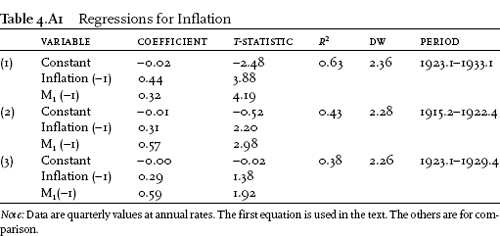
Gold has no significant effect on discounting in the short term and a negative relation after a quarter. Over the longer term, government securities have a modest negative effect on gold. Nevertheless, the variance decomposition (not shown) suggests that past gold movements dominate all other influences on the gold stock.
The monetary base appears to be relatively independent of its asset components. The exception is a longer-term positive effect of gold flows on the base. The short-run response of gold to the base is small and insignificant, suggesting the active program of short-run gold sterilization during these years. Chart 4.2 above shows that the contemporaneous relationship is weak also.
The very weak association between the base and its principal components suggests that the deflationary policy of the period was a consequence of Federal Reserve actions. Over the longer term, the base moved with net gold inflows; for the period as a whole, the gold stock increased by $650 million, and the monetary base rose $970 million. These increases were produced by compound average annual growth rates of 2 percent and 1.7 percent, respectively. All of the increase occurred before summer 1927.
APPENDIX B: SOURCES AND USES OF THE MONETARY BASE AND OPEN MARKET OPERATIONS
The basic statement of the Federal Reserve’s monetary position is the table Member Bank Reserve, Reserve Bank Credit, and Related Items, published in the Federal Reserve Bulletin. The table was developed at the Board in the 1920s by combining the balance sheets of the twelve reserve banks and the monetary accounts of the Treasury. This appendix rearranges these data as sources and uses of the monetary base.
The principal sources of the monetary base are Reserve Bank credit and gold and foreign exchange assets. Under a pure gold standard or a fixed exchange rate system without intervention, gold and foreign exchange are the principal sources of the monetary base. Under a fluctuating rate system, without intervention, gold and foreign exchange is constant. Reserve bank credit is the principal source item.
Other source items are mainly small positive and negative accounts. Historically, the principal positive item here has been treasury currency outstanding, because the Treasury formerly issued currency. During much of Federal Reserve history, these were small-denomination notes.208 The principal liabilities here are Treasury deposits with Federal Reserve banks and deposits of foreign governments and central banks.


Reserve bank credit consists of three principal items: bills discounted, bills bought, and United States government securities. The first is usually referred to as discounts and advances. These are made at the option of the member bank, under rules prescribed by the Federal Reserve. The founders of the Federal Reserve believed this item would be the major source of short-term changes. The text refers to “bills bought” as acceptances. The founders intended this source to become an important item and the main source of adjustment and policy operations, as in London. From the 1920s on, its role was taken by the third source—United States government securities.
The uses of the monetary base include member bank reserves and currency held by the nonbank public. Rules permitting member banks to count vault cash as part of reserves add to the base by including currency held by banks as a use of the monetary base.
In January 1928 the statement of sources and use of the monetary base, appeared as in table 4.A2.
An open market purchase of acceptances or government securities increases one of the items on the sources side and balances the increase by adding to member bank reserves. An open market sale of government securities reduces this source and, correspondingly, reduces bank reserves.
By law the Federal Reserve cannot buy securities directly from the Treasury (with some minor exceptions). Open market operations are therefore conducted in the credit markets.
1. Real growth is computed from third quarter 1923 through third quarter 1929 to omit the recovery early in 1923 and the start of the 1929 recession. Using annual data, growth is 4.7 percent for the seven years 1923 through 1929. The difference is due principally to the strong recovery reported for second quarter 1923. Quarterly and annual data for inflation give very similar results.
2. Between 1922 and 1926, the United States share of the world monetary gold stock rose from 43.3 percent to 45.5 percent, while the share held by the Treasury and Federal Reserve fell. The difference is explained by gold and gold certificates in circulation (Schwartz 1982, vol. 1, tables SC8 and SC10).
3. Adolph Miller, the only economist on the Board, urged creation of a statistical office. The office was located in New York mainly to accommodate Parker Willis, its director. It began publication of the Federal Reserve Bulletin in 1914. Willis took charge in 1918 after he resigned as secretary of the Board. The New York bank started its own publication, the Monthly Review of Credit and Business Conditions, and in 1920 it hired W. Randolph Burgess as its first editor. New York also had a statistics department led by Carl Snyder. In 1922 the Board’s research office moved to Washington, D.C., when Walter Stewart was appointed director in July. See Burgess 1964 and Yohe 1982. Stewart left the Board in 1926 to enter private business, but he continued to serve as an adviser to Strong until Strong’s death. He then served as economic adviser to the governor of the Bank of England from 1928 to 1930, where he initiated construction of statistical series similar to his work at the Board. During this period, the Board’s staff developed the statistical data for the table called “Member Bank Reserves and Related Items.” The “Index of Industrial Production” first appeared in 1922 as the “Index of Production in Basic Industries” and later (1927) as “A New Index of Industrial Production.” Between 1922 and 1925, the statistical section of the Federal Reserve Bulletin introduced, among others, series on department store sales, agricultural movements, department store stocks, wholesale trade, factor employment, factory payrolls, and building contracts (House Committee on Banking and Currency 1926, 698). Yohe (1990) discusses the early history of the Research Division.
4. The House report on the Glass bill mentions two reasons for open market operations in “the classes of bills which it is authorized to rediscount” (Krooss 1969, 3:2318). The first is to make the discount rate effective. The second is to provide an outlet for investment of funds “when it was sought to facilitate transactions in foreign exchanges or to regulate gold movements” (ibid.).
5. Before 1819, the bank seldom bought Exchequer bills except at the Treasury’s request (Wood 1939, 5). Other bills were bought, however.
6. Keynes (1930, 2:170, 229) is misinformed when he writes that in 1890 “open market policy had not been heard of.” Sayers (1957, 49) claims that before 1914 the bank purchased but never sold. Hawtrey (1932, 151) cites the 1847 experience when the bank sold current bills for specie and bought forward bills, thereby removing cash from the market at a time of stress. Testifying before the Lords in 1797, Thornton said it was immaterial whether the bank relieved market strain by discounting or by purchasing government securities.
7. The Federal Reserve Act gave each reserve bank responsibility for its own portfolio. Without voluntary agreement, the System could not have a common policy.
8. The committee included Governors Morss and Fancher and Edwin Kenzel, New York’s expert on acceptances and one of the first appointments Strong made in 1914. The recommendations were not entirely welcome at several of the reserve banks, so frictions about acceptance market practices continued.
9. Purchases were not uniform. New York, Chicago, Cleveland, Boston, and Kansas City were heavy buyers (Board of Governors File, box 1441, March 8, 1922).
10. Inflation and expanded operations had greatly increased expenses. By 1921–22 the reserve banks’ expenses were close to $50 million, nearly ten times expenses in 1916. The general price level was about 50 percent higher, so in constant dollars expenses had increased about sevenfold while the number of member banks increased by 30 percent.
11. The Treasury’s policy seems a reversal of typical government finance. A reason for the Treasury’s desire to keep the reserve banks from buying or holding governments was that the Treasury had started to run surpluses in fiscal year 1920 and continued to run large budget surpluses throughout the decade. (At its peak in 1927, the budget surplus was 28 percent of Treasury receipts.) The Treasury used the surplus to retire debt. Between June 30, 1922, and 1929, the gross debt declined $6 billion, 26 percent of the amount outstanding in June 1922. Hence the Treasury had no interest in having the Federal Reserve banks bid for and raise prices on outstanding debt that it would buy. The Treasury did not invoke the real bills view that the central bank should hold gold and real bills.
12. Strong added: “I would view the future with apprehension were we to commence now to liquidate the $150 million or $160 million of investments” (Chandler 1958, 211). These amounts refer to holdings at New York. The System held over $500 million but began to liquidate in June when prices started to rise. Within a year, System holdings were less than $100 million.
13. An exception to the decision allowed reserve banks to purchase so-called Pittman Act securities that the Treasury wanted to withdraw. Richmond, Atlanta, and Dallas purchased only these securities. Pittman Act securities had been issued under an April 1918 act that permitted the Treasury to withdraw silver certificates from circulation and replace them with Federal Reserve banknotes backed by Pittman Act certificates. The Treasury sold the silver to Britain to support India’s silver standard. After the war, the Treasury repurchased silver and reissued silver certificates, and the reserve banks reduced Pittman Act certificates and the corresponding currency issues (Friedman and Schwartz 1963, 217n).
14. Strong recognized, however, that unless the directors objected, an individual reserve bank would receive securities under the formula for allocating purchases and sales. Hence a bank’s portfolio would change with decisions by other banks, including particularly the decisions by the five largest banks, whose governors constituted the committee. But he did not mention this point in response to Seay.
15. Burgess (1964, 220) cites Strong’s discussion of “credit control” at Harvard in October 1922, in which he does not mention open market operations, as evidence that there was no open market policy. The May and October 1922 meetings, however, show that Strong was clearly aware of the opportunity. The only coordinated action to that point had been sales at the behest of the Treasury.
16. Edmund Platt served as a member of the Board from June 1920 to September 1930 and was vice governor after July 1920. Platt trained as a lawyer but had worked as a journalist and an editor. In 1912 he was elected to Congress as a Republican when his opponent died. He voted against the Federal Reserve Act. In 1919 he became chairman of the Banking Committee (Katz 1982, 216–17). Platt was the senior operating official of the Board from August 9, 1922, when Governor Harding’s term as a Board member ended, to May 1, 1923, when Congress confirmed Daniel R. Crissinger as governor. The most likely reason for the change was that Governor Harding was a Democrat, appointed by President Wilson. The New York Times wrote at the time that “his forced retirement would give a shock to the financial community,” a comment repeated about many of his successors (Kettl 1986, 28). Subsequently, Harding became governor of the Federal Reserve Bank of Boston, where he served from 1923 to 1930.
17. The letter appears to have been sent after Adolph Miller raised the issue at the January 8 Board meeting. Miller understood that open market operations had a monetary effect. He wanted the banks to explain the reasons for their purchases and their plans for 1923 (Board Minutes, January 8, 1923).
18. The reserve bank governors’ concern for earnings is shown by the votes on the resolutions offered at the October 1922 meeting. The governors defeated Strong’s proposal that open market operations be used to regulate discounts and gold imports. When the resolution omitted “gold imports,” the proposal passed unanimously. The difference affected earnings. Substituting securities for discounts leaves earnings unchanged; substituting securities for gold changes the earnings flow.
19. Miller’s recommendation had the open market committee chaired by the Board. The Board removed this phrase to meet the objections expressed at the Governors Conference. Miller was not satisfied with the Board’s role. In the 1926 Stabilization Hearings, he urged the House Banking Committee to strengthen the Board’s role by making open market operations “subject to the approval and the orders of the Federal Reserve Board” (House Committee on Banking and Currency 1926, 866), and he proposed Board control again in 1928–30, when the committee’s size increased to twelve members. The Banking Act of 1935 transferred control to the Board.
20. Undersecretary Gilbert was present at the meeting. He did not participate in the heated exchanges, confining his remarks to urging additional liquidation first of certificates and then of notes (House Committee on Banking and Currency 1929, 741).
21. In September 1921 a private citizen, Albert Russell, wrote to Governor Harding urging action to stop the deflation. Russell wanted the Board to authorize purchases of bills, acceptances, and government securities to expand credit, lower interest rates, and reduce unemployment. Russell also wanted to let New York buy securities in districts with higher rates to bring rates toward equality in the various districts. Harding’s reply did not disagree but claimed that the Board lacked authority. The “ Board does not have the power to compel a Federal Reserve bank to make any investment which its own directors may deem inadvisable.” Harding urged Russell to write to the reserve banks, “particularly the Federal Reserve Bank of Chicago,” but he asked that the letter not mention Harding’s reply. Russell wrote to both McDougal and Strong (and perhaps to others). The letters urged that “the Federal Reserve Banks force lower commercial rates by increasing on their own initiative the reserve funds of commercial banks.” The letter went on to argue that there would be a multiple expansion of money and credit. McDougal replied that he could not comment because “I prefer not to be quoted” (Board of Governors File, box 1433, September 26 and 28, October 1 and 6, 1921). Strong replied that purchases would not lower interest rates or expand credit “but would probably result in the immediate repayment of borrowings for a like amount by the member banks.” Strong added: “I agree that ultimately in more normal times …the operations of the Reserve banks will be principally through open-market purchases rather than discounting for member banks” (Chandler 1958, 207–8). Chandler criticizes this passage for its lack of understanding and comments on the change that occurred in Strong’s thinking in the next two years (by 1923). In fact, the passage shows that Strong had already formed the main new idea he held in the 1920s—that open market operations drove banks to borrow or repay discounts.
22. “The discussion had moved away from the concept of the Reserve system as a mechanism responding semiautomatically to the demands made upon it to that of an organization responsible for taking the initiative” (Burgess 1964, 222).
23. The report does not recognize, however, that making the latter change without changing the authorized backing for currency created a potential mismatch between assets and liabilities. If government securities became a relatively large part of the asset portfolio, there would be fewer real bills to back currency and bank reserves. The Glass-Steagall Act removed the problem temporarily in 1932. Permanent authority waited until 1945.
24. These statements reflect the strong belief that monetary (or credit) velocity was unstable. This was the basis of the statements by Miller and others that the Federal Reserve could control credit but not the price level.
25. Concerns about the quality of credit and real bills were common in the academic profession, the financial community, and Congress. Beckhart (1972, 214) quotes congressional testimony by leading academics who refer to “diversion of large amounts of credit into speculative enterprises which are bound to breed ultimate collapse.” This view is closely related to the alleged inevitability of depressions following increases in speculative credit that the System used to absolve itself of responsibility for the Great Depression.
26. At the time, J. Herbert Case was deputy governor at New York. Later he served as chairman and Federal Reserve agent. Case substituted for Strong on the Open Market Investment Committee (OMIC) in the 1920s when Strong was absent.
27. Daniel R. Crissinger was a boyhood friend and neighbor of President Warren Harding. He served as Comptroller of the Currency, and ex officio member of the Board, from March 1921 to April 1923. On May 1 he became governor of the Board. Crissinger was a small-town lawyer who had served as president of a small bank. Secretary Mellon opposed his appointment as governor, but President Harding insisted and he was confirmed, perhaps because he came from a rural and agricultural background (Katz 1992, 62). He is generally regarded as an ineffectual manager who could not achieve agreement within the Board or control Strong and the reserve bank governors. He resigned to join a mortgage loan firm in November 1927 after the Chicago discount rate controversy discussed later in this chapter.
28. This particular report of the Joint Conference was treated as confidential within the System. It was not circulated to the governors or included with the report of the meeting. The report is filed at the end of the report of the Governors Conference, but the pages are numbered independently.
29. Wicker (1965) correctly distinguishes between quantitative and qualitative guides but separates their application by time period. A closer reading suggests that some members relied on one, some on the other, throughout the period.
30. Industrial production reached a peak in May 1923, then fell until August 1924. The annual rate of decline reached 18 percent in July. At the time of the meeting, the year-to-year decline was 13 percent. Balke and Gordon’s GNP data show a 7 percent decline in the price level and an 8.6 percent decline in real GNP for the second quarter of 1924. The recession had started a year earlier but had been interrupted by a strong recovery early in 1924. The recovery ended, however, and the decline in the price level and real GNP resumed.
31. These claims that the discount rate had only modest effect were not forgotten when the reserve banks wanted to increase discount rates in 1929 and the Board opposed.
32. One reason is that he misinterprets Federal Reserve policy in the 1920s. Keynes claimed that the policy worked because the United States public was willing to absorb “the remarkable growth in the volume of bank money.” In fact, base money and M1 rose at average rates of 2 to 3 percent a year, slightly less than output growth.
33. A complete statement of the Riefler-Burgess framework is part of Brunner and Meltzer 1964a. This section is based partly on that paper.
34. As already noted, Strong and Stewart contributed independently. Strong read and commented on an earlier edition of Burgess’s book. The framework evolved to reflect major changes, notably the large increase in excess reserves in the 1930s. It remained as a guide to policy into the 1950s.
35. Riefler (1930, 21–22) compared the behavior of borrowing under the “reluctance” and “for profit” motives. Banks could have borrowed to equalize rates during the 1920s. When open market rates were above discount rates, banks would have brought them down if they borrowed for profit. This argument ignored risk elements.
36. “When the member banks find themselves continuously in debt at the Reserve banks, they take steps to pay off the indebtedness…. Conversely, when most member banks are out of debt at the Reserve banks, they are in a position to invest their funds; and money rates, including commercial paper rates become easier. The relationship rests largely on the unwillingness of the banks to remain in debt at the Reserve banks” (Burgess 1936, 220).
37. The acceptance market differed from the market for borrowed reserves. The Federal Reserve announced a price, the discount charged on acceptances. Banks sold to the Federal Reserve, at their initiative, only if it offered a price above the going market rate.
38. The points at the upper right of chart 4.1 are for second quarter 1928 to third quarter 1929.
39. In 1922 Strong discussed borrowing in a talk at the Harvard Economics Club. He placed considerable emphasis on profitability. Banks repaid borrowing when other opportunities were less attractive: “Now, in the long run, it is my belief that the greatest influence upon the member bank in adjusting its daily position is the influence of profit or loss” (Strong 1930, 181). Possibly Strong and others revised their earlier opinion. An alternative explanation is that policy changed, and the reluctance theory of borrowing reflected constraints that reserve banks imposed on borrowers. The “reluctance theory” failed later in the decade when the Board tried to reduce borrowing by exhortation.
40. Once again, Adolph Miller had a different view. He asked: “Suppose it [gold] doesn’t presently flow back?” And he warned that it was risky “to predicate a policy upon a possibility that may or may not materialize” (Governors Conference, March 28, 1923, 769). The Board did not follow the governors’ recommendation. It did little to change opinion about the gold reserve ratio. Chandler (1958, 191) reports that this irritated Strong and other governors, who faced this issue when talking to bankers, businessmen, and farmers. It seems likely, however, that the Board produced the policy statement in the tenth annual report partly in response to these demands. Friedman and Schwartz (1963, 283) point out the Federal Reserve continued to cite the possible withdrawal of gold as a reason for sterilization after the gold standard was restored, when the argument was no longer valid.
41. Appendix 4B describes the monetary base and its relation to Federal Reserve policy operations. Appendix 4A analyzes the statistical relation between gold and the base.
42. Short-term and lagged responses are shown in appendix 4B. The long-term relation is positive but small. Criticism of gold sterilization was common abroad. Criticism of the United States and France is a main point of the League of Nations (1932) retrospective study of the interwar gold exchange standard. On the other hand, Keynes (1930, 2:258) praised the Federal Reserve for showing that “currency management is feasible in conditions which are virtually independent of the movements of gold.”
43. The $1 billion was about equal to the value of gold certificates in circulation at the start of the Federal Reserve System. The Treasury also tried to increase the circulation of gold coins, but this policy was not successful, suggesting that the reserve banks were now sufficiently established in the public’s mind as the main source of money that the public was unwilling to bear the costs of using gold coins.
44. McDougal had a very different reason for issuing gold certificates—they reduced expenses by the reserve banks for issuing and replacing currency. In 1928 he proposed replacing all Federal Reserve notes with gold certificates to save $700,000. All other governors were opposed (Governors Conference, April 1928, 199–213).
45. The 1924 annual report relates the opinion of the Federal Advisory Council that it was “imperative” that England and Germany return to the gold standard. At the time, French restoration seemed unlikely.
46. The Dawes Plan removed reparations as a source of current instability but did not resolve either the reparations problem or the transfer problem. The latter problem arose because German reparations payments required a surplus on the German current account. Hence other countries collectively had to be in deficit relative to Germany. The Dawes Plan did not settle the total reparations to be paid by Germany. Instead, the plan required Germany to pay reparations of £50 million, rising to £125 million in the next five years. To stabilize the German mark against gold, loans of $190 million were offered to support the currency. The plan did not restrict import tariffs by the receiving countries or assess Germany’s ability to pay. However, by limiting and rescheduling German payments and stabilizing the mark, the plan removed a major source of European instability. The Dawes Plan achieved its reparations targets because stabilization encouraged foreign loans to Germany, principally from the United States, but also from Britain. Germany received more loans than the amount of its reparations payments under the Dawes Plan, so foreigners financed the reparations payments that Germany made. According to Hjalmar Schacht (1955, 211), governor of the Reichsbank between 1924 and 1932, Germany paid only $10 billion to $12 billion of the $120 billion promised. Germany never achieved a current account surplus; all the payments were made from the proceeds of $20 billion in loans that foreigners “pressed upon her to such an extent that in 1931 it transpired she could no longer meet even the interest on them” (211). The result was that foreign governments received the $10 billion to $12 billion, and the lenders lost their money.
47. To conserve limited gold stocks (and earn interest on reserve balances) countries other than the United States, Britain, and later France held part or all of their reserves in dollar or pound securities, exchangeable for gold. These dollar or pound claims could be exchanged for gold reserves on demand as long as the United States and Britain maintained convertibility; hence the name gold exchange standard.
48. Norman was the main proponent; Churchill was a reluctant follower of his advice and the advice of Otto Niemeyer in the Treasury. Churchill, influenced by Keynes, was concerned about the effect on industry and employment.
49. Strong negotiated the loan to the Bank of England on behalf of the Federal Reserve, not the United States government. This was a standard feature of international monetary policy at the time; central bankers negotiated with other central bankers. Typically they informed their governments and kept them apprised of foreign developments and negotiations. Governments borrowed in the market using investment bankers as agents. Britain used J. P. Morgan.
50. Parker Willis, former secretary of the Board and editor of the Commercial and Financial Chronicle, was a main critic. He had worked for Carter Glass at the House Banking Committee in writing the act, so his criticisms were taken up by members of Congress. Willis favored Britain’s return to the gold standard and recognized that section 14 authorized transactions with foreign banks. He criticized the size of the loan and the use of section 14 to aid a foreign government. Willis interpreted the act narrowly. He wanted a penalty discount rate, and he opposed the issuance of gold certificates as a violation of the principle that the act intended to centralize gold holdings. Currency should be backed by gold and commercial paper only, and the Federal Reserve should limit its activity to discounting real bills. Similar views were held, perhaps not independently, by Senator Carter Glass.
51. The loan was fuel for Strong’s critics, who feared that Strong acted like the head of a central bank instead of being one member of a system of semiautonomous banks. After the loan commitment was announced, Miller changed his opinion about the legal authority for the loan. He is recorded as “not voting” when the Board approved a resolution confirming the transaction (Board Minutes, May 19, 1925). The credit expired after two years and was never drawn upon. Miller was a strong supporter of the gold standard and a partisan of the policy of restoring the standard. He described restoration this way: “The fantastic vagaries which a certain school of economics on both sides of the Atlantic embraced in their efforts to find a substitute for the gold standard have given way before the world’s resolution to tie its fate in monetary matters …to something more objective and less capricious than fallible human discretion” (Miller 1925b, 4).
52. Wicker (1966, 90) based much of his argument on the decline in New York member bank borrowing after February or March 1924. Total system borrowing remained above $400 million until June and did not fall below $300 million until August. Open market purchases began in March and ended in November. These data are consistent with the Riefler-Burgess view that high borrowing in recession called for open market purchases.
53. One of many examples of Strong’s view of limited international cooperation is in a letter to Norman in March 1921: “I have always taken the position that both you and we had three possible courses in our relations with each other. One was to deal wholly independently with our respective problems …in other words to ignore each other; another might be to pursue a wholly selfish policy . . .; and the third might be to adopt a policy of complete understanding, and exchange of information and views, and to cooperate where our respective interests made it possible” (Chandler 1958, 247).
54. Chicago at first refused to reduce its rate. The Board ordered the reduction. The incident is discussed more fully below.
55. The meeting had been planned before the crisis began in May. Norman had wanted a meeting of the principal banks for a long time. Strong had been hesitant but changed his mind. The location of the meeting, New York, shows the shift in power toward the United States.
56. Moreau published the account in the late 1930s; 6.5 percent was the French long-term interest rate at the time of the Paris meeting.
57. Norman and Schacht traveled to the United States incognito, but their arrival in New York was well known and the subject of much speculation. Mrs. Ogden Mills describes Norman at the meeting. Despite warm July weather, Norman dressed in a large velvet-collared cloak and sat in a fan-back chair placed at the end of the room (CHFRS, March 1, 1954). The Committee on the History of the Federal Reserve, organized at the Brookings Institution in the mid-1950s under the direction of Allan Sproul, interviewed several participants in Federal Reserve policymaking and administration. The unpublished notes are at the Brookings Institution. The principal publication from the project is Chandler’s book on Strong. At the time, Sproul was president of the Federal Reserve Bank of New York.
58. After these meetings, the Open Market Investment Committee met with Norman. Governor Crissinger represented the Federal Reserve Board, but no other members were invited. Wicker (1966, 111), relying on Hamlin’s diary, reports that their exclusion irritated members of the Board and added to their animosity toward Strong. We know most about Miller’s irritation because he testified at length about the 1927 meetings and his own meeting with Schacht before the luncheon. He described the luncheon at the Board as a “social” event (House Committee on Banking and Currency 1928, 216–220). On June 15, in advance of the meeting but after it was scheduled, the Board reviewed the authority of reserve banks to conduct foreign business and the Board’s supervisory role. The secretary was instructed to open and read the sealed agreement with the Bank of England, signed in December 1916. The legal opinion of the Board’s counsel was that the act authorized the reserve banks to enter into such agreements and to lend abroad.
59. Goldenweiser’s diary reports on a 1949 letter from Rist that claims the reduction was agreed to in a meeting between Norman and Strong by themselves. Schacht and Rist approved it after the fact. See Wicker 1966, 112.
60. In late June 1927 the London price (in dollars) was $20.64 Per fine ounce, above the price in the Netherlands or Switzerland but below the $20.669 in the United States. Strong’s offer lowered the price in New York and absorbed shipping costs (memorandum, Harrison to Strong, Sproul files, December 2, 1927).
61. Kindleberger (1986, 51) reports the total of these transactions as $440 million in May 1928 and almost $600 million in June 1928.
62. Goldenweiser’s summary of policy from mid-1927 to 1929, based on his records but written later, repeats this argument but adds that higher rates abroad “would have endangered the maintenance of the gold standard” (Goldenweiser to Miller, Board of Governors File, box 1449, October 30, 1934).
63. The gold flow reversed quickly. In the first six months, the United States received $200 million in gold. From July 27 to December 28, 1927, it sold $193 million. Open market purchases offset the domestic effect of the gold outflow.
64. The problem was repeated in slightly different form in the 1960s with similar outcome—the breakdown of the standard.
65. Board members, governors, and leading members of Congress shifted their views in the 1930s. They blamed Strong’s policy change for subsequent credit expansion, and they blamed the rise in stock prices on the credit expansion. The result, they said, was an inevitable collapse.
66. Perhaps one reason for the emphasis on maldistribution in the 1920s is that the stock of monetary gold increased much more than commodity prices. The 1925 commodity price index for the world increased 60 percent from 1913 to 1925; the world monetary gold stock doubled. For the rest of the decade, the commodity price index fell and the monetary gold stock rose. The world’s price index is the wholesale price of commodities from League of Nations (1930, 84). The stock of monetary gold is from Board of Governors of the Federal Reserve System (1943, 544).
67. The increased demand for francs despite falling interest rates reflected not only stabilization but the rapid growth of the French economy after 1927. Between 1927 and 1929, GDP rose 13 percent and industrial production 17 percent compared with GDP growth of 4 percent in Britain and 7 percent in the United States. French M1 growth was 15 percent, approximately equal to growth of production (data from St. Etienne 1984).
68. Nurkse’s data differ slightly from the data in table 4.2. French sales were usually made in the forward market by selling pounds forward. This policy began in August 1927, possibly reflecting an understanding at the New York meeting in July, to avoid sales in the spot market that were more easily monitored by private speculators and the Bank of England.
69. Like Strong, Moreau wanted to build his country’s financial center at Britain’s expense. One part of this policy was to shift French reserves into gold until France, like Britain and the United States, held only gold as a reserve. See Chandler 1958, 379–80. There was in addition France’s desire to divide Europe into two spheres of financial influence, one British, one French. See Moreau 1954, 489. Personal relations may also have been a factor. Moreau and Norman did not have a warm or cordial relationship. There is a parallel in the 1960s when France insisted on converting dollar reserves into gold to reduce “American hegemony.”
70. For a different view, stressing the absence of international cooperation, see Eichengreen 1992.
71. Berg and Jonung (1998) report on the successful efforts of the Swedish Riksbank to stabilize the price level after 1931 using a price level rule.
72. Legislation passed the House in 1932 by a vote of 289 to 60 but was defeated in the Senate, owing largely to opposition by Carter Glass. The Federal Reserve opposed the bill.
73. E. W. Kemmerer, John Bates Clark, Henry Wallace, and many others testified for the proposal.
74. Congressman James A. Strong was not related to Governor Benjamin Strong. I will refer to the congressman as Strong (Kansas) when needed to avoid confusion. The wording of the mandate changed many times to respond to objections from Federal Reserve officials and others.
75. Cotton was by far the most important export crop at the time. In most years the value of cotton exports exceeded the combined value of the next four or five export items. The System was concerned that it would be expected to stabilize the prices of individual commodities, especially cotton.
76. Strong had written many of the same objections to Professor Bullock in 1923. His first objection criticized “quantity theory extremists,” by which he almost certainly meant to include Fisher (Chandler 1958, 203–5).
77. “Mr. Goldsborough: …You [Strong] have said that the Federal Reserve System, by its open market operations and by changes in the discount rate, would influence the supply of credit, which, of course, influences the price level. Now, that being so, what is the objection to a general direction of the Federal Reserve System to use such powers as it has for the purpose of stabilizing the general price level? That is certainly one question in which the committee is deeply interested. Governor Strong: It might be possible, Mr. Goldsborough, to frame some language as an amendment to the act …that would safeguard the system against misinterpretation of the intention of that declaration…. [I]t certainly would need to contain the limitation, or the recognition of the fact, that credit alone does not control prices. Mr. Goldsborough: Is not that generally understood? Do you not think that is generally understood? …Governor Strong: No. If I felt so, I would not feel as strongly as I do about this amendment, which I would fear on that account principally” (House Committee on Banking and Currency 1926, 299). Goldsborough persisted, citing evidence from farm publications. Strong responded by citing the blame heaped on Federal Reserve policy for agricultural problems in 1920–21. This was a non sequitur. The Federal Reserve had contributed to the problems, but Goldsborough did not make that point.
78. In contrast to Miller’s testimony (see below), Strong described the Board as solely a supervisory body. Operations were conducted “in cooperation with the Board, and subject to their review.” “Policy results from the discussions and recommendations that are made by the operating officials of the banks; that would necessarily be so.” Strong recognized a change in his own views: “I believe in this regional system…. Textbook knowledge had always led me to believe that a central bank was the proper thing. This system suits the needs and feelings of the country much better socially, politically, and in every way.” Then he warned: “The danger in a regional system might be that if each Reserve bank goes its own way, the system as a system would have no policy” (House Committee on Banking and Currency 1926, 341).
79. The gold standard also removed power over the price level from central banks and governments: “When you speak of a gold standard, you are speaking of something where the limitation upon judgment is very exact and precise and the penalty for bad judgment is immediate” (House Committee on Banking and Currency 1926, 295). Like many of his contemporaries, Strong did not recognize that the gold standard did not guarantee a stable long-run price level.
80. “It will not be a great while before we shall see restored this condition of price stability that was insured to the commercial world before the outbreak of the great war, under the operation of the gold standard” (House Committee on Banking and Currency 1926, 694).
81. The context makes it difficult to judge whether this statement was a reflection of Miller’s beliefs or a pandering to southern and western congressmen with their traditional fear of “Wall Street.” Perhaps both.
82. Fisher paid the salary of John R. Commons, who stayed in Washington to work on the Strong (Kansas) bill (Fisher 1946, 8). I am indebted to Wayne Angell for providing a copy of Fisher’s 1946 letter to Clark Warburton.
83. Sprague defined inflation as “a rapid rise in prices continued for a number of years,” thereby distinguishing persistent from temporary price level movements much more clearly than his friend Benjamin Strong (House Committee on Banking and Currency 1926, 404). Like Strong, he recognized that real bills failed as a regulatory principle because the type of collateral could not change the (marginal) use of credit.
84. Fisher claims to have responded: “I will trust you as long as you live but you will not live forever and when you die I fear your policies will die with you.” Fisher says that Strong replied: “I have trained my assistants so that they know these policies and they will be continued” (Fisher 1946, 3). Hetzel (1985, 8) reports very similar statements in Fisher 1934, 151. Fisher’s recollection is probably correct. Very similar statements were made by Congressman Strong in the 1926 hearings (House Committee on Banking and Currency 1926, 569, 601).
85. Fisher (1946, 5) claims that Strong could not favor the bill in public without the approval of the Federal Reserve Board. Strong asked the Board if he could favor the legislation, but they refused.
86. Chandler (1958, 255) reports Herbert Hoover’s references to Strong as a “mental annex to Europe” and “Strong and his European allies.” Hoover was friendly with Miller. Chandler claims that Hoover took these views from Miller.
87. Young described Miller’s love of argument: “If no one on the Board started arguing with Mr. Miller, he would argue with himself” (CHFRS, Young, March 1, 1954, 2).
88. Eugene Meyer, governor of the Board from 1930 to 1933, did not share in the adulation. He described Strong as “an ignoramus in international banking” (CHFRS, Meyer, February 16, 1954, 3). Irving Fisher thought highly of Strong and believed he would have prevented the deflationary policy of the 1930s. Fisher had contempt for Meyer. He claimed that in 1931, when told that demand deposits were falling, Meyer did not know what a demand deposit was and did not know that they had fallen (Fisher 1946, 4).
89. Leslie Rounds compared Strong with Gates McGarrah, who served as acting governor for a few months after Strong died: “McGarrah could present a case quite effectively, but when it got to the arguments, he was through…. McGarrah just wasn’t built on a plan to permit him to argue and win. Strong loved it. He thoroughly enjoyed getting into a fight and coming out on top, as he always did” (CHFRS, Rounds, 13). McGarrah and the New York directors voted for discount rate increases repeatedly in the spring of 1929, but the Board would not approve.
90. Early in 1928, Miller and others at the Board worked to dilute Strong’s authority by replacing the five-person OMIC, dominated by Strong, with a twelve-person committee consisting of all reserve bank governors. The change, discussed below, was made in 1930 after Strong died.
91. There are two issues. First is whether Strong would have convinced the Board to raise the discount rate early in 1929. The other, more important issue, is whether he would have convinced the open market committee to expand in 1930 or 1931. I return to that issue in chapter 5.
92. Morrill reports that James was from Tennessee and believed that the mule, the horse, and hay were “the basic elements of any economy.” He was “wrapped up in organic fertilizer.” He disliked the automobile and believed that by doing away with the horse and the mule, automobiles contributed to the “decay of the country” (CHFRS, Morrill, May 20, 1954, 6).
93. Smead added that in the 1940s the “New York–Washington feud” continued under Allan Sproul and Marriner Eccles.
94. In late April 1923 the National Bureau of Economic Research wrote: “We will soon have a boom, with the standard trimmings and the standard ending” (quoted by Miller in House Committee on Banking and Currency 1926, 701).
95. Strong wrote to Norman that the discount rate increases had been delayed until it was clear that Congress would approve a loan to Britain. As reason for the increase in the discount rate, Strong cited the increase in borrowing, market rates 1 percent above the discount rate, rising stock market loans, and production “practically at a maximum” (Chandler 1958, 221).
96. The meeting also considered an issue that continued throughout the decade. Banks in California allowed a limited amount of check writing against “special savings deposits, subject to a 3 percent reserve requirement ratio.” By a vote of seven to five, the governors agreed to keep the prevailing policy. The problem spread to other states, and though it was discussed many times, the policy was not changed. The policy allowed banks to lower the applicable reserve requirement ratio and blur the distinction between demand and time deposits.
97. Case circulated Crissinger’s letter to the members of the OMIC. Philadelphia’s reply suggests the way many of the reserve banks looked at the issue. The Philadelphia directors had approved sharing in the sale only to accommodate the Treasury. The Board’s program would require selling securities at a loss. Decisions about purchases and sales were not the province of the Board, and the Board lacked authority to have a policy about sales. His directors reserved the right to dissent from future OMIC recommendations (Norris to Case, Board of Governors File, box 1434, June 8, 1923).
98. Gilbert continued to develop and modify this view and to urge it on the Board until August. (See Letter Gilbert to Crissinger, Board of Governors File, box 1434, August 3, 1923.) The Federal Advisory Council accepted Gilbert’s suggestions in principle but decided that the time was not right for further sales. In August Gilbert accepted that the reserve banks’ position was “well liquidated,” ending the issue.
99. A later index, base 100 in 1992, puts the decline at 18 percent. The Miron-Romer index has an overall decline of 36 percent for the period. Their index has an initial decline of 38 percent between May and September 1923, followed by a rise to February 1924 and a renewed decline to July 1924.
100. In September the Board approved a request from Dallas to purchase $10 million of long-term Treasury bonds for income. The Board approved because of the weak earnings of the Dallas bank. It denied a similar request from Boston in November. These incidents suggest, correctly, that much of the interest in open market purchases at the reserve banks continued to be for earnings. The tenth annual report had not been written. Strong’s statement at the meeting anticipated part of the report.
101. Purchases were made for a new Special System Investment Account to be used for all purchases and sales by the committee. Allocation to individual reserve banks was based on earnings needs of the reserve banks. The reserve banks paid or received payment by transferring gold on the books of the gold settlement fund.
102. The bulk of the gold was in bullion. Beginning in January, governors agreed to ask the Treasury to increase gold coinage and to issue more gold certificates until coins and certificates equaled 20 percent of notes and deposits, 6 percent in coin and 14 percent in certificates (Governors Conference, May 6, 1924, 340–47; November 10–14, :1924).
103. Wicker (1966) interprets the 1924 purchases as made mainly for international reasons. He dates the principal purchases as occurring between June and August (88). This neglects $100 million made in March 1924. As noted below, Strong later testified that purchases should have stopped in June.
104. The Board was divided on the issue. The vote was three to two to reject Chicago’s request. Crissinger abstained. Hamlin believed the Board exceeded its authority.
105. This was a year after the start of the recession. The only discount rate change in 1923 was a 0.5 percent increase by San Francisco two months before the cyclical peak. Chandler’s claim (1958) that the Federal Reserve, particularly Strong, had discovered countercyclical policy (along Keynesian lines) is not consistent with the long delay at the start of the 1923–24 and 1927 recessions. What Strong and other proposed, and did, depended mainly on credit markets, particularly the level of borrowing. Although Strong talked about measures of production, his actions were based on discounts and interest rates as suggested by the Riefler-Burgess doctrine.
106. In July, the OMIC voted to allow its chairman to sell and repurchase securities in the new Special System Investment Account to smooth the market during tax payment periods. New York and Chicago had been smoothing on their own earlier.
107. The statement is based on a memo that Strong wrote in December 1924 and read to the Banking Committee at the 1926 hearings.
108. W. W. Riefler prepared a summary of open market decisions for 1923 to 1931 based on the principal documents for the period. His summaries are in the Board’s files.
109. Strong also responded to criticism of the policy by the American Bankers Association. The bankers accused the Federal Reserve of accentuating financial swings and competing for securities with member banks. They suggested that Federal Reserve banks return “to their primary functions as banks of issue and rediscount” (Riefler 1956, 30). Strong recommended that the Board reply in the Federal Reserve Bulletin. The Dawes loan was part of the Dawes Plan to reduce German reparations payments and restore convertibility of the mark.
110. The following week, Strong wrote a lengthy memo to the files summarizing the events of 1923–24. Subsequently he read from this memo at a congressional hearing, as cited above. One part of the memo refers to the gold inflow as “one of the greatest menaces to our ultimate security against inflation.” Recognizing the role of United States interest rates as helpful for the recovery of the pound, he concluded that Britain was now able to resume gold payments: “A lower interest level …was a further influence in turning the tide of gold away from the United States” (House Committee on Banking and Currency 1926, 337).
111. Beginning in 1926, I rely on appendix table A-1 in Ibbotson and Sinquefeld 1989 for annual returns on common stocks.
112. Strong wanted to increase the rate before the British resumed gold convertibility (Governors Conference, April 6–7, 1925). The Bank of England preceded New York by raising its discount rate in February and again in April (to 5 percent). Board of Governors of the Federal Reserve System 1943, 656, shows the British increase in April but not in February. This record is not consistent with discussion at the time.
113. Reed (1930, 93) suggested that the slow shift to tighter policy and the aggressive ease in 1924 were the forerunners of the aggressive policy of ease in 1927 and the slow reversal in 1928.
114. At its April joint meeting the Board and governors also appointed a committee to consider legislation introduced by Congressman Louis T. McFadden. The legislation included renewal of the Federal Reserve’s charter. The Board appointed O. M. W. Sprague of Harvard and Walter Stewart, a former research director, to work with the Board. Sprague also undertook a study of member bank borrowing. He found that, contrary to the “reluctance” theory, a large number of member banks in agricultural areas continued to borrow, to carry loans made in 1918–20. He urged the reserve banks to notify members that continuous borrowing was not permitted.
115. The authorization to buy or sell up to $100 million, agreed to in November 1924, was still in effect. Critics of Strong’s policies in 1924 and 1927 never mentioned this decision to sterilize the gold outflow just at the time Britain resumed convertibility.
116. After the April 6 meeting, Adolph Miller challenged the argument that System purchases should be made to prevent individual bank purchases. That undermined the case for a System account and a System policy. Miller added that purchases should not be made to increase earnings. Strong and McDougal defended the purchases as consistent with the agreement under which they participated in the OMIC. Although the OMIC made no purchases, the incident brings out the concern of many governors for their earnings and the pressure on Strong to accede to these demands in the interest of maintaining a System policy. The pressure came mainly from the reserve banks in the South and West. In March, Dallas had made purchases for its own account until March 26, when the Board ordered it to stop. Governor Lynn P. Talley of Dallas replied that the Board had approved purchases in October 1923 and never revoked the authority. Chicago, Kansas City, and Minneapolis made small purchases also. At the time, Dallas and some of the others were probably below efficient size. They owed their existence to the decision to establish twelve reserve banks rather than eight.
117. At about this time, Miller (1925a) publicly criticized the financing of speculation and urged his readers to accept greater variability in discount rates, as in England. To real bills advocates like Miller, increases in speculative credit were evidence of inflation even if commodity prices remained unchanged.
118. In his 1926 testimony to Congress, Strong said (about the standby credit to the Bank of England): “[The New York bank] is free to raise and lower its discount rate; quite as free, in fact, as though no such arrangement had been made” (quoted in Chandler 1958, 320).
119. Short-term changes at year end induced New York to purchase $50 million to prevent an increase in call money rates to 6 percent. The Board agreed reluctantly when New York explained that it had bought $18 million and would put the purchases in its own portfolio instead of the System account (Board memo, Board of Governors File, box 1434, July 1, 1927; Riefler 1956, 63–64).
120. At the November 1925 Governors Conference, Strong raised the issue of charter renewal. Although the original charter did not expire until 1933, Congress had started consideration. Strong urged the governors to make sure that no scandals would be uncovered if Congress examined the System’s operations before renewal. His list includes issues of discrimination for religious or political belief, nepotism, favoritism for one or another person or group in purchasing, dealing in securities, and similar matters. No officer at the New York bank was allowed to borrow money without Strong’s approval. He urged the other governors to adopt similar standards.
121. Seventy years later, banks used computer programs to shift deposits from demand to time account overnight, reducing bank reserves. The System reduced the reserve requirement ratio against time deposits to zero.
122. Agricultural problems continued. A drought in Texas increased the demand for discounts at the Dallas reserve bank. Governor Talley tried to be selective, angering local bankers who thought they had a right to borrow. A local congressman introduced a bill to remove Talley, and there was a congressional hearing in 1928. Talley remained (CHFRS, Dreibilbis, March 4, 1955).
123. Later in the same report, Strong added an additional condition—borrowing by New York City banks of $100 million or more. With only $50 million borrowed, there is less tendency for credit to flow to New York (in the form of call loans). Thus, for Strong, the key to reducing call loans was to reduce borrowing by New York banks without increasing borrowing elsewhere.
124. Stock prices fell sharply from February to April, then renewed their rise. Every month in 1926 is above the corresponding month of 1925.
125. Strong admitted, however, that he was startled by the amount, more than $1 billion, above the highest estimates before the data were reported (Governors Conference, March 1926, 124).
126. Comparison of bank participation in the System account in 1928 with the initial distribution of securities when the System account started in 1924 shows that Boston, New York, Richmond, and Atlanta reduced their shares while Cleveland, St. Louis, Minneapolis, Kansas City, and Dallas increased by relatively large percentages. As suggested above, New York, possibly assisted by Boston, appears to have worked systematically to redistribute income within the System toward the small, mainly agricultural regional reserve banks. For comparison with table 4.3, the distribution in January 1924 is as follows (percentage):
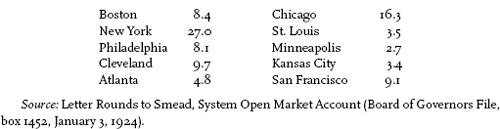
Source: Letter Rounds to Smead, System Open Market Account (Board of Governors File, box 1452, January 3, 1924).
127. Earmarked holdings were excluded from reported gold holdings, so they did not appear in the Federal Reserve published reports or in the monetary base. In 1927 earmarked gold rose $160 million, but the Federal Reserve was able to report a decline in gold holdings of $113 million for the year (Board of Governors of the Federal Reserve System 1943, 536).
128. The McFadden Act began as an effort by the comptroller to revitalize the national banking system. To escape restrictions in the national banking laws, national banks converted to state banks in the mid-1920s. Before the McFadden Act, national banks could not establish branches or purchase investment securities.
129. Before the change, loans were for one year, renewable at the one-year rate. Telser (1996, 19) claims this change contributed to the severity of the depression by increasing bankers’ risk. In fact, real estate loans by national banks were a modest share of national bank portfolios and did not increase rapidly after February 1927.
130. His deputy at the OMIC, Pierre Jay, resigned as chairman of the New York bank in December 1926. His replacement was Gates McGarrah, who served from May 1927 to February 1930, when he resigned to become president of the Bank for International Settlements. McGarrah would not accept appointment as chairman until the Federal Reserve Board agreed that he could remain a member of the general council of the Reichsbank set up as part of the Dawes agreement.
131. This was a change of mind. In February, New York had concurred with the Federal Advisory Council’s recommendation that the March maturities should not be replaced. The change reflected the increase in securities market activity and rise in stock prices (Riefler 1956, 95). The Board staff’s memo for the meeting gave an additional reason for inaction: belief that the recession had ended. The memo shows industrial production back to the level of the previous year. The National Bureau of Economic Research dates the end of the recession eight months later. The memo reports the price level as 6 percent below the previous year (Board of Governors File, box 2461, March 18, 1927).
132. These actions avoided showing an increase in the gold stock on the weekly release. The bank reported the earmarked gold on the published statement as “gold held abroad,” a new item. Since the gold had originally been offered to the Irving Trust, there was no secret about the Bank of England’s changed position.
133. One of twelve possible actions discussed at the meeting was to stop this practice, thereby lowering the gold price by the amount of interest lost on delayed payment.
134. Miller’s principal concern was the rising stock market. The vote on his proposal to delay was five to three against. He argued that the Federal Advisory Council was to meet and report on its proposal to change the OMIC’s methods and objectives and that delay would give an opportunity to purchase after trade (and discounts) expanded. The last, real bills view was repeated frequently during 1929–33 as a reason for delaying purchases.
135. The monetary base increased less than 1 percent in the twelve months ending in May.
136. The Board staff’s background memo notes that industrial production in July was the lowest for the year and back to the 1925 level. Preliminary figures for August were weak also (Board of Governors File, box 2461, August 19, 1927).
137. The London market strengthened in August. Strong sold sterling bills in London and, to offset the effect on the base, purchased governments in New York. By mid-August the System account was at $347 million, more than $20 million above the ceiling approved at the July 27 meeting. Strong kept Crissinger and the Board informed, and there was no criticism of his decisions at the time. Nor is there any record that the Board approved the additional purchases.
138. Hamlin was on vacation in Massachusetts and so ineligible to vote. Platt’s letter identifies Crissinger, James, and Comptroller Joseph W. McIntosh as favoring action, but James subsequently reversed his position, making action unlikely. Cunningham and Miller were on vacation also.
139. The benefits included postponement of rate increases abroad and a strengthening of sterling that permitted New York to sell some of the sterling bills held in London.
140. According to Hamlin, Crissinger did not report to the Board that Mellon had asked to delay a decision until he returned to Washington on the following day. Strong took no part in the decision. Although he wanted the rate reduced, he disliked the Board’s action (Chandler 1958, 449).
141. Glass wrote in 1927: “Neither the spirit nor the text of the Act sanction[s] interferences by the central board except in unusual circumstances” (quoted in Warburg 1930, 2:493).
142. Warburg (1930, 2:493–95) shows that the only support for reserve bank autonomy with respect to discount rates in 1914 was in an amendment offered by Senator Owen that was not included in the final bill. He criticized Owen, Glass, and Parker Willis for taking opposing positions on what the act intended. The final wording was “subject to review and determination” by the Federal Reserve Board. In the early days, reserve banks resubmitted rates weekly, so the Board could influence changes by rejecting a submission (ibid., 491). This practice resumed in the 1930s.
143. Young served until April 1930, when he became governor of the Boston bank. Young started in banking as a bank messenger but rose quickly. In 1927 he supported McDougal in the rate controversy and was the last to lower his discount rate. He had extensive experience with agricultural credit and had handled many defaults, so he was welcomed by the farm bloc as an antidote to eastern (New York) influence.
144. The meeting had been discussed for more than a month. In late September Strong asked the members of the OMIC if they wanted to meet. Opinions differed. All favored a meeting and approved sterilizing gold outflows. Norris and McDougal expressed concern about stock market speculation. Harding and Fancher favored seasonal purchases to be reversed in January. Strong favored seasonal purchases also. At the time, the System held about $375 million. Strong expected purchases of an additional $25 million, made to offset sales of sterling bills, to bring the account to $400 million, far above the authorized $325 million. However $95 million of the total had been purchased to offset gold outflows.
145. Strong’s background memo for the November Governors Conference remarks that “the positions agreed upon in July have so far been successful.” Miller also described the first effects as successful—“a brilliant exploit” (Miller 1935, 447). The problems came later.
146. Kettl (1986, 34) reports on a 1934 letter from Miller to Herbert Hoover claiming that Montagu Norman exerted great influence on Strong. I have found nothing in the record that contradicts Strong’s statements that he cooperated only to the extent that it did not conflict with domestic objectives. United States prices had fallen at the time of the July 1927 agreement.
147. Burgess (1964, 224) mentions discussions in the twenties about the desirability of United States inflation to help Europe recover. Strong was opposed.
148. President Coolidge found nothing alarming about the stock market. His statement to this effect shocked Hoover, who was about to campaign for the presidency (Kettl 1986, 34).
149. Strong was not present at the time, but he favored sales. Burgess (1964, 219) reports a visit early in 1928 to Strong, who was recuperating in Atlantic City. Strong was concerned that the New York banks had reduced borrowings from the Fed. He favored greater restraint (increased borrowing) to prevent inflation. The wholesale price level, recorded at the time, was 97 (base 100 in 1926). See also Chandler 1958, 454–55.
150. At about this time, Hamlin asked the research division what open market operations accomplished. The reply was that open market operations support discount rate changes, but their effects “are not as great as is generally believed” (memo, Goldenweiser to Hamlin, Board of Governors File, box 1435, February 17, 1928).
151. The year-to-year change in stock prices (S&P) was 33 percent, in consumer prices -1 percent.
152. The reserve banks continued to hold about $150 million on their own account for income, so total holdings of governments were about $250 million.
153. Market acceptance rates had fallen below the Federal Reserve’s minimum buying rate, so the acceptance portfolio declined. One reason was a change in tax laws exempting foreign central banks from tax on interest received on acceptances.
154. Harding (Boston) was the principal advocate of preferential rates in 1920–21.
155. The OMIC also discussed reductions in discount rates to encourage borrowing. Opinion was unanimous that reductions should be avoided but that the lower (4.5 percent) rates should be maintained in dominantly agricultural districts (Letter Young to Cunningham, Board of Governors File, box 1436, August 17, 1928).
156. Hamlin and Cunningham were on vacation (Young to Cunningham, Board of Governors File, box 1436, August 17, 1928). Miller and James voted no. Miller (1935, 451–52) claimed the easy policy in the second half of 1928 was “lacking in strong conviction” (452), but he did not say what he wanted to do at the time. Seasonal factors favored an increase in credit. The gold stock and the gold reserve percentage fell. Discounts remained near $1 billion, evidence of tight, not easy policy on the Riefler-Burgess interpretation. The main evidence of ease was the rise in acceptances. Acceptance rates remained below discount rates.
157. Strong returned from Europe in early August but was too ill to resume his duties. Soon after, he offered to resign, but the directors refused. He no longer had an active role. He received a memo from Walter Stewart, at the time an adviser to the Bank of England. Stewart warned that money was tight in New York. Concerning the large volume of borrowing, Stewart wrote: “Surely it was never intended that member banks should bear the full burden of gold exports for currency stabilization in France” (quoted in Chandler 1958, 459–60). Strong was less concerned about the short term than the long. He replied that the Federal Reserve could reduce short-term pressure by open market purchases and discount rate reductions. Then he added: “If the System is unwilling to do it, then I presume the New York Bank must do it alone” (ibid., 460). With respect to the stock market, he wrote: “I fear voluntary assumption of responsibility for this matter just as much as I fear voluntary assumption of responsibility for the prices of commodities” (ibid., 460–61). At the time, he believed New York’s discount rate was too high. He preferred a 4.5 percent rate in New York, with 5 percent elsewhere, to push discounting toward New York. However, he avoided mentioning the System’s major problem—reaching several inconsistent goals simultaneously.
158. Alan Temple was managing editor of a business weekly. His memo brings out the political, and policy, conflict between support of the crop movement and concerns about Wall Street and the stock market.
159. This policy was not accidental. In a letter to the Board dated September 26, Harrison proposed the policy that they followed (Riefler 1956, 338). In December, Miller proposed an increase in the acceptance rate, but the motion failed. Hamlin and Platt joined Miller in voting to approve. This was a bold interference, since the reserve banks set acceptance rates.
160. The twelve-month percentage change in the consumer price index is negative from July 1926 to May 1929. Between June 1929 and January 1930, the annual change is between 0 and 1 percent. It then turns negative for more than three years.
161. Procedure did not change. Harrison pointed out that the 1926 rules had never taken effect. New York had changed the rate on ninety-day acceptances fourteen times in the interim. On January 21, New York raised the rate to 5 percent. Miller (1935) ignored this incident when he blamed New York for the “easy policy” and insisted that New York failed to act in 1929 until after the Board announced its “direct action” policy. Miller described New York’s policy in late 1928 as “complete abandonment of restraining action” (453). He concluded that the Board should have taken control sooner.
162. The Board also had under consideration a proposal to replace the OMIC with a committee of twelve reserve bank governors chaired by the governor of the Board. See below.
163. The open market account changed during this period when the System purchased from foreign central banks and attempted to dispose of the purchases in the market without affecting rates. Also, securities matured.
164. There is considerable difference in measures of output growth for the period. The 3 percent estimate in the minutes and correspondence lies between the 2.2 percent later estimated as the annual average by the Department of Commerce and the 4.1 percent from the (base 1982) index of industrial production based on yearly averages. Growth rates for the four quarters or twelve months ending in December suggest substantial acceleration during the year, more in keeping with credit growth. Balke and Gordon’s (1986) average GNP growth for the four quarters of 1928 is 9 percent; Kendrick reports a 10 percent increase in manufacturing output; Miron and Romer (1989) report a 26 percent increase in industrial production for December 1927 to December 1928; and the Federal Reserve’s (1982) index shows a 15 percent rate of increase. Balke and Gordon’s data show no growth in the first quarter and 16 percent (a.r.) in the fourth quarter. Miron and Romer are at the extreme with 14.4 percent (a.r.) for the first half and 36.5 percent for the second half. The high growth rates of output are more consistent with Harold Barger’s (1942) reported 23 percent increase in corporate net profits and the 37 percent return to equities.
165. Harrison also used the 3 percent and 8 percent numbers in his preliminary memo for the January 7 OMIC meeting. He estimated the change in deposits times their velocity (MV) as 25 percent in 1928 versus 15 percent in 1927. The probable underestimate of output growth and overestimate of money growth (or growth of aggregate demand) contributed to the belief that policy was inflationary.
166. In its 1928 annual report and elsewhere, the Board criticized the reserve banks for their policy. The banks’ “liberal purchase of bills [acceptances] in excess of credit needs was a factor in the revival of speculation and in the growth of broker loans” (Discount Rate Controversy, 11, Board of Governors File, box 1246, undated). The Board charged that the acceptance purchases nullified the discount rate increases (12).
167. On February 7, the Board tabled a request by the Dallas bank to raise its discount rate to 5 percent. Dallas was one of four banks with a 4.5 percent rate. The Board permitted the increase early in March.
168. The Bank of France kept its discount rate at 3.5 percent and sterilized its gold inflow by selling foreign exchange.
169. In the first quarter brokers’ loans by New York banks fell 33 percent and those by other banks 18 percent. Nonbanks increased lending by 27 percent. Total brokers’ loans rose 6 percent (Board of Governors of the Federal Reserve System 1943, 494). Miller (1935, 456) recognized the substitution of loans by nonbanks but claimed success for direct action because, he said, total brokers’ loans decreased and loan rates increased sharply. A chart in his paper showed a small decline in total brokers’ loans in the spring followed by a much larger increase after the Board “relaxed” direct action in June (448).
170. Harrison asked, “Are we getting what we want?” The minutes report that Miller answered: “What it is that the System wants. Considerable discussion ensued, but no definite statement was made” (Governors Conference, box 1436, April 4, 1929).
171. Part of the German gold outflow resulted from the failure to reach agreement about reparations payments.
172. In all, New York voted nine times to raise the discount rate. Leslie Rounds, the first vice president at New York, explained the persistence as an effort by Chairman McGarrah to “show the bank had been on the job and had done what it could, but perhaps he did not sense how great a calamity was building up” (CHFRS, Rounds, May 2, 1955, 13).
173. A week later, the Federal Advisory Council changed sides also, recommending a 6 percent rate.
174. After the Board relaxed its policy of direct action in June, Seay (Richmond) wrote to Harrison: “It is a rather strange or mixed course or procedure which the Board expects Federal Reserve banks to follow. Having told member banks that they were not within their reasonable rights for rediscounts while they are lending under certain conditions, we are now not to abandon that position but to temper it... then if they overdo the matter, we are to tell them that they have overdone it and resume pressure. It is difficult to pilot the ship with such a variable compass” (Seay to Harrison, June 27, 1929; quoted in Chandler 1958, 469).
The Board communicated the agreement in a letter to each of the reserve banks. The letter described its earlier decision to take direct action as deliberate, its current position as holding fast to its belief that it was necessary. The present suspension was temporary to assist banks “that have not found it practicable to readjust their position in accordance with the Board’s principle.”
175. The full seasonal swing from early August through the end of December was estimated at $500 million (OMIC Minutes, Board of Governors File, box 1436, September 24, 1929). The actual was half the estimate.
176. The Board regarded New York’s action as a violation of the 1923 agreement establishing the OMIC. The following week the Board approved a resolution denying Federal Reserve banks the right to buy or sell government securities without Board approval. Counsel advised them that there was considerable doubt about its legality, so it did not become effective (Riefler 1956, 359).
177. For the period 1922 to 1929 as a whole, the Board’s contemporary measure of industrial production rose at a compound average annual rate of 7.5 percent (Miller 1935, 443, chart 1). The Miron-Romer data show a growth rate above 8 percent from January 1922 to February 1929, the peak in their data. Extended to August, their average is close to the Federal Reserve data. Recent Federal Reserve data (base 100 in 1982) show a peak in July 1929 and a 3.3 percent decline in the next three months (a 13.5 percent annual rate). These data show industrial production doubling between the 1921 trough and the 1929 peak, a 9 percent compound annual rate of increase.
178. The Board prepared a summary (unsigned) that appears to have been written by Young based on his personal records. The summary contrasts the Board’s direct action with New York’s policy, which it characterized as a request for repeated increases in rates. The summary quotes an April 9, 1929, letter from Harrison: “The discount rate would be employed incisively and repeatedly, if necessary” (Discount Rate Controversy, 21, Board of Governors File, box 1246, undated). Several other quotations from Harrison and McGarrah’s comments refer to higher rates, even 8 percent or more (22).
179. Leslie Rounds remarked that “without Miller there never would have been any great difference of opinion. I don’t think anybody else down there would have ... trusted their own judgment enough to take such a stand” (CHFRS, Rounds, May 2, 1955, 6).
180. In the 1960s, Clay Anderson (1965, 57) gave these same reasons for reliance on “direct action” in 1929 and added concern that an increase in rates would harm commerce and agriculture. Anderson was an officer of the Philadelphia reserve bank.
181. One month after announcement of the policy of direct action, National City Bank offered to lend $25 million to the call market while borrowing from the Federal Reserve. The president of the bank was a Federal Reserve director. He justified the policy as necessary to prevent panic in the money market. His defiance made the System appear weak even to those who understood that direct action could not prevent credit expansion. Neutral observers saw loans at rates of 20 percent or more financed by borrowing at 5 percent.
182. Strong agreed that the problem was “speculation” in Florida land in 1925 and in stocks in 1927–28. Like the others, he saw these more as manias than as endogenous responses to strong economic growth and low inflation. See, for example, Chandler 1958, 460–61.
183. Burgess (1964, 224) suggested a different reason for the program—reluctance to raise interest rates after the 1920–21 experience: “The disagreement was not as to the dangers of the situation but as to the methods of dealing with it.... Back of this was, I believe, reluctance to take the responsibility for decisive action, having in mind the criticism incurred by the Board for increasing the discount rate in 1920.”
184. The specific references are to Lionel Robbins and a New York Times editorial. Miller recognized that the Board approved some of the policies he cites, so he assigned it secondary responsibility for the outcome.
185. The policy was originated by “the distinguished Governor, the late Benjamin Strong. Brilliant of mind, engaging of personality, fertile of resource, strong of will, ambitious of spirit, he had extraordinary skill in impressing his views and purposes on his associates in the Federal Reserve System” (Miller 1935, 447). Miller ignored not only Strong’s absence during most of 1928 and the increase in the acceptance rate that came before the Board’s announcement in February 1929 but also his own initial praise of the operation.
186. Miller cited a secondary factor in 1927—larger than expected redemptions of the Second Liberty Loan. Federal Reserve banks supported the issue to help the Treasury.
187. “The incontrovertible fact is that during this period .. . the leadership of the Federal Reserve System rested with the Federal Reserve Bank of New York” (Miller 1935, 452).
188. Miller cited the public outcry against the Board for its actions in the 1927 Chicago rate controversy as a reason for the Board’s failure to act in 1928. This is a weak defense. Nothing prevented the Board from suggesting discount rate changes, as it had done several times. Also, he failed to recall his statement to the Strong (Kansas) hearings on stabilization, where he gave the Board credit for initiating “most of the changes in the discount policy” and credited the Board with a longer view. See House Committee on Banking and Currency 1926, 640–41. Although Miller defended the Board and criticized the reserve banks, particularly New York, he never explained why the Board waited until it believed the time for a discount rate increase had passed. Nor did he explain his vote in March 1928 against an increase in the discount rate.
189. Woodlief Thomas (1935) argued that more effective control of stock market credit was necessary for economic stability. Thomas was a leading economist on the Board’s staff and later an adviser to the Board. Credit control prevented diversion of credit, which he took to be a major reason for policy failure in 1928–29. This was a widely held view. Reed (1930) devoted many pages to analysis of whether there was diversion. The idea of “absorption and diversion of credit” lacks analytic content except, perhaps, in a real bills framework.
190. Senator Carter Glass chaired the hearing and heartily agreed with Miller’s testimony. The following exchange is representative: “Mr. Miller: An alternative use of discount policy would have been what you alluded to yesterday, Mr. Chairman …successive increases to 6, 7, 8 or 9 percent, in other words, a race between the call rate and the discount rate. The Chairman [Glass]: With legitimate commerce the victim” (Senate Committee on Banking and Currency 1931, 143).
This position was not uniformly held in Congress. Warburg (1930, 514) reported that the chairman of the House Banking Committee, Henry Steagall, did not share Glass’s views and wanted the Board to stop interfering with stock exchange loans. Former senator Robert Owen was counsel for plaintiffs in a suit to stop the Federal Reserve from restricting the credit supply.
191. His difference with Glass became clear in this exchange: “Governor Harrison: If we have to go beyond the paper presented and determine the loan not on the character of the paper but the business of that bank— The Chairman: You have to determine it upon the purpose for which the borrowing bank wants money from you. Governor Harrison: In the usual case, I will have to say that I could not tell. The Chairman: What are your examiners for if you cannot tell?.. . Governor Harrison: At times, the banks themselves do not know whether the borrower is speculating. The Chairman: But ought they not to know that? Governor Harrison: It is sometimes pretty difficult to find out” (Senate Committee on Banking and Currency 1931, 54)
192. Glass responded: “I have never been able to see, and I did not see in 1920, either the fairness or the effectiveness of increasing the discount rate and thereby imposing a penalty upon the ordinary business of the country, commercial or industrial, in order to control the activities of the stock market” (ibid., 57).
193. Market capitalization includes new issues and valuations of shares not included in the S&P index.
194. In the nearly seventy following years, there were only two periods when the ratio came close to its 1929 peak. One was in the latter part of 1936, just before a steep recession. The other was 1965 to 1968, just before the Great Inflation of the 1970s.
195. The report showed the peak in the index of industrial production in June 1929, up at a 19 percent annual rate for the first six months. Automobile production peaked in April, 67 percent above its 1928 average. Agricultural prices continued to fall in 1929, at a 4.5 percent annual rate from December 1928 to September 1929 (Board of Governors File, box 2461, January 15, 1930, 10–11).
196. Allyn Young was a leading economist of his time. He finished college at seventeen. He was the first American to be president of the Royal Economic Society. He was also president of the American Economic Association and the American Statistical Association. He served as an adviser to President Wilson at the Versailles conference.
197. Warburg (1930, 1:506–7) blamed the Board for “the most anomalous rate structure ever devised by any powerful central bank.” This refers to the refusal to raise the discount rate in 1929. In the annual report of his bank, published in March 1929, Warburg accused the Federal Reserve of “tossing about today without its helm being under the control of its pilots” (ibid., 826). Kindleberger (1986, 96) recognizes that prices were not at extraordinary levels relative to profits. Like Warburg, he located the problem in the financing on the call money market: “The danger posed by the market was not inherent in the level of prices and turnover so much as in the precarious credit mechanism that supported it.” Warburg did not criticize Strong or the Federal Reserve for helping Britain remain on the gold standard. He criticized the failure to promptly reverse policy (raise interest rates). He did not speculate on whether a prompt reversal would have reversed the gold flow.
198. Beckhart (1972, 227) listed as proximate causes of the October decline: reports of smaller corporate earnings, the flooding of the market with new security issues, the rise of London bank rate to 6.5 percent, the Hatry failure in London, and a decline in business activity clearly evident by October.
199. These data suggest that between January 1926 and September 1929, Canada and France experienced a stock market boom greater than in the United States. United States stock prices rose 112 percent, Canadian prices 243 percent, and French prices 156 percent (Kindleberger 1986, 110-11).
200. The decline in the demand for money in 1929 and 1930 is largely consistent with contemporary changes in interest rates and wealth. Annual estimates for these years do not show large residuals. Relatively large residuals are found in 1926 to 1928. See appendix to chapter 5 below and Field 1984.
201. After reading an earlier version of this chapter, Michael Bordo referred me to Sirkin 1975. Sirkin used a valuation model to show that, although individual companies may have been valued optimistically, “the marked overvaluation of stocks was not general” (231).
202. Appendix A shows the statistical relationships discussed in this section.
203. Narrow monetary aggregates such as the base and M1 are more revealing of the deflationary policy than broader aggregates (M2) in this period. M2 rose 3.6 percent in the two years ending in second quarter 1929 (based on quarterly averages) (Friedman and Schwartz 1963, table A-1). One reason for the difference is that, as noted several times, banks encouraged depositors to shift from demand to time deposits, reducing the average reserve requirement ratio and permitting bank assets to rise relative to M1. I interpret the shift of deposits as a response to the restrictive policy. Banks could not obtain desired reserves from the Federal Reserve, so they “innovated,” sharing some of their gains with their customers by paying higher interest rates on time deposits.
204. GNP data were not available at the time. The Bureau of Labor Statistics (BLS) index of wholesale prices declined also. By 1928 the BLS index was 6.6 percent below its peak in 1925, a larger decline than Balke and Gordon’s (1986) index for the same period. The BLS index declined an additional 1.5 percent in 1929. These data were available at the time and are at times cited in the minutes. The annual rate of change of consumer prices lies between 0 and -3 percent from July 1926 to June 1929.
205. Appendix A reports the equation used for these estimates.
206. Young’s view is more surprising because he had been governor at Minneapolis before moving to Washington.
207. Richmond, Kansas City, and Dallas did not reply by the date of the meeting, so their positions are not included. There were objections also to other sections not discussed in the text. A summary of the responses by Hamlin is part of the minutes of a meeting of the governors (Open Market, Board of Governors File, box 1437, March 24, 1930).
208. For more detail, see Friedman and Schwartz 1970.