
SEVEN
The period from 1942 to March 1951 divides almost equally into years of war and years of peacetime expansion. For Federal Reserve policy, the period can be treated as a whole, a repeat with different details and a different outcome of the experience during and after World War I. Once again the Federal Reserve put itself at the service of the wartime Treasury, and once again it had difficulty extricating itself from the Treasury’s grasp after the war. And again it took almost as much time to free postwar monetary policy as to fight the war.
The Federal Reserve summarized its “primary duty” in wartime as “the financing of military requirements and of production for war purposes” (Board of Governors of the Federal Reserve System 1947). In practice, this meant continuation of the historically low interest rates carried over from the 1930s. Principal efforts to control spending and inflation fell to administration tax policy and, during wartime, to price and wage controls and the rationing of several commodities. The Federal Reserve supplemented these policies mainly by regulating credit used to purchase consumer durable goods. Wartime allocation of materials and conversion of factories to military production restricted the supply of durable goods; consumer credit controls aimed to restrict demand at the controlled prices. After the war, Congress removed controls (1947), but it soon restored them (1948). In the early postwar years, the Federal Reserve used margin requirements to limit securities purchases. Credit controls proved difficult to administer and ineffective against inflation.
Eccles described his work in wartime as “a routine administrative job… . [T]he Federal Reserve merely executed Treasury decisions” (Eccles 1951, 382). When his term ended in February 1944, he offered to resign but agreed to remain if the president would commit to consolidation of banking regulation and supervision under a single agency. His reappointment as a member of the Board ran to 1958, as chairman to 1948.1
The Treasury relied more heavily on taxation than in World War I. Tax receipts rose from less than $9 billion (7 percent of GNP) in the 1941 fiscal year to more than $45 billion (21 percent of GNP) in 1945, but expenditures rose more. Public debt increased by $200 billion in the same four-year period (approximately 25 percent of GNP). Secretary Morgenthau’s passionate attachment to low interest rates meant that in practice the Federal Reserve’s “primary duty” was to market the debt at prevailing interest rates and, as in World War I, assist in the periodic war loan drives.2 To carry out this policy, beginning in April 1942, the System fixed ceiling rates on government securities at 0.375 percent for Treasury bills and 2.5 percent for long-term bonds, with intermediate rates on intermediate maturities. This pattern of rates became a main source of difficulty. With all rates expected to remain fixed, banks, financial institutions, and the public increased profits by buying higher-yielding long-term bonds and selling short-term bills in the market, where they were acquired by the System.
The war ended with wartime rates still in place. As in 1919, the Treasury was reluctant to let rates change, first because it wanted to float a Victory Loan, later because it was unwilling to increase the cost of debt service. Unlike 1919–20, no one at the Federal Reserve was willing to challenge the Treasury’s position. Eccles gave three reasons. First, like the Treasury, he was concerned about the budgetary cost. Economists in and outside government cited the large outstanding debt, the higher cost to the Treasury, and potential losses to bondholders from higher interest rates as impediments to the use of orthodox policies. Eccles shared this view. Second, higher interest rates would increase bank earnings, an outcome considered politically unacceptable. Third, Eccles believed there was no political support for higher interest rates. He was unwilling to make the case, certain he would lose to the Treasury, and skeptical that inflation could be controlled without raising interest rates so high that a postwar depression would be likely.3
An unspoken fourth reason was also present. The dominant view of professional economists at the time was that the task of monetary policy was to promote budgetary finance. Fiscal or budgetary policy was believed to have much more powerful effects on prices and economic activity than changes in the quantity of money or interest rates. In addition, many economists believed the war would be followed by a return to unemployment and slow growth, as in the 1930s. This view was based in part on historical precedent—most wars had been followed by recessions—but even more on Keynesian analyses showing that private spending would be too small to sustain full employment (Samuelson 1943).
Woodlief Thomas, of the Board’s senior staff, set out the prevailing view on the role of money. His essay emphasizes the role of unmeasured magnitudes such as “availability” and “turnover” as more important influences on the economy than money. Changes in money did not cause changes in output or aggregate income (Thomas 1941, 324–25). The Federal Reserve had limited influence on the stock of money (304–5), and the stock of money was less important than its rate of turnover, or velocity of circulation (330).
Nevertheless, the Federal Reserve had statutory responsibility for monetary control. Because it could be blamed for inflation, it became increasingly restive under tight Treasury control. It claimed that restrictions on interest rates converted the Federal Reserve into an “engine of inflation.” Morgenthau’s resignation in 1945 did nothing to change the Treasury’s stance. His successors, Fred M. Vinson and John W. Snyder, were no less concerned about maintaining the wartime pattern of interest rates.
Fears of a postwar depression soon disappeared as a reason for low interest rates, but other reasons remained. Although Eccles continued to oppose confrontation, he was not passive. He favored raising reserve requirements, mandating that banks must hold a secondary reserve of Treasury bills, higher tax rates to produce a budget surplus, selective credit controls, and during the transition, price and wage controls.
At first there was little opposition within the System to many of these ideas. After the transition, Allan Sproul, president of the New York Federal Reserve bank, began to advocate a more active monetary policy. Although generally reluctant to clash openly with Eccles and the Treasury or reopen the 1920s split between the New York bank and the Board, Sproul became the principal spokesman for a more independent monetary policy. When Eccles’s term as chairman ended in 1948, Sproul’s influence increased under the new chairman, Thomas B. McCabe.
Little changed until two events altered the political balance. First Congress, under the leadership of Senator Paul Douglas, opposed the Treasury’s position. Second, the start of the Korean War, in June 1950, heightened public concern about renewed inflation. The result was an agreement with the Treasury in March 1951, known as the Treasury–Federal Reserve Accord (the accord), that permitted the Federal Reserve to implement a more independent policy.
In fact, early postwar monetary policy was far from an “engine of inflation.” By the end of 1948 prices were falling, and long-term interest rates were below the Treasury–Federal Reserve maximums. The decline in prices was soon followed by a decline in output and a mild recession. Chart 7.1 shows growth of output and inflation from 1942 to 1951. The large spike in inflation in third quarter 1946 (and some of the increase in the previous two quarters) reflects the removal of wartime price and wage controls in that quarter.
Reliance on selective controls, to limit general price level increases, shows the System’s inability or unwillingness to use more general measures. But it also reflects the lingering effects of the real bills doctrine. Buyers of durables could borrow in ways other than the particular way that controls restricted, just as buyers of stock had done when the Board tried to control stock purchases by restricting credit to the stock market. Discussions at the time did not explain how inflation—a sustained rate of increase in a broad-based price index—could be controlled by limiting the use of credit to purchase particular goods and services.4 To prevent “speculative” accumulation of inventories of consumer goods, the Federal Reserve urged bankers to curtail lending to firms with rising inventories.

In June 1950 the United States went to war again. Spending to fight the Korean War brought nominal government spending back to its peak wartime level. President Truman chose to finance the war out of current revenues, so the cash budget had a surplus. After a brief spurt, inflation remained modest. Despite pegged interest rates, growth rates of the monetary base and the money stock were modest also, in part because gold outflows increased.
Korean War finance shows that wartime inflation can be avoided if policymakers choose to do so. President Truman’s budget policy did not force interest rates to rise, and it did not require the Federal Reserve to increase money growth to prevent the rise. In the two years beginning June 1950, the monetary base rose about 7 percent, a 3.5 percent annual rate. In the same period the consumer price index rose 11 percent, but by far the larger part of the rise occurred as a one-time price level change driven on one side by fear of a return to wartime shortages when the war started and on the other by the expectation that money growth always increases to finance wartime deficits. When the administration chose a balanced budget, expectations of inflation collapsed.
The principal international financial event of the period was the attempt to reconstruct the international monetary system as a fixed exchange rate system and, at the end of the period, the start of the gold outflow from the United States. At first the Federal Reserve and the administration welcomed the loss of gold as a necessary step in the reconstruction of a more viable international monetary framework. A decade later, concerns about the United States gold loss became the subject of an increasingly active discussion about the viability of the monetary standard based on gold and the dollar.5
The architects of the early postwar international monetary standard, the Bretton Woods system, believed that the failure of surplus countries to adjust was one of two major flaws in the interwar gold standard of the 1920s. The other was competitive devaluation, or beggar-thy-neighbor policies. The Bretton Woods Agreement established the International Monetary Fund as a public intermediary in the international monetary system. The fund’s key features were (1) an agreement to lend and borrow to adjust “temporary” imbalances in international payments and (2) a structural adjustment arrangement to correct “permanent” imbalances by changing exchange rates while preventing competitive devaluations.
Countries with a “temporary” current account deficit could use the fund to borrow from countries in surplus. This provision sought to avoid the problem that the United States and France created by failing to expand and inflate in response to gold inflows at the end of the 1920s. Their decisions forced deficit countries to contract without triggering an equilibrating expansion in the surplus countries. Under Bretton Woods rules, deficit countries did not have to contract. They could borrow the funds accumulated by the surplus countries.
The structural adjustment provisions permitted countries to correct persistent or permanent imbalances by adjusting exchange rates. A major problem with this provision was that central banks and governments could not distinguish temporary from persistent imbalances ex ante or even for some time after deficits appeared. A related problem was that fund rules did not make it clear what should happen when the principal reserve currency country—the United States—ran persistent trade or current account deficits.
Reliance on gold as a principal reserve asset of the fund and the member countries gave the appearance of a gold-based system. This appearance probably strengthened the belief that inflation would remain modest and thus contributed to the slow adjustment of inflationary anticipations in the 1960s. In practice the system was based mainly on the dollar, and there proved to be no binding restrictions on the supply of dollars under the Bretton Woods system.
The principal designers of the International Monetary Fund were John Maynard Keynes of Great Britain and Harry Dexter White of the United States. Keynes spent the war years, until his death in 1946, at the British Treasury. White was an economist at the United States Treasury. In contrast to the 1920s, when Governors Benjamin Strong and Montagu Norman were the principal architects of the postwar international monetary arrangements, power and influence over international monetary arrangements rested firmly in the two treasuries. Here, too, central banks had a subsidiary role.
At the New York bank, John H. Williams became one of the principal opponents, so he was kept from membership on the United States delegation. The Federal Reserve never formally considered the Bretton Woods Agreement and was not asked to do so. As the system developed, however, Williams’s proposal for an international system, based on the dollar, soon supplanted many of the features of the Keynes-White plan.
THE ADMINISTRATION’S WARTIME PROGRAM
There are both similarities and differences in the financing programs for the two world wars. Table 7.1 shows that interest rates remained lower and rose less in World War II, and the measured rate of inflation was lower also. Price controls distort the timing of price changes for the period. When controls were removed, in third quarter 1946, the deflator rose at a 45 percent annual rate, releasing most of the changes suppressed by wartime controls.
The first observation for each war is for the quarter in which the United States entered the war—second quarter 1917 and fourth quarter 1941. Second is the observation for the quarter in which the war ended—fourth quarter 1918 and third quarter 1945. Third is the observation for the postwar quarter in which wartime inflationary pressures began to recede, as measured by the rate of growth of the monetary base. Annualized rates of change for money and prices are computed from the first to the third date shown in the table.
Financing World War II was a much larger task. The cost of the war was substantially larger both absolutely and relative to GNP.6 Real GNP was approximately two and a half times greater in the later war, and the level of the deflator was similar in both periods, but government debt increased nearly ten times as much, as the table shows. The larger increase in debt occurred despite the larger share of taxes and faster growth of base money in World War II. Also, the Federal Reserve chose a different method of supplying reserves and supporting the Treasury market. In World War I, the Federal Reserve System did not have an open market policy. Banks obtained reserves by borrowing at the discount window using Treasury securities as collateral. In World War II, the System supplied reserves principally by open market purchases. Since the Federal Reserve supported a pattern of rates, it became the residual buyer. This left control of reserve changes to the banks’ decisions, much the same as in World War I.

With long- and short-term interest rates comparatively lower in the 1940s, the demand for real money balances was higher. In World War I, base money, money, and prices rose at about the same rate, 10 to 12 percent. Real balances declined slightly. In World War II, base money and money rose at about the same rate (16 percent), but prices rose at less than half that rate, reflecting the rising demand for cash balances. The rise in real cash balances financed spending and inflation at the end of the war and therefore became a cause for concern.
Beginning in 1942, the government severely curtailed automobile production and took all residual production. Production of other durables was curtailed also; spending declined and saving increased. Part of the saving was held as money because higher mobility of the population increased the demand for currency (Cagan 1965).
Chart 7.2 shows the relation of base velocity to a long-term interest rate and highlights quarterly data from 1942 to first quarter 1951. The chart suggests that much of the quarterly movement in wartime and postwar velocity (the reciprocal of average cash balances) is consistent with the long-term relationship. Velocity was historically low, and average cash balances were correspondingly high, principally because long-term interest rates remained close to the 2.5 percent maximum.
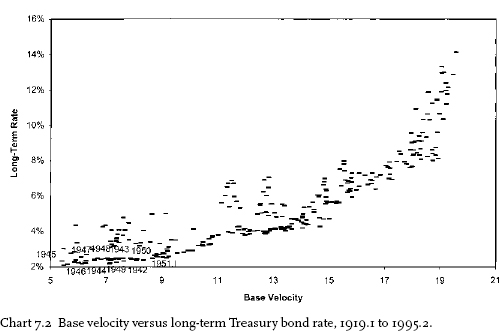
Chart 7.3 looks at the war and postwar period on a finer scale. The positive relation remains, but the effect of the 2.5 percent interest rate ceiling is now visible. Observations at the ceiling rate, mainly in 1943 and 1944, suggest that the ceiling was binding in these years. Extrapolating from the linear relationship, the data suggest that without the ceiling, interest rates and velocity would have been higher and average cash balances correspondingly lower during part of the war years. For much of the period, however, the ceiling rate seems not to have affected money holding.7
The opposite side of the much larger rise in cash balances was the much smaller increase in the public’s share of the debt. Morgenthau’s Treasury urged individuals to purchase debt, but he was unwilling to pay them to do so. The Treasury issued series E war bonds at prices as low as $18.75 per bond and war savings stamps for as little as 10 cents, which could cumulate to a bond purchase. The Treasury encouraged corporations, schools, and other institutions to sell bonds and stamps through payroll deduction and appeals to patriotism. These actions were not enough to offset the low interest rates paid on the debt. The nonbank public acquired a smaller portion of the debt in World War II than in World War I. Commercial banks acquired 40 percent of debt held outside the government and the reserve banks. Although many citizens and corporations pledged to buy bonds during bond drives, they sold many of the bonds to banks after the bond drive ended.

Secretary Morgenthau set three major objectives for war finance (Blum 1967, 14–15). He wanted to finance 50 percent of the war by direct taxation, to finance most of the rest by voluntary purchases of bonds, and to maintain low interest rates. He believed that low interest rates would minimize the cost of the war. He succeeded in his third objective, came close to his first, and managed to avoid most of the pressures from Congress and other parts of the administration calling for compulsory bond purchases.8
For calendar years 1942–45, total government spending was $306 billion, revenues were $138 billion, and GNP was $740 billion. These periods correspond to the war years, with a few additional months of demobilization and reconversion to peacetime resource use at the end. Based on these data, tax collections were 45 percent of spending, only $15 billion short of Morgenthau’s goal.9
Tax Policy
Morgenthau had little success getting Congress to approve his tax policy. Despite a Democratic majority in both houses, he did not fully meet his revenue goal or get his preferred tax policy. By 1944, relations between Congress and the administration became so strained that, with large majorities, both houses of Congress overrode the president’s veto of a tax bill for the first time in United States history. The administration did not try again to change tax rates during the war.
The main sources of conflict were the level of rates and the distribution of the tax burden. Many congressmen favored a sales tax. Morgenthau opposed on equity grounds; the sales tax would put more of the burden on low-income earners, a group he tried to shelter. At the opposite end of the income distribution, Roosevelt favored a limit of $25,000 on individual after-tax income, $50,000 for families. This proposal had so little appeal that Congress did not consider it seriously.
The 1943 tax bill made a lasting change in the tax system by introducing withholding at the source. Before 1943, taxpayers paid taxes in March on the previous year’s income. Withholding shifted most tax collection to the current year, a pay-as-you-go system for wage earners and some others. Withholding greatly simplified enforcement, as the number of taxpayers expanded to include 40 million to 50 million returns on incomes as low as $600 a year.10
Morgenthau at first opposed the withholding plan because Congress proposed to forgive all 1942 tax liabilities (due in March 1943) when withholding began. His main objection was that, with progressive taxation and high wartime rates, high-income taxpayers (and wartime profiteers) would benefit most. He was able to limit tax forgiveness and introduce some progressivity. The bill forgave $50 or 75 percent of the lower of 1942 or 1943 tax liabilities. Withholding began on July 1, 1943.
Morgenthau recognized inflation as a tax on households. He claimed he preferred direct taxation to inflation, but he would not allow interest rates to rise.11 However, he proposed some fiscal changes to reduce household income. One of his proposals would have raised the Social Security tax on labor income during the war, with the proceeds returned after the war, if needed, as unemployment compensation (Blum 1965, 313). Perhaps without fully recognizing the change, Morgenthau had become a proponent of countercyclical fiscal policy.
At the Federal Reserve Marriner Eccles saw the war as a major shift in demand that had to be met by substantial tax increases. In 1940–41 he agreed with the Keynesians who argued that, given the high unemployment at the start of the war, the country could increase both “guns and butter.” By 1942 he was concerned that the administration and Congress would be slow to recognize that the problem was no longer an excess supply of goods. There was an excess supply of money and excess demand for goods (Eccles 1951, 346–47).12
Debt Finance
Morgenthau foresaw that the war would require an unprecedented volume of borrowing. The Treasury and the Federal Reserve agreed on the desirability of ceiling rates of interest, high tax rates, and selling bonds mainly to the nonbank public. Morgenthau described relations with the Federal Reserve as “more harmonious during the war than they had ever been during the years of the New Deal” Blum (1967, 15). Board members shared this view.
Differences about substance remained, however (Board Minutes, April 9, 1942, 8). Eccles and some others preferred a mandated program—forced saving—to Morgenthau’s mainly voluntary bond purchase program. The Board offered proposals in each of the eight bond drives intended to increase sales to nonbanks, restrict speculation in bonds, and limit the role of banks to short maturities. The Treasury accepted few of these suggestions.
There were other differences about debt finance. Although the Treasury agreed on the aim of selling as many bonds as possible to nonbank investors during bond drives, it was less concerned than the Federal Reserve about whether the purchasers held the bonds after the drive. Getting the bonds sold at prevailing rates was its overriding interest.
Three main problems arose. First, with interest rates lower on short-term than on long-term debt, the Treasury faced an upward-sloping yield curve. Bank and nonbank holders sold shorter-term securities and reinvested in longer-term bonds. Second, as in World War I, the Treasury permitted a “borrow and buy” policy. To ensure that bond drives were successful, banks lent money to finance bond purchases at interest rates below the bonds’ yield. Many banks agreed to buy the bonds from their customers after the drive. Since the buyers could profit by buying the bonds, they oversubscribed the new issue. This gave the appearance of public subscription but depended on bank financing. Third, Treasury certificates with one year or less to maturity were troublesome throughout. The Treasury first offered certificates in 1942 at a yield of 0.8 percent. The rate was above the rate required by the market, so prices rose to a premium. As the certificates approached maturity, they sold at a premium over Treasury bills. Banks sold them to the Federal Reserve at a profit. The Federal Reserve tried repeatedly to get the yield reduced to 0.75 percent on new issues or to shorten the maturity and lower the rate, but the Treasury would not change (Minutes, FOMC, March 1, 1944, at 11:40, 1).
Officially, the Treasury opposed the borrow and buy policy. In practice, it did little to prevent it (Eccles 1951, 361). As a result, nonbank purchasers acquired $147 billion of government securities (including nonmarketable war bonds) but held only $93 billion. Corporations subscribed to about $60 billion in bond drives but increased their holdings only $19 billion.
Commercial banks financed bond purchases by selling Treasury bills and other low-yielding securities to the Federal Reserve. With bill rates pegged and ceiling rates set on all other Treasury securities, the banks moved to the higher end of the yield curve. To limit bank purchases of long-term debt, many of the bonds were made “bank restricted.” Small and medium-sized banks complained that mutual savings banks and savings and loans could buy the restricted bonds and thus were able to offer higher returns to savers. In 1944 the rules changed to permit commercial banks to purchase restricted securities during bond drives up to 10 percent of their savings deposits (Board Minutes, December 7, 1943, 2–4). Overall, bank purchases were limited to $10 billion during all bond drives. Bank holdings increased by $57 billion, however (Eccles 1951, 362).13
As in World War I, debt finance was much less successful than claimed after the war bond drives. The monetary base doubled in the four years ending fourth quarter 1945, an 18 percent compound average annual rate of increase. Purchases of Treasury securities account for almost all of the $18 billion increase in the base.14
Eccles proposed a three-part alternative. First, he wanted more of the debt made ineligible for bank purchases. This limited the profits that nonbanks could make by buying bonds at a favorable price during bond drives and reselling them to banks after the drive. Second, Eccles thought more of the debt should be in nonmarketable securities to supplement the (nonmarketable) series E, F, and G bonds sold to individuals. The Treasury accepted part of this proposal, issuing a nonmarketable short-term bond. They did not issue a nonmarketable long-term bond, mainly because they did not want to pay the additional cost. Third, Eccles wanted to limit bank eligible issues to the residual amount required to finance the budget. He urged Morgenthau to sell banks only short-term securities with low yields. This “would have prevented the excessive profits which many banks were able to make” (Eccles (1951, 365).
To support Eccles’s suggestions, the executive committee of the FOMC voted to recommend a long-term program. On January 28, 1942, it sent a memo to the Treasury that proposed (1) tap issues (on demand) to absorb surplus funds of nonbank corporations; (2) a 2.5 percent rate on securities with fifteen or more years to maturity; and (3) flexible rates on shorter maturities, bounded between 0.25 percent and 0.5 percent for Treasury bills.
As on many subsequent occasions, the Treasury did not accept most of the FOMC’s suggestions. It was not interested in a long-term plan. Morgenthau preferred to remain opportunistic, and he was not concerned with rate flexibility or higher interest rates. He accepted only the fixed 2.5 percent maximum rate. At war’s end, he was proud of his achievement—financing more than $200 billion at an average cost of 1.94 percent. In World War I, he noted, the average interest cost was 4.22 percent (Blum 1967, 30).15
In all, there were seven war bond drives and a Victory Loan drive between November 1942 and December 1945. Judging from discussions by the New York Federal Reserve directors and the open market committee, problems with “speculators” increased in the later drives. The bank put limits on the volume of discounting and issued warnings to member banks not to participate in these activities (Minutes, New York Directors, November 16, 1944, 48; July 5, 1945, 8; October 25, 1945, 96).
The warnings did not reduce the undesired activities. The open market committee was reluctant to change course at the end of the war until the Treasury completed the last (Victory) bond drive in the fall of 1945. But it agreed unanimously to discuss with the Treasury “policies which should be adopted for the reconversion and postwar periods” (Minutes, FOMC, October 17, 1945, 5).
Price and Wage Controls
Unable to persuade the Congress to pass all its proposed tax increases, the administration turned to price and wage controls to prevent wartime inflation. In July 1941 the president asked for selective controls on prices, but the bill did not pass in the Senate. After the war started, Congress approved the Emergency Price Control Act in January 1942, authorizing selective controls.
In March the president appointed a committee to consider the inflation problem. The committee concluded that selective price controls would fail. It recommended controls on rents, profits, wage rates, and prices and a $50,000 a year limit on incomes of corporate executives and professionals.16 Workers would have an incentive to increase income by working more hours (at overtime rates). Morgenthau opposed wage controls, but he favored limiting profits to 6 percent of invested capital (Blum 1965, 314).
In April and July 1942 the administration tried selective price controls. Prices rose at a 4.8 percent annual rate in that year’s first three quarters. The administration considered that rate too high. The president requested authority to freeze prices and wages, warning Congress that if the bill was not passed by October 1, he would issue an executive order. The Stabilization Act gave the president broad authority to control prices and wages. A former senator, Justice James Byrnes resigned from the Supreme Court to administer the Office of Economic Stabilization. Controls remained until the fall of 1946, when Congress repealed the authority it granted in 1942.17
THE FEDERAL RESERVE IN WARTIME
In a prescient 1942 memo, the staff of the Philadelphia reserve bank analyzed the problem the Federal Reserve faced in wartime. Although the war was less than a year old, the bank’s staff projected that by the end of 1944 the government debt would reach $200 billion. Banks would hold between $85 billion and $100 billion; bank reserves would have to increase by $14 billion to $18 billion to support the purchases (Memo, Supply of Reserve Funds, Board of Governors File, box 1452, October 8, 1942). The memo concluded that open market purchases were the best method of supplying the reserves (ibid., 7).
With discount rates at 0.5 percent and open market rates on Treasury bills below 0.375 percent, banks preferred to sell bills rather than discount. The main wartime decision of the Federal Reserve was to keep this structure unchanged.
Pegged Rates
On April 30, 1942, the Federal Reserve announced its commitment to purchase all ninety-day Treasury bills offered “on a discount basis at the rate no higher than 0.375 percent per annum” (Board of Governors File, box 1441, April 30, 1942). It did not fix rates on other government securities explicitly, but it established a pattern of rates that it maintained throughout the war and beyond. It held one-year rates at 0.875 percent. At the longest end, it held the rate on bonds with twenty-five years or more to initial maturity to a maximum of 2.5 percent, as noted earlier. During the war and early postwar period, the duration of the longest-term bonds declined, but the maximum yield remained fixed.
The announcement put maximum Treasury bill rates above the rates prevailing at the time. During 1941 and early 1942, the Treasury bill rate had increased gradually from 0.02 percent to 0.25 percent. At the long-term end, bond yields had increased from 2 percent in much of 1941 to 2.5 percent in January 1942. The announcement had no effect on the long-term yield.18
The Federal Reserve did not vote to fix yields on all securities for the duration of the war. Memos written in early 1942 are explicit about rates on the shortest and longest maturities. Conversations with bankers and other active market participants show some concern that the 2.5 percent long-term rate might be too low; Federal Reserve officials wanted to increase the prevailing 0.25 percent rate on short-term bills. But the uniform opinion was that “the cost of war is a social cost and its risks should be borne by the public at large, not by any one group, such as those who have bought government securities” (Letter Sproul to Bell, Sproul Papers, Monetary Policy 1940–41, March 16, 1942, 2). “The Treasury, representing the public at large, should assume the risk of a change in credit conditions.”19 (ibid., March 10, 1942, 3).20
Households would get nonmarketable securities that they could redeem at the Treasury at a fixed price. This decision avoided the problem of imposing losses on the general public, a concern based on experience after World War I. Banks would be large holders of marketable debt, so it would be “necessary … for the Federal Reserve and the Treasury to protect that market, not only during the war, but during the post-war period” (ibid., March 16, 1942, 2). Sproul recognized that protecting the market meant that government debt would “have some attributes of a demand obligation.” The problem was to manage the debt “in the way least likely to contribute to … inflation” (2).21
A few days later, Sproul’s letter to Eccles summarized the agreement with the Treasury. At the short end, the Federal Reserve agreed to support the market “when the rate on Treasury bills reaches ¼ of 1 percent, and support[ing] with increasing strength as the rate approaches  of 1 percent” (Sproul to Eccles, Sproul Papers, FOMC 1942, March 21, 1942). The general market would be kept “on about the present curve of rates but this … does not mean that we must hold the 2’s of 1951–55 or the 2½’s of 1967–72, or any other issue, at par, or any other fixed price” (ibid.). The System maintained this position for a time, but it was unable to get the Treasury to agree.22
Even granting that the Federal Reserve had no choice but to finance the war at fixed rates, it was a mistake to accept the prevailing structure of interest rates. That structure reflected market anticipations in April 1942 about future economic expansion and inflation. The positive slope of the yield curve, expressing rates by maturity of the debt, suggests that the market anticipated that output, inflation, and therefore interest rates would rise over time. The fixed pattern of rates was inconsistent with this anticipation, so it invited debt holders to sell low-yield securities and buy at higher yields. Since the peg made all government securities equally liquid, or nearly so, the Federal Reserve’s decision was the cause of its principal problems for the next nine years. First, banks could lend to their customers for short periods at rates below the rates on long-term debt. As debts matured, bond prices rose to a premium. Holders sold, took capital gains, and purchased longer-term debt. Although the Treasury disliked both practices, it was unwilling to consider any changes in the structure of rates during the war. Second, banks followed the same pattern, selling bills with yields of 0.375 percent to the Federal Reserve and buying longer maturities with higher yields. By 1945 the Federal Reserve had acquired almost all of the outstanding bills: “They ceased to be a market instrument” (Eccles 1951, 359).
In the late 1930s, the Federal Reserve urged the Treasury to increase the supply of short-term debt. The Treasury refused. With the short-term rate fixed, the Treasury could now reduce interest cost by issuing a relatively large volume of short-term debt. At prevailing rates and policies, the market wanted more long-term debt. By fixing the structure of interest rates, the Federal Reserve sacrificed its ability to change the composition of the debt held by the public. Market demand dictated the amount and composition of its purchases and sales.
In 1944 some members of the open market committee began to shift their position. They asked the Treasury to increase bill rates to 0.5 percent by lengthening the initial term to four months (Minutes, FOMC, March 1, 1944, 5). Eccles opposed the request on the improbable grounds that large banks would use the additional revenue to absorb exchange charges on checks. Small banks would increase these charges, weakening the banking system (Board Minutes, March 8, 1944, 2).
Despite the comments about flexibility he made in 1942, Eccles favored the fixed rate structure throughout the war to reduce financing costs and to prevent owners of Treasury securities from profiting from war finance. He opposed a proposal to extend the maturity of the debt by selling more three- to four-year securities and fewer bills because “there was no reason why they [banks] should receive 1¼ or 1½ percent” (Board Minutes, Meeting of the Federal Advisory Council, December 4, 1944, 9). “It was highly desirable that the proportion of outstanding Government debt in the form of bills and certificates (under one year) should continue” (11). He regretted only that banks did not buy more short-term securities. It was a mistake, he thought, not to restrict them to these short-term issues in 1941 (13). The banks had too much profit.23
With its chairman firmly holding views of this kind, the Federal Reserve did not seek changes in interest rates during the war. Even if it had sought higher rates, it would have faced two obstacles. Morgenthau opposed any increase. And populists in Congress claimed the interest cost was too high. Congressman Wright Patman (Texas), a member of the House Banking Committee, denied that he wanted “printing press money.” He wanted lower interest rates: “If money must be created on the government’s credit, the taxpayers should not be compelled to pay interest on it” (Board of Governors File, box 141, July 1942).24
The Board and the banks understood the inflationary consequences of pegging rates, but they did not oppose the policy during the war. Those most concerned about inflation urged higher income tax rates, sales or expenditure taxes, or compulsory savings to absorb purchasing power. To improve understanding of the problem and disseminate information more widely, Eccles urged the reserve banks to expand their research staffs and coordinate their efforts through a System committee (Board Minutes, March 2, 1943, 2–7).25
Open Market and Other Purchases
With rates fixed, the FOMC had little to do. It approved new limits on the size of the account and authorizations to purchase and sell. It spent much of its time discussing problems associated with bond drives, banks playing the pattern of rates, and the possibility of lending to banks instead of buying securities or using repurchase agreements instead of discounts and outright purchases.

Banks held more than $6.5 billion of excess reserves early in 1941. At first they purchased securities by reducing excess reserves. The decline was most rapid in New York, slowest at country banks.26 By August, New York banks had all but eliminated their excess reserves (Minutes, FOMC, August 8, 1942). To provide reserves, the Federal Reserve removed all restrictions on the amount of short-term securities (bills and certificates) in the System Open Market Account by the end of 1942. Limits on the amount of longer-term securities remained.
Table 7.2 shows the rates of purchase from 1942 to 1945. By the end of the war, short-term government securities had become the Federal Reserve’s principal asset. The pre–World War I problem of a portfolio insufficient to offset a gold inflow or, in the 1930s, excess reserves greater than the portfolio, would not return. Financing World War II left the Federal Reserve balance sheet and the monetary base dominated by the open market portfolio. This result was very different from the founders’ plan; the System had become an indirect source of government finance.
It soon became a direct source as well. On March 27, 1942, the second War Powers Act authorized Federal Reserve banks to acquire direct or guaranteed obligations of the United States by purchase from the Treasury. Eccles supported the bill enthusiastically. At one point he suggested that the FOMC should view the change as a new method of distribution: “Instead of having to … price an issue at a figure which would attract heavy oversubscriptions, the securities could be taken by the System and sold to the market as it could absorb them” (Board Minutes, February 3, 1942, 4).
Other Board members accepted the change as a wartime measure needed to ensure that Treasury issues would not fail to find buyers at established rates and to furnish funds for short periods around tax dates. Sproul, who was at the meeting, did not oppose the amendment. He criticized the Board’s failure to discuss the subject with the president before it was included in the War Powers bill, and he opposed Eccles’s suggestion that the reserve banks distribute government securities. He accepted direct purchases as a temporary measure to help the Treasury around tax dates or in an emergency.27
The change repealed a section of the Banking Act of 1935 that prohibited the System from purchasing government securities except in the open market. A few months later, the Board told the account manager to combine direct purchases from the Treasury with open market purchases in the weekly statement. The War Powers Act expired six months after the war ended; initial authority for direct purchases expired in December 1944. The Board requested renewal for two more years; later the authority became permanent.
Despite the low interest rates on short-term debt, war finance greatly increased earnings of the reserve banks. Net earnings rose from an average of $11 million for 1937–41 to more than $92 million in 1945. The Federal Reserve had been relieved of payments to the United States Treasury after 1933 in exchange for the capital provided to establish the Federal Deposit Insurance Corporation.28 By September 1942, Vice Governor Ronald Ransom anticipated that the government would reinstate the franchise tax if earnings rose (Board Minutes, September 15, 1942, 2). He was correct but premature. Congress imposed a tax equal to 90 percent of annual net earnings in 1946. The tax offset a substantial portion of the interest payments on Treasury debt held by the reserve banks.29
Reserve Requirements
With the bill rate at 0.375 percent in 1942 and income taxable at high wartime rates, banks outside New York and Chicago did not bother to invest in bills or send excess reserves to correspondent banks. The Treasury wanted to reduce reserve requirement ratios for urban banks to release reserves for purchases of Treasury securities.
The Banking Act of 1935 did not permit the Board to change reserve requirements for only one class of banks. Congress approved the additional authority on July 7, 1942. The change was contentious within the System. The Federal Advisory Council opposed the change, and initially so did the Board. Eccles described the reduction as “a grave mistake” (Board Minutes, February 16, 1942, 2–3). Prodded by the Treasury, once the legislation passed, the Federal Reserve reduced required reserve ratios at central reserve city banks in three steps, from 26 percent to 24 percent on August 19, 22 percent on September 14, and 20 percent on October 3. Together the three reductions released $1.2 billion, about 6 percent of the monetary base at the time.
The New York and Chicago banks bought Treasury bills, as expected. The principal effect of the change was not on reserves or the monetary base but on the earnings of the banks and reserve banks. With interest rates rigidly fixed, banks as a group determined the aggregate amount of reserves by buying or selling Treasury bills. Further, New York and Chicago banks could create more deposits and add more to earning assets per dollar of reserves or base money. Contrary to Eccles’s aim, the reserve banks had smaller earnings and the banks had more.30
The three changes brought required reserve ratios for the two central reserve cities to equality with reserve city banks for the first time in Federal Reserve history. There were no further changes in reserve requirement ratios during the war. The only other wartime change removed reserve requirements on war loan deposits as an inducement to banks to buy securities by increasing Treasury deposits during bond drives.
Discount and Other Rates
Discount rates ranged from 1 to 1.5 percent when the war started. After some prodding from the Board, on April 11, 1942, the reserve banks agreed to a uniform discount rate of 1 percent. In addition to the basic discount rates, the Federal Reserve set a preferential rate for loans collateralized by short-term government securities and a rate on direct loans to military contractors made under its authority to lend to individuals and businesses. The latter provision, a depression measure, was used to finance production of war materials. The amount outstanding on June and December reporting dates never exceeded $35 million (lent in 1936). During World War II, the total outstanding was about $10 million. Almost all the loans were for one year or less (Board Minutes, 1976, 492).31
Analysis at the Philadelphia reserve bank correctly noted that banks would obtain reserves at lowest cost and would hold debt with higher rates and longer terms to maturity. With discount rates above Treasury bill rates, discounting remained small. The memo criticized preferential rates for loans collateralized by government securities. Preferential rates would not affect the volume of borrowing, only the collateral used to borrow and the maturity of bank-held debt (Board of Governors File, box 1452, October 8, 1942, 7–10).
The Philadelphia bank’s memo was critical of preferential discount rates on other grounds also. The memo rejected the real bills doctrine: “The experience with preferential rates in the last war and the postwar period on the whole was not satisfactory. The general conclusion of Reserve officials and analysts is that the particular paper used to secure an advance has no relation at all to the use that the bank will make of the funds it secures” (ibid., 9).
Despite this correct analysis, the Board adopted a preferential discount rate of 0.5 percent for discounts secured by short-term governments. The main argument for the preferential rate was that it would induce banks to hold more short-term bills instead of higher-yielding bonds. George L. Harrison said that it would be easier to eliminate the preferential rate, when it was time to reverse policy, than to increase the general discount rate (Board Minutes, October 7, 1942, 9).32
Harrison underestimated the Treasury. In June 1945 Sproul proposed an increase in the preferential rate to 0.75 percent. All the presidents concurred, but the rate remained at 0.5 percent (Minutes, FOMC, June 20, 1945, 9). The following month, the New York bank directors asked to eliminate the preferential discount rate. The Treasury remained unwilling, so the rate stayed (Minutes, New York Directors, July 19, 1945, 20).
Bankers grumbled occasionally about Treasury tax and interest rate policies. When the opportunity arose, members of the Federal Advisory Council argued for higher rates on short-term securities to get banks to hold more of them. The most strenuous plea came from a member who argued that banks could not be expected to finance the war if they were “‘bled white’ through the maintenance of low interest rates and application of high taxes” (Board Minutes, April 9, 1942, 13).33
Selective Credit Controls
Unable to control money or interest rates, the Board turned first to controls on consumer credit and later to controls on real estate, stock market, and other forms of lending and borrowing. Some of these actions were taken to show that it was “doing something” to control inflation, some in the belief that it had to use existing authority before Congress would grant additional powers, and some at the urging of other agencies.
The Board adopted regulation W to reduce the demand for durable goods. The original order required a 20 percent down payment and limited loans to a maximum of eighteen months. Wartime revisions and amendments extended the range of goods covered, raised the required down payment, and reduced the maximum term.34 Experience with regulation established once again that efforts to control a complex economy produce unforeseen consequences leading to both extensions and exclusions from earlier regulations.35 Since credit is fungible, restrictions on one type of credit shifted demand to less regulated forms and encouraged innovation to circumvent regulations.36
By 1943 the Board began to discuss extending credit regulation to include real estate, securities, and traded commodities. Eccles explained to the reserve bank presidents that “the Board was not seeking the authority … but was willing to accept it” (Board Minutes, June 29, 1943, 21). Eccles preferred to increase taxes and forgo additional regulation, but he accepted the new responsibility to retain credit control under the Federal Reserve System: “Some of the Presidents indicated agreement with Chairman Eccles’s attitude and expressed doubt as to the ability of any agency successfully to discharge the responsibility” (22).
Enforcement differed across the country because each reserve bank chose the extent of enforcement. Vice Chairman Ransom complained at one point that the Board had chosen a middle course between strict and lax enforcement. Strict enforcement “would antagonize the people whose support was necessary,” and lax enforcement would foster the “impression that the System did not care whether the provisions of the regulation were observed” (ibid., 23).
Years later, W. Randolph Burgess summarized matters: “Looking back at the experience with the control of consumer credit, it would be very hard to make a case that what was done … was useful, and it certainly made a great deal of work for a great many people, at a time when there was a shortage of manpower and a heavy surplus of irritating red-tape and procedures to interfere with essential war work” (Letter Burgess to Sproul, Sproul Papers, Board of Governors, Joint Committee on Economic Report, October 7, 1949, 2).
Common stock prices had fallen a total of more than 20 percent from 1939 to 1941. Stock prices rose 20 percent in 1942 but remained below their 1938 value (Ibbotson and Sinquefeld 1989). In March 1943 the Board began discussing increases in margin requirements on securities. The volume of trading had increased to about one million shares a day, making some of the staff uneasy. Earlier, the Board had issued regulations T and U to set margin requirements as authorized by the 1934 Securities Exchange Act. Some staff members urged a preemptive strike against speculation, but the Board decided not to act (Board Minutes, March 15, 1943, 2–4). Prices continued to rise. By the end of 1944, the stock price index was almost 40 percent above the 1936 peak.
On February 5, 1945, the Board increased margin requirements to 50 percent. Eccles argued that there was no evidence of excessive use of credit in the stock market, but the Board approved the increase to show that it was concerned about future inflation (Board Minutes, February 2, 1945, 3–9).
Three weeks later, Eccles reported that the Economic Stabilization Board had suggested a 100 percent margin requirement. Eccles saw no need for the change, but Chairman Vinson of the Stabilization Board thought that Congress would not authorize new powers to control inflation until existing powers had been used. Eccles suggested that Vinson send a letter to the Federal Reserve asking for the increase in margin requirements (Board Minutes, February 23, 1945, 7–8). Vinson sent the letter, but the Board delayed a decision.
By a vote of five to one, the Board agreed to let Eccles tell the Economic Stabilization Board that the System favored an increase only to 70 percent. Governor John K. McKee opposed because the government’s anti-inflation program was incomplete, and not much credit had been used for purchasing and carrying securities (Board Minutes, May 3, 1945, 7–8).37
The Federal Advisory Council agreed unanimously that speculation in real estate and stocks should be discouraged, but it saw little evidence of inflationary pressure in asset markets: “Farm lands are about where they were in 1913… . There has been a good deal of speculation in the larger apartment buildings and hotels and in some kinds of commercial buildings, but even there the prices are below the cost of reproduction. Stock prices are not above the 1936–37 levels, in spite of the fact that in the interim most corporations have added very materially to their assets” (Board Minutes, May 14, 1945, 2).
By late June 1945, with the war almost over, the Economic Stabilization Board agreed to recommend credit controls on real estate, higher margin requirements on stock transactions, and a longer holding period for capital gains. It considered an increase in the capital gains tax rate. It could not decide whether new construction should be exempt from real estate controls. Eccles believed that the new credit controls would be ineffective and should not be used unless Congress passed a tax increase (Board Minutes, June 21, 1945, 18–19).
Pressed by the administration, the Board voted to increase margin requirements on new purchases of securities to 75 percent effective July 5. The Board also required that the proceeds of security sales be used to bring the margin on the whole portfolio toward the new requirements before cash could be distributed to the owner. Governor McKee again opposed the increase.
The new requirements were unpopular with the public and with many bankers and securities dealers. In September the Federal Advisory Council urged the Board to consider returning to a 50 percent margin. Eccles thought it was premature to consider a reduction. Effective January 2, 1946, the Board increased the margin requirement to 100 percent; all transactions had to be for cash.
Other Wartime Changes
Rapid growth of the Federal Reserve’s portfolio and the monetary base, and a small gold outflow, lowered the System’s gold reserve ratio toward the legal limit—40 percent of notes in circulation and 35 percent of deposits at Federal Reserve banks. By mid-1944 the System’s gold reserve ratio had fallen to 55 percent (from 91 percent in November 1941).
The FOMC minutes first mention the problem in May 1944. The committee voted to reallocate Treasury bills in the System account to prevent the ratio at any reserve bank from falling below 45 percent. Members agreed to buy Treasury bills from the reserve banks with low ratios and to change the allocation of open market purchases (Minutes, FOMC, May 4, 1944, 14–15). Several banks sold Treasury bills to other reserve banks for gold certificates, and the Federal Open Market Committee revised the securities allocation formula to adjust for differences in gold reserves.
The System’s gold reserve ratio continued to fall. In July the executive committee considered asking Congress to reduce the ratio to a uniform 25 percent against notes and deposits. Eccles favored eliminating the requirement, but the committee thought the public was not ready to remove all ties to gold. The executive committee voted to put off any decision until after the election.
Legislation introduced in January, and passed in June, lowered the gold reserve requirement to 25 percent and extended the “temporary” authority, first granted in 1932, to use government securities as collateral for Federal Reserve notes.38 The FOMC responded by lowering from 45 percent to 35 percent the gold reserve ratio at which the individual reserve banks would cease to participate in open market purchases. Table 7.3 shows that even after the legal change, several of the reserve banks did not meet the requirement.

Eccles attempted to coordinate the research functions at the reserve banks under the direction of the Board’s research division. The issue had arisen first in 1936, after the Banking Act of 1935 became law. It arose again in 1943, under the guise of having a “steering committee” to give direction to research work. The reserve banks resisted and, on both occasions, prevented the Board’s staff from acquiring authority over the banks’ staffs (Sproul Papers, Memorandums and Drafts, December 17, 1943). Eccles tried again, claiming that the Board had the right to approve persons appointed to supervisory positions in the banks’ research departments, but he did not prevail over the protests of the banks’ officers and directors (Minutes, New York Directors, August 17, 1944, 267).
To supplement wartime price controls, the government ordered coupon rationing of gasoline, food, shoes, and other consumer goods. Purchasers presented coupons along with cash to complete transactions. Processing ration coupons became the responsibility of commercial banks and Federal Reserve banks beginning in January 1943.
The army decided early in 1942 to move Japanese and Nisei living in the western states into camps. After the administration approved the order, Japanese and Nisei had to leave their homes and businesses. The Treasury had responsibility for protecting the property they left behind. The Federal Reserve banks administered the program for the Treasury (Blum 1967, 3–4).39
POSTWAR PLANNING
Planning postwar economic policies began long before the war ended. Interwar experience convinced many businessmen, economists, and others that it would be unwise, and probably unacceptable, to return to the high unemployment rates and instability that characterized the interwar period. Keynes’s General Theory (1936) seemed to provide an economic rationale for activist government policies to expand or slow domestic economic activity.40 His plan for international monetary cooperation, prepared during the war, made a major contribution to the development of the postwar Bretton Woods institutions. Earlier, in his Treatise on Money (1930), he had made the case for international monetary reform, based on a more flexible gold standard. These topics moved to the forefront in planning for the postwar world.
Discussion of postwar planning shows significant changes in policy views since the 1920s. Two changes eventually altered the role of United States monetary policy. First was the commitment to economic stabilization. This commitment was a long step away from the Federal Reserve’s denial in the 1920s that its actions affected the price level or the pace of economic activity. Second was the primacy given to domestic over international considerations. The proponents of these changes assigned a very modest role to monetary policy and the Federal Reserve. As the perceived influence of monetary policy changed in the 1950s and 1960s, full employment and domestic stability became dominant policy concerns by the 1960s. Although not fully recognized at the time, the heightened emphasis given to domestic concerns in many countries was incompatible with plans for an international monetary system based on gold and fixed exchange rates.
Domestic Plans
In spring 1943 the System began to study postwar reconversion. One set of issues was transitional. For example, when the military canceled contracts, small and medium-sized firms would need loans to convert to peacetime production just as regulation V loans to finance military procurement ended. The System appointed a committee to study transitional lending (Board Minutes, April 29, 1943, 5–7; June 20, 1943, 5–7). In May 1944 the Board authorized a series of studies of postwar policies. A sample of the ideas gives the flavor of many economists’ opinions at the time.
The Board’s economic adviser, Emanuel A. Goldenweiser, recommended the “continuation of wage and price controls, rationing and allocation, as well as licensing exports … [as] a prime condition of a successful transition from a war to a peace economy” (Board of Governors of the Federal Reserve System 1945, 1:3). Goldenweiser proposed that the government offer employment to any unemployed worker to sustain consumption. He favored keeping selective credit controls, margin requirements, and “all the powers over the general volume and cost of money that they have had in the past, and they should have additional authority over member bank reserves” (1:15). The “additional authority” is probably a reference to a secondary reserve requirement of securities to prevent banks from selling Treasury bills to the reserve banks.
Unemployment was a main concern. The second study in the Board’s series warned of another 1929 collapse and unemployment of 6 to 8 million during reconversion to peacetime (ibid., 1:18–49).41 Postwar experience turned out very differently. Reconversion occurred quickly. After a brief adjustment, economic activity rose rapidly. Unemployment remained low.
Like Goldenweiser, Eccles believed that price controls should be retained until postwar output increased enough to satisfy demand. He testified that “price controls, rationing, curbs on consumer credit or stock market credit, and similar devices, admittedly deal only with effects and not with basic causes of inflationary pressures” (House Committee on Banking and Currency 1946, 171).42 Nevertheless, he believed that an opportunity to control inflation was lost with repeal of the excess profits tax in 1945, termination of the War Labor Board, and failure to increase the capital gains tax at the end of the war (Board Minutes, November 19, 1945, 10–11). He did not mention that these wartime measures distorted allocation and slowed investment. Nor did he recognize that price and wage controls caused many low-priced goods to disappear and encouraged producers to lower quality as a substitute for raising prices. Similarly, wage controls encouraged both labor “hoarding” and shortages and the substitution of noncash benefits for cash payments.43 Neither he nor his staff recognized that deregulation and correct price signals would speed the transition and reduce waste.44
Congress did not concur. It responded to the general dissatisfaction with wartime controls, rationing, and black markets by removing most controls by fall 1946. The immediate effect was a short-lived surge in the reported price index, as reported prices adjusted to reflect hidden or deferred changes (see chart 7.1 above). Consumer prices rose at a 29 percent annual rate between June and November, with the largest rise in July. By January 1947 the monthly increase had fallen to zero.45 After these adjustments, price levels were 33 percent above the level at the start of the war, a 6.5 percent annual rate of increase.
Lauchlin Currie, on the White House staff, and Keynesian economists at Commerce, Treasury, and other agencies believed that a severe postwar depression was likely. They bolstered their argument by showing that private spending would not expand enough to replace military spending as a source of employment. Much of the shortfall was a consumption “gap”—the difference between predicted consumption spending and spending consistent with full employment. And because the consumption gap would be large, private investment would remain low and unemployment high.46 Beginning in 1944, Keynesian economists urged gradual release of materials from military use to smooth postwar readjustment. The military opposed the change while the war continued, and nothing was done. Interest in peacetime conversion rose when the European war ended in April 1945. The National Resources Planning Board advocated a comprehensive social welfare program, pollution abatement, public transport systems, and other government programs.
Nothing in Keynesian analysis favored government spending instead of tax reduction as a way for government to influence the transition from war to peace. Largely as a matter of belief, administration economists and their outside advisers favored government spending.47 System economists were divided.48
President Roosevelt adopted part of the Keynesian program. His last State of the Union message to Congress set a goal of 60 million postwar jobs. At the time, there were 55 million people in the civilian labor force and an additional 11.4 million in the armed forces, but some of these were women who were expected to leave the labor force after the war. The statement was seen as a loose commitment to “full employment.”
Roosevelt’s statement was soon followed by a proposed Full Employment Act that became the Employment Act of 1946.49 The original proposal recognized a person’s right to employment and the government’s responsibility to provide full employment. To achieve this end, the proposal called for some national planning: a National Production and Employment Budget would forecast the state of the economy and the levels of employment and output consistent with full employment. The president would recommend actions needed to close any “gap” between expected and full employment.
Discussion of the bill shows the large shift in opinion that had occurred in a decade. The bill had three Republican senators as sponsors and more than one hundred sponsors in the House, including Congresswoman Clare Booth Luce, a prominent conservative and the wife of a prominent publisher. Few in Congress criticized the commitment to an expanding economy or the idea that government spending could affect the economy. The right to a job and a commitment to full employment were more contentious. Opponents pointed to the risk of inflation, the possibility of continuous budget deficits, and the possible use of the act to promote “national planning,” price controls, or other restrictions on freedom.
The act that emerged was a compromise, but it gave more to the opponents than to the original proponents.50 Gone were the commitments to full employment and mandatory computation of the “gap.” The legislation called only for “maximum employment, production, and purchasing power,” a phrase that was undefined, therefore open to whatever interpretation an administration or Congress might put on it. Gone also was a legislated commitment to forecasts of economic activity, although forecasting became standard procedure in all administrations.51
The act created a Council of Economic Advisers in the Office of the President to help the president decide on economic policy. The intention may have been to keep the council as a professional body, free of politics. In practice the council, as a staff agency, had a weaker position than many of the current and future line agencies representing business, labor, environmental, educational, consumer, and other interest groups. The role of the council has varied with the president’s interest in receiving its advice and the relationship between the council’s chairman and the president.52
The Board’s reaction was generally positive and supportive of the original bill. Woodlief Thomas, assistant director of research at the Board, read the bill as an attempt to “legislate the Keynes-Eccles-Hansen-Beveridge theory of economic stabilization” (Memo Thomas to Ransom, Board of Governors File, box 198, February 12 and 4, 1945). Thomas saw enactment of a particular economic theory as a danger, but the act did not do that. The bill, he said, was “a statement of goals, not an outline of policies” (ibid.).
Eccles had favored countercyclical use of fiscal policy since the early 1930s. He came to Washington early in the New Deal to promote that policy. In a letter to Senator Robert Wagner, he accepted the objectives of the bill but emphasized the primary role of the private sector in providing employment. He urged Wagner to substitute for full employment “maintaining economic stability at as high a level of employment and production as can be continuously maintained” (Eccles to Wagner, Board of Governors File, box 198, June 16, 1945). Although he discussed the Federal Reserve, he did not mention monetary policy as a tool for reaching the objectives of the act.
Neglect of monetary policy was not an oversight. The conventional view among economists at the time was that monetary policy had, at most, modest effects on output and prices.53 These beliefs justified the passive monetary policy that the System chose mainly for political reasons. When conventional views changed in later years, the Federal Reserve accepted major responsibility for moderating recessions and controlling inflation.
International Plans
Planning for postwar international monetary cooperation began before the United States entered the war. Section 7 of the lend-lease agreement, under which Britain and others obtained military supplies and equipment “on credit,” provided that the United States could waive postwar repayment if the British agreed to eliminate trade “discrimination” and reduce tariffs. Discrimination was not further defined, but the objectives it expressed included elimination of the prewar system of imperial preference that bound Britain to its empire and favored British exports.
Avoidance of bilateral agreements and imperial preference was a major goal of the State Department. Secretary of State Cordell Hull favored a multilateral system centered on “most favored nation” clauses that gave each signatory the lowest tariff rate agreed with any other country. The British accepted section 7 out of wartime desperation. They did not like it (Presnell 1997).
In the course of negotiations leading to the lend-lease agreement, Keynes broadened the terms of reference to include finance and exchange rates. The two treasuries then took the lead in negotiations, shifting emphasis from trade issues to finance. By September 1941 Keynes had developed a proposal for an international clearing union that could create a currency for member central banks to use in settling payments imbalances. After adjustment, Keynes’s proposal became the British government proposal in April 1943, when formal bilateral discussions began.
Keynes (1924) had developed the basic analysis much earlier. Each country acting alone can achieve either stable prices or a fixed exchange rate but not both. To achieve both, there must be international cooperation or agreement. The gold standard is one type of agreement; each country accepts the rules of the standard, defining currency value in grams of gold, agreeing to buy and sell gold at a fixed price, and allowing money and prices to rise or fall with gold movements. If member countries followed these rules, exchange rates would remain fixed and inflation or deflation would be limited to changes around the world price level, the latter set by world demand for and output of gold. Large productivity shocks might disrupt countries’ efforts to maintain employment and stable prices, but prices and output would eventually adjust as required by the fixed exchange rate.
The rules, however, required procyclical policies—allowing gold inflows to inflate the economy during expansions and to accept contraction, unemployment, and deflation when gold flowed out. With the growth of industrialization, labor unions, and the spread of the voting franchise, voters and governments were less willing to follow such rules in the 1920s. Many proposals to eliminate or reduce procyclicality had been made, but none had been adopted.54
In December, a week after the United States entered the war, Morgenthau asked Harry Dexter White to “prepare a memorandum on the establishment of an inter-Allied stabilization fund” as the basis for postwar international monetary arrangements (Blum 1967, 228–29).55 Morgenthau’s diary suggests that, although the United States had insisted on title 7, he had no more than a vague idea about expanding the prewar Tripartite Agreement to avoid competitive devaluation.56
The British were particularly interested in preventing a return of their interwar problem, when efforts to expand their economy by lowering interest rates were followed by a current account deficit and an outflow of gold that reduced the money stock and forced contraction and deflation.57 White, and others at the United States Treasury, also favored a more flexible system. He too proposed a middle way between fixed and fluctuating rates with rules for lending and borrowing. Exchange rates would be fixed but adjustable; countries with a balance of payments surplus (like the United States in the 1920s) would lend to countries with deficits (like Britain in the 1920s). Unlike Keynes’s plan, the new international institution could not create money.
The plan envisaged that deficit countries would not be forced to contract and deflate for balance of payments purposes. They would maintain imports from the rest of the world instead of reducing purchases and spreading contraction. To enforce lending, member countries agreed to impose costs on surplus countries that would neither expand imports nor lend to countries in deficit. Thus deficit and surplus countries alike would benefit from increased flexibility.58 Both Keynes and White limited their proposals to financing trade and current account deficits. To the extent that they considered lending and borrowing on capital account, it was the responsibility of the proposed International Bank for Reconstruction and Development, later called the World Bank.59
Countries could pursue the domestic policies of their choice, a main British aim and another major departure from classical gold standard rules. Countries could correct policy errors by changing the exchange rate, with the consent of the new agency, the International Monetary Fund. The fund would also prevent multiple currency practices, discriminatory bilateral arrangements, and competitive devaluations. Eventually countries would maintain current account convertibility, a main aim of the United States.
Many in the banking community and the Federal Reserve wanted to return to the gold standard. White dismissed these proposals: “There isn’t the slightest chance of getting other countries to return to the gold standard” (White to the Board and Reserve Bank Presidents, Minutes, FOMC, March 2, 1945, 20). The only chance for agreement was to combine stability of exchange rates with the flexibility to change them with the fund’s approval. Other countries would agree to this mixture of stability and flexibility if it was part of an agreement that gave each country some assurance that it could borrow in an emergency: “We must give them time to balance their payments in such a way that they will not hurt the rest of the world” (25). Adjustment might take two, three, five, or even ten years.
The Reserve Board began to consider the Keynes and White plans in May–June 1943. Their first concern was the amount of new bank reserves that the United States would have to create. To eliminate all restrictions on current account financing, as Keynes proposed, required an expansion of $25 billion to $30 billion of United States base money. An expansion of this magnitude would double the amount of base money then outstanding. Board members wanted either power to control the domestic effect of such a large increase or a limit on the size of the increase (Board Minutes, May 29 and June 1, 1943). The Board also favored a provision, suggested by the Canadian representatives, that if the amount of foreign exchange balances at the fund increased beyond a preset limit, the member would gain voting power (ibid., June 1, 1943, 4). This would permit a surplus country to eventually limit borrowing and expansion of its money stock. The British would not accept this proposal. They remembered the policies of surplus countries (the United States and France) in the 1920s and did not intend to repeat the experience.
As the plan developed, the Board’s discussion of substantive issues ceased. Board staff participated actively in meetings organized by the Treasury, but few of the issues they raised came before the Board. The Board never considered the merits of alternative proposals and objections to the plan by leading bankers and the New York reserve bank.
The Board’s consideration of the proposals that became the Bretton Woods Agreement is remarkable for the failure to discuss substance. This was not its initial intention. On March 7, 1944, Governor Menc S. Szymczak proposed that the Board approve the joint statement of a committee of international experts provided the Board would participate in the selection and control of the United States representative to the fund (Board Minutes, March 7, 1944, 1).60 The Board did not act. The following day the Federal Advisory Council, meeting with the Board, supported the principle of exchange rate stabilization under an international agency but mentioned no details. A week later, Szymczak asked whether the Board wanted to suggest changes in the plan.61 There was “general agreement … that if a plan were to come into existence it would not be possible for the Board to propose any fundamental changes” (Board Minutes, March 13, 1944, 2). The only decision was that a majority of the Board wanted “a voice in the selection of the American member of the board of directors” (3). “Reference was made to the fact that discussion of the plan up to this point had been strictly on a staff level and that none of the interested heads of agencies of the Government had in any way committed himself to what had been done” (4). The Board agreed to wait and not take a position until other agencies did. It instructed Goldenweiser, one of the Board’s representatives at the technical discussions, to say that the Board’s representatives did not speak for the Board.
This was either subterfuge or myopia. The Treasury was moving rapidly toward agreement on the plan. Morgenthau called a meeting in mid-April to discuss next steps. Eccles reported to the Board that Morgenthau had asked whether the Board would make a commitment to the plan. Eccles said no, the discussions had been at the staff level, and “it was understood that no commitments had been made or were expected at this time. I said it had been my understanding that the principals would meet and consider the report of the technicians, after which there would be an opportunity to discuss the matter, and that no such meeting had been called” (Board Minutes, April 18, 1944, 2). White, who was present, did not agree. The conference “would not go outside of the statement of principles” (1).62 The Board hesitated, neither endorsing nor opposing the plan.63 Instead it adopted a statement saying that “no governments are committed by action of the technicians. It now becomes necessary for the executive branch of the Government to consider the proposal of the technical experts and to determine what course of action in this matter should be undertaken and ultimately what program should be recommended to Congress” (Board Minutes, April 24, 1944, 2). The Board voted five to one to approve the statement. McKee abstained because he said the statement had no value.
Late in May the president announced an international conference to begin July 1 at Bretton Woods, New Hampshire. Governor Szymczak told the Board that, on June 15, technical experts from twelve countries would meet to prepare the conference agenda. Eccles, who was not present at the Board meeting, had agreed to be a member of the United States delegation. Some of the Board’s staff would serve as members of the conference staff.64
The Board members agreed that the main issue they faced was how the Board wished to counsel Eccles as their representative (Board Minutes, May 31, 1944, 3). Governor McKee asked for a meeting with the reserve bank presidents to hear objections from President Sproul and to discuss the plans “point by point” (3).
The meeting was held on June 6, but the “point by point” discussion did not occur. The main reason was that Eccles was now a member of the United States delegation, and the conference was only a few weeks away. Eccles did not attend the meeting; it was chaired by Vice Chairman Ransom, who opened the meeting by limiting discussion “to the question of how to make the international fund serve the best interests of this country, including the Federal Reserve System, rather than the question whether the international fund should be created or some other mechanism devised” (Board Minutes, June 6, 1944, 2–3). This limitation prevented Williams and Sproul from proposing an alternative. Governor Szymczak proposed removing additional topics from discussion. The meeting should discuss issues that had not yet been decided at the technical level, how the proposed arrangement would affect the United States economy and Federal Reserve operations, and how to raise the United States contribution to the fund. This was opposite to the position he had taken a few months earlier.
The most substantive discussion came after Goldenweiser distributed copies of the plan agreed to by United States, British, and Russian experts. The opening paragraph said in part: “No government is formally committed. In practice, the governments are committed, except that Congress can refuse to ratify” (Board Minutes (June 6, 1944, 4).65 Sproul responded that “the plan as indicated is the wrong way to approach the problem” (8). He recommended that the conference concentrate on the immediate postwar problem of providing borrowing and lending arrangements for the transition from war to peace. Ransom replied that the international conference would not consider alternative proposals. It would be limited to discussion of the prepared joint statement. Sproul’s reply summarized what had happened. He was now faced with the outcome of “the procedure which had been followed of discussions at the technical level, with no commitments … leading inevitably to the position where, without having expressed its views or having been able to develop its point of view, the System would be committed to a program on which it was stated there was to be no variation except as to details” (9). Sproul threatened to oppose the program when it came before Congress.66
Those who spoke in favor of the plan did not discuss it. They spoke in favor of international cooperation and the need for monetary stability. Sproul and Williams, supported by Governor McKee, wanted to limit agreement to a transitional arrangement. Most of their arguments did not attack the plan directly; they argued that it was not appropriate at that time.
Sproul, Williams, and many bankers disliked the plan partly for the lack of attention to transitional problems. They saw, correctly, that the fund’s resources were inadequate for the task of reestablishing an international payments system. At the time of the Tripartite Agreement, they had accepted the principle that exchange rates had to be set collectively. For the longer term, they preferred a system, like the Tripartite Agreement, based on gold and fixed exchange rates. They viewed the British commitment to full employment as inconsistent with stable exchange rates. They were skeptical about Britain’s willingness to end imperial preference, and they believed that Britain’s transition to peacetime stability would take more than three years. Although Sproul and Williams did not express their distaste for an international organization, they must have seen the plan as a further weakening of New York’s influence on international economic policy.67
A central concern of the opponents was often implicit in their remarks. The agreement reversed a central principle of the classical gold standard. Countries on the gold standard had to adjust domestic policies to maintain their exchange rate. The agreement allowed international policy to adjust to domestic policy. If a country adopted a full employment policy that was incompatible with its exchange rate, it could borrow from the fund to cover its current account balance or, if the problem persisted, it could devalue. This central principle was acceptable to the British and the Americans, so much of their negotiation was concerned with how the principle would be carried out in practice. This involved the size of the fund, how much could be borrowed, what happened if a country’s surplus became large relative to the fund, and so on.
Williams addressed part of the transitional arrangement at the meeting: “This is a stabilization plan with all the stabilization measures left out” (Board Minutes, June 6, 1944, 16). The British press, he said, was exultant: “Lord Keynes is said to have said that this plan is the opposite of the gold standard. If this is so, I think that we should declare that this cannot be the opposite of the gold standard” (16). Later he added: “The essence of monetary stability is to stabilize the major currency and all else flows from that. If you do that, it is much easier to permit of exchange controls and exchange rate variations for the younger countries. That does not really affect stability” (17).
Alvin Hansen replied that countries were unwilling to deflate. Without the plan, the international system would lack discipline. The issue was internal, not external, stability. Turning to the unmentioned concerns about British postwar policy, Hansen was hopeful. The plan, he said, “would exercise moral restraint against unsound policies” (ibid., 20).68
Karl Bopp (Philadelphia) pointed out that if the fund had existed in the 1930s, it would not have prevented any devaluation that took place. But he favored international cooperation. Unlike Williams, he believed that exchange rate adjustment was important because it was unlikely that countries would set postwar exchange rates correctly.
The meeting concluded without reaching agreement on the plan or discussing most of its provisions. Those present agreed only on the importance of the System’s being consulted on the choice of the United States director and having reports sent to the chairman of the Board of Governors as well as the secretary of the treasury and the secretary of state.
At the June 19 meeting, with McKee absent, the Board unanimously approved Eccles as the Board’s representative at the conference and gave him full discretion to act for the Board. In an attempt to silence Sproul and Williams, the Board agreed that “public expressions of differences of opinion within the System would tend to impair effective representation at the international conference and to destroy any influence that the System might have” (Board Minutes, June 19, 1944, 8).
The meeting at Bretton Woods lasted three weeks. At its end, forty-four countries agreed to the plans for the International Monetary Fund (IMF) and the World Bank. In contrast to the 1920s, representatives of the United States and British treasuries ran the meeting. Central bankers had a modest role.69 In contrast to the League of Nations agreement, the United States delegation included key members of Congress. White’s assistant, Edward Bernstein, described the work of the conference as modest: “Everything of importance had been discussed and settled in the two years of discussion before the Conference” (Black 1991, 47).70 This refers more to the IMF than to the World Bank. The bank agreement was much less developed before the meeting because there was less controversy about the main provisions, and no agreement about the bank would have been approved if countries had not agreed on the fund.71
The Federal Reserve Board’s principal effort after the conference was to include an international financial council in the bill authorizing United States participation in the fund and the bank.72 The proposed council, with the Board represented, would supervise, approve, or reject decisions by United States representatives to the bank and the fund before any action could be taken. The Treasury agreed to an informal arrangement but would not include the council in the legislation.73
The Board’s resolution supporting ratification of the agreements included a provision asking Congress to create the council. It did not condition its support on the creation of the council, and it revised its earlier statement to remove the explicit reference to its membership on the council. The council “would not only advise the American governors and directors on the Fund and the Bank of its views with respect to the financial and monetary policies of the United States” but would also be authorized to act for the United States in matters that required approval under the agreements.74 The Board approved the resolution, with Governor McKee abstaining (Board Minutes, March 21, 1945, 1–5). To reduce bankers’ resistance, the Treasury supported the proposal.
The System remained divided on the proposal for the fund. Except for McKee, the governors supported the plan. At the New York bank, Sproul and Williams favored the bank but opposed the fund, usually stating their opposition as a matter of timing, not principle. Other presidents remained undecided or neutral. White attributed opposition or ambivalence to the influence of the American Bankers Association, which opposed both the fund and the bank.
In its haste to pass the bill, so as to show the international commitment of the United States before the San Francisco meeting to create the United Nations, the House did not ask Board members to testify. On June 21, Sproul and Williams testified at the Senate hearings.75
OBJECTIONS TO THE INTERNATIONAL MONETARY FUND
The Board’s concern was out of keeping with the New York spokesmen’s testimony. Both Sproul and Williams favored the World Bank and international cooperation. They did not explicitly oppose the fund; they opposed starting it at a time when there was no hope of restoring multilateral trade.76 Their testimony went beyond their support for the fund. Williams, especially, proposed an alternative.
Their principal concern was Britain. The British still had imperial preference and were signing bilateral clearing agreements, contrary to the spirit of multilateral clearing. They could not redeem sterling balances, so these balances would overhang the fund. Sproul and Williams did not object to exchange controls on capital movements, but they doubted that controls on trade and payments would be removed in the foreseeable future. This violated the agreement and, of greater concern, increased the demand for dollars as the principal convertible currency. The fund would gain inconvertible currencies, lose dollars, and fail. Initially, the fund would hold only $2.75 billion, so the risk of running out of dollars was high.
Exchange rate flexibility was also a concern. The agreement permitted devaluation, so exchange rates were not really fixed. A country could follow social or economic policies leading to “fundamental disequilibrium,” then devalue its currency “if it seems to advance its interests” (Senate Committee on Banking and Currency 1945, 305). Further, the agreement was very explicit about the obligations of creditor countries, much less so about debtor countries. Since countries could devalue, they could force the adjustment on others instead of accepting it themselves. Countries would not agree on whether a devaluation was to gain competitive advantage or to respond to a “fundamental problem.”
Williams was concerned particularly about Britain’s large export sector and its precarious financial position.
The gist of the agreement is that if this country will create and maintain the conditions necessary for multilateral trade in a free exchange market, England will undertake, after a transition period of 3 to 5 years during which exchange controls and bilateral currency arrangements are permitted, to relinquish her controls and join a multilateral exchange system. The agreement, however, carefully states that, even after the 5-year period, the member country shall be the judge of whether the conditions are right for relaxing its controls. (Ibid., 323)
Williams argued, also, that the proposed system was more complicated then necessary. He advocated a “key currency” approach, with the dollar and the pound as the key currencies. Once Britain restored convertibility, other countries could fix their exchange rates to one of the key currencies. The main problem at the time was the British transition and the large volume of inconvertible sterling balances left from the war.
Both Sproul and Williams questioned whether the United States should enter the agreement when there was great uncertainty about what Britain and others would do and when, if ever, they would do it.77 White’s statements that adjustment loans might be made with five or ten years’ duration suggested that he too believed the transition would be long and difficult.
Potential dangers are not the same as flaws. Opponents who favored delay faced two major obstacles: the belief that, after the interwar experience, the United States had to show that it would support a multilateral approach and the conviction that the best time to get agreement was now. White did not disagree with many of the criticisms. He argued that reopening the agreement would not produce a better agreement.
Williams’s strongest argument was that in three to five years Britain would not be ready for multilateral trade and the elimination of current account restrictions. He estimated that the British war debt was $12 billion and rising, and that the country faced current account deficits of $1.2 billion to $2 billion a year for many years after the war. These arguments lost some of their persuasive power when the United States later agreed to a $3.75 billion loan to make the transition succeed.78 But Williams was right about the difficulties Britain would have in the postwar period. He erred only in being insufficiently pessimistic about British policy and prospects and the problem of maintaining convertibility. The pound did not become a fully convertible currency until 1979.
Major newspapers supported New York’s position and either opposed the agreement or wanted major changes. Senator Robert A. Taft (Ohio) led the opposition in Congress. Taft saw the World Bank in much the same way as Morgenthau described it to White at the start of negotiations—a new type of deficit finance, an extension of President Roosevelt’s New Deal into a new class of problems to the benefit of other countries (Blum 1967, 429).79
On June 8 the House approved the agreement by a wide margin. Ratification by the Senate was more difficult. The Treasury worked for passage by offering rosy forecasts and minimizing the difficulties of transition from war to peace (ibid., 436). Late in July, the Senate approved the agreement by a two-thirds majority.
The British loan agreement, signed in December 1945, imposed many of the restrictions Williams wanted. After the loan’s ratification in July 1946, Britain agreed to ratify the Bretton Woods Agreement. It agreed to make the pound convertible within a year and relinquished the long transition to convertibility permitted under Bretton Woods. Trade discrimination against the United States had to end by December 1946.80 In return, the United States lent $3.75 billion at 2 percent interest, repayable over fifty years beginning in 1951 and settled lend-lease obligations of approximately $17 billion for about 4 percent of the claim. Since the loan was fixed in nominal value, United States inflation eased repayment; British inflation and devaluation increased the cost.
The Bretton Woods Agreement Act directed the Treasury to pay the $2.75 million subscription to the International Monetary Fund in installments. The Exchange Stabilization Fund contributed $1.8 billion of the profit on the 1934 revaluation of gold. The Treasury paid the remaining $950 million in dollars and non-interest-bearing notes, payable from tax revenues. The $950 million was an ordinary expenditure. To fund the $1.8 billion, the Treasury transferred $1 billion in gold to the IMF and, in February 1947, sold $800 million in gold certificates to the Federal Reserve.81
Despite the emphasis on trade and avoidance of discrimination in the lend-lease agreement, countries did not adopt a trade agreement at the Bretton Woods Conference. In fact, the British delegation was under orders not to discuss trade policy, so the conference limited its statement to a recommendation favoring cooperation in trade matters. However, the British loan agreement also committed the British to participate in a trade conference. This was a major change from Keynes’s policy of separating trade and payments, then neglecting trade. The conference, held in Havana, Cuba, from December 1947 to March 1948, brought back the conflict between the United States, at the time the proponent of open, multilateral trade, and the British, still attached to preferential arrangements with its empire.
The conference agreed that preferences would end within five years, but the agreement had so many exceptions that the United States Congress would not approve it. The Truman administration withdrew the agreement, and it was never ratified (Presnell 1997, 227). Instead, countries adopted the General Agreement on Tariffs and Trade (GATT), negotiated separately. Originally a transitional arrangement, GATT became the postwar trade organization until it was replaced by the World Trade Organization fifty years later.
The International Bank for Reconstruction and Development (World Bank) created much less controversy at the Bretton Woods Conference. The consensus was that private international lending would remain small after the many loan defaults in the 1930s. The plan was that the World Bank would lend directly and encourage private capital lending by guaranteeing part of the loans. John McCloy, the first governor, thought the bank would concentrate on reconstruction of wartime damage, then close (Dominguez 1993, 377).
The bank started slowly. The Marshall Plan took over much of its original task of reconstruction. By the 1980s, private capital movements had increased. Contrary to the belief under which the bank was organized, most postwar financial problems in developing countries came about because of too much lending, not too little, particularly short-term lending.
The bank specialized at first in loans to developing countries and technical assistance. Countries soon learned to offer the bank projects with the highest expected return. Although aware that money is fungible, the bank made few efforts to assess its role in financing or learn about the marginal projects that its loans permitted countries to undertake.82
Summary on Postwar Planning
Early Keynesian models based their predictions of postwar depression, and a return to prewar unemployment rates, on estimates of consumer spending. Some market indicators gave a different forecast. For example, measures of risk, such as the spread between Baa and Aaa bonds, fell below 1 percent in 1944 and continued to fall as the yields on riskier bonds declined. By early 1946, the spread was below 0.5 percent, the lowest value reached by the series up to that time. There is no sign in these or similar data of an expected return to depression, unemployment, and bankruptcies.
Investors remained cautious, however. Wars have typically been followed by depressions. Stock prices fell in 1946 as profits declined. For the next five years, capitalization of profits remained low relative to past (or future) experience. Chart 7.4 shows the relation of corporate profits to market capitalization, the inverse of the capitalization rate. The relatively low capitalization rate (high value of the ratio) from 1947 to 1951 suggests that wealth owners did not anticipate continuation of robust profit growth.
In the event, the Keynesian models were inaccurate, the bond market forecasts correct. There was no postwar depression. Instead, the United States had a sharp eight-month recession as war plants closed or converted to peacetime production. The National Bureau of Economic Research dates the peak of wartime expansion to February 1945, two months before the end of the European war and six months before the end of the Asian war. By November the economy began to recover.
Though brief, the recession produced a large drop in output. Strikes for higher wages added to the loss. Industrial production fell 38 percent, but the peak unemployment rate reached only 4.3 percent of the labor force (Zarnowitz and Moore 1986).83
Internationally, the World Bank and the International Monetary Fund did very little to smooth the transition from war to peace (Presnell 1997; Bernstein and Black 1991). As Williams and Sproul had insisted, the fund and the bank could not cope with the transition. After Roosevelt’s death, Morgenthau and White resigned. The new secretary, Fred M. Vinson, recognized that the fund had limited resources. The British loan and, by 1948, the Marshall Plan provided sufficient capital transfer to Western Europe to permit these countries to import both nondurables and the capital equipment needed for reconstruction. The United States operated unilaterally, outside the institutions it had worked to establish.

James (1996, 60) summarizes the failure of the Morgenthau-White international economic policy and the substitution of a policy that recognized the reality of American power.
The U.S.S.R. withdrew. In the United Kingdom and the United States bitter conflicts were fought out over the ratification of the Bretton Woods Agreement. The United States adopted more and more a dollar-centered view of the world, more compatible with a different intellectual tradition than that which had led to Bretton Woods. Over the next two decades, the United States often in practice behaved as if a dollar exchange standard had been created in 1944… . The United Kingdom clung desperately to the role of the pound sterling as an international currency and, as a consequence, became an obstacle to economic liberalization.84
One of the anomalies of the period is that the American Bankers Association and most large New York banks vigorously opposed the IMF agreement. They could not, and did not, foresee the evolution of the fund. In the 1980s and 1990s, one of the fund’s main tasks was lending to countries experiencing capital outflow to permit them to service debts to large banks in New York and other financial centers.
POSTWAR POLICIES, BELIEFS, AND ACTIONS
Fred M. Vinson left the Treasury after a year to accept appointment to the Supreme Count. His replacement was John W. Snyder, a Missouri banker and friend of President Truman who had served during wartime in several government agencies. Snyder remained secretary until the Eisenhower administration took office in January 1953.
Economic policy remained under the control of the Treasury. On the fiscal side, at the war’s end, government purchases, mainly military spending, declined from $97.3 billion to $29.9 billion in the four quarters ending in second quarter 1946. Tax rates remained close to peak wartime levels. After a short postwar recession the economy grew, so tax receipts stabilized and the budget had a surplus.
After World War I, the budget shifted from a $13 billion deficit in 1919 to a $500 million surplus in 1921. The larger effort in World War II produced both a larger deficit and a larger swing—from a $54 billion deficit in fiscal 1945 to surpluses of $700 million in fiscal 1947 and $8 billion in fiscal 1948. Part of the surplus was used to reduce tax rates in November 1945 and April 1948. The highest income tax rate in World War I was 66.3 percent on an income of $1 million. By 1922 that rate was 55 percent, and a few years later, 24 percent. In World War II the highest rate, 90 percent at $1 million, fell to 84 percent in 1946–47 and 77 percent in 1944–49. Thereafter the rate rose to 87 percent during and after the Korean War.85
Despite pegged interest rates, pent-up demand, and fiscal stimulus from lower tax rates, inflation remained in the 4 to 6 percent range (deflator) through most of 1947 and 1948. By 1949 prices were stable or falling. This is one of the very few times in the postwar years to date that the price level declined.
Treasury operations were a main reason for reduced money growth and lower inflation. The Treasury used the proceeds of the Victory Loan in 1946 and its surpluses in 1947 and 1948 to retire debt.86 Gross public debt reached a local peak at $279.2 billion in February 1946. In the next three years, gross debt declined about 10 percent, $28 billion. Table 7.4 shows the change in the distribution of the debt by type of securities and by ownership.

One of the Treasury’s aims was to reduce the debt held in the banking system. As the table shows, it succeeded by selling the Victory Loan, consisting of securities ineligible for bank purchase, and by retiring notes and certificates held mainly by banks. The Victory Loan placed nearly $11 billion (net) with nonbank holders.
The administration retired outstanding debt after reducing spending in 1946, 1947, and 1948 and running $13 billion in cash budget surpluses, mainly in the 1947 and 1948 calendar years.87 The surplus, an excess of Treasury receipts over expenditures, reduced the public’s money balances. Using the surplus to retire debt held by the public restored those balances. Reducing debt held by commercial banks increased bank reserves and permitted banks to increase loans. Table 7.5 shows the changes in bank assets during this period. The most deflationary policy retired debt held by the reserve banks. This policy reduced the monetary base and did not restore the public’s money balances.

Market yields changed very little during the period. After a short-lived decline to 2.08 percent during winter 1946, yields on long-term bonds remained between 2.15 and 2.25 percent until late in 1947. Thereafter, yields rose slowly toward 2.45 percent. These yields give no hint that the public anticipated sustained inflation. Growth of the monetary base and money suggest that inflation would remain low. Table 7.6 shows that, after an initial surge that includes the removal of price controls, the rate of inflation slowed in 1948. By the end of 1948, prices were falling. All of the 5.8 percent inflation in 1950 came after the start of the Korean War. During the years of low inflation and falling prices, the monetary base and money fell. Treasury debt retirement, not Federal Reserve policy, was the main influence on monetary growth and inflation. The Federal Reserve urged the Treasury to pursue deflationary policies, but it had little influence on decisions.
Since the Treasury used its surplus to retire debt, it had less reason to be concerned about interest rates. In similar circumstances in the 1920s, Secretary Andrew Mellon pressed the Federal Reserve to avoid actions that lowered rates. Secretaries Vinson and Snyder were more concerned about rolling over maturing obligations, so they continued to insist that wartime interest rates be maintained.88
Unlike the bond market, the government saw a threat of inflation. President Truman called a special session of Congress in fall 1947 to restore price and wage controls, renew consumer credit controls, and introduce controls on commodity speculation. The Federal Reserve asked for secondary reserve requirements, a new power.89 Congress did not approve any of these requests at the time, but in August 1948 it restored consumer credit controls on installment loans for one year to show its concern about inflation at election time. Although installment credit had not increased rapidly, the Board reimposed regulation W effective September 20, 1948.

Prices rose after the start of the Korean War in June 1950. The twelvemonth change in consumer prices increased from –0.5 percent in June to 5.8 percent in December. President Truman disliked budget deficits; he proposed to fight the war with a balanced budget. In September Congress increased individual and corporate income tax rates and levied some new excise taxes on durable goods purchases. In January 1951 an excess profits tax passed Congress, retroactive to July 1950. An additional round of tax rate increases for individuals and corporations passed in October 1951. The net effect, as shown in table 7.6 above, was to continue surpluses in the cash budget despite the large increase in military spending. Total outlays rose $30 billion from 1950 to 1952 (calendar years), an increase of 71 percent. Revenues rose almost as much, so the budget had a surplus in 1951 and a modest deficit in 1952.
President Truman’s determination to finance the war by taxation may have convinced the public that the wartime price increases were a one-time change, not the start of sustained inflation. Although measured inflation rates were more than double the interest rate on long-term Treasury bonds, rates on long-term bonds remained below the 2.5 percent ceiling. Between late June and December 1950, the long-term rate rose only from 2.34 percent to 2.39 percent. Short-term rates rose slightly more—from 1.17 percent to 1.37 percent on new issues of Treasury bills. Growth of the monetary base remained low throughout. These data suggest that the Federal Reserve’s concern about inflation was misplaced. Its error, repeated by many economists at the time and subsequently, was a failure to distinguish one-time price level changes from the sustained rate of change that constitutes inflation.
The period provides evidence on the role of money in inflation. The surge in the price level was nonmonetary; recalling wartime shortages, rationing, and allocation of scarce materials, consumers and producers bought goods and ordered larger inventories. Prices rose, but base money growth remained low or negative. Within a few months, the price level stabilized.
The dominant view in the academic profession and the Board of Governors was that the price increases were evidence of inflation, but that monetary policy could do little to prevent inflation.90 Eccles’s strong belief was that the budget was a much more important instrument for responding to depression or inflation. Unlike many of the Keynesian economists who had joined him in urging larger deficits during the 1930s, Eccles urged budget surpluses after the war. He forecast postwar inflation, not depression, so he recommended tax increases at every opportunity and supported other policies including maintenance of price and wage controls and consumer credit controls until peacetime production was restored (Eccles 1951, 409).91 The Board’s staff and its members reflected the views of contemporary economists, as they had in the past and would in the future. They minimized or denied the effect of money growth on inflation. Such views now seem extreme, but they dominated professional writing in the 1940s and 1950s.92
A central belief at the time was that the large wartime increase in government debt had rendered traditional monetary policy useless. Banks did not borrow from reserve banks, so discount policy could not be effective. Eccles described the discount rate as “largely irrelevant” because banks could sell government securities (ibid., 420): “A moderate rise in yields on government securities would not prevent and would only slightly restrain banks from selling securities in order to make loans. On the other hand, an increase in rates large enough to exercise effective restraint on banks may have to be too great or too abrupt to be consistent with the maintenance of stable conditions in the government securities market” (420).
Eccles had always chafed under Morgenthau’s control of interest rates and monetary policy. In the 1930s the Treasury had exercised control by threatening to use the Exchange Stabilization Fund and other Treasury accounts to buy securities. Eccles and the Board believed they were in a weak position to pursue an independent policy or counter the Treasury. The Federal Reserve held a small securities portfolio relative to the gold inflows, so it had no way to control the monetary base had it chosen to do so. These problems vanished with the wartime growth of debt and the Federal Reserve’s portfolio. Now the argument was that the large debt made traditional monetary policy tools and techniques useless.93
Further, market-determined interest rates would confront the Treasury with “an impossible debt-management problem” (ibid.). The Treasury would be at the mercy of the market and subject to chaotic swings in interest rates. Therefore Eccles restricted his recommendations for monetary policy and debt management to modest increases in short-term rates on bills and certificates, more reliance on selling debt to the public, and new powers to control bank reserves. Since the Federal Reserve owned most of the outstanding Treasury bills and (pegged) long rates exceeded short rates, the main effect of a rise in the bill rate would be the increased interest cost as the bill rate rose and other rates moved in response.
The New York Federal Reserve Bank, and many bankers, held a different view. Directors of the New York bank began pressing for higher rates on Treasury certificates late in 1944. In December they arranged to meet with Secretary Morgenthau to convey their views (Minutes, New York Directors, December 28, 1944, 112). In January 1945 they discussed the difficulty of maintaining the existing yield curve (pattern of rates) when holders were free to shift from one maturity to another (ibid., January 18, 1945, 139).
Allan Sproul, president of the New York bank, spoke out against the prevailing view. In a December 1946 speech he argued publicly that small changes in interest rates would have beneficial effects by changing bond values and by introducing uncertainty about future market rates. Uncertainty would remove the belief that reserves could be obtained on demand without loss of principal. He believed this would have a modest effect on the banks’ decisions to expand. Sproul did not claim that monetary policy could have more than a secondary role in controlling inflation, but he wanted to adjust market yields to reflect the change from war to peace and the increased risk of inflation (Sproul 1947).
At times Sproul pressed for a policy change. He was one of the first to urge the Treasury to relax the ceiling on long-term interest rates. In 1950, before the Korean War renewed concern about inflation, he told his System colleagues: “There cannot be a purposeful monetary policy unless the Federal Reserve System is able to pursue alternating programs of restraint, neutrality, and ease… . The terms of Treasury offerings for new money, and for refunding issues, must be affected” (Board of Governors File, box 1433, April 4, 1950).
Vinson remained at the Treasury about a year. His successor, John W. Snyder, knew very little about monetary or fiscal policies. Morgenthau’s staff continued to serve Vinson and later Snyder. Its priority was minimizing the current budget cost of financing the debt.94 Further, by maintaining the pattern of rates the Treasury staff kept control of interest rates away from the Federal Reserve. Though nominally an independent agency, the Federal Reserve remained under Treasury control.
Issues and Views
In May 1947 the Board unanimously approved the text of a long letter that Eccles sent to Thomas B. McCabe.95 McCabe had expressed concern about inflation and Federal Reserve policy. Eccles’s reply shows the ambivalence that characterized policy at the time. Concern about inflation had to be balanced by concern that an effective policy would require a steep rise in interest rates.96 “It was not possible by any practicable means, except higher taxes, to contract either current income or accumulated buying power in the form of liquid asset holdings” (Eccles to McCabe, Board Minutes, May 28, 1947, 7).
The issues at the time were in several respects a replay of earlier issues in a different context. Contemporary writers, within and outside the Federal Reserve, expressed concern about whether monetary policy could operate with a large debt. This concern was both economic and political. A rise in interest rates sufficient to stop inflation would lower bond prices below par (initial offering price), imposing losses on all holders. Reserve officials and some senior staff could recall the political response in 1920–21 to higher interest rates and the public’s losses on war bonds.97
Vestiges of the real bills doctrine remained. Board members feared that speculative credit would increase: “It is too much to expect that further increases in bank credit will be confined to productive loans, the more likely outcome, in the absence of repressive measures, will be an increase in speculative credit” (Minutes, FOMC, October 14, 1947, 4). Under the real bills doctrine, speculative use of credit would be evidence of inflation. Even the New York reserve bank, which had rejected the real bills doctrine in the 1920s, expressed concerns about “speculative purchasing and carrying of securities” and opposed loans for that purpose (Minutes, FOMC, June 10, 1946, 10).
Eccles’s reasons for opposing an increase in interest rates are a mixture of economic and political considerations that seem inconsistent. He too referred to 1920–21 and argued that rates could not be changed until the public supported the move (ibid., 10–11). At times he opposed an increase in interest rates because a small increase would have little effect.98 But he also claimed that the effect on the prices of government bonds would be too great.99
Eccles’s economic views seem confused. In the 1930s he saw no reason for Federal Reserve action because monetary policy was ineffective when interest rates were low in a recession. In 1946, a period of anticipated expansion, part of his argument was that policy would have little effect unless the Federal Reserve undertook large-scale operations and raised interest rates substantially. He saw no way of stopping an expansion of private credit by rate action except by rates high enough to seriously affect the government securities market, and if such action were taken by the System “it would be received in much the same way as action to increase rates was received following the last war” (ibid.). But he also claimed that using the modest budget surplus to retire Treasury debt had increased bond interest rates in fall 1946. He urged additional retirements and favored rate increases on (nonmarketable) savings bonds to encourage purchases and reduce redemptions100 (Minutes, FOMC, October 3, 1946, 13, 17).
Differences of opinion between New York and the Board were similar to the differences in 1928–29. New York, under the leadership of Allan Sproul, periodically pushed for higher interest rates. The Board preferred alternative methods of controlling credit. As in 1928–29, the Board was more concerned about the political response to higher interest rates and the effects on commerce and agriculture. Hence it favored control of specific uses of credit instead of more general policies. The Board’s political concern is clear in the letter to McCabe: “If the Secretary of the Treasury were confronted with any such consequences as would be produced by the System’s abandonment of support of the Government bond market, he would no doubt take the issue directly to the President who, in turn, would take it to the Congress if the Open Market Committee remained adamant. There can hardly be any doubt as to what the result would be” (Eccles to McCabe, Board Minutes, May 28, 1947, 9).101 During the rest of his term as chairman, Eccles held to this view. In his memoir, he recognized that he erred in not taking a more independent position (Eccles 1951, 425).
The Federal Reserve’s failure to act raised legal as well as political issues. The Board’s counsel advised “that the System would not be relieved of responsibility because the Treasury did not want the System to take action which it [the Board] believed … should be taken” (Minutes, FOMC, January 23, 1946, 12). Without political support, the Board believed it had to take the legal risk.
The Postwar Recession
An eight-month recession began in February and ended in October 1945. Data available at the time show a decline in nominal GNP of $20 billion (9.7 percent) between the first and fourth quarters of 1945. Prices rose, and real GNP fell almost 14 percent.
Resources shifted to peacetime use. Government spending declined more than $39 billion, nearly twice the decline in GNP, but spending on gross private capital formation rose from $3.6 billion to $15 billion in the same period. Private investment and consumption continued to increase and government spending continued to fall. By third quarter 1946, almost a year after the recession ended, private capital spending exceeded government spending for the first time since 1941.
Monetary actions were limited, so they had limited influence. Monetary base growth remained high during 1945 and fell with the budget deficit after the recession ended. Interest rates remained in a narrow range throughout the recession.
A major concern at the time was that readjustment to a peacetime economy would, via the Keynesian multiplier, bring a sharp decline in private consumption and investment. The data on nominal GNP and government spending suggest that the ratio of the two changes was about 1/2, far below estimates of the multiplier then in use.
First Steps, 1946–47
The Federal Reserve limited its initial postwar efforts to raising short-term rates on Treasury bills and certificates, ending the preferential discount rate for loans secured by governments, and asking for new powers. It wanted the Treasury to use its cash balance to reduce outstanding marketable short-term debt and issue more nonmarketable long-term debt to the public. During the war, the Treasury had sold nonmarketable series E bonds in small denominations to small savers and series F and G bonds in larger denominations. The public could buy and redeem these bonds on demand, but banks and financial institutions could not hold them. The System wanted to increase the amount outstanding and raise the limits on the amount a buyer could own (Board Minutes, February 18, 1946, 3–14).
Efforts to eliminate the preferential discount rate began before the war in Asia ended. In a letter to Vinson, who had just become treasury secretary, Sproul advised him that the System had two options under consideration. First was elimination of the preferential discount rate of 0.5 percent (for loans collateralized by government securities with one year or less to maturity). Second was an increase in the interest rate from 0.5 percent to 0.75 percent. The System’s concern, he wrote, was the “abuses” that had developed. The use of bank credit to finance government security purchases and “great speculative” activity occurred “in an atmosphere somewhat reminiscent of the late 1920s” (Sproul to Vinson, Sproul Papers, FOMC, July 31, 1945, 1). The letter assured Vinson that the System would support the government securities market “into the indefinite future” and that the “Treasury would continue to borrow … at no more than the rates it is now paying” (1). The Treasury would not agree to the changes, so the preferential rate remained.
Sproul tried again in December 1945, after the Treasury had sold the Victory Loan. This letter repeated the earlier arguments and added new ones. The preferential rate was inflationary. It encouraged banks to expand credit and made it profitable for them to borrow from the reserve banks. Also, with the war ended and no further new borrowing likely, the earlier rationale was gone (Sproul Papers, FOMC, December 12, 1945, 2–3).102 Secretary Vinson’s reply rejected the proposal. Throughout the winter, Vinson refused to accept the change, arguing that it would increase interest rates; the Federal Reserve repeated its arguments without success.
In late March, Sproul warned Eccles that the New York directors would vote to eliminate the preferential rate at the next meeting, April 4. Eccles asked for two additional weeks’ delay because the Treasury had agreed to use part of its cash balance to retire $4.8 billion of securities in March and April.
Further, to ease the Treasury’s concern, the Board notified Secretary Vinson that it would keep unchanged the 0.875 percent rate on certificates when it approved the elimination of the preferential rate on certificates (Board Minutes, March 15 and April 12, 1946). Vinson objected that the reserve banks’ action would raise interest rates. He continued to oppose the change.103
The Treasury’s position was more extreme than after World War I, when it insisted on no change in interest rates as long as it had to undertake large-scale financing. By spring 1946 the Treasury had current and prospective surpluses in its cash budget. It could now retire debt, but it continued to oppose even the slightest change in wartime monetary arrangements.
Treasury intransigence annoyed the Federal Reserve. In a strongly worded letter, the Board claimed that eliminating the preferential borrowing rate would stop further monetization of government debt without raising interest rates.104 The Board assured him again that it would act to keep the certificate rate from rising (Board Minutes, April 19, 1946, 9). The guarantee of the 0.875 percent certificate rate irritated Sproul because it bound the System unconditionally (Memo, Sproul to Ruml, Sproul Papers, FOMC, July 19, 1946, 1–3).
On April 23 the Board approved actions by directors at New York, Philadelphia, and San Francisco to discontinue the preferential rate effective April 25. The announcement emphasized that the rate was a wartime measure and that the Board did not favor higher rates. Weekly average short-term rates in the New York market remained unchanged, but average discounts fell by $100 million in the following week and, on monthly average, by $300 million from March to May.
It had taken eight months since the end of the war to achieve this first, very modest change in wartime monetary policy. Another year passed before the System could raise the 0.375 percent bill rate. Moreover, the System continued to discount banker’s acceptances at 0.5 percent.105
Eccles told the FOMC that the Board was committed to the Treasury’s interest rate policy until Congress and the public would accept higher interest rates. To gain support, he agreed to discuss the problem and the need for higher reserve requirement ratios and other new powers in the Board’s annual report, so that the public would be aware of the Board’s position. Sproul wanted to reopen the rate issue with Secretary John W. Snyder, who had just replaced Vinson. With respect to the new powers that Eccles wanted, Sproul noted that to be effective the System had to make credit less easily available and therefore more costly. Higher rates could not be avoided.
Sproul opposed an increase in reserve requirements on central reserve city banks.106 His program at the time called for “some modest increase in short rates while maintaining the 2½ percent rate on long-term bonds.” Other specific actions that he favored included using the budget surplus to retire long-term debt and increased sales of savings bonds and bank-restricted 2.5 percent long-term bonds.
Eccles disagreed about interest rates. It was not useful to overemphasize the importance of credit policy in discussions with the Treasury. He concluded a very lively exchange by repeating that “there was nothing that the System could do to unfreeze the rate structure, and that the best thing it could do would be to present the problem to Congress and point out … [that] the use of those powers under present circumstances [was] entirely inappropriate” (Minutes, FOMC, June 10, 1946).
The Board’s annual report for 1945 emphasized the “inherent limitations of the System’s existing statutory powers, under present conditions, or the inevitable repercussions on the economy generally and on the Government’s financing operations in particular of the exercise of such existing powers to the degree necessary to be an effective anti-inflationary influence” (Board of Governors of the Federal Reserve System, Annual Report, 1945, 1). Further, the Board argued that letting holders shift substantially into longer-term debt “would be undesirable because it would increase the cost to the Government of carrying the public debt” (5).107
For the rest of 1946, the FOMC made recommendations to the Treasury for debt retirement and for new issues that would place more of the debt in private, nonbank hands. After the Board failed to get legislative approval of secondary (security) reserve requirements, it concentrated on legislation to increase maximum reserve requirement ratios, consumer credit controls, and margin requirements for purchasing and holding stock.108
By October Sproul had become more cautious, citing a slowdown in business activity, the Treasury’s debt retirement program, aggressive bank bidding for government bonds, and a rise in short-term rates of interest (Minutes, FOMC, October 3, 1946, 17). The last was “weak medicine” against inflation, but he was reluctant to be more aggressive with the economy weakening.
Meanwhile he proposed that the System prepare for its next moves—elimination of the 0.375 percent bill rate and 0.875 percent certificate rate. Increases in these rates would increase System earnings at the same time that Treasury borrowing costs increased. Since the System held most of the 0.375 percent bills, it could offset some of the Treasury’s higher costs by restoring the franchise tax on earnings it had paid until 1933.109 At the next meeting, in December, the executive committee decided to put Sproul’s proposal into a memorandum for Secretary Snyder.
The Board considered three methods of paying interest to the Treasury: restoring the franchise tax; charging interest on Federal Reserve notes not backed by gold certificates; and eliminating charges for performing fiscal operations (Board Minutes, February 28, 1947, 38). A majority of the reserve bank presidents favored the franchise tax, provided the reserve banks maintained an adequate surplus. Eccles’s concern was that a request for legislation would raise questions about the size of Federal Reserve earnings, the size (6 percent) of dividends paid to member banks, the amount of expenses, and the issue of ownership (39). Sproul responded that the questions could be answered, but he did not persuade Eccles.
The legal staff found an alternative. Under paragraph 4 of section 16 of the act, the Board could charge the reserve banks interest on their outstanding notes. After Eccles discussed the proposal with members of the House and Senate banking committees, the Board approved the tax in April.110 The tax was supposed to provide enough revenue to transfer 90 percent of the System’s earnings to the Treasury.
Eccles and Sproul discussed the interest charge on notes with Secretary Snyder. Snyder agreed to the tax on note issues but delayed the increase in the 0.375 percent rate. Although Eccles argued that the decision about rates was the Federal Reserve’s responsibility, the System did not act until the Treasury approved (Meeting, Executive Committee, FOMC, June 5, 1947, 4). Treasury Undersecretary Albert Wiggins explained the Treasury’s hesitancy. A rise in the bill rate would cause existing certificates to fall in price.111
On April 23, 1947, the Board voted to charge interest on the difference between the average daily amount of Federal Reserve notes outstanding and the average daily amount of gold certificates held by the reserve banks. Rates were not uniform at all reserve banks. New York and San Francisco paid more than twice the interest rate at St. Louis. In aggregate, the interest payments transferred 90 percent of the earnings of the reserve banks to the Treasury, about $60 million at the time.112
It took nine months to go from first proposal to action. On July 3, 1947, the System withdrew its commitment to the 0.375 percent rate. Beginning July 10, the Treasury issued ninety-day bills at rising rates. By September the bill rate was 0.79 percent, close to the 0.875 percent yield on nine- to twelve-month Treasury certificates. The rate continued to rise, forcing reconsideration of the rate on certificates as Sproul had hoped.113 Two years after the war ended, the Federal Reserve had taken the first small steps toward market-determined rates on short-term securities, but with long-term rates pegged, bill rates had not increased enough to attract banks to hold them (Meeting, Executive Committee, FOMC, August 6, 1947, 6–9).
Regulations 1946–47
Through most of 1945–46 the System could not agree to take even small steps to increase interest rates. Yet it recognized its responsibility for inflation and knew that Congress and the public would hold it accountable. Unwilling to act effectively, or pessimistic about its ability to do so, it turned to regulatory actions.114
RESERVE CITIES In August 1945 the Board approved a change in regulation D to require member banks with branches in reserve cities to maintain reserves based on the reserve city classification. This opened a long-dormant issue about the criteria for classifying cities as reserve cities. The Board could not at first agree on criteria, so none were adopted.115
The Board later chose two explicit criteria: the proportion of interbank demand deposits held at member banks in each city to total Systemwide interbank deposits or the proportion of interbank demand deposits at member banks to total demand deposits at member banks in the city. Designations would be renewed or changed every three years.116 The new rule took effect on March 1, 1948 (Board Minutes, December 19, 1947, 2–7). New York and Chicago continued as central reserve cities. All other cities with Federal Reserve banks or their branches continued as reserve cities.
CONSUMER CREDIT The president authorized regulation of consumer credit, under the Board’s regulation W, by proclamation under the Trading with the Enemy Act of 1917. Six months after the war ended, many wartime restrictions and regulations expired. The Trading with the Enemy Act was permanent, but the grant of emergency powers to the president expired, and with it the authority to control terms and conditions for consumer credit.
President Truman endorsed continued regulation, and so did the Conference of Reserve Bank Presidents, in a divided vote (Board Minutes, October 4, 1946, 19). The Republicans controlled Congress after the November 1946 election. They wanted to end all wartime regulation and controls. Many merchants who had to enforce controls agreed, but the Board wanted to retain controls, citing the need to control spending. It failed to recognize that aggregate spending could not be controlled by restricting credit for purchasing particular goods. Households could borrow in other ways.
The Board claimed that by restricting consumer credit regulation W limited total credit outstanding and thereby reduced total spending. Since the Federal Reserve would not raise interest rates and banks no longer held idle reserves, the Board omitted from its argument the step by which credit control reduced banks’ demand for reserves and the monetary base at prevailing interest rates. Without a change in interest rates or reserves, controls did not change the amounts of money and bank credit.117
The reserve bank presidents had the job of enforcing regulation W. They claimed that enforcement would be easier if Congress authorized regulation instead of relying on an executive order. The Board’s annual report for 1946 asked for such legislation. President Truman supported legislation, but he warned that if Congress did not legislate, he would vacate the executive order and allow authority for consumer credit regulation to lapse (Board Minutes, June 6, 1947, 22).
Congress ended controls in August, effective November 1.118 The Board sent a letter, approved unanimously, urging merchants to exercise self-restraint and reduce prices instead of lengthening credit terms to attract new customers. Data for consumer credit show no evidence of acceleration after controls ended.
SECONDARY RESERVE REQUIREMENTS At the October FOMC meeting, Woodlief Thomas of the Board’s staff led a discussion of three options for slowing or preventing inflation: permit a gradual further increase in short-term rates to observe whether credit demand slows; adopt a policy of controlling bank reserves, a return to earlier procedures; and push more vigorously for passage of the Board’s legislative program. John H.Williams followed Thomas’s discussion by arguing against control of money and credit. These methods “might operate to bring about a deflation through reducing production” (Minutes, FOMC, October 6, 1947, 7). As usual, Eccles opposed rate increases or control of reserves as ineffective. Sproul disagreed. He urged the System “to accommodate itself to the powers it already had and not continue to refer to powers that it might have had” (10). He urged also that the System not exaggerate the amount of bank credit expansion.119
The committee agreed on a six-point program that included increasing short-term rates to 1.125 percent by the end of the year (1947), raising discount rates and reserve requirements for central reserve city banks, and moral suasion to call bankers’ attention to the dangers of rapid credit growth. The FOMC voted eleven to one to approve the program and authorized Eccles and Sproul to discuss the program with the Treasury. Governor Rudolph M. Evans opposed. He saw no evidence that higher interest rates would reduce credit expansion.
Eccles did not endorse the System’s program when asked in November about recommendations to slow the rise in prices. His main proposal called for a secondary reserve requirement, originally proposed in the Board’s 1945 annual report, that made all banks (including nonmember banks) hold a reserve consisting of government securities with less then two years to maturity. The FOMC would have authority to vary the requirement up to 25 percent of gross demand deposits.120 His only other proposal was to reinstate consumer credit controls.
Concerns about inflation were well founded at the time. A very large increase in the gold stock during the third and fourth quarters of the year temporarily raised the growth rate of the monetary base. From June to December, consumer prices rose at a 12 percent annual rate. The burst of inflation was short-lived, however. It ended before Congress could act on the president’s proposals for new controls on consumer credit, commodity speculation, price and wage controls, stronger rent controls, and new powers for the Federal Reserve over reserve requirements. Congress did not approve any of the new controls.121
The arguments made by proponents and opponents of controls show the reasoning at the time. Bankers argued that there was no need for additional controls. At a meeting with the Board, the Federal Advisory Council rejected Eccles’s argument that bank credit expansion was excessive. There was no evidence of excessive growth of money: “As bank loans have increased, the banks have decreased their investments” (Board Minutes, November 18, 1947, 3). In a sharply worded statement, the council pointed out that the growth of bank loans reflected demands by businesses and households, not speculative actions by the banks. It cited some of the many ways government policy encouraged borrowing: the Reconstruction Finance Corporation guaranteed risky loans; foreign aid programs raised farm prices and encouraged expansion; and mortgage guarantees for war veterans and others increased construction and mortgage lending. The council challenged the Federal Reserve to control bank reserves using the powers it had instead of seeking new ones, and it opposed the request for secondary reserves as impractical and as a transfer of power from individual bankers and their directors to the Federal Reserve.
The council’s argument did not change Eccles’s views. Testifying before the Joint Committee on the Economic Report a week later, he urged Congress to give the System additional powers. He told the committee that “there is no easy, simple, or single remedy. We are already in the advanced stages of this disease” (Board Minutes, November 26, 1947, 3).122 The problem was not just inflation. Ultimately, inflation would be followed by deflation: “The higher prices rise and credit expands, the greater the subsequent liquidation and downward pressure on prices is bound to be” (5–6).
This is an extraordinary statement for the head of a central bank. Not only did he fail to recognize his ability to prevent inflation using existing powers, he treated deflation as an inevitable consequence of the preceding inflation, just as the System had done in 1929–33. The new powers the Board had gained in 1933 and 1935 did not affect his analysis or argument. Although he asked Congress to restore consumer credit controls (ibid., 7) and to establish secondary reserve requirements, the only general control he recommended was to adjust fiscal policy so as to use “the largest possible budgetary surplus” to retire government debt (6). He opposed the tax cut that the Republicans in Congress favored.
Although he favored using the budget surplus to reduce the money stock, the usual methods of monetary control could not be used, Eccles said, because (1) the cost of servicing the large outstanding debt would rise, requiring higher taxes; (2) the increase in interest rates would have to be very large, “substantially above the present relatively low levels” (ibid., 10); (3) the Treasury would not know at what price it could sell its securities, and (4) there would be massive liquidation of government bond holdings, including series E, F, and G bonds held by households. Despite these dire consequences, he added, if Congress favored ending wartime policy, “we would welcome such an expression from the Congress” (9). This was hardly a likely outcome after his warnings.
Eccles’s statement had several errors. First, he neglected the effect of inflation on interest rates. The statement presumed that the structure of rates could be held indefinitely, with only a few additional powers. Second, he endorsed a comment by a New York banker that raising interest rates to control inflation would be highly inflationary. Removing the interest rate peg, he said, “would be the most dramatically inflationary move that could be made at this time … so catastrophic as to make present fears appear as one raindrop in a storm” (ibid., 10). Third, after removing the peg, the System would remain powerless to offset increases in bank reserves from gold inflows.123 Fourth, to control credit expansion, the System would have to sell securities in competition with private credit demands and gold inflows: “Private borrowers might outbid us for these reserves” (10).
Eccles used the experience in 1928–29 to bolster his argument: “We are convinced that the remedy of letting interest rates on Government debt go up on the theory that this would bring an end to inflationary borrowing is dubious at best, as has been demonstrated in past monetary history, notably in the 20s when high rates were unsuccessful in restraining speculation in the stock markets, real estate, or otherwise” (ibid., 12). This is a misstatement of history. The Board had opposed interest rate increases in 1928–29. Although Eccles had often said that a large increase in interest rates would be required to stop inflation, he had not previously based his case on the disaster scenario he sketched for Congress. Nor did he mention Sproul’s contrary view.124
Doing nothing was dangerous too, he warned. To make the case for a special security reserve requirement, Eccles exaggerated the risks of excessive expansion. He assumed that banks might sell half of the $70 billion in government securities to the Federal Reserve. The increase in bank reserves would support a $200 billion increase in credit and money, six times the increase in reserves.125 The money stock, currency, and demand deposits would increase from $112 billion to more than $300 billion, and gold inflows would add an additional $2 billion to $3 billion to reserves. Further, he told the committee, other holders of securities could sell up to $70 billion of securities to the Federal Reserve.
The Board’s solution was to increase the demand for government debt by imposing a security reserve of up to 25 percent against demand deposits and 10 percent against time deposits. It would phase in the new requirement gradually. At the maximum percentages, Eccles said, the new requirements would reduce credit expansion by about 60 percent. Further, banks would reduce the supply of loans, so lending rates would rise without increasing rates on Treasury debt: “Hence, the cost of restraining credit would be borne by private borrowers who are incurring additional debt, and not by the government which is reducing its debt” (ibid., 14). Eccles and the Board did not explain why banks would not sell debt and make loans if loan rates rose relative to rates on government bonds.
Bankers regarded the reserve banks as more concerned for their interests than the Board. To reduce bankers’ criticisms, Eccles proposed giving the FOMC power to set secondary reserve requirements. He concluded by submitting the Federal Advisory Council’s statement opposing secondary reserves.
The Board approved Eccles’s statement unanimously and voted to send a copy to all banks and banking supervisors. It also unanimously approved a lengthy reply to the Federal Advisory Council and voted to send a statement of its views to the Joint Committee on the Economic Report. The reply to the council argued that if interest rates increased, the System would have to supply more, rather than fewer reserves.126
A puzzling feature about this period is that interest rates rose very little, a repeat of the experience during and after World War I. As inflation rose from 4 percent to more than 10 percent during the second half of the year, rates on prime commercial paper rose from 1 to 1.25 percent and rates on three- to five-year Treasury securities rose from 1.25 to 1.5 percent. Although long-term interest rates rose modestly in autumn 1947, long-term Treasury bonds were at 2.36 percent at the time of Eccles’s testimony.127
One partial explanation of the puzzle is that the public did not expect inflation to persist.128 The “peg” on rates contributed to the lack of response, but despite the interest rate ceiling, money growth remained modest. For the year as a whole, the base increased less than 1 percent. The money stock rose slightly faster, 4.9 percent for the year.
The Federal Reserve recognized that using the Treasury’s surplus to retire debt from the reserve banks reduced the stock of money. Hence, despite a $2 billion increase in the gold stock, Treasury operations left the monetary base little changed for the year. As long as money growth remained low, the public was right to interpret the higher rates of inflation reported for July to September 1947 as temporary and unsustainable.
The Bretton Woods Agreement fixed the dollar to gold at $35 an ounce. At the time, many considered this arrangement a type of gold standard, involving a commitment by the United States to a fixed gold exchange rate. Although United States citizens could not buy gold from the Treasury, foreign banks could.129
Further, by the fall of 1947 the United States government was committed to aiding European recovery by lending and transferring funds abroad. This limited the gold inflow at the time. With neither a budget deficit nor a large capital inflow to expand domestic money, the risk of persistent inflation may have seemed slight.
This explanation is partial. It can explain why rates on long-term securities did not reflect reported rates of inflation. It does not explain why short-term rates, adjusted for measured inflation, remained negative during and immediately after the war.
MARGIN REQUIREMENTS Stock prices rose rapidly at the end of the war. Urged on by the chairman of the Securities and Exchange Commission, the Board increased stock market margin requirements to 100 percent on future purchases effective January 21, 1946. Eccles explained to President Truman that “elements were present … which might result in a speculative movement exceeding even 1929” (Board Minutes, January 17, 1946, 2). He believed that raising margin requirements was a poor substitute for an increase in the capital gains tax or control of bank credit. In their absence, margin requirements would have a modest effect against speculative use of credit. The peak in stock prices and trading volume came in May. In February 1947, with the Standard and Poor’s index 16 percent below its peak, the Board reduced margin requirements to 75 percent. Trading volume remained between 25 million and 30 million shares a month, and the Standard and Poor’s index continued to decline until May.
The Board’s announcement, lowering margin requirements effective February 1, 1947, recognized that the adjustment to a peacetime economy was far along. Despite many strikes, industrial production rose rapidly in the second half of 1946. Ten million demobilized veterans found jobs. Shortages of most goods had ended.
Eccles favored a further reduction of margin requirements for banks, but not for brokers and dealers. He also favored a change in the law to eliminate all broker margin accounts and to leave regulation of banks’ margin loans to the bank supervisory agencies. The Board did not propose legislation, however. The new requirements remained in effect until March 30, 1949, when the Board reduced the margin requirement to 50 percent.
Beginning of Restraint
The October 1947 meeting was a turning point. Although Eccles had not presented the System’s program in his testimony to Congress, the FOMC resumed discussion of higher rates. There was general agreement that the special session of Congress had created anxiety in the market. Bond yields had increased as banks reversed the way they played “the pattern of rates.” They now sold long-term securities and, at the increased rates on bills and certificates, bought short-term securities.
The directive issued at the October meeting reflected the change at the Federal Reserve. Instead of referring to particular prices or interest rates to be maintained, the directive now called for “maintenance of stable and orderly conditions in the government securities market” and for “relating the supply of funds more closely to the needs of commerce and business.” The new directive looked more to the economy and less to the Treasury market. It left open the meaning of “stable and orderly,” but by referring to the “needs of commerce,” it pointed the System back toward the 1920s and away from the years under Treasury control. And by referring to an orderly market, the FOMC tried to end its commitment to the pattern of rates. Only the commitment to the long-term rate remained.
The change was easier to state than to put into practice, but some changes were made. The Treasury agreed in November to use its surplus to retire Treasury bills held by the reserve banks instead of paying out cash to retire debt held by the commercial banks or the public.130 The Board joined with other regulators to warn lenders and borrowers that “our country is experiencing a boom of dangerous proportions” (Board Minutes, November 21, 1947, 3). Its letter urged bankers to “ exercise extreme caution in their lending policies” and to curtail loans for speculation in real estate, commodities, or securities.131 As in the 1920s, the letter did not advise banks how to identify such loans.132
The December meeting took a more effective step. It agreed that long-term yields should be allowed to rise to the 2.5 percent ceiling once the Treasury completed its January refunding. Governor Szymczak suggested letting bonds go below par, but the FOMC decided to hold bonds at or above par value until the Treasury agreed to a higher rate.
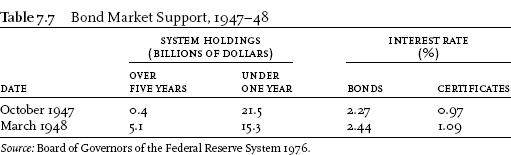
Also in December, Eccles opened a discussion of discount rates by reporting that the Board was now ready to consider an increase in rates.133 Eccles favored 1.25 percent, above the rate on one-year certificates. Sproul favored 1.125 percent. On January 12, discount rates were set at 1.25 percent, the first change in almost six years. The 1.25 percent rate equaled the rate on securities held by banks that would mature in the next five years. Eccles wanted short-term rates at that level to encourage banks to hold short-term and sell longer-term securities.
The new program worked more quickly than expected. Banks, insurance companies, and other holders of long-term debt perceived these changes as a first step toward increased rates on long-term bonds. Bonds no longer seemed as riskless as before, so banks, insurance companies, and others sold bonds and bought bills and certificates. The Federal Reserve now faced the question, Should it allow bonds to go below par?
Its actions give the answer. Table 7.7 shows the large volume of System purchases of long-term debt, and sales of short-term debt, between October 1947 and March 1948. To support the market, the System purchased as rates fell. In addition, the Treasury bought about $1 billion for the trust accounts.
The Treasury continued to run a surplus. Instead of holding the surplus (in war loan accounts) at commercial banks, the Treasury withdrew its balances to the Federal Reserve banks, then used them to retire short-term debt as it matured. The shift in Treasury balances from commercial banks to the reserve banks reduced bank reserves, as expected at the time. The monetary base declined in the first two quarters of 1948.134
The principal disagreement at the FOMC meeting was about how quickly tightening should proceed. Eccles was more aggressive than Sproul. He argued that the Treasury’s cash position presented “an opportunity to exert enough pressure on the reserve position of member banks to curb to a substantial extent the volume of capital expansion that otherwise would take place, that such expansion was undesirable at the present time because of the shortage of labor and materials” (Minutes, Executive Committee, FOMC, January 20, 1948, 15). Sproul did not disagree on the desirability of reducing bank reserve growth, but he believed the committee should spread its effort over months rather than weeks. He suggested that Eccles wanted a bold program so that he could tell Congress that the System had used its existing powers and needed new authority (17).135
The difference was not resolved at the January meeting, so the FOMC’s letter to Secretary Snyder included both views, along with a recommendation to raise the certificate rate from 1.125 percent to 1.25 percent at the March refunding. The Treasury used a decline in commodity prices in February to postpone the rate change.
The decline in commodity prices concerned the FOMC also. At the February 27 meeting, Sproul interpreted the decline as a temporary correction, not the start of recession and deflation. Nevertheless he proposed a less restrictive policy than he had urged in the fall: no further reductions in the Treasury’s war loan accounts at commercial banks; receipts from taxes held in the war loan accounts; continued run-off of System bill holdings at the rate of $100 million a week; and reducing to eleven months the maturity of the 1.125 percent certificate issued in April, to signal that certificate rates would rise in June. The FOMC approved Sproul’s program. Governor Evans voted no on the recommendation to raise certificate rates. Once again he objected that the rate increase would be ineffective against inflation and would increase bank earnings. He preferred the secondary reserve plan. Eccles explained that the purpose was to flatten the yield curve so that banks and others would stop playing the pattern of rates (Minutes, FOMC, February 27, 1948, 12–13).136
For the first time, the committee agreed unanimously that it would not prevent interest rate increases even if some bonds went below par. “At the appropriate time” Eccles would advise Secretary Snyder that “the only commitment the System had made was, under existing and prospective conditions, to maintain the 2.5 percent long-term rate and not that it would support all issues of Government securities at par” (16).137
By March, holders apparently had become convinced that the System would maintain the price of long-term bonds above par. Selling slowed, and System purchases ended. During 1948, long-term Treasury yields remained between 2.41 and 2.45 percent. Although still operating under the Treasury’s strictures, for the first time since the 1930s the Federal Reserve had managed a sudden shift in market sentiment following a policy change. The Treasury had a smaller role, supporting the System’s operation by purchasing for the trust accounts.
New Leadership
Leadership at the Federal Reserve changed after the war. Emanuel A. Goldenweiser retired as research director in January 1946. Governor John K. McKee retired the following month, but he remained at the Board until his successor, James K. Vardaman Jr., arrived in April. Eccles’s former assistant, Lawrence Clayton, joined the Board in February 1947. Vice Chairman Ronald Ransom died at the end of 1947. A month later, President Truman notified Marriner Eccles that he would not reappoint him as chairman when his third term expired on February 1, 1948. The new chairman was Thomas B. McCabe. Truman offered Eccles the vice chairmanship of the Board, and Eccles accepted.138
President Truman gave no reason for removing Eccles as chairman. In his memoirs, Eccles made a strong circumstantial case that Truman wanted election year support of the Giannini family that controlled Bank of America and Transamerica Corporation.139 There was ample reason for the Giannini family to want Eccles removed. The Federal Reserve had tried to obtain legislation to limit further expansion by their holding company, Transamerica Corporation.140 After years of investigation, the Board began a proceeding under the Clayton Act to prevent Transamerica from expanding further. Eccles believed he had been removed in the expectation that the investigation would end.
Transamerica may have contributed to Eccles’s dismissal, but there were other possible reasons. Eccles’s relations with the banking industry had never been friendly. Bankers and Secretary Snyder strongly opposed his call for secondary reserve requirements. Despite Snyder’s objections, Eccles testified in favor of his proposal. Moreover, he had become friendly with Republican Senators Robert A. Taft and Charles W. Tobey and critical of the administration’s budgets. He openly favored increased taxation to prevent inflation. His working relationship with Secretary Snyder was never comfortable. It probably did not help that the Board raised discount rates and allowed bond rates to rise in December and January. These changes came at the same time that President Truman’s budget message to Congress supported maintaining the pattern of rates on government bonds.141
Although his term as chairman ended on February 1, Eccles continued as chairman pro tem until McCabe took office on April 15. He continued to take an active role in System policy and later played an important role in removing the ceiling rate on long-term bonds. He left the Board in July 1951.
A Deflationary Interlude
The inflation rate slowed at the start of 1948. By year end prices were falling. Quarterly average values of the consumer price index show several quarters of deflation beginning in fourth quarter 1948. Inflation did not return until the start of the Korean War in June 1950.
At first prices fell rapidly. Early in 1950 the decline slowed. At the end of the deflation interlude, the consumer price index had returned to the level reached in first quarter 1948. Table 7.8 shows these data.
Both Treasury and Federal Reserve actions contributed to the deflation. The Treasury continued to use its surplus to retire debt from the reserve banks and to purchase debt for the trust accounts. This policy reduced the public’s holding of government debt without increasing the monetary base.
Falling output soon followed falling prices. The National Bureau of Economic Research puts the economy’s cyclical peak in November 1948 and the trough eleven months later, in October 1949. Industrial production (1992 = 100) fell about 9 percent from peak to trough. The unemployment rate reached a peak of 7.9 percent.
With the interest rate peg in effect, the Federal Reserve could not prevent inflation, but it was entirely capable of stopping deflation. The monetary base shows no sign of expansionary actions. Interest rates rose modestly as the monetary base declined. The rate on four- to six-month commercial paper, representative of short-term rates, increased by 0.5 percent in the year before the recession. It remained unchanged (at 1.56 percent) through July 1949, eight months after the cyclical peak.
As in 1921 and 1938, deflation had two positive effects. First the gold inflow increased. Between fourth quarter 1947 and the peak in Federal Reserve gold holdings—third quarter 1949—the gold stock rose 9.5 percent, slowing the decline in the nominal stock of base money.142 Second, falling prices raised the real value of the monetary base, creating an excess supply of real balances and a demand for goods and services.

CHANGES IN RESERVE REQUIREMENTS Early in 1948 the Board again considered an increase in a reserve requirement ratio to slow loan growth. At the time, reserve requirement ratios for reserve city and country banks were at their maximum values, 20 percent and 14 percent, respectively, but central reserve city banks, at 20 percent, were below their 26 percent maximum. The Board voted unanimously to raise reserve requirements at central reserve city banks to 22 percent, effective February 27.
The Board’s staff estimated that the change would absorb $530 million of reserves at New York and Chicago banks. This is an overstatement based on faulty analysis. The true estimate of the effect is approximately zero.143 Banks sold government securities to acquire additional reserves and slightly increased borrowing. The main effect was a transfer of income (on government securities) from commercial banks to the reserve banks.
Since the Board had voted before the Federal Advisory Council met, the council did not oppose the February 27 increase. The members expressed concern, however, about the recent decline in commodity prices and the possibility of a recession. They wanted a halt to restrictive policy, maintenance of the 2.5 percent rate, no further increases in discount rates or reserve requirement ratios at central reserve city banks, and no additional powers for the Federal Reserve. The council thought “it would be a good thing if the situation could develop into a mild recession, but … the members of the Council felt that it might develop into a very severe recession if not into a depression” (Board Minutes, February 17, 1948, 9). Chairman Eccles agreed that “a recession at this time would be in the best interests of the country and that the longer such a development was delayed the greater would be the downward adjustment that eventually would have to come” (10).144
The Board was eager to get the council to agree on a joint program to send to Congress, as in 1940. The bankers were reluctant, so their emphasis on the possibility of a deep recession may have been an expression of dissent.145 Eccles argued that whether inflation continued or ended in recession, the Board and the commercial banks would be blamed for what happened. They had a common interest. He agreed that discount rates could not be raised, but his reason was not concern about recession. First the Treasury had to increase the coupon on the one-year certificate to 1.25 percent. That would not be done in current circumstances. Council chairman Edward E. Brown responded that banks were so “jittery” that a change to 1.25 percent might cause additional selling of government securities.
The next three years are a unique period in the use of reserve requirements as a policy instrument. The System made nineteen changes, up and down, in these ratios. Many were small. Table 7.9 shows the level of reserve requirements on February 1, 1948, and the adjustments in the next three years. The last column shows the weighted average, or effective, ratio. This ratio changed very little from year to year. The largest change, in 1950, resulted from a shift in deposits from demand to time accounts.
After the changes in reserve requirement ratios, banks increased their use of the discount window to adjust reserves. Discounting had started to revive during the war but remained below $100 million, on a sustained basis, until August 1944. After 1946, discounts remained between $100 million and $300 million. Discounts typically increased after an increase in reserve requirement ratios, reviving the adjustment pattern that Strong, Riefler, and Burgess had observed in the 1920s.

After February 1948, the Board and the FOMC discussed additional increases in reserve requirement ratios at New York and Chicago. Governor Evans was often the leading proponent. Eccles remained cautious, despite strong output growth and continued inflation early in 1948. The Board and the FOMC repeatedly urged the Treasury to increase the certificate rate to 1.25 percent, so they could raise the discount rate, but the Treasury ignored or rejected the advice and the rate stayed at 1.125 percent throughout the spring and summer.146
The System remained divided over whether future inflation or deflation posed the greater risk. After the Treasury rejected its suggestion of a 1.25 percent certificate rate for the July refunding, Sproul and Szymczak looked to the September refunding. Eccles urged the committee not to act without Treasury agreement, but it ignored him and voted to permit an increase in short-term rates before the September refunding if inflation increased during the summer. It wanted to force the Treasury to raise the rate to 1.25 percent. This was a significant change, since the committee had earlier declined to increase rates until the Treasury agreed.
Spending for foreign aid began to rise, beginning with the Greek-Turkish aid bill in 1947 and the Marshall Plan in 1948. Looking forward, the members worried that the budget surplus would decline and with it debt retirement (see table 7.8 above). Effective action against inflation would end.147 At the meeting of the Federal Advisory Council in April, the Board recalled the 1940 proposal to Congress, sponsored jointly by the council and the System, calling for a statutory increase in maximum reserve requirement ratios for all banks. The council was reluctant to increase banks’ costs. It noted that there were both inflationary and deflationary tendencies at work, so it preferred to wait until the future became clearer. It urged the System to use existing powers by raising the discount rate or reserve requirements at central reserve city banks.148
Several bankers spoke against the proposal to increase maximum reserve requirements. Their principal arguments were that a request to Congress for higher reserve requirement ratios would at once induce banks to shift assets from long- to short-term securities. If the proposal was adopted, banks would have more difficulty raising capital and would take more risk to compensate for lower earnings. Membership in the System would be discouraged, particularly if the higher reserve requirements applied to all banks, as the Board wished. They were particularly opposed to Eccles’s recent testimony calling for higher cash reserve requirement ratios and a secondary securities reserve.149
Chairman McCabe asked the bankers what they would do if inflation rose. They responded that, unlike the Board, they did not expect that to happen. However, they favored maintaining the 2.5 percent ceiling rate, partly out of concern that a fall in government security prices would lower bank capital (Board Minutes, April 27, 1948, 19).
The Board continued to prepare for an increase in the reserve requirement ratio at central reserve city banks. The main issue had become not whether the change should be made but when. A principal consideration was to find a time when the change would have greatest effect on inflationary psychology, but there was concern also to use existing powers. Congress had again rejected the request for additional powers, and one of the reasons given was that Board had not used its existing powers fully.
On June 1, 1948, the Board voted to increase to 24 percent the reserve requirement ratio at central reserve city banks, effective June 11. McCabe was absent, and Szymczak opposed the timing of the increase. He argued that New York and Chicago banks had no excess reserves, so the increase would simply shift $500 million of government securities from banks to the reserve banks. McCabe wrote a letter that was read at the meeting urging the Board to delay the change for a month. He believed the change would be more effective if accompanied by a rise in the certificate rate (Board Minutes, June 1, 1948, 5–6).150
To prepare for the 1948 election and give the appearance of decisive action, President Truman called a special session of Congress in August. He asked for price controls, rationing, rent control, an excess profits tax, repeal of the Taft-Hartley Act, and regulation of commodity markets. He also asked Congress to increase spending on Social Security and education, more government aid for housing, and increases in the minimum wage and farm price supports. The aim was to return to the wartime control program while redistributing income toward traditional Democratic constituencies. The Federal Reserve asked for renewed controls on consumer credit and higher statutory maximum reserve requirement ratios as part of the program.
Congress rejected most of the program, but by joint resolution it approved renewal of consumer credit controls until June 30, 1949, and an increase in maximum reserve requirement ratios for member banks. In September the Board set minimum down payments of 33.33 percent for automobiles and 20 percent for other durables.
The president’s proposals suggest the haphazard way the administration thought about the substance of economic policy. Proposals for higher wages accompanied a proposal for price control, and encouragement of home building accompanied controls to discourage purchases of household durables and furniture. The increased mortgage credit, if approved, would have substituted for consumer credit.151
On August 2 Chairman McCabe and Governor Evans testified on parts of the president’s proposal. McCabe repeated the familiar arguments supporting legislation authorizing higher reserve requirement ratios. He referred several times to the problem of controlling inflation while maintaining the 2.5 percent rate, but he insisted that it should be maintained “to insure orderly conditions in that market, not primarily because of an implied commitment to wartime investors that their savings would be protected, nor to aid the Treasury in refunding maturing debt, but because of the widespread repercussions that would ensue … if the vast holdings of public debt were felt to be of unstable value” (House Committee on Banking and Currency 1948, 89).152 McCabe urged that the Board’s powers be extended to include nonmember banks, but he offered no evidence of relative expansion by nonmember banks and gave more attention to increased lending at insurance companies than at banks.153
Several times, members of Congress asked McCabe whether long-term rates had to rise for effective control of inflation. The Board had discussed the possibility that this question would arise at its July 30 meeting, but it did not reach a conclusion. McCabe did not want to confront the Treasury and tried to avoid the issue by saying that “it was vitally necessary to support the 2½ percent bonds” (ibid., 101).154
Chairman Jesse P. Wolcott and other members questioned McCabe and Evans about the reason for credit controls. McCabe tried to shift responsibility to Congress, suggesting that Congress should order an end to pegged rates. Wolcott demurred.155 He challenged McCabe and Evans to explain how credit controls would reduce demand, pointing out that people could take out larger home mortgages to offset larger down payments on cars and other durables. Other members cited examples showing that credit controls did not curtail demand for durables. McCabe and Evans had no answers.
During the summer of 1948, the Board continued to press the Treasury to raise short-term interest rates on its refundings and to use its balances to retire Treasury bills. On July 16 McCabe gave Snyder the draft of a letter outlining the Board’s concerns. The Board again referred to its “statutory responsibility” to control inflation, warned of higher inflation ahead, and expressed concern that the Treasury had failed to increase the rate on certificates at the April and June refundings. The letter warned that credit demands remained strong and that insurance companies and other holders of long-term bonds were likely to sell as much as $1.5 billion of such debt to the System in the second half of 1948. To offset these prospective purchases, the System had to be able to sell an equal amount in the short-term market.
The letter again proposed higher rates on certificates and higher discount rates. The Federal Reserve pledged again to support the long-term market, and it asked the Treasury to continue retiring short-term debt from the reserve banks. While awaiting the Treasury’s response, the Board began to discuss a further increase in reserve requirements, to 26 percent, at central reserve city banks.
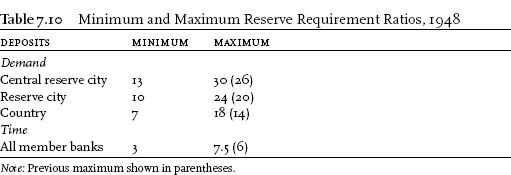
In July the annualized monthly rate of increase in consumer prices reached 15 percent, and the twelve-month rate reached 9.3 percent. The Treasury agreed to an additional 0.25 percent increase in the discount rate, to 1.5 percent, a 1.25 percent rate on one-year certificates, and an increase in the bill rate. In return, Snyder asked the Board to again reaffirm its support for the 2.5 percent long-term rate and to postpone a decision about reserve requirements until September (Letter, Snyder to Board, Board Minutes, August 10, 1948, 3). The Board promptly notified the reserve banks that they could raise discount rates. All banks voted for an increase. Open market rates on short-term securities rose. Two years after the war’s end, the spread between short- and long-term rates was down to 1.25 percent.156
Table 7.10 shows the minimum and maximum rates fixed in August 1948. These rates applied only to member banks and were temporary until June 30, 1949. Congress refused again to authorize the Federal Reserve to set reserve requirements for nonmember banks.157
At the Board’s August 24 meeting, Governor Vardaman announced that he intended to propose increases in reserve requirement ratios for demand and time deposits at the first meeting after Labor Day. McCabe spoke in favor of the increase as part of a more general program developed jointly with the executive committee of the FOMC. Vardaman and Szymczak preferred immediate action. Eccles was not present but sent a letter proposing increases, effective within the next two weeks, and expressing concern that, having been granted additional authority, the Board would hesitate to use it (Board Minutes, September 7, 1948, 7–14). The discussion reached an informal agreement that the Board would increase reserve requirements by two percentage points for demand and 1.5 percentage points for time deposits and would notify Secretary Snyder of its intention. The only formal decision was to postpone the vote until after the meeting of the FOMC executive committee the following day.
At that meeting, President Clifford S. Young of the Chicago bank gave the correct analysis: “The increase would not do much good as an anti-inflationary move because banks would only sell securities which the System would buy in order to give them the reserves to meet the increased requirements” (Minutes, Executive Committee, FOMC, September 8, 1948, 6). Sproul, on the other hand, thought the change was too big. It would “ churn the market unnecessarily” as banks sold governments to meet the higher requirements (6). McCabe favored lowering the support price for long-term bonds to the 2.5 percent rate, a reduction of only $25 on a $1,000 bond, but Sproul opposed using the same argument that had been used against him—that such a move would “create apprehension as to whether the entire support program was going to be continued.” They would then have to buy large amounts (9).158 McCabe urged a drop in other support prices with an announcement that the 2.5 percent rate would be maintained, but Sproul cautioned that they had done that successfully in December 1947 and could not repeat the promise a second time after imposing losses on bondholders in December. He wanted to be rid of pegged rates, and he disliked further commitments to support them, but he did not favor the small step McCabe proposed (10). Sproul also opposed McCabe’s suggestion that the bill rate be allowed to fluctuate more freely. With a fixed rate on certificates at 1.25 percent and the bill rate at 1.08 percent, there was little to be gained.
The Board met the same afternoon and voted unanimously to increase reserve requirement ratios, as previously agreed, for demand and time deposits. The staff estimated that the change would absorb $1.9 billion in reserves. On average the system portfolio rose $1.54 billion, and the gold stock rose $130 million, canceling most of the restrictive effect. Banks and others responded by selling long-term and buying short-term securities. Short-term interest rates remained unchanged, and the monetary base continued to decline.159
New York now had a more important role than at any time since the 1920s. Sproul took the lead in shaping the September decision. McCabe deferred to Sproul’s views, whereas Eccles had not.
The 1948–49 Recession
Industrial production fell in August and September, rose in October, then fell sharply in November. The consumer price index reached a peak in August, remained unchanged in September, and fell in October. The fall was precipitate, from a 15 percent annualized rate of increase in July to unchanged in September.
The Board and the FOMC were unprepared and at first did not respond to the recession. The only mention of a decline referred to an eventual, inevitable recession if inflation continued. At a meeting of the System Research Advisory Committee in late September, Woodlief Thomas, the director of research, forecast a substantial increase in expenditure and income and continued price increases (Sproul Papers, Board of Governors, Memorandums and Drafts, September 27, 1948). He urged actions to slow the expansion. The Board’s staff forecast 10 percent growth of GNP in the last three quarters of 1948 and the first quarters of 1949 (ibid., September 30, 1948).
The recession eventually forced the System to face facts it had tried hard to avoid; it could not control inflation and was reluctant to respond to recession. Consumer credit controls, changes in stock market margin requirements, or adjustment of reserve requirement, with interest rates unchanged, accomplished little. Interest rates and money growth were set by markets, not by the System.
Realization grew slowly and spread even more slowly. More than halfway through the recession, the Board and the FOMC continued to press the Treasury to raise short-term interest rates, despite sustained declines in industrial production and consumer prices. Two closely related reasons help to explain why policy was slow to change. First, the principals regarded the recession as temporary, and for many it was a welcome interlude. The problem of greater concern was long-term inflation. Second, market interest rates were at historical lows, so they believed policy was easy. No one mentioned the effect of falling prices on real interest rates, a repeat of behavior in previous periods of deflation.
The New York bank was more perceptive than the Board about the start of the recession. At the October FOMC meeting, John H. Williams predicted that the economy was about to enter a mild recession, while inflation “was in the process of wearing itself out” (Minutes, FOMC, October 4, 1948, 5). He favored additional increases in short-term rates and no change in long-term rates.
His comments about recession had no impact, perhaps because the FOMC welcomed a mild recession. The main topic at the meeting was an increase in certificate rates to 1.5 percent as soon as possible but before the January refunding. The increase would permit the Treasury bill rate to rise toward the certificate rate and increase commercial banks’ bill purchases. Sproul proposed that the Federal Reserve should present its plan to the Treasury without seeking approval or disapproval. Following the FOMC meeting, Sproul and McCabe met with Snyder, but they waited for approval and did not act. A month later, in mid-November, over Federal Reserve objections, Secretary Snyder announced that the certificate rate would remain unchanged through January. Short-term rates remained the same until May 1949.
Stymied by the Treasury’s reluctance to increase rates, the Board discussed a further increase in reserve requirement ratios but did nothing. Banks objected to the further increase as costly to them and ineffective against inflation.
President Truman’s reelection surprised many bankers, businessmen, and others. The Federal Advisory Council ignored the deflationary policy but blamed the election for “a very profound change in business sentiment” (Board Minutes, November 16, 1948, 2). The council reported that businessmen were concerned about an excess profits tax, higher corporate tax rates, and new price controls. It warned that these policies would slow the economy. The risk of recession had increased. There would be a pause; construction and expansion would slow. The length and depth of the slowdown depended on the administration’s programs.
Long-term bond yields fell after the election, at least partly in response to recession and deflation. Insurance companies had been heavy sellers before the election. They now began to buy, so the Federal Reserve reversed course, selling long-term and buying short-term securities.160 The Treasury also changed its operations after the election. Instead of retiring bills from the Federal Reserve, it began to retire bills held by commercial banks. The effect on the stock of debt was of course the same, but the monetary base and the money stock increased.
The FOMC discussed the Treasury’s new procedure at its November 30 meeting and concluded that the Treasury was trying to reduce the outstanding stock of bills to the point where the rate could be set free. Although the FOMC preferred to keep pressure on bank reserves, it did not object that the new procedure increased reserves. It decided also to reduce the premium above par on long-term debt. There was no mention of recession.
After his reelection, President Truman asked the Board for its legislative program. The Board suggested several changes: (1) extend the temporary powers to raise reserve requirements and impose consumer credit control beyond June 30, 1949; (2) enact new legislation giving the Board power to regulate bank holding companies; (3) authorize the Federal Reserve to guarantee loans by banks to businesses; and (4) ease membership requirements by reducing capital requirements for branches of state banks (Board Minutes, November 30, 1948, 4–6). Later the Board modified its request. It asked to maintain new maximum reserve requirements only if they applied to member and nonmember banks. None of the proposals had much to do with inflation (or deflation), and none became law.
At its December 1 meeting, the Board reviewed material to be included in the president’s economic report. The draft showed no awareness of recession or deflation. The principal recommendations called for a larger budget surplus, achieved by raising tax rates and reducing spending to retire debt at reserve banks (Board Minutes, December 1, 1948, 3–5). On the critical issue of the bond price support, the Board recognized “a serious dilemma,” but it offered no new solution and did not recommend increasing long-term rates (5).161
The Board asked the reserve bank presidents to comment on consumer credit controls and reserve requirements. The presidents favored credit controls, and some wanted to make them permanent. A majority opposed further increases in reserve requirements. They reported that “banks continued to hold the view that the only effect of an increase was to transfer Government securities from the banks to the Federal Reserve banks” (ibid., 6). They noted that bankers talked about withdrawing from membership, but none had done so.
The Board responded by making two changes in its proposals for the State of the Union message. It proposed paying interest on the additional required reserves.162 And it limited its request for authority to regulate reserve requirements for nonmember banks to those that offered deposit insurance, thereby exempting the smallest, nonmember banks (Board Minutes, December 17, 1948, 5).163
At the turn of the year, the FOMC continued to press gently for a 0.125 percent increase in short-term rates. One of the main objectives at the time was to reduce the spread between short- and long-term rates so that holders would have no incentive to play the pattern of rates. Sproul reported that the Treasury would resume its former practice of retiring debt from the reserve banks and, despite declining economic activity, was open to the idea of increasing short-term rates at the March and April refundings (Minutes, Executive Committee, FOMC, January 4, 1949, 5–7).
The January 1949 meeting was the first time the FOMC discussed how it could end support of the long-term market. Sproul proposed refunding outstanding long-term debt into higher-yielding issues that would not require support (ibid., 8). The Treasury did not agree until 1951.
The Federal Advisory Council opposed the Board’s legislative program. It reminded the Board that increases in reserve requirements had no effect on inflation. The council also opposed interest payments on reserves and extension of the Board’s authority to include nonmember banks (Board Minutes, February 15, 1949, 3).164
February’s minutes show the first clear recognition that a recession had started. The council “was definitely of the opinion that the country was in a recession … that the business decline was spreading (ibid., 3–4). McCabe challenged this view: “In spite of the decline in business activity, there was more optimism than had been expressed by the Council” (5).165 Council members demurred and used the recession to argue against the Board’s program. In a statement reminiscent of Miller or Young in the 1920s, Eccles showed that he had forgotten why he came to Washington in 1933: “The business decline that was now occurring was an inevitable result of the unprecedented inflation during the past two or three years, that the longer the unbalance and distortion in the economy continued the more disastrous the deflationary adjustments would be … and that some adjustment was necessary and desirable [sic] if the economy was to return to a period of stability” (13–14).166
A widening rift between the Federal Reserve and the Treasury developed at the March 2, 1949, FOMC meeting. Secretary Snyder’s letter, responding to the committee’s request for an increase in short-term rates, stimulated an active discussion during which several members gave their views. Three issues were in contention at the time. First, the secretary again rejected the proposed 0.125 percent increase in certificate rates. Second, he cautioned the System to reconsider its policy of allowing rates on Treasury bills to rise because it would force a rise in the certificate rate.167 Third, the Treasury would not commit to retire debt from the reserve banks. It preferred to retain its freedom to choose the source of open market retirements. The System saw this as a threat to its role.
FOMC members differed about whether interest rates should be raised. Some of the Board’s staff and Governor Clayton opposed the increase in rates as inappropriate in a recession. Some noted that prices had fallen (since October). Sproul described the decline as “a healthy readjustment.” He proposed to continue pressure to increase the bill rate, while avoiding an increase in the discount rate, to “improve the interest rate structure … and avoid the appearance of more or less permanently pegged rates at both ends of the rate pattern” (Minutes, FOMC, March 1, 1949, 12).
The FOMC adopted Chairman McCabe’s suggestion that it ask Secretary Snyder to increase the rate but to be less insistent than in the past. To show its awareness of conditions in the economy, the committee included the words “in the light of changing economic conditions” in its directive. The vote, however, was to raise rates. Some members may have voted for the increase knowing that the Treasury would reject it.
In March, four months after the peak, with industrial production down almost 6 percent, the Board made its first public acknowledgment of recession. By a vote of five to one, it reduced down payment requirements on furniture and appliances to 15 percent (from 20 percent) but kept the 33.33 percent down payment on autos. The maximum maturity on all loans increased to twenty-one months (from fifteen or eighteen months). Eccles opposed the change as “premature.” Further, he thought it encouraged families to go heavily into debt on “too easy terms at high prices” (Board Minutes, March 2, 1949, 2–3).
At the end of the month, by unanimous vote, the Board reduced stock market margin requirements from 75 percent to 50 percent, effective March 30.168 The purpose was to stimulate investment without reducing open market rates. The decline in output continued at a steeper pace. The Board continued to press for a rise in short-term rates and new issues of long-term debt restricted to nonbank holders. The staff continued to view falling prices as helpful and to regard future inflation as a more serious concern than current deflation (Minutes, FOMC, March 1, 1949, 4).
Sproul explained the System’s dilemma in an April memo. Wholesale prices and industrial production were 8 percent below their previous peaks. Factory man-hours had fallen 9 percent. Bank credit had declined “rapidly and substantially.” The economic and credit situation called for lower interest rates; the problem was that the Treasury might not permit a reversal after the economy recovered. He proposed a resolution calling for greater interest rate flexibility that would allow “the short rate to move up and down from the new level with some freedom while trying to find a long rate … which will float by itself without too great deviations either up or down” (Sproul Papers, FOMC, April 1949, 2–3).
On April 21, the Board began discussing a reduction in reserve requirements. Interest in an expansive action conflicted with a desire to have Congress renew temporary authority for higher maximum reserve requirements. Facts overcame politics. A key fact was the size of the contraction of bank credit, described as one of the most severe on record (Board Minutes, April 28, 1949, 7). Effective May 1 and 5, the Board reduced reserve requirement ratios by two percentage points at central reserve city banks, one percentage point at other banks, and one-half percentage point on all time deposits (see table 7.9 above). The relative size of the changes reflected the relative size of the decline in bank credit in the year to date. In all, the staff estimated that the changes liberated $1.2 billion of reserves.169 The Treasury issued $100 million in long-term debt to absorb part of the reserves without lowering rates unduly. In May the System sold $1.3 billion, offsetting the effect of the reduction on the monetary base.
Open market rates remained unchanged except for a modest (0.005) decline in the ninety-day bill yield. The Board’s policy now aimed to “twist the yield curve” by raising short-term rates while slowly reducing long-term rates.170 The Treasury was unwilling to permit higher short-term rates, so the System was forced to sell long-term, bonds to prevent a steep decline and buy short-term to prevent a rise (Minutes, Executive Committee, FOMC, May 3, 1949, 2).
The Federal Advisory Council praised the Board for reducing consumer credit controls but questioned why controls were needed when durable goods were in excess supply. Governor Vardaman sided with the bankers: controls had been authorized to reduce inflation; inflation had ended. Some manufacturers wanted the controls retained to regulate trade practices but, Vardaman said, that was not authorized in the law (Board Minutes, May 17, 1949, 13–14).
The council again opposed supplementary reserve requirements and asked the Board why it did not reduce requirement ratios below the former maximum values. McCabe questioned the members about the effect on interest rates. W. Randolph Burgess, a member of the council, said there would be little if any effect if the Board sold securities and the Treasury issued medium-term bonds to fill gaps in the maturity structure.
By early June, several in the System began to express concern that the recession was spreading. Their policy of pressing for higher short-term rates and resisting lower long-term rates prevented any effective monetary response to the decline. FOMC members who wanted a more expansive policy agreed that the Treasury would not oppose rate reduction. Later, they hoped, rates could be raised if necessary and policy would be more flexible.
Sproul took the lead in urging flexibility, but Eccles and McCabe joined him. Eccles said that future policy should maintain an orderly market without supporting a pattern of rates. He favored a symbolic reduction in the discount rate and in reserve requirements. Sproul agreed that the time had come to ease the money market to combat deflation, but he insisted that the change to an independent policy should be permanent, not tied to a current reduction in rates.
Congress did not renew supplementary reserve requirements or consumer credit controls. Both expired on June 30, so demand deposit reserve requirement ratios returned to 26, 20, and 14, with 6 percent for time deposits. The Board considered additional reductions near the end of June but postponed its decision until the Treasury agreed to a general program that included an end to the peg on short-term rates.
POLICY CHANGES Seven months of recession, and a growing sense of its impotence, had moved the System toward a new policy. On June 21, McCabe and Sproul met with Snyder to propose lower rates on bills and certificates. The Federal Reserve would remove the peg at the short end but retain it at the long end. It would announce the change publicly. Privately they assured Snyder that rates would probably fall and would not be allowed to rise when the peg was removed. Snyder liked the proposal but was hesitant to announce the change.
By July the consumer price index had fallen in six of the preceding nine months and was below the previous year’s level. To stop the deflation, the Board’s staff proposed that reserve requirements be reduced by three percentage points on demand deposits and one point on time deposits, to release $2.6 billion of required reserves. The proposed reductions were an addition to the reserves released by the expiration of supplementary reserve requirement ratios. The Board also reduced the discount rate by 0.25 percent (Board Minutes, June 21, 1949, 16).171
As the System began a more activist policy, it restored the indicators of ease and restraint it had used in the 1920s. Riefler played a major role in drafting and presenting the proposal, so it is not surprising that the proposal discussed policy in terms of excess or free reserves (excess reserves minus member bank borrowing). Reducing reserve requirements, he said, increased excess reserves and put downward pressure on market rates, easing policy.
Although the proposal called for a Board decision, it was the main subject of the June 28 FOMC meeting. The committee held the most active policy discussion in many years. What seems remarkable in hindsight is that opinion was divided about the need for change. Of those who are recorded, Presidents C. E. Earhart (San Francisco), Ray M. Gidney (Cleveland), and Hugh Leach (Richmond) were most aggressive; they favored ending the peg for both short- and long-term rates and announcing the change as a permanent change whether rates moved up or down. Governor Evans, at the opposite pole, favored letting rates decline but wanted the Board’s public statement to reaffirm the commitment to the 2.5 percent rate as a maximum. Keeping the 2.5 percent rate “was one of the major accomplishments of the postwar period” (Minutes, FOMC, June 28, 1949, 8).
Snyder’s support for lower rates seemed to give the opportunity Sproul had waited for. He favored letting rates fall, but he was reluctant to announce that rates would be more flexible henceforth. He wanted to limit the public announcement to a statement that the FOMC would maintain orderly conditions, omitting words about stable rates but not making a permanent commitment to market-determined rates (ibid., 22).
McCabe hesitated also. He “felt it would be catastrophic if long-term government bonds were allowed to drop below par” (ibid., 11). He proposed avoiding the issue in his letter to Secretary Snyder by reaffirming that the “programs and policies to be pursued would be decided upon after full discussion and mutual understanding” (10). This formulation did not assert independence or accept a Treasury veto. It was ambiguous enough to gain unanimous consent.
The committee next had to decide what it would announce publicly and what it intended to do about the $800 million that would be released when the supplementary reserve requirements expired in two days. There was general agreement that the System would not absorb the $800 million by open market sales but, instead, would allow banks to lower market rates. Riefler wanted to supplement the $800 million by a further reduction in reserve requirement ratios. Reverting to the Riefler-Burgess framework of the 1920s, “he was not interested in lower short-term rates as such… . [He] was prepared to accept them as the inevitable consequence of bank reserve positions that would put banks under some pressure as lenders” (ibid., 18–19). Sproul emphasized market rates, not free reserves. He thought $800 million of additional reserves was a sufficient increase to reduce rates. The presidents agreed with Sproul. Only President W. S. McLarin Jr. (Atlanta) favored the staff position.
The public announcement, approved unanimously, emphasized the “needs of commerce, business, and agriculture,” and the “general business and credit situation.” It added that “under present conditions the maintenance of a relatively fixed pattern of rates has the undesirable effect of absorbing reserves from the market at a time when the availability of credit should be increased.” This formulation left open whether the decision to drop the peg was temporary or permanent.172 The committee’s hesitation proved costly when it wanted to increase rates. Because it failed to tell Snyder and the market what it wanted to do, it weakened its claim that the June 1949 change permitted rate increases later.
Stock prices reached their cyclical low in mid-June, 13 percent below the October 1948 peak. The announced change in policy may have contributed to a rise in stock prices; the July average is more than 5 percent above June. The actual change in policy was slight. Contrary to its discussion, the System sold securities, withdrawing $800 million of reserves in July. Bill, certificate, and bond rates declined in July, with long-term bonds reaching the lowest rate in two years, 2.27 percent in late July. Gold continued to flow in, increasing the monetary base. The decline in rates was not steep enough to compensate for ongoing deflation, so real rates of interest continued to rise.
The following day, urged on by McCabe, the Board again discussed an additional reduction in reserve requirements. All other governors opposed, preferring to observe the full effects of the expiration of supplementary reserve requirements.173 Ten days later, and continuing through July, Board members and staff frequently suggested additional action, including reductions in the discount rates and in reserve requirement ratios. Several governors were on vacation, so discussions remained informal.
By August the Board was ready to reduce reserve requirement ratios by two percentage points on demand deposits in a series of steps (Board Minutes, August 4, 1949, 10). The following day the FOMC agreed to absorb the reserves released by the Board’s action so as to hold bill and certificate rates within their current ranges. Although discount rates were now above market rates on Treasury bills and certificates, McCabe proposed postponing any rate reduction. Discussion of a discount rate reduction continued throughout the fall, but discount rates remained unchanged.174
Several FOMC members asked the reasons for the August reduction in reserve requirement ratios. The Board did not give a credit or monetary reason. The reasons given were that the System wanted to make clear that it was no longer concentrating its efforts on controlling inflation; that requirements could be raised later, if needed; and that increased ownership of government securities would increase bank earnings.175
The August 5 meeting raised issues that would not be resolved for a decade. New York pressed for flexibility in the range of short-term rates and authority to purchase and sell at all maturities. It claimed that it was difficult to forecast how much of any increase in reserves would be held as excess reserves, so the account manager needed to respond to the market. As usual during discussions in this period, Robert Rouse, manager of the System Open Market Account, Woodlief Thomas, the Board’s chief economist, and Winfield Riefler, adviser to the chairman, took an active role not limited to staff or operating duties. Sproul’s was the dominant voice, Eccles’s a close second. McCabe remained relatively passive, looking for compromise and unwilling to challenge the Treasury. Most of the bank presidents were recorded infrequently or not at all.
Rouse suggested a further reduction in reserve requirements so that they could be raised later if inflation developed. The committee members rejected this proposal, recognizing at last that they could act through open market purchases (or sales) if they were willing to let market rates change. For the first time, there was general recognition that the System could not control the size of excess reserves while maintaining a fixed level of interest rates. It gave up using excess reserves as a target. Instead, it set a target for Treasury bill rates at 0.94 to 1.06, about the prevailing range.
END OF THE RECESSION The National Bureau of Economic Research dates the end of the recession in October. Industrial production increased at a 12 percent annual rate in August and again in September. October’s decline reflected strikes in that month. In November and December production rose at a 25 percent annual rate, and third quarter GNP rose 2.5 percent.
The FOMC executive committee recognized the turn in November. Renewed fears of inflation replaced concerns about recession and deflation. Using a phrase that recurred many times in the next fifty years, the minutes referred to “the largest peacetime deficits in the history of the United States at a time of very high levels [sic] of production and employment” (Minutes, Executive Committee, FOMC, November 18, 1949, 2). The members agreed that interest rates should rise and now asserted more forcefully that the flexible policy adopted the previous June allowed rates to change up as well as down. The committee unanimously approved an increase in bill rates by 0.07, a range for bills from 1.00 to 1.14 percent and for certificates 1.10 to 1.16 percent.
The minutes show that the Treasury would not agree to flexible rates. It wanted to sell certificates at 1.125 percent. Since the System was unwilling to challenge the Treasury in the marketplace, it could only petition and advise but was not free to act.
Much of the committee’s discussion in this period concerned advice on Treasury debt management. Sproul and McCabe continued to meet with Snyder, or to petition him by mail, seeking higher rates at Treasury refundings. Occasionally the advice was accepted; most often it was not.
The System did not limit its advice to rates for new issues and refundings.176 It expressed concern about the decline in the maturity of the debt, a reflection both of the passage of time and of Treasury policy. The rate structure did not permit the Treasury to sell longer maturities. As notes and bonds matured, the Treasury substituted bills and certificates. Five years after the war, Treasury notes had declined from a peak of $20 billion to less than $4 billion. The stock of bonds outstanding also continued to fall as bonds matured. There were no new bond issues until 1952, after the interest rate peg was removed.
WHY DID THE RECESSION END? The Federal Reserve was slow to respond to deflation and recession but quick to dampen recovery. Until June, seven months after the recession started, the System did little, none of it effective. Yet it raised rates in November, one month into the recovery. This behavior raises two questions. Why was policy action, and the recognition of a need for action, asymmetric? Did policy actions contribute to recovery?
The minutes suggest some answers. Many policymakers believed the economy would expand because of pent-up wartime domestic and foreign demand. Also, the System had struggled to raise interest rates and was reluctant to give up some of its “progress” toward higher rates and a flatter term structure. It acted only after Secretary Snyder accepted greater flexibility in principle, with some concern about whether the Treasury would permit flexibility both ways. This was a legitimate concern, given the Board’s experience, and it soon proved to be correct. Further, Eccles and other Board members remained skeptical about the effectiveness of monetary policy. This view was widely held by officials and economists within the System and outside.
At another level was the belief that had done much harm in the Great Depression—failure to distinguish between nominal and real rates. With market rates from 1 to 2.5 percent, officials thought monetary policy was easy. John H. Williams offered a classic restatement of this view: “The System had not had a tight money policy … any effort to ease money conditions to counter the recession would be starting from an already easy situation, and he felt that the System was likely to be frozen into a low-interest rate situation about which it might not be able to do anything” (Minutes, FOMC, May 3, 1949, 4).
Prices were falling at the time, so real interest rates rose. The rise increased the cost of investing in new capital relative to the cost of buying existing assets and increased the return to holding money. But falling prices raised the real value of money balances and the excess supply of money.
Chart 7.5 compares the change in real base money to the ex post real rate of interest on long-term bonds. Both series reflect the common influence of falling prices, hence they are roughly parallel in the months preceding the 1948–49 recession and during the recession.177

The chart suggests that monetary policy in 1948–49 is qualitatively similar to that in 1920–21. Both recessions followed an inflation that drove down the real interest rate and the real value of the monetary base. The real value of the monetary base reached a trough two months before the 1948–49 recession started, and it turned positive in April, six months before the recession’s trough. Industrial production started to rise in July, three months later. As in 1920–21 and 1937–38, but to a lesser extent, gold inflows under a fixed exchange rate contributed to the increase in real balances.
Real interest rates give a very different picture of events. Ex post real rates were lowest before the recession and highest before the recovery. The fall in real rates did not prevent the recession, and the rise did not prevent recovery. As in 1920–21 and 1937–38, the effects of real rates on economic activity appear to have been dominated by the response to rising real balances.
Two of the deflationary recessions, 1937–38 and 1948–49, provide evidence on the frequently stated proposition that monetary action becomes ineffective at low nominal interest rates. The data suggest that nominal interest rates near zero did not make monetary policy ineffective or irrelevant. Between November 1948 and July 1949, the rate on new issues of Treasury bills remained between 1.13 and 1.16 percent. In July the rate fell to about 1.05 percent, where it remained for most of the summer and fall. Changes in the rate of deflation dominated the small changes in the growth of the base and the level of nominal rates.
The deflationary recessions provide evidence, also, on the process by which monetary policy affects output. The fall in market prices raised the public’s stock of real balances above the desired amount, just as if the Federal Reserve had increased base money at a constant price level. The public used its excess real balances to purchase assets, goods, and services. These purchases stimulated production directly and by changing asset prices relative to the prices of new production, thereby increasing the demand for new production. The rise in real interest rates worked in the opposite direction, but it was less powerful.
RECOVERY, EXPANSION, AND INFLATION
Industrial production passed its prerecession peak in April 1950. Consumer prices started to rise but remained near 1948 levels. The Federal Reserve took no action. Throughout the winter and spring of 1950, FOMC meetings considered, in detail, whether the Treasury should sell tap issues on demand, long-term nonmarketable debt, or bank eligible debt. The committee again offered advice on Treasury refundings and new debt issues. Typically the advice called for a slight increase in rates with the hope that the System could follow by raising its buying and selling rates for bills and certificates. The opposite was also true. Unless the Treasury was willing to increase its offering rate, the System could not raise open market rates. If it pushed the market rate above the offering rate, it expected large open market sales by private holders, who were expected to sell outstanding debt and buy new issues.178
The System remained unwilling to confront the Treasury publicly and was frustrated by its failure. As long as Secretary Snyder insisted on a 1.125 percent offering rate for new issues or refundings, the System had to either insist on independence or remain subservient. Fearing the consequences of the first course, it remained with the second.
The government budget heightened the members’ concerns. After three (fiscal) years of surplus, in the 1950 fiscal year the budget had a deficit. Instead of net debt reductions, the Treasury sold more than $3 billion of new issues. Defense spending and foreign aid rose. There seemed to be no prospect of soon again using a budget surplus to reduce the monetary base.
The Treasury permitted very modest increases in short-term rates in February and May and a larger increase in June, without any negative market reaction. The long-term rate remained between 2.38 and 2.43 for the entire period, and the stock market index rose 13 percent between December and June as recovery gained momentum.179
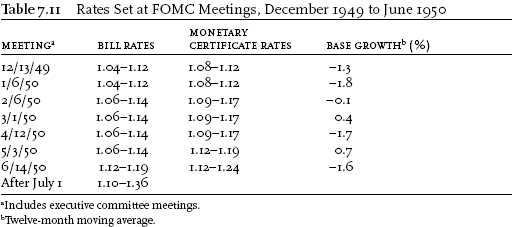
Table 7.11 shows the interest rates set at each meeting between December and June. In June the staff suggested that the economy showed signs of an unsustainable boom. Real estate and commodity prices had increased. Reported rates of inflation were 5 percent or higher in May and June.
The return of expansion and inflation turned attention back to monetary policy. At the May 3 meeting of the executive committee, Sproul proposed to confront the Treasury. Referring to the June 1949 decision to permit flexibility, he “saw no reason why the System should, and every reason why it should not, make statements about support or non-support of the Government securities market at par or any other price” (Minutes, Executive Committee, FOMC, May 3, 1950, 5). In June he continued to press for a firmer policy, including an increase in certificate rates to 1.25 percent followed by an increase in discount rates, as “a signal to the whole financial community and to the public that there has been a change in our policy in the light of the changed business and credit situation” (Minutes, FOMC, June 13, 1950, 4).180 He wanted to continue selling long-term bonds from the System account and, if the problem arose, to let these bonds go below par.
Eccles gave Sproul limited support. He continued to urge new issues of long-term nonmarketable bonds. Although he favored an increase in bill and certificate rates, he opposed an increase in discount rates and was not yet ready to allow long-term bonds to go below par value. The FOMC remained unwilling to confront the Treasury over long-term rates. It agreed to let the long-term rate rise until long-term bonds were at 100.75 and to have the executive committee meet again if that happened. The committee, however, increased short-term rates in two steps, immediately to a maximum of 1.24 percent, and after the Treasury refunding to 1.36 percent, consistent with a 1.375 percent certificate rate.
The Treasury did not accept the System’s advice or accede to its threat to raise rates. It continued to issue Treasury bills at 1.15 percent and certificates at 1.25 percent. Open market rates on bills remained unchanged and were only 0.05 percent higher on certificates, at the lower end of the System’s support range.
The issue remained unresolved when the Treasury came to market. Snyder refused to raise offering rates. The System was unwilling to allow the new issues to fail, so it purchased heavily, offsetting part of the purchases with sales of bills. For the month of June, System holdings in the one- to five-year range rose nearly $2 billion, and total holdings of governments rose $942 million (5.4 percent). In the market, certificate rates rose by 0.05 percent to 1.23 percent in the week ending June 3. System purchases kept rates at this level through the refunding and beyond. The first skirmish with the Treasury ended with the System supporting the rates set by the Treasury.
Reform of Reserve Requirements
In the months before the start of the Korean War, both the Board and Congress again considered eliminating geographical location as the basis for reserve requirements. Classification into reserve city and country classes caused repeated problems. Not all banks in reserve cities held correspondent deposits of country banks, and some large country banks served as correspondents. The Board exempted from reserve city status banks on the periphery of a reserve city that did not hold correspondent balances, but it recognized that this was not entirely satisfactory.
After discussions with interested groups, the Board proposed the system based on type of deposit it first developed in the 1930s. Reserve requirement ratios would be 26 percent for interbank deposits, 15 percent for demand deposits, and 4 percent for time deposits. The requirements would apply to all commercial banks, not just members. The proposal did not attract support from bankers. Country banks would face increases, so they were strongly opposed. Banks that held a large volume of interbank deposits also opposed. Reserve city banks would have lower requirements for demand deposits, but they did not trust the Board to administer the requirements objectively: “The Federal Reserve System would go to almost any end to get banks to join the System and in so doing would take steps that would injure the business of the correspondent banks” (Board Minutes, October 3, 1950, 4). Bankers told the Board that to get banks to accept the proposed changes, it would have to reduce reserve requirement ratios. With concern about inflation rising, the Board was unwilling to consider anything that would increase the credit multiplier. The proposal remained on the System agenda but was never implemented.181
The Korean War
The Korean War began on June 26, 1950. The almost immediate economic response was a surge in domestic demand and prices. The economy was recovering rapidly, with real incomes rising. Memories of wartime shortages of durable goods remained strong. Also, war periods in the United States had always been financed by deficit spending and money growth. The public anticipated a repetition. When it did not occur and money growth did not rise, inflation concerns vanished. In the first two quarters of 1950, real GNP rose at a 14.9 percent annual rate. Third quarter GNP increased slightly faster, and consumer prices accelerated from a 4.5 percent rate of increase in the second quarter to 10 percent in the third.
The Korean War inflation is one of the few examples of expectationally driven price increases. Concerns about shortages and possible rationing increased demand, and an anticipated reallocation of resources from civilian to military uses reduced expected supply. Growth of the monetary base or M1 was modest in the first nine months of war. The federal budget shifted from a $3 billion deficit to a $6 billion surplus, driven mainly by a large increase in personal and corporate tax rates. Government revenues increased by $12 billion in fiscal year 1952, a 30 percent increase.182 Tax revenues reached $51 billion, the highest level up to that time. Income tax rates were near (or above) peak World War II rates.
The Federal Reserve could not know at the time that the first year of war would be financed by taxes. Its concern was that wartime deficits would bring back inflation. Unlike the decision in 1942 to finance the war at prevailing, low interest rates, to many in the System the war gave greater urgency to the need for higher interest rates. This view was widely but not uniformly held.
The eight months from the start of the Korean War to the end of February 1951 brought a growing rift between the Treasury and the Federal Reserve. Faced with the prospect of having to finance expected wartime deficits and to roll over large parts of the $250 billion marketable debt, the Treasury became less willing to increase short-term rates or acknowledge Federal Reserve responsibilities for restraining inflation. Since Snyder was a longtime close friend of President Truman, he was confident that the president would rebuff a Federal Reserve appeal.
THE DOUGLAS HEARINGS
That left matters to Congress. In fall 1949 a subcommittee of the Joint Committee on the Economic Report (later the Joint Economic Committee) under the chairmanship of Senator Paul Douglas (Illinois) held hearings on monetary, credit, and fiscal policies.183 The hearings gave the Federal Reserve a public forum in which to make its case under the sympathetic questioning of Senator Douglas, Senator Ralph E. Flanders (Vermont), and Congressman Jesse P. Wolcott (Michigan). While there is no way to directly connect the hearings to the System’s subsequent behavior, System policy discussions changed in 1950, before the Korean War started. Many in the System believed that the Treasury’s reluctance to let rates rise during the recovery broke the 1949 agreement under which it reduced rates in the recession. Nevertheless, the FOMC remained unwilling to act without Treasury agreement.
Eccles had often said that the System could not act independently without congressional support. The hearings gave the first public evidence of that support.184 McCabe, Sproul, and Eccles testified for the Federal Reserve. Snyder spoke for the Treasury. Other witnesses included Leon Keyserling, chairman of the Council of Economic Advisers, the heads of other financial agencies, and representatives of labor, agriculture, and finance.
Secretary Snyder denied there was a conflict. The Treasury had final responsibility for debt management. The Federal Reserve had principal responsibility for credit and monetary policy, but debt management required the cooperation of the Federal Reserve: “I have been very happy with that cooperation. I think it has been splendid” (Subcommittee on Monetary, Credit and Fiscal Policies 1950a, 408). He refused to be drawn into a discussion of possible conflicts. Most of his testimony discussed the difficulty of managing a large debt and the Treasury’s successful management. At one point he compared his record favorably with debt management after World War I, when government bonds went below par value.
Snyder denied that the Treasury was unwilling to let interest rates change: “The Treasury Department has never taken an inflexible position” (ibid., 409). Senator Flanders responded by reading from a letter Eccles sent to the committee to supplement his testimony. Discussing the Board and the FOMC, Eccles wrote: “Under present circumstances the talents and efforts of these men are largely wasted. Views of the Federal Reserve Board and the Open Market Committee regarding debt-management policies are seldom sought by the Treasury before decisions are reached… . Decisions are apparently made by the Treasury largely on the basis of a general desire to get money as cheaply as possible” (410).185 Snyder would not comment publicly, but he agreed to meet privately with McCabe, Sproul, Eccles, and the members of the subcommittee.186 Later in his testimony, however, he denied that the Treasury’s decisions were based on the desire to borrow cheaply (425).
The System did not speak with a single voice. Its three spokesman differed in both tone and substance. McCabe was most conciliatory, Eccles characteristically the most outspoken. On substance, however, Sproul was the strongest proponent of an independent central bank, McCabe most willing to accommodate the needs of the Treasury.
Differences in style and presentation reflected differences in personality. Substantive differences show that after forty years, political and financial interests had not been fully harmonized. McCabe and Eccles saw the Federal Reserve as mainly a government institution regulating the financial industry and carrying out government policy. Sproul saw the Federal Reserve mainly as a financial institution, blending private and public control. The difference had always been one of degree or mix; although the mix had changed in the 1930s, the difference between New York and Washington continued.
The testimony brought out several changes in analysis and outlook. Unlike the 1920s, all System spokesmen accepted responsibility for countercyclical policy and recognized that System actions affected prices, output, and employment. Although there were occasional references to “speculative” uses of credit, these have a much less prominent role.
Witnesses offered reform proposals, including abolishing the Board and vesting all monetary powers in the FOMC. At the opposite extreme, Eccles repeated his earlier wish for a five-person Board without reserve bank participation in open market decisions. Such perennial issues as required membership, uniform reserve requirements for all commercial banks, and coordination with other banking and financial regulators reappeared. Members of the subcommittee and the witnesses considered whether some type of domestic policy council would help to coordinate policy actions. The three System spokesmen differed on these issues, reflecting their views on the role of government.
The main focus remained on Federal Reserve–Treasury conflicts and whether there was a legal obligation or commitment to prevent bonds from going below par value. Snyder denied any legal obligation. It was a policy, not a binding commitment. McCabe denied that the FOMC had been pressured by the Treasury to support the 2.5 percent long-term rate (ibid., 465). There were “widely varying shades of judgment” about appropriate policy. His view was that the System had to avoid the “repercussions that would ensue throughout the economy if the vast holding of the public debt were felt to be of unstable value” (465). The Treasury had been slow to accept higher short-term rates, but McCabe did not challenge the ceiling on the long-term rate.187
McCabe quoted from the June 1949 announcement that interest rates would be more flexible: “I regard June 28, 1949 as a most important date. It signified removal of the strait-jacket in which monetary policy had been operating for nearly a decade” (ibid., 471). The public debt was now sufficiently settled in the hands of stable holders that monetary actions could be more flexible. Coordination would continue to be required: “A splendid degree of cooperation exists between the Treasury and the Federal Reserve” (472).188
Sproul asked Congress to issue a directive to the Treasury requiring it to carry out debt management within a structure of rates “appropriate to the economic situation” (ibid., 431). He described policy coordination as “better than might have been expected … but agreed action … has most often been too little and too late so far as the aims of an effective monetary program were concerned” (431). Neither he nor members of the committee mentioned that the Employment Act gave the Treasury some of the guidance that Sproul wanted.189
Like Strong in the 1921 hearings, Sproul showed far greater sophistication about the working of monetary policy than Board spokesmen and many economists of that period. Interest rate changes did more than change borrowing costs, as in the simple Keynesian framework of that period or the Board’s view: “I think in dealing with the interest rate, you are dealing both with expectations as to the future business situation and as to future profits… . I think you have an effect far beyond what I admit is the minor cost of interest in the carrying out of any business undertaking” (ibid., 436). Sproul rejected the prevailing view that monetary policy was either ineffective or too powerful to use in an economy with a large outstanding debt. Monetary policy could be used effectively to maintain a satisfactory degree of economic stability. The large debt was not a deterrent to effective policy, as many believed. Small changes in interest rates could be helpful if they were supported by stabilizing fiscal, labor, and debt management policies.190 The main limitation was political. With great insight, he forecast a central feature of the policy of the 1960s and 1970s. Large changes in interest rates were impractical. People would not submit to that sort of discipline because it required reduced production and employment: “I do not think that is the kind of climate we live in” (438). On the critical issue of whether there was an implied or explicit commitment to bondholders, Sproul was firm. No such commitment had ever been made or discussed. A contrary statement by the chairman of the Federal Deposit Insurance Corporation was “grossly mistaken” (439).191
The start of Eccles’s testimony repeated the themes he had emphasized throughout—the need for additional powers over nonmember banks and secondary reserve requirements. Eccles argued, with customary force, that the policy of fixed rates of interest rendered the System powerless to control the supply of money. The process of making decisions continued, but the Treasury controlled the substance of decisions (ibid., 223). Congress had to choose one of three courses. It could retain the present arrangement under which the Treasury controlled monetary policy and the Federal Reserve advised the Treasury; give the Federal Reserve additional powers as a partial substitute for open market and discount powers; or restore the Federal Reserve’s powers to carry out the mandate of the Employment Act and compel the Treasury to take account of the mandate when managing the debt (225).192
Eccles did not argue for a change in the 2.5 percent interest rate. Nor did he argue that the Federal Reserve should force the Treasury to increase interest rates. Federal Reserve independence did not go that far. His statement explains some of the reason for a long delay in implementing an anti-inflation policy in the 1970s: “Congress appropriates the money; they levy the taxes; they determine whether or not there should be deficit financing. The Treasury then is charged with the responsibility of raising whatever funds the Government needs to meet its requirements… . I do not believe it is consistent to have an agent so independent that it can undertake, if it chooses, to defeat the financing of a large deficit, which is a policy of the Congress” (ibid., 231). Chairman William McChesney Martin Jr. also held this view in the 1950s and 1960s.
None of the three Federal Reserve witnesses criticized the 2.5 percent ceiling or asked Congress to remove the ceiling. That recommendation was made most forcefully by a banker, W. Randolph Burgess.193 In contrast to Eccles, Burgess argued that the Federal Reserve did not need new powers. The System’s problems arose from insufficient independence, “The wise executive will yield to the Reserve System a substantial measure of independence of action so that its judgments can be objective and free from political bias” (ibid., 178). Open market operations and discount rate changes are powerful tools, Burgess said: “If we will act to restore the prestige of the Federal Reserve System, to give it greater independence and better cooperation from other Government agencies, I believe it does not need any new powers” (179).
Burgess distinguished between real and nominal values, a subject that Reserve officials never mentioned. He compared the relative fixity of interest rates to the loss of value from inflation.194 His testimony also made the strongest argument for allowing interest rates to change. Unlike Snyder, McCabe, and Eccles, who argued that losses on the debt had major consequences that made interest increases too socially costly to impose, Burgess testified that “a moderate decline in bond prices is nothing very serious” (ibid., 182). Small savers were protected from capital losses. The Treasury, mindful of experience in the 1920s, had offered nonmarketable savings bonds, redeemable at the Treasury at a fixed price, including interest, that could only increase in nominal value. Then, he added: “The responsibility of the United States government for the buying power of the savings bonds … is fully as important as the cash redemption of these bonds at the price you sell them” (184).195
The subcommittee’s report was a victory for the Federal Reserve. The subcommittee opposed subordination of monetary policy to debt management. It supported Sproul’s and Burgess’s view that monetary policy could be used flexibly, with fiscal and other policies, to achieve the goals of the Employment Act. New powers were not necessary if existing powers were used flexibly. (Subcommittee on Monetary, Credit, and Fiscal Policies, 1950a).196
Policy Actions before the Accord
Conflict over refunding rates on certificates at the end of June was a main topic at the FOMC executive committee meeting on July 10. The Federal Reserve had voted to raise rates, without Treasury concurrence. Snyder called the System’s bluff. By refusing to raise rates on the new issue, he had forced it either to let the issue fail or to hold the rate by purchasing enough to clear the market. Snyder blamed the large purchases by the Federal Reserve on leaks to the press about differences between the Federal Reserve and the Treasury. The Federal Reserve regarded the differences as real and known to market watchers. The issue for the members was whether to stay with the June policy decision to discontinue purchases of short-term securities until rates reached 1.375 percent.
The July meeting was the first meeting after the start of war in Korea. The members viewed the war and increased military spending as an additional inflationary threat. Yet they decided to take no action to increase interest rates and resolved only to draft another letter to Secretary Snyder explaining the problems they faced and asking again for a tap issue of long-term bonds, ineligible for bank purchase.197 They believed a tap issue would absorb saving, thereby satisfying part of the market demand for long-term issues. The letter explained that, as in World War II, banks were “playing the pattern of rates,” selling short-term and buying long-term securities. To keep long-term rates from falling further, the System sold long-term debt. It also purchased short-term debt to prevent yields from rising. Since the Treasury would not raise its offering rates, the System felt unable to let market rates rise.198 A long-term Treasury bond would absorb market demand, reducing the Federal Reserve’s need to sell long term bonds and buy short term. This would firm short-term rates, a System objective that the Treasury did not share.
Snyder’s reply again emphasized the need for stable market rates as the first priority. Although he did not mention the proposed tap issue, he opposed “experimentation” and emphasized the importance of leaving short-term rates unchanged.199 After canvassing the opinions of all the presidents, the executive committee renewed its request for a tap issue (Minutes, Executive Committee, FOMC, July 21, 1950). It also postponed a decision on the New York bank’s request to increase the discount rate to 1.75 percent pending discussion with the Treasury.200
On August 18 the Board approved discount rate increases at New York and Boston, the first changes in two years. Within the week, all other reserve banks raised their discount rates to 1.75 percent. In announcing the increase, a joint statement of the FOMC and the Board declared that they were willing “to use all the means at their command to restrain further expansion of bank credit consistent with the policy of maintaining orderly conditions in the Government securities market” (Board Minutes, August 18, 1950, 3–4). The FOMC met on the same day. It supported the decision by voting to let short-term market rates rise to 1.375 percent immediately.
Before announcing the rate increases, McCabe and Sproul met with Snyder and his staff. Instead of asking the Treasury to agree, McCabe and Sproul told Snyder of their concerns about the growth of credit and inflation and their decision to raise short-term rates. They promised to maintain orderly markets. Snyder made no comment. “Chairman McCabe asked him if he was in accord with what we had done. The Secretary said we had told him what we had done and there was nothing he could say.” McCabe promised to read the announcement to Snyder when he returned to the Board (Sproul Papers, Meetings with Secretary Snyder, August 18, 1950).
The meeting was brief. “A few minutes after our return, a call came through from Secretary Snyder. He told Chairman McCabe that he was announcing his September–October financing immediately, and that he was offering the market a 13-month 1¾ percent note… . Chairman McCabe said that the announcement … would be in direct conflict with our announcement, that it would create confusion, and that it ran counter to any ideas of restraining inflation by credit measures” (ibid., 3). McCabe then called the president to read the announcement of the rate increase and to inform him of the conflict with the Treasury announcement.

Neither side retreated. The System again faced a choice of supporting the Treasury issue or letting it fail. Sproul later explained that “failure” meant that the Federal Reserve had to buy most of the maturing short-term issue, $8 billion of the $13 billion refunded. To offset the purchase, the System sold $7 billion of other securities, absorbing the difference in interest rates as a portfolio loss.201 Sproul affirmed that the Treasury had been informed about the increase in the discount rate before making its announcement (Subcommittee on General Credit Control and Debt Management 1951, 518–19). Table 7.12 shows the large swings in bill and certificate holdings one year and under, and in one- to five-year maturities, between August and November.
Total system holdings increased $3.9 billion, approximately 22 percent in seven months. Gold losses offset about half of the increase; an increase in reserve requirements in December offset the other half. The net effect was a 3.2 percent ($620 million) annual rate of increase in the monetary base for the seven-month period ending in February 1951.202
Minutes of the August 18 FOMC meeting show the heightened antagonism that marked the Federal Reserve–Treasury relationship during this period. The Federal Reserve continued to urge the Treasury to issue a long-term, nonbank 2.5 percent tap issue. The Treasury continued to refuse, claiming there was not enough demand. The System challenged the Treasury’s data with its own estimates of demand, but it could not get Treasury staff to discuss the differences. Phrases like “the bitter experience of recent years,” “unwillingness of the Treasury to sop up nonbank funds,” or “spirited discussion” leading to “an impasse” appear in letters to the Treasury and in the discussion at FOMC meetings (Minutes, FOMC, August 18, 1950, 4–6). Secretary Snyder continued to talk about stable rates; System representatives referred to stable markets.203
The FOMC held four more meetings between August and December, and the executive committee met separately twice during this period. Nothing changed. The System recommended a long-term tap issue, pressed for higher rates at refundings, and discussed its inability to persuade Secretary Snyder or his aides.
The Federal Reserve had support from members of Congress and from the Federal Advisory Council. When voting on the Defense Production Act in August, Senators Paul Douglas (Illinois), J. William Fulbright (Arkansas), and Ralph E. Flanders (Vermont) urged the Treasury and the Federal Reserve to reduce credit expansion. The Federal Advisory Council urged the Board to press its case with the Treasury, to seek Treasury cooperation but, if that failed, to take its case to the president. As a last resort, the members should resign if they felt the issues were of sufficient importance (Board Minutes, September 13, 1950, 4–7). In November, Edward E. Brown, chairman of the Federal Advisory Council, suggested letting the 2.5 percent bond go below par value (Board Minutes, November 21, 1950, 15). Eccles objected.
McCabe continued to seek a compromise with the Treasury. He urged caution, and he continued to consult Snyder before taking any action. Sproul seems to have decided that the Treasury would not agree to any rate increases. He told his colleagues in September, “We ought to proceed immediately with open market operations that would permit the short-term rate to rise” (Minutes, Executive Committee, FOMC, September 27, 1950, 3). He proposed a one-year rate of 1.75 percent, an increase of almost 0.5 percent. When McCabe and Sproul again made their case to Snyder, Snyder urged delay. The only suggestion he offered was voluntary credit restraint.204
The FOMC voted unanimously to let the one-year rate increase to 1.75 percent but to postpone the increase until after a further meeting between McCabe, Sproul, and Snyder. The long-term rate would remain at 2.5 percent or slightly below. On completion of the rate increase, the FOMC suggested that the Board increase reserve requirement ratios by two percentage points on demand deposits.
Not much happened. Secretary Snyder and his aides thought inflation might be ending. On October 5, he promised an answer by October 9. Although this meeting was more cordial, it was no more decisive. The FOMC executive committee could not agree on a response. McCabe and Evans wanted to wait for Snyder’s response. Sproul and Eccles wanted to increase rates but would defer putting the change into effect until October 10, after Snyder’s reply. On a two to two vote, the committee took no action.
The FOMC met again the following week. Snyder had taken a strong position against a rate increase, citing the harmful effect on sales of series E savings bonds. The committee voted to put the rate increase into the market, to let the one-year rate rise to 1.75 percent, provided the long-term 2.5 percent bond remained above par value. And it repeated its recommendation that the Board increase reserve requirement ratios by two percentage points. The Board discussed a change in reserve requirement ratios throughout the fall but did not act until December.205
In a letter to Snyder explaining the decision to increase rates, McCabe pointed for the first time to the effects of inflation on real values and purchasing power. He did not mention the effect on interest rates, but he reminded Snyder that “any resultant increase in the costs of carrying the public debt will be directly saved, many times over, if it helps to curb the rising costs of Government procurement” (Minutes, Executive Committee, FOMC, October 11, 1950, 7). He assured Snyder again that the 2.5 percent rate would remain as a ceiling for long-term bonds.
Table 7.13 shows the levels of short-term interest rates from August to February. The System’s actions did not get the one-year rate to 1.75 percent, but they permitted short-term commercial paper rates to rise by 0.30 percent between August and October and an additional 0.24 percent between October and February. Rates on government securities changed by lesser amounts, and long-term rates remained nearly constant at about 2.38 percent. To forestall Federal Reserve activism, the Treasury preannounced its December and January refunding on November 22. Acceding to the Federal Reserve’s request, and after the usual consultations with advisory committees, the Treasury offered to refund $7.9 billion in maturing bonds and certificates into a five-year, 1.75 percent Treasury note.206

The initial market response was favorable, but market sentiment quickly changed after the Chinese entered the Korean War. The Federal Reserve supported the issue by buying $2.7 billion of the maturing issues, partly offset by sales of $1.3 billion.207 The result was a large increase in the System’s portfolio in December, as shown in table 7.12 above. “Throughout the whole period … a premium was maintained on the new issue despite the fact that prices on many outstanding issues continued to move lower” (Subcommittee on General Credit Control and Debt Management (1951, 520).
On December 21, McCabe reported to the Board that he had again discussed an increase in reserve requirement ratios with Secretary Snyder. Snyder had questioned the effectiveness of the action, since the Federal Reserve would have to purchase securities that banks sold to meet the increase. He did not object, however.208 The Board voted an increase of two percentage points for demand deposits and one percentage point for time deposits, effective in the second half of January. The Board’s statement highlighted growth of credit and “an excessive rise in the money supply” (Board Minutes, December 21, 1950, 6).
The action moved an estimated $2 billion into required reserves. The move had been discussed so long and with so many groups that banks had accumulated more than $1 billion of excess reserves in advance. The following week the executive committee, on Sproul’s recommendation, voted to keep interest rates unchanged, so the change in reserve requirement ratios again had no effect on the monetary base. In January bank reserves and the monetary base increased.
Looking back on these events more than a year later, the Board wrote:
It was not possible during the period of August 1950 through February 1951 to carry out adequately the August 18 decision to undertake a limited program of general credit restraint. Immediately after the System in mid-August 1950 began to strengthen its efforts to curb inflation through monetary and credit action, it became necessary to buy Government securities in volume in support of an exceptionally large Treasury refinancing program. After the refunding was out of the way, short-term yields tended to adjust upward further in response to pressures in the credit market. The increase permitted, however, was very small. Under the circumstances, the policy of credit restraint could not be followed far enough to make the discount rate effective. Beginning in mid-November, both short-term and long-term yields on Government securities were again firmly pegged until the Treasury–Federal Reserve accord in early March. (Subcommittee on General Credit Control and Debt Management 1951, 365)
This summary, like similar statements about credit expansion made at the time, either is based on an error of interpretation or is deliberately misleading. It is true that bank loans increased rapidly during this period. Total bank credit and money increased modestly, at noninflationary rates. Table 7.14 shows the values of money, loans, and bank credit for the period. These data appear to support the Treasury view that monetization of debt had not occurred. In fact, monetization did occur, but its effect was largely offset by loss of gold.
Only the data for loans show rapid expansion. Banks sold government securities to finance most of their loan growth. The Federal Reserve and the Treasury trust accounts made heavy net purchases, but the gold outflow offset most of the effect on the monetary base. The base, M1 and M2, rose modestly. Once again the Federal Reserve appears to have been misled by its focus on nominal interest rates and bank lending and its neglect of monetary aggregates.

What about inflation? The data tell an unusual story for wartime. Inflation soared at the turn of the year. The consumer price index rose at a 19 percent annual rate for three months, December 1950 through February 1951. The rate of price change then fell back to about 1 percent (annual rate) from March through June 1951. The GNP deflator shows a similar pattern, 14 percent in first quarter 1951, –2.9 percent in the second quarter. Low rates of inflation continued for the next year or longer.
The surge in the measured rate of inflation appears to be a one-time change in the price level. For the Federal Reserve, the timing was ideal. The inflation it had warned about appeared with a vengeance just as its conflict with the Treasury became both more open and more intense.
Other Actions
The Board did not confine its action to the modest changes in interest rates and reserve requirement ratios. President Truman, Secretary Snyder, and the Board agreed to bring back consumer credit controls and supplement them with controls on real estate credit, authorized under the Defense Production Act of 1950. The Board delegated regulation of credit for real estate construction to the Housing and Home Finance Administrator. On September 18 the Board restored consumer credit controls, setting minimum down payments and maximum length of contract. The following month, it introduced real estate credit controls with the cooperation of the Federal Housing Administrator and tightened controls on consumer credit.
Although Secretary Snyder and the Board referred to credit controls as important parts of the anti-inflation program during the Korean War, at times the Board recognized that controls were “of secondary importance” though “effective in their respective spheres of operation” (Letter to President Truman, Board Minutes, December 1, 1950, 8).
The Board’s staff had a different, and more correct, appraisal.
Industry lawyers proved to be highly adept at developing arrangements that effectively circumvented the letter of Reg W [consumer credit]. Fed regulators found themselves lagging far behind industry lawyers, first in ferreting out the loopholes, and then in devising measures to close them. Similar enforcement problems developed in the administration of Regulation X [real estate credit].
This generally negative experience with mandatory credit allocation programs strongly influenced Fed attitudes. Each time Congress has subsequently proposed new programs for direct credit regulation, Fed officials have taken a negative view of their feasibility. (Stockwell 1989, 19)
The Board also raised stock market margin requirements by twenty-five percentage points, to 75 percent, in January 1951. It had discussed, and dismissed, the change several times during the fall, usually on the grounds that stock market credit had not increased rapidly. A rise of more than 7 percent in stock prices between December and January, with increased trading volume, led the Board to respond.
THE END OF PEGGED RATES
Between August and December 1950, conflict between the Federal Reserve and the Treasury intensified and became open. Although the FOMC continued to advise on debt management and McCabe continued to discuss Federal Reserve concerns, there was less talk about cooperation and coordination and growing determination at the Federal Reserve to free monetary policy from Treasury control.
The Treasury’s decision to accept the FOMC’s advice by offering a four-year note in November to extend the maturity of the debt deepened the conflict. The issue’s failure to attract buyers required the Federal Reserve to support the market by buying a large part. The Treasury blamed the System’s advice for the failure and charged that rate increases had accomplished nothing useful. Federal Reserve talk and actions had unsettled securities markets, raised rates, and increased the cost of debt finance to the Treasury and the taxpayers.
The Federal Reserve accused the Treasury of announcing refundings far in advance to prevent the System from carrying out its responsibilities to control credit and money. It had become resentful of Treasury dominance, particularly after the Treasury ignored the modest 0.125 percent increase in interest rates in August. And of greater substance, System officials were skeptical about the administration policy to control wartime inflation. Sproul in particular doubted that the resources for war could be obtained without restricting private demand more than the Treasury contemplated. In his view, the administration’s program relied too much on credit, wage, and price controls and too little on higher interest rates to restrict demand and control inflation. Sproul made these views known at a meeting with Snyder and McCabe early in January 1951.209 He again urged higher short-term interest rates, to flatten the yield curve and stop debt owners from playing the pattern of rates, and higher rates on long-term debt, to permit the Treasury to sell debt without System support. Still, Sproul stopped short of asking for a long-term rate above 2.5 percent. He limited his demands to letting the bond price fall to par.210
Discussions between McCabe, Sproul, and Snyder could not resolve the differences over power, responsibility, and policy. On January 17 Snyder and McCabe met with President Truman in an effort to resolve differences and restore cooperation after failed attempts in August and November to market government securities. McCabe’s account of the meeting does not mention short-term rates, the immediate issue in dispute. The president said he would like the 2.5 percent long-term rate to remain “if possible.”211 McCabe replied that “we have some doubt as to whether a long-term bond can maintain itself at the 2½ percent rate. Secretary Snyder said that he thought it could and that he would meet the situation when he came to it… . The Secretary said that we ought to let the public know that we are going to maintain it” (Sproul Papers, January 18, 1951, 2). McCabe replied that the FOMC had sent the secretary a letter several weeks earlier giving its views, and he could not commit the FOMC beyond that letter.212
Snyder has a different, though not wholly contradictory, account. At the meeting with President Truman, Snyder later reported to Congress, “The President, the Chairman and I agreed that market stability was desirable, and the Chairman again assured the President that he need not be concerned with the 2½ percent long-term rate” (Subcommittee on General Credit Control and Debt Management 1952, 73).213 Snyder responded to McCabe’s complaints about the size of recent purchases by blaming the Federal Reserve for creating uncertainty about future interest rates.
According to McCabe, Snyder did not mention a speech to the financial community in New York that he planned to give the following day. The speech first discussed the importance of avoiding inflation and the desirability of financing the Korean engagement out of current taxes. He then forecast a $16.5 billion deficit for fiscal 1952.214 Snyder dismissed small increases in interest rates as ineffective. To control inflation, the government would rely on a return to wartime policies, allocation of materials for defense, selective credit control, and wage and price control. Then he said: “The Treasury has concluded, after a joint conference with President Truman and Chairman McCabe, …that the refunding and new money issues will be financed within the pattern of that [2.5 percent] rate” (Sproul Papers, FOMC, January 31, 1951; Eccles 1951, 484).215
The speech was a turning point. Federal Reserve officials were incensed that Snyder’s speech had publicly committed them to a policy many of them no longer supported. Some, who had continued to support the 2.5 percent rate, changed their position. The speech seemed to convince them that the Treasury took their support for granted and would not change its position.216
Four factors worked to the benefit of the System. First, it found support within the administration. Second, the financial press took its side. Third, some congressional leaders, especially in the Senate, wanted a more independent policy. Fourth, as noted earlier, economic activity and inflation were rising rapidly. Nominal GNP growth in 1950 was above 15 percent. Fourth quarter growth in GNP continued at that pace. Industrial production increased more than 20 percent in 1950. In December, consumer prices rose 14 percent. These data bolstered the Federal Reserve’s arguments with each of the groups that now supported its position.
Support within the administration became clear when McCabe met with President Truman on January 19 to correct the impression left by Snyder’s speech. The president told him he had not known about the speech in advance. McCabe warned the president about inflation. He then read a memo he had sent to mobilization director Charles Wilson warning about the effects of inflation on defense costs. The president said he would talk to Wilson. Wilson supported the System’s view that inflation was a problem and that he wanted to avoid rising defense costs (Sproul Papers, January 19, 1951, 4; Minutes, Executive Committee, FOMC, January 31, 1951, 14).217
Strong support in the financial press bolstered the System’s position in Washington. One of the leading financial journalists, writing in the New York Times, gave his opinion of Snyder’s speech:
In the opinion of this writer, last Thursday constituted the first occasion in history on which the head of the Exchequer of a great nation had either the effrontery or the ineptitude, or both, to deliver a public address in which he has so far usurped the function of the central bank as to tell the country what kind of monetary policy it was going to be subjected to. For the moment at least, the fact that the policy enunciated by Mr. Snyder was, as usual, thoroughly unsound and inflationary, was overshadowed by the historic dimensions of this impertinence. (Quoted in Eccles 1951, 485)
Press coverage of this kind, especially if widespread, undermines the position of officials in political Washington. Politicians who cannot have a well-founded, independent position on every issue are often influenced by public opinion as reflected in the press. This is particularly true when the criticism finds support among members of Congress who are viewed as knowledgeable about the subject.
In this controversy, many members of Congress regarded Senator Douglas as an expert. He firmly supported the Federal Reserve and the need to control inflation by controlling money growth.218 Douglas was not alone. Senators A. Willis Robertson (Virginia) and Burnet R. Maybank (South Carolina), both influential members of the Banking Committee, worked to avoid public hearings, at which populist senators would side with the Treasury. They too supported the System’s position and opposed the Treasury. On the Republican side, Senator Taft, a minority member, invited Eccles to present the Federal Reserve’s position to the Joint Committee on the Economic Report. Eccles changed his earlier position and criticized the bond support policy as inflationary.
The FOMC was scheduled to meet on January 31. At Secretary Snyder’s suggestion, President Truman invited the entire committee to meet with him. The White House announced the meeting to the press, so it drew considerable attention. It was the first and only meeting of this kind ever held. It shows how much independence had been lost since President Wilson’s decision not to interject political consideration into Federal Reserve proceedings.
Before meeting the president, the FOMC discussed its options. McCabe suggested three alternatives: agree to maintain the 2.5 percent ceiling rate; agree to support the rate conditionally and to discuss a change with the president and the secretary if economic conditions changed; or resign if unwilling to make any commitment.
Sproul disagreed. He found the first two alternatives unacceptable, the third an admission of failure. He proposed asking Congress for new instructions, thereby shifting the onus of continued inflation onto Congress if it failed to support the Federal Reserve (Minutes, FOMC, January 31, 1951, 15–19). No one suggested letting the market adjust. That would continue conflict with the Treasury, an unacceptable outcome for both sides.
The committee did not make a choice. The members could not agree on the language for a written statement of their position. They agreed only that Chairman McCabe would speak for the group. Agreement was not unanimous. Governor Vardaman said he would offer his own view, that the committee should be “guided by whatever request was made by the President as Commander-in Chief” (Minutes, FOMC, January 31, 1951, 21).219
The substance of the meeting with the president was less important than its aftermath.220 The president talked about the seriousness of the wartime emergency and the importance of maintaining confidence in government securities. He recalled his experience in 1920 when the value of government bonds fell to 80 before rising to a premium. He thanked the committee members for their past cooperation, then told them that he wanted to finance the war with taxes and that he would ask for $16.5 billion of new revenues to balance the fiscal 1952 budget (Minutes, FOMC, January 31, 1951, 25).
McCabe explained that the Federal Reserve shared his concern about maintaining the government’s credit, but that it had responsibility for economic stability. Its decisions were made by a committee of public-spirited men who might, however, disagree. He did not touch on the dispute with the Treasury, nor did the president. He promised to continue consultation with the secretary. If they failed to reach agreement, he would discuss the issue with the president.
The president said that was “entirely satisfactory.” He concluded the meeting by again stressing the importance of maintaining confidence in the government’s credit and in the securities market. The president said the White House would issue a statement saying that “we discussed the general emergency situation, the defense effort, budget and taxes, and that he had stressed the need for public confidence in the Government’s credit” (ibid., 27).
The meeting with the president smothered the conflict in ambiguity.
Everyone seemed to agree, but no one changed position. Some members of the FOMC complained that they had wasted an opportunity.
Press reports at the time said that the FOMC voted eight to four against a motion to support the 2.5 percent rate. This is an error. There is no mention of a vote, only a statement by McCabe that the price of the long-term bond would remain 10021/32. Although Snyder was not present when the FOMC met with the president, the Treasury began to tell the press its version of what had taken place. In the Treasury’s version, the Federal Reserve had agreed to support Treasury issues and maintain the 2.5 percent rate. These stories infuriated Sproul and other Federal Reserve officials. But there was more to come. As Sproul and McCabe discussed the Treasury’s leaks to the press and debated whether to respond, McCabe received a letter from the president thanking the FOMC for its cooperation and for its “assurance that you would fully support the Treasury … financing program” (Minutes, FOMC, February 6, 1951, 3). McCabe then said that there were two courses of action: one, get the president to take back the letter or, two, deny that the FOMC had given any such assurances.
At noon on February 1, the White House released a press statement that took the Federal Reserve by surprise. Instead of the bland statement that President Truman had given at the meeting, the White House press office announced: “The Federal Reserve Board has pledged its support to President Truman to maintain the stability of Government securities as long as the emergency lasts.” Soon after, a statement from the Treasury said that the White House announcement meant that interest rate levels would be maintained during the Korean emergency.
These efforts to force the System to remain subservient accomplished in a few days what most of the members had been unwilling to consider in the previous five and a half years. The Treasury had lied publicly. In Sproul’s words, “publicity concerning yesterday’s meeting with the President … doesn’t accord with the facts” (Sproul Papers, February 1, 1951, 1).
At the February 2 Board meeting, McCabe circulated the letter from the president and asked for discussion of a response. The Board decided that McCabe should ask to meet with the president to show him Governor Evans’s summary of the January 31 meeting. Then McCabe would ask the president to withdraw the letter. Before a meeting could be arranged, the White House released the letter to the press late on Friday afternoon.221
That was too much for Eccles.222 After thinking about his response overnight, he released a copy of Evans’s memo, summarizing the January 31 meeting at the White House, that the Board had agreed to unanimously. The memo, published in the press on February 4, showed that the White House and the Treasury had released false information to give the impression that the Federal Reserve had capitulated. The press and much public opinion supported the Federal Reserve.
The FOMC met on February 6–8. Sproul proposed a confidential response to the president and another to Secretary Snyder. The letter to the president was polite, but firm and carefully reasoned. The committee stressed its responsibility to control inflation and argued that control of inflation was essential for achieving the president’s goal of maintaining confidence in the “integrity of the dollar and therefore in Government securities” (Minutes, FOMC, February 6–8, 1951, 26). The letter reminded the president of his own frequent statements on the importance of controlling inflation. Confidence would be destroyed, however, “by a flood of newly created dollars [that] will overwhelm whatever price, wage, and similar controls, including selective credit controls, that might be contrived” (26).
The letter then explained the differences between 1941 and 1951 to show why higher interest rates must be part of the 1951 program. The FOMC did not want high interest rates: “We favor the lowest rate of interest on Government securities that will cause true investors to buy and hold these securities” (ibid., 27). Then, at last, the committee took up the president’s press statements and releases: “The inevitable result [of supporting bond prices] is more and more money and cheaper and cheaper dollars. This means less and less public confidence. Mr. President, you did not ask us in our recent meeting to commit ourselves to continue on this dangerous road. Such a course would seriously weaken the financial stability of the United States and encourage a further flight from money into goods” (27).223 The letter closed with an assurance that the FOMC would seek to work out an agreement with the secretary to protect both the credit of the United States and the purchasing power of the dollar.224
The importance of the letter lay not so much in what it said to the president as in what it said about the FOMC. The committee was now on record favoring an anti-inflationary policy, even if that meant that long-term rates would rise. Money growth had to be controlled. It is of interest, also, that nowhere does the letter, or the discussion, suggest that if inflation persisted interest rates would rise.225
The committee turned next to the letter it would send to the secretary. By unanimous vote, it approved a letter outlining a coordinated program to control inflation and finance Treasury borrowing. The Federal Reserve offered to hold the price of long-term debt above par “for the present.” If this required a substantial increase in reserves, the Treasury could issue a “longer-term bond with a coupon sufficiently attractive” to investors. Holders of outstanding long-term bonds would be permitted to exchange them for the new bond. This exchange would remove any debt overhang. The Federal Reserve would maintain an orderly market for short-term securities but would not maintain fixed interest rates. Returning to its 1920s procedures, “banks would be expected to obtain needed reserves primarily by borrowing” (ibid., 30–31).226
All that remained was to work out an agreement with the Treasury. On February 7, Senators Robertson and Maybank asked McCabe and Sproul to meet with Snyder. They both agreed, but they refused to accept Snyder’s suggestion that bankers and outsiders should be present. Snyder agreed to think about it. The first meeting was held the following day.
At the February 8 meeting, both sides repeated their grievances. Snyder was angry. He claimed that McCabe had agreed to support the 2.5 percent rate at the January 17 meeting with President Truman. He charged that the FOMC had given him an ultimatum in August 1950 and that he had not been asked to express a view. Sproul criticized Snyder for not conducting a dialogue, for listening to the Federal Reserve’s position but refusing to discuss his plans. The only progress that was made came at the end, when McCabe read a letter to Snyder outlining the Federal Reserve’s position on future monetary and debt management policy. The secretary “expressed strong reservations.” He thought they should just let markets settle down, but he agreed to study the letter and meet again (ibid., 34).227
The FOMC proposal became the basis for the Treasury–Federal Reserve Accord. The Federal Reserve agreed to remove support of the 2.5 percent rate gradually. It would regain its independence only after the market stabilized at a new level of interest rates. The Treasury would assist the adjustment by offering to refund outstanding 2.5 percent bonds at a higher interest rate and would absorb the cost of removing the excess supply of bonds.
Two days later, Secretary Snyder told McCabe he was going into the hospital for eye surgery. He expected to be away for two weeks and asked that the status quo be maintained during that time. McCabe told Snyder that “unless there was someone at the Treasury who could work out a prompt and definitive agreement with us as to a mutually satisfactory course of action, we would have to take unilateral action” (Subcommittee on General Credit Control and Debt Management (1951, 520).228 Secretary Snyder then appointed assistant secretaries Edward F. Bartelt and William Mc-Chesney Martin Jr. to negotiate with the Federal Reserve.229 The System appointed Riefler, Thomas, and Rouse.230
Snyder’s stay in the hospital lasted a month. He asked for more time before reaching agreement so that the discussions at the technical level, led by Martin and Riefler, could consider alternatives other than those proposed by the Federal Reserve. McCabe declined because, he said, the FOMC continued to buy government bonds in “very substantial amounts” (Minutes, Executive Committee, FOMC, February 26, 1951, 3).
One reason the Federal Reserve’s position hardened was that the staff had almost completed the technical discussions with the Treasury. At meetings between Riefler, Martin, and their associates between February 20 and 23, the Federal Reserve insisted on ending the monetization of long-term debt, a rise in short-term rates to 1.75 percent, and reliance on member bank discounting to supply reserves.231 The Treasury team agreed to all of this. It asked only that the Federal Reserve maintain discount rates at 1.75 percent until December to facilitate Treasury planning of future issues. Riefler proposed, also, that the Treasury issue a 2.75 percent nonmarketable long-term bond in exchange for the 2.5 percent bonds of 1967–72. The bond would not be redeemable before maturity but could be exchanged for a marketable 1.5 percent five-year note (Minutes, FOMC, March 1–2, 1951, 4–11).
The main difference between the two sides had been reduced to different speculations about what would happen if they agreed on the program and how to lessen the market response. “The Federal Reserve’s position was firm that this could be done without repercussions in the money market while the Treasury view has been that it could be minimized through direct controls which were preferable to increases in interest rates” (Martin memo in Minutes, FOMC, March 1–2, 1951, 11).232
With agreement nearly in hand, the Federal Reserve wanted to avoid additional delay. The members were in no mood to compromise when the president called a meeting at the White House on February 26 to discuss a program to prevent inflation. McCabe and Sproul represented the Federal Reserve. In Snyder’s absence Treasury Undersecretary Edward H. Foley and Martin represented the Treasury.233
The president began the meeting by reading a lengthy statement about the need to reconcile stability of the government securities market with restriction of private credit. He sketched a comprehensive program of controls, spending reductions, tax increases, credit restraint, and debt management. Clark described the Federal Reserve’s policy as disastrous for the economy and the government’s credit. Foley talked about the possible destruction of confidence if government securities prices fell. Sproul described the System’s statutory responsibility and claimed that the System’s proposals would strengthen confidence in the market rather than weaken it.
The president again referred to his post–World War I experience with Liberty bonds and said he did not want that experience repeated. Sproul replied that fluctuations in securities prices would not affect World War II savings bonds (Sproul Papers, February 27, 1951, 1–3).
Wilson agreed that something had to be done to slow the growth of bank credit. The president appointed him to take responsibility in Snyder’s absence by chairing a committee to study ways to reconcile credit control and debt management. The president asked that the Federal Reserve maintain current interest rates during the study period, until March 15. The White House released a press statement following the meeting. This time it did not announce the Federal Reserve’s commitment.
That evening McCabe and Sproul told Wilson that the meeting “had all the appearances of another delaying action… . The FOMC could not commit itself to the maintenance of fixed rates” (Sproul Papers, February 27, 1951, 3). Wilson said he understood their position and doubted that his committee could resolve the issue.
Two days later, after additional discussion, Martin told Riefler that “from the standpoint of the Treasury, the matter was sufficiently in hand so that it could be presented to the Federal Open Market Committee as a basis for discussion” (ibid., 12). The discussions now moved from the technical level to the policy level.
Martin and Bartelt met with the FOMC to present the Treasury’s counterproposal. They asked for three principal changes, based on conversations with Secretary Snyder. The first required the Federal Reserve banks to keep discount rates unchanged until the end of the calendar year. The second asked the Federal Reserve to maintain the existing premium on long-term bonds until the Treasury sold the 2.75 percent long-term bond. The commitment had a ceiling of $600 million in open market purchases to be shared with the Treasury. The third was mainly cosmetic; to appear consistent with Snyder’s January 18 speech, the joint statement would say that nonmarketable saving bonds would be available at unchanged interest rates.
After Martin and Bartelt left, the FOMC discussed the proposal. It declared itself unable to commit reserve bank directors to hold the discount rate. And it was reluctant to maintain the premium on the 2.5 percent bonds during the refunding.
The final agreement said that the Board “will approve no change in the discount rate during the rest of the calendar year without prior consultation with Treasury” (ibid., 37). The FOMC agreed to a maximum of $200 million of purchases of the 2.5 percent bonds during the refunding and until April 15.
The Board then approved the following statement, subject to approval by the secretary: “The Treasury and the Federal Reserve System have reached full accord with respect to debt-management and monetary policies to be pursued in furthering their common purpose to assure the successful financing of the government’s requirements and, at the same time, to minimize monetization of the public debt” (Board Minutes, March 2, 1951, 1–2). The rest of the statement discussed the conversion of long-term debt, the commitment to support rates during the conversion, and the agreement to let short-term rates rise and to maintain an orderly market.
The FOMC approved the agreement the same day. Secretary Snyder approved it the following day. The joint statement was published on March 4, 1951.234
For the first time since 1934, the Federal Reserve could look forward to conducting monetary actions without approval of the Treasury. The accord ended ten years of inflexible rates, following seven years of inactive and inflexible policies. The System now faced the task of rediscovering how to operate successfully.
On March 9 McCabe resigned. His efforts at conciliation had lost support on both sides. Although his term as a member ran until 1956, President Truman told McCabe that “his services were no longer satisfactory, and he quit” (President Truman in Snyder’s memoirs as quoted in Kettl 1986, 75). He left the System on March 31, after confirmation of his successor. The president named William McChesney Martin Jr. as chairman.235 Martin served for almost nineteen years beginning April 2, 1951, the longest term of any chairman to this time.236
The accord was a major achievement for the country. It was not inevitable. The Truman administration could have appealed to patriotism, to the exigencies of war and to populist sentiment against higher interest rates to keep the support program in place. That decision would have required an earlier end to the Bretton Woods system, a different history than the one we know.
The Immediate Aftermath
The announcement of the accord lifted uncertainty from the securities markets. Considering the strength with which Secretary Snyder had resisted the change, the initial response of interest rates and stock prices seems modest. By the standards of the time, however, the changes in short- and medium-term rates are relatively large; the nine- to twelve-month certificate rate increased as much in March as in the seven months following the August 1950 decision to allow rates to rise to 1.75 percent. Table 7.15 shows rates in the weeks following the announcement and at the end of the month.
The refunding into 2.75 percent nonmarketable bonds in mid-April did not greatly change the yield on long-term debt. After the refunding, the yield rose to 2.62 percent on April 19. Federal Reserve purchases during March may have eased the transition to a freer market. It is difficult to separate open market purchases at that time from the normal seasonal change in bank reserves over the (then) March 15 tax date.237 The monetary base rose more than 5 percent in the second quarter, the largest sixmonth rate of increase since 1945. As noted earlier, the consumer price index rose very little (0.3 percent) in the next three months. Interest rates were no higher on June 30 than on March 31, suggesting that most of the adjustment had occurred within the month. In June the Treasury carried out a refunding by selling nine-and-one-half-month certificates at 1.875 percent, a yield Sproul described as “generous” (Sproul Papers, FOMC, June 7, 1951).
In less than two years, General Dwight D. Eisenhower became president, with George Humphrey as secretary of the Treasury and W. Randolph Burgess as his deputy. Burgess had testified strongly against pegged rates in 1949. He favored an independent monetary policy. The Federal Reserve was once again independent within the government.238

Why So Little and So Long?
The Treasury’s warnings about disaster proved empty. A rise of 0.25 percent in long-term bond rates, and about 0.34 percent in medium-term issues, restored equilibrium. There was neither panic nor destruction of confidence in the government’s credit. Apparently, existing market rates had not been far from equilibrium rates. The puzzles are to explain why interest rates rose so little and why the Federal Reserve was so slow in regaining independence.
The principal reason for the modest adjustment was that, despite the Federal Reserve’s repeated concern, inflation remained low. It is true that consumer prices rose, on average, 7 percent a year from 1946 through 1951. Most of the rise was an adjustment to the end of wartime controls. Much more relevant is that the consumer price index at the start of the Korean War was the same as in April 1948. In between, prices had fallen and gradually returned to their earlier level.
Again, despite its protests, the Federal Reserve had not become an “engine of inflation,” the description Eccles was fond of using. The principal reason is not hard to find. The government budget was in surplus most of the time; the net budget surplus for fiscal years 1947 to 1951 was approximately $8 billion. Federal government civilian employment declined from a World War II peak of 3.4 million to 2.1 million in 1950. And President Truman committed repeatedly to fighting the Korean War with a balanced budget. Further, gold flows reduced monetary expansion after 1948. The gold stock reached a peak in September 1949, near the end of the deflation. By the time of the accord, gold holdings had declined 10 percent from their peak. Almost all of the decline came after the start of the Korean War.
With a modest budget surplus, no gold inflow, and given interest rates, money growth depends mainly on growth of private spending and the portion financed by the banking system. The monetary base was about the same in March 1951 as in December 1945. Without sustained growth of money per unit of output, the public had no reason to expect continued inflation, and there is no evidence in market data that it did.
With hindsight, it seems clear that the Federal Reserve could have ended pegged rates much earlier, without harm to the economy, if its officials had been more forceful. Their delay was more for political than for economic reasons, and resistance to change was usually stronger in Washington than in New York.
System officials believed they had no friends in high political office. Secretary Snyder was a Missouri banker, a longtime friend of the president. Although he denied it in the 1949 Douglas hearings, his principal concern was to borrow and refund debt at low interest rates. Until the Douglas hearings, the Federal Reserve had little overt congressional support to end pegged rates. And there was considerable opposition from the more populist members of Congress.239
Through most of the early postwar period, the Federal Reserve lacked a leader who was willing to push the issue forward. During his chairmanship, Eccles preferred to seek new powers over reserve requirements and to pursue his long-standing goal of gaining authority over nonmember banks. Reliance on credit controls, margin requirements, and other nonmonetary arrangements reflects an effort to show that the Federal Reserve recognized its legal responsibility to prevent inflation, in part a mistaken belief that the Federal Reserve could control inflation without raising interest rates and controlling money.
Although political concerns were paramount, faulty economic analysis had a prominent role. Eccles did not believe that monetary policy could control inflation without very large increases in interest rates. Like many private and public sector economists at the time, he believed that fiscal policy was powerful and monetary policy was weak or impotent. On many occasions he expressed concern about the size of the change in interest rates required to control inflation. This too reflected political and economic concerns. Memories of 1920–21, when discount rates rose to 7 percent (in a period of high inflation), haunted the Federal Reserve, Secretary Snyder, and President Truman. Since no official at the time distinguished between nominal and real rates of interest, concern that interest rates would rise again to 6 percent or 7 percent deterred action. The existence of a large stock of debt—ten times the size of the federal debt after World War I—reinforced other concerns about higher rates. A substantial increase in market rates would lower the value of existing debt, causing losses to the public and financial institutions.
Neither Federal Reserve nor other economists had developed a framework linking debt, money, and interest rates to output and prices. The common belief, repeated many times by officials and economists, was that the large outstanding debt changed the possibility of using monetary policy.240 It was not until the Korean War that Federal Reserve spokesmen pointed out that if inflation rose, the budget saving from holding interest rates low would be more than offset by the rising cost of government purchases.
The System began to change its view near the end of Eccles’s term as chairman. Sproul was often the most forceful proponent of change. Since McCabe was a much weaker chairman than Eccles, leadership shifted to New York. It was Sproul who pushed for the 1949 decision to make policy more flexible and the August 1950 decision to raise interest rates without Treasury approval. And it was Sproul who appeared most determined, in the eight months of conflict that preceded the accord, to regain full independence from Treasury domination. But even Sproul was slow to state opposition to the 2.5 percent rate until concern about wartime inflation and political and press support opened an opportunity in 1951.
GOLD AND INTERNATIONAL ISSUES
The 1949 Douglas Committee hearings also reviewed the role of gold in the monetary system. The hearings came soon after several European countries, led by Britain, devalued against the dollar. Some members questioned whether the president or secretary could change the price of gold without the approval of the International Monetary Fund or Congress. The fund had the right to approve a devaluation, but Congress had retained authority to set the gold price of the dollar.241
The Federal Reserve gave little attention to international monetary issues during this period. Gold holdings were large at the end of the war compared with any previous experience. They continued to increase once the initial postwar United States inflation ended. Deflation in the United States and concerns about devaluation of some European currencies added to the gold inflow. Despite exchange controls in most of Europe, the United States gold stock increased more than 22 percent, to $24.6 billion, in the four years following the end of the war in August 1945.
The peak in the United States gold stock came in 1949 when Britain, the sterling area, and Scandinavia devalued by 30 percent, with smaller devaluations by Germany, France, Belgium, and Portugal. Purchasing power parity calculations suggest that the devaluations substantially overvalued the dollar against the British pound and the Swedish krona (Friedman and Schwartz 1963, 771).242 By the following September, the United States gold stock was 4.4 percent lower. A larger decline began after the start of the Korean War.
Chart 7.6 shows the real value of gold from 1934 to 1951 in 1982–84 prices. As commodity prices rose, the price of gold in constant dollars fell. By 1951 the $35 gold price, set in 1934, had fallen by almost 50 percent in real terms.
There was only a slight echo of the Federal Reserve’s earlier concerns about gold inflows in the early postwar years. Gold movements were small relative to changes in the government budget. Gold inflows reinforced demand for new powers to raise reserve requirements, but the demand would almost certainly have been made in any case.
Aside from a few technical adjustments, the Bretton Woods agencies leave no mark in the System’s minutes for the period. The principal reason is that these agencies were inactive at the time. James (1996, 83) describes the IMF as “moribund,” a view apparently shared by the fund’s first two managing directors (83–84).

The IMF’s minor role reflected both errors in the original plan and changed views in the United States and abroad.243 Roosevelt and Morgenthau were gone. Their multilateral, internationalist views did not survive in the emerging postwar struggle with the Soviet Union. The Truman administration shifted toward a unilateral policy (James 1996, 60, 62). After 1947 the Marshall Plan, providing unilateral aid, became the principal source of European aid.
Even if there had not been a Cold War, it seems unlikely that the IMF and the World Bank would have taken a large role. They had limited resources, and the misalignment of exchange rates was much greater than the IMF’s resources could handle. John H. Williams of the New York reserve bank, W. Randolph Burgess, and Allan Sproul had foreseen the problem. Their writings and testimony in 1945–46 opposed the Keynes-White plan as premature and inadequate for the circumstances they expected after the war. Williams especially argued for a “key currencies” approach, based on the dollar and the pound sterling. He believed that the increased postwar demand for dollars could not be satisfied from the fund’s resources.
The so-called dollar shortage—the excess demand for dollars by foreigners—reflected the misaligned exchange rates agreed to at Bretton Woods. These rates did not take adequate account of the wartime differences in inflation and the destruction of capital and living standards.244 By raising concerns about devaluation, and despite currency controls, discussion of the “dollar shortage” probably contributed to capital flight from Europe to the United States. After the 30 percent devaluation of the British pound in September 1949, followed by a 22 percent devaluation of the German mark and other devaluations, discussion of the dollar shortage ended.
Unlike the postwar 1920s, this time the Federal Reserve had a modest, insignificant role in international monetary affairs. Authority and responsibility shifted to the Treasury, where it has remained through most of the postwar era.
CONCLUSION
From the start of United States participation in World War II to the accord of March 1951, debt management policy dominated monetary policy. To a considerable degree, the period continued the Morgenthau policy of 1934–41: keep interest rates low to minimize the cost of selling and refunding debt. The Federal Reserve willingly supported this policy in wartime. After the war, it feared postwar deflation and depression. The problem seemed much greater after 1945 because the increased stock of debt fostered concern that higher interest rates would impose capital losses, weaken the financial system, curtail lending, and bring back deflation and depression. Many in the System believed that an independent policy was impossible. Table 7.16 shows the wartime rise in debt and the postwar change in ownership.
At its peak, gross debt was much larger than gross national product. Almost 27 percent of the debt was in bills and certificates with less than one year to maturity. The Treasury may have been right in 1945–46 to be concerned about the task of managing the debt while avoiding the (widely predicted) postwar depression that had been the norm after earlier wars. It was wrong, however, when it refused to agree to the very modest changes in interest rates that the Federal Reserve wanted and to insist on continuing wartime interest rates long after the threat of postwar depression had passed.
Table 7.16 shows that the Treasury used budget surpluses to retire debt. In addition, Congress used part of the surplus to reduce taxes by more than $20 billion, overriding President Truman’s veto. However, tax rates remained high by historical standards, thereby contributing to the budget surplus. In addition, the Treasury purchased more than $12 billion of debt for its accounts.
Commercial banks had been the largest wartime buyers; they became the largest postwar sellers. The Federal Reserve was a net seller also. Instead of serving as “engine of inflation,” as Eccles and others often described its role, monetary actions were often deflationary; the monetary base and the money stock fell, and the consumer price index fell more than at any time in the postwar years. Chart 7.7 shows that the base and the money stock rose rapidly during the war, grew more slowly after the war, and declined in 1948–49 in advance of the recession and during its early months.

Converted to constant dollars, base growth remained nearly constant during the war, then collapsed at the end of the war when controls were removed and prices fully reflected earlier wartime inflation. Thereafter, real money balances fell until 1949. With nominal long-term interest rates almost constant, the movement of real interest rates shows mainly the rise and fall of measured inflation. Chart 7.8 shows highly negative ex post real interest rates at the end of the war; the one-time effect of removing price controls in 1946 overstates the decline, however. Negative real rates encouraged holding money for its real return. Negative real base growth reduced spending and aggregate demand.
As in several earlier recessions and recoveries, real base growth and real interest rates are positively related during recession and recovery, reflecting the common effect of inflation. Although the two series move together, they have opposite implications. Rising real interest rates produced by deflation imply that policy has become more restrictive; rising real balances may suggest an excess supply of money. In the 1948–49 recession, the effects of the real base again dominated the effects of real interest rates on output and economic activity, a repeat of experience in 1920–21 and 1937–38.245
Historically low nominal interest rates of the early postwar years, and the continued negative real long-term rates from 1946 to 1949, show that monetary policy—measured by the growth rate of money—was not impotent even at the prevailing interest rates. Relative prices, including stock prices, and prices of existing real assets continued to respond to current and prospective rates of money growth and inflation. In 1947 and 1948, with real base growth negative, the total return to common stocks was 5 to 6 percent; when real base growth turned positive in 1949, stock prices rose more than 18 percent, and the recession ended.

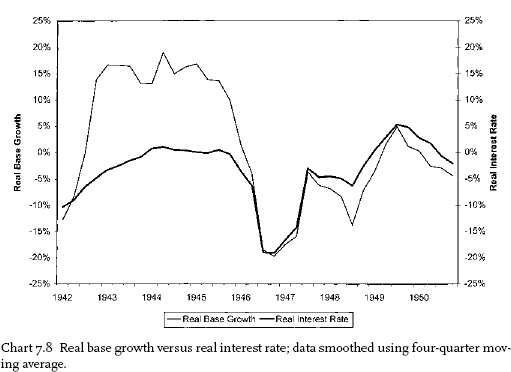
In 1942, the Federal Reserve volunteered to keep the long-term rate on Treasury bonds at 2.5 percent, fix short-term rates, and hold the pattern of rates prevailing at the time. After the war it did not insist on, or even propose, a free market in Treasury debt. It believed, correctly, that the spread between short- and long-term rates was much too large to encourage banks and others to hold short-term debt. Its goal through most of the period before the Korean War was to raise short-term rates enough to stop holders from selling short-term bills and buying long-term debt.
Most members of the FOMC shared this goal. They differed about how to achieve it. The Board, led by Eccles, preferred to increase reserve requirement ratios, use selective credit controls to ration credit, and require banks to hold secondary reserves of government securities. Influenced by political pressures from the Treasury, and reinforced by his own beliefs, Eccles hoped to control credit expansion without increasing interest rates. The reserve banks, particularly New York, acquiesced in some of these policies or supported them. They argued correctly that none of these actions would be effective unless interest rates rose. Although New York urged a slow and deliberate policy, it took advantage of opportunities to change short-term rates when they arose in December 1947, June 1949, and after the start of the Korean War.
Policy differences between New York and the Board have some aspects of a repeat, in different form, of the policy dispute in 1928–29. As before, the Board most often favored some type of credit or monetary control that did not require higher interest rates. New York argued for higher interest rates as a necessary step to control money growth and inflation. And as in 1928–29, the Federal Reserve ignored deflation in 1948–49.
Both the Board and the reserve banks had political and economic concerns. The main political concern was to avoid an open fight with the Treasury. The two main economic concerns were (1) that an increase in interest rates large enough to prevent postwar inflation would run the risk of reproducing the 1920–21 deflation and deep recession and (2) the mistaken belief that historically low nominal interest rates indicated an easy monetary policy. As in 1928–29, the Board and the FOMC paid less attention to money growth and price changes than to nominal interest rates.
Eccles and several of the Board’s economists, like many private sector economists, did not believe that small changes in interest rates had much effect on economic activity and prices. In the 1930s, Eccles accepted the phrase “pushing on a string” to describe the alleged impotence of expansive policies. In the postwar years he had similar reservations about contractive policies, unless carried far enough to run the risk of deflation. In both periods many economists, influenced by early Keynesian analysis, shared this view. There was no attempt to reconcile the conflicting beliefs that monetary policy was weak or impotent with the expressed concern that allowing interest rates to rise would risk deflation and depression. And along with these divergent views, a third view was often repeated: that deflation must inevitably occur to purge the effects of the previous inflation.
Before the start of the Federal Reserve System, bankers expressed concern about political dominance by a Board located in Washington. The Banking Act of 1935 shifted power from the reserve banks, particularly New York, to Washington. The sixteen years from 1935 to 1951 did little to dispel the early concerns. Resistance to the Treasury was stronger in the reserve banks, particularly New York, than in Washington. After Thomas B. McCabe replaced Marriner Eccles as chairman in 1948, Allan Sproul was able to gradually increase New York’s influence over the direction of Federal Reserve policy and, three years later, to insist on an end to pegged interest rates and a restoration of some of the System’s independence. But Sproul too was cautious, unwilling to push hard for independence until the threat of Korean War inflation made action seem imperative and support in Congress made success more likely.
Restoration of independence was not simply a victory for the reserve banks over the Board. Eccles played an important role, as did Senator Paul Douglas and other members of the congressional banking committees. High-handed actions by the Treasury and President Truman helped to marshal support for the System in the financial press and in Congress.
The FOMC had little to do during the long period when open market policy remained subordinate to Treasury debt management. The committee spent much of its time giving advice to the Treasury about the types of debt to sell, advice that the Treasury usually ignored. The Board also recommended tax changes, wage and price controls, and other policies unrelated to its mission. Within the System, the role of the account manager changed. Since the account manager had more information about the debt markets than the members did, his influence increased. Often he took the lead, making recommendations to the FOMC and, beyond his role, recommending changes in reserve requirement ratios. This shift in the manager’s role remained for years after the accord.
The long period when the FOMC was inactive did not eliminate the Riefler-Burgess doctrine as a guide to policy action. When the FOMC became more active, it reverted to its earlier operating procedure. Riefler was again at the Board, and Sproul used that framework to discuss monetary policy. Discussions at the FOMC before the accord, and the accord itself, refer to future policy actions as intended to “immediately reduce or discontinue purchases of short-term securities and permit the short-term market to adjust to a position at which banks would depend upon borrowing at the Federal Reserve to make needed adjustments of their reserves” (Krooss 1969, 4:3056).
Monetary policy was not the only friction between Washington and New York. Eccles and Sproul disagreed about the International Monetary Fund. The New York bank opposed the multilateral system developed at Bretton Woods. It favored a key currency system based on the dollar and the British pound. Although the Board had no role in the design of the postwar international system, the Treasury gained its support by appointing Eccles to the delegation for the Bretton Woods meeting.
The war opened a wide gap in the relative size and strength of the United States economy. Net exports and, despite controls, capital inflow continued the gold inflow that the war and the lend-lease program of allied war finance interrupted. Low inflation—even deflation—budget surpluses, and an expanding economy attracted foreign investment. Recovery in Europe, foreign aid policies like the Marshall Plan, and the start of the Korean War reversed the inflow. By 1950 the deflated price of gold was back to the predevaluation level. Large outflows began in 1950. For the next two decades, gold and the balance of payments deficit would become matters of increased attention and concern.
1. The president’s wartime powers included authority to reorganize government agencies. According to Eccles, Roosevelt agreed to consolidate the banking agencies but soon afterward rejected Eccles’s proposal. Eccles did not resign. Eccles’s service dates from 1934, but he was reappointed to a twelve-year term in 1936 after reorganization. Since he had not served a full term, he could be reappointed for fourteen years. The other members at the time were Governors Ronald Ransom, John K. McKee, Ernest G. Draper, M. S. Szymczak, and Rudolph M. Evans.
2. There is no evidence supporting Toma’s (1997) argument that the low-interest policy was intended to maximize the government’s seigniorage. Under the rules adopted in 1933, the Federal Reserve did not transfer any surpluses to the Treasury to compensate for its subscription to the initial stock of the Federal Deposit Insurance Corporation. This rule changed in 1947 to the present rule, under which the Federal Reserve pays 90 percent of its net earnings to the Treasury. A reader familiar with Secretary Morgenthau’s excessive concern about small changes in interest rates in the 1930s, when debt issues were relatively small (chapter 6), would not seek another explanation for wartime interest rate pegs when the size of debt issue increased by about 20 percent of GNP.
3. Eccles repeated this belief many times. One example is his 1946 testimony on the continuation of price controls after the war ended. On that occasion, Eccles testified that “it would be quite unsatisfactory, it seems to me, to try to meet the present problem by what was considered the usual or the orthodox way of dealing with inflationary forces, which was through increasing the discount rate, raising interest rates. Now, the reason for not following this course is that it would increase the cost of carrying the public debt, which is already very high, and it would likewise increase the earnings of the banking system which are also high. Such a policy would be a very unsatisfactory way to deal with this problem. I am sure that the Treasury would have considerable objection, as Congress and the public would, to increasing the interest burden on the Federal debt for the benefit of the banking system” (House Committee on Banking and Currency 1946, 183).
4. As late as 1980, the Carter administration imposed selective credit controls seeking to end a general inflation.
5. I return to this discussion, and proposals for change, in volume 2.
6. Feinstein, Temin, and Toniolo (1997) put the cost of the two wars at 13 percent and 45 percent of United States GNP at the time. For Germany, they estimated the costs as 53 percent and 76 percent.
7. Base velocity is computed as the ratio of GNP from Balke and Gordon 1986 to high-powered money from Anderson and Rasche 1999.
8. J. M. Keynes advocated a compulsory saving scheme as part of a British plan for war finance. Many of Keynes’s followers in the United States wanted to adopt Keynes’s program. Morgenthau opposed it, in part because the United States economy started the war with output far below capacity, in part because he was able to market the debt at historically low interest rates (Blum 1965, 297, 299). In World War I, the Treasury assigned a quota for banks’ purchases. The quota was a minimum subscription for each bank (Sproul Papers, Monetary Policy, 1940–41).
9. Eccles (1951, 381) includes the prewar defense spending in his calculation. For July 1940 to December 1945 he reports spending as $380 billion financed by $153 billion of taxes (40 percent), and $228 billion of borrowing and money creation. Nonbank investors acquired about $130 billion but sold some of their bonds to commercial banks after the bond drives. Elsewhere, Eccles gives contemporary data for June 1940 to June 1946, the period including prewar preparation. Total cost was $398 billion, 44 percent paid by taxation, 56 percent by borrowing and money creation (Board Minutes, November 26, 1947, 4).
10. The proposal was advocated in 1941 by Beardsley Ruml, head of R. H. Macy’s department store and chairman of the New York Federal Reserve bank. Hence it was often referred to as the Ruml plan.
11. Using the average values of the monetary base and GNP for the war years, the government taxed nearly 10 percent of the base through inflation. The base was about 5 percent of GNP and 15 percent of government spending, so the inflation tax on the base is about 0.5 percent of GNP and 1.5 percent of government spending.
12. Eccles cites a conversation with Roosevelt in December 1940, just after Roosevelt had announced the lend-lease program to help Britain. Roosevelt understood that technically it made no difference to the economy whether we lent the British money or lent them goods. But he believed the public would favor lending goods but oppose lending money. “If we made a dollar loan to the British, it would seem to our people that we were giving the British money, of which we were short, instead of goods which were in surplus” (quoted in Eccles 1951, 348).
13. The Federal Reserve minutes for the period return repeatedly to the topic of “educating” the public about the importance of holding the bonds they purchased. The problem was not ignorance but knowledge of opportunities.
14. As shown in table 7.1, the rate of base growth slowed in 1946. Morgenthau blamed “speculative practices” for the sales by nonbank investors. In contrast, Eccles recognized Treasury practices as the cause. Suspicious of bankers, Morgenthau argued that Eccles’s program (see text) would have raised interest rates, increasing the profits of banks and Federal Reserve banks (Blum 1967, 29).
15. Morgenthau was so pleased with his achievement that he concluded the Treasury should have a larger role in monetary and financial policy. He advocated returning the secretary to the Board of Governors (Blum 1967, 31).
16. The committee also recommended compulsory saving and lower tax exemptions to absorb purchasing power. In the Treasury, Undersecretary Randolph Paul and Harry Dexter White also favored compulsory saving (Blum 1967, 43).
17. Two modest policy benefits during the war were the end of the wasteful policy of purchasing Canadian silver and a reduction of the purchase price for Mexican silver to 35 cents an ounce, slightly below the world market price. The reason for these changes was to release silver for wartime use in photography and armaments. The Treasury continued to purchase domestically produced silver at 71.11 cents an ounce, as required by law (Blum 1967, 12).
18. The Treasury’s initial interest was not in an explicit peg. They asked the System to keep large excess reserves in the market, preferably by reducing reserve requirement ratios. When the Federal Reserve objected, the Treasury proposed the 0.375 percent bill rate. The FOMC approved the agreement unanimously. The agreement to support the “pattern of rates” was made in March. “The general market to be maintained on about the present curve of rates, but this does not mean special support for issues that may be out of line” (Minutes, FOMC, May 8, 1942, 3). The agreement provided for more flexibility than the Treasury allowed and much less than the FOMC anticipated.
19. This is a very different rationale than Eccles gave: “It would have been wrong for the government to pay increasing rates of interest for the use of the funds it helped to create” (Eccles 1951, 350). The same statement could be made at any time about any supply of base money. It expresses a preference for relying on inflation to tax wealth instead of relying on explicit taxation.
20. The memos do not mention that the benefits of victory would go to both future and current generations, justifying some sharing of the social costs through taxation to retire the debt after the war.
21. Sproul proposed interest rates starting at 0.375 percent for up to six months, rising by 0.25 percent to 1.375 percent at two and a half years, then by 0.125 percent to 2 percent at five years. The Treasury proposed a lower short-term rate and a steeper slope starting at 0.25 percent and progressing by 0.25 percent to 2.5 percent at five years. By June some in the System recognized that a fixed pattern of rates increasing with maturity gave holders an opportunity to “play the pattern of rates” by buying long, letting the price rise as maturity shortened, taking the profit, and then repeating the operation. The (unsigned) memo proposed letting rates fluctuate to reduce certainty (Sproul Papers, FOMC, June 1, 1942).
22. In June the Federal Reserve repeated that the pattern of rates “does not involve fixed or pegged prices for individual issues, but means maintenance of prices within a range which may include prices below par as well as above par” (Sproul Papers, FOMC, June 27, 1942, 4). The Federal Reserve did not refer to this position in the postwar years.
23. He said that since the banks had a franchise from the government to create money in the form of checks, the banking system was vulnerable to the trend throughout the world to socialize banking (Sproul Papers, FOMC, June 27, 1942, 17).
24. The quotation comes from a June 1942 letter to a Dallas newspaper signed by Congressman Wright Patman. The news clipping is in the Board’s files.
25. Eccles’s proposal called for a staff member at the Board “to direct the coordination of the work of the Board and the Federal Reserve Banks.” This brought a quick response from Allan Sproul of New York opposing direction by the Board.
26. At the end of the war, excess reserves of all member banks were about $1 billion. The low yield on Treasury bills and the small size of many country banks probably explain the sacrifice of pecuniary returns. The FOMC considered reducing the discount rate to encourage banks to increase borrowing and reduce excess reserves, but it did not act (Minutes, FOMC, August 3, 1942, 14–17).
27. In the course of the discussion Eccles offered his interpretation of central bank independence: “The kind of independence a central bank should have was an opportunity to express its views in connection with the determination of policy, and that after it had been heard it should not try to make its will prevail but should cooperate in carrying out the program agreed upon by the Government… . [A]ny other kind of independence would be an impractical position which would result in the loss of authority and influence that it otherwise might have” (Board Minutes, February 3, 1942, 8).
28. The System paid a modest amount to the Treasury from 1936 to 1946 for interest received on industrial loans. The largest annual payment was $327,000.
29. There were other lasting changes. The large increase in wartime debt and in trading led to changes in the market for government securities. The FOMC and the Board considered proposals to use the reserve banks instead of government dealers to make markets in government securities. The reserve banks opposed suggestions that the Treasury sell all government securities to the reserve banks, which would market the debt to the public. Instead, the New York bank agreed to license government security dealers. In exchange, the dealers agreed to provide detailed portfolio and transactions data (Minutes, FOMC, February 29, 1944, 6–8). Another change increased the roles of reserve bank economists at the FOMC. Until the war, only New York had sent an economist to the meeting. During the war, all banks were invited to adopt this practice. Discussion at FOMC meetings continued to be dominated by Eccles, Sproul, and economists at the Board and the New York bank, however.
30. The Board did not fully understand the limited effect of the change. On April 9, 1944, it unanimously approved a letter to a Mississippi banker who had written to request a reduction in the reserve requirement ratio for country banks from 14 percent to 7 percent. The Board explained in part that “reserves supplied through open market operations … go in the first instance directly to the particular banks needing them” (Board Minutes, June 9, 1944, 4–5). The letter then went on to cite other reasons, including the greater ease of monetary control after the war. There was no mention of earnings.
31. The New York Federal Reserve bank set the rate on direct loans to war contractors at 4 percent to 6 percent. The Board wanted the rate reduced to from 2.5 percent to 4 percent. The compromise was to lower the rate schedule to from 4 percent to 5 percent (Minutes, New York Directors, May 7 and June 4, 1942).
32. Harrison, former governor of the New York bank, was a member of the Federal Advisory Council. His memory of 1919–20 was faulty. The Treasury was willing to increase the general discount rate before it was willing to raise the preferential rate. See chapter 3.
33. Between 1941 and 1945, member bank income after taxes rose from $390 million to $788 million, about a 50 percent increase in real terms. (Since prices were controlled, the price index is biased downward. Using the 1945 price index, the gain is 60 percent; using 1946, after controls were removed, the gain was 43 percent.) To help the Treasury sell debt to the public, the Board discussed lowering the maximum rate that commercial banks could pay on time deposits from 2.5 percent to 1.5 percent. Eccles, Ransom, and Leo Crowley (chairman of the FDIC) favored the change, but it was not made. One reason is that banks feared they would lose savings deposits to nonbank thrift institutions, a problem that returned in the 1960s.
34. By spring 1942, the list included new and used goods, shoes, hats, and haberdashery. Monthly charge accounts were covered also. The regulations became so detailed that the Board agreed to exempt the Boy Scouts and railroad employees required to use a precision watch (Board Minutes, June 29, 1942, 9; August 12, 1942, 1).
35. The Board had to decide such weighty matters as Should reupholstered furniture be treated like new furniture? Should loans for funeral expenses be exempted? Medical and dental expenses? (Board Minutes, August 12, 1942, 1).
36. Studies of the effect of selective controls on housing and durable goods find no evidence of their effectiveness. For housing, see Kane 1977 and Meltzer 1974. For durables, see Hamburger and Zwick 1977, 1979. These studies apply to later periods, but their findings are applicable to the war. A principal finding is that credit controls have clear effect on the form in which lenders extend credit, but there is no evidence of an effect on the allocation of resources or total spending.
37. John K. McKee was appointed to the FOMC in February 1936. He served ten years, leaving in April 1946.
38. When the bill was introduced, Senator Elmer Thomas wrote asking the Board to append his bill authorizing all banks and other financial institutions to carry government obligations at par value. It declined (Board Minutes, January 26, 1945, 2). The Board also requested repeal of the Thomas amendment authorizing the president to issue $3 billion of currency (Board Minutes, March 15, 1945, 202). At about this time, Congress considered a proposal to have the General Accounting Office audit the Federal Reserve, as it had done in the System’s early years (Minutes, New York Directors, February 5, 1945, 170). This issue returned many times.
39. The unique private-public structure of the Federal Reserve left unresolved whether property such as the Board of Governors building was taxable by the District of Columbia. The District agreed to treat the property as government property provided each of the reserve banks disclaimed ownership (Minutes, New York Directors, January 13, 1944, 21).
40. In fact Keynes (1936) says very little about activist policies. Keynes’s support for such policies antedates his book and is more explicit in his policy tracts. See Meltzer 1988.
41. There is nothing in the studies about the need to restore monetary control by eliminating the interest rate peg. Volume 8, devoted to Federal Reserve policy, is given over mainly to a historical review of past options.
42. “To the extent that we can deal effectively with the money supply and production factors, we will be getting at the root causes of the inflationary problems confronting the country today” (House Committee on Banking and Currency 1946, 171).
43. World War II wage controls, and tax deductibility, produced a long-term inefficiency—health care benefits paid by employers who deduct the cost. This distortion increases the demand for health insurance and limits opportunities for individual workers or families to choose the health insurance they prefer.
44. Eccles had a mixed view of price and wage controls. He supported the call for controls in 1942, but he saw them as at best a supplement to taxation that removed private command of resources. At the same time, he seems aware of the conflicts set off by controls—whether costs could be controlled as effectively as, or more effectively than, prices, problems such as setting rents, concerns about excess profits, and so on. See Eccles 1951, 370–72. Morgenthau favored controls on prices but not on wages. He said that labor was not a commodity, so wages should not be treated like other prices.
45. Price controls expired in June 1946. Congress voted for rapid decontrol, but President Truman vetoed the bill, so controls ended when they expired. In early August, Congress renewed controls (but not food subsidies). This was followed almost immediately by meat shortages. Almost all controls were abolished by executive order on November 11, 1946.
46. This section is based on Jones 1972.
47. Principal among them were Seymour Harris (1943), Alvin Hansen of Harvard, and Paul Samuelson of MIT (1943). Others such as Herbert Stein of the Committee for Economic Development preferred lower taxes. Stein’s influential essay became the basis for policies advocated by the Committee for Economic Development, a business-sponsored group.
48. At a meeting of the Board and the presidents to discuss the Board’s studies of postwar problems, John H. Williams was highly critical of a study by Richard Musgrave, a member of the Board’s staff. The study showed that the budget would not be balanced if government spending remained low. The argument, based on a Keynesian model, proposed that the government absorb the excess savings. Williams countered that Musgrave had neglected the crowding out of private spending. Some government spending makes “private business work better, but when you get up to this level, you are bound to ask what these expenditures are doing to the private economy. It is inevitable that it will take its place to an increasing degree” (Board Minutes, March 2, 1945, 5). Williams’s remarks anticipated major controversies about the effects of government spending, deficits, and debt in the 1960s and 1970s. Williams added, “[Economists] are interested in large and even growing public expenditures. I think there is a lot to be looked into on that point before we accept it as a guide for postwar policy” (Board Minutes, March 2, 1945, 6). Seymour Harris (1943) wrote: “These [Keynesian] economists are impressed with the failure of the capitalism of the twenties to provide full employment and are impatient with economic theory that fails to discuss conditions of disequilibrium and underemployment. Keynesian influences will be especially evident in the parts of the volume devoted to the discussion of full employment and fiscal policy” (5). In the same volume Paul Samuelson (1943, 53) wrote: “All our findings lead to the conclusion that there is a serious danger of underestimating the magnitude of the problem of maintaining continuing full employment in the postwar period.”
49. See Murray 1945. The standard reference to the act is Bailey 1950. The bill was pushed by Leon Keyserling. Later George Terborgh of the Machinery and Allied Products Institute rejected the Hansen-Samuelson argument. “Nothing in the purely economic or technical situation indicates that private investment will have to be propped up by public investment not desired for its own sake. Indeed, the situation is so favorable for a boom after the inevitable transition period” (Sproul Papers, Board of Governors, Correspondence 1943–44). The quotations are from a speech by Terborgh, 14–15. One of the first members of the Council of Economic Advisers and its second chairman, Keyserling had been a legislative assistant to Senator Robert Wagner of New York, one of the sponsors. Keyserling was a principal developer of “the Fair Deal,” President Truman’s economic program. See Brazelton 1997.
50. For a contrary view, see Keyserling 1972. According to Keyserling, the act allowed economic planning but was not carried out because of the unwillingness of government (and Keynesian economists) to propose income redistribution.
51. Forecasters’ failure to foresee rapid postwar recovery instead of a return to high unemployment did not strengthen their case. See Stein 1990, 202. On the inaccuracy of economic forecasts, see Meltzer 1987.
52. The Reagan administration considered abolishing the council because of differences between one of its chairmen and other presidential advisers over budget deficits. Since the council was authorized in the Employment Act, demission required legislation. The administration chose not to raise the issue.
53. This position dominated research at the time. See Villard 1948 and Ackley 1961, and for a Federal Reserve view see Thomas 1941. For a contrary view see Friedman 1956 and Warburton 1966. Assigning a more powerful influence to monetary policy would have required the Federal Reserve to accept more responsibility for the Great Depression, but it would have moderated, or even prevented, the Great Inflation after 1965.
54. Chapter 4 discusses attempts in the United States to enact Irving Fisher’s proposal for a “compensated” gold dollar and to establish domestic price stability as the principal policy goal.
55. White was director of monetary research and later assistant secretary of the treasury. The United States proposal that became the basis of the International Monetary Fund is often referred to as the White plan. Keynes’s plan called for a clearing union to adjust current account balances of debtors and creditors. White envisaged a permanent fund that could lend to debtor countries. White’s version was the basis of the Bretton Woods Agreement.
56. Blum (1967, 228) speaks of “a kind of New Deal for a New World” and avoiding past difficulties caused by “private bankers, pursuing selfish ends” (229). Gardner 1956 is a comprehensive history of the origins of the fund. Several papers in Bordo and Eichengreen 1993 are a useful supplement. I limit my discussion principally to Treasury and Federal Reserve responses and actions. Keynes visited the United States in fall 1941 and possibly discussed his plan informally before White began work.
57. Keynes’s dislike of the classical gold standard and what he called laissez-faire was no longer heretical in Britain by the 1940s. The established view was that the maldistribution of gold had made the system untenable. The accepted conclusion was that Britain should manage domestic policy to maintain full employment (Ikenberry 1993; Presnell 1997). Fluctuating rates were anathema to bankers and policymakers. An influential study by Nurkse (1944) concluded that fluctuating exchange rates caused destabilizing speculation in exchange rates and the prices of traded commodities. Nurkse’s argument and evidence were later successfully challenged by Friedman (1953), but Nurkse’s view remains widely held by bankers and governments.
58. This benefit could be achieved if all fluctuations were temporary, or cyclical, so that members could borrow in recessions and repay in recoveries, but the authors did not specify how to distinguish cyclical or temporary changes from permanent changes. Countries were allowed to devalue up to 10 percent without approval by the fund, and by more than 10 percent with prior approval. Devaluation was to be used to adjust to a “fundamental” disequilibrium. The fund was never able to define “fundamental” or to enforce the requirement that countries could not devalue by more than 10 percent without agreement.
59. White explained to the Federal Reserve Board that the World Bank would be responsible for capital transfers. “Many of the loans will be risky and there will be some losses. That is one of the reasons why we insisted that the Bank be an international bank rather than to take the risks by ourselves. We felt that the benefits would be world-wide and that other countries should bear part of the risk” (White to the Board and Reserve Bank Presidents, Board Minutes, March 2, 1945, 17). The Bank was also expected to remove the impediment to economic development arising because risk-averse private lenders restricted lending to developing countries or charged excessive risk premiums. Although no evidence was presented, this conclusion was widely held.
60. Menc S. Szymczak, who served from 1933 to 1961, was a professor of business administration at DePaul University in Chicago when he was appointed to the Board. He had been active in Chicago area banking and had served also as comptroller of the city of Chicago. He was the Board’s expert on international economics and participated in some of the Treasury meetings preparatory to the Bretton Woods Conference. Later he served as director in charge of rehabilitation of the German economy, on leave from the Board. His long service is explained by appointment to a twelve-year term in 1936 followed by a fourteen-year term beginning in 1948. He resigned six months before his term expired (Katz 1992).
61. Before the meeting, each of the members received a copy of the Joint Statement of Experts, a synthesis of the Keynes and White plans, and a statement of the positions taken by the Board’s staff in the discussions.
62. Goldenweiser was present also. He told Eccles that agreement with the statement of principles meant a commitment to a major part of the plan.
63. This was not true of the New York bank. Sproul was opposed, and his vice president, John H. Williams, had made several public statements in opposition. The New York board of directors voted unanimously in October 1943 and June 1944 to endorse the position taken by Sproul and Williams (Minutes, New York Directors, June 19, 1944, 208–9). At Morgenthau’s request, Eccles agreed to suggest to Sproul that Williams desist from criticism.
64. Szymczak reported that White had agreed that John H. Williams could come as an assistant to Eccles if Eccles wished. Later he insisted that Williams could participate only if he accepted the Joint Statement of Experts as the basis for discussion. He was sure Williams would not agree to the statement.
65. The proposal Goldenweiser distributed contained many of the provisions in the final agreement. The fund would have $8 billion from countries in the United Nations. Country quotas would be paid 25 percent in gold. Quota sizes had not been set. The fund was limited to financing trade; capital movements were explicitly excluded from fund lending. Exchange controls on current account were to be removed in three to five years, but capital restrictions were permitted.
66. Williams asked whether all countries agreed at the technical level. Goldenweiser replied that he knew only about England and Russia. He agreed that the fund “was wholly inadequate” for the postwar transition. It would have to be part of a program of lending and relief (Board Minutes, June 6, 1944, 11).
67. Williams’s proposal tried to solve the transition problem by permitting different speeds of adjustment to convertibility. At first the United States, Britain, and a few others would adopt stable exchange rates. Other countries would have more time to adjust. At the time, as much as 50 percent of all trade was denominated in pounds sterling.
68. In correspondence with Jacob Viner, Keynes wrote that he favored price stability as a goal and was skeptical of the alleged advantages of devaluation. The main occasion for devaluation, he wrote, was when efficiency wages increased relative to wages abroad. Viner replied that the wage criterion “accepts the business agent of the powerful unions as the ultimate and unlimited sovereign over monetary policy.” See Meltzer 1988, 241.
69. Morgenthau led the American delegation. It included Fred M. Vinson, Dean Acheson of the State Department, Harry Dexter White, and four members of Congress. Eccles was the only representative of the Federal Reserve, but Edward E. Brown, president of the First National Bank of Chicago and chairman of the Federal Advisory Council, was a member. Senator Robert A. Taft was omitted because he was opposed. The British delegation, led by Keynes, also included only one representative of the Bank of England. Williams refused to accept the restriction that his comments remain within the framework established by the proposal, so he did not attend.
70. Bernstein served as chief technical adviser of the United States delegation and chairman of the Committee on Unsettled Questions. Later he became the IMF’s first director of research.
71. At one point Morgenthau (Blum 1967, 432) thought that a single board of directors should coordinate the work of the fund and the bank. Proposals of this kind reappeared many times.
72. Eccles and the Board also attempted to silence the proposal’s critics at the New York bank. On September 19 Eccles read a statement that he proposed to give to the presidents. The statement reviewed the discussions held the previous spring, then concluded: “The public expression of an adverse attitude, if any, on the part of any of the Federal Reserve Banks and their officers would be likely to impair the usefulness of the System in relation to the problems growing out of the conference” (Board Minutes, September 19, 1944, 6). Eccles explained that by attending the conference he had committed the Board to support the plan. Only McKee argued against the statement. He could accept a statement saying that no one could speak for or against the agreement, but not a one-sided statement. The Board approved the statement with McKee voting against. When the Board met with the Presidents Conference, the statement was the last (eleventh) item on the agenda. Eccles read the prepared statement. Sproul responded that on an issue of this importance, until it became law, “he had a duty to express his views and that if … such an expression [was] damaging to the System then he would have to decide whether to leave the System, but he could not agree with the view that the officers of the System from here on should be muzzled” (Board Minutes, September 22, 1944, 31). President John N. Peyton (Minneapolis) supported Sproul. Eccles retreated. He thought it would harm the System, but they were at liberty to express conflicting views.
73. The Board obtained assurance from White that he would discuss the Board’s request with Senator Wagner, chairman of the Senate Banking Committee, and other committee members. Since the proposal originated with the American Bankers Association, Morgenthau regarded it as additional evidence that the Federal Reserve represented the bankers. He had held that view for some time, so it did not take much to convince him (Blum (1967, 428). The Board’s effort was an attempt to restore some of the System’s responsibility for international monetary policy. At the same meeting, the Board voted to end the Treasury’s Exchange Stabilization Fund, scheduled to expire on June 30, 1945. The Board asked that the Stabilization Fund terminate when the subscription to the International Monetary Fund became due.
74. Congress gave the Treasury main responsibility for the bank and the fund. The United States executive directors are assistant secretaries of the treasury. The secretary is the United States delegate, and the chairman of the Board of Governors is his alternate.
75. Board members were enraged. On September 25 they discussed voting to censure Sproul. Their counsel advised them that they did not have a case. They knew his intention in advance and had authorized his right to appear more than a year before (in September) when the Board had tried but failed to silence the opponents. The Board then discussed statements by Chairman Beardsley Ruml, of the New York bank, and his use of this position as a platform from which to criticize the Bretton Woods Agreement. Eccles said that Ruml should not be reappointed when his term expired. Eccles also thought that the Board should dismiss John H. Williams because his “part time job [as vice president and research director] left him free to make public statements.” They agreed only to prepare a statement of policy about public statements by bank officials (Board Minutes, September 25, 1945, 7–10). The Board prepared a letter to Chairman Ruml stating that Sproul’s actions were “inappropriate and unwise.” The Board “could not countenance” that degree of independence. Nothing could be done about the past, but in the future they must function as a system. The governors could not agree, so they voted to have Eccles speak to Sproul (Board Minutes, October 16, 1945, 3–4).
In December, Eccles reported on his conversations with Sproul and Ruml. Sproul replied that the directors of the New York bank would not accept the Board’s position. Sproul made no commitment to be bound by the Board’s positions. Eccles replied by threatening not to renew his appointment as president. Sproul repeated that he would not commit to a different position (Board Minutes, December 7, 1945, 4–7). Then Eccles discussed Williams’s part-time appointment and his freedom to express his views outside the bank. Again, Sproul disagreed. He was unable to control Williams’s public statements. This did not satisfy Eccles, so he threatened not to renew Williams’s appointment.
Eccles was no more successful with Ruml than with Sproul. Ruml agreed only that he would stay within the policy statements made by the Board; he said he would state his views on other public issues.
76. Sproul’s Senate Banking Committee testimony is in Senate Committee on Banking and Currency 1945, 301–17. Williams’s is in ibid., 318–34. Eccles tried to prevent the testimony. He told Morgenthau that “he did not think the Banks should be asked to express their views on the Agreements, particularly since at least one of the Banks was opposed” (Board Minutes, February 23, 1945, 4).
77. “A set of vested interests and a network of discriminatory trade and currency practices will have grown up which it may prove difficult to break down” (Senate Committee on Banking and Currency 1945, 323). “The agreement may institutionalize exchange controls” (306). Bankers and others opposed the agreements because they gave away United States gold and supported deficit finance abroad, and because Keynes supported them. The American Bankers Association, and other bank associations, testified in opposition (James 1996, 64–65).
78. The French also borrowed $800 million to help in the transition. This loan came from the Export-Import Bank, so it did not require congressional approval. William McChesney Martin Jr., head of the Export-Import Bank and later chairman of the Board of Governors, opposed the loan. The Treasury insisted, and the loan was made (Black 1991, 56).
79. Blum (1967, 427) lists the Wall Street Journal, New York Times, World Telegram, and others as opponents. Morgenthau believed that criticism of the fund was misplaced. The fund would be open only to countries capable of keeping exchange rates stable, and its loans would be only for short-term trade finance. (429). Proponents included the national labor unions, the Independent Bankers Association, and most economists.
80. The fund began operations in March 1946 under the leadership of Camille Gutt, a Belgian. Britain removed restrictions, as promised, in July 1947, followed by the postwar British exchange crisis in August. Under the “scarce currency” clause of the IMF agreement, the British could continue trade discrimination if the fund declared the dollar “scarce.” A main reason for the early postwar discussion of the dollar shortage was to have the dollar declared “scarce.” The clause was never invoked.
81. The Treasury issued $1.75 billion of special non-interest-bearing notes to the IMF, in effect borrowing back and deferring payment of part of its subscription. It then used the $800 million balance obtained from issuing gold certificates to retire $500 million in debt from the reserve banks and $300 million to offset an outflow of gold in January (Fforde 1954, 194). These operations neutralized the effect on the monetary base.
82. Later the bank broadened its scope to include poverty reduction, environmental concerns, women’s rights, and other projects popular with contemporary political groups in the United States. Keynes had feared that locating the bank in Washington would expose it to pressures from United States domestic politics. James (1996, 72) quotes Keynes’s comment that the United States wanted to move control of international economic policy from Congress to the new institutions where it had a large voice.
83. For 1945 as a whole, production (1992 = 100) fell from 25.9 to 21.2, a drop of 18 percent. The wartime peak in industrial production came in 1944 and was not surpassed until 1950.
84. Morgenthau and his aides worked hard and made several concessions to get the USSR to join the International Monetary Fund. Russia did not join until after the collapse of the Soviet Union in the late 1980s.
85. The 1948 act permitted income splitting, so it reduced the rate applicable to many married, high-income taxpayers. The act, passed over President Truman’s veto, increased the standard deduction and reduced rates for all taxpayers by $5 billion, about 11.5 percent of receipts.
86. The Victory Loan raised $21 billion between December 1945 and February 1946. Gross public debt declined $20 billion from February through December 1946, so the net effect was to cancel the Victory Loan. As in the text, the reduction was mainly in notes and certificates, held mainly by banks, so the combined effect shifted debt ownership from banks to nonbank holders. The Treasury’s effort to sell bank-ineligible securities was less successful than the text suggests. During the Victory Loan, commercial banks purchased $7 billion in the market, almost all of it from nonbank investors.
87. The Treasury also sold $11 billion of nonmarketable special issues to its trust accounts to fund its obligations, and the public added $7 billion to its holdings of government savings bonds.
88. When bond yields fell to 2.08 percent in the winter of 1946, Chairman Brown of the Advisory Council asked Eccles whether the Treasury was concerned that rates were far below the ceiling. Eccles replied that the Treasury had no financing in prospect and so was unconcerned (Board Minutes, April 24, 1946, 11).
89. The Federal Reserve proposal is discussed in the next section.
90. “The notion that inflation is a monetary phenomena and that it can be prevented by refusing to allow the quantity of money to increase is to mistake a symptom for a cause” (Robinson and Wilkinson 1985). See also Kaldor 1982.
91. The Board formally disapproved of tax reduction in 1947 and notified the president (Board Minutes, June 9, 1947, 1–2). Eccles also proposed, and the Board agreed unanimously, to recommend to President Truman that he sign the Taft-Hartley Act. The Board recognized that labor relations was not its field but agreed that strikes and labor unrest would disrupt production and raise prices. The letter was approved and sent (Board Minutes, October 17, 1947, 1–5).
92. Three sources will suggest how broadly these views were held in the academic community. Henry Villard (1948) was commissioned by the American Economic Association to survey monetary theory. The paper was published in the association’s Survey of Contemporary Economics. The Committee on the Working of Monetary System (1959), known as the Radcliffe Committee, denied any role for a policy of monetary control in Britain. As late as 1965, the American Economic Association’s Readings in Business Cycles has no role for money (Gordon and Klein 1965). Citations of popular textbooks such as Ackley 1961 or of econometric models of the period provide additional evidence.
93. This belief in the impotence of monetary policy was so widely held that it is rare to find a memo suggesting the opposite. One such memo, by Walter Salant, warned that the swing in opinion since the 1920s went too far. Monetary policy was not totally impotent, Salant wrote, and experience did not support total impotence. Drawing on Currie 1934, he argued that policy had not been easy during most of 1929–33 or in 1937–38. He concluded with a double negative: there is no reason to believe that monetary policy “cannot exert a significant expansive influence” (Salant 1948, 8). The memo, dated May 21, concerns mainly policy in recession. At the time, Salant was on the staff of the Council of Economic Advisers. He sent me a copy of the memo.
94. Eccles describes the clash with Snyder as arising from conflicting responsibilities, not personalities (Eccles 1951, 421). Casimir Sienkiewicz, who worked in the System from 1920 to 1947, is less charitable. He described the Treasury as under the control of its staff. “Mr. Snyder did not really know very much about the problem he should have been coping with” (interview with Casimir Sienkiewicz, CHFRS, March 18, 1954, 3).
95. At the time, McCabe was chairman of the Philadelphia Federal reserve bank. In 1948, he succeeded Eccles as chairman of the Board of Governors.
96. “Every member of the Open Market committee is aware of the disastrous consequences that would follow if the system were to attempt to force rates up to levels that would be effectively restrictive on private borrowing” (Board to McCabe, Board Minutes, May 28, 1947, 8). The letter spells out the “disastrous consequences” as substantial losses on bank (and other) portfolios, increased cost to the Treasury, and loss of any freedom of action by the Board, a reference to the political consequences the Board most feared.
97. “Mr. Evans stated that he was opposed to increasing the rate on certificates because the burden of such an increase would fall on the farmers, and the small businessmen, and the taxpayers. He recalled the situation after World War I, when the Federal Reserve was blamed for increasing interest rates, tightening credit, and causing a fall in prices, and he said that in some places the Federal Reserve system was still held responsible” (Minutes, FOMC, May 2, 1947). Rudolph M. Evans served as a member of the Board of Governors from March 1942 to August 1954. He held the “agricultural seat” after the resignation of Chester C. Davis in April 1941.
98. “Chairman Eccles did not think that a higher rate of interest—unless it was a very much higher rate—would have any substantial effect in curbing the demand for credit for private purposes” (Minutes, FOMC, June 10, 1946, 10).
99. A partial resolution of the apparent inconsistency is that there was a large debt outstanding, so a small change in interest rates would have a larger effect on private wealth than heretofore. Williams used the same argument, however, to claim that a small change “would have a greater retarding effect than in the past” (Minutes, FOMC, June 10, 1946, 13).
100. The reasoning is wrong. Debt retirements raise bond prices and lower interest rates, not the reverse.
101. This is a political argument, but the Board was also skeptical about the economic effects. The letter ends as follows: “Outside of the monetary cranks, no one at all informed on the subject would suggest that in the great complex of economic forces there is some simple monetary device that could preserve or restore economic equilibrium” (Board to McCabe, Board Minutes, May 28, 1947, 10). Eccles also expressed concern about large bank earnings if interest rates rose (Minutes, FOMC, January 23, 1946).
102. The quotations are from Sproul’s draft. Eccles sent the letter to Vinson the following day.
103. Total member banks borrowing was about $200 million to $300 million at the time but had reached $600 million earlier, the highest level since the early 1930s. The Treasury contributed to anti-inflation policy by running a surplus of $754 million in fiscal 1946 and retiring debt of $10 billion. The difference between the two is explained by costs of the IMF, World Bank, and veterans’ loans not spent that year ($3.9 billion), use of trust funds to purchase debt ($5 billion), and sale of savings bonds ($1.1 billion) to retire debt.
104. Banks could still sell bills yielding 0.375 percent. The Federal Reserve was the principal and usually the only buyer.
105. The volume was small, however. Eccles questioned the manager (Robert Rouse) about the acceptance rate at the June 10 FOMC meeting. Sproul responded that the New York bank wanted to “go slow,” a strange argument given his interest in raising rates. The rate was raised to 0.75 percent in July and 1 percent in August (Board of Governors of the Federal Reserve System 1976, 636). Sproul’s argument recalls the New York reserve bank’s policy of nurturing the acceptance market in the 1920s.
106. A letter to Eccles explained that, with interest rates unchanged, banks would sell securities to restore their ability to lend (Sproul to Eccles, Sproul Papers, Memorandums and Drafts, May 6, 1946). Eccles’s reply argued that they had to use their existing powers or Congress would not grant additional ones. However, he argued also that the increase in requirements would force banks to sell short-term securities. They could then not sell these securities to increase bank loans (Eccles to Sproul, Sproul Papers, Memorandums and Drafts, May 17, 1946).
107. The Board proposed three changes in powers: authority to set a maximum amount of long-term debt (public and private) that a bank could hold relative to its deposits; power to set a secondary reserve of short-term securities that a bank must hold as a percentage of its deposits; and authority to increase reserve requirement ratios. The Board recognized that with excess reserves low, an increase in reserve requirement ratios would raise interest rates as banks sold assets. The Federal Reserve would acquire the securities to prevent higher rates. This is the first time I have found the Board clear on this point (Board of Governors of the Federal Reserve System, Annual Report, 1945, 8). Elsewhere the report recommended that the Treasury issue more nonmarketable debt, a recommendation the Board and Eccles made many times. The 1946 annual report repeats the same argument but omits reference to the cost of financing the debt when discussing the importance of lengthening the maturity structure of the publicly held debt (Board of Governors of the Federal Reserve System, Annual Report, 1946, 6).
108. In October the executive committee authorized the manager to engage in direct purchases and sales of United States securities with the International Monetary Fund and the World Bank. It rejected a request from the bank that the Federal Reserve stabilize the market for World Bank debt (Minutes, Executive Committee, FOMC, October 3, 1946, 10–11).
109. Eccles proposed an alternative—exchange the System’s 0.375 percent bills for a lower yielding bill. Sproul opposed giving the Treasury control of the rates paid to the reserve banks (Minutes, FOMC, October 3, 1946, 18).
110. Questions were raised about the Board’s authority. The section of the act provided for the tax to restrict the note issue. Counsel ruled that the authority was broader, citing a 1920 discussion by Governor W. P. G. Harding.
111. One member of the Board objected to the proposed increase in rates on certificates. It would have no noticeable effect on inflation. The banks would gain, and the System would be blamed for raising interest rates paid by farmers and small businessmen (Minutes, FOMC, June 5, 1947, 7–8).
112. This amount can be compared with the $149 million paid as franchise tax from inception to 1932. Wartime inflation and the large increase in debt held by the reserve banks account for the change in order of magnitude. At the end of 1946, the reserve banks had a $440 million surplus and capital of $374 million.
113. In 1943 Congress amended the Federal Reserve Act to permit direct purchases of government securities from the Treasury up to a $5 billion maximum holding. This power expired with the War Powers Act in March 1947. Congress renewed the authority as a temporary measure, later made permanent. At about the same time, at the Board’s request, Congress repealed a section of the Emergency Banking Act of 1933 that gave the Treasury authority to regulate and prohibit banking transactions (Board Minutes, March 3, 1947, 3–6).
114. Some of the actions were entirely cosmetic. For example, when President Truman asked all departments and agencies to reduce spending so as to increase the budget surplus, Eccles proposed cutting the Board’s expenditure and asked the reserve banks to do the same even though they were not part of the budget and, at the time, did not pay a tax to the Treasury (Board Minutes, August 2, 1946, 3).
115. The classification system was archaic, carried over from the National Banking Act when central reserve and reserve cities had held the principal reserves of country banks as correspondent balances. Under the Federal Reserve Act, banks continued to serve as correspondents, but most reserves were held at Federal Reserve banks. In discussion with the Federal Advisory Council, Eccles favored uniform reserve requirements for all banks, a position that was inconsistent with his efforts to get congressional approval of an increase in reserve requirements for central reserve city banks only (Board Minutes, May 20, 1946, 6). Some bankers opposed eliminating the reserve city classification because they claimed banks would lose correspondent deposits. There was nearly general agreement that the classification system had lost its logical basis. The problem was that no one could suggest an appropriate revision (1–7). In 1930–31, 1932, and 1934, the System considered basing reserve requirement ratios on activity. Congress turned down these requests. It returned to these proposals in 1945, when it considered three classes of deposits—interbank, other demand, and time. The revised system would count vault cash as reserves (Sproul Papers, Memorandums and Drafts, 1945, October 1, 1945). The System offered the proposal again in 1948, with ratios of 30, 20, and 7 percent for the three types of deposit (ibid., April 22, 1948).
116. If all the member banks in a city chose to continue an existing reserve city classification, the Board agreed to maintain the classification.
117. The Board confused relative and absolute changes in demand. “It has not seemed to the Board that any change in the regulation [W] would be advisable at the present time. With employment and incomes high and the supply of spendable funds excessive, credit beyond that now available would only waste itself in stimulating undesirable price rises and retarding needed price adjustments” (Board to T. Schlesinger, Board Minutes, May 13, 1947, 14–15). Schlesinger was vice president of Allied Stores Corporation. Other letters from congressmen and their constituents questioned the legality of peacetime regulation. In its 1946 annual report, the Board made its error explicit. “It [regulation W] can restrict excessive demands for credit by limiting the borrowing capacity of prospective purchasers of goods without operating, as general instruments of credit policy must do, by increasing the cost of credit to the Government or to industry” (Board of Governors of the Federal Reserve System, Annual Report, 1946, 8).
118. The Board’s press release, a mixture of annoyance and economic error, is remarkable for its implicit criticism of Congress. “The continuance of strong inflationary pressures has confirmed the belief of the Board that this is no time for the relaxation of terms by banks, finance companies and installment dealers” (Board Minutes, November 24, 1947, 6).
119. This was a response to Eccles’s use of rising bank loans to make his case for control, neglecting sales of securities that limited total credit expansion. Eccles argued, also, that a further increase in interest rates would have little effect on the demand to borrow—another example of “elasticity pessimism” (Minutes, FOMC, October 6, 1947, 4).
120. Governor Draper opposed the plan. He had not received any advance notice, nor had other governors. There had been no analysis. He thought the plan was too drastic. Nevertheless, he voted in favor to make the vote unanimous (Board Minutes, November 5, 1947, 5). The reason for haste in presenting the plan was that Eccles had been asked by the White House to recommend policies for the president’s speech to a special session of Congress. Bankers opposed the plan as “impractical, socialistic, and unnecessarily drastic” (Eccles 1951, 428). Snyder opposed and had the proposal replaced in Truman’s message by a general statement favoring a reduction in credit. Snyder nevertheless agreed to support the Board’s proposal for consumer credit controls (430–31), and to refrain from testifying against the secondary reserve plan. When asked his opinion, however, he said that “he didn’t think it would work” (432).
121. Contemporary observers point out that the administration knew that Congress, under a Republican majority, would reject the program. The president wanted to blame Congress for inaction. Congress provided more stimulus by reducing tax rates in April 1948 and overriding the president’s veto of the tax bill (Fforde 1954, 163–64).
122. The verbatim statement is part of the Board Minutes.
123. This statement denies that the System could sterilize gold inflows, as in the 1920s. At best the statement is misleading. The System held more than $22 billion in securities at the time, a sum larger than the combined monetary gold stock of all countries other than the United States.
124. After reading Eccles’s proposal to the president, asking for a secondary reserve requirement, Sproul telegraphed: “It would be most unfortunate if in our zeal to acquire new powers which might not be granted we were unnecessarily to minimize the effectiveness of our present policy, exaggerate the role of monetary factors … and expose the System to the risk of being held responsible for not checking or remedying a situation due primarily to non-monetary causes. In the circumstances I want to reaffirm that as a member of the Federal Open Market Committee I cannot regard myself as in any way committed to what is proposed” (Sproul Papers, Memorandums and Drafts, 1947, November 13, 1947).
125. The money multiplier of six appears to be based on the average reserve requirement ratio with no allowance for a spillover from deposits into currency. At the time the average base money multiplier was about three.
126. The reply argues that an “attempt to use those [the System’s established] powers would increase sales of Government securities in the market by banks and others. If the System refused to purchase any more securities, bond prices would decline sharply. The threat of such a policy would induce a wave of selling… . The Reserve System would have to purchase securities in order to meet the drains on the Treasury, and new reserves would therefore be created” (Board Minutes, November 26, 1947, 22–23).
127. The Treasury sold securities from the trust accounts in May to raise long-term rates toward the ceiling. This annoyed the FOMC members because they had not been notified in advance.
128. Friedman and Schwartz (1963), suggest that the public expected postwar deflation. A related explanation is that on the margin, bondholders believed that inflation would be followed “inevitably” by deflation. Such explanations compound the problem. Why did expectations of a future deflation, at an uncertain date, overwhelm evidence of current inflation?
129. Surprisingly, Board and FOMC minutes make no mention of the commitment under Bretton Woods or its possible effect on inflation. The slow response of interest rates to inflation occurred again in the 1950s and 1960s. This is consistent with the view that, at the time, creditors believed inflation was temporary, although there is no direct evidence.
130. Between November 1 and June 30 the Treasury retired $6.8 billion, of which $4.9 billion came from reserve banks.
131. The warning was aimed especially at insurance companies to try to stop their sales of long-term bonds. Banks complained about competition from insurance companies in the loan market, claiming that they exercised restraint but insurers did not.
132. A further change brought an end to the practice of exempting Treasury war loan accounts at commercial banks from reserve requirements. The exemption was a wartime measure, taken in 1943 to increase banks’ returns from bond sales. War loan accounts served as a depository for receipts from sales of Treasury new issues. Removing the exemption in 1947 forced a small increase in required bank reserves. A secondary effect was a reduction in the contractive effect of a shift in Treasury deposits from commercial to reserve banks.
133. The issue was first discussed in July, after the increase in bill rates. The Board postponed consideration until rates on certificates rose. In October, after the Treasury accepted the 1.125 percent rate on one-year certificates, the Board considered raising discount rates to 1.25 percent. It decided to observe the response to the higher certificate rates before acting. The Board renewed discussion on December 5 and 19, but it again delayed action because of seasonal demands and to give the market time to adjust to recent changes in rates.
134. Rouse’s memo to the FOMC estimated that the shift in Treasury balances in the first quarter would reduce bank reserves by $7.3 billion before offsets from gold inflows and other (estimated) changes (Minutes, Executive Committee, FOMC, January 20, 1948, 11). Rouse was the account manager. His report also shows the relative changes in bond prices at the end of 1947. Some long-term bonds fell as much as $4.50. These were large changes. The Treasury accepted them, unlike Secretary Morgenthau, who had treated almost any price decline as a crisis. Rouse reported that almost all the bond price decline occurred on December 24, “when the new support level was adopted” (5). Later the Treasury blamed the Federal Reserve for the disturbance in the bond market.
135. Sproul made his argument for a gradual approach in a lengthy January 13 letter to Senator Taft. The letter responded to speeches Taft made criticizing monetary policy as too expansive. He emphasized the need to avoid depression while achieving deflation. In a prelude to the position Sproul and others took during the recession that started later that year, Sproul wrote: “We are all a little enchanted, of course, with the idea of a modest downturn which would relieve some existing pressures and forestall worse disturbances later. But no one has yet found a sure way of bringing just a little depression, and I think our present program of modest restraints involving a combination of debt management and credit policy is the best course to follow in trying to achieve that objective” (Sproul to Taft, Sproul Papers, January 13, 1948, 3). Sproul’s letter may have convinced Senator Taft to choose a different target. Soon after, Taft chaired the committee that responded to the 1948 economic report. The response does not repeat the criticism. It blames inflation on the government’s “huge programs” of foreign aid, public works, and domestic assistance and criticizes Eccles’s proposals for credit controls, secondary reserve requirements, and price and wage controls (Joint Committee on the Economic Report 1948, 3–6).
136. Although not yet confirmed by the Senate, chairman-designate McCabe was present at the meeting.
137. Since 1944, the System had licensed a limited number of dealers in governments to trade with the System. Small dealers, who were excluded, complained that their business was hurt because the Federal Reserve had become the principal buyer in the market. They claimed the conditions to become a licensed dealer were too burdensome. The executive committee decided to keep the requirements unchanged (Minutes, Executive Committee, FOMC, March 1 and April 21, 1948). No major change was made for many years.
138. McCabe was the chairman of Scott Paper Company. He had served as a board member and as chairman of the Philadelphia reserve bank. The Senate approved his appointment on April 12, and he took office as chairman on April 15, 1948. He served until March 31, 1951. President Truman did not announce Eccles’s appointment as vice chairman. In April, Eccles withdrew his name in a sharply worded letter to the president (Eccles 1951, 442).
139. This summary is based on Eccles 1951, 434–56. Eccles’s personal and family interest in banking in an adjacent region are part of the circumstances of the case. Eccles’s book denies any connection, although he acknowledges that the charge was made at the time (1951, 454). On the other side, Secretary Snyder was a friend of the Gianninis, and the bank’s general counsel had been counsel to a Senate committee that Truman chaired. Eccles’s account of the events shows that he ignored several strong hints from Secretary Snyder to stop investigating Transamerica.
140. The proposed legislation was the Bank Holding Company Act of 1947. The legislation did not pass until 1956.
141. Eccles’s testimony to Senator Douglas’s subcommittee by letter in December 1949 suggests that relations between the Federal Reserve and the Treasury had deteriorated. Almost every meeting of the FOMC advised the Treasury on debt management policy, but the suggestions were not often taken. Eccles recognized that the Federal Reserve had lost its independence: “ It can hardly be said that the Federal Reserve System retains any effective influence in its own right over the supply of money in the country” (Eccles 1951, 460). Eccles offered three alternatives. The first continued prevailing arrangements. Credit and monetary restraint would depend on the Treasury’s willingness to accept higher interest rates. The second expanded the Board’s power over reserve requirements for all banks; he included secondary reserve requirements as one option. The third proposal restored independence. The Treasury would be required to consult with the Federal Reserve about debt management policy and interest rates. Eccles warned the subcommittee that interest rates would rise (Eccles 1951, 461–62).
142. Earlier, the Board sent a letter to all reserve bank presidents requesting them to notify banks that they should discourage individuals and businesses from buying gold at premium prices. The letter was a response to rumors that the dollar would be revalued against gold (Board Minutes, July 22, 1947, 10).
143. The qualification allows for a secondary effect on the profitability of loan demand. Central reserve city banks had to hold higher reserves against the deposits created when making new loans. With interest rates unchanged, loans were less profitable. Market interest rates remained unchanged.
144. The language shows how little had changed since the early 1930s. Recessions were still seen as the “inevitable consequence” of prior inflation. Although the Employment Act was now law, the Federal Reserve had not changed its analysis.
145. Although interest rate remained low, the bankers no longer complained about easy money as they did in 1940.
146. An example of the Treasury’s argument against raising the certificate rate from 1.125 percent to 1.25 percent is that “the Secretary [Snyder] felt that if the rate were raised at this time it would not be as effective as at some future time when, if inflationary pressures were increased, the rate could well be raised” (Minutes, Executive Committee, FOMC, May 20, 1948, 2). Snyder explained that the actual decision to reject the System’s advice was made after discussions with “bankers from various parts of the country.” A majority had told him to make no change (11).
147. For fiscal years ending June 1947, 1948, 1949, and 1950, spending for national security and international affairs was (in billions): $20.9, $16.3, $19, $17.7.
148. The council showed signs of changing beliefs about the effectiveness of monetary policy: “Relatively slight changes in open market policy … can greatly influence bank operations, the security markets and business” (Board Minutes, April 27, 1948, 7).
149. Eccles had testified at a congressional hearing on April 13; he reported on the progress made against inflation but warned that the money supply was “excessive” and that proposed tax reduction would add $5 billion to purchasing power and reduce future budget surpluses and debt reduction. Increased military spending added a new large source of inflation both directly and through its effects on private sector attitudes. A shift from budgetary surplus to “deficit … would eliminate the only remaining important anti-inflationary influence” (Board Minutes, April 2, 1948, 18, with transcript of Eccles’s April 13 testimony). He asked again for new powers to increase reserve requirements at all commercial banks and secondary reserve requirements. He described the latter as “essential” in the event of larger deficits (20). None of his forecasts were correct.
150. Like Szymczak, McCabe argued that the banks would sell securities to the Federal Reserve, so there would be no effect on lending or inflation. This was a correct forecast, of course; in the two weeks following the effective date, New York and Chicago banks sold securities. Interest rates remained unchanged, and the monetary base (adjusted for the change in reserve requirements) continued to fall at about a 1 to 2 percent annual rate. The action was criticized in the press as an attempt by Eccles to push through an increase against the Treasury’s wishes while McCabe was absent.
151. The administration, not the Board, initiated the decision to reimpose consumer credit controls (Board Minutes, July 20, 1948, 3). The Board sent Woodlief Thomas to participate in a meeting on July 23 at which the White House staff presented the details of the president’s message to Congress. The Board authorized Thomas to say that the Board favored consumer credit controls, to last three years, and authority to increase reserve requirement ratios “in such form as it might wish.” If required to be specific, Thomas was authorized to ask for ten percentage points for demand and four percentage points for time deposits above current maximum rates. He was told not to raise the issue of whether the change applied to all banks or only to member banks (Board Minutes, July 23, 1948, 6).
152. This statement is clearly disingenuous and misleading, since the Federal Reserve would not change the 2.5 percent rate without Treasury approval, and the Treasury was concerned about interest costs on the debt. McCabe recognized the Treasury’s concern later in his testimony (House Committee on Banking and Currency 1948, 95).
153. The Board’s proposal was part of the program for the special session of Congress in August 1948. The bill authorized state bank supervisors to enforce reserve requirements against nonmember banks. The Senate bill limited the change in reserve requirements to member banks.
154. Congressman Jesse P. Wolcott was the committee chairman. “The Chairman: Then you mean … that it is going to be your continued policy … to buy Governments in the open market? Mr. McCabe: I would not say that it is our policy forever. I say for the foreseeable future… . The Chairman: That is to support our debt. Mr. McCabe: That is to support our debt; yes, sir. The Chairman: Then you are saying that it is necessary to continue inflation in order to carry the national debt? Mr. McCabe: I would not like to put it that way, sir” (House Committee on Banking and Currency 1948, 101).
155. “The Chairman: There have been orthodox ways of controlling it [credit] heretofore… . I do not know why we have to supplement those with consumer credit controls at the present time, anymore than we did before. Mr. McCabe: … [I]f it is the wisdom of this Congress that the Federal Reserve should not support the Government bond market, then I think Congress should so direct the Federal Reserve… . The Chairman: I do not think we are going to direct you not to support the government bond market. I do not think we are going to direct you to support the Government bond market at a particular figure” (House Committee on Banking and Currency 1948, 109).
156. The account manager, Rouse, explained how the market worked at the time. The Federal Reserve was the residual buyer at the end of the day. If it allowed prices on certificates or bonds to move by more than  , the market would offer all maturities to learn whether the support price had changed. This made it difficult to move to a more flexible rate policy. This description makes clear that the market was no longer confident that the peg would remain indefinitely.
157. Out of more than fourteen thousand banks in 1948, eleven withdrew from membership in 1948 and four in 1949. Admissions to membership were twenty-seven in 1948 and fifteen in 1949. More than two thousand banks had not agreed to par collection at the time, so they were not eligible for membership.
158. A notable feature of these discussions is the unwillingness to pay a one-time cost to improve control and reduce certainty about the 2.5 percent rate. This problem remained long after the peg was removed.
159. The volume of security sales was so heavy that the manager had to make three requests to increase the ceiling on purchases during September.
160. Between May and November 1948, Federal Reserve holdings of governments with ten years to maturity increased by $4.3 billion. In the next six months to May 1949, during the recession, its holdings decreased by $2.3 billion.
161. Although the recession had started, the administration’s budget ignored evidence of recession and deflation. The budget asked for higher taxes on profits and estates and a surtax on incomes, and it assumed continued growth. It requested more spending for defense and education. By mid-February, when Chairman McCabe testified on the budget, he recognized that a mild readjustment was occurring, but he continued to urge his legislative program to control inflation.
162. The president’s staff objected to including insured banks on the grounds that the recommendation was too “controversial” for the State of the Union message. The Board agreed to delete the sentence from the speech provided it remained in the Economic Report of the President (Board Minutes, December 22, 1948, 5).
163. Several Board members accepted payment of interest on reserves reluctantly. Governors Szymczak, Evans, Vardaman, and Clayton preferred a secondary reserve of securities but regarded that proposal as unacceptable to Congress.
164. State banks could convert to national charters, but national banks could not convert to state charters. The increase in maximum reserve requirement ratios may have stimulated interest in removing this restriction. The Board opposed the change unless Congress approved its request to place nonmember banks under its reserve requirements. The so-called membership problem continued to occupy the Board until the 1980s (Board Minutes, March 17, 1949, 2–4).
165. During the general discussion, Eccles responded that the increase in reserve requirements “did nothing more than immobilize reserves received by the banking system as a result of the System’s support policy and, therefore, was entirely justified for that reason” (Board Minutes, February 15, 1949, 8). Despite the recession, Eccles favored the rate increase.
166. The council also favored an increase in short-term rates despite the clear recognition of recession and deflation, but it opposed an increase in the discount rate.
167. Snyder irritated the FOMC by writing that the 1.25 percent certificate rate should remain until “a different rate can be mutually agreed upon” (Minutes, FOMC, March 1, 1949, 6). The FOMC recognized that it would not act unilaterally, but it disliked the presumption that the Treasury had veto power. It voted to so inform Snyder (7).
168. Before acting, the Board informed the Securities and Exchange Commission (SEC). The SEC did not object.
169. The Board decided to ask for renewal of authority to change reserve requirements, to make the supplemental reserve requirements permanent, and to extend the requirements to all insured banks that received demand deposits (thereby exempting mutual savings banks). The members wanted the maximum requirements increased by 10 percentage points for demand and 4 percentage points for time deposits, as initially requested in the State of the Union address, but they realized this was not likely to pass. They prepared two bills, one with the higher ratios they wanted and one renewing authority beyond June 30 with maximum increases of 4 percentage points and 1.5 percentage points above former statutory ratios. The Board also asked for a two-year extension of consumer credit controls instead of the permanent authority it preferred (Letter McCabe to Maybank, Board Minutes, May 5, 1949, 2–3). The chairman of the Federal Advisory Council testified against the bill.
170. “Twisting the yield curve” was the name given in the early 1960s to a policy of raising the interest rate on short-term debt and lowering the rate on long-term debt. As this experience shows, the policy had been tried before.
171. Eccles said that although he favored the proposal, it “implied that credit policy had a greater influence on the economic situation than the facts warranted” (Board Minutes, June 28, 1949, 2).
172. Leading banks welcomed the June 28 action as the end “of the fixed rates … and of the close relationship of System open market policies to Treasury financing policies that had existed since the war” (Minutes, FOMC, August 5, 1949, 2).
173. Eccles cited the overnight drop in Treasury bill yields from 1.16 percent to 1.10 percent following the Board’s announced policy change. Yields fell to 1.02 percent by the end of July, then rose back to 1.10 percent by late December.
Eccles drafted a long statement after the June 29 meeting. He proposed releasing the statement to the public, but only four governors agreed to the statement. McCabe, Vardaman, and Draper did not sign. Part of the statement shows the mistaken interpretation of low nominal interest rates as evidence of monetary ease. The relevant section reads: “Since we have had easy money conditions with relatively low rates all along in the money market, it should not be supposed that still easier conditions with lower rates will completely correct or cure a deflationary trend, although they may encourage greater use of the existing money supply… . To the extent that the Reserve System becomes a reluctant seller of its holdings of Government securities, banks may be more disposed to make productive loans to private borrowers… . Monetary policy by itself cannot make lenders lend or borrowers borrow… . It cannot by itself bring about the very necessary price and other readjustments within the economy” (Board Minutes, June 29, 1949, 17–18).
174. The New York directors voted to reduce the discount rate to 1.25 percent, effective September 19. At first the Board postponed action pending discussion with the Federal Advisory Council (Board Minutes, September 16, 1949, 8). One reason for hesitation was signs of recovery, but the Board also cited the British devaluation that week. The Federal Advisory Council opposed the reduction, as did several presidents (Minutes, FOMC, September 21, 1949, 6–7). They preferred to keep the discount rate as a penalty rate (Board Minutes, September 20, 1949, 2–3). New York tried again in October, but the Board refused again. Governor Eccles cited the explosion of a Russian atomic bomb as a reason for opposing the reduction. The Russian action would cause United States defense spending to increase, with inflationary consequences.
175. Chairman McCabe read a letter from Leslie Rounds of the New York reserve bank citing the low prices of bank stocks in relation to book values (Minutes, FOMC, August 5, 1949, 7).
176. The System also responded to requests from the president for legislative proposals and for statements to be included in the January 1950 Economic Report. The principal legislation sought at the time was regulation of bank holding companies. It asked also for renewal of authority to purchase a limited volume of securities directly from the Treasury, authority over nonmember banks, and modification of limits on the cost of new Federal Reserve buildings.
177. Inflation in chart 7.5 is based on the deflator from Balke and Gordon 1986. The interest rate is the yield on long-term Treasury bonds with ten years or more to maturity.
178. In March 1950 the FOMC authorized reserve banks to enter into repurchase agreements with nonbank government securities dealers to provide reserves temporarily. These were the first such operations since the 1920s.
179. Real GNP rose at an annualized 15 percent rate in the first half of 1950 (Balke and Gordon 1986).
180. Sproul went on to assert that there was no difference between the effect of selling marketable and nonmarketable bonds. This is the first clear rejection of the view held by Eccles and others that it was less inflationary to sell nonmarketable issues.
181. In May President Truman nominated Edward L. Norton to be a member of the Board of Governors. In July he named Oliver S. Powell. Norton was from Alabama. He served from September 1, 1950, to February 1, 1952, completing Ernest Draper’s unexpired term. Powell had been a vice president of the Minneapolis reserve bank. He served from September 1, 1950, to June 30, 1952.
182. As another sign of the Federal Reserve’s role in government policy at the time, the Treasury asked the Federal Reserve to present its ideas about the tax program. McCabe designated Riefler as its representative (Board Minutes, July 18, 1950, 2).
183. Paul Douglas was a distinguished economist who had been an economics professor at the University of Chicago before his election to the Senate. As is often the case, senators who had little understanding of the technical issues relied on a colleague’s expertise, so Douglas’s opposition to pegged rates carried considerable weight.
184. Eccles’s book does not emphasize the role of the Douglas committee, but he later recognized that congressional support helped the Federal Reserve to regain its independence (CHFRS, May 18, 1954, 2).
185. In a later hearing, Snyder described the consultative role of the Federal Reserve in debt management. Until 1943, Secretary Morgenthau called on a large number of experts for advice on the pricing, timing, and maturity of new debt issues. He included presidents of reserve banks among the experts. Eccles and Sproul objected to this procedure on the grounds that advice from the presidents should come through them. Citing the statutory responsibility of the FOMC, the Board asked the Treasury to recognize the chairman and vice chairman of the FOMC as the representatives of the FOMC. The Treasury agreed. This procedure continued in effect under Secretaries Vinson and Snyder (Subcommittee on General Credit Control and Debt Management 1951, 78–79).
186. There is no record of the discussion at this meeting. Snyder was either misleading or not well informed. He denied that there had been a recession in 1948–49 (Subcommittee on Monetary, Credit and Fiscal Policies 1950a, 412) and claimed that the United States was on a gold bullion standard (422).
187. Unlike Sproul, McCabe argued that raising reserve requirement ratios had been useful. Sproul argued correctly that the changes simply shifted securities between the Federal Reserve and banks without effects on money or credit.
188. Douglas gently but repeatedly challenged McCabe. Coordination and cooperation, he said, are vague terms, often covering up disagreement. The June 1949 agreement came in a period of recession and called for a reduction in interest rates. The Treasury would, of course, agree to that. “Does it follow that … the Treasury will go along with primary regard to the general business and credit situation in other periods?” (Subcommittee on Monetary, Credit and Fiscal Policies, 493–94).
189. Sproul recommended uniform reserve requirements for commercial banks and was willing to open the discount window to nonmember banks as compensation.
190. Douglas asked Sproul to comment on a statement he had sent to the Board: “The problem of the budget is not merely that of deficits and surpluses but also one of size… . Carried beyond some point, a large budget destroys incentives throughout the whole community” (Subcommittee on Monetary, Credit and Fiscal Policies, 438). Sproul agreed.
191. Sproul testified that reserve requirements, margin requirements, and other controls should be decided by the FOMC. He strongly defended the regional character of the System and its importance for decision making (Subcommittee on Monetary, Credit and Fiscal Policies, 444–45). The System should continue to combine the political influence from Washington with financial concerns (445). In a letter to McCabe, he endorsed Eccles’s proposal (see below) that Congress should require the Treasury to consult with the FOMC about debt management (Sproul to McCabe, Sproul Papers, Board of Governors, Douglas Hearings, December 16, 1949).
192. McCabe was reluctant to have Congress mandate consultation between the Federal Reserve and the Treasury about interest rates and debt management. His concern was political. He thought that “it would be inexpedient to inject language as explicit as is embodied in this directive into the political arena of Congressional debate” (Letter McCabe to Senator Douglas, Sproul Papers, Board of Governors, Douglas Hearings, December 22, 1949, 6–7). His concern was that the populists in Congress would use the opportunity to mandate low interest rates.
193. W. Randolph Burgess was chairman of the executive committee, National City Bank. He had been a vice president of the New York reserve bank in the 1920s and 1930s and was a member of the System’s Federal Advisory Council.
194. “Since the war the buying power of those bonds has been reduced very substantially (Subcommittee on Monetary, Credit and Fiscal Policies 1950a 181). “Let’s not get our attention focused solely on the dollar price of things. Let’s think in terms of the buying power” (184).
195. Burgess had served as account manager, so he could describe how the System could permit small changes in interest rates. He favored “orderly markets” operated according to the judgment of the manager and the FOMC.
196. The subcommittee recommended a new coordinating body in the federal government consisting of heads of four agencies, the Treasury, Federal Reserve, Budget, and Council of Economic Advisers. The group would discuss issues of common interest. The Kennedy administration tried a council of this kind, called the Quadriad, but it did not last.
197. A tap issue permits buyers to purchase from the Treasury on demand. The main reason Sproul gave for not raising short-term rates was that it might generate uncertainty, leading to further consumer buying and inventory building.
198. The only other action at the meeting was to propose reimposition of consumer credit controls.
199. Snyder explained later that in view of the uncertainties about war finance and the unprecedented size of the debt at the outbreak of the war, he wanted the Federal Reserve to maintain rates unchanged. He pointed out that far from monetizing debt and acting as an inflationary force, the Federal Reserve had reduced its portfolio by $4.5 billion in 1949 and continued the reduction in the first half of 1950 (Subcommittee on General Credit Control and Debt Management 1951, 66).
200. The New York directors had discussed an increase in the discount rate on July 6, but they postponed action, at Sproul’s urging, until they had more information about the cost of the Korean War. On July 20, with Sproul absent, they voted for a 0.25 percent increase in the rate (Minutes, New York Directors, July 6 and 20, 1950). The letter from the New York directors also urged the Board to increase short-term market rates, get the Treasury to issue a long-term bond, and control consumer and real estate credit. The New York directors renewed their request on July 27. Again the Board deferred action pending discussion with the Treasury (Board Minutes, July 28, 1950, 2–3). The following week the Board approved a statement to all banks, issued jointly with federal and state banking regulators. The statement asked banks “to decline to make loans … used for speculative purposes” (Board Minutes, August 3, 1950, 7). The real bills tradition continued.
201. Private holders exchanged less than 6 percent of the maturing issue; $2.25 billion was redeemed in cash, the largest change of that kind experienced to that time.
202. The $620 million increase includes all transactions affecting the base. Data on the base are from the Anderson-Rasche series (St. Louis Federal Reserve bank), so they are adjusted for the change in reserve requirement ratios in January 1951.
203. On August 10, McCabe told Snyder that the System had purchased $400 million in the past three months. “He then asked the secretary just how far he thought the System could go in providing hot money. The secretary replied that ‘it wasn’t a question he should try to answer … and that in the natural course of things reserves needed to be supplied to the market’” (Minutes, FOMC, August 18, 1950, 7).
204. The FOMC minutes report his views (referring to the August decision) as follows: “There was a big question in his mind whether the recent increase of percent had any value whatever… . Both the Secretary and Mr. Bartelt [assistant secretary] brought up the cost to the government of an increase in the short-term rate, asking in different ways what proof we had of the effectiveness of the increase. He seemed pretty emphatic that any further increase in the short-term rate would be a step of very doubtful character” (Minutes, FOMC, September 28, 1950, 8). Compare this statement with his testimony at the Douglas hearings the year before denying that he insisted on low interest rates.
205. On October 2 the Board voted to dispense with the requirement that the chairman sign the minutes of Board meetings. This requirement had been in place since 1914.
206. Rates on three-to five-year issues had remained between 1.60 percent and 1.68 percent in October and November. The rate on November 18 was 1.60 percent.
207. Holders converted only 51 percent of the maturing issue into the new offering. They exchanged 14.5 percent of the old issues for cash. At the time, the average cash redemption was about 5 percent (Subcommittee on General Credit Control and Debt Management 1951, 72).
208. McCabe also discussed the action with Charles Wilson, director of the Office of Defense Mobilization, Senators A. Willis Robertson (Virginia) and Burnet R. Maybank (South Carolina), and Leon Keyserling. None objected, perhaps because they recognized that it would have no effect on market rates.
209. Sproul and McCabe reported on the meeting. Their statements and reports of Snyder’s response are in Minutes, Executive Committee, FOMC, January 31, 1951, 4–9.
210. Sproul also warned about savings bond redemptions. Ten-year series E bonds sold to small savers in 1941 were due to mature. Sproul urged the Treasury to increase rates and revitalize the selling organization to reduce redemptions. McCabe told the FOMC that the Federal Reserve staff had worked out a program for refunding E bonds but that Treasury staff had listened to their suggestions but ignored them (ibid., 9).
211. The quotations are not direct. They are quoted from Chairman McCabe’s telephone discussions with Allan Sproul as reported by Sproul and available in Sproul’s papers in the Archives of the Federal Reserve Bank of New York. Other quotations in this section are from the same source but are based on Sproul’s notes of meetings he attended. The notes refer to the president as “the Chief.”
212. The latter was sent after the October FOMC meeting. Although Snyder is not quoted as asking for a renewal of the 1942 policy statement fixing interest rates for the duration of the war, it seems clear that this was his aim.
213. McCabe reported his statement as: “The Chief [president] said he is concerned about maintenance of the 2½percent rate. The Chairman replied the market has been acting well recently, that what support has been necessary has been given, and that he could not see anything to be concerned about” (Sproul Papers, January 18, 1951, 1; emphasis added). McCabe went on to refer to the letter he had sent to Snyder giving the FOMC’s position. This was not the first time President Truman intervened directly with the Federal Reserve. In early December he called Chairman McCabe at home. Referring to a newspaper article reporting that the Federal Reserve was “undercutting” the Treasury, he “hoped we would stick rigidly to the pegged rates on the longest bonds” (Minutes, Executive Committee, FOMC, January 31, 1951, 9). McCabe explained how many bonds they had bought (at the time of the failed note offering) and said they had bought the bonds at a premium, rewarding the sellers. President Truman ended with: “I hope the Board will realize its responsibilities and not allow the bottom to drop from under our securities. If that happens that is exactly what Mr. Stalin wants” (10). McCabe responded by assuring the president that they would “do all in our power to insure the successful financing of the Government’s needs” (10). After reporting to the president on the amount purchased to support the recent financing ($2.5 billion gross, $1 billion net), McCabe did not commit to announcing a firm peg. Instead, he asked to talk to the president about the risks and costs of such an announcement. The president subsequently sent some news clippings with a letter urging the Federal Reserve to stabilize the long-term rate.
214. The actual deficit was $1.5 billion followed by a $6.5 billion deficit in fiscal 1953. Tax rates were increased to reduce the deficit.
215. Sproul’s notes on the speech, taken at the time, do not record the reference to Truman and McCabe that caused subsequent excitement (Sproul Papers, Snyder Talk, January 18, 1951, 2).
216. The usually conciliatory McCabe described his position as “untenable.” He had not committed, and could not commit, the FOMC. Governors Evans, Norton, and Szymczak were cautious, believing the System would lose a public confrontation. McCabe hesitated, pointing out that the statement had not committed the FOMC, only referred to consultations. Sproul protested. The press and the financial community regarded the statement as a commitment. He urged McCabe to tell President Truman that the System was not committed to the 2.5 percent rate. He did not want a press release or immediate public statement. They should inform the public in their speeches and public statements later. Governor Szymczak called Sproul later in the day to say he agreed, adding that McCabe had received a letter from Secretary Snyder reaffirming the importance of keeping the 2.5 percent rate. Eccles also called, agreed with Sproul, and advised that he would testify at the Joint Committee on the Economic Report the following Thursday (Sproul Papers, January 19, 1951, 2–5).
217. McCabe also pointed out that before taking any decisions, he advised and consulted with all relevant parts of the government, especially the Treasury. Snyder did not reciprocate when setting interest rates on debt issues. The president agreed to talk to Snyder and urge him to be more cooperative.
218. In a Senate speech a month later, Douglas warned of the destructive power of inflation and compared it to wartime destruction. Then he added: “In the eyes of those who want to destroy democracy and capitalistic institutions it is a cheap way of achieving their collapse” (quoted in Eccles 1951, 481).
219. Governor Vardaman then read a memo he had presented to the Board the previous day. The memo criticized McCabe and the other members for opposing the Treasury. The decision about interest rates and debt finance was the secretary’s. “This Board has nothing further to say on the question involved other than to state quite firmly and clearly that the Board will support to the fullest extent of its authority the program as officially promulgated by the United States Treasury” (Board Minutes, January 30, 1951, 7–8).
220. The text is based on a memo prepared by Governor Evans after the meeting, probably based on notes made during the meeting, and on Eccles 1951, 487–90.
221. Eccles (1951, 492) claims the Treasury drafted the letter.
222. Eccles (1951, 495) had decided to resign and return to Utah. He held his letter of resignation until after the controversy ended. He left the Federal Reserve on July 14, 1951. His last days were among his best. Eccles recognized that what he did next was irregular and improper. At the FOMC meeting on February 6, only Sproul supported Eccles’s action, although he agreed that it was improper to discuss publicly what happened at meetings with the president. No other member of the FOMC took a position (Minutes, FOMC, February 6, 1951, 10). Sproul described the conflict with the Treasury as “violent,” the FOMC record of the meeting with the president as “fair and accurate,” and the White House statement and the president’s letter as inaccurate and a misrepresentation (9–10).
223. The letter then reminded the president of the difference between the bonds he bought in World War I and the series E bonds sold to the general public in World War II. The latter were protected against loss of nominal value.
224. The Board approved the letter eleven to one. Vardaman dissented on grounds that the committee had not adopted a program. He agreed to have his dissent recorded along with his reason, but McCabe said he would not include the dissent when he sent the letter to the president. Vardaman wanted to remain on good terms with the president and the administration, so he insisted that the staff tell the president’s press secretary he had dissented. There were several exchanges with other Board members at about this time accusing Vardaman of leaking confidential information to the press and the administration. Vardaman denied these charges. He also sided with the White House and Treasury interpretation that McCabe had agreed to support government bonds at the January 31 meeting (Board Minutes, February 6, 1951, 1–6). He was the only one.
225. The change in attitudes is reflected in a long statement that Governor Eccles made at the time. “We are almost solely responsible for this inflation. It is not deficit financing that is responsible because there has been a surplus in the Treasury right along; the whole question of having rationing and price controls is due to the fact that we have this monetary inflation, and this Committee is the only agency in existence that can curb and stop the growth of money” (Board Minutes, February 6, 1951, 18). Later he added: “I believe we have been derelict;… I think I have not made the record I should have… . If we had had a row [in 1946–47] I could have resigned” (19).
226. The committee also approved a motion to ask the president to fire any Board member who leaked information about meetings. There is a reference to a member who had called the Wall Street Journal and also offered to confer with members of Congress. This is apparently a reference to Governor Vardaman.
227. McCabe questioned Snyder about why he had not mentioned his January 18 speech in New York when they met with the president on January 17. Snyder said that the president knew what he planned to do, but McCabe replied that the president had denied any knowledge of the speech. Snyder agreed to keep McCabe informed in the future, but McCabe was not mollified. The meeting permitted both sides to complain and respond to the other side’s complaints, but it made no progress toward agreement.
228. To support the long-term rate at a slight premium (2.4 percent) the System bought (net) $700 million in the first two weeks of February. Market pressure slowed after mid-February. For the month as a whole, the System purchased (net) $400 million, of which $200 million had ten or more years to maturity (Board of Governors of the Federal Reserve System 1976, 488, 536). Holdings of long-term bonds were $2 billion lower than a year earlier.
229. Sproul’s papers (February 10, 1951, 2) report a conversation with McCabe. McCabe wanted to agree to a postponement, but Sproul was opposed. McCabe said, “As long as the Treasury [sic] is supporting the longest term restricted 2½ there wouldn’t be anything for us to do. I said yes, there is continued purchase of short-term securities to prevent the rate from going above 1½ percent for one year—we ought to quit that right away”. They agreed to discuss their next move at the executive committee meeting on February 12.
230. The Federal Reserve came under almost immediate pressure to delay discussion and withdraw its letter to the president. Senator Maybank and others urged delay. They reported that Congressman Wright Patman “was very critical of the Federal Reserve” and eager to conduct public hearings on the controversy (Minutes, FOMC, February 14, 1951, 2). McCabe asked other members of the executive committee. Sproul favored sending the letter but not releasing it to the press. He opposed a commitment to maintain rates. Young (Chicago) and Evans agreed with Sproul about the letter but were willing to postpone action on interest rates. Eccles sided with Sproul. McCabe told the senators that the System was buying longterm bonds at a premium above par. This, he said, encouraged additional sales, further increasing reserves.
At its next meeting, the executive committee voted unanimously not to withdraw the letter to the president. Negotiations with the Treasury were under way based on the System’s recommendations in their letter to the secretary, so the committee decided not to raise rates provided it was not required to purchase heavily to support the rate structure. If it had to buy, McCabe would discuss the decision with Martin and Bartelt before acting.
The Board asked the Federal Advisory Council for support. The council was reluctant to take a stand. Meeting with the Board on February 20, the council recognized the threat of inflation, but it concluded “that small changes in interest rates will not have any important effect on the volume of loans made” (Board Minutes, February 20, 1951, 3). Citing the large government debt outstanding, it called for “a flexible attitude” by the Treasury and the Federal Reserve. (At the time, commercial banks held about $9 billion of government securities with five or more years to maturity, and insurance companies held about $ 15 billion.) McCabe tried to get a stronger statement, but the bankers were unwilling. Eccles took them to task and accused them of lacking courage, but he did not sway them.
231. Riefler’s case for discounting is along the lines of his book (Riefler 1930). Banks were reluctant to borrow, so increased borrowing is contractive.
232. The Treasury team was able to reconcile acceptance of the Federal Reserve’s proposal with Snyder’s January 18 speech because Snyder had not discussed an exchange issue. The non marketable 2.75 percent bonds “would be consistent with the 2½ percent rate as announced by the Secretary on January 18” (Martin memo in Minutes, FOMC, March 1–2, 1951, 11).
233. Also present in addition to President Truman: Charles Wilson, director of defense mobilization, Charles Murphy, special counsel to the president, Leon Keyserling, John D. Clark, and Roy Blough of the Council of Economic Advisers, and Harry McDonald, chairman of the Securities and Exchange Commission.
234. The 2.75 percent bond was exchanged successfully in April 1951. Press reports of the accord did not treat the agreement as a major change in policy or independence. See Keech 1995.
235. Concerned that Martin’s appointment meant the Treasury would dominate, Senator Douglas voted against him (Stein 1990, 277). Snyder proposed Martin. Truman and his staff preferred Harry McDonald, chairman of the Securities and Exchange Commission. McDonald was not from an open Federal Reserve district, so he was ineligible (Kettl 1986, 75).
236. Martin was forty-five years old at the time. His father had served as the first chairman and, after 1928, as governor (president) of the St. Louis reserve bank. He had taken graduate courses in economics at Columbia and had studied law. He worked as a broker after graduation. In 1938, at thirty-one, Martin became the first paid president of the New York Stock Exchange after a personal scandal sent his predecessor, Richard Whitney, to jail. He served as president of the Export-Import Bank after World War II and as assistant secretary of the Treasury from 1949 until his appointment as chairman. When he met President Truman before his appointment to the Board, the president retold the story of his loss on government securities in 1920–21. He hoped that would not happen again. Martin’s answer was: “I’ll do my best, Mr. President” (taken from some unpublished remarks by Robert Solomon on October 27, 1998). There are many stories about Martin’s strength of character and integrity. One that he told concerned his possible appointment by President Roosevelt as chairman of the Securities and Exchange Commission. Martin describes Roosevelt as very cheerful until Martin told him that he would gladly accept the chairmanship “but that he thought Mr. Roosevelt should know that there were three members of the commission that he could not get on with.” The president’s mood changed, and he did not appoint Martin (CHFRS, May 19, 1955, 3).
237. The seasonally adjusted growth of the St. Louis monetary base is smaller in March than in February or April. Monthly numbers contain relatively large random components, suggesting caution in drawing conclusions.
238. This phrasing was used by Martin, and it is often attributed to him. I believe it originated in Sproul’s 1952 letter to Congressman Wright Patman amplifying his testimony in hearings on monetary policy and management of the public debt. Sproul responded to questions about why monetary policy should be independent if defense policy or foreign policy was not. His reply included the following: “I think it should be continuously borne in mind that whenever stress is placed on the need for the ‘independence’ of the Federal Reserve, “it does not mean independence from the government but independence within the government” (Sproul 1980, 144; emphasis added).
239. I worked for the House Banking Committee in 1964 and had several opportunities to discuss some of these issues with the chairman, Congressman Wright Patman (Texas). Patman regarded the period of pegged interest rates as akin to a golden age of monetary policy. His slightly more muted views are on the record in many hearings, including the 1952 hearings on monetary policy and debt management that he chaired. These hearings, coming after the accord, gave opponents of the accord a chance to voice their complaints. By the time he held the hearings, the Treasury was not eager to reopen the issue. The subcommittee recommended many changes in the System, including required reserves for nonmember banks, appointment of labor representatives on reserve bank boards, six-year terms for governors (with reappointment), elimination of geographical requirements for governors, four-year term for the chairman, coterminous with the president’s term, an advisory council to coordinate policy, and an annual audit of the Board’s accounts. It opposed selective credit controls except in “special circumstances,” favored “mutual discussion” to resolve conflicts between the Federal Reserve and the Treasury, and pointed to the Employment Act as the policy mandate (Subcommittee on General Credit Control and Debt Management 1952, 2–7).
240. One explanation for the delay in changing policy is fear of capital losses at banks. This argument is valid as one part of the concern at the time, within and outside the Federal Reserve, about using monetary policy actively in the presence of a large outstanding debt. It finds support in the emphasis given to issuing debt that banks could not buy, although the proposals were not defended on that ground. The argument is incomplete, however. I believe the Federal Reserve would have changed policy after June 1949, and possibly in December 1947, if it had believed that Congress and the public would support its decision.
241. Section 5 of the Bretton Woods Agreement Act, enabling the United States to join the fund and the World Bank, provided that “neither the President nor any person or agency shall propose to the International Monetary Fund any change in the par value of the United States dollar or approve any change in par values unless Congress by law authorizes such action.” When President Nixon stopped the sale of gold in August 1971, he did not get the prior approval of Congress or order a change in par value. He claimed authority under the same Trading with the Enemy Act that President Roosevelt used to stop gold sales in March 1933.
242. The British devaluation lifted the purchasing power of the pound relative to the dollar far more than Britain’s 1931 devaluation. To a lesser extent this is true of the Swedish krona.
243. James (1996, chap. 3) summarizes changing views in Russia, Britain, and elsewhere.
244. The pound was set at $4.035, its prewar value, whereas the French franc was devalued by about 60 percent in 1946 and the Belgian franc by about 75 percent.
245. The influence of the real base represents more than the conventional real balance effect. In Brunner and Meltzer 1976, 1993, the response includes relative price changes of assets to output in addition to the standard wealth effect. These changes induce an excess supply of real balances and an increase in spending.