
SIX
The Federal Reserve took few policy actions from 1933 to 1941. The open market portfolio and the discount rate rarely changed. Changes in the monetary base during these years reflect principally changes in the gold stock and the devaluation of the dollar against gold; after the gold standard broke down the United States more closely followed gold standard rules for the money stock.
Congress and the Treasury made the important decisions about gold, silver, and banking legislation. Early in the administration, President Roosevelt took an active part in setting gold policy and making decisions about gold and silver purchases and exchange rates. The Federal Reserve had a subsidiary role—the backseat. New York transacted for the Treasury, as fiscal agent, but the Board had little influence on the decisions and was often uninformed about Treasury actions and plans.
The Banking Act of 1935 permanently changed the Federal Reserve’s structure and laid the foundation for the postwar Federal Reserve System. Out went the legal basis for semiautonomous, regional banks, each controlling its own portfolio. Reorganization shifted power and authority over the reserve banks to the Federal Reserve Board in Washington, where it remained. Although the Treasury controlled most decisions until after World War II, the 1935 act made possible the centralized system that developed once the Federal Reserve became free to pursue an independent policy.
Reorganization was mainly the work of Marriner S. Eccles, a Utah banker, aided by Lauchlin Currie, a young economist at the Treasury and later at the Board and in the White House as a presidential adviser. Eccles became governor of the Federal Reserve Board in November 1934 and, after reorganization, the first chairman of the Board of Governors in 1936. He was a strong proponent of government investment spending as a countercyclical policy and believed that the Federal Reserve should keep market rates low to facilitate private spending and government finance during a depression. He called his program “controlled inflation.”
Despite these strongly held views, Eccles and the Board became convinced after 1935 that the growing volume of reserves at member banks posed the threat of future inflation. The Board’s principal policy action in these years increased reserve requirement ratios as a preemptive act against inflation. Between August 1936 and May 1937, the Board doubled these ratios, thereby contributing to a steep recession in 1937–38.
Until 1937, recovery from the depression proceeded rapidly. In the four years following the trough in March 1933, using Balke and Gordon’s (1986) data, real GNP rose at a compound annual rate of almost 12 percent. After a sharp decline in the 1937–38 recession, growth resumed in mid-1938. Real GDP did not reach its 1929 value until 1941, however, and per capita consumption did not regain its 1929 peak until 1942.1
Prices rose during the recovery, in part a result of deliberate policy to devalue the dollar so as to raise agricultural and commodity prices. The GNP deflator and the consumer price index remained below their 1929 levels, however, when the United States entered World War II.
Despite the strong recovery, many contemporary observers, including prominent administration officials, regarded President Roosevelt’s New Deal as unsuccessful. The principal reason is that 8 million people, more than 14 percent of the labor force, were unemployed in 1940. In fact, the number employed in 1940 was the same as in 1929, and hours worked were lower. Viewed one way, there was a substantial increase in productivity, but part of the measured increase was a substitution of capital for labor to avoid costly New Deal legislation. These measures sought to raise wages, reduce hours of work, and encourage the growth of trade unions. Militant unionism, particularly in manufacturing industries such as autos, steel, and rubber, reduced current and expected profits in those industries and deterred investment.
Labor legislation was one part of President Roosevelt’s New Deal. The period 1933–41, particularly the early years, was a time of intense legislative activity. The New Deal restructured society, permanently changing the role of government and the public’s attitude toward the responsibilities of government. Lasting changes were made in the financial system and the Federal Reserve.
Much of the period’s financial legislation reflected the judgments reached by the authors of the new legislation, often shared by much of society at the time, that speculation was responsible for financial collapse and the Great Depression. Taken as a whole or separately, much of the new financial legislation sought to prevent or limit speculation in common stocks, restrict banks from financing securities, and centralize authority and responsibility for monetary policy2. The Securities Exchange Act (1934) gave the Federal Reserve Board authority to set margin requirements in the belief that general monetary powers, such as open market operations or discount rate changes, cannot prevent a speculative boom in stock prices without harming the so-called legitimate needs of trade.3 Parts of the Banking Act of 1933, generally referred to as the Glass-Steagall Act, separated commercial banking from investment banking. This section of the Banking Act was mainly the work of Senator Carter Glass. A leading proponent of the real bills doctrine, Glass was convinced that the boom and bust had been caused by commercial bankers’ financing investment banking activities and other nonreal bills.4
In retrospect, the period marks the beginning of the decline in the importance of the real bills doctrine at the Federal Reserve. The 1932 Glass-Steagall Act permitted government securities to serve as backing for the note issue. Conceived as a temporary step, lack of discounts during the depression required renewal of temporary authority, later made permanent. At the end of the period, the beginning of wartime expansion restructured the Federal Reserve’s balance sheet. Government securities became the principal source of reserve bank credit. Growth in the size of the balance sheet and wartime inflation made it less costly to reduce, and later eliminate, reserve requirements behind the note issue and the monetary base than to shrink the base and force postwar deflation.
Other legislative changes reshaped the Federal Reserve by reducing the power of the New York Federal Reserve bank domestically and internationally. Glass and others believed that Benjamin Strong’s assistance to Britain in 1924 and, even more, in 1927 initiated the speculative boom that ended in the collapse. A widely shared view held that the collapse was an inevitable consequence of previous speculative excesses and departures from real bills principles. Unorthodox policies, such as the Hoover budget deficits and Britain’s departure from gold, sustained and deepened the collapse. Hence the remedy was to reduce the influence of those like Strong whose ideas, they believed, had failed.
None of this was lost on Adolph Miller. Miller, a friend of both Glass and Roosevelt, saw the Banking Acts of 1933 and 1935 as a vindication of his views (Miller 1935). He believed that by centralizing power in the Board, and eventually restoring the gold standard, the Federal Reserve would return to its original conception. In this he was mistaken.
A contemporary reader finds it difficult to reconstruct the prevailing orthodoxies of the past or to see events as they were seen at the time. Bernard Baruch, a financier who advised many presidents, perhaps typifies the views of the more articulate and influential bankers and financiers of the period. In testimony before the Senate Finance Committee in February 1933, Baruch blamed the depression on four factors, all the effects of war: inflation, debt and taxes, national self-containment, and excess productive capacity (Baruch 1933, 1). The “chief barrier” was wartime inflation. Only in 1933 could prices be said to have fallen to the 1913 level. Reflation by monetary means to restore prices to the 1929 level was the wrong policy. Prices could not be raised by increasing money: “If there is no confidence, no amount of tinkering with the currency can raise the price level… . Deficits and the finance of them by ‘bank money’ inflation … impair confidence and drive money deeper into hiding” (9). A main task of government was to reduce public spending. Although he favored relief of human suffering, he believed that “reduction in public expense is indispensable for recovery” (2). Reductions in spending and the budget deficit instill confidence and “the working of natural processes” (4). Baruch’s views are similar to the views of the Economists’ National Committee on Monetary Policy, a group that included prominent academic economists.
Views like these were not just wrong, they were influential. They appealed to beliefs that were widely shared. They called for more deflation and contraction in the mistaken belief that the 1913 price level (or some other) was correct. Restoration of that price level would somehow right whatever was wrong, but the proponents could not say how or why that would happen.
Not all financial legislation and action corrected past mistakes and alleged misdeeds. Roosevelt had campaigned as a financial conservative, critical of the Hoover administration’s deficit spending, but he also wanted to end the depression and stop the fall in prices. He promised to balance the budget, except for emergency relief, but he offered few specific proposals during the 1932 campaign and had no coherent plan for the economy when he took office.5 During the campaign, Roosevelt described himself as an advocate of experimentation: “The country needs and, unless I mistake its temper, the country demands bold, persistent experimentation. It is common sense to take a method and try it. If it fails, admit it frankly and try another. But above all, try something” (quoted in Sumner 1995, 1).
Between 1933 and the beginning of defense and war mobilization in 1940, the Roosevelt administration experimented with five main types of economic policy. The Supreme Court declared some of these actions unconstitutional. Some conflicted with others, for example, establishing cartels to fix prices and later strengthening antitrust action against price fixing. Roosevelt encouraged some advisers to advocate policies that others opposed so that he could gauge public reaction. He chose between them, tired of the policies when they did not work or were unpopular, and went to something different.
One group led by Agriculture Secretary Henry Wallace and two of Roosevelt’s campaign advisers, Rexford Tugwell and Raymond Moley, wanted national planning.6 In the administration’s first months, Congress passed the National Industrial Recovery Act (NIRA) and the Agricultural Adjustment Act. Both were declared unconstitutional within three years.7
A second group wanted reductions in government spending and a balanced budget. During the campaign Roosevelt had promised a balanced budget, except for emergency relief, in a campaign speech in Pittsburgh, and he had criticized Hoover repeatedly for running deficits. In the first one hundred days Congress passed the Economy Act, reducing government employees’ salaries by 15 percent and reducing veterans’ pensions. Balancing the budget remained an unrealized goal of the administration until the 1938 recession, when the goal changed. Prominent advocates of balanced budgets, as a means of restoring confidence, included many economists and businessmen. Within the administration, the leaders of this group were Henry Morgenthau, who followed William Woodin as secretary of the treasury, serving from late 1933 to 1946, and Lewis Douglas, the first budget director.
A third group took the opposite position. This group included Marriner Eccles, Lauchlin Currie, Harold Ickes, and Harry Hopkins. Eccles and Currie, separately, developed the idea of countercyclical fiscal policy that later became identified with Keynes’s General Theory8. Eccles, like Keynes, wanted not just spending but government investment to replace private investment during recessions. Roosevelt took this approach in 1938, but his change of view was partly, possibly mainly, a political decision about the 1938 election.
The fourth group wanted antitrust policy to break monopolies. Adolph Berle, an early adviser, was the leading proponent for many years, but he was supported in 1938 by the staff of the antitrust division of the Justice Department led by Thurman Arnold. As part of this policy, the Temporary National Economic Committee conducted a massive study of monopolies, trusts, and business practices beginning in 1938.
Fifth was the concerted effort to supplement NIRA codes of fair pricing by increasing the gold price and buying silver. These monetary operations to raise the price level are discussed more fully below.
Both the Democratic and Republican platforms, prepared for the 1932 campaign, called for an international conference to consider monetary questions. Both platforms mentioned silver explicitly, in deference to political pressures from western states. Both urged reform of bank supervision and action to prevent the use of credit for speculation (Krooss 1969, 4:2692–93). Both are short on specific recommendations.
The depression years were the beginning of the end of the international gold standard. Increasingly, domestic concerns dominated international concerns. Roosevelt had not committed to maintaining the gold standard during the campaign or after. He had not decided to devalue, either. In retrospect, July 1933 is the turning point, the time when the administration chose domestic recovery and an end to deflation over commitment to a fixed gold price. The Federal Reserve had sterilized gold flows in the past to achieve domestic objectives, but sterilization did not alter the commitment to a fixed exchange rate. Although the Roosevelt administration attempted to stabilize exchange rates by international agreement in 1936 and again in 1944, neither agreement required the Federal Reserve to subordinate domestic to international monetary objectives.
REOPENING THE BANKS
Most of the banks in the country had been closed before the national banking holiday in March 1933 as a defense against further bank runs. Federal Reserve staff had considered how to restore banking services. The administration, however, had no plan for reopening banks, and no program for what would come next. It had not planned whether the United States would leave the gold standard or reopen the reserve banks and pay out gold as necessary. On March 9 the Emergency Banking Act resolved the administrative issue by authorizing the secretary of the treasury and the state banking authorities to license banks. Implementing the program proved time consuming.9
The Federal Reserve had been indecisive and incompetent as the banking problem became a crisis. The Board now took a backseat.10 The Treasury and the new president made the policy decisions. Ogden Mills stayed on to assist the new secretary, William Woodin. The Board’s senior staff took a leading role in drafting proposals to reopen the banks in stages. It also drafted legislation that became the Emergency Banking Act, based on earlier work. George Harrison came to Washington on March 5 to work with Mills, Woodin, Senator Carter Glass, Congressman Henry Steagall, the acting comptroller, Francis Awalt, Adolph Berle, one of the Columbia professors advising Roosevelt, Treasury staff, and others. Later, Adolph Miller joined the group.
The group could not reach a conclusion. Some wanted to guarantee all bank deposits. Others wanted to print currency and pay it out to all depositors. Glass shifted from favoring an end to gold payments to a proposal that they pay gold on demand without regard to the statutory reserve. The proposal to issue currency is the only mention of a readily available Bagehotian solution to the currency drain. Harrison opposed the proposal as inflationary, and it did not get much consideration (Harrison Papers, Memo to the Files, file 2010.2, March 12, 1933).
The discussion went on most of Sunday without reaching a conclusion. Woodin appointed a small subset to work out a plan. On Monday, this smaller group proposed to guarantee bank deposits either up to 50 percent or on a sliding scale depending on the bank’s assets, but the administration, especially the president, opposed a guarantee.11 They agreed to open the strongest banks first but could not agree on how to open the weaker banks without renewing bank runs or offering guarantees.12 Finally Roosevelt decided to make all government bonds, $21 billion, convertible into currency on demand at par. Full conversion would have doubled the money stock, currency, and demand deposits. Mills and Harrison were aghast. Harrison regarded it as “completely destructive of government credit, such an inflation of the currency as to destroy the currency and offer no means of contraction” (ibid., 7).
The crisis got the Federal Reserve to do what it had failed to do earlier— relax its rules governing currency issues and credit expansion. To head off the president’s proposal, Mills and Harrison proposed that the administration reopen the sound banks, reorganize those that could survive and support many of them in exchange for preferred stock held by the Reconstruction Finance Corporation (RFC), and close the rest. The Federal Reserve (1) would lend to any member bank that opened based on its sound assets and weaken the links between gold and note issue by (2) issuing Federal Reserve bank notes backed only by portfolio assets (not gold), and (3) would broaden the definition of eligible paper backing the new notes to include direct obligations of individuals and firms that borrowed from Federal Reserve banks against government securities. The president accepted the proposal, and it became part of the Emergency Banking Act (Harrison Papers, file 2010.2, March 12, 1933).13
Federal Reserve banks reopened on March 10 and 11 to provide cash for payrolls and to lend on government securities. Harrison told his directors that the new law “greatly extends the powers of the Reserve banks, and adds to their responsibilities and the risks, which they may incur” (Minutes, New York Directors, March 9, 1933, 172). They could now lend more freely and greatly expand the note issue. Since the objective was to prevent reopened banks from failing, “the Federal Reserve banks become in effect guarantors of the deposits of reopened banks” (172).14
In his first “fireside chat” to the public on March 12, the president explained the plan for reopening banks. Licensed banks in Federal Reserve cities reopened on Monday, March 13. On Tuesday, licensed banks reopened in 250 cities with clearinghouses. Reopening continued for months. The Federal Reserve banks sent the Treasury lists of banks recommended for reopening, and the Treasury licensed those it approved.15 As late as October, bankers wrote to complain about the slow pace of re-openings (Board of Governors File, box 2185, October 2, 1933).
Approximately 4,000 banks did not reopen.16 This was nearly 40 percent of the banks that closed between June 1929 and June 1933. The Midwest was hit particularly hard, losing 2,500 of the 4,000 banks. The Cleveland Federal Reserve bank sent a telegram to the Board expressing concern about “many banking institutions the present condition of which precludes their reopening with governmental support... or otherwise” (telegram, Decamp to Meyer, Board of Governors File, box 2158, March 11, 1933). Other reserve banks wired concern about too few or too many banks being opened.
The president’s announcement had assured the public that only sound banks would be reopened. Recognizing that the public would not distinguish between member and nonmember banks, Congress allowed state nonmember banks to borrow from Federal Reserve banks on acceptable collateral. This power expired after one year.17
Many of the banks that did not immediately reopen had borrowed from the Federal Reserve. Nearly nine hundred unlicensed and closed banks owed $125 million, almost 30 percent of outstanding borrowing in early April. Chicago had the largest number of such banks, 13 percent of the total, but Philadelphia, New York, and Cleveland each held about 20 percent of the now illiquid loans (Board of Governors File, box 1297, April 8, 1933).
The April meeting of the Governors Conference considered the many problems encountered in reopening and licensing banks. A week after the meeting, a committee of governors drafted a statement reporting the unanimous opinion that “if any member bank which had been licensed to reopen, is permitted to fail, it will prove a serious shock to the confidence of the public, … and may well precipitate a banking crisis even more critical than the recent one” (Governors Conference, April 19, 1933, memo dated April 26, 1933).18 The governors accepted a share of the responsibility for avoiding failures, but they were concerned that their efforts would reduce the capital and surplus of the Federal Reserve banks if banks failed while in debt to the reserve banks. The governors’ subcommittee recommended that the Federal Reserve banks “adopt a liberal loan policy and be prepared to make loans on sound assets with little or no margin in cases where it is necessary to keep a bank open.” To reduce risk to the reserve banks, the subcommittee urged that the Reconstruction Finance Corporation take over loans after an agreed period (ibid., 2–3).19
The subcommittee also suggested an alternative. The Federal Reserve could lend to the RFC, and the RFC could lend to the banks. The RFC’s debentures carried a government guarantee, so the Federal Reserve would be protected against losses. The subcommittee wanted authorization to negotiate an agreement to this effect with the Treasury.
The remarkable feature of the memo is that, except for the guarantee, it recalls a proposal made by Secretary Mellon in 1931. At that time President Hoover and Secretary Mellon sought a nongovernment solution to prevent bank failures. Large banks were asked to underwrite a new intermediary, the National Credit Commission, that would buy up some of the assets of failing banks. The effort failed in part because the Federal Reserve refused to accept obligations of the proposed intermediary as eligible paper if the subscribing banks faced insolvency or illiquidity. If the earlier proposal had been implemented, many of the bank failures and the resulting financial crisis could have been avoided.
No less remarkable is that the subcommittee recommending the financial safety net had three members, George W. Norris, George Seay, and George L. Harrison, who had served throughout the decline. Norris was an especially strong proponent of real bills and an opponent of credit expansion by the Federal Reserve. It is hard to avoid the conclusion that the governors were not just chastened by their experience but were also fearful of the legislation that the new Congress and administration would support if they failed to cooperate with the recovery program.
The proclamations and orders closing and reopening banks also changed the role of gold in the monetary system. On March 6 banks were ordered not to pay out gold or gold certificates in connection with the few transactions authorized with foreigners during the bank holiday. After March 10, reopened banks or financial institutions could not pay out gold or gold certificates without authorization by the secretary of the treasury. The Board ordered the reserve banks to compile lists of all persons who purchased gold from the reserve banks after February 1 and had not rede-posited the gold in a bank before March 13 (later extended to March 27).
The administration had not formulated a gold policy. Among those whose advice the president sought, Professors Irving Fisher, George Warren, and John R. Commons were the main proponents of devaluation or abandoning the gold standard. Roosevelt made no decision at the time, so it was not known whether the restrictions on gold payments would remain or prove temporary (Barber 1996, 24–25).
The banking position was a decisive factor in the decision to leave the gold standard. On April 5, the president forbade domestic gold holding. All gold coin, certificates, and bullion were ordered sold to the Federal Reserve banks by May 1.20 On April 18 the president announced that the Treasury would cease issuing licenses to export gold (except to settle claims of foreign governments made before the moratorium).
The April 18 order took the country off the gold standard and ended any deflationary threat from adherence to gold standard rules. The president’s announcement did not explain what would happen next. The president was no less obscure the next day, when he explained that he wanted to raise commodity prices and get the world back on the gold standard. This was followed on June 5 by a joint resolution abrogating the gold clause in all public and private contracts. Payments could be made only in legal tender.
The gold drain did not require a ban on domestic gold holding or repudiation of the gold clauses in private and public contracts. The president’s April 18 decision would have stopped the gold outflow by making the dollar inconvertible into gold, a decision President Nixon made in 1971. This would have permanently removed the deflationary pressure that the embargo had ended temporarily. Banning private gold holdings and abrogating the gold clauses transferred the profit on the devaluation to the federal government. These steps seem unnecessary interventions into private contracts and asset decisions. Their purposes were mainly political, to show that bankers and wealthy individuals would not gain from the policy.
Since the United States held about one-third of the gold in all central banks, these moves puzzled Europeans and generated suspicion and distrust of United States policy in the negotiations leading up to the London economic summit scheduled to be held that summer. The suspicions remained when the administration later changed course and sought cooperation to stabilize the dollar exchange rate against the pound and the franc.
MONETARY AND OTHER LEGISLATION, 1933
The Hoover administration had done little to correct the perceived flaws in financial regulation. The Glass-Steagall Act granted authority to use government securities as collateral for the note issue as a temporary measure, later made permanent. Likewise the Reconstruction Finance Corporation started as a rescue operation for banks, insurance companies, and railroads, but initially loans had to have full collateral backing. The RFC had very limited resources. After Congress required release of the names of banks it helped, banks hesitated to ask the RFC for assistance. Mason (1994) notes that the RFC’s constructive role in reorganization began in 1933, when it gained the power to acquire preferred stock in weak or failing banks.
Congress held hearings on reform proposals during 1931 and 1932 without reaching agreement or passing legislation.21 The information collected proved useful, however. In 1933 the banking committees could proceed without new hearings. Their major problem was to avoid some of the more populist measures such as those calling for issuing greenbacks, coining silver, devaluing the dollar, and compensating depositors for part of their losses from bank failures.22 Some of these proposals had considerable public support and support in Congress.
The Thomas Amendment
The wholesale price index, as recorded at the time, reached a low of 59.6 (base 100 in 1926) in early February and again in March. By early April the index had increased only one point. This was far too slow for many farmers and ranchers, hence for their representatives. They wanted prices for crops and livestock increased in time for the harvest.
Senator Burton Wheeler (Montana) offered an amendment requiring the Treasury to coin silver in the ratio of sixteen to one to gold. When Roosevelt threatened to veto the bill, Senator Elmer Thomas (Oklahoma) offered a substitute amendment to the Agricultural Adjustment Act (AAA) that permitted the Federal Reserve to purchase up to $3 billion of securities directly from the Treasury upon authorization by the president; gave the president discretionary authority to issue $3 billion in currency (United States notes or greenbacks) if the Federal Reserve refused to make direct purchases of Treasury securities; and permitted the president to devalue the dollar against gold and silver up to 50 percent of its value.23 The amendment also permitted the Federal Reserve Board to raise or lower required reserve ratios by declaring an emergency, on a vote of five members and with the approval of the president, and it authorized silver purchases of up to $200 million (Krooss 1969, 4:2719–22).24
Roosevelt and his advisers did not agree about the amendment. Opponents believed it was inflationary and likely to raise concerns about the administration’s direction. Roosevelt saw the issue in political terms. The amendment authorized action but did not require it. If he opposed the Thomas amendment, Congress could pass mandatory legislation to inflate. The hesitation suggests that the administration had not decided whether to return to the gold standard at the old parity, devalue, or inflate. When Roosevelt announced on April 18 that he would accept the amendment, his budget director, Lewis Douglas (a gold standard advocate), is reported to have said, “This is the end of western civilization” (Kindleberger 1986, 200).
The Federal Reserve did not participate in discussions with the president about the Thomas amendment (Todd 1995, 26). Nor did it raise objections or point out that prices of most agricultural products were set in world markets, so that any benefit to farmers resulting from inflation would be temporary, reversed by devaluation of the dollar and a rise in the prices farmers paid.
Meyer did not approve of the administration’s direction and had limited contact with its officials. On May 10, he resigned. His replacement as governor was Eugene R. Black, governor of the Federal Reserve Bank of Atlanta since early 1928. Black had the shortest tenure as governor of the Board to date; he served only fifteen months before returning to the Atlanta bank. He died in December 1934, four months after his return.25 Roosevelt also appointed J. F. T. O’Connor as comptroller and, ex officio, a member of the Board.
The Banking Act of 1933
As a senior member of Congress, Carter Glass had his choice of the chairmanship of two Senate committees—Appropriations and Banking. If Glass chose Banking, Kenneth McKellar (Tennessee) would be chairman of Appropriations. McKellar was a machine politician and, for this and other reasons, unattractive to the incoming administration as chairman of a key committee. The president prevailed on Glass to take the Appropriations post but, de facto, he retained control of banking legislation (Hyman 1976, 162).26
The 1933 act was the first major revision of the Federal Reserve Act. Glass submitted his first bill in December 1930. Shortly after, he appointed H. Parker Willis as technical adviser to the committee.27 Willis had worked with Glass in 1913 and shared his views about the real bills doctrine, speculation, and decentralization. Hearings began in January 1931. Glass and Willis used the hearings to question Harrison, Case, Miller, and others about what had gone wrong, whether speculation and the power of the New York bank in dealings with foreign central banks had contributed to bank failures, deflation, and depression, and whether the Board should have more control of open market operations.28
A second attempt to write a bill, in 1932, strengthened the Board’s power over open market operations. All operations had to have the approval of the open market committee and the Board. The Board argued that that was too rigid.29
The 1933 act established a deposit insurance fund that became the Federal Deposit Insurance Corporation (FDIC), separated deposit and investment banking, restricted member banks from dealing in investment securities, and placed supervision of bank holding companies under the Board.30 The act also lengthened the terms of the six appointed Board members to twelve years, increased the Board’s power to remove bank officers or directors who violated banking laws, prohibited interest payments on demand deposits, and gave the Board power to set ceiling rates on time deposits.31
The Federal Open Market Committee, with all twelve banks as members, acquired legal status. Reserve banks could engage in open market operations only under Board regulations (Krooss (1969, 4:2725–69). To retain local directors’ authority, the act permitted a reserve bank to refuse to participate in an open market operation on thirty days’ notice to the Board and the committee (Kennedy 1973, 210). This was a step away from the idea of semiautonomous reserve banks, but it did not abandon local option.
Glass believed the New York bank and the secretary of the treasury had too much power. He blamed New York, particularly Strong, for the expansion of speculative credit after 1927. He was suspicious of the relation between the New York bank and the Bank of England and determined to prevent relations of this kind from affecting the growth of credit. The act reduced New York’s role in foreign transactions by shifting control to the Board. Glass also wanted to remove the treasury secretary from the Board, but the secretary objected strongly, and Glass did not prevail.
The act also eliminated the double liability of directors of national banks, specified in the National Banking Act.32 Despite much testimony arguing that reserve banks could not control the use of credit, Glass inserted a provision that the banks must keep informed about “whether undue use is being made of bank credit for the speculative carrying or trading in securities, real estate or commodities” (Krooss 1969, 4:2726). The intent was to limit discounting and prevent financial speculation. Since discounts remained low in the 1930s, the provision had no effect. Glass also included a provision making the System’s goal the accommodation of commerce, industry, and agriculture.
Writing at the time, Westerfield (1933, 727) reports that Glass believed the Federal Reserve had been dominated by the Treasury and had permitted securities speculation. The Board had been timid and vacillating. Power had shifted to New York. The Board, on its side, considered most of the legislation unnecessary. It wanted only an amendment clarifying its power of supervision over open market operations and relations with foreign banks (732).
Glass had larger plans. He wanted most of all to strengthen commercial lending by separating commercial and investment banking. Some bankers supported this change, among them Winthrop Aldrich, chairman of the Chase National Bank (Harrison Papers, Conversations, file 2500.1, March 8, 1933).33 He wanted banks to retain powers to underwrite only municipal, state, and federal government bonds. After the Pecora investigation of investment banking exposed the alleged misdeeds of banks’ investment affiliates, other bankers wrote to Roosevelt or Glass supporting separation (Kennedy 1973, 222–23).34
Section 20 of the Banking Act, known as the Glass-Steagall Act, gave banks one year to choose between commercial and investment banking, prohibited investment banks from taking deposits, and banned interlocking directorates for commercial and investment banks. Glass regarded this as the most important feature of the 1933 act. It took more than sixty years to reverse the mistake.
Henry Steagall (Alabama) had proposed some type of deposit insurance or guarantee for several years. The insurance provisions were his main contribution to the Banking Act.35 Public pressure to get partial recompense for banking losses helped to move the legislation toward passage.
Opposition to deposit insurance came from two sources. First, past attempts by states had produced mixed results, in part because of problems of moral hazard, in part because local banks were not diversified. Second, many small banks wanted insurance, but large banks believed they would be forced to pay most of the cost and thus subsidize small, weak banks. The history of failures before the depression supported this argument. Opponents favored liberalized branching to produce more diversified financial institutions (White 1997, 3).
The 1933 provision started as a proposal to deal with the liquidation of failed member banks. The Federal Advisory Council argued that the government should pay the liquidation costs for member banks just as the RFC paid for nonmember banks. The compromise proposal took $150 million from the RFC and half the surplus of the reserve banks on January 1, 1933—$138 million—to establish the Temporary Deposit Insurance Fund, which opened in January 1934 (Todd 1995, 28). Insurance was limited to $2,500 of deposits. Large bankers wanted any fund restricted to member banks, but the legislation admitted nonmembers if they undertook to join the System within two years. This provision was unpopular with small banks, and it was removed in the Banking Act of 1935.36 The latter act changed the fund’s name to the Federal Deposit Insurance Corporation (FDIC), made it a permanent agency, and raised maximum insurance to $5,000 (White 1997, 4–5). By 1980 the government insured deposits up to $100,000, the equivalent of $16,000 at 1934 prices.
The Federal Reserve’s failure to serve as lender of last resort, principally from 1931 to 1933, is the main reason for deposit insurance. Deposit insurance, however, is not a substitute for the lender of last resort; the insurance fund cannot protect against systemic or widespread failure. For that, the financial system required improvements in monetary policy that the 1930s legislation did not address. Without the many bank failures, the many depositors who lost money in failed banks, and others who feared such losses in the future, political pressure for deposit insurance most likely would have remained weak. Glass and Roosevelt would most likely have prevailed.
There is no record of the Federal Reserve’s opinion about deposit insurance, but there is some evidence in the minutes of the executive committee of the New York directors for April 10, which Secretary Woodin attended. The dominant view was opposition, but some directors accepted insurance for national banks. Harrison opposed the plan and criticized the proposal to use the Federal Reserve banks’ surplus to finance the insurance fund.37
Roosevelt had opposed guarantees and insurance in discussions about the bank holiday, and he did not quickly change his position. Glass opposed insurance, as he had earlier. The Senate bill provided only for a sinking fund limited to member banks. Change began after Senator Arthur Vandenberg (a Michigan Republican) offered a substitute amendment authorizing $2,500 of insurance. Most midwestern senators voted for the bill, urged on by thousands of telegrams and letters from citizens with deposits in failed banks.38 At its start, on January 1, 1934, 13,201 institutions joined the new system. Only 1 percent of state banks that applied did not qualify at the opening (Patrick 1993, 179–81).
Deposit insurance seemed a great success until the banking failures of the 1980s once again highlighted the problems of moral hazard and adverse selection that were recognized at the time of passage.39 Almost all banks have chosen to be insured, and insurance of savings and loans, credit unions, and stock market accounts followed. Most mutual savings banks stayed out of the federal system.
White (1997, 35) concludes that the FDIC did not reduce costs of bank failures from 1945 to 1994 and may have raised them. He places the cost of resolving bank failures in these years at $39 billion, with a present value of $7.8 billion. His estimates exclude the much larger costs of savings and loan failures in the 1980s and do not include the benefit of avoiding bank runs. Bank runs almost disappeared under the FDIC, in part because the FDIC absorbed part of the losses and encouraged mergers of failing banks into stronger banks. Instead of a run to currency, depositors in banks and savings and loans, with very few exceptions, held their insured deposits or moved them to another insured bank.
Although deposit insurance appears less successful now than before the 1980s, it retains broad public support. The failures of the 1980s convinced Congress that moral hazard was a real problem. Legislation strengthened capital requirements and required banks with less than minimum capital to close. After 1980, national and regional banking, proposed in the 1930s as an alternative to insurance, increased diversification of portfolios and the banks’ average size.
Contemporary beliefs that speculation had caused financial collapse, and Senator Glass’s powerful role in the Banking Act of 1933, greatly enhanced the Federal Reserve’s ability to respond to speculation. The new legislation included the power to fix the percentage of a bank’s capital and surplus invested in loans secured by stocks or bonds, restrict discount privileges by banks ordered to stop lending to customers using stock as collateral, warn banks not to lend to stock exchanges or loans from the Federal Reserve would come due immediately, and suspend a bank using its facilities for purposes not related to sound credit (“Power of the Federal Reserve System to Restrain Speculation in Stocks and Bonds,” Board of Governors File, box 1297, July 6, 1933). Most of these powers were rarely, if ever, used. Their presence after 1933 shows that Congress accepted Glass’s explanation of the financial collapse.40
Operations of the Reconstruction Finance Corporation
Nonmember banks that failed or required capital infusion to survive became the responsibility of the RFC. After the Emergency Banking Act authorized banks to issue preferred stock, the RFC assisted banks by buying their preferred stock or debentures. During its twenty-five years of operation, the RFC made 15,400 loans, totaling more than $2 billion, to more than 7,300 banks and trust companies. It ended operations in 1957 (Beckhart 1972, 273).
Beginning in June 1934, Congress authorized the RFC to lend to business enterprises. The same statute added section 13b to the Federal Reserve Act authorizing commercial and industrial loans in cooperation with financial institutions or on its own. The volume of such loans outstanding and authorized was never large. It varied between $35 million and $60 million. The number of applications ranged from eight thousand to ten thousand a year (Board of Governors of the Federal Reserve System (1943, 345). Discussion of section 13b loans absorbed a considerable amount of time at directors’ meetings.
OPEN MARKET POLICY IN 1933–34
The New York reserve bank closed with its gold reserve ratio about 25 percent, far below requirements. Although the Board had been unwilling to require Boston and Chicago to participate in open market operations, it now instructed five reserve banks to rediscount $245 million for New York at 3.5 percent. This was the first use of interdistrict lending since 1922 and the last use to date.41 New York repaid its borrowings in mid-April.
The monetary base and the money stock continued to fall in March and April as banks repaid discounts made during the emergency. The Federal Reserve was busy reopening banks and preparing legislative proposals, so the Open Market Policy Conference did not meet. Early in April, New York lowered its discount rate by 0.5 percent to 3 percent. Late in May, it reduced the rate again to 2.5 percent, where it remained until October. Other banks followed, but Richmond, Minneapolis, and Dallas kept their rates at 3.5 percent until February 1934.
The Open Market Policy Conference met on April 21 and 22 and voted to purchase up to $1 billion in securities over time “to meet Treasury requirements.” Harrison told his directors that the Governors Conference was not in favor of purchases, but referring to the Thomas bill, he was afraid of “undesirable legislation coming out of Congress” (Harrison Papers, Directors’ Meeting, April 27, 1933). The Board deferred action and made no purchases. This was Meyer’s last meeting. On May 12, with Meyer gone, the Board approved purchases of up to $1 billion. The amount was 60 percent of the portfolio held at the time.42
Governor Black first met with the executive committee on May 23. Under pressure from the administration, Black urged the members to purchase $100 million to $200 million. The OMPC favored $25 million. Before Black agreed to the lower amount, he obtained agreement that the committee would make heavy purchases if business activity and prices fell off. The committee agreed, subject to approval by a majority of the OMPC. Fears of a renewed decline did not materialize, but the purchases continued. In the next two months, the Federal Reserve purchased $200 million, at the rate of $20 million to $25 million per week.43
Most of the purchases were Treasury notes with up to five years maturity. Between May and December, note holdings increased by $700 million. The System sold shorter-term securities, mainly certificates (under one year), lengthening the portfolio’s maturity. The increased risk alarmed some of the governors, who pointed out that a rise in interest rates could wipe out the reserve banks’ capital.44
With the passage of the Banking Act of 1933, the Open Market Policy Conference became the Federal Open Market Committee (FOMC). At its first meeting on July 20, the FOMC chose an executive committee consisting of the same five members as before to carry out its instructions— Boston, New York, Philadelphia, Cleveland, and Chicago. Harrison remained as chairman. The committee voted unanimously to continue purchases and renewed the authority to purchase up to $1 billion.45
As excess reserves rose, some members of the FOMC became more reluctant to continue purchases. The System continued purchases, however, to avoid displeasing the administration and from fear of new legislation. On June 8, W. Randolph Burgess used Riefler-Burgess reasoning at the New York directors’ meeting to argue that there was not much reason, other than the psychological reaction, to continue purchases. On July 6 Harrison told his directors that Governor Black believed purchases should stop but that the president had said publicly that he wanted higher commodity prices, so this was a poor time to stop purchases. Oliver M. W. Sprague talked about the need to assist the Treasury in debt finance (Board Minutes, July 21, 1933, 1). On August 10 Harrison reported he had told Secretary Woodin that, with excess reserves at $500 million, the FOMC saw no reason for additional purchases. The Treasury responded that the president wanted purchases to continue.
Oliver Sprague was again present at the August 10 meeting. Sprague was working at the Treasury and served as an intermediary with the Federal Reserve. Asked to describe the administration’s monetary policy, Sprague replied that he could not because no particular policy had been adopted. Various policies had adherents in the administration. He warned that some wanted more radical approaches, so they hoped Federal Reserve policies would fail. Harrison complained again that it was difficult to know what to do, since he didn’t know what the administration’s policy was. One of his directors disagreed: the Federal Reserve, he said, should pursue its own correct policy.
The following week, Harrison reported that the president wanted purchases of up to $50 million. After an initial recovery, the economy was slowing down and commodity prices had fallen. The directors were reluctant to approve large purchases. They authorized only $25 million.46 A week later, Governor Black and Secretary Woodin came to New York. Black told the executive committee of the New York directors that purchases of $10 million or even $25 million a week would achieve little. He wanted purchases of $50 million a week. This was a relatively large rate of purchase, and Black would not say how long he thought it should continue. Much of the discussion at the meeting was not about the economy but about the risk of legislation to force inflation. The directors approved purchases of $50 million for that week with only one director voting against. Woodin urged that the vote be unanimous so he could tell that to the president; the recalcitrant director reluctantly changed his vote.
The president knew how to keep the Federal Reserve under his control. He agreed not to issue greenbacks during September, but he did not offer a longer-term commitment. The New York directors’ meeting of August 25 was reluctant to approve the $50 million rate of purchase agreed to by its executive committee. Owen Young of General Electric voiced the sentiment of many. He was opposed to directives from the government. If there was to be a policy of inflation, it should be a consistent policy, not one that changed every week.
Late in August, Governor John U. Calkins (San Francisco) wrote to Black suggesting larger purchases, up to $100 million a week. But he added that he did not expect them to be effective: “It is my view that the Federal Reserve System should do its full part [to encourage expansion], even at the risk of subsequently having to realize that its efforts were ineffective.” Black replied that he agreed “with the expressions in your letter” (Calkins to Black and Black to Calkins, Board of Governors File, box 1449, August 23 and 31, 1933).
The FOMC continued to authorize purchases in September and October. Member bank borrowing declined to about $125 million, and excess reserves rose to between $700 million and $800 million. By Federal Reserve standards, policy was easy and there was no reason for further purchases. Harrison’s memo for the September FOMC meeting referred to the volume of excess reserves as evidence of an easy money market position. The governors agreed that further purchases were unnecessary from a banking and credit perspective, but they feared an issue of greenbacks and for that reason wanted the Board to indicate that it favored further purchases. Governor Black gave that assurance, and the executive committee of the FOMC voted to maintain the $36 million per week rate of purchase for another week.47
Opposition to Purchases
Between the July and October meetings, the Federal Reserve purchased almost $300 million, bringing total purchases to $500 million of the $1 billion authorized in April. Prime commercial rates fell to 1.25 percent and acceptance rates to 0.25 percent, far below the discount rates at Federal Reserve banks.
Opposition to the purchase program increased. Disturbed by the decline in rates and loss of revenues and by the volume of government securities, the executive committee of the Chicago bank unanimously approved a resolution on September 29 calling for reduction in its share of open market purchases. Chicago continued to adhere to the real bills doctrine, citing not only the $700 million of excess reserves but the need to be in position to rediscount paper for commercial, agricultural, and industrial borrowers. Further, the directors saw “no need for further purchases” (Letter C. R. McKay to Eugene Black, Board of Governors File, box 1449, October 4, 1933). Since Chicago took the largest share of new purchases, its decision threatened the purchase program.48
The background memo for the October 10 meeting showed that “basic commodity prices” reached a peak in July, then fell back. By early October, the index was above April but substantially below mid-July. Governors Roy A. Young (Boston) and George W. Norris (Philadelphia) argued that market rates were so low that they deterred lending. Banks incurred costs with very little return. All the governors agreed that the credit and banking position gave no reason for purchases. The committee voted to continue purchases, however, to avoid political confrontation.
The minutes of the meeting give the governors’ view of how open market operations work and why they had not worked on this occasion. Open market operations force funds into the short-term market and, as short-term rates decline, into the longer-term markets. The focus is on interest rates, not on the broader interplay of relative prices of assets and output. Some governors reported that banks were reluctant to lend because of their recent experience and concerns about some (inflationary) provisions of the Securities Act and the Banking Act. Borrowers were reluctant to take on debt. The governors believed that the inflationary program deterred lending and investment. They favored an administration program to strengthen confidence. The latter is probably a reference to the budget deficit and the uncertainty surrounding the administration’s policy of buying gold to raise the price level and devalue the dollar (FOMC Minutes, Board of Governors File, box 1449, October 10, 1933).
Harrison described the committee’s position when presenting the recommendation to the Board. The committee found “little or no reason for further purchases.” A reduction in purchases should be made if it could be carried out without harming the recovery program (Board Minutes, October 12, 1933, 3–4).
Chicago’s directors voted to participate in 12 percent of the purchases, based on the allocation formula in effect before May 1933, instead of 36 percent under the new formula. This was a modest concession to the Board, since the directors had voted to participate only on the written request of the Federal Reserve Board (Letter McKay to Black, Board of Governors File, box 1449, October 16, 1933). The main reason for the concession was that the Banking Act of 1933 required a month’s notice by reserve banks withdrawing from the purchase program (Letter Young to the Board, Board of Governors File, box 1449, November 6, 1933).
Chicago was not the only recalcitrant bank. After the FOMC voted to reduce the rate of purchase to $18 million on October 25, Boston voted on November 1 not to participate in the purchase. It cited the Chicago decision, the large amount ($581 million) remaining from the $1 billion commitment, and uncertainty about what its share would be. The formal rules required prior notification. The bank was willing to consider purchases weekly (ibid., 2).
In October and November the System purchased $55 million, then purchases stopped. The committee did not meet again until March 1934, when it voted to reduce the authorization to purchase from $1 billion to $100 million. Between November 1933 and April 1937, the open market portfolio remained at about $2.43 billion. Changes represent expiring maturities not immediately replaced.
The System’s discussion of interest rates and credit conditions ignored the sustained upward movement of stock prices. During the spring and early summer of 1933, the Standard and Poor’s index of stock prices nearly doubled, rising from 45 in March to 85 in July. Thereafter the index declined slightly to the end of the year. By July 1933 the index of industrial production reached the highest level in three years, more than 50 percent above its trough; the Board’s index, available at the time, shows a larger increase, 70 percent above its trough, back to the level last experienced in May 1930. The index declined in the fall. By December much of the increase had reversed.
Just as in 1932, open market purchases stopped as the economy began to expand. Although the circumstances differed, the reasoning was much the same. Harrison explained the prevailing view in a memo to his files on November 20. Acting Treasury Secretary Henry Morgenthau wanted the reserve banks to purchase $25 million a week in advance of the December Treasury financing.49 All the governors opposed. Harrison told Morgenthau that “it would not only do no good, but it might do some harm; it would be only another factor of uncertainty, tending toward inflation” (Harrison Papers, November 20, 1933). According to Harrison, Morgenthau agreed.50
Federal Reserve officials appear to have learned nothing from the experience of 1929–33. They continued to operate in established ways and to interpret events as they had in the past. The principal reason for large-scale purchases was fear—fear of legislation or of action by the new administration. Balancing this fear was fear of inflation, a concern more closely related to the real bills doctrine than to the fact that the price level was 25 percent below its 1929 level.
In 1920–21, gold movements and a falling price level raised real balances and ended the recession despite high real interest rates. The pattern was very different in 1933. The economy recovered strongly beginning in the second quarter, as banks reopened and the financial crisis ended. The deflator rose at an 11 percent average annual rate for the last three quarters of the year, mainly the effect of NRA codes approved in July. Growth of the monetary base remained negative throughout the spring and early summer, and real balances fell. The ex post real interest rate was negative. In the fourth quarter output fell, and the risk premium in interest rates rose by 0.75 percent from the low reached in May.51
Unlike Hoover, Roosevelt did not intend to be the victim of Federal Reserve inaction. He began buying gold and silver to raise their prices and the general price level. Although Federal Reserve credit declined slightly in 1934 as discounts and acceptances fell to insignificant levels, gold and silver purchases increased the monetary base. The base and the money stock resumed their increase, and recovery also resumed.
GOLD AND SILVER POLICY, 1933–34
From the banking holiday to April 11, the gold price remained within 15 cents (0.7 percent) of its par value, $20.67 an ounce. There is no sign of anticipated devaluation in either the gold price or the forward market. The Treasury granted export licenses without hindrance. Gold returned to the Federal Reserve banks.52 These and other available data suggest that the markets regarded the suspension of convertibility as a temporary move. The relatively large United States gold holdings at the time gave no reason for permanent devaluation under “rules of the game.”
Sentiment began to change in April. Discussions leading to the Thomas amendment and pressure for inflation or reflation increased requests for licenses to export gold. In mid-April, gold outflows increased. The liberal gold export policy ended abruptly on April 18, when Secretary Woodin refused to issue new export licenses. The following day, the president prohibited gold exports except for gold previously earmarked, and hence owned, by foreign governments.53 The United States was no longer on the gold standard.54
Business and the public supported the decision. The stock market response was euphoric. The Dow Jones index of industrial stock prices rose 14 percent in the next two days and 55 percent in the next three months (Sumner 1995, 12). A daily index of the wholesale prices of seventeen commodities rose 76 percent, and the gold price rose to $30.18 in the next three months (Pearson, Myers, and Gans 1957, 5613).55 J. P. Morgan praised the decision as an end to the deflationary policy (quoted in Crabbe 1989, 436). Proponents of devaluation within the administration were delighted, as was the Committee for the Nation, a group of prominent citizens who favored reflation as a cure for depression (Pearson, Myers, and Gans 1957, 5610).56
Suspension of the gold standard was a decision to favor domestic over international considerations in the recovery. Most observers at the time presumed this was a temporary move, not a decision to float the dollar permanently. Roosevelt had not yet made a firm decision about either gold or the dollar.
Congress took a longer view. On June 5 the president signed legislation abrogating the gold clause in all contracts. The action redistributed wealth from creditors to debtors, including the government as a principal debtor. The clause applied to about $100 billion of public and private debt and to $1.6 billion of currency—gold certificates. Holders of mortgages, bonds, notes, and currency calling for payment in gold at 23.22 grains per dollar could not insist that their claims be enforced by the courts. Creditors challenged the action, but the Supreme Court upheld the government’s action five to four in February 1935 (Pearson, Myers, and Gans 1957, 5598).57
The London Monetary and Economic Conference
Events soon forced President Roosevelt to choose between stabilization and devaluation. An international conference at Lausanne, Switzerland, in July 1932 agreed to call another conference to consider international capital movements, currency stabilization, tariffs, and trade policy.58 London was chosen as the site and June 12 as the date. As the conference date approached, Roosevelt became active. Between April 22 and June 3, he met with ten prime ministers or presidents and cabled fifty-four others. His statements supported the aims of the London conference and an international solution, as pledged in the 1932 party platform (Pearson, Myers, and Gans 1957, 5617). In a fireside chat on May 7, he told the public that the conference “must succeed. The future of the world demands it” (quoted in Beckhart 1972, 306).
Roosevelt’s advisers were divided. George Warren was the leading advocate of devaluation within the administration. Outside, Irving Fisher favored devaluation based on his proposal for a compensated dollar and his belief that the rise in the real value of debt was a main obstacle to recovery. Both wanted the price level restored to the 1926 level.59 Morgenthau supported Warren’s views and used his charts comparing weekly changes in agricultural prices to changes in the world price of gold to convince Roosevelt. The president “was impressed” (Blum 1959, 64).
Conservatives within the administration opposed devaluation. Dean Acheson, later secretary of state in the Truman administration, was undersecretary of the treasury under Woodin. Woodin appointed Oliver Sprague of Harvard as his adviser on international economic policy. Sprague held traditional views; he favored deflation to reduce the price level as required under gold standard rules. Government could help by reducing “sticky” prices—wages, freight rates, and telephone charges.60
Secretary of State Cordell Hull headed the delegation to the London Monetary and Economic Conference. Hull’s concern was multilateral tariff reduction, and he does not seem to have taken much interest in monetary or financial issues. Drafting the United States position on these issues was left to Sprague and James Warburg, who favored a return to a gold standard after a 15 to 25 percent devaluation of the dollar. This plan was unacceptable to the British and the French (Kindleberger 1986, 205–6).61
Harrison was the principal Federal Reserve official involved in the discussions. In May he talked to Montagu Norman about a French proposal to stabilize the dollar, franc, and pound. Norman suggested that the franc and the dollar could remain at their current values but said the pound was likely to depreciate. He proposed that France and the United States accumulate sterling balances in London, to be paid in gold when the stabilization agreement ended. He doubted that the plan would work or would be helpful to Britain, but he promised to send a member of his staff to Paris to discuss the proposal (Harrison Papers, Memo, file 3115.4, May 18, 1933).
Four days later, Norman told Harrison that the Bank of England and the Bank of France had agreed on a joint reply to the United States. They favored a return to gold. In an indirect reference to uncertainty about United States monetary policy, he urged that the three governments “should make each other aware as to what policy they intended to follow in monetary matters” before agreement could be reached (Harrison Papers, Memo, Crane to Files, file 3115.4, May 22, 1933, 1). Norman insisted there was no point discussing Warburg’s proposal or any other technical details until the three countries agreed on a policy.62
The problem for the United States delegation was that Roosevelt had not yet decided what to do. Devaluation and rising prices were politically popular. By June 2 the Board’s weekly wholesale price index was five points higher (8.5 percent) than when the administration took office. The weekly price memo referred to “substantial increases” in several prices and no large declines.63 Wallace, Tugwell, and the planners claimed credit for the price increases, as did the proponents of devaluation. Under the Agricultural Adjustment Act, approved on May 12, the Agriculture Department paid farmers to reduce supply by plowing under cotton and wheat and slaughtering pigs. Slaughtering little pigs proved politically unpopular, strengthening the proponents of devaluation as a means of raising prices (Pearson, Myers, and Gans 1957, 5623).
Roosevelt is often accused of scuttling the London conference and ending monetary cooperation working toward currency stabilization (Kindleberger 1986, 220–21; Beckhart 1972, 306). The truth to this charge is that Roosevelt’s message to the conference, on July 3, rejected an agreement to return to an international gold standard. The agreement specified neither the time nor the parity at which countries would rejoin because the conference could not agree on exchange rates. Chart 6.1 suggests the principal difficulty—the depreciation of the real dollar exchange rates for the pound and the French franc in 1933. France and Britain would not accept the 1933 rate; Roosevelt would not restore the earlier nominal rate and accept the implied deflation that would follow.64

In April, after floating the dollar, Roosevelt had offered to stabilize at a 15 percent devaluation against gold provided Britain and France would agree to a stabilization fund to keep exchange rates at the proposed levels. They refused. The British and French had been favorable to stabilization in the winter of 1933, before devaluation of the dollar brought the franc to a peak and the pound back to its traditional range, $4.86 per pound. By the time of the conference, the principal concern for Britain and France was that the dollar would continue to depreciate against the pound and the franc.
Harrison’s notes record the jockeying for relative advantage of the British, French, and United States delegations to a conference called from June 9 to June 16 at the Bank of England to resolve trilateral issues outside the main London conference. James Warburg, representing the State Department, Oliver Sprague, representing the Treasury, and Harrison were members of the United States delegation. All three favored a return to the gold standard, and two of them resigned later in the year when Roosevelt forced further dollar devaluation. This agreement aside, the United States delegation did not have a common viewpoint. Harrison favored “de facto stabilization as soon as possible” but does not mention an exchange rate (Harrison Papers, Diary of Trip to London, file 3010.2, June 1933, 1). He reports Sprague as not favoring any definite arrangement until exchange rates stabilized, perhaps in three months, but willing to consider an interim agreement. Warburg worried about the domestic political consequences of stabilization, almost certainly a reference to congressional and agricultural interests and perhaps to Warren and Morgenthau also. By June 10 Warburg had changed his mind, at least to the extent of tactically favoring stabilization. He cabled the president that he would support gold exports to make stabilization effective, but he did not expect the British to agree. The onus for failure would then be on them (ibid., 2).
Norman refused to negotiate any agreements until Treasury and government officials agreed on the policies of the respective governments.65 The governments agreed on the desirability of fixed exchange rates, but they could not agree on a policy. The French wanted a permanent agreement, based on gold. They considered an interim agreement useless or worse. Speculators would bet on the next step. Sprague said that “a permanent stabilization commitment was now entirely out of the question so far as the United States is concerned” (ibid., 3). The question to be considered was whether there should be a temporary agreement. He offered to forgo use of the Thomas amendment during the period of the agreement if the United States recovery continued. He favored stabilization but argued that it was impossible as long as unstable economic conditions persisted. Norman agreed with Sprague, but he viewed the pound as the weak currency. The United States and France had large stocks of gold; Britain did not: “He foresaw great difficulties and many quarrels” in a tripartite agreement (ibid., 7).
At the central bankers’ meeting, Norman suggested an interim program under which the pound and dollar would be fixed to gold with settlement in gold. The commitment would be limited to the specific amount of gold committed. If a country paid out its entire commitment, a new agreement could be reached at adjusted gold parities. This process could continue until the countries reached stable parities.66 Émile Moret preferred this plan to Harrison’s proposal to stabilize exchange rates, because the franc remained convertible into gold and the Bank of France was not allowed to buy foreign exchange. Harrison was skeptical because Washington favored stabilizing exchange rates, not the gold price. He considered daily or weekly announcements of gold movements a source of instability, so he wanted to avoid them. Exchange rate stabilization with gold settlement would show only net movements over a period. Further, he explained, the United States Treasury was unwilling to promise not to devalue after the London conference ended.
Moret rejected Harrison’s proposal. Central banks could stabilize exchange rates without an agreement. What was needed was a statement about monetary policy, current and future. Announcing and maintaining a gold price would provide the information.
On June 15 the central bankers’ meeting reached a modest, partial agreement to fix the dollar-pound rate within a 3 percent (12 cent) band around $4 per pound for a two-week period. The British government reserved the right to change the rate after two weeks, and the United States reserved the right to reject any British devaluation. Otherwise the contract would remain in force. The French would continue pegging to gold at a rate that equaled $0.04662 per franc. The United States promised not to invoke the Thomas amendment.
Financial markets greeted the announcements as a halt to reflation and recovery. Stock and commodity prices began to fall on June 12 as rumors of an agreement spread. Between June 12 and June 17 commodity and stock prices fell 3.5 and 8 percent, and the dollar appreciated against gold. Burgess told Harrison that even temporary stabilization was unacceptable. The delegation to the main London conference announced that “measures of temporary stabilization now would be untimely” (State Department files, quoted in Eichengreen 1992, 333). Roosevelt went on a sailing trip. The dollar fell, and commodity and stock prices resumed their rise.
That seemed to put an end to the main business of the London conference, but the conference continued. Roosevelt seems not yet to have made a final decision. Instead he sent one of his principal advisers, Raymond Moley, to London with instructions calling for a return to “stability in the international monetary field ... as quickly as practicable,” with gold “reestablished as the international measure of exchange values” (Moley 1939, app. F). Gold would not circulate but would be held by central banks or governments. Currencies would be subject to a uniform minimum gold reserve ratio. Silver could substitute partially for gold as a central bank reserve.
Based on these instructions, Moley negotiated a new agreement with Britain and France to limit speculation and restore the gold standard, but the agreement did not specify either the date or the gold price at which countries would return to gold. This was left to the future.
The June experience helped to convince Roosevelt about the difficulty of reaching a meaningful agreement. The market response to the June 15 agreement seemed to confirm Warren’s view that stabilization would bring back deflation. Morgenthau, who joined the president on his vacation, reinforced the latter view by showing Roosevelt Warren’s charts of weekly changes in gold and commodity prices.67
On July 3 Roosevelt reversed direction, threw out the instructions given to Moley, and rejected Moley’s agreement. In a strongly worded message to the conference favoring domestic over international action, the president said:
The world will not long be lulled by a specious fallacy of achieving a temporary and probably an artificial stability in foreign exchange on the part of a few countries only. The sound internal economic system of a nation is a greater factor in its well-being than the price of its currency in terms of the currencies of other nations… . Our broad purpose is permanent stabilization of every nation’s currency. Gold or gold and silver can well continue to be a metallic reserve behind currencies, but this is not the time to dissipate gold reserves. When the world works out concerted policies in the majority of nations to produce balanced budgets and living within their means, then we can properly discuss a better distribution of the world’s gold and silver supply to act as a reserve base of national currencies. (Quoted in Crabbe 1989, 437–38)
Roosevelt had at last made up his mind to emphasize domestic over international considerations as many in Congress wanted. Reflation of the domestic commodity price level became a key element in a policy of domestic recovery.
The world, Roosevelt said, faced catastrophe if the conference limited its concerns to exchange rate stabilization. There was no visible prospect of successful international cooperation to restore prosperity. The British hesitated to enter more than a temporary agreement that gave them a temporary advantage. The Harrison diaries make clear that agreement with the French was possible only on their terms. By law France could not engage in expansive open market operations. By choice they would not do so, because French officials continued to believe that the only proper solution was for each country to force its prices down to the level implied by its gold holdings. If this policy forced deflation on other countries, they must restrict money growth and deflate also. Harrison, Black, Miller, and others at the Federal Reserve, and Acheson, Warburg, and Sprague at the Treasury, favored a gold standard policy for the United States. The Federal Reserve made open market purchases at the time, but mainly out of fear of the administration and congressional “inflationists.” A commitment to restore the gold standard would soon end these purchases and restore deflationary policy.
By rejecting the London agreement, Roosevelt freed policy from the gold standard and kept the Federal Reserve in the backseat. He had moved, hesitantly, toward the policy of reflation advocated by Warren, Fisher, and Morgenthau. He did not decide to forever abandon the gold standard, as Fisher and Warren proposed. Long-term commitments had no special attraction and surely were not his concern at the time. The decision was to raise agricultural and commodity prices, to experiment, and to see where the experiment led.
Roosevelt’s decision to choose domestic expansion over stabilization of the gold price was correct in the circumstances. Starting from the low levels of 1933, the income effect of domestic United States expansion would more than offset any effect on foreigners of a United States devaluation. Further, a return to the gold standard would have brought back deflation in those countries that lost gold. Even if the technicians could have adjusted exchange rates appropriately—an unlikely event—fixed exchange rates would again be misaligned as countries moved toward full employment at different rates and with different price changes. The London meetings show that policymakers could not agree on exchange rate changes. They were unlikely to pay the costs of maintaining fixed rates during the long period of adjustment that lay ahead.
Unilateral Action
Markets greeted Roosevelt’s “bombshell,” as it is often called, enthusiastically. They anticipated reflation, rising output, and a vigorous policy of domestic expansion. On July 3 the daily indexes of commodity and stock prices rose 2 and 3 percent respectively, and the dollar depreciated against the pound. The daily price indexes continued to rise until July 18, when the NIRA announced its first codes. The following day, the Dow Jones industrial average fell almost 5 percent. The cumulative decline in the next few days reached 18 percent for stocks and 10 percent for Moody’s daily index of commodity prices. The dollar appreciated.
The president did not want the dollar to go above $4.86 per pound, the nominal rate prevailing before the 1931 British devaluation. On July 11 he asked the Federal Reserve to earmark $20 million in gold for the Bank of England, to be released two weeks later. Harrison explained to Norman that the intervention was intended to slow the dollar’s appreciation; it was not an attempt to fix the dollar at the old rate. As chart 6.1 above suggests, the dollar had appreciated strongly in real terms since April; it reached a peak in July, then declined (Board Minutes, July 13, 1933, 1–3; Harrison Papers, file 2210.3, July, 14, 1933).68
A week after his July 3 message to London, Roosevelt asked Morgenthau to invite Warren, Fisher, and Professor James Rogers of Yale for tea. Warren and Fisher met with Roosevelt at his home in Hyde Park, New York, on August 8. Roosevelt asked whether he should increase the price of gold to $29 an ounce. Warren urged at least $32 to $37. He showed Roosevelt charts showing the recent increases in prices of commodities, stocks, and gold and the level of employment (Pearson, Myers, and Gans 1957, 5626–27). Fisher, of course, agreed with Warren that buying gold would raise the price level (Barber 1996, 47, paraphrasing a letter from Fisher to his wife). Roosevelt was convinced and apparently pleased. He called a news conference the next day to show the press some of Warren’s charts.
Warren divided the determinants of commodity prices into national and international factors. World supply and demand for gold determined a world price level. Domestic price levels depended on the world price level and the domestic price of gold. By changing the latter, the domestic price level could be made to rise or fall (Pearson, Myers, and Gans 1957, 5601).
Warren’s conclusion was attractive to Roosevelt, since the charts showed that the effects occurred quickly (ibid., 5664). Farm prices had declined 64 percent from February 1929 to February 1933, while prices paid by farmers declined 36 percent. Devaluation, Warren concluded, would reverse this change in the price level and the relative price of farm products (5670–71). This was what Roosevelt wanted to accomplish for political as well as economic benefits.69
Roosevelt did not want the higher gold price to reward gold speculators and foreigners. On August 28 he used the emergency powers in the Trading with the Enemy Act and the Emergency Banking Act to extend the embargo on gold exports and call all outstanding gold into the Federal Reserve banks. The resolution abolished the domestic market for gold, hampering efforts to raise the gold price without making foreign purchases, contrary to Roosevelt’s intention. The next day the president authorized the Treasury to purchase all newly mined gold at a price set by the secretary. Ten days later, the Treasury set the price for newly mined gold at $29.62 an ounce. This decision formally abandoned the $20.67 price of gold.70 By late October, the gold price had increased only to $29.80 (Pearson, Myers, and Gans 1957, 5632).
Farm prices continued to fall. As the harvest approached, political pressure from the farm states and memos from Warren pushed Roosevelt to be less concerned about profits to foreigners. By mid-August, he decided to buy gold in the open market above the open market price. The attorney general ruled that he did not have that power, but as usual Roosevelt was determined. He decided to set up a corporation within the Reconstruction Finance Corporation to buy gold, silver, cotton, and other commodities. The attorney general, the Treasury, and RFC lawyers discussed the legality for several weeks before reaching a conclusion (Blum 1959, 65–67). Acheson opposed the decision and soon after resigned.71
The plan called for the RFC to sell short-term notes and use the proceeds to buy domestic and foreign gold above the going market price. Roosevelt personally drafted the fireside chat he gave on October 22, highlighting the importance of restoring the price level nearer to the level at which debts had been incurred and reversing the relative decline in farm prices. Higher prices would restore employment, Roosevelt said, but the increase was to be a one-time change, achieved over two or three years, not the start of permanent inflation. Once the price level rose, his policy was to maintain the dollar’s “purchasing and debt-paying power during the succeeding generation” (Krooss 1969, 4:2780). The option was not a temporary expedient, Roosevelt said. His policy moved toward a managed currency that “would not be influenced by the accidents of international trade, by the internal policies of other nations and by political disturbances in other continents” (4:2780).72
Roosevelt’s speech notwithstanding, the immediate objective was more circumscribed. On October 29 he told Harrison that it was “imperative to get agricultural prices up before Congress meets and that if we did not, he was fearful of what Senator Thomas [Oklahoma] and the other inflationists might do” (Harrison Papers, file 2010.2, October 30, 1933, 3). He anticipated spending $100 million to get the dollar gold price to $33 or $34 before Congress met, and he again warned about the dangers of serious social disorder in the West.73
Markets and the public received Roosevelt’s speech enthusiastically. Between the beginning and the end of the broadcast, wheat future prices rose 38 percent to more than 93 cents a bushel (Pearson, Myers, and Gans 1957, 5641). Telegrams gave overwhelming support. With a few exceptions, leading economists of that period opposed the plan, usually because they favored the gold standard at the traditional gold price and opposed devaluation.
Purchases began on October 25. Roosevelt personally decided on the daily price.74 The initial objective was to have cotton at 10 cents a pound, corn at 50 cents a bushel, and wheat at 90 to 95 cents a bushel by January 1, 1934. (These prices were 10 to 20 percent above June 1933.) Originally the RFC made all gold purchases in the United States. Since gold exports had to be licensed, the United States gold price soon rose above the world price, so the policy changed by November 1 to include purchases abroad. Still, the purchases were limited to about $5 million a week, divided equally between London and Paris. A two-tier market developed, with the higher price set by United States purchases. After its initial successes in raising the domestic and international gold price to $34 an ounce, the program faltered. World gold prices fell, and commodity prices (in dollars) followed.
The gold buying program rewarded sellers able to sell to the RFC with little effect on its target, the prices of wheat, cotton, and corn. If the United States had been willing to buy in unlimited quantities, it would have eliminated the difference between domestic and international gold prices. Under the program, the difference persisted and widened. By mid-December, the United States gold price was 7 percent above the world price, but commodity prices were set in international markets. They fell from mid-November to mid-December. The Board’s wholesale price index was 11 percent above the previous year but back to the level of early September.
Falling commodity prices weakened the program’s support and strengthened opponents. Opposition intensified. Acheson, budget director Douglas, and Sprague resigned, the last after complaining that the “present policy threatens a complete breakdown of the credit of the government” (quoted in Pearson, Myers, and Gans 1957, 5649). Other prominent economists stressed the risk of inflation and damage to the government’s credit.75 These claims seemed to be validated by a small temporary, seasonal increase in short-term interest rates in December.76 The American Federation of Labor (AFL), the Chamber of Commerce, the American Legion, and the Economists’ National Committee on Monetary Policy opposed the policy. Farm groups and the Committee for the Nation approved.
Foreign central bankers vigorously opposed the policy also. Harrison described Norman as having “hit the ceiling” when first informed about RFC purchases. United States gold purchases might “undermine confidence in all currencies … [a]nd bring about currency and exchange chaos in Europe” (Harrison Papers, file 3115.4, November 2, 1933, 1). Harrison assured Norman repeatedly that Roosevelt acted for domestic reasons only.77 With the dollar depreciated in mid-November, he offered to discuss stabilization of the pound at $5.25 to $5.35, even if it meant selling up to $25 million in gold. Nothing came of the discussion. The usual reason given was that French political problems made it difficult to discuss stabilization of the franc, 78 but Morgenthau told Harrison his main concern was that, even if the agreement lasted only a week, prices might fall.79
Between September and December, the dollar depreciated against the pound and French franc by 9.6 and 5.3 percent, respectively, in nominal terms and by 8.6 and 7.8 percent in real terms. Harrison described Roosevelt in mid-November as “pleased with the gold experiment up to date” and “working up to around $34 at the end of the week when he will survey the situation and decide on the next move” (Harrison Papers, file 2012.4, November 13, 1933, 5). Harrison also described the president as uncertain what to do next. He was opposed to legal devaluation but might consider temporary de facto stabilization if the British would agree. But the president was also concerned that Congress would want wheat and cotton prices to reach $1.25 a bushel and 15 cents a pound (5).80
Depreciation awakened British interest in concerted action to stabilize currencies temporarily. As commodity prices fell, Roosevelt’s interest in a joint agreement increased, and his interest in buying gold waned.81 By December, RFC gold purchases slowed. Morgenthau asked Harrison to reopen discussions with Norman about a possible agreement to devalue jointly against gold, then stabilize. Agreement had to be reached before Congress reconvened.
The British would not consider joint devaluation against gold (Harrison Papers, file 2012.4, December 4, 1933, 4). Roosevelt blamed them for the dollar’s failure to depreciate against gold in foreign markets (Blum 1959, 121).82 Many bankers shared this view and claimed that the British used their Exchange Equalization Fund, set up after the 1931 devaluation, to prevent dollar devaluation. The bankers wanted a United States stabilization fund to counter the British fund (12).
Devaluation
Discussion of a formal devaluation started in late September.83 The Federal Reserve’s main concern, at first, was whether the profit on the gold stock belonged to the Federal Reserve or could be taken by the Treasury under existing legislation. The attorney general’s staff considered the Thomas amendment possibly invalid because it delegated to the president congressional power “to coin money and regulate the value thereof.” Further, even if the courts upheld the Thomas amendment, that amendment did not give the president the right to take the Federal Reserve’s profit from the devaluation. When Congress discussed the Thomas amendment, it considered profits from devaluation, but it did not reach a conclusion (Memo on Taking Gold Profit, Board of Governors File, box 164, October 5, 1933).
The Board’s staff repeated the arguments about legality and added others. The takings clause of the Fifth Amendment provided some protection. The staff argued also that the Federal Reserve could not maintain gold reserve requirements against Federal Reserve notes, and member bank reserve balances could not be maintained, if the Treasury took the gold in Federal Reserve banks.
In addition to legal concerns, the Board had policy concerns. A devaluation by 40 percent of the gold content would increase the value of monetary gold by almost $2.9 billion. If the profit accrued to the Treasury, the Treasury could retire all the debt held by Federal Reserve banks, depriving them of earnings and removing their ability to sell securities to contract credit. Further, the profit to the Treasury could be used to finance government spending (Memo Smead to Black, Board of Governors File, box 164, November 23, 1933).84 The System’s relations with the Treasury, and Morgenthau’s attitude toward “bankers,” did not permit the System to dismiss this possibility.
Early in December, Roosevelt appointed a committee consisting of the acting secretary of the treasury, the attorney general, and the governor of the Federal Reserve Board to consider how to resolve differences. The committee did not meet. Instead, the attorney general proposed that the Treasury take the System’s gold, using the powers of the Board authorized in section 11 of the Federal Reserve Act, without public announcement or prior notice to the officers of the reserve banks. The reserve banks would receive a letter stating that they were entitled to gold certificates. Black objected that the proposal was probably illegal, unwarranted, unworkable, and unnecessary. The Thomas amendment was probably unconstitutional. It should be left to Congress to legislate the disposition of the Federal Reserve’s gold holdings (Board of Governors File, box 164, December 22, 1933).
The directors of some of the reserve banks reinforced Black’s position. Chicago’s directors unanimously approved a resolution opposing the transfer. Citing the opinions of Newton Baker and their own counsel as the basis for doubts about their legal authority to surrender the gold, they declined to voluntarily comply with a request to turn over the gold (Letter Stevens to Black, Board of Governors File, box 164, December 27, 1933).
After much additional discussion by the reserve banks, by the Board, and within the administration, on December 28 the secretary ordered all gold delivered to the Treasury at $20.67 per ounce. The next day the Board agreed that the profit on revaluation belonged to the government, not the reserve banks. It urged the president to get congressional approval of the decision to take the gold and allocate the profit (Board Minutes, December 29, 1933; Letter Black to Roosevelt, same date).
Roosevelt yielded. On December 29 he offered Black a compromise. If the reserve banks would transfer their gold, he would propose legislation ratifying the transfer. If Congress did not approve the transfer in the next session, the Treasury would return the gold, excluding the profit on revaluation. He reserved the right to take over the gold at a later date (Letter Roosevelt to Black, Board of Governors File, box 164, December 29, 1933).
Two weeks later the president asked Congress for authority to acquire the gold held by the Federal Reserve banks, substitute gold certificates, permit devaluation up to 60 percent of the gold content, and use $2 billion of the profit of any revaluation to establish a fund for foreign exchange operations, later called the Exchange Stabilization Fund (Krooss 1969, 4:2789–92). The proposed fund was about the size of the Federal Reserve’s open market portfolio. It operated secretly, under the control of the treasury secretary with the president’s approval (Schwartz 1997). Moreover, the proposal gave the secretary “authority to assume complete control of general credit conditions and to negate any credit policies that the Federal Reserve System might adopt” (Memo, Smead to Black, Board of Governors File, box 164, January 17, 1934). The Exchange Stabilization Fund gave the Treasury the means to conduct monetary operations without getting approval for spending from Congress.
The Federal Reserve did not oppose the bill. Black testified against the transfer of gold.85 Burgess and Young (Boston) urged Congress to limit the secretary’s use of the Exchange Stabilization Fund to an emergency. Both pointed to the potential conflict between Treasury and System policy actions. Burgess also warned about the potential increase in excess reserves if the administration used the profits on devaluation to expand credit.
Several economists testified against passage. H. Parker Willis is representative. He opposed abandoning the gold standard and devaluation, but he recognized that the administration intended to devalue. He opposed transferring the gold to the Treasury, but he argued that if it was done, the dollar should be stabilized at some depreciated level by returning to the gold standard. Always an opponent of the quantity theory, Willis showed how little he knew about economics when he rejected the argument that devaluation would raise the domestic price level: “I refuse to accept the idea at all that a change in the theoretical weight of the dollar would have any effect whatever on prices” (Senate Committee on Banking and Currency 1934, 230).86
Congress passed the Gold Reserve Act on January 30, by votes of 370 to 40 in the House and 66 to 23 in the Senate.87 The following day the president fixed the price of gold at $35 an ounce, a 59.06 percent devaluation against gold. Secretary Morgenthau announced that the New York Federal Reserve bank would buy gold for the Treasury at $34.75 and sell at $35.25, but purchases and sales were restricted to transactions with central banks and governments.88 The nominal gold price remained fixed for more than thirty-seven years, until President Richard Nixon stopped gold sales and purchases on August 15, 1971.89
Devaluation raised the relative gold price and stimulated world gold production. Schwartz (1982, table SC2) reports that world gold production did not exceed 25.4 million fine ounces a year until 1934. World production rose each year of the 1930s, reaching a local peak of 41.8 million fine ounces in 1941. United States production rose from 2.28 to 4.86 million fine ounces in the same period. The United States share of world production rose from 9 percent to 11.6 percent, but the largest part of the production subsidy went to foreign producers (Schwartz 1982, tables SC2 and SC5).
The Treasury used $2 billion of the profit from devaluation to establish the Exchange Stabilization Fund, $650 million to retire national banknotes, and $27 million to finance industrial loans by reserve banks. The Federal Reserve received gold certificates for its gold. The initial effect was a one-time increase in the gold price and ultimately in the prices of goods and services.90
United States devaluation made life difficult for the countries remaining on the gold standard, France among them. Gold flowed toward the United States. Once the act passed, the Treasury started buying gold immediately and in relatively large quantities. It purchased $454 million in February, of which $239 million came from London and $124 million from France (Crabbe 1989, 439). In the three years 1934–36, before the Treasury began to sterilize inflows, the United States purchased more than $4 billion of gold, a 57 percent increase in the stock held on January 1934. By the end of 1936, the Treasury held more than half of all gold at central banks (Schwartz 1982, table SC8). Purchases were made directly, not through the Exchange Stabilization Fund. The latter did not begin operations until April 27, 1934, when the Treasury transferred $250 million from the capital of the fund for use in market transactions.
The Federal Reserve paid for its inactivity by losing control of monetary policy. The fund gave the Treasury a strong hand in setting policy toward interest rates, money, and debt, and it used its power. The Treasury remained the dominant partner for the next fifteen years, until the March 1951 accord released the Federal Reserve from Treasury control.
Silver Policy
The Gold Reserve Act did not end either the agitation for reflation in Congress and the farm states or Roosevelt’s interest in raising the price level. The focus shifted to silver, where the combined influence of senators from the silver mining states and the reflationists constituted a sizable bloc of votes.
Their first action, part of the Thomas amendment, authorized the president to accept silver in payment of foreign debts, coin silver, and issue silver certificates. Like other parts of the amendment, these actions were permissive, not mandated.
The silver interests wanted more. To accommodate some of their demands, Roosevelt appointed Key Pittman, a Nevada senator and chairman of the Foreign Relations Committee, as a delegate to the London Monetary and Economic Conference. Pittman was able to get an agreement to stop countries from melting silver coins, replace paper money with silver coins, and purchase an agreed minimum of 35 million ounces of silver a year for four years. The United States agreed to purchase about two-thirds of the total. In advance of the new congressional session, on December 21, Roosevelt committed the United States Treasury to buy silver produced in the United States at 64.5 cents an ounce and to coin silver dollars (Krooss 1969, 4:2782–85). The price was about 20 cents above the world market price.
The president’s action did not appease the silver advocates. They failed by two votes to attach an amendment to the Gold Reserve Act requiring the government to buy 50 million ounces of silver a month to add 1 billion ounces to monetary reserves. The narrow defeat encouraged new approaches. By May, Roosevelt conceded and began work on the Pittman Silver Purchase Act of 1934, committing the Treasury to purchase silver until the silver reserve reached one-fourth of the gold reserve. The act became law on June 19. Unlike its predecessor, the act committed the Treasury to purchase silver from foreign as well as domestic sources at prices up to $1.29 an ounce.91
Since the Treasury purchased large volumes of gold, the required volume of silver purchases rose substantially. The Treasury purchased silver and issued silver certificates up to the purchase price of the silver. The demand for currency did not increase as rapidly as the supply, so most of the new currency substituted for Federal Reserve and national banknotes (Blum 1959, 188–89). In July, Morgenthau used the Exchange Stabilization Fund to buy silver in London. Table 6.1 shows the price of silver in selected years. The price rose after the purchase program started but reached a peak in 1935 and subsequently declined. The price was high enough, however, to increase domestic silver production.92
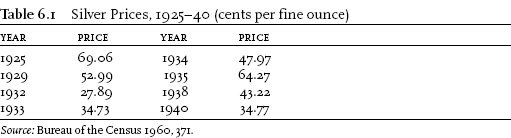

There were two prices for silver, just as there had been for gold. Domestic producers received 64.5 cents an ounce. Foreign purchases by the New York Federal Reserve Bank were at the world market price. Treasury purchases were far in excess of domestic production in 1934 and 1935, so the world market price rose toward the domestic price. As the price rose, silver activists offered new legislation to raise the price. Table 6.2 shows production of gold and silver on five-year averages.
A new complication entered. China and Mexico were on a silver standard.93 At 72 cents an ounce, it paid to melt Mexican pesos and sell the silver to the Treasury. Morgenthau fixed the domestic price at 71.11 cents. This did not satisfy the silver activists, and the price went to 77.57 cents. Pressure mounted for a $1.29 domestic price, but Roosevelt refused because he had the votes to prevent legislation that term (Blum 1959, 190–92). Speculators acted on the presumption that the price would continue to rise, but Morgenthau sold silver from the Exchange Stabilization Fund to stop the rise at 81 cents in April 1935. By August the price was back to 65 cents. Prices did not reach this level again until after the World War II inflation.94
Silver activists argued that raising the silver price would help China and Mexico by raising commodity prices in countries on the silver standard. This was backward. The policy drew silver from these countries, forcing monetary contraction. In November 1935, China abandoned the silver standard and offered to sell the United States most of its remaining silver, 200 million ounces, for approximately $130 million at the Treasury’s buying price, $50 million above the market price (Friedman 1992, 171–78).
That was too much for Morgenthau.95 Silver sold in China for about 40 cents an ounce. He allowed the world price to fall toward 40 cents after an understanding with the silver state senators that he would continue to buy newly mined domestic silver at 64.5 cents.
The silver purchase policy hurt China more than Mexico, because Mexico had large silver mines and was able, for a time, to increase its exports to the United States. China was less fortunate. Forced off the silver standard and soon afterward attacked by Japan, China experienced a major inflation that a more rational silver policy would have avoided.
Domestically, the program was a waste of money. It subsidized a relatively small number of miners and companies at large cost. Like several of the experiments during these years, the program achieved very little. It continued until November 1961.
SUMMARY: INFLATIONARY POLICY IN 1933
Roosevelt was right to be concerned about congressional and public reaction to his policies. At the end of 1933, his experiments with the NRA, the AAA, gold, and silver had not succeeded. Prices were 20 percent or more below the 1929 or 1926 level. After a robust recovery in the second and third quarters, Balke and Gordon’s (1986) quarterly real GNP growth declined at a 24 percent annual rate in the fourth quarter. Despite the low levels of employment and output, the GNP deflator continued to rise in the fourth quarter, although at a much lower rate than in the summer.96
Market indicators showed continued anxiety and fear of inflation. The risk spread between Aaa and Baa bonds remained above 3 percent, not much lower than at the end of 1932. The term spread between long- and short-term securities was above 4 percent and had increased over the course of the year.
One reason for the aborted recovery was the change in the thrust of monetary policy. Annual growth of the monetary base remained low in the spring and summer. Growth in the money supply, M1, had a similar pattern.
The Federal Reserve committed to an expansive policy, mainly for political reasons during the congressional session, but it failed to follow through. If it had made substantial open market purchases, the administration’s gold (and silver) purchase policy would have been unnecessary. The 1926 price level could have been restored by domestic monetary expansion, particularly after April when the president suspended the gold standard. Instead, the administration bought gold at a fixed (but adjustable) price. The policy drained gold from countries in the gold bloc, forcing further deflation there without much domestic benefit until purchases became large enough to change the world gold price.
Early in 1934, devaluation brought an increase in money growth. The Gold Reserve Act devalued the dollar against gold and fixed the United States buying price above the world market price. Instead of limited purchases of 1933, the United States announced its willingness to buy all gold offered at the $35 price. Thus, disappointment at what appeared to be a failed policy produced a change that achieved the desired end of higher commodity prices and economic expansion that the administration sought.
ECCLES AND MORGENTHAU
The new year brought in a new economic team. Early in January 1934, Henry Morgenthau became secretary of the treasury. In June, Eugene Black resigned as governor of the Federal Reserve Board to return to the Atlanta bank.97 The vice governor, J. J. Thomas, served as acting governor until November, when the president nominated Marriner S. Eccles to be governor of the Board.
Eccles was a Utah banker and businessman whose father and grandfather had emigrated from Scotland in 1863. Though impoverished when he arrived, Eccles’s father built a successful timber and sugar business. Like many self-made men, he was a strong believer in hard work, personal effort, and responsibility and an opponent of government involvement in the economy. His son, Marriner, inherited responsibility for the family business. With his brothers, he expanded the business and added banking. His banking corporation, the First Security Corporation, had branches throughout the region. Until the depression, he held many of the same political and social views that he learned from his father and mother.
Eccles first came to national prominence during the banking crises from 1931 to 1933. By pluck, boldness, and careful planning, all his banks remained open until ordered to close in March 1933. None of his depositors suffered a loss.
The experience had a lasting effect on Eccles’s beliefs. The prevailing belief was that the depression was purgative.98 Business leaders argued that “a depression was a scientific operation of economic laws” and could not be interfered with (Eccles 1951, 73). The 1920s had been a profligate era. The price of profligacy was (eventual) depression—the inevitable consequence of prior events.
Experience caused Eccles to reject these views. He recognized that many of the same people who had declared in the 1920s that depression could not occur again now found the seeds of depression in the excesses of that decade. Eccles recognized this argument as fallacious; in the 1920s the economy had produced in the aggregate more than it had consumed. There was no evidence of national overconsumption or indulgence (ibid., 74). Further, he convinced himself that there was nothing “natural” or preordained about what was happening. He believed the depression was caused by an overexpansion of debt and investment; the maldistribution of wealth—too much wealth concentrated in too few hands; and underconsumption by low-income earners (76–77). His solution was government spending for investment, timed countercyclically to take up the shortfall resulting from the depression. He accepted an unbalanced budget as a means of paying for public works—a result of the depression, not a cause. He favored redistribution to aid the poor and unemployed (78–81).
His views soon attracted national attention. In February 1933 he testified at hearings before the Senate Finance Committee that the economic system’s failure was “due to the failure of our political and financial leadership.” The problem was “purely of distribution.” The cure was more purchasing power, to be achieved by deficit spending until prices and employment rose (Eccles 1933, 705, 708).
His views help to explain his decisions and his passivity as head of the Federal Reserve. Eccles did not blame the Federal Reserve for the depression or urge credit expansion. The Reconstruction Finance Corporation and the Federal Reserve banks had expanded credit without result.99 The “extension of credit alone is not the solution” (ibid., 709). Nor was the solution a continued or deeper deflation, as many bankers and businessmen insisted.
Eccles opposed devaluation, silver purchases, or increases in money unless they increased consumers’ purchasing power. He believed the money stock, though 22 percent below 1929, was adequate to support higher spending; the problem was low velocity of circulation resulting from hoarding currency. His program, calling for $2.5 billion of government spending on public works (more than 4 percent of depressed GNP), financed by debt, and cancellation of Allied war debts, did not appeal to most senators (ibid., 712).100 He also favored “a more equitable distribution of wealth” (730) to increase purchasing power, unification of the banking system under Federal Reserve supervision, high income and inheritance taxes, a minimum wage, unemployment insurance, old age pensions, government supervision of security issues, transport, and communications, and a national planning board to coordinate public and private activities (730–31).101
Eccles’s views on budgets and deficits differed from Roosevelt’s or Morgenthau’s. Roosevelt advocated a balanced budget and reduced expenditure as “the most direct and effective contribution that Government can make to business” (Eccles 1951, 97, quoting Roosevelt’s campaign speech of October 19, 1932).102 Morgenthau was a strong advocate of a balanced budget, and the difference became a source of friction between the two men.103
Eccles’s first job in the Roosevelt administration was as an assistant to Morgenthau for banking and monetary problems. He came to Washington early in February 1934 with the stated intention of staying sixteen months. He remained for seventeen years, most of the time as head of the Federal Reserve System.104
His initial meetings with Morgenthau were a prelude to their later relationship. The two men were very different in background, personality, and beliefs. Eccles described himself as blunt, and his biographer adds that his relationship with Morgenthau was “deeply troubled” (Eccles 1951, vii; Hyman 1976, 207). Morgenthau saw Eccles as talented and energetic but also as confident, assertive, and ambitious, with “an insatiable drive to gain personal power” (Hyman 1976, 207; Blum 1959, 279). Morgenthau was a country gentleman who had been drawn into government by the longstanding family friendship of the Roosevelt and Morgenthau families. His biography shows him to be cautious, rarely willing to make a decision without the president’s approval. He distrusted bankers and opposed “bigness” and government deficits. Eccles attributed many of his disputes to the “quirks of Morgenthau’s personality” (Hyman 1976, 207).105 Both men tended to see substantive issues as personal, a fact that Eccles realized after Morgenthau resigned and his disputes and differences continued, and intensified, with Secretaries Fred M. Vinson and John W. Snyder, who followed.
Eccles’s self-image was that he defended principles against expediency (Eccles 1951, 394). The role of government was to run deficits in depression to finance investment and to run surpluses during prosperity, even in wartime, to reduce debt. This view of government spending and deficits clashed with Morgenthau’s belief that spending financed by deficits during depressions was a cause for alarm and hesitancy by business, leading to lower investment. Wartime deficits were, for Morgenthau and many others, a very different matter—a necessity. Eccles saw the inconsistency in this position and attributed it to the self-interest of those who benefited most from the spending.106
Appointment to the Federal Reserve
Despite their early differences, Morgenthau proposed Eccles to replace Eugene Black as governor of the Board. In September, when President Roosevelt interviewed him, Eccles told him that he would accept appointment only if the president agreed to change the System. He wanted a commitment to end President Wilson’s compromise by centralizing power and authority in the Board and its chairman. The regional banks, particularly New York, representing “private interests,” controlled the System. Their power had to be broken, or the job was not worth having (Hyman 1976, 155).
Eccles agreed to prepare a memo describing the changes he regarded as necessary. He presented it to Roosevelt shortly after the 1934 congressional election. The memo, prepared with the assistance of Lauchlin Currie, combined Eccles’s and Currie’s ideas of what went wrong at the Federal Reserve. Currie claimed to have drafted the memo (Sandilands 1990, 63); his views were well represented.107 It seems highly likely that it was how Eccles learned about the role of the real bills doctrine as a cause of the depression. Currie had written extensively on that issue; Eccles never mentioned it in his testimony and speeches, before meeting Currie or after. The memo to Roosevelt, however, began with an explicit statement of the need to eliminate procyclicality of the money supply. Money supply should be used as “an instrument for the promotion of business stability” (Eccles 1957, 173). The notion of eligible paper, a keystone of real bills, would be replaced by “sound assets.”
The memo departed from the more extreme position on nationalization of the reserve banks that Currie took in his September memo to Morgenthau (Currie 1968). But he proposed to vest control of open market operations in the Board, with “banker interest” removed. Bank directors would no longer have power to refuse to participate in open market operations. Also, the Board would have the power to approve or disapprove appointment of governors of the reserve banks.108 The memo met the usual complaint head-on. The Federal Reserve would become a central bank, centrally controlled: “Private ownership and local autonomy are preserved, but on really important questions of policy, authority and responsibility are concentrated in the Board” (quoted in Hyman 1976, 158).
In the two-hour meeting at which Eccles presented and discussed the memo, Eccles records that Roosevelt paid close attention, recognized the serious political obstacles, rejected the idea of national branch banking, and accepted the proposal as a blueprint for reform. Six days later, on November 10, Roosevelt nominated Eccles as governor of the Board.109 The announcement emphasized Eccles’s business and banking background and reported the capital value of each Eccles enterprise, its volume of business, and the fact that all his enterprises had survived the depression. In this way the administration hoped to defuse criticism of Eccles’s radical ideas about budgets and show that not all the new appointees lacked business experience.
Perhaps because Carter Glass had not been notified of his appointment, Eccles served in a recess appointment for five months. He was not confirmed until the following April, by a four to three vote in Glass’s banking subcommittee with Glass opposed, and by a unanimous vote in the full banking committee with Glass absent.
Much of the opposition to Eccles focused on the banking bill prepared by Eccles and Currie. Many bankers opposed the legislation, particularly the sections that shifted power from the New York bank to the Board. Harrison was among them, firmly opposed to the legislation. Always ready to put an issue in personal terms, Eccles viewed this opposition as acting “on behalf of the private banking interests of New York” or out of personal pique (Eccles 1951, 178–79). He never mentions, and seems unaware, that the proposed move toward a central bank and the weakening of the System’s regional structure was seen as a substantive issue of great importance in many sections of the country and by many groups.110 Even bankers who favored a central bank did not want the bank controlled from Washington.
Further, Eccles irritated Glass by his brash manner, failing to pay a courtesy call until two months after the president announced his appointment and failing to keep his promise to give Glass an advance copy of the legislative proposal that became the Banking Act of 1935. Eccles, uncharacteristically, recognized the second failure as a mistake (ibid., 196).
Eccles’s recess appointment did not deter him from taking charge. Three days after taking office, he met with the Federal Advisory Council, a group of twelve bankers legally constituted under the Federal Reserve Act to confer and advise the Board. The council had adopted the practice of issuing statements without submitting them to the Board.111 Eccles threatened to ignore the council and deny them access to the staff unless they agreed to submit their statements to the Board before their release. This would allow the Board to reject the statements privately and, if it chose, publicly. The council reluctantly accepted the new arrangement.
Even before he was sworn in, Eccles clashed with Harrison. The immediate issue was the System Committee for Legislative Suggestions, established in spring 1934 at the request of the Federal Reserve bank chairmen. The Board approved the committee in June (Board Minutes, June 23, 1934, 4–5). Harrison was elected chairman. All but one of the members came from the reserve banks; Vice Governor J. J. Thomas represented the Board. To Eccles, control by the reserve banks was control by private interests, especially the reserve bank directors. Eccles determined to shift control to himself, representing the public interest.
When Harrison came to congratulate Eccles on his appointment and invite him to replace Thomas on the committee, Eccles replied: “I don’t intend to be a member of your committee. And, moreover, one of my first acts after I’m sworn in as Governor will be to move the abolition of your committee… . I have accepted the post of Governor primarily for the purpose of carrying out an important legislative program, which you in all probability are going to oppose” (Eccles 1951, 192). Thus Eccles began his tenure at the Board.112
THE BANKING ACT OF 1935
Planning for changes to the Federal Reserve Act started before Eccles became governor. A Treasury committee headed by Jacob Viner began work on banking and currency legislation early in 1934. The Board’s research director, Emanuel A. Goldenweiser, and the Federal Reserve agents (chairmen) , recommended that a System committee work with the Treasury. On June 25 the Board approved the recommendation and established the legislative committee, chaired by Harrison, that Eccles abolished on taking office. Also, Eccles and Currie had prepared recommendations for Eccles’s November meeting with Roosevelt.113
Eccles did not want the modest reforms and compromises expected from a System committee. With Currie, he challenged two of the main tenets underlying the Federal Reserve Act. First was the almost ritual restatement that the Federal Reserve was not a central bank. Eccles wanted a central bank with authority concentrated in Washington, specifically in his hands. Second, although he did not seem to share Currie’s strong beliefs about the need to abandon the real bills doctrine, he did not defend it. Eccles disliked rules such as the real bills doctrine. He preferred to rely on judgment and wanted a large measure of authority to do what he believed was in the public interest.
Glass held exactly the opposite view from Eccles on both main issues. Financial collapse reinforced his commitment to the real bills doctrine. In his view the collapse was the inevitable consequence of violating the doctrine, and he continued to favor a decentralized system. The fault was that New York had acquired too much power. Centralization had gone far beyond original intent.
Even if Eccles and Glass had had good personal relations, they would have clashed over substance. In the event, substance and personal feeling set up a clash between two strong-willed men.
Harrison and the System Committee
The work of Harrison’s committee shows the internal view of what went wrong and the desirable changes.114 There were, of course, differences of opinion and pressures to avoid contentious issues.115
The committee began to consider an ambitious agenda of reform of the banking system and Federal Reserve controls. A comparison of failure rates in the United States, Canada, and Britain led to a proposal for branch banking. The background paper for the meeting recognized that “England, with a central bank, and Canada, without a central bank, entirely escaped bank failures” and that United States banking failures explain “both the greater severity of the depression in this country, particularly from 1931 on, and the greater difficulty experienced in achieving recovery” (Memo on Banking Reform, Goldenweiser to Committee, Board of Governors File, box 142, September 6 and 7, 1934, 2). But the memo shifted away from this promising start by blaming the “soundness of bank assets” for the higher failure rate (3). Thus it missed the opportunity to rid the banking system of its greatest weakness—restricted portfolios and limited diversification.
The rest of the memo was defensive, aimed at preventing reorganization and a shift of power to the Board. The memo claims that the Federal Reserve had shown its effectiveness in financing World War I and in acting promptly in the recessions of 1924 and 1927. None of the existing central banks used credit or monetary control to stabilize prices, prevent booms or depressions, or hasten recovery; therefore the System should be credited for its successes and could not be blamed for the depression. Further, the Federal Reserve Act limited the Federal Reserve’s mandate to “accommodat[e] the needs of industry, commerce and agriculture” (ibid., 4). The Thomas amendment removed that restriction, so there is “no lack of power or of central banking machinery for carrying out whatever monetary and credit policies the Government may deem desirable for the promotion of recovery” (6; emphasis added).
The principal conclusion: System reorganization would not solve the problem of how to manage credit control policy. The memo proposed a broad study of banking, monetary, credit, and organizational changes. In October the committee reduced the scope of possible changes. The defensive tone and substance remained until the final report.
The preliminary report (October) located the “basic problem” in the quality of bank credit extended: “This lack of quality has been due to conflicting jurisdiction, to laxity of laws, to lack of uniformity … in supervision, and … to lack of skill and vision in [bank] management” (Preliminary Report of the Committee on Legislative Program, Board of Governors File, box 142, October 16, 1934, 1). There is not a word about Federal Reserve failures or inaction: “The depression which began in 1929 continued to develop notwithstanding the great volume of credit made available to the banks through open market operations by the Federal Reserve banks” (2).116
Perhaps reflecting the realities of the time, the final report made a brief reference to a new theme: the Federal Reserve banks have a responsibility to adjust their policies to “the need for expansion or restraint as conditions dictate” (Report, System Committee on the Legislative Program, Board of Governors File, box 142, December 17, 1934, 2). The report immediately shifted away, locating the main defects not in System failures to respond to economic conditions or bank failures, but in the “quality of bank assets and the soundness of banks” (ibid.). It failed to recognize that “quality” and “soundness” depend to a considerable extent on what happens to the economy.
The report proposed improved supervision and regulation, to be achieved by unifying examinations and supervision under the reserve banks and by subjecting all banks to unified standards.117 The deposit insurance law required all insured banks to join the Federal Reserve System by July 1937. The report wanted this provision retained, but it was dropped.
The most important change proposed in the report called for increased authority to raise and lower reserve requirement ratios. Under the existing power, in section 19 of the act, changes required approval of the president and declaration of an emergency. The committee proposed giving that authority to the Board. It also endorsed a staff proposal to make reserve requirements depend on both deposit turnover (velocity) and volume (ibid., 18).
The final report removed from the earlier draft the Board’s defense of its policy from 1929 to 1933: “The Federal Reserve System has undertaken bolder and more extensive experiments in credit control than have ever been carried out by any other banking or Governmental authority” (Preliminary Report, Board of Governors File, box 142, October 16, 1934, 9). Failures and depression had occurred, of course, but not because of Federal Reserve failures. The problem was expansion of speculative credit, over which the Federal Reserve had more control after 1933. However, “sound banking is possible only under sound economic conditions. In the presence of profound national and international maladjustments that developed during the decade after the war, no banking system could function effectively” (10).118 The report does not mention that some reserve banks refused to participate or that the Board did not force recalcitrant reserve banks to pool the gold stock by discounting for participating banks.
Currie’s Treasury Proposal
Most of the work of Viner’s committee at the Treasury reflected Currie’s views.119 Currie expanded the recommendations in his book (Currie 1968). The responsibility of the Federal Reserve, Currie wrote, is to control the quantity of money, not the quality of credit. The Federal Reserve Act took the opposite approach through its reliance on the real bills (commercial loan) doctrine.120
Currie concluded that “there exists no valid theoretical justification for the Commercial Loan Theory of Banking” (ibid., 39). “The drastic contraction of money from 1929 to 1932 can in large part be attributed to the failure of the reserve administration to appreciate the significance of changes in the supply of money” (44). And he added: “It is generally held that the reserve administration strove energetically to bring about expansion throughout the depression but that the contraction continued despite its efforts. Actually the reserve administration’s policy was one of almost complete passivity and quiescence” (147).
To remedy these failures and control the money stock, Currie proposed 100 percent reserves against demand deposits and no reserve requirements for other deposits. The gold standard and open market operations would control the volume of reserves and deposits. Banks could expand or contract lending relative to money by bidding for time deposits.
Control of money was vested in a five-person board appointed by the president and confirmed by the Senate. Its charge was to maintain business stability, not to “accommodate commerce and business.” It would have discretionary authority to alter gold reserves, within limits consistent with maintenance of the gold standard.
Currie expanded these proposals in his recommendations to Morgenthau mainly by adding detail and working out the transition to 100 percent reserves against demand deposits. One issue discussed at length was whether the Federal Reserve Board (called the Federal Monetary Authority) should be responsible to the administration. Currie recognized the possible inflationary consequences of this arrangement, but he chose political control under a general congressional mandate that set objectives. He suggested removing the secretary of the treasury from the Board.121 Eccles took Currie onto the Board’s staff as assistant director of research. Currie’s main task initially was staff work leading to the 1935 act.
The Banking Act in Congress
The bill that was sent to Congress in February 1935 contained three sections. Roosevelt recognized that the proposed changes in the Federal Reserve Act calling for creation of a central bank, with headquarters in Washington, would not be popular with most bankers, many populists, and those who wanted to nationalize banking. He joined the Eccles-Currie proposals (title 2) to two other pieces of legislation. Title 1 liberalized FDIC assessments and required all member banks to join the deposit insurance fund.122 Title 3 changed a section of the Banking Act of 1933 that required bank officers to resign if they had not repaid all loans to their banks by July 1. Title 3 extended the time limit for repayment, made technical adjustments to the Federal Reserve Act, and made permanent the use of government securities as collateral for the note issue. Thus Roosevelt put together a provision that many bankers wanted for personal reasons, and permanent deposit insurance, popular with Congress and the public, with a proposal that many disliked very much (Hyman 1976, 171).123
The House passed the bill almost as it had been submitted. The vote was 271 to 110. Eccles testified on ten days, presenting the proposal and responding to questions. Unlike Currie, he described the 1928–29 experience as a “speculative orgy,” perhaps to appeal to Congress. The aim of the proposed legislation was both to control speculation and to “promote stability of employment and business.” The latter was a decisive shift in goals, certain to be unpopular with Glass (House Committee on Banking and Currency 1935, 180).
To meet this new goal the Federal Reserve needed reorganization and new powers. Eccles emphasized four changes proposed in the bill: (1) subject the head of each reserve bank to approval by the Board, make the Board’s governor the head, and eliminate the office of reserve bank chairman;124 (2) vest control of open market operations in a five-person committee consisting of three Board members and two reserve bank governors; (3) transfer authority to specify eligible paper from the reserve banks to the Board; and (4) further liberalize provisions relating to real estate lending. The last provision was included to attract bankers’ support by increasing their opportunities at a time of relatively small loan demand.125
The proposed control of open market operations did not fully satisfy Eccles. In his testimony he went beyond his bill, asking the committee to remove the two reserve bank governors, eliminate the committee, and make the Board alone responsible for open market operations. A committee of five reserve bank governors would have a consultative or advisory role only.126
In the course of more than two hundred pages of testimony, Eccles both explained and defended sections of the proposed bill and offered his explanation of the causes of the depression and the path to recovery. The questions show the principal concerns of opponents and supporters, and Eccles’s arguments give a preview of the policies he followed and advocated during the rest of the decade. The committee members expressed their fears of deficits and debt burdens that return again and again in the next sixty years. Many of the comments about debt and deficits would be repeated unchanged in the 1980s and 1990s.
CONGRESSIONAL CONCERNS Eccles chaired a committee, consisting mainly of Board staff, that prepared the bill without consultation or discussion with the reserve banks. The proposal then went to an Interdepartmental Loan Committee, chaired by Morgenthau, with representatives of other government agencies: “The Board was not asked to approve it. The Board was kept advised of the legislation” (Blum 1959, 352–53).
This method of drafting raised concern about the shift in power that the bill proposed. Repeatedly Eccles was asked about the dangers of consolidating power over discount rates, reserve requirements, and open market operations in a single agency, appointed by the president and subject to political control. Congressmen expressed concern about the potential for inflation and the use of monetary expansion by the executive branch to influence elections. And the old issue of regional autonomy remained (366–67). Eccles responded that “monetary policy is a national matter, and it cannot be dealt with regionally without having such situations as we have had in the past” (367).
THE ROLE OF MONETARY POLICY The colloquy with House members shows that Eccles knew the legislation was a long step away from the Glass-Wilson reserve system and toward a modern central bank with responsibility for economic stability. That step was not taken for many years, however. The main reason is that the Treasury held a commanding position during the 1930s and 1940s. Eccles’s beliefs about monetary policy and his framework for analyzing the economy also played a role.
Eccles held a Keynesian view long before that view became dominant among academics and central bankers. Mixed with that view were vestiges of older ideas about underconsumption, overinvestment, borrowing, speculation, and income distribution. Eccles repeated many times, in the hearings and elsewhere, that the depression was due in part to inequality in income distribution. One of the fullest statements of this belief is: “One of the principal troubles or difficulties that brought about the depression was not the shortage in the supply of money altogether, but it was due in part to the inequitable distribution of income which contributed to the speculative situation in the security markets and to an expansion of productive capacity out of relationship to the ability of the people of the country to consume under the existing distribution of income” (House Committee on Banking and Currency 1935, 405).
He regarded the depression as “inevitable” given the distribution of income. The depression might have been deferred or delayed by increasing the stock of money in 1929, but it could not have been prevented: “As long as we had such an inequitable distribution of wealth production … a depression was inevitable” (ibid., 210).
The cure was therefore mainly fiscal. Eccles thought that “there is only one way by which we will get out of the depression, and that is through the process of budgetary deficits until such time as private credit and private spending expands… . Until private borrowing and spending expands, and puts people to work, the Government must do the borrowing and spending” (ibid., 403).
This view does not seem unusual now, but at the time it struck many of his listeners, both in and out of Congress, as radical. Eccles coupled his view with his belief that depressions were inevitable under capitalism. Debt built up in periods of expansion. Investment expanded production faster than consumption. When depression came, there were two choices: deflation, bankruptcy, and debt reduction or reflation to lower the real value of the debt (ibid., 346–48).127
The most quoted line in Eccles’s testimony is “you cannot push on a string” (House Committee on Banking and Currency 1935, 377). Congressman T. Alan Goldsborough (Maryland), 128 a supporter of Eccles and the bill, introduced the phrase. Eccles accepted it immediately: “That is a good way to put it, one cannot push a string… . [T]here is very little, if anything that the reserve organization can do” (377). He had expressed the same pessimism earlier in his testimony several times. Monetary action was asymmetric; it was easier to stop an expansion than to end a contraction.129 An attempt to flood the economy with currency by paying off the debt, as some congressmen proposed, would just create excess reserves (322).
Eccles’s views fit well with those of Goldenweiser, Riefler, and other Board staff. Monetary expansion did not work in the depression because “you must have borrowers who are willing and able to borrow” (ibid., 216). Although he mentioned interest rates, and the effects of policy action on interest rates, these were far from central to his analysis. The liquidity trap—pushing on a string—dominated his view.130 Hence the only role for monetary action was to keep rates low and to be alert to the risk of inflation inherent in the large volume of excess reserves held by the banking system. Several times Eccles warned about this problem and mentioned the large potential expansion in loans and money.
Eccles differed from his predecessors in his belief that government had to take responsibility for the economy. He devoted much of his time to advocating fiscal measures, especially increased spending on investment financed by government borrowing to expand demand.131
THE BILL IN THE SENATE Senator Glass intended to defeat the bill by separating title 2, containing Eccles’s proposals, from the sections the bankers wanted.132 July 1 was the critical date on which bankers would have to repay their loans and the (temporary) FDIC would expire. Glass hoped to delay passage until that time, get an agreement to separate the sections, pass titles 1 and 3, and later defeat title 2.
When the House in April appeared ready to pass a version of the bill, Glass held brief hearings on Eccles’s nomination, hoping to defeat the nomination and be rid of Eccles.133 The subcommittee approved the nomination four to three, with Glass opposed. On April 25 the Senate confirmed Eccles as governor. Glass then started hearings on the bill.134
The Republican minority on the House Banking Committee had objected to the bill on three main grounds. First, the minority claimed that the bill ended the private-public compromise arrangement in the 1913 act by changing the Board from a supervisory agency to a managing partner and by giving the Board authority to approve the appointment of reserve bank presidents. Second, the bill gave the Board control of open market operations and forced the reserve banks to buy or sell securities at the Board’s initiative. Third, since there was no emergency, there was no reason to pass title 2 without further study. The last was Glass’s plan, and the objective of the bill’s opponents.
Eccles’s testimony before Glass’s subcommittee responded to the main criticisms in the minority report on the House bill, so it was largely defensive in character. He repeated the arguments he had made to the House committee about income redistribution, but most of his statement defended the shift of power to the Board. He claimed the shift did not increase political control over the financial system: “There is nothing in this bill that would increase the powers of a political administration over the Reserve Board” (Senate Committee on Banking and Currency 1935, 280).
Glass interrupted repeatedly. He disputed Eccles’s claim that proposals to place the regulation of monetary policy under government control retained the spirit of the 1913 act. The 1913 act gave the Board supervisory responsibility, he said, not control of policy (ibid., 281).
Eccles offered to compromise. The American Bankers Association had proposed that five reserve bank governors should join with the Board to set open market policy. Eccles accepted this proposal in place of his earlier recommendation that the banks have only an advisory function (ibid., 287–89).
Senator James Couzens (Michigan) raised the most intriguing question: What would the Federal Reserve have done differently if the proposed changes had been law in 1928–29? Eccles first tried to evade the issue, but Couzens, joined by Glass, persisted. Eccles could not answer at the hearing but submitted his response in a letter to Senator Couzens.
“The banking bill of 1935 is not primarily proposed for meeting a situation such as existed in 1928 and 1929” he responded (Senate Committee on Banking and Currency 1935, 673). The Banking Act of 1933 and the Securities Act strengthened the Board’s power to meet such situations. Then he added two arguments that reflect hindsight, not the views held at the time. First, despite the dominant view at the Board denying any ability to affect economic activity or prices, Eccles claimed, “The Federal Reserve Board felt that there was nothing in the business situation that required restraint” (674). Second, “It was not in 1929 that the powers contained in this bill would have been valuable but in 1931… . The System would have been in a much stronger position to adopt a vigorous open-market policy if this bill had been in effect” (674). Eccles added that the bill also would give the Federal Reserve power to counteract inflation if banks expanded based on their current excess reserves.
Adolph Miller was the next witness. Miller supported Eccles’s argument about (August) 1931: “In 1931 some of the Reserve banks and the Reserve Board had reached the conclusion that it would be desirable to relieve the situation by an open-market operation of considerable extent. Strong opposition was encountered on the part of two or three of the reserve banks … [A]n open market operation was undertaken, but to a very much more limited extent” (ibid., 750).135
Miller defended the main provisions of the bill. He had favored, and worked for, Board control of open market operations since 1924. In his view the bill did not cause a massive redistribution of powers within the System (ibid., 699). His main objection was to the section making the 1932 Glass-Steagall provisions permanent. Limited powers to change eligibility requirements in an emergency would be sufficient.136
A colloquy with Glass brought out a main substantive issue between opponents and proponents. Glass viewed the reserve banks as acting in the interest of stockholders and depositors. He opposed giving the open market committee “the right to compel [reserve] banks to use their resources and the resources of their depositors, whether they thought it was prudent to do it or not” (ibid., 751). Miller responded that centralization was critical not only to affect the public interest but to concentrate responsibility: “Open market policy is peculiarly a national policy, and if it be kept as a national policy and operated only … when the indications of its need are clear, I do not think there is anything to fear in the way of bad action through withholding from any individual reserve bank the power of veto so far as itself is concerned” (751).137
Citing the Federal Reserve’s inability to offset gold inflows in 1916, Miller favored increased power to change reserve requirement ratios. Like Eccles, Miller called attention to the problem of excess reserves and potential inflation that had begun to concern the Board. Glass opposed the change.
Miller proposed that the name of the Federal Reserve Board be changed to Board of Governors with the members as governors, as a “matter of prestige” (ibid., 756). He also proposed that the Board be permitted to elect its chairman and vice chairman, but the final bill gave the president that right, subject to Senate approval.
Harrison decided not to testify, but he helped Glass find witnesses who opposed the bill. Many of them urged the subcommittee to pass the bill without title 2. H. Parker Willis reaffirmed Glass’s view that the bill subverted the Federal Reserve Act. Title 2 negated “everything in the theory of the Reserve Act” (ibid., 864). He thought open market operations should be phased out. An expanded definition of eligible paper would make it more difficult to enforce provisions against speculative credit. In Willis’s view, “the Reserve System has been in the hands of Philistines a great deal of the time and has not lived up to its early promise… . [That] has nothing to do with the validity of the principles under which it was organized” (873).138
Board members George R. James and Charles S. Hamlin testified also. James saw no need for a central bank or title 2. The present arrangement worked well. Bankers had caused problems by creating deposits “against prices rather than values” (Senate Committee on Banking and Currency 1935, 925). Hamlin favored several of the changes, including substitution of “sound assets” in place of the needs of trade as a criterion for discounts and centralized control of open market operations. He preferred to leave the power to appoint reserve bank governors to the directors, to leave the treasury secretary on the Board, and to keep current restrictions on changes in reserve requirement ratios. Hamlin concluded by affirming support of the Eccles bill.139
In all, Glass called about sixty witnesses. Most opposed title 2 as unnecessary. Several made the same argument that Eccles used to respond to Senator Couzens—that the important changes in powers were in the Banking Act of 1933 and the Securities Act.140
Glass was exultant after the hearings ended. He told Harrison, “I have them badly whipped both in the subcommittee and in the big committee” (Harrison Papers, Telephone Conversation with Senator Glass, file 2021.0, June 15, 1935). The subcommittee had voted to put off discussion of title 2 for a week, so Glass hoped to pass only titles 1 and 3 to meet the July 1 deadline for bankers to repay their loans and continue deposit insurance. He planned to amend title 2 “to make it objectionable to the administration” (ibid., 1).141
Both tactics failed. Pressed by Roosevelt, Chairman Steagall insisted on a compromise, prepared by Eccles and Goldsborough, that extended title 1 for two months. The Senate accepted many of Glass’s amendments, but the House did not, so the issue moved to a conference committee.142
The final bill was again a compromise between concerns about banker or political control. Congress accepted many of the changes Eccles proposed, but not in the form he had suggested. The Board gained power and influence over policy and appointments at the reserve banks; however, Glass managed to get representation by the reserve banks on the new open market committee and authority for directors to choose a reserve bank’s officers, subject to Board approval.143
Morgenthau supported the final bill because he anticipated large budget deficits and wanted to share responsibility for any future debacle that deficit finance might cause. Above all, he wanted a Board with power to keep interest rates low. He wrote in his diary: “I have been hoping and have not mentioned it to a soul that the Federal Reserve Board would be given additional powers and created more or less as a monetary authority so that they and the Treasury can share the responsibility and possibly help us in case we get into a financial jam” (Blum 1959, 352).144
The Act
The act changed the open market committee from a committee of twelve reserve bank governors to seven Board members and five members chosen by reserve bank directors.145 The head of the bank had the title president, not governor, and was not ex officio a member of the open market committee. Reserve bank directors appointed the presidents and first vice presidents for five-year terms, with approval of the Board of Governors. As before, the Board set salaries. The act replaced the full-time office of chairman and Federal Reserve agent with a part-time chairman.146
As before, the president appointed members of the Board of Governors, subject to Senate confirmation. The act reduced the size of the Board from eight to seven members, holding office for staggered fourteen-year terms beginning March i, 1936, and removed the secretary of the treasury and the comptroller of the currency.147 The chairman and vice chairman (formerly governor and vice governor) received four-year terms in those offices and fourteen-year terms as board members (or the remaining years of an unexpired term). No one could be appointed to more than one fourteen-year term.148
Accommodating commerce and business remained in the act, but the new law weakened the role of real bills by adding “with regard to the general credit situation of the country.” Eccles did not get his choice of phrasing, but Glass could not keep unchanged the wording in the 1913 act. More important was the change in the definition of eligibility. Under the 1935 act, the Board could define eligibility as broadly as it wished. Although the real bills doctrine lived on, it no longer had the force of law behind it. This was a major step in the evolution of the System.
The Board also gained authority to change required reserve ratios up to twice the prevailing ratio by majority vote. Eccles lost the unlimited authority that he requested and Glass opposed. The act eased restrictions on mortgage loans by member banks. Reserve banks were required to vote on discount rates every two weeks; as before, changes required approval of the Board.
Eccles had tried to replace requirements for geographical representation on the Board with a vague reference to education and experience. Glass’s views prevailed, so the bill retained the original restrictions.149
The bill passed on August 19, and the president signed it on August 23. Glass took credit for the final bill, as he had for the 1913 bill (Eccles 1951, 221). In fact, the compromise gave Eccles many of the changes he wanted. Glass lost on the shift of power to the Board, the diminished powers of the regional reserve banks, and the weakened role of the real bills doctrine. The 1935 Act permitted the Federal Reserve to become a central bank, but the major changes in practice came only after World War II and the Korean War.150
OTHER PROPOSED CHANGES
Although pleased by the increased power granted by the Banking Act, Eccles was not satisfied with the extent of the Board’s powers. He pressed Roosevelt to support legislation forcing all banks to become members of the Federal Reserve System. His reasoning is similar to claims made repeatedly by other Federal Reserve chairmen: the Reserve System “cannot function efficiently or effectively in the national interest as long as half of the banks are in it and the other half out… . [O]ne half… is free to negate management in the national interest” (Eccles 1951, 267–68; memo to President Roosevelt November 12, 1936, quoted in Hyman 1976, 275–76). Eccles wanted all banks with deposit insurance to be members of the Federal Reserve System and all bank examination and regulation to be under the Federal Reserve’s control. Also, he wanted bank examiners to vary examination standards over the cycle in harmony with monetary policy, a result that could be achieved only if the Federal Reserve controlled the examinations.
Eccles greatly overstated his case. More than 50 percent of the banks were not members, as he said, but their share of deposits was down to 15 percent in 1936 from 27 percent in 1928 and nearly 17 percent in 1933. Bank failures in the depression, and the bank holiday, had eliminated many of the small, weak, mainly nonmember banks. New lending powers had encouraged growth in the number of state bank members and national banks. Table 6.3 shows these data for selected dates in the 1930s.
The proposal requiring membership, coming soon after the first increase in required reserve ratios, probably reflects Eccles’s concern that the higher ratios would reduce Federal Reserve membership by increasing cost. This argument is more plausible than the argument Eccles—and subsequent chairmen—used. Contrary to their claims, control of money and bank credit or an interest rate does not require universal membership in the Federal Reserve System. There is no valid argument to this effect and no evidence that control changed after all banks became subject to reserve requirements in the 1980s.

Examination Standards
Roosevelt did not endorse Eccles’s proposal for Federal Reserve control of bank examination, but Eccles did not give up. He tried several more times to persuade Roosevelt to endorse his program. Finally, as part of a program to end the 1937–38 recession, Roosevelt endorsed unification and liberalization of bank examination policies in a message to Congress on April 14, 1938 (Hyman 1976, 247; Eccles 1951, 272).151 Roosevelt then asked Morgenthau to establish a committee of federal and state banking agencies to agree on a more liberal bank examination policy.
All the banking agencies, except the Federal Reserve, quickly agreed on revision of examination procedures and a common set of standards. The National Association of State Bank Examiners accepted the changes. Eccles continued to argue over some technical details. What most disturbed him, perhaps, was that the new standards had been agreed to without legislation. Consolidation of all examination under the Federal Reserve would not be necessary, and he would not get countercyclical examination standards. Adding to Eccles’s problem was strong support for the revision by the American Bankers Association and the financial press, and his own political blunder.152 Morgenthau gave him an ultimatum: agree to the committee’s recommendations or he would go to the president without Federal Reserve agreement. Eccles agreed, and the standards were issued.153
The new standards allowed banks to invest in nonmarketable bonds issued by small corporations and reduced the size of the mandatory write-off of slow and doubtful loans. The standards used average value over several months in place of current market value to judge soundness of marketable assets. This moved away from mark-to-market accounting and increased examiner’s discretion.
Eccles did not give up. A few months later he told Roosevelt that he would resign at the end of his term, February 1940, unless the Board of Governors gained new powers “to do the work expected of it” (Eccles 1951, 279). Knowing Roosevelt’s reluctance to take up the membership issue, Eccles recommended that the president ask Congress to study the issue and draft legislation. Congress appropriated $25,000 for this purpose, one-fourth the amount Eccles had suggested. The matter died when the war in Europe shifted attention toward preparation for war. Eccles never realized this objective, nor did other chairmen who pursued it.
Nationalizing the Reserve Banks
Proposals to nationalize the reserve banks by having the government repurchase all outstanding shares continued after passage of the 1935 Banking Act. In May 1937 Congressman Wright Patman (Texas), who later chaired the House Banking Committee, proposed legislation that attracted 151 cosponsors. The legislation transferred ownership of the reserve banks to the government, returned the treasury secretary and the comptroller to the Board, and added the chairman of the FDIC and twelve members, one from each district. The enlarged Board would serve as the Federal Open Market Committee (FOMC). The bill also required the Federal Reserve to stabilize and maintain the purchasing power of money and gave all members of the FDIC the rights and privileges of member banks. At the time, the consumer price index was about 80 percent of its 1926 level. The act required the Federal Reserve to keep the price level within 2 percent of its 1926 value. Once again, some members urged price stabilization and a price level target.
The Board’s staff dismissed the last proposal as unrealistic and impractical (Board of Governors File, box 141, undated). The reasons they gave show some change of views. The staff no longer denied that the price level depends on money, but it recognized both monetary and nonmonetary causes of price changes. For example, a crop failure or taxes may raise prices. Also, there was no satisfactory measure of the price level. Index numbers differ.
The staff concluded that the Patman bill mistook ownership for control. The banks owned stock in the reserve banks but did not control the System. All the net earnings of the reserve banks after dividends of 6 percent went into a surplus fund. The excess was paid to the Treasury (or had been used for other purposes, e.g., to establish the FDIC). Congress could allocate the surplus, so it had final control.154
Raising Prices
The 1937–38 recession renewed proposals to raise the price level and thereafter keep it stable. Congressman Goldsborough again offered legislation to require the Federal Reserve to restore wholesale prices to the 1921–29 average. Other legislation (Board of Governors File, box 136, January 21, 1938) required the Federal Reserve to make social payments to aged and infirm adults and to dependent children and to finance farms and homes for lower income groups. Senator Elmer Thomas (Oklahoma) proposed to reconstitute the Federal Reserve as a monetary authority responsible for controlling the price level based on the values at home and abroad of tax payments, interest payments, outstanding debt, prices, and other factors (Board of Governors File, box 141, March 25, 1937, 7).
The staff responded to the price level proposals by sending out a published version of its response to the Patman bill. It accepted the desirability of economic stability, opposed using price stability as a goal, and opposed raising the price level 25 percent to restore the 1926 price level. The memo failed throughout to distinguish between individual prices and the price level (Wyatt to Congressman Kelly, Board of Governors File, box 141, June 17, 1938).
The lasting feature of these proposals is congressional interest in legislation giving guidelines for improving the economy and maintaining price stability. These concerns eventually led to the Employment Act of 1946.155 Legislative interest in price stability as a goal of monetary policy waxes and wanes, but Congress has not adopted it.
RESERVE REQUIREMENTS AND OPEN MARKET POLICY, 1935–37
By the time Eccles joined the Federal Reserve, Roosevelt’s economic program was about to change. The Supreme Court soon declared the NRA and the AAA unconstitutional. Gold and silver purchases continued routinely, but hopes for reflation to the 1926 or 1929 price level were no longer widely held.156 Agricultural prices (measured at the time) had increased absolutely and relative to other prices, as Warren had predicted, but they remained 25 percent below the 1926 average. The consumer price index was about 30 to 35 percent above its low but 25 percent below the 1929 level.
Roosevelt had not yet abandoned his hopes for a balanced budget, but the low level of activity and relief expenditures kept the hope unrealized. To finance the deficit while keeping interest rates from rising, Morgenthau bought bonds for the new Exchange Stabilization Fund and the Treasury trust funds—Postal Savings, Railroad Retirement, and others. The Federal Reserve, as fiscal agent, made purchases for the Treasury, limiting its own operation for most of 1934 to exchanges of long-term for short-term debt. The open market portfolio remained below $2.5 billion, about 25 percent larger than in March 1933.
Morgenthau recognized that using the stabilization and trust funds not only freed him from dependence on the Federal Reserve but gave him an opportunity to influence its decisions. Despite the legislative changes that had increased de jure Federal Reserve independence, the Federal Reserve was less independent of the administration from 1934 to 1941 than in any other peacetime period.
Policy Issues, 1935–36
In January 1935 the Board approved reductions in discount rates to 2 percent at Philadelphia, Atlanta, and St. Louis and to 2.5 percent at Richmond, Minneapolis, and Dallas. These were the lowest rates at these banks up to that time, but further reductions in discount rates, open market rates, and deposit rates soon followed. The proximate cause of lower rates was the gold inflow in response to the $35 price. The Federal Reserve had not made any net open market purchases for more than a year.
THE GOLD CLAUSE On January 25, Eccles told the FOMC’s executive committee about the Treasury’s concern that prices of bonds carrying the gold clause had increased absolutely and relative to the prices of other bonds. On January 11 the price of Treasury bonds with the gold clause was 0.75 percent above bonds without the clause. The difference remained throughout the month. The price difference reflected the impending Supreme Court decision in Perry v. United States, known as the gold clause case.157
The New York directors responded to the spread in rates by authorizing sales of gold clause bonds in exchange for other bonds. The FOMC followed. On February 5, it approved purchases or sales of up to $250 million (FOMC Minutes, Board of Governors File, box 1451, January 25 and February 5, 1935).
The administration also prepared for the Court’s decision. Harrison was told to stabilize the foreign exchange and gold markets by keeping the French franc within the gold points. The plan was to use the Exchange Stabilization Fund to buy francs by selling sterling “violently” if necessary (Harrison Papers, file 2012.5, February 18, 1935). The Court’s decision, favorable to the government, required no action.158
DELAY AND INACTION The System’s inaction in 1935 was not accidental.159 As excess reserves rose, members of the FOMC became concerned about potential credit expansion and uncertain what to do. A background memo prepared for the March 21 meeting addressed the issue by asking, What is the duty of a central bank in the present situation? (Excess Reserves and Federal Reserve Policy, Board of Governors File, box 1449, March 21, 1935).
The memo had two parts. The first traced the increase of excess reserves and discussed the reasons for their continued growth. It found that, initially, excess reserves were expected to pressure banks to expand private loans by pushing down the yield on government securities. This could happen, but there was little evidence so far. One reason given was that government deficits supply bonds that the banks bought (ibid., 2–3): “If this process should continue, should we not expect on the basis of the experience of other nations that eventually a point will be reached where the banks will be unable or unwilling to absorb the government debt, so that the government will be forced to expend its stabilization fund … or request the reserve banks to purchase more government securities … , or to borrow directly from the Reserve banks” (4).160 The memo concluded that neither past experience nor central bank theory gave any guidance in present circumstances.161 Previous inflations abroad had occurred with rising activity and government borrowing directly from the central bank.
The second issue was the course to follow. The memo considered open market sales to absorb excess reserves but rejected this course on economic and political grounds. The economic argument was that sales might cut off an incipient expansion by overweighting future dangers of inflation and not encouraging expansion enough. The political argument was that the government could offset Federal Reserve actions by using the stabilization fund or resort to issuing paper money under the Thomas amendment. Further, with the banking act in Congress, the government could change the entire financial system, including the central bank: “It seems clear that we could act effectively only with the consent and cooperation of the administration” (ibid., 8).162
The memo recommended no action for the present. The only policy change in the next two months followed a May 1 letter from the Board to the reserve banks, calling attention to discount rates and suggesting that the directors consider reductions. A week later the Board approved reductions at Dallas, Richmond, Cleveland, Minneapolis, and Kansas City. Discount rates were now 1.5 percent in New York and Cleveland, 2 percent at all other banks. Discount rates remained at these levels for the next two years.
The volume of discounts fell below $10 million in January 1934 and, except for a small increase in the 1937–38 recession, remained there until the war. The acceptance portfolio reached $10 million in spring 1934, then gradually faded away. Open market rates remained below the discount rate and the buying rate on acceptances. Prime commercial paper was at 0.75 percent, banker’s acceptances were at 0.125 percent, and long-term Treasury bonds fluctuated around 2.75 percent.
CONCERNS ABOUT FUTURE INFLATION Propelled by gold inflows, the monetary base rose at an 18 percent annual rate for the first three quarters of 1935 and at a 25 percent annual rate in the fourth quarter. Chart 6.2 shows the very close relation between gold and the monetary base during the recovery. With the exception of a few periods, mainly in 1937–38, gold flows dominated changes in the base. The money stock rose and fell with the base.

The background memo for the October 1935 FOMC meeting noted the improvement in business conditions. But it noted also that member banks held almost $3 billion in excess reserves, an increase of $1 billion since March.163 The volume of excess reserves now exceeded the size of the open market portfolio.
The memo was more anxious than the March memo. It asked whether the Federal Reserve should intervene to prevent further accommodation and the risk of inflation. Its conclusion: the System must coordinate with the Treasury. Monetary restraint without a reduction in the budget deficit would risk higher interest rates on Treasury financing (Memo for FOMC, Board of Governors File, box 1452, October 22, 1935, 11–12).
The memo raised two questions that the governors discussed at length: What was the appropriate time to reduce excess reserves, and should it be done by open market sales or by an increase in reserve requirement ratios? The governors were divided. Some saw no reason to act; some favored an increase in required reserves; some wanted open market sales. Eccles favored an increase in reserve requirements, but he was concerned about how it could be presented to the public.
The resolution adopted at the meeting recognized the risks of action and rejected taking any immediate steps. It called for action “as promptly as possible” to reduce excess reserves, and it provided for purchases of up to $250 million in the event of a disturbance following an increase in required reserve ratios, the decision to be taken by telegraphic vote. The members generally preferred a change in the requirement ratios to open market sales, because open market sales had previously been used only to tighten credit. This was not the intention. The effect of increased reserve requirement ratios, they said, would depend on the distribution of excess reserves by class of banks and by geographical location. The governors recommended that the Board learn about these distributions (FOMC Resolutions, Board of Governors File, box 1450, October 23, 1935).164
THE ROLE OF EXCESS RESERVES With borrowing reduced almost to zero, the key relation of the Riefler-Burgess framework was inoperative. Member bank borrowing could not be an indicator of policy action. Instead, the System focused on the level of excess reserves. A high level indicated potential credit expansion; an increase was a sign of increased potential expansion.
This interpretation of excess reserves follows directly from the Riefler-Burgess theory, if excess reserves are treated as negative borrowing. Instead of reducing borrowing when the credit market eased, banks added excess reserves. In the System’s view, beyond some point additional excess reserves were excess in the economic as well as in the accounting sense.
There is no evidence of a study by the Board or the reserve banks to understand why banks held large excess reserves. With short-term interest rates below 0.5 percent, the opportunity cost of holding excess reserves remained low, but banks had other options. Interest rates on long-term Treasury bonds fluctuated around 2.75 percent. The Board appears to have made no effort to understand or explain this puzzle. The common presumption was that unless excess reserves remained concentrated in one part of the banking system, they could be absorbed without consequence.165 All Federal Reserve discussion at the time treated excess reserves as a redundant surplus.166
The poor quality of the Board’s analysis shows also in the estimates of potential credit or monetary expansion. Their usual estimate is ten to twelve times the volume of additional reserves, but some estimates put additional lending potential at twenty times excess reserves. Emanuel Goldenweiser’s book, written many years later, repeats these estimates (Goldenweiser 1951, 175). To get these numbers, the staff used only the required reserve ratio, ignoring drains into currency holding and time deposits. A more accurate calculation, one that allowed for these concomitants of monetary and credit changes, would have estimated maximum credit expansion as seven or eight times the addition to reserves. And this calculation is almost certainly too high because, like the Board’s staff, it assumes that none of the excess reserves were held for reasons of safety based on experience. The result was a large overestimate of potential monetary and credit expansion and prospective inflation and an underestimate of the effect of higher reserve requirement ratios.
A subsequent memo by the Board’s staff considered the pros and cons of a reduction in excess reserve achieved by raising reserve requirement ratios. The pro case claimed there was no question that the Board would have to act; it was “merely a question of timing” (Memo, Board of Governors File, box 1450, November 5, 1935). Prompt action, before banks expand, based on outstanding excess reserves, was best because delay might force loan liquidation. Also, reserves were “ample,” so increased reserve requirements would be less likely to lose members.
The memo recognized that the same reduction in excess reserves could be achieved by selling securities. Raising reserve requirements would not affect the government bond market, unlike open market sales, or diminish the earning assets of the reserve banks. It would begin a policy of using the new instrument to adjust to new conditions while reserving traditional methods to expand or contract bank credit. And it would put the Federal Reserve in a better position to control credit expansion by open market operations.
The con case was shorter. There was no evidence of a need for restraint. Policies of restraint should be used when restraint is required, or they risk misunderstanding. Both the open market portfolio and the effect of a maximum increase in reserve requirement ratios would remove current, but not future, excess reserves. It might be better to wait to get the maximum effect “when the need comes.” Action might retard recovery, although it should not.167
On November 15 the directors of the Chicago bank voted to advise the Board that they favored an increase in reserve requirements. One director opposed, preferring a sale of government securities. A month later, New York unanimously endorsed the change (Board of Governors File, box 1450, November 15 and December 16, 1935). The Board was ready to act. The next steps were to discuss the issue with Secretary Morgenthau and to prepare a press release announcing the increase, effective January 1, 1936.
Morgenthau was still chairman of the Federal Reserve Board, but he attended few meetings. On November 7 Eccles briefed him on the Board’s decision to raise reserve requirement ratios. Morgenthau prepared for the meeting by getting opinions from former undersecretary Parker Gilbert, a partner at J. P. Morgan, Walter Stewart, and Jacob Viner. All three urged delay; the economy was recovering but needed stimulus, not contraction (Blum 1959, 354–55). Morgenthau added concerns about financing the 1937 budget deficit that would soon be sent to Congress, and he urged delay for three or four months. Eccles agreed that there was no reason for immediate action, but based on the staff memo about the distribution of reserves, he assured Morgenthau that the increase would have no market effect. Eccles reported his conversation to the Board. No action was taken (Board Minutes, November 8, 1935, 1–5).
In May, stock prices started to rise rapidly. After remaining unchanged through 1934, the Standard and Poor’s index rose 40 percent in 1935, with much of the increase in the second half of the year. Many of those who believed that the 1927–29 stock market boom had caused the economic and financial collapse interpreted the 1935 increase as another speculative boom presaging another collapse.
Eccles had started to issue a press release after every FOMC meeting, announcing the decision, if any, and the main issues discussed. The release following the November 22 meeting discussed inflation and the stock market boom. It defined inflation as “a condition brought about when the means of payment in the hands that will spend them increases faster than goods will be produced” (Press Releases, Board of Governors File, box 1441, November 22, 1935, 1). The memo added that the economy was a long way from inflation. It noted that the increase in stock prices was financed by cash, not credit, a reminder that concern about “speculative credit” remained widespread.
Many bankers criticized administration policy. Some used devaluation, continued budget deficits, large excess reserves, and rapidly rising stock prices to claim that the administration was bent on inflation.168 As the election year approached, Morgenthau regarded much of this criticism, and many of the pressures to reduce excess reserves, as political efforts to hurt the administration (Blum 1959, 355–56). But he also accepted the argument that rising excess reserves permitted increased inflation. Resisting Harrison’s argument for higher reserve requirement ratios to control the stock market, he recommended an increase in margin requirements instead. Harrison replied that the purchases were for cash, so increased margin requirements would not help. Higher reserve ratios were needed primarily to prevent future inflation and reassure foreigners that we recognized the danger (Memo, Conversation with Secretary Morgenthau, Harrison Papers, file 2012.5, November 21, 1935).
The Board reviewed its policy on December 17 with Harrison and Williams present. Goldenweiser presented the options, now including increased margin requirements. He favored an increase in required reserve ratios, but he warned of a possible bad psychological reaction. He recommended that a press release say that the Board wanted to foster recovery and that “if any action were taken on reserve requirements, it would be in the nature of a precautionary measure … rather than a reversal of the System’s easy money policy” (Board Minutes, December 17, 1935, 5).
Goldenweiser was ambivalent about the need for action. He saw the threat of future inflation if the banks expanded but found “no need to worry about inflation at this time with the very large volume of unused plant capacity and unemployment” (ibid., 6).169 He dismissed pressures from bankers to reduce excess reserves as based on a desire for higher interest rates (6).
John H. Williams supported Goldenweiser’s analysis but strongly urged prompt action: “The present volume of excess reserves was considerably greater than anyone considered necessary for the furtherance of the present easy money policy” (6). He wanted to absorb the 1935 excess reserve increase, and he proposed that action be taken in January as soon as the administration announced the 1937 budget proposal.
The Board’s only action was to issue a press release after the meeting emphasizing that the volume of reserves, reflecting gold inflows, “continues to be excessive” and warning that “appropriate action may be taken as soon as it appears to be in the public interest” (Press Statement, Board of Governors File, box 1441, December 17, 1935).
The FOMC met the following day. It adopted a resolution calling on the Board to act “as soon as possible without undue risk” to absorb part of the excess reserves. It left to the Board decisions about the timing and size of the increase (Sproul Papers, FOMC Resolution, Excess Reserves, December 18, 1935).
Excess reserves decreased seasonally in December but rose back to $3 billion in January. The relation of the reserve banks to the Board was in an important respect the reverse of the 1920s. The bank governors were the only members of the FOMC for a few remaining months, but having decided to avoid open market operations, the FOMC could only petition the Board to act. On January 21 the committee again adopted a resolution, marked “very confidential,” recommending “a substantial reduction in excess reserves … as soon as this may be feasible” (Policy Record, Board of Governors File, box 291, January 21, 1936). The vote was nine to three in favor with Governors Roy A. Young (Boston), Oscar Newton (replacing the deceased Eugene R. Black at Atlanta), and William McChesney Martin Sr. (St. Louis) opposed.170
This was the last meeting of the full membership of the old FOMC. The Board ignored its principal recommendation, choosing instead to replay, in different form, the issue of general versus selective control. Three days later the Board voted to increase stock market margin requirements from 45 percent to 55 percent.171 Two months later, it extended the increase in margin requirements to collateral loans made by banks.172
These steps did not allay fears of inflation. In February the Federal Advisory Council concluded unanimously that the Board should increase required reserve ratios. The “present huge volume of excess reserves is a most serious menace.” The council did not make a specific recommendation about the size of the increase, but it urged an increase large enough to prevent the country’s credit structure from “being built on that part of the gold holdings which may be deemed to be transitory or temporary.” The council released its recommendation to the public within a week (Board Minutes, Meeting with Advisory Council, February 12, 1936, 2–3).
Reorganization
The Banking Act of 1935 required the treasury secretary and the comptroller of the currency to resign from the Board. The act also reduced the number of Board members from eight to seven and changed the membership of the FOMC.
Eccles did not want to reappoint most members of the Board. J. J. Thomas resigned as vice chairman in February to return to Kansas City as chairman.173 The new members included Ronald Ransom, a banker from the Atlanta district who had served on the legislative committee of the American Bankers Association. The bankers had split on the new legislation, but Ransom and the legislative committee had worked to get a compromise they could support. To gain Glass’s support for Eccles’s appointment, Roosevelt allowed him to choose three members of the new Board. He chose Ransom, John K. McKee, chief examiner of the Reconstruction Finance Corporation, and Joseph A. Broderick, New York state superintendent of banks. Roosevelt chose Eccles and Menc S. Szymczak from the old Board, and Ralph W. Morrison.174 Disagreement about the member to represent agriculture delayed appointment of the seventh member until June, when Roosevelt appointed Chester C. Davis, head of the Agricultural Adjustment Administration. The four new members joined the Board in February 1936. Four of the seven served through the end of World War II. Broderick left in September 1937 and Davis in 1941.175
As the March 1 date for the new FOMC approached, the Board voted not to approve appointment of any president who was over seventy or would become seventy during a five-year term. Four governors left the System. George Seay (Richmond) had started as a governor in 1914.176 George W. Norris (Philadelphia) and John Calkins (San Francisco) had served since 1920. Of the old guard, only Roy A. Young (Boston), George L. Harrison (New York), and William McChesney Martin Sr. (St. Louis) remained.
The 1935 act did not specify who could be a member of the FOMC. Some reserve banks wanted to nominate people with wide experience in financial affairs who were not officers of the reserve banks. The Board voted that the non-Board FOMC members should be presidents of the reserve banks. At its organizational meeting on March 18 and 19, the new FOMC elected Eccles chairman and Harrison vice chairman and set March 1 of each year as the date for rotation of membership and election of an executive committee to execute transactions and allocate securities to the reserve banks. The new executive committee would have five members as before, but now three came from the Board.
The new bylaws changed the 1933 wording of the governing principle by omitting agriculture. More significant, the new statute now included “bearing upon the general credit situation,” an open-ended commitment to discretionary action. The rules barred individual reserve banks from making purchases and sales except as part of the committee, and the committee reserved the right to require a reserve bank to sell or transfer to the System Open Market Account any securities held or purchased outside the committee. The old issue of individual bank earnings was put to rest. Earnings would now depend principally on shares in the open market portfolio (Open Market Regulations, Board of Governors File, box 1433, March 19, 1936).
The Board now had control. Perhaps recalling October 1929, Harrison moved to permit a reserve bank to purchase government securities in an emergency. The motion was defeated. Eccles was unwilling to have the issue considered.
In May, the Conference of Reserve Bank Presidents and the new FOMC discussed the allocation formula for allotment of securities and earnings to the reserve banks. They agreed to transfer all securities held by individual reserve banks to the System account, but the individual reserve banks retained the right to enter into temporary resale agreements for up to fifteen days. The new FOMC retained the old formula for allocating profits and losses to individual banks (Board of Governors to Reserve Banks, Board of Governors File, box 1452, June 12, 1936).177
The First Increase and Its Aftermath
Although the gold stock continued to increase during the winter and spring, excess reserves fell about $500 million between January and April. The decline did not change the discussion. Harrison and the commercial bankers continued to agitate for an increase in requirements. Harrison, Burgess, and Williams pressed hard at an April Board meeting, but the Board deferred action pending receipt of new information on individual bank positions showing how many banks would lose all their excess reserves. Eccles agreed with Morgenthau, who wanted to delay action until the Treasury completed its June financing (Hyman 1976, 216).
Roosevelt had a different view. With the political conventions starting, he wanted to show that he was alert to the risks of inflation. He told Eccles he preferred the increase in May rather than July (Blum 1959, 356). The political problem was less important to Eccles. The decisive factor for him was the decline in interest rates. During the spring and early summer, government bond yields continued to fall. Eccles’s concern was that banks would lend money and buy securities at low interest rates and suffer large losses in a future inflation (Eccles 1951, 289). Nevertheless, Morgenthau prevailed; the Board did not act.
On July 9 Eccles met with Roosevelt to explain that the Board was about to act and to discuss the political consequences of the action.178 He assured the president that he would not act if he thought interest rates would rise and that the FOMC would purchase bonds if bond prices fell by one point or more (ibid.).
The Board voted on July 14 to increase reserve requirement ratios by 50 percent. The new ratios were 19.5, 15, and 10.5 percent for demand deposits at central reserve city, reserve city, and country banks and 4.5 percent for all time deposits. The new requirements became effective on August 15. The vote was four to two, with McKee and Davis opposed.179 The staff estimate showed that the increase would absorb $1.45 billion of excess reserves but would leave excess reserves of $1.95 billion with $400 million to $800 million in excess reserves at the three classes of banks (Board Minutes, Board of Governors File, box 291, July 14, 1936, 4). The press release described the reserves as “superfluous” and the action as preventive, not a change in policy (ibid., 2–3).
The market was not convinced, and Morgenthau was “furious that Eccles had not warned him about the action” (Blum 1959, 356). He did not believe Eccles’s response that Roosevelt had been told the previous week. Bond yields rose by 0.01 percent in the week following the announcement. The Treasury ordered Harrison to buy long-term bonds for the trust and stabilization accounts. The Federal Reserve joined in, selling bills and buying bonds.180 By late August, yields were lower than at the time of the announcement.
The Economy at the 1936 Election
The August increase had no perceptible effect on the economy in 1936. Expansion was robust as the country approached the presidential election. Industrial production increased 17 percent in the year ending in October, just before the election. Balke and Gordon’s (1986) GNP data show 9 percent growth and 1.9 percent inflation for the four quarters of 1936. Contemporary data show national income produced in 1936 rising 15 percent, with wholesale prices almost unchanged (Barber 1996, 98–99). Based on these data, income had reached 80 percent of the 1929 level, but population and economic potential had increased since 1929, so there was considerable idle capacity. Currie estimated potential output at full employment as $85 billion to $90 billion. Using those values, national income was about 65 to 70 percent of its full employment level, but the unemployment rate was 17 percent (Memo, Board of Governors File, May 18, 1936). The private sector created fewer than 30 percent of the 5 million new jobs in 1936 (Barber 1996, 99). The rest were jobs in relief agencies like the Works Progress Administration (WPA).
PARTNERS WITH THE TREASURY Gold inflows continued, influenced in part by fears in Europe, in part by the gold price and economic expansion. By the time the new reserve requirement ratios took effect, some of the expected decrease in excess reserves had been offset by the gold inflow The monetary base fell (after adjusting for reserve requirement ratios). For the last six months of 1936, the base remained about 10 percent below the previous year.
Morgenthau’s tongue lashing on July 15 was followed by efforts to improve the working relationship. Eccles complained that Morgenthau was very secretive about gold operations and did not inform the Board. Even New York (as fiscal agent) was better informed. Morgenthau agreed to release weekly data to the Board on net purchases and sales by the Exchange Stabilization Fund. In return, he asked Eccles to help with bond market stabilization. The Treasury had bought heavily to keep prices of recent issues above par. He asked Eccles to participate in the purchases. The Treasury would henceforth make purchases in the open market, instead of through the New York bank. At the end of each day, the open market committee could decide to take half the amount purchased. Eccles checked with the committee and agreed to the new arrangement. This arrangement made the Federal Reserve an adjunct of Treasury or, as Morgenthau put it, the Treasury’s partner (Blum 1959, 358).
Morgenthau also urged Eccles to make an open market purchase or sale of $50 million in December. He thought the public should be accustomed to the idea that open market operations would be used, and it was best to get the market accustomed to purchases and sales after three years of inaction.
Gold Sterilization
By the end of October, excess reserves were above $2 billion, again almost equal to the size of the open market portfolio. The sustained gold inflow had three effects that worried the president and others.
First, foreigners bought United States securities, contributing to a rapid increase in stock prices. Total return to common stocks was 47.7 percent in 1935 and 33.9 percent in 1936. By the end of 1936, the total return on common stock since 1929 was again positive (Ibbotson and Sinquefeld 1989, 160–61). Second, the gold inflow added to reserves and base money, raising the price level. Inflation remained low, however. Consumer prices rose only 1 percent in 1936. Third, the United States was vulnerable to a gold outflow. A particular concern was that in a European war foreign governments would sequester private holdings of foreign securities, sell securities to finance the war, and export gold from the United States.
Similar concerns had arisen before World War I, when the Federal Reserve was unable to prevent a gold inflow, and in the early 1920s, when the Federal Reserve sterilized part of the inflow. Roosevelt wanted something done to remove speculative inflows without reducing long-term investment (Blum 1959, 359).
The November FOMC meeting came in the midst of these concerns. Eccles told Morgenthau that he proposed to sell $300 million to $400 million to offset the increase in excess reserves from August to November. Some FOMC members preferred to again increase required reserve ratios, and some preferred to wait until after the seasonal return of currency to banks in January. Others argued that, although the economy had recovered, the time for reversing policy still lay in the future. The consensus was to wait (Minutes FOMC, November 19 and 20, 1936). In the press release following the meeting, the Board alerted the country to its renewed concern about reserve growth.
Eccles soon shifted his position to favor a second 50 percent increase in required reserve ratios. The Treasury was not enthusiastic.181 Morgenthau searched for an alternative.182
The Treasury staff proposed to sterilize the gold inflow to prevent it from increasing bank reserves and the monetary base. The Treasury would continue to issue gold certificates on receipt of gold. Instead of allowing the gold certificates to increase bank reserves, the Treasury would pay for the gold by selling debt. Later, if foreigners sold securities and withdrew gold, the Treasury could reverse the operation and avoid the deflationary effect. In accounting terms, the transaction differed little from a Federal Reserve sale of debt to the public combined with a gold purchase. The difference was that responsibility for the conduct of the operation remained with the Treasury183
Eccles could not make up his mind. He alternated between seeing the proposal as a way to avoid increasing reserves and concern about the shift in responsibility for monetary policy from the Federal Reserve to the Treasury.184 He argued also that the timing was bad; reserve growth and the stock market had slowed. The Board could raise reserve requirement ratios, at no cost to the government, instead of selling short-term debt to sterilize gold inflows. In a letter to Morgenthau he demanded that the policy, if adopted, should be automatic, not left to the discretion of the Treasury to operate monetary policy.
The letter annoyed Morgenthau and led to another in the series of disputes that frequently disturbed their relationship. Eccles withdrew from the agreement to share in the Treasury’s bond market support program. Morgenthau threatened to take control of monetary policy: “I think there is one more issue to be settled …that is whether the Government through the Treasury should control … monetary policy … or whether control should be exercised through the Federal Reserve Banks who are privately owned and dominated by individuals who are banker minded” (quoted in Blum 1959, 363).
Eccles then sent a conciliatory letter but followed it on December 10 with a more formal letter explaining that he would endorse the sterilization policy if the Treasury would agree not to run its own discretionary monetary policy (Hyman 1976, 221–22). As usual, Roosevelt listened to the two disputants. Instead of making his own case, Eccles changed sides, endorsed Morgenthau’s case for sterilization, and declared his own preference for sterilization over the Board’s proposal to use open market sales or higher required reserve ratios to neutralize the gold inflow (Hyman 1976, 223; Blum 1959, 364–65).
Roosevelt ordered the sterilization program to begin. On December 23 the Treasury began sterilizing gold inflows and newly mined United States gold. Between December 1936 and July 1937, when gold sterilization ended, gold certificates outstanding increased $1.3 billion and Treasury cash increased by a like amount. Bank reserves rose only $180 million in this period.
The FOMC’s executive committee met on December 21 to discuss the System’s role in smoothing the government securities market. There was general agreement that with short-term rates near zero, much of the market activity was in longer-term securities. Hence the long-term market was now “a huge part of the money market” (Minutes, FOMC Executive Committee, December 21, 1936, 4). The committee agreed that it was responsible for smoothing the market, either alone or in partnership with the Treasury.
The committee then met with Secretary Morgenthau. They agreed to renew the partnership operation. The Treasury ended its own purchase operations, restoring the role of the manager of the System Open Market Account acting on orders from the Treasury. The Federal Reserve agreed to share in the purchases and sales up to the authority granted by the FOMC, $50 million at the time. If more purchases were needed, the FOMC would meet to discuss what action should be taken.
The Second and Third Increases in Reserve Requirements
By late 1936, short- and long-term interest rates were at the lowest levels experienced to that time. The economy and the stock market continued to recover, and gold stocks were at record levels. Many bankers believed that low rates would not persist in that environment. Strengthening that belief was the almost continuous discussion of policy actions to reduce excess reserves by open market operations or a change in reserve requirement ratios.
Perhaps typical of prevailing attitudes is the letter from a Missouri banker who wrote to the Kansas City reserve bank urging open market sales instead of a higher reserve requirement ratio for country banks.
We are vitally interested in protecting our capital funds from depreciation when the ultimate increase in interest rates comes and brings along a depreciation in longer term securities. This being true the only chance we have to maintain earnings at all is through an increase in volume. Our deposits show a substantial increase but if reserve requirements were again substantially raised, it would limit our resort to this procedure in what seems to me a very serious way. (J. E. Garm to Hamilton, Board of Governors File, box 1450, November 23, 1936; emphasis added)
Morgenthau reported a similar view in his diary. Discussion of future inflation and proposals to increase reserve requirement ratios, he believed, convinced many bondholders that interest rates would rise (Blum 1959, 367). Morgenthau was concerned that higher interest rates would raise Treasury borrowing costs, increasing the deficit, and hurt the economy by reducing investment. He urged the Board to reach a decision before February 1. To help him plan the March 15 bond issue, he wanted the increase to be effective by March 1.
At Vice Chairman Ransom’s suggestion, the Board met with Morgenthau to hear his opinion directly (Board Minutes, January 19, 1937, 2). Morgenthau expressed reservations about a second increase in reserve requirement ratios, but he gave his approval (Blum 1959, 368). A memo from Goldenweiser predicting only small increases in short- and longterm interest rates reassured him (Memo, Goldenweiser, Board of Governors File, box 418, January 12, 1937).185
Eccles and some of the Board’s staff hesitated. On January 25, Currie prepared two memos. One warned that the proposed increase in the reserve requirement ratio for time deposits was too large. The second argued the opposite side at greater length (Currie to Eccles, Board Files, January 25, 1937.186 He concluded that the current stock of money was sufficient to support full employment.
The reserve bank presidents received a briefing from Goldenweiser on the day of Currie’s memos. There is no mention of Currie’s estimates.187 Goldenweiser urged the increase. He expected short-term rates to increase: “Short-term rates had been abnormally low in relation to long-term rates and some stiffening of the former would be desirable” (Board Minutes, January 26, 1937, 3). The Board or the FOMC would have to reduce excess reserves at some time in the future, and he believed that the “most effective time for action to prevent the development of unsound and speculative situations is in the early stages of such a movement when the situation is still susceptible of control … [S]uch a time had arrived” (3).188
Goldenweiser added that aggregate excess reserves of $2.1 billion could absorb the $1.5 billion increase in required reserves. However, 2,435 banks would have to draw on correspondent balances, and 197 would have a reserve deficiency that would require borrowing or asset sales (ibid., 4). He also dismissed concerns about loss of membership. John H. Williams reinforced Goldenweiser’s arguments and urged prompt action. The longer the Board delayed, the greater the likelihood that future action would force liquidation of loans.
A majority of the presidents spoke in favor.189 The following day, Goldenweiser assured the FOMC that the increase in required reserve ratios would not reverse the easy money policy but would place the System in a position to influence the market by open market operations when needed. Three days later, Eccles reported that Morgenthau had again not opposed the change, provided it was effective no later than the close of business on February 27 so that the market could adjust before the March 15 financing. Eccles and Morgenthau then discussed the issue with the president. Roosevelt left the decision to the Board but did not object to the increase (Board Minutes, January 28, 1937, 4).

Governor McKee proposed that the increase be made in two steps, half at the end of February and half in April or May. Eccles later asked Morgenthau and Burgess about this suggestion. Both found it acceptable. The following Saturday, January 30, 1937, the Board increased reserve requirement ratios by 33⅓ percent of prevailing levels. The vote was five in favor, one (McKee) not voting. Deferring a bit to Treasury concerns, only half the increase became effective on March 6. The rest was scheduled for May 1. Table 6.4 shows the changes.
The Board’s press release emphasized that policy had not changed and affirmed its view that the $1.5 billion of excess reserves was superfluous: “Member banks will have excess reserves of approximately $500 million, an amount ample to finance further recovery and to maintain easy conditions” (Press Release, Board of Governors File, box 291, January 30, 1937, 2). The release cited the earlier experience, warned about the risks of inaction, and repeated its earlier conclusion: “It is far better to sterilize a part of these superfluous reserves while they are still unused than to permit a credit structure to be erected upon them and then to withdraw the foundation of the structure” (4).
The Board had now used all of its new authority to raise reserve requirements. With gold sterilization limiting increases in reserves and an open market portfolio five times the estimated volume of excess reserves, the Board believed it had the power to control future inflation.
Burgess met with Morgenthau and the Treasury soon after the announcement. There were no complaints. The main discussion concerned Treasury issues in March and June.190
BOND MARKET JITTERS Neither the Federal Reserve nor the Treasury anticipated the break in the bond market on March 12. Government bond yields had remained between 2.46 and 2.48 since the start of the year, influenced partly by Treasury operations. Rates rose on March 12 and 13, ending at 2.52 percent on March 13.
Once again Morgenthau was furious. He described the decline as a “panic” and cut short his conversation with Harrison when Harrison pointed out that rates were at the lowest level in history and refused to agree that there was a panic. Morgenthau blamed the increase in reserve requirement ratios for the market break and insisted that the Federal Reserve make net purchases of bonds to support the market (Harrison Papers, file 2012.5, dictated March 31, 1937).191 The Treasury had purchased $75 million in three days. It was time, Morgenthau said, for the System to help. Eccles agreed, but Morgenthau was doubtful that Eccles could get Harrison and Burgess to consent (Blum 1959, 369).
The FOMC’s executive committee called an emergency meeting for March 13. Eccles reported on his meeting with Morgenthau, explaining that Morgenthau blamed the Federal Reserve and wanted outright purchases to bring the 2.5 percent bond to par (a difference of 0.02 percent). The executive committee refused to make a commitment to a particular interest rate but pledged its cooperation with the Treasury (Minutes, FOMC Executive Committee, March 13, 1937).
The entire executive committee then went to Morgenthau’s office. Eccles reported the decision and, to strengthen his case, urged Morgenthau to balance the 1938 budget by raising tax rates and begin to retire debt. Morgenthau tried to get a commitment from the Federal Reserve about how much it would let interest rates rise, but Eccles would not go beyond a general commitment to continue an easy money policy. Morgenthau threatened to end gold sterilization, in effect nullifying the Federal Reserve’s action. The FOMC members urged him not to do that, since it would transfer responsibility for monetary policy to the Treasury (ibid., 1–2). The two sides agreed to continue operating as they had, placing bids under the market, sharing purchases without any change in the System Open Market Account. The Federal Reserve agreed to hold a full FOMC meeting on March 15 to extend its power to purchase.
At the March 15 meeting the FOMC voted unanimously to continue the policy of offsetting long-term purchases with sales of short-term bills. This increased earnings of the reserve banks, so it was popular with the presidents, and it avoided adding to the portfolio and offsetting part of the long-sought reduction in excess reserves.
Eccles argued at length that the market break was not caused by Federal Reserve policy. He cited instability in France, British rearmament, demand for war materials, increased union activity, inventory building, and concerns about another unbalanced budget. He told the FOMC he had prepared a press release saying that monetary policy remained easy and that “the time for adoption of a restrictive monetary policy does not arise until there is full production and employment” (Minutes, FOMC, March 15, 1937, 7). No one responded that a long-term commitment to “easy money” could contribute to the increase in long-term rates.
Harrison agreed with Eccles but took a less defensive stance, accepting that Board action was one cause of the market break, but not the principal cause. The policy change had been necessary to absorb excess reserves. He opposed open market purchases (unless offset by sales of other maturities) and attributed the bond market problem to concerns about inflation.
Goldenweiser discussed the economic situation. Expansion was under way everywhere. As to policy, the committee should be willing to undertake purchases to avoid disorderly markets. They could be offset later. His concern was political: if the System did not act, the Treasury would. The System would run the risk that action might be taken in another form that would complicate the machinery of credit control and divide responsibility for such control (ibid., 11). Williams disagreed. Like Eccles, he regarded the disturbances to the bond market as nonmonetary in character, then added, “Sooner or later the System will be forced to take restrictive monetary action to prevent dislocation” (12). Purchases would be seen as a reversal of policy.
Morgenthau called from Georgia to learn what the FOMC had decided. The minutes report that he was satisfied with the decision to continue bond market support, offset by short-term sales, and with authority to purchase up to $250 million in an emergency (ibid., 19).192 The minutes show that the committee wanted to tell Morgenthau it saw no reason to increase its portfolio at that time (16).193
Eccles left for vacation. The committee had failed to specify what constituted a dire emergency, requiring purchases. When the bond market fell again on March 16 and 17, Morgenthau wanted to desterilize gold, but Roosevelt did not approve. The Treasury continued to purchase bonds for the trust funds, mainly the postal savings account, but purchases could not exceed the amount of uninvested cash in the fund.
Harrison bought $37 million on March 16 and 17 but offset the purchases by selling bills. On March 18 the market rose, and by the end of the week the bond yield was at 2.62 percent, an increase of 0.15 in two weeks. Harrison regarded the change as an orderly adjustment; Eccles and Morgenthau saw it as an emergency. Eccles, perhaps influenced by Morgenthau, wanted purchases of $250 million—a 10 percent increase in the portfolio, the maximum amount approved by the FOMC. If the banks wanted excess reserves instead of earning assets, he would let them have them. Harrison regarded this as partly vindictive (Harrison Papers, file 2140.2, April 2, 1937, 2). Vice Chairman Ransom agreed with Harrison that there was no emergency.
The executive committee met on Saturday, with Harrison presiding in Eccles’s absence. Ransom said the meeting had been called because the Treasury had only $14 million left in the trust accounts. It wanted the System to take responsibility for purchases. Morgenthau had told him, he reported, that “if the Treasury were called upon to make additional purchases in order to prevent a disorderly market such purchases would have to be accomplished with funds derived from the transfer of gold certificates to the Federal Reserve banks or in some other manner” (Minutes, Executive Committee, FOMC, March 22, 1937, 2).
The threat did not perturb the members. Harrison thought the principal lesson from the recent experience was not to follow the market too closely or offset daily adjustments. He had purchased $121 million for the Treasury and $68 million for the System. Ransom presented Eccles’s case for immediate purchases. The committee disagreed. It did not see an emergency that required purchases; it was unwise to increase excess reserves; the best course was to continue Harrison’s policy of placing bids beneath the market price and offsetting purchases with sales of bills.
The next day the FOMC considered a broader agenda: purchases; revocation of the May 1 increase; and ending gold sterilization. There was general agreement that none of these steps should be taken (Harrison Papers, file 2140.2, April 2, 1937).
Morgenthau wanted more action by the Federal Reserve but was dissuaded by a conversation with Roosevelt. The president, Morgenthau told his staff, was not worried about the bond market (Blum 1959, 371). But Morgenthau was, and his concern increased as the bond market continued to fall. Yields reached 2.72 in the week ending March 27. Eccles, still on vacation, wanted to act. He blamed Harrison for the failure.194 But only Eccles and Morgenthau appear to have been disturbed.195
Eccles and Morgenthau met on April 6. Eccles was “apologetic.” He proposed three alternatives. The Board could repeal the May 1 increase for country banks; the FOMC could begin outright purchases; or the System could ask the Treasury to desterilize some gold. The Treasury staff wanted some combination of the three actions to assist the Treasury at its next bond sale. Morgenthau told Eccles he wanted a “big, broad stroke,” including release of $500 million of gold and beginning net open market purchases. Eccles was “very much in favor” (Blum 1959, 372).
If so, Eccles reconsidered. His proposed announcement of the joint program referred only to open market purchases “if necessary.” Morgenthau threatened to ease by desterilizing gold if the System would not cooperate. Eccles, at last, agreed to endorse the original joint program, even if the FOMC did not want to purchase (ibid.).196 He now had to sell the plan to the FOMC.
The committee met on April 3. The bond yield was 2.78, 0.32 above its all-time low. Eccles began the meeting by reading the statement, prepared with the Treasury, announcing a program to release $400 million in gold from sterilization and open market purchases to increase Federal Reserve holdings197 (Minutes, FOMC, April 3, 2).198 He was willing to accept Treasury policy with the understanding that Morgenthau would again sterilize gold after the May 1 increase in reserve requirements.
The FOMC members, other than Eccles, argued that there was no emergency and no reason for System purchases. Harrison urged the FOMC to hold a free and open discussion. It was Saturday; markets had closed. There was no reason for hasty action. Eccles replied that the committee was wrong not to have declared the markets disorderly and begun purchases. Ransom responded that he had talked to the Treasury all through the week and had heard no complaints, even from Morgenthau.199
Perhaps without realizing it, Eccles shifted his argument. He had claimed throughout that excess reserves were redundant and could be removed without cost.200 Now he recognized that
[the] banks have been accustomed for a long time to an extremely large amount of excess reserves, that by the actions of the Board this excess has been drastically reduced, and that it would take the banks some time to accustom themselves to operating with a smaller amount of excess, as evidenced by the fact that they had sold earning assets rather than reduce their balances with correspondents. He suggested that.. . the System would be justified in increasing the System portfolio in recognition of the fact that, because of the reluctance of banks to reduce their excess reserves, there had been a larger amount of selling of government securities than was anticipated when reserve requirements were increased, and these offerings were coming into the market at a time when the market was already disturbed by other factors and there were practically no buyers. (Minutes, FOMC, April 3, 1937, 7)
It is difficult to know what to make of this statement. If Eccles believed what he said, he should have stopped the third increase in required reserve ratios. Although the members discussed cancellation at times, there is no suggestion that this was a real possibility. Cancellation would have recognized the System’s responsibility for the rise in long-term rates. The main arguments against it were concern about the embarrassment of reversing a policy that had been announced and the belief that inflation remained a threat. The committee was reluctant to appear to have made an error.
The FOMC split between those who favored purchases because of the rise in interest rates, those who wanted to prevent the Treasury from taking monetary action alone, and those who favored letting the Treasury deposit gold certificates at the Federal Reserve. The main opponents of purchases, Ransom, Harrison, and John H. Williams, expressed fear of inflation, citing labor strife and the unbalanced budget.201
Harrison asked whether the FOMC considered purchases only to meet the Treasury’s demand. In the classic New York–Washington split, he expressed a willingness to purchase if the economic situation required it, but not just to satisfy the secretary. Eccles’s reply repeated his earlier argument; rates had increased more than the FOMC had anticipated. Williams supported Harrison. He saw no reason for purchases. The problem was that the Treasury had sterilized gold without waiting for the change in reserve requirements to take effect. They could now stop sterilizing. Eccles opposed this suggestion: “It was the responsibility of the System to take the leadership in meeting this problem” (ibid., 15).
Eccles then talked to Morgenthau, who agreed to wait until the following day for the FOMC’s decision. Morgenthau believed the time had passed for action by the FOMC alone, but he was willing to wait a day for joint action on the program he had worked out with Eccles.202 The FOMC decided to let the executive committee meet with Morgenthau at his home that evening.
Eccles and Morgenthau met with Roosevelt in the afternoon. Roosevelt asked whether it would be inflationary to desterilize gold. Morgenthau agreed that it would. The president proposed a compromise that pleased both men. Morgenthau would tell the Federal Reserve that if it did not fulfill the responsibilities Congress had given it, he would act alone. Eccles would have the opportunity to act alone; the Treasury would not desterilize gold if the Federal Reserve purchased enough to reduce the long-term rate (Blum 1959, 373–74).
At his home that evening, Morgenthau criticized the FOMC for allowing interest rates to rise. Harrison continued to balk. The meeting dragged on until Morgenthau exploded: “You people just don’t want to admit that.. . you monkeyed with the carburetor and you got the mixture too thin . .. You give us the policy now” (ibid., 374). Harrison would not yield. Finally, Morgenthau ended the meeting with the warning that the president had suggested. Either the FOMC would act or the government would.203
The threat ended the controversy. After meeting for the whole next day, on Eccles’s motion the FOMC voted to begin purchases at once, to purchase $25 million in the current week, and to purchase up to $250 million by May 1. If the FOMC refused to adopt the policy, or if it failed to lower interest rates, Eccles was willing to cancel the third increase in reserve requirements ratios. He believed it was most important for the System to remain in control of policy.
Harrison fought a rear-guard defense, urging that action not be taken solely to prevent Treasury action. He preferred to continue the policy of shifting maturities without changing the total portfolio, but once he recognized that he had little support, he favored giving the executive committee authority to prevent disorderly markets (Minutes, FOMC, April 4, 1937, 5).204
Only Governors Davis and McKee favored canceling the May 1 increase in reserve requirements. The dominant view was that inflation remained a threat. A majority supported open market purchases, some to prevent Treasury action, some to correct so-called disorderly market conditions.205
With Harrison abstaining, the rest of the committee voted to adopt Eccles’s motion. Purchases began the next day. This was the first increase in the open market account since November 1933.
The committee’s action was mainly political.206 Only Eccles expressed strong support for purchases. He summarized the views of the other members as acting “on grounds of expediency, to avoid a break with the Treasury” (Harrison Papers, Supplementary Memo, Williams to Harrison, file 2140.2, April 14, 1937). Goldenweiser agreed with Eccles but regarded the decision as “not mainly an economic but a political question.”207
The executive committee met again the following day, April 5, and voted to purchase up to $5 million of Treasury bills. Harrison voted no. Bond rates fell, so no purchases were made until the next day, when rates again rose. Burgess purchased $29 million for the week. No one objected that the account manager (Burgess) exceeded the authorization for the week’s purchases.208
Bond yields reached a local peak of 2.80 percent at the end of the week. In all, rates increased 0.34 (14 percent) from the January low. The executive committee had set a limit to the open market account of $2.53 billion. The System continued to purchase until the portfolio reached $2,525 billion at the end of the month, an increase of $95 million for the month.209
The third increase in reserve requirements took effect on May 1. Banks had prepared adequately, so there were no additional repercussions. Bond yields reached 2.80 percent again, then declined. The Federal Reserve did not undertake additional purchases.
Summary: Reserve Requirements and Monetary Policy
The response to doubling reserve requirement ratios in 1936–37 remains controversial. The controversy began when Morgenthau blamed the Federal Reserve for the rise in interest rates and for the recession that followed. He did not mention the Treasury’s decision to sterilize gold inflows. Eccles and most Federal Reserve officials denied responsibility for both the increase in interest rates and the recession.210 Roose’s comprehensive study of the 1937–38 cycle includes monetary action as one factor affecting the decline (1954, 239). Friedman and Schwartz (1963, 526–31) argue for the importance of monetary policy acting on output and income by reducing the money stock. Calomiris and Wheelock (1996, 510) reject this explanation at least for the changes in reserve requirements. They give more attention to changes in reserve requirements than to gold sterilization, but they recognize both as factors affecting money growth.
Chart 6.3 compares the increase in the weighted average reserve requirement ratio in 1936–37 with subsequent changes in the years to 1953.211 The 1936–37 changes removed $3.1 billion of reserves as a base for monetary expansion in a period of nine months. The reduction is approximately 28 percent of the level of reserves on June 30, 1936. After subsequent changes in reserve requirement ratios, the Federal Reserve held interest rates constant, so banks could sell securities and restore desired reserve positions at unchanged interest rates. The principal effect of later changes in reserve requirement ratios was to raise (or lower) the tax on bank profits without any significant effect on the money stock.
In 1937 Morgenthau and the Federal Reserve agreed to prevent disorderly market conditions without pegging interest rates. Interest rates rose, and the effective monetary base declined. Banks did not restore the reserves absorbed by the changes in reserve requirements; total reserves, the monetary base and, beginning in second quarter 1937, the M1 money stock fell. In the four quarters of 1936, average M1 growth was 12.8 percent, propelled by the increase in gold. Growth fell to 5 percent (annual rate) in first quarter 1937. For the remaining three quarters of 1937, the average annual growth rate of money was −6.5 percent.212

Interest rates on risky assets show relatively large increases. Table 6.5 shows the rates on Baa bonds and the spread between Baa and Aaa rates, a measure of the risk premium. The risk premium rose in 1937 and the first half of 1938. At its peak, the risk spread had returned to the level reached in third quarter 1931, when Britain left the gold standard.
The Federal Reserve’s error was the belief that excess reserves could be reduced without consequence. Its denial of the effect of doing so is puzzling in light of the efforts that banks made to restore excess reserves, an effort Eccles and others commented on at the time. Since most short-term interest rates did not change, Harrison and others refused to believe that policy had tightened.
Table 6.6 shows the estimates of excess reserves at New York and other banks based on data available at the time. These data suggest that banks in New York and outside first restored, then increased excess reserve holdings, so that banks held more excess reserves at the end of 1938 than they did when the System undertook to eliminate them in August 1936. New York banks added more to excess reserves during this period than banks outside New York.213 The policy therefore did not achieve what the Federal Reserve set out to accomplish. It not only contributed to the recession but also failed to reduce the System’s fear that it could not prevent future inflation.


The source of this concern is a slightly modified version of the Riefler-Burgess framework. The principle was unchanged. In the 1920s Riefler-Burgess suggested that once banks were out of debt, the Federal Reserve had little control. For it to exercise control, the banks had to be forced to borrow. Since borrowing had almost disappeared in the 1930s, the doctrine changed. Now excess reserves (negative borrowing) rendered the System incapable of preventing inflation. By reducing excess reserves below the size of the open market portfolio, the System believed it was in position to prevent runaway inflation; once excess reserves were smaller than the open market portfolio, open market sales could force banks to borrow. Under Riefler-Burgess, they would then want to pay off their indebtedness by contracting.214
The System ran the experiment of reducing excess reserves three times. Each time banks responded by restoring excess reserves. Partly out of unwillingness to admit policy error and partly under pressure from the Treasury, the Federal Reserve ignored this contradiction of Riefler-Burgess, much as it had ignored contrary evidence earlier. It continued to cling to its theory.
THE 1937–38 RECESSION
Did the increase in reserve requirement ratios cause the 1937–38 recession? Changes in reserve requirements were part of monetary policy, and monetary policy was part of government policy. The data on interest rates, risk premiums, and changes in the monetary base and money suggest that the Federal Reserve did not offset the effects of the change. Monetary policy became more restrictive. The proximate causes of the monetary policy change were the increase in reserve requirement ratios, not offset by open market purchases, and the shift in December 1936 to gold sterilization.
Monetary factors were not alone.215 There were two large contractive changes in fiscal policy in 1937. One was the reduction of soldiers’ bonus payments and passage of the undistributed profits tax; the other was the beginning of Social Security tax payments. Passed in 1935, Social Security taxes became effective in fiscal 1936 (calendar 1937).216
Congress had insisted, over the president’s veto, on accelerating the soldiers’ bonus, so that veterans would receive payment before the 1936 election.217 Beginning in June 1936, the government issued $1.7 billion of bonds. By December veterans had cashed $1.4 billion of the bonds and spent the money. Balke and Gordon’s (1986) quarterly data show an 18 percent average rate of increase in real GNP for the final three quarters of 1936. The deflator rose, and profits reached a peak for the recovery in fourth quarter 1936.218
Responding to criticism about deficit spending, and hoping to stimulate private spending, in March 1936 the administration promised to tax undistributed corporate profits (Eccles 1951, 260). The tax was based on the peculiar belief that corporations held funds idle instead of investing them. If these funds, like the excess reserves of the banks, could be put to work, the economy would expand faster.219 The Treasury expected the tax to raise $620 million, about 5 percent of the prospective deficit (ibid.).
Roose (1954, 238–39) adds some additional factors influencing investment spending, of which the most important is the increase in labor costs following strikes to organize major industries. The combined effect of higher interest rates, fiscal contraction, rising costs, and the growing belief that the Roosevelt administration had become more hostile—as shown by the undistributed profits tax and Roosevelt’s second-term rhetoric about “economic royalists”—raised current and prospective tax rates and costs of capital.220
The National Bureau of Economic Research ranks the 1937–38 recession as the third most severe in the years after World War I. Real GNP fell 18 percent and industrial production 32 percent in the thirteen months beginning June 1937.221 At its peak, the unemployment rate reached 20 percent, not much below the 25 percent maximum in 1932 (Zarnowitz and Moore 1986). It is no wonder that many feared the 1929–33 disaster had returned.
The Federal Reserve made no purchases until fall. The principal reason, again, was beliefs, not lack of information. John H. Williams recognized the beginnings of hesitation in the economy at the May 4 meeting of the FOMC, before the peak recorded by the NBER.222 He saw no reason for action, however, and he favored continuing the policy of preventing disorderly markets, if they should occur. Goldenweiser agreed there was no need for action. The economy had slowed, but “he did not see any possibility at this time of a new period of depression setting in” (Minutes, FOMC, May 4, 1937, 6).223
Not much had changed when the FOMC met again on June 8 and 9. The committee discussed the business situation and the continued gold inflow Williams regarded the slowdown of business as “salutary.” He agreed with Goldenweiser that the gold inflows were the most serious problem of the moment (Minutes, FOMC, June 9, 1937, 3–5). Goldenweiser remarked that the System had to be in a position to offset gold imports when the Treasury stopped sterilizing, probably a reference to Morgenthau’s reluctance to continue borrowing to sterilize gold inflows (3).
Before Eccles left for summer vacation, he called a meeting of the FOMC executive committee to propose purchases of $200 million to $300 million to offset the seasonal increase in demand for base money.224 Harrison opposed “increasing our portfolio merely for the purpose of taking care of a seasonal demand for loans and currency… . [He] preferred to … have the banks borrow and show bills payable” (Harrison Papers, file 2140.2, August 27, 1937, 2–3). In making this argument, he showed the continuing influence of Riefler-Burgess—the need to get the banks in debt to the reserve banks. He argued that pressure on bank reserves in New York reflected the lower rates charged by correspondent banks. He proposed “reduction in discount rates at reserve banks outside New York.”
The first steps to ease policy came from Chicago and Atlanta. These banks reduced their discount rates to 1.5 percent on August 20. The Board approved, and Eccles urged Harrison to reduce the New York rate at the next directors’ meeting. Ever cautious, Harrison opposed the change as “too early.” He believed they should wait for the Treasury to complete its financing. Pressed by the Board, however, he agreed. New York lowered its rate to 1 percent effective August 27, with one dissent (Harrison Papers, file 2140.2, August 27, 1937, 3; Minutes, New York Directors, August 26, 1937, 11). By the end of the first week of September, all reserve banks outside New York had lowered their discount rates to 1.5 percent. These were almost the last changes in discount rates until after World War II.225
The FOMC voted on September 11 to undertake open market purchases of up to $300 million during the fall and to ask the Treasury to desterilize $200 million to $300 million of inactive gold. The Treasury agreed and acted promptly. The actions were taken more for seasonal than for cyclical reasons, to offset expected seasonal changes in the demand for reserves. After years of inactivity, this was a return to the 1920s policy of seasonal accommodation to prevent interest rates from firming during the harvest and Christmas seasons. Estimates presented at the meeting suggested that the banking system’s excess reserves would fall below $400 million before Christmas, and New York banks would use all of their excess reserves.226
Only a few months earlier, the FOMC had been reluctant to let the Treasury undertake monetary action by desterilizing gold. Eccles, who appears to have felt most strongly about the issue, was not present at the September meeting. In his absence, Goldenweiser noted that “action by the Treasury also might be interpreted as violating the principle that the Federal Reserve System has primary responsibility for credit conditions and has adequate instruments for handling it” (Minutes, FOMC, September 11, 1937, 5). He urged the System to act on its own. The minutes do not record much discussion of the issue; they report that the committee recognized that “while the System could act alone … the most desirable action would be the suggested joint action” (12).
The Federal Reserve had been inactive so long that it needed new criteria to guide operations. Goldenweiser (ibid., 6) recalled that in the past the rule of thumb was that borrowing by New York banks in excess of $50 million suggested tightness and less than $50 million suggested ease. That rule was no longer applicable. In its place he proposed to use excess reserves in place of borrowing; $250 million of excess reserves in New York and $700 million to $800 million for the country could be the threshold for judging ease and tightness.227 The committee did not discuss the proposal, but it reveals that the events of the 1930s had little effect on the Riefler-Burgess framework. Only the numerical magnitudes had changed.
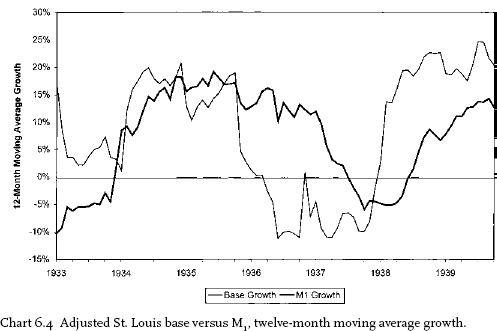
In his biography, Eccles reports that he expressed concern to the president about the economy as early as March. His concern at that time was that rising prices and wages would prevent the economy from reaching full use of capacity (Eccles 1951, 296–97). In August, he urged the president to encourage housing construction.228 None of these concerns appear in the September 11 minutes. Williams again recognized that the economy had slowed, but he was uncertain whether a recession had started (Minutes, FOMC, September 11, 1937, 6–8). Harrison noted that bank credit was available, so the “causes of the present situation were not in the monetary field” (9) The implication was that there was no need for policy action.
Once again, the monetary base and the money stock tell a different story. Chart 6.4 shows the growth rates of the adjusted monetary base and the money stock from 1936 to 1939.229 Growth of the monetary base turned negative after gold sterilization in December 1936. The base fell throughout 1937, much of the time at a 7 to 11 percent rate. The money stock lagged behind; although its growth rate fell throughout 1937, the money stock began to fall only in August, two months after the start of the recession. Money growth remained negative until the early months of the recovery. With inflation (deflator) rising at a 6 percent average for the first three quarters, real money balances fell. In fourth quarter 1937 the situation changed; the price level fell and the base rose, so the real value of base money increased as real rates of interest rose. Again, as in 1920–21, the rise in the real value of the base and money dominated the effect on economic activity of rising real rates of interest.
Although the recession began in June, the FOMC made no purchases until November. Even a sharp stock market break, reducing the stock price index by 26 percent from late August to mid-October, did not induce a response. At last, on November 9, the FOMC executive committee voted to begin purchases at once and to purchase $50 million by the end of the month, using the authority of the September meeting. Eccles again wanted purchases because the Treasury threatened to act on its own by desterilizing gold. Harrison opposed purchases but voted in favor (Harrison Papers, file 2140.2, November 6, 1937). Perhaps because excess reserves rose and there was no evidence of seasonal tightening, the system bought only $38 million in November.230 On November 16, Harrison and Eccles agreed to stop purchases after checking with Morgenthau. The System made no further purchases until March 1938.
Williams explained why the Federal Reserve purchased so little and stopped so soon. He described the period as a small depression but with “continued monetary ease,” and “for that reason, a policy of monetary ease could not be counted on as a major corrective” (Minutes, FOMC, November 29, 1997, 3). “Those in authority should not sit back and do nothing… . steps should be taken to devise a means of encouraging private investment” (4). But he made few suggestions about what should be done, opposed any increase in government spending, and stressed the importance of a balanced budget and other fiscal measures: reduction of the undistributed profits tax, the capital gains tax, and the surtax.
Goldenweiser agreed that monetary policy had been easy since early 1932. The increases in reserve requirements had not reversed the easy money policy; the recession was due to (unspecified) nonmonetary causes. He agreed with Williams that the third increase in reserve requirements should have come earlier (ibid., 6). He saw no reason for “any major monetary action at this time” (9). The System remained inactive.
The committee voted unanimously to continue the authorization to purchase for seasonal adjustment agreed on in September. Not a single dissenting voice suggested that the committee should purchase for expansion. Once again, the level of money market interest rates misled the FOMC. The members failed to see that falling prices meant that real rates of interest had increased as deflation and recession took hold.231 Using nominal interest rates instead of monetary growth as an indicator of the policy stance gave the wrong signal in 1937 just as it had in 1929–33. Even growth of bank loans would have told the Federal Reserve that policy was restrictive; in the year ending June 1938, total bank loans fell 7.5 percent, reflecting restrictive monetary policy and the recession.232
Kindleberger (1986), Roose (1954), and Eccles (1951) describe the recession as principally an inventory recession. Eccles is representative of this view. He denied any monetary influence and attributed the 1937–38 cycle to four causes: (1) the buildup of business inventories at a time when (2) government spending declined; (3) the introduction of Social Security tax payments ($2 billion); and (4) labor disturbances that threatened to raise future production costs (Eccles 1951, 294–95). Instead of the $4 billion deficit in 1936, the Treasury had a cash surplus of $66 million in the first nine months of 1937.233
Chart 6.5 shows two measures of the change in inventories during these years. The sharp peaks in fourth quarter 1936 and second or third quarter 1937 are clearly visible. The change in inventories, however, is small relative to the change in GNP or final sales.
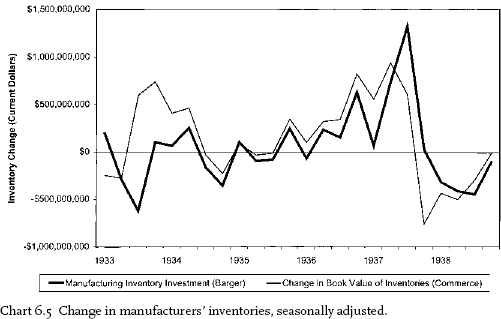
A more plausible interpretation is that the very large decline in final sales made inventories seem excessive. Chart 6.6 shows that rapid money growth in 1935 preceded the increased growth of final sales in 1936. The deceleration of money in 1937 preceded the sharp decline in final sales, and the resumption of money growth preceded the resumption of growth in final sales. On this interpretation, gold inflows caused an acceleration of the monetary base followed, as in chart 6.4, by an acceleration of money and, as in chart 6.6, by faster growth of final sales. Fiscal changes, especially bonus payments, reinforced these effects. At peak deceleration in the summer of 1937, the monetary base declined at an 11 percent annual rate. Final sales (and real GDP) reached their trough at the end of 1937.234
Contemporary observers within and outside the administration gave considerable weight to the president’s “antibusiness” rhetoric and actions. Although the undistributed profits tax did not produce more than about $400 million in revenue in fiscal years 1936 to 1938 (much below projections), the revenue aspect seems to have been less important than the president’s message (March 3, 1936) citing the large growth of corporate profits in the 1920s as a source of disturbance. Regulation of foreign exchange and the capital markets by the Securities and Exchange Commission also gave rise to concerns.235
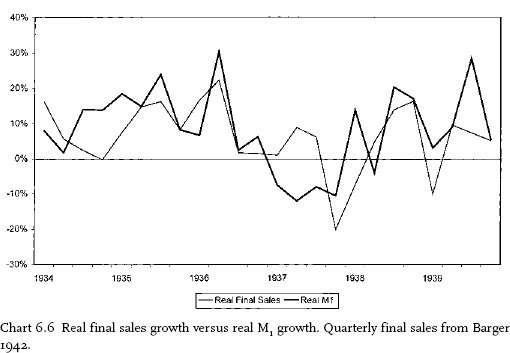
End of the Recession
The Federal Reserve did little to correct the mistakes that contributed to the recession. Since short-term market interest rates remained low, it regarded its policy as easy. It continued to express more concern about future inflation than about current deflation. It took expansive actions when prodded by the administration and to avoid criticism for hindering the expansion program that the administration finally adopted.
Although the recession started in May 1937, policy did not change until 1938, when Morgenthau and the Treasury pressed for an end to gold sterilization and reductions in the reserve requirement ratios. Eccles continued to urge increased government spending and a larger deficit. Repeal of the undistributed profits tax relieved some of the real or psychological effects its passage had generated.
In November 1937, when Morgenthau first proposed to end gold sterilization, Eccles opposed on the grounds that “Roosevelt might grab the idea as a panacea for solving all economic problems. He considered excess reserves plentiful and contended that neither desterilization nor loosening of reserve requirements would actually ease credit” (Blum 1959, 393).
Morgenthau persevered. On February 8 he met with Roosevelt, deeply concerned about the continuing recession and the effect of the recession on other democratic countries. Despite his concerns about deficits, he wanted to spend an additional $250 million in the remaining months of the fiscal year to increase WPA employment by 650,000. He believed falling prices encouraged delays in private spending, so he proposed to end gold sterilization. Roosevelt accepted both suggestions (Blum 1959, 400). Morgenthau’s diary explains that Morgenthau ended sterilization, in part, to prevent more government spending.236
Eccles hesitated to approve unlimited gold purchases. The gold purchase program announced on February 14 limited the monetary base increase to $100 million a quarter, retroactive to January 1.237 Chart 6.4 (above) shows the immediate large change in the growth rate of the monetary base. In the second quarter, final sales rose modestly but inventories declined, so real GDP did not rise until the third quarter.
Eccles regarded the gold program as Morgenthau’s plan. He was at best cool to the idea (Blum 1959, 406). Gold purchases expanded money without increasing Federal Reserve earnings, but his principal concern was the size of excess reserves. At the March 1 FOMC meeting, he favored continuing the program of selling long-term bonds and buying bills. The committee discussed open market sales to reduce excess reserves. This action would have neutralized Morgenthau’s program, in effect resterilizing gold. Eccles concluded: “No useful purpose would be achieved by reducing the total amount of securities held in the System open market account.” He did not propose purchases (Minutes, FOMC, March 1, 1938, 6–7).
Again in April, the Roosevelt administration, not the Federal Reserve, acted to spur the recovery that by then was under way. Morgenthau leaves no doubt about the reason for action. On March 25, while Roosevelt was on vacation in Georgia, the stock market fell sharply. The proponents of spending within the administration seized the opportunity to convince the president that more spending would help the economy and the Democratic Party.238 After much internal wrangling, and Morgenthau’s threat to resign over the budgetary consequences, Roosevelt announced a new recovery plan on April 18.239 Spending for construction and welfare increased by about $2 billion. On the monetary side, the Federal Reserve reduced reserve requirement ratios, and the Treasury desterilized $1.4 billion, all the remaining gold sterilized since December 1936. The reduction in reserve requirement ratios released an estimated $750 million, reversing the May 1, 1937, increase for central reserve and reserve city banks (to 22.75 percent and 17.5 percent) and lowering to 12 percent and 5 percent the requirement for country banks and all time deposits. The Board’s minutes refer to the change as part of the president’s program (Board Minutes, April 15, 1938, 1–2).240 The very rapid expansion of the monetary base is apparent in chart 6.4 (above). Estimated excess reserves rose to $3.9 billion when desterilization was complete. Within a few months, the money stock began a sustained increase.
The Federal Reserve was reluctant to permit all the sterilized gold to increase reserves at once; the Treasury felt otherwise. The Treasury wanted to issue gold certificates in exchange for Federal Reserve deposits, then use the deposits to retire Treasury bills as they came due. This would increase excess reserves quickly, pressuring the banks to expand credit. The Federal Reserve preferred to have the Treasury use its deposits to pay for gold purchases, thereby spreading the increase in excess reserves over a longer period. On April 19 the executive committee of the FOMC agreed to present its case to Morgenthau in terms of disorderly debt markets. Reducing the stock of short-term government securities would reduce yields and could create disorderly markets. The Treasury dismissed the argument.
The president’s announcement of the new program sparked a rally in the Treasury market. Already low yields on short-term securities fell to zero out to a maturity of eighteen months (Minutes, FOMC, April 21, 1938, 7). Desterilization and the reduction in reserve requirements appear to dominate any effect of a larger deficit; the market viewed the monetary ease as more than sufficient to absorb any additional debt resulting from the deficit or increased private spending and borrowing.
The FOMC’s April 21–22 meeting gave most attention to the problem of replacing Treasury bills and notes with market yields at zero or below.241 With a large increase of excess reserves currently and prospectively available, yields on Treasury securities had fallen at all maturities. The FOMC’s principal concern was “disorderly markets”; rates had declined rapidly and could reverse.242 The members did not want either to criticize the administration’s program or to accept responsibility for correcting disorderly markets.
Eccles told Morgenthau about these problems. He reported to the FOMC that Morgenthau was sympathetic but would not agree to stop retiring $50 million in Treasury bills a week. The most he offered was to reconsider the subject later. Divided and uncertain about what to do, the FOMC voted to replace maturing Treasury bills with notes out to a two-year maturity, if it could be done without paying a premium (negative yield).243
The following week the committee reconsidered the same issues. Harrison wanted authority to replace maturing issues with longer-term securities if useful for maintaining orderly markets and authority to purchase or sell securities to prevent disorderly markets. Eccles opposed sales as counter to the administration program. He proposed to continue replacing securities as long as yields were not negative. Harrison’s motion was defeated eight to three; Eccles’s proposal then passed unanimously.244 Unlike the situation in the 1920s, the Board had control.
In September, long-term Treasury yields rose as the economy recovered and despite foreign buying of United States securities at the time of the Czech (Munich) crisis. The Treasury bought $37 million of notes and bonds. The Federal Reserve made smaller purchases, offset by sales of bills. Pressure from the Treasury to keep yields low lessened a bit after the Munich agreement. With Eccles absent, Harrison urged the executive committee on September 15 to let up to $700 million in bills run off without replacement if necessary. This would have reversed the April reduction in reserve requirements and offset Treasury purchases to hold rates down. The committee defeated the proposal. It voted instead to replace government bonds with Treasury bills to put the System in a position to offset monetary expansion without taking portfolio losses.245
The December meeting reconsidered the same issue, the problem of replacing bills as they matured without paying a premium to buy bills. The FOMC asked Morgenthau to increase the size of weekly bill issues, but he preferred to encourage lower bond yields by keeping bill yields near zero. Over Eccles’s objection, the FOMC voted to let bills run off without replacement if they could not be replaced without paying a premium. A background memo prepared for the December 30 meeting showed the problem worsening. The System had to buy an increasing amount of notes to prevent a decline in its portfolio. In its announcement after the December 30–31 meeting, the FOMC noted that its portfolio might show some fluctuation solely because the System was unable to replace maturing bills. The committee assured the public that “no change in Federal Reserve policy is contemplated at this time” (Press Release, FOMC, Board of Governors File, box 1452, December 31, 1938).246
GOLD AND EXCHANGE RATES, 1935–40
Gold and exchange rate policies, culminating in the 1934 devaluation, provided the main stimulus to domestic recovery in the first two years of the Roosevelt administration. The permanent increase in the gold price to $35 an ounce permitted gold holders to exchange gold for United States goods and assets on more favorable terms. As gold flowed to the United States, the principal countries remaining on the gold standard—France, Belgium, Italy, and Switzerland—came under increasing deflationary pressure.
By 1935 advocates of stable exchange rates, to revive international trade, had become more active. In the Treasury, Jacob Viner argued that side. Harrison favored allowing the British Exchange Equalization Account to buy and sell gold directly with the Treasury to help stabilize the pound.247 These ideas appealed to Morgenthau, who wanted to build a democratic alliance against Hitler and hoped that monetary cooperation would help achieve that goal (Blum 1959, 140–41). But Morgenthau hesitated, because Roosevelt was suspicious of British intentions and believed Harrison was influenced too much by the British.
The dollar weakened early in 1935 when the Supreme Court was about to decide the gold clause cases. United States gold clause bonds went to a premium. Harrison discussed with Morgenthau and Undersecretary T. J. Coolidge what actions the Treasury planned or had under way through the Exchange Stabilization Fund.248 He wanted the Treasury to develop a policy instead of operating from day to day. Morgenthau agreed to talk to Roosevelt, who controlled the decision (Harrison Papers, file 2012.6, February 18, 1935).
At about this time, Morgenthau asked John H. Williams to suggest a policy. Williams proposed informal discussions with the British. Something had to be done, he believed, because United States gold and silver policies drained gold and silver from all other countries, making both standards untenable. Harrison agreed. Morgenthau relayed the conversation to the president, but Roosevelt would consider cooperation only if the British asked for help (Harrison Papers, file 2013.2, March 2, 1935).249
With the pound continuing to weaken against the dollar and the franc, the Bank of France proposed to extend credit of $330 million (Fr 5 billion) if the British would agree to defend the pound and would state, informally, the level they intended to hold. The French asked the New York reserve bank to join in the support operation if the French government approved. Morgenthau discussed the issue with the president, who was ambivalent. The United States offered “sympathetic support” and expressed hope that the pound would not go below $4.86, the old parity (Harrison Papers, Memo J. E. Crane to Files, file 2012.6, March 6, 1935).
The pound continued to fall, reaching $4.776 on average for March. Morgenthau did not pursue the issue of support operations. Instead, he invited some advisers on foreign exchange and domestic prices to dinner on March 5. The topic was further devaluation of the dollar against gold to raise commodity prices. Former governor Eugene Meyer was in favor, but he gave no reason.250 George Warren and Herman Oliphant favored devaluation. Oliphant wanted the president to announce a price level objective. Harrison, Williams, Viner, and undersecretary Coolidge opposed. Viner and Harrison argued that the administration’s objective should be to increase business activity and reduce unemployment. Profits, not just prices, were the key to recovery. Williams supported this position and warned against further competitive devaluations. With his council divided, Morgenthau did not pursue the idea.
The next move, again, came from France. Still wanting to stay on the gold standard, and willing to deflate as necessary, the Bank of France requested permission to sell gold to the United States.251 Morgenthau agreed to buy up to $150 million on May 31 and to release the dollars for immediate use in New York or Paris (Harrison Papers, file 2012.5, June 3, 1935). This support helped to convince the French government that the United States would cooperate.
Conversations with the British and the French continued sporadically throughout 1935. Roosevelt, who did not trust the British, was particularly wary of Neville Chamberlain, then chancellor of the exchequer. He blamed Chamberlain for the system of empire preference that gave British exports an advantage in British colonies. And he blamed the British for the failure of the London Monetary and Economic Conference. They blamed him (Blum 1959, 141). Despite these antipathies, Morgenthau remained eager to engage the British and the French in stabilization measures as a means of strengthening democratic governments against Hitler. He believed that exchange rate stability would improve prospects for expansion in all three countries. By 1936 the United States economy was expanding rapidly, attracting gold from the rest of the world; faster expansion abroad would slow the inflow.252
Late in April 1936 Poland, one of the remaining members of the gold bloc, imposed exchange controls and embargoed gold, effectively leaving the gold standard. The pound fell slightly. Morgenthau used the opportunity to convince Roosevelt to permit him to begin conversations with the British about stabilization. Since the president’s authority to devalue had expired at the end of January, the United States was less able to threaten independent action. The British eventually replied to his overture, and to Morgenthau’s insistence on greater transparency in their actions, by stating their aims. They wanted to return, eventually, to a reformed gold standard, but they were not ready to commit to such a move. They wanted to retain the right to devalue if necessary. Within that framework, they welcomed cooperation. Morgenthau was pleased by these conditions. He suggested further discussions between the two treasuries, avoiding the central banks (Blum 1959, 142–43).
The French elections of May 1936 accelerated the conversation. A coalition of leftist parties, known as the Popular Front and including the Communist Party, came to power under the leadership of a Socialist, Leon Blum. Their platform did not put forward a clear monetary program. The Socialists were willing to consider devaluation, but the Communists opposed (Kindleberger 1986, 252). Morgenthau favored devaluation of the franc by 15 percent but opposed a French gold embargo. Several of his advisers were willing to accept a 25 percent devaluation (Harrison Papers, file 2012.6, June 9, 1936).
The British used the market disturbance resulting from French strikes, the election, and concerns about devaluation to request authority to purchase gold directly from the United States Treasury. Morgenthau, as usual, took the issue to Roosevelt, who objected. But Morgenthau managed to convince the president of the importance of a French devaluation followed by stabilization of the pound, franc, and dollar. The next day Roosevelt agreed to let Morgenthau sound out the British on a program to let the franc devalue by 25 percent without any retaliation by the United States or Britain (Blum 1959, 145–47).
France was the stumbling block. In a pattern later followed by socialist governments in Chile, France, Peru, and elsewhere, Blum and his finance minister, Vincent Auriol, believed they could raise wages and reduce the workweek to forty hours without devaluing. To add to their mistakes, they allowed firms to borrow from the Bank of France at a 3 percent interest rate to cover the additional employment costs. The government guaranteed the loans.
The program increased costs and raised prices. In the Blum government’s first year, French wholesale prices rose 47 percent. Blum and Auriol had pledged to maintain the franc’s gold parity, but they left room for an adjustment in its value as part of an international agreement. In fact, they had few choices. Faced with a continuing loss of gold, they could devalue or resort to exchange controls. Morgenthau’s offer of assistance, and his use of sanctions against Germany, convinced the new government that a cooperative agreement was possible.253 They sent a special representative to meet Morgenthau to discuss international monetary relations.254
The Tripartite Agreement
To remain on the gold standard, France and the gold bloc had followed deflationary policies in 1934–35. By the summer of 1935, French wholesale prices were 51 percent of their 1929 average. The policy would have worked had it been followed long enough, but the cost was high, and the policy had become unpopular. There were two problems. First, devaluation of the dollar and the increased United States gold price drained gold from France. Second, as a consequence of continued deflation, the gold bloc countries faced increasing unemployment or lower wages at a time of recovery in Britain, Germany, and the United States.255
Beginning in summer 1935, repeated efforts to deflate by balancing the budget, reducing wages and pensions, and other means failed to stop inflation. Chart 6.7 shows that French prices began to rise absolutely and relative to prices abroad. Eichengreen (1992, 367–74) describes the response; successive governments blamed the unbalanced budget. They promised to do better.256 If fiscal stringency did not work, many said, the answer was more stringency.
In the year before the Blum government took office, French wholesale prices rose 15 percent. By September 1936 the French price level was back to 67 percent of the 1929 average. This compares with 86 percent and 78 percent for the United States and Britain. In August, before the franc devaluation, the real dollar-franc exchange rate was 4.8 cents, about 20 percent above the 1929 rate.
The Blum government hesitated to act. The final push came after renewed weakness of the franc against the dollar and the pound in August 1936. The French wanted the dollar and pound to remain fixed if they devalued the franc, and they wanted an agreement to return to the gold standard. Neither the United States nor Britain would agree to fix rates permanently. Roosevelt, Morgenthau knew, would not agree to return to the gold standard.
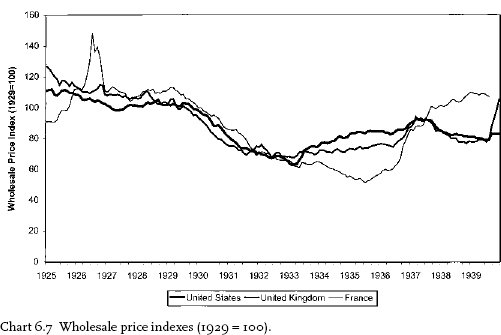
The French government’s position was weak. It had paid out more than one-fourth of its gold stock in nine months and counted on devaluation to provide enough profit on its remaining gold to balance its budget. Morgenthau offered only a general agreement to avoid retaliation following a French devaluation. He did not mention the gold standard. The British response was similar. The final agreement accepted the main points of the United States statement, although each government used its own wording.257 The agreement provided funding for a French stabilization fund from half the proceeds of the devaluation. Each country agreed to stabilize exchange rates, one day at a time, by announcing in the morning the price at which it would exchange its currency for gold at the end of the day.258 The British did not insist that the United States agree to sell gold to stabilization funds, but it did agree to do so on October 12. Belgium, the Netherlands, and Switzerland chose to comply with the agreement. Switzerland and the Netherlands devalued by 28 percent and 20 percent, respectively. Italy also devalued by an additional 33 percent to bring its devaluation to 40 percent since the United States devaluation in 1934.
Morgenthau did not mention the agreement to Eccles or the Federal Reserve until it was final. Like Roosevelt, he wanted to put governments, not bankers, in charge of monetary policy. The Tripartite Agreement was another step in that program. Unlike the 1920s, when Strong and the New York bank ran international monetary policy, the Treasury was now in charge.259
Morgenthau was euphoric about the outcome. He believed the agreement was a major step toward peace, economic stability, and prosperity. The Treasury staff shared his enthusiasm, as is common among those who have participated in a long and difficult negotiation.260 Major newspapers lauded the agreement (Blum 1959, 173; Eichengreen 1992, 380). Harrison was cautious. He probably expressed the view of those who wanted to restore the gold standard when he told Morgenthau that “a stabilization fund to keep the franc within a 10 percent range only added one more flexible exchange [rate]” (Harrison Papers, file 2012.6, September 25, 1936).
In fact, the agreement was more symbolic than substantive. The franc and some of the currencies allied in the former gold bloc devalued their nominal exchange rates by 15 percent to 30 percent of their 1929 values. The dollar and the pound remained close to their predepression nominal parity. Britain and the United States agreed not to respond immediately to the French devaluation, a modest sign of cooperation.
One measure of the agreement is the effect on exchange rates. Table 6.7 shows estimates of exchange rates adjusted for changes in wholesale price levels, a measure of so-called real exchange rates, at selected dates. The top row shows bilateral real exchange rates before the start of the Great Depression. Rows 2 and 3 show these rates after the 1931 British devaluation and the 1934 United States devaluation. Row 4 follows the Tripartite Agreement.
Devaluation restored the 1929 real franc exchange rate for the dollar and devalued the real rate for the pound by 3 percent. What a cumbersome and costly way to correct the misalignment of exchange rates after the restoration of the gold standard in the 1920s!261
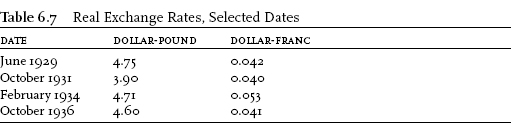
The adjustment that the agreement made possible did not produce stability. Chart 6.7 shows that between September 1936 and the start of the United States recession in June 1937, French prices continued to rise relative to United States and British prices; the franc depreciated in real value against the dollar and the pound.
After the Agreement
Harrison telephoned to ask for cooperation from the major bankers on Friday evening, after agreement was reached. Apparently they did not all relay the message to their traders. On Saturday morning the pound began to sink, falling from $5.02 to $4.91. The proximate reason was an order from the Russian State Bank to Chase National Bank to sell £1.2 million for dollars. Morgenthau viewed this as an attempt to subvert his agreement: “He was not going to have the Reds or Communists ruining this program” (Harrison Papers, file 2012.6, September 26, 1936, 9). He ordered Harrison to buy the pounds immediately for the Exchange Stabilization Fund, and he threatened to announce publicly that “the Reds were making an attack on the pound in order to draw it down and spoil the program” (10).262
The agreement did not specify who could buy or sell gold at the Treasury. Morgenthau tried to clarify the issue at a press conference in October, but he misstated the policy. By limiting transactions to governments only, he was more restrictive than he intended, but he would not issue a corrected statement until after the November election (Harrison Papers, file 2012.6, October 13, 1936). Finally, on November 24 the Treasury announced that it would sell gold to treasuries or fiscal agents acting for treasuries (including stabilization funds) that would sell gold to the United States. This statement relaxed the restriction on the Treasury to deal only with gold standard countries, in effect since January 1934. Britain, France, Switzerland, the Netherlands, and Belgium became trading partners.
In 1937 the French began to respond to German rearmament by increasing military spending. The increased spending added to the burden of the Popular Front’s social programs and the devaluation. By February the franc was under pressure, falling against the dollar and the pound. Harrison began conversations with the British about stabilization of exchange rates, and the Treasury began intergovernment discussions. At $2.5 billion, French gold holdings were at the lowest level since the 1931 British devaluation. The French suggested that the United States buy $5 million to $10 million worth of francs but not convert them into gold until after the summer tourist season. Morgenthau was shocked. The suggestion “made him break out in a cold sweat” (Blum 1959, 456). The loan would probably have violated the Johnson Act, passed in 1934, prohibiting loans to any foreign government that had defaulted on its war debt.
The French thought they would have to impose exchange controls, violating the Tripartite Agreement. At Neville Chamberlain’s urging, bankers arranged a private loan to France, so the agreement continued. The Blum government survived (ibid.).263
By March 1937 the franc was under pressure again. The French wanted to arrange a defense loan, payable in dollars, francs, and pounds. The announcement created a storm in Washington, and Morgenthau had to testify that the Treasury viewed the loan as a violation of the Johnson Act, hence illegal (Harrison Papers, file 1610.1, March 8 and 9, 1937; Blum 1959, 461–62).
So it continued, with intermittent disturbances followed by brief periods of calm. Again, as in 1927–29, the main problem was never mentioned: exchange rates were misaligned and, as charts 6.1 and 6.7 show, inconsistent with the relative movements of wholesale prices in the principal countries.
Rumors spread in April that, to slow gold flows, the United States planned to revalue the dollar against gold. Gold flowed to the United States from private speculators and the exchange stabilization funds of smaller countries (Kindleberger 1986, 265). The franc weakened again in nominal and real terms. On April 9 President Roosevelt denied any knowledge of a plan to change the gold price. The franc continued to weaken, but the rate of decline slowed temporarily (Harrison Papers, file 2012.7, April 10, 1937).
The Blum government fell in June 1937. The new government promptly devalued the franc by 15 percent but agreed to hold the new range, 3.80 to 3.96 cents, and not seek a competitive devaluation. It wanted only to offset the costs to French industry of the Blum government’s social legislation.
Morgenthau accepted the devaluation as within the Tripartite Agreement because the French avoided new controls and announced a buying and selling rate at which they would sell gold. He was able to persuade the British to agree also, although they privately warned the French to avoid a further devaluation (Blum 1959, 478).
For the next year, several French governments, plans, and discussions produced no result. To save the remnants of the agreement, Morgenthau offered to let the French use “temporary” exchange controls (ibid., 500). In May 1938 France again devalued the nominal exchange rate to 175 francs to the pound and 2.8 cents per franc. The more critical real exchange rate was now 3.6 cents per franc, about 12 percent lower than at the start of the agreement. The British did not want to accept the new parity, but they feared even more ending the Tripartite Agreement while facing the prospect of war to stop German and Italian expansionist actions.
Discussions continued about how to use the agreement as a political measure to strengthen the democratic governments. For practical purposes, the agreement ended before the May 1938 devaluation. After Munich, in September 1938, preparations for war increased in Britain and France. Both currencies fell against the dollar in nominal and real terms. The United States continued to regard the agreement as in effect.
What Was Achieved?
Proponents of international cooperation point out that exchange rate variability declined after the agreement. Eichengreen (1992, 382) shows that afterward monthly exchange rates were more stable in leading countries (except France).
This is a modest benefit to put beside the economic cost. The agreement could work only if the new nominal exchange rates were (close to) full equilibrium rates, consistent with stable real exchange rates. Differences in price levels and in economic policies leave little doubt that this was not so. Within six months the real dollar-pound exchange changed by 6 percent.
Try as they did, Morgenthau and Chamberlain could not make cooperation produce stability. The British insisted that the agreement was limited to daily, or short-term, exchange rates and a pledge to avoid using devaluation to improve relative positions.264 That meant uncertainty about future exchange rates remained. Countries remained free to pursue policies that would result in devaluation. Indeed, the French were engaged in such policies at the time. Instead of criticizing the policies as inconsistent with the agreement, Morgenthau and Roosevelt praised and encouraged them as a French version of Roosevelt’s New Deal.
The policies failed. French industrial production had increased 9 percent in the year ending March 1936. Under the Popular Front, production fell; increased costs of production, particularly labor costs, aborted a recovery that was under way, much the same as happened in the United States under the NIRA in summer 1933. Prices rose, requiring devaluation. The agreement postponed devaluation, delaying adjustment. A floating rate would have devalued the currency to reflect the cost increase; the fixed rate forced the adjustment to come through changes in prices, output, and employment.265
The agreement had two basic flaws. The first was failure to distinguish between real and nominal exchange rates. Fixing nominal exchange rates forced adjustment of misalignment through price changes. The discussions leading up to the agreement, and after, show no recognition of this central point. Second was the belief that international cooperation was a viable alternative to exchange rate adjustment. Exchange rates and prices were misaligned in the mid-thirties, just as at the end of the twenties. Belief in the gold standard remained strong, however. Prominent economists like Viner and Williams, who advised Morgenthau, and many businessmen and politicians believed that fixing exchange rates under some type of gold standard was evidence of adjustment and a source of stability. What better way to restore stability than to fix exchange rates?
In retrospect, we know now that the agreement ended the major principle of the gold standard—that countries should avoid devaluation as a means of adjustment whatever the cost. If the British devaluation was the first step, the French, Dutch, and Swiss devaluations represent rejection of the principle by the last countries with strong commitments to the gold standard. After 1931–36, devaluation was no longer unthinkable.
As a political measure, the agreement had greater merit. Morgenthau was eager to show the Germans and Italians that the democracies would work together toward a common goal. And Roosevelt overcame some of his suspicions about the British, so he was better prepared to cooperate in a wartime alliance.
POLICY AND WAR PREPARATIONS, 1939–41
The probability of a European war rose and fell in the late 1930s. The first explicit mention of preparations by the reserve banks came at the time of the Munich agreement, on September 8, 1938. The New York directors discussed their policy toward loans on government securities in the event of a war. They reached no decision, but they reopened the subject at the Conference of Reserve Bank Presidents (Presidents Conference) later that month. The main issues were the rates at which the reserve banks would lend on government securities and whether the rates would be higher for nonmember banks, individuals, and corporations. The presidents recommended making their discount rates (1 percent to 1.5 percent) the applicable rates for member banks but using a slightly higher rate for nonmember banks and others (Board Minutes, September 21, 1938, 1–2). The political problem in Europe eased, so they did not make a decision.
By early 1939, real GNP rose above its prerecession peak, with prices slowly falling. Falling prices and economic recovery, plus the threat of a European war, increased the gold flow from $113 million in the first half of 1938 to $1.3 billion in the second half. More than $3 billion followed in 1939.266 Sterilization had ended, so the monetary base rose 23 percent in 1938 and 20 percent in 1939. Interest rates and risk premiums fell as excess reserves rose.
At the end of 1938, excess reserves were above $3 billion, higher than in August 1936, when the System first increased reserve requirements. A year later, excess reserves were above $5 billion. The gold reserve percentage reached 83.5 percent, the highest level since World War I, but not yet a peak. Although excess reserves were again greater than the open market portfolio, the Federal Reserve remained inactive.267
Conflict continued between the Treasury and the Federal Reserve over whether to increase the size of the weekly Treasury bill auction. The System wanted a higher bill rate so it would not have to extend portfolio maturity. It hoped that an increased supply of bills would lower the price and raise the yield. Higher short-term rates were expected to raise long-term interest rates, permitting the System to reverse the approximately $100 million (4 percent) increase in the portion of its portfolio with five years or more to maturity.268 The Treasury opposed. Morgenthau liked the low yields on Treasury bills, so he turned down the request. To prevent a fall in long-term rates, Morgenthau sold $10 million from the Treasury trust accounts. He invited the System to participate in the sale, but it declined because markets were not disorderly. The “strength of the market was due to fundamental causes which would not be reached by the action suggested” (Minutes, Executive Committee, FOMC, March 13, 1939, 2). The fundamental causes were the government’s silver purchase policy and the gold inflow at the time of the March 1939 German occupation of western Czechoslovakia.269
Concerns about a European war remained high. Pressed by the Treasury for a policy to prevent market disorder in the event of war, the executive committee agreed to share purchases equally with the Treasury until the Treasury had invested all of the balances in the trust accounts, approximately $100 million. After that, the System would purchase on its own up to $500 million, a 20 percent increase in its portfolio.
Eccles made his reasoning clear. After the Treasury exhausted the trust funds, any additional Treasury purchases would come from the Exchange Stabilization Fund, “which would create in the Treasury an open market portfolio of Government securities. . . . This would be undesirable” (Minutes, Executive Committee FOMC, March 14, 1939, 2). He preferred to operate alone, after consultation with the Treasury (3).
Harrison, cautious as usual, agreed to the proposal but asked for a commitment to sell the securities after the emergency passed: “There should be no objection . .. solely on the ground that no sales should be made before conditions warranted a change in the present easy money policy” (ibid., 3–4). The committee agreed only to keep an open mind about sales.270 The following week, the full FOMC authorized the proposed purchase policy.
The presidents and governors again discussed discount policy in the event of a European war. Late in April, the reserve banks agreed to make loans to member and nonmember banks at the discount rate, if collateralized by government securities valued at par. The New York rate was 1 percent, with 1.5 percent at all other banks. The Board approved the policy but agreed not to announce it until a war began.271 This changed as war approached in late August; the Board wanted to announce the policy as part of a general statement describing its powers and its willingness to serve as lender of last resort. Only the Cleveland bank objected to not waiting for the war to start. By the time the discussion finished, war had started. The Board issued the statement on September 1.
Gold flows increased. As war approached, safety of capital and, later, payment for war materials supplemented the United States gold price as a driving force. By the end of 1940, the United States Treasury owned almost 80 percent of the world’s monetary gold (Schwartz 1982, tables SC6 and SC8). The inflow would have slowed without policy action as Treasury gold holdings approached 100 percent of the world’s monetary gold stock.
Policy changed first. In March 1941 Congress approved “lend-lease,” under which countries allied against Germany or at war with Japan could obtain materials in the United States on loan from the United States.272
Before lend-lease, Britain purchased supplies by selling $2.5 billion in gold and United States securities formerly held by British citizens. To appease Congress, Morgenthau insisted that they also sell direct investments in United States companies. Lend-lease substituted United States government debt for gold as payment for war material.
Almost immediately, the gold inflow slowed. After rising at a 22 percent annual rate from the start of the European war to first quarter 1941, the base fell at a 4 percent rate for the next three quarters.273 The banking system’s excess reserves reached a peak of $6.5 billion in January 1941. By December, excess reserves had fallen to $3.4 billion.
Criticism of Easy Money
With the economy expanding strongly in the spring of 1939, excess reserves far larger than the (stagnant) open market portfolio, and interest rates on Treasury bills at 0.25 percent or less, the Federal Reserve began considering what it could or should do. Harrison raised the possibility of open market sales in discussions with the New York directors. The directors believed that sales were appropriate (Minutes, New York Directors, vol. 45, June 1, 1939, 94).
Earlier, the Federal Advisory Council had asked the Board at its February meeting to reexamine the effects of “cheap money.” The Board rejected the suggestion on grounds that there had been many studies, so not much more could be learned. The council was more forceful in June. The easy money policy, in effect since 1929 (sic), they wrote, expected to stimulate business by making borrowing cheap. The policy had failed. The reasons were that low interest rates reduced saving, weakened the capital position of the banks by reducing their earnings, and made the public and Congress indifferent to the size of the government’s debt. The council urged the Board to abandon the policy of extreme easy money (Board Minutes, June 6, 1939, 6–7).
Governor Ransom asked what the council wanted the Board to do. One member proposed open market sales and increased reserve requirements to raise interest rates: “Nothing would be more effective than the resumption of the coinage and circulation of gold and . . . no further devaluation of the dollar.” He said that the System should advocate this policy (ibid., 7). Other members agreed on the importance of higher interest rates and pointed to the British agreement to have a minimum 0.5 percent rate on Treasury bills at auctions. Several participants urged open market sales of $100 million to show that the System recognized that rates were too low.
Goldenweiser gave the Board’s view. Policy had not forced easy money. Low rates had been brought about by an active policy in 1932. Since that time the System had been passive, except for the increase in reserve requirements in 1936–37. This was “not a policy of restraint, but a preliminary precautionary action to bring the System in touch with the market” (ibid., 12–13). Low rates reflected gold flows, silver policy, and business conditions. The System could make some minor adjustments, but even if the FOMC sold its entire portfolio, excess reserves would be plentiful and would continue to increase: “The System would be deprived of its ability to do anything in the future . . . and would have no source of income with which to pay its expenses” (14).
Goldenweiser’s defense of inaction did not convince the bankers. They differed only on the rate at which securities should be sold. Several emphasized that market participants believed long-term rates would continue to fall, so they saw little risk in buying bonds. A signal that the System disapproved of the easy money policy, or was concerned about low bank profits, would change perceptions. Some expressed concern about bank losses and possible failures if war in Europe raised rates in the United States.
The bankers’ arguments were largely self-serving, the search for an argument to justify higher portfolio earnings. Goldenweiser’s response again showed the persistence of the Riefler-Burgess framework. The Federal Reserve could do nothing. With total member bank borrowing below $5 million and excess reserves above $4 billion and rising, the System was “disconnected” from the market.
Both sides shared a “lending” approach. Neither suggested an aggressive policy of buying long-term bonds, corporate bonds, and other securities to change the relative prices of assets and output and encourage expansion.274 The bankers would have opposed purchases of long-term securities because, temporarily, their earnings would have declined.
The meeting authorized reductions in the open market portfolio to maintain orderly market conditions. This action was in the direction the bankers wanted. Between June 21 and August 16, the FOMC sold $100 million. Bond yields rose by 0.1 percent. These were the first net sales in any week since March 1933.
War Starts
As Europe moved toward war at the end of August 1939, the Federal Reserve at first was alert to market disturbances, but not active. On August 25 Britain suspended gold payments, formally ending the Tripartite Agreement.275 The pound fell from $4.53 to $4.44, but the bond market opened unchanged. Harrison met with city bankers to urge them not to sell bonds. During the week to September 1, the System purchased $6.8 million as rates fell.
Eccles reminded Harrison that they had authorization to purchase up to $500 million in the event of a disturbance if war started. This pledge had been made to the president, and he wanted assurance that Harrison would carry it out. Harrison was characteristically hesitant to take decisive action or to disagree with Eccles. With yields at 2.27 percent, they agreed that bonds would not fall below par, about 2.75 percent—a decline of approximately $6 per bond (Harrison Papers, file 2140.4, August 30, 1939, 5–7). On September 1 and 2, the System purchased $139 million as prices fell (System Open Market Account, Board of Governors File, box 1452, September 13, 1939).
Bond prices continued to fall. On September 5 Harrison talked to an excited Eccles, who shifted between proposals to let the market fall and to support it on the way down. Harrison proposed buying at declining yields, pointing out that bondholders were shifting to the equity market and that corporate bonds had fallen more than governments, so governments were out of line.276
Between August 30 and September 13, the FOMC bought $800 million, half for the Treasury accounts. Bond yields rose about 0.5 percent. The Federal Reserve continued the policy of following market prices down until, at a meeting in the Treasury on September 12, Morgenthau urged it to let prices “go down faster and with less expenditure of money.” He had to sell some new issues soon, and he wanted the market to reach bottom (Harrison Papers, file 2140.5, September 16, 1939).277
The System’s aggressive purchases, to slow the rise in interest rates, contrast sharply with its passivity throughout the depression. There are only two previous periods in which weekly rates of purchase were closely comparable to the $800 million purchased jointly with the Treasury in three weeks at the war’s start. One was in the fall of 1929 when, despite the Board, New York purchased $157 million in two weeks. The other was at the peak of the purchase policy in spring 1932, when the System purchased $640 million in seven weeks.
Three main reasons explain the 1939 purchases. First, the FOMC had discussed for months the policy it should follow in the event of a European war. Eccles had committed to an expansive policy in meetings with the president and the Treasury. The reserve banks had agreed in advance to purchases of up to $500 million for the System account. Second, the objective was to stabilize the money or bond market in the face of an external disturbance. This objective was widely shared and uncontroversial. Unlike New York’s effort in October 1929, there were no issues about the inevitable consequences of stock market speculation dividing New York and Washington. Third, low rates were interpreted as “easy” policy, rising rates as evidence of tightening. Neither the Federal Reserve nor the Treasury distinguished between real and nominal rates, so they did not mention, and probably did not recognize, that the war changed real expected returns and risk premiums.
The Federal Reserve agreed to lend to member and nonmember banks at the prevailing discount rate. This was a major change—the first time the System publicly accepted responsibility for systemwide liquidity.278 As Walter Bagehot had urged, it announced its policy in advance. Although there is no mention of the deposit insurance system, by lowering the risk to the Federal Reserve of lending to nonmember banks, deposit insurance may have contributed to this change.
At the September 18 FOMC meeting, Eccles presented three issues: the speed at which the bond market should decline, the size of purchases during declines, and the timing of purchases. He favored strong resistance to prevent bonds from going below par value (Minutes, FOMC, September 18, 1939, 6.
For the first time in many years, Eccles asked for individual views. The committee was divided. Harrison repeated Morgenthau’s view that the System had been too active. He preferred to let the market decline while avoiding disorder by placing bids below current prices. This would revive the private securities market and help the Treasury. Roy A. Young (Boston) and John S. Sinclair (Philadelphia) expressed views similar to Harrison’s. George Hamilton (Kansas City) wanted aggressive purchases if bonds fell below par, because the public expected it. Most of the others preferred to continue the policy of purchasing to prevent rapid decline and opposed pegging yields.
The committee voted to buy up to $500 million additional if needed to maintain an orderly market. Within a week, the System was able to sell as yields reached a peak and declined. The decline in yields continued for the rest of the year. Sales and retirements brought the account below $2.5 billion by year end, and lower than before purchases began. Bond yields ended the year at 2.30 percent, 0.16 percent above the lowest rates of the year and 0.44 percent below the peak.
The FOMC resumed the quiet life. The December 13 meeting concluded that the System should confine its activity to smoothing the market by buying or selling on a sliding scale when there were few other bids. Again, it explicitly resolved not to peg interest rates.
The policy statement at the December meeting, withdrawing from active play, reflected earlier discussions with the Federal Advisory Council. The council again unanimously approved a statement opposing the “easy money” policy and urging the Federal Reserve to allow bonds to be priced by the market, “free of official intervention” (Board Minutes, October 10, 1939, 2). It approved of actions to prevent a disorderly market but opposed the prevailing actions—sales to force rates back to earlier levels.
Discussion at this meeting was a prelude to discussion of “bills only” in the 1950s. Governor Ransom asked, What is an orderly market? Several members acknowledged that they could not define “orderly.” The best the group did was to define an orderly market either as “a natural self-supporting market” that, if perturbed, maintained the new price without panic buying or selling or as a market in which bids and offers were not too far from the last sale (ibid., 4–5). A market was not orderly if there was a single buyer or seller “whose one purpose was to maintain a market” (14).
The members stated forcefully that they opposed “easy money,” and they disliked the System’s requirement that buyers and sellers had to give their names during the market break.279 They again suggested a return to the 1920s policy of letting individual reserve banks buy and sell government securities with district banks.
Eccles’s main comment is similar to Goldenweiser’s statement at the June meeting. He denied that the System influenced the interest rate structure. Any influence was temporary, he said.280 The System had not bought to maintain “easy money”; the dominating factors were the gold flow and the level of excess reserves.
Three lasting procedural and administrative changes were made at the end of 1939. Although he was a member of the executive committee, Hugh Leach (Richmond) was not included in the frequent telephone conversations between New York and Washington. In response to his complaint, Harrison ordered the manager of the System Open Market Account to call Leach every day at about noon to keep him informed. This is the origin of the daily conference call that continues to the present (Harrison Papers, file 2140.6, November 29, 1939).
Early in November the New York bank nominated Robert Rouse to replace Allan Sproul as manager of the System Open Market Account.281 At about the same time, the bank adopted new rules limiting trading to “recognized dealers.”
Search for a Policy Guide
By March 1940, the pace of decline had slowed. Goldenweiser and Williams regarded the decline as a correction of heavy inventory building after the war started. They proposed no policy action, and none was taken (Minutes, FOMC, March 20, 1940).
The main decision was to undertake a study of the role of open market operations under prevailing conditions—conditions of relatively large and growing excess reserves and minuscule yields on Treasury bills. The study produced the first statement of guiding principles in many years (Memo, Despres to Goldenweiser, Board of Governors File, box 1433, April 29, 1940).282
The report began by repeating the explanation of how open market operations worked in the 1920s, made familiar by Riefler and Burgess. The new elements were the large volume of excess reserves and the relatively small supply of short-term assets issued by government and corporations. Monetary policy could work in this environment by changing the interest rate structure—the relation of short- to long-term rates. Changes in money were irrelevant: “Any volume of expenditure in the markets for goods and services can be financed by any quantity of money” (ibid., 2). The memo illustrated how changes in short-term interest rates induced changes in borrowing, money holding, and spending. The discussion emphasized mainly borrowing costs.283
The memo then made a significant break with standard beliefs: “Excess reserves are truly ‘excess’ only in the legal sense. In an economic sense, they meet the banking system’s demand for liquidity which was formerly met by its holding of short-term assets. The willingness of banks to hold their present portfolios of Government securities at existing yields is dependent on the present supply of reserves” (ibid., 4). Goldenweiser’s marginal comment: “That I think is doubtful.”
The memo applied similar analysis to money holdings. The argument reflected contemporary understanding of Keynes’s 1936 General Theory. There were fewer alternatives to cash than in the twenties. Money holders had shifted into long-term bonds, but their willingness to hold bonds depended on expectations about future interest rates, and thus on Federal Reserve policy: “If the market believes that the System is prepared to furnish vigorous support to the government security market, holders of high-grade securities will be less disposed to press their holdings on the market” (ibid., 5). By signaling its intentions, the System could shift holders between cash (money) and bonds, with significant effects on long-term rates.
The conclusion was that excess reserves and low short-term rates did not remove the possibility of controlling inflation. With short-term rates near zero, the System had much greater influence over long-term rates than in the past, so it could operate directly on the margin between money and long-term assets (ibid., 5). The memo concluded by urging a policy to promote “expansion now and stability later.”
Entrenched views were too strong to overcome. The System continued its inactivity, and the Federal Advisory Council continued its concern for the System’s “easy money” policy. At the Board’s suggestion, the council developed a statement of the causes of easy money and what might be done. The council wanted the statement published in the next issue of the Federal Reserve Bulletin.
The council’s statement gave seven main causes of “easy money.” Placed first was the Board’s easy money policy and “its continuous advocacy” of that policy. The Board had not “set up warning signals against the evil effects of the extreme to which it has been carried and of the dangers of its continuance” (Board Minutes, May 21, 1940, 8). The policy began at the end of 1929 and had not been reversed. Instead, bill rates had been pushed to zero, and the System had bought long-term debt (a speculative asset). The government’s spending program and deficits also contributed by making the Treasury a proponent of low interest rates, dollar devaluation, silver purchases, and the Johnson Act (prohibiting loans to foreign governments that had defaulted on war debts). Finally, the statement cited the continued gold inflow and discontinued sterilization policy.
The council proposed open market sales, purchases only to offset disorderly markets, sale of Treasury issues to nonbank investors, and jawboning by the Federal Reserve against easy money policy. The quality of the council’s understanding is suggested by its simultaneous call for a return to a full gold standard, followed in the very same sentence by a request to resume gold sterilization.284
The only proposal that appealed to Eccles came near the end—an increase in legal reserve requirements. He told the council he could think of nothing more injurious to the position of the council than publication of its views. The Board would respond to the statement, bringing the conflict before the public. He urged them to cooperate in a joint statement that might get Congress to act.
Several members of the Board denied responsibility for “easy money.” Criticisms of the Board and the administration aside, there was general agreement on the need to end easy money by reducing excess reserves. Governor Szymczak raised the usually unspoken issue. If the System reduced its bond portfolio, “it would be without sufficient earnings and would be forced to go to Congress for appropriations” (Board Minutes, May 21, 1940, 17). Eccles added that only a small amount could be sold before earnings fell below expenses. And he reminded the council that it had publicly opposed giving the Board authority to increase reserve requirements when the Banking Act of 1935 came before Congress.
The outcome was an agreement to work on a joint statement and to invite the reserve banks to join the discussion. In December the Board, the council, and the presidents of the reserve banks agreed on three main recommendations: (1) authority to double reserve requirement ratios from the current maximum to 28 percent, 40 percent, and 52 percent for the three classes of banks; (2) decisions about reserve requirements to be transferred from the Board to the FOMC, where the reserve banks, hence the member banks, had more influence; and (3) reserve requirements to apply to member and nonmember banks. Eccles explained that he had agreed to the second change to avoid opposition from commercial banks.285 The discussion and recommendations show no recognition of Emile Despres’s memo to Goldenweiser. Excess reserves were treated uniformly as an inflationary threat, “excess” in the economic as well as the legal and accounting sense.
The final draft offered the recommendations as part of defense policy, necessary to prevent inflation from hindering mobilization. In addition to the powers to change reserve requirements, the memo called for repeal of the silver policy, the Thomas amendment authorizing the president to issue greenbacks, and the president’s authority to devalue the dollar. These provisions removed several of the irritants that bankers disliked. The memo also suggested that, as production expanded, a rising share of government spending should be financed by taxation.
The Board sent the statement to Morgenthau, who angered Eccles by doing nothing for ten days and failed to endorse the statement or comment on it publicly when it was sent to Congress at the end of December. When long-term bond yields rose (from 1.88 to 1.97), Morgenthau blamed Eccles and declared the increase in interest rates “not warranted” (Eccles 1951, 355). In response to a question, he suggested that Congress was unlikely to act on the statement. He would give his opinion of the policy only if Congress took the proposal seriously (Sproul Papers, Monetary Policy, 1940–41, January 9, 1941). Eccles complained to Roosevelt without effect.286
Morgenthau’s only policy proposal asked Congress to make interest on all government securities taxable. Dismissal of the joint proposal started a new period of hard feelings and intermittent feuding between the Federal Reserve and the Treasury and between Eccles and Morgenthau. Eccles described the Board’s response to Morgenthau’s statements as “a mood of impotence and frustration” (Eccles, 1951, 355).
The bankers’ criticisms and reconsideration of policy actions had a modest effect on decisions. The FOMC was much less active at the time of the German invasion of the Netherlands, Belgium, and France and the fall of France in May and June.287 The FOMC authorized sales at the May meeting, to prevent disorderly conditions. It made a few sales in June, as interest rates fell. During the autumn, sales increased. Between September and December the FOMC sold $250 million, more than 10 percent of the portfolio. By December, members expressed concern about whether the portfolio would be large enough to pay the reserve banks’ expenses and dividends. Authority to prevent disorderly markets replaced the authority to sell (Minutes, FOMC, December 18, 1940, 10). The FOMC made no further purchases or sales until the United States entered the war a year later. During most of this period, long-term bond yields remained between 1.9 percent and 2 percent. The gold stock rose above $22 billion, and excess reserves reached $5 billion. On November 1, 1941, with inflation above 10 percent, the Board reversed the 1938 reduction in reserve requirement ratios, returning to the maximum values and removing approximately $1.5 billion of excess reserves.
Disputes ended when the United States entered the war. In December 1941 the Board adopted a statement assuring the public and the administration that it was “prepared to use its powers to assure that an ample supply of funds is available at all times for financing the war effort and maintaining conditions in the United States Government security market that are satisfactory from the standpoint of the Government’s requirements” (Minutes, FOMC, Board of Governors File, box 1433, April 4, 1950).
Controls and Regulations
Treasury intransigence about interest rates helped to shift the Federal Reserve’s focus toward selective controls. Soon after President Roosevelt declared an emergency. He used his emergency powers to order controls on consumer credit in summer 1941. The Board issued regulation W setting rules for credit allocation and down payment requirements, effective September 1, 1941. Eccles believed the controls would help the defense effort by restraining consumer spending, particularly spending on durable goods. He expected in this way to reduce inflationary pressure.
The Board’s announcement of credit controls warned about what was ahead—price controls, rationing, and allocation: “Our people can not spend their increased incomes and go into debt for more and more things today without precipitating a price inflation that would recoil ruinously upon all of us” (Board Minutes, September 1, 1941, 2–3). The Board’s announcement recognized that credit controls are “a supplemental instrument to be used in conjunction with the broader, more basic fiscal and other governmental powers in combating price inflation” (3).
Controls were supposed to work by restricting demand. They work only if the public does not spend on other goods or services but saves instead, and if it uses the saving to finance government spending. Credit controls alone have little effect on aggregate demand.
To Eccles’s credit, he did not rely only on controls. He strongly urged higher taxes and higher interest rates to finance defense and wartime spending (Hyman 1976, 278–81). Morgenthau opposed. The two protagonists changed sides. Eccles, who had favored government investment and larger deficits to increase output and employment, now wanted smaller deficits and increased taxes. Morgenthau, who had abhorred deficits in the 1930s, welcomed them as an inexpensive way of financing defense and wartime spending.
Earlier the Board had made the facilities of the Federal Reserve System available to finance construction of defense plants. The Board set rates as low as 1.5 percent, the discount rate at most reserve banks, for loans to finance these facilities. The maximum rate was 4 percent (Board Minutes, October 7, 1940, 2–3).
PERSONNEL AND ORGANIZATIONAL CHANGES
Harrison left the New York Bank at the end of 1940 to become president of New York Life Insurance Company. Although his resignation was effective on July 1, the Board asked him to postpone his departure until the end of the year.288 Allan Sproul succeeded Harrison as president of the New York reserve bank, and Leslie Rounds replaced Sproul as first vice president.289 At the same time, Owen Young completed his long service as director and chairman of the bank’s board. Under the 1935 act, he could serve only six years.
Under the Banking Act of 1935, Boston and New York shared a seat on the FOMC. In practice, Boston ceded the seat to New York by agreeing each year that Roy Young would serve as Harrison’s alternate. Harrison’s resignation reopened the issue. A committee of Boston and New York directors recommended that Boston should be moved to a different group so that Young (and his successor) could serve as a member of the FOMC. New York would hold a permanent seat. This required an amendment to section 12A of the Federal Reserve Act.
Pending the legislative change, the directors agreed to have Sproul serve for the first year and Young (or his successor William Paddock) serve in the second year. The Board was unwilling to sponsor the legislation, so it was not presented (Minutes, New York Directors, May 1941). Perhaps because of the war, Boston agreed to suspend the agreement in 1942, so Sproul continued as a member of the FOMC with Paddock as alternate.
In August 1942, Congress amended section 12A to make New York’s president a permanent member of the FOMC with its first vice president as his (or her) alternate. Boston moved to a three-year rotation. Cleveland and Chicago shared the only remaining two-year alternation.290
To cooperate with the defense effort, the Board approved a letter to the president in June 1940, offering use of the facilities of the Board and the reserve banks and the services of the System. The offer included the directors of the reserve banks, members of the Federal Advisory Council, and the System’s staff. The Council on National Defense used the facilities.291
RECOVERY FROM DEPRESSION
In 1940 more than 8 million people, 14.6 percent of the labor force, were counted as unemployed. As Darby (1976) noted, some of these people were on work relief or other government work programs. Allowing for Darby’s suggested correction reduces the unemployment rate to 9.5 percent.292 The usual interpretation of these data is that until wartime spending began, economic policies were unsuccessful. Since gold inflows provided substantial growth of money and low market interest rates, this interpretation suggests that monetary policy was weak or impotent. Table 6.8 gives selected data for the period.
The data show that the labor force grew by 7 million persons, but employment was the same in 1940 as in 1929 and below 1929 in all the intervening years. The economy did not absorb, net, any of the increase in population and labor force, facts that Morgenthau recognized at the time (Blum 1965, 24). Further, hours of work were about 14 percent smaller at the end of the period. Real GNP rose modestly, less than 2 percent, and per capita real GNP rose only $50 for the eleven-year period as a whole.
The experience raises two central questions: First, why after more than ten years was the recovery incomplete before war and defense spending restored high employment and more complete use of resources? Second, why was economic activity more responsive to government spending for war and defense than for public works and relief?
The Roosevelt administration did not have a uniform answer. At first the administration seemed optimistic that its program would work. By 1937–38, doubts set in. Within the government, many concluded that monopoly pricing by utilities, construction firms, and large manufacturers slowed the recovery. Morgenthau believed that “the best way to stimulate building was to knock down building costs” (Blum (1959, 414). For a change, Eccles agreed: “Big business was exploiting the bad times [in 1938] to drive for repeal of New Deal reforms” (ibid.). The president told Congress in 1938: “One of the primary causes of our present difficulties lies in the disappearance of competition in many industrial fields, particularly in basic manufacture where concentrated economic power is most evident and where rigid prices and fluctuating payrolls are general” (quoted in Cox 1981, 179). To counter monopoly power, the administration began an active antitrust campaign, and Congress ordered an investigation of pricing practices to show how monopoly power hurt consumers and delayed or prevented recovery293

Alvin Hansen (1938) explained the incomplete recovery as the result of secular stagnation. Investment opportunities had declined, and the economy was mature. This explanation extended the Keynesian argument for government spending and deficits as a cure for the problems of the time.
Many businessmen took the opposite view. Government deficits were part of the problem. Morgenthau and some others in the administration, including at times the president, held firmly to this view. They believed that deficits promoted lack of confidence and fear of inflation.294 At the Federal Reserve, Harrison held strongly to this view, as did much of the banking community in New York.295 One variant, found in Williams’s memos to Harrison, is that low-risk government debt permitted banks to earn a profit without taking lending risk. Hence bank lending remained low.
The argument about harmful effects of deficits is difficult to reconcile with the facts. The total increase in government debt from 1932 to 1940 was $23.8 billion. Even if the entire decline in private debt ($8.5 billion) is considered to have been “crowded out” in these eight years, the increase in outstanding debt is relatively small. Most of the increase ($16.4 billion) occurred during the years of rapid recovery, 1932 to 1936. In the five following years, 1940 to 1945, government debt increased $207.7 billion without provoking concerns that prevented expansion. In fact, bankers responded positively to the president’s declaration of an emergency and his announcement of increased defense spending. Within a few days, the same bankers who had opposed deficits and repeatedly urged a balanced budget told Harrison about “their existing desire and ample capacity to finance the credit requirements . . . which might arise from the preparedness program” (Minutes, New York Directors, June 13, 1940, 95).296
Businessmen did not limit their criticism and antagonism to deficits. There were frequent complaints about high tax rates, the undistributed profits tax, regulation of securities markets, licensing of foreign exchange, and devaluation. In fact, corporate income tax rates rose sharply under the Hoover administration to forestall criticism of unbalanced budgets. The Roosevelt administration did little to increase these rates before 1938. Chart 6.8 compares the maximum corporate tax rate for the period with average marginal tax rates paid by individuals. The highest corporate and individual tax rates (note the different scales) are at the end of the period, so they cannot explain both the sluggish recovery earlier and the robust wartime expansion.297 Although the increased marginal tax rates in the 1930s were a deterrent, any deterrent effect was dominated by other factors, including the pace of recovery.
Personal income tax rates rose a bit more than corporate rates under the New Deal, but until 1941 the average marginal personal tax rate remained in the range 3 to 5 percent. From the 1940s to the 1980s, the average marginal rate was 20 to 25 percent.298
The different explanations for the sluggish recovery offered in the late 1930s show that many contemporary observers accepted the conclusion that the recovery was slow. Here it seems useful to distinguish between early and later views, between explanations applicable to the entire period, like complaints about the New Deal, and those that were offered after 1937–38, when there is more of a puzzle about the absence of full recovery.

Table 6.9 uses real GNP data from Balke and Gordon (1986) to compare the speed of recovery from deep recessions. These data suggest that, relative to the length and severity of the decline, the speed of recovery was not very different from 1933 to 1937 than it was in the 1890s or 1920–21. Recovery from the 1929–33 depression was not especially slow in the early years; real GNP rose 17.5 percent and 9.8 percent, respectively, in 1935 and 1936. Table 6.10 shows growth of real GNP from Balke and Gordon (1986) and total return on common stocks from Ibbotson and Sinquefeld (1989). These data suggest that much of the problem lies in the period after 1937.
Two striking features of table 6.10 are that stock prices fell after the 1937–38 recession despite the recovery and output recovered at a relatively rapid rate. By 1940, real GNP had passed the 1929 or 1937 level. We know from table 6.8, however, that average labor hours in manufacturing were no higher in 1940 than in 1933, and more workers were counted as unemployed in 1940 than in 1937.
Other Explanations
Kindleberger’s explanation emphasizes international external policy and policy coordination:
The explanation in this book is that the 1929 depression was so wide, so deep, and so long because the international economic system was rendered unstable by British inability and U.S. unwillingness to assume responsibility for stabilizing it by discharging five functions: (1) maintaining an open market for distress goods; (2) providing counter-cyclical or at least stable, long-term lending; (3) policing a relatively stable system of exchange rates; (4) ensuring the coordination of macroeconomic policies; (5) acting as a lender of last resort . . . in financial crises. (Kindleberger 1986, 289)

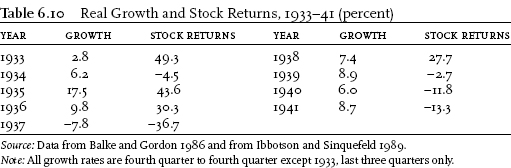
Let us accept the relevance of tariffs as a factor disrupting trade in 1929–31. United States trade barriers fell after 1934, and most research suggests that the aggregate effect of the 1929 increase was small.299 The failure of the Federal Reserve to serve as lender of last resort is generally accepted as an explanation of 1931–33 but has less relevance for the late 1930s after development of deposit insurance in 1934.
The remaining items put most of the burden of explanation on international factors, particularly exchange rate variability and absence of policy coordination. Kindleberger does not mention the misalignment of real exchange rates, discussed earlier, before and during the depression.
The problem in the 1930s, as on other occasions, was that unemployment and misaligned exchange rates required countries to choose. High employment, freedom of capital, trade, and exchange, and price and exchange rate stability could not be achieved simultaneously. Some countries sacrificed fixed exchange rates and capital mobility to increase domestic employment. President Roosevelt’s choice, in 1933–34, of domestic expansion over international stability was a major reason for United States recovery in 1934–36. International cooperation to maintain fixed exchange rates required a different set of choices. France, Belgium, Switzerland and the rest of the gold bloc made this choice until 1935. Results were poor. Deflation continued.
Policy coordination can solve problems of misalignment only if countries are willing to adjust their tax, spending, and monetary policies to benefit their partners. Given the political difficulties that many countries, including France and the United States, faced in adjusting spending and tax policies for domestic reasons, the required cooperation was unlikely.
It was also unnecessary. Exchange rate changes were a readily available substitute. To argue that exchange rate changes led to competitive devaluations misses the point. There is every reason to expect that countries seeking relative advantage through devaluation would have chosen other policies to gain relative advantage, as Germany did.
The main difficulty with Kindleberger’s argument is that it misstates the central problem. The sluggish decline in United States unemployment was mainly a result of domestic policy. The decline in the United States was larger and deeper than in the principal European countries, but the recovery after 1933 was also more robust. Chart 6.9 shows comparative data for real GNP growth in six advanced countries.
The recovery of German GNP, based on armaments and autarky, is the only one that surpasses that of the United States, and only for a few years. Until the policy mistakes of 1937, real GNP growth in the United States seemed certain to pass the 1929 level. Relative to the other developed countries, the United States recovery until 1937 was strong, not weak.
Unemployment rates tell a different story. The reported unemployment rate declined more slowly in the United States than in Europe and was much higher in 1939.300 Insufficient international cooperation cannot explain this difference. Policy mistakes in 1937 are again part of the explanation, but the United States unemployment rate remained relatively high before the 1937–38 recession, despite its relatively strong recovery. Chart 6.10 shows these data.
Wages and Profits
Recent research on wages and employment during the recovery concludes that New Deal wage and labor policy acted as a negative shock to the supply of output by raising wages and encouraging labor unions. In 1933 and 1934, as we have seen, the NIRA established codes that raised wages in many industries. Subsequently the Wagner Act (1935) strengthened trade unions and led to the organization of labor in the steel, automobile, rubber, and other manufacturing industries. Strikes and occupation of plants achieved settlements that recognized unions and further raised wages. In 1938 the Fair Labor Standards Act introduced a minimum wage and maximum hours of work.

When demand rose rapidly, as in 1935–36, profits rose despite higher wages. Hourly wages in manufacturing continued to increase in 1937 and 1938 despite the recession and the reduction in hours of work. Chart 6.11 shows that after 1938, growth of profits is much slower absolutely and relative to wages.301 Further, stock prices fell in 1939, 1940, and 1941, and prices of large company shares fell relative to small company shares, suggesting that profits were not expected to increase strongly, particularly at larger companies most subject to government and union pressures.302

Chart 6.11 compares rates of change of nominal profits and nominal wages from 1935 to 1941. Note the difference in scales. Growth of profits declined well before the 1937 recession and (based on a different data series) increased more slowly after the recession. The economy entered the recession with rising wage growth and falling profit growth. After the recession, wage growth continued to increase, contributing to the low level of optimism about future profit growth that stock prices reflected at the time.
Productivity growth appears to be a principal factor affecting stock prices, most likely by changing the growth rate of expected future earnings. Chart 6.12 shows that the two series move together from 1933 to 1938. Thereafter they diverge; productivity growth exceeds growth of stock prices after 1938. Stock price changes for this period support the finding in chart 6.11 based on the less reliable profits data. Together the two charts suggest that after the 1937–38 recession, both profit growth and expected future profits fell.
Real wages remained above average productivity through most of 1933–40. New Deal labor policies were a common complaint. If the data for manufacturing in chart 6.13 are representative of the economy, two periods dominate these years. The first, 1933–35, corresponds to the NRA period but also to the start of recovery. The second, 1937–38, includes the wages and hours legislation and mandatory minimum wages. It follows the period of militant union organizing. Following both periods, productivity remained below real wages.
The data on productivity and real wages correspond broadly to the patterns shown by profits after 1936. There are too few observations to precisely separate current and lagged effects of cyclical and New Deal changes. Nevertheless, the evidence is consistent with a number of studies suggesting that New Deal labor legislation increased unemployment rates by raising costs of employing labor (Weinstein 1981; Silver and Sumner 1995; Cole and Ohanian 1999).

New Deal labor policies emphasized demand. Proponents of these policies expected higher wages, and higher incomes, to stimulate demand through the income effect. In labor markets, as in agricultural markets, the policies ignored or minimized the effect of relative price changes, later called supply-side changes.
Political calculation and economic beliefs are not easily separated in the policy process. Particularly after 1936, the president and parts of his administration reinforced the concerns of businessmen with rhetoric suggesting that additional costly changes were more likely than a retreat from the policies that increased costs of production and lowered profits.
For the postwar years 1962 to 1984, Fallick and Hassett (1998), building on Rose 1987, test the hypothesis that unionization is a tax on capital. They find that, on average, union certification is equivalent to a thirty percentage point increase in the corporate tax rate. Applied to the 1930s, this finding suggests that rising unionism, encouraged first by the NIRA and later by the Wagner Act, may explain both rising real wages and the sluggish growth of investment in the 1930s. The possible effect is large; union membership rose from 11 percent of the labor force in 1933 to 27 percent in 1941. The largest jump came in 1937 (Freeman 1998, 292).

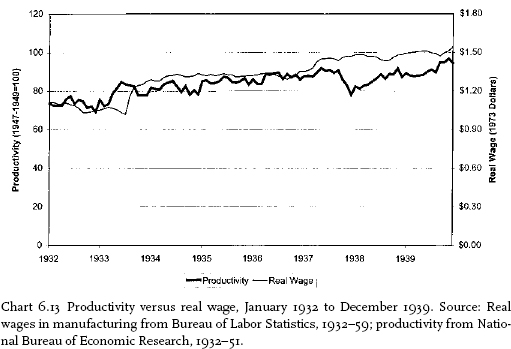
Chart 6.13 shows that real wages again rose rapidly in 1941. Yet unemployment fell, and most explanations based on the stifling effect of New Deal policies, taxation, and regulation do not apply to the defense and war period. Nor do they apply to the postwar period, when high rates of taxation and many regulations remained. If New Deal regulations are part of the explanation for the thirties, by the end of the decade their effect was probably more on prices and exchange rates than on profits. And by 1940 the president and most of his administration sought cooperation. Antibusiness rhetoric declined.
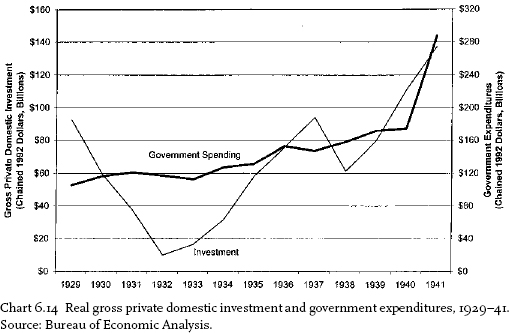
Frequent unanticipated changes in policy may have been important also. The New Deal had little coherence and little continuity. Roosevelt was proud of his commitment to experimentation and not much concerned with consistency. The NIRA and the AAA sought to raise prices. The antimonopoly rhetoric and the antitrust drive aimed to prevent price increases or to lower prices. The administration shifted also on balanced budgets, the role of gold, devaluation, and many other issues. Policy changes, reinforced by changing rhetoric, maintained a state of flux in which long-term planning was difficult.303 As Alvin Hansen remarked at the time, “Businessmen avoided as much as possible long-term capital commitments” (quoted in Roose 1954, 174).
In contrast, defense (and later wartime) spending was both larger and expected to continue longer. President Roosevelt’s declaration of an emergency in June 1940 was the beginning of a sustained program. A permanent expansion replaced temporary experiments. Output and employment responded to the permanent change and perhaps to the changes in rhetoric and practice. To manage the defense buildup, the president appointed leading Republicans—Frank Knox and Henry Stimson—to the cabinet, and leading businessmen to the new defense agencies.304 Chart 6.14 shows the increase in real government spending and private investment. The slope of the real investment line increases in 1940 and 1941.

Chart 6.15 shows one measure of the incomplete recovery. Trend real output growth, at the rate calculated for 1922 to 1929 (based on Balke and Gordon’s quarterly data), put 1940 output about 15 percent below the capacity output that would have been achieved if the 1920s trend (2.7 percent) had continued in the 1930s.305 One reason for using the 2.7 percent growth rate is that recovery from the depths of the recession was rapid to the end of 1936, 11 to 12 percent a year. If the economy had avoided the policy errors that produced the 1937–38 recession, real GNP, on this path, would have reached the 2.7 percent trend line by the end of 1938. No doubt this is an overestimate. Growth would likely have slowed as it approached the old trend. Nevertheless, much of the gap between actual and potential output would have closed before wartime spending began.

The conclusion I draw is that the 1937–38 recession is part of the explanation for the failure of the economy to fully recover. New Deal labor, and other policies, played a role. That these policies did not prevent recovery of profits, employment, and production after 1940 suggests that, if the deep 1937–38 recession had been avoided, the lasting effect of New Deal policies would have been mainly on the price level and the real exchange rate.
Money and Inflation
Money growth had a major role in the recovery and in the 1937–38 recession. Although the Federal Reserve took few actions, gold flows and gold sterilization changed the rates of growth of money and base money. Chart 6.6 (p. 529) plots the relation between quarterly values of growth in real final sales and growth of real money balances. The association is strong, although there are some large exceptions.306 The chart suggests that money growth continued to affect spending during the recovery. The chapter appendix shows some statistical analysis.
Finally, chart 6.16 shows the relation between actual inflation and the inflation predicted for 1930 to 1941 using estimates computed from the 1920s. The prediction captures the thrust of actual inflation, again suggesting that the relation of money growth to inflation remained in the 1930s. The chapter appendix shows the underlying relation.
CONCLUSION
The two outstanding features of economic performance from 1933 to 1941 are the strong recovery of output, interrupted by a deep recession in 1937–38 and the weak recovery of employment and investment spending. Together these features tell a consistent story about economic policy.
The main policy stimulus to output came from the rise in money, an unplanned and for the most part undesired consequence of the 1934 devaluation of the dollar against gold. Later in the decade, German mobilization and annexation of the Rhineland, Austria, and Czechoslovakia, the rising threat of war, and war itself supplemented the $35 gold price as a cause of the rise in gold and money.
The United States was on the gold standard after 1934 in the sense that changes in the monetary base were dominated by gold movements and the Treasury agreed to buy or sell gold at a fixed price.307 At first the Treasury agreed to sell gold only to countries on the gold standard. Later, after few countries remained on the gold standard, it bought and sold gold with other foreign governments and their agencies, but not with United States citizens.
In practice, the Treasury bought all gold offered at the $35 price and issued gold certificates to the Federal Reserve. With market interest rates low and excess reserves accumulating rapidly, the Federal Reserve and the Treasury became concerned about inflation. One response was to return to the gold sterilization policy that the Federal Reserve followed during much of the 1920s. A second response was to remove excess reserves by raising reserve requirements for member banks. In 1935 the Federal Reserve received new powers to increase reserve requirement ratios without presidential approval. In 1936 and 1937 it put the new powers to use.
The two discretionary monetary actions, coming within a brief period and supplemented by the end of the soldiers’ bonus, caused a reversal of the rapid economic recovery. The economy returned to recession in 1937–38.
As in 1920–21 and 1929–33, the Federal Reserve took no responsibility for the recession, denied that higher reserve requirements had contributed, and took no expansive actions until late in the recession. The administration increased relief payments but did not initiate countercyclical policy until spring 1938.308
The principal force for recovery from the 1937–38 recession came from the decline in prices that raised the real value of the money stock and, later, from the rise in the nominal money stock. As in 1921, both real money balances and real interest rates rose; again the expansive effect of real balances outweighed the contractive effect of real interest rates. With the release of gold from sterilization and a modest reduction in reserve requirement ratios, the nominal stock also rose, followed by a rise in spending.
Although Federal Reserve officials believed that monetary policy was impotent, and this view was widely held in the academic profession, the evidence suggests very strong effects of real money balances on real output during the recovery. (See chart 6.6, for example.) For the period 1933 to 1941 as a whole, there is very little change in monetary velocity. Using Balke and Gordon’s (1986) quarterly data, real GNP and the price deflator rose at a compound annual rate of 6.6 and 2.5 percent, respectively. The monetary base rose at a 9.7 percent annual rate, so monetary base velocity changed relatively little over the period.309 This is consistent with the small change in interest rates, particularly long-term rates. (See appendix chart 6.A1.)
Marriner Eccles headed the Federal Reserve Board from 1934 to 1935 and the Board of Governors after March 1936. Eccles was much more interested in fiscal actions, housing, and advising President Roosevelt on these and other issues than in conducting monetary policy. The Federal Reserve took very few discretionary actions. Except for doubling reserve requirements in 1936–37, it was passive through most of these years. Despite the mutual antipathy between Eccles and Treasury Secretary Morgenthau, the Treasury usually led and the Federal Reserve followed.
A main reason the Treasury could lead in monetary matters was that most of the profit from the 1934 revaluation of gold went to establish the Exchange Stabilization Fund. Morgenthau threatened to use the fund, and the Treasury trust funds, to engage in open market operations. The Federal Reserve disliked these actions, disliked being a junior partner, and feared that the Treasury would take over its functions. Morgenthau, on his side, distrusted Eccles and regarded most Federal Reserve officials as bankers of questionable loyalty to the administration. He wanted interest rates to remain low so he could market government debt on favorable terms; and he was willing to use his trust funds as a threat so that he could choose the monetary policy he wanted. These efforts were generally successful.
Treasury pressure is not a full explanation for Federal Reserve passivity and subservience to the Treasury. Board members and the Board’s principal staff believed that monetary policy was impotent. One reason is that nominal or market interest rates were low. A second reason is that excess reserves rose.
At first the appearance of excess reserves puzzled the staff and the governors. Gradually they modified the Riefler-Burgess doctrine to include excess reserves. Excess reserves replaced borrowing as the main indicator of the thrust of monetary policy and the position of the financial system. In the 1920s, the Federal Reserve considered borrowing of $500 million neutral; policy was neither easy nor tight at that level. With borrowing almost eliminated, the level of excess reserves and short-term interest rates became the principal measures of policy thrust. Both measures suggested that policy remained easy throughout the decade. Hence there was no reason for action.
One of Morgenthau’s achievements, which he valued highly for political and economic reasons, is known as the Tripartite Agreement. The agreement fixed exchange rates between the British pound, the French franc, and the dollar. Morgenthau believed the agreement showed that the democracies could cooperate politically to achieve a common end. Economically, it fixed exchange rates daily; the parties could change rates with one day’s notice.
In fact, the agreement had little economic effect. The principal reasons are that countries pursued independent policies often unrelated to the exchange rate goal and that after adjusting for differences in inflation, nominal exchange rates were misaligned. The agreement to fix nominal or market rates meant that the French government had to deflate its economy further. After years of high unemployment and repeated cuts in spending on social services and pensions, most French voters were unwilling to accept additional austerity. Even before the agreement was made, a centrist coalition had started an expansive policy. Its successor, a socialist government with Communist support, pursued expansive policies more aggressively. These policies were inconsistent with the Tripartite Agreement, so the agreement could not, and did not, accomplish much economically.
The period between 1933 and 1940 is known as the New Deal, the name President Franklin Roosevelt gave to his administration. The New Deal introduced many programs to redistribute income and initiate welfare state measures. These programs succeeded politically; the administration was reelected by a large majority in 1936 and a smaller but decisive majority in 1940.
At the time, and afterward, many economists regarded the New Deal as a failure or as less than successful (Arndt 1966; Hansen 1938; Kindleberger 1986; Morgenthau, in Blum 1965, 124). A principal reason was continued high unemployment. Between 1929 and 1940, the figure of 6.5 million new entrants in the labor force is about the same as the net increase in the number unemployed. Hours of work declined.
New Deal programs raised real and nominal wages faster than productivity or encouraged these increases. By 1940 per capita real output had returned to the 1929 level, but real wages in manufacturing were 44 percent higher than in 1929. The early New Deal prescribed wage increases through NIRA codes. When the Supreme Court declared NIRA unconstitutional in 1935, other legislation encouraged union organizing, a shorter workweek, a minimum wage, and other measures to raise wages. Similar measures in France after 1936 had a similar effect; wages and prices rose while employment fell.
Although New Deal measures help to explain the sluggish growth of employment and the persistence of unemployment during the 1930s, the long-term effect of these measures was on the price level and the exchange rate. Once the United States entered the war, employment rose rapidly.
The New Deal had a lasting effect on the organization of the Federal Reserve. The Banking Act of 1935 changed the locus of power in the Federal Reserve System by strengthening the role and powers of the (renamed) Board of Governors in Washington. Without ever reaching an explicit, collective judgment, Congress and the Roosevelt administration appear to have concluded that the policies pursued by the reserve banks, particularly New York, had encouraged speculation, leading to the 1929 stock market collapse, bank failures, and depression. Centralization of responsibility and authority in the Board, and measures to prevent security market speculation, were the chosen solutions.
Subservience to the Treasury during the recovery, and in the war that followed, limited the effect of the legislation for a time. The Treasury took control of international economic policy. Both New York and the Board had a limited role. The Board gained nominal control of open market operations and the power to approve appointment of reserve bank presidents. The new powers changed the System’s internal organization and operations in the 1930s. Major effects on policy had to wait for the postwar years.
APPENDIX: STATISTICAL RELATIONS
This appendix shows the regressions underlying chart 6.16, gives some related equations, and reproduces the chart on base velocity, highlighting the data for the 1930s recovery.
Chart 6.A1 compares base velocity to a long-term interest rate as in chapters 4 and 5. The chart notes the points for 1933–41 in relation to the long-term position of the curve. Base velocity declined as interest rates declined. Both reached the lowest values in recorded United States history.


1. GNP came very close to the 1929 peak in 1937, before the recession. Balke and Gordon’s (1986) quarterly data (in billions) have a peak of $329.7 in third quarter 1929 and $329.3 in first quarter 1937. Annual data (in 1958 prices) show $203.6 billion for 1929 and $203.2 for 1937. The annual data in 1958 dollars pass the 1929 peak in 1939.
2. President Hoover partly shared this belief. In 1930 he asked the officers of the New York Stock Exchange to reform their rules to eliminate excessive speculation. He did not believe there was constitutional authority for legislation (Fusfeld 1956, 224).
3. Several studies, beginning with Moore 1966, find that margin requirements are ineffective and have little effect on stock prices or trading. Although not recognized by the financial community at the time, some of the legislation contributed to the development of financial markets. The 1933 Securities Act improved both the quantity and the quality of information about companies, thereby encouraging widespread ownership of common stocks after growth resumed in the postwar years.
4. Benston (1990) documents the charges made against bankers, including claims of criminal activity and disregard for the public. In a superb book, he shows that the claims were either false or unsupported by evidence. At the time, each citation of evidence of wrongdoing referred to previous citations, so a reader could believe that the changes had been thoroughly researched and documented. After World War II, the United States imposed a similar system on Japan. Congress repealed these provisions in 1999 after a major bank merged with an investment bank and an insurance company.
5. Much of his campaign was an attack on Hoover’s policies. His main charges were that the Hoover administration had encouraged speculation and overproduction, misled the public about the gravity of the collapse, blamed other countries for our problems, and delayed relief and forgotten reform (Fusfeld 1956, 223). During the campaign Roosevelt favored a larger measure of “social planning” but did not elaborate (204).
6. Tugwell was an economist and Moley a political scientist at Columbia University. Along with Adolf Berle, a lawyer, they were the principals of Roosevelt’s campaign “brain trust.” Moley coordinated campaign policy statements. His specialty was crime and the administration of justice, but he worked on all domestic policy issues during the campaign (Fusfeld 1956, 210–15). Tugwell was the main advocate of planning and a tax on undistributed corporate profits that the administration later tried. Berle was a student of economic concentration. He believed that corporations must serve not just stockholders but the community, a view that appears periodically in the literature critical of the modern corporation. Although he shared some of Tugwell’s views, he was more favorable to antitrust as a solution to the economy’s problem. Instead of forming cartels under government supervision, Berle favored breaking up large firms.
7. Weinstein 1981 is a careful study of the macroeffects of NIRA. The act, signed by the president in June 1933, gave the administration power to regulate production in cooperation with business and labor unions. These groups adopted “codes” of conduct that had the force of law. In total, 557 codes were adopted (plus 188 supplementary codes), covering 95 percent of industry. The codes increased wages, reduced hours of work, and set “fair” prices (Arndt 1966, 42).
8. Keynes first advocated the plan (with Hubert Henderson) during the 1929 British election. Eccles and Currie did not seem to know that Keynes’s advocacy predated their own. As Laidler (1999) shows, deficit finance had many advocates before Keynes, Currie, or Eccles.
9. Case describes procedures at New York (interviews with J. Herbert Case, CHFRS, February 26, 1954, 3–4). The New York district had 1,200 banks, of which 30 percent had problems. Leslie Rounds, a vice president, and his staff screened each bank. The directors met all day, every day, during the bank holiday to consider his recommendations. In some cases, the RFC purchased preferred stock to restore capital and permit reopening.
10. One active participant blames Meyer for the lack of leadership. Meyer did not get along with Roosevelt and resigned in May 1933 (CHFRS, interview with Edward Smead, June 14, 1954). Smead was head of Reports and Statistics at the Board. Smead claims that Ogden Mills took control of the banks’ reopening. Await (1969, 361–63) also credits Mills with a leading role even though his term had ended. He reports that Meyer insisted on a stenographic record of all his conversations (and his staff’s) with Secretary Woodin. Woodin refused to speak to him or the staff. Await (368) attributes this behavior to concern about future embarrassment.
11. Harrison describes Adolph Miller at these meetings as “impossible . . . making long harangues—many of them quite academic and not pertinent.” Miller refused to take a position because he was there unofficially (Harrison Papers, Memo to the Files, file 2010.2, March 12, 1933, 5).
12. Harrison proposed that individuals, corporations, and others that held government bonds be allowed to borrow currency against this collateral at Federal Reserve banks. This was a major departure from precedent, but it did not solve the larger problem of reopening banks.
13. Joseph Dreibilbis gives principal credit to Walter Wyatt, the Board’s counsel, and to various ideas that “had been thought up previously.” He does not mention Harrison by name (CHFRS, Dreibilbis, March 9, 1954, 2). Await (1969) also credits Wyatt and Mills. Roosevelt’s refusal to consider deposit guarantees may have been motivated by unwillingness to endorse Hoover’s main proposal or by his belief that guarantees would increase risk.
14. A liberal reopening policy meant the reserve banks would have to lend to relatively weak banks but deflation would end. A conservative policy would leave many areas without banks; the shrinkage of money and credit would pose a risk. The directors chose a liberal reopening policy but wanted to restrict the public’s access at first to 50 percent of its deposits, gradually increasing the percentage. The Treasury wanted 100 percent of the deposits available and agreed to indemnify the reserve banks against losses (Minutes, New York Directors, March 11, 1933, 179). Out of 5,938 national banks, 5,300 reopened on March 9 (Await 1969, 360–61, 367).
15. Authority for the secretary to license banks continued until April 1947, and some banks continued to operate under Treasury license in the 1940s. Government intermediaries such as the Reconstruction Finance Corporation, the Home Loan Banks, Intermediate Credit Banks, and Land Banks reopened on March 13. Some states permitted all banks to open at once, so there were wide differences in availability of banking facilities in the country.
16. Data from Board of Governors of the Federal Reserve System (1943, 16) show a decline of 3, 871 in the number of banks (including mutual savings banks) between December 1932 and June 1933. Friedman and Schwartz (1963, 423–27) give a detailed accounting. They report only 2,132 banks closed, suspended, or liquidated between March 15, 1933, and December 31, 1936. An additional 500 banks terminated during the bank holiday to March 15. Part of the discrepancy results from differences in the definition of a bank, but the main difference arises from the difference in dates; 1,334 banks reopened between June 1933 and December 1936.
17. The banks had to meet reserve requirements and other Federal Reserve regulations while in debt to a reserve bank. The history of this bill gives insight into the way government functioned during the crisis. The Federal Reserve learned about the bill by chance, when one of its senior staff overheard a conversation between the budget director and a treasury undersecretary. The Board believed the legislation unnecessary because the Reconstruction Finance Corporation could make the necessary loans or could purchase preferred stock under the Emergency Banking Act. Senator Huey Long (Louisiana) wanted to admit all banks to the Federal Reserve System, so the Board proposed to amend the pending bill by making state banks meet the reserve and other requirements of member banks. The Board notified Senator Glass, however, that it continued to oppose the legislation.
18. The minutes of the April 19 Governors Conference also considered matters “of such a confidential nature that a written record seems to be undesirable.”
19. Calomiris and White (1994) point out the importance of an agreement between Roosevelt and the RFC regarding deposit insurance as one of the key steps in the reopening process by reducing concerns of the reserve banks.
20. Awalt (1969, n. 6) reports that Miller considered leaving the gold standard in the fall of 1932. Also, he notes that Adolph Miller discussed a gold embargo in June 1932. The discussion never went further. The Treasury agreed to repay the Federal Reserve for the expenses incurred in reopening the banks. Roosevelt had insisted on frugality, so the Treasury would not pay for the costs of shipping gold and for losses from abrasion. Some commercial banks refused to ship gold to the reserve banks unless the reserve banks paid for freight, insurance, and abrasion (memo to Morrill, Board of Governors File, box 745, October 10, 1933). The following April, the Treasury agreed to reimburse the reserve banks.
21. The 1931 hearings focused on branch, group, and chain banking. Congress could not agree on what regulation was needed. National banks were permitted to follow state rules on branching in 1927.
22. One bill (S. 806) abolished the Federal Reserve System. All deposits would be placed in a bank (with branches) authorized to issue $2 billion of new credit (approximately 25 percent of the monetary base at the time). The bank would be charged with restoring the price level to the 1915–25 range, a range that included wartime inflation (Woodin to Fletcher, Board of Governors File, box 136, May 3, 1933). The Home Loan Bank Act passed on July 16, 1932, permitted issuance of $917 million in national banknotes. Only $120 million was issued in the next year. On the same date legislation authorized Federal Reserve loans directly to individuals and businesses.
23. Originally the bill had no time limit. In January 1934 the Gold Reserve Act limited the authority to two years.
24. The legislation became part of the Agricultural Adjustment Act because the act sought to raise farm prices by restricting output. The Thomas amendment added a demand side policy to raise farm prices. The amendment passed the House 307 to 86 and the Senate 64 to 21, more than enough to override a veto.
25. Black knew Roosevelt from Roosevelt’s frequent trips to Warm Springs, Georgia. He did not intend to stay in Washington and went on leave from the Atlanta bank. His salary at the Board was about half his salary at Atlanta, and though he opposed deflation, he did not favor the administration’s “inflationary policies.” Unlike Meyer, he favored expansion, so he resumed open market purchases, but he opposed devaluation of the dollar (Katz 1992, 14–24).
26. Duncan Fletcher (Florida) became chairman of Banking and Currency, but power and authority rested with Glass. Glass became chairman of a subcommittee with authority to formulate banking and monetary policies. All members of the committee were also members of Glass’s subcommittee, and all legislation affecting banking and the Federal Reserve went through his subcommittee. In the House, Henry Steagall remained as chairman of the Banking and Currency Committee. Before the 1932 election, the Republicans controlled the Senate but not the House after 1930. Senator Peter Norbeck (South Dakota) was chairman of the banking committee, but he allowed Glass to chair the subcommittee on banking legislation (Patrick 1993, 42–43).
27. Chester Morrill, for many years the Board’s secretary, reports that bankers strongly opposed Willis’s draft legislation. Early in 1932, “Meyer exposed his weakness as a draftsman.” Willis resigned (CHFRS, interview with Chester Morrill, May 20, 1954, 4–5).
28. The reference to “foreign central banks” referred mainly to Strong’s assistance to the Bank of England, which Glass regarded as violating the principles of the Federal Reserve Act. Parts of the colloquy are summarized in chapter 4. Miller supported Glass’s argument for greater Board supervision and responsibility for open market operations but did not argue for the Board’s taking responsibility for relations with foreign central banks (Senate Committee on Banking and Currency 1931, 159).
29. In his letter to Congress about the proposed bill, Meyer offered a strange proposal suggesting that reserve requirements be based on deposits and deposit turnover—debits to deposit accounts. The intention was to penalize speculative credit by taxing overnight or short-term borrowing and repayments (Board of Governors File, box 142, March 29, 1932). The proposal penalized a bank for its customers’ decisions.
30. One-bank holding companies were inadvertently omitted. This omission was corrected in 1956.
31. Restrictions on interest payments reflected the belief that banks had made speculative and unsound loans to increase earnings and pay interest. Benston (1964) shows there is no evidence for this belief. The Board opposed the prohibition of interest payments as a major change whose consequences could not be foreseen. Glass told them he did not need their views, since he knew them (Board Minutes, April 10, 1933, 24; April 13, 1933, 16).
32. Kane and Wilson (1998) show that elimination of double liability helped shareholders of large banks during the recovery.
33. Winthrop Aldrich was the son of Senator Nelson Aldrich, who played a leading role in establishing the Federal Reserve. He had become chairman of Chase by opposing financing through an affiliate and favoring conservative banking. At Chase, he replaced Albert Wiggins, a longtime director of the New York reserve bank.
34. As noted above, Benston (1990) shows that there was little if any evidence to support the charges. Calomiris (1997, 11) summarizes research as showing “that securities underwriting by banks prior to 1933 was at least as honest as securities underwriting outside of banks.” Securities operations diversified bank risks, hence lowering risk. See also Rajan (1992), who points out that banks realize informational economies by combining lending and underwriting securities. If there is conflict of interest, this gain could be a loss to customers.
35. In 1932, with the help of Speaker John Nance Garner, later vice president, a deposit insurance bill passed the House. Glass was opposed, so the bill died (Kennedy 1973, 214). See Calomiris and White 1994 for a thorough discussion of Steagall’s role.
36. The Banking Act of 1933 made the fund permanent beginning July 1934, but later amendments postponed the start of permanent operations. The fund had independent directors, one of whom was the comptroller of the currency. Hence, until 1936 the comptroller served as a member of the Federal Reserve Board and as a director of the FDIC.
37. Earlier, there is a Board staff memo that recognizes the need for a new policy because of failure to stop bank runs. The memo discusses a guarantee of deposits and a policy of marking deposits to the market value of bank assets. The memo also considers the use of clearinghouse certificates in a crisis (memo Riefler to Goldenweiser, Board of Governors File, box 2222, February 23, 1933). The memo, written during the crisis, is concerned mainly with current problems.
38. There are several histories of deposit insurance and the legislative battle. A main conclusion is that the proponents were mainly small rural banks and their representatives, who expected to gain; the opponents were led by large city banks who expected to subsidize the small banks. After the bank holiday, the public overwhelmingly supported insurance, partly in the hope of repayment of losses, partly because many blamed Wall Street and big bankers for the depression. With Vandenberg’s intervention, the issue was likely to be a major issue in the 1934 campaign. Glass, who had opposed deposit insurance for years, urged Roosevelt to accept it. See Calomiris and White 1994 and Golembe 1960.
39. Friedman and Schwartz (1963, 442) call deposit insurance far more important than reform of the Federal Reserve, but they recognize that some of the reduction in bank failures resulted from FDIC actions to merge failing banks rather than permit failures (440).
40. Glass’s view was widely held. One of the Board’s senior economists, Woodlief Thomas, claimed: “More effective control of stock-market credit is necessary for business stability. Adequate control may be exercised over the supply of funds only by making stock-market activity the principal guide of credit policy” (Thomas 1935, 21).
41. Chicago supplied $150 million, Cleveland $50 million, Boston $20 million, St. Louis $15 million, and Richmond $10 million. Boston also bought $15 million from Philadelphia. New York paid a fine of $10,200 for violating the reserve requirement.
42. John H. Williams joined the New York bank as assistant Federal Reserve agent on May 1. Williams taught economics at Harvard. He had considerable influence on policy throughout a long career at the Federal Reserve and was an ardent proponent of international coordination under the gold standard (Tavlas 1997, 168–70).
43. Dallas did not participate in some of these purchases.
44. Letters and telegrams from Governor Seay (Richmond) to Burgess and Black make Richmond’s reluctance to participate clear. He participated, nevertheless, because of the “inflation bill” (Thomas amendment) then in Congress. Seay wrote that he preferred to purchase securities directly from the Treasury because it would be “credit inflation pure and simple” (Seay to Burgess, Open Market, Board of Governors File, box 1437, May 8, 1933).
45. The meeting was held on the day the National Industrial Recovery Administration announced policies to raise prices and wages. The stock market broke under this news. The decision to purchase may have reflected these developments or renewed bank failures and rising demand for discounts (Minutes, New York Directors, July 20, 1933, 113–15).
46. Roosevelt appointed a special committee to consider monetary policy. He asked the committee to recommend issuing greenbacks under the Thomas amendment. The committee did not want to go along, so the president withdrew the request and asked, instead, to have open market purchases of $50 million.
47. In a memo to his files, Harrison reports Black’s statement more fully. “He said that there is persistent and insistent pressure in Washington for immediate inflation, not for inflation in two or three weeks, but for inflation at once” (Harrison Papers, file 2210.3, September 16, 1933, 2; emphasis in the original). Black named Senator Bryan P. (Pat) Harrison, the majority leader, and Senators Elmer Thomas, Ellison D.Smith, and Duncan Fletcher as proponents of inflation. He had talked to Senator Harrison, who wanted more done than the Federal Reserve was doing. Black also wrote to Jesse Jones at the RFC and urged him to purchase $600 million of preferred stock to reopen closed nonmember and member banks by January 1.
48. In April the FOMC changed allocations of government securities to give more securities to banks with larger gold reserves. The change shifted the allotment by reducing New York, Kansas City, and Dallas. Chicago went from 12 percent to 36 percent. New York’s percentage was 15.25 percent (McKay to Black, Board of Governors File, box 1449, September 12, 1933). Hitherto New York had always taken the largest share.
49. Woodin was ill and resigned. Morgenthau became secretary on January 1, 1934.
50. Harrison took a different attitude toward commercial bank bond purchases. In January he called on Winthrop Aldrich to discuss sales of governments by Chase National. He told Aldrich Washington believed that “New York banks were selling ... as part of a conspiracy to depress government bonds and thus to defeat the government’s program.” Aldrich agreed to cooperate (Harrison Papers, file 2500.1, January 9, 1934).
51. The risk premium is the difference between Baa and Aaa bonds. Output data are from Balke and Gordon 1986. Monthly data for industrial production, wholesale prices, and common stocks show similar patterns. Industrial production rose 57 percent between March and July, then faltered. By November, half the initial rise was gone. Wholesale prices rose 18 percent between March and August, then remained unchanged for the rest of the year. The stock market peaked in July, 80 percent above the March average. By November the average was 16 percent below its peak. The NRA was the proximate cause of the stock market decline from its peak. Announcement of the first codes raising costs of production in mid-July precipitated the decline (see below).
52. Between March 4 and March 22, $250 million in gold coin and $310 million in gold certificates returned to Federal Reserve banks (Draft Statement of Executive Order Forbidding the Hoarding of Gold Coin, Board of Governors File, box 2160, April 2, 1933). The statement was issued on April 5.
53. The shift in policy appears to have been a sudden change, supporting the view that the Thomas amendment played a major role. Two weeks earlier, Harrison and the New York directors had discussed possible resumption of gold payments and a fixed parity. Harrison acknowledged, however, that he did not know the administration’s plans (Minutes, New York Directors, April 3, 1933, 253–54).
54. April 19 is also the day Roosevelt agreed to accept the discretionary powers to print greenbacks granted by the Thomas amendment and talked about depreciating the dollar to raise the domestic price level.
55. The stock market boom ended on July 19. The Dow Jones average fell 4.8 percent that day and an additional 15.5 percent in the next two days, eliminating half the gain since April 18. On July 19 the NIRA announced an increase in wages and reductions in hours. Sumner (1995, 18–19) computes the increase in nominal and real wages as 20 percent in the two months from July to September 1933, using the wholesale price index as the deflator for average hourly earnings. Weinstein (1981, 267) estimates that the NIRA codes raised nominal wages 26 percent a year for the two years of NRA existence and raised prices by 14 percent a year.
56. The group of three hundred included Henry Morgenthau Sr., father of one of Roosevelt’s closest advisers, soon to become secretary of the treasury. Other members included the heads of Sears, Roebuck, Remington Rand, and several banks. Earlier, on April 5, an executive order prohibited domestic gold holding of more than $100 (except for industry and the arts).
57. Gold clauses became common after the Civil War, especially after de facto stabilization in 1879 at the gold price of $20.67 per ounce. The clause specified payment “in gold coins of present standard weight and fineness,” that is, 23.22 grains of gold to the dollar (Pearson, Myers, and Gans 1957, 5598).
58. The Lausanne conference ended German reparations payments permanently.
59. Warren was a professor of agricultural economics at Cornell, where Henry Morgenthau Jr. had been a student. Morgenthau introduced Warren to Roosevelt as an agricultural adviser in 1930. Warren kept a diary of his meetings with Roosevelt and others in 1933–34. The diary is the basis for large parts of the paper by Pearson, Myers, and Gans (1957) on which I draw heavily. Warren served as a consultant and did not hold any position in the administration. Fisher wrote to Roosevelt, sometimes by request, but he did not participate in the principal policy discussions within the administration, as Warren did, and he was not an adviser.
60. Sprague also favored increased government spending, especially on construction (Pearson, Myers, and Gans 1957, 5649). In the 1920s he testified in Congress against bills to make price stability a goal of the Federal Reserve. He was always skeptical of linkage between money and prices and opposed Fisher’s compensated dollar. Other prominent opponents of devaluation included James Warburg, son of Paul Warburg, a member of the original Federal Reserve Board, Herbert Feis, economic adviser to the secretary of state, and the budget director, Lewis Douglas.
61. Kindleberger (1986) summarizes many of the proposals for tariffs, public works, and currency stabilization. The discussion shows disagreements on major issues that were unlikely to be resolved by a multinational conference. War debts were ruled out of the discussion, but they were important to Congress and to the United States public, so the United States delegation was unwilling to consider any of the proposals calling for additional international lending.
62. Warburg’s proposal probably refers to the proposal drafted by James Warburg and Oliver Sprague, calling for a return to a gold standard with different rules. Gold would not circulate but would be held only by central banks and governments. Gold reserve ratios supporting currency would be adjustable, not fixed. Silver would supplement gold as a reserve metal.
63. Cotton and wheat prices were back to levels not seen since 1930 or 1931 (Kindleberger 1986, table 16).
64. Real exchange rates are obtained using relative wholesale price indexes to adjust for differences in inflation. Eichengreen (1992, 318) agrees that Roosevelt was not wholly to blame for the failure. He blames differences in analysis of the problem and domestic political considerations. The latter have a role, but I believe there was a common view about the gold standard and fixed exchange rates. The hard issues were where new exchange rates would be set and whether prosperity could best be restored by reflation or further deflation.
65. The French Treasury delegation included Émile Moret, governor of the Bank of France, and Jacques Rueff a strong proponent of the gold standard. In the 1960s, Rueff as an adviser to President Charles de Gaulle, took positions similar to those he had taken in the 1930s. At London, government officials met separately to work out a government position, then met with the central bankers.
66. The working assumption was that they would. Chart 6.1 suggests that starting in 1933 might have required large changes in the relative price levels of the three countries.
67. Morgenthau gives credit to Louis Howe and Eleanor Roosevelt (Blum 1959, 65).
68. The authorization to intervene was for two weeks, ending July 28. By that time the dollar had fallen, so the authorization ended.
69. Warren recorded Viner as favoring a return to the gold standard following an international conference to fix the price of gold. Strangely, Warren did not believe that central banks could fix the price of gold by joint action (Pearson, Myers, and Gans 1957, 5628–29).
70. The Treasury had established a committee on monetary policy under James Warburg. The committee included among its members Black and Harrison from the Federal Reserve and Walter Stewart. They opposed the devaluation policy but did not propose an alternative.
71. Pearson, Myers, and Gans (1957, 5633–34) report from Warren’s diary that Roosevelt continued to talk about greenbacks and silver as well as gold. Warren warned against other methods as ineffective. The reason for Roosevelt’s strong interest is the fall in commodity prices. Wheat at 75 cents a bushel was 50 cents below the summer peak, corn was back to the April price, and cotton, at 9 cents a pound, was 25 percent below its summer peak. The pressure from farm organizations and Congress for inflation rose as farm prices fell. Woodin objected, and the monetary committee including Sprague, Rogers, and Harrison tried to stop the planned devaluation.
72. Roosevelt bypassed the legal issue by citing “the clearly defined authority of existing law.” Roosevelt seems to have accepted some part of Fisher’s debt-deflation theory.
73. Governor Black, who was at the meeting, told the president that small purchases would not be effective and large purchases would have serious repercussions abroad. He offered to cooperate, however, if the president decided to proceed. Harrison seconded his statements. Neither man said what he would do (Harrison Papers, file 2010.2, October 30, 1933, 4–5).
74. Each morning Morgenthau, Warren, and Jesse Jones, head of the RFC, met in Roosevelt’s bedroom. Morgenthau reported the previous day’s prices of gold and commodities. Roosevelt chose a new gold price for the day. The aim was to keep the gold price rising. On Roosevelt’s announcement the price in London rose from $29.01 to $31.02. Roosevelt set the first buying price at $31.36. The daily price changes were always positive, but the increments varied to fool the speculators (Blum 1959, 69). In fact, it made little sense to fool the speculators. One day he raised the price by 21 cents because that was a lucky number, three times seven (ibid., 70). Pearson, Myers, and Gans (1957, 5643) quote a slip Roosevelt gave to Warren with the words “Oct. 30. I think 31.96 is right for today. FDR.”
75. Six young Harvard instructors, led by Lauchlin Currie, sent a letter to Roosevelt supporting devaluation of the dollar as essential for Roosevelt’s expansionist policies, but they dismissed Warren’s argument closely linking the price of gold to commodity prices (Pearson, Myers, and Gans 1957, 5653; Sandilands 1990, 56–57).
76. On November 16, Roosevelt accepted Acheson’s undated letter of resignation and appointed Morgenthau as his successor. Since Woodin was ill, Morgenthau became acting secretary and, after Woodin’s resignation, secretary on January 1, 1934.
77. Norman recognized, as Harrison apparently did not, that, if successful, the “domestic operation” would raise the gold price and lead to increased United States exports, fewer imports, and a flow of gold to the United States. This would initially force appreciation and deflation on all gold standard countries.
78. Roosevelt blamed the French problems on their failure to balance their budget for three years. He told Harrison that he did not expect them to remain on the gold standard. Harrison urged him to stop gold purchases temporarily to help the French, and Roosevelt agreed (Harrison Papers, file 2012.4, November 22 and 23, 1933).
79. Harrison made several proposals, on his own initiative, to stabilize exchange rates (Harrison Papers, file 3115.4, November 15, 18, December 1). At one point (December 1) Norman was willing to approach the British Treasury with a proposal to stabilize the exchange rate at the former rate, $4.86. Norman and Harrison also discussed the possibility of exchange controls. Harrison’s concern was with inflationists in Congress when Congress returned in January.
80. The memo also reports that Roosevelt and Morgenthau were concerned about capital flight as rumors of an impending devaluation spread.
81. Morgenthau’s evaluation was that success had been partial, but the changes “did not restore the balance between agricultural and industrial prices that Warren had hoped to redress” (Blum 1959, 75). Morgenthau’s views are consistent with Harrison’s reports suggesting that Roosevelt had achieved most of his objective. Warren cites criticism of the program at home and abroad by the AFL, the Chamber of Commerce, bankers, numerous economists including J. M. Keynes, and many members of Congress (Pearson, Myers, and Gans 1957, 5649–55).
82. Jacob Viner, on Morgenthau’s staff, explained the differences between domestic and foreign gold prices in the same way Warren did (Blum 1959, 120). The United States gold purchases abroad were not large enough. Roosevelt and Morgenthau did not seem to understand that devaluation and a fixed gold price would bring the domestic and world gold prices together at the fixed price, and raise the dollar prices of commodities commensurately if the United States maintained the higher gold price by buying all gold offered at the price. The United States gold price would become the world gold price, so dollar prices of commodities would rise.
83. There was not much precedent. Congress had reduced the weight of the gold dollar by 6 percent and fixed its value in 1834. The dollar had floated during and after the Civil War, but the gold parity did not change.
84. The reserve banks, as legal owners of the gold, hired Newton Baker, a longtime outside counsel, to negotiate a compromise with the administration. The banks accepted that the profit belonged to the Treasury. They proposed that, at the time of devaluation, the Treasury should exchange gold for gold certificates. The profit would go to the Treasury, but the gold would be returned in exchange for the gold certificates once the devaluation was completed. Congress would pass legislation approving the devaluation and the exchange. Otherwise several banks would not surrender their gold and others would do so under protest unless the banks’ directors approved the transfer. The banks’ directors were concerned about their fiduciary responsibility as representatives of the shareholding banks.
85. Black testified in executive session, so his criticisms are not part of the hearings on the bill. He read his testimony to the Board before presenting it. His statement outlines the dispute with the administration before the bill (Board Minutes, January 20, 1934, 280–81).
86. Other opponents believed there would be serious inflation if the dollar was devalued. Edwin W. Kemmerer of Princeton feared that insurance and endowments would be wiped out (Senate Committee on Banking and Currency 1934, 213). Walter Stewart said the bill would “scrap the Federal Reserve System” (358).
87. As the vote suggests, many Republicans voted for the bill on final passage. Robert A. Taft, son of a former president and a leading Republican member of Congress, was more active in defending the gold clause than opposing the devaluation (Patterson 1972, 152).
88. The official price of gold rose from $20.67 to $35, an increase of 69.3 percent. In terms of grains of gold, however, the devaluation is from 23.22 to 13.71 grains, or 59 percent of 23.22. This is the equivalent of a devaluation from 25.8 to 15.238 ounces, nine-tenths fine.
89. By the end of December 1933, gold coin in circulation had fallen to $24 million from $181 million a year earlier.
90. In addition, the Treasury issued $180 million in gold certificates to the Federal Reserve for gold that the Federal Reserve purchased in January. The Board’s counsel ruled that the reserve banks could “safely comply” with the requirement to transfer their gold to the Treasury (Wyatt to Black, Board of Governors File, box 164, January 30, 1934). The transfers were made the same day, so that all domestic gold was held by the Treasury when the dollar price of gold changed. Devaluation did not change the monetary base. The increase of $2.8 billion in the value of gold certificates offset an increase in the liability “general fund in gold” included as part of the liability “Treasury cash.”
91. The price at which the Treasury coined silver, $1.29, was the equivalent at a sixteen-to-one ratio to $20.67 per ounce of gold. Warren claims that Morgenthau and Roosevelt believed silver purchases would raise commodity prices (Pearson, Myers, and Gans 1957, 5663). Seigniorage on silver (arising from the difference in the prices at which the Treasury purchased silver and issued coins and certificates) rose from $80 million in 1934 to $181 million in 1935. For the years 1934 to 1940, seigniorage on silver was $600 million (Board of Governors of the Federal Reserve System 1943, 515).
92. On August 9, 1934, by proclamation, President Roosevelt ordered all silver not used as coins or in arts and manufacture to be sold to the Treasury (Krooss 1969, 4:2833–35).
93. The problem for China is discussed as early as December 1934 (Minutes, New York Directors, December 6, 1934, 29).
94. On August 14, to hold the price near 65 cents, the Treasury purchased more silver in one day than the entire production in the United States in 1934 (Blum 1959, 195).
95. In his diary he called the policy “stupid.” He was particularly incensed by the encouragement to smuggling of silver from China to Japan for sale to the United States (Blum 1959, 196).
96. Perhaps for reasons such as this, economists who associate inflation with low unemployment typically ignore the 1930s.
97. He left in August. Hyman (1976, 154) attributes his resignation to the much lower salary at the Board. His lasting contribution to the Federal Reserve was to start planning for the Board’s own building. The Board and its staff were scattered in offices at the Treasury Department and in buildings around Washington. In July 1934 the Board approved an assessment on the reserve banks to build the Board’s building (Minutes, New York Directors, July 5, 1934, 11). Black died in December 1934, a few months after his return to Atlanta.
98. “As I looked to the business and financial leaders .. . their stock reply was that a deflation in values, and a scaling down of the debt structure to meet existing price levels, would in time create a self-corrective force” (Eccles 1951, 71).
99. Eccles in 1935 accepted the much-used phrase “pushing on a string” to describe his belief about expanding credit and money in deep recessions.
100. Gross investment had fallen $26 billion from the 1929 peak.
101. Although Eccles advocated a national planning board, he opposed the NRA price-and wage-raising schemes. He was glad when the Supreme Court declared the NRA unconstitutional (Hyman 1976, 153).
102. As noted earlier, Roosevelt categorically rejected deficits but then added that he would tolerate a deficit to relieve “starvation and dire need.” Eccles (1951, 98) claims that Samuel Rosenman, who edited Roosevelt’s papers, tried to reconcile Roosevelt’s deficits with his 1932 speech by claiming that Roosevelt meant only the administrative costs. Eccles viewed Roosevelt as a “budget-balancer” who regarded a balanced budget as “a self-contained good” (98).
103. Eccles was highly critical of wartime deficits. He favored deficits only to make up for a shortfall of private investment. Although his proposals for deficit finance are similar to Keynes’s views after 1928, Eccles claimed never to have read Keynes’s main work.
104. His service as head of the Federal Reserve ran from November 15, 1934, to January 31, 1948, when President Truman replaced him as chairman. He remained as a member of the Board until July 14, 1951. Eccles believed that his pursuit of antitrust charges against Transamerica Corporation angered powerful political and banking interests in California during the 1948 election year. This, combined with his antagonistic relationship with Treasury Secretary John W. Snyder, a friend of the owners of Transamerica, may have led to his dismissal (Eccles 1951, 450–53). The dismissal was the subject of a congressional hearing, but the reason was not firmly established.
105. A contemporary describes Morgenthau as “suspicious” and irritable, Eccles as a person ofcontradictory enthusiasms.” “Heloved the freedom . . . which allowed him to get very rich, and at the same time, a born centralizer” (CHFRS, interview with Casimir Sienkiewicz, March 18, 1954, 3). Sienkiewicz worked in the Federal Reserve System from 1920 to 1947. Jacob Viner describes Eccles as a “voluble talker” who “talked for hours at a time.” Morgenthau “had no patience with Eccles. The two men grated on each other.” Viner, like Sienkiewicz, described Morgenthau as a “suspicious man” but also as decisive in the early days (CHFRS, interview with Jacob Viner, March 17, 1954, 3–5). Currie (1971, 2) adds that “Morgenthau disliked Eccles intensely.”
106. Clashes were not limited to spending and budgets. Eccles was often involved in government policy. One of the principal clashes with lasting effect arose in 1936 over the undistributed profits tax. Eccles proposed his own version and actively worked against the Treasury’s proposals.
107. Currie (1968, 39) concluded that “there is no valid theoretical justification for the Commercial Loan Theory of Banking” (real bills). He found that the Federal Reserve had never defined “productive credit” or distinguished productive from nonproductive credit except by casual inference (39). Currie also favored 100 percent reserve requirements against demand deposits and zero against time and savings deposits (151). He favored control by a three- or four-person board, in Washington, with reserve banks reduced to branches of the central bank and with all banks required to be members of the System. He recognized that expanding the Board’s control was useless (or worse) unless it gave up quality of credit (real bills) as a guiding principle. Its goal should be control of spending by controlling money—currency and demand deposits (157). He repeated some of these points in different form in a long memo to Secretary Morgenthau written in September 1934 (197–226). The memo contains many of the same points but differs from his book, notably by calling for government ownership of the reserve banks. Morgenthau’s diary does not mention the memo.
108. Until 1936, each bank’s directors appointed the bank’s governor without approval by the Board. The Board approved salaries, however.
109. Roosevelt failed to clear the appointment with Carter Glass, increasing the animosity that Glass held toward Eccles. Up to this time Eccles had not had to resign from any of his business activities. After the appointment, Eccles resigned as president of First Security Corporation and First Security Bank and sold his stock. But he was legally permitted to retain positions as chairman on leave of the Utah Construction Company, vice president and treasurer of the Amalgamated Sugar Company, and president of the Eccles Investment Company. He attended directors’ meetings of the latter companies throughout his Washington career (Hyman 1976, 160).
110. Eccles several times charged Glass with changing sides, from fighting the “interests” in 1913 to defending them in 1936 (Eccles 1951, 179, and elsewhere).
111. The statement that irritated Eccles was issued in September just before the 1934 congressional elections. The statement demanded a balanced budget. Eccles regarded the statement as a political document issued to embarrass the administration.
112. Relations were rarely good. In September, before Eccles’s appointment, Harrison discussed relations with the Board “and the possibility of their improvement” (Minutes, New York Directors, September 17, 1934, 171).
113. There were many other proposals for change. One bill by Senator Elmer Thomas (Oklahoma) established a government-controlled system by purchasing all stock of the reserve banks. The System’s objective would be to “control the price of commodities through control of the purchasing power of money” (Board of Governors File, box 141, S. 433, undated). A bill offered by Senator Gerald P. Nye (North Dakota) created a central bank with representatives elected from each state for twelve-year terms. The bill also imposed 100 percent reserves against demand deposits and 5 percent against time deposits (ibid., S. 2162, March 4, 1935).
114. In addition to Harrison, the committee included two former governors of the Reserve Board, Black and Young, Norris (Philadelphia), two representatives of the Cleveland bank, and G. J. Schaller, who had replaced James McDougal at Chicago. The only Board member was J. J. Thomas, recently arrived as vice governor of the Board. Its advisers, Emanuel Goldenweiser and John H. Williams, were responsible for the drafting. Most members of the committee had participated actively in policymaking during the depression, so the committee was almost certain to find lack of power, not errors, as the reason for the System’s failures.
115. An early draft drew a strong response from George James, a member of the Board (1923–36), who was not a committee member. Describing the drift as “one man’s offhand opinion,” James criticized most severely neglect of “investment speculation on the part of member banks. In my humble opinion this very factor was one of the major causes of the recent banking difficulties” (memo James to Board, Board of Governors File, box 142, October 2, 1934).
116. The section on credit control concludes: “The record of the System shows that it has always functioned in the spirit of its constitution as an institution vested with the public interest” (Preliminary Report of the Committee on Legislative Program, Board of Governors File, box 142, October 16, 1934, 5).
117. Unification of examination standards was not achieved until 1938. The report showed awareness of moral hazard. It recommended that liquidation of failed banks take place “before the equity has been absorbed,” but it made no proposal about how this could be done or how to avoid dissipation of the assets of failed or failing banks.
118. The preliminary report ignores the dispute between New York and Washington in October 1929, when New York acted independently, and the subsequent criticism by Young and the Board. See chapter 4. “The Federal Reserve promptly cushioned the decline [in stock prices] by promptly. . . buying securities on a large scale. During the depression it purchased . . . in unparalleled volume and thereby enabled the member banks not only to meet the drain of currency. . . . [but] to reduce their indebtedness to the Reserve banks to negligible proportions” (Preliminary Report, Board of Governors File, box 142, October 16, 1934, 8). The last statement shows the continuing influence of Riefler-Burgess views.
119. Currie had studied at the London School of Economics before receiving a Ph.D. at Harvard. At Harvard, he met Ralph Hawtrey a visiting professor who had done pathbreaking work in monetary economics, emphasizing the role of money in cyclical fluctuations. Currie’s work (1968) blamed the Federal Reserve for the depth and severity of the depression, anticipating the later critiques by Warburton (1948) and Friedman and Schwartz (1963). See Sandilands 1990, Laidler 1993, and Brunner 1968.
120. “By and large the concern of the banking authorities in this country has been with the composition of bank assets” (Currie 1968, 35). Currie pointed out that, probably because it was difficult to do, the Federal Reserve had never defined “productive credit” (39).
121. The Board would consist of experts who would publish quarterly reports containing diagnosis of current conditions, expectations about future trends, “an account of its current policy which not only explains why it is being pursued but also what it hopes to accomplish thereby” (Currie 1968, 215). This proposal anticipated the decisions in New Zealand, Sweden, Britain, and elsewhere in the 1990s when central banks in these countries adopted inflation targets. It took many years before central banks surrendered enough secrecy to provide information about their current and prospective activities.
122. The 1934 FDIC law provided permanent deposit insurance on July 1, 1935, up to $10, 000, 75 percent insurance for accounts between $10, 000 and $50, 000, and 50 percent above $50, 000. Title 1 limited insurance to $5, 000. Title 1 also gave the FDIC power to restrict entry. Warburton (1966, xiii) explains that the premium for deposit insurance, 0.083 percent, was set to cover depositors’ losses from bank failures except in deep depression of the 1870s, 1890s, and early 1930s.
123. Morgenthau saw the bill as a means of wresting control of monetary policy from bankers. Roosevelt shared this view. In October 1933 he said: “Some members of the banking fraternity . . . do not want to make loans to industry. They are in a sullen frame of mind hoping by remaining sullen to . . . force our hands” (quoted in Blum 1959, 343). See the earlier reference to Chase National Bank and Harrison’s discussion with Winthrop Aldrich, its chairman. Morgenthau and Roosevelt saw this opposition of New York banks and large insurance companies as the dominant influence on the open market committee and the New York reserve bank (343).
124. The title of governor is not written into the Federal Reserve Act. The reserve bank directors created the position and gave the title to the banks’ top officials.
125. Other provisions of title 2 reduced terms for reserve bank directors to six years, raised salaries and provided pensions for future members of the Board, repealed collateral requirements for Federal Reserve notes (extending the 1932 Glass-Steagall provisions), expanded authority to raise or lower reserve requirements, and made other technical changes (House Committee on Banking and Currency 1935, 185).
126. The House had already adopted this plan, but Eccles’s testimony angered Morgenthau. He distrusted the Federal Reserve Board, in part because of its unwillingness to further reduce interest rates in 1934 (Blum 1959, 346–47). They “lacked courage” (348). Glass tried to use the opportunity to get Morgenthau to withdraw support, but after talking to Roosevelt, Morgenthau decided to support government ownership of the reserve banks and the principle of placing the open market committee under the Board’s control. He did not endorse a specific compromise because Roosevelt had not yet made a decision (349). Throughout the spring Roosevelt was cautious about endorsing title 2. At one point he led Glass to believe that he did not care about title 2 (347, 349).
127. Elsewhere in his testimony, he reaches the same conclusions by arguing that an inequitable distribution of wealth results in “excessive savings” in the expansion phase, hence too little consumption (House Committee on Banking and Currency 1935, 241). Government can help to stabilize by taxing away the excess saving, thereby increasing monetary velocity and spending.
128. In the 1920s, Goldsborough proposed Irving Fisher’s rule for price stability. See chapter 4. In 1932 he proposed expansive operations to raise the price level. He took an active part in the hearings on the Banking Act of 1935. Commenting on Federal Reserve purchases in 1932, Goldsborough said, “They continued [purchases] until the danger of the passage of the Goldsborough bill was over, and then it immediately stopped” (House Committee on Banking and Currency 1935, 209).
129. This is a remarkable shift from the hand-wringing in 1928–29 about inability to stop the “speculative” excesses. Before testifying, Eccles held a press conference. Contrary to his testimony, he gave as two main reasons for the banking bill “to accelerate the rate of economic recovery . . . [and] to prevent the recurrence of conditions that led to the collapse of our entire banking structure” (Eccles 1934–37, press conference, February 8, 1935, 1).
130. Although the idea of a liquidity trap is now associated with Keynes (1936), Eccles’s 1935 testimony shows that the idea was older. Keynes may have acquired the idea from bankers.
131. Currie seems to have shared this view. Although he analyzed the Federal Reserve’s failure to expand as a consequence of adherence to the real bills doctrine and neglect of the falling money stock, he does not seem to have pursued this view at the Federal Reserve. He devoted much of his research after 1935 to developing measures of fiscal thrust and the case for unbalanced budgets (Sandilands 1990, 68–78). Later, he described his 1934 book as “partly obsolete when it was published” (Currie 1971). The reason he gave was that money (deposits) depend on member bank borrowing, and there was no borrowing. This is an odd conclusion.
Currie worked as Goldenweiser’s deputy, but he reported directly to Eccles. Goldenweiser could (and did) prevent him from publishing some of his work, but he could not prevent him from urging expansive monetary policies or avoiding the doubling of reserve requirement ratios in 1936–37 if he had chosen to do so. Currie described Goldenweiser as laying down “a rule that nothing can be published by the division which he does not understand, which limits the possibilities seriously” (Currie 1971, 79). It is difficult to understand why Eccles retained Goldenweiser in his position and adopted many of his ideas about excess reserves. Currie noted in a 1934 letter to Eccles that Goldenweiser believed that the Federal Reserve had been too inflationary in 1931. They (the staff) are “not interested in money and have never completed a series on money” (68–69). Of course, Goldenweiser disliked Currie’s criticism of policy from 1929 to 1933 and thought it tainted by what would later be (loosely) called “monetarism.” In a 1935 letter to Viner, Currie complained that Goldenweiser vetoed publication of an article on income-increasing government spending.
132. Roosevelt worked behind the scenes, but not openly, to assist passage. He had the Senate add three new members to the banking committee and secretly encouraged Senator Duncan Fletcher (Florida), chairman of the whole committee, to hold hearings with the whole committee instead of Glass’s subcommittee. The latter effort failed. It violated the spirit and possibly the letter of the agreement under which Glass gave up the chair of the Banking Committee to take the Appropriations Committee.
133. He also began an investigation of whether Eccles remained connected to his banks and therefore ineligible (Hyman 1976, 174–75).
134. At first he ignored Eccles and invited Chairman Leo Crowley of the FDIC and Comptroller J. F. T. O’Connor. Both favored separating title 2 and promptly passing titles 1 and 3. Both Crowley and O’Connor opposed title 2. Morgenthau disliked both of them, but both had support in Congress (Hyman 1976, 345–46). O’Connor had been a law partner of Senator William G. McAdoo (California) and was a friend of Glass and the president’s son, James. Crowley had the support of James A. Farley, head of the Democratic Party. Eccles did not testify until May 10, a month after hearings began.
135. Hamlin’s testimony confirmed that the reference was to August 1931 (Senate Committee on Banking and Currency 1935, 945–46). At that meeting, Meyer urged purchases of $300 million, and Harrison agreed. The committee voted to make seasonal purchases of only $120 million. Governor Young (Boston) opposed any purchases; Calkins (San Francisco) argued that not all the banks could participate because some lacked sufficient gold reserve. See chapter 5. Another occasion, not mentioned here, is November 1931, when Miller wanted a “bold” program of purchases, but the committee made only seasonal purchases. Hamlin also mentions the refusal by Boston and Chicago to participate in purchases in 1933, most likely a reference to 1932.
136. Glass, a former treasury secretary, observed that the Treasury would always consider it an emergency when it had bonds to sell (Senate Committee on Banking and Currency 1935, 729). With respect to the 1932 Glass-Steagall Act, he observed that “I never would have agreed to have reported that bill but for the fact that we were assured . . . that they did not expect to use it” (685).
137. It is likely that Miller’s statement was more persuasive than Eccles’s had been. He was a proponent of the gold standard and real bills, had been a member of the Board from the start, and was a friend of many senators and of both Hoover and Roosevelt. He had opposed the increase in “speculative credit” that many senators blamed for the depression. Senator McAdoo, another former treasury secretary on the subcommittee, agreed with Miller’s statement at the time (Senate Committee on Banking and Currency 1935, 751), but later in the hearing he proposed to give the Board authority to excuse a regional bank from participation in an open market operation (761).
138. A sample of views conveys some of the strong beliefs of the time. James Warburg of the Bank of Manhattan left the Roosevelt administration because of its gold policies. Like Willis, he was against open market operations and favored a return to the principles of the 1913 act that his father had helped to write. Oliver M. W. Sprague, of Harvard, testified that decentralization was no longer possible. There is one money market. The Federal Reserve Board should have more control, but the Board should be independent of the administration. Edwin W. Kemmerer of Princeton opposed the bill as too large a transfer of authority to the president over the Board and the Board over the reserve banks. He also opposed provisions to lower the quality of bank assets by abandoning real bills. Kemmerer ended his statement by reading a statement signed by the sixty-two members of the Economists’ National Committee on Monetary Policy urging defeat of title 2.
139. Hamlin’s argument for keeping the secretary on the Board stressed the need for cooperation and coordination of fiscal and monetary actions, a theme much discussed in the early postwar years (Senate Committee on Banking and Currency 1935, 949).
140. Eccles (1951, 206) is critical of this argument and fails to recognize that he had made a similar argument in response to Senator Couzens’s question. A list of some principal witnesses is on 205–6.
141. Glass does not seem to have noticed that Eccles’s testimony, defending the bill and its purposes, had changed opinions in the press and the public. The Washington Post, owned by Eugene Meyer, and the New York Times, both influential, changed from opposition to support. Eccles was the subject of favorable articles in leading magazines (Hyman 1976, 181–82).
142. Glass’s bill tried to prevent the executive branch from controlling the System. It required the Federal Reserve to report to Congress on open market operations, required a supermajority of five governors to change reserve requirement ratios, limited Board members to a single term, and required four members from one party and three from another.
143. Subsequently, the new bylaws of the Federal Open Market Committee barred the presidents from divulging FOMC decisions to their directors.
144. Morgenthau continued along this line, citing his power over the present Board as stemming not from his seat on the Board but from the use of the Exchange Stabilization Fund “plus the many other funds I have at my disposal. . . . [T]his power has kept the open market committee in line and afraid of me” (Blum 1959, 352).
145. Section 205 of the 1935 act specified that the five presidents would be chosen from restricted groups as follows: Boston and New York; Philadelphia and Cleveland; Chicago and St. Louis; Richmond, Atlanta, and Dallas; Minneapolis, Kansas City, and San Francisco. Each year, a committee of directors met to choose the representative. The act did not require rotation among the reserve banks. Harrison was chosen from 1936 to 1940, with Boston’s president always as alternate. Beginning in 1942, New York gained a permanent seat as vice chairman of the committee; Chicago alternated with Cleveland, and the remaining nine banks rotated within three triplets. New York’s first vice president serves as the New York alternate.
146. The 1913 act intended the chairman and Federal Reserve agent to be the main contact with the Board. The position of governor is not mentioned in the act. Practice evolved so that the governor became the chief executive. The 1935 act recognized practice. Directors of reserve banks continued to receive $20 per meeting they attended plus travel (if over fifty miles), plus $10 per diem for expenses.
147. Morgenthau agreed to the removal of the secretary but was piqued when he learned that the comptroller, his subordinate, would remain (Hyman 1976, 187). Glass favored removal of the secretary because he believed that, as secretary, he had too much influence after World War I.
148. The salary increased from $12,000 to $15,000 a year, more than $190,000 in 2001 dollars. The rule for service left either Miller or Hamlin, who had served since 1914, eligible for the fourteen-year term beginning in 1936. The other could receive a twelve-year term. Eccles persuaded Roosevelt not to reappoint either. Hamlin was given a staff position as special counsel, and Miller was given responsibility for supervising construction of the new Board of Governors building (Hyman 1976, 198). The building was financed from the Board’s “profits” and by assessments on the reserve banks.
149. In the 1960s and after, several presidents bypassed sectional restrictions by appointing governors based on their birthplace, even if they had not lived there for twenty years or more.
150. The act also required the Board and the open market committee to keep a complete record of all action taken, the reasons for the action, and the votes. The record had to be published annually in the Board’s report. Miller (1936, 11) describes this as a major innovation for central banking. He thought it would improve the reasoning given for votes.
151. Many of the same arguments about examination standards as a cause of recession or slow recovery reappeared in Federal Reserve and administration statements in 1991–92. Eccles’s argument seems rather naive despite his experience in government. He compared the banking authority he wanted to create to the Interstate Commerce Commission—“a single, strong, independent, nonpolitical, but public body . . . that would make decisions free from the political winds” (Eccles 1951, 270).
152. Eccles made the mistake of complaining about “faulty examination procedures” in a long letter to Senator Arthur Vandenberg (Michigan), a potential rival to Roosevelt in the 1940 election. The letter urged countercyclical examination standards. Vandenberg published it in the Congressional Record and made it public. Eccles’s criticism of administration banking policy, with the clear implication that it delayed the recovery, infuriated Morgenthau (Blum 1959, 430–31; Eccles 1951, 275–77).
153. Eccles’s version claims that Morgenthau adjusted the recommendations to meet Eccles’s requirements (Eccles 1951, 276).
154. Other provisions of the Patman bill eliminated the restriction on changes in reserve requirements that mandated uniform changes for all reserve city and central reserve city banks, or all country banks. But it also removed the required reserve ratio from banks that did not borrow from a reserve bank. The staff memo liked the proposals to unify the Board and the open market committee (although the timing might be wrong) and eliminate the Federal Advisory Council of twelve bankers. The council “serves no useful purpose,” and “its advice on monetary and credit matters is either useless or worse” (Board of Governors File, box 141, undated, section 7). But the report grudgingly accepted that there would probably have to be consultation with bankers, so it might be best to retain the council.
155. The Board also used Eccles’s 1938 letter to Senator Vandenberg to respond to proposals for nationalizing Federal Reserve banks or repaying the government debt by issuing currency. On the latter issue, Eccles makes the extraordinary claim that issuing currency to buy back the federal debt would not raise prices or increase prosperity (Eccles to Senator Arthur Capper, Board of Governors File, box 141, June 5, 1939, 3). The claim is that the currency would return as excess reserves and remain idle. In the 1938 letter, this is followed by a contradictory claim that inflation would result (Eccles to Vandenberg, Board of Governors File, box 141, June 14, 1938, 5, 7).
156. Fisher continued to argue for a higher gold price, an increase to $41.34, the maximum permitted under the Thomas amendment. Roosevelt listened but did not act (Barber 1996, 81). The experiment had not worked in 1933 as Warren and Fisher promised, so Roosevelt had moved on.
157. There were several cases. The Court issued separate opinions for private bonds and pubic debt. The plaintiffs in the private bond cases asked to receive compensation for the 59 percent devaluation of the dollar against gold by payment in dollars at the old exchange rate of dollars for gold. They did not question the right to devalue or withdraw gold. The government claimed the right under its explicit power to coin money and regulate its value. The decision, expected in early February, was delayed until February 18. The Court found for the government by five to four, with Justices Hughes, Stone, Cardozo, Brandeis, and Roberts in the majority and Butler, Sutherland, Van Deventer, and McReynolds in the minority. Citing earlier decisions in the Legal Tender Cases (1871) and the Court’s opinion following the 1834 6 percent reduction of the gold content of the dollar, Hughes’s opinion found that the plaintiff had not been damaged and placed the constitutional power to regulate the value of money above the obligations of private contracts. Stone’s decision, in the case involving government bonds, Perry v. U.S., concluded that the plaintiffs had not suffered a loss. McReynolds’s dissent denied that the Constitution gave Congress power to repudiate contracts. He found that Congress had acted to “destroy private obligations, repudiate national debts and drive into the Treasury all gold within the country in exchange for inconvertible promises to pay, of much less value” (Krooss 1969, 4:2865). The gold clauses in contracts did not prevent Congress from regulating the value of money. Justice McReynolds is reported to have said, “The Constitution is gone” (Pearson, Myers, and Gans 1957, 5618). The court ignored the higher market price of bonds with the gold clause, clear evidence that the option was valuable as protection against future inflation.
158. Issues about the gold clause did not end with the cases. The decision for the government was based in part on the finding that, since prices had fallen, bondholders had not been harmed. This suggested that the decision might be reversed at a later date. In March 1935 Robert A. Taft, acting for the Dixie Terminal Company, demanded payment on a $50 bond with the gold clause at the value of gold in 1918, when the bond was issued. The Treasury refused, so Taft sued in the Court of Claims on behalf of Dixie Terminal and other clients. In November 1936 the Court of Claims rejected these suits. A year later, the Supreme Court agreed with the government (Patterson 1972, 152–54). I am indebted to Leonard Liggio for this reference.
159. The Federal Reserve was not alone in its inactivity and hesitancy. Harrison reports on a meeting with Roosevelt in late May. The NRA had been declared unconstitutional on May 27. Harrison describes Roosevelt as “harassed and stumped and for once I thought he had no definite plan and seemed quite hopeless and helpless” (Harrison Papers, memo to personal files, June 3, 1935, 3). The meeting came about after Morgenthau told Harrison that the president was concerned that Harrison might be angry about the banking bill and, for that reason, no longer called on him. Harrison made an appointment. The president “chided me for not having called on him and rather expected me to explain why I had not called” (3). They agreed that Harrison would call and visit when he was in Washington.
160. This presumes without explicit recognition that the gold inflow is less than the deficit. Otherwise banks would continue to gain reserves and purchase Treasury bonds. Eventually prices would rise, reversing the gold flow.
161. The memo has a rare acknowledgment of policy error. Looking back at September 1931, the memo commented that standard theory misled them following England’s departure from the gold standard. The Federal Reserve raised the discount rate, a classic response. “The rate increase probably served more to add to the deflationary movement of succeeding months than to check the gold outflow” (Excess Reserves and Federal Reserve Policy, Board of Governors File, box 1449, March 21, 1935).
162. Governor Schaller of Chicago wrote on May 4 urging reduction of Treasury bill holdings, by allowing them to run off weekly, until the bill rate reached 0.5 percent. The Board responded: “Excess reserves should not be reduced until there is evidence of excessive borrowing or speculative expansion” (Board of Governors File, box 1451, May 4 and 17, 1935).
163. This figure is preliminary. The final figure was $3.6 billion. The difference suggests the large changes occurring at the time.
164. After the meeting, Harrison prepared the first of many draft statements explaining that the increase in reserve requirements was a precautionary move, not a change in policy. (Harrison to Eccles, Board of Governors File, box 1450, November 4, 1935).
165. There is remarkably little academic study of excess reserves. The best work (Frost 1966) attributes the increase in excess reserves to risk and the prevailing low level of opportunity cost. See also Brunner and Meltzer 1968a for conditions required for a liquidity trap in the banking system.
166. A staff study showed that at the last call report on June 29 only 897 banks out of 6,410 would have to increase their deposit balances at reserve banks if reserve requirements increased by 25 percent. The Federal Reserve would have to provide only $99 million of additional reserves to offset the shortfall at banks with reserve deficiencies. All the banks had correspondent bank balances sufficient to cover the reserve deficiency. A 50 percent increase would require 2,041 banks to increase reserves by $528 million. All but 125 could meet the increase from correspondent balances. The memo makes clear that no further adjustment was expected following the increased requirements or the reduction in correspondent balances (Board Minutes, November 6, 1935, 5–6). Only James questioned whether some banks would adopt “less liberal lending policy” to restore excess reserves (6). The rest of the Board accepted the memo’s conclusion. Eccles used the memo in his discussions with Morgenthau and left a copy.
167. The Federal Advisory Council opposed, preferring open market sales because of the “rigidity” of reserve requirements (Board of Governors File, box 1450, November 21, 1935). Open market sales would transfer earning assets to the market; increased reserve requirement ratios would reduce bank earnings.
168. The extent of the hostility is suggested by the proposal at the American Bankers Association convention to boycott the government and, by refusing to purchase government bonds, force the government to reduce spending (Eccles 1951, 251).
169. He estimated industrial production as halfway between the depression low and the 1929 peak. (Current data put the recovery at two-thirds of the decline.) He put the gold inflow in the year to September at $900 million, and $3 billion since the devaluation.
170. The Board replied by letter, citing the increase in margin requirements and insisting that there had been little change in the past month (Sproul Papers, Excess Reserves, January 31, 1936). Harrison told the New York directors that the Board would not act until the new Board took office.
171. Legal counsel advised the Board that it had no responsibility for stock prices or the volume of trading. It could act only on a finding that action was “necessary or appropriate to prevent the excessive use of credit to finance transactions in securities.” Earlier in the same meeting the Board noted that the increase in loans on securities was “slight” and “the amount of borrowing at this time is low as compared with some past years.” Most of the purchases—estimated at 80 percent—were for cash. Nevertheless, the Board cited increased borrowing to justify its action and used its decision to increase margin requirements to reject the FOMC’s recommendation to increase reserve ratios (Board Minutes, January 24 and January 31, 1936).
172. Margin requirements are governed by Board regulation T, collateral requirements by regulation U.
173. Thomas was paid a salary for three years to encourage his return to Kansas City. In hearings on Eccles’s appointment, Glass again raised the issue of Eccles’s financial interests. Eccles replied forcefully, denying the charges, and the matter ended.
174. Morrison remained only five months. His nomination was pushed by Vice President Garner. He was a Texas rancher but had legal and financial difficulties and fled to Mexico in July 1936 (Hyman 1976, 201).
175. Szymczak served twenty-eight years, twenty-five of them under the new rules. His twelve-year term ended in 1948. He was reappointed for a full term but resigned in 1961. He served also as United States director in charge of German rehabilitation in 1946, on leave from the Board and, in 1944, as an adviser to the Bretton Woods Conference (Katz 1992, 314–16).
176. Governors Fancher (Cleveland) and McDougal (Chicago) had left in 1935 and 1934. As already noted, Black died at the end of 1934. His replacement (Newton) had served as chairman of the Atlanta bank.
177. The formula, proposed by Harrison in December 1929, provided for interbank transfers at book value and for profits and losses distributed at year end based on average annual holdings of securities. Since interest rates had fallen, many of the securities were above purchase price. Reallocation at book value had major effects on individual bank earnings. Additional meetings and some adjustments were required before the transfer could be completed (Minutes, FOMC, Executive Committee, June 24, 1936).
178. Under the new law, Eccles did not need presidential approval, but he believed “the country would hold him responsible for whatever was done” (Eccles 1951, 289). As this and his subsequent actions show, Eccles was not greatly concerned about independence from the executive branch.
179. Davis had joined the Board two weeks before, so he voted no because he lacked information. McKee wanted to postpone the decision until September.
180. Eccles claimed that in April Morgenthau agreed to the change. By August 15 the increase in required reserves was $1.79 billion, larger than the staff estimate.
181. Nor were some reserve bank presidents and their members. An increase in the reserve ratio would make member banks pay the cost of offsetting the gold inflow, discouraging membership by country banks. George Hamilton, president of the Kansas City reserve bank, made this argument in a letter to Eccles after the November FOMC meeting. Eccles’s reply did not respond to this point. Instead, Eccles pointed to the excess reserve holdings of country banks, showing that they held a higher proportion of total to required reserves than other classes of members (Hamilton to Eccles and Eccles to Hamilton, Board of Governors File, box 1450, November 24 and December 5, 1936). Hamilton warned also that “many banks are watching .. . with the idea of dumping [bonds] whenever there is a change made in our policy” (Hamilton to Eccles, Board of Governors File, box 1450, November 24, 1936, 2).
182. Toma (1982) explains the 1936–37 increases, and the recession that followed, as an effort by the Federal Reserve to increase seigniorage. There is no mention of a seigniorage or revenue motive, and as noted, the Treasury was displeased and in 1938 forced a reduction in reserve requirement ratios.
183. The accounts showed a Treasury purchase of gold paid for by drawing on its deposit account at the Federal Reserve and a sale of debt to the public to replenish its deposit. The net effect on the Treasury’s balance sheet is a larger gold stock offset by increased debt outstanding. The Treasury issued gold certificates but held the gold in the “general fund in gold,” part of Treasury cash. These operations neutralized the effect on the monetary base; no additional reserves were created.
184. At the New York bank, Burgess wrote a strong objection to gold sterilization as putting additional monetary control in Treasury (political) hands (Sproul Papers, Excess Reserves, December 9, 1936).
185. Goldenweiser argued that rates on Treasury bills would be held down by rates of 0.5 percent on banker’s acceptances and that rates on long-term bonds would remain low until short-term rates equaled or exceeded long-term rates (Board of Governors File, box 418, January 12, 1937, 3, 5). The prediction proved to be wrong.
186. Currie also computed the estimated nominal value of national income three years ahead, based on estimates of velocity and his belief that the price level would rise by 10 percent as the economy returned to full employment in 1939.
187. However, Goldenweiser dismissed the argument that time deposits be exempt from the increase.
188. This is probably a reference to a revised view of the 1927–29 stock market speculation.
189. Harrison again proposed that reserve banks be given emergency powers to purchase and sell securities in amounts up to $50 million without prior approval. The FOMC postponed discussion until January 26. Eccles opposed the motion, but it passed six to five, with Governor Broderick voting with the five presidents. Broderick then changed his vote to abstain on grounds that motions of this character should not be carried by such a narrow margin (Minutes, FOMC, January 26, 1937, 15–16).
190. The Senate approved a resolution on February 5 asking for the reasons leading to the increase in reserve requirement ratios. The Board’s reply consisted of a copy of the press release announcing the change, and the reasons for it, and a longer article prepared for the Federal Reserve Bulletin showing the ability of the banking system to obtain the required reserves from correspondents if needed.
191. The Federal Reserve began sharing purchases with the Treasury on March 12, but it continued its usual practice of offsetting purchases by sales of Treasury bills. Morgenthau wanted an increase in reserves, which Harrison opposed. Total Treasury purchases for the day were $32 million.
192. In the 1960s, the Federal Reserve returned to the policy of offsetting long-term purchases with short-term sales in an effort to change the slope of the yield curve. Most studies of the later episode suggest it had no effect on relative yields.
193. Harrison reports that Eccles opposed a motion to renew authority of the executive committee to increase or decrease the portfolio by telephone conference. The reason was that “it would not satisfy the Secretary” (Harrison Papers, file 2012.5, March 31, 1937, 8). The motion was redrafted to mention emergency action. “It was clearly understood . .. that the emergency in mind must be a dire one” (8). The FOMC minutes report that Morgenthau was unhappy with Eccles’s press release and with the decision to leave authority to purchase with the executive committee, where Harrison would have more influence (Blum 1959, 370).
194. Eccles’s biography says he hurried back to Washington (Eccles 1951, 292). In fact, he stayed on his fishing vacation in Florida for two weeks and was kept informed by telephone.
195. Ransom reported that the Treasury staff was not disturbed. Harrison and Ransom met with Eccles on Monday, March 29. Both favored doing nothing other than continuing the swap operation, but Eccles wanted more. Eccles favored net purchases but indicated that he would accept gold desterilization (Harrison Papers, file 2140.2, April 9, 1937).
196. Currie sent Eccles a memo that dismissed the reserve requirement change as a factor affecting interest rates. He blamed fears of inflation arising from price and wage increases. (Balke and Gordon’s deflator shows a 10.76 percent increase for the quarter; Currie to Eccles, Board of Governors File, box 1433, April 2, 1937). However, the spread between Baa and Aaa bonds, a measure of risk, fell to the lowest level in seven years. Rates on four- to six-month prime commercial paper increased from 0.75 percent to 1 percent in April. They remained at 1 percent for a year.
197. Williams’s memo to Harrison reporting on the meeting described the memorandum as “an ultimatum by the Treasury” (Williams to Harrison, Harrison Papers, Open Market, April 14, 1937).
198. The Federal Reserve proposed a sentence for the joint statement that attributed the fall in market rates to “developments wholly unjustified by underlying financial and economic conditions” (Blum 1959, 372). Morgenthau objected to the statement because he believed the increase in reserve requirements had caused the rise in interest rates. The System removed the words “developments wholly unjustified.” Eccles also wanted to insert that open market purchases would be made “if necessary,” but Morgenthau wanted no qualifications and threatened to act alone if the FOMC would not act (ibid.). Eccles had promised Morgenthau that the FOMC would decide by noon because the two of them would meet the president at 1:00, and Morgenthau had scheduled a press conference at 4:00.
199. Williams’s memo to Harrison gives a somewhat different account of these events. He describes Eccles’s statement as “an ultimatum by the Treasury” and reports Eccles as saying that a failure to agree to the program would be evidence that the System would not “play ball” (Williams to Harrison, Harrison Papers, file 2140.2, April 14, 1937, 1).
200. Eccles did not recognize the import of this statement, for he continued to deny responsibility for the rise in interest rates and voted that way at the next day’s meeting. His biography also denies any responsibility.
201. The Congress of Industrial Organizations had broken off from the American Federation of Labor. At the time, there were seven strikes in the auto industry. Freeman (1998, 282) shows that in 1937 there were 2,200 strikes for union recognition, involving nearly a million workers. For comparison, 1935 had 560 strikes for union recognition involving 200,000 workers.
202. The FOMC’s discussion of a reversal of the third increase in reserve requirements went beyond its authority and into the actions of the Board. It is clear that Eccles was not overly concerned about the separate roles of the Board and the FOMC.
203. Eccles supported Morgenthau, agreed on the need for purchases, and at one point threatened to resign if the FOMC did not support him (Harrison Papers, file 2140.2, April 14, 1937)
204. Williams’s memo conveys the intense feeling, even animosity, between Eccles and Harrison (Williams to Harrison, Harrison Papers, FOMC, April 14, 1937).
205. By a vote of nine to two, the FOMC agreed that the disorder in financial markets was not caused by the Board’s policy action. Only McKee and Davis, both Board members, blamed the Board. Neither had voted for the increases. Despite Eccles’s April 3 statement, quoted above, he continued to absolve himself and the Board of responsibility.
206. Harrison opposed the commitment to purchase a fixed amount in the next week, but he lost on a vote of eight to three. Only Szymczak and Sinclair (Philadelphia) supported him. The choice of a week reflected Morgenthau’s warning that he would judge their actions after a week. Harrison subsequently changed his vote to support the motion.
207. Williams summarizes the difference in economic outlook between Eccles and Harrison. Eccles believed the economy had been hurt by the rise in interest rates, citing the virtual standstill in new issues on the capital market. Harrison (and Williams) saw the economy acquiring “increased momentum.” They were more concerned about inflation, the budget deficit, wage settlements, and the beginning of armament demand (supplementary memo, Harrison Papers, file 2140.2, April 14, 1937, 2).
208. Eccles twice asked Harrison to reduce the acceptance-buying rate. Harrison took the issue to his directors but expressed his view that the reduction was not justified. The directors agreed (Sproul Papers, Open Market Policy, April 8, 1937).
209. Most of the purchases were made in periods of market breaks on April 6–8 and April 22–24. On the latter dates, the Federal Reserve was the principal buyer. The account also sold bonds when the bond market rose, for example, on April 10 (memo, Harrison to files, file 2012.7, April 10, 1937). Morgenthau was annoyed by the purchases on April 14 because he had to sell bills to continue gold sterilization and bill rates had increased a bit (Harrison Papers, file 2012.7, April 14, 1937). The sales were offset within the week by bill purchases so that the account would not decline.
210. McKee, who did not vote for the increases, is one exception, as noted earlier. The Board’s staff undertook a study of reserve requirements but did not study the effect of the 1936–37 changes. Their report reconsiders proposals made in 1931 to count vault cash as part of reserves, to make reserve requirements uniform for all classes of banks and types of deposit, and to put reserve requirements on deposit turnover (debits). The report gave a mixed review to these proposals, and none was adopted at the time (Board of Governors File, box 107, February 5, 1938). In March the Conference of Reserve Bank Presidents endorsed the proposal to count vault cash as part of required reserves up to 50 percent of required reserves (Board of Governors File, box 136, March 19, 1938). The Board made the change in vault cash beginning in 1959.
211. The chart is computed using deposits subject to reserve requirements (net demand deposits and time deposits) from the call reports published in Board of Governors of the Federal Reserve System 1943. See Cagan 1965, 198–99.
212. Changes in short- and long-term interest rates on government securities show only modest effects of the policy action. Rates on four-to-six-month prime commercial paper increased from 0.75 percent to 1.0 percent in April 1937 and were otherwise unchanged. Monthly average rates on ninety-day banker’s acceptances moved steadily from 0.19 percent in December 1936 to a peak of 0.56 percent in April 1937 before declining again. As noted earlier, rates on long-term governments peaked at 2.80 percent in April 1937, then declined slowly. Although these relatively modest changes disturbed Morgenthau, they were much less than the annualized rate of inflation, 8.3 percent for the GNP deflator, in the first half of 1937.
213. The risk premiums in table 6.5 suggest the increase in uncertainty, as in Frost 1966. Despite the low interest rates on government bonds, Baa bonds were at about the same rates as in the 1920s, so the risk spreads were higher.
214. Concerns about membership appear to have been misplaced. The proportion of member banks among commercial banks increased annually from 1935 to 1939 and more rapidly in 1940 and 1941.
215. Romer (1992) estimates the effects of fiscal and monetary shocks using data for 1920 to 1937. She found no effect of fiscal shocks and attributed the 1937 recession to monetary shocks. Romer assumed a one-year lag of policy variables to recognize that the fiscal changes were known in advance. As the text shows, the Board gave advance notice of changes in reserve requirement ratios.
216. Concerns about the effect of Social Security taxes on the 1937–38 recession led to repeal of actuarial provisions and substitution of “pay as you go” or intergenerational transfer in 1939.
217. The bonus had been approved in 1924 for payment in 1945. Congressman Wright Patman (Texas) led the fight to have the bonus paid in 1936 (without discount). He proposed to finance the payment by printing greenbacks, and the bill passed the House and Senate with that provision. Roosevelt vetoed the bill but did not work to prevent an override after Congress omitted greenback financing. Bonds were issued to the veterans but could be sold immediately for cash (Blum 1959, 249–58).
218. The bonus payment declined to about $15 million in 1937.
219. Eccles (1951, 260–65) opposed the Treasury’s bill on grounds that it discriminated against small companies with low retained earnings. Like the Treasury, he failed to recognize that the tax increased the cost of capital to corporations financing investment from retained earnings. Eccles’s public criticism, and proposals for a less regressive undistributed profits tax, was another reason for resentment by Morgenthau and his staff. The tax worked perversely. Dividend payments increased in advance to avoid the tax, then declined (Roose 1954, 236). Businessmen saw the tax as another example of the administration’s hostility toward business (Stein 1990, 87). It was repealed in 1938, effective January 1940.
220. In April, Roosevelt criticized high prices in the durable goods industry as a source of “excessively high profits” and ordered a shift in public works spending to avoid these industries (Roose 1954, 236). The statement reflected widespread concern in view of the rapid price rise. Currie had urged Eccles to consider using antitrust action to deter price increases (memo, Currie to Eccles, Board of Governors File, box 1433, December 16, 1936). This policy was adopted in 1938. Adolph Berle had urged it from the beginning.
221. The two more severe recessions are 1929–33 and 1920–21.
222. “Since the last meeting of the Committee, the movement had leveled out with some reduction of prices both at home and abroad. .. [T]here seemed to be much less likelihood of a runaway movement than was the case a month or two ago” (Minutes, FOMC, May 4, 1937, 3).
223. The Federal Advisory Council found “some recession in business activity in some districts” but “the recession was apparently temporary in character” (Board Minutes, May 18, 1937, 4–5)
224. This was the first executive committee meeting held in the new Board of Governors building (August 18). The building opened formally on October 20, 1937.
225. The qualification recognizes the reduction of the Boston bank’s discount rate to 1 percent in September 1939 and reduced rates on industrial loans for defense production.
226. See table 6.6 above. At the time, excess reserves were above $3 billion. Contrary to the forecast, excess reserves rose, so the System made few purchases.
227. The staff had estimated the level of excess reserves at which banks would begin to borrow from the reserve banks. A staff memo in February 1937 estimated that the banks wanted to hold $100 million of excess reserves, a clear recognition that not all excess reserves were redundant. At the time, excess reserves were $2.5 billion, but there is no attempt in the memo (or elsewhere that I have seen) to explain why actual excess reserves remained so far above the estimate of desired excess reserves.
228. Eccles (1951, 361) defends himself against the charge at the time that the increases in reserve requirements and the undistributed profits tax had caused the depression. These beliefs appear to have been held most vigorously by advocates of a balanced budget who may have wished to avoid criticism of fiscal tightening in 1937.
229. The adjustment corrects the base for changes in reserve requirements by reducing (or increasing) reserves by the dollar value of reserve requirement changes.
230. Unlike earlier recessions, the Federal Reserve learned about the severity of the recession slowly. At the October 8 meeting of the Federal Advisory Council, participants talked about a tendency toward decline and suggested that only steel, textiles, and construction were below September 1936 levels. The council expected that the fourth quarter “would be satisfactory” although below earlier anticipations (Board Minutes, October 8, 1937, 4). By mid-December the Advisory Council recognized that there had been a sharp business recession. Some plants had been closed. Others produced for inventory only. The tone remained relatively optimistic about recovery in the near future (Board Minutes, December 14, 1937, 6). This contrasts with statistics on industrial production. The Board’s index shows a decline from 106 in September to 83 in December (22 percent). The Miron-Romer (1989) index shows a modest decline in this period (1.2 percent) and a very large decline in January 1938 (23 percent), with further declines cumulating to 44 percent by July 1938. Kindleberger (1986, 271) reports that on several measures the recession destroyed half the recovery from the 1932 lows.
231. The meeting made a small adjustment in the allocation formula to increase earnings at banks that might have difficulty covering expenses and dividends. After 1933, the reserve banks did not pay franchise tax to the Treasury. Earnings above dividends and expense increased earned surplus.
232. Investments fell also, so total bank earning assets declined.
233. Morgenthau’s figures are slightly different. He has a cash deficit (excluding gold and silver purchases) of $288 million for the first nine months compared with a $2.8 billion deficit in the same period of 1936 (Blum 1959, 383). Morgenthau worked tirelessly to get the budget balanced and, to Eccles’s consternation, made a speech in New York on November 10, 1937, promising to balance the 1939 budget. Among the cabinet, James A. Farley and Henry Wallace endorsed his view, and Roosevelt also adhered to it until late in the recession.
234. Eccles (1951, 299) appears to change his argument without noticing: “Soon thereafter the inflated price bubble burst for want of purchasing power to sustain it, and the slump started in earnest” (emphasis added). This recognizes a monetary effect. Consistent with his belief that monetary policy was impotent in recessions, Eccles’s proposals for responding to the recession never mention Federal Reserve actions. He urged the president to lower mortgage down payments and interest rates on loans from the Federal Housing Administration (302).
235. Harrison reports, as an example, a conversation with George Whitney, a partner in J. P. Morgan. Whitney attributed the recession “largely to the Government’s attitude about taxes and business regulation and the rapidly growing fear of business that it will not be allowed to make a profit” (Harrison Papers, file 2610.1, November 12, 1937). Jacob Viner partly endorsed these views (Blum 1959, 384).
236. If nothing was done, they “would get instead a transcontinental highway or $8 billion of extraordinary expenses” (Blum 1959, 405).
237. This implied an annual rate of base growth of 4 percent. The Anderson and Rasche 1999 measure of the base increased 4.6 percent for the quarter; all of the change occurred in March. Morgenthau checked the plan with the British (under the Tripartite Agreement discussed below). The British agreed but asked why the United States did not reduce reserve requirements.
238. On April 5, Roosevelt told the cabinet: “The situation was bad not only for the country but also for the Democratic Party, which might lose the fall election if conditions continued as they were” (Blum 1959, 418). The reaction of the stock market was probably more closely related to foreign than to domestic conditions. The Harrison Papers (file 2140.3, March 21, 1938) discuss growing concerns about a European war after Hitler annexed Austria that month.
239. This program is cited as the first United States example of a planned increase in spending and the deficit to stimulate the economy. Some writers describe the decision as a major change in Roosevelt’s thinking about fiscal policy (see Stein 1969, 109–14). Stein does not mention the political argument for spending. Currie, who served as Roosevelt’s economic adviser during the war, does not share Stein’s view. He claimed (1971, 3) that Roosevelt understood compensatory changes in spending and taxes only in 1940. I am indebted to Roger Sandilands for a copy of Currie’s letter. Currie and others may have based their view on Roosevelt’s opposition to increased spending in the 1939 budget, but it is also true that, in the fall of 1938— possibly to placate Morgenthau—Roosevelt appointed a conservative businessman, John W. Hanes, as undersecretary of the treasury, responsible for fiscal decisions (Blum 1965, 15–16).
240. The preliminary draft of the announcement stated: “While there were ample excess reserves to meet any probable needs . . . many people were under the impression that the Board’s action . . . increasing reserve requirements was unduly deflationary; . . . the System is in a position, in the opinion of a substantial portion of the public at least, of resisting the recovery program; and that for that reason the Board could not be motivated exclusively by the economic factors in the situation and disregard the psychological factors” (Policy Records, Board of Governors File, box 291, April 15, 1938). All this was eliminated in the final draft, which talked about a “concerted effort by the Government.” It appears, however, in the FOMC minutes for April 21 (7), which described the reduction of reserve requirements as “in the best interests of the Federal Reserve System.”
Discussion of the effects of the 1937 reserve requirement increases was highly contentious. In February, Goldenweiser was relieved of all other duties and ordered to rewrite the annual report to make the discussion of reserve changes more appealing to the Board (Board Minutes, February 25, 1938). The FOMC rejected Williams’s report on reserve requirement changes three times.
241. Treasury bills have large denominations that make them useless in transactions. At an equal nominal rate of zero, the real yield on currency—the own or nonpecuniary yield— is the higher of the two. Also, Cecchetti (1988) shows that the negative yields were the price paid for “exchange privileges.” Certain coupon securities carried rights to purchase new issues of these securities. Adjusted for this option, rates on notes are positive but close to zero. Treasury bills did not have the exchange privilege. Bankers urged their customers to withdraw deposits and buy bills (even with very low yields) to save the cost of deposit insurance, onetwelfth of 1 percent.
242. Yields on long-term government securities declined from 2.62 in April to 2.51 in May and June (Board of Governors of the Federal Reserve System 1943, 471).
243. Failure to replace maturing securities reduced the open market portfolio. The System was reluctant to offset or cancel the reserves released by the reduction in reserve requirements so as not to appear in opposition to the president’s recovery program.
244. At the May 31 meeting, the FOMC decided that meetings with the secretary of the treasury were not official FOMC meetings, so they did not have to be reported in the minutes.
245. The September 15 meeting accepted the resignation of W. Randolph Burgess as manager of the System Open Market Account. Burgess resigned as vice president of the New York bank on September 13 to become vice chairman of National City Bank. He returned in the 1950s as treasury undersecretary in the Eisenhower administration. Allan Sproul became account manager. Appointment of a new manager led to a brief discussion of the conduct of open market operations. Harrison mused that “he had come to question whether the Committee had not gone into the market too frequently to try to moderate movements which, in some cases, were merely temporary. . . . He suggested that better results might be obtained in the future if the Committee were less responsive to minor fluctuations.” The suggestion had no visible effect. The System continued and later intensified its concern for short-term changes. Governor Ransom suggested that the System “enter the market in the early stages of a situation which might develop into a disorderly rise or fall.” He offered no suggestion about how that perennial problem could be solved (Minutes, Executive Committee, FOMC, September 15, 1938, 3).
246. In December the staff considered means of improving operations of the government securities market. The suggestions included allowing each reserve bank to deal in government securities in its own district (a return to conditions in the early 1920s), making open market operations continuous instead of intermittent, and having the manager report directly to the executive committee of the FOMC instead of to the New York reserve bank, an issue that would return many times (Board of Governors File, box 1433, December 9, 1938). The committee’s use of press releases, and its concerns about market reactions, contrasts with its traditional secrecy. The System became aware of anticipations as a strong influence on markets without explicit recognition of why these changes could be helpful.
247. Under Treasury rules, only countries that remained on the gold standard could deal with the Treasury. This excluded Britain.
248. T. J. Coolidge served as special assistant to the secretary from March to May 1934 before he became undersecretary, where he served until February 1936. The Treasury had been selling pounds to buy French francs, while the British did the opposite, selling francs and buying pounds.
249. Harrison urged a conversation among technical central bank experts to avoid politics. The Treasury responded that those days were gone; exchange policy was now run in the Treasury (Harrison Papers, file 2013.2, March 2, 1935, 5).
250. Eccles was governor at the time but was not present. Meyer was no longer in the System. J. E. Crane was a deputy governor of the New York reserve bank concerned with foreign exchange operations. He was present at the dinner and summarized the discussion in a memo to Harrison, who was present also. Herman Oliphant was the Treasury counsel at the time and one of Morgenthau’s principal advisers.
251. One reason for pressure on the franc-gold price was the continued gold drain to the United States. The more immediate cause was the crumbling of the Latin Monetary Union, the last gold bloc. Belgium devalued in April. Italy, the Netherlands, and Switzerland did not devalue until the following year, 1936, but Italy adopted extensive exchange controls, contrary to gold standard rules.
252. Contemporary Federal Reserve explanations of the inflow gave primary responsibility to relatively strong United States expansion and uncertainty about devaluation by the gold bloc countries. It did not mention the $35 gold price (memo, Despres to Sproul, Sproul Papers, December 5, 1935).
253. Germany used currency manipulation—discounts of the mark for purchases in Germany, export subsidies, and other policies—to expand exports. The Treasury claimed these actions violated the 1930 Tariff Act, so they required retaliation. The State Department objected, but the solicitor general found for the Treasury. Roosevelt agreed. On June 4, the United States ordered countervailing duties (Blum 1959, 149–53).
254. Governor Montagu Norman usually took his vacation in Maine. In June 1936 he expressed interest in coming to Washington during July to confer with Morgenthau and Eccles. Morgenthau talked to Roosevelt, who was concerned that, since no agreement was contemplated, the press would decide that the meeting had failed to reach agreement. Part of the concern may have been an unwillingness to have a policy “failure” so close to the presidential election (Harrison Papers, Conversations with Other Officers of the Bank of England, file 3117.4, June 29, 1936).
255. Eichengreen (1992, 357–74) gives a good account of the problems within the gold bloc. Even before the Popular Front, a French government had tried reflation instead of deflation. As noted in the text, French prices began to rise in 1935 before the election.
256. Eichengreen (1992, 367) notes that in 1935 France lost 20 percent of its gold reserves, the Netherlands 25 percent, and Switzerland 40 percent.
257. The Blum government hesitated to state that it would devalue the franc. It preferred to float the franc but in the end agreed to a devaluation of 25 percent to 34.3 percent with the pound at $5.00 ± 0.10. Roosevelt insisted the pound must be above $4.86 as the United States election approached. Blum (1959, 160–73) gives the details of the discussion and negotiation. The British did not mention $4.86 and did not agree to keep the pound fixed, but they agreed not to force devaluation.
258. The Bank for International Settlements called the arrangement a daily gold settlement system.
259. Eccles’s book does not mention the agreement. Harrison was informed and acted as an adviser to Morgenthau, but he could not talk to Eccles or Ransom. When the countries reached an agreement, he called the principal New York bankers, at Morgenthau’s request, to ask that they avoid speculating against the three currencies.
260. The Bank of England was enthusiastic also, judging from correspondence between H. A. Siepmann at the bank and Allan Sproul at New York. These men exchanged personal letters, sharing views and information. Siepmann’s letter dated October 27, 1936, for example, is sixteen pages of handwritten comments that end by noting that he did not inform the bank’s governor of their correspondence (Sproul Papers, Bank of England, November 6, 1936).
261. The agreement has always had greatest appeal to proponents of currency stabilization policies. See, for example, Kindleberger 1986, 258–59, or Eichengreen 1992, 381–82. See chart 6.1 (above) for more detail on real exchange rates.
262. When Morgenthau called the Chase to get permission to announce the transaction, he learned that the total was £1.2 million, of which £300,000 had been sold on the thin Saturday market before the Exchange Stabilization Fund intervened. After Morgenthau made the announcement, with Roosevelt’s permission, at a Saturday press conference, Winthrop Aldrich, president of Chase, informed him that the transaction was a commercial transaction by the Russians to obtain dollars to repay a loan to Sweden. Morgenthau did not dispute the explanation but remained skeptical (Blum 1959, 173–74). And he was happy to show that the bankers, not the government, were doing business with the Russians.
263. Both the United States and Britain wanted the Blum government to survive. Both saw Blum as the strongest antifascist likely to form a government. Morgenthau and Roosevelt also liked his social policies (Blum 1959, 456–57).
264. They did not fully agree on what the Tripartite Agreement required. As late as December 1937, Sproul and Siepmann exchanged views on such basic questions as the size of permissible fluctuations, responsibility for maintaining stability of the bilateral rate, and the conditions requiring gold shipments (Siepmann to Sproul, Sproul Papers, Bank of England, December 15, 1937).
265. France is the only major country in the 1930s, and possibly the only country, that saw output fall after devaluation. This suggests the extent of misalignment in countries such as the United States, Belgium, and Britain.
266. People shipped gold by parcel post. Many of the shipments came from France, although the sender may have lived elsewhere. The Bank of England tried to stop or slow the shipments by getting insurance companies to raise insurance rates, but the insurance business shifted to Swiss companies. In 1938 shipments averaged £1 million per month. By February 1939 shipments reached £4. million per month (telephone conversation with the Bank of England, Sproul Papers, Bank of England, March 13, 1939).
267. In March the New York bank acknowledged defeat in its efforts to establish a bill market comparable to the London market, as Strong and Warburg had planned. The directors abolished the bill department and merged bill and securities (governments) operations (Minutes, New York Directors, vol. 45, March 2, 1939, 21).
268. The Federal Reserve did not want to take the risk of a rise in longer-term yields, but it also did not want to sacrifice income.
269. A background memo suggested that the decline in long-term rates resulted from $390 million of purchases by New York banks. The banks wanted to increase their income, so they sold notes and bills and purchased bonds (Board of Governors File, box 1452, March 17, 1939).
270. After this discussion, the committee discussed how to maintain an orderly market in the event of a major disturbance. Committee members were aware of some dynamic effects of policy. Harrison argued against fixed, or pegged, interest rates because they would encourage market participants to “dump their holdings,” since most of them had profits. He proposed an adjustable peg, under the current market. Each day a new price would be set. He did not consider, however, why the adjustable peg would not generate the same expectations and sales by market participants. The committee agreed to the procedure (Minutes, Executive Committee, FOMC, March 14, 1939, 4–5).
271. Only Chicago opposed; it wanted a 4 percent rate for nonmembers. Federal Reserve officials regarded these rates as low, as they were in an absolute sense. Rates on prime commercial paper and banker’s acceptances were lower still. The System had inadvertently returned to a penalty rate.
272. The act was initially an amendment to the Neutrality Act, but hostility to foreign aid was strong in the Foreign Relations Committees, so the majority leaders introduced the bill (Blum 1965, 216–17). The act also contained a section authorizing negotiations about the postwar economy. Discussions leading to the Bretton Woods Agreements began under this title.
273. Since gold flows had been the driving force in growth of the monetary base, base growth turned negative in second quarter 1941. Despite rising government expenditure, the economy slowed in the second half of 1941. The Federal Reserve made no open market purchases. In the fourth quarter, industrial production, real GNP, and stock prices fell.
274. Eccles came closest to this position. He wanted the Treasury to stop the sale of long-term bonds not only to avoid capital losses at banks but to force investors to buy corporates “and thus encourage the private capital market” (memo Harrison to Rouse, Harrison Papers, file 2140.4, August 16, 1939).
275. The Bank of England sold dollars in large volume during August. New York Federal Reserve records report $235 million from August 10 to August 24, with the daily amounts increasing. The bank told the Federal Reserve of its decision to float the pound the night before the public announcement (Sproul Papers, Bank of England, August 1939).
276. Harrison reports Eccles as saying: “Why try to stabilize at all, why not let it go down 2 or 3 points? I [Harrison] said that was our judgment [to let it open ½ point down] and if he did not like it, he [Eccles] could take a vote and we would abide by that” (Harrison Papers, file 2140.5, September 5, 1939, 1).
277. With Eccles absent, the executive committee split two to two, so no change was made. The Board members voted to keep the gradual policy. Harrison was angry when the news of the split appeared in the papers. The Treasury believed the committee had opposed action to embarrass the secretary (Harrison Papers, file 2140.5, September 22, 1939, 12–13).
278. New York agreed to hold clearing balances for nonmember banks in 1935 (Minutes, New York Directors, August 22, 1935, 1134).
279. This requirement remained in effect for only a few days. The idea was to prevent speculative selling. Several bankers argued that it also prevented buying, so the effect was ambiguous at best. The bankers’ discussion mentions some of the rumors spread by security dealers to increase transactions volume (Board Minutes, October 10, 1939).
280. For several years the FOMC had been trading bonds for shorter-term securities, at times with the announced intention of changing relative yields. Eccles’s statement suggests that he concluded that these operations had only temporary effects.
281. Rouse joined the New York bank as assistant vice president on July 1, 1939. He became a vice president when he became manager.
282. Emile Despres was an international economist at the New York bank and later a professor at Stanford University.
283. Goldenweiser’s handwritten comment is, “Availability is more important than cost” (Memo, Despres to Goldenweiser, Board of Governors File, box 1433, April 29, 1940, 4).
284. The council ended its statement by reciting its opposition to many “artificial” devices. The list includes devaluation, pump priming, taxing undistributed profits, and easy money. These policies had failed, they said.
285. Eccles’s acceptance of a large role for the reserve banks reversed his position at the time of the 1935 banking act. President Young (Boston) wanted to add to the statement that it was a change from the “easy money” policy, but other presidents opposed. Goldenweiser suggested that the limit be raised to three times present requirements, but it was not adopted.
286. Morgenthau’s reaction should not have surprised Eccles. Eccles, Harrison, and Edward E. Brown, chairman of the Federal Advisory Council, presented the statement to Morgenthau on December 19. Morgenthau’s response was that issuing the statement might raise interest rates. He promised only to discuss the issue with the president, and he urged Eccles to discuss the matter with Lauchlin Currie, who was then on the White House staff as economic adviser. In conversation with Morgenthau, Roosevelt dismissed both the idea and Eccles: “This is so unimportant, the Federal Reserve system is so unimportant, nobody believes anything that Marriner Eccles says or pays any attention to him” (Blum 1965, 298). Later Roosevelt assured Eccles that everything would “work out all right” (Eccles 1951, 357).
287. German conquests raised the issue of ownership of gold earmarked and held for foreign central banks. An executive order, issued on April 10, 1940, extended the president’s authority, under the Trading with the Enemy Act (1917) and the Emergency Banking Act of 1933, to license all transfers between banking institutions in the United States and abroad. The order explicitly protected Norwegian and Danish gold from transfer to Germany. It was extended later to include other countries. On April 19 the order was extended to include transfer of stocks, bonds, or any property in which a foreign state or national had an interest (Board Minutes, April 23, 1940, 12–14). In May the board agreed to assist the Vatican by accepting deposit of its gold under earmark at the New York bank (Board Minutes, May 22, 1940, 1–3).
288. There is a hint in the New York directors’ minutes that Harrison was annoyed by the board’s refusal to approve his salary increase for 1940. Discussions of senior officers’ salaries became more contentious in the late 1930s.
289. Sproul began service as head of research at the San Francisco reserve bank in 1920. In 1924 he became secretary of the bank. He moved to New York, as secretary, in 1930, then became, in turn, assistant to Harrison, account manager, and first vice president. He remained as president until June 1956. Sproul’s initial salary was unchanged at $32, 500. In March 1941 he was appointed to a five-year term at a salary of $45, 000 (approximately $500, 000 in the late 1990s).
290. In 1940 the Board discussed employment of married women whose husbands worked. It declined to reappoint a woman draftsman to a permanent position because she was married to a man who was employed (not at the Board). Governor Ransom was the only member to argue that “women should have the same right to a career as men” (Board Minutes, June 27, 1940, 2–4).
291. To Eccles’s consternation, one user of the System’s resources wanted to take them over for the duration of the war. In December 1941, a meeting of the chief military advisers to the United States and British governments took place in the Federal Reserve’s boardroom. The United States Joint Chiefs admired the Board’s building and proposed to move in. They suggested the Board could move to Maryland. The meetings are known as the Arcadia Conference. Twelve meetings were held. Eccles successfully defended the Board’s territory by ceding some space to the military. As in most matters of great urgency, the president decided the issue. The Board remained in its home. See Hyman 1976, 282–84, for a more complete account of the incident.
292. As new opportunities developed in 1940–41, workers made substantial shifts out of work relief. This suggests that counting this employment as equivalent to private employment overstates employment.
293. The Temporary National Economic Committee (TNEC) was organized to study concentration. Adolph Berle had proposed antimonopoly policy as a means to recovery in 1933. Berle’s argument requires increasing monopoly power, not just its presence.
294. Morgenthau also believed that a low interest rate was evidence of public confidence in government.
295. This argument carried some weight in Congress. In 1939 Congress defeated some of the administration’s spending proposals. Assistant Treasury Secretary Hanes told Harrison: “Business must show that it has the power to recover through private spending before Congress reconvenes; otherwise, it is very likely that the next Congress, convening in an election year, will resort to unbridled public spending” (Harrison Papers, file 2150.2, August 16, 1939). Hanes added: “The action of both Houses in turning down the President’s spending program . .. was intended as a very definite evidence of a change in the trend and an attempt to give business its chance” (ibid.). Harrison agreed but did not think the action went far enough.
296. The New York bankers asked Harrison to send a letter to the National Defense Advisory Commission in Washington to affirm their interest in lending for industrial expansion and preparedness.
297. At an income of $10,000, relatively high in the 1930s, a taxpayer paid an average effective rate of 0.9 percent in 1928, 6.0 percent in 1932, and 5.6 percent in 1938. At $100,000 the rates are 14.9 percent in 1928, 30.2 percent in 1932, and 33.4 percent in 1938 (Bureau of the Census 1960, 217).
298. The undistributed profits tax is not included, but that tax was more a nuisance than a revenue raiser. Excess profits tax was levied also, but average corporate tax payments remained at about 14 percent of corporate income.
299. In Meltzer 1976 I point to the role of the 1929 Smoot-Hawley Tariff and retaliation for its effects on trade, but mainly on gold flows. Most research suggesting a small effect ignores the pronounced effect on farm exports, distress, bankruptcies, and bank failures in farm states.
300. Correcting for part or all of the relief workers, as in Darby 1976, would alter this statement only slightly. Unemployment in Switzerland and the United Kingdom had fallen to about 6 percent in 1939. Darby’s measure is 9.5, slightly above Sweden.
301. The profit series from Barger 1942 is not comparable in coverage to the Commerce Department Series, so I have not attempted to combine the two series and have omitted 1939, the transition year.
302. Silver and Sumner (1995) find strong support for the negative effect of wage policy on output. Their findings show considerable difference in the effect of wage growth on growth of industrial production in the 1920s and 1930s. They attribute the large negative effect in the 1930s to New Deal wage policy. As noted above, Weinstein (1981) estimates that NRA codes raised real wages in manufacturing 12 percent a year in 1933 and 1934. Bordo, Erceg, and Evans (1997, charts 14 and 18) show the very rapid rise in real wages and the sluggish increase in hours worked noted earlier.
303. Higgs (1997) makes a persuasive case for heightened uncertainty about what the administration intended. There was also concern with what it did, for example, abrogating the gold clause in contracts, regulating small details, and prosecuting even very small businesses that violated the NRA codes or later legislation.
304. Recall that Harrison met with New York bankers in the summer of 1940. Many of these men led the criticism of New Deal taxes and deficits. Now faced with much higher tax rates and larger prospective deficits, they wanted Harrison to express their interest in financing defense plants.
305. Admittedly this is a relatively high growth rate, well above the approximate 2 percent average generally used as the trend. I have used the higher rate intentionally for the calculation that follows. At 2 percent growth, the shortfall is less than 10 percent in 1940.
306. McCallum (1990) shows that an adaptive rule for the monetary base captures the main features of the decline and recovery of nominal GNP.
307. Silver purchases also added to the monetary base, but their contribution was much smaller.
308. Eccles, his principal aide Goldenweiser, and most of the Board denied that the increase in reserve requirement ratios had done more than absorb redundant excess reserves. This view was not unchallenged. A staff memo by Emile Despres later argued the opposite side and urged that a vigorous monetary policy of expansion could be used to end the recession. Goldenweiser opposed this view, and it does not appear to have had any effect on decisions.
309. Starting in first quarter 1934 avoids the revaluation of the gold stock and the bank holiday. This conclusion would not change greatly if official (annual) data are used instead. For 1933 to 1941, nominal GNP, as reported by the Commerce Department, rose approximately 10 percent a year compared with the 9.7 percent rate of base money growth.