
bandog literally, a dog kept on a chain or rope as a guard; generally used for mastiffs or similar types.
base a small gun, usually of wrought iron and breech-loading; of 1-in to 6-in bore; firing cast lead shot; usually mounted on a wooden block, with a drop-in chamber. An anti-personnel weapon.
basilisk a large gun, generally bronze, defined as a bastard (or reduced) demi-culverin, instanced as having a 5in bore and firing shot of 15¼lb.
bastard culverin smaller type of culverin, q.v.
bolt cylindrical pin of iron or copper to hold a movable object in place.
bonnet an additional part laced to the bottom of a sail, usually one-third of its depth.
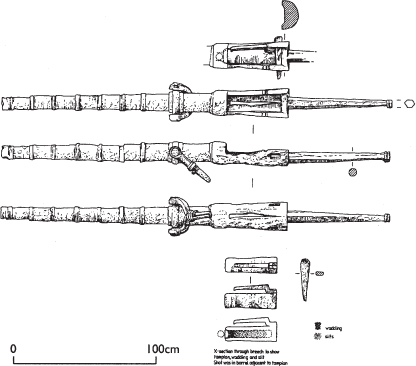
A drawing of a corroded base. (Mary Rose Trust)
bouging staving in of a ship’s hull to cause a leak.
bowline a rope leading forward, which is fastened to the perpendicular edge of the sail. Used to keep the weather edge of the sail tight.
breeches, breeching ropes used to secure a gun to the structure of the ship; sometimes attached to the gun itself, and sometimes to the carriage.
buckram a coarse linen cloth.
bumkin a vessel for carrying water.
cagger a kedge anchor; a small anchor used for mooring or warping.
camlet a fine fabric made from the hair of Angora goats.
cannon the largest type of cast mounted gun, usually of bronze and muzzle-loading; bore of at least 7in, and weighing 7,000lb. Firing mostly cast-iron shot of 45lb or more.
cat ropes used for hauling cat hooks.
cat hook strong hook used to retain the ring of an anchor when it is raised.
charter party an indenture, or contract, written in duplicate.
chief of iron ‘chief’, meaning principal. In this case an iron sheathing for the prow of a boat.
commander large wooden mallet, used for removing or replacing wedges.
crayer a small single-masted trading vessel.
culverin cast-iron or bronze muzzle-loading gun; long in relation to its bore (14ft, bore 5–5½in), weighing approximately 4,770lb; firing cast-iron shot of between 7 and 26lb weight.
curtal large gun firing shot up to 40lb, with bore of approximately 6in.
deadshare the wage due to a fictitious or non-existent seaman; these shares were recognized perquisites distributed among the officers pro rata.
Deeps, or Black Deeps an area in the North Sea, between Harwich and Margate.
demi-cannon cast bronze or iron muzzle-loading gun; approximately 12ft long, with a bore of 6–6½in; weighing 5,800lb; firing cast-iron shot of 33–4lb weight.
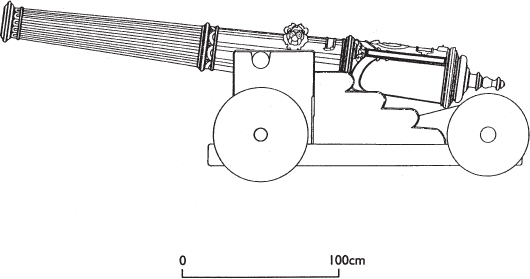
Demi-culverin on carriage. (Mary Rose Trust)
demi-culverin cast bronze or iron muzzle-loading gun; approximately 13ft long, with a bore of 4–4½in; weighing 4,760lb; firing cast-iron shot of 10–15lb weight.
demi-sling a small sling, but it is not known whether the half dimension refers to the bore size, or weight of shot.
Downs a sea area off the Sussex coast, in the neighbourhood of Dogger Bank.
falcon cast bronze or iron muzzle-loading gun; approximately 7ft long, with a bore of 2¾in; weighing 700lb, and firing cast-iron shot of a little over 2lb weight.
foist a light galley, propelled by oars and sails.
fowler a small breech-loading gun; sometimes cast bronze, but usually wrought iron; carriage-mounted; of uncertain dimensions, but with a bore of more than 2in; fired stone shot.
garland collar of rope wound around the head of a mast to prevent the shrouds from chafing.
garnet (1) a hinge. (2) a purchase fastened to the main stay, for hoisting cargo in and out.
gunstones shot of all descriptions, including iron as well as stone.
hackbut portable matchlock firearm with a large hook beneath the barrel to attach to a rail as a recoil mechanism, heavy enough to require support; also known as an ‘arquebus’.
hailshot piece breech- or muzzle-loading gun, cast or wrought iron, with rectangular bore, weighing about 30lb; firing dice (iron cubes).
harness body armour (set of).
hoses either in the common sense, to convey water, or possibly sockets to hold shafts.
junk remains of pieces of old cable, used for making oakum.
kenning distance of ordinary vision at sea (about 20 miles).
knight and ramshead two principal blocks of timber securing running rigging.
leech hook as leeches were the borders or edges of sails, these hooks were probably used to attach bowlines.
lift ropes which reach from each mast head to their respective yard arms.
luff hook a luff tackle was composed of a double and a single block, the fall coming from the double. The hook was used to secure the tackle to a strong point.
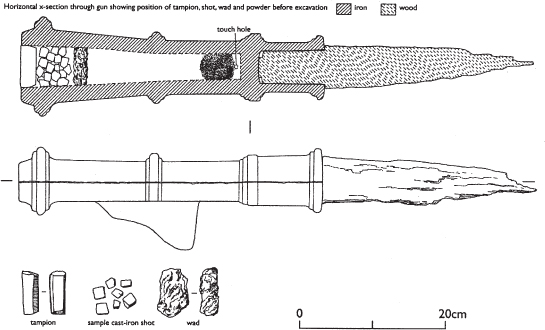
Drawing of hailshot piece. (Mary Rose Trust)
marline small line of two strands.
murderer a general name for a large gun firing loose fragments of iron.
parrel a loose collar of iron or rope fitted around the mast, retaining the yard to the mast, but able to slide up and down with the yard.
polancre a combination of pulleys connected by rope; a hoisting or hauling device.
port-piece a large breech-loading gun, usually of wrought iron, with a bore of up to 10in; weighing (with its breech chamber) about 1,200lb; usually mounted on a large sledge, with a single pair of wheels.
prest advance of money for public service.
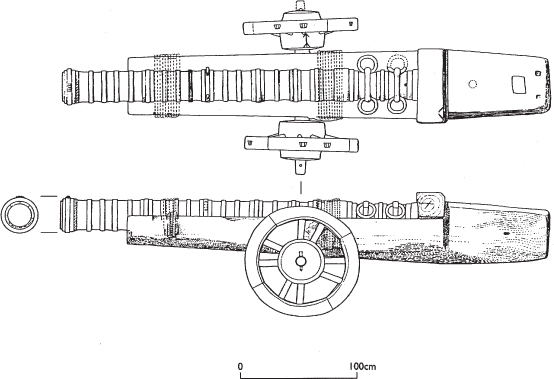
Drawing of a port-piece. (Mary Rose Trust)
quarter-sling a form of sling; it is uncertain whether the dimension refers to the bore or the shot size.
raft wooden spar or plank (the original meaning of the word, subsequently applied to an assembly of such).
ramshead see knight
saker muzzle-loading gun, usually bronze but sometimes of cast iron; approximately 9ft long, with a bore of 3½in; weighing 2,000lb, and firing iron shot of about 4lb 12oz.
serpentine wrought-iron breech-loading gun, usually long in relation to bore, and commonly mounted.
sheet ropes fastened to one or both the lower corners of a sail to retain the clew down to its place.
shiver wheel upon which the rope runs in a block.
sling wrought-iron breech-loading gun, long in relation to bore, which was from 1 to 5ft. Usually carriage-mounted.
spike a large headless nail, usually of iron.
stay strong ropes extending from the upper end of each mast towards the stem of the ship.
swifting tackle pairs of shrouds, fitted to the port and starboard sides of the lower masts.
swivel gun gun such as a base (q.v.) rotated on a pin to increase arc of fire.
tacks any arrangement of blocks used to increase purchase or lifting power.
thring usually a verb, meaning to bind tightly together; as a noun, probably a bundle (unspecified).
thrum section of coarse woollen or hemp yarn used for mops etc.
top armours cloths tied about the tops of masts for show.
Trade, the the sea area around Brittany, centred on the port of Brest.
truss a parrel used on the lower yards to bind them to the masts.
tuke canvas.
warping moving a ship by hauling on a cable from the shore.
wildfire incendiary mixture directed, used as projectile, especially against sails or rigging.