
1
Commentary
It is not known exactly when, where, or by whom, the Mary Rose was built. There is a reference to four unnamed ‘new ships’ being fitted out at Southampton in December 1509, and if the Mary Rose was one of them, then she must have been laid down before April 1509; in other words the decision to build her must have been taken by Henry VII rather than Henry VIII. However, it is probable that these were much smaller vessels, and that the true date of the laying down of the Mary Rose and her sister ship the Peter Pomegranate was January 1510, represented by the warrant of the 29th (1). Neither ship is named, for the simple reason that names would not have been given at this early stage. Nor do the tonnages match those ultimately achieved; as they were eventually launched the Mary was about 600 tons and the Peter about 450, but tonnage measurement was notoriously inaccurate at that date, and if the ships were still in building the burthen was probably mere guesswork. The warrant, of course, does not represent more than a small fraction of the cost, and the reference to rigging suggests that the building was already well advanced. Ships of this size cost in the region of £3,000 at this time, a figure which should be multiplied by 1,000 to get an approximate modern equivalent. At a time when the King’s ordinary annual revenue was about £100,000 a year, they represented a substantial investment. This cost would have been met by a series of warrants of this kind, drawn on a variety of different revenue sources. This one is an assignment on the customs revenues of the port of Southampton, but others would been assigned on London, or drawn directly from the Exchequer or the Duchy of Lancaster.
Southampton was convenient, because honouring the assignment would have meant transporting cash in the shape of gold or silver coin, and it is almost certain from later references that the ships were built at Portsmouth. Robert Brigandine had been Clerk of the King’s Ships since 1495, and knew most of what there was to know about the business. He was not trained to the sea, but had begun his career as a minor officer of the royal household. Henry VII had relied on him for advice on all matters relating to the ships, and he was clearly responsible for the building of the Mary and the Peter, but exactly what that meant is more difficult to say. Brigandine paid the bills, but he was not a master shipwright. Whether he was responsible for the design, and the shipwrights worked to his instructions, or he was merely the site manager and the shipwrights themselves were responsible for the design, we do not know. The latter is more likely, because they would have lacked the status to claim the credit – and as far as we are aware, no one ever did. Brigandine divided his time between Portsmouth and Woolwich, but was increasingly located at the former, and seems to have been working there throughout the time when these ships were being built.
It is reasonable to deduce that Portsmouth was the principal royal dockyard at this time, because work on the Regent and the Sovereign, both large warships and about twenty years old at this point, was being carried out at the same time, and also under Brigandine’s supervision. The indenture, or contract, over which the Clerk was concerned in June 1511 (2) probably marks the end of the construction process. The sum of £1,075 14s 2d may well represent the whole cost of renovating the older ships, but £1,016 13s 4d would have been only the last instalment for the new constructions (3). The warrants for the balance do not appear to have survived. When the Peter was first launched, she seems to have been very similar to the Sovereign, and designed in the same way to carry a substantial number of small guns. It was only later that she was rebuilt to carry heavier weapons. The Mary, however, carried heavy guns from the start; not many, probably six or eight, but they necessitated a design feature which was new to the point of being revolutionary – the gunport. Whether she was actually the first warship to be built in this way, is not known; nor who was responsible for the idea. Ports had been used for loading purposes before, and seem to have originated in Brittany. It has been suggested that the King himself insisted on the Mary being built in this way, and his known interest in both ships and guns makes that plausible; but Henry is not known for being inventive, and it seems likely that he got the idea from somewhere else, most likely France, although it is possible that he was already emulating his brother-in-law James IV of Scotland, as he was to do in 1514 with the Henry Grace à Dieu.
Although there is no record of the launch, it clearly occurred in the summer of 1511. The ships would have been named at that time; by 9 June they are known as the Mary Rose and the Peter Pomegranate. It was quite usual to give ships the names of saints, and in this case such names seem to have been combined with two well-known Tudor badges, the rose for the King and the pomegranate for the Queen. It is also possible that the former name was a recognition of the fact that the Virgin was traditionally known as the ‘mystic rose’. It is often said that the ship was named after, if not actually by, the King’s sister, but there is no evidence for this.
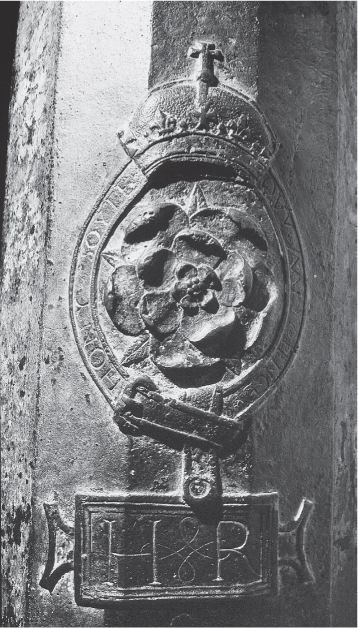
The Tudor rose, surrounded by the Garter and topped by the closed imperial crown; with, below, the King’s monogram ‘HR’ (‘Henricus Rex’). This mark of royal ownership appears on this demi-cannon recovered from the Mary Rose. (Mary Rose Trust)
By the beginning of July the two new warships were afloat in Portsmouth harbour, awaiting a move to the Thames, where the guns would be loaded and the final fitting-out would take place. It seems from the accounts of Sir John Daunce that the Mary, at least, proceeded under her own sails, rather than being towed (4). Brigandine would have recruited the mariners, and it looks as though he paid them the bulk of their wages in advance, although that would have been unusual. The number of mariners is not mentioned, but the total cost was £170. A sailor was paid 5s a month, plus his victuals, and the officers significantly more, so if these crews were hired for a month, the number in the two ships would have been between 300 and 350, which would be about right at contemporary manning levels. It seems as though the journey from Portsmouth to the Thames also marked the commissioning, or handing over, of the ship to the King’s agents, because from then on the bills were paid directly by the Exchequer. John Clerke appears to have been appointed master for the transit voyage only, because Thomas Sperte, who was the first regular master when the ship passed into service, had already taken over by the middle of October.
The last stages in the equipping of the Mary Rose can be roughly reconstructed from the same accounts. Stocks or carriages were most likely prepared specifically for the guns which each ship would carry, and therefore would remain on the ship when the guns were removed at the end of a period of service. What the ‘stuff’ may have been for the decking and rigging, can only be surmised. Most of both must have been already in place when the ship was sailed from Portsmouth, and it may have been the spare canvas, rope and timber necessary for running repairs in service which was acquired at this late stage. Last of all came the flags, both numerous and splendid, as can be seen from later inventories and from the illustrations in the Anthony Roll. The great streamer, which was flown from the mainmast on special occasions, was 51 yards long, in the Tudor colours of green and white. John Browne painted and stained flags of St George, and of the King’s arms, flags blazoned with the King and Queen’s various badges, and possibly some depicting the Virgin and the various devices associated with her. In November 1511 Henry joined the Holy League of Pope Julius II and Ferdinand of Aragon, against France, and on the 24th Thomas Sperte rendered his last account for equipping his ship. She was now ready for action in the forthcoming war.
Documents
1. Privy seal warrant to the Exchequer for reimbursement of payments from John Dawtrey, customer of Southampton, to Robert Brigandine, Clerk of the King’s Ships, 29 January 1510.
The ‘two new ships’, as yet unnamed, will be the Mary Rose and her sister the Peter Pomegranate. The whole sum is assigned on the customs revenues of the port of Southampton.
Henry, by the grace of God, King of England and of France and Lord of Ireland, to the Treasurer and Chamberlains of our Exchequer, greeting. Whereas our wellbeloved servant John Dawtrey, one of our customers of our port of Southampton, hath delivered and paid by our commandment to our servant Robert Brigandine, Clerk of our Ships, for the reapparelling of our ship called the Regent £180 4s 5d; also the said John Dawtrey by our like commandment hath delivered and paid unto the said Robert Brigandine, Clerk of our Ships, for the repairing and new making of our ship called the Sovereign £1,175 14s 2d; also the said John Dawtrey by our like commandment hath delivered and paid unto the said Robert Brigandine, Clerk of our said Ships, for timber, ironwork, and workmanship of two new ships to be made for us £700, and the one ship to be of the burthen of 400 tons and the other ship to be of the burthen of 300 tons; and also the said John Dawtrey by our like commandment hath delivered and paid unto the said Robert Brigandine, Clerk of our said Ships three hundred and sixteen pounds thirteen shillings and four pence for all manner of implements and necessaries to the same two ships belonging as particularly hereafter ensueth, first for sails, twine, marline, ropes, cables, cablets, shrouds, hawsers, buoy ropes, stays, sheets, buoy lines, tacks, lifts, top armours, streamers, standards, compasses, running glasses, tankards, bowls, dishes, lanterns, shivers of brass and pulleys for the said two new ships, victuals and wages of men for setting up of their masts, shrouds and all other tacklings for the said two new ships, which said several sums will extend in the whole to the sum of two thousand three hundred threescore and twelve pounds eleven shillings and eleven pence, for the which sum our said servant John Dawtrey as yet hath not had of us any manner of discharge by reason whereof he may proceed unto his accounts which he is in yielding before the Barons of our Exchequer; we, willing him to be sufficiently discharged of the said sum of two thousand three hundred threescore and 12 pounds eleven shillings and eleven pence as right and conscience re[quir]eth, wherefore we will and command you our said Treasurer and Chamberlains that you in due form do [cause] to be levied one tally or tallies containing the said sum of £2,372 11s 11d upon the said John Dawtrey and Thomas Wodeshawe as late customers in our said port of Southampton of the customs and subsidies grown within the same port to us due at Michaelmas last past; and the said tally or tallies in due and sufficient form levied, we will that you deliver unto the said John Dawtrey in discharging of his said accounts without prest or any other charge to be set upon the said John Dawtrey and Thomas Wodeshawe for the same. And for your indemnity herein, we will that you make issue of the said sum of £2,372 11s 11d as money paid by the said John Dawtrey unto the said Robert Brigandine, Clerk of our said Ships, by our said commandment for the causes above expressed. And these our letters shall be your sufficient warrant and discharge in that behalf. Given under our privy seal at our palace of Westminster the 29 day of January the first year of our reign.
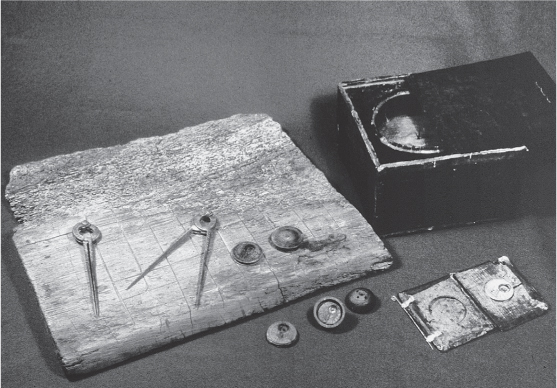
Two pairs of dividers, a compass and three sundials. The wooden board may also be a navigational aid, or simply used for gaming. (Mary Rose Trust)
Authorized by the King’s Sign Manual initial: H.
Counter-signed by the duty Clerk of the Privy Seal: [William] Purde.
2. Robert Brigandine to Richard Palshide, customer (customs officer) of Southampton, 9 June [1511].
This letter contains the earliest extant reference to the Mary Rose by name. Although undated as to year, it is evidently answered by the indenture of 30 June 1511 which follows.
Right worshipful sir, I heartily recommend me unto you, daily desiring to hear of your good welfare, furthermore desiring your mastership that for the indenture of parchment that I delivered unto you there may be made another new, extending to the whole sum of money as it specifieth of bearing the date and time according; but whereas it specifieth several sums of money, so much to the Sovereign spent and so much to the Mary Rose and Peter Pomegranate, I would not have it so, but the said whole sum of the indenture delivered by Master Dawtrey and by you unto me in general, as well for the repairing of the Sovereign as for the new making of the Mary Rose and Peter Pomegranate jointly together, and moreover that it will please you I may be recommended unto Master Dawtrey, desiring his mastership and you both that I may have the copy of the warrant whereby I received money of you for the keeping and for certain reparations done on the Regent in Ludovico de La Fava his time, and in as goodly haste as may be possible you would vouchsafe that the said indenture, and also copy of the warrant may be delivered unto the bringer hereof [or to my wife or John Peryn (I) pray you inserted] for the expedition of my account, as my very especial trust is in your mastership, as knoweth God, whom I beseech preserve you and all yours. Amen. Written at Woolwich, the 9th day of the month of June.
By your own Robert Brigandine, Clerk of the Ships.
Minuted: Master Brigandine, the indenture you write for is in my coffer of iron at London, where no man can see it till my coming thither by no means, but I shall be always ready to follow and to fulfil your desire therein as for it is all one to me.
Yours, J. Dawtrey.
3. Indenture witnessing receipt by Brigandine from Dawtrey, 30 June 1511.
This indenture made the last day of June in the third year of the reign of our sovereign lord King Harry the VIIIth betwixt John Dawtrey, one of the customers of our said sovereign lord the King of the port of Southampton on that one part and Robert Brigandine, Clerk of the King’s Ships, on that other part, witnesseth that I the said John Dawtrey have delivered to the said Robert Brigandine at divers times for the new making of the King’s ship called the Sovereign a thousand a hundred threescore and fifteen pounds fourteen shillings and two pence, and also for the new making of two other new ships for the King’s grace, one of 300 tons and the other of 400 tons – a thousand sixteen pounds thirteen shillings and four pence. Sum of all – £2,192 7s 6d. In witness whereof the parties abovesaid to these present indentures interchangeable have set their seals the day and year aforesaid.
John Dawtrey.
4. Extracts from the accounts of Sir John Daunce, a teller of the Exchequer, July–December 1511.
These include the first references to the Mary Rose at sea.
29th day of July. Also paid by our commandment to Robert Brigandine, Clerk of our Ships, towards the charges of the conveyance of our two new ships from Portsmouth unto the River of Thames, the one of them called the Mary Rose and the other called the Peter Pomegranate – £120.
20th day of September. Also paid by our commandment to Robert Brigandine, Clerk of our Ships, towards the charges of [the King’s deleted] our two new ships, the one of them called the Mary Rose and the other the Peter Pomegranate now lying upon Thames – £50.
24th day of September. Also paid by our commandment to Richard Palshide, one of our customers in our port of Southampton, these parcels ensuing: first, for 24 coats of white and green for 24 soldiers for the sure conducting of our ship called the Mary Rose from Portsmouth to the Thames of London, and 6 coats of white and green for the master, 4 quartermasters and the boatswain, at 6s 10d the coat – £10 5s. Item for the wages of the said 24 soldiers by the space of one month and a half, at 5s a man by the month – £9. Item for the reward of the said Richard Palshide for his attendance upon the said ship – 40s. Item for the reward of John Clerke, master of our said ship – 20s. In all – £22 5s.
1st day of October. Also paid by our commandment to Cornelis Johnson, gunmaker, towards the new stocking and repairing of divers pieces of [our inserted] ordnance of [the King’s deleted] four of our ships now being in Thames, the one called the Mary and John, the other the Anne of London, the other the Mary Rose and another the Peter Pomegranate – £20. Item for 8 loads of elm for stocking of the said ordnance, at 4s the load – 32s. In all – £21 12s.
18th day of October. Also paid by our commandment to Thomas Sperte, master of our ship called the Mary Rose, and David Boner, purser of the same ship, by indenture for all manner of stuff needful to be had for the decking and rigging of the same ship – £66 13s 4d.
17th day of December. Also paid by our commandment to William Botrys of London, mercer, upon a bill signed with the hand of Sir Edward Howard, knight, for certain tukes, buckrams, Brussels cloths and camlets of the said William bought for to make streamers and banners for the use of our ships called the Mary Rose and Peter Pomegranate – £50 19s 2d.
Also paid by our commandment to John Browne of London, painter, upon a book of parcels signed with the hand of Sir Edward Howard, knight, for painting and staining of certain banners and streamers for the use of our ships called the Mary Rose and Peter Pomegranate – £142 4s 6d [½d deleted].
18th day of December. Also paid by our commandment to Thomas Sperte, master of our ship called the Mary Rose, upon his account made and determined before Sir Edward Howard, knight, the [29 deleted] 24 day of November the third year of our reign, for all manner of charges concerning our said ship due upon the said account – 29s 1¾d.
[To several of the pages of this book of accounts the King has added his Sign Manual: Henry R.]