
2
Commentary
Henry’s desire for war in 1511 was personal rather than political. He had no particular grievance against Louis XII, but he did have a strong desire to emulate his illustrious predecessor, Henry V, and to re-establish English control over at least a part of France. This was mainly because he was nineteen years old, and full of physical vigour and ambition; but it was also partly because he wanted to emancipate himself from his father’s old councillors, most of whom opposed the idea. Henry wanted glory, and trophies to lay at the feet of his new bride, Catherine of Aragon. He may also have been aware that a new generation of nobles had grown up in England, who shared his aspirations. War was what noblemen did, and for a whole generation their ambitions had been thwarted, and their finances pressurized, by the pacific and suspicious policies of the old King. So Henry’s intention was not entirely quixotic; he was also about to ‘busy giddy minds with foreign wars’, in case some of the same ‘giddy minds’ might be tempted to work out their frustrations on him.
The King mobilized his fleet between January and April (5). Altogether he prepared seventeen ships for action, but only three of them were his own: the Regent, the Mary Rose and the Peter Pomegranate. He had taken a small Scottish prize, the Lion, in 1511, and later in 1512 he was to buy two large Genoese carracks, the Gabriel Royal and the Katherine Fortileza, but none of these was included in this fleet, which mainly consisted of armed merchantmen varying from 70 to 400 tons burthen. Sir Edward Howard was appointed Admiral of the fleet on 7 April and given detailed instructions; and although the Regent was the largest ship available to him, he chose the brand new Mary Rose as his flagship. The King took his oath on 16 April, and dispatched £6,000 to John Dawtrey at Southampton to cover the expenses of the fleet in the forthcoming campaign. For a couple of weeks Howard did little but terrorize French fishing boats and Flemish merchants (who were supposed to be allies), but this was mainly because he held the initiative and no French warships had yet put to sea. In other words he had secured command of the English Channel without even the semblance of a fight.
One of the Flemings he appears to have terrorized was Jacques Berenghier of Lille. Margaret of Savoy, the Regent of the Netherlands, wrote a letter complaining that a grievous wrong had been done to her subject (6), while the articles against Berenghier accused him of an act of sabotage which endangered both his shipmates and his ship (7). In fact the two statements are not incompatible, as the articles do not explain how the Fleming came to be a gunner on the Mary John, and the Regent’s letter does not even allude to the offences for which he had been punished. It is quite likely that he was press-ganged in the manner alleged, and endeavoured to get his own back by sabotaging the guns entrusted to his care. The relevance of the case in this context is that Berenghier was tried by Howard on board the Mary Rose, using his ex officio jurisdiction as Admiral. It seems very unlikely that he would have been pressed into service, and given a responsible position, because he was mistaken for a Frenchman. The French were, after all, the enemy, and Lille was not, at that time, in France.
The actual service of the Mary Rose during the remainder of this eventful summer is only thinly reflected in these summary accounts. No doubt Howard wrote dispatches from his flagship, as he was to do in the following year, but they have not survived. Early in June he escorted the Marquess of Dorset’s ill-fated expedition to Guyenne as far as Ushant, but saw no action in the process. Throughout July and early August he ‘kept the seas’, capturing merchant ships and filling in the time until the French King had got his sea power together. About 5 or 6 August word reached Howard at Portsmouth that the French had at last assembled at Brest, and he set off to give battle. This was not what René de Clermont, the French Admiral, was expecting, because the normal tactic in sea-fighting up to that point had been to manoeuvre to keep the weather gage of your enemy, hold your fleet together, and hope that your victuals and the health of your crews lasted better than his. Maintaining control of a fleet was so taxing in itself that battle was best avoided. However, Howard came looking for a fight, and caught the French unawares about 2 or 3 miles outside Brest harbour, on the morning of 10 August. A detailed description of the resulting action survives, but it is not a first hand account, and makes no mention of the Mary Rose. It is contained in a letter written a few days later by Thomas Wolsey, who must have obtained it from an eyewitness. The most spectacular outcome of a messy and otherwise inconclusive engagement was the mutual destruction of two of the largest ships, the Regent and the Cordelière, both of about 1,000 tons, when the latter’s magazine exploded as they grappled together. Over 1,000 men perished in this disaster, which made a huge impression on everyone.
Thereafter, the French retreated into Brest, and Howard signalled a somewhat equivocal victory by scouring the coast of Brittany, until shortage of victuals compelled him to retreat at the end of August. The French fleet disbanded in early September, having accomplished precisely nothing for a huge expenditure of money and effort. The English campaign account was wound up at the end of September, when it appears that Howard was allowed for 400 men on the Mary Rose (8). As this figure included about 35 ‘deadpays’, in accordance with established custom, the actual complement of soldiers, seamen and gunners would have been 365. However, there were also 47 men present who were not allowed for in the official calculations: 31 servants of the Admiral, and 16 of the captain of the ship, Sir Thomas Wyndham. It was proper and normal for an aristocratic officer to take his own servants to sea, but presumably they had not been declared in advance. They were paid like the rest. The ship was then brought round to the Thames estuary and, having unloaded her ordnance at Blackwall, was laid up ‘aflote’ in the new dock at Erith, where some minor repairs seem to have been undertaken. She was then left in the care of her master, Thomas Sperte, and nine other mariners as shipkeepers. This account runs only from 28 October to 25 November, but she was actually there until 11 February, when John Hopton’s maintenance records come to an end, and preparations for the new campaigning season began (9). Hopton was a Gentleman Usher of the Chamber who had been involved with the King’s ships for more than a decade. At some point earlier in 1512 he had been appointed to the newly created office of Clerk Comptroller. The intention appears to have been to confine Brigandine to Portsmouth, and to make Hopton responsible for the operations in the Thames and Medway.
In 1513 Louis XII was determined not to be taken by surprise. During the winter he had introduced a new element into his armoury by bringing six war galleys from the Mediterranean under the veteran commander Prégent de Bidoux. On 13 March Prégent set out to raid the English coast, but was frustrated by bad weather. Apart from the galleys, there was at this time little to choose between the mobilization times of the two fleets. The new French Admiral, du Chillou, left Honfleur in Normandy at almost exactly the same time as Howard left the Thames, on about 20 March. On this occasion the English had the advantage of numbers. Henry had strained every nerve to acquire more ships of his own, and the fleet of 28 which Howard commanded included only 5 armed merchantmen. Du Chillou had 16, plus Prégent’s 6 galleys. In spite of their light construction, and lack of seaworthiness, the latter posed a serious threat to sailing warships, even large ones, because they were armed with heavy forward-firing guns, known as basilisks. Early in March the Lord Admiral of England, the Earl of Oxford, died, and on the 19th Sir Edward Howard was appointed in his place; so it was with greatly enhanced status (if not much more actual power) that he set off on this new campaign. The English ships were well manned and armed, but the victualling was less organized, as Howard’s letter, assumed to be of 19 March, makes clear (12). Wolsey was in charge of the logistics, and he was normally efficient, but in this respect he was struggling and the fleet set out inadequately provisioned, with serious consequences later on. Resupplying at sea, using small victuallers, was a bold and innovative solution, but only partially successful.
Howard’s first shipboard dispatch to the King, dated 22 March, describes the fleet’s progress from the Thames estuary to the Downs, off the Kentish coast (13). It is racy and circumstantial, but in this context mainly notable for its praise of the sailing qualities of the Mary Rose, ‘the noblest ship of sail … at this hour that I trow be in Christendom’. This was no doubt why he continued to use her as his flagship; but the comment may also have been intended to please Henry, who seems to have been fond of this ship from the beginning. Perhaps he had had some say in her design (as he did later for the Great Galley), and such remarks were a subtle compliment to his skill. By 5 April Howard had reached Plymouth, and was itching for a fight (14). The 100 sail with which he was allegedly confronted was almost certainly a wild exaggeration, even if the smallest support ships were included, and did not dent his confidence at all. Victuals, however, continued to be a nagging problem, and were the main theme of this last dispatch before he engaged with the enemy. He sailed on 10 April, and any French ships at sea retreated into Brest as he advanced, a tactic which he typically attributed to cowardice, but which was in fact no more than traditional caution. By the 12th the whole French fleet, now numbered at fifty sail, had adopted a strong defensive position under the guns of the fortifications of Brest (15); the galleys, however, were separated, a little further down the coast. The Admiral continued to fret about his supplies, and about the ‘Spanish ships’, which were actually under command of English captains and because of various delays, never joined him at all. On the 13th he landed an amphibious force near Crozon, partly to threaten Brest from the landward side, and partly to forage for victuals, but it achieved little, and by this time the French fleet, apart from the galleys, was firmly blockaded in Brest (16). Howard appeared to make light of the threat from Prégent de Bidoux, and in that, as events were to show, he was seriously mistaken.
A probing attack on the harbour resulted in the loss of one ship, the Nicholas of Hampton, commanded by Arthur Plantagenet (Edward IV’s base-born son), which struck a concealed rock. Realizing the hazards of operating without local knowledge, the English retreated to Bertheaume Bay, and Howard was now confronted with a critical dilemma. His supplies were almost exhausted, and he could not keep his fleet on station much longer to blockade the port. On the other hand, to retreat with nothing accomplished would have been an unspeakable dishonour, as well as (probably) costing him the King’s favour. On the 22nd Prégent made up the Admiral’s mind for him: his galleys attacked, sinking one English ship and badly damaging another. Howard decided to take out the galleys; then he could at least retreat with honour. They were backed into a strong anchorage, and Howard decided to attempt an outflanking movement ashore, and a frontal attack from the sea. Unfortunately he lacked the necessary shallow-draught ships for the latter operation, having only a couple of rowbarges and a number of ships’ boats. With more valour than discretion, on the morning of 25 April he attacked, leading his insufficient force in person. His panache allowed him to come within an ace of success, but having boarded Prégent’s own galley, he was inadequately supported, and was cut off and killed. Whether he died fighting, or was thrust overboard and drowned by his armour is not clear. His force fled in disarray, and the English fleet abandoned its campaign, retreating to Dartmouth, hungry and demoralized.
Documents
5. Extract from an account for charges for the first three months’ service, 17 April–8 July 1512.
Charges of the army and navy for the first 3 months beginning on Saturday the 17 day of April the third year of our sovereign lord King Henry the VIIIth and ending the 8th day of July the 4th year of his reign, as in victual, wages, deadshares and tonnage, as well of these 17 ships as other victuallers, crayers and other ships ensuing, some for less time as ensueth.
The Mary Rose. First to Sir Edward Howard, knight, chief captain and Admiral of the fleet, for his wages and victual at 10s a day, by the said 3 months amounting to – £42.
Also to Sir Thomas Wyndham, knight, for his victual and wages at 18d by the day, by the said 3 months – £6 6s.
Also for the wages [diet deleted] and victual of 2 lodesmen alias pilots, each of them at 20s a month, by the said 3 months – £6.
Also for victual of 411 [men], soldiers (251), mariners (120), gunners (20) and servitors (20) in the same ship, every man at 5s a month, by the said time – £308 5s.
Also for wages of the same 411 persons, every man at 5s a month, by the said time – £308 5s.
Also for 34 deadshares [and] half, at 5s a share, by the said time – £25 17s 6d.
Also for tonnage after 3d a ton a week, by the said time, 500 tons – nil, because the King’s ship.
Sum – £696 13s 6d.
6. Margaret of Savoy, Regent of the Netherlands, to Henry VIII, 15 September 1512.
Summary.
Jacques Berenghier of Lille, who went to England last Lent to trade, was seized on his return by Master Christopher, master of one of the King’s ships, compelled to serve as a gunner, plundered of all his goods, taken for a Frenchman because he spoke the language, was racked by the captain Master Griffendon, and so lost a foot. Afterwards he was delivered to the Admiral and was long kept prisoner at Southampton, had his ears slit, and was threatened with hanging. The King will perceive by a certificate from the town of Lille that he is a native of that place, and of good repute. She desires reparation be made to him, and that such barbarities be not repeated. Antwerp, 15 September 1512.
7. Articles against Jacques Berenghier, gunner in the Mary John, 1512.
An enquiry before the Admiralty Court, prompted by the Regent’s complaint, established that the man had been found guilty by due process of an act of sabotage.
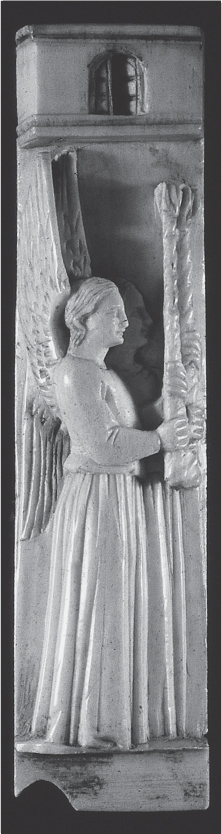
A bone carving of an angel, one of the few purely decorative objects recovered from the wreck. (Mary Rose Trust)
In the name of God Amen. All and singular the below-written articles, and each particular of them, the counsel of Sir Griffith Don, knight, gives, presents and instances against Jacques Berenghier.
First, that the said Sir Griffith Don, knight, in the months of April, May, June, July, August, September, October in the year of Our Lord one thousand five hundred and twelve, and each of the said months, was captain of a ship called the Mary John, which was then with the fleet of the most excellent prince and lord, the most illustrious lord Henry, by the grace of God, King of England and France and Lord of Ireland, under the noble Sir Edward Howard, Admiral of the said fleet. Item that the said Jacques Berenghier was taken into the said ship by the said Sir Griffith in the place and duty of a gunner, and for the faithful exercising of his office in that part he received wages of the said most high prince, under the principal master gunner of the said ship, with obedience to the said Sir Griffith the captain of the same. Item that the said Jacques undertook the keeping of certain guns assigned to him in the said ship. Item that the said Jacques, the year and months aforesaid or one or other of them, falsely, wickedly, maliciously and fraudulently placed in certain of the said guns then in his custody two stones wrapped in thick cord, where it was not necessary or suitable to place more than one, so that many guns of these gunners in the said ship called the Mary John, being in battle with the enemies, were broken and fractured in such way that they could not harm the said enemies, and even some guns not committed to the said Jacques were charged with similar stones, to their destruction, by wicked deed of the said Jacques. Item that he had in his shoes certain gunpowder, very fine and light, with a certain little stone and an iron for striking light, notwithstanding the powder which he had in a horn hung from his neck, as the habit of gunners is. Item that because of the trans-gressions of the said John in the said office and duty committed to him, and further as a result of vehement accusations and enquiries, the said Jacques was arrested by Christopher Gybson, principal master gunner of the said ship, and by him and the said Sir Griffith the captain was sent to the said lord Admiral in the ship called the Mary Rose. Item that the said Admiral, having first examined the said Jacques on the foregoing, returned the said Jacques to the said Sir Griffith, so that he should strictly examine and detain him, and furthermore enquire by torture or otherwise if he had any companions or followers in the said transgression, or otherwise concerning the business of these guns. In certain of which guns the said Jacques was found to have placed two stones wrapped in thick cord where it was not necessary, as beforesaid, to place more than one stone, to the extent that by the operation of the said guns in battle with the enemies, many of the guns in the said ship were broken and fractured in such way that they could not, as aforesaid, harm the enemies. And likewise other guns not committed to him were charged and broken with similar stones, by the deed as aforesaid of the said Jacques. Item that the said Jacques was found to have in his shoes certain gunpowder, very fine and light, with a certain little stone and an iron for striking light, notwithstanding the powder which he had in a horn hung from his neck, as the habit of gunners is. Because of all which, not only on vehement accusation made, but by enquiries taken in law, he was put to torture and punished. Item that the said Jacques was returned by the said Sir Griffith to the said lord Admiral, who punished him by the authority lawfully given to him in that part, having had the opinion and advice of the officers of the said ship, who condemned him to have both his ears cut off, and to be wholly removed from the ship’s company. Item that he who is detected in a similar transgression and is condemned for the same shall lose all his goods which he has with him, which being taken shall be applied to the chest. Item that the foregoing matters were all and singular true, notorious, manifest and well known throughout the whole said fleet and in other places.
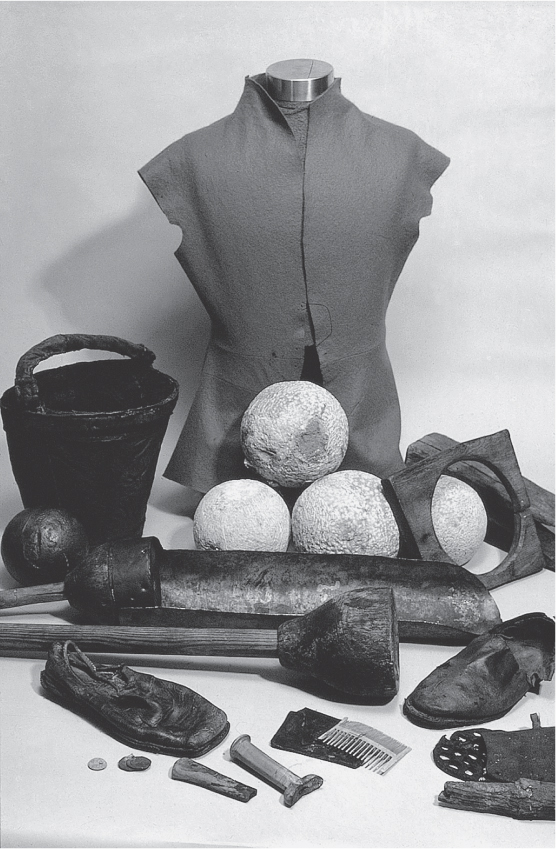
A selection of items associated with a gunner, including shot, shot gauge, powder scoop, ram and knife handle, together with a replica of his sleeveless jerkin. (Mary Rose Trust)
8. Extract from an estimate of charges for the second three months’ service, 9 July–30 September 1512.
A rate for wages, victual, tonnage, deadshares and other charges of [the King’s] navy of 17 ships and the army of 3,000 men in them upon the sea etc. for 3 months as ensueth.
Also for the overcharges and excess of wages and victual of 31 men charged and being on Mr Howard’s ship the Mary Rose over his first muster, with 16 of Thomas Wyndham’s servants not roomed in his muster, with 5 trumpets and certain mariners and gunners, forasmuch as he is allowed for 400 men and hath 431 men, so in excess for 3 months past – £46 10s, and 3 months next to come – £46 10s, after 10s a man for wages and victual by the month of the said 31 men for 6 months – £93.
9. Extract from an account of charges for four weeks, 28 October–25 November 1512.
Here ensueth the expenses, costs and charges had and made by the King’s great commandment for the King’s ship named the Mary Rose, paid by the hands of John Hopton, as well the mariners that keepeth the said ship as of all manner of workmanship, provision of stuff, tackle and apparel with all other and sundry necessaries for the use and behoof of the said ship, from the 28 day of October unto the 25 day of November the year of the reign of our sovereign lord King Henry the VIIIth the next ensuing, by the space of 4 weeks, that is to say:
Wages of shipkeepers
Thomas Sperte, master mariner, taking for his wages 3s 4d the week, by the time of 4 weeks – 13s 4d.
Jeffray Hickes, taking for his wages 2s 3d the week, by the time of 4 weeks – 9s.
Thomas Colte, taking for his wages 15d the week, by the time of 4 weeks – 5s.
John Preston, taking for his wages 15d the week, by the time of 4 weeks – 5s.
Rallyn Cotte, taking for his wages 15d the week, by the time of 4 weeks – 5s.
Edmund Juller, taking for his wages 15d the week, by the time of 4 weeks – 5s.
Richard Farmer, taking for his wages 15d the week, by the time of 4 weeks – 5s.
Robert Colte, taking for his wages 15d the week, by the time of 4 weeks – 5s.
John Tomlyn, taking for his wages 15d the week, by the time of 4 weeks – 5s.
William Schipard, taking for his wages 15d the week, by the time of 4 weeks – 5s.
[Sum] – £3 2s 4d.
Lighterage. Also the said John Hopton hath paid unto John Dyer for lighterage of the ship’s ordnance when that she lay in grounding at Blackwall by the space of 4 days – 6s 8d. So paid for the said [ship deleted] lighterage in time of this account in all, amounting to – 6s 8d.
Flags with St George’s cross. Also there is paid by the said John Hopton unto John Browne, painter of London, for flags with St George’s cross at 3s the piece, for 14 of them – 42s. So paid and delivered the same flags to the use and behoof of the said ship in time of this account in all amounting to – 42s.
10. Warrant from Admiral Sir Edward Howard. Undated, but before 25 April 1513.
Master Treasurer, deliver the master of the Mary Rose 27 deadshares and half, which John Daunce left unpaid for the first month. And this bill shall be your discharge. By me Edward Howard.
£6 17s 6d.
11. Extract from an account of expenses, February–April 1513.
Mary Rose. Gunstones. Also the said John Hopton hath paid unto Nicholas Sesse for gunstones of iron with crossbars of iron in them at £19 the ton tight, one ton tight – £9. For one ton tight half of round gunstones of iron – £10. And in like wise to a man of Maidstone for gunstones of hewed stone at 13s 4d the 100, for 2,700 of them – £18. So by him paid and delivered the foresaid gunstones to the Mary Rose in time of this account, in all [repetition] amounting to – £37.
12. Sir Edward Howard, Lord Admiral, to Thomas Wolsey, King’s Almoner, [19 March 1513].
The first of the letters written aboard the Mary Rose. The Saturday on which it is dated is likely to be 19 March, the first after the patent by which Howard was confirmed as Admiral and leader of the ships in the army ‘for the defence of the Roman see’ (16 March). Cf. the chronology established in the next dispatch. Coincidentally, Howard’s patent as Lord Admiral of England was issued on 19 March. The ‘guest’ he mentions was, of course, a prisoner; by ‘well twitched’, he was recommending stiff interrogation.
Master Almoner, in my heartiest wise I can recommend me unto you. And I have received your letter, whereby I perceive that you have sent my fellow [William] Keby with a clerk with him to take a view how much victual we have here. Sir, without I should lose a tide, it cannot be. And you shall have as good a certainty there at London of the deliveries of the victual which have delivered the pursers upon their bills to them made as much victual as is come to our ships. And the most part of our pursers we have left them behind for hasting of the rest of our victual, by whom you shall be in a certainty. I have caused Keby to come to you again with all haste. And I have sent a guest up to the King that was taken in the Maria de Loretta. I pray you let him be well twitched, for I [think] well he can speak news. Sir, I have received the satin of Bruges. I shall order it as I shall think best to the King’s honour and profit, and certify you by the next post when I am come to the Downs, and if you will anything with me, send it to the Downs.
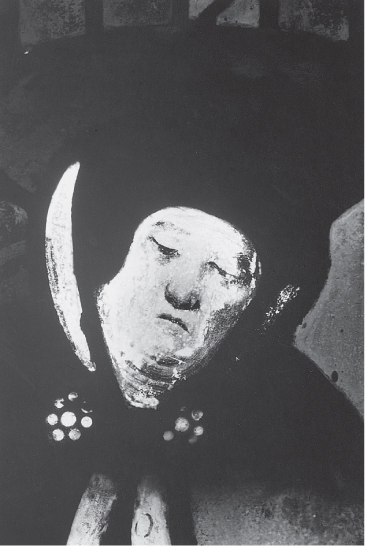
This figure from the ‘Judgement of Solomon’ window in Fairford church, Gloucestershire (attributed to Barnard Flower), has been identified as the future Cardinal Archbishop of York, Thomas Wolsey, whose great career in Church and state was founded on competence as a military and naval organizer. (Dr H.G. Wayment)
Written in the Mary Rose, this Saturday by yours to my little power.
Edward Howard.
Endorsed: To Master Almoner be this delivered in haste.
13. Sir Edward Howard to the King, 22 March 1513.
This report, unfortunately now much damaged, presents a vivid image of Henry VIII’s fleet at sea, and notably commends the sailing qualities of the Mary Rose. By contrast the Christ is dangerously overloaded with ordnance. The Bristol ships mentioned were the Trinity, Christopher Davy and Matthew Craddock. The Baptist of Harwich was assigned as victualling tender to the Mary Rose.
Pleaseth your grace to understand that the Saturday in the morning [19 March], after your grace departed from your fleet, we went down to have gone into the Deeps, but, or [before] we came at the danger of entering into the Deeps, called ‘Gyrdelar’ Head, the wind veered out of the West-North-West into the East-North-East, wherefore [we were] fain to go to an anchor for that day, And the same morning that I came toward the Deeps, I commanded [some] of the small ships as would go the next way to the Downs to get them over the land’s end, and [there] went that way both the new barks, the Lizard, the Swallow, and eight more of the small ships. [The] residue kept with us through the Deeps. And, Sir, all Palm Sunday we stirred not, for the wind was […] here with us at East and by South, which was the right course that we should draw to e […]. On Monday the wind came West-South-West, which was very good for us, and […] we slept it not, for at the beginning of the flood we were all under sail. And […]. And from our first setting of sail […] slacking where the Katherine Fortileza sailed very well and […]. All such ships as made sail even together with her once a quarter of a […] three mile sailing your good ship, the flower, I trow, of all ships that ever sailed, reckoning […] every ship, and came within three spear length of the Katherine and spake to John Fle[myng], Peter Seaman, and to Freman, master, to bear record that the Mary Rose did fetch her at the […] best way and the Mary’s worst way. And so, Sir, within a mile sailing left her in flight […] at the stern, and she all the other, saving five or six small ships which cut […] the Foreland the next way. And, Sir, then our course changed and went hard upon a bowline […] the Foreland, where the Mary Rose, your noble ship, set the Mary George, the Katherine prow, a bark Lord Ferrers hired, the Leonard of Dartmouth, and some of them were a long mile afore me, or ever I came to the Foreland. The next ship that was to me but [except] the Sovereign was 3 mile behind, but the Sovereign passed not half mile behind me. Sir, she is the noblest ship of sail [and] great ship at this hour that I trow be in Christendom. A ship of 100 ton will not be sooner at her […] about than she. When I came to an anchor, I called for pen and ink to mark what ships [came] to me, for they came all by me to an anchor. The first next the Mary Rose was the So[vereign, then the] Nicholas, then the Leonard of Dartmouth, then the Mary George, then the Henry of Hampton, then the Anne […] then the Nicholas Montrygo called the Sancheo de Garra, then the Katherine, then the Mary J[ames] – Sir, one after another. There was a foul tail between the Mary Rose, and the aftermost was the Maria de Loretta. And the Christ was one of the worst that day, she may be […] sail, no more may the Katherine. I trust we shall remedy her well enough that she shall follow with the best; Sir, she is overladen with ordnance, beside her heavy tops, which are big enough for a ship of 8 or 900 [tons].
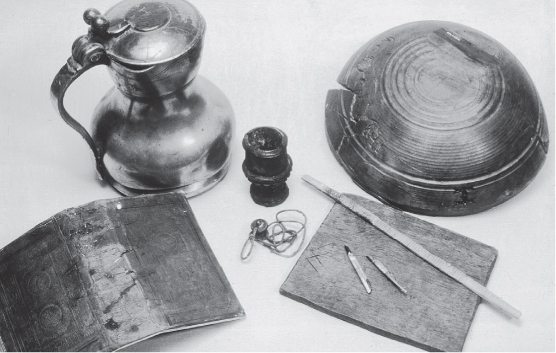
That literacy was evident aboard the Mary Rose is shown by this pen and inkpot, and other objects seen above, as well as from the letters presented here. The stamped leather cover came from what must have been a prized book, its contents lost. The flagon and bowl are also inscribed. (Mary Rose Trust)
Sir, we had not been at anchor at the Foreland but the wind [turned] up at the Northerboard so strainably that we could ride no longer there without great danger, [so] we weighed to get us into the Downs through the ‘Gowles’ [Gull Stream]. And when we were in the midst, between the ‘Brakkes’ and the Goodwin, the wind veered out again to the West-South-West, where we were fain to make with your great ships three or four turns, and God knoweth […] row channel at low water. As we took it, the Sovereign and the Mary stayed […] a quarter of a mile off the Goodwin Sands, and the Maria de Loretta offered her […] would none of it, and was fain to go about with a forewind back […] where that she lyeth […] I fetched the Downs with many turns, and thanked be to God I […] Downs at an anchor in fast. And I pray God that he send our victual sh[ortly … ] for in Christendom out of one realm was never seen such a fleet as [this. I assure you that] with our barketts come to us, that the first fair wind that cometh, we might be doing [service, for you] saw never poor men so in courage to be doing as your men be.
I beseech your g[race not to be] miscontent that I make so long a matter in writing to you, and of no matter of substance, but that you commanded me to send your grace word how every ship did sail, and this same was the best trial that could be, for we went both slacking and by a bowline, and a ‘cool[…]’, a course and a bonnet, in such wise that few ships lacked no water in over the lee wales.
Sir, the ships of Bristol be here with me, I assure your grace, gorgeous ships for their burthen; one that Anthony Pointz is in upon a 180 [tons], and another of 160, and another of 140, I had not spoken [of] when I wrote this letter. I understand they lack victual. I have written to Master Almoner for it and for their mariners. Your grace must command Master Almoner to make a warrant to ble[…] to deliver to Hopton 200 harness for them, which shall send it down in the victuallers.
[I have] no more news to write to your grace as at this time, but that the next fair weather […] lie here in the Downs, I will send forth your two new barks, the Lizard, [the two row] barges, the Baptist of Harwich, to play up and down between Dover and Calais […] perchance will fall in their hands that we might have some news thereby out of [France].
Sir, for God’s sake, haste your Council to send us down our victual, for if we shall lie long [here], the common voice will run that we lie and keep in the Downs and do no good but spend money and victual, and so the noise will run to our shames, though your grace know well that we can no otherwise do without we should leave our victual and fellows behind us. I r[emit] all this to the order of your noble grace, whom I pray God preserve from all adversity, and send you as much victory of your enemies as ever had any of your noble ancestry.
Written in the Mary Rose, by your most bounden subject and poor Admiral,
Edward Howard.
14. Sir Edward Howard to Wolsey, 5 April 1513.
In marked contrast to the flowery report he had sent to the King on 22 March, the Admiral addresses the Almoner on prosaic issues of meat and drink. Despite shortages, he exudes optimism, and manages a side-swipe at a negligent carpenter.
Master Almoner, in my heartiest wise I can I recommend me unto you, certifying to you that I am now at the writing of this my letter in Plymouth road with all the King’s fleet saving the ships that be at Hampton, which I look for this night. For when I came open of the Wight I would not go in, but sent a ship of [William] Compton’s to cause them to come in all haste. And the wind hath been ever since as good as was possible. And as for our Spaniards that should come out of Thames, I hear no word of them; God send us good tidings of them. Sir, I think our business will be tried within 5 or 6 days at the furthest, for an hulk that came straight from Brest showeth for a certainty that there be ready coming forward a 100 ships of war besides the galleys, and be prest [ready] upon the first wind, and says that they be very well trimmed and will not fail to come out and fight with us. Sir, these be the gladdest tidings to me and all my captains and all the residue of the army that ever came to us, and I trust in God and St George that we shall have a fair day on them; and I pray God that we linger no longer, for I assure you was never army so falsely victualled. They that received their proportion for 2 months’ flesh cannot bring about for 5 weeks, for the barrels be full of salt; and when the pieces keepeth the number, where they should be penny pieces they be scant halfpenny pieces, and where 2 pieces should make a mess, 3 will do but serve. Also, many came out of Thames but with a month’s beer, trusting that the victuallers should bring the rest, and here cometh none. I send you word for a surety, here is not in this army one with another past 15 days.
Sir, the Katherine Fortileza hath troubled me beyond reason; she brought out of Thames but for 14 days’ victual, and no victualler is come to help her. And so have I victualled her with [beef deleted] beer ever since, and so brings my victualling back, for it is no small thing that 500 men spendeth daily, and no provision here for her. I have sent to Plymouth on mine own head to get some victual, if it be possible. I trust you will allow for it. I would I had never a groat in England that I might keep these west parts till they and I meet.
Sir, [you otiose] my lords of the King’s most honourable Council wrote to me of a proportion that should be already delivered. Sir, if some be well victualled, the most part be not; and you know well, if half should lack, it were as good in a manner that all lacked, in consideration to keep the army together. Sir, for God’s sake send by post all along the coast that they brew beer and make biscuit, that we may have some refreshing to keep us together upon this coast, or else we shall be driven to come again into the Downs and let the Frenchmen take their pleasure; and God knoweth when we shall get us up so high westward again. I had liefer [rather] then that we should be driven to that issue to be put all the days of my life in the painfullest prison that is in Christendom.
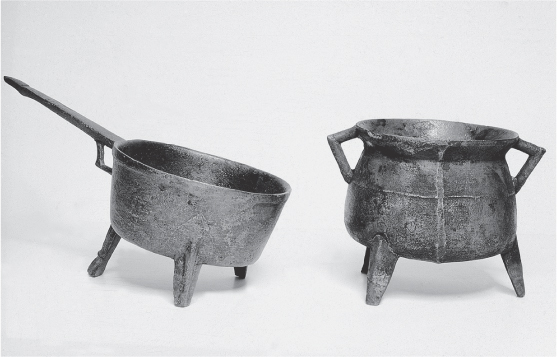
Two pots found in the hold. The one on the left was used to heat tar, the other, a cooking vessel. (Mary Rose Trust)
Sir, the Katherine Fortileza has so many leaks by reason of Bedell the carpenter that worked in her at Woolwich that we have had much to do to keep her above water. He hath bored an 100 auger holes in her and left it unstopped, that the water came in as it were in a sieve. Sir, this day I have all the caulkers of the army on her. I trust by tomorrow she shall be more staunch.
Sir, where you write to me that you send hoys to take our pipes: Sir, they are such men that they would throw them that you sent with the victual over [the deleted] board, and when the pipes hath been brought, and they gone from us, they throw them over board and goeth into Flanders. Sir, I know no man’s proportion but mine own, nor one captain knoweth what his purser hath received, for we left all our pursers at London to haste forth our victual, and neither hear we of our pursers nor our victuals. And well I wot [know] that I have given such order in dispending of our victual that there was never army so straited, not by one drinking in a day, which I know well hath been a great sparing; but for all this we be at the issue that I showed you before. And whereas you write that it were no reason that the King should pay for his own goods: sir, I am of the same opinion; but, sir, or ever I had knowledge of any man, the deliverers of victual [that deleted] had received divers foists of divers ships, and given the stewards 4d for every tun drawing, which I thought a perilous example. Howbeit, one that [William] Atclif sent for the sealing of certain commissions for the taking and preserving of the foists showed me that Master Atclif had commanded them to pay every man 4d for the drawing of a tun. And, sir, if that had not been, I should have seen all delivered without any penny taking. But, sir, never man complained to me of any such things. Sir, all the victual that shall come to us, let it come to Dartmouth, for there it may lie ready for us. And sure enough, sir, there is much victual at Sandwich, and they have no vessels to bring it to us. Fill some of your Spaniards ships their bellies full: 3 or 4 of them will carry much. And spare not to spend victual upon us this year, for with God’s grace the fleet of France shall never do us hurt after this year. And if they be so ready as the hulk hath showed us for a certainty, I trust to God and St George that you shall shortly hear good tidings. And howsoever the matter goeth, I will make a fray with them if wind and weather will serve or 10 days to an end.
Therefore I pray you recommend me to the King’s noble grace, and show him that he trust no tidings till [he] hear word from me, for I shall be the first that shall know it if I leave, and I shall be the first that shall send him word. Sir, I pray you recommend me to the Queen’s noble grace, and I know well I need not to pray her to pray for our good speed; and to all good ladies and gentlewomen, and to my fellows Sir Charles [Brandon] and Sir Henry Guildford. And, sir, specially recommend me to my lord my father, beseeching him of his blessing. And, sir, I pray you to knit up all which have me most humbly recommended to the King’s noble grace as his most bounden servant, as knoweth Our Lord, who evermore send him victory of his enemies, and you, my special friend, your most heart’s desire. Written in the Mary Rose the 5th day of April, by your to my little power,
Edward Howard.
Sir, I need not to write unto you what storms we had, for you know it well enough. Sir, I saw never worse; but thanked be to God all is well, saving the loss of one of our galleys; all ill go with her. Sir, I send you in this packet a letter to my wife; I pray you deliver it to her.
15. Sir Edward Howard to the King, 12 April [1513].
Reporting the first encounters with the enemy. The signature to this letter has been lost, but there is no doubt as to its provenance.
[Pleaseth your grace] to understand that on Sunday last, was the 10 [day of April, we adv]anced out of Plymouth with your noble army, and we […] night.
[The Monday last inserted] the wind rose so sore at North-North-East that we were fain [to] set us in with the Trade, and went in at the broad sound, where [w]hen we came afore St Matthew’s [Pointe St Matthieu] there lay at road a 15 sail of men-of-war, which, as soon as they spied us, they like cowards fled to the Brest water, so that they were got in or [before] we could get as far as St Matthew’s. And the wind shot out to East-North-East, and the e[bb c]ame, that with all the turning we could make, we could get no further than the mouth of the entry of Brest water, where we saw rid[ing al]l the fleet of France to the number of 50 sail, which we should [not] have missed if the wind and the ebb had not come. And so we [weighed] an anchor in their sight, determining that the next morning, [if] we could have wind to lay it on a-board, that we would have […] them there [sic] they lie. For, Sir, this ship cannot get in by [the cas]tle but at an high water and a drawing wind. Sir, the wi[nd has] blown so at East-North-East that we cannot as yet come n[earer sti]ll, we have them at them at the greatest advantage that ever men had. [God] worketh in your cause and right, for upon a 5 or 6 days [afore we came to] the Trade, Peryjohn [Prégent] with his galleys and foists, for skant [of wind went] to St Malo’s, and a 5 or 6 small barks […]le between the fleet. And all their trust […] there shall never come together with God’s […] them to leave them […] his issue. Sir, the first wind that ever cometh […] have broken heads, that all the world shall speak of it.
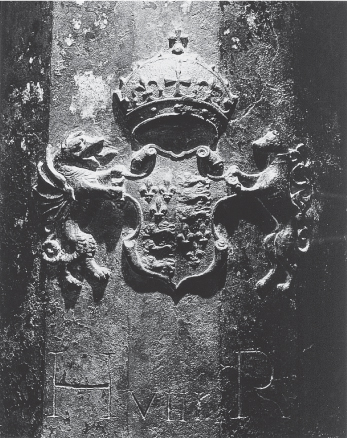
Henry VIII’s arms, as borne by all English monarchs from Henry IV to Elizabeth I. The fleurs-de-lis in the first and third quarters were a continuing reminder of their ancient claim to the throne of France. This example comes from a bronze demi-cannon. (Mary Rose Trust)
Sir […] ships resort with our victuals into the Trade, setting their course on f[ast] along the coast of England or they hale over. And if they hear ne[ws of] us there, then let them come over, on God’s name, ‘commyn at the broode’, for they be enough to beat Peryjohn and all his fleet, I warrant your grace, having them a-seaboard.
Sir, this Tuesday at night I heard as I lay at anchor that a ship of 80 lying in Crozon bay, and 4 small men, had run themselves aground, so I sent out the Lizard, the Jenet, the Baptist of Harwich and my ship boat well trimmed, and commanded them to bring them away if they could, or else to burn [them]. And so, Sir, the ship of 80 was run so far aground that they could not [get] him off, and my boat set him on a fair fire, and made a goodly […], and the residue of the small men were brought to me, whereof [one] was laden with salt, which I have sent to bring this letter to […] that he could come to of England.
And, Sir, I have sent a letter [to the captains of the s]hips of Spain and victuallers, if so be they be come on the coast […] to your grace that they shall resort hither with all diligence.
Sir, if [God is] so good to send us any wind, not having no part of the e[ … the army] of France shall do your grace little hurt. At the […] shall not tarry long here for it, for Sir, that we w[…] in 2 days, with God’s grace. And it pleased God, I w[ould … that] we had done our business with the army t[…] also with all Brittany, for here is […] that is fell little, and […] a land […] eth at all.
Sir, there was never such a sort of captains that the […] the sea, nor such a sort of soldiers and mariners so well willing to do […]. And to be doing with your enemies, Sir, we lose no time, I warrant you, for [we] think upon none other thing but how we may best grieve our enemies. [And] if victual serve us, as your men and ships are determined, we shall this year [make] a bare coast all the realm of France that boundeth on the sea coast, [which] shall never recover it in our days. Therefore, for no cost sparing, let pro[vision] be made, for it is a well spent penny that saveth the pound, for […] was wont to be spent in 3 or 4 year on the sea with one expense now, we shall do more good than in 4 year by driblet. Sir, I remit all the further order of this great matter to your noble [wisdo]m and discreet order of your wise councillors, and I pray God send us [bette]r wind, that we may do your grace that service that our heart desireth [ … I pray] this the blessed Trinity send your grace victory of your enemies.
[When] I was writing of the latter of this letter, the Lizard, the […] row-galleys and rowbarges went in to them with the flood rowing […] them and caused them to come to their sails, and so came large […] we come and fought with us, and so I weighed and came to sail […] made to them-ward with the skant wind that we had that [ … lac]ked but wind. God if we had it come it on th[…]ll is one to us. Sir, St George to ‘borowgh[ …’] he yet for 10 days here and […] have our victual.
16. Sir Edward Howard to the King, 17 April [1513].
The immediate interest of this letter is its account of the accident which befell Arthur Plantagenet, the future Lord Lisle, commanding the Nicholas of Hampton. But it is also the last letter from Sir Edward Howard, who was to be killed in the assault on the galleys eight days later.
[Pleaseth] your grace to understand that the next day after [I had writt]en to your grace, I caused all my boats of the army with the […] head to make a countenance of landing on the side that Brest […] one, for to make the country to resort down to the waterside […]d the victual of the country, and to weary of them. And I am [sure there] was within an hour above 10,000 men. Such as they be, Sir, my [men wo]uld have landed to have fought with them, and I dare say we [had no]t in all the boats past 1,500 men. Sir, for to content somewhat the [me]n’s minds, which are hardly handled in the distributing of [da]ily victualling by reason that as yet our victualling is not come to us, a[nd to] keep them out of murmuring, which is hard to do without [th]ey be set a-work with somewhat, I skirmished there the past [tw]o hours with our ordnance. And when I spied the country sore moved and [ … to] the waterside, for fear of our landing I went over to the other [si]de of Brest, that new Crozon stood on, and landed all our boats, and made two battles, and so went over all the neck of land in [the ba]y, and made our muster so straight afore the castle that they might see that we were not afeared to land our men afore their sight, to proc[eed] to come forth, yea, and to anger them were burned up all the ho[uses that] stood in their sight on the waterside, to their great displeasure and the [pleasure] of our men.
Sir, there I viewed how the ships lay. Sir, they be run underneath the castle, and they have by, as far as we can spy […] all the hulks afore the mouth of the haven, for because we should [do] them no hurt. By reason of, for no otherwise, Sir, we dare not put […] because of lack of victual. Sir, and we be able to land [ … as] many horse as will carry two pieces of good ordnance, with the carts, [with wh]ich these ships shall be sunk where they lie. Sir, it were too great a p[eril they] should ever escape, seeing that we have them in this danger. I remit this to your great wisdom,
Sir, as for the galleys, we make great w[ay with] them, as Master Arthur [Plantagenet] can show your grace. And, Sir, if there come any other by day or by night, the boats and small vessels and row[barges and] row-galleys shall lay them sharply aboard, and rather than they [should] escape us, I have assigned [William] Harper, the Thomas of Hull, my bark, [Sir William] [Trevy]nyan’s bark and two or three small ships [not to inserted] spare to give t[…]stand [even] though they should run them aground for to make them [sink]. And, Sir, if they came amongst us, they shall not escape clean with good.
Sir, we marvel sore that we hear no word of our three Spaniards [that] should come out of Thames. We fear that they have been in some danger, [which] God defend, in the Deeps, for they have had as fair winds to c[ome unt]o us as can be wished, and our victuallers too. I shall think long [to] have word from your grace of all your further pleasure how you will ha[ve all] further ordered. Sir, and our victual come not to us by tomorrow, we be in [great] despair to have any remedy, for now these two days hath blown [the] fairest wind that could be devised. God send us comfort of them shortly. We can do no more than is possible, and that will we do to bid you [greate]st pain that ever did men, seeing that God hath sent us here in so great [advantage] of your enemies, as I am sure [William] Sabyne hath informed your grace.
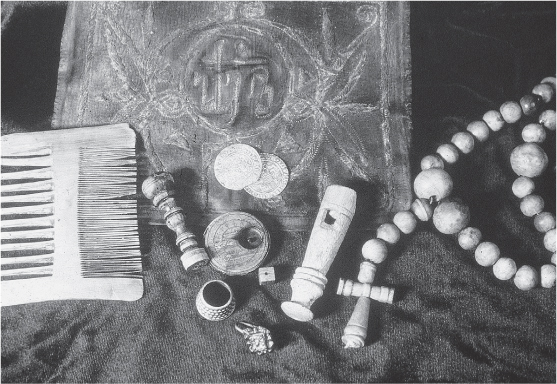
This display of personal items reflects hygiene (a comb) and private devotion (a rosary). (Mary Rose Trust)
Sir, [I have] taken all Master Arthur’s folks and bestowed them in the army where I [lacked b]y reason of death, by casualty and otherwise; and, Sir, h[ave given him licen]ce to go home, for, Sir, when he was in the extreme danger [and hope gone] from him, he called upon Our Lady of Walsingham for help and comf[ort, and made] a vow that, and it pleased God and Her to deliver [him inserted] out of that pe[ril, he w]ould never eat flesh nor fish till he had seen Her. Sir, I a[ssure you] he was in marvellous danger, for it was marvel that the ship, be[ing with] all her sails striking full but a rock with her stem, that she br[oke] not on pieces at the first stroke. Sir, we shall have a great w[ant of] him out of your noble army, for I know no man dis[…] that, considering his power, should better have served you if the fortune had not been; for, Sir, he was well trimmed, and hath […] he had in effect. And, Sir, he would not have departed but [for] that vow he should do here in a manner your grace but small service, [and to] himself great discomfort to see every man shipped, and to see h[is own] place and his men divided from him. Therefore, and because […]th inform your grace what place we stand in, and to be set […]d again if your grace will have to come to us, which will be as […] thing as possible, wheresoever you will command him. I have sent [him to your] grace, beseeching your grace to be his good and gracious lord. [I assu]re you he shall do your grace good service wheresoever you [ … at] both for his good order and hardiness. And, Sir, he is the sorriest man I ever saw, and no man here can comfort him. Therefore I beseech again your grace to give him comfortable words to be his good [lord].
I beseech your grace to send me word how you [do hear of] Scotland to s[end] a spial of his ships. And Our Lord send you victory ever of your enemies. Written to [towards] St Matthew’s, the 17th day of April.
Your bounden servant, Edw[ard Howard].
Endorsed: To the King’s grace, in all possible haste.