
5
Commentary
The peace between England and France which had been signed in 1514 lasted precariously for nearly eight years. It had been sealed by a marriage between Henry’s younger sister, Mary, and Louis XII. But Louis died in December of the same year, worn out, it was said, by his energetic young wife. The new King was Francis I; he was much the same age as Henry, and shared many of the same tastes and characteristics. However, he sought his military reputation in Italy, and did not break the peace in the north. Henry toyed with the idea of a new French war in both 1516 and 1517, but drew back on each occasion. Meanwhile, his chief minister and Lord Chancellor, Thomas Wolsey, was trying to shape an Anglo-French entente as part of a general European peace settlement. In 1518 he succeeded, and Tournai (Henry’s conquest from the war of 1512–14) was returned to France under the terms of the Treaty of London. This ambitious treaty, which temporarily raised the reputations of both Henry and Wolsey to dizzy heights, was intended to be permanent, but lasted in fact only some three years. Ferdinand of Aragon (de facto King of all Spain), Henry’s father-in-law, had died in 1516 and had been succeeded by his grandson, Charles of Ghent. Charles was also the grandson of the Emperor Maximilian, and in 1519 Maximilian died in turn. His son Philip having died in 1506, Charles was elected to succeed him, thus creating an empire of unprecedented dimensions. Charles now ruled, under various titles, the Holy Roman Empire (including most of northern Italy), Spain (including most of southern Italy) and the Low Countries. These domains virtually surrounded France, and a renewal of a Franco-Imperial war was therefore only a matter of time. For obvious reasons, both sides wanted Henry’s support, and it was with that in mind that Henry and Francis staged their famous ‘summit conference’ at the Field of the Cloth of Gold in 1520, an exercise in competitive display which caused Henry to parade his full credentials as a ‘sea king’.
The meeting failed, largely because the competitive display strained goodwill to breaking point, and in September 1521 Henry entered into an agreement with the new Emperor, for a joint attack on France in the following year. When Charles visited England to confirm their treaty, Henry met him at Dover, where the two monarchs inspected the fleet and went aboard the Henry Grace à Dieu and the Mary Rose (46). By the terms of the agreement, however, although England was bound to declare war on France in May 1522, Henry was not pledged to a major land campaign until the following year. The first campaign in the summer of 1522 was therefore fought at sea. In spite of this, Henry made no attempt to augment his existing fleet, and this must raise some doubts about how seriously he was proposing to take his commitments. In 1512 there had been a considerable build-up, but between 1515 and 1522 only five ships were added to the fleet; two of them were small, and one was a gift from the Emperor. The only important new ship to be built was the Great Galley, launched in 1515. Mobilization of the existing fleet began in December 1521, and by May it was at sea, as had been agreed. The intention seems to have been to bring the ships round from the Thames estuary to Southampton, and there to embark an expeditionary force to attack Le Havre. The Earl of Surrey was in overall command, and in spite of the presence of the Henry Grace à Dieu, which from the comments made on her sailing qualities was clearly part of the force, he carried his flag in the Mary Rose. From the first letter (47) it is clear that the Vice-Admiral, Sir William Fitzwilliam, was in operational command of the fleet, and was probably not in the same ship; however, John Browne was still her master, and the veteran Clerk of the King’s Ships, Robert Brigandine (who was to retire in the following year), was still active.
By 21 June the soldiers had been embarked, but Surrey felt unable to sail because of the usual difficulties over victualling (48). Most of his letter of that date is taken up with frantic pleas to get his supplies moving, because although he did not need to await their arrival, he did need to know that they would follow him. The trouble, clearly, was money. There were no funds to pay the brewers, and the ordnance at Portsmouth was falling apart for lack of maintenance. The King had spent his father’s accumulated surplus during his first French war, and by this time was living from hand to mouth. Over the next few days Surrey, having presumably received some reassurance over the victualling problem, set out, first to St Helen’s and then to Dartmouth, his movements largely dictated by the wind (49–51). Most of his letter of 30 June is an extended digression on the merits of Dartmouth as an advance wintering place for the ships (52). This advice fell on deaf ears, because in spite of the commodious anchorage and the availability of timber, it was too remote. Again, victualling was the snag. Not enough was available locally, and the place was inconveniently situated for supplies which came mainly from Kent and Essex, via London.
While all this was happening, the Emperor was continuing his visit to England. He had been lavishly entertained by the King, who could find money for that purpose, even if not to victual his Navy. While he was in England, Henry belatedly declared war on Francis, and the two monarchs agreed to a detailed plan for a joint attack on France in the following year. Charles embarked for Santander on 7 July, but whether the Henry escorted him as suggested is not apparent. By then Surrey had achieved such modest success as was within his reach. He had seized and partly destroyed the Breton port of Morlaix on 1 July, presumably because it was more accessible than Le Havre, and less strongly defended. However, the supplies for which he asked so urgently on 3 July seem never to have reached him, so that his proposal to ‘draw beyond the Trade’ – that is, to launch an attack on Brest – had no effect (53). Shortly after, Surrey and his fleet returned to Portsmouth, and the Lord Admiral was redeployed to lead an ‘Army Royal’ of 15,000 men out of Calais into France. That adventure also turned out to be a waste of money and effort, because the Emperor’s forces were all tied up in Italy, and without Imperial support the English were not strong enough to achieve anything beyond the same kind of destruction which they had wrought at Morlaix. By 16 October Surrey was back at Calais, and his army was disbanded.
The navy, though, was redeployed, and in that respect Fitzwilliam’s letter to Wolsey of 4 August is particularly interesting (54). It is not known which of the various options proposed was eventually adopted, but it seems clear that a significant proportion of the Great Ships available was to be kept in service. Some were to ‘keep the Narrow Seas’ (later called the ‘Channel Guard’), some were to go westward, and some to the north. Of course, this was not winter provision. Two months victualling from early August would only last until early October, and what seems to have happened was that a reduced fleet under Fitzwilliam returned to the Brittany coast in mid-August. This was mainly a defensive measure, because Henry feared a counter-attack, or reprisals for the sacking of Morlaix. The Henry was probably taken out of service at this point, because although the Mary Rose was described as ‘the second ship of the fleet’, she was clearly used by Fitzwilliam as his flagship. The Channel fleet returned to Portsmouth at some time during October, and she may well then have been taken out of service, as there are no further references to her. By this time a Channel Guard was being maintained through the winter, but smaller ships would have been used for that purpose, as no major attack would have been expected.
The war resumed in 1523. English ships commanded by William Sabyne had already attacked France’s ally, Scotland, in 1522, bombarding Leith and Kinghorn, and in 1523 there was actually some fighting in the North Sea. The Scots briefly blockaded the Humber, and an English North Sea fleet cruised off the east coast to prevent French troops from arriving in the north. On 11 June there was a skirmish in which the English commander, Sir Henry Sherborne, was killed. Under his successor, however, at least seven ships heading for Leith were taken. It was not until 21 September that the Duke of Albany with 3,000 men managed to get through, using the Irish Sea route. By then the Scots had concluded that it was too late in the year to launch a campaign, and nothing more happened. Normally in wartime the King’s main battlefleet would have been in the Channel by the end of May, but there is very little evidence of what happened in 1523, and certainly no mention of the Mary Rose. Fitzwilliam seems to have been patrolling in June and July, but it is not known what ships he was using. Early in August he attacked and burned the small port of Tréport, but his main service was to escort the Duke of Suffolk’s expeditionary force to Calais later in that month. As this was an Army Royal, it can be assumed that most of the capital ships available would have been deployed, but neither the accounts nor any relevant dispatches have survived. Suffolk’s campaign is not relevant in this context. Henry expected great things of it, but foul weather and the failure (again) of Imperial support to materialize, meant that it achieved nothing at vast expense. Henry had now completely run out of money, and 1524 was largely taken up with diplomatic attempts to heal the rift with the Emperor, and to take advantage of the fact that the Constable of France, the Duke of Bourbon, had defected to the Habsburgs. There was no campaigning, and as far as is known, the fleet never left port. By November the Mary Rose was laid up at Portsmouth, and Wolsey was urging the King to make peace.
Documents
46. The Emperor Charles V goes aboard the Mary Rose at Dover when arriving for his meeting with Henry VIII, 30 May 1522.
From the chronicle of Anthony Anthony, who also compiled the illuminated roll of the King’s ships (58).
26 May 1522. The Emperor arrived at Dover and went to the Castle. 28 May. The King went down river and met the Emperor at Dovergate. 30 May 2 p.m. The Emperor and K. Henry went aboard the Great Harry and Mary Rose. After the fleet had discharged all their ordnance, they took horse and came to Canterbury 9 p.m.
47. Sir William Fitzwilliam, Vice-Admiral, to the King, 4 June 1522.
Please it your highness to understand that on Friday at night last past, which was the self same day your grace departed from Dover, the wind came to the West-South-West, and blew so strainably that we were constrained to forsake that road and go into the Downs, where we were fain to abide that night and Saturday and Sunday all day, for because the wind abode there continually and blew exceeding strainably. And Monday the wind came to the West and by North, and so we made sail, purposing to have stopped at every flood, and so to have plied to Hampton with the tides. And when we were more near half seas over, the wind blew at South-West again so sore that we were forced to forsake the sea and come to the Downs again for harbour. And since that day hitherto the wind keepeth and hath kept in that quarter continually, insomuch that we cannot go to Hampton as yet. Howbeit, the next wind that is, there shall no slackness be found in us in that behalf, by God’s grace. And to advertise your grace of the sailing of the Henry Grace à Dieu, the same day we made sail, she sailed as well as any ship that was in the fleet, and rather better, and weathered them all save the Mary Rose. And if she go by a wind, I assure your grace there will be hard choice between the Mary Rose and her, and next them the Galley. Howbeit and the said Galley may veer the sheet, she will go from us all. And yesterday the wind blew as sore and strainably as I have lightly [commonly] seen, and thanked be Our Lord, the Henry rode as still and as gently at an anchor as the least ship that is in the fleet did, whereof I and all the rest of [the] army be right glad.
Furthermore, the foresaid day your grace departed from Dover, I called to me according to your commandment Brigandine, my fellow Gonson, and all the wisest masters in the fleet, and examined them whether the Camber were a meet place to lay up the Henry this winter, in case your highness were minded she should be, or not. And they all agreed in one saying, and said they thought it not meet. Howbeit, for the trial of the premises, I sent John Browne, master of the Mary Rose, and John Clogge, master of the Peter Pomegranate thither, and they called to them one John Fletcher and John Swanne, which be two of the wisest masters within the town of Rye. And they all together went and sounded the said Camber, and every place therein, and can find no place there meet to lay her in safe, and so I am sure the said John Fletcher and John Swanne will affirm whensoever they shall be examined upon the same. And the said masters conclude all together and say that Portsmouth or Dartmouth be the meetest places to lay her in that be, and reckon that it is too great a danger to bring her into the Thames again. As the blessed Trinity knoweth who ever have your highness in his blessed tuition. Written in the Downs this Wednesday the 4th day of June. By your humble subject and most bound servant,
William Fitzwilliam.
48. Lord Admiral Surrey to the King, 21 June 1522.
Pleaseth it your most noble grace to be advertised that upon Thursday at noon I, with all your grace’s army here, embarked, and only remain here for lack of wind, which I pray God shortly to send, for as yet it continueth at South-West and West, which is the way that we should go. And to advertise your highness how your grace is deceived for the furniture of victual for your army, where it was promised that by the last day of May we should have had the whole complement for 5,000 men from Portsmouth of beer, and from Hampton of all other victual, with much difficulty we be furnished now, which is the 20 day of June, from Hampton of flesh, fish and biscuit for the said two months, and from Portsmouth by no means we can have none than for one month of beer. And where the Vice-Admiral was promised before this day to have had his whole complement, none of his ships have full furniture of all victuals passing three weeks, and of those right few, and some but for 8 days, and the most part not passing for 14 days. And whereas of late is come from London 13 or 14 crayers with victual for the said Vice-Admiral, the victuallers there have caused the masters to indent with them for such proportions as they have received, not sending to me nor to the said Vice-Admiral any letter to advertise us what is sent nor when the rest shall come. And where all their doubts hitherto hath been ever for lack of casks for the beer, I cannot perceive but that they be as far or further behind them with flesh, biscuit and fish as with beer, wherein I think is some negligence. Most humbly beseeching your grace to consider that it shall not be possible for me and the company here to accomplish all that we be determined to attempt unless we be better furnished with victuals than we be yet, as well from London as Portsmouth, and great pity it were that your grace should spend thus much money without that some great displeasures might be done to the enemies, which we that be here, having well debated what we may do, see good like-lihood to do that your highness shall be contented with if the wind and victuals serve us, doubting much more of the victual than wind. Beseeching your grace to cause some substantial man to go to London for the hasting forth of that is there, and the same to be shipped in the Christopher Davy and other good ships, and to be conducted within the Wight by Thomas Vaughan and his company. And also to send one other wise man to Portsmouth for to see diligence used for the beer there. And I have left William Symmond with 100 sailors to embark in such good ships as shall come from London to conduct all the victuals of London, Hampton and Portsmouth unto me. Also I, Sir [Richard] Wingfield and divers others have been at Portsmouth to see in what case the ordnance and bulwarks be there, and also to show our opinion for the fortification of the same, and undoubtedly we find all the ordnance there so far out of order that no piece can be shot, the most part of the stocks being rotten and all the woulding clearly consumed, and much of the ironwork failed. And Palshide, having no money to pay the brewers, as this day without which payment they will not labour, nor also no money being there for making of bulwarks nor repairing of ordnance, I, having a little money here of mine own, have delivered unto him two hundred marks. And, Sir, after my poor opinion, methinketh it were well done that William Pawne or some other expert man should be sent thither [to otiose] for the ordering of all business there. Also that it might please your grace to cause James Worsley to come home to the Wight to see that good watch be made to descry such ships as may come to do any displeasure, and to see beacons and fires made to give warning to Portsmouth, and also beacons to be made upon Portisdown, and the country to be warned with diligence to resort to Portsmouth when the beacons shall be on fire. Finally, Sir, your grace shall be tomorrow advertised by Mr [John] Jenyns of all the state of the affairs of your army here, beseeching your grace to examine him yourself of the same. Written in the Mary Rose within the Isle of Wight, the 21th day of June.
Your most humble subject, T. Surrey.
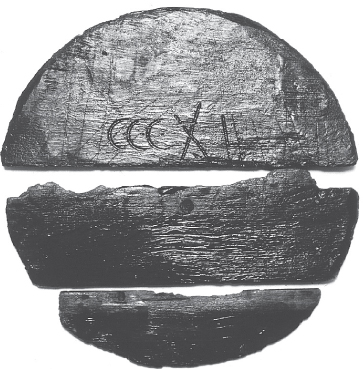
Barrel end. The barrel was the basic storage component aboard ship; a vessel’s capacity was originally reckoned by the number of barrels (or ‘tuns’) it could carry. This barrel is from the orlop deck and contained beef bones. (Mary Rose Trust)
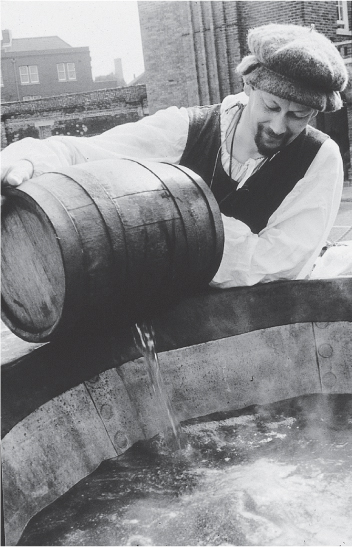
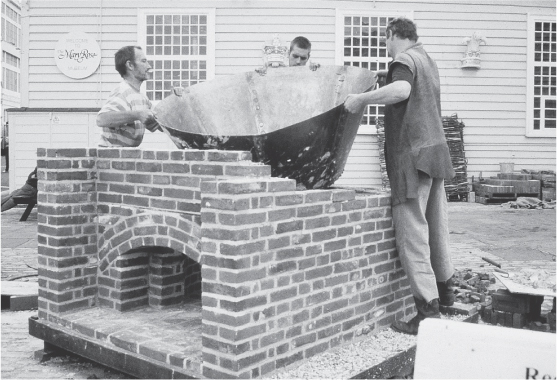
The basic structure of the galley was a vast cauldron built into a brick firebox. Those who enjoyed the fruits of this reconstruction did not share Lord Admiral Howard’s complaints about the quality. (C.T.C. Dobbs)
49. Surrey to Wolsey, 23 June 1522.
Pleaseth it your grace to be advertised that at the writing hereof I was under sail near unto St Helen’s, the wind being meetly good, but it bloweth very little. Most humbly beseeching your grace to command straitly the victuallers at Hampton, Portsmouth and London to make despatch with all diligence in sending after me all the rest of my victual, which if they do, I trust your grace shall be content with that shall be done, if God send us good wind. Also, I beseech your grace to send a strait letter to Christopher Coo to follow the advice of Harper, and in no wise to come within havens. Your grace shall know by the victuallers of London for how long he and Harper be victualled. Thomas Clere is victualled of beer but for one month, and for all other victuals for two months at Hampton. Also I beseech your grace to write straitly unto Thomas Vaughan to convey the victuallers of London within the Wight, and then to return, and that in any wise when he is in the Narrow Seas that he keep more the coasts of Calais than the Downs, and that he sail not nightly to lie near Calais, for by that way the Frenchmen do steal away in the night, both Northward and from by North. And thus Our Lord send your grace that your heart most desires. Scribbled in the Mary Rose the 23 of June.
Yours most bounden, T. Surrey.
Addressed: To my lord legate’s good grace.
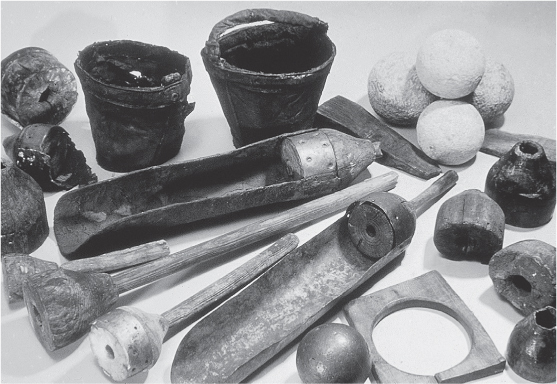
Ordnance equipment – shot, measuring ring, powder scoops, rams and buckets. (Mary Rose Trust)
50. Surrey to the King [24 June 1522].
The date is deduced from no. 51.
Pleaseth it your most noble grace to be advertised that at the writing hereof I was under sail going forwards, the wind being at the North, which is good, but it is very little wind. Most humbly beseeching your grace to cause our victuals to be sent after us, as well from London as from Hampton and Portsmouth. It were pity that we should let to accomplish that we intend to attempt only for lack of victuals. Also I send your grace herewith a book of such cables as of very necessity must be with all diligence provided for your highness’s ships, beseeching your grace to command some sure man to see for the provision of the same. And Our Lord send your highness the accomplishments of your most noble heart’s desires, and me grace to do you such service as my poor heart desireth. Written in the Mary Rose near St Helen’s, under sail.
Your most humble subject, T. Surrey.
51. Surrey to the King, 27 June 1522.
Pleaseth it your grace to be advertised that on Tuesday last [24 June] we departed from St Helen’s, the wind being contrarious, and with force of the ebb stopping the floods, be this present hour come before Portland, and so from tide to tide intend to do unto the time we may get as far as Dartmouth, where we must of force abide unto the time God will send wind to serve us to run over with the coasts of your enemies. Sir, considering how little victual we have on board, contrary the minds of the masters of the army, we have thus plied the tide to the intent something might be done against your enemies before our victual be spent; most humbly beseeching your grace that the rest of our victual might be with haste sent after us, and with God’s grace there shall be no time foreclosed by us your poor servants here to do that thing may be to your highness’s contentation and pleasure. Written in the Mary Rose, the 27th day of June.
Your most humble subject, T. Surrey.
52. Surrey to the King, 30 June 1522.
Nothing came of this proposal to make Dartmouth a principal anchorage for the navy. The idea that security could be provided by big dogs was only one of the impracticalities.
Pleaseth it your grace to be advertised that yesternight I came to the road, and because of divers of my company were within sight and might not come so far forth unto this tide, and also for lack of fresh water, whereof we were all destituted, [I] thought best to abide here this day. And so I, with Sir Richard Wingfield, Sir William Fitzwilliam, Sir Richard Jerningham, Hopton, Gonson, Sabyne, John Browne and divers others, took a boat and went into Dartmouth haven to view and see what places we might find to lay in your grace’s great ships this winter, and to advertise your grace as we have seen. In my life I never saw a goodlier haven nor more sure lying, after all our opinions, for your said ships, than here. First, at the entry of the haven there is a blockhouse made of stone, and of the same side an old castle; on the other side there is another old castle, and besides that another blockhouse, and a chain ready to be laid over the haven and all thing ready for the same. The town is not two arrow shot from thence, and the ships may lie two miles further within the haven under John Gilbert’s house, and at the best 5 fathom at a low water. The chain that is at Portsmouth may be laid within the other chain, so that we here think it shall not be possible for any ships to come within the haven. The most danger we see is that if the enemy would come with a great puissance and land at a place called Tor Bay, which is but two miles from the place where the ships shall ride, they might with casting fire into them do some hurt, or else some fellow might in the night steal into them [and throw wildfire into them inserted]. The remedy whereof, after our opinions, is this, that your grace should write unto the Bishop of Exeter and to all the best gentlemen of Devonshire, showing unto them that your grace is informed that they be now making a blockhouse a little beside Brixham within Tor Bay, and if they would make another at Churston within the said Tor Bay, your grace would help them with ordnance and powder. I perceive by divers gentlemen that have been aboard [this] day that they would make the same upon their own costs; [which] being made, as we here be informed, it shall be unpossible f[or an] army to land there to do any displeasure to your grace’s said [ships]. And as for casting of wildfire into them by stealth, in the […] if 3 or 4 acres of low wood be cut down that is gro[wing by] the shore where they shall ride, and a wall of stone made [not] passing 800 pace long, which will cost no great money [there being] so great plenty of stone there; and within the said wall […] great bandogs to go loose a-nights, I think they should [be] good surety for taking any hurt by stealth, notwithstanding [it] might stand with your highness’s pleasure to have them kept [under] your grace’s correction. I think it were well done your grace should [appoint] two or three wise expert men, as well to see and view the said […] also such places as shall be fortified within the haven and else[where] near where the ships shall be kept, where the enemies might [land] which I and the others here with me have had to leisure to [view]. Assuring your grace that, after my poor opinion, with the spending [of an] hundred pounds, such sure defences may be made for the s[urety] of your royal navy here that it shall be in manner not possible for [the] enemies to do any displeasure unto them, And within 4 m[iles of where] they shall lie your grace hath a park called Dartington, [wherein] is 2,000 goodly oaks, as I am informed, and may be br[ought by] water, which from time to time will serve for the reparations […]. And undoubtedly they shall spend less in tackling here than [at] Portsmouth by as much as in one year as in all the charges of [new] making here shall extend unto. And if it shall be your gr[ace’s pleasure] to have them kept here, then after my poor opinion, it sho[uld not be needed] to spend much for the reparations of Portsmouth, but wh[ile the Emperor] should pass into Spain, to cause the Henry Grace à Dieu to [keep him] company thus far, and then to be brought in hither, f[or as] I am informed, there will be gathered together here of your [grace’s army] within 24 hours 9 or 10,000 men for their defence ag[ainst the enemies].
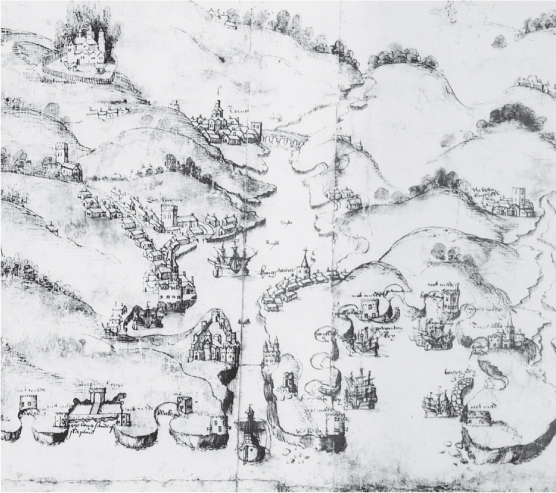
Dartmouth harbour. Another section of the panoramic map of the south coast from about 1540. A ship is entering the mouth of the River Dart, and another lies at anchor within Dartmouth harbour (the town of Dartmouth with its square-towered church to the left). Above is the bridge at Totnes, and to the left, Dartington. From British Library Cotton MS Augustus I, i, 35, 36, 38, 39. (British Library)
[Concluding in Surrey’s own handwriting]: Finally, Sir, at the closing of this letter, all the ships were under sail, and if the wind hold, with God’s grace tomorrow we shall land upon your enemies’ ground; and because Nicholas Semer, mayor of this town, is a very wise man and can well inform your grace of this haven, I have sent him to your grace with this letter, to whom it may please your highness to see for his costs. I have also desired divers of those that were with me at the viewing of this haven to put their hands to this letter. Written in the Mary Rose in Dartmouth road, the last of June.
Your most humble subjects, T. Surrey,
R. Wingfield, John Hopton, W. Gonson.
53. Surrey to Wolsey, 3 July 1522.
Pleaseth it your grace to be advertised that at this time I have advertised the King’s grace of the taking of Morlaix, with the circumstances of much part of that hath been done since my coming hither, whereof I do forbear to write to your grace because I know the same shall come to your hands. I trust of this time your grace hath caused more victuals to be sent after us, which shall be very welcome for we have need thereof. Sir William Fitzwilliam’s company is now without flesh and fish in a great number of his ships, and so I am fain to lend him part of mine, and all my company have beer but for 12 days. Great pity it were to see this well-willed company, for lack of victual, to leave undone that we here be in mind to essay, and what danger it shall be, with so little victual, to put ourselves so far from the coasts of England upon the coasts of enemies I report me unto your grace, notwithstanding undoubtedly as soon as we shall have wind to depart hence and to draw beyond the Trade we shall not fail so to do, and shall not return as long as we have any beer left, though in our return we should drink water. I beseech your grace that letters of thanks might be sent to all the lords and gentlemen here which have deserved the same right highly, as more at length at my return I shall show unto your grace. And thus Our Lord send your grace that you most desire, and us the rest of our victual, with good winds to bring our intended enterprise to pass, which we be like to essay without the help of others that were promised. Scribbled in the Mary Rose within the haven of Morlaix, this Thursday the 3 day of July.
[Postscript]: Sir, this day our anchors were weighing to have gone about other enterprises, and then the wind turned and compelled us to abide.
Yours most bounden, T. Surrey.
54. Fitzwilliam to Wolsey, 4 August 1522.
Please it your grace to understand that this day about one of the clock at afternoon I received your letter dated at Westminster the 3rd day of this present month of August, the contents whereof I have well overseen, with a bill specifying the names of such captains and ships, with the number of men, as be appointed to keep the sea. Your grace shall understand that yesterday my lord Admiral departed towards Calais, and this day hath had the wind right fair, so as I trust, and the wind keep there where it is, he shall be there tomorrow. Afore whose departure he appointed as well the ships as the captains and number of men to keep the sea, whose names shall appear unto your grace by a book which I send unto you herewith, which is not possible now to change. For here is left no more ships save only they, and they have their whole proportion of victuals already delivered unto them for two months, of such victuals as was left that was provided for the army, and also their wages paid unto them for one month. Also, such ships as be appointed to go Northwards be not only despatched, but also such as be appointed to go Westwards shall be despatched tomorrow, all save only the Gabriel of Topsham and the Trinity George, who were appointed to be manned and victualled with the men and victuals of the Mary Rose at such time as she should be laid up. And as to the ships that shall keep the Narrow Seas, I shall send them forth incontinently, all save the Mary Rose and the Great Bark, which cannot be made ready as yet these three days. Beseeching your grace, considering that Mr Pointz is already departed with my lord Admiral to Calais, I may know your pleasure what you will I shall do. And if so be your grace be minded to have the Mary Rose, which now is in a-readyness, and the Peter Pomegranate, laid up, to keep the sea, you must then discharge the Gabriel of Topsham and the Trinity George, or else cause a new proportion of victuals to be provided for them, and also send money for their wages. Which, the appointing of the Mary Rose or the Peter Pomegranate to keep the sea (if it may stand with the King’s grace’s pleasure and yours) me seemeth should not need ne’r no more great ships save the Great Bark, the Mary James and the new Spaniard, unless it were advertised for a truth that the French King made forth an army; and that once known, any of the ships in Portsmouth might soon be made ready. And in mine opinion the Gabriel of Topsham and the Trinity George should do better service in the West Sea, as well for the coming home of the fishers from the Newfound Land as for the going of the Frenchmen into Scotland: then, either the Mary Rose or the Peter Pomegranate in the Narrow Seas for these two months (unless the French King made an army, as above).
And as touching my going to Calais, the King’s highness can command me to go into no place in the world that I shall refuse. And in case his pleasure be that I shall go thither, I then beseech your grace I may not only be advertised thereof with diligence to the intent I may send my folks thither and provide myself of such things as I have need of, and when I have put everything in order, run in post thither; but also, that it will please your grace to write to my lord Admiral to keep me such tent or pavilion as was appointed for me.
And if the King’s pleasure shall be that I shall go to Calais, that then I may know his grace’s pleasure whether Gonson shall be Admiral, according to the book my lord Admiral brought from his grace, or not; seeing that Master Pointz is not here. Furthermore, as touching Mr Hert, he is not here; n’er here be no more gunners save 50; howbeit I shall speak to [John] Westowe to take up as many gunners as he can get, to the number of an hundred.
And as touching the Maglory, my lord Admiral hath taken her with him to Calais for the conveyance of my Lord Fitzwalter forth thither. And as soon as they be on land, the said ship is at her liberty. As the Blessed Trinity knoweth, who ever have your grace in his blessed tuition. Written in the Mary Rose the 4th day of August, by your servant to the best of his power,
William Fitzwilliam.