
CHAPTER 6
If the position of foreign countries is further strengthened by adoption of the proposals agreed on at the International Monetary and Financial Conference held at Bretton Woods, there will be every reason to expect more stability, order, and freedom in international exchange relationships in the postwar world.
Thirty-First Annual Report of the Board of Governors of the Federal Reserve System Covering Operations for the Year 1944.1
The Bretton Woods era can be divided in two halves. The first half was characterized by fiscal and monetary restraint. The second half was not.
During the first half, from 1945 to 1960, the Fed once again operated as it was originally designed to. Federal Reserve Credit expanded in some years and contracted in others. The outstanding stock of Federal Reserve Credit was $25 billion in 1945. It fell to as low as $17 billion in 1949 and then rose back to $28 billion in 1960, only 12% higher than at the end of the war. During the second half of this period, Federal Reserve Credit surged by 160%, from $28 billion in 1960 to $73 billion in 1971.
A significant change in the government's fiscal policy explains the sharp contrast in monetary policy before and after 1960. During the first half, the government's budget was roughly balanced. After 1960, however, the government ran large budget deficits and the Fed was called upon to help finance those deficits at low interest rates, which it did by acquiring government bonds with Federal Reserve Credit.
The government's large budget deficits and the Fed's willingness to help accommodate them had far reaching consequences. Most importantly, they resulted in a large outflow of gold from the United States that reduced the country's gold reserves – and the Fed's holdings of gold certificates – by half during the 1960s. The loss of gold forced Congress, in 1965, to eliminate the requirement that the Fed hold gold certificates to back the reserves banks held in their reserve accounts at the Fed. Three years later, Congress removed the final constraint on the Fed's ability to create credit by rescinding the requirement that the Fed hold gold certificates to back the Federal Reserve Notes it issued. Finally, in August 1971, the Bretton Woods system collapsed altogether because the United States no longer had enough gold to abide by its commitment to allow the governments of other countries to convert the dollars they accumulated into US gold. That commitment had been the cornerstone of the Bretton Woods system.
The breakdown of the Bretton Woods system completely and permanently severed the link between dollars and gold, unleashing a new era of purely fiat money that transformed the world. This chapter describes how these events were reflected in the evolution of the Fed's balance sheet.
Assets
From 1945 to 1960, the Fed's total assets remained roughly flat. But between 1960 to 1971, they increased by 80% (see Chart 6.1).

CHART 6.1 The Fed's Total Assets, 1914 to 1971
Source: Data from “The Federal Reserve System’s Weekly Balance Sheet Since 1914” and accompanying spreadsheet. Johns Hopkins University, SAE/No.115/July 2018. See Bibliography.
What was responsible for this disquieting increase in the Fed's assets after 1960? To answer that question, it is necessary to explain how the Fed conducted monetary policy after World War II ended.
The Fed continued to hold the yield on government securities fixed up until 1951. However, that year, the Fed reached an “Accord” with the Treasury Department that freed it from that World War II commitment.
Afterwards, the Fed's primary objective shifted from financing the government's debt at low interest rates to producing monetary conditions that would foster economic growth without creating inflation. The Fed used open market operations as its principal monetary policy tool to accomplish that objective. When the Fed wished to loosen monetary conditions to support more rapid economic growth it conducted open market purchases of government securities, thereby adding reserves to the banking system and, consequently, lowering interest rates. Additional reserves enabled the banking system to lend more, while lower interest rates encouraged more private sector borrowing. When the Fed wished to tighten monetary conditions to slow the economy and deter inflationary pressures, it conducted open market sales of government securities, which drained reserves from the banking system and pushed up interest rates, which, in combination, deterred lending by the commercial banks.
This process required the Fed to first make an assessment of what the appropriate level of monetary accommodation should be and then to conduct open market operations to achieve the level of accommodation it deemed appropriate.
Between 1951, when it reached its Accord with the Treasury Department, and 1960, the Fed was required to make only relatively small adjustments to its holdings of government securities to maintain the level of monetary accommodation that it desired. After 1960, however, much larger open market purchases were necessary. A fundamental change in fiscal policy was responsible for that change in monetary policy.
Between 1946 and 1958, the government's budget was more or less in balance. The cumulative deficit during those 13 years was just $4 billion. In 1959, however, the government ran a large budget deficit of $13 billion. Afterwards, deficits were the norm rather than the exception. The cumulative deficit during the 13 years between 1959 and 1971 was $95 billion. Chart 6.2 shows the government's budget deficits each year from 1946 to 1971.
Presidents Truman and Eisenhower believed in balanced budgets. Between 1946 and 1952, the Truman administration ran a small budget surplus, despite very large military expenditures related to the Korean War. The Eisenhower administration was also quite fiscally conservative, at least up through 1957. The recession of 1958, however, resulted in a large budget deficit the following year. The Kennedy and Johnson administrations ran budget deficits every year between 1961 and 1968, with a particularly large deficit in the final year. President Nixon also produced a very large budget deficit in 1971.
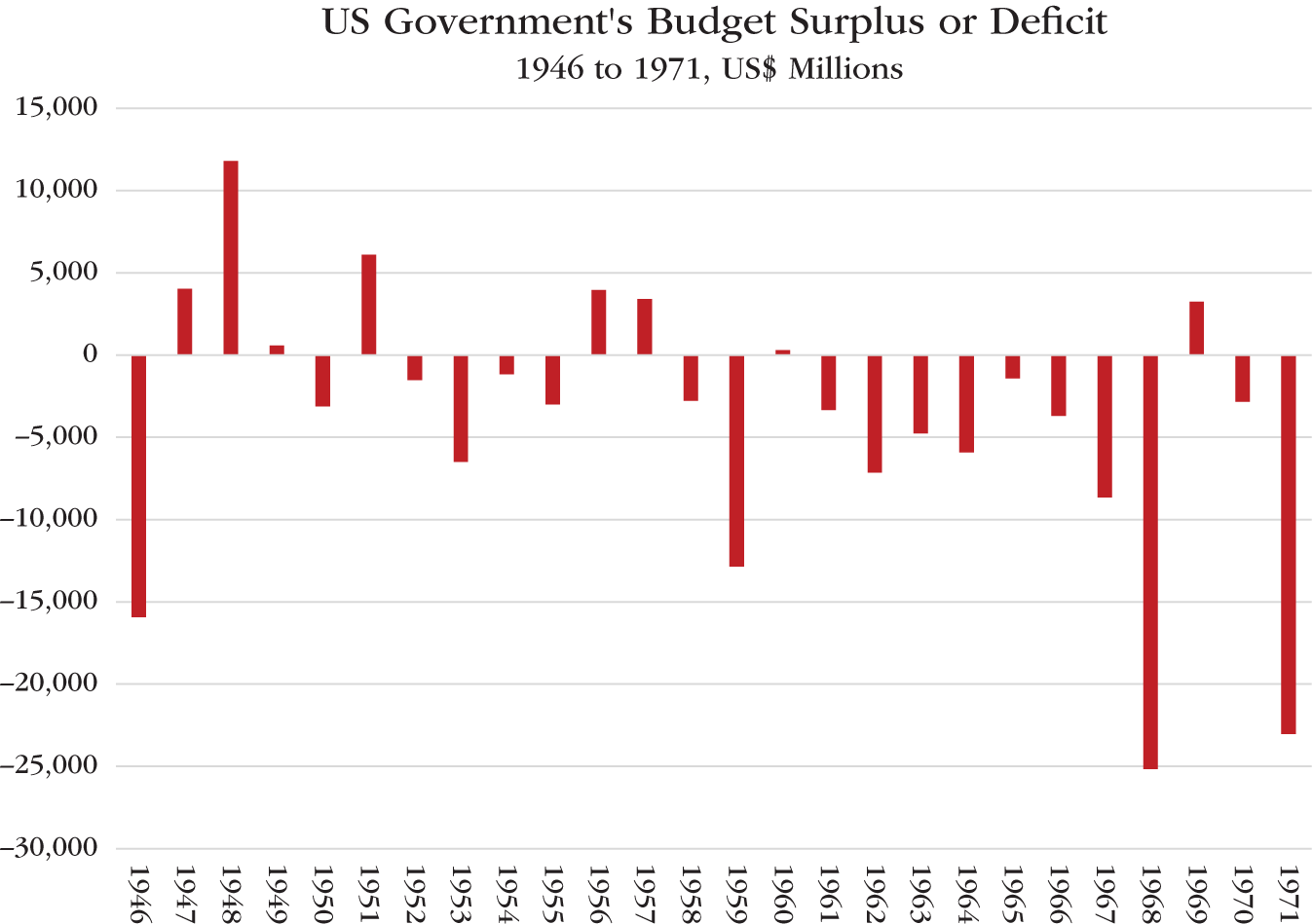
CHART 6.2 US Government's Budget Surplus or Deficit, 1946 to 1971
Source: Data from the Office of Management and Budget Historical Tables, the White House
The surge in government borrowing necessitated by large budget deficits exerted upward pressure on interest rates. This required the Fed to purchase larger amounts of government securities in order to hold interest rates at the level it believed appropriate to support economic growth. Moreover, as the government's budget deficits grew during the 1960s, the Fed came under increasing political pressure to help finance them at low interest rates.
The Great Depression and World War II had brought about a radical change in public opinion regarding the government's responsibility for managing the economy. Beginning in 1933, the Roosevelt administration had introduced a wide series of experimental policies in the attempt to end the Depression. When World War II began, the government took over direct management of nearly every aspect of the economy, including production, distribution, money, prices, and labor. By the time the war ended, the public expected the government to continue managing the economy.
The public had come to believe it was the government's responsibility to manage the economy so that people could find jobs. Congress passed legislation that made it the government's legal obligation to do so. In February 1946, President Truman signed into law the Employment Act of 1946, which, according to the first sentence of that law, was “An Act to declare a national policy on employment, production, and purchasing power, and for other purposes.”
Section 2 of the Act states:
The Congress hereby declares that it is the continuing policy and responsibility of the Federal Government to use all practicable means consistent with its needs and obligations and other essential considerations of national policy, with the assistance and cooperation of industry, agriculture, labor, and State and local governments, to coordinate and utilize all its plans, functions, and resources for the purpose of creating and maintaining, in a manner calculated to foster and promote free competitive enterprise and the general welfare, conditions under which there will be afforded useful employment opportunities, including self-employment, for those able, willing, and seeking to work, and to promote maximum—employment, production, and purchasing power.2
William Martin, Fed chairman from 1951 to 1970, held the view that it was the duty of the Congress and the president to decide how large the government's budget deficit would be and that it was the duty of the Fed to help finance those deficits at reasonable interest rates.3 Arthur Burns, who succeeded Martin as Fed chairman in February 1971, is generally believed to have succumbed to pressure from President Nixon to keep monetary policy accommodative ahead of Nixon's campaign for reelection in 1972.4

CHART 6.3 A Breakdown of the Fed's Major Assets and Liabilities, 1914 to 1971
Source: Data from “The Federal Reserve System’s Weekly Balance Sheet Since 1914” and accompanying spreadsheet. Johns Hopkins University, SAE/No.115/July 2018. See Bibliography.
With this political environment in mind, let's look more closely at the evolution of the Fed's balance sheet.
Balance Sheet
During the first half of the Bretton Woods era, when the government was fiscally conservative, all the Fed's major assets and liabilities remained roughly unchanged, as Chart 6.3 shows.
On the asset side, the Fed's holdings of government securities increased only from $24 billion in 1945 to $27 billion in 1960, while the Fed's holdings of gold certificates also increased modestly from $18 billion to $19 billion over the same period. On the liabilities side of the balance sheet, the reserves commercial banks held at the Fed rose from $16 billion in 1945 to $17 billion in 1960, while Federal Reserve notes in circulation increased from $25 billion to $30 billion.
The change in the Fed's balance sheet tells a very different story after 1960, however, once the government began running persistently large budget deficits. The most notable development on the asset side was an extraordinary surge in the Fed's holdings of government securities, which more than doubled from $27 billion in 1960 to $70 billion in 1971.
The Fed's holdings of US government securities not only increased sharply in absolute dollar amounts, but they also increased sharply relative to the total amount of government debt outstanding. In 1961, the Fed owned 10% of all such securities. By 1971, it owned 17% of the total. In other words, by 1971, the Fed had monetized 17% of the government's debt. This fact is all the more startling given the very large increase in US government debt outstanding during those years (see Chart 6.4).
A second development to take note of on the asset side of the Fed's balance sheet is that the Fed's holdings of gold certificates fell sharply starting in 1958, as shown in Chart 6.3.
Huge amounts of dollars left the United States during the 1960s. The US government gave its allies large military grants, particularly for use in the war in Vietnam. US corporations and banks also made large investments in Europe that resulted in dollars going abroad. The capital outflows were greater than the United States trade and current account surpluses. Consequently, the United States balance of payments was in deficit. Dollars went abroad to pay for that deficit. Some of those dollars were converted into US gold. As a result, the United States lost more than half of its gold reserves during the 1960s. Consequently, the Fed's holdings of gold certificates declined from $23 billion in 1957 to $10 billion in 1971.
Between 1945 and 1957, the Fed held roughly an equal amount of Treasury securities and gold certificates. By 1971, the Fed held nearly seven times as many Treasury securities as gold certificates, as can be seen in Chart 6.3.

CHART 6.4 The Fed's Ownership of US Treasury Securities as a Percentage of Gross Federal Debt, 1945 to 1971
Source: Data from Board of Governors of the Federal Reserve System, The Fed's Annual Reports 1945 to 1971
Chart 6.5 shows the contribution of both Treasury securities and gold certificates to the Fed's total assets during these years.
On the liabilities side of the Fed's balance sheet, it is the growth in Federal Reserve Notes that stands out. Before World War II, the public increased its holdings of cash during wars and economic crises, but then redeposited the currency once the emergency had passed. That did not happen at the end of World War II. Currency outside banks (Federal Reserve Notes) remained larger than Bank Reserves even after the war ended. In fact, more than six decades would pass before the Fed's reserve liabilities once again exceeded it liabilities for Federal Reserve Notes.
This is all the more surprising since, when the Fed began buying more government securities from the early 1960s, it paid for those securities by making deposits into the reserve accounts of the commercial banks from which it bought the bonds. Therefore, growth in commercial bank reserves should have dominated the liabilities side of the Fed's balance sheet during the 1960s. But that was not the case. Instead, currency outside banks increased much more than Bank Reserves. Federal Reserve notes in circulation increased from $30 billion in 1960 to $54 billion in 1971.

CHART 6.5 The Fed's Total Assets: Gold vs. Assets Acquired with Federal Reserve Credit, 1914 to 1971
Source: Data from “The Federal Reserve System’s Weekly Balance Sheet Since 1914” and accompanying spreadsheet. Johns Hopkins University, SAE/No.115/July 2018. See Bibliography.
In the early 1960s, the outstanding amount of Federal Reserve Notes in circulation began to increase rapidly. As demand for cash grew, the public withdrew Federal Reserve Notes from their bank accounts; and when the banks ran short of cash they obtained more from the Fed. When the Fed provided the banks with additional Federal Reserve Notes, the Fed debited their reserve balances at the Fed. Consequently, the growing demand for Federal Reserve Notes resulted in a large and persistent drain of Bank Reserves.
In part, the increase in demand for cash was the result of a regulatory change. Beginning in 1959, the Fed permitted vault cash, i.e., the cash banks hold at their place of business, to be counted as reserves. Up until then the commercial banks could only satisfy their liquidity reserve requirements by holding funds on deposit in their reserve accounts at the Fed. This change lowered the level of reserves that banks had to hold idle in an account at the Fed and increased the banks' demand for Federal Reserve Notes. A higher rate of inflation during the second half of the decade also explains part of the increase in the demand for cash, since higher prices required a greater volume of currency.
Although Federal Reserve Notes grew more, the deposits banks held in their reserve accounts at the Fed also expanded. That is the final development to take note of on the liabilities side of the Fed's balance sheet. As the 1960s progressed, bank deposits grew. Consequently, the level of reserves that the banks were required to hold relative to their deposit base also grew. Between 1963 and 1971, the Fed's reserve liabilities increased from $17 billion to $28 billion, despite the drain caused by the increase in the number of Federal Reserve Notes in circulation (see Chart 6.3).
Federal Reserve Credit
During the 1960s, Federal Reserve Credit grew every year, with the rate of growth accelerating throughout the decade. Such a rapid and prolonged increase in Federal Reserve Credit was unprecedented. The significance of this development must not be overlooked. Astonishingly, Federal Reserve Credit grew more in 1971 than it did in 1944, at the peak of World War II. This is shown in Chart 6.6.
Federal Reserve Credit consisted almost exclusively of credit extended to the government through the Fed's acquisition of US government securities, as shown in Chart 6.7. Notice that there were practically no bills discounted among the Fed's assets. Before the Great Depression, the Fed carried out monetary policy primarily by extending Federal Reserve Credit through its discounting operations, during which it accumulated bills discounted as collateral. From 1932, however, the Fed provided Federal Reserve Credit primarily through open market operations instead. Afterwards, bills discounted nearly ceased to register on the Fed's balance sheet. The same is true for bills bought, since, after 1934, when the Fed conducted open market purchases it acquired government securities rather than commercial paper.

CHART 6.6 Federal Reserve Credit, Annual $ Change, 1915 to 1971
Source: Data for 1915 to 1917 from “The Federal Reserve System’s Weekly Balance Sheet Since 1914” and accompanying spreadsheet. Johns Hopkins University, SAE/No.115/July 2018. See Bibliography. Data for 1918 to 1971 from The Fed’s 2017 Annual Report, p. 306
The End of Gold-Backed Money
By the mid-1960s, it was becoming clear that within a very short period of time, the United States simply would not have enough gold left to enable it to meet its obligation to allow the governments of other countries to convert the dollars they accumulated into US gold – as it was required to do under the rules of the Bretton Woods system – unless it radically altered both its fiscal and monetary policy.

CHART 6.7 Federal Reserve Credit and Its Components, 1914 to 1971
Source: Data from “The Federal Reserve System’s Weekly Balance Sheet Since 1914” and accompanying spreadsheet. Johns Hopkins University, SAE/No.115/July 2018. See Bibliography.
The Fed could have stopped or even reversed the gold outflows by pushing up interest rates to a much higher level. Higher US interest rates would have encouraged US banks and corporations to stop investing in Europe and to bring their capital back home by making the returns on US bonds more attractive. Higher US interest rates would have also caused the US current account surplus to grow larger, since higher interest rates would have caused a recession in the US that deterred consumption and imports. A larger current account surplus would have brought more gold into the United States.
However, the Fed was committed to the government's goal of maintaining full employment. Higher interest rates would have thrown Americans out of work and undermined the government's efforts to create more jobs.
The Employment Act of 1946 required the Fed to take actions that would help achieve full employment. The Bretton Woods Agreement required the Fed to conduct monetary policy in a manner that would prevent the United States from losing gold through a balance of payments deficit. Clearly, those two requirements were incompatible. Loose monetary policy designed to support full employment would result in a balance of payments deficit and the loss of gold. Tight monetary policy designed to prevent the loss of gold would lead to higher unemployment.
The Fed could not pursue both policies at once. It chose to support employment. The Fed believed that government policies – budget deficits and capital outflows stemming from military grants – were responsible for the drain of US gold reserves. It was unwilling – and politically unable – to tighten monetary policy enough to stop the United States' loss of gold.
The combination of the loss of US gold and the increase in Federal Reserve Notes in circulation brought about a rapid deterioration in the Fed's gold coverage ratio, which fell from 46.6% in 1958 to 27.7% in 1965, as shown in Chart 6.8.
To enable the Fed to continue accumulating government securities without falling below its statutory gold coverage obligations, Congress, in 1965, changed the law so that the Fed was no longer required to maintain any gold certificate backing for the reserves commercial banks held at the Fed. That caused the Fed's gold coverage ratio to move back up to 41.2%. However, with the Fed continuing to buy government securities on a large scale and currency in circulation expanding rapidly, that relief did not last long.
In 1968, Congress changed the law again so that the Fed was not required to hold gold certificates to back Federal Reserve Notes either.
Once President Johnson signed Public Law 90-269 into effect on March 19, 1968, the Fed was freed of its obligation to hold gold certificates to back the money it created. In fact, the Fed no longer faced any domestic constraints on how many Federal Reserve Notes it could issue or how much Federal Reserve Credit it could create. The United States moved from a gold-backed monetary system to a pure fiat monetary system. The men who passed the Federal Reserve Act that had created the Fed in 1913 would have been appalled. Afterwards, only the fear that inflation would result from an overly expansive monetary policy kept the Fed in check.
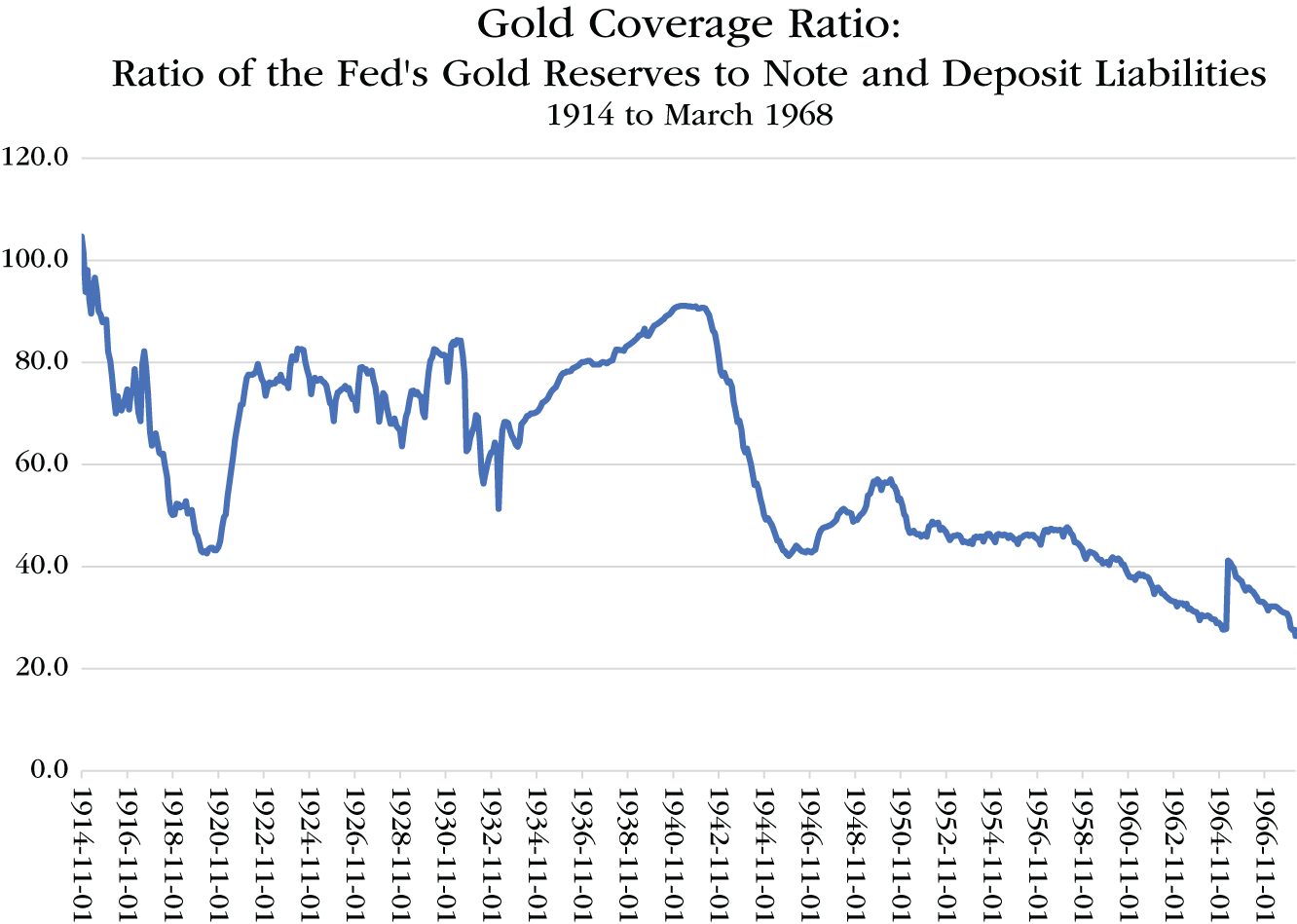
CHART 6.8 Gold Coverage Ratio, 1914 to 1968
Source: Data for 1914 to 1948, Ratio of Reserves to Note and Deposit Liabilities, Federal Reserve Banks for United States, St. Louis Fed. Data for 1949 to 1968, Factors Affecting Reserve Balances of Depository Institutions and Condition Statement of Federal Reserve Banks, St. Louis Fed.
When US gold reserves began to dwindle during the 1960s, the governments of other countries became concerned that the United States soon would not have enough gold left to allow them to convert the dollars they had accumulated into US gold. The more these concerns grew, the faster those countries converted their dollars into gold.
President Johnson had asked Congress in 1968 to end the Fed's obligation to back dollars with gold certificates in the hope that such a change would calm those fears and restore international confidence in the dollar.
Confidence in the dollar was not restored, however. The rest of the world was not convinced that the United States would tighten fiscal and monetary policy enough to swing the US balance of payments from deficit back into surplus. The run on the dollar continued and US gold reserves continued to shrink.
On August 15, 1971, President Nixon unilaterally declared the United States would no longer abide by its commitment to allow other governments to convert dollars into gold. By that time, the US simply did not have enough gold left to allow dollar convertibility to continue.
Nixon's announcement was the death knell of the Bretton Woods system. The regime in which all currencies were directly or indirectly pegged at a fixed exchange rate to gold disintegrated. Fixed exchange rates gave way to a new system of floating exchange rates. Soon thereafter international trade ceased to balance and cross-border capital flows ballooned. Credit growth exploded. This Money Revolution fundamentally changed the nature of the global economic system that had emerged under the gold standard. A new era, financed merely with fiat money, got underway. This new monetary regime quickly transformed the global economy.
Notes
1. Thirty-First Annual Report of the Board of Governors of the Federal Reserve System Covering Operations for the Year 1944, dated April 28, 1945, p. 24.
2. Employment Act of 1946, St. Louis Fed. https://fraser.stlouisfed.org/files/docs/historical/trumanlibrary/srf_014_002_0002.pdf
3. Source for William Martin's view: Allan H. Meltzer, A History of the Federal Reserve, Volume 2, Book 1, 1951–1969. p. 85
4. Source for statement regarding Arthur Burns: “Nixon tapes reveal political pressures on the Fed.” Burton A. Abrams, professor of economics and acting chairperson of the Department of Economics in UD's Lerner College of Business and Economics. http://www1.udel.edu/PR/UDaily/2007/nov/fed111706.html]