
CHAPTER 10
So many fearless young sailors in pea-jackets and caps perished in the deep. So many times we saw dead sailors’ caps floating on the sea.1
Conventional wisdom – sometimes erroneously – holds that, under the circumstances of a war cult, the state controls remembrance centrally. This is definitely the case with Victory Day celebrations on 9 May, which remain popular across post-Soviet Russia today since their reincarnation under Brezhnev in 1965.2 From a presentist point of view, Eric Hobsbawm proposes a hegemonic mechanism for commemorative tradition, which provides little scope for public debate or individual input. According to this politics of memory approach, the state alone is responsible for inventing traditions. Hobsbawm sees the ruling elite introducing rituals and symbols ‘which seek to inculcate certain values and norms of behaviour by repetition, which automatically implies continuity with the past’.3 This theory correctly describes the situation regarding Victory Day and its relatively new attendant invented tradition of the St George ribbon, a symbol of war memory that has proved particularly successful since its introduction by the state in 2005 in capturing and moulding the national mood. Today there remains a general lack of dissent surrounding war memory by the public, who would probably mount a public outcry if this traditional holiday were ended. The high degree of popular support for Victory Day signifies the substantial convergence under President Putin of a manipulative state and a society relatively happy to be manipulated.
However, despite the outward impression of a state juggernaut pushing through its own agenda with respect to commemoration of the war, I contend that the position is far from straightforward. Catherine Merridale finds that, in the Soviet Union, state repression of potential alternative, personal remembrance was particularly noticeable during the grand military parades, which ‘were designed to overwhelm, to drown individual memory in the clamour of patriotic ceremonial’.4 And yet an alternative mode of commemoration with its own symbol unique to maritime Novorossiisk was indeed invented in Brezhnev’s Soviet Union, its origins rooted in a provincial bottom-up memory movement. The ceremonies and practices around Victory Day in modern Russia will be examined in more detail in Part IV. In contrast, this chapter concentrates on the local Beskozyrka tradition, named after a simple sailor’s cap.
In this ceremony, it is the beskozyrka which acts as the focal point of respect for the individual within the collective in an annual ritual of remembrance of the dead which is altogether more sober than Victory Day. The Beskozyrka ritual was invented in 1968 not by the national elite responsible for Victory Day celebrations, but by a small group of young Novorossiisk residents. However, this Soviet youth group was also no doubt under the influence of the state’s burgeoning war cult shortly after Brezhnev’s appointment as the country’s leader in 1964.
The change in state policy to promote the war myth and associated remembrance was anticipated in Novorossiisk in 1963, when the local Communist Party newspaper, Novorossiiskii rabochii, filled a whole page with war memories. Two years later the same paper was exceptionally published on a Sunday, devoting its whole four-page edition to the revived Victory Day celebrations.5 With a build-up of the memorial climate nationally and locally during the mid-1960s, the time was ripe for a new form of commemoration in Novorossiisk. In January 1968 a ten-line paragraph appeared in the youth section of Novorossiiskii rabochii, advertising Operatsiia ‘Beskozyrka’ (Operation ‘Beskozyrka’), a procession taking the ‘torch of glory’, lit from the eternal flame on Heroes’ Square, to the site of the Malaia zemlia landings in the small hours of 4 February, in commemoration of the twenty-fifth anniversary of the start of the battle.6
The youth group promoted by Novorossiiskii rabochii was inspired by the creation in 1962 of a literary club for young readers, Klub iunykh kommunarov (the Young Commune Members’ Club) by Komsomol’skaia Pravda, the official mouthpiece of the Communist Party’s youth movement, the Komsomol.7 The Novorossiisk off-shoot of the readers’ club was named ‘Shkhuna rovesnikov’ (the Schooner ‘Young Contemporaries’), possibly after Rovesnik, the Komsomol magazine for teenagers which was popular in the 1960s.8 The ‘Shkhuna rovesnikov’ may well have been modelled on the crew of a real ship on the Bering Sea, the Seskor, who had started a literary journal from their cabin.9 The Novorossiisk club encouraged its teenage members (so-called Shkhunatiki) to form the land-based crew of an imaginary schooner, incorporating a system of ranks, an oath of adherence and passwords for meetings. The founding captain and self-proclaimed helmsman of the ‘Shkhuna rovesnikov’ was the novice Novorossiiskii rabochii journalist, Konstantin Podyma. Gathering his crew in November 1965 through a new youth page in Novorossiiskii rabochii, the 19-year-old invited all ‘romantics’ and ‘fantasists’ to set sail with him on a journey of dreams, discussion and self-discovery.10 Thus started the weekly meetings in their ‘cabin’ in the Novorossiiskii rabochii offices,11 leading to a series of romantic exploits deemed by a former Shkhunatik to be typical of the eccentricity of the club members.
Although the Shkhunatiki may in retrospect consider themselves to have been atypical of their generation, they were probably rather the product of their times and cultural environment, with relatively normal family backgrounds including peasants, accountants, workers in the port, doctors and managers in industry. Some of the young people’s parents also worked for the Communist Party. Indeed, according to Gleb Tsipursky’s analysis, most of the readers of Komsomol’skaia Pravda in the early 1960s represented ‘conformist youth’, who identified with the values propagated by the newspaper, including the strong sense of patriotism disseminated from above, a view extrapolated by Jeffrey Brooks to the relationship between the press and the Soviet population in general in the early Brezhnev years.12 However, it is evident that this local club brought its own creative interpretation to the pervading examples in national youth publications.
Members of the ‘Shkhuna rovesnikov’ revelled in an atmosphere of literary romanticism, adopting as their hero the poet Pavel Kogan, who met his death outside Novorossiisk in September 1942. The young people regularly spent the night changing a red flag on the summit of Sakharnaia golova, the hill where he was killed in battle.13 This interest in Kogan is a local reflection of the influence of the romantic poetry and song which became fashionable with young people in the post-Stalin era of the 1950s and 1960s, when student anthems included Kogan’s ‘Brigantina’ (1937), typical of the ‘bardic song’ of the thaw years. Exotic heroes including the sea captains featured in Kogan’s work and the romantic pirates of the open seas were popular heroes in this new genre.14 It has even been suggested that ‘Brigantina’ is Kogan’s tribute to Nikolai Gumilev, the poet well known for his Wanderlust.15 No doubt the escapism inherent in Kogan’s poetry and the perceived freedom of a sea captain were attractive to shore-bound teenagers with little chance of significant travel. It therefore comes as no surprise that, with their combination of idealistic romanticism and respect for the war dead, the group decided to mark the anniversary of the landings in 1968 in a special way, framing themselves within the pervading memorial context. Their idea was to commemorate unburied troops who had died at sea by carrying a sailor’s peakless uniform cap (the eponymous beskozyrka) four kilometres through the streets of the town just after midnight. The hat would then be ceremonially lowered into the sea at Stanichka, surrounded by wreaths of flowers.
This ceremony is also a reflection of the increasing focus on military-patriotic youth training in the Brezhnev era, strongly endorsed by the Komsomol organisation. Membership of the Komsomol was expected for schoolchildren and students aged from 14 to 28 who became members of a primary cell, the bottom layer of a complex hierarchy of management mirroring the Communist Party organisation. Komsomol activities centred on the war cult were highly controlled by nationalist sympathisers and encouraged by novels and memoirs about the war. Furthermore, young people were taken to visit war sites and monuments as part of their moral upbringing (vospitanie).16
Novorossiisk teenagers were possibly even more exposed to memory of the war than many of their peers. According to Klara, a former member of the ‘Shkhuna rovesnikov’, the young postwar generation of Novorossiisk in the late 1960s were exposed to stories of wartime exploits in books, the press and the family. Moreover, when I was fortunate enough to interview him, Podyma claimed that the Shkhunatiki would routinely find grenades, shell cases and human remains, breeding a feeling of involvement in the war myth from childhood and a sense of identification with the young partisans who had fought outside Novorossiisk during the war.
However, Podyma and two female Shkhunatiki categorically dismiss suggestions of direct Komsomol influence on the original Beskozyrka ceremony, although it is probable that the overwhelming state propaganda machine of their youth went largely unnoticed due to its ubiquitous nature. They do, however, acknowledge Communist Party support from the editor of Novorossiiskii rabochii, Grigorii Pogibel’, a member of the Gorkom, the town committee of the Communist Party, who provided premises for their meetings. He also encouraged the already independent youngsters to plan the ceremony themselves, while nonetheless checking on the organisational details.17 Rather more direct input into the meetings is recalled, however, by Viktor Saloshenko, second secretary of the Novorossiisk Komsomol Committee at the time, who claims to have implemented all the organisation of which he deemed the young people incapable. He also suggests that, without his official Komsomol presence at all meetings of the ‘Shkhuna rovesnikov’, its members risked being taken for dissidents by the KGB.18
Klara admits that it took time for the authorities to come to terms with the group’s sometimes unusual projects, although Podyma believes that the Komsomol was unwilling to help in the early days because of the absence of prestigious veterans from the first ceremony. This difficulty may reflect not only the status that the veterans would bring to the event, but possibly points to a problem with permission for a group procession. Veterans were among the few categories of citizens allowed to gather together in public at the time – an important privilege granted to those from whom the state needed absolute loyalty for the credibility of the war cult.19 Podyma alleges that there was some peripheral involvement from the KGB, whose border guards set up searchlights along the shore to light up their proceedings,20 a claim disputed by Klara. In the light of competing memories and the lack of decisive evidence from Komsomol records, it is difficult to gauge with certainty the degree of influence from above. The Beskozyrka movement may possibly have been the product of an organised campaign by the Komsomol leadership, which, under the influence of the national memorial climate, tapped into the enthusiasm and inventiveness of the younger generation. In today’s Novorossiisk, however, the credit for its inception is placed squarely with the inventive young people themselves.
The first Beskozyrka ceremony was a modest affair, involving only 22 young people and six adults; the cap was carried by Elena Ostapenko, a former nurse on Malaia zemlia.21 The newly invented ritual then faltered for a time, being banned by a Communist Party bureaucrat the following year, despite its patriotic intent and the countrywide encouragement of youth initiatives.22 Party concern may have been due to a degree of nervousness about crowds of young people gathering together following the protest events in Moscow against the invasion of Czechoslovakia in 1968, as, although the ceremony was permitted officially in 1970, it was restricted to a much smaller area.23 Thanks to the intervention of influential veterans and the Gorkom, local Komsomol officials were apparently finally convinced of the value of the ceremony and gave it their approval in 1971.24 By the outing of the third Beskozyrka the number of participants had increased dramatically to a critical mass of 5,000, such that by 1973 the press was already referring to it as an established tradition.25
The rise in popularity of the Beskozyrka ritual during the 1970s mirrored the development of the war cult nationwide. The early Beskozyrka tradition was apparently welcomed by both young and old, fusing the patriotic commemoration desired by the older generation with the romance of a secret society attractive to its young inventors. Sokolov recalls the emotion evoked by the ceremony as veterans silently remembered their fallen comrades, linked with their gratitude for the opportunity to pass on this memory to the younger generation.26 In contrast, the main aspect of Beskozyrka apparently enjoyed by the younger generation was the night-time torchlit procession and the secrecy of a complex system of passwords.27 Here was an adventure in keeping with the romantic leanings of the Shkhunatiki, nurtured by the state emphasis on ‘romantic militarism’, exemplified by the publication from 1964 to 1990 of a series of biographies of romantic figures in history, Plamennye revoliutsionery (Fiery Revolutionaries).28 Furthermore, the system of ranks and the military parade of Beskozyrka reflected official war cult values, which promoted a convergence of generations that would ensure the ceremony’s success.
A Changing Tradition or a Tradition of Change?
The juxtaposition of the concept of longstanding tradition with a relatively young state such as post-Soviet Russia may seem paradoxical, particularly bearing in mind the unsettled years of perestroika and the 1990s, when Beskozyrka struggled to survive. Eric Hobsbawm suggests that newly invented traditions may be more widespread during periods of rapid social change and modernisation to which older established traditions may succumb.29 In contrast, I contend that the comfort of any tradition, whether old or young, is particularly welcome within an environment rendered unstable by war, political or financial crisis. According to Edward Shils, it is the very normativeness of tradition that acts as ‘the inertial force which holds society in a given form over time’.30 Similarly, Paul Connerton sees the importance of ritual mainly in its invariance over time.31 Maurice Halbwachs confirms that rituals tend to remain constant over time, even when society as a whole is in the process of change, as, especially in these circumstances, people tend to cling to tradition for the perceived security it offers.32
On the other hand, any inertia associated with a tradition, even one strongly linked with local identity, risks leading to stagnation. There is the related risk that the ritual may become static and boring, with over-reliance on what Paul Connerton calls ‘habit-memory’, leading to popular apathy rather than a proactive commitment to remember.33 This is certainly not the case in Novorossiisk, though, where I have found that a society can successfully adapt an old tradition for new conditions by grafting new rituals or language onto the original ceremony of commemoration. In fact, it is perhaps not surprising that an analysis of the development of the Beskozyrka tradition over nearly five decades reveals gradual changes in the ritual. The organisers of Beskozyrka have adopted a process of re-invention and rejuvenation, enabling each generation to place its own stamp on the ritual, while serving to prevent stagnation and promote local identity. The series of changes in Beskozyrka has been established not merely as the passive response typical of a comfortably apathetic society, but in a proactive attempt to attract young people and propagate war memory across the generations. Furthermore, in view of the scale and frequency of these innovations, it seems that the concept of change in the Beskozyrka ritual has become an invented tradition in its own right.
With even younger children and their parents in mind, the time was brought forward firstly to the afternoon and then the evening of 3 February, better facilitating cross-generational transmission. Raisa Sokolova describes the addition of a solemn oath to the proceedings in 1978, the tenth anniversary of the tradition and the week during which Brezhnev’s memoirs were published.34 Repeating the oath made by Major Kunikov’s troops prior to battle, the young people swore to become a living memorial to those who had given their lives. The original marine infantry had sworn to die for their country:
We will give up our own will, strength and blood, drop by drop, for the life and happiness of the people, for you, our beloved Motherland!35
After the event, their historic success was reinforced in a dispatch from the War Council:
Your fathers, mothers, wives and children will be proud of your defence, courage and heroism. We know that this small area of land will become great and will bring about the liberation of our fathers, mothers, wives and children groaning under the fascist yoke.36
The heroes of Malaia zemlia were thus situated in a mythical historical continuum, charged with ensuring the freedom of their children, the generation responsible for the invention of the Beskozrka ceremony. In contrast, the oath made by the Beskozyrka carriers in 1980 principally reflected the prevailing ideology of the Brezhnev era, as participants vowed to strive to work hard to fulfil communist ideals, including the stringent economic demands of the tenth five-year plan.37 It is perhaps not surprising that, in a ceremony with links to the general secretary’s wartime service, political ideology further complicated the simple war myth. Despite an ostensible wish to commemorate the past, this pragmatic consideration of the political environment confirms that, towards the end of the Brezhnev era, national political concerns barely connected with war memory had taken over the local myth of Malaia zemlia.
In the early years after the fall of the Soviet Union interest in Beskozyrka waned in line with national trends after Gorbachev had dismantled the Brezhnev-era war cult.38 Newspaper reports of the ritual are scarce, with nothing about Beskozyrka in the local press in 1993, the fiftieth anniversary of the landings. Several of my respondents mentioned that Beskozyrka in its original form barely survived during this period. Marta, a former member of the ‘Shkhuna rovesnikov’, blamed this decline on the end of the Komsomol organisation, which had apparently continued to endorse the ceremony since 1971. However, a retired headmistress recalls that 100 children from each of the local schools were invited during the 1990s to the town’s theatre for a different type of commemoration involving about 5,000 annually, reinforcing Marta’s claim that the town’s head of culture and other founding members of the ceremony kept the ritual alive. This is plausible, since, following the town council’s decision to take over responsibility for the ritual, it was back to full strength in 1998 for its thirtieth anniversary.39
For over 50 years the fact that two landings had actually taken place in 1943 was rarely recalled, as the war myth privileged the successful Malaia zemlia campaign over the failed landings at Iuzhnaia Ozereika. Since 1996 two torches have been lit and two hats carried to the beaches: the first to Malaia zemlia in the usual fashion, and the second transported by tank to the more distant Iuzhnaia Ozereika, where the ritual has evolved slightly differently, with its own committed following.
The twenty-first century has seen a partial return under President Putin to more conservative Soviet values, a renewed emphasis on vospitanie and the development of a new war cult. Once again, politicians promote a common interest in social coherence and continuity with the Soviet past, presenting the people with an image of a strong and united nation. As will be shown in Part IV, the involvement of the younger generation is central to current policy for the propagation of the war myth, utilising many of the strategies of the Brezhnev era.
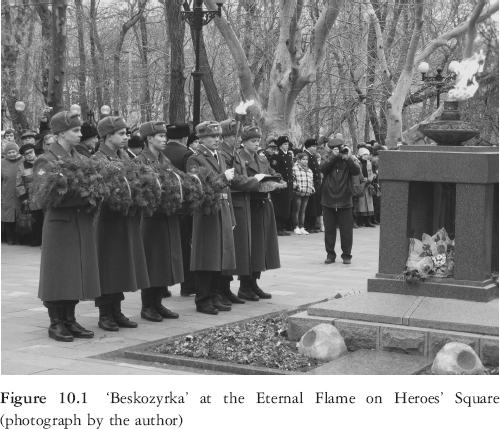
My observations indicate that the majority of Russians of all ages welcome the associated ceremonies and ritual reminiscent of the Brezhnev era, particularly Victory Day in May.40 However the notoriously cold weather in February provides a ready-made excuse for inhabitants of Novorossiisk to stay indoors and not attend Beskozyrka. Some respondents in their thirties and early forties search for further reasons for non-attendance, explaining how they would like to join in the procession, but would find it difficult to get there in the rush-hour traffic; moreover, they claim that their children are tired after school. Possibly with this in mind, the organisers introduced in 2010 a newly invented off-shoot of Beskozyrka, Svecha v okne, the ‘Candle in the Window’ movement, whereby those staying at home are encouraged to show their solidarity with the marchers outside. Those in the actual procession carry red glass lanterns containing a small candle. This is replicated in the homes of those not able or willing to join in the ceremony by placing a lit candle in the window as the procession passes by. Heavily promoted by the town council on posters and in newspaper advertisements, this modern idea is reminiscent of other ceremonies of remembrance worldwide. In Britain, for example, crowds holding candles gathered around local war memorials while lights were dimmed indoors on the centenary of the start of World War I. According to female respondents of all ages, this new supplementary invented tradition is particularly popular amongst women not wishing to venture outdoors, and involves far more people than ever before, even if they do not demonstrate the commitment of those taking part in the cold. Like the addendum of the St George ribbon to Victory Day, this is an innovation grafted onto an older, established tradition, having the effect of enriching, rejuvenating and refreshing the ritual, rendering it more attractive to the younger generation and their parents.
A new daytime Beskozyrka especially for children has been introduced, attracting a further audience of 4,700 young people,41 a cohort of citizens not able to deploy excuses when taken to the ceremony by their teachers, as their families respond to a complex mixture of social expectation and freedom to attend. Continuing the tradition of innovation ingrained in the Beskozyrka ritual, a further ceremony started in 2016, whereby schoolchildren launch white ballons containing small paper seagulls at the Malaia zemlia memorial. This ‘White Seagulls’ movement once again encourages the active participation of the youngest generation during this special day.42
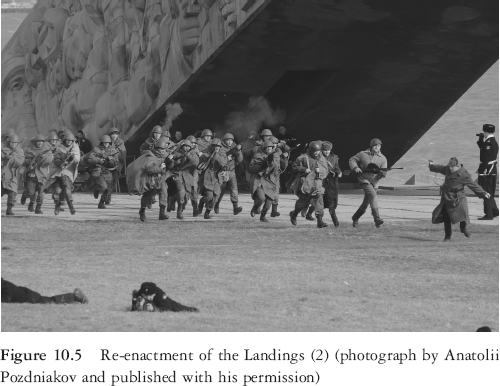
With their memorial duty dispatched, the children then watch a reconstruction of the landings at Malaia zemlia, repeated annually since 2011. Such historical events have also become very popular globally, ranging from the Battle of Hastings to civil war events in Britain and the United States. Napoleon’s defeat at the Battle of Waterloo is reconstructed annually in Belgium, just as, in Russia, the re-enactment of the turning point in the Napoleonic war at the Battle of Borodino attracts large crowds. War memory in twenty-first century Russia increasingly refers to less controversial ubiquitous heroism rather than to the more specific examples still being cited in the 1990s. Any potentially problematic issues, such as continuing this tradition from the Soviet Union to modern Russia, are overcome by an increasing simplification of the memory message to one of popular patriotism and the dismissal of side-issues that may threaten to disrupt its coherence. In contrast, there is considerable local geographical detail in the reconstructions of the 1943 landings, which bring to life the generalisms of the national war myth with some local historical accuracy.43
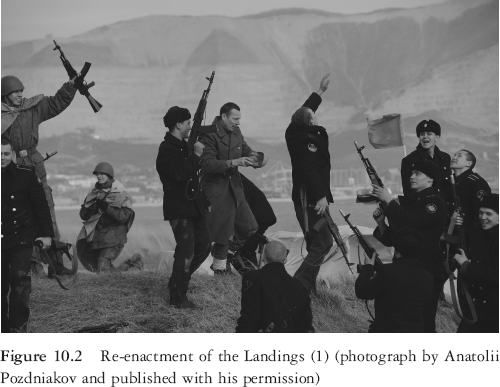
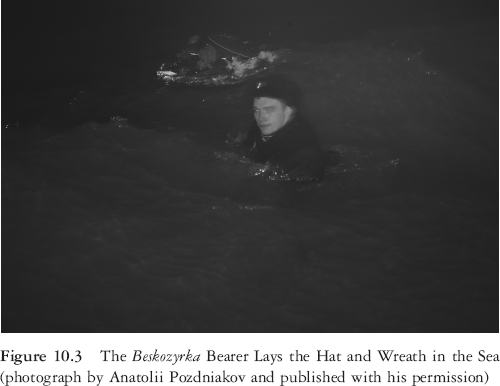
A re-enactment on the actual battle site can be a very powerful means of propagating a war myth, while still representing a relatively passive experience for the large audience. In contrast, the more intimate group in Iuzhnaia Ozereika witnessed a different spectacle in 2011. In a seemingly spontaneous gesture, the beskozyrka bearer, young marine Ivan Ognev, attracted gasps of admiration from spectators as he strode into the sea up to his shoulders to deposit the hat on the waves. An exchange of messages in an online forum established that he had gone into the water of his own accord, in a surge of empathy with the original landing troops, and with no orders from above, effectively bringing the myth to life.44 In the light of this personal tribute in braving the winter waves, it appears that the romanticism of the young founders of Beskozyrka lives on, at least in Iuzhnaia Ozereika, where there remains some scope on the fringe for the individual in organised remembrance today.
However, this originally spontaneous part of the ceremony has now been incorporated into the main ritual at Malaia zemlia, an indication perhaps of the increasingly centralised control of Beskozyrka, both administratively in the organisation by the town council, and physically in the ranks of Cossacks holding the spectators at bay. Such top-down intervention has prompted some negative comments in online discussions about over-organisation and the desecration of genuine memory for the sake of political utility.45
What started out as a series of sometimes minor innovations and refinements to the invented tradition of Beskozyrka has become a tradition of invented change in its own right. Even in 2012, more changes were still being promised by the press:
From year to year the movement [. . .] does not change, but on each occasion the programme acquires new memorial components. This year will be no exception.46
Despite the innovations, there is comfort in the continuity of symbolism in the Beskozyrka tradition. With candles, caps and ribbons, its interpretation and essence remain constant, although the consistency of symbolism permits only one interpretation of the past, in accord with the conventions of the war myth, albeit widely endorsed by the local population. My observations and interviews indicate that Beskozyrka still appeals to the same members of society: teachers, cadets and veterans, although the first actors would hardly recognise the scale of today’s operation and the veterans are becoming fewer. With the participation of schools, the interest of parents is guaranteed, with some young families new to Novorossiisk learning about Beskozyrka and coming to appreciate local history thanks to their children, as in the case of the original inventors.
In contrast, responsibility for the Beskozyrka ritual, founded by and traditionally associated with the young people of Novorossiisk, was taken over in 1999 by the regional youth committee in Krasnodar, this time involving a committee for youth rather than the younger generation themselves, who thereby appear to have lost their ownership of the ceremony. The following year, Beskozyrka became known as a pan-Russian operation, its name today emphasising its roots: The Pan-Russian Patriotic Youth Movement ‘Beskozyrka’.47 Despite the implicit geographical expansion, attendees are largely local, with the financial burden of the ceremony falling on the town of Novorossiisk, whose mayor now takes responsibility for its implementation, possibly reflecting some local rivalry over the ownership of memory between the hero city of Novorossiisk and the regional centre of Krasnodar. The 2011 advertising pamphlet, published by the region, confirms the continued emphasis on youth participation, although there is no mention of its young founders and their vision, indicating perhaps that the authorities are anxious to take all the credit.
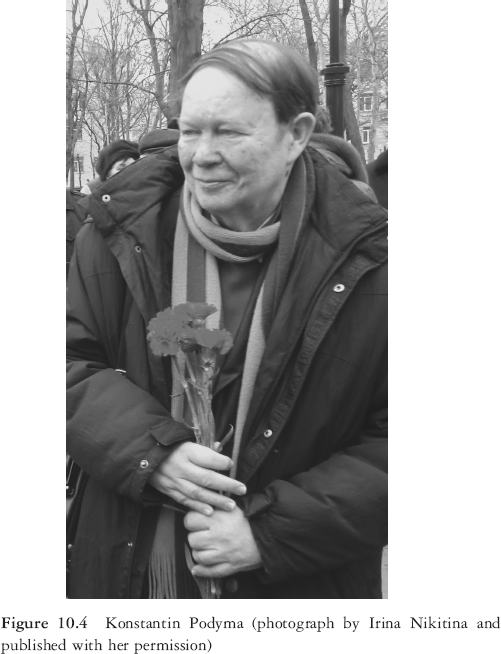
Despite this omission, Podyma, a prolific inventor of tradition both in Novorossiisk and Moscow, has numerous publications on Beskozyrka and other less well-known memorial rituals to his credit, including one to commemorate those who died on the first night of the war in June 1941.48 For over 40 years he consistently propagated the myth of Malaia zemlia, building up a legend around the ‘Shkhuna rovesnikov’, which, he claims, spread from Novorossiisk to other ‘outposts’ around the Soviet Union.49 At the same time he nurtured his own personality cult as its ‘romantic’ founder and only true guardian of memory.50 In Novorossiisk Podyma’s name has become just as recognised as those of the real heroes of Malaia zemlia. While children learn about the history of Kunikov and his landing troops, older interviewees are equally likely to speak about the propagation of memory through Podyma’s Beskozyrka ritual, which has also been assimilated into the local history of the town, albeit a generation younger than the war itself.
In the Russian Orthodox tradition, the exact site of burial is a vital focus for socially prescribed mourning.51 In the case of soldiers lost at sea, with no obvious monument or grave for the individual bereaved family to visit, the simple sailor’s cap floating on the waves provides the only focal point for tributes of flowers and the expression of emotion, much as the eternal flame for the Unknown Soldier provides a focus for memorial tribute in Moscow.
The original Beskozyrka ceremony also served to fill a ceremonial vacuum in the Soviet Union. Celebrations in February are not uncommon in other societies to alleviate the tedium and hardship of the long winter before the days lengthen and the signs of spring appear. In a blend of Christian and pagan tradition, many countries hold a carnival week in February before the onset of the rigours of Lent, although the traditional Russian carnival Maslenitsa was banned in Soviet times. Beskozyrka is neither joyous nor food-orientated, but does involve those elements of flame and liturgy more often associated with church ritual. Similarly, the sailor’s hat is borne in procession and laid on the waves in an act resembling an offering to the memory of the landing troops.
Reinforcing this interpretation, elderly Sonia throws sweets and biscuits into the sea behind the hat and the wreaths, as her own small sacrifice to the dead.
Secular commemoration and organised religion have much in common, with the sacralised war myth becoming almost a surrogate religion or faith system in Novorossiisk. Candles are very often lit in a Russian Orthodox church in an act of memory and are carried by President Putin in official services of remembrance. The quasireligious symbolism of the liturgy and ritual of Beskozyrka is evident in the symbols of light and fire, the imagery of sacrifice and martyrdom. According to journalist Evgenii Rozhanskii, each small flame in the ‘living sea’ of candles in the Beskozyrka procession represents ‘the soul of a dead soldier’. With implicit religious symbolism, the new Candle in the Window movement now effectively brings the sacred memorial ritual into the secular home, using the symbolism of the candle to shed light on memory. Russian families have traditionally placed a candle in the corner of a room to illuminate a holy icon, creating their own spiritual space for private worship. The placing of the candle on a windowsill, visible from the outside, breaches any remaining barriers between the collective and the private with respect to memory.52
Although few Soviet soldiers in the war were overt Christians, the Orthodox Church today is very close to the state, a situation accepted by veterans and encouraged by Putin, who ensures that priests pray for the war dead.53 The joint influence of State and Church should aid in principle both the maintenance of the war myth and the inculcation of conservative moral values. However, some of my male respondents did not feel the necessity for the presence of a priest at Beskozyrka, stressing the mixture of faiths and ethnicities of the original troops and viewing it as a purely secular occasion. Local priest Father Georgii Fedorenko considers his presence at Beskozyrka to be vital, though, claiming that 95 per cent of the population of Novorossiisk are Orthodox believers. He has been invited by the mayor to attend in an official capacity for several years, demonstrating the increasing importance of the Church in Russia both socially and politically. While wearing his own military medals, Father Georgii’s role remains largely symbolic, as he is not usually invited to speak, in contrast to his input on other memorial occasions, such as re-interments.54
There is no doubt that religion does play a part in remembrance today, but, according to my evidence, that part is largely in the personal sphere, for example when individuals pay their respects to the fallen by their gravesides on Den’ pamiati i skorby (the Day of Remembrance and Sorrow) on 22 June, the more solemn anniversary of the start of the war in the Soviet Union in 1941, when a priest is usually present. As John Bodnar found with remembrance of the Vietnam War, there is a marked difference in tone between private commemoration concentrating on the pain of loss, and the larger, official ceremonies which employ generalised expressions of martyrdom, sacred duty and patriotism.55
Issues of personal mourning may no longer be applicable so long after the war, but individuals must still make a choice whether or not to attend a traditional ritual, even if subject to group pressure. The evidence in Novorossiisk demonstrates a strong commitment by attendees to the Beskozyrka ceremony in the face of often daunting weather conditions which serve only to strengthen the bond between those remembering and those remembered. Most participants in the Beskozyrka tradition are not simply passive spectators, but are able to justify their presence, usually accepting some physical discomfort as an aid to their interpretation of the ritual. This may not always be true for those simply watching a reconstruction, but it remains the case for those making the longer journey to the beach at Iuzhnaia Ozereika outside Novorossiisk. Here, the genuinely involved younger participants are compared favourably with the original Shkhunatiki by Galina Krympokha, who is credited with keeping the ‘Shkhuna rovesnikov’ and its crew afloat over the long years since its inception: ‘There are no indifferent eyes there.’56
It is possible that the current wave of nostalgia for the Soviet Union plays a role in the popularity amongst older people of rituals of remembrance dating back to the Brezhnev era. In contrast, there is evidence that some young adults may have experienced enough of the Beskozyrka tradition following years of enforced participation as schoolchildren. However, the tradition is re-fuelled with fresh blood as eight newcomers to the area I interviewed seemed keen to attend the ceremony, while locals bring friends from further afield to experience it at first hand, attracted by the unique maritime connotations of the ritual.
It is clear that there remains a place today for traditional ritualistic ceremony in this modern, youth-oriented society, despite the fact that an established tradition may be regarded as a sign of conservatism in a society, as it simply maintains the status quo. In Novorossiisk the combination of the new state-sponsored war cult of the Putin era, with the influence of the more reactionary, provincial older generations, is sufficient to counteract the sometimes anti-traditional attitude of young people.
Although currently larger than ever, the numbers attending Beskozyrka remain substantially smaller than those celebrating Victory Day in Novorossiisk, mainly due to the different nature of the remembrance involved. As a celebration of national victory in 1945, Victory Day is less solemn than Beskozyrka, although a requiem for the dead is held early on Victory Day, before the start of the main celebrations. Citizens feel that Victory Day is a different type of event: national, happier and more celebratory, while Beskozyrka demands a more thoughtful approach to memory, which, according to some respondents, comes directly from the romantic soul of the young people of Novorossiisk.
The continuing sense of identification with Beskozyrka of the younger generation, with the gratitude and participation of many of their elders, maintains a sense of social cohesion that may easily have died out with other traditions during the 1990s. Furthermore, its original, specifically local, interpretation endures, despite and also thanks to a series of changes; these are usually regarded as elements of creative enrichment of the ceremony and more recently take their inspiration from commemorative norms worldwide rather than a small local youth club. Shils may regard originality as the enemy of tradition,57 but in Novorossiisk it has helped to avoid any dilution of meaning and has guaranteed the longstanding popularity of Beskozyrka, which is now at an all-time high, with no sign of ritual fatigue. Official council figures state that between 15,000 and 20,000 participants in 2011 remembered the heroes of 1943,58 while Deputy Mayor Maiorova suggested that a record 23,500 attended the ceremony in 2013. According to the official town website, a staggering 44,000 took part in 2017.59 The fact that nearly 20 per cent of the total population of the town is involved in some way is an indication of the growing popularity of the tradition. Although Beskozyrka remains a ceremony reinforcing local identity, Podyma claimed a decade ago that over 350,000 people had taken part in the ceremony since its inception and visitors from 270 other towns have taken part over the years.60 In 2011, for example, delegates were invited from other hero cities to take part in a series of events and a ritual on a much larger scale, while coverage on the national television news confirmed the status and identity of Novorossiisk nationwide.61 In recent years, however, the only visiting delegations to Novorossiisk have been from the regional capital, Krasnodar. The considerable local and national media hype serves to convince many younger respondents that Beskozyrka is famous worldwide, such that they express naive surprise that it remains unknown in Western Europe.
For today’s ritual, it is the town council which bears the brunt of, and takes the credit for, the organisation of Beskozyrka. This indicates a new uncompromising recognition of the significance of the ceremony on the part of the town. It is in this respect that responsibility for the propagation of memory has changed most significantly, with the original transmission of Beskozyrka by the younger generation now centralised and controlled by the local authorities, and the only remaining spark of individuality and spontaneity on the periphery now formally incorporated into the official mainstream narrative at Malaia zemlia. The mnemonic vicious circle may have been broken through the tradition of change, but Soviet society’s traditional values are increasingly being projected through ritual onto the younger Russian generation, subject today to domination and determination by the elite who now organise Beskozyrka, rather than the romantic young idealists of 1968.
Young people in Novorossiisk appear today to be less able or willing to use their own initiative about remembrance practices than in the Brezhnev era. What started as a rare example of a bottom-up ritual in the Soviet Union, albeit under the not insignificant influence of the Brezhnev-era war cult and probably the Komsomol leadership, has become more like the top-down type of invented tradition described by Hobsbawm, with its stress on the propagation of social values through the war myth. As Russia experiences a second war cult under Putin, the Soviet emphasis on patriotism and moral education of the young are once again in evidence, affording national and local conditions under which this unique remembrance ritual is thriving and where increasing empathy with the landing troops is demonstrated. It is notable also that, although started under Brezhnev, this ceremony has no connection with the former general secretary, focusing instead on the individuals who died, and thus serves to deflect attention from his memoirs. There may be a growing audience of schoolchildren to ensure its future propagation, but, nonetheless, the tradition would not last unless enjoying popular approval from the public as a whole. The proactive maintenance of this tradition with its regular re-invention helps to define the mnemonic identity of the hero city of Novorossiisk and ensures that the myth of Malaia zemlia remains at the heart of the local community.
This case shows that it is not sufficient to accept state domination without consideration of the local ‘community of memory’, which is perhaps more conscious of its own past than of national history.62 This type of social remembrance is potentially more meaningful to groups and individuals as it is designed and customised by the local community and implemented through ritual close to home. The Beskozyrka tradition does not seek to contest the national narrative, but represents a special subset of memorial behaviour which commemorates the myth of Malaia zemlia within the national war myth. It is evident that there does not have to be a binary opposition or power struggle between state and popular expressions of collective memory, as in the case of memory of the war in Vietnam.63 The Beskozyrka tradition is not at all conflictual, being accepted throughout the country as specific to Novorossiisk.
From the point of view of nationwide commemorative events, Novorossiisk is typical of contemporary Russian society. However, the ceremony here shows several idiosyncratic features, proving that remembrance was capable of taking on a distinctly local form, even under the centralised and authoritarian conditions prevalent in the Soviet Union. It is largely the unique Beskozyrka ceremony which distinguishes Novorossiisk from other hero cities of the former Soviet Union. Unlike the infamous Brezhnev connection, this special distinction is welcomed by the people of Novorossiisk, who still profess an admiration for the tradition of romanticism and spontaneity associated with war memory from below.
The Time and Tide of Memory
Confiding her personal thoughts during the remembrance ceremony of Beskozyrka, middle-aged Klavdiya remarks: ‘I think behind my eyes: I try to imagine it, from films and books, how awful it was: explosions, how they lived. It must have been very hard.’ This statement demonstrates that, even though today’s rituals of remembrance represent a highly organised communal experience, they nonetheless offer the opportunity for an individual, if silent, response. This is a good example of transtemporal empathy promoted by a successful memorial ritual, whereby each person’s imagination may be converted into a time machine capable of linking two distant moments in time by the act of memory.
The return to the past through anamnestic recall raises the question of the complex temporality of memory with respect to historical time -time which is often perceived as linear and unidirectional, but, where the annual rhythm of memorial anniversaries is concerned, may also be perceived as cyclical, leading the participant’s memory back to the original event on a regular basis. During the Beskoyrka reconstructions a reversal of time is apparent on the very same space where the landings took place, reducing the perceived relative time gap between past and present with a resultant increase in identification between present - day participants and the original troops. In this respect, Klavdiya’s testimony shows that ‘the past becomes something experienced, rather than understood or examined’.64
Monuments tend to preserve the past in the present in much the same way as ritualistic tradition, where cyclical temporal movement gives the impression of static time around the monumental focus of rituals. However, instead of time merely standing still, Mikhail Yampolsky argues persuasively for a special flow of time around a monument:
A monument creates around itself a kind of special temporal expanse in which time moves differently than in other places, a sort of mystical protective zone that surrounds the monument and is apparently connected with the experience of temporal metamorphosis.65
In the case of Novorossiisk, those taking part in the Beskozyrka ritual act as time-travellers, approaching the Malaia zemlia monument from the present, crossing the timeless space around it, to arrive in the past via the Brezhnev era as they reach the monument itself. In this way the monument in the shape of the prow of a motor launch, erected in 1982, seems transformed back into the original craft it represents, while the sculpted depictions of the original 1943 landing troops on its sides are transformed into the ranks of the modern soldiers reconstructing the landings. This blurring of time zones evident even today is reminiscent of the deployment of socialist realism in Soviet literature, which recycled heroic historical precedents as a fore-taste of the implied reality to come, thus merging present time with past and promised future.66 The static monument and the memory it channels may have outlived the heroes, but still transmit the timeless testimony of non-contestable patriotic heroism to be valued in the present and future and appreciated by all stake-holders in the Beskozyrka ritual.
According to memoirist Georgii Sokolov, the beskozyrka floating on the water is carried by the same waves as in 1943, themselves depicted as insensitive carriers of memory of those who lost their lives: ‘They will never return, no, these lads will never return to shore. Only the senseless waves beat on the shore, remembering the past . . . .’67 Thus the sea itself is deemed to be an agent in the apparent closing of the temporal gap between 1943 and today. Not only the waves recall the night, apparently. Mariya, a classmate of Konstantin Podyma, feels that nature as a whole sees the need to reproduce the conditions of 1943 in tribute to the troops. An aspect of the war myth expressed by respondents of all ages includes the legendary icy wind and stormy weather every year on the night of 3–4 February.68 Podyma himself stated on one of his last visits to Novorossiisk: ‘It is appointed by nature that it is always foul weather on 3 February in Novorossiisk, with wind, rain, and bitter cold which penetrates to the bones.’69 In a masterpiece of understatement, Novorossiiskii rabochii proclaims: ‘On this day, tradition is religiously observed not only by citizens, but also by the weather. A warm wind never blows on 3 February.’70 Women, particularly, refer to wearing layers of clothes for the ceremony, while some men endorse the sentiment expressed by a Novorossiiskii rabochii journalist: ‘The harsh weather reminded descendants of the conditions experienced by Kunikov’s troops landing in the icy waves of the Black Sea.’71 Podyma, describing in 1975 the first Beskozyrka seven years previously, emphasised the similarities: ‘The February night was freezing and windy. Exactly the same as many years ago . . . .’ Even the password on that night reflected the prevalent winter wind in Novorossiisk Nord ost (north-easterly).72 In 2012, myth became reality, as hardy citizens turned out in unprecedented temperatures:
There is never good weather on 3 February. Never! But this year the temperature plunged even below yesterday’s - 15oC, with wind too, a change from the usual more tolerable - 3oC.73
An annual, cyclical and quasi-biological ritualistic chronology promotes an illusion of timelessness and permanence, linking past and present time while offering both continuity and stability.74 It is as if traditional time stands still, while historical time marches on regardless. However, thanks to the continuing tradition of innovations associated with the Beskozyrka ritual, serving to give the impression of a renewed ceremony every year, the danger of stagnation associated with circular ritualistic time is not so marked in Novorossiisk.
Over the years since the war, the addenda to the myth of Malaia zemlia, with their own ritualistic chronology, have been incorporated in tandem with the original, producing a uniquely complex local memorial time running alongside the national. The annual cycle of anniversaries is quite demanding: the town library and museum keep a special calendar so that nobody and nothing is forgotten.75 Not only specifically war - related anniversaries have an impact on people’s consciousness - respondents also mention other significant maritime dates, including Morskoi uzel (the Sailor’s Knot) and Den’ Flota (Navy Day).
The inauguration of wartime monuments hinged on the most well-known anniversaries, many of them having been completed in a significant year after the war. Similarly, books dealing with local history or traditions tend to be published in key years. The Beskozyrka tradition, which was started on the twenty-fifth anniversary of the landings, has its own anniversary, too. One recent book, for instance, links the thirty-fifth anniversary of the landings with the tenth anniversary of Beskozyrka itself, giving almost equal importance to both, so indicating that the mythical time of ritualistic tradition has virtually converged with linear historical time.76 A newspaper article in 2007 completely misunderstands the dates, though, confusing the commemoration with the actual historical event, and stating that 2007 would see the thirty-ninth anniversary of the landings, rather than the thirty-ninth anniversary of Beskozyrka.77 It is tempting to infer that the journalist was a relatively young person, for whom the fixed temporal horizon of 1968 seemed just as far away as 1943, such that real time and mythical time have actually converged. Certainly, it provides further evidence that, for some at least, the act of commemoration has become more significant than the distant event it commemorates, while also suggesting that memory of the Malaia zemlia campaign in Novorossiisk is indeed incomplete without the Beskozyrka tradition.
Jan Assmann considers memorial rituals themselves to be suspended from the onward movement of linear time, forming ‘islands of time’, or ‘memorial spaces’, rather like the Malaia zemlia monument standing in its own protective space and time. Assmann’s reading is supported by Eviatar Zerubavel’s observation that what is historically worthy of remembrance appears amplified in time with respect to the mundane, suggesting that time appears to slow down at key points in the calendar. From a similar perspective, Christine Boyer visualises days of remembrance as ‘blank’ spaces in the calendar.78 My research indicates that time is experienced differently by locals at Beskozyrka and on Victory Day. The latter is always a holiday from work, loved by all and celebrated by families together, both a ‘blank’ and a red-letter day. On the other hand, Beskozyrka breaks the established socio-temporal order, eating into free time on a long February evening, when many families would prefer to be at home. They would much rather be strolling the streets on 9 May than 3 February, suggesting that Beskozyrka does not have the same impact as an ‘island’ on the memorial calendar as Victory Day. Young Maksim even admitted that he had to be reminded at the last minute that Beskozyrka was happening, which would never be the case with Victory Day. Since 2010, even the private time of those not taking part in the procession outside has been invaded by ritualistic time thanks to the Candle in the Window movement, which also demands extra memorial space as the Beskozyrka ritual expands into people’s homes.
There is no doubting the spatial and temporal expansion of Beskozyrka. What started out as a small-scale evening event now takes up the whole of the day and evening on 3 February, and most of the previous day too, as increasing numbers of delegates from other towns are invited to take part in an ever-longer programme of events in a growing statement of local identity. Furthermore, schools devote the whole month of February to patriotism, the new top topic of the Russian curriculum, almost seamlessly linking history of the landings on 3 February with Defender of the Fatherland Day (Den’ zashchitnika Otechestva) on 23 February. Similarly, the colonisation of time by wartime memorial dates impinges on other existing anniversaries in Novorossiisk. The anniversary of the 1943 liberation falls on 16 September, just days later than the anniversary of the town’s foundation on 12 September (1838). A joint poster advertises a full week of celebrations and processions, merging the original foundation of the town with its postwar re-foundation thanks to the liberation. Here, the more recent memory predominates, with the St George ribbon and other military symbolism covering all advertising material for both anniversaries.
It is clear that mythical time seems to be measured and perceived differently from historical time. But I have shown that commemorative time, reinforced by political will, seems to have the power to expand flexibly, to colonise adjacent days and even weeks, while occasionally dominating historical time. This is a key factor in the establishment of cross-generational empathy and identity so evident at the Beskozyrka ceremony. It is probable that, with the death of the last veterans, time may eventually run in a more linear fashion, when historical rather than mythical time rules memory of the Great Patriotic War and Malaia zemlia finally becomes distant local history in Novorossiisk.