
CHAPTER 11
Мы были большими, как время.
Мы были живыми, как время.
Теперь —
мы в легендах прославленных дней.
Теперь —
мы в поэмах и прозе.
Теперь —
мы в граните и бронзе
Теперь —
мы в безмолвье могильных камней.1
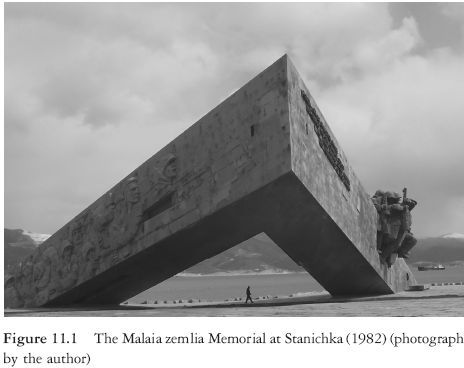
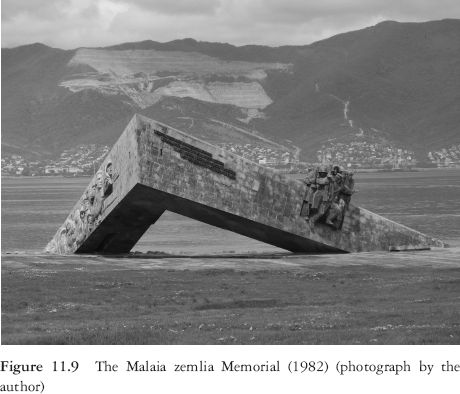
On my very first day as a visitor to Novorossiisk in 1999 I was taken to view the most iconic and powerful of monuments - the Malaia zemlia memorial complex at Stanichka. Here, at the site where thousands of Soviet, Russian and foreign tourists have been introduced to the war myth over the years, I listened to the simplified story of the seven-month campaign and first became aware of the war in Novorossiisk.
As I stood in the shadow of the gigantic monument, my feet were on Malaia zemlia, and yet Malaia zemlia itself, the site of the protracted battle, does not appear on any maps. In his memoirs Brezhnev famously defined this small area as an abstract concept rather than a geographical entity:
In a geographical sense, Malaia zemlia does not exist. If you want to understand it further, you should clearly imagine this rocky area of dry land right up against the water. It measured six kilometres along the front line with a depth of four and a half kilometres in all.2
The mythical identity of Novorossiisk is linked to a specific space around the area of Stanichka to the south of the town centre, where the Malaia zemlia memorial complex now stands. But Brezhnev’s Malaia zemlia also extended further south and west to Myskhako, a village just outside the town, and even further inland to the forested slopes of Mount Koldun. The modern town of Novorossiisk has developed around this geographically limited memorial site, its public space a dynamic testament to the priorities of the community and a reflection of the collective will to promote and maintain respect for the dead.
This chapter examines the role of monuments in and around Novorossiisk in creating and sustaining the war myth, while honouring the dead both individually and collectively. In it I analyse dense layers of accumulated memories through their spatial inter-relationships to shed light on the changing priorities of both state and town over the years since the war, as successive generations have projected their own vision of the memorial role of urban space. In the twenty-first century this strong geographical identity is easier to preserve than living memory. With natural lapses of memory and the death of war veterans, each successive generation becomes further removed temporally, if not spatially, from the events of 1943. As personal memory gives way to social commemoration around the main war memorials, monumental remembrance has become more important to the town than oral testimony or memoirs.
The dissipation of direct memory with the passage of time indeed presents a challenge to remembrance. In this respect, memory behaves in a similar fashion to the thermodynamic concept of entropy. Entropy may be described as the probability of a closed system of existing in a particular state, or simply its degree of disorder.3 Highly organised solids possess a low entropy, while more randomly organised fluids are higher in entropy. Entropy increases naturally with time, as organisation of a system inevitably decreases, unless energy is expended in counteracting the resultant disorder.4 I shall invoke the concept of ‘societal entropy’ as a useful tool for analysing the effects of the relentless flow of physical time since the war in Novorossiisk. Without man-made intervention, the passage of time and natural increase in entropy would lead eventually to the complete atomisation of memory, resulting in collective forgetting. When external agencies intervene in the natural process, however, time can appear to stand still, and even go into reverse, as order is re-imposed on the natural process of decay. This process of reorganisation and entropy decrease demands the input of considerable social energy: from the state in the form of a dominant war cult; from a community with the collective will to retain memory of the past through ritualistic and monumental remembrance; and even from exceptionally motivated individuals. I shall show that considerable energy in the form of finance and planning is expended by the local community in maintaining and even enriching its ritualistic and monumental tradition. Most local war memorials are maintained rather than being allowed to fall into disrepair, demonstrating that war memory in Novorossiisk exhibits an unnaturally low entropy status, a reflection of the strong social desire to combat the effects of naturally increasing entropy in a concerted undertaking not to forget the war dead.
In the first months after the end of the war, Novorossiisk was named by the Council of Ministers as one of the 15 Russian cities structurally most badly affected by the conflict and therefore given priority for rebuilding.5 During the invasion in 1942 and the liberation of the port in September 1943, 96.5 per cent of its buildings had been flattened and its infrastructure totally destroyed by both German and Soviet bombardment.6 As was the case with many key towns in northern France and Germany, complete reconstruction was necessary. The postwar visionaries established a creative committee to come up with a regeneration plan: architect Boris Iofan, well respected for his work in Moscow in the 1930s, was appointed to lead this proposed drive to resurrect the town from the rubble. This was the first step in the construction of order out of the high-entropy chaos of war, as Iofan took advantage of the total destruction to design a new town along Haussmannian lines. Concentrating on the living rather than the dead, he drew up plans for new single-storeyed houses linked by a system of roads 100 metres wide radiating out from what remained of Ulitsa Sovetov, the town’s main street before the occupation. Iofan proposed a new central square close to the shore in the southern part of the town, where the local council, port authorities, central post office, museum and library would be sited, alongside a theatre for 1,000 people. This new, functional centre would be complemented by another open space even closer to the sea, which would be semicircular in shape in order to house a huge commemorative panorama depicting the liberation of the town.7
This postwar vision included gardens, parks and sports centres. Iofan also considered commercial transport, linking the train and sea stations. Everything was carefully planned to take into consideration the topography of the town: details were incorporated such as the judicious planting of trees to protect the centre from the vicious northeasterly winds from the mountains. However, with some tension between the abstract plan and postwar reality, this grand design never came to fruition – there was simply not enough money in the state budget to support such an ambitious project, with the demands for regeneration across the country and the push to establish control over eastern Europe. In the end, all that could be afforded was a central avenue around what is now known as Pushkin Square, where citizens could stroll on high days and holidays. Large-scale housing developments, hospitals, parks and roads for these citizens had to wait for a few years, but nonetheless most of the major work had been completed by 1960. By then 300,000 trees and bushes had been planted around the new avenues and parks, where the growing population went to relax as the pressures of postwar life decreased.8
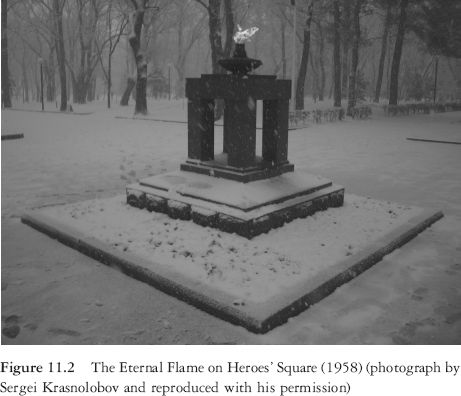
However, residents who had gradually returned to what was left of their town, supplemented by those veterans of the 18th Army who wished to remain in the area, were adamant that at least one central space was too sacred to delay even for one year: a proper tomb for the heroes of the Malaia zemlia campaign was deemed a priority.9 The remains of Major Kunikov and the others who had earned the title ‘Hero of the Soviet Union’ were reinterred in 1946 close to the shore near what had been the town centre, on what would become known as Ploshchad’ Geroev (Heroes’ Square).10 Over the years Heroes’ Square has been gradually developed to become the centre of remembrance in Novorossiisk. In 1958 the town became only the third in the Soviet Union to have an eternal flame, following Leningrad and Sevastopol’, with the latter acting as the source of the flame lit next to the heroes’ grave in Novorossiisk, thereby linking the two maritime towns. The eternal flames in Moscow and Stalingrad were not introduced until 1967, considerably later than in Novorossiisk.
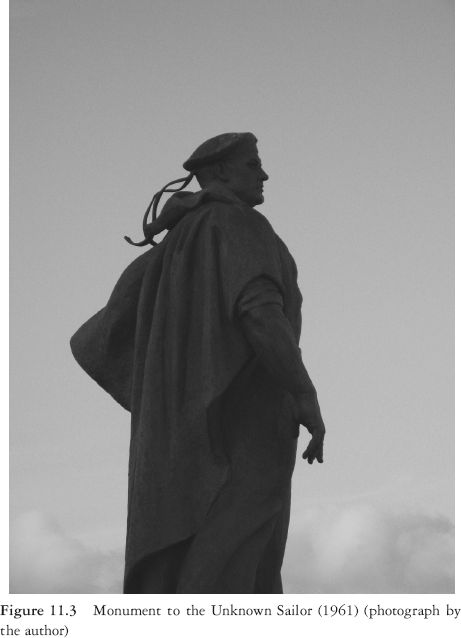
During the Khrushchev years, a few more monuments started to appear on the urban landscape. Testifying to the maritime nature of the battle, a striking memorial to the Unknown Sailor was erected on the promenade in 1961, the ribbons of his beskozyrka flowing prominently behind his head. A further monument to all the troops who fell during the seven-month campaign appeared in Myskhako in 1962.
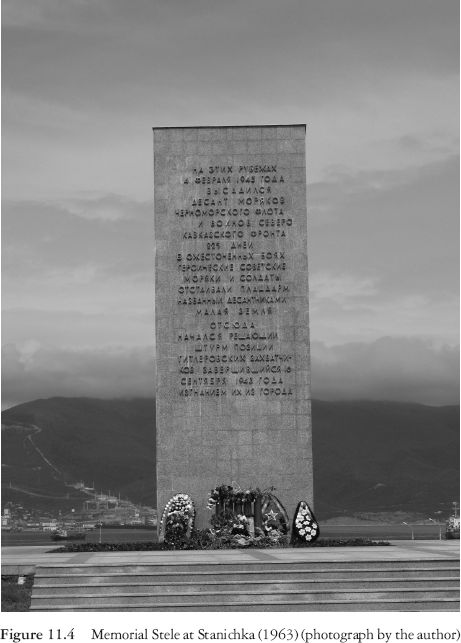
However, to local outrage, the Krasnodar regional authorities refused a request from the people of Novorossiisk for a more substantial monument on the actual site of the landings.11 A further demand from key veterans of Novorossiisk was sent directly to Brezhnev himself, as a veteran of the action on Malaia zemlia, leading to the erection in 1963 of a commemorative concrete stele at Stanichka, on the twentieth anniversary of the landings. Etched on its sides was a brief history of the campaign with the names of all those troops involved in the battle who were made Heroes of the Soviet Union. For years, this stele stood alone on the shore, standing guard over what had become the sacred site of the landings. The beach and the ground behind it were left untouched, with the softened contours of the trenches and dugouts a moving testament to the battle.
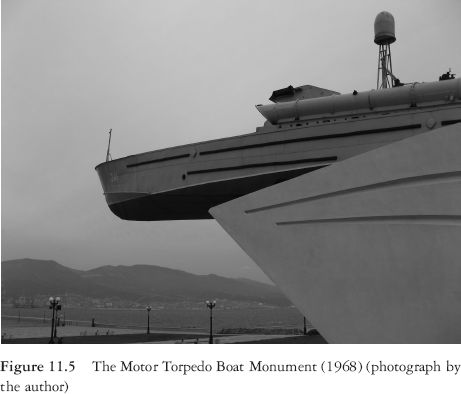
The mythical identity of the hero city of Novorossiisk was largely established during the Brezhnev-era war cult, when many more monuments were erected and new streets named. As a sign of this state influence, a concrete motor torpedo boat appeared in 1968 on the shoreline for the twenty-fifth anniversary of the landings, representing the fleet of small craft that had transported the marine infantry troops to the shore in the wintry early hours of 4 February 1943.
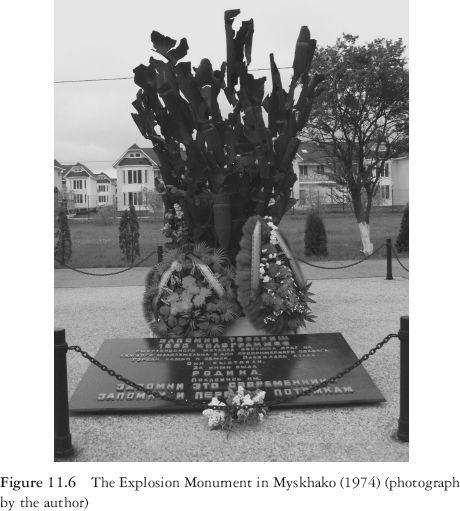
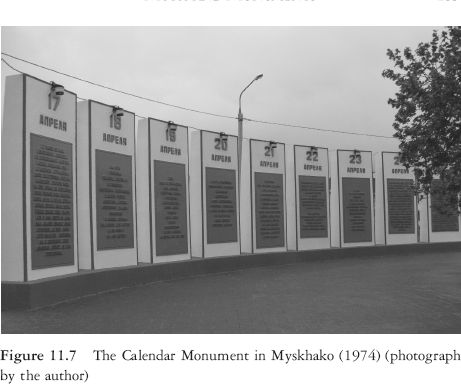
A further cluster of monuments was erected in Myskhako when Brezhnev visited Novorossiisk in 1974. The Explosion sculpture represents the mythical 1.2 tonnes of enemy metal that rained down on each of the Soviet troops on Malaia zemlia. This sculpture vividly depicts the highentropy chaos of battle, its shards of metal fused together randomly in a static representation of a dangerously turbulent situation, where death is just around the corner. In contrast to the Explosion monument, most of the main memorials are sculpted from concrete in the style favoured by the state, socialist realism, where the subjects are usually young, muscular, square-jawed ethnic Russians. This unusual sculpture stands next to a map of the battle lines and the Calendar monument, where large steles represent the consecutive days of the fiercest fighting in April 1943.
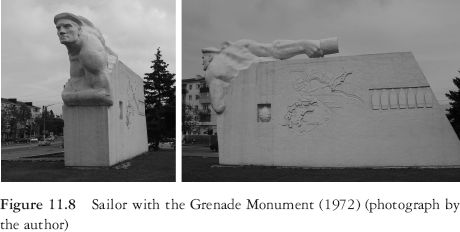
The accumulation of mnemonic symbolism in the urban space during the Brezhnev era facilitated the transmission of the agreed narrative of Malaia zemlia to the younger generation, especially as the uniquely local significance of the visual narrative was evident. As the population of Novorossiisk grew in the 1960s and 1970s, many new streets were named in memory of the fallen. New blocks of flats were built in the area of Stanichka, re-named after Major Kunikov, the leader of the landing troops. Similarly, the long Ulitsa Geroev desantnikov (Landing Troop Heroes Street) is a constant reminder of all the heroes, while other streets are named after Sniper Rubakho, Viktor Chalenko, Lieutenant Schmidt and Admiral Sipiagin. One construction, the Sailor with the Grenade monument, depicts the Malozemelets Viktor Kaida, the memoirist, immediately recognisable to many in Novorossiisk as he settled here after the war.
Erected in 1972, the Sailor with the Grenade monument marks the wartime boundary of Malaia zemlia and occupied Novorossiisk. Inscribed on the side of this monument is an outline map showing the front lines on either side of the occupied town. It is complemented by a second, larger monument on the other side of the bay, representing the front line to the east of Novorossiisk. The latter is one of another specially designed group of monuments erected as a result of the state’s growing recognition of the political utility of war memorials. Large monuments formed a significant aspect of state ideology during the war cult of the Brezhnev era. Along with an avalanche of war memoirs and an escalation of the scale of annual Victory Day celebrations, state-sponsored remembrance of the war became a politically unifying feature of late socialism. The erection of monuments was incorporated into the state ‘Plan for the Construction of Monuments with Federal Significance between 1967 and 1970’.12 In response to this countrywide initiative, the Novorossiisk local authorities recommended a project which would finally lead to the construction of a proper memorial complex at Stanichka.
Not content with just one monument, they requested three, to be arranged in an equilateral triangle around the Tsemes Bay. This project was both ideologically and financially extravagant, linking the maritime history of the town from World War I to World War II. When eventually completed, this state-funded initiative resulted in an harmonious composition set around the bay, with each monument situated five kilometres from the others. The first component of the trilogy was planned to stand outside the town to the east, on a cliff high over the bay. This monument commemorates the deliberate scuttling of the Black Sea Fleet in 1918 on the orders of Lenin, to prevent the ships falling into German hands following the Treaty of Brest-Litovsk. Moving in an anti-clockwise direction, the second monument was the Defence Line arch, which was completed in 1978 to complement the Sailor with the Grenade across the bay, marking the opposite front lines. The third and largest monument would be the long-anticipated gigantic Malaia zemlia monument on the beach at Stanichka.
Architect Vladimir Tsigal’ worked on this monument for years. News of the grandiose project even reached London via the Moscow correspondent of The Times.
The Soviet authorities have ordered the construction of a massive monument at the site of a once little-known Second World War battle in which President Brezhnev took part.
The monument will be a vast panoramic depiction of the engagement at Malaya Zemlya, near Novorossiysk on the northeast coast of the Black Sea, where Soviet forces prevented German landings in 1943, an official bulletin said. The decree did not mention Mr Brezhnev, then a political commissar with the rank of colonel, but it is thought almost certain that he will get a prominent place in the panorama.13
The Times was correct. During the years between the planning and fulfilment of the project, Brezhnev’s memoirs had been published, and the decision was taken to incorporate some of his quotations on the side of the new monument. The wait was embarrassing for both the government and the town, but finally the monument was officially inaugurated in September 1982, on the 39th anniversary of the liberation of Novorossiisk in 1943. The delays were critical: by then Brezhnev was not able to attend due to ill health, and he died two months later, never having seen this final testament to his wartime service and indeed his entire cult of personality.
The Brezhnev-era war cult had, in its twilight years, seen a spate of what some scholars deem to be unnecessarily large war memorials across the Soviet Union, visible symbols of the power of the state. Nina Tumarkin criticises the ‘vulgarity and gigantism’ of memorial complexes, while Scott Palmer refers to their ‘pharaonic excess’. Even Soviet citizens themselves dared to criticise these edifices. Former war correspondent and famous author Konstantin Simonov saw the huge monument at Stalingrad as tasteless: ‘An authentic heroic monument should always be as modest as the heroes themselves.’14
However, the reception in Novorossiisk was more favourable, as the new memorial complex rapidly became a potent symbol of the hero city. The Malaia zemlia monument, towering over the shore-line at 22 metres high, cements the sense of place. It represents a stylistic motor launch, which replicates in concrete the abstract triangular shape across the bay: in fact, this monument is affectionately known in Novorossiisk as the nos korablia (ship’s prow). On the external walls, groups of sculpted figures depict the landing troops storming the beach from their craft. Inside the monument visitors mount a steep staircase towards the pinnacle. Here, a memory capsule containing the names of all the dead Soviet troops of Malaia zemlia is located inside an artificial red ‘beating’ heart, the apex of the remembrance process in Novorossiisk. Along the sides of the ascending and descending staircases are bas-reliefs of the heroes of the Soviet Union involved in the battle, including both Major Kunikov and Colonel Brezhnev. Both internal and external walls of the monument are studded with quotations from Brezhnev’s memoirs, sealing in concrete his links with the town of Novorossiisk.
The state is responsible for the monument’s upkeep, while local authority architects are responsible for the area around it. In order to preserve the Malalia zemlia memorial in its own space-time zone, the conservation area around it has been left totally uncultivated, the ground still retaining the lines of the trenches and dugouts established by the landing troops in the first days of the campaign.15 The whole area was curtained off from nearby buildings by a line of 225 poplars, representing the number of days the land was defended. Time may have stood still in the protected area, but it moved rather too quickly on the perimeter. The expected lifespan of the trees was curtailed by the adverse climate in a triumph of entropic decay over man-made order. Likened by Novorossiiskii rabochii to the fallen landing troops, the dead trees were replaced by young ash trees in 2010, prized for their robustness in extremes of weather, and sourced, ironically, from Berlin.16 Continuing the simile, the head of the council’s environmental department observed that the landing troops also wore green, and that the red autumnal leaves of the ashes recall the spilled blood of the brave troops. Today, the thin ranks of young trees stand guard over the sacred site of Malaia zemlia, screening it from the quotidian, thanks to the new generation of local councillors who are actively endorsing the renewed national cult of war memory under President Putin.
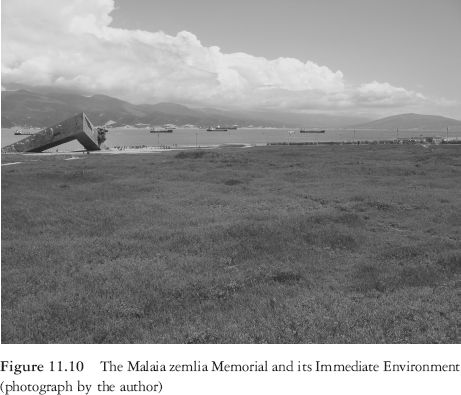
The spilled blood of the landing troops is a popular ingredient of the war myth. I have also observed the widespread assertion that the poppies flourishing on the rough ground of the Malaia zemlia memorial complex are symbolic of this blood. This may be compared with the symbolism attached to red poppies as vehicles of memory in Great Britain. Ten respondents confirmed that Malaia zemlia is regarded as sacred ground precisely because the land is soaked with blood: anointed through the spilling of heroes’ blood, Malaia zemlia has thus acquired the status of holy land. Religious superstition is also evident in flowers placed on one large stone near the monument. Reminiscent of a shrine, this stone is deemed by young manager Anton to be the site of the miraculous oozing of the blood of heroes from the earth on which they fell, as if in recognition of their martyrdom.
Russian tradition holds the earth of graves as sacred, with implications for the sanctity of war memory in Novorossiisk through the soil.17 This is not unique to Russia, though: tourists on D-Day battlefield tours around the Normandy beaches or on the World War I trail from Ypres to the Somme also refer to ‘sacred ground’ when encountering war memorials and cemeteries testifying compellingly to mass sacrifice.18 In the opinion of Caroline Winter, ‘the Western Front has become a sacred landscape of remembrance, and its battlefields and memorials are now regarded as the equivalent of shrines and holy sites’.19 A geographically specific sanctity was also recognised by Georgii Sokolov: ‘Malaia zemlia [. . .] is a sacred place for Black Sea troops’, with even a sniper’s rifle acquiring religious significance for a new generation of soldiers.20 This sentiment was embedded in the war myth upon the award of hero city status to the town in 1973: ‘You live on sacred earth, where the blood of defenders of the Fatherland has poured onto every stone’, which was captured in the popular song ‘Malaia zemlia, sviashchennaia zemlia‘ (‘Malaia zemlia, sacred land’) of the same year.21 Even now, many citizens of Novorossiisk avoid swimming in the sea near the Malaia zemlia monument, as even the sea bed is deemed by some to be sacred ground.22
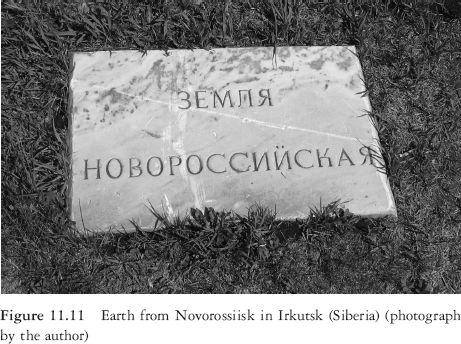
Remembrance of the war in Novorossiisk is guaranteed across the former Soviet Union not only by Brezhnev’s memoirs, but also through its ‘sacred’ earth. Soil from all the hero cities is found at key war memorials in major cities, spreading the concept of sacrificial glory to places far beyond their own immediate region. Soil from Novorossiisk was geographically dispersed to be honoured and respected across the country, and can be found today around monuments in city centres ranging from Moscow’s Aleksandrovskii Garden to Irkutsk in Siberia.
However, this perceived sacred ground is under the bizarre threat of development in the form of a cathedral complex to be built on Malaia zemlia. Grandiose plans for the project indicate a tall main church with further smaller buildings around it. The concept of a sacred site apparently varies from person to person, as objections to the construction around the memorial complex abound. Some residents are concerned about the destruction of the land for ecological reasons; others do not wish to see the Malaia zemlia monument diminished by this planned intrusion into its sacred space.23
However sacred it may remain to some residents, the functional urban landscape must tread a fine balance between the need to remember and the need to forget.24 Paul Connerton identifies an inherent failure of war memorials, contending that, once erected, their presence assists communities to discontinue their duty of remembrance. In Novorossiisk, the 200 war monuments and 42 streets named after war heroes present a real risk to memory inflation and consequent devaluation, with the possibility that they may gradually fade into the expanding townscape and be taken for granted.25 Although the powerful Malaia zemlia complex is deliberately kept apart from the encroachment of new buildings, the spatial impact of the Valley of Death complex in Myskhako has been diminished by the intrusive presence of an avenue of large, dark trees and a development of new houses. The Calendar monument still dominates the small area, however, to the detriment of the Explosion monument, which appears much diminished due to the urbanisation of the once-rural area.
With the Brezhnev memorial statue a notable exception, monuments, once placed in their permanent position, normally remain there as a testament to the war myth, even if human memory starts to fail. However, the natural increase in entropy with time also predicts the gradual decay of stone and concrete. Shelley’s poem ‘Ozymandias’ (1817) expresses this inexorable process, depicting a monument subsumed by entropy, whose decaying remains serve only to emphasise the dominance of time over the memory of a once-powerful ruler.26 In contrast, monuments that are well maintained can demonstrate both the desire of a community to retain memory and, transcending time, the importance to the community of the event or people commemorated.
Novorossiisk is growing around its Soviet-era monuments and the town council has had to make key decisions about their role in the modern landscape. Towns often rely on old buildings as an everyday reminder of their history. This is not the case in Novorossiisk, however, where most prewar buildings were completely destroyed during the war. In the period of postwar reconstruction it was decided by the state to retain unaltered the shelled former palace of culture as a monument to the damage inflicted on the town rather like Dom Pavlova in Stalingrad or the old Coventry Cathedral in England.27 Also under the protection of the Ministry of Culture, on the other side of the main road stands the rusty skeleton of a railway coach bearing the marks of hundreds of bullets. These two monuments have been left deliberately unreconstructed, powerful symbols of the destructive chaos of war.
There was a danger in the lean decade of the 1990s of many other monuments falling into permanent disrepair, but this is certainly not the case in today’s Novorossiisk, where most show signs not of decay, but rather of well-planned restoration. Although the state controls the maintenance of some major Brezhnev-era memorials, the upkeep of most is devolved to the regional department for the preservation of monuments, and thence to local agencies. Although the state’s Ministry of Culture provided 1.4 million roubles in 2011 for the upkeep of monuments in Novorossiisk, this was insufficient. To plug the gap, the mayor holds public competitions to renovate monuments, while encouraging local firms and schools to sponsor the maintenance of their chosen memorial.28 For example, although originally under state control, and then taken over by the region, the upkeep of the concrete motor torpedo boat erected in 1968 and standing astride the promenade is in the de facto hands of a well-known Novorossiisk company. More parochially, in Myskhako, the maintenance budget is stretched by the local authority’s encouragement of volunteers to spend weekends in April sprucing up the monuments in this vestige of communism, the subbotnik day, dedicated to the refreshing of the war myth in time for the Victory Day celebrations in early May.
Thanks largely to former Mayor Siniagovskii, the memorial landscape of Novorossiisk is not entirely static, even 70 years after the war. A new generation of statues and memorials for the town centre is appearing and yet more are under public discussion, mainly due to the development of the new promenade, Siniagovskii’s pet project. A new monument has recently been erected on the promenade to commemorate the exodus of the White Army from Novorossiisk towards the end of the civil war in 1920, while consultation is taking place about the popular demand from older residents for the erection of a monument to the khamsa, the small Black Sea fish, which, according to the local war myth, kept the partisan population from starvation during the World War II occupation.
Monuments demonstrate very low entropy both temporally and materially, while the present is fluid and ever-changing, always fading into the more entropic future. Unlike rituals, which may and do change, monuments and their associated space and time are generally more resistant to change. A monument’s temporal stagnation neglects, however, the ravages that may be wrought by time itself, with its increase in entropy effecting a degradation as in the case of Ozymandias, which could well serve to diminish and alter its significance in the future. Moreover, a monument may reign in its own time-zone and space, but time moves on around it, during which its surroundings may change, potentially undermining the monument’s meaning.
Like the new Brezhnev statue, most town-centre war memorials remain popular with residents. When one of the first simple memorials high on the slopes of Mount Koldun started to disintegrate, artist Aleksandr Kamper designed a new monument, erected with his own resources in 2008. His successful attempt to take on the ravages of time and increasing entropy met with defeat, however, when the department for the preservation of monuments became involved and ordered him to remove the new monument on the grounds that it was not in keeping with the overall ‘plan’. Kamper retaliated by accusing the local authorities of being guilty of ‘designer’ rather than ‘genuine’ memory, despite the fact that he had replaced the original modest obelisk with a large, red, Soviet-style metal star, possibly not to everyone’s taste. After a second battle of Malaia zemlia, on this occasion a battle for the ownership of collective remembrance, during which Kamper won the support of the local press and its readers, his monument was eventually officially recognised in 2009.29 Kamper’s supporters believe that the officials should be grateful for his help, deeming them reluctant to spend limited resources on the proper maintenance of outlying memorials, while concentrating largely on the higher profile, central monuments. In this case, overwhelming popular support from below succeeded in overcoming the top-down organisation of monuments, which normally carries more weight than any bottom-up individualisation of memory.
These undercurrents on the periphery are not obvious to the relatively few Western tourists visiting Novorossiisk, who are introduced to a town that seems to some to be ‘stuck in a Soviet time warp’.30 Disembarking from their cruise ships for a few hours, visitors are whisked around the Valley of Death and the Malaia zemlia memorial complex.31 Even ordinary Russians far from Novorossiisk see life in the hero city portrayed as revolving around the iconic Malaia zemlia monument in key scenes from the recent popular film Marafon (The Marathon),32 while 80,000 tourists are estimated to visit the monument every summer.33
Over the years, the town of Novorossiisk has created its own monumental culture, which serves to define this unique urban site of memory, and has been partly responsible for creating the mythical identity of the town. It seems that the tradition of monumental memory in evidence in today’s Novorossiisk has indeed overtaken the folkloric type of propagation of the war myth by ‘folk-tale, song and proverb’ claimed by war correspondents Svetov and Miliavskii to be more enduring than physical monuments.34 Once carefully filtered, this is an eminently potent and marketable myth, both to outsiders and residents, with its unambiguous heroes and successful outcome. Thanks to the town’s use of space and symbolic spatiality, the grand designs in the centre dominate Novorossiisk’s mnemonic identity. It is fair to say that the town is doing (almost) everything in its power to maintain monumental memory of Malaia zemlia. Bottom-up individualisation exists on the periphery, but is discouraged by top-down bureaucracy. Veterans may be succumbing to the effects of ageing, but monuments, in this respect, are more permanent than living memory, thanks to careful preservation which reverses the natural increase of entropy with time. If this maintenance should be halted, when there are perhaps no longer the political will or financial resources available, then chaos would set in and monuments and memory gradually crumble.